




Abstract
European countries are undergoing significant changes in employment schedules, including increases in weekend work with potential consequences for families. We focus on one arena of family life—the couple’s division of housework—to investigate implications of weekend work for this aspect of gender equality. Furthermore, we situate these divisions within the cross-national context of wives’ weekend work to determine whether nonstandard employment has more general implications for domestic practices. Using 2004 European Social Survey data for married respondents in 25 nations, we test original hypotheses which address time availability arguments, the qualitative differences in weekend and weekday time, and the gendered nature of domestic roles. We find husbands and wives accommodate to weekend employment, but women benefit less from these domestic adaptations. Regardless of their personal employment arrangements, husbands do relatively more housework and wives less in countries where wives’ weekend work is more prevalent.
European countries are witnessing a regime change in the organization of time. Shop hours continue to be regulated, and maximum employment hours are still capped, but increasingly, consumption and production beyond the home are occurring outside of standard weekday hours. In the workplace, the concept of nonstandard work schedules reflects the development of irregular hours, evening employment, night shifts, rotating schedules, and weekend work (Kümmerling & Lehndorff, 2007; Messenger, 2011; Presser, 2003). Weekends in European societies have long been viewed as sacrosanct—a hard-won worker’s right and dedicated time for leisure, rest, and family. Little is known, however, about the distribution of weekend employment’s personal costs and benefits. If there is a cost in the home accompanying such time regime changes as weekend employment, we do not know who is paying the price. Interestingly, women workers are overrepresented in weekend employment (Presser & Gornick, 2005). Given this gender difference in weekend employment, the implications for household gender inequality cannot be ignored. Furthermore, the increase in weekend work reflects broader country-level developments in work and family that may structure couples’ housework allocations whatever their personal work arrangements. As such, the shift toward weekend work may have implications for gender inequality at multiple levels.
To assess these relationships, this article draws on European Social Survey (ESS) data to investigate how weekend employment influences wives’ and husbands’ shares of household labor. Our focus on partners’ division of housework follows from the large body of research that takes parity in unpaid household labor as an intimate indicator of gender equality in heterosexual unions (Fuwa, 2004; Geist, 2005). The article makes three contributions. First, evaluating theories of time availability, power, and exchange, we develop and test hypotheses that link men’s and women’s weekend employment to gender inequality in housework. Second, investigating alternative adaptations to weekend time-binds, we demonstrate that weekend employment reverberates through the household, adding a temporal weekday–weekend dimension to our understanding of the division of household labor. Third, we demonstrate that country-to-country differences in the prevalence of wives’ weekend work moderate the influence of work schedules on gender inequality in the household. Although our analyses find that women pay a disproportionate price for weekend work in terms of the couples’ divisions of household labor, we also show that this temporal regime of weekend employment is associated with a country context that promotes greater domestic equality between husbands and wives.
Background
In a development seen earlier in the United States, paid work in Europe is less and less confined to traditional business hours and weekdays. Although night work remains at low levels, weekend work, especially Saturdays, is relatively common, albeit with cross-national differences (Kümmerling & Lehndorff, 2007). Across Western Europe, mothers and fathers are considerably more likely to be asked frequently to work weekends than nights, or overtime with short notice (Lewis, Campbell, & Huerta, 2008). At the start of the 20th Century, 29% of Italian employees, 25 to 64 years old, regularly worked Saturdays, although only 12% of their counterparts in Belgium did so (Presser & Gornick, 2005). While Sunday work was less common, it was increasing and ranged from 5% in Luxembourg to 16% in Sweden. Furthermore, workers employed Sundays were apt to work Saturdays as well.
On the one hand, this revolution in time regimes has been read as a benign concession to globalized modernity—expanding employment opportunities, increasing industry competitiveness, and offering greater convenience for consumers (Gauthier-Villars, 2009). On the other hand, the 24×7 economy, notably the demise of work-free Sundays, has been charged with threatening health, undermining social cohesion and religious values, weakening worker rights, and disrupting family life (European Sunday Alliance [http://www.europeansundayalliance.eu/site/home]; Richter, 1994). Evidence on the implications of weekend employment is limited because analyses seldom break it out from other nonstandard schedules, such as evening hours and night shifts. In the Netherlands, however, weekend employment is associated with poorer working conditions (e.g., jobs that are physically demanding, dirty, noisy, and subject to harassment; van Hooff, 2007). In the United States, weekend workers report more stressors than weekday workers (Presser & Gornick, 2005).
EU regulations have focused on setting maximum work hours and assuring adequate rest periods (Boulin, Lallement, & Michon, 2006). Efforts to harmonize employment with the calendar of other social institutions (say, via a universal guarantee of work-free Sundays) have met with less success (European Sunday Alliance, see http://www.europeansundayalliance.eu/site/home). Although work hours are identified as a mechanism for promoting greater equality between men and women (Messenger, 2006), gender equality has not figured prominently in discussions about weekday versus weekend work. The 24/7 economy may respond to employed women’s need for part-time jobs and extended business hours. We do not know, however, whether the routine absence from the household due to weekend work promotes gender equality in the homes of weekend workers.
Although men account for a larger overall percentage of weekend workers (Lewis et al., 2008), the types of weekend employment are highly gendered. Specifically, men make up the overwhelming majority of weekend industrial workers, but women dominate weekend employment in the fast-growing service sector where Saturday and Sunday work is relatively common (Presser & Gornick, 2005). The trend toward women in weekend service work is characterized as a “feminization” of weekend work (Presser & Gornick, 2005). Indeed, among women, ages 25 to 64 years, employed full-time in the service sectors of 15 European countries, the percentage with Saturday and/or Sunday work ranged from 31.8% in the Netherlands to 49.2% in Finland (Presser & Gornick, 2005). The clustering of women in nonstandard service employment may structure housework for weekend workers as well as increasing access to market substitutes for household goods and services for the broader population. In this context, the need to investigate wives’ weekend work at multiple levels is paramount.
Weekend Work and Household Work
Because women everywhere assume the larger share of household responsibilities (Ruppanner, 2010; Treas & Drobnič, 2010), weekend employment is relevant to the organization of family life and, specifically, to the gendered division of unpaid labor in the home. In theoretical accounts of the couple’s allocation of housework, time availability explanations emphasize that domestic chores will fall to the partner with more discretionary time, as gauged by fewer hours of paid employment (Coltrane, 2000; Coverman, 1985; Lachance-Grzela & Bouchard, 2010). Cross-nationally, time availability finds empirical support (Davis & Greenstein, 2004; Fuwa, 2004; Geist, 2005; Stier & Lewin-Epstein, 2000). At least in the United Kingdom, women see weekend work as interfering with domestic responsibilities; 28% of women employed full-time, but only 6% of men, said Saturday work would be inconvenient because they would not be able to get their chores done (Fagan, 2001).
The allocation of unpaid household labor is apt to depend not only on how many hours one works for pay but also on when one works, because there is a temporal organization to family and community life. This organization is imposed by institutional constraints, including school schedules, customary dinner times, church services, sporting matches, shop hours, garbage collection days, etc. Weekends and weekdays present different expectations and different opportunities for various activities. Perhaps for this reason, Australian workers are unable to make up on weekdays for family time lost to Sunday employment (Bittmann, 2005). In the United Kingdom, fathers working weekends do not compensate fully for lost time with children by increasing their time together on weekdays (Hook, 2012). This evidence on weekend work and time shared with family members suggests that weekends and weekdays are not perfect substitutes for one another. It remains to be seen what happens to another dimension of family life—housework—when couples include a Saturday or Sunday worker.
Weekend Workers’ Housework Adaptations
Weekend workers have less time available for housework on the weekends than do those who do not work Saturdays or Sundays. While this constraint may reduce the absolute time spent on weekend work, it may also restructure the division of household labor—with implications for the parity between the partners. How do couples adapt in organizing housework in response to weekend work? Weekend workers, we argue, may pursue three general strategies in response to the demands of weekend work. Although we are unable to observe these adjustments in housework hours directly, we can determine whether the outcome of weekend work for gender shares of housework is consistent with the adjustments we describe. Furthermore, because we are concerned with the implications of weekend work for gender equality in the division of household labor, we are not directly interested in the housework that is foregone altogether. Rather, we are interested in the housework that gets done and how it is allocated between partners.
First, those who work weekends may simply cut back on their overall housework. They may settle for lower housekeeping standards (Sayer, 2010). They may rely more on labor-saving household appliances (Heisig, 2011). Or they may outsource domestic work to paid helpers or commercial services (Treas & de Ruijter, 2008)—a trend made more feasible by higher family incomes and by the service sector growth fueling women’s weekend employment. Although much of the housework can be reduced or outsourced, some weekend household work must continue to be done. In a country like France, where average hours of weekend employment are high, couples still do unpaid labor on the weekend and, thus, register a high total burden in cumulative hours of paid work, housework, and childcare (Craig & Mullan, 2010). If the weekend worker cuts back on housework without a comparable housework reduction by the partner, the worker’s share of domestic responsibilities will decline.
Second, as another housework management strategy, weekend workers may reschedule their weekend housework to weekdays. We do not know much about this strategy for accommodating weekend work. Employed mothers in Australia do shift their housework to other days (Craig, 2007); of course, this typically involves weekday housework shifted to the weekend rather than vice versa. Assuming no changes in their partners’ housework, moving weekend housework to weekdays implies that the weekend worker will do a lower housework share on the weekend and a larger share on the weekday than the counterpart who does not work Saturday or Sunday. As such, we may observe inequality in couples’ weekend and weekday housework allocations with the weekend worker experiencing a greater disadvantage on weekdays.
Third, the weekend worker may off-load weekend housework to the partner resulting in an increase in the partner’s share of housework on Saturday and Sunday. Historically, off-loading seems to have occurred in response to the increase in women’s labor force participation. Some female-type housework shifted from wives to husbands in a pattern consistent with the time availability argument (Gershuny, 2000; Sayer, 2010). Depending on their work schedules, wives’ weekend employment is linked to the husbands’ larger share of housework at least in the United States (Presser, 2003). Since weekend work translates to less overlap in the spouses’ time in the home, husbands may need to do chores, especially those which cannot be postponed until the wife returns. Of course, if the weekend worker’s partner also works weekends for pay, this partner may be unavailable to help out more with the chores. Furthermore, if the weekend worker’s household absence increases the spouse’s time in other activities, say caring for children, the off-loaded housework may spillover to the partner’s weekdays. Thus, spouses of weekend workers may report a larger share of the weekend and/or weekday housework than spouses whose partners do not work weekends. Whether these developments promote greater gender equality in the household depends on whether the partner whose housework share is reduced is the woman, who does most of the housework, or the man, who does a smaller share of household duties.
The Role of Gender
Motivating this thinking about adaptive strategies for weekend work is the logic of time availability, which has long been invoked in studies of the division of household labor (Coverman, 1985). According to the time availability argument, the partner with less discretionary time to do housework, as gauged by employment demands, will do a smaller share of the household labor. The logics of time availability and the limited substitutability of weekend and weekdays are gender neutral. Given the persistence of male privilege and the continued association of housework with women, the assumption that temporal constraints affect men and women equally is highly questionable. In fact, the results relating employment to housework have been less consistent for men than for women, reflecting men’s low levels of housework and high levels of employment (Coverman, 1985; England & Farkas, 1986; Hiller, 1984).
Much thinking about the allocation of housework is based in power and exchange theories. Whether framed in terms of economic dependence on the partner or a household bargaining model where having relatively more resources translates into fewer housework responsibilities (Brines, 1993, 1994), these theories recognize that women’s general economic disadvantage explains, in part, why they do more housework than men. As Blumberg (1984) emphasized, however, a multilayered structure of gender inequality assures that women’s relative resources are discounted and their clout reduced in household bargaining. Indeed, Fuwa (2004) showed that full-time employment was less consequential for the division of household labor in countries where there was a higher level of gender inequality. According to existing research, nonstandard work schedules seem not to lighten household responsibilities for women as much as they do for men. For both husbands and wives in the United States, working outside daytime hours is associated with more time spent in female-type housework, but the added work is greater for women (Presser, 1994). Furthermore, Australian women’s unpaid work seems to be more responsive to husbands’ weekend employment than husbands’ domestic workloads are to wives’ weekend employment (Craig & Powell, 2012). The applicability of these findings to a European sample is yet to be tested, but the implications are clear: Whether the husband or wife works weekends, the wife will likely experience the greater costs in terms of a relative housework burden. This calls for gendered hypotheses addressing the relation of weekend work to weekday and weekend housework. Our gendered hypotheses are explicitly stated below.
Country Context
We would expect the macro-level context of employment to matter for the influence of time availability on domestic labor. Cross-national housework research documents the importance of country characteristics in structuring couples’ housework above and beyond individual-level predictors (Batalova & Cohen, 2002; Fuwa, 2004; Hook, 2010; Ruppanner, 2010; Treas & Drobnič, 2010; Treas & Lui, 2013). In countries where women are more fully incorporated into the economic and political spheres, there is a stronger positive association between women’s employment-based time availability and their share of housework (Fuwa, 2004). Furthermore, women in countries where they are more economically empowered are more likely to contest unequal divisions of housework (Knudsen & Waerness, 2008; Ruppanner, 2009). Taken together, this research indicates that the economic sphere is integral to gender parity in housework.
What is less clear, however, is whether temporal employment regimes influence couples’ housework shares. Although countries where men work longer hours are those where men do less and women more housework (Hook, 2010), empirical results are mixed on whether higher rates of female labor force participation per se are linked to greater gender parity in housework (Fuwa, 2004; Geist, 2005; Hook, 2006; Sjöberg, 2004; Treas & Tai, 2012). Hook argues that a long standard workweek reflects the cultural dominance of a male “ideal worker” norm, an enduring set of beliefs and institutionalized practices, which discourage men’s participation in housework while promoting women’s via their limited labor force participation.
Theoretically, women’s employment—including weekend work—should promote greater gender equality, because it challenges the breadwinner–homemaker model of family life and creates a discordant mismatch between institutionalized arrangements. As described by the concept of structural lags (Riley & Riley, 1994), social change (i.e., women’s employment) is an impetus to adaptations in the home (Treas & Lui, 2013). Couples will gradually adopt more egalitarian routines to meet the needs of working women (Gershuny, Godwin, & Jones, 1994; Treas & Tai, 2012). For instance, in a given country, the growing visibility of husbands and wives sharing housework can give rise to a new cultural model for all couples. These innovations will be institutionalized in cultural understandings and associated with social structures.
We extend the logic of institutionalization to expect couples to adapt to a social context in which women’s weekend employment is common. Because women do the lion’s share of housework, their weekend employment requires household accommodations. If women are to take advantage of growing weekend employment opportunities in the service sector, they will likely have to do less housework and their partners more. We would expect egalitarian domestic practices to be gradually institutionalized where female rates of weekend employment are higher, even as the diffusion of this weekend temporal regime expands access to market substitutes for wives’ unpaid labor (e.g., longer weekend bakery hours).
Hypotheses and Rationale
Following from the logic of time availability, three adaptive strategies to weekend work motivate our thinking, but we recognize that the implications of weekend work are unlikely to be gender neutral. We posit five hypotheses which assume that gender interacts with weekend employment to determine the partners’ relative housework shares. Because their own resources and circumstances are systematically discounted in household negotiations (Blumberg, 1984), women benefit less and men more when housework is cut back or shifted between days or partners in response to weekend employment. Consistent with the gender-neutral time availability arguments, the null hypothesis poses the alternative, namely, that there are no significant gender interactions with weekend employment.
On weekends, the weekend worker—having less discretionary time for tasks around the house—will do less weekend housework, deferring some chores or perhaps foregoing them altogether. We anticipate that men will use this strategy to reduce their housework shares more successfully than women. All things considered, our gendered hypothesis is as follows:
One strategy for getting weekend work done is for the weekend worker to shift some or all of the household work from weekends to weekdays, but women workers may make disproportionate adjustments.
Another approach to address this time-bind is to off-load weekend work to the partner, resulting in an increase in the partner’s share of housework on Saturday and Sunday. Again, wives of weekend workers are expected to be more adversely affected than the husbands of such workers.
Of course, to preserve regular weekend family and leisure routines, off-loaded work may be shifted, at least in part, to the weekdays by the weekend worker’s spouse. If the weekend worker’s household absence increases the spouse’s time in other activities, say caring for children, the off-loaded housework may spillover to the partner’s weekdays, particularly for wives whose husband works Saturday or Sunday.
While paid weekend work at the individual level may reinforce gendered housework inequality, living in a country where more wives work for pay may be linked to gender equality in the home. At the societal level, high levels of female employment may be institutionalized in more supportive domestic arrangements. The question is whether the level of wives’ weekend work, being less common than weekday employment, is consequential for the allocation of housework above and beyond individuals’ domestic arrangements.
Data and Methods
This study draws on individual-level data from the family, work, and well-being module of the 2004 ESS for 25 nations: Austria, Belgium, the Czech Republic, Denmark, Estonia, Finland, France, Germany, Greece, Hungary, Iceland, Ireland, Luxembourg, the Netherlands, Norway, Poland, Portugal, Slovakia, Slovenia, Spain, Sweden, Switzerland, Turkey, Ukraine, and the United Kingdom. The ESS is a collaboration of researchers who collect comprehensive cross-national data on Europe’s changing institutions, beliefs, and behaviors. Households are randomly selected to participate in the survey, and one respondent from each household is interviewed by a member of the ESS team. Each country is required to have a minimum response rate of 70% (ESS, 2004/2005).
Among the 25 nations, the effective sample size is 15,669 for weekend and 15,701 for weekday housework. We restricted our sample to respondents who are 18 years or older and who report being currently married or are living as married. We also limited our analyses to those who report values for both their own and their spouses’ housework contributions. Respondents who reported values for themselves and their spouse that were implausible (e.g., summing to more than 100% of weekday or weekend housework) were excluded from our sample. This restriction resulted in a modest reduction of the sample by 1.8% (n = 288) for weekend and 1.6% (n = 256) for weekday housework. To account for the nonindependence of observations resulting from the nesting of individuals within countries, the models are estimated using hierarchical linear modeling (HLM; Raudenbush & Bryk, 2002). All data were weighted by the survey design weight.
Level-1 Measures
Spouses’ Relative Weekday and Weekend Housework Proportions
Dependent variables measure the respondent’s relative weekend and weekday housework reports. Respondents are told that housework is defined as “things done around the home, such as cooking, washing, cleaning, care of clothes, shopping, maintenance of property, but not including childcare and leisure activities.” In separate measures for a typical weekday and weekend, the respondents were asked to report their own and their spouses’ share of the total housework hours done by household members according to a 6-point scale: none or almost none (1); up to a quarter of the time (2); more than a quarter, up to a half of the time (3); more than half, up to three quarters of the time (4); more than three quarters, less than all of the time (5); and all or nearly all of the time (6). To ascertain the partners’ relative shares for weekdays and weekend separately, we calculated the difference between the respondents’ reported housework and their report on their spouses’ housework contribution. On an 11-point, least-to-most-equal scale, this dependent variable ranges from −5 (respondent does no housework/spouse does all of the housework) to 5 (respondent does all of the housework/spouse does no housework).
We use this relative housework measure for theoretical and methodological reasons. Theoretically, we are interested in implications of weekend work for gender inequality rather than for overall domestic time burdens. This calls for a measure of the partners’ relative housework shares. Methodologically, the housework hour measures in the ESS are problematic. Initially and in separate questions, respondents were asked to report the total time (hours) that all people in the household spent on housework in a typical weekday and weekend. Then, respondents were asked similarly about each partner’s share of the household’s housework. When weekday hours are multiplied by the respondent’s relative share, the results sometimes produce inflated values (i.e., more than 24 hours per weekday), suggesting that some respondents misinterpreted this question and reported their typical weekly rather than weekday housework hours. Although we are not confident in the measures of absolute hours, the measures of fractional contributions or shares of housework provide reasonable, if admittedly broad, estimates of housework shares, regardless of whether the respondent reported on weekday, weekly, weekend day, or weekend time frames.
Key Independent Variables
For the key employment schedule measures, respondents were asked to report how often they and their spouse regularly work weekends on the following 5-point scale: never (1), less than once a month (2), once a month (3), several times a month (4), and every week (5). For respondent and spouse, this measure was dichotomously coded to identify those who always worked weekends for pay (value = 1, else = 0). We identify 6.0% of our respondents (n = 946) and 6.1% of their spouses (n = 967) who work weekends weekly. As consistent Saturday or Sunday workers, they are most likely to have developed stable adaptations in their housework routines. For each spouse, we also consider total work hours, including overtime, in a typical week as a measure of overall time availability. Those who were reported to be homemakers and had no weekly paid work hours were coded as zero. To assess whether these zero-hour respondents conditioned our results, we reestimated our models excluding this group; our results for these two samples are equivalent and thus the zero work hour respondents are included in our analyses. A measure for gender (female = 1, male = 0) assesses its main effects on housework allocations. In interaction with weekend employment arrangements, gender indicates whether men’s or women’s domestic workload bears the disproportionate cost of weekend employment.
Individual-Level Control Variables
Our individual-level control variables are drawn from empirical research on the division of household labor (Coltrane, 2000; Lachance-Grzela & Bouchard, 2010). Total household income is measured on a 12-point scale with higher values representing higher income. Respondents reported their contribution to the total family income on a 7-point (1-7) scale with higher values reflecting a greater contribution (none, very small, under a half, about half, over a half, very large, and all). For the respondent and spouse, the highest level of completed education is coded on a 7-point categorical scale with higher values reflecting more schooling. Gender attitudes are ascertained from a factor analysis of the respondent’s agreement with four statements: (1) a woman should be prepared to cut down her paid work for the sake of her family; (2) when jobs are scarce, men should have more right to a job than women; (3) when there are children in the home, parents should stay together even if they don’t get along; and (4) a person’s family ought to be his or her main priority in life. The items loaded on a single factor with higher scores mean more gender egalitarian attitudes (Cronbach’s α = .62). Because children, especially young ones, are associated with a more gendered division of household labor (Buhlmann, Elcheroth, & Tettamanti, 2009), dummy variables indicate the presence in the home of one or more children, ages 1 to 5 and 6 to 17 years (the omitted reference group is no children). Because more recent cohorts divide housework more equally (Davis & Greenstein, 2004; Treas & Tai, 2012), respondent’s age and age-squared are also included in the analyses.
Level-2 Measures
To test for multilevel relationships, we match the individual-level ESS data with country-level measures of wives’ weekend employment. This country-level measure aggregates individual reports on the ESS weekend employment question (described above) to capture the percentage of wives, ages 25 to 59 years, who frequently (several times a month or weekly) work weekends. To determine whether there is something unique about countries with more female employment on weekends, we also consider the country-specific percentage of wives who report full-time weekday employment (i.e., 30 or more hours weekly). Because women make up a larger share of weekend workers in more developed European countries (Presser & Gornick, 2005), and because there is greater gender parity in housework in more affluent societies (Fuwa, 2004), we include a control for per capita gross domestic product (GDP) in 2004 (Central Intelligence Agency, 2004), a control consistent with previous multilevel housework research (Knudsen & Waerness, 2008). Given our focus on weekend work, time availability, gender, and wives’ country-level work patterns, we present the results for the key micro and macro variables, as adjusted for the individual-level controls.
Results
Table 1 provides a descriptive overview by country of the housework dependent variables for married men and women, as well as the country-level measures. Consistent with previous research (Fuwa, 2004; Treas & Drobnič, 2010), women report larger mean housework shares—both weekday and weekend—than do men in all countries. Women in Turkey and Greece report the largest average weekday and weekend housework share; women in the Ukraine report the smallest means for weekdays and those in Sweden the smallest for weekends. Conversely, men in Turkey and Greece report the smallest weekday and weekend housework shares and those in Sweden the largest. On average, women perform relatively more of the weekday than weekend housework. Men do a relatively larger share of housework on weekends than weekdays, although they still do less than women.
Descriptive Overview of Dependent Variables and Macro-Level Measures by Country.
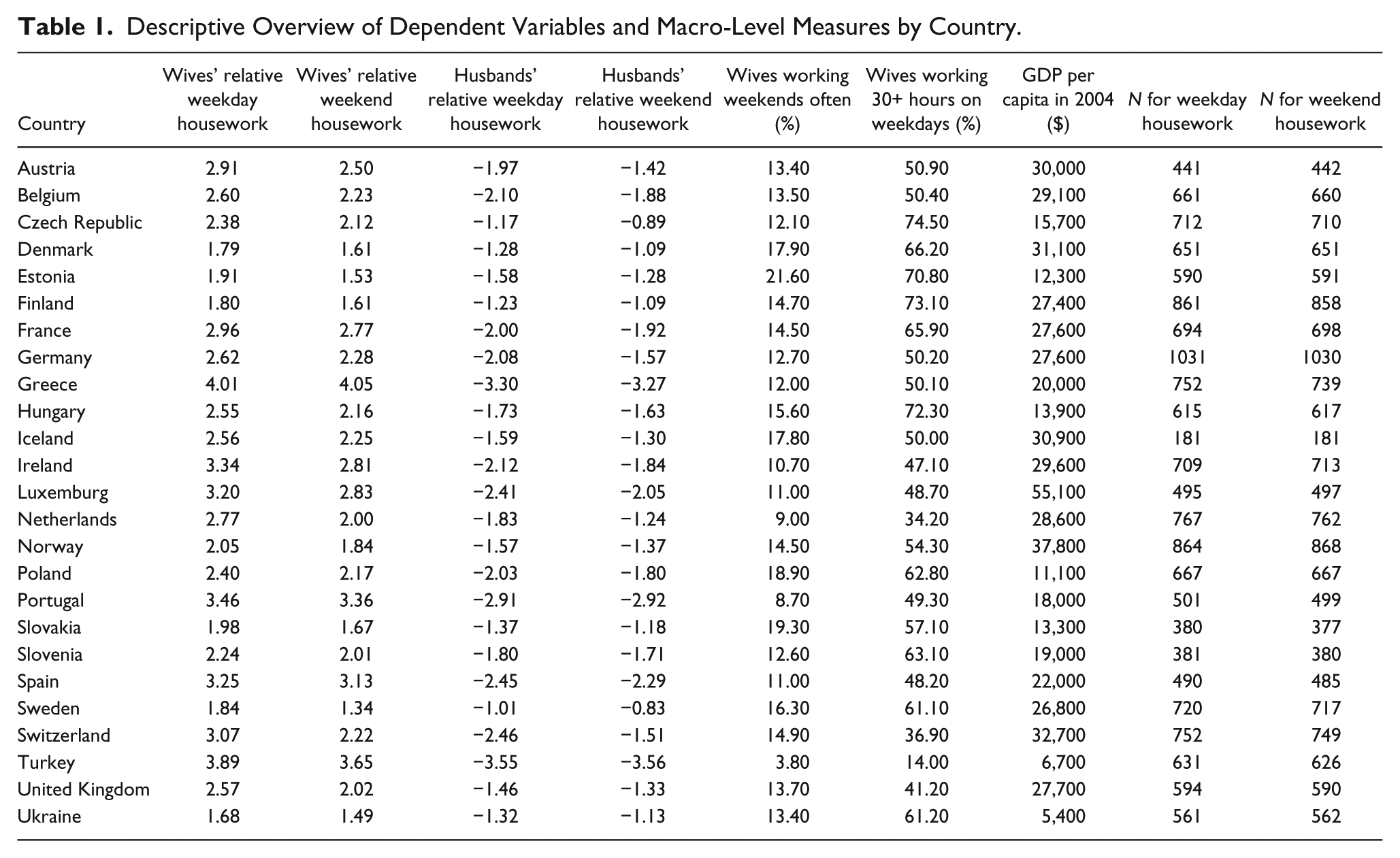
At the country level, wives are most likely to work weekends in Estonia (21.6%) and least likely in Turkey (3.8%). Wives’ full-time (i.e., 30 hours or more) weekday work is most common in the Nordic (73.1% in Finland) and Post-Communist (74.5 % in the Czech Republic) countries and by far the least common in Turkey (14.0%). Given its outlier status across these measures, we estimated our models excluding Turkey; the results (not shown) are equivalent, indicating that the country is not driving the findings. Our country-level measures of weekday and weekend work are positively correlated (0.65, p < .01), indicating that country-to-country differences in wives employment are not restricted to weekends but rather extend to employment throughout the week. The countries also show variation in per capita GDP with lower levels of economic development in postsocialist countries and especially in Ukraine and Turkey.
Level-1 Results
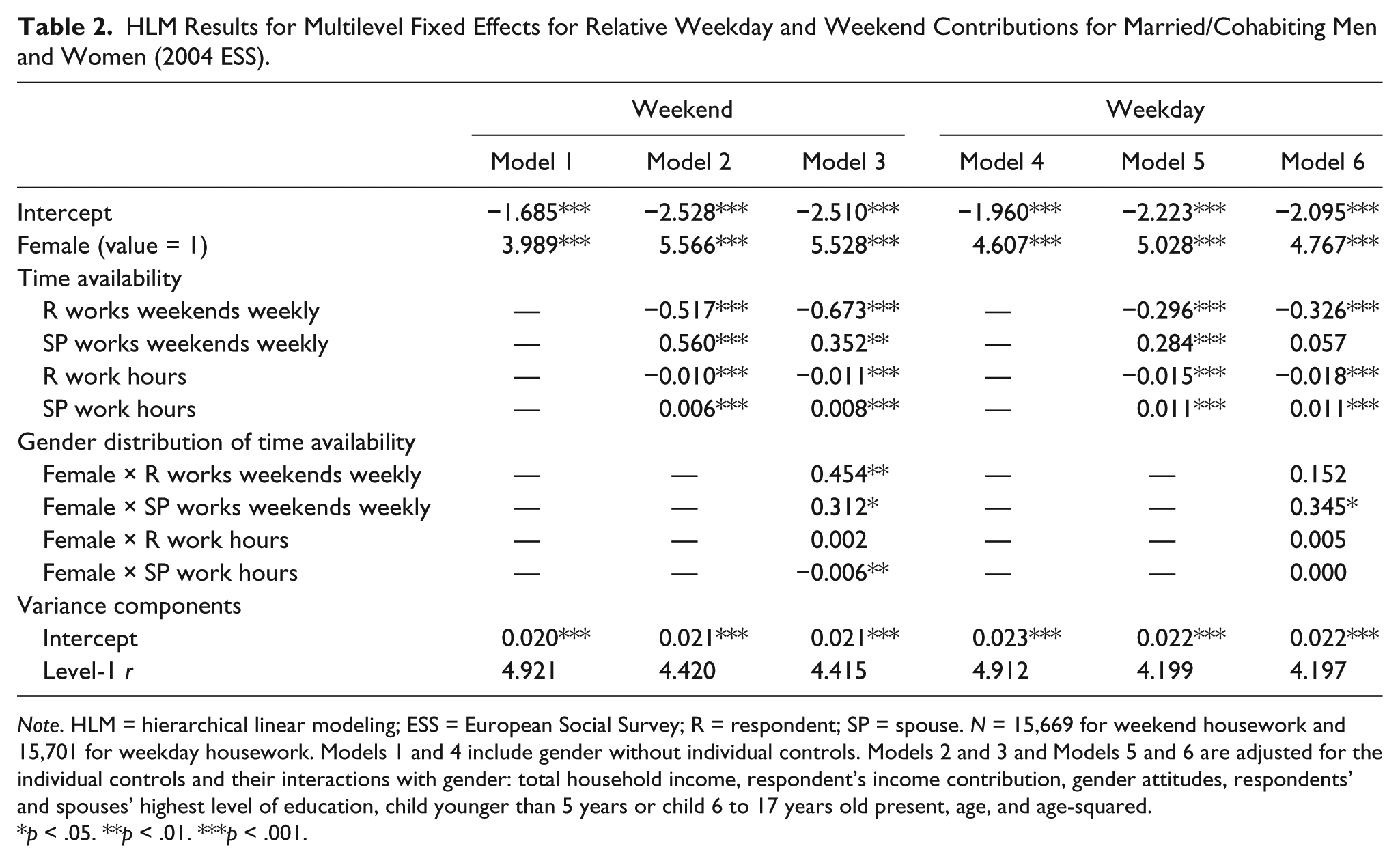
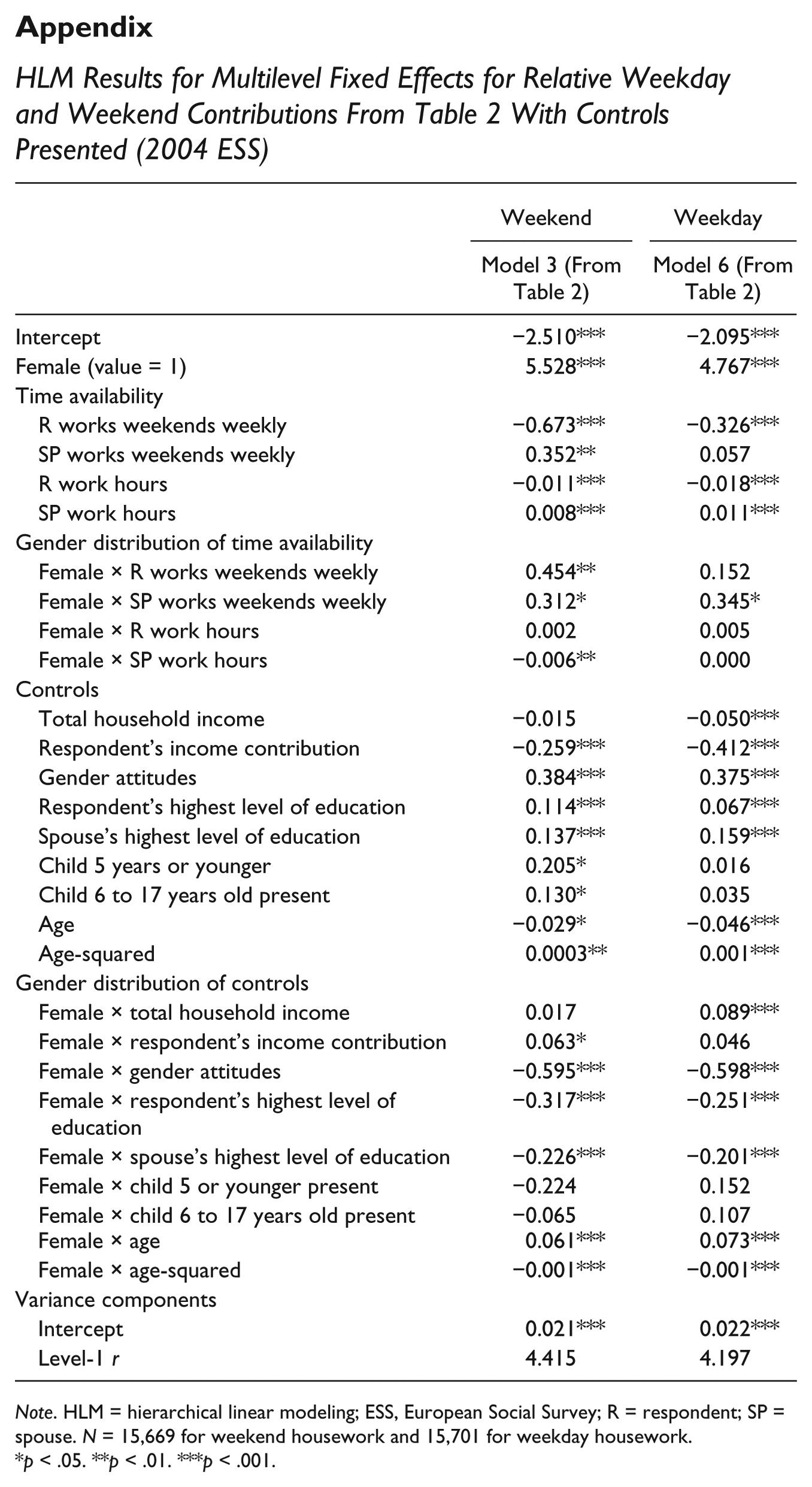
Table 2 presents the individual-level results for the key gender and employment variables in our HLM models. For weekends and weekdays, respectively, baseline Models 1 and 4 identify a large gross gender effect, confirming that female respondents report performing a much larger share of the weekday and weekend housework and male respondents a much smaller share. To demonstrate that this gender difference in housework is not explained by respondents’ individual-level characteristics, Models 2 and 5 add time availability measures, adjusted for the control variables (not shown), for weekends and weekdays, respectively. The time availability variables (weekend work and weekly work hours) and the controls, which include both main effects and interactions with gender, result in no decline in the magnitude of the gender difference in housework shares over the baseline models; in fact, the magnitude of the gender effect increases net of these additional variables. Women are found to perform relatively more and men relatively less housework on both weekends and weekdays, even when we take account of weekend employment, weekly employment hours, and the main and gender interaction effects of other individual and household characteristics, such as total household income and the partners’ educations.
HLM Results for Multilevel Fixed Effects for Relative Weekday and Weekend Contributions for Married/Cohabiting Men and Women (2004 ESS).
Note. HLM = hierarchical linear modeling; ESS = European Social Survey; R = respondent; SP = spouse. N = 15,669 for weekend housework and 15,701 for weekday housework. Models 1 and 4 include gender without individual controls. Models 2 and 3 and Models 5 and 6 are adjusted for the individual controls and their interactions with gender: total household income, respondent’s income contribution, gender attitudes, respondents’ and spouses’ highest level of education, child younger than 5 years or child 6 to 17 years old present, age, and age-squared.
p < .05. **p < .01. ***p < .001.
In Models 2 (weekend) and 5 (weekday), the individual-level results for weekend employment present the main effects of time availability variables, notably respondent’s and partner’s weekend employment. Before testing for gender implications of weekend employment on the division of household labor, we assess whether weekend workers seem to use the housework adaptation strategies we describe above. Consistent with time availability arguments, respondents working weekends perform a smaller share of the weekend housework than do their counterparts who do not work Saturday or Sunday. Counter to the expectation that weekend workers reschedule their housework to other days, married people employed weekends report doing a smaller, not a larger, share of the weekday housework compared with those who do not work weekends. We do, however, find evidence of the strategy of weekend workers off-loading housework on the partner. Those respondents whose spouse works weekends report doing a larger share of that weekend housework than others do. Furthermore, the weekday housework share is also greater for the spouse of a weekend worker.
Whether we consider weekend or weekday housework, respondents’ longer weekly hours of paid work are negatively related to housework shares, whereas spouses’ longer work hours are positively related. Because the weekly work hours of each spouse are controlled, the effects seen for weekend work are not due to these workers having less discretionary time available for housework overall. The significant weekend work effects apparently relate to when those hours are available during the week. Saturday and Sunday employment seems to demand domestic accommodations above and beyond the time constraint of weekly work hours.
Are the housework implications of weekend work gender neutral? Including terms for gender interactions with the time availability measures, Models 3 and 6 test the first four hypotheses. Consider Model 3. Expectedly, given the weekend time-bind hypothesis (Hypothesis 1), working weekends reduces a man’s share of weekend housework significantly (−.673), and the reduction is greater than for a woman working weekends (−.673 + .454 = −.219). The logic of time availability also leads us to expect some household chores to be moved from weekends to weekdays (weekday shift hypothesis; Hypothesis 2), but neither men nor women who work Saturdays or Sundays show any net increase in their relative domestic work on weekdays (Model 6). In fact, weekend workers have a −.326 decrease in weekday work with no significant difference by gender—even in a model adjusted for controls such as household income.
In terms of domestic gender equality, then, women pay the price when they work weekends, because female weekend workers do relatively more around the house on Saturdays or Sundays. In line with the weekend off-load hypothesis (Hypothesis 3), women also pay a disproportionate price when the spouse holds a weekend job. On weekends (Model 3), being married to a weekend worker increases the wife’s relative domestic workload (.352 + .312 = .664) considerably more than the result for the husband of a weekend worker (.352). We also find support for the gender differences in the off-load weekday shift hypothesis (Hypothesis 4). On weekdays (Model 6), having a weekend working spouse is associated with a statistically significant increase in the share of housework done by the wife (.345) but not the husband.
The results for weekly work hours contrast with those seen for weekend employment. There is no significant gender difference in the implications of the respondent’s or spouse’s weekly paid work hours for weekday housework share. Only one work hour gender interaction is statistically significant. Having a spouse employed longer hours each week raises a man’s share of weekend housework (.008) more than a woman’s (.008 − .006 = .002). Collectively, these results refine time availability arguments. Not only do they show that weekend employment matters for the division of housework above and beyond its association with total employment hours, but also weekend work disadvantages women disproportionately on the home front.
Level-2 Results
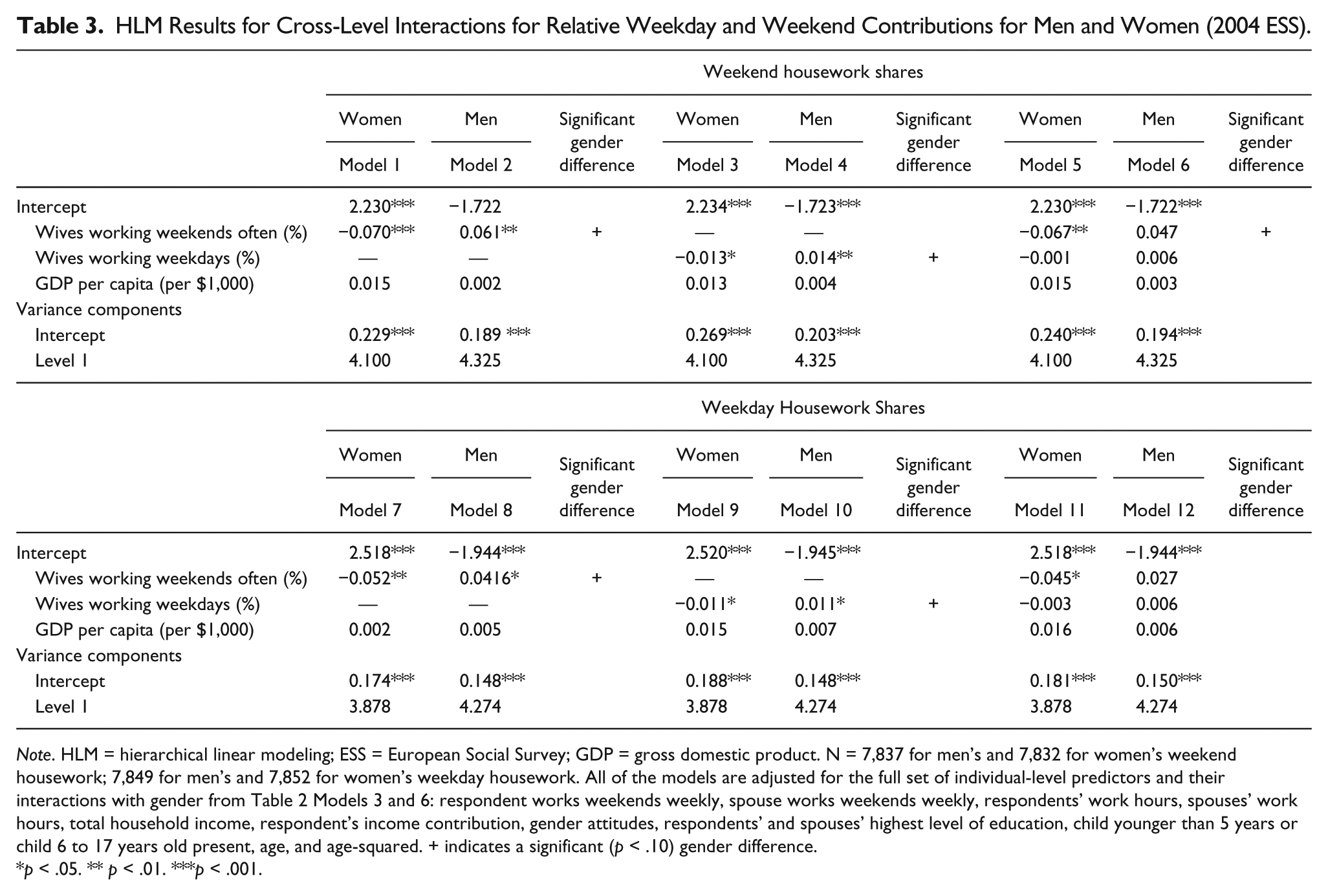
Couples’ domestic adaptations to weekend work may be structured not only by their personal circumstances but also by the extent to which women’s nonstandard work is institutionalized in the country where they live. Table 3 presents macro-level results from multilevel models for the intercept and gender slope. Our models allow us to assess whether wives’ weekend employment at the country level structures couples’ housework more generally (Hypothesis 5). All the macro-level models control for GDP per capita, respondent’s and spouse’s weekly work hours, and the complete set of individual-level controls with gender interactions presented in the final Models 3 and 6 of Table 2. We display the results separately for men and women, but any significant gender differences, established with a pooled model with gender interaction terms, are indicated.
HLM Results for Cross-Level Interactions for Relative Weekday and Weekend Contributions for Men and Women (2004 ESS).
Note. HLM = hierarchical linear modeling; ESS = European Social Survey; GDP = gross domestic product. N = 7,837 for men’s and 7,832 for women’s weekend housework; 7,849 for men’s and 7,852 for women’s weekday housework. All of the models are adjusted for the full set of individual-level predictors and their interactions with gender from Table 2 Models 3 and 6: respondent works weekends weekly, spouse works weekends weekly, respondents’ work hours, spouses’ work hours, total household income, respondent’s income contribution, gender attitudes, respondents’ and spouses’ highest level of education, child younger than 5 years or child 6 to 17 years old present, age, and age-squared. + indicates a significant (p < .10) gender difference.
p < .05. ** p < .01. ***p < .001.
Consistent with the institutionalization argument for the weekend employment context hypothesis (Hypothesis 5), wives’ paid weekend work at the societal level has equalizing implications for couples’ weekend and weekday housework, as shown in the top and bottom panels of Table 3, respectively. In countries where a higher percent of wives work weekends, wives report significantly smaller and husbands significantly larger housework shares for weekends (Models 1 and 2) and weekdays (Models 7 and 8). The influence of weekend employment levels is not simply due to their correlation with weekday employment rates. Of course, a higher percent of wives working full-time on the weekdays is also linked with lower housework shares for women and higher ones for men on weekends and weekdays (Models 3 and 4 and Models 9 and 10, respectively). When both weekend and weekday employment (net of per capita GDP) are considered, country-level Monday to Friday employment by wives ceases to be statistically significant, but their level of weekend work continues to be negatively associated with women’s relative housework burden on both weekends and weekdays (Models 5 and 11, respectively). In short, our models indicate that couples report more equal divisions of weekday and weekend housework in countries where wives’ have stronger labor force attachments. Wives’ weekend work seems to be a telling predictor of domestic adaptations to women’s employment.
To better understand the impact of wives’ weekend work on domestic arrangements, Figure 1 presents wives’ weekend housework shares by their macro-level weekend employment levels for key employment statuses: neither spouse working weekends, wife only working weekends, and wife married to a weekend worker. Given the nonsignificant effect for husbands, we only present the regression results for wives’ weekend housework shares. Of note, wives married to a weekend worker report the largest weekend shares of housework, followed by those where neither spouse works weekends and then those where the wife is the weekend worker. As the parallel slopes for each group indicate, all wives benefit from living where wives’ have higher levels of weekend employment with weekend workers themselves reaping the greatest housework benefit.
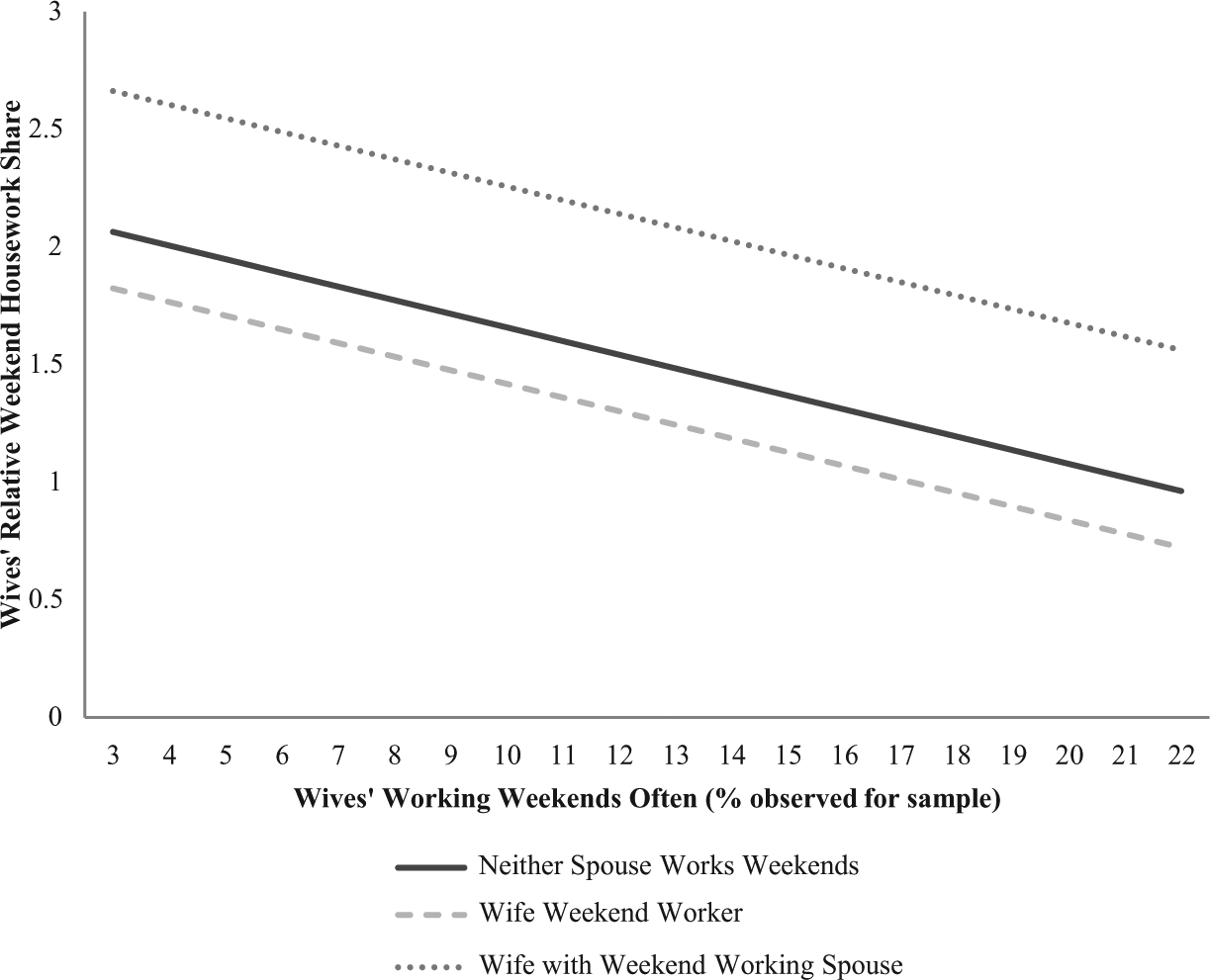
Wives’ weekend relative housework shares by weekend work status and wives’ macro-level weekend work (ESS, 2004; n = 7, 832 women).
Discussion
Across European societies, changes in the organization of time have registered in higher levels of weekend employment, especially for women. Using ESS data to investigate how weekend employment influences wives’ and husbands’ shares of household labor, this article advances the understanding of nonstandard employment in three ways. First, motivated by theories of time availability and the gendered nature of bargaining and exchange, we develop and test hypotheses that relate husband’s and wives’ weekend employment to gender inequality in the division of household labor. Second, we offer evidence that weekend employment has domestic implications, adding a temporal weekday–weekend distinction to our understanding of housework. Third, we establish that cross-national differences in the pervasiveness of wives’ weekend work moderate the influence of individual work schedules for gender inequality in the household.
Although the new time regime seen in weekend work may offer women greater employment opportunities and added convenience, our analysis provides evidence that weekend jobs may come at some cost to gender equality in the home. All things considered, the weekend worker, whether male or female, does a smaller share of the weekend and weekday housework than a counterpart who does not have a weekend job. Husbands working weekends, however, see a greater reduction in their relative housework on Saturdays and Sundays than do wives working weekends—consistent with the weekend time-bind hypothesis. Since we control for each partners’ weekly paid work hours, these findings cannot be explained by the overall time constraints of weekend workers.
Both men and women seem to backstop the weekend working spouse by taking on a greater share of Saturday or Sunday chores. But, given a weekend working spouse, wives’ relative contributions to weekend housework increase more than husbands’ do (per the weekend off-load hypothesis). Furthermore, having a spouse working weekends is associated with an increase in weekday housework shares only for wives, not husbands, thus, indicating that this strategy for adapting to weekend work is highly gendered (as the off-load weekday shift hypothesis suggested). In short, the results imply that couples adapt housework routines to accommodate weekend employment. Husbands appear to pick up the slack on weekends when the wife is working. Of course, we are not able to discount the possibility that wives achieve greater equality simply by jettisoning their own chores, either settling for lower housekeeping standards or outsourcing more of the domestic labor. What is clear, however, is that wives benefit less than husbands from these accommodations.
Despite this evidence that time availability does not work in a gender-neutral way, the general logic of time constraints receives support. Respondents with longer weekly hours of paid work report doing smaller shares of the housework. Those with partners who work longer weekly hours report larger shares. That weekend employment matters for housework allocation—above and beyond each partner’s total employment hours—points out the qualitative differences in weekend and weekday time. Contrary to the weekday shift hypothesis, weekend workers, whether male or female, report smaller weekend and weekday housework shares. They do not simply shift housework to the weekdays when they may have more discretionary time, perhaps because some chores cannot be readily accomplished on weekdays. Some may require the presence of others who are not available then. As noted above, women, if not men, do seem to adapt to a spouse’s weekend employment by shifting housework to weekdays. Taking on more housework on weekdays may be necessary to protect the family leisure time, which is an integral part of weekend life.
All things considered, women pay the disproportionate cost on the home front of Europe’s trend to weekend employment. This is not to say that men are not called on to do relatively more at home. Nor are women uniformly disadvantaged by the rise of weekend work. They undoubtedly benefit from higher family incomes, which may even permit them to outsource some of their housework to paid helpers. Women, however, are less advantaged by housework accommodations to weekend employment than are men. While these individual-level results suggest a weekend work disadvantage for wives on the domestic front, the macro-level results offer some reassurance.
Even controlling for individual-level characteristics and societal wealth, living where a higher percent of women work weekends, is associated with smaller housework shares for women and larger shares for men on weekends. These results are consistent with the weekend employment context hypothesis, the notion that supportive domestic practices will be institutionalized where their employment is high. They are also consistent with the results on weekend housework that we find for the country-level indicator of women’s full-time weekday employment. Although wives’ full-time weekday work has equalizing effects on couples’ weekday housework as well, this effect is not robust in the final model. Weekday housework, which is less discretionary, may be less sensitive to wives’ employment at the macro level.
Whatever the couple’s own labor market pattern, women appear to benefit from labor markets that promote weekend work schedules for women. Couples may adapt their routines to take advantage of weekend employment opportunities. They may substitute store-bought goods and household services—some now more readily available on weekends—for their own household labor. Of course, husbands may more easily participate in the routine housework like meal preparation in countries where bakeries, delis, and grocery stores are open longer hours or on weekends. Whatever the mechanism, our multilevel results indicate that couples share weekday and weekend housework somewhat more equally in countries where wives work weekends.
Although this analysis offers unique insights into how weekend employment plays out in the gendered division of household labor, our rough measure of the partner’s share of housework does not allow us to pursue additional questions about the ways in which weekend work affects the broader organization of the household. Despite evidence of weekend work’s association with the allocation of domestic responsibilities, we are not able to determine whether the differences in housework shares arise from changes in the domestic work of husband, wife, or both. We cannot tell whether weekend work has implications for the absolute volume of housework. Couples might well reduce the domestic workload for each partner with no change in their relative housework shares. We would like to know more about the extent to which couples respond to weekend work by outsourcing housework, purchasing labor saving appliances, and lowering housekeeping standards, because these strategies may well have different consequences for the hours of housework performed by men and women. Although we have addressed gender equality in housework, it remains to be seen how the effects of weekend employment are felt on decision making, childcare, leisure, or family time together. As our results indicate, changes in the temporal regimes of employment merit serious attention as social changes with significant implications for European families.
Footnotes
Appendix
HLM Results for Multilevel Fixed Effects for Relative Weekday and Weekend Contributions From Table 2 With Controls Presented (2004 ESS)
| Weekend | Weekday | |
|---|---|---|
| Model 3 (From Table 2) | Model 6 (From Table 2) | |
| Intercept | −2.510*** | −2.095*** |
| Female (value = 1) | 5.528*** | 4.767*** |
| Time availability | ||
| R works weekends weekly | −0.673*** | −0.326*** |
| SP works weekends weekly | 0.352** | 0.057 |
| R work hours | −0.011*** | −0.018*** |
| SP work hours | 0.008*** | 0.011*** |
| Gender distribution of time availability | ||
| Female × R works weekends weekly | 0.454** | 0.152 |
| Female × SP works weekends weekly | 0.312* | 0.345* |
| Female × R work hours | 0.002 | 0.005 |
| Female × SP work hours | −0.006** | 0.000 |
| Controls | ||
| Total household income | −0.015 | −0.050*** |
| Respondent’s income contribution | −0.259*** | −0.412*** |
| Gender attitudes | 0.384*** | 0.375*** |
| Respondent’s highest level of education | 0.114*** | 0.067*** |
| Spouse’s highest level of education | 0.137*** | 0.159*** |
| Child 5 years or younger | 0.205* | 0.016 |
| Child 6 to 17 years old present | 0.130* | 0.035 |
| Age | −0.029* | −0.046*** |
| Age-squared | 0.0003** | 0.001*** |
| Gender distribution of controls | ||
| Female × total household income | 0.017 | 0.089*** |
| Female × respondent’s income contribution | 0.063* | 0.046 |
| Female × gender attitudes | −0.595*** | −0.598*** |
| Female × respondent’s highest level of education | −0.317*** | −0.251*** |
| Female × spouse’s highest level of education | −0.226*** | −0.201*** |
| Female × child 5 or younger present | −0.224 | 0.152 |
| Female × child 6 to 17 years old present | −0.065 | 0.107 |
| Female × age | 0.061*** | 0.073*** |
| Female × age-squared | −0.001*** | −0.001*** |
| Variance components | ||
| Intercept | 0.021*** | 0.022*** |
| Level-1 r | 4.415 | 4.197 |
Note. HLM = hierarchical linear modeling; ESS, European Social Survey; R = respondent; SP = spouse. N = 15,669 for weekend housework and 15,701 for weekday housework.
p < .05. **p < .01. ***p < .001.
Declaration of Conflicting Interests
The author(s) declared no potential conflicts of interest with respect to the research, authorship, and/or publication of this article.
Funding
The author(s) disclosed receipt of the following financial support for the research, authorship, and/or publication of this article: This research was supported by the Stockholm University and its Linnaeus Center on Social Policy and Family Dynamics in Europe (SPaDE).