




Abstract
Black family structures, dynamics, and processes in the United States have had a long history of investigation in the social sciences. And recently, research on sexual orientation disclosure has become an important feature of the scholarship on lesbian, gay, bisexual, and transgender (LGBT) populations. The various ways in which the family affects a person’s decision to be an out LGBT person, or outness, are less known. Using a national sample of Black LGBT people (N = 2,166), this article assesses the relative importance of a variety of characteristics in understanding outness levels. Regression modeling reveals that having family support is the strongest predictor of outness for Black LGBTs. Two other predictors include the belief that one’s sexual orientation is an important part of one’s identity and having a connection to the LGBT community. The significance of these findings is discussed regarding future research with Black LGBT populations.
Keywords
Research on Black families in the United States often extols its structure as either a source of successful resiliency or as a contributor of disempowering poverty and inequality. Along the way, we have learned that the state of Black families is robust and has many functions and forms. And like the literature on familismo for Latina/os, Black family dynamics—relations, sustenance, structures—continue to play an important role in social scientific inquiry on race, ethnicity, and Black people in the United States. Throughout, there has been a particular focus on how social class influences the family. Research on the family has been identified as an important way to understand how Black people create and maintain social support and psychological well-being. Using empirical data collected from a large-scale quantitative study, this article examines the relative importance of family and perceived family support for Black lesbian, gay, bisexual, and transgender (LGBT) people and the extent to which they have chosen to disclose their sexual orientation to others.
Recent research on Black LGBT people has discovered that numerous factors affect a person’s identity development. For example, in their review of the literature, Akerlund and Cheung (2000) suggest that though Blacks endure specific barriers—such as generalized stigma of homosexuality, a cultural emphasis on sex for reproduction, and perceived lower levels of education and socioeconomic status—the identity development process also points to the family as a source of strength for Black LGBT people. Still, as Bernstein and Reimann (2001) caution,
In cultures that do not place the same values on individualism as mainstream American culture does, expectations of being out are culturally inappropriate and carry greater risk to those who depend on their families and communities for refuge from an often hostile and racist outside world. (p. 6)
In other words, as other bodies of research have described, Black and other LGBT people of color live intersectional lives where the social, political, and cultural context of racism and homophobia (to name a few) clearly have importance (Pastrana, 2006). So while the family may be an important source of support for Black LGBT people, being out in the context of one’s family is complicated by social phenomena such as racism and homophobia, which much of the research on this population has documented. For example, in one of the largest-ever studies on Black LGBT people in the United States, Battle, Cohen, Warren, Fergerson, and Audam (2002) found that 80% experienced at least one form of discrimination in their lives, 53% experienced racial or ethnic discrimination, and 42% experienced discrimination based on sexual orientation (p. 42). Interestingly, that same study found that a majority (54%) had positive experiences with their families of origin (Battle et al., 2002, p. 45). Still, these data notwithstanding, there is a paucity of empirical evidence that seeks to understand how Black LGBT people relate to their families and, more germane to this article, how important perceived family support is in the midst of other factors such as sex, age, education level, affiliation with community, and religiosity.
Using a national, purposive sample of Black LGBT people (N = 2,166), this article asks the following: What are the factors that contribute to living an openly lesbian, gay, bisexual, or transgender life, or “outness”?; and What is the relative importance of things such as family, identity, and other demographic characteristics when examining outness levels for Black LGBT people? These questions are particularly important for several reasons. First, it places the experiences of Black LGBT people in the larger body of research on the family. Second, it provides new evidence for how Black LGBT people live intersectional lives, where the markers of sexual orientation, gender, and race and ethnicity simultaneously come together. The predictors of living an openly LGBT life may be different from what the current literature reveals about White populations. At the same time, the research questions explored in this article also shed new light on how the experiences of Black LGBT people can be understood through the lens of positive identity formation, where deficiencies and models of pathology are contested. In sum, drawing attention to the factors that influence a Black LGBT person to live an “out” life can help to situate knowledge about the greater Black experience and about the greater LGBT experience in the United States. Activists, researchers, and policy makers interested in race-specific and sexuality-specific strategies that emphasize awareness of intersectional issues can be informed by this research to include the current-day life experiences of Black LGBT people in the United States.
Background and Literature
This article brings together two bodies of literature that have been prominent in research on Black people and on LGBT people: family relations and sexual orientation disclosure.
Research Perspectives on the Black Family
That Black families provide support to their members is not new, but little is known about how such support influences the lives of Black LGBT people, especially with regard to sexual orientation disclosure. One of the most prominent terms used by researchers to describe the extended family networks that exist for Black individuals is “kin support.” In their quantitative study on race and family organization, Sarkisian and Gerstel (2004) found that, when compared with Whites, Black families provided more “practical support” with activities such as help with transportation, household work, and child care. In addition, the authors found what many other scholars have discovered about the study of race and ethnicity: There is more variance within a group than there is between groups. Given this, it is plausible to consider that there are a variety of practices and experiences to be discovered and studied within what has been commonly termed the Black family. Still, with a few notable exceptions (namely, Battle et al., 2002; Greene, 1994; Greene & Boyd-Franklin, 1996; Mays, Chatters, Cochran, & Mackness, 1998), research about the roles that Black families play in their interactions with LGBT members is largely understudied.
Especially since the publication of The Negro Family: The Case for National Action (Moynihan, 1965), scholars have identified at least two major trends in the research on Black families. On one side of the spectrum, there is what has been labeled a strengths-based approach where the family is a source of support, resources are often pooled, and stressors and successes are shared via extended kinship bonds and relationships (Collins, 2000; Johnson, 2000; K. S. Newman, 1999; Sudarkasa, 1996). Within the strengths-based approach, “social problems are assessed and intervention strategies are outlined” (Waites, 2009, p. 279). On the other side, however, there is a body of research that locates the family as a persistent source of deficiency, where cycles of deviance are identified as part of larger cultural patterns (Frazier, 1939; Moynihan, 1965; Patterson, 1998). As with many perspectives, there is overlap and these two bodies of knowledge sometimes intersect, resulting in theories that both implicate and celebrate the variegated experiences of Black family members, structures, and relations.
Recent reviews of research on Black families have also revealed that there is an emphasis on social class issues, especially with regard to low-income earning households (Furstenberg, 2007); and on the structural types that exist (Sarkisian & Gerstel, 2004). Social support and psychological well-being (Taylor, Chatters, Tucker, & Lewis, 1990) has also been identified as a factor present in the literature on Black families. In terms of social class, the well-being of families has been tied to income, where the earning capacities of men and women are largely uneven, unsteady, and marginal (Jaynes & Williams, 1989; Wilson, 1993). In terms of household configurations, research has revealed that Blacks often depend on a network of family members and are likely to reside in extended households (Angel & Tienda, 1982) with members spanning multiple generations (Taylor, 1988). Psychological well-being within the study of the family often identifies the presence of spouses as having a positive influence in life. For example, married Black people tend to express more life satisfaction and positive overall well-being than unmarried people (Broman, 1988; Zollar & Williams, 1987). Throughout, the frameworks used when studying Black families have included the importance of family support, or lack thereof, for each member of the family, whether extended or nuclear. The literature continues to emphasize that when studying Black families, income, sex, family size, and marriage are important variables to explore.
However, as Bennett and Battle (2001) have noted, one of the things that remains understudied is the presence of Black LGBT people as members of the Black family. Understanding how Black families interact with sexuality and with the sexual orientation disclosure of LGBT members can lead to more robust theories and more accurate descriptions of Black families today. Additionally, “LGBT perspectives on the black family can both reveal the importance of creating a space for nonnormative self-representations and also scrutinize the effects of assumed heteronormativity in constructions of African American families” (Bennett & Battle, 2001, p. 55). This challenge to heteronormativity is also echoed later by Battle, Cohen, Harris, and Richie (2003) in their assessment of research on the presence of LGBT people in Black families.
The findings discussed in this article attempt to challenge the heteronormative aspects of the Black family and place Black LGBT people at the center of Black family relations. For, as Chito Childs, Laudone, and Tavernier (2010) argue, “researchers are challenged to move beyond assumptions of heterosexuality and incorporate analyses of sexual identity” (p. 148). One of the consistent features of social science research on LGBT people is the coming out experience, or how sexual orientation disclosure occurs. And still, that body of research often overlooks the experiences of Black LGBT people. The next section will briefly summarize some of the research findings on the factors associated with sexual orientation disclosure.
Research on Sexual Orientation Disclosure
Research on sexual orientation disclosure has helped to document and understand how “coming out” and “being out” occurs for various populations. Though some have argued that the decision to live an “out” life is connected to positive health benefits, others have characterized the decision not to be out as a reflection of self-hatred or of sustained external stigma. “Coming out” and “being out” as a gay, lesbian, bisexual, or transgender person are two different processes, often requiring different sets of questions asked of research participants (Harry, 1993). Moreover, being out is not necessarily a developmental process but rather one that is inextricably tied to structural forces (Harry, 1993). However, for a variety of reasons, being an “out” LGBT person is complex and deserves more attention in research, and this is especially so for Black populations.
Research has shown that sexual orientation disclosure for LGBT people is associated with gender. That is, lesbians and bisexual women have unique coming out experiences (Morris, Waldo, & Rothblum, 2001; Rust, 1993). In one of the largest surveys of lesbian respondents, Morris et al. (2001) found that sexual identification as lesbian, years of thinking and exploring lesbianism or bisexuality, and participating in LGBT community events all significantly predicted increased levels of outness for European American and Black women. In developing a methodological model for exploring “being out” for gay men, Harry (1993) found that demographic characteristics can also explain levels of outness to heterosexuals. Some of these included income, type of occupation, and area of residence (Harry, 1993). The inclusion of demographic characteristics in statistical models that seek to predict outness (Harry, 1993; Morris, 1997) is an important development because it methodologically attempts to divorce the study of outness from being only a single act of disclosure, and it also separates the study of outness from traditional developmental models widely used in psychological inquiry. Still, the experiences of Black people within these studies were not adequately explored, often resulting in either continued silence or weak comparisons with White LGBT people.
Another strand of the literature on sexual orientation disclosure asserts that age matters. For example, youth are more likely to come out than their older counterparts (Floyd & Bakeman, 2006), but some have found that this is not true for some racial minorities, especially when compared with their White peers (Rosario, Schrimshaw, & Hunter, 2004). Studies have shown that women come out at slightly later ages than men (Grov, Bimbi, Nanin, & Parsons, 2006; Herek, Norton, Allen, & Sims, 2010). In addition, others contend that coming from a family with traditional values is more important than race itself in predicting outness for gay male adolescents (B. S. Newman & Muzzonigro, 1993). For them, traditional values included factors such as the importance of religion, emphasizing marriage, emphasizing children, and speaking a non-English language in the home (B. S. Newman & Muzzonigro, 1993).
Though some have argued that Black and Latina/o LGBT people have low rates of sexual identity disclosure (Garnets & Kimmel, 1993), recent studies have shown that even racial and ethnic minority populations are coming out at younger ages (Grov et al., 2006) and these patterns mirror the experiences of their White peers (Potoczniak, Crosbie-Burnett, & Saltzburg, 2009). However, in their exploration of identity integration, Rosario et al. (2004) found that Black youths were “less comfortable with others knowing about their homosexuality . . . and had self-disclosed to fewer individuals . . . than had White youths” (p. 222). Also, in a mixed methods study with Black lesbian and bisexual women, age was among several demographic characteristics used to predict outness (Bowleg, Burkholder, Teti, & Craig, 2008).
However, researchers have agreed that the experiences of lesbian and gay ethnic minorities are largely understudied (Akerlund & Cheung, 2000; Asencio, 2009; Battle et al., 2003; Pastrana, 2006). To date, research has documented that Black LGBT people often face discrimination on the basis of race, class, education, sexual orientation, religion, and gender (Battle et al., 2002). The literature on the intersections of racial and sexual identity—development and management—also shows significant barriers to personal and professional development that LGBT-identified ethnic minorities sustain (Wallace, Carter, Nanin, Keller, & Alleyne, 2002).
An Intersectional Lens
More than an examination of whether or not a person is “out” as lesbian, gay, bisexual, or transgender, much of the scholarship on sexual orientation disclosure couches “being out” as an endpoint and “coming out” as a developmental stage. Rarely is there an opportunity to showcase that being out is often tied to structural forces as well (Harry, 1993). Over the course of a person’s life, these forces change and mutate to reflect the various social or cultural identities that a person may be navigating.
To date, research on Black LGBT people highlights that discrimination on the basis of race, class, and gender often permeates the life experience (Battle et al., 2002; Cohen, 1999; Collins, 2004). An intersectional perspective (Collins, 2000; Crenshaw, 1992) acknowledges that the social markers or identifiers tied to discrimination cannot be easily separated or added together. So while sexual orientation disclosure and coming out can be examined and discussed as singular moments, the totality of living an out LGBT existence must be viewed holistically with the understanding that not only is it possible to be out (or not) to different people in one’s life, but it is also possible that these very people change over the course of one’s life. For example, being out to many people in one’s neighborhood will change once that person moves from one residence to another.
In addition, research on transgender people of color (see, e.g., Bith-Melander et al., 2010; Bockting, Miner, Romine, Hamilton, & Coleman, 2013; Serano, 2007) has shown that the experiences of coming out and being out are different from those of lesbians, gays, and bisexuals. For transgender people, the practice of coming out is further complicated by the desire and/or ability to pass as transwoman or transman. The burgeoning research on transgender people of color is important because it highlights how coming out and being out is also tied to the levels of privilege that may be attached to particular identities. An intersectional perspective thus allows for a continued examination of how outness is lived, navigated, and experienced, while accounting for numerous factors. An examination of outness levels through the lens of the Black experience is only one way of understanding the complexities surrounding the intersection of race and sexuality as socially important and socially constructed concepts. In other words, being an out Black LGBT person is not a static identity. Outness has the capacity to change (importance) over time and under different circumstances.
The literature reviewed thus far indicates that—with very few exceptions—research on Black families rarely examines LGBT issues, and sexuality research does not fully investigate Black family formations. That is, the scholarship on Black families is often viewed through a heteronormative lens while LGBT scholarship is often overrepresented by the experiences of Whites.
With data collected in 2010, this article contributes to the understanding of family support in the lives of Black LGBT people. It brings two bodies of research—on Black families and on sexual orientation disclosure—together to contextualize the Black LGBT experience in the United States today. How do demographic characteristics, sexual identity, racial identity, and religion affect the ways in which Black LGBT women and men live “out” lives? Data analyzed in this article may provide a way to further connect family support to the coming out—and, more precisely, to the “being out” (Harry, 1993)—levels of Black people in the United States. In the next section, I will explore these ideas by showing the relationships between outness and a number of individual and structural factors. Furthermore, the analysis used in this article acknowledges and provides more evidence to show the diversity of experience that is observed within Black LGBT populations.
Method
The data used for this article were collected from LGBT people of color over a 12-month (January 2010-December 2010) period in the United States. The 10-page, 105-item, self-administered Social Justice Sexuality (SJS) Survey included questions on five broad themes: racial and sexual identity, family formations and dynamics, spirituality and religion, civic engagement, and mental and physical health. Recruitment for the national survey included methods such as venue-based sampling, where research participants were sought at political, social, and cultural events; snowball sampling, where community organizers or opinion leaders often distributed surveys at other events not initially identified as a recruitment venue; community partnerships with national and local LGBT groups and organizations such as the National Black Justice Coalition, Unity Fellowship Church, and the Zuna Institute; the Internet; and other strategic partnerships developed over the course of the survey field period.
Many of the items used in the SJS survey were taken from other instruments to ensure reliability and build on existing research. However, some questions were modified, or new ones created, in order to tailor them to LGBT people of color specifically. Some of the sources used to develop the survey included, but were not limited to the following: the Black Pride Survey 2000 (Battle et al., 2002), which serves as one of the largest survey projects to gather data from Black LGBT people in the United States; the Black Youth Project, 1 which continues to amass relevant data on Black youth today; the General Social Survey 2 ; the Lavender Islands Study on Family (Henrickson, Neville, Jordan, & Donaghey, 2007), which specifically examined the roles of family in the lives of LGBT people; the Living in the Margins Survey (Dang & Vianney, 2007), which gathered data on Asian and Pacific Islander populations; the National Black Lesbian Needs Assessment Survey (Ramsey, Hill, & Kellam, 2010), which collected data on issues specific to Black lesbians; the National Health and Nutrition Examination Survey 3 ; Nuestras Voces (Diaz, Bein, & Ayala, 2006), which serves as one of the largest survey projects to gather data on Latino gay and bisexual men; and the Santa Clara Strength of Religious Faith Survey (Plante, Vallaeys, Sherman, & Wallston, 2002), which has continued to measure the importance of religion in this country.
For this article, “Black” is used to refer to respondents whose racial or ethnic identity (as indicated by their responses to such a question) included “Black” as either a marked category or as a specified, written response. Like the U.S. Census of 2010, respondents were able to check all racial/ethnic markers that apply. The sample for this article includes respondents who indicated a Black identifier either alone or in addition to other racial/ethnic labels. Though data were collected from more than 5,000 respondents across the United States, for this article, the subset of 2,166 people who identified as Black was analyzed.
Sample
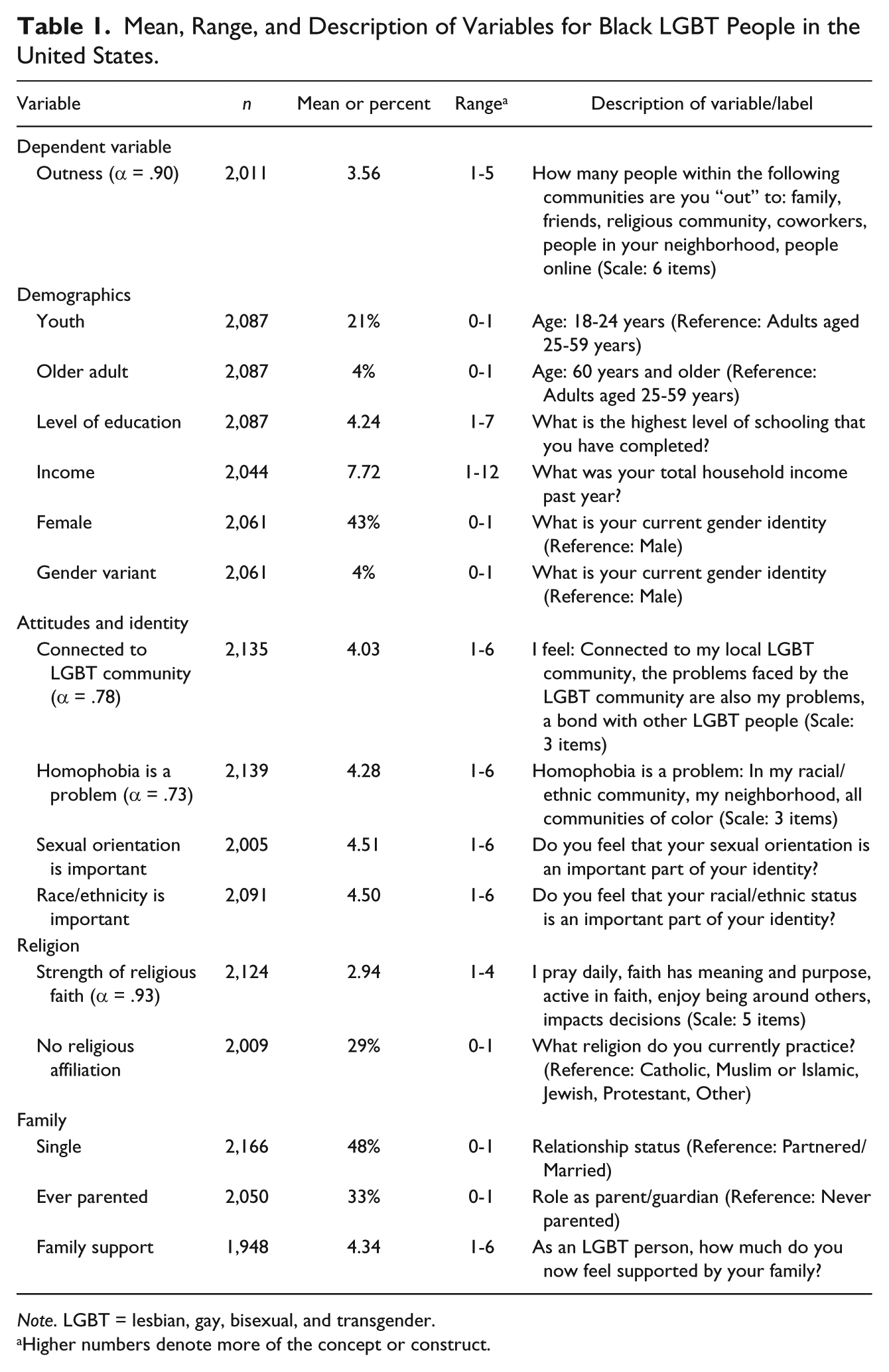
The Black LGBT 4 people within this sample were between 13 and 81 years of age, with a mean age of 36. Slightly more than two fifths of the sample identified as female (43%). In terms of regional location, 35% were from the Northeast, 34% from the South, 16% from the Midwest, and 15% from the West. Almost half of the respondents identified as single (48%) and 33% were parents. The mean level of educational attainment was an associate’s degree and the mean household income was between $20,000 and $39,000. A summary of descriptive statistics (mean, standard deviation, and minimum–maximum values) for the dependent and independent variables used in this article is presented in Table 1.
Mean, Range, and Description of Variables for Black LGBT People in the United States.
Note. LGBT = lesbian, gay, bisexual, and transgender.
Higher numbers denote more of the concept or construct.
Variables
This article focuses on the correlates of “outness” within a sample of Black LGBT people. It seeks to assess the factors that contribute to a person’s decisions to be “out” to more people in their lives. More precisely, to measure the relationship between four sets of variables (demographic variables, attitudes and identity, religion, and family) and the outness levels of Black LGBT people, hierarchical regression analyses were performed. The importance of each variable is then assessed relative to all other variables included in the analysis.
One dependent variable and four sets of independent variables were included in this analysis. The dependent variable Outness is a sexual orientation disclosure scale (α = .90) that measures how many people a respondent is “out” to in various communities and settings. It is made up of six items and asks the following: How many people within the following communities are you “out” to? The six settings included family, friends, religious community, coworkers, people in your neighborhood, and people online. The five response categories, for which respondents were instructed to mark only one for each setting, went from 1 = None to 5 = All, and included 2 = Some, 3 = About half, and 4 = Most. This set of questions was similar to previous ones analyzed in the literature on sexual orientation disclosure (see, e.g., Floyd & Bakeman, 2006; Grov et al., 2006; Wallace et al., 2002). Black LGBT people reported that they were out to family (3.64), friends (4.08), religious community (3.16), coworkers (3.38), people in the neighborhood (3.09), and people online (3.64). The reported alpha for this scale (.90) indicates that taken together, these six items are a strong measure of how many people a person is out to in various settings, or what some have called being out. As reported in Table 1, the mean for the outness scale is 3.56, which is between the “about half” and “most” response categories. The research question for this article identifies and measures the factors that influence an increase in the number of people a Black LGBT person chooses to be out to in her or his life, or what is referred to as outness in this article.
Four sets of independent variables were used in this article: demographics, attitudes and identity, religion, and family. Key demographic characteristics were included in this analysis. Previous research has shown that age (Bowleg et al., 2008; Floyd & Bakeman, 2006; Taylor, 1988), race (Battle et al., 2002; Garnets & Kimmel, 1993), gender (Morris et al., 2001; Wilson, 1993), religion (B. S. Newman & Muzzonigro, 1993; Potoczniak et al., 2009), and education (Morris, 1997; Wilson, 1993) have each been significant in assessing either Black families or sexual orientation disclosure for LGBT people. For this article, age was measured using two dummy variables where adults aged 25 to 59 years were the reference category; 21% of the sample were youth (<24) and 4% were older adult (60+). Because of the growing literature on youth and LGBT issues, it was important to capture this particular subgroup. Gender was measured using two dummy variables where males were the reference category; 43% of the sample was female (and 53% was male). Gender variant is a variable created to document the experiences of respondents who, for whatever reasons, did not consistently mark one sex over the other when answering the survey. For example, a respondent may have marked “female” as the gender category she presently prefers but may have indicated that she was categorized as “male” in her birth certificate. The gender variant variable represents such responses from the sample. Also noteworthy is the widely accepted, but not fully investigated with research, notion that for people of color, the label “transgender” is not readily used. Hence, for this article, the term and variable gender variant is used; 4% of the sample was gender variant. Other demographic variables included level of education and income.
Related to the research on the predictors of sexual orientation disclosure, attitudinal measures were chosen to assess the strength of the relationships found. This set of four variables asked respondents about their connections to the overall LGBT community (Battle et al., 2002; Morris et al., 2001), the belief that homophobia is a problem (Battle et al., 2002), and the importance of sexual orientation (Battle et al., 2002; Morris et al., 2001) and racial or ethnic identity (Asencio, 2009; Battle et al., 2002; Pastrana, 2006). Connected to LGBT community and Homophobia is a problem are each scales composed of three items that measure connection to the LGBT community (α = .78) and level of agreement that homophobia is a problem (α = .73). The response categories for each of these scales went from 1 = strongly disagree to 6 = strongly agree. The connection scale had a mean score of 4.03, which indicates that Black respondents generally agreed that they felt connected to other LGBT people. Similarly, for the homophobia scale, the mean score was 4.28, which indicates that, on average, Black respondents generally agreed that homophobia is a problem. The reported alphas for these scales indicate that taken together, the three items that make up each scale are a strong measure of connection to the LGBT community and of the belief that homophobia is a problem. Sexual orientation is important and Race/ethnicity is important are each Likert-type scale items that ask respondents to indicate the level of importance of sexual orientation (mean = 4.51) and racial or ethnic status (mean = 4.50) in their lives. The response categories for each of these items went from 1 = not important at all to 6 = extremely important.
Strength of religious faith and religious affiliation were also captured. Adopted from an abbreviated version of the Santa Clara Strength of Religious Faith Questionnaire (Plante, Vallaeys, Sherman, & Wallston, 2002), Strength of religious faith is a scale (α = .93) composed of five items that measure a respondent’s level of agreement about the following statements: “I pray daily,” “I look to my faith as providing meaning and purpose in my life,” “I consider myself active in my faith or religious institution,” “I enjoy being around others who share my faith,” and “My faith impacts many of my decisions.” The response categories went from 1 = strongly disagree to 4 = strongly agree. A mean score of 2.94 was obtained from the scale, which is closer to agree than disagree. No religious affiliation was created using a survey question that asked respondents to indicate the religion that she or he currently practices; the no religious affiliation variable includes respondents who marked “atheist,” “agnostic,” or “none” to the survey question. Almost a third of Black LGBT people in the sample (29%) reported no religious affiliation.
Last, to account for the relative importance of family and family support, three family-related variables were analyzed. Single is a dummy variable created to identify whether a respondent was single (coded 1, 48%) or married, partnered or other (coded 0). Marriage continues to be an important factor in much of the research on Black families (Broman, 1988; Zollar & Williams, 1987). In the United States, LGBT people continue to face legal challenges to marriage. Though there are no federal protections, some states have passed laws that grant marriages to lesbians and gays. Given this context, being single or being in a relationship/partnership is an important aspect in the research on LGBT families. Ever parented is a dummy variable created to identify whether a respondent had ever served as a parent or guardian to a child (coded 1, 33%) or not (coded 0). The literature on LGBT families suggests that parenting and the presence of children in a household is an important factor in the lives of LGBT people (Cahill, Ellen, & Tobias, 2002). Respondents were also asked to indicate the perceived level of support, if any, received from their families. Specifically, survey participants were asked, As a LGBT person, how much do you now feel supported by your family? Family support is a variable whose response categories go from 1 = Not supported at all to 6 = Completely supported. This variable directly addresses the issue of family connection or family support in the literature on Black families (see, e.g., Angel & Tienda, 1982; Taylor, 1988). The mean score of the family support variable was 4.34, which can be interpreted as feeling more supported than not.
Analytic Plan: Hierarchical Modeling
To investigate the effects of the independent variables on the dependent one, four hierarchical regression models were used. More specifically, the models assess the additive impact of four sets of variables—basic demographics (Model 1), attitudes and identity (Model 2), religion (Model 3), and family (Model 4)—on Black LGBT outness. The purpose of this technique is to assess the relative importance of each of the variables when predicting how many people Black LGBT people choose to be out to in their lives.
Results
Though the overall SJS Survey data set included the results of more than 5,000 respondents across various racial and ethnic groups, genders, ages, and income levels, this article focuses on the subsample of Blacks who provided valid responses to the survey. Ultimately, this included 2,166 cases, representing one of the largest samples of Black LGBT people in the United States to date. As stated above, on average, Black respondents were out to about half or most of the people in their life, including family, friends, religious community, coworkers, people in the neighborhood, and people online. This article explores those factors that influence Black LGBT people to be out to more people in their lives.
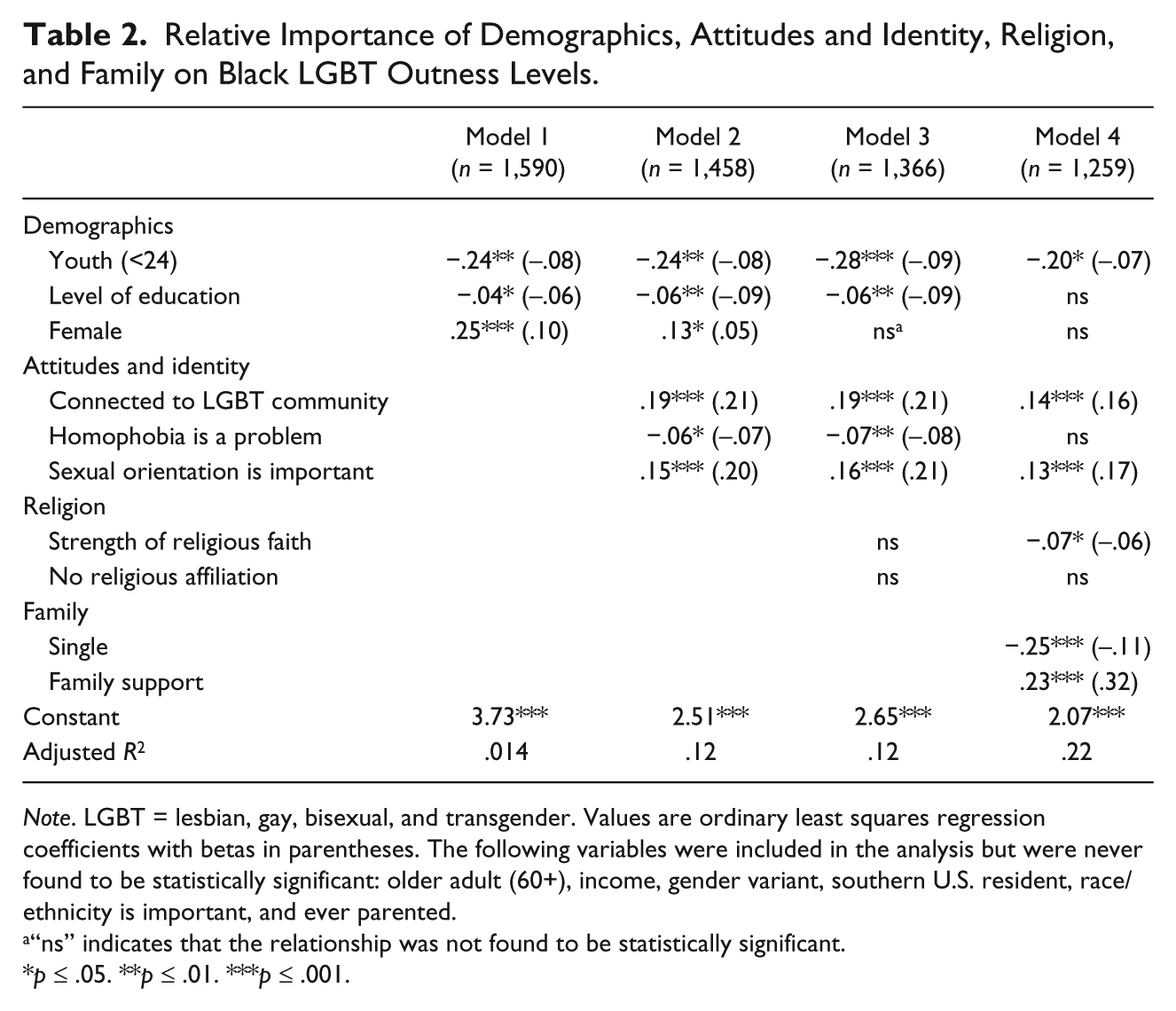
The analysis revealed some important and interesting findings (see Table 2). Model 1 shows that there are three demographic characteristics that influence outness for Black LGBT people: age, education, and gender. However, gender is the only one that predicts outness in a positive direction. That is, when holding constant all demographic variables included in this model, females—when compared to males—are out to more people. Contrary to some of the literature, when compared with their adult counterparts, Black LGBT youth aged 24 years and younger, are not as likely to be out to many people in their lives. And, surprisingly, education is a negative factor in outness; as education levels increase, respondents are less likely to be out to many people. Gender, specifically being female, is the most powerful positive predictor (β = .10) of outness in this model. Income did not make a difference in predicting outness levels for Black people.
Relative Importance of Demographics, Attitudes and Identity, Religion, and Family on Black LGBT Outness Levels.
Note. LGBT = lesbian, gay, bisexual, and transgender. Values are ordinary least squares regression coefficients with betas in parentheses. The following variables were included in the analysis but were never found to be statistically significant: older adult (60+), income, gender variant, southern U.S. resident, race/ethnicity is important, and ever parented.
“ns” indicates that the relationship was not found to be statistically significant.
p ≤ .05. **p ≤ .01. ***p ≤ .001.
When adding the attitudes and identity variables, Model 2 shows that being connected to the LGBT community as well as believing that sexual orientation is an important part of one’s identity each significantly predicted higher levels of outness for Black LGBT people. Interestingly, the more a person believes that homophobia is a problem, the more likely she or he is to not be out to many people. When controlling for demographic characteristics and attitudes and identity, being connected to the LGBT community was the most powerful positive predictor (β = .21) of outness. In this model, the belief that race/ethnicity is an important part of one’s identity did not matter. All relationships reported in Model 1 held when adding the attitudes and identity measures.
Unexpectedly, Model 3 illustrates that neither religious affiliation nor strength of religious faith affects outness levels for Black LGBT people. And although all the attitudes and identity relationships observed in Model 2 held, gender loses its significance. This means that there is something about religious faith and religious affiliation that renders gender insignificant.
The full model (Model 4) adds all the family variables described above. First, it reveals that demographics, attitudes and identity, religion, and family each matter in predicting outness for Black LGBT people. It shows that when controlling for all variables, perceived family support is not only significant, but it is also the most powerful predictor of outness (β = .32). Perceived family support is almost twice as powerful as the next predictor: the belief that sexual orientation is an important part of one’s identity (β = .17). This model also shows that, when compared with their partnered counterparts, single people are less likely to be out to many in their lives. Similarly, for every increase in religious faith, there is a decrease in outness levels. This is the first time that religious faith becomes a factor in outness. And out of all the demographic characteristics included in the model, only age continues to be significant. Compared with their adult counterparts, Black LGBT youth are not likely to be out to as many people in their lives.
Discussion
The analysis presented in this article offers an important account of the experiences of Black LGBT people and the factors that affect their decisions to be out to more people in their lives. Though outness levels for this population cannot be fully explained with the data used for this article, the findings support previous research while pointing to potentially new areas inquiry. For Black LGBT people, family matters. That is, having family support is a powerful predictor of outness. As a social institution, the family is an important part of the sexual identity formation of Black LGBT people. Given some of the positive health benefits associated with living an open lesbian, gay, bisexual, or transgender life, understanding the factors that contribute to disclosing one’s sexual orientation is essential for the health and well-being of Black LGBT people. Research on families has revealed that for Black people, “socialization occurs within a broader social environment that is frequently incompatible with realizing a positive self and group identity” (Taylor et al., 1990, p. 994). Without a doubt, there are numerous broader social factors that continue to negatively affect Black people in general today and Black LGBTs specifically. Some of these include racism, homophobia, gender socialization, social class status, health care access, and sexism. Though that body of research is important in understanding how marginalization continues to affect the lives of Black people, it is equally important to document and analyze those factors that may provide greater sustenance to individuals and their quest for achieving a positive sense of self and associating themselves with a larger group. That having family support and being connected to the larger LGBT community significantly predicted outness provides empirical evidence for the importance of larger social groups; Black LGBTs are indeed connected to these larger social institutions. Still, there is observed variance in the lives of Black people in the identification of barriers and conduits to being an out LGBT person to numerous people in their lives.
Black LGBT Outness
Though research has discovered that youth are coming out more than their older counterparts (Floyd & Bakeman, 2006; Grov et al., 2006; Schope, 2002), this may not be so for Black LGBT youth today. As shown in Model 4 of this article, when compared with adults aged 25 to 29 years, Black LGBT youth (aged 24 years and younger) are not out to as many people in their lives. This was the only demographic characteristic that was consistently associated with outness levels. Black LGBT youth may be guarded about their LGBT identity because they may be responding to age-related stigma such as generalized disempowerment, or their immediate social environments may not be as developed, varied, or numerous. Like Rosario et al. (2004) have argued, it could be that for some youth of color, the coming out process may occur later in life. Future research must account for measures of the types of social environments in which Black LGBT youth navigate and how much influence these have on them as youth. Since family support is one of the most powerful predictors of outness, future research on Black family relations or dynamics should examine how much support youth receive from their families regarding sexual orientation disclosure patterns.
Other researchers have reported that connections to community and saliency of identity—both racial and sexual—are important to how LGBT people navigate various social settings (Asencio, 2009; Griffith & Hebl, 2002; Morris et al., 2001). Not surprisingly, according to data analyzed for this article, Black LGBT men and women are out to more people when they feel a connection to the LGBT community and when they believe that their sexual orientation is an important aspect of their identity. Although this is important because the sample here consists of only those who identify as Black, much of the literature on LGBT people of color still continues to document how race often serves as a divider preventing LGBT people of color from feeling fully accepted into largely-White LGBT settings. In other words, since feeling connected to the LGBT community and believing that sexual orientation is important positively predicts higher levels of outness, developing a more racially inclusive LGBT environment (whether it is with regard to political, cultural, or social settings) must continue to be a part of larger community-building efforts.
Religious faith was also significant for Black LGBT outness levels. This is important because it contributes to the scholarship on the role of religion in the lives of Black LGBT people, which often yields inconclusive findings. On one hand, discourse in the popular media often highlights conservative religious attitudes toward homosexuality, whereas on the other hand, research has underscored the pivotal role of the Black Church in the social justice struggles of Black people in the United States (Lincoln & Mamiya, 1990). Interestingly, though two different measures of religion were used for this article, ultimately, only one was found to be associated with outness levels. As the strength of religious faith increases, outness levels decrease. Here, religious faith serves as a barrier to a person’s decision to be out to many people in her or his life. This is similar to what researchers have discovered with regard to the deleterious effects of homophobic rhetoric within Black communities and within the Black Church (Ward, 2005). But having a religious affiliation itself did not matter in terms of predicting outness levels. Future research on how religious faith may be affecting the attitudes and lives of Black LGBT people must interrogate the importance of faith, how faith is constructed, and why it may seem incongruous with an LGBT existence.
Last, when controlling for all variables included in this analysis, family was most important. That is, as perceived family support increases so too does the outness level of Black LGBT people. This finding reinforces the key role of family in the lives of LGBT people in general and Black LGBT people more specifically. Here, being supported by family may be viewed as a possible measure of social support, which the literature on LGBT identity has also found (Morris et al., 2001). Relationship status was also found to be important. Single Black LGBT people differ from their partnered counterparts in that those who are single are less likely to be out to others. It could be that unpartnered people do not find it necessary to be out or that single people feel more stigmatized by larger social institutions. Given that one of the most visible and highly funded political strategies currently pursued for LGBT liberation in the U.S. centers on the right to marriage, it is plausible that, for many single people, being an out LGBT person is not important. An unintended consequence of the recent marriage-/partner-based legal challenges to homophobia in this country may be that single people are reluctant to be out to others.
Activists and social service providers who are interested in increasing the outness levels of Black LGBT people are encouraged to work on advancing the images, services, and attention to those who are unpartnered, young, and have high levels of religious faith. More research is needed on Black LGBT people who are not partnered, who are young, and who sustain high levels of religious faith to better understand these significant barriers to outness.
Importance of Family Support: Possible Preliminary Evidence of Structural Resilience
The most powerful predictor of outness for Black LGBT people is perceived family support. This finding is congruent with previous research, which has revealed that when surrounded by supportive networks, LGBT people are more likely to be out (Beals & Peplau, 2006). But, as indicated by decades of research, the Black family is more than a supportive network. It is also a source of strength for many. The research presented in this article shows that not only are Black LGBT people a part of Black families (as has been explored by Bennett & Battle, 2001; Greene, 1994; Mays et al., 1998) but that having family support is an important and powerful factor in being an out Black LGBT person to others in their lives as well. In their discussion of four main theoretical approaches to the study of the Black family, Sarkisian and Gerstel (2004) contend that structural destruction theorists “argued that the kin support among blacks has declined rapidly over the past few decades, so that blacks currently are less likely to be involved in support transfers than whites” (p. 815). That family support is present in the lives of Black LGBT people directly counters this view and is, instead, aligned with the structural resiliency perspective where there is an “extensive exchange of support within kin networks” (Sarkisian & Gerstel, 2004, p. 814). Still unexplored, however, are the various ways that Black LGBT people use this support and the forms of support that are most common.
Limitations and Strengths
This study had a number of limitations. The sample, though large, was not representative, thus not generalizable to any specific population. Though the analyses contained in this article reflect sound statistical significance, caution must be observed when seeking to make observations that may be reflective of the life experiences of all Black LGBT people in this country. Another limitation concerned the survey instrumentation. The SJS Survey was an exploratory study designed to provide preliminary evidence for relationships and associations that require further inquiry. Thus, many of the most salient concepts and variables (e.g., family support) were measured by a single item. For example, methodologists have pointed to the importance of capturing things such as familial support, familial interconnectedness, familial honor, and subjugation of self for family when investigating family support (Lugo-Steidel & Contreras, 2003). Future studies should explore the dimensions of these concepts more rigorously. Despite these limitations, as reported in Table 2 for this article, statistical analyses used in this article were strong, robust, and significant.
This study also has a number of strengths. The data used for this article came from a large-scale, quantitative study with a national scope. It targeted LGBT people of color and used a purposive sampling frame. Widely used as a method during the piloting stage of a survey, purposive sampling techniques have also been used in feminist research projects and in studies about vulnerable populations, or people who have systematically or historically been excluded from traditional forms of scientific inquiry. Despite the lack of representativeness, with 2,166 cases, this sample represents one of the largest ever for Black LGBT people in the United States and can be used to support the ever-expanding field of inquiry for this group, which has often been studied with smaller sample sizes.
Conclusion
The Black LGBT population is not monolithic. In examining outness levels, for example, this article found that Black LGBT people vary by age, connections to the LGBT community, perceived importance of sexual orientation, strength of religious faith, relationship status, and perceived family support. Using empirical data, this article provides a preliminary view of the importance of family support for Black LGBT people. The data explored in this article position Black LGBT individuals within larger networks: families and LGBT communities, specifically. However, future research must continue to assess the various ways that families interact with members who disclose their LGBT sexual orientation. For example, the types of relationships that LGBT people have with their families may vary in how much time they spend together, how much financial support they provide to each other, how far away they live from each other, and other such relationships. Similarly, researchers interested in the lives of LGBT people must include family and family relations as part of the areas of inquiry.
Having family support and being connected to the LGBT community are both important for Black LGBT people in the United States. Increasing the opportunities for these two social and cultural institutions—the family and the larger LGBT community—to exchange ideas, develop strategies, and otherwise sustain and build relationships with Black LGBT people is essential. By further understanding precisely how this happens, other LGBT people may be able to learn how they too can establish support from their families and be more connected to the LGBT community. In addition, service agencies, care providers, activists, and policy makers must acknowledge that the Black family—as well as the LGBT community—are indeed strong and vital parts of the lives of Black LGBT people. Policies, outreach, and services that make this association will yield more positive benefits. To be clear, being an out LGBT person is a complex social and cultural dynamic, one that often requires support from others. Through this lens, support from Black families has the potential of increasing the well-being of Black LGBT members.
Footnotes
Declaration of Conflicting Interests
The author(s) declared no potential conflicts of interest with respect to the research, authorship, and/or publication of this article.
Funding
The author(s) received no financial support for the research, authorship, and/or publication of this article.