




Abstract
The transmission of power requires the presence of an interpersonal network as a medium; however, the nature of the relationship in the effect of power exertion is seldom discussed. In view of this research gap, this study aims to examine whether the degree of the relationship determines the impact of discipline over hidden youth, which subsequently affects young people’s level of subordination. Hidden youth (N = 363) participated in the quantitative part of this study, whereas 42 participated in the qualitative phase; surveillants included 21 parents, 11 teachers, 16 social workers or counselors, and three police officers. Using hierarchical regression analysis, moderation analysis, and qualitative verbatim accounts, this study shows that the degree of relationships “catalyzed” the effect of power and control. When the degree of relationship was higher, the effect of power exertion would be higher.
Introduction
The phenomenon of “hidden youth,” also known as “hikikomori” (Saito, 2002b), was first recognized in Japan. In Japan, the phenomenon is used to describe young people who “seclude themselves for more than six months at home” (Isobe, 2004, p. 27) and “withdraw from most social activities and retreat into their living spaces” (Ogino, 2004, p. 120). In 2004, this phenomenon was uncovered in Hong Kong (Wong & Ying, 2005) and was also found in other countries (Kato, Shinfuku, Sartorius, & Kanba, 2011), such as Oman (Sakamoto, Martin, Kumano, Kuboki, & Al-Adawi, 2005), Spain (Garcia-Campayo, Alda, Sobradiel, & Sanz Abos, 2007), and Korea (Lee, Koo, Kim, & Lee, 2001). In Hong Kong, hidden youth are referred to as those who have withdrawn from society and retreated from social connections or participation for at least 3 months (Wong & Ying, 2006). They are viewed as a group of youth deviant from the mainstream society, as they do not fulfill societal expectations. They are NEET (i.e., people without employment, education, or training), poor, and suffer from discrimination or marginalization (Wong & Ying, 2006).
In 2004, it was announced at a conference that the number of hidden youth in Hong Kong had reached 6,000 (Wong & Ying, 2005). In 2007, the number increased to about 18,500 young adults and 540 students (Hong Kong Christian Service, 2007). In view of the increasing severity of the problem, researchers have attempted to investigate the causes of hidden youth. They argue that the pressure-based education and career system (Dziesinski, 2004; Saito, 2002a; Wong & Ying, 2006), bullying (Dziesinski, 2003), overdependent parent-child relationships (Saito, 2001; Saito, 2003), poverty, social discrimination (Wong & Ying, 2006), exaggerative media reporting (Lewis, 2004), and coping with emotional neglect of parents (Hattori, 2005) were important reasons for the phenomenon, with many of the causes implying that this group of young people had low self-esteem (e.g., Olejarz, 2011; Saito, 2002a; Wong & Ying, 2006).
However, according to the empirical observation of the investigators, not all hidden youth have low self-esteem; rather, those who maintain a good relationship with close family have a high level of self-esteem. Besides, becoming hidden youth is a long developmental process that cannot be accounted for by separate causes and factors; instead, hidden youth experience different situations and power dynamics during this process. It is doubtful that their self-esteem might be related to their relationships with others. To investigate this association, this study examines whether relationships, especially family relationships, influence the level of self-esteem of hidden youth, as well as how family relationships affect the self-esteem of hidden youth.
The Power Dynamics Between Surveillants and Hidden Youth
In order to show the significance of the degree of relationships in the impact of power exertion, this paper adopts Foucault’s concepts of power and discipline. Foucault (1980a) suggested that power is everywhere and not owned by a particular party, but operates within unequal power relations. Power “excludes,” “represses,” and “censors” (Foucault, 1975, p. 194). Various surveillants, including teachers, parents, social workers, and police officers are in these types of unequal power relations with hidden youth. The surveillants are generally in a powerful position over hidden youth to enforce social control over them by supervising, managing, signifying them as “bad” and “outlawed,” and differentiating them from the “good” and “legal” (Roberts, 1993, p. 171), while hidden youth are subordinate, being exposed to continuous management and regulation from the surveillants. Thus, power flows from the powerful adults to the powerless hidden youth, with the aim to mold hidden youth into bodies compliant with the indoctrination and discipline (Foucault, 1975).
However, as resistance coexists with power (Foucault, 1980b), hidden youth can engage in different forms of resistance to show their discontent with the adults’ disciplinary power. This implies that the difference in the levels of power between any two parties does not necessarily bring out a successful exertion of power over the powerless; rather, the powerless can resist against the flow of power and indoctrination over them. Foucault (1980b) further asserted that it is not essential for power to be exerted in a top-down manner; it could be transmitted via interpersonal networks to achieve its purpose. A relationship must be present as a medium for the transmission of power and knowledge between the two parties in an unequal power relation.
The Significance of Relationship in the Exertion of Power Over Hidden Youth
Because power is exercised rather than owned (Su, 1994), interpersonal relationships need to be present as a medium to allow the flow of disciplinary power from the powerful to the powerless. Although the dominant parties are undoubtedly more powerful within a relation, they may not necessarily enjoy more power. As suggested by Su (1994), the effect of power operation varies with the differences in positions that allow them to exercise power. This implies that the powerless group in a particular relation can be the powerful one in another relation. As claimed by Yang (2004), the more information an individual possessed about another person, the higher ability of the individual to exert influence over that person; besides, whether other people can guide a person’s behavior depends on the person’s willingness to enter into power relations. Using social security system as an example, Moffatt (1999) argued that when a person agrees to sign a consent form regarding the disclosure of personal information, the social security staff gains the legitimatized right and power to collect the recipient’s personal information and examine the truthfulness of the information; however, if a person refused to disclose any personal information, the person would not be eligible to receive social security, and would not benefit from the social security system. This example illustrates that if a person refuses to enter into a power relation, the person will become insignificant in the power relation, causing the disability of the flow of power over him or her.
From the above notions, it is seen that it is not absolutely true for a powerful person to be able to transmit knowledge and exert influence exactly as Yao (2002) had asserted; rather, the effect of power exertion should be determined by the closeness of the relationship between the two parties, as well as the willingness of a person to receive power and control from the powerful party. Hence, when examining the power dynamics experienced by hidden youth, all surveillants should not be assumed as homogeneously powerful; instead, the uniqueness of each group of surveillants, as well as their level of importance in the eyes of hidden youth, should be carefully considered.
During the process of becoming hidden youth, the young people participate in relations with different surveillants, in which the interactions vary in degree and level of importance in their eyes. When young people withdraw and have detached connections with external society, only the family remains as their main group of surveillants. Hence, the family is viewed as having a major role in hidden youth’s daily life.
The Significance of Family in the Power and Control Over Hidden Youth
Among all relationships, family is widely regarded as a highly important institution that affects an individual’s development as it is the most fundamental socializing agent (Macionis, 2006). Hidden youth become “deviant” in the first place because they want to escape surveillants’ control. This is coherent with the notion that “where there is power, there is resistance” (Foucault, 1980b, p. 101). Parents initially urge them to connect with society, but when youth insist on staying in the prolonged seclusion, many parents start to respect their choice.
As one of the surveillants of hidden youth, the family serves as the closest executors to discipline youth. Although parental monitoring is stated to be effective in preventing maladaptive behaviors such as drug taking and misconduct (Byrnes & Miller, 2012; Parker & Benson, 2004), it is pointed out that use of punitive discipline, such as corporal punishment, might only be able to generate compliance on a short-term basis and might even increase the likelihood of aggressive behavior (Fletcher, Walls, Cook, Madison, & Bridges, 2008). To nurture individual’s optimal development, family relationship is said to be essential and family support is viewed as important in young adults’ lives (Riggio, 2004; Riggio & Kwong, 2011). According to Oliphant and Kuczynski’s (2011), parents who show intimacy with their children are likely to promote children’s compliance with parental rules and expectations. Also, authoritative parenting—family with warmth, support, and control (Baumrind, 1991) has been widely asserted as promoting positive outcomes including prosocial values (Barry, Padilla-Walker, Madsen, & Nelson, 2007), positive behavior (Bowen, Rose, Powers, & Glennie, 2008), fewer problematic behaviors (Karre & Mounts, 2012), and psychosocial well-being (Bean & Northrup, 2009). Hence, the above notions suggest that without a relationship, the sole existence of disciplinary power in the family is not enough for achieving social control and positive behavior.
The Present Study
In view of the importance of family closeness in individual development, the present study aims to investigate whether the degree of relationship with significant others, especially the family, does determine the effect of power exertion over hidden youth. Based on the above literature, it is hypothesized that (1) the degree of relationships influences the impact of power exertion, and (2) family relationship moderates the power exertion over hidden youth. Power exertion was measured by the label of deviance, as well as supervision and management of parents and teachers, who are the adults whom hidden youth interact with during the process of becoming socially withdrawn, as they constitute a deployment of discipline aimed at suppressing individuals (Foucault, 1980b). Relationships were measured by hidden youth’s relationships with parents, siblings, teachers, and peers; these relationships were tested since they are the significant others who greatly influence young people. The impact of power exertion was measured by hidden youth’s level of self-esteem, as it reflects the condition of their subordination under power and control.
Method
This study was composed of two parts: quantitative and qualitative study. The quantitative study was conducted by a questionnaire survey to investigate the factors affecting young people’s self-esteem and how the relationships with various parties moderated the effect of label of deviance on young people’s self-esteem. The qualitative study was conducted by means of semistructured in-depth interviews. They were mostly held at participants’ home. Each interview lasted for about one and a half hours. During each interview, only the hidden youth participant was present. (For details of the interview guideline, please refer to the Appendix.) The verbatim accounts were used to explore the degree of relationships of hidden youth with different surveillants and the responses of hidden youth to different surveillants’ control and discipline. This might shed light on the association between the degree of relationships and the degree of impact of disciplinary power from each group of surveillants. Both the quantitative and qualitative parts of study were conducted face-to-face with the participants. In total, 363 hidden youth took part in the questionnaire; 42 of them participated in the qualitative interviews.
Participants
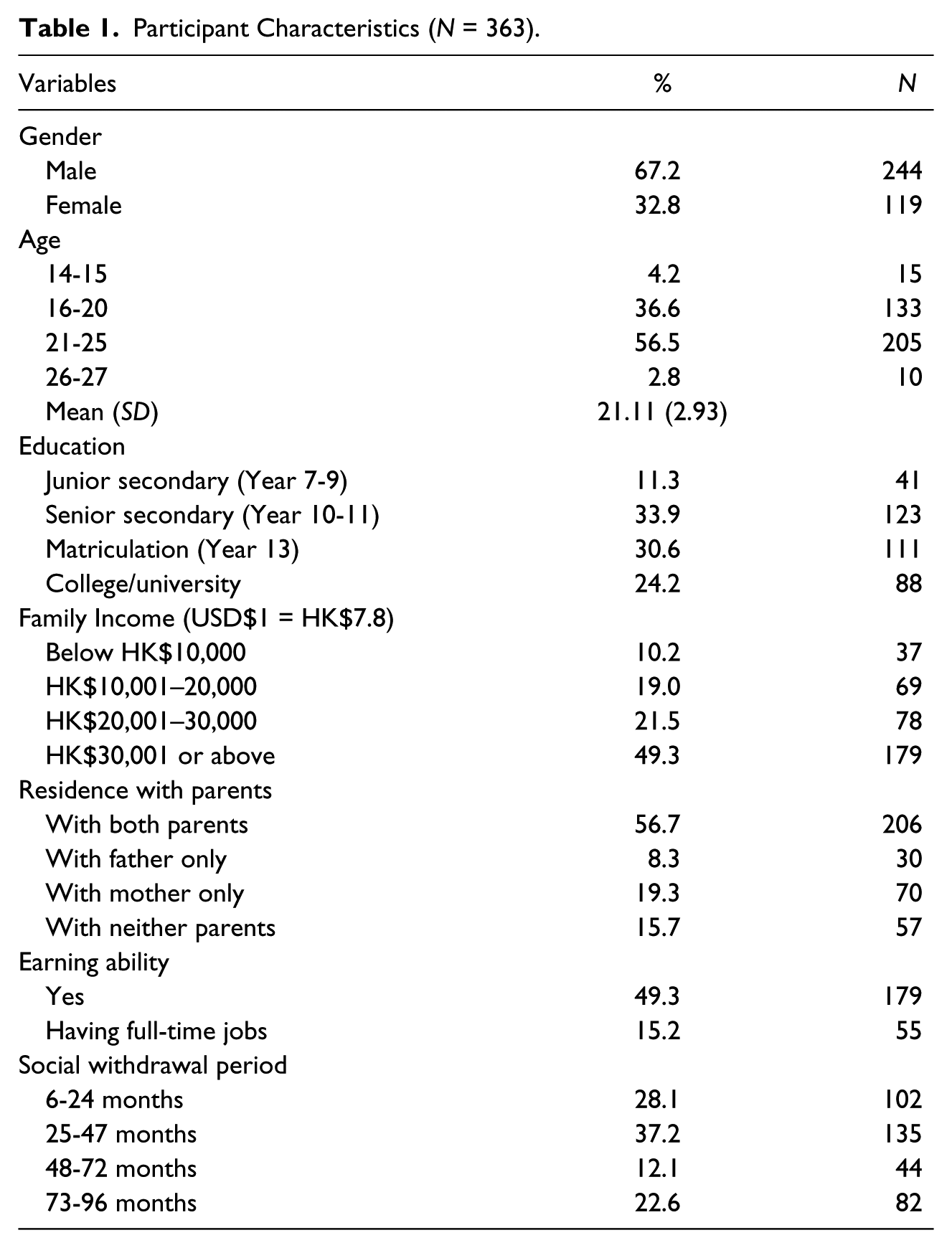
As shown in Table 1, the withdrawal period of the 363 participants ranged from 6 months to 96 months. Males comprised 67.2% of the participants; 32.8% of them were female. The age range of the participants was 14 to 27; the average age of the participants was approximately 21 (M = 21.11). More than half of the participants had an education level of matriculation (year 13) or above (54.8%), and a family income of more than $20,000 (70.8%). Nearly half of them (49.3%) reported having earning ability, and a few had full-time jobs (15.2%). Information about hidden youth’s residence with parents was also sought; 206 (56.7%) of them lived with both parents, whereas 30 (8.3%) and 70 (19.3) of them lived with either father or mother, respectively. The demographic information of the participants reflects that although they retreated from school or work, most of them maintained interactions with their parents. It should be noted that it is possible for the participants to develop relationships with their partners via the Internet and engage in home-based work to earn a living.
Participant Characteristics (N = 363).
Sampling
The present study used purposive sampling to locate the hidden youth respondents. From January 2007 to November 2010, the investigator initially contacted hidden youth by means of the Internet, including ICQ, MSN, Facebook, weblog, and especially online games, including Ragnarok Online, Perfect World, and World of Warcraft. The investigator is also an online game player who regularly participates in online games and understands the operation of the gaming platform. After initial contact with the potential participants and rapport-building, the investigator disclosed identity and invited them to take part in the study. The investigator contacted them via the Internet or telephone to explain the aim of the study, reconfirm whether they had met the sampling criteria, ask for consent, and make appointments with them for conducting interviews. Consent forms were directly given to participants age 18 or above, and for those under 18, to their parents. The interviews lasted for about an hour, and participants were not compensated for their participation in the study.
In order to exclude inappropriate subjects, hidden youth participants had to meet the following criteria: (a) residents of Hong Kong; (b) within the age range of 12 to 30; (c) withdrawn for at least 6 months without maintaining most face-to-face social connections or participation except with closest family members; and (d) free from any psychiatric diagnoses or treatments. The investigator adopted the definition similar to that used in Japan (Saito, 1998), in which hikikomori is referred to young people having retreated from social connections except the closest family for more than six months and are not primarily caused by psychiatric illnesses, and modified it to suit the local context.
Measures Used in the Questionnaire Survey
Background information
This includes demographic variables of hidden youth participants, including their age, gender, education level, and family income.
Power variables
The power variables assess the power exertion over hidden youth by the adults. These include label of deviance (29 items), supervision and punishment by teachers (4 items), and parental supervision and punishment (13 items), which enable the measurement of the level of management and discipline from society and surveillants. Label of deviance was assessed by using an adopted version of the Internalized Stigma of Mental Illness (ISMI) scale (Ritshera, Otilingama, & Grajalesa, 2003) (e.g., “People discriminate against me because I am a hidden youth”). It was suitable to assess the effect of labels on hidden youth through examining how hidden youth participants think and respond when experiencing the stigmas imposed on them by society. Supervision and punishment by teachers (S.P. Zeng, 2000) (e.g., “Having done something that will be punished by teachers”) explored the degree of disciplinary regulation from teachers. For the measurement of the degree of disciplinary regulation from parents, Parental supervision and punishment (S.P. Zeng, 2000) was used (e.g., “Father / Mother timely corrects me when I have done something wrong”). The two scales that measure the disciplinary power from teachers and parents were adopted from Taiwanese research due to their strong applicability into Hong Kong’s cultural context.
Relationship
The variables were Relationship with parents (S.P. Zeng, 2000; Y.H. Zeng, 2000) (8 items, e.g., “I maintain good relationships with Father / Mother”); Relationship with siblings (S.P. Zeng, 2000; Y.H. Zeng, 2000) (7 items, e.g., “My siblings and I are concerned about each other’s lives”); Relationship with teachers (Deng, 2001; Xu & Ma, 1997) (7 items, e.g., “You and your teachers maintain harmonious relationships”); and Relationship with peers (Deng, 2001; Xu & Ma, 1997) (9 items, e.g., “You maintain harmonious relationships with your schoolmates”) (Deng, 2001; Xu & Ma, 1997), which were assessed and compared to see which kind of relationship exerted the greatest moderating impact of power and control over hidden youth.
Hidden youth’s self-esteem
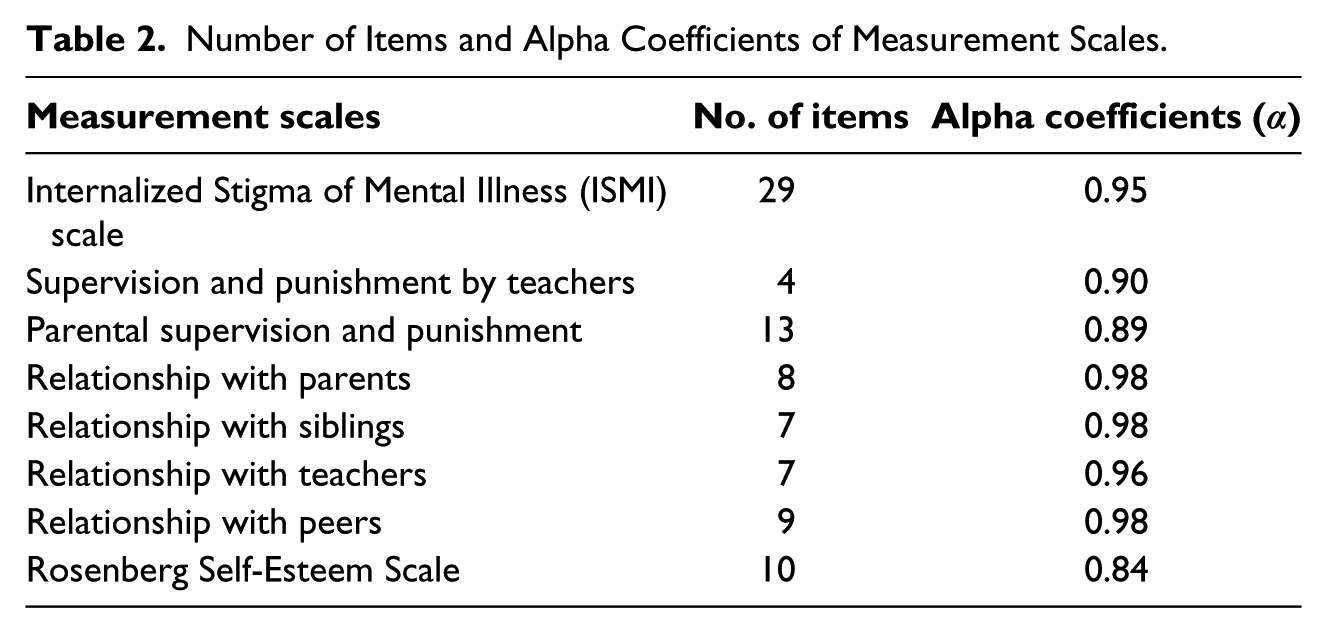
This variable represents the level of subordination and subjectivity under the power exertion by the adults. This was measured by the 10-item Rosenberg Self-Esteem Scale (Rosenberg, 1965) (e.g., “On the whole, I am satisfied with myself”). It was incorporated in this study because of its high empirical support in the assessment of individuals’ self-esteem. For details of alpha coefficients of the measurement scales, please refer to Table 2.
Number of Items and Alpha Coefficients of Measurement Scales.
Analyses
In order to explore which block of variables has the highest significant predictive power of hidden youth’s self-esteem, hierarchical regression was performed. In this analysis, apart from the effect of the relationship with parents, siblings, teachers, and peers on self-esteem, power variables and demographic information were also tested. The reason for including demographic information of the participating hidden youth was that it consists of individual factors that might cause individual differences in self-esteem among the participants. This statistical method enables the entrance of variables in the regression model in blocks, so as to determine which type of variables is the most significant predictor of a particular dependent variable. In addition, effect size (d) was introduced to give a supplementary measure of the degree of variance in the relationship between variables. To test the applicability of the hierarchical regression analysis, correlation analyses were conducted.
In addition, in order to explore whether the relationship between surveillants’ indoctrination of hidden youth through the label of deviance and their sense of self are dependent on the relationship with significant others, moderation analysis was performed. Label of deviance was used as the predictor in this analysis as it reflects the dominant societal expectations and judgments in Hong Kong, which constitute power exertion. Self-esteem as the outcome of the moderation analysis can be viewed as an indicator of the degree of impact of power exertion. To avoid the problem of multiple linearity, the investigator standardized the predicting variable and the moderating variable respectively, and multiplied them. If the mutual interaction causes a significant effect on the outcome variable, the moderating effect exists. In this case, the investigator further designed a diagram to represent the mutual interaction among the variables.
Results
Relationships With Significant Others and Hidden Youth’s Self-Esteem
As shown in Table 3, relationship with parents (r = .73****), siblings (r = .66****), teachers (r = .13*), and peers (r = .16*) were all significantly positively correlated with hidden youth’s self-esteem. This signifies that relationships with family members and others in external society are associated with self-esteem. Better relationships with other people are associated with higher self-esteem. On the other hand, label of deviance (r = −.60****), supervision and punishment by teachers (r = −.43****), and parental supervision and punishment (r = −.57****) were all significantly negatively correlated with self-esteem. This reflects that exertion of disciplinary power is associated with negative self-esteem. In addition, age (r = .38****), education level (r = .18**), and family income (r = .35****), but not gender, were all significantly positively correlated with self-esteem. This demonstrates that higher age, education level, and family income are linked to higher self-esteem.
Correlations Between Background Information, Power Variables, Relationship and Hidden Youth’s Self-Esteem.
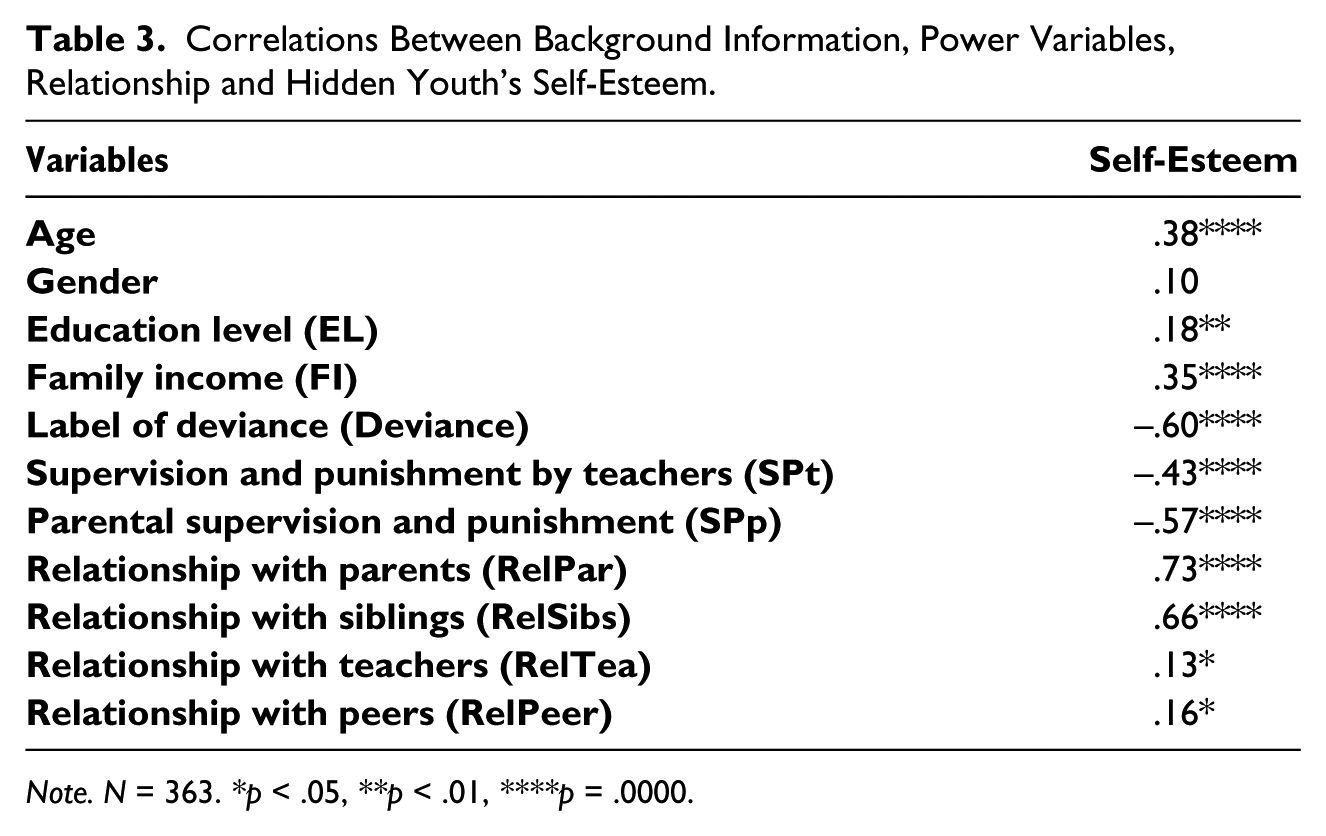
Note. N = 363. *p < .05, **p < .01, ****p = .0000.
In order to find out which of the above variables are most relevant in predicting self-esteem, hierarchical regression analysis was conducted. Altogether, there were five steps. Among the five models, changes in the predictive power of variables as indicated in the coefficients were observed. As shown in Table 4, model 1 only included demographic information of hidden youth participants. Age (ß = .43****) and family income (ß = .27****) were significant. Next, in model 2, when power variables were incorporated, demographic information became insignificant in predicting hidden youth’s self-esteem, but label of deviance (ß = −.32****) and parental supervision and punishment (ß = −.28****) were significant. In model 3, when relationship with teachers was incorporated, label of deviance (ß = −.32****) and parental supervision and punishment (ß = −.28****) became significant in predicting self-esteem. In model 4, when relationship with peers was incorporated, label of deviance (ß = −.35****), parental supervision and punishment (ß= −.30****), and relationship with peers (ß = .13*) remained significant in predicting self-esteem. Label of deviance and parental supervision and punishment predicted lower self-esteem, whereas a good relationship with peers predicted higher self-esteem. In model 5, when relationships with parents and siblings were incorporated, family income (ß = −.16*), parental supervision and punishment (ß = −.16*), relationship with peers (ß = .14**), relationship with parents (ß = .58****), and relationship with siblings (ß = .28**) were significant in predicting self-esteem. These results show that self-esteem in hidden youth is affected by not only the deployment of discipline (Foucault, 1980b), but also relationships with other people. Relationship with parents is especially important in affecting self-esteem. In model 5, relationship with parents (ß = .58****) was the strongest predictor of self-esteem among all variables. This implies that parents are the significant others that play the most important role in affecting self-esteem.
Mitrarchital Regression Analysis Predicting 11 itltlcn Youth’s Self-Esteem.
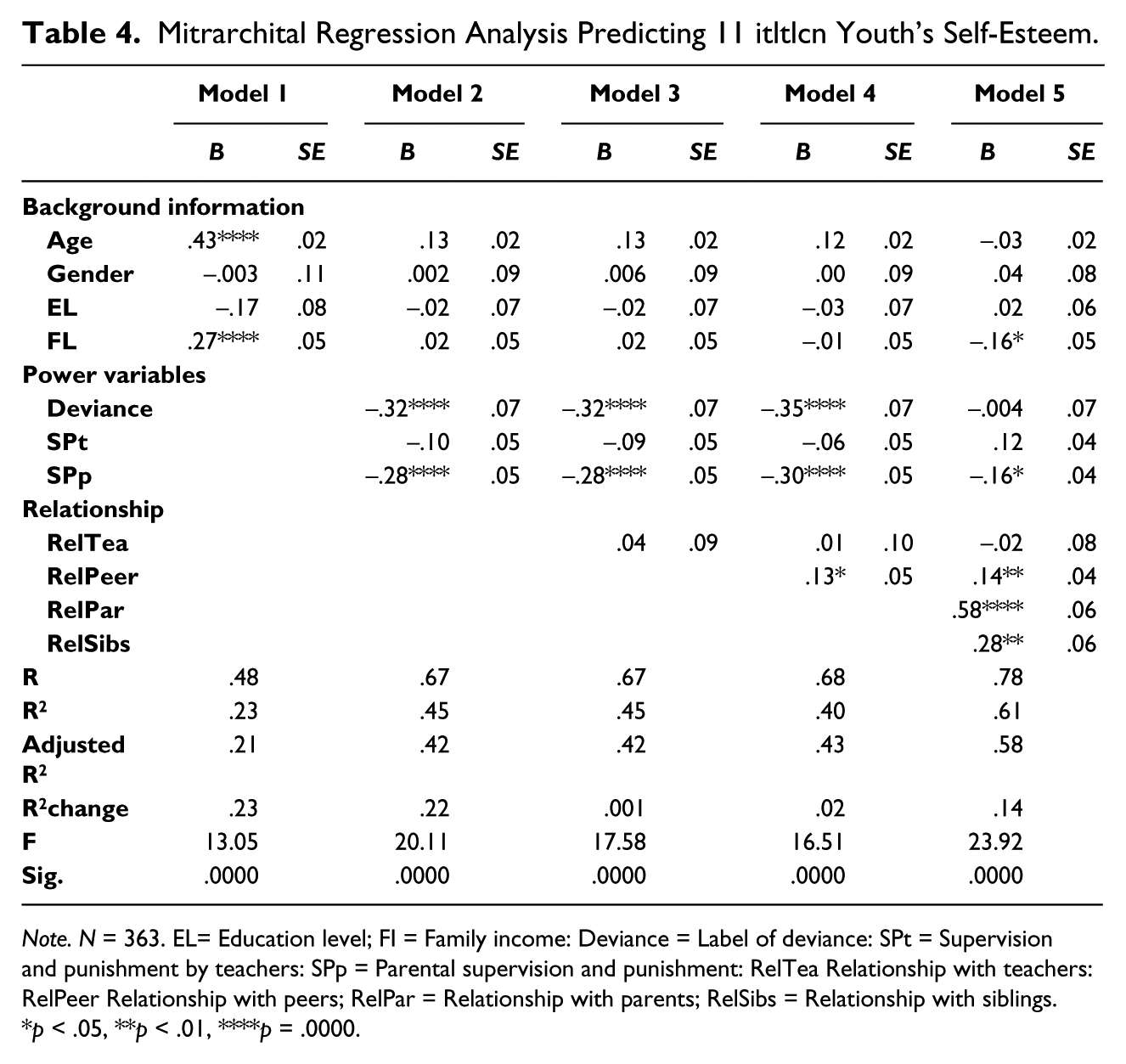
Note. N = 363. EL= Education level; FI = Family income: Deviance = Label of deviance: SPt = Supervision and punishment by teachers: SPp = Parental supervision and punishment: RelTea Relationship with teachers: RelPeer Relationship with peers; RelPar = Relationship with parents; RelSibs = Relationship with siblings.
p < .05, **p < .01, ****p = .0000.
All the five models were significantly predictive of self-esteem (p = .0000). Of the five models, model 5 showed the strongest predictive power of self-esteem. About 58% of variance of hidden youth’s self-esteem was accounted for by model 5 (F = 23.92****). A large corresponding effect size (d) of 1.39 was derived from model 5. In addition, the above regression analysis shows that relationship with parents is crucial in affecting the impact of power exertion as its incorporation in the model greatly diminishes the predictive power of other variables causing them to become insignificant. To summarize, the results suggest that the relationship of hidden youth with family, especially with parents, largely predicts self-esteem.
Relationships With Significant Others and the Impact of Power Exertion
To further explore how relationships with significant others influence the impact of power exertion over hidden youth, moderation analysis was conducted. It is assumed that either a good or poor relationship with parents may affect the impact of power exertion. As shown in Table 5, label of deviance was negatively associated with hidden youth’s self-esteem (β = −.34****), indicating that a higher level of label of deviance predicts lower self-esteem. The relationship between label of deviance and hidden youth’s self-esteem was significantly moderated by relationship with parents (β = .19***).
Results of Regressing Relationship With Parents, Relationship With Siblings, and Moderators.

Note. N = 363.
p < .001, ****p = .0000.
As shown in Figure 1, a higher level of self-esteem was noted when there was a good relationship with parents than when there was a poor one. As label of deviance increased, the level of self-esteem dropped regardless of how good or bad the relationship with parents was, but dropped at a faster rate when there was a good relationship with parents (t = −7.16****) than when there was a poor relationship with parents (t = −2.25*). The results indicate that the negative association between labels of deviance and hidden youth’s self-esteem becomes more apparent when there is a good relationship with parents.
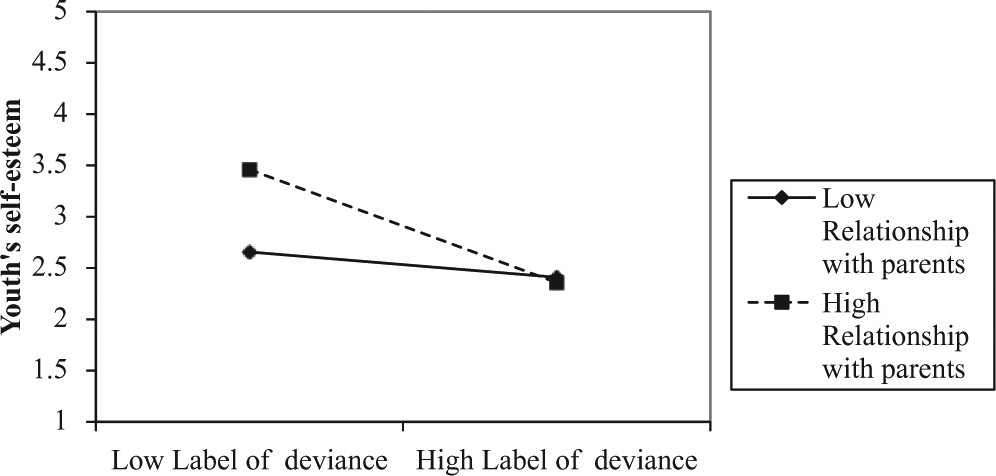
Relationship With Parents as a Moderator of the Relationship Between Label of Deviance and Hidden Youth’s Self-Esteem (N = 363).
Qualitative Analyses
To further explain these results, qualitative verbatim accounts were used to explore the greater significance of family relationships for hidden youth compared with other relationships. Throughout the process of becoming hidden youth, young people are disciplined by different people, including teachers, peers, siblings, and parents. In the eyes of hidden youth, these people have different levels of importance. Teachers and peers are far less important when compared with close family. The following verbatim accounts shed some light on the reasons why relationship with teachers is not a significant predictor of self-esteem:
The above verbatim accounts show that teachers are significant to hidden youth when compared with the hidden youths’ parents (Youth 26). They are afraid of the teachers not because of the teachers themselves, but the fear of negative consequences brought about by their family (Youth 18). This shows that in their views, teachers’ power comes from the parents, not from the teachers themselves. As hidden youth retreat from school to home, they have detached from the outer circle and their social status as a student is removed. This frees them from being controlled (Youth 35). Even though teachers continue to control them, they feel free to act rebelliously toward them as a form of “revenge.” The following accounts highlight some key aspects:
The above accounts show that facing discipline from teachers or social workers, hidden youth simply ignore them (Youth 03; Youth 09), or rebelliously resist (Youth 21) in order to force them to give up control. Because of low importance of teachers in their eyes, they feel comfortable cutting off the connections with the teachers to escape from their disciplinary control. In Youth 21’s case, he succeeded. The fact that teachers have almost no impact of power over hidden youth can be explained by the theoretical concepts of power. As youth retreat from society to home, they change from students to individuals without social status. Since the strength of power is determined by the strategic positions within relations in a particular historical context (Mao, 1992), this change in social status brings young people a change in the strength of power exercised within the relations with teachers. Their active refusal to be disciplined by teachers indicates a withdrawal from the power relations with teachers. Hence, the flow of disciplinary power from teachers becomes obstructed, and thus hidden youth become unaffected by teachers.
Peers also have less significance in the life of hidden youth. The following accounts show that hidden youth seldom find good, intimate friends at school:
The above accounts show that difficulty in finding good friends may push them to engage in school refusal, or even social withdrawal (Youth 18). Since they mainly find close friends outside school, or even from the hidden youth subculture, they are more willing to be influenced by these friends and build up friendships with them (Youth 29; Youth 37). This illustrates why peers may not significantly affect their self-esteem: when relationships with peers at school are not close enough, they remain unaffected by those peers in terms of behavior and psychological adjustment.
However, within their family, they adopt a very different attitude if they have good relationship with their family. In young people’s eyes, the family is of the utmost importance due to the inseparable, inborn kinship, and attachment (Bowlby, 1969/1982). The following accounts serve as an example:
… I don’t care…what I can’t accept is the harsh words from my parents.… I feel hurt.”
As shown above, the hidden youth care about their parents’ feelings (Youth 37). Although they receive discipline from their parents, they tend not to view them as annoying; rather, they view the disciplinary control as parents’ caretaking responsibility. Hence, they feel they are obliged to fulfill their responsibility as a son or daughter and feel their parents’ support and care (Youth 37), suggesting that they value the relationship with their family. Therefore, they tend to accept their prompting (Youth 13) and hope to receive their recognition (Youth 04).
Despite the uniqueness of the relationship between the youth and their family, some maintain a poor relationship with their family. This makes them become immune to the power of family, as shown in the following accounts:
The above accounts show that when the youth have a poor relationship with parents, characterized by lack of affection and support (Youth 09; Youth 16), they are less likely to be affected by their parents, even though they are severely disciplined by them. They do not care about their parents’ negative evaluations, and therefore they do not suffer from poor self-esteem (Youth 02). This supports the results of the moderation analysis that a good relationship with parents highly moderates the impact of power exertion.
To summarize, young people have the closest relationship with their family throughout the process of becoming hidden youth. Because this relationship is of the highest level of importance for hidden youth, they are mostly affected by their parents’ disciplinary control. Although parents’ discipline may be severe, they are more willing to respect their demands when compared with other surveillants. Although they receive negative evaluations from their family, they still hope to be valued and recognized by family members. These findings show that the degree of relationship with significant others plays an important part in influencing the impact of power exertion.
Conclusions
The above results show that of all types of relationships, hidden youth’s relationship with parents is the one most related to the impact of power exertion. This finding signifies that the degree of relationship is essential in affecting the effectiveness of disciplinary control. In addition, this finding sheds light on the important role of the family. Being regarded as the fundamental agent of socialization (Macionis, 2006), the family is the most significant in terms of the transmission of societal norms to offspring.
Surveillants are executors enforcing disciplinary control over hidden youth so as to serve the aim of social control (McLaughlin & Muncie, 2001). During daily interactions, the deployment of disciplinary power over hidden youth is allowed (Foucault, 1980b). Nevertheless, the effect of the exercise of power is demonstrably dependent on the degree of relationships. As asserted by Yang (2004), the effect of disciplinary power deployed by an individual over another person is dependent on the understanding of that person; also, as noted by Moffatt (1999), whether the exertion of power is successful is determined by the person’s willingness to participate in the power relations. The findings of the present study show that Moffatt’s (1999) analogy of the social security system where the applicant and the social security staff form unequal power relations, as mentioned in the literature review, is applicable to the context of hidden youth. As young people have an innately intimate and inseparable relationship with family (Bowlby, 1969/1982), hidden youth view them as the most important significant others, and thus are more likely to yield to their parents’ expectations and indoctrination. That they respond to their family symbolizes their engagement in power relations with their family, which allows a further flow of disciplinary power and the exertion of influence by their family over them. In contrast, as people from the outer circle, such as teachers, are not significant others, hidden youth can simply cut off social connections with them to escape disciplinary control. As a result, the flow of disciplinary power over them is blocked; they then become immune to their discipline, and become invisible within the power relations with adults in the outer circle.
To conclude, the hypothesis of this study is fully supported. The results show that self-esteem of youth comes after the experience of relationships with parents. This justifies that the effect of power exertion is moderated by the degree of relationship: The closer the relationship, the higher the impact of power exertion. Since hidden youth, who are in prolonged seclusion, reject most forms of social participation and stay only in the family, family becomes the only group of surveillants who interact with the youth. When the youth maintain good relationships with the family, they thus become more susceptible to the labels of deviance imposed by family members. On the contrary, when hidden youth have poor family relationships, the strategic positions between hidden youth and the family would change. The youth are more likely to resist and ignore the labels of deviance imposed by the family, thus weakening the effect of power exertion.
The present study strengthens current understanding of hidden youth by stressing the crucial role of relationships in influencing the effectiveness of power and control over deviant youth. It should be advocated that helping professionals should view hidden youth as a phenomenon rather than a problem. Instead of helping them eliminate their social withdrawal behavior, re-engaging them into society, and helping them regain social status, they should be concerned about youth’s needs and feelings, and underpinning meanings of their social withdrawal behavior. When hidden youth view themselves as a problem, helping professionals should help them externalize the problem and to enhance their self-esteem. Also, as it is their socially unrecognized capabilities that push them into marginalization, helping professionals should recognize their potentials and encourage them to develop their abilities to the fullest, so as to increase their self-esteem and self-efficacy. For parents, helping professionals should provide family education, as parents need to embrace diversity, and recognize the strengths and dreams of their children. The abilities that hidden youth possess are valuable resources and assets, only that they are not traditional ones and are not accepted by society. In addition, family counseling can be provided for families with hidden youth in order to equip them with the communication skills needed for maintaining harmonious parent-child relationships.
The major limitation of this study is its sampling method. As the investigator recruited the participants based on relative accessibility and proximity, the participants may have come from one single source and be highly homogeneous, which may have resulted in sampling bias hindering the representability of the sample to the entire hidden youth population. Further studies should recruit participants by using other sampling methods to determine whether there are different findings. Moreover, since resistance of hidden youth is an intervening factor in the complicated relationships among different variables: family relationships, labeling, power, and self-esteem, it is worthwhile to conduct further investigation into such dynamics.
Footnotes
Appendix: Qualitative Interviewing Guideline for Hidden Youth
Declaration of Conflicting Interests
The author(s) declared no potential conflicts of interest with respect to the research, authorship, and/or publication of this article.
Funding
The author(s) received no financial support for the research, authorship, and/or publication of this article.