



Abstract
This article examines changes in the trends and patterns in union formation of men and women in the Philippines, with primary focus on the role of education and urbanization. The study also investigates the determinants of marriage timing of both Filipino men and women to assess whether similar factors are at work in their decision to enter marriage. Data are drawn from the 2003 and 2008 National Demographic and Health Survey, and the Cox proportional hazard models are used for analysis. Results reveal that both Filipino men and women are delaying entry to marriage, as evidenced by their increasing age at marriage. The proportion of Filipinos living together has been increasing over time, compensating for the consistent decline in the proportion of those who are legally married. Education remains an important factor in marriage timing of both genders, although its impact is more substantial among the most recent cohort.
Introduction
The importance of marriage as an institution both for the individual and for the society at large cannot be overemphasized. For the individual, it is an important event characterized by a flurry of multiple transitions—from child to adult, from mere member of a natal family to main actor in the formation of a new family. Marriage is also a rite of passage that permits a range of adult behavior, including childbearing that is acknowledged by the society and legitimated by state and religious structures (Hull, 2011; Smith, 1983). At the societal level, marriage not only unites the marrying couple but their families as well to forge new social ties and create new production and consumption units (Quisumbing & Hallman, 2003). The importance of marriage for the individual and for the society as a whole has long been recognized in the Philippines, as evidenced by the wealth of studies in the 1970s and 1980s on nuptiality and its implications on fertility (Raymundo, 1984; Smith, 1975).
However, since these studies were conducted, a host of demographic and socioeconomic changes have swept the country. Population growth has been faster than in other major Southeast Asian countries, but economic growth slower. Education has continued to expand and urbanization to increase. The powerful Catholic Church, to which 81% of Filipinos adhered to in 2000, is strongly opposed to use of modern methods of family planning. While this has probably served to delay fertility decline in the Philippines, its effect on marriage is less clear. Lack of access to contraceptives may tend to encourage earlier marriage for some, but the fact that divorce is illegal in the Philippines may make some people more cautious about entering into marriage. As will be discussed later in the article, the incidence of cohabitation, also opposed by the Church, is increasing. Thus, there is a need to revisit the past and examine recent data to update our knowledge and improve our understanding of the marriage institution in the Philippines and of the way it is influenced by socioeconomic and ideational changes. This article therefore aims to examine changes in the trends and patterns on union formation of men and women in the Philippines, with primary focus on the role of education and urbanization in these changes (or lack thereof). Given the dearth of studies in the Philippines that investigate the marriage timing of men, this study attempts to fill this gap by examining the determinants of marriage timing of both Filipino men and women to assess whether similar factors are at work in their decision to enter marriage.
Background Literature
The determinants of women’s entry into marriage have received considerable attention in the past decades because of its close link to fertility. It has been recognized that the quantum, the timing (the age at which individuals enter marriage), and the tempo (the pace in the transition from being single to married) of marriage are important variables that affect fertility (De Guzman, 1983). In countries where early marriage is prevalent the concern is not only with its impact on fertility but also with its consequences on the overall well-being of the woman and her offspring (Jensen & Thornton, 2003). A number of factors have been examined to explain the variations in marriage timing of women but three prominent factors consistently emerge in the literature: female labor force participation, women’s acquisition of formal education, and urbanization (Singh & Samara, 1996; Smith, 1978).
The expansion of women’s education figured prominently as one of the major factors underlying the delay of women’s entry to first marriage (United Nations Commission on Population and Development, 2002). Various mechanisms have been suggested for the effect of increased schooling in delaying marriage. School attendance, especially beyond primary level, is not compatible with marriage because a woman has to remain unmarried in order for her to continue schooling into high school and advanced levels (Jones & Gubhaju, 2009; Smith, 1978). Aside from incompatibility with marriage, educational attainment, in conjunction with labor force participation, reduces the economic motivation for early marriage, and offsets its attractiveness by offering access to better jobs and higher income (Jones & Gubhaju, 2009 Singh & Samara, 1996). Moreover, formal education exposes women to nontraditional roles and provides viable alternatives to early marriage thereby expanding their opportunities and choices (Ikamari, 2005). In effect, education develops among women a sense of value orientation and aspirations that prioritize the attainment of personal fulfilment and career development over traditional roles of early marriage and reproduction (Ikamari, 2005). In addition, higher education may directly delay marriage among women because it reduces the pool of marriageable partners, since women are generally expected to marry men as educated as themselves (Cochrane, 1979 as cited in Singh & Samara, 1996). Meanwhile, it can also indirectly delay marriage by increasing woman’s ability to regulate her fertility through the use of contraception (Ikamari, 2005; Singh & Samara, 1996). Studies have shown that educated women are more knowledgeable about contraceptives and are more likely to use them than their less educated counterparts (Abejo, Go, Cruz, & Marquez, 2006). Moreover, the effective use of contraception lowers women’s exposure to unplanned pregnancy that may compel them to enter early marriage.
Apart from education, women’s participation in paid labor is also thought to influence both women’s and their parent’s desire and ability to postpone marriage (Dixon, 1978; Singh & Samara, 1996). Particularly, involvement in the formal sector exposes women to ideational change, provides them economic resources to postpone marriage if they wish to and gives parents the economic incentive to encourage their daughter to work sometime before marriage (Mason, 1987, and Adebusoye, 1995 as cited in Singh & Samara, 1996; Jones, 1994 as cited in Jones, 2004). Finally, urbanization is another factor that influences women’s age at marriage. Singh and Samara (1996) suggest that living in urban areas exposes women to modern values that favor marriage postponement and distances them from their kin who would otherwise control their sexual behavior, mate selection, and opportunities for nonmarital sexual relationships.
While these indicators of socioeconomic development have become prominent in explaining the variation in marriage timing of women, several authors observed the lack of attention to the marriage timing of men and its role in explaining the marriage timing of women (Mensch, Singh, & Casterline, 2005; Oppenheimer, 1988; Xenos & Gultiano, 1992). This lack of attention stemmed from the fact that available demographic surveys largely focused on women and their role in reproduction (Mensch et al., 2005). Oppenheimer (1988) criticized the one-sided focus on women’s economic behavior and changes in marriage timing and directed attention to the role of men in explaining the change in the marriage timing of both men and women. Oppenheimer (1988) argued that As long as men’s economic role in the family remains of considerable importance, the nature of the economic prospects of young males should continue to be a major factor in the marriage timing of females, as well as of males, despite changes in women’s labor-market behavior. (p. 586)
Studies on marriage timing in the Philippines abound in the 1970s and 1980s and are mostly linked to fertility (Raymundo, 1984; Smith, 1975). These studies reveal age at marriage to be an important determinant in fertility behavior of Filipino women although some studies have found that in more recent times, marriage makes little contribution in the fertility decline in the Philippines (Casterline, 2012; Cruz, 2011). In any case, studies on marriage formation in the country since the1980s have veered away from a focus on fertility (Ogena, Kabamalan, & Sasota, 2008; Williams & Guest, 2005; Xenos & Gultiano, 1992). This is probably in response to van de Walle’s (1993, p. 118) challenge to “care about marriage patterns ‘in their own right’” because understanding of “nuptiality change could further the understanding of other social change.” One recurring finding in the Philippines is that there is a general trend of increasing age at marriage of both men and women in the country, although marriage in itself continues to be considered desirable. As found in other settings, education, women’s employment, and urbanization remain important determinants of marriage timing in the Philippines (Ogena et al., 2008).
This article is divided into two parts. The first part updates the trends and patterns in age at marriage of men and women in the Philippines based on census and survey data. Changes in the marital status distribution of the population, specifically the never married, formally married and living together will also be examined. The second part investigates the determinants of marriage timing among women and men in the Philippines. Although there are studies that have investigated the marriage timing of men and women in the country these focus on the macro level (Ogena et al., 2008) and are limited to Filipino youth (Kabamalan, 2011a). The present research advances our knowledge by examining the microlevel determinants of marriage timing of both Filipino men and women using survey data that captures a broader cross-section of the population.
Trends and Differentials in Age at Marriage, Proportion Never Marrying, and Living Together in the Philippines
The mean age at first marriage of Filipino women rose from 20.9 years in 1903 to 24.4 years in 2010, or an increase of 3.5 years. Among men the increase in the same period was much lower, from 24.9 in 1903 to 27 years in 2010, translating to an increase of 2.1 years. The increase has been steady for both men and women, except in 1960 and 1980.
Compared with other Southeast Asian countries, the singulate mean age at marriage (SMAM) in the Philippines is way below that of Malaysia and Singapore, but is above that of Indonesia (see Figures 1 and 2). However, the rate of increase in SMAM has been much slower in the Philippines than in the other countries. For example, among women the increase in SMAM in the Philippines from 1970 to 2010 was only around 1.6 years. The corresponding increases in other countries for the same period range from 2.7 to 3.7 years. A similar pattern was also observed among the men. As in other countries, Filipino men marry later than Filipino women, although the gender differences have been narrowing over time, from 4 years in 1903 to 2.6 years in 2010.

Trends in singulate mean age at marriage (SMAM) among women in Southeast Asian countries, 1970-2010.
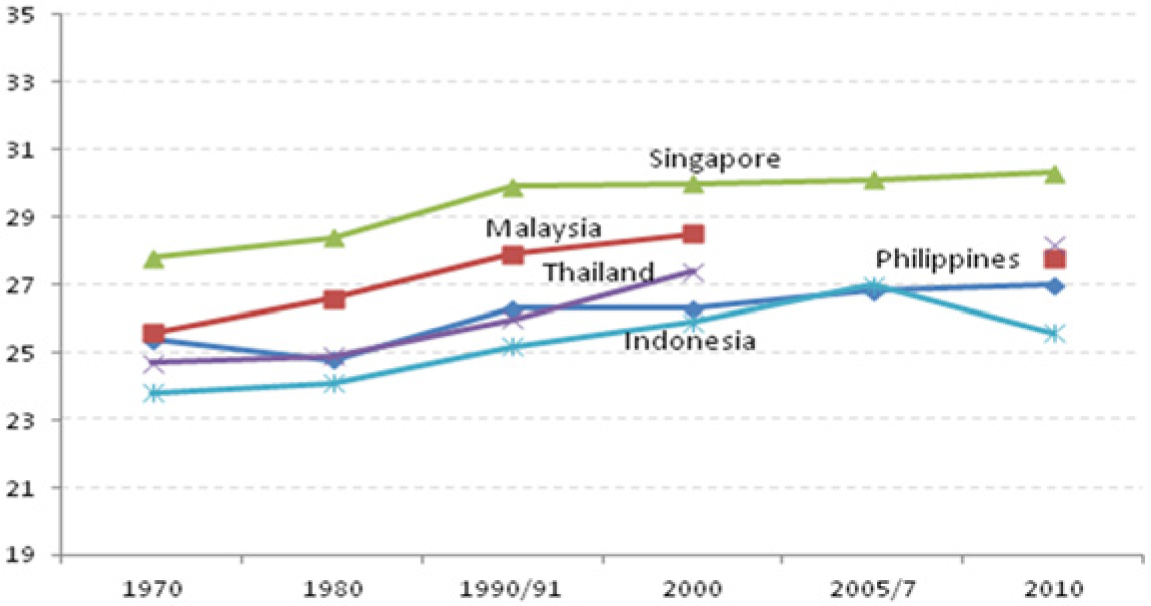
Trends in singulate mean age at marriage (SMAM) among men in southeast Asian Countries, 1970-2010.
As expected, there is a marked differential in age at marriage by level of education, as shown in Figures 3 and 4. Those with above secondary education marry later than those with below secondary education, although the difference is more glaring among women than men. For example as shown in Figure 3 a Filipino woman in 1990 with less than secondary education married at around 21 years while her counterpart with above secondary education tied the knot at around 26 years, translating to a difference of around 5 years. This large educational difference among women persisted until 2007 while that of men narrowed somewhat over the same period, from 2.8 years in 1990 to 1.7 years in 2007, as can be seen in Figure 4.
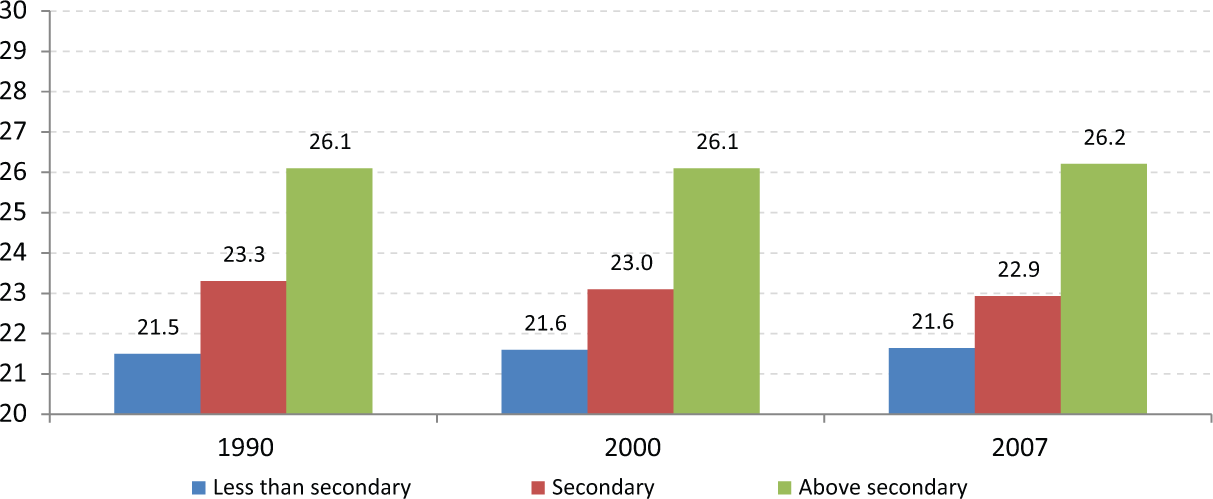
Trends in singulate mean age at marriage (SMAM) among women by education, Philippines: 1990-2007.
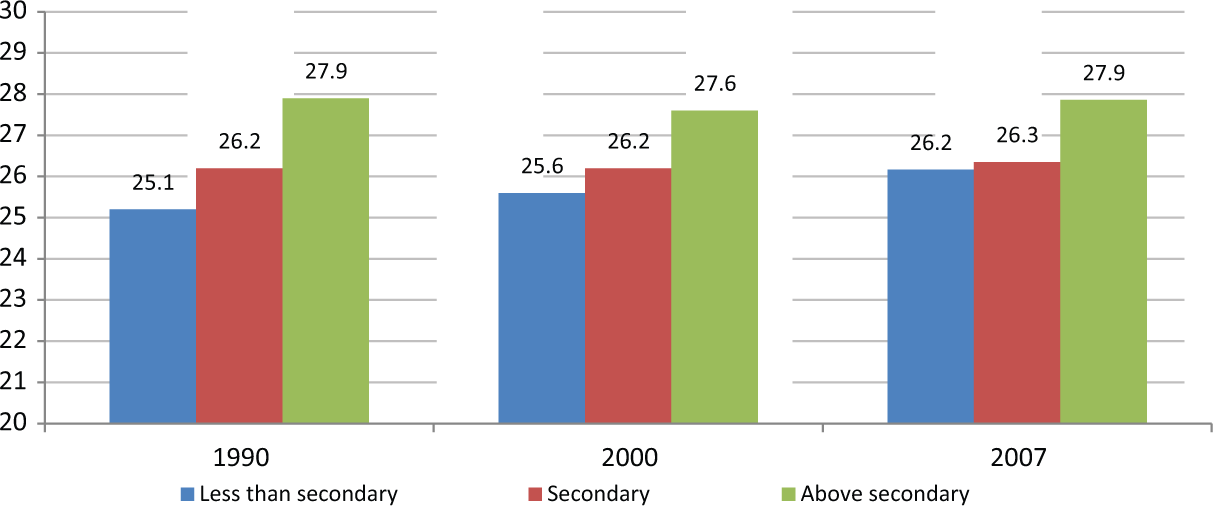
Trends in singulate mean age at marriage (SMAM) among men by education, Philippines: 1990-2007.
Similarly, there are clear differences in the marriage timing of men and women in the Philippines by type of place of residence, although the urban–rural divide has been fading over time. For example, in 1970, Filipino men in urban areas married 1.2 years later than their rural counterparts (26.2 vs. 25.0 years); however, in 2000, men from both urban and rural areas married at about the same age (26.4 years). For women, the difference was reduced from 2.3 years in 1970 (24.3 vs. 22.0 years) to less than 1 year in 2000 (24.3 vs. 23.5 years).
Another commonly used indicator to track changes in the nuptiality patterns is the proportion of never married in various age-groups. Historically, the Philippines was characterized by a high rate of singlehood at younger ages (Xenos & Gultiano, 1992), and this has persisted in recent times (see Table 1). The increasing marriage delay among women has also left a gradually increasing proportion of never married women in almost all age-groups, particularly among those in their 20s. Between 1970 and 2007, the proportion of never married women at ages 20 to 24 years increased from 50% to 58%, and among the 25- to 29-year age-group from 22% to 29%. Finally, the proportion of women who remain unmarried at the end of their reproductive years (45-49) has hovered around 6% to 7% from 1970 to 2007, indicating that marriage is still nearly universal in the Philippines.
Percentage Never Married Among Men and Women, Philippines: 1970-2007.

Source. Census data from various years.
Except for the sudden drop in 1980, the proportions of never married men beyond adolescence have also been increasing over time with a prominent increase in the 25- to 29-year age-group, from 30% in 1970 to 42% in 2007. The sudden drop in the proportion never married in 1980 could have been due to the different procedure in different censuses for treating those who are living together (Jones, 2011). Meanwhile, the rising trend in permanent celibacy among Filipino men has also continued unabated since 1970 with the proportion remaining single at ages 45 to 49 rising from 3.7% in 1970 to 7.8% in 2007.
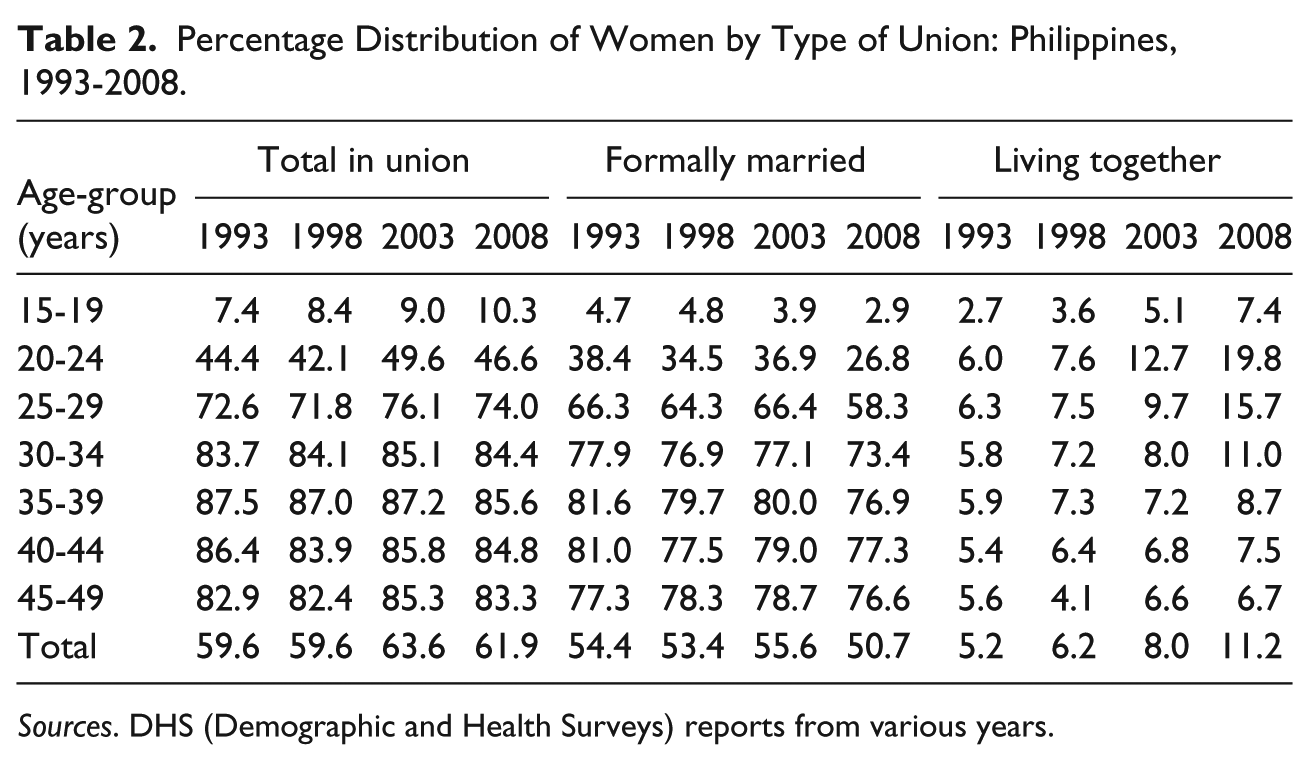
Given the changes in the proportion single in most age-groups in the country it is also instructive to look at changes in the type of union of those who are in union. Table 2 presents the percentage distribution of women by type of union, that is, legal or formal marriage and cohabitation or living-in arrangement. As a whole, the proportion of Filipinos who are in union is decreasing over time, although teenage marriage among women remains one of the highest in the region. In the earlier decades, the Philippines used to have one of the lowest proportion of teenage brides in Southeast Asia, but by 2000, after the large declines in other countries, the Philippines ranks high in terms of proportion of teenage marriage (Jones, 2011).
Percentage Distribution of Women by Type of Union: Philippines, 1993-2008.
Sources. DHS (Demographic and Health Surveys) reports from various years.
Disaggregating those in union by type of union reveals an emerging pattern of marriage formation in the Philippines. As can be seen in Table 2, the proportion legally married has consistently declined since 1993, but this decline was offset by the increasing proportion of those who are living together, particularly among the younger age-groups. For example, the proportion of women aged 20 to 24 years who are cohabiting increased from 6% in 1993 to 20% in 2008. The proportion in cohabitation among women aged 25 to 29 years likewise increased from 6% in 1993 to 16% in 2008.
Why do so many Filipinos cohabit? A variety of reasons have been cited. Based on a 2002 survey of young adults in the Philippines, 36% of young people opted to live together with their partner due to economic reasons, another 23% cited pregnancy, and some 15% considered it as a sort of trial marriage (Kabamalan, 2004). Qualitative evidence revealed that cultural traditions, misinterpretation of marriage laws, and legal impediments, among others, were also some of the reasons why Filipinos resort to this type of union (Kabamalan, 2004, 2011b). With the increasing proportion of Filipinos in live-in arrangements, the question arises whether cohabitation has become another path to marriage or an alternative to marriage in the Philippines. Available data suggest that it is more of the former than the latter. Survey data collected by the Social Weather Station in 1994 among Filipinos 18 years old and above show that 22% of married respondents ever lived with their partner/spouse before they married (Guerrero, 1995). Meanwhile, in 2002 more than half (54%) of Filipino youth aged 15 to 24 who have been married went through cohabitation before being formally married (Kabamalan, 2004).
Determinants of Marriage Timing of Men and Women in the Philippines
While the preceding section reveals an association between education and urbanization, on the one hand, and age at marriage on the other, it is still important to examine the effect of these factors in multivariate analyses to assess the net effect of other confounding factors. This section deals with the correlates of marriage timing among men and women in the Philippines. To assess the effect of these correlates overtime a separate model for each cohort of men and women was estimated.
Data Source
Data for this analysis are drawn from the 2003 and 2008 National Demographic and Health Survey (NDHS). The 2003 and 2008 NDHS are used to examine the marriage timing of men and women, respectively. The 2008 NDHS collected comprehensive information on women’s reproductive health, marriage timing, contraceptive method, and other sociodemographic characteristics, among others (National Statistics Office & ICF Macro, 2009). The survey interviewed 13, 594 women aged 15 to 49 years; of these, 9,194 were ever married and 4,400 were never married. Meanwhile, the 2003 NDHS is the first and only national demographic survey conducted in the Philippines that interviewed male respondents. It collected information on men’s sociodemographic and health concerns including fertility, marriage, and reproductive health, among others. In total, 4,766 Filipino men aged 15 to 54 years were interviewed; 2,877 were ever married and 1,889 were never married. Details on the methodology and sampling procedures of these surveys can be found elsewhere (National Statistics Office & ICF Macro, 2009; National Statistics Office & ORC Macro, 2004).
Dependent Variable
Marriage in this study includes both formal marriage and living together or cohabitation. The dependent variable is age at first union and is defined as the age at which the respondent began living with his or her first spouse. Since arranged marriage is not prevalent in the country, it is assumed that the risk of first marriage starts at age 15 years. The study will use the event history analysis, specifically the general proportional hazard or Cox model, to assess the effect of various covariates on the timing of union in the Philippines. The timing of union can be interpreted as survival time from single to married state. However, there are men and women who will not make the transition from single to married state during the observation period and thus constitute censored cases. Given this constraint, a hazard model is the most appropriate method of analysis because it takes into account these censored cases or those who have not experienced the event, thus producing less biased estimates when compared with the ordinary least squares regression.
Explanatory Variables
In examining the determinants of marriage timing, the study focuses on socioeconomic factors, specifically education and urbanization. While it is ideal to include the experience of work prior to marriage, especially among women, this indicator is not available in the survey data.
Education refers to the highest grade completed by the respondent and is categorized into primary and below, secondary and above secondary education. Urban exposure is a dichotomous variable indicating whether the respondent mostly lived in an urban area until age 12. 1 The respondent’s childhood place of residence captures the impact of urbanization on marriage timing by measuring the effects of more individualistic social and normative environments in cities where the respondents grew up (Tsuya, 2001).
Other explanatory variables include birth cohort, ethnicity, and religion. Birth cohort is the respondent’s year of birth. For women, it is grouped into 1958-1968, 1969-1978, and 1979-1993. Among men, it is classified into 1948-1963, 1964-1973, and 1974-1988. This variable is meant to capture the various cultural, socioeconomic, and political factors that may have an impact on the life experiences of these men and women.
Since the Philippines is home to more than a hundred ethnic groups, ethnicity is also included as one of the explanatory variables to capture this ethnic diversity. However, due to limited sample size only the five major groups are considered in this study. These are Tagalog, Cebuano, Ilocano, Ilonggo, and Bicolano. All other ethnic groups were lumped into the “other” category. Finally, religion is also included because of its role as an important transmission channel of marriage norms (United Nations, Department of International Economic and Social Affairs, 1990). This variable is grouped into Roman Catholic, Islam, and other religions. 2
Results
The results of the multiple Cox-proportional hazard models are presented in Table 3 for women and Table 4 for men. Table 3 shows that education, ethnicity, and birth cohort are all significantly associated with the timing of Filipino women’s entry to first union. Consistent with earlier studies, education is the major factor delaying Filipino women’s entry to first marriage. The risk of first marriage is 22% and 60% lower for women with secondary and above secondary education, respectively, compared with those with primary education or lower.
Hazard Models of the Risk of First Marriage Among Women by Birth Cohort: Philippines, 2008.

p < .05. **p < .01. ***p < .000.
Hazard Models of the Risk of First Marriage Among Men by Birth Cohort: Philippines, 2003.

p < .05. **p < .01. ***p < .000.
The year of birth is also significantly associated with early marriage. Women born much more recently are somewhat more likely to enter early union than women in the older generations. For example, women born between 1979 and 1993 are 8% more likely to marry early than women born between 1958 and 1968. Ethnicity also shows a significant relationship with the timing of union among Filipino women. Specifically, Ilocana women are 20% more likely to enter union than their Tagalog counterparts. However, urban exposure during childhood and religion do not have significant net effect on the risk of first marriage in the Philippines.
Table 3 also presents the results of the Cox regression analyses on each of the three cohorts of women using the same set of predictors among all women. As in the earlier model, higher levels of education are associated with a lower risk of early marriage in the three cohorts of women. However, the effect of advancing education on the hazard of early marriage is more pronounced among the youngest cohort. Compared with women with primary or below primary education, the risk of early marriage among women with above secondary education is reduced by 51%, 58%, and 72% for women born during 1958-1968, 1969-1978, and 1979-1993, respectively. The stronger effect of advanced education among the most recent cohort of women could be due to the enhanced career opportunities for women with higher level of education and to the weakening of cultural traditions and practices that encouraged early marriage in the past (Ikamari, 2005).
Meanwhile, ethnicity also proved to be significant but only among the youngest and oldest cohort of women. For instance, Ilocana women in the youngest cohort are 41% more likely to form union than their Tagalog counterparts.
Analyses on the determinants of Filipino men’s marriage timing are presented in Table 4. As with women, education has a delaying effect on Filipino men’s entry to marriage. Filipino men with secondary and above secondary education are 18% and 34%, respectively, less likely to marry early than men with primary education or lower. Childhood place of residence, birth cohort, and ethnicity do not have an important effect on men’s entry to union, but religion display significant association with Filipino men’s timing of union. Specifically, Muslim men are 35% more likely to marry early than Roman Catholic men.
Table 4 also presents the results of the analyses comparing the determinants of timing of marital formation of Filipino men across cohorts. As with the earlier model that used the full sample of men, education exerts a significant effect on the transition to first union formation among Filipino men, albeit of varying magnitude. As with the women, the impact of advancing education on the likelihood of early marriage is much stronger among the recent generation of men than their older counterparts. For instance, above secondary education reduces early marriage by 25% among the 1948-1963 and 1964-1973 cohort; and 60% among the 1974-1988 cohort, all compared with men with primary education or lower.
Ethnicity and religion emerge as significant only among men in the oldest cohort. Specifically, Cebuano men born during 1948-1963 are 23% more likely to marry early than Tagalog men. Meanwhile, the risk of early marriage among Muslim men born in 1948-1963 is 39% higher than for Catholic men.
Summary and Discussion
This article examined the trends and differentials in age at marriage of men and women in the Philippines. Results show that both Filipino men and women are delaying their entry to marriage, as evidenced by their increasing age at marriage, albeit at a slow pace compared with their Asian neighbors. Moreover, clear differentials in age at marriage by level of education and type of place of residence are also observed. Higher level of education is associated with higher age at marriage for men and women, although the education differential is more pronounced among women. Although age at marriage differs between urban and rural residents, the urban–rural divide has been collapsing over time, particularly among men. An emerging path to union formation is also noted. The proportion of Filipinos living together has been increasing overtime, compensating for the consistent decline in the proportion of those who are legally married. This is somewhat consistent with the findings of a survey conducted in 2012 by the Catholic Church among 2,500 persons from 85 archdioceses and dioceses across the 17 regions of the country. The survey revealed that only 42.3% of those who were interviewed claimed to be married in a Catholic Church, whereas 50.2% had “no answer.” The Catholic hierarchy suggested the large proportion who had “no answer” could be living together out of wedlock but are embarrassed or uncomfortable to admit that they are in such an arrangement (Antonio, 2012).
One common explanation for the increasing marriage delay is the increasing education level, especially among women. This is borne out in the multivariate analyses as both men and women with higher education are more likely to marry later than their lower educated counterparts, although the impact of education is much more substantial among the recent cohort of men and women. The stronger impact of education on marriage timing among the youngest cohort can be explained by the increasing importance of advanced education in securing decent employment in recent times. It should be noted that unemployment, along with poverty and financial inadequacy constitute the main drivers of marriage delay in the Philippines (Williams & Guest, 2005). Unlike in the past when it was much easier to get a job even without formal schooling, today’s generation have to contend with much stiffer competition in the job market, necessitating them to pursue more advanced levels of education to get ahead of their competitors, at the expense of marriage postponement. Overall, these results suggest that socioeconomic factors still play an important role in the timing of union formation of men and women in the Philippines.
Footnotes
Acknowledgements
I am grateful to Gavin Jones, Wei-Jun Jean Yeung, and Maria Midea Kabamalan for their helpful comments on an earlier version of this article.
Declaration of Conflicting Interests
The author(s) declared no potential conflicts of interest with respect to the research, authorship, and/or publication of this article.
Funding
The author(s) received no financial support for the research, authorship, and/or publication of this article.