




Abstract
This article analyses trends in early marriage in Turkey over a period of 30 years from 1978 to 2008, and factors associated with early marriage, based on data from the 1978 Turkish Fertility Survey and 2008 Turkey Demographic and Health Survey. The proportion of all women aged 20 to 24 who married before age 18 declined from 38% in 1978 to 14% in 2008. For ever-married women aged 20 to 24 years, the article examines risk factors for the common explanatory variables such as educational level of women, childhood place of residence, type of place of residence, region and spousal age gap, using logistic regression analysis. For women, early marriage is associated with all the explanatory variables in both surveys. Increasing women’s education and achievement of gender equality in all spheres of life emerge as essential steps to cope with the problem of early marriage and to eliminate child marriage.
Introduction
Early marriage, a problem faced mostly by girls, leads to inequality and discrimination in the lives of women (Hervish & Feldman-Jacobs, 2011; International Planned Parenthood Federation & United Nations for Population Association [IPPF & UNFPA], 2007). Although prevalence of child marriage differs by country and region, early marriages are more frequently witnessed in those developing countries where marriage is near universal and extramarital childbearing is not approved than in developed countries (Bates, Maselko, & Schuler, 2007; Caldwell, 2005; Singh & Samara, 1996). The critical age limit worldwide for defining child marriage is 18 (Hervish & Feldman-Jacobs, 2011; United Nations Children’s Fund [UNICEF], 2007). 1
Marrying off a girl child at an early age contravenes human rights and children’s rights; it is one of the forms of discrimination and violence against women. The results of national surveys conducted in 10 countries between 2000 and 2010 indicate that 58 million young women in developing countries have been married before the age of 18 years (Hervish & Feldman-Jacobs, 2011). While the percentage married among women aged 15 to 19 is 4% in the United States and 2% in the United Kingdom, this proportion is 62% for Niger and 51% for Bangladesh, reflecting the tendency for more child marriage to occur in countries with relatively lower levels of socioeconomic development (Otoo-Oyortey & Pobi, 2003). The percentage of women aged 20 to 24 who have married before the age of 18 is highest in South Asia (48%) and Africa (42%), followed by Latin America and the Caribbean (29%; UNICEF, 2007; see also Jensen & Thornton, 2003; Singh & Samara, 1996). Thus, even though marriage patterns have been changing in most Asian countries, early marriage remains a social problem in South Asia (Jones, 2010). In Turkey, in 2008, 14% of women aged 20 to 24 years were married before age 18 years. Although not as high as in the South Asian countries, this is a sociodemographic problem requiring attention.
The primary objective of this article is to present the early marriage trends in Turkey over a period of 30 years, from 1978 to 2008, based on the available demographic survey data, which enable comparison of women’s basic characteristics. In this article, the risk factors affecting girls’ marriage before the age of 18 will be identified, focusing on selected explanatory variables for which information is available—educational level of women, type of place of residence, region, and spousal age gap—using logistic regression analysis.
Addressing the Major Factors of Child Marriage
With a population of 75 million, Turkey is the ninth most populous country in Asia, and situated as it is between the continents of Asia and Europe, it is an interesting setting to study early marriage patterns. Despite the legal arrangements and ratified international conventions for eliminating early marriages, the society’s patriarchal values, religion, and various socioeconomic factors and family structure are the cornerstones of early marriage in Turkey. Families play an important role in marriage decisions of their children in Turkey, and more than half of the marriages are decided by the families not by the individuals concerned. Based on the 2008 Turkey Demographic and Health Survey (TDHS), cousin marriages (24.1%) and traditional practices such as bride price (14%) as well as religious-only marriages (3.3%) still exist (Yuksel-Kaptanoglu & Ergocmen, 2012). In Turkey, patriarchal values reinforced by religion have more influence on marriage and childbearing than the direct effect of religion. Gender relations in the country, argues Kandiyoti (1988), can be labeled as a part of “classical patriarchy,” the key to which
lies in the operations of the patrilocal extended household which is characteristic of South and East Asia as well as the Muslim Middle East . . . under which girls are given away in marriage at a very young age into households headed by their husband’s father. (p. 278)
Patrilocality is another characteristic of the family structure, and 61.3% of newlyweds live with family members at the beginning of marriage (Yuksel-Kaptanoglu & Ergocmen, 2012).
Age at first marriage provides valuable information about women’s status in public and private life and has important implications for power relations between spouses. As a result of demographic transition and progress in socioeconomic conditions in Turkey, there has been a rise in the mean age at first marriage from 17.7 in 1978 to 20.8 in 2008 for women aged 15 to 49 years. Age at first marriage for men is higher; men are expected to marry after becoming breadwinners, usually subsequent to completion of a certain level of education as well as military obligations.
Early marriage takes away many opportunities from women’s lives, such as continuing education, participating in the labor force, and having a real role in household decisions. Being married off at early ages restricts women’s lives to traditional roles with less power in all spheres of life. Studies conducted in Asia and in the Middle East and North Africa region show that child brides have a lower status within the family and a higher risk of becoming victims of domestic violence (Clark, Silverman, Shahrouri, Everson-Rose, & Groce, 2010; Das Gupta, 1996). Specifically for Turkey, a nationwide study on domestic violence against women has revealed that young women at ages 15 to 24 years are more exposed to sexual and physical violence than women older than 25 years (Directorate General on the Status of Women, 2009). Pressures and controls on child spouses’ behavior not only decrease their self-confidence but also put them in a disadvantaged position in many respects. The typically wide age gap between child brides and their spouses creates unequal power relations between the young bride and her husband (UNICEF, 2001). Besides, sexual activity, which they experience at very early ages, usually takes place against their will (Otoo-Oyortey & Pobi, 2003). Having sexual intercourse with child spouses can be considered as child abuse (Bates et al., 2007; Hervish & Feldman-Jacobs, 2011; Mikhail, 2002; Otoo-Oyortey & Pobi, 2003).
Many factors which are mostly beyond the control of the girl child put her at risk of early marriage. Although factors are generally interwoven, level of education, family structure, religion, the social and cultural environment that women are brought up and live in, and the gender system are the most pronounced ones.
Prevailing gender roles in any country shape women’s social life and restrict them to traditional roles. Globally, gender inequality is measured by different indicators, among which the Global Gender Report documented inequality both in the private and public spheres. According to the Gender Gap Report of 2012, Turkey is in the 124th rank among 135 countries (Hausman, Tyson, & Zahidi, 2012). Although substantial progress toward gender equality has been made in Turkey, there is clearly a need to adopt new dimensions for further improvement in this area. For example, with the increased momentum of women’s movements for the provision of gender equality, Turkey has signed many international conventions, such as the Convention on the Elimination of All Forms of Discrimination against Women monitored by the Committee on the Elimination of Discrimination against Women. One of the recent legal arrangements aiming to ensure equality between women and men was that in 2001, the minimum legal age for marriage was raised with an amendment to the Civil Code. Accordingly, the legal marriage age, which was 15 for women and 17 for men, was raised to 17 years for both. This amendment, however, has proved inadequate in preventing child marriages due to the concepts used in expressing the article such as “extraordinary conditions” and “for compelling reasons”:
A man or woman is not allowed to marry before completing the age of seventeen. Nevertheless, a judge can make an exception and lower the age limit to sixteen under extraordinary conditions and for compelling reasons. Where possible, the judge hears the opinions of parents and guardians before making a decision. (Turkish Civil Code, 2001)
In Turkey, Islam is the predominant religion (98%), and Sunnis make up the overwhelming majority. However, as a secular country, liberal attitudes prevail in practicing religion. Marriages performed only by religious ceremony are not legally recognized, and a religious marriage may not be performed before the civil marriage. Yet in child marriages, girl children are married off only by religious ceremony until they reach the legal age of marriage for the civil marriage to be conducted. Getting married only by religious ceremony prevents girls from exercising their legal rights, ranging from choosing the home they live in and participating in decisions about their children to having equal rights on property acquired during marriage. Religious-only marriage deserves attention; it is not legal by itself and is a religion-based practice that is the preferred choice for families marrying off the girl child at an early age. Although it is considered a crime of rape to have sexual relations with a child under the age of 15 years, in religious-only marriages, such behavior is usually not reported as a crime, and no criminal action is taken. This is one of the obstacles to prevention of child marriages. Nevertheless, change is certainly occurring; in the three decades between 1978 and 2008, among all women aged 20 to 24 years, the proportion who married (civil and/or religious) before age 18 declined from 38% to 14%. This shows a significant decline in child marriage over this period.
Failure to prevent child marriage despite international conventions and national legal regulations prohibiting such marriages denotes that this problem cannot be solved only through laws. Social and cultural value judgments that approve early marriage of especially girl children and consider it legitimate may prove to be more powerful than laws. Among these values, perception of sexuality and the concept of honor in society are the outstanding ones. For example, the concept of “honor” in Turkey is generally associated with sexuality of women, and it is one of the cultural factors which incline families to favor early marriage for the girl child before she experiences any sexual relations which could bring dishonor to the family. Moreover, in view of the fact that not being in a marital union is socially disapproved, particularly in rural areas, families prefer to marry off their children before their marriage can be considered to be a late marriage.
The heterogeneous socioeconomic and cultural structure of the country introduces large disparities in the social, cultural, economic, and demographic spheres, bringing into view the simultaneous existence of modern and traditional beliefs regarding social and demographic behavior. Based on the different levels of socioeconomic development as well as ethnic and cultural characteristics, divergence in lifestyles, attitudes, and behaviors are observed throughout the country among different population groups. Ethnically, Turks constitute the majority of the population followed by Kurdish and Arabic-speaking populations. Kurds were originally concentrated in the Eastern and South eastern parts of Turkey, and the Arabic population in the Southeast. Kurdish women make up 46% of women who marry before the age of 18 and Arabs 31%, while the proportion for Turks is 25% based on the 2008 TDHS results (Yuksel-Kaptanoglu & Ergocmen, 2012). This is much higher than their proportions in the country’s population, meaning that the proportions of women having early marriages are much higher for the Kurds and Arabs than for the Turks.
Urban/rural and regional variations are also observed in terms of many indicators, including the demographic ones. Demographic surveys in Turkey show a persistent difference in demographic profiles among places of residence. The long-term declining trends of fertility and mortality brought the country to the last phase of demographic transition, with close to replacement level reproduction of 2.1 children per woman, with higher values in rural areas compared with urban areas based on the 2008 TDHS. Demographic disparities exist among the five regions of Turkey, which are not administrative divisions but are generally distinguished by geographic conditions and socioeconomic levels. Most of the demographic indicators (e.g., high total fertility rate [TFR] of 3.27) and lower level of socioeconomic development lead to expectation of high early marriage levels for the East region among its counterparts. In contrast, the West has a low TFR of 1.73 and high levels of socioeconomic development. The Central region has the second highest fertility after the East Region with a TFR of 2.20 (Hacettepe University Institute of Population Studies [HUIPS], 2009). However, it also has the second highest socioeconomic-level indicators after the West Region. Parallel with this heterogeneity, age at first marriage shows variation across the country, with a difference of almost 2 years between the East and West regions. Even though age at marriage has been rising throughout the country, marriage remains a universal institution; 96% of women are in a marital union by their late 30s, and less than 1% remain never-married at the end of their reproductive period. Nevertheless, postponement of marriage has been a significant factor in the remarkable decline of fertility and thus in the demographic transition of the country. The proportion of never-married women aged 15 to 19 increased from 77.8% in 1978 to 90.2% in 2008. With a shift to low and relatively stable levels of mortality and fertility, Turkey is now in the last phase of its demographic transition.
Because of the rapid growth of urban populations, more than three fourths of the population now lives in urban areas. This mobility from rural to urban settlements caused an interaction of values influencing both parties; and in the process of transition, the family has also undergone change. The nuclear family which has been the prevailing family type since the early 1970s (58%) is increasingly the most common family form at 69.8% (HUIPS, 2010). Moreover, in the past four decades, the proportion of patriarchal extended families declined from 19.3% in 1968 to 7.4% in 2008. However, internal migration dating back to the mid-19th century from the eastern to the western and southern parts of the country has resulted in a rather heterogeneous population in these regions.
Education has an important place among social, economic, and cultural factors associated with child marriages. One of the consequences of the patriarchal system that restricts women’s access to education is that, in many countries, girls have less access to education than boys at all levels of education. The low level of education of girls is both the cause and outcome of early marriages (IPPF & UNFPA, 2007; Santhya et al., 2010; UNICEF, 2005). Most studies conducted in developing countries touch on the importance of the increase in the level of education of girls in preventing early marriages (Bates et al., 2007; Hervish & Feldman-Jacobs, 2011; Ikamari, 2005; Singh & Samara, 1996). Increase in women’s educational level has been a remarkable achievement in Turkey. However, the countrywide illiteracy rate of 10% for women and 2% for men as of 2010 indicates that overall literacy in the country has yet to be achieved (Turkish Statistical Institute, 2011). With the extension of the period of compulsory primary schooling from 5 to 8 years in 1997, school enrolment rates for boys and girls at the primary school level have been equalized, with more or less universal enrolment. However, the secondary school enrolment rate for girls (only 66%) remains lower than that of boys (Turkish Statistical Institute, 2011).
Method
Information about child brides/child marriages is usually obtained from demographic surveys, especially in the developing countries where the vital registration system has serious deficiencies in terms of coverage and accuracy. To make the number of child marriages visible, in 2003, UNICEF with other international organizations suggested the use of various indicators. These indicators are (1) percentage of women first in union by age 18 according to age-groups 15 to 19, 20 to 24, and 45 to 49 years; (2) percentage of girls currently in union between 15 and 19 years of age; (3) spousal age difference; (4) percentage of women currently in polygamous union by age groups; (5) percentage of ever-married women who were directly involved in the choice of their first husband or partner. Among these indicators, the 15- to 19-year age-group is preferred to determine the situation of girls currently in that age-group, while the 20- to 24-year age-group is the appropriate age-group if we want to know the proportion of all girls who were married or in union by age 18 (UNICEF, 2005).
The data sources for this study are the two demographic surveys that were conducted in Turkey in 1978 and 2008. The Turkish Fertility Survey was conducted in 1978 within the framework of the World Fertility Survey, while the TDHS was conducted in 2008. Both surveys were household-based studies, and they provided data for the whole country as well as urban/rural and regional breakdowns. The sample design of Turkish Fertility Survey 1978 is a weighted, stratified cluster sample, while TDHS-2008 is a complex multistage, weighted, stratified, cluster sample. A household questionnaire and an individual questionnaire for ever-married women in the reproductive age-groups are the structured questionnaires used in these surveys. Information about women’s background characteristics, birth history, marriage history, reproductive health, fertility, work history, as well as husband’s background characteristics are obtained from face-to-face interviews with women (HUIPS, 1980, 2009).
In most marriage statistics, only registered civil marriages are taken into consideration, and this causes underestimation of child marriages due to the exclusion of religious marriages or partnerships before age 18 years. This is certainly the case for marriage registration statistics in Turkey. However, it is important to stress that based on the marriage definition of our data source, this article is not restricted to civil marriages, but it includes religious marriages as well. Woman may have either a civil-only marriage or religious-only marriage or both kinds of marriages.
This study focuses on first marriages of ever-married women who are in the 20- to 24-year age-group. We define marriages before age 18 as “early marriages,” and descriptive statistics are presented on marriages before and after 18 years of age. To present the trends in the three decade period, variables which are common in both surveys, such as women’s educational level, current place of residence (urban or rural), childhood place of residence (urban or rural), region, and spousal age difference, are used as independent variables. Some of these variables can be considered both as a cause and consequence of marrying before the age of 18. For example, low level of education for women is a cause of marriage at early ages, and at the same time, it is also a consequence since early married women have low education levels. A wide age gap between spouses is another example in view of the fact that marrying a young woman is accepted as a social norm in the society. A young bride is usually preferred for several reasons: among them are sexual preferences, desire to have full control over women, and young women’s high fertility potential. As a well-known fact in Turkey, evidence on this mentality can be found in the cultural motives which are reflected in everyday life, folk songs, movies, and so on. In this study, these variables are assumed to affect a girl’s propensity of having a child marriage. Because of the cross-sectional nature of the data, we are unable to address the causal relationships adequately. The information about marriage formation that was collected only in the TDHS-2008 survey is mentioned in the discussion part of the study.
Findings
Trends in Age at First Marriage
There has been a steady increase in the age at first marriage in Turkey in the last three decades, reflected in an increase in the proportion of never-married women at age 15 to 19 years from 77.8% to 90.2% in the years between 1978 and 2008, and an even more striking rise in the 20- to 24-year age-group, from 26.2% to 54.4% in the same period (HUIPS, 2009).
The findings of this section are for marriage trends experienced by ever-married women, since the data from demographic surveys used in this study are based on ever-married women at reproductive ages (age-group 15-49 years). Table 1 shows the cumulative percentages of such women who were married by each single year of age, comparing 1978 and 2008. The decline from 28.5% to 11% in the proportion of women who were married before age 15 is especially noticeable, as is the near-halving in the proportion married before age 18. Perhaps even more striking is the growing proportion still unmarried by age 24: from less than 3% in 1978 to more than 13% in 2008.
Cumulative Proportion of Women Married in Turkey by Year of Age, for Ever-Married Women Aged 15 to 49 Years, 1978 and 2008.

Source. Own calculations, Turkey Fertility Survey 1978 and Turkey Demographic and Health Survey 2008.
In this study, we limited the analyses of early marriage to women in the 20- to 24-year age-group to reflect the current situation as well as to eliminate the effect of the early marriage trend of the older cohorts. The increase in the mean age at first marriage from 17.2 to 18.5 reflects the postponement of marriages in the past 30 years throughout the country. Among all women aged 20 to 24 years, as already noted, early marriage proportions declined significantly, from 38% in 1978 to 14% in 2008. However, the analysis in this article will be restricted to ever-married women aged 20 to 24, as the detailed characterisitics of single women aged 20 to 24 years are not available in the surveys. It is noteworthy that mean ages at first marriages for ever-married women aged 20 to 24 who married below age 18 are very similar for 1978 and 2008 (15.5 and 15.7, respectively). For these women, a substantial postponement in age at marriage has not been realized.
Determinants of Early Marriages
Social, cultural, and economic factors play an important role in determining whether a woman marries at an early age. Factors such as increase in urbanization levels, women’s education, and labor force participation as well as welfare status of the households are influential in the decline of early marriages. On the other hand, patriarchal values, family type, and some cultural factors that encourage women to marry as early as possible and to participate in life as housewives and mothers reinforce early age marriages.
The percentage of child marriages for ever-married women aged 20 to 24 years declined from 55.0% to 30.7% between 1978 and 2008. Table 2 enables us to examine differentials in the proportions of child brides according to various socioeconomic indicators in both years, as well as trends in marriage age according to the same indicators. Considering education first, the percentage of marriages before age 18 decreases as women’s level of education increases; this pattern is observed in both of the surveys carried out 30 years apart. A change has been achieved in the primary level where early marriages decreased by 35%, and the decline in the lowest education category is 26%. The TDHS-2008 results reveal that among women with no education, half married before age 18, whereas this proportion is only 21.1% for women with secondary education and above.
Percentage Married at Ages Less Than 18 Years in Turkey, by Various Indicators, for Ever-Married Women Aged 20 to 24 Years, 1978 and 2008.
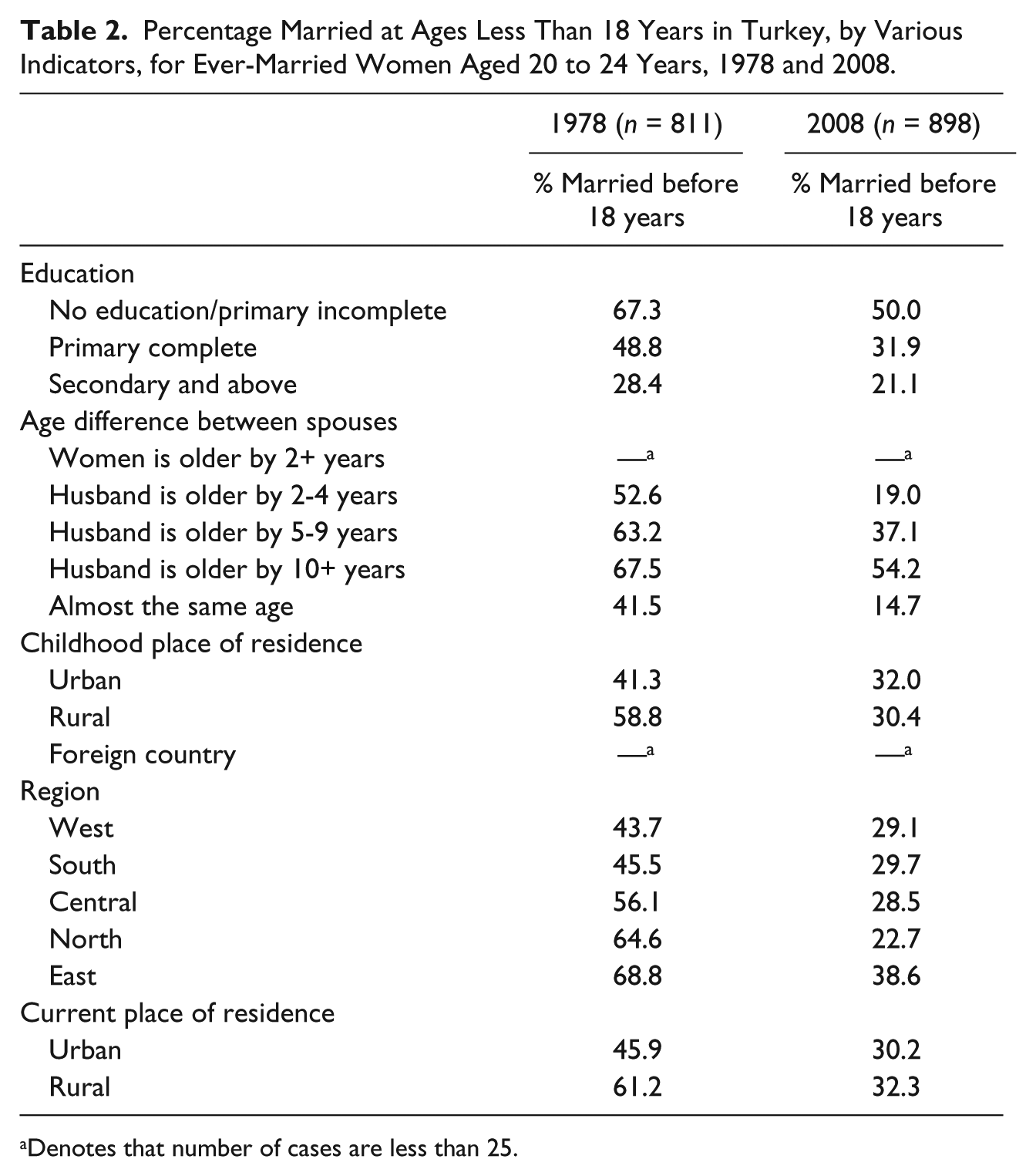
Denotes that number of cases are less than 25.
Another important feature of early marriages is the mean age difference between spouses which in Turkey is around 4 years for women at reproductive ages. However, in the last 30-year period, the percentage of women whose husbands are 5 to 9 years older than themselves have increased for women aged 20 to 24 years. In marriages in which the bride was aged below 18, there were large spousal age differences between partners, in most cases, the husband being much older than his bride. There has been a modest decline in the proportion of child marriages in which the husband is older than his wife by 10 years or more from 67.5% to 54.5%, but it still remains the case that for more than half of the early married women, their husbands are much older than they are.
Social values of the family and of the children shape their approach to marriage. If the socialization process of the girl child has taken place in a social environment where early marriages are approved, then this turns out to be a major barrier in fighting against child marriages. In 1978, the proportion of marriages below age 18 years was higher for those who were brought up in rural areas than for those brought up in urban areas (58.8% and 41.3%, respectively); similarly, it was higher for those currently living in rural areas. This pattern seems to have changed in the three decades, because the TDHS-2008 results show almost identical proportions of child marriages among those raised in rural and urban areas, and among those currently living in rural and urban areas.
Declining trends in early marriages are seen in both rural and urban areas, but the most striking change in terms of urban/rural residence is the narrowing gap between the two areas as regards child marriages in 2008, compared with 1978. Proportions of early marriages declined from 45.9% to 30.2% in urban areas, while in rural areas, these percentages dropped much more sharply, from 61.2% to 32.3% over the three decades.
Regional differences have also narrowed, but remain more apparent than urban/rural differences. Difference in the social and economic levels of the regions are evident in the prevalence of child marriages, which is greatest in the East region, where socioeconomic indicators are lowest compared with other regions and particularly to the West. Although the proportion of women in early marriages declined from 69% to 39% in the East region over the period, currently 4 out of 10 women still marry below the age of 18. In the North and Central regions, where early marriage was still prevalent at the time of the 1978 survey, the proportion of early marriage declined drastically by 64% and 49%, respectively. Despite a decline observed in all regions, in Turkey as a whole, 2 or 3 out of 10 ever-married women in the 20- to 24-year age-groups still married before the age of 18 in 2008.
Risks of Early Marriage
The risks of having a child marriage are analyzed through two logistic regression models for the 1978 and 2008 demographic surveys (see Table 3). The outcome variable of the two models is marriage before the age of 18. The educational level of ever-married women, region, type of place of residence, and age difference between spouses are related to the propensity of a girl becoming a child bride. Childhood place of residence shown in Table 2 as a variable associated with early marriage has been removed from the logistic regression models because of the high correlation of this variable with the respondent’s place of residence at the time of the survey. The first category of the age difference between spouses’ variables has been removed since number of cases is less than 25 in this category.
Determinants of Early Marriage of Ever-Married Women Aged 20 to 24 in Turkey in 1978 and 2008.

Results of the logistic regression models indicate that becoming a child bride is highly associated with the educational level of women; increase in the level of education decreases the risk of being married before age 18. The risk of being a child bride for women who are in the lowest educational category is 5.01 times higher compared with women with secondary or higher education in 1978 and was 5.24 times higher in 2008. It is striking that the risk of entering an early marriage is not much different between 1978 and 2008 for women with primary education (2.48 times and 1.91 times higher, respectively, than women with secondary or higher education). Even though the education level of women has increased in the last three decades, the almost unchanged risk of being a child bride for women with little education highlights the importance of further raising women’s educational level.
Age difference between the spouses is an important indicator of power relations, and is significantly related to being married at early ages. Results of the two models for 1978 and 2008 indicate a similar pattern. Although in Turkey, age gap in favor of men is observed in all marriages, these two models emphasize that the risk of being a child bride is much higher for women whose husbands are older than themselves by 10 years or more. Stated differently, a girl who marries at such a young age is highly likely to be getting married to a man who is considerably older than her.
Considering the regional and urban/rural differentiation for early marriages, the two models show an unchanged pattern in the last three decades. The risk of being married before the age of 18 for girls living in rural areas was 1.63 times higher than for those living in urban areas in the late 1970s, and 1.16 times higher in the late 2000s. However, it is not statistically significant in either survey. The results for both surveys indicate that the Central and East regions had a higher risk of early marriage than the West region, though these results are only significant in the case of the 1978 survey.
Discussion and Conclusion
Child marriage, generally defined as marriage below age 18 and internationally recognized as a violation of children’s and human rights, is a global problem. It causes the girl child to start her life on an unequal basis, which leads to further inequalities in her participation in the social, economic, and political stage. Marrying at a young age causes girls to quit their education at very early ages and accordingly to lose their right to education. Additionally, low levels of participation in the labor force, not having the opportunity to decide the person she marries, motherhood at a very early age, and the increased likelihood of being exposed to domestic violence and abuse are all problems that accompany early marriage.
This study reveals that early marriage has been becoming less common in Turkey since the late 1970s. The proportion of all women aged 20 to 24 years who began their married life below age 18 declined from 38% in 1978 to 14% in 2008. However, it is notable that among these women who married early, the age at first marriage has not changed in the past three decades. The factors that lead to early marriage of young women in the present study are in accordance with the results of many other studies showing that educational level of women, spousal age difference, regional, and urban/rural differentiations are strongly associated with child marriages.
The study finds a much higher risk of early marriage for less educated women compared with those with secondary level education. Although it played a positive role in raising women’s level of education, the extension of the compulsory formal education period from 5 to 8 years in 1997 has apparently not been sufficient to end child marriages. Gender inequality in secondary and higher education enrolment rates still continues. Another change in Turkey’s education policy came into force in 2012: A new education system known as “4 + 4 + 4” that extends compulsory education to 12 years by dividing it into three equal parts. This new system allows students to opt out of school in favor of home study. A concern is that the new system may lead to children continuing education without attending classes at school, and this may increase girls’ risk of undergoing early marriage as well as children becoming child workers.
In most of the countries where child marriage is common, it is more prevalent in the rural areas and in the less developed regions, and this is the case in Turkey as well. Early marriage is more prevalent in the East region where social and economic indicators are at low levels, and the age structure is comparatively young. The western part of the country is the economically most developed region, and it has the lowest levels of child marriage. On the other hand, despite the comparatively better socioeconomic standards and educational level in the Central Region, fairly prevalent early marriage in this region indicates that education is not the sole determinant of early marriages. More broadly, the social values of the family as well as women’s status both in the family and society are important. The traditional roles of women as spouse and mother lead families to marry off their children when they find an opportunity that meets family expectations, regardless of the age of bride and groom.
Large spousal age difference is another significant feature of most early marriages. A large age-gap in favor of the husband puts the girl child in a less powerful status, and they start to live under the control of the husband, lacking the opportunity to gain their autonomy. In some such marriages, families seek the girl’s consent, but the consent given at childhood ages is questionable from a social and psychological viewpoint. In most of the cases, since the girl child feels pressured, she does not have any choice but to say “yes” to the decision of her family.
In spite of the fact that Turkey has ratified the international laws and conventions against the practice of early marriage and has its own national laws and regulations, early marriage continues to be a social problem. Existing social and cultural factors legitimize early marriage through various strategies. For example, religious-only marriage is the type of marriage frequently conducted in early marriage. Since early marriages are generally practiced below the legal age at first marriage, some families in Turkey prefer to marry off the girl child by religious-only marriage until she reaches the legal marriage age for a civil ceremony. Unfortunately, the law that considers such marriages illegal in the absence of formal marriage is usually disregarded. Furthermore, in this type of illegal marriage, the girl child not only loses her legal rights, but her risk of being in a polygamous marriage also increases.
This analysis has several limitations, resulting from the limited number of explanatory variables common to both surveys, conducted 30 years apart, and from the relatively small sample size. Certain important factors such as family socioeconomic background and cultural norms and beliefs are not included in the analysis. Moreover, some explanatory variables such as education and age gap between spouses can be considered as both a cause and a consequence of an early marriage, showing the complexity of the phenomenon. Because of data constraints, we are not able to disentangle the causal relationships between these variables and child marriage. Despite these limitations, the analyses in this article suggest that social norms, local customs, and traditions that justify early marriage may be more powerful than national laws. Thus, in a society where traditional and patriarchal structures are dominant, merely raising the legal age at first marriage may not protect girls from becoming victims of child marriage. Eradication of child marriage requires a comprehensive approach focused on transformation of outlook at societal level, supported by increase in level of education and by national laws.
Footnotes
Declaration of Conflicting Interests
The author(s) declared no potential conflicts of interest with respect to the research, authorship, and/or publication of this article.
Funding
The author(s) received no financial support for the research, authorship, and/or publication of this article.