




Abstract
This study analyzes trends in the timing of entry into first marriage and the tendency for Taiwanese to choose partners of similar age, educational attainment, and ethnicity. Using pooled data from the 1991, 1996, 2001, and 2006 Taiwan Social Change Surveys, we examine the shift from early and universal marriage toward late and less marriage among postwar birth cohorts. After educational expansion, higher educated Taiwanese are more likely to postpone marriage, but poorly educated men have become most likely to remain single. In 2012, among primary-educated men born in 1968-1972, 42% were never-married. While men still prefer to marry younger women, the age gap between spouses has narrowed significantly, and following the increase in educational attainment of both genders, there is an increase in ethnic intermarriage and educational homogamy. However, if women postpone marriage to older ages, their chances of marrying men with equivalent education decreases significantly.
Introduction
As in other East Asian societies, dramatic changes have occurred in the timing and prevalence of marriage in Taiwan. In 1905, under Japanese colonial rule, almost half of women aged 15 to 19 years had married and most men were married by their mid-twenties. Marriage was nearly universal among Taiwanese in the first half of the 20th century. However, this trend was disrupted by World War II and the influx of migrants from mainland China after the Chinese Civil War in the late 1940s. While many of the newcomers fled from the mainland as families, there were also a substantial number of unmarried young men in the military. The imbalanced sex ratio immediately produced a marriage squeeze, making it difficult for men to find marriageable partners (Lee, 1994; Thornton & Lin, 1994). Through a process of natural replacement of population, acceptance of ethnic intermarriage, and cross-border marriage involving migrants from China and Southeast Asia in recent years, this once serious male marriage squeeze has largely disappeared over the past few decades (Chen, 2008).
In addition, societal transformation from an agrarian society to an industrial one profoundly changed the timing of marriage. Age at first marriage increased for both genders; though women tend to marry earlier than men. Official statistics show the mean age at first marriage for women, which was 22.3 years in the mid-1970s, had been delayed to 28.2 years in 1995 and to 29.5 years in 2012, a significant increase of 7.2 years. In the same period of time, the average age difference between married couples decreased from 4.5 to 2.5 years. Meanwhile, a growing number of never-married Taiwanese in their thirties raised considerable concern over the extent of postponement in marriage. Specifically, the proportion of never-married women aged 30 to 34 years increased from 7.7% in 1980 to 37.2% in 2010 (Ministry of the Interior, 2013a). While this may be a continuation of the shift to late marriage, it could also indicate an emerging trend toward lifelong singleness. An unconventional life choice, singlehood caught public attention and became headline news (Chen, 2012).
The method of mate choice changed substantially, too. Traditionally, Chinese parents had overwhelming power in their children’s marriage and compatibility of socioeconomic status and cultural background between two marrying families was important. Marriage decisions were made by parents or other family elders, with the aid of paid matchmakers. Men usually married women who were younger and lower in status. The long history of hypergamy has in fact resulted in more lifelong never-married men (i.e., so-called bare branches), who were usually poor males. The expansion of educational opportunities and access to the labor market benefit women in modern times, but many educated and well-paid young women encounter enormous pressure from family and friends to get married. The leftover women, a catchphrase in China’s media referring to professional women still unmarried in their late 20s, emerged as a new social stigma in China. A similar social phenomenon that has raised considerable debates in recent years is also found in Taiwan.
In this article, to examine the continuity and changes in timing and formation of first marriage in Taiwan, we first describe trends in age at first marriage and estimate the mean ages for different birth cohorts and social groups with parametric models based on pooled national representative survey data. Next, we explicitly evaluate changing patterns of marriage formation in the context of rapid social and economic transformation; we examine the degree of age, ethnic, and educational homogamy among married couples. Finally, we identify major explanatory factors that are associated with age and educational homogamy.
The Changing Marriage Institution
In industrialized societies, the marriage institution has been greatly modified during the twentieth century. The development of modern nonfamilial institutions, the education system, and the labor market in particular, has profoundly affected personal expectations for mate selection and family formation. The prevalence of cohabitation is also posited as a factor contributing to the deinstitutionalization of marriage (Bumpass, Sweet, & Cherlin, 1991; Cherlin, 2004), and the meaning of marriage and its place in peoples’ lives have changed dramatically (Blossfeld, 1995) including in Japan (Ochiai, 1996). To what extent has marriage changed in modern Taiwanese society? With a solid cultural heritage of familism, marriage is still emphasized and highly appraised in Taiwan. However, the delay in marriage and the increase in ethnic intermarriages and cross-border marriages have somewhat modified the timing and patterns of marriage. The former may eventually create a substantial increase in lifelong singlehood and the latter has attracted much attention and debate on its possible negative consequences on the family and the overall society. Theoretical perspectives and empirical studies on marriage formation and its associated factors in Taiwan are reviewed in the next three sections.
The Effect of Education on Marriage Formation
The timing of first marriage deserves investigation not only because of the close link between marriage and childbearing but also because the age when men and women marry has implications for the organization of family life and for gender relations within society. Since the 1960s, age at marriage has risen considerably and cohort proportions ever-married started declining in Western societies (Council of Europe, 2006) and later in other regions of the world. In Taiwan, with rapid social and economic transformations, changes in timing and prevalence of marriage have occurred since the mid-1970s (Directorate General of Budget, Accounting and Statistics, 2002). Two major factors associated with the postponement of marriage have been the increase in educational attainment and later entry into the labor market.
The economic conditions of men and women have been at the core of theoretical and empirical arguments surrounding the dramatic changes in marriage and family. Becker’s (1973, 1981) specialization and trading model provides much of the foundation for the economic theory of marriage. He argues that men with a comparative advantage in the labor market tend to choose women who are willing to devote themselves to full time childbearing, childrearing, and domestic work. The increase in women’s labor force participation and wage level will decrease the profit of marriage and incentive for marriage for women. Moffitt (2000) revises Becker’s theory and proposes a new argument. He suggests that declining marriage rates for the better educated are related to increasing female wages, whereas declining rates for the less educated are associated with decreasing male wages. From the economic point of view, trends of late and less marriage are anticipated in modern societies, particularly among better educated women and less educated men. In contrast, some scholars claim that women and men with higher education are more attractive marriage partners due to their higher wages (e.g., Blossfeld, 1995). To understand changes in family formation, it is necessary to examine the economic prospects and changing statuses of men and women in the labor market (Oppenheimer, 1988; Oppenheimer, Kalmijn, & Lim, 1997). As better educated women will take longer to search for suitable partners, they will marry at later ages.
Because of the divergent views relating to timing of first marriage, many studies have started to analyze empirical data to verify different causal mechanisms for both genders in relation to when and whether to marry. Drawing on Oppenheimer’s argument, empirical studies show women’s economic resources such as educational attainment and earnings have increased the odds of marriage in most industrial societies. However, this is not the case for Japan (Ono, 2003). While improved economic prospects indeed encourage Japanese men to get married, Japanese women’s economic independence actually discourages marriage since it reduces gains in marriage for women (Raymo, 2003; Retherford, Ogawa, & Matsukura, 2001).
Similar research results are also found in Taiwan. Younger women are more likely to benefit from the expansion in higher education which in turn may decrease their chance of marriage (Yang, Li, & Chen, 2006). Analyzing the labor force participation behavior of Japanese and Taiwanese women during the past few decades, Yu (2009) suggests that, regardless of marital status, highly educated Taiwanese women are more likely to be employed in the labor market than their Japanese counterparts. If there is a negative relationship between women’s economic independence and the likelihood of marriage formation, we may anticipate that young Taiwanese women would further postpone the timing of entry into first marriage.
Variations in Ethnic Intermarriage
Ethnic/racial background is another important consideration in marriage decisions. Taiwanese society is composed of 98% Han Chinese population and 2% aborigines. The former includes three ethnic groups, Fukienese (70%), Hakka (15%), and Chinese Mainlanders (13%) who moved to Taiwan after the Chinese Civil War (Hsiao, 2004). Despite sharing the same culture and traditions among three Han subpopulations, intermarriages were not common in the earlier periods because of tense ethnic relationships. Being the majority group, Fukienese were more likely to marry within the same ethnic group. For the other two minority groups, Hakka and Mainlanders, intermarriage with Fukienese emerged as an alternative. Specifically, until the lifting of Martial Law in 1987, the imbalanced sex ratio of Mainlanders pushed male members to marry women from different ethnic groups or to remain single.
Why ethnic intermarriage takes place in Taiwanese society and its consequences have been studied (Wang, 2001), and previous studies in the field of social stratification have regarded marriage to someone from an outside group as an indicator of social openness because certain types of heterogamy have to defy family expectations and opposition from the marriage partner’s family, community or society, and such instances can be conceptually interpreted as crossing of the strongest social boundaries between social groups (Tsay & Wu, 2006). Whether persons with similar education marry each other depends partly on their preferences and partly on the structure of the marriage market (Mare, 1991). For Taiwanese born before 1950, chances of getting married to a spouse within or outside an ethnic group were highly associated with the population size, composition, and structure. For people born after 1950, their chances of forming marital unions were affected by a variety of assimilation processes including education and employment. Even though the aborigines constitute a very small proportion of the Taiwan population, they are least likely to marry Han Chinese because of their unique social organization and residential segregation (Tsay & Wu, 2006; Wang, 2001).
Age and Educational Homogamy
The increase in ethnic intermarriage is the result of reduced or eliminated language and residential barriers as well as narrowed group differences in education and labor market opportunities. Therefore, interethnic marriages tend to be homogamous in characteristics such as age and educational attainment (Qian & Lichter, 2007). Shifts in age and educational differences between spouses are also linked to broad processes of industrialization and modernization and integrated social development (Van Poppel, Liefbroer, Vermunt, & Smeenk, 2001).
Educational attainment and age at marriage may affect a person’s chance of finding a spouse with similar social characteristics. Because school classes are educationally homogeneous, they structure students’ potential acquaintances and raise the likelihood of persons with similar levels of education marrying one another (Luoh, 2001). Persons who marry while they are still in school or shortly after are likely to have met their spouses as students and to resemble them in educational attainment. In contrast, persons who marry well beyond their schooling years are more likely to meet potential spouses outside of their school class and to marry persons who differ from them in educational attainment. This implies that the longer the time between departure from school and marriage, the greater the chances that couples will form educationally heterogamous marriages.
With substantial growth in the number of educated young Taiwanese, it is evident that the timing of first marriage has been further delayed. However, we know little about how this change is related to different birth cohorts and ethnic groups. It is also uncertain whether the traditional practices of compatibility in marriage match and preferences for potential partner still continue or have been changing in Taiwanese society. For married couples, what is the extent of age and educational homogamy? Is there any difference across ethnic groups and ethnic combinations of couples? Transition in marriage formation being a long-term process, this study is devoted to an analysis of trend in the timing of first marriage and the tendency to choose partners of similar age, education, and ethnic background. The analytical data come from the Taiwan Social Change Survey (TSCS), a nationwide representative data set. We first apply a standard parametric method to estimate the mean age at first marriage for postwar birth cohorts and different educational levels and ethnic groups. Next, the cross tabulations of sociodemographic characteristics, including age gap, educational differences, and ethnic differences between spouses are presented. In the third part of the analysis, by using binary logistic regression, we calculate the likelihood of homogamy and examine the differential across groups. Based on these results, the continuity and changes in marriage formation are discussed in the final section.
Data and Methods
Data and Sample
The data for the current study were drawn from the TSCS, an interdisciplinary research project that tracks Taiwan’s political, economic, social and cultural changes. The TSCS has been based at the Academia Sinica, jointly operated by the Institute of Sociology and the Center for Survey Research. All survey data are available for free and instant download from their respective websites to scholars and students. The TSCS has a rigorous procedure for data collection. Using household registration records as the sampling frame, three-stage stratified sampling scheme and probability proportional to size method were employed for generating random samples from administrative districts in Taiwan. Since the first nationwide survey was completed in 1985, this long-term, cross-sectional survey project is conducted in 5-year cycles that rotate selective modules in order to capture the time-series of social changes. As of 2012, the family module has run through up to five cycles of survey operations which enable researchers to further understand changes in marriage and family from a longitudinal perspective (Chang, Tu, & Liao, 2012). Since the latest cycle of the family module collected in 2012 has not been released for public use, only four cycles (1991, 1996, 2001, and 2006) were used for modeling nuptiality patterns of postwar birth cohorts.
Among these four cycles, the 1991 and 1996 samples were restricted to those who were at least 20 years old and with upper age limits of 64 and 75 years, respectively. The upper limit was lifted in 2001 and the lower age limit was decreased to 18 years old in 2006. The response rates of the first three cycles fell within the stable range (67% to 75%) throughout the recent survey years of the TSCS (Chang & Fu, 2004), except that only 51% of respondents completed interviews in 2006. Pooling four cycles together, the total sample consists of 8,493 respondents. Since the majority of the younger birth cohorts were unmarried during the periods of data collection, we decided to exclude 306 respondents born after 1980 to avoid biased estimates. In total, we have an analytical sample of 8,187 that comprises 4,112 men and 4,075 women, of whom 17% were never-married at the time of data collection. Since the sample design of TSCS does not tend to overrepresent specific ethnic or educational segments within Taiwanese population, we do not use any sampling weight as a statistical correction in analytical models.
Measures
The outcome variable, age at first marriage, was calculated from respondent’s birth year and retrospective report on year of first marriage. To compare the transition in timing of first marriage across various social groups, we also included three covariates: birth cohort, education, and ethnicity. Based on the year of birth, all respondents were categorized into 9 birth cohorts. The oldest cohort consisted of samples born before 1940 (19%). Others were divided into eight groups based on 5-year intervals: 1941-1945 (7%), 1946-1950 (9%), 1951-1955 (14%), 1956-1960 (16%), 1961-1965 (13%), 1966-1970 (10%), 1971-1975 (6%), to the youngest one in 1976-1980 (6%). The completed education was coded as primary school or less (33%), junior high school (15%), senior high school (27%), college (13%), and university or beyond (12%). And, the ethnicity was coded as Fukienese (74%), Hakka (12%), Mainlander (12%), and Aboriginal (2%).
Additionally, the compositional characteristics of married couples were examined through cross tabulations. For 6,811 ever-married respondents, their spouses’ birth year, education, and ethnic background were measured using the same guidelines described above. When respondents were asked regarding these characteristics of their spouses, missing data were more likely to be coded through this operation. While the multiple imputation procedure has been widely used to handle missing data, we did not adopt this method because of nonrandom distributions of missing values in these measures. Since no information for these variables was associated with specific cases (i.e. separated, divorced, and widowed), we finally decided to use 5,857 couples with completed data for analysis.
Methods
With completed and reliable marital histories, it is common to apply single decrement marriage life table to portray the progress from the state of being “never-married” to the other state of “getting married.” This method allows a year-to-year and age-by-age accounting, through which overall marriage patterns become clearer. In essence, the force of nuptiality for first marriage cannot be observed directly because two decrements, nuptiality and mortality, jointly operate on the never married population. Researchers are often confronted with data distributions that display substantial irregularity due to sample sizes being small or responses being concentrated at preferred values. Thus, a number of parametric models, combining empirical and algebraic components, have been proposed. Among them, the Coale–McNeil model (Coale, 1971; Coale & McNeil, 1972) has been the most successful in the analysis of age patterns of first marriage (Preston, Heuveline, & Guillot, 2001).
Recent studies, however, indicate that this model is inadequate for estimating the pattern of first marriage for some populations in which people have heterogeneous beliefs regarding age at marriage. For this reason, Kaneko (2003) suggested the use of the generalized log gamma (GLG) model that is mathematically identical to the Coale–McNeil model and an improved adjusted version of it. The GLG model is expressed by

where f(x) is the age-specific first marriage rate at age x; u, b, and λ are three parameters to be estimated, and Γ denotes the gamma function. Two parameters, λ and u, determine the shape and the location of mode of the distribution respectively. And

where ψ is the digamma function. We can apply empirical distribution of analytical sample for model fitting and then attain three estimates for u, b, and λ. Since the GLG model is one of the standard parametric regression models in survival analysis, we have conducted the GLG regression for age at first marriage with sex, birth cohort, education, and ethnicity by using TSCS data. Following Kaneko’s (2003) approach, we use LIFEREG procedure in SAS/STAT through which constant term of u, b, and λ are respectively correspondent to INTERCEPT, SCALE, and SHAPE in the SAS output of the procedure with option NOLOG.
For 6,811 ever-married respondents, the cross-tabulations of demographic and social characteristics, including age gap, ethnic differences, and educational differences between spouses that show the extent of homogamy are presented in the second part of the analysis. Finally, binary logistic regression analysis was used to evaluate similarities in age and education between spouses. Relevant background variables examined in this analysis include wife’s birth cohort, wife’s age at marriage, ethnic combination of couples, and education. We also calculate the predicted probability of forming a homogamous marriage, indicated by similar age and education between spouses, through coefficients derived from the logistic regression analysis.
Results
Trends in the Timing of First Marriage
The key finding about union formation is that Taiwanese are marrying later. Figures 1 and 2 present the age-specific proportions of ever-married Taiwanese across birth cohorts for men and women, respectively. The age at marriage increased gradually among Taiwanese women born before 1960 and the fraction married was more than 70% by age 25 years or 90% by age 30 years. In contrast, men of the same cohorts married significantly later than their female counterparts; about three quarters entering first marriage before reaching 30 years of age. It should be noted that, given the significant influx of single young soldiers from China in the late 1940s, chances of finding a wife was greatly affected by the imbalanced sex ratio since then. To combat this unexpected marriage squeeze during the postwar era, most men attempted to marry younger women through a prolonged search process. Therefore, the oldest cohort and baby boomers in fact shared a very similar pattern of marriage formation, with less than 5% of never-married men among these cohorts (see top lines in Figure 1). As a whole, Taiwanese born before 1960 had gradually postponed marriage but the vast majority of them did not abandon marriage.
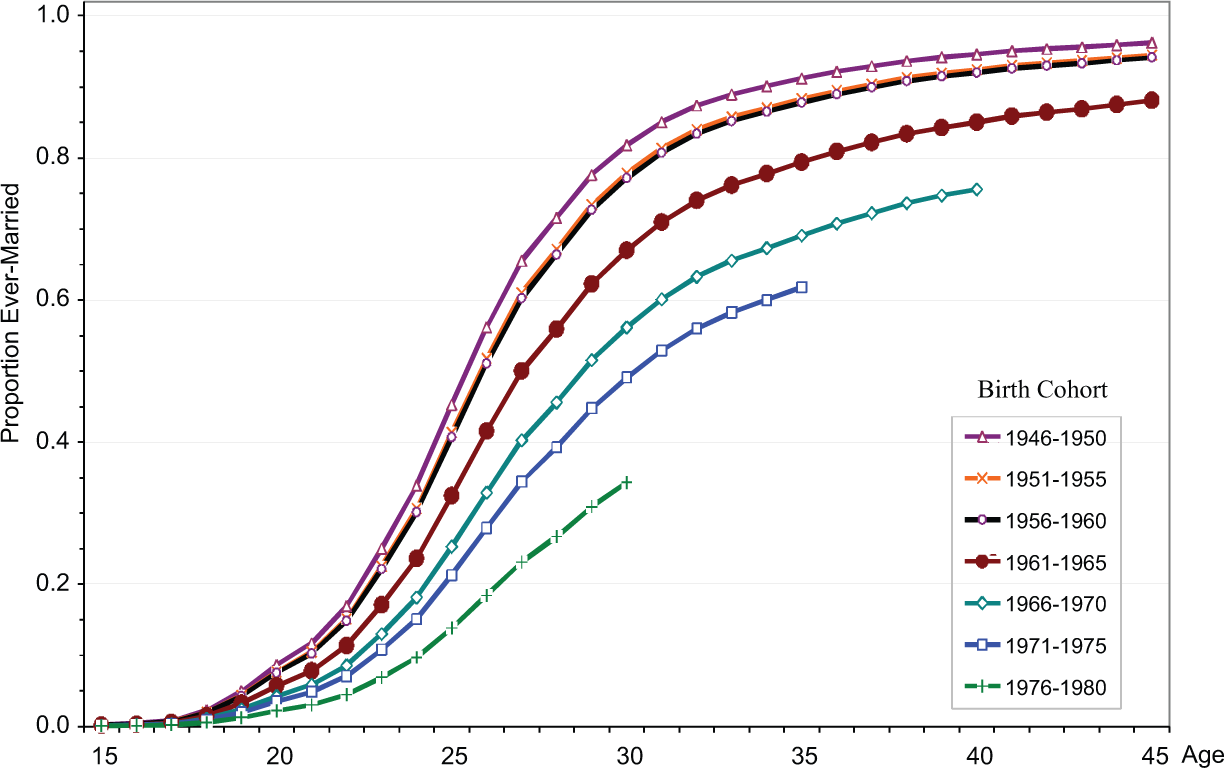
Age-specific proportions of ever-married men, by birth cohort.
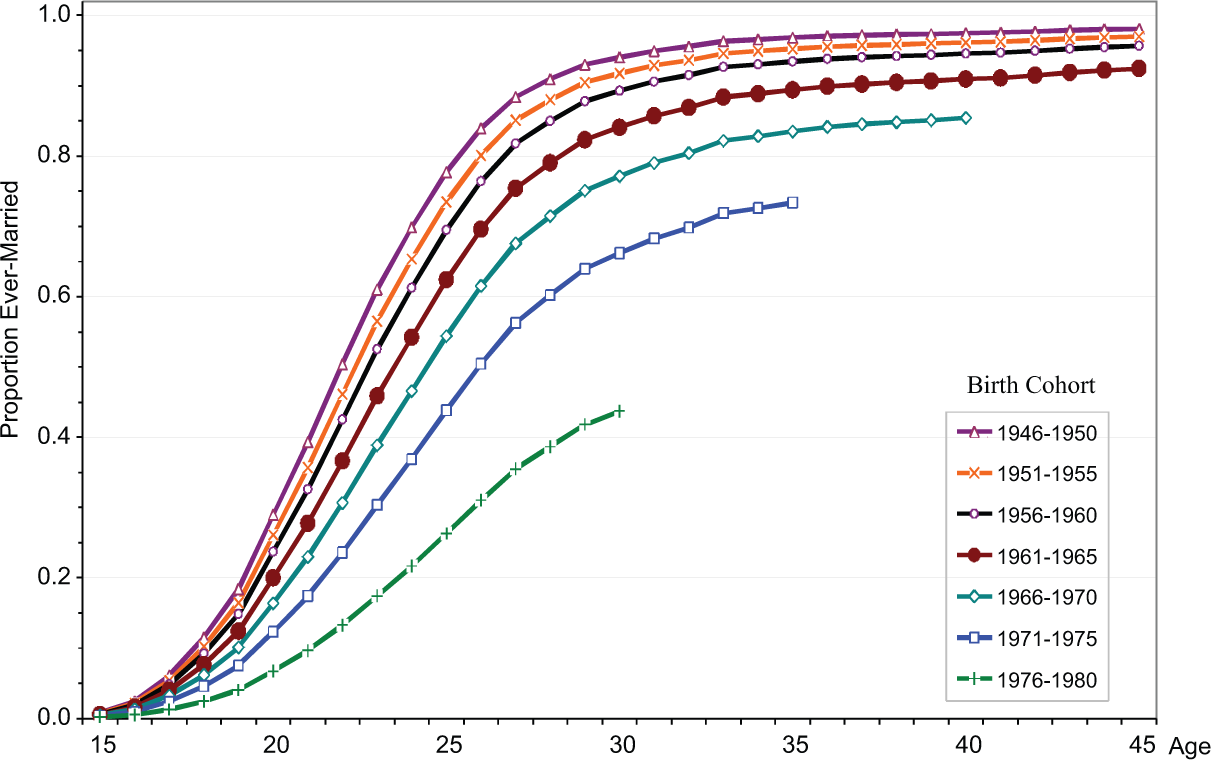
Age-specific proportions of ever-married women, by birth cohort.
The shift to late marriage has been especially pronounced among cohorts born after 1960. As depicted in Figure 1, two thirds of men born in 1961-1965 entered first marriage before the age of 30, but less than one third of the youngest male cohort (i.e., 1976-1980) were married before 30. Figures 1 and 2 portray not only the changes in prevalence of marriage but also in the timing of first marriage across postwar birth cohorts. The most remarkable postponement of marriage was found among younger Taiwanese women. Unlike their older counterparts who were married in their early 20s, the mean ages of female cohorts born in 1961-1965 and in 1966-1970 had increased to 25.5 and 26.5 years, respectively. Examining the marriage schedule for female cohorts born from 1941 to 1980, Taiwan has gone from a situation where almost all women married before reaching 30 to a situation where more than half of the youngest females were still single by age 30.
We then assess whether the decline in the proportion of young people who were married was related to increases in schooling. The mean ages at first marriage of different educational levels are calculated based on the GLG distribution described in the subsection on methods. For the female cohort born in 1966-1970, the mean ages at first marriage for university-educated and primary-educated women were 29.9 and 21.3 years, respectively. The increase in women’s education, especially college degree or beyond significantly postponed their timing of first marriage. For men of the same birth cohort, it is not surprising to find that most university-educated men tended to get married in their thirties, but the mean age at first marriage increased most rapidly for the least educated men (data not shown but available on request from the authors).
Undoubtedly, young Taiwanese men with compulsory or primary education only are disadvantaged in the marriage market. Because of the small size of the sample comprising these men, we check statistics from the static population data in the household registration system (Ministry of the Interior, 2013b). By the end of 2012, there were only 2% of Taiwanese men aged 40 to 44 years with primary education; among this group, 41.7% were never-married. Although men with university education typically entered marriage later, they were just as likely to ultimately marry by about age 40 and only 16.3% of men with university education born in 1966-1970 were single. According to the same statistics, 26% of 40- to 44-year-old Taiwanese women with university or higher degrees were still single, compared with only 16% of men with equivalent diplomas. Young women with higher degrees are increasingly more likely to put off marriage than their male counterparts. Clearly, a negative effect of university education on women’s chance of marriage is seen in both official statistics and survey data.
We also estimate the mean ages at first marriage for Fukienese, Hakka, Mainlander, and Aborigines. For the Fukienese and the Hakka, men had a slightly higher mean age than women across birth cohorts. The timing of entry into first marriage was strikingly different between men and women for Mainlanders and Aborigines. Among Mainlander women, mean age ranged from 21.5 to 27.7 years for the cohort born before 1940 and the youngest cohort born in 1966-1970. Among male Mainlanders, the corresponding figures were 32.1 to 31.2 years. Because of the relatively imbalanced sex ratio among migrants from China after World War II, the oldest female Mainlanders born before 1940 married in their early 20s (21.5 years), but the chance of marriage was limited for their male counterparts, in particular the veteran soldiers, resulting in a mean age of 32.1 years for the oldest Mainlander men. In contrast to the Han population, early marriage was actually common practice among aborigines. While this trend continues for young female aborigines, the mean age at first marriage is extremely high for younger male aborigines (33.4 yers). Such a divergent development in marriage formation indeed reflects the disadvantaged status of aboriginal men in current Taiwanese society.
Trends in Age, Ethnic, and Educational Homogamy
We employ cross-tabulations to examine the extent of age, ethnic, and educational homogamy. Table 1 presents results in age homogamy across male birth cohorts using the descriptive measure of spousal age differences. Instead of using the most conservative definition of age homogamy, which is “no age gap,” we adopt “similar age” referring to couples with husbands no more than 2 years older. The tendency of age homogamy has become more salient among postwar birth cohorts. While it is traditional Chinese norm that men prefer to marry younger women, the large age gap between spouses has been replaced gradually by a narrowed age gap of 2 to 5 years. Examination of age differences at marriage also shows an emerging trend toward increasing percentages of women marrying men younger than themselves (i.e., age hypogamy). These trends in age homogamy and smaller age differences are what we expected.
Age Differences of Married Couples, by Husband’s Birth Cohort.
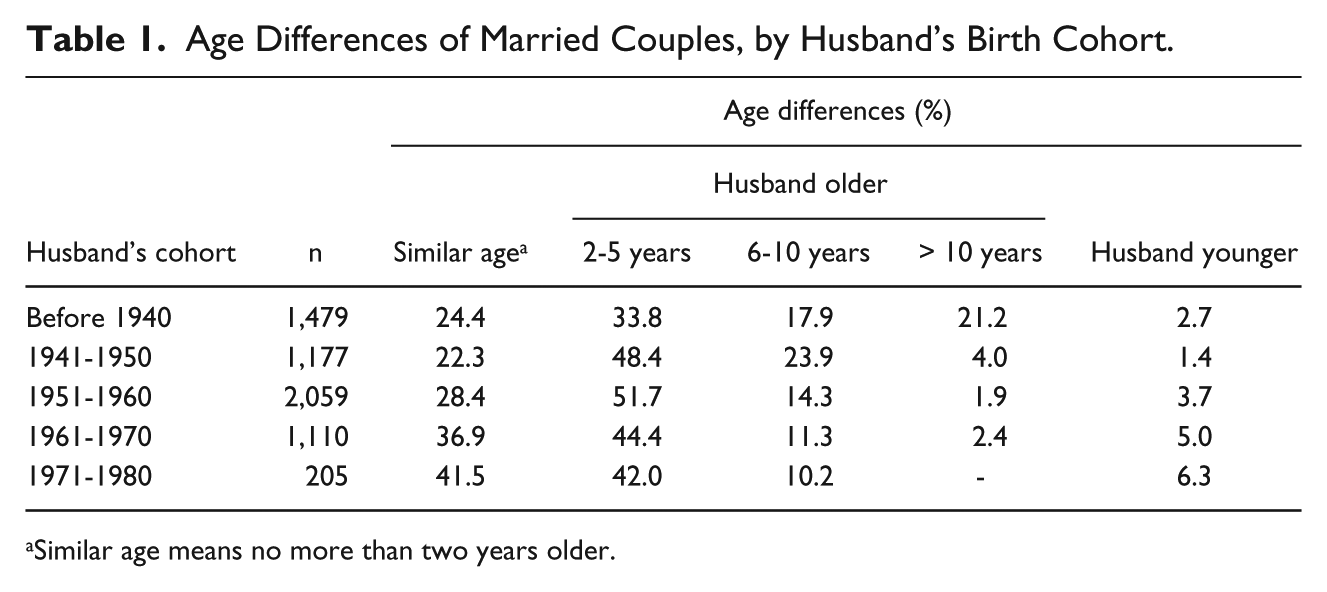
Similar age means no more than two years older.
Table 2 provides descriptive statistics on ethnic combinations of married couples. The percentage of ethnically endogamous marriages was related to group size. Being the largest ethnic group in Taiwan, Fukienese men were least likely to marry women from different ethnic backgrounds. On the contrary, the other two Han subpopulations, the Hakka and Mainlanders, have adopted intermarriage as an alternative in union formation. Because of an extremely imbalanced sex ratio of older Mainlanders, only 34.4% of Mainlanders were able to marry women with the same ethnic background. As a result, out-marriages with Fukienese women were most common among male Mainlanders (50.5%). As the smallest non-Han ethnic group, marriage patterns among aborigines contrasted sharply with those of the Hakka and Mainlanders. Their low socioeconomic status prevented them from being able to intermarry with the Han population. Consequently, aborigines in fact had a high percentage of endogamous marriages (84%). The rise of ethnic intermarriage implies declining social distance and growing acceptance between Fukienese and other minority groups.
Percentage Distributions of Interethnic and Intraethnic Marriage, by Husband’s Ethnicity.
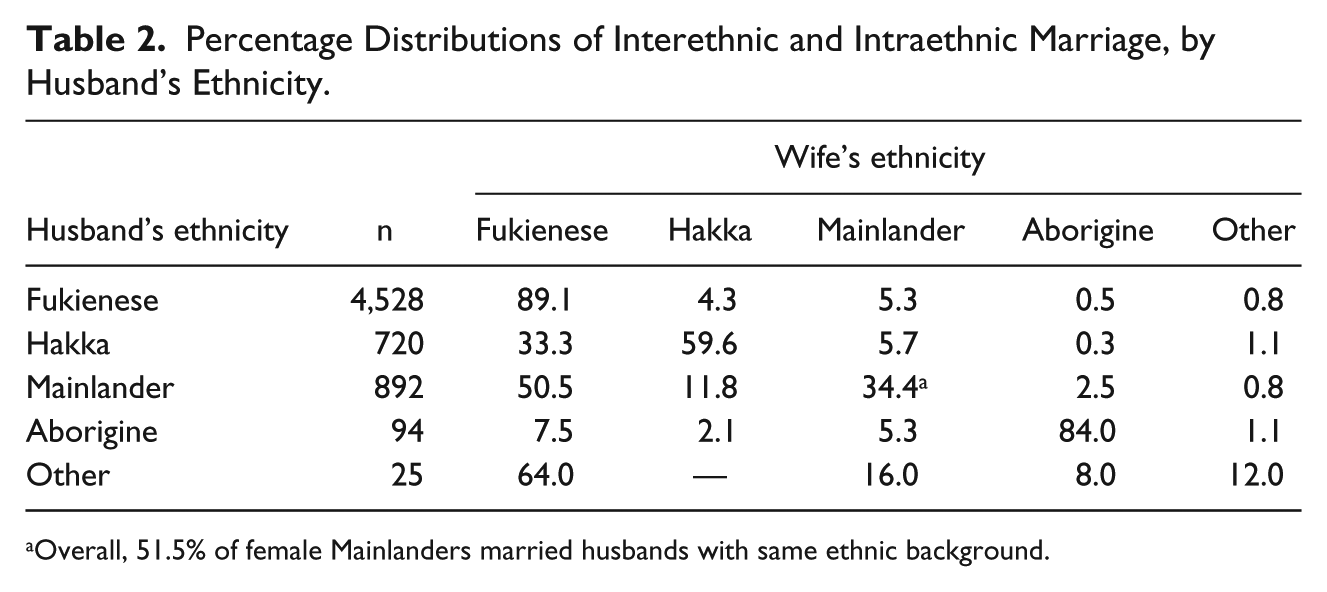
Overall, 51.5% of female Mainlanders married husbands with same ethnic background.
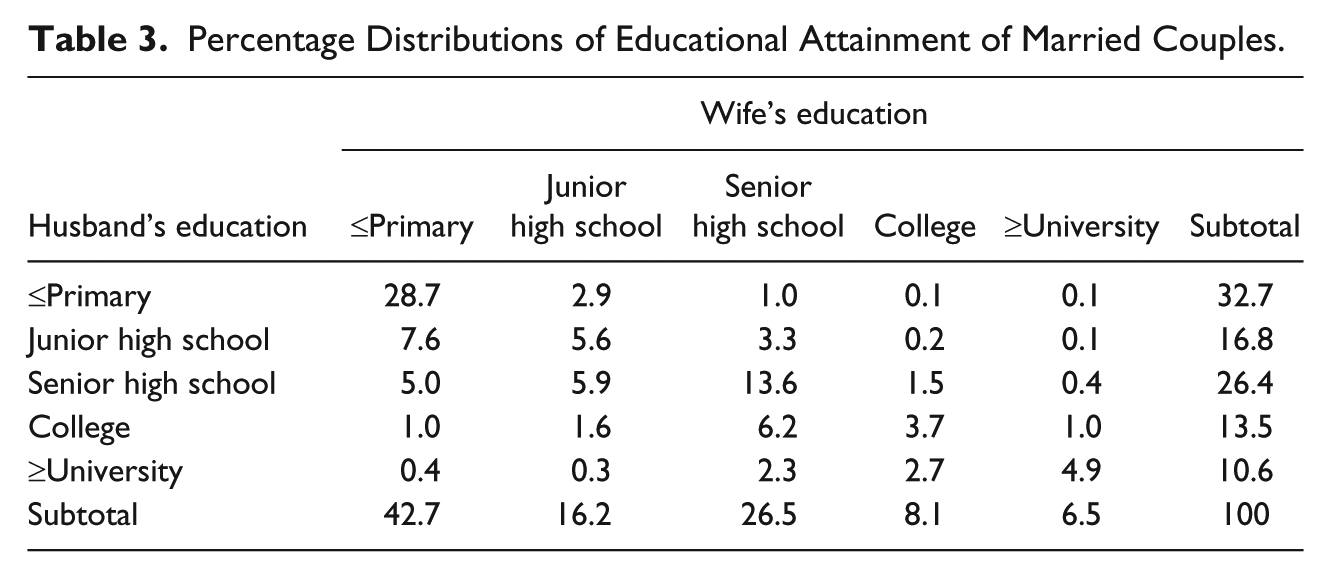
The educational gradient in marriage is the other consideration of spousal and familial compatibility within the Chinese social context. Table 3 displays the cross-tabulation of husband’s and wife’s educational levels, including couples in 33% of hypergamous marriages and 10.6% of hypogamous marriages. It is clear that educational homogamy (56.5%) has become more visible in Taiwanese society. Examining the formation of marriage from women’s standpoint, three quarters of highest educated women tended to marry men with the same education, whereas only 46% of Taiwanese men with university or higher education married women with similar education.
Percentage Distributions of Educational Attainment of Married Couples.
Factors Associated With Age and Educational Homogamy
We then employ logistic regression to examine the odds of age and educational homogamy. Because of the smaller sample size and a tendency of endogamy among aborigines, we decide to eliminate this ethnic group from this part of the analysis. The results are presented in Table 4. Model 1 shows that all explanatory variables except wife’s education have significant effects on the likelihood of age homogamy. Compared with the cohort born in 1941-1950, the oldest women born before 1940 and in 1951-1960 tended to marry men no more than 2 years older or younger. Specifically, wife’s age at marriage has a positive effect on age homogamy. Unlike older men who were more likely to marry younger women due to imbalanced sex ratio since the 1950s, older women had a higher tendency to marry men of similar ages. This result reflects a social reality that, in line with Oppenheimer’s (1988) argument, when the availability of potential partners decreases, women would lower their mate preference standards. Previous studies have indicated that the Hakka and Mainlanders were more likely to marry someone outside their own ethnic groups (Wang, 2001). Thus, an interaction term was added into the logistic regression to verify whether age homogamy is associated with the ethnic intermarriage or intramarriage. For ease of interpretation, we graph this interaction effect (see Figure 3). The results show that the higher predicted probability of age homogamy is found among couples who are both Fukienese (41%), whereas for Hakka and Mainlander intramarried couples, husband’s and wife’s age are similar in only 12% and 20% of cases. On the contrary, for mixed marriages involving a Hakka or Mainlander wife, about 35% of these intermarriages are categorized as age homogenous marriages. Surprisingly, there is no significant effect of wife’s educational attainment on the odds of age homogamy.
Logistic Regression Analysis of Age and Educational Homogamy (N = 5,857).

The two reference categories in model 1and model 2 are “husband is at least 2 years older than wife” and “husband has completed higher education level than that of wife’s,” respectively.
p < .05. **p < .01. ***p < .001.

Predicted probabilities of similar age (left) and similar education (right) for interethnic and intraethnic marriages.
The likelihood of educational homogamy is higher for oldest and youngest female cohorts. Since respondents born before 1940 are generally less educated or uneducated, educational homogamy is thus more common among oldest couples. Because of the expansion of the education system in the 1990s, women born after 1970 are most likely to attain higher education and to meet their future partners in educational institutions. If women tend to put off marriage to older ages, however, their chances of marrying men with equivalent educational level would decrease significantly. Our results also indicate that women who have completed junior high education are most likely to form hypergamous marriages with higher educated men. Because of the extremely imbalanced sex composition of Mainlanders, intramarried Mainlander couples are least likely to have the same education between spouses, compared with the other ethnic groups. For example, among mixed marriage couples involving a college-educated Mainlander wife, 85% belong to the category of educational homogamy (see Figure 3), whereas 70% of intramarried couples who are both Mainlander are categorized as educationally homogamous. In other words, the increase in education for female Mainlanders also enhances their chances of getting married to higher educated men from other ethnic backgrounds. As for the Fukienese and Hakka, the chance to form educationally homogamous marriage is higher due to the relatively more balanced sex ratio in these two subpopulations.
Conclusion and Discussion
The late/less marriage and patterns of marriage formation have continuously attracted great attention from researchers in the East (Raymo, 2003; Raymo & Iwasawa, 2005; Retherford et al., 2001; Tsay & Wu, 2006). The latest statistics show that young Taiwanese are putting off marriage to beyond 30 (Ministry of the Interior, 2013a), but these data do not provide details regarding specific variations in marriage formation across social groups. Within a society of three Han subpopulations and heterogeneous aboriginal people, an individual’s chance of endogamy or exogamy is greatly influenced by the uneven distribution of ethnic groups and the continuing imbalanced sex ratio. The effect of the expansion of higher education on marriage timing and union formation also deserves examination.
Using pooled survey data from the Taiwan Social Change Survey collected in 1991, 1996, 2001, and 2006, and applying the GLG model, our analyses show trends in delay of first marriage and document the postponement of marriage for ethnic groups and by major education levels. The especially pronounced delay in marriage is found among men with primary education and women with university degree or beyond. The question remains whether delayed marriage may lead to foregone marriage (Goldstein & Kenney, 2001). We expect this could be a possibility among women with the highest education, while their male counterparts would further delay the timing of first marriage only (Ministry of the Interior, 2013b). For lower educated or socioeconomically disadvantaged men, cross-border marriage has become an alternative if they are unable to find partners in the local marriage market (Chen, 2008). Because of their multiple disadvantages, aboriginal men are least likely to find marriageable partners within or outside of their ethnic groups. On the contrary, early marriage has long been adopted by aboriginal women as an alternative trajectory to improve their less privileged social status and economic condition.
Age, ethnic homogamy, and educational homogamy in marital unions have increased significantly during the postwar era. The formerly large spousal age difference has been replaced by a narrowed age gap of 2 to 5 years and age homogamy has become more visible among younger couples. Our findings on age homogamy and smaller spousal age gaps confirm the positive relationship between age homogamy and social development (Van Poppel et al., 2001). Compared with the majority Fukienese, the Hakka and Mainlanders have a higher propensity to marry across the ethnic boundary. This tendency not only reconfirms the effect of uneven population composition on ethnic intermarriage but also reflects how frequent social contact in schools and work places could improve otherwise tense ethnic relationships. The most substantial proportion of interethnic marriage was found among the highest educated Taiwanese. Being the smallest ethnic group, however, endogamy is still practiced by most aborigines due to residential segregation and socioeconomic disadvantages.
While hypergamy relating to age and educational differences between spouses is losing its importance in Taiwan, the results reveal a significant gender difference in the relationship between age at marriage and homogamy. Net of the effects from other factors, if a woman enters marriage at an older age, she tends to marry a partner of similar age but is less likely to marry a man with the same educational level. This finding indicates that the trade-off between age and education between spouses has continued to play an important role in marriage formation. It also confirms the results from a recent cross-national comparative study. In a comparison of 25 European countries, Kalmijn (2013) found that better educated women are less likely to be married than less educated women in countries where gender roles are traditional and women’s earning power is less appreciated. Regardless of social context, better educated men are generally more likely to be in a marital union during midlife than lower educated men. In other words, to enhance the likelihood of marriage formation for better educated Taiwanese women, it is crucial to emphasize the importance of gender equality and promote an egalitarian society.
Changing marriage is a result of social change. After the lifting of Martial Law in 1987, the development in cross-strait relations and the increase in outward investment in Southeast Asia have both provided opportunities to form a new marriage pattern, cross-border marriage. Many single veteran soldiers originally from China were able to return to their hometowns to look for brides. Through international marriage brokers, less favored Taiwanese men were able to search for partners from Vietnam, Indonesia, Thailand, Cambodia, and the Philippines. Marriages of Taiwanese to foreigners peaked in 2003 at 54,634 couples, accounting for one in every three marriages. In 2012, this figure dropped to 21,516, or one in every 7.7 marriages, with 63% of non-Taiwanese spouses from China and 23% from Southeast Asian countries (Ministry of the Interior, 2013a). In our TSCS pooled data, since only 25 cases could be identified as cross-border marriages, we were not able to conduct any sophisticated analysis. Undoubtedly, this marriage pattern deserves much attention in future research.
The current study has two limitations. First, it is certain that the large-scale longitudinal and completed event history data are the most appropriate sources in studying the timing and patterns of nuptiality. The smaller sample size of TSCS pooled data may comprise errors of coverage, classification, and sampling error, but it is the only data source in which spousal information including age, ethnicity, and education are available for in-depth analysis. Second, in the multivariate analysis, we only included basic individual’s characteristics such as birth year, age at marriage, education, and ethnicity to estimate the likelihood of age and educational homogamy. The TSCS data do contain other attitudinal and contextual variables, but we decided not to include these variables due to serious problems of missing data in these variables.
Changes in marriage are closely related to the transformation of culturally endorsed processes and patterns of mate selection, including norms of early, universal, and arranged marriage, and partly to structural changes resulting from increasing female educational attainment, employment experiences in the labor market, and overall social liberation (Oppenheimer, 1988; Thornton & Lin, 1994). In this chapter, we provide a detailed examination of marriage differentials in Taiwan, with a focus mainly on timing of first marriage and the sociodemographic characteristics of married couples. Our study confirms that age at first marriage does vary widely across social groups, but to reveal the subtle mechanisms of gender role segregation and practices and preferences in marriage matching in the process of marriage formation, it is necessary to add other contextual factors (i.e., settings in which contacts occur) and personal characteristics (i.e., attitudes toward marriage and family, experiences in the labor market, etc.). Further research is also warranted to examine the prevailing cross-border marriages in which spousal age and education differ. Combining these proposed in-depth research plans with this current study, we will be able to get a comprehensive understanding on marriage timing and mate selection of postwar birth cohorts in Taiwan.
Footnotes
Declaration of Conflicting Interests
The author(s) declared no potential conflicts of interest with respect to the research, authorship, and/or publication of this article.
Funding
The author(s) disclosed receipt of the following financial support for the research, authorship, and/or publication of this article: This work was supported by grants from the National Science Council, Taiwan (Grant Nos.: NSC96-2412-H-002-012-MY2 and NSC101-2410-H-002-101-MY2; Principal Investigator: Y.-H. Chen).