



Abstract
Scholars of transracial adoption (TRA) have theorized that neoliberal ideology—valuing unregulated markets, welfare-retrenchment, color-blindness, and privatized charity—has catalyzed support for TRA among political and religious conservatives as a way of relieving governments from subsidizing poor minority children in foster care or their families on welfare. Drawing on theories linking neoliberal ideology, conservative Protestantism, and race, I examine neoliberalism’s effect on support for TRA and its possible moderating relationship with evangelicalism across both Whites and non-Whites. Analyses of national survey data demonstrate that both neoliberalism and evangelicalism in their main-effects are either unassociated or negatively associated with TRA approval. However, neoliberalism interacts with evangelicalism such that evangelicals who hold more strongly to neoliberal views are more inclined to support TRA. This effect holds across both White and racial minority respondents. Findings suggest that neoliberalism leads to greater support for TRA primarily within the context of evangelical Protestantism, thereby helping account for growing enthusiasm toward TRA among conservative Protestants.
Since the mid-1950s, transracial adoption (TRA)—the legal placement of minors into families of another race—has been a politically contentious practice (Kennedy, 2003; Patton, 2000; Samuels, 2009; Smith, Jacobson, & Juarez, 2011). Although TRA may technically include international adoptions or adoptions involving any combination of races, the vast majority of attention, research, and conflict has centered on the adoption of domestic racial minority (and particularly African American) children by White parents (Barn, 2013; Jacobson, Nielsen, & Hardeman, 2012; Kennedy, 2003; Smith et al., 2011). Early opponents of TRA largely criticized the practice on the grounds of it being assimilationist, naively color-blind, and an insufficient substitute for redressing racial discrimination and inequalities that lead to unwanted pregnancies, neglect, and coercive child-relinquishment (National Association of Black Social Workers [NABSW], 1972; Samuels, 2009).
More recent critics of TRA, however, have argued that TRA represents an increasingly neoliberal project, with neoliberal ideology—the promotion of unregulated markets, antiwelfare/small-government politics, color-blind policies, and privatized charity—leading conservatives to support TRA as a strategic alternative to federal and state governments subsidizing (disproportionately minority) children in the foster care system or their families on welfare (Briggs, 2012; Ortiz & Briggs, 2003; Patton, 2000; Solinger, 2001). Such critics have also drawn an important connection between neoliberalism and conservative religious groups who have recently mobilized to advocate on behalf of domestic TRA such as conservative Protestants (Briggs, 2012; Joyce, 2013; Perry, 2014). Researchers theorize that, along with other reasons for religious conservatives to support large-scale TRA (infertility, altruism, proselytizing, pro-life commitments), conservative Protestants are often staunch adherents to neoliberal ideology (Emerson & Smith, 2000; Gorski, 2009; Green, 2009; Hackworth, 2012) and are likely influenced by such views to favor TRA as an ostensibly altruistic and color-blind way to rescue racial-minority children from poverty while reducing the number of children and families on the government dole (Briggs, 2012).
Although the theory connecting neoliberalism to conservative support for TRA makes intuitive sense—especially considering neoliberalism’s documented relationship to welfare-retrenchment, policing practices, incarceration rates, and eviction rates that unfairly target racial minorities (Wacquant, 2009)—it has yet to be tested empirically. Does neoliberal ideology, in fact, incline rank-and-file Americans to support TRA? Moreover, does neoliberalism’s proposed effect on support for TRA moderate the views of other known TRA proponents, such as conservative Protestants? And last, is this potential moderating effect limited to White Americans, or does it hold across both Whites and racial minorities? These questions represent the focus of this study. Drawing on data from a national probability sample, this article examines the relationship between neoliberalism and support for TRA among the general population and across both White and non-White adults and the ways in which neoliberalism may help explain the recent growth of interest in TRA among religious conservatives. This research thus extends the literature on race relations in the United States by identifying the extent to which public support of TRA as a practice is connected, not with more racially progressive, multiculturalist intentions, but rather conservative political-economic interests among the general public, among religio-political subcultures, and across racial groups.
The remainder of this article is structured as follows. First, I provide a brief overview of the history of TRA in the United States. This is followed by a discussion of the theorized role of neoliberalism in catalyzing support for TRA among political and religious conservatives. I develop a series of hypotheses about the effects of neoliberalism on support for TRA and its potential moderating relationships with religion. Second, I discuss in detail my data, measures, and analytic method. Third, I present my analyses. I conclude by discussing the limitations of this study, and I outline directions for future research on TRA in the United States.
A Brief History of Transracial Adoption in the United States
Prior to the mid-1950s, cultural values in favor of blood kinship and stigma toward interracial families of any sort, combined with social work practices that favored matching along lines of race and religion, ensured that TRA was an uncommon phenomenon (Herman, 2008; Patton, 2000; Smith et al., 2011). A confluence of forces, on both the supply-side and the demand-side, led to a rise in TRA from the 1950s to the early 1970s. On the supply side, both ecological and cultural factors contributed to the rise in TRA. The philandering of American GIs abroad during World War II, the Korean War, and the Vietnam War left thousands of mixed-race orphans, often abandoned due to cultural stigmas against mixed-race and/or “illegitimate” children (Briggs, 2012; Herman, 2008). Many of these orphans would represent the first wave of transracial adoptees (Barn, 2013; Silverman, 1993). 1 On the demand side, the Civil Rights Movement of the 1950s and 1960s had a liberalizing effect on White Americans’ views toward racial integration, thus making infertile White couples more amenable to the idea of adopting non-White children from abroad and domestically (Herman, 2008). Contemporaneous to these events, the increasing availability of birth control and declining stigma toward unwed mothers resulted in a dearth of adoptable White children and a sharp rise in the number of primarily Black and Native American children in the child welfare system. These factors resulted in the rise in TRA among White middle-class families who were unable to have their own biological children during the 1960s and 1970s (Herman, 2008).
Concerned about the rise in the placement of Black children into White families, in 1972, the NABSW decried TRA as a form of “cultural genocide.” In light of the historic oppression of Black families at the hands of White families, and the fact that the U.S. adoption policy regarding minority children (e.g., Native American children) was overtly assimilationist and racist, the NABSW argued that White families could not impart the coping strategies that Black children needed to thrive in a racist society and that Black children raised in White families would not develop a positive racial identity (NABSW, 1972; Patton, 2000). 2 The criticism of the NABSW toward TRA was so strident that the Child Welfare League of America actually revised its standards in 1973 to emphasize racial matching in placement. This resulted in a sharp decline in TRA during the 1970s and early 1980s (Silverman, 1993; Simon & Altstein, 1992). The contention of the NABSW regarding Black children met with strong opposition in the mid-1980s. Citing studies that argued that TRA had not caused psychological harm to children of color (Feigelman & Silverman, 1984; Silverman, 1993; Silverman & Feigelman, 1981), TRA advocates argued that opposition to placing Black children in White families based primarily on the desire to preserve the child’s racial identity was political in nature and, therefore, secondary to the well-being of the individual child (Bartholet, 1991, 1995; Kennedy, 2003). 3 The rhetoric of “serving the child’s best interests” ultimately provided Republican lawmakers political justification to engineer neoliberal policies that promoted the well-being of minority children by removing them from low-income minority birth-mothers and hastening their adoption into middle-class White families (Briggs, 2012; Patton, 2000).
Transracial Adoption as an Increasingly Neoliberal Project
The Multiethnic Placement Act (MEPA) of 1994 and its later amendment in 1996 firmly established a neoliberal, “color-blind” direction in adoption policy. MEPA prohibited federally funded adoption agencies from delaying the placement of children into permanent homes solely on the basis of race, culture, color, or nationality, thus making TRA easier for White families. Linked with MEPA legislation was the 1996 “Personal Responsibility and Work Reconciliation Opportunity Act,” in which a Republican-run Congress sought to dismantle traditional welfare benefits that were purportedly going to minority “welfare queens,” limiting their benefits to 5 years and requiring employment after 2 years. Initially, the 1996 amendment to MEPA—making TRA even easier for White families than under MEPA—had been included in the 1996 Personal Responsibility Act. The two pieces of legislation were eventually separated into two bills and—along with a $5,000 to $6,000 dollar tax credit to adoptive families—were signed into law in 1996. These two pieces of legislation simultaneously made it more difficult for poor, disproportionately minority mothers to keep their children, while making it easier for middle-class, White families to adopt those children (Briggs, 2012; Patton, 2000).
Today, political and religious conservatives have increasingly rallied behind domestic and international TRA as a highly valued family form (Briggs, 2012; Joyce, 2013; Perry, 2014; Smolin, 2012; Solinger, 2001). Contemporary adoption scholars suspect that the growing enthusiasm among political and religious conservatives for domestic TRA in particular may be due in large part to their neoliberal convictions (Briggs, 2012; Solinger, 2001). Over the past decade, American conservatives have been increasingly influenced by neoliberal political-economic ideologies that simultaneously valorize libertarian-individualism, unregulated markets, color-blind policies, and limited government intervention for the poor in favor of privatizing support through families, churches, and faith-based nonprofits (Gross, Medvetz, & Russell, 2011; Prasad, 2006), while vilifying birth-mothers in poor minority communities who are bemoaned as “welfare cheats,” unworthy of government assistance (Briggs, 2012; Ortiz & Briggs, 2003; Patton, 2000; Prasad, 2006; Solinger, 2001). Flowing out from these ideological views, several scholars argue that, for contemporary conservatives, domestic TRA provides an expedient, ostensibly altruistic, and color-blind solution to the problem of vulnerable minority children. Under a banner of “serving the child’s best interest,” TRA helps avoid federal and state governments being required to subsidize minority children in foster care or provide financial assistance for their families by placing those children into the homes of more well-to-do, and almost exclusively White, families (Briggs, 2012; Ortiz & Briggs, 2003; Patton, 2000; Solinger, 2001).
Yet while the link between Republican lawmakers’ neoliberal motivations and TRA policy has been fairly clear (Briggs, 2012; Patton, 2000; Solinger, 2001), it has yet to be tested whether neoliberal motivations influence rank-and-file Americans to support the practice, conservative or otherwise. Based on the theory that neoliberal views incline persons to support TRA as a way to relieve the government from subsidizing poor minority children or their birth-families, I would expect the following:
Transracial Adoption, Religion, and the Moderating Role of Neoliberalism
Conservative Protestants or “evangelicals” have long been closely associated with both domestic and international TRA, but increasingly so over the past decade (Briggs, 2012; Joyce, 2013; Perry, 2014; Smolin, 2012). This growing interest among evangelicals in TRA is evidenced by the recent proliferation of new organizations, coalitions, and conferences advocating for and facilitating TRA among evangelicals (Joyce, 2013; Smolin, 2012) as well as documented shifts in evangelical donations toward adoption-related ministries (Evangelical Council on Financial Accountability, 2010, 2011, 2012, 2013). Evangelical motivations to participate in TRA (or any form of adoption) may stem from a variety of sources, 4 but several researchers theorize that much evangelical enthusiasm for domestic TRA may originate from their growing commitment to neoliberal ideology (Briggs, 2012; Joyce, 2013). Researchers consistently draw a link between religious conservatism and neoliberal views with evangelical Protestants being more likely to favor color-blind, privatized, family-based solutions to poverty over government aid (Emerson & Smith, 2000; Emerson, Smith, & Sikkink, 1999; Gorski, 2009; Green, 2009; Hackworth, 2012). Emerson and his colleagues (Emerson et al., 1999; Emerson & Smith, 2000), for example, demonstrate that evangelicals embrace more individualist, antistructuralist, and relationalist views toward racial inequality, which influence them to be less willing to attribute economic disparities between Whites and Blacks to structural inequalities (discrimination, lack of educational opportunities) and more likely to blame poor Blacks’ supposed lack of motivation and dysfunctional family relationships. This helps account for why conservative Protestants tend to favor neoliberal policies supporting color-blindness, small-government, and free markets.
In outlining his theory of “religious neoliberalism,” Hackworth (2012) goes even further to argue that neoliberal ideology depends on evangelicalism for its survival. He argues contemporary conservative politics is characterized by a symbiotic fusion of neoliberal ideology and evangelical Protestantism in which neoliberal views are sanctified by religious justifications. He describes evangelicals espousing a “compassionate neoliberalism” in which government welfare solutions to poverty are criticized in favor of private, faith-based solutions.
Based on these theories linking evangelicals and neoliberalism, it would be reasonable to expect that evangelicals would support TRA, at least in part, as a strategic way to reduce the size of government by attractively color-blind and privatized means. 5 Yet despite widespread enthusiasm among evangelicals for TRA in practice (Joyce, 2013; Perry, 2014; Smolin, 2012), in studies of public opinion toward TRA, White conservative Protestants have been found to be less approving of TRA in general (Fenster, 2003; Perry, 2010, 2014). This is likely due to conservative Protestantism being among all religious traditions most rooted in racial prejudice and traditionalist conceptions of family formation (Emerson et al., 1999; Emerson & Smith, 2000; Whitehead and Perry, 2014) and would lead to the initial expectation that:
However, because of the theorized connection between neoliberal ideology, evangelicalism, and support for TRA as a practice, it could be expected that evangelicals who subscribe to neoliberal ideology would actually be more favorable toward TRA. That is to say, though evangelicals have in public opinion research been less supportive of TRA, neoliberalism will likely influence evangelicals to hold more favorable views toward TRA. Thus, I hypothesize that:
In contrast with evangelical Protestants’ relative lack of support for TRA on national surveys, Perry (2010, 2011) found that persons who are more religious—as measured by frequency of church attendance and sacred text reading—tend to be more supportive of TRA, possibly indicating an “intrinsic religiosity” that is distinct from conservative-traditionalism and promotes altruism and racial tolerance (Perry, 2010, 2011). Considering that neoliberal views are theorized to incline persons to be more supportive of TRA, it is likely that religiosity and neoliberalism would interact, making highly religious persons who hold to neoliberal views even more likely to approve of TRA. Additionally, based on Perry’s (2010, 2011) finding that greater religiosity inclines persons to support TRA, it would also be reasonable to expect that more religious evangelicals would be more inclined to support TRA than more nominal evangelicals. Although not the central focus of this study, regarding the relationship between religiosity, neoliberalism, and evangelicalism on support for TRA, I predict the following:
Last, an important factor to consider would be whether or not the proposed effect of neoliberal ideology on support for TRA, and its potential moderating relationship with evangelicalism and religiosity, apply only to White Americans or could extend to Blacks and other minority groups as well. Although neoliberalism could be argued to benefit White Americans primarily, racial minorities who hold to neoliberal ideology would likely be influenced by those beliefs to support TRA for similar reasons as White neoliberals. It would also make sense to predict that evangelicals of color, like their White counterparts, would also be influenced by neoliberalism to support TRA. Stated more formally, I predict the following:
Method
Data
I test the above hypotheses using data from Wave 1 of the Baylor Religion Survey (BRS), which was fielded in 2005. The BRS design was based on the General Social Survey (GSS), but with a goal to comprehensively assess the religious attitudes, beliefs, and behaviors of American adults. Surveys were administered in English, and so the study is limited to the English-fluent population. Survey data were collected by the Gallup Organization, using a mixed-mode method (telephone and mailed questionnaires). Gallup contacted 7,041 potential respondents by phone and mailed out 2,603 questionnaires. Of the 2,603 questionnaires distributed, 1,721 completed surveys were returned for a response rate of 66.1%. The response rate for the entire sampling frame was 24.4% (1,721/7,041). Although this response rate is not ideal, demographic results from the BRS compare favorably with results from nationally representative surveys such as the GSS and other national surveys (Bader, Mencken, & Froese, 2007). 6 Missing values were handled with listwise deletion (N = 1,461 in full models). For a detailed description regarding the sampling procedure and data collection, see Bader et al. (2007).
Dependent Variable
The dependent variable for this study is respondents’ level of support for TRA. This is measured with the BRS question, “How do you feel about the following marriage and family-related issues . . . adopting a child of a different race?” Respondents could indicate that they felt it was: 1 = always wrong, 2 = almost always wrong, 3 = only wrong sometimes, or 4 = not wrong at all. Because this study is most interested in those who express unequivocal support for TRA, responses were collapsed and dichotomized into a binary variable (not wrong at all = 1, wrong or sometimes wrong = 0). Thus, throughout the analyses, respondents with a 1 for this question are understood to approve of TRA without reservation. Because of the dichotomous nature of the dependent variable, binary logistic regression is used for multivariate analyses.
Independent Variables: Neoliberalism Measure and Religion Measures
The focal independent variable for this study is respondents’ adherence to neoliberal ideology. The BRS included four questions used to measure respondents’ political-economic views. The BRS asked respondents to indicate the extent to which they agreed or disagreed that the federal government should (1) distribute wealth more evenly, (2) regulate business practices more closely, (3) do more to protect the environment, and (4) promote affirmative action programs. 7 Respondents could answer from 1 = strongly agree to 5 = strongly disagree. Principal components factor analysis revealed that all questions loaded on the same factor with factor loadings above .72 and thus appear to be measuring the same concept. Cronbach’s reliability coefficient for the four questions was .73. The four questions were summed into a “neoliberalism scale” and mean centered at zero. Higher scores on the neoliberalism scale indicate that a respondent is more strongly opposed to the federal government implementing redistributive policies, overregulating businesses, enforcing environmental regulations, or promoting race-preference policies. Opposition to such policies is a hallmark of neoliberal thought (Gross et al., 2011; Hackworth, 2012; Prasad, 2006).
The analyses also test the impact of evangelicalism and religious practice on support for TRA, focusing primarily on the ways these measures potentially moderate neoliberalism’s association with TRA attitudes. For greater simplicity in interpreting coefficients and interaction terms, evangelical Protestantism was measured as Evangelical = 1 and all other religious groups = 0. To gauge various dimensions of religious commitment and behavior, I constructed a religious practice scale using three BRS questions concerning respondents’ frequency of religious service attendance, sacred text reading, and prayer. For frequency of religious service attendance and sacred text reading, respondents could indicate 1 for never to 9 for several times a week. For prayer frequency, respondents chose options from 1 for never to 6 for several times a day. These measures were standardized into Z scores and averaged to create the religious practice scale (α = .83). In multivariate models, evangelicalism, religious practice, and neoliberalism are interacted with one another to analyze the moderation effects.
Controls
Multivariate analyses included a number of sociodemographic controls following previous research on attitudes toward TRA. Age was measured in years from 18 to 93. I created dummy variables for gender (female = 1), marital status (married = 1), children (any children = 1), race (White = reference), Hispanic ethnicity (any Hispanic ethnicity = 1), region (South = reference), and political affiliation (Republican = reference). Education was measured in attainment categories ranging from no high school degree = 1 to postgraduate work/degree = 6. To control for the racial attitudes of respondents, the BRS asked respondents to indicate their level of trust in “people of other races.” Respondents could answer from not at all = 1 to a lot = 4. Both education and trust in other races are included in multivariate models as continuous-level variables. 8
Plan of Analysis
The analysis for this study proceeds in three steps. First, Table 1 presents descriptive statistics and bivariate correlations between the independent variables and support for TRA. Second, Table 2 presents odds ratios from logistic regression models predicting support for TRA with the full sample. Model 1 includes only the neoliberalism scale. Model 2 adds evangelicalism, religious practice, and the sociodemographic controls. Model 3 adds the interaction term for neoliberalism and evangelicalism. Model 4 removes the interaction term for neoliberalism and evangelicalism and adds the interaction term for neoliberalism and religious practice. Model 5 removes the interaction term for neoliberalism and evangelicalism and adds the interaction term for evangelicalism and religious practice. And Model 6 represents the full model with all measures included. Third, Table 3 presents odds ratios from logistic regression models predicting support for TRA with Whites and non-Whites separated. 9 For both Whites and non-Whites, Model 1 includes all variables without interaction terms. Model 2 includes the interaction terms for neoliberalism and evangelicalism as well as for evangelicalism and religious practice.
Descriptive Statistics and Correlations.

Reference category.
Source. Baylor Religion Survey 2005.
p < .05. **p < .01. ***p < .001 (two-tailed tests).
Logistic Regression Predicting Support for Transracial Adoption (Full Sample).

Note. Odds ratios with standard errors in parentheses.
Source. Baylor Religion Survey 2005 (weighted).
p < .10. *p < .05. **p < .01. ***p < .001 (two-tailed test).
Logistic Regression Predicting Support for Transracial Adoption (Whites/Non-Whites).

Note. Odds ratios with standard errors in parentheses.
Source. Baylor Religion Survey 2005 (weighted).
p < .10. *p < .05. **p < .01. ***p < .001 (two-tailed test).
Findings
Table 1 presents descriptive statistics for all variables in multivariate models and bivariate correlations between independent variables included in multivariate models and support for TRA. Although the vast majority of Americans feel that TRA is “not wrong at all” (83%), it is apparent that as commitment to neoliberal ideology increases, support for TRA actually decreases (r = −.09; p < .001). This would contradict the first hypothesis. As predicted, evangelicalism is significantly and negatively associated with support for TRA (r = −.07; p < .05). Religious practice, however, is not associated with TRA support at the bivariate level.
Table 2 presents odds ratios from binary logistic regression models predicting support for TRA with the full sample. Model 1 includes only the neoliberalism scale. As in Table 1, neoliberalism is significantly and negatively associated with support for TRA (odds ratio [OR] = .948; p < .01). The Pseudo R2 (= .010) is low, suggesting that neoliberalism on its own does not account for much variance in attitudes toward TRA. Model 2 introduces religious measures and sociodemographic controls. Being younger, living in the Eastern or Western United States (vs. being in the South) and expressing more trust in people of other racial groups are all significant predictors of support for TRA. Being female or Independent (compared with being Republican) only predicts support for TRA to a marginal degree (p < .10). And while being childless and more educated were both significant predictors of support for TRA at the bivariate level (Table 1), the effects of these measures are reduced to nonsignificance in the face of other sociodemographic controls. The associations between the sociodemographic controls and TRA attitudes remain basically the same throughout all analyses. Despite the initially strong bivariate effect, with relevant controls in place, neoliberalism is no longer significantly associated with support for TRA. This finding contradicts the first hypothesis. As predicted, however, evangelicals are less likely than other religious or nonreligious groups to support TRA (OR = .640; p < .05), and persons who more frequently practice their religious faith are more likely to support TRA (OR = 1.098; p < .05), net of controls. Hypotheses 2 and 4 are thus supported.
Model 3 includes the interaction term for neoliberalism and evangelicalism. The interaction between neoliberalism and evangelicalism is significant (OR = 1.135; p < .01), and the odds ratio indicates that evangelicals who adhere more strongly to neoliberal views are actually more likely to support TRA. The inclusion of the interaction term also has noticeable effects on the odds ratios for neoliberalism and evangelicalism. In Model 3, the effects of neoliberalism (OR = 920; p < .01) and evangelicalism (OR = .592; p < .01) are more statistically significant than they were in Model 2, and the odds ratios for both have reduced, suggesting that (1) neoliberals who are not evangelical and (2) evangelicals who are not neoliberal are even less likely to support TRA as a practice. In sum, while evangelicals and persons who hold neoliberal views tend to be less favorable toward TRA (Model 2), evangelicals who hold to neoliberal views are more likely to support TRA (Model 3). This finding supports the third hypothesis.
Model 4 removes the interaction term for neoliberalism and evangelicalism and adds the interaction term for neoliberalism and religious practice. The interaction term is significant, but not particularly large (OR = 1.025; p < .05) indicating that neoliberalism and religious practice moderate one another such that persons who are neoliberal and practice their faith more often are slightly more likely to support TRA. Model 5 removes the interaction term for neoliberalism and religious practice and introduces the interaction term for evangelicalism and religious practice. The interaction term is significant and positive (OR = 1.252; p < .01) and the odds ratios for evangelicalism and religious practice independently have reduced indicating that evangelicals who are more religious are more likely to support TRA compared with evangelicals who are more nominally religious or highly religious persons who are not evangelical. This finding supports the sixth hypothesis.
Model 6 includes the full model with all variables and interaction terms included. While the interaction term for neoliberalism and religious practice is no longer significant, the term for neoliberalism and evangelicalism is still statistically significant (OR = 1.108; p < .05), and its effect on the odds ratios for neoliberalism and evangelicalism are the same as in Model 3. Thus, in the full models, neoliberalism and evangelicalism interact such that evangelicals who espouse neoliberal views are more likely to support TRA as a practice, despite the fact that evangelicals and neoliberal adherents in general tend to be less hold less favorable attitudes toward TRA. The interaction term for evangelicalism and religious practice is also statistically significant (OR = 1.236; p < .05), suggesting that while evangelicals on the whole tend to be less favorable toward TRA, highly religious evangelicals tend to be more supportive.
To assess whether these observed effects hold for both Whites and non-Whites, Table 3 presents odds ratios from logistic regression models predicting support for TRA for Blacks and other racial groups separately from Whites. In Model 1, neoliberalism is not significantly associated with support for TRA for Whites, whereas for Blacks and other racial groups, it is negatively associated with TRA support to a marginal degree (OR = .803; p < .10). Conversely, among Whites, evangelicalism is significantly and negatively associated with support for TRA, whereas for non-Whites, it is not a significant predictor. Model 2 introduces the interaction terms for neoliberalism and evangelicalism as well as for evangelicalism and religious practice. Although the interaction term for evangelicalism and religious practice is only marginally significant for Whites (OR = 1.179; p < .10), the term for neoliberalism and evangelicalism is positive and significant for both Whites (OR = 1.109; p < .05) and non-Whites (OR = 2.257; p < .05). 10 As in Table 2 with the full sample, across Whites and non-Whites, the inclusion of the interaction term strengthens the statistical significance of neoliberalism and reduces its odds ratio. This indicates that while neoliberalism and evangelicalism are either not associated or negatively associated with support for TRA for Whites and non-Whites, evangelicals who hold more neoliberal values are more likely to support TRA across racial groups. Hypotheses 7 and 8 are thus affirmed.
Figure 1 presents predicted probabilities for supporting TRA interacting evangelicalism and neoliberalism for the full sample and for Whites and racial minorities separately. For the full sample and across racial groups, the direction of the lines clearly illustrates the moderating relationship between evangelicalism and neoliberal views on support for TRA. When adherence to neoliberal views is low, non-evangelicals are far more likely than evangelicals to support TRA, but as scores on the neoliberalism scale for evangelicals approach the mean score of zero, support for TRA increases and ultimately surpasses that of non-evangelicals to where evangelicals who espouse strong neoliberal views are far more likely to support TRA than (1) evangelicals who do not espouse neoliberal views or (2) non-evangelicals who do hold neoliberal views. And this relationship appears to hold generally for Whites as well as for Blacks and other racial minorities. Thus, it appears that neoliberalism increases support for TRA primarily within the context of conservative Protestantism, and regardless of race.
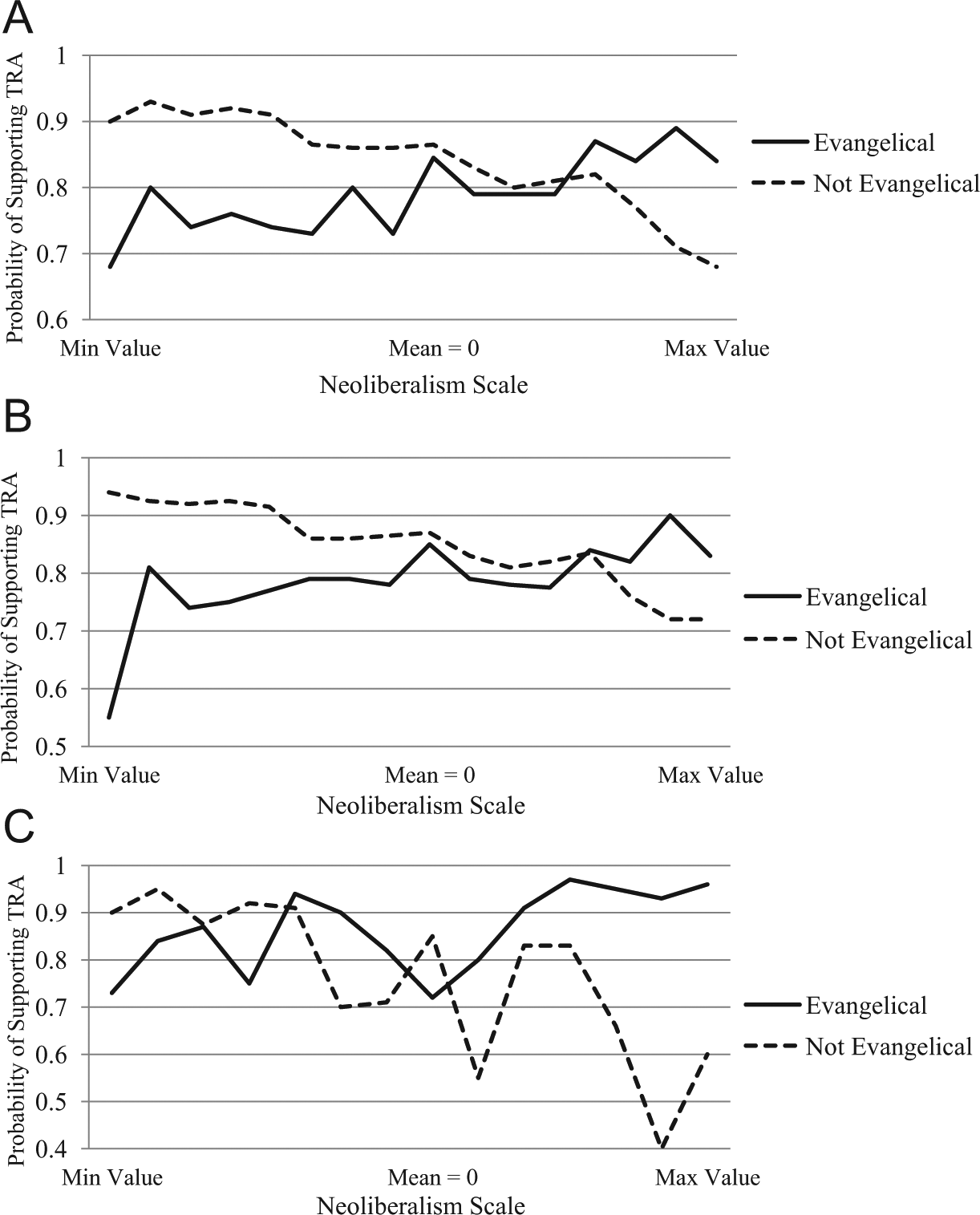
Predicted probabilities of supporting transracial adoption by evangelicalism and neoliberalism: (A) Full sample; (B) Whites; (C) Non-Whites.
Discussion and Conclusion
Scholars have theorized that neoliberal ideology favoring welfare retrenchment, unregulated markets, color-blindness, and privatized charity inclines American conservatives to support domestic TRA as a practice that allows them to simultaneously “address” the problem of poor minority children while relieving the government from subsidizing those children in foster care or their families on welfare (Briggs, 2012; Ortiz & Briggs, 2003; Patton, 2000; Solinger, 2001). Such scholars have also linked growing evangelical Protestant enthusiasm toward domestic TRA to their neoliberal commitments (Briggs, 2012; Joyce, 2013). The current study provides both support and nuance for this theory. Although neoliberalism and evangelical Protestantism, considered separately, seem to incline persons to be less supportive of TRA, neoliberalism and evangelicalism moderate one another with the result that evangelicals who hold more strongly to neoliberal views tend to be more favorable toward TRA. Moreover, these effects appear to hold across both White and non-White Americans.
This research extends both the literatures on domestic TRA and on race relations in the United States more broadly in several important ways. First and foremost, while TRA advocates contend that TRA represents an advance in race relations, with predominantly White American families becoming multiethnic and rigid boundaries of race becoming more fluid (Bartholet, 1999; Kennedy, 2003), the findings of this study suggest that recent support for domestic TRA among political and religious conservatives is less likely to be the result of a desire to cross racial boundaries or become a multicultural society. Rather, the enthusiasm among conservative Americans for domestic TRA may, in large part, stem from more ideologically conservative and subtly racist beliefs about the “unworthiness” of poor Black women to keep their children or receive aid, and the superiority of White middle-class families to raise those children. 11 Although these sentiments have been pervasive among conservative leaders since the Reagan administration (Patton, 2000), these beliefs are likely becoming more pervasive among rank-and-file conservatives, thus resulting in increased enthusiasm for TRA among contemporary conservative groups (Briggs, 2012).
The finding that neoliberal evangelicals are more favorable toward TRA is especially interesting in view of the fact that trust for people of other races was also one of the strongest predictors of support for TRA (Table 2), except among racial minorities (Table 3). Given that neoliberals and evangelicals have been found to hold more traditionalist and conservative racial views (Emerson & Smith, 2000), 12 it is likely that neoliberal evangelicals and people with greater trust in other races support TRA for different, and possibly contradictory, reasons.
This study’s findings also qualify the extent of neoliberalism’s influence on TRA attitudes in that neoliberalism appears to engender support for domestic TRA specifically within the context of evangelical Protestantism. As several scholars have pointed out, the culture of evangelical Protestantism combines aspects of neoliberal ideology that valorizes welfare retrenchment, color-blindness, privatized charity, and individual responsibility with religious altruism that recognizes the need for vulnerable children to be cared for (Emerson & Smith, 2000; Gorski, 2009; Hackworth, 2012). In this sense, the large-scale adoption of poor minority children into middle-class, White, Christian homes represents an ideal “solution” in the minds of conservative Protestants. In domestic TRA involving children from poor minority families, White Christian parents—and by extension, the White Christian community—are able to “rescue” the vulnerable “other,” and thus appear unassailably altruistic and color-blind, while “relieving” both the minority birth-mother from her supposed burden of parenthood and the government from subsidizing the poverty of the mother or child. The alternative, namely, promoting the preservation of poor minority families or reunification of minority children with their birth-parents by increasing government support of those families, would sound unthinkable in light of evangelicals’ neoliberal convictions. Additionally, the fact that this relationship between neoliberalism, evangelicalism, and TRA support extends to both Whites and minorities, suggests that the influence of “religious neoliberalism” (Hackworth, 2012) to shape racial views can likely subvert minority-group interests, ultimately advantaging conservative White political strategies.
Correspondingly, the significant interaction effects suggest that recent enthusiasm among evangelical Protestants toward domestic TRA as a practice is primarily among evangelicals who are (1) highly religious and (2) tend to espouse neoliberal views. Although rank-and-file White evangelicals who actually engage in TRA likely do so for a variety of different reasons, evangelical pundits who rally evangelicals toward TRA in books and conferences (Cruver, 2011; Merida & Morton, 2011; Moore, 2009) may be motivated, in part, by more ideological concerns rooted in neoliberal political-economic beliefs. Further qualitative research should be done among White evangelical Protestants who promote and/or engage in TRA to assess the extent to which their motivations derive from neoliberal ideology, compared with other motivations, such as infertility, altruism, or pro-life commitments (Joyce, 2013; Perry, 2014). Participant observation at evangelical adoption conferences and church groups, as well as qualitative interviews with evangelical adoption agencies and adoptive families would help flesh out these motivations.
Another pressing concern related to White evangelical families who transracially adopt is the extent to which neoliberal ideology influences their parenting of racial minority children, and ultimately, the identity, emotional, and intellectual development of those children. The NABSW and other TRA critics have long criticized TRA on the grounds that Black children adopted by White parents would not only lose a sense of solidarity with the Black community but could in fact grow to despise their own blackness, having learned implicitly from their White conservative parents a sense that African Americans are immoral, irresponsible, and demanding of undue entitlements. As neoliberal ideology continues to influence Americans, and particularly religious conservatives eager to adopt, this outcome may be an even greater likelihood. Longitudinal qualitative research focusing specifically on evangelical adoptive families and the development of their racial minority children is necessary to determine the extent of neoliberalism’s influence.
Several limitations of this research should be acknowledged. First, BRS data are cross-sectional, and thus, causal arguments must be made with caution. Although the BRS data do evidence a link between neoliberalism, evangelical Protestantism, and approval of TRA, the data do not specify exactly how these factors are connected. Again, future studies ought to use qualitative interviews and longitudinal data in order to assess the mechanisms at work in these relationships and establish directionally with more certainty. Second, while the BRS data provide insight into respondents’ views toward TRA, the BRS does not include measures to tap attitudes toward other adoption options (e.g., fostering-to-adopt, same-race adoption, kinship adoption). Related to this point, because the question refers to a “child of a different race” broadly, I am unable to determine whether the respondent had a particular racial group in mind or even international adoption involving a child of another race. Neoliberal views would likely be related to support for international TRA differently than support for domestic TRA. Although this issue is mitigated by the fact that “White-parent, African American-child” TRA is generally at the forefront of American consciousness when thoughts of TRA are invoked (Hollingsworth, 2002), future studies would ideally specify the type of adoption to analyze how political-economic and sociocultural factors influence relative support for each type.
Third, while this study was able to examine the relationship between attitudes toward TRA, neoliberalism, and religion among the general population, it does not provide any indication as to whether evangelical Protestants who actually engage in domestic TRA do so because of their neoliberal commitments to any degree. 13 Reasons for adopting children are diverse and complex and likely cannot be fully captured with closed-coded survey questionnaires. In-depth, life-history interviews could be used to assess which motivations are present and dominant among families who have actually adopted and the agencies that facilitate these adoptions. Last, as stated above, the 2005 BRS data do not include a large enough sample of Blacks and other minority groups to analyze the effects of neoliberalism and religion on TRA attitudes for each group separately. Although the sample of racial minorities was large enough to run multivariate models, ideally, future research should use data that would allow testing of these relationships in larger samples of racial minority groups along with White Americans.
These few limitations notwithstanding, this study makes an important contribution to our understanding of the ways in which neoliberal ideology and American religious subcultures may interact to shape racial policy and family structure in the United States. Although neoliberalism’s impact on support for TRA may be localized primarily to the context of evangelical Protestantism, as both the influence of neoliberal ideology and the political engagement of White evangelicals increases (Gorski, 2009; Green, 2009; Hackworth, 2012), we would expect even greater pressure from political and religious conservatives to aim government subsidies toward more privatized solutions to the problem of vulnerable minority children, like domestic TRA, and away from more direct support to the families themselves.
Footnotes
Acknowledgements
The author wishes to thank the editor and three anonymous reviewers for their helpful comments and recommendations. All errors are mine alone. Thanks also go to Jill Perry for her constant support and encouragement.
Author’s Note
This article represents part of a larger project by the author on the growing evangelical adoption and orphan care movement in the United States. Data and coding information for the purposes of replication are available from the author on request.
Declaration of Conflicting Interests
The author(s) declared no potential conflicts of interest with respect to the research, authorship, and/or publication of this article.
Funding
The author(s) received no financial support for the research, authorship, and/or publication of this article.