



Abstract
The transition to first-time parenthood at advanced maternal age has become a rising challenge for families in the 21st century. The present study aimed to examine the perceptions of influencing factors and the satisfaction with child-timing among older first-time mothers and their partners (older parents) compared with younger first-time mothers and their partners (younger parents) and to explore the relationships between these variables, depending on age group. A total of 105 older parents and 93 younger parents were recruited in a Portuguese urban referral maternity and completed self-report scales during pregnancy. Both age groups perceived that a shared desire to have children and a suitable partnership were the most influential factors. However, older parents were less satisfied with the timing of first childbirth than younger parents. Aside from some perceptions of influencing factors, advanced maternal age was the most consistent predictor of lower satisfaction with child-timing.
Keywords
The transition to first-time parenthood at advanced maternal age (AMA), which is usually defined as a maternal age of 35 years or older at the time of delivery (T. A. Mills & Lavender, 2014), has been a rising challenge for families in the 21st century (Bures, 2009). In United States, the percentage of live births at AMA has increased from 4.9% to 14.2% between 1980 and 2009 (Martin et al., 2011). Similar trends have been observed in Europe (Oliveira, 2011). Most studies have focused on the high educational, professional, and socioeconomic status of older first-time mothers, inferring that these women deliberately privilege individualistic prospects before starting a family (Shaw & Giles, 2009). Psychosocial child-timing models have evidenced the need to consider the subjective perceptions of factors that influence the timing of childbearing (Miller, 1994; Soloway & Smith, 1987). The few studies that have examined this topic have challenged the preconceived views that have prevailed about first childbirth at AMA (Cooke, Mills, & Lavender, 2010). Beyond reporting a deviation from their desired age at first birth (MacDougall, Beyene, & Nachtigall, 2012), older first-time mothers who planned to become pregnant usually perceive that the timing of first childbirth results from a diversity of influences that are sometimes imposed by circumstances (Cooke, Mills, & Lavender, 2012) and depend on men’s readiness to have children (Dion, 1995; Hammarberg & Clarke, 2005). Due to the joint nature of family decisions and their consequences for both partners (Jansen & Liefbroer, 2006), it is important to clarify couples’ perceptions of influencing factors and satisfaction with the timing of first childbirth at AMA.
The trend toward later childbearing in the present-day context has been related to a wide range of factors that implies a delay in adult milestones, such as the increase in education, economic uncertainty (i.e., unemployment or temporary contracts, especially among young people), partnership shifts (i.e., delay in partnership formation and marriage, increase in multiple unions and divorces), or challenging housing conditions that lead young people to leave the parental home at later age (M. Mills, Rindfuss, McDonald, & te Velde, 2011). Therefore, the establishment of independence through education, career, and financial security has been described as a consistent influence (Bayrampour, Heaman, Duncan, & Tough, 2012; Benzies et al., 2006; Dion, 1995), but it has not been the most frequently cited factor explaining first childbirth at AMA (Berryman, Thorpe, & Windridge, 1995; Cooke et al., 2012; Siegel, 1995). Conversely, older first-time mothers have essentially highlighted the achievement of emotional stability through the establishment of a marital relationship with a man who shares their desire to have children (Cooke et al., 2012; Hammarberg & Clarke, 2005; Maheshwari, Porter, Shetty, & Bhattacharya, 2008). These women have also often reported infertility problems and adverse pregnancy outcomes that have constrained the timing of first childbirth and intensified the feeling of time pressure against the biological clock (Cooke et al., 2012). External influences, such as parental leave policies or sociocultural expectations, have been less frequently reported (Benzies et al., 2006).
Despite challenging the preconceived views about first-time motherhood at AMA, these studies have been characterized by small sample sizes and have significantly varied in their definition of AMA (ranging from 30 to 40 years), depending on the decade of publication and on the target group investigated (Boivin et al., 2009). Most studies have been qualitative or have used checklists (Cooke et al., 2010) that captured how frequently each factor was cited but not how much each of these factors influenced the timing of first childbirth. Given their methodological characteristics, these studies have rarely included comparison groups. The few studies that have gone beyond this limitation have shown that emotional stability has been a consistent influence across all age groups (Benzies et al., 2006). Nevertheless, older first-time mothers cited reproductive health problems and the establishment of independence through education, career, and financial security more frequently than did younger mothers (Benzies et al., 2006; Dion, 1995). However, education and labor market participation has increasingly become a normal part of life for contemporary women (Cooke et al., 2012; Davia & Legazpe, 2013), suggesting the need to examine these age differences in the present-day context.
In addition to previously described influences, older first-time mothers have often reported that the timing of first childbirth depends on divergences on men’s desire to have children (Hammarberg & Clarke, 2005) and perceptions of the suitability of their life conditions (Soloway & Smith, 1987). However, few studies have focused in couples, showing that partners usually agreed that first childbirth at AMA depends on the establishment of financial security, career achievement, and marital stability (Coltrane, 1990; Daniels & Weingarten, 1982; Schlesinger & Schlesinger, 1989; Soloway & Smith, 1987). Aside from being outdated, these studies have generally focused in dual-earner couples in stable first-time marriages, giving little attention to the breadth of modern partnership patterns (i.e., the increase in multiple unions and divorces; M. Mills et al., 2011; Mulder, 2003).
Due to this complex interplay of influences, first childbirth at AMA has appeared to be a less deliberate and satisfying choice than commonly expected (Cooke et al., 2012; MacDougall et al., 2012). However, few studies have examined women’s satisfaction with the timing of childbearing and its relationship with the perceptions of influencing factors. The satisfaction with the timing of childbearing of older first-time mothers has seemed to depend on whether the influencing factors were perceived as being under or beyond control. Specifically, older first-time mothers who established their independence through education, career, and financial security before starting a family have generally appeared to be satisfied with the timing of childbearing (Benzies et al., 2006). However, older first-time mothers have often reported that they would have liked to have become mothers 5 to 10 years earlier, especially when they perceived that infertility problems constrained the timing of first childbirth (MacDougall et al., 2012). MacDougall et al. have also shown that the partners of older first-time mothers seemed to report less frequently that they would have liked to become fathers earlier in life due to infertility problems. However, gender differences and within-couple dynamics regarding these issues have remained unclear. To our knowledge, existing studies have not examined whether the relationships between the perceptions of influencing factors and satisfaction with the timing of first childbirth vary depending on maternal age at first childbirth. New studies focused on both partners should be developed to prepare interventions that may promote satisfying child-timing decisions and facilitate psychosocial adjustment during the transition to parenthood.
To overcome the previously described limitations, the first goal of this study was to describe the perceptions of influencing factors and satisfaction with the timing of first childbirth of older first-time mothers and their partners (older parents) compared with younger first-time mothers and their partners (older parents). The second goal of this study was to explore the relationships between the perceptions of influencing factors and the satisfaction with the timing of childbearing, depending on age group (older vs. younger parents).
We hypothesize that older and younger parents will highlight the establishment of a suitable relationship with a partner who share their desire to have children as the most influential factor explaining the timing of first childbirth. However, older parents will be more likely to value the establishment of independence through education, career, and financial security than younger parents. Due to the lack of evidences in literature, we did not establish hypotheses concerning gender differences in the perceptions of influencing factors, the satisfaction with the timing of first childbirth, and its relationships with the perceptions of influencing factors, depending on maternal age at first birth.
Method
Participants
A total of 232 older parents (maternal age of 35 years or older) and 291 younger parents (maternal age ranging from 20 to 34 years) were initially contacted using a consecutive sampling method. Inclusion criteria for both age groups were as follows: (a) woman should be primiparous; (b) parents should be married or cohabitating; (c) parents should not experience adverse outcomes during the current pregnancy (i.e., miscarriage, stillbirth, or termination of pregnancy due to fetal anomalies); (d) parents should not have any indication of fetal anomalies or medical problems of the baby; (e) parents should have the ability to read and understand Portuguese; and (f) both parents should classify the pregnancy as planned, that is, should report a conscious choice to have a baby, so that they could identify the individual, familial, and societal circumstances that influenced the timing of first childbirth (see Figure 1).
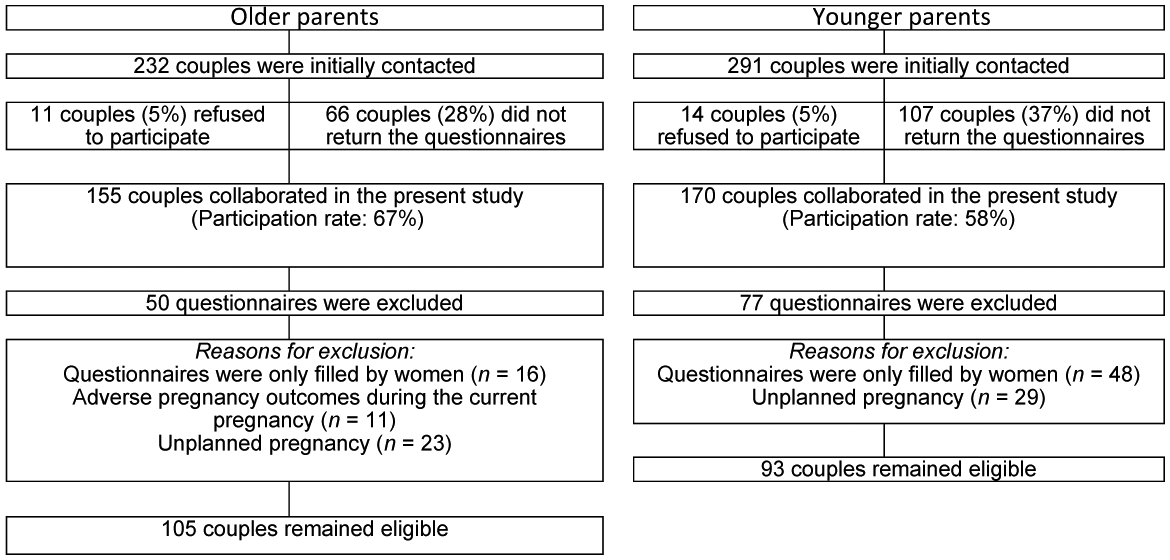
Flowchart of the selection process of older and younger parents.
The final sample consisted of 105 older parents and 93 younger parents. Table 1 summarizes the characteristics of the final sample.
Sociodemographic and Clinical Characteristics of the Sample.

Prior adverse pregnancy outcomes refer to miscarriages, ectopic pregnancies, terminations of pregnancy due to fetal anomalies, and fetal deaths; among older parents, 19 (18%) parents reported that prior adverse pregnancy outcomes occurred at advanced maternal age, and 13 (13%) parents reported that prior adverse pregnancy outcomes occurred before advanced maternal age.
Medically induced conception refers to conception through assisted reproduction treatments (in vitro fertilization and intracytoplasmic sperm injection), intrauterine insemination, and ovarian stimulation; among older parents, 8 (8%) parents reported that fertility treatments began at advanced maternal age, and 18 (17%) parents reported that fertility treatments began before advanced maternal age.
p < .05. **p < .01. ***p < .001.
Older and younger parents did not significantly differ regarding education, relationship length, and dual-earner pattern. However, older parents had been employed longer and were more likely to report prior adverse pregnancy outcomes and a medically induced conception than younger parents. The partners of older mothers were more likely to report prior marital relationships and to have prior children than the partners of younger mothers. Independent of the age group, mothers had studied longer than fathers. Older parents did not differ regarding employment length. However, younger mothers had been employed for shorter lengths of time than their partners.
Procedure
This study was approved by the Ethics Committee of the Centro Hospitalar e Universitário de Coimbra, Portugal. Data collection occurred between April 2011 and November 2012. Eligible parents were approached during pregnancy by the researcher prior to their standard obstetric appointment at a mean gestational age of 26.98 weeks (SD = 7.88). The study aims were presented, and informed consent was given by parents who agreed to participate in the investigation. Parents were given two versions of the questionnaires (one for each partner) and were told that both parents should complete the questionnaires separately at home and return them to the researchers at the following appointment.
Measures
Information on sociodemographic (age, professional status, relationship length, prior marital relationships, and prior men’s children) and clinical data (prior reproductive health problems) was collected.
An adapted version of the factors influencing the timing of childbearing section of the questionnaire developed by Tough, Tofflemire, Benzies, Fraser-Lee and Newburn-Cook (2007) (Guedes & Canavarro, 2014b) was used to measure the perceptions of influencing factors. Participants retrospectively assessed how much each of the presented 17 factors influenced the timing of childbearing using a response scale that ranged from 1 (not at all) to 5 (a lot). Participants had the possibility of adding other factors that influenced the timing of childbearing. The adapted version of the scale consisted of four factors (Guedes & Canavarro, 2014b) that were used for the purposes of the present study: Independence and Financial Security (α = .89), Shared Desire to Have Children and Suitable Partnership (α = .72), Parental Leave and Sociocultural Expectations (α = .71), and Reproductive Health Problems (α = .81).
The global satisfaction with the timing of childbearing was measured through the question “To what extent are you satisfied with the timing of the current pregnancy?” using a visual analogic scale that ranged from 0 (not satisfied at all) to 100 (completely satisfied). The regret for the timing of first childbirth was assessed through the question “Would you have liked to experience first childbirth at another time of your life?” If participants answered affirmatively, they had to specify the desired age for first childbirth.
Data Analysis
Analyses were performed with the Statistical Package for Social Sciences, version 20.0. Descriptive statistics and comparison tests (t tests and chi-squared tests) were computed for sample characterization. Regarding the first goal, comparisons were examined using a repeated-measure multivariate analysis of variance. Due to the interdependence of a couple’s observations, these analyses were performed on the couple as a unit (Kenny, Kashy, & Cook, 2006). The database was restructured to consider each couple as the subject of the analysis and each partner’s score as a different variable. Age group (older vs. younger parents) was considered as the between-subjects factor and gender (mothers vs. fathers) as the within-subjects factor. Univariate analyses of variance were performed when the multivariate effect was significant. Comparisons concerning the global satisfaction were examined using a repeated-measure analysis of variance, with age group as the between-subjects factor and gender as the within-subjects factor. Sociodemographic and clinical variables were not included as covariates in these comparison analyses because they reflected expected differences between groups. Comparisons concerning regret for the timing of childbearing were examined using chi-squared tests. Effect sizes were reported for comparison analyses (small: Cohen’s d ≥ 0.20, ϕc ≥ .01; medium: Cohen’s d ≥ 0.50, ϕc ≥ .03; large: Cohen’s d ≥ 0.80, ϕc ≥ .05; Cohen, 1992).
Regarding the second goal, Pearson correlations, point-biserial correlations, and phi coefficients were computed to identify the control variables (sociodemographic and clinical variables), which were significantly correlated with the outcomes (mothers’ and fathers’ global satisfaction and regret). Multiple linear regressions and binary logistic regressions were performed for each partner separately due to the interdependence of the couples’ observations. Following the procedures recommended by Aiken and West (1991), multiple linear regressions were computed to analyze moderation effects and used global satisfaction as the dependent variable. After inserting the covariates in the first step (when applicable), the study variables (which were centered to control multicollinearity) and the moderator (age group; dummy-coded as 0 = younger parents and 1 = older parents) were introduced. In the last step, interaction terms were introduced. Following the procedures of Jaccard (2001), binary logistic regressions were performed to analyze the moderation effects using regret as the dependent variable (dummy-coded as 0 = would not have liked to experience first childbirth earlier in life and 1 = would have liked to experience first childbirth earlier in life). The steps of the binary logistic analyses were organized as previously described. The significance level was set to p < .05, but marginally significant results were also reported (p < .10) for moderation analyses, because power is often low in interaction effects (Fairchild & McKinnon, 2009).
Results
Perceptions of Influencing Factors
A significant multivariate age group effect was observed, Pillai’s trace = .05, F(4, 193) = 2.50, p = .044, η2p = .050. Table 2 shows that univariate tests did not reveal significant differences between older and younger parents. A significant multivariate gender effect was observed, Pillai’s trace =.10, F(4, 193) = 5.28, p < .001, η2p = .100. Univariate tests showed that mothers attributed greater influence to Shared Desire and Suitable Partnership and to Parental Leave and Sociocultural Expectations than did fathers. No significant multivariate age group × gender interaction was observed, Pillai’s trace = .01, F(4, 193) = 0.55, p = .631, η2p = .013.
Perceptions of Influencing Factors and Global Satisfaction With the Timing of First Childbirth in the Advanced Maternal Age Group and in the Comparison Group.

Note. For perceptions of influencing factors, analyses of variance were not computed for gender × group interaction, due to the nonsignificant multivariate gender × group interaction in the multivariate analysis of variance.
p < .05. **p < .01. ***p < .001.
Aside from the presented factors, one older mother (1%) and two younger mothers (2%) mentioned their own age as a factor that influenced the timing of first childbirth. Fathers did not mention other factors aside from the presented ones.
Satisfaction With and Regret for the Timing of First Childbirth
Table 2 shows that older parents were significantly less satisfied with the timing of first childbirth than younger parents. Table 2 also shows that no significant gender effect was observed. No significant gender × age group interaction was observed, F(1, 196) = 0.12, p = .731, η2p = .001.
Older mothers (n = 60; 57%) were more likely to report that they would have liked to become mothers at an earlier age compared with younger mothers (n = 15; 16%), χ2(1, N = 198) = 35.97, p < .001, ϕc = .19. The partners of older mothers (n = 51; 49%) were also more likely to report that they would have liked to become fathers at an earlier age compared with the partners of younger mothers (n = 12; 13%), χ2(1, N = 198) = 29.47, p < .001, ϕc = .15. The mean desired age to have had children (with standard deviations in parentheses) for older mothers and their partners were 30.10 (3.70) and 31.32 (4.31) years, respectively. The mean desired age to have had children (with standard deviations in parentheses) for younger mothers and their partners were 28.64 (1.90) and 28.54 (1.98) years, respectively.
Relationships Between Influencing Factors and Satisfaction With the Timing of First Childbirth
Preliminary analyses evidenced that no covariates were identified for mothers’ and fathers’ global satisfaction. For mothers’ regret, prior adverse pregnancy outcomes (ϕ = .23, p < .001) and mode of conception (ϕ = .33, p < .001) were identified as a covariate. For fathers’ regret, prior adverse pregnancy outcomes (ϕ = .27, p < .001), mode of conception (ϕ = .34, p < .001), and relationship length (r = .17, p < .05) were identified as covariates.
Global Satisfaction With the Timing of Childbearing
Table 3 shows that the first step in the regression was significant for mothers. Younger age group, a higher perceived influence of Shared Desire and Suitable Partnership, and a lower perceived influence of Parental Leave and Sociocultural Expectations predicted higher levels of global satisfaction. The interaction step did not significantly improve the explained variance of the model. For fathers, the first step in the regression was significant. Younger age group and a higher perceived influence of Reproductive Health Problems predicted higher levels of global satisfaction with the timing of childbearing. The interaction step did not significantly improve the explained variance of the model.
Multiple Regression Models of Global Satisfaction With the Timing of First Childbirth.

Note. Overall model statistics for mothers’ global satisfaction, F(9, 187) = 5.37, p < .000, R2 = .21. Overall model statistics for fathers’ global satisfaction, F(9, 187) = 2.44, p = .012, R2 = .11. Interaction effects were not presented, because they did not improve the explained variance of the regression model.
p < .05. **p < .01. ***p < .001. †p < .10.
Regret for the Timing of First Childbirth
Table 4 shows that the first step in the regression was significant for mothers. Prior adverse pregnancy outcomes and a medically induced conception predicted a higher probability of regret. The second step significantly improved the explained variance. Older age group and a higher perceived influence of Reproductive Health Problems predicted a higher probability of regret. The interaction step did not significantly improve the explained variance. For fathers, the first step was significant. Prior adverse pregnancy outcomes, a medically induced conception, and a longer relationship length predicted a higher probability of regret. The second step significantly improved the explained variance. Older age group predicted a higher probability of regret. The interaction step did not significantly improve the explained variance.
Logistic Regression Models of Regret for the Timing of First Childbirth.

Note. Overall model statistics for mothers’ regret, χ2(11, 185) = 70.89, p < .001, −2 Log likelihood = 189.92, pseudo-R2 = .30 (Cox & Snell), .42 (Nagelkerke), Percentage of cases correctly classified: 74.5%. Overall statistics for fathers’ regret, χ2(12, 184) = 70.77, p < .001, −2 Log likelihood = 175.39, pseudo-R2 = .30 (Cox & Snell), .42 (Nagelkerke), Percentage of cases correctly classified: 79.1%. The variables marked with a dash were not introduced into the model because they were not significantly correlated with the outcome. Interaction effects were not presented, because they did not improve the explained variance of the regression model.
Dummy-coded as 1 = yes and 0 = no.
Dummy-coded as 1 = medically induced and 0 = spontaneous.
p < .05. **p < .01. ***p < .001. †p < .10.
Discussion
This study showed that a shared desire to have children and a suitable partnership were the most influential factors and were equally valued by older and younger parents. However, older parents were less satisfied with the timing of first childbirth and were more likely to report that they would have liked to become parents earlier in life than younger parents. For mothers, a lower perceived influence of a shared desire to have children and a suitable partnership and a higher perceived influence of parental leave, and sociocultural expectations were related to a lower satisfaction with the timing of first childbirth. Mothers who perceived a higher influence of reproductive health problems were more likely to report regret for the timing of first childbirth. For fathers, a higher perceived influence of reproductive health problems was related to a higher satisfaction but was not related to a higher probability of regret for the timing of first childbirth.
As hypothesized and previously stated (Benzies et al., 2006), a shared desire to have children and a suitable partnership were the most influential factors and were almost equally valued by older and younger parents. However, older parents seemed to have achieved these conditions later in life because they often experienced a delay in marriage (as shown in relationship length) and/or prior divorces (Berryman et al., 1995). Gender differences concerning this influencing factor tended to suggest that fathers often diverge in their willingness to have children compared with mothers (Hammarberg & Clarke, 2005). The influence of age was cited only by mothers, reinforcing that fathers do not always feel the same pressure from their biological clocks (Schlesinger & Schlesinger, 1989). In contrast to the previously stated (Benzies et al., 2006; Dion, 1995), the establishment of independence and financial security was almost equally valued in both age groups, challenging the assumption that first childbirth at AMA reflects a deliberate choice to privilege these prospects before starting a family. These findings seem to corroborate that these goals have increasingly become a normal part of life in the present-day context (Cooke et al., 2012; Davia & Legazpe, 2013). The similarities between age groups in education and professional status also support this explanation, reflecting the increase in the percentage of Portuguese women with university education compared with men and the strong participation of Portuguese women in the labor market in the contemporary background (Instituto Nacional de Estatística, 2012; Organization for Economic Co-Operation and Development, 2013). The retrospective appraisal of the factors that influenced the timing of first childbirth may also explain these findings. Although the establishment of independence and financial security may exert some influence, older parents may not have recognized these influences because they did not consciously plan the timing of first childbirth based on the achievement of these goals (Rijken & Knijn, 2009). Alternatively, older parents may have already established these conditions and done so for a longer period (as suggested by their employment length) than younger parents, attributing a lower influence to these factors (Kalebic, 2011). As previously stated (Benzies et al., 2006), external influences were perceived as less influential in both age groups. However, gender differences seem to suggest that the work–family balance remains essentially a feminine concern, due to the absence of a family-friendly workplace culture (Nomaguchi, 2006). Despite being more likely to have experienced prior reproductive adversities, older parents differed only slightly from younger parents concerning the perceived influence of reproductive health problems in explaining the timing of first childbirth. In the present sample, an important proportion of older parents reported prior adverse pregnancy outcomes and fertility treatments at AMA. Consistent with the findings of Bayrampour et al. (2012), reproductive health problems may not have been perceived as prime influences in explaining first childbirth at AMA.
Although parents from the two age groups perceived similar influencing factors for the timing of childbearing, older parents were less satisfied with the timing of first childbirth and were more likely to would have liked to have children earlier in life than younger parents, corroborating that first childbirth at AMA is a less deliberate and satisfying choice than commonly expected (Cooke et al., 2012; MacDougall et al., 2012). However, older parents who would have liked to have children earlier in life showed a higher variability in the desired age at first birth than younger parents. Previous studies have shown that older parents usually display diverse trajectories before achieving a successful pregnancy (Guedes & Canavarro, 2014a) and describe the timing of childbearing as an individual and contextual undertaking that reflect a sense of preparedness (MacDougall et al., 2012), explaining possibly why they may report more diverse child-timing age expectations than younger parents.
AMA, per se, appeared to be a consistent predictor of lower global satisfaction and higher probability of regret for the timing of first childbirth for both parents. Aside from reflecting a higher deviation from the desired age for first childbirth, AMA has been associated with increased medical risks (Schmidt, Sobotka, Bentzen, & Andersen, 2012) and psychosocial concerns (e.g., lifetime with children, social stigmatization, or smaller family size; Friese, Becker, & Nachtigall, 2008; MacDougall et al., 2012), which may negatively affect couples’ childbearing prospects and satisfaction with child-timing.
The global satisfaction with the timing of first childbirth was predicted by different perceptions of influencing factors depending on gender. Mothers’ perceptions concerning a shared desire and a suitable partnership appeared to positively affect global satisfaction. These findings seem to corroborate that a shared desire and a suitable partnership are important for mothers across all age groups (Benzies et al., 2006) and that perceived convergence in their partner’s willingness to parent may minimize conflicts in the decision-making process (Rijken & Knijn, 2009), thus positively affecting their satisfaction. These findings also seem to suggest the importance of mothers’ sense of control toward influencing factors for their own satisfaction (Cooke et al., 2012), especially regarding external influences. In contrast, fathers’ perceptions of reproductive health problems appear to positively affect their global satisfaction. These findings seem to show that the achievement of pregnancy may also be considered positive in initially pessimistic expectations (Friese, Becker, & Nachtigall, 2006), generating feelings of luck and appreciation toward childbearing (MacDougall et al., 2012).
Independent of the age group, parents who reported prior adverse pregnancy outcomes and a medically induced conception showed a higher probability of regret for the timing of first childbirth, because these reproductive circumstances usually inhibit the achievement of desired childbearing prospects (Friese et al., 2006). However, a greater perceived influence of reproductive health problems was positively associated with mothers’ regret but not with fathers’ regret. This finding supports that the interference of reproductive adversities in child-timing may be more disruptive for women than for men (MacDougall et al., 2012), especially when they perceive them as a problem that inhibits the achievement of a valued goal (McQuillan, Stone, & Greil, 2007). The higher physical burden (e.g., experience of pregnancy loss or intrusive fertility treatments) and social stigmatization (e.g., feelings of inadequacy, due to the centrality of motherhood for women’s identity) that are typically related to reproductive problems among women (e.g., Abbey, Andrews, & Halrnan, 1991; Greil, Leitko, & Porter, 1988) may also explain these gender differences. Conversely, fathers who were married or cohabitated for longer were also more likely to report regret for the timing of first childbirth. These findings seem to support that the suitability of marital conditions is also important for men’s reflections on the timing of childbearing (Soloway & Smith, 1987). The earlier achievement of marital stability may minimize the divergences in men’s desire to have children (Rijken & Knijn, 2009), thus affecting the expression of their wish to have become fathers earlier in life.
Some limitations should be considered when interpreting the presented findings. First, the sample was recruited in only one public health service and the representation of some characteristics (e.g., prior marital relationships or medically induced conception) was small, thus limiting the generalization of the results. Single women and women with same-sex partners, who are also part of the diverse pregnancy context for older first-time mothers (McMahon, Boivin, Gibson, Hammarberg et al., 2011), were not included in this study. Second, the retrospective assessment concerning factors that influenced the timing of first childbirth may have influenced the findings due to memory bias or a social desirability to minimize negative stereotypes about first childbirth at AMA. Third, satisfaction with the timing of first childbirth was assessed using only a visual analogical scale and an item concerning regret for the timing of first childbirth.
However, the present study has several strengths. First, this study focused on mothers and fathers considering the recent shifts that have prevailed in the present-day context. Second, this study did not examine how frequently each influencing factor was cited but how much each of these factors influenced the timing of first childbirth. Third, this study included a group of younger parents that allowed for a broader understanding of the factors that influenced first childbirth at AMA. Finally, this study also explored the relationships between the perceptions of influencing factors and satisfaction with the timing of first childbirth for mothers and fathers.
This study has several implications for research. Longitudinal studies are needed to better understand the perceptions of influencing factors, their underlying meaning (i.e., what parents may assess as emotional stability or financial security), and their articulation as primary or secondary influences over time, combining qualitative and quantitative methods. Future studies should also allow for a more comprehensive assessment of satisfaction with the timing of first childbirth by exploring other questions, such as perceived control or partner’s influence. Previous large prospective studies have made a significant contribution in examining both age and mode of conception effects on adjustment during pregnancy (McMahon, Boivin, Gibson, Hammarberg et al., 2011) and early postpartum depression (McMahon, Boivin, Gibson, Fisher et al., 2011). Future studies should consider both age and mode of conception effects to clarify the relationship between the perceptions of influencing factors and the satisfaction with the timing of first childbirth. The role of other variables (e.g., social age deadlines, childbearing motivations, or pregnancy planning) on satisfaction with the timing of first childbirth should also be explored.
This study has also implications for social policies and clinical practice. Preventive approaches should be developed to promote satisfying reproductive decisions. Protective familial policies should be enhanced to facilitate work–family balance (e.g., parental leave, child care facilities, and job flexibility) and minimize the perceived influence of external influences that negatively affect mothers’ satisfaction with the timing of first childbirth. Given the importance of a shared desire and a suitable partnership, family planning and preconception services should privilege a couple-focused approach. Health professionals should provide individualized information about the reproductive life cycle and explore the underlying meanings and (mis)conceptions concerning the suitable conditions for having children to promote a realistic balance between the advantages and disadvantages of later childbearing. Antenatal interventions should also be prepared to meet parents’ needs in the present-day context. Health professionals should avoid judgmental attitudes toward older parents that may negatively affect their relationship with patients. During antenatal routines, they should also give attention to older parents who express disruptive feelings of dissatisfaction or regret for first childbirth and to mothers who, independent of age, perceive that partnership, reproductive or external circumstances significantly constrained the timing of childbearing. In these situations, interdisciplinary collaboration with psychological services may be important in developing preventive interventions that could facilitate the psychosocial adjustment during the transition to parenthood. Early psychosocial interventions may enhance acceptance and cognitive consonance toward the timing of first childbirth, facilitate couples’ understanding, communication and problem-solving strategies, and help address gender differences concerning child-timing issues.
Footnotes
Declaration of Conflicting Interests
The author(s) declared no potential conflicts of interest with respect to the research, authorship, and/or publication of this article.
Funding
The author(s) disclosed receipt of the following financial support for the research, authorship, and/or publication of this article: This study is part of the Transition to parenthood in advanced maternal age: Individual, marital and parental adaptation research project, integrated in the Relationships, Development & Health Research Group of the R&D Cognitive-Behavioral Center for Research and Intervention of the University of Coimbra (PEst-OE/PSI/UI0730/2014). Maryse Guedes is supported by a scholarship from the Portuguese Foundation for Science and Technology (SFRH/BD/68912/2010).