



Abstract
The study examines how family climate counteracts the constraints in the business system created by relationship conflict that is known to negatively affect business outcomes (firm satisfaction and firm performance). Cross-sectional self-reported data were obtained from a nationally representative sample of 392 Austrian family businesses. The core tenet of sustainable family business theory provided the theoretical underpinnings for the study’s hypotheses. Family climate includes measures of cohesion, adaptability, and open communication. Results demonstrate the negative effects of relationship conflict on firm satisfaction and firm performance. Adaptability was significantly related to firm performance. Cohesion and adaptability moderated the negative effect of relationship conflict on firm satisfaction; adaptability moderated the negative effect of relationship conflict on firm performance.
According to Carlock and Ward (2001), all families experience relationship problems. Relationship conflicts such as children’s desire to differentiate themselves from their parents, marital discord, or ownership dispersion among family members are central to every family (Eddleston & Kellermanns, 2007). However, family businesses face even bigger challenges and are fertile grounds for conflicts (Harvey & Evans, 1994a; Sorenson, 1999) because family and business are interconnected so that the potential for conflict is greater than in firms with other governance forms (Danes, Rueter, Kwon, & Doherty, 2002; Lee & Rogoff, 1996).
Conflict in family businesses is a double-edged sword that can have positive or negative effects on the business. On one hand conflict is described as bad and detrimental, and on the other, it can be beneficial in the sense that it can motivate a system to change (for an overview, see Frank, Keßler, Nosé, & Suchy, 2011). It is critical when studying conflict in family business to recognize the distinction between conflicts among related family members versus conflict among unrelated organizational team members (Harvey & Evans, 1994b; Kaye, 1991). Related family members have enduring dual relationships, long histories, and deep-seeded, unspoken agendas (Kaye, 2005) that result in common as well as different ways of construing reality (Amarapurkar & Danes, 2005). Thus, understanding and managing destructive conflicts (e.g., relationship conflict) in the short term can affect business productivity and business survival in the long-run (Gudmunson & Danes, 2013; Stewart & Danes, 2001; Vincent, 1966).
This study is grounded in the sustainable family business theory (SFBT), a behavior-oriented systems theory demonstrating integration of the family system, the business system, and their interplay (Danes & Brewton, 2012). SFBT recognizes that conflict among related family members is distinct from conflict among unrelated organizational team members (Kaye, 1991). This study uses SFBT propositions to examine relationship conflict and family climate as resource and interpersonal transactions that occur as family system processes at the interface of family and business systems.
Eddleston and Kellermanns (2007) found a negative association between relationship conflict and family firm performance with altruism, a family system outcome (Schulze, Lubatkin, & Dino, 2003), tempering that negative effect. This study contributes to their call to further elucidate how an owning family can be a source of strength and comparative advantage to the family firm by examining family climate, a family system resource. Family climate plays a unique role in family firms compared to other companies (Dyer, 2003). A positive family climate is a type of bonding social capital that creates resilience capacity epitomized by functional strength (Danes, Stafford, Haynes, & Amarapurkar, 2009). When family climate is accessed and used, it can build trust through open communication, build solidarity through internal cohesiveness, and adaptability through flexible conflict management (Gudmunson & Danes, 2013).
This study uses multiple measures of business outcomes that contribute to a deeper insight into dynamic processes within family businesses. Typical financial indicators of firm success found in the literature are gross revenue, survival, return on assets, sales growth, profits, and number of employees (Miner, 1997; Stafford, Danes, & Haynes, 2013). However, Pieper and Klein (2007) postulated that family businesses incorporate a multidimensional nature that needs to be addressed. In fact, Astrachan and Jaskiewicz (2008) developed a formula for business “value” inclusive of both financial and what they labeled as “emotional” components. When the study’s research question focuses on effects of relationship conflict on family firms and the role of positive family climate, as is the case in this study, it is essential to use a multidimensional business outcome measure to elucidate a more complete lens into the impact of those socioemotional processes (Gomez-Mejia, Cruz, Berrone, & De Castro, 2011). Sandig, Labadie, Saris, and Mayordomo (2006) indicated that more subjective, nonfinancial assessments of business success are needed to more fully understand dimensions of success such as owner expectations and motivations.
The study purpose is to examine the effect of positive family climate on the association of relationship conflict and business outcomes (firm satisfaction and firm performance). The study purpose reflects the SFBT proposition that during times of stability, family businesses garner resources primarily within the business system, but with the disruption that relationship conflict with the business creates, it is often necessary to access and use resources from both the family and business systems (Danes & Brewton, 2012). This resource integration during times of disruption and change occurs at the family business interface. This study contributes to the research gap found by Zacchary (2011) by identifying measurable dimensions of family climate representing owning family bonding social capital that contributes to enhancing business outcomes. Family climate has been theorized, and research has called for studies incorporating family climate (Björnberg & Nicholson, 2007); however, neither main effects nor moderating effects of positive family climate on firm satisfaction or firm performance have been examined. This study addresses this research gap to empirically examine the effects of positive family climate on family firms.
Theoretical Foundation
Previous research has used theories that describe the various aspects of the intersection of work and family domains. For instance, the conditions under which the spillover between work and family are positive or negative is described very well with spillover theory (Westman, Brough, & Kalliath, 2009). Role theory (Kahn, Wolfe, Quinn, Snoeke, & Rosenthal, 1964) proposes that social structures are made up of role relationships between work and family that may be incompatible with one another (Goode, 1960; Greenhaus & Beutell, 1985). However, neither of these theories describe the effects of family members, considered as a system, working together in the company on a daily basis on which this study focuses. A theory that has been systemic orientation is boundary theory (Ashforth, Kreiner, & Fugate, 2000). Although it describes the permeability of system boundaries very well, it does not address processes composed of interpersonal transactions that lead to higher permeability, such as disruptions caused by work/family issues. A theory that incorporates a systemic approach with propositions addressing processes and disruptions within a family business is the SFBT, which guides this study.
The central SFBT tenet is that equal recognition is given to family and firm and that each system takes available resources and constraints and transforms them via interpersonal and resource transactions into achievements (Danes & Brewton, 2012). This central tenet undergirds the study’s analytical model. Relationship conflict is a constraint that consistently has negative impacts on firm performance (Eddleston & Kellermanns, 2007). Family climate is a family and business system inherent resource that is part of bonding family social capital that epitomizes its resilience capacity through functional strength.
Access to and use of family climate occur through interpersonal and resource transactions (Danes & Stafford, 2011). Thus, another SFBT proposition that applies here is: Processes in the family and business are composed of interpersonal transactions and resource transactions (utilization of bonding family social capital) that can be thought of as routine or standard operating procedures (Danes & Brewton, 2012). An owning family’s cohesiveness and adaptability and their way of talking openly with each other (dimensions of family climate) affect daily business and professional handling of conflicts (e.g., Olson & Gorall, 2003).
Dissecting this main tenet into component parts, one more targeted SFBT proposition informing this study’s analytical model is that family social capital can have simultaneous positive or negative effects on business outcomes depending on the circumstances (Danes & Brewton, 2012). Family social capital is described as goodwill and trust among family members. Family climate is a reflection of the owning family’s resilience capacity to tackle problems that cause tensions at the family–firm interface (Gudmunson & Danes, 2013).
In sum, a positive family climate creates a resilience capacity that serves as the foundation for addressing disruptions in the family business such as relationship conflicts. SFBT proposes that patterns of resource and interpersonal transactions in firm and family systems during times of stability create a resilience capacity that serves as a foundation for addressing stresses during times of change and disruptions (Danes & Brewton, 2012). When the owning family encounters disruptions such as relationship conflict, family members access and use the stock of social capital through interpersonal transactions to moderate the effects of those disruptions. Family climate is an aspect of an owning family’s resilience capacity, and it can be drawn on to temper the negative effect of relationship conflict of the firm.
Relationship Conflict
Drawing on past research and given the breadth of conflict literature (Baron & Kenny, 1986; Jehn, 1997; Jehn & Bendersky, 2003; Jehn, Greer, Levine, & Szulanski, 2008; Jehn & Mannix, 2001), two streams of thought exist that address a paradox of conflict. On one hand, conflict can act as a creative mechanism that stimulates richer interactions and supports innovative decisions (De Dreu & Van De Vliert, 1997; Janssen, Van De Vliert, & Veenstra, 1999; Jehn, 1995, 1997). It can increase opportunity recognition, environmental scanning, and the learning necessary for entrepreneurial behavior (Corbett, 2005; Eddleston, Otondo, & Kellermanns, 2008; Lumpkin & Lichtenstein, 2005). On the other hand, conflict, especially relationship conflict (defined as interpersonal conflict involving emotions such as anger, resentment, and worry), is detrimental to firm performance because it limits information processing ability or the cognitive functioning of family members by increasing stress and anxiety levels (Jehn & Mannix, 2001; von Schlippe & Kellermanns, 2008).
Conflict can be categorized into three types—task, process, and relationship conflict (Jehn, 1995). These conflict types arise in the context of organizational issues and relate, in particular, to differences in viewpoints and opinions pertaining to a task or to controversies about aspects of how task accomplishment will proceed, respectively (Jehn & Mannix, 2001). Relationship conflict exists when there are interpersonal incompatibilities and disagreements that typically include tension, animosity, and annoyance. In this study, relationship conflict conceptually represents the frequency and intensity of interpersonal conflicts between family members within the business system. Harvey and Evans (1994a) indicate that conflict in family businesses emanates from three arenas, family, business, and external stakeholders. Relationship conflict between family members occurs in one arena with effects on the other arena. According to SFBT, it represents the internal disruption in one of these arenas that has effects on the other where the two arenas intersect.
Research findings indicate that the disruption produced by relationship conflict causes family members to focus more on each other than on the problem itself (Jehn, 1995). Doing so limits the information processing ability of people, distracts them from the task that needs to be accomplished, causes them to work less effectively (Jehn, 1995), and to be less satisfied with the job (Li, Zhou, & Leung, 2011). The disruption is very strong in family businesses because of the unique link between family and business, which makes them more vulnerable to the negative effects of relationship conflict (Kellermanns & Eddleston, 2004). Given that negative events have been found to explain more of the variance in outcomes than positive events (Olson & Gorall, 2003), we focus on relationship conflict to identify the negative effect on business outcomes (firm satisfaction and firm performance).
Firm performance subsumes market criteria such as turnover, profit, number of employees, and share of regular customers, whereas firm satisfaction is based on the business owners’ assessment of the firm. Both are relevant in the evaluation of success in family firms (Conway & Lance, 2010). Neither aspect of success should be substituted for the other, since each serves a specific purpose (e.g., Ruderman, Ohlott, Panzer, & King, 2002). The measurement of business outcomes is more complex than either of the measures alone so it is very important to include both to better reflect reality and to make a more meaningful contribution to practice (Chrisman, Chua, & Sharma, 2005). According to SFBT, both measures represent the achievement of the firm. On the basis of the above reasoning and its theoretical grounding, Hypothesis 1 was proposed:
Family Climate
In general, climate is a person-oriented concept that reflects shared perceptions of how things are (Ostroff, 1993). Following James and Jones (1974), who recommended that a differentiation of climate should be made according to the used attribute, we use the term family climate that is referring to family attributes. Following the convention of organizational climate research (James et al., 2008; James & Jones, 1974; Pritchard & Karasick, 1973) that combines collective organizational and psychological dimensions, family climate combines organizational and familial dimensions. How the family functions creating a stock of resilience capacity or a state of vulnerability is a collective attribute that is based in the family system and adapted for use to the organizational system.
Family climate characterizes the functioning of a family, for example, how family members communicate, make decisions, and adapt, especially in unexpected situations (Björnberg & Nicholson, 2007). A widely accepted definition of family functioning is based on the Circumplex Model of Marital and Family Functioning (Olson, Sprenkle, & Russel, 1979), which includes three dimensions: cohesion, adaptability, and communication. Cohesion reflects the emotional bonding a family shares; adaptability is the ability of a family to cope with change (Olson, 2000). Communication is considered to facilitate changes in cohesion and adaptability.
Family cohesion, the emotional and intellectual glue (Björnberg & Nicholson, 2007), is defined as the emotional bonding family members have with one another and the degree of individual autonomy a person experiences in the family system (Danes, Lee, Stafford, & Heck, 2008). It focuses on separateness versus togetherness of family business systems. Thus, family cohesion is conducive to effective family functioning (Danes et al., 2008).
Adaptability is the ability of a family to deal effectively with a problematic situation by changing roles and strategies in terms of new or modified assessments of situations it confronts (Kossek, Colquitt, & Noe, 2001). The family serves very often as a familia spongia that is highly adaptive externally to the demands of the environment and internally to the needs of its own members (Vincent, 1966), which is a vital function in changing environments. An adaptable and viable family needs to balance change and stability and manage problems that arise because of different external and internal requirements. This approach suggests viewing family as not only maintenance oriented but also developmental and growth oriented (Danes et al., 2008).
We define open communication as a regular, straight forward, and interactive dialogue involving listening as well as sincere expression of concerns. To use open communication skills enables families to alter and adjust their levels of cohesion and adaptability to meet developmental or situational demands (Olson & Gorall, 2003). In this study, family climate conceptually represents the functioning of a family composed of cohesiveness, adaptability, and open communication. Considering SFBT’s proposition that family social capital when accessed and used influences the disruptive effect of relationship conflict, the following hypothesis was introduced.
The Moderating Role of Family Climate
Family climate is composed of interaction processes between family members. Family climate is fundamental for integrating and regulating change in the family system (Björnberg & Nicholson, 2007). Even when a family develops a positive family climate, relationship conflict can arise but the way the dispute is managed most likely will be less detrimental. A positive family climate implies that cohesion, adaptability, and open communication are high. Where a positive family climate exists, conflicts can be openly expressed and carefully considered because every family member has the security of knowing that their attitude and perception will be heard and respected by the others.
Due to existence of a positive family climate, a healthy way of handling the conflict can be established, and relationship conflicts can be managed before they escalate. Not having the opportunity to discuss and make decisions about family business issues can intensify relationship conflict (Stewart & Danes, 2001). Speaking openly about a conflict and trusting that everyone is working for the common good may reduce the detrimental effect of conflict.
In regard to SFBT, family climate is a form of bonding family social capital that is accessed and used by family members in times of disruptions such as relationship conflict. Hence, the use and access of family climate fosters resilience capacity within the family, which influences the negative effects of relationship conflict on firm satisfaction and firm performance. On the basis of this theoretical reasoning and its theoretical grounding, Hypothesis 3 was proposed:
Method
To test the primary research question of this study—if positive family climate influences the negative effect of relationship conflict on both of the business outcomes (firm satisfaction and firm performance)—a quantitative approach was used. We conducted an online questionnaire that was sent to a random sample of Austrian businesses of all industries.
Recruitment Procedure
A three-step participant recruitment procedure was conducted from November 2010 until January 2011. First step: Firms with more than 10 employees were selected from Aurelia (Austrian reliable company information) due to higher occurrence of relationship conflict in larger firms (Eddleston & Kellermanns, 2007). Aurelia is a business database composed of current information for about 160,000 businesses. A superpopulation of 19,593 firms was obtained that was representative of all Austrian businesses. Second step: Out of this population, a random sample of 5,500 firms was generated, and each of them was invited by phone to participate in the study. Third step: An online questionnaire link was sent via e-mail to 2,400 firms that agreed to participate (44% gross response rate). A total of 583 questionnaires were returned fully completed (24% net response rate).
Sample Description and Representativeness
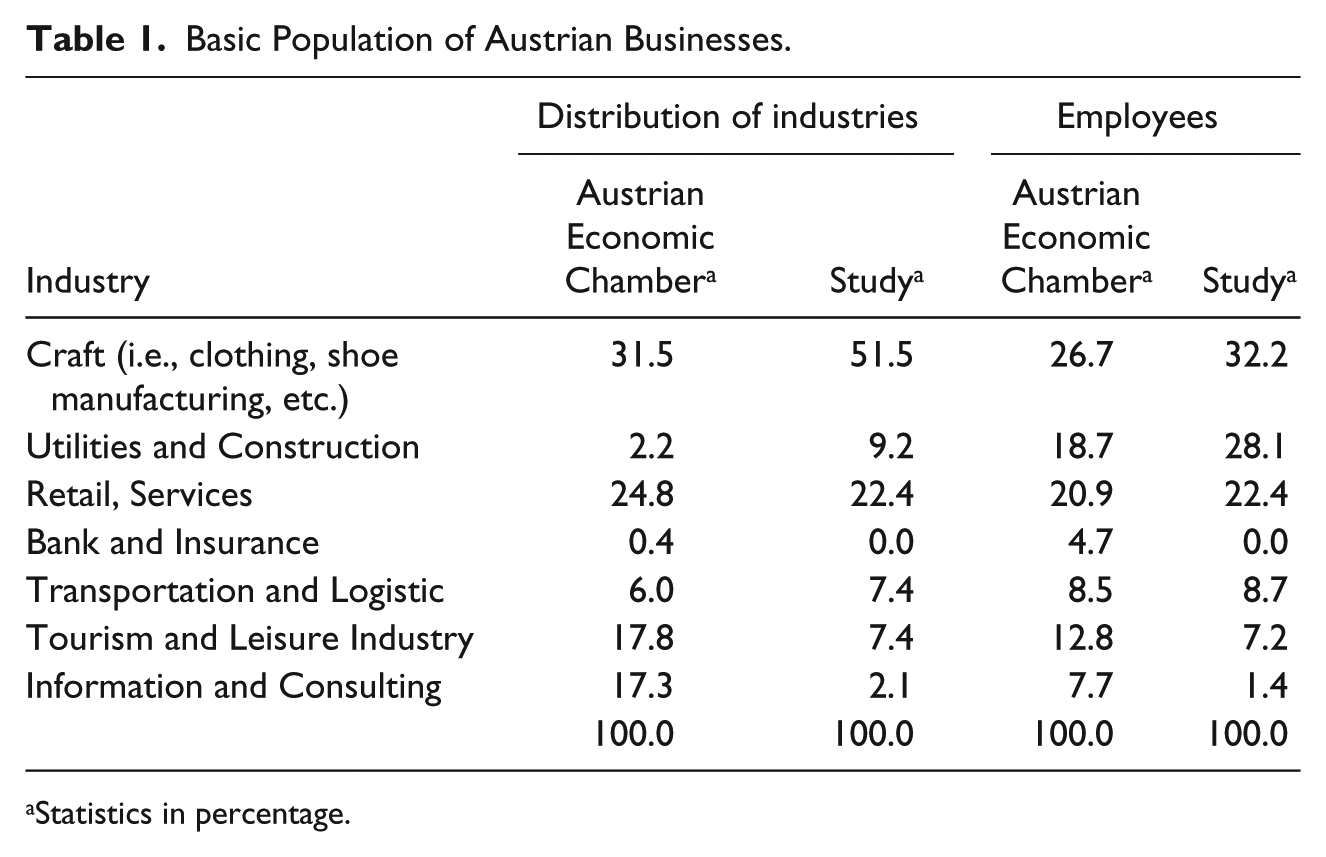
To make sure that these questionnaires were representative of the distribution of Austrian businesses, we compared a list of industries of the Austrian Economic Chambers (WKO, 2013) that represents data of the basic population of all Austrian businesses with the firms in our study (see Table 1). There are only small differences in the distribution of industries between our study and the list of industries of the Austrian Economic Chambers. In the study, more crafts, utilities, and constructions were included and fewer firms related to tourism and leisure industry, and information and consulting, were included. All other industries had distributions similar to the basic population of Austrian businesses. A comparison of employees between the Austrian corporate landscape and our study shows similar differences in the aforementioned industries.
Basic Population of Austrian Businesses.
Statistics in percentage.
To capture the degree of family influence in our sample, we used the F-PEC (Family Influence on Power, Experience, and Culture) scale (Astrachan, Klein, & Smyrnios, 2002). The F-PEC is a measurement instrument that addresses the multidimensional and continuous operationalization of the family influence construct, which is achieved through power, experience, and culture. According to Cliff and Jennings (2005), who encourage researchers to examine the subdimensions of the family influence construct as separate variables, we used the power dimension of the F-PEC scale. The power dimension measures the degree of potential overall influence on the firm either directly through family members or indirectly through people chosen by the family (Aiken & West, 1991). The power subscale results from a combination of (a) the extent of direct equity stake of the family in relation to total company equity; (b) the extent of direct governance control through family board members in relation to the overall number of members on the board of directors; and (c) the extent of direct managerial control through family managers in the supervisory board in relation to the total number of members on this committee. Firms with a score for the power subscale of the F-PEC of less than 1 were excluded as they cannot be classified as family firms. Companies having a value equal or above 1 were defined as family firms (Klein, Astrachan, & Smyrnios, 2005).
In family businesses where only one family member is active and decides, relationship conflict within the business setting based on business decisions is unlikely to occur (Eddleston & Kellermanns, 2007). Therefore, firms with fewer than two active family members were removed from the sample. Based on these procedures, the final sample consists of 392 family businesses.
According to the European Union definition, the sample consisted of 97% small- and medium-sized firms and 3% large firms. Furthermore, 37% of respondents were female, and 63% were male, with an average age of 41 years. Positions held by respondents in their firms were 68% owner/shareholder, 35% executive board member/CEO, 13% middle management, 1% member of supervisory board or advisory board, and 7% other positions (multiple answers are possible). On average, three people worked in general management (SD = 3.98), of which, on average, two were family members (SD = .91). In 66% of family firms, up to three family members were active, and in 34% four or more family members were active. Family firms were managed by first (35%), second (32%), third or higher (33%) generations.
Measures
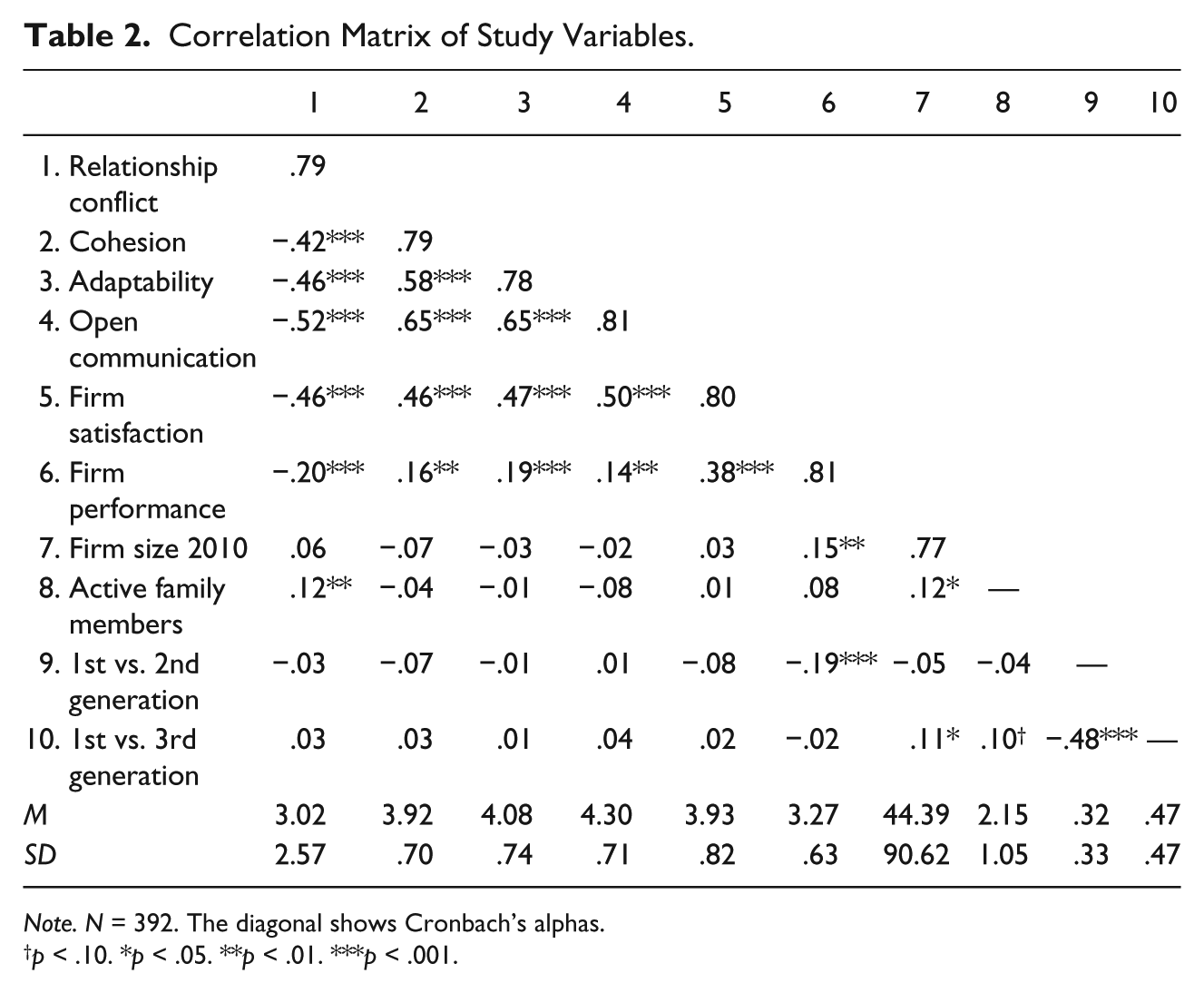
Most of the constructs were measured by already validated scales. If necessary, items were slightly adapted to account for the family firm setting. Scale characteristics are described in Table 2. Unless otherwise noted, constructs were measured on a 5-point Likert-type scale of 1 = does not apply at all to 5 = applies fully.
Correlation Matrix of Study Variables.
Note. N = 392. The diagonal shows Cronbach’s alphas.
p < .10. *p < .05. **p < .01. ***p < .001.
Relationship Conflict
Relationship conflict was measured by adapting items developed by Jehn (1995, 1997). It may be assumed that conflicts in family firms occur frequently, but the perception of their intensity is different (Stewart & Danes, 2001). Thus, we also included evaluations about conflict intensity. This introduction was given before participants answered the items, “Please think about decisions you made in the company together with other family members during the last year and rate the following statements in frequency and intensity.” There have been personal conflicts among family members, and There have been conflicts about personal goals with family members.
The frequency of relationship conflict was measured on a 5-point Likert-type scale ranging from 1 = never, 2 = hardly ever (fewer than 6×/year), 3 = some of the time (1×/month), 4 = almost always (1× every 2 weeks), and 5 = always (min. 1×/week); Cronbach’s alpha for the measure was .79. The intensity of relationship conflict ranged from 1 = none/irrelevant, 2 = somewhat strained, and 3 = severely strained, with Cronbach’s alpha of .79. Frequency and intensity of each item of relationship conflict were multiplied and show a Cronbach’s alpha of .81.
Family Climate
Family climate questions were adapted from Björnberg and Nicholson’s Family Climate Scale (2007). The number of questions within each subscale of family climate was reduced from the original scale due to constraints of cultural understandings and time restrictions of business owners.
The introduction to this set of questions began with this statement: “Following statements refer to family members working in the family business”: Open communication (e.g., We are frank with each other), cognitive cohesion (e.g., We have shared interests and tastes), and adaptability (e.g., When we face difficulties we work together effectively) were all composed of three questions; two items asked about the emotional cohesion (e.g., We make each other feel secure). Cronbach’s alphas of cognitive and emotional cohesion were very low (less than .50), so we calculated a factor analysis to figure out if both scales measured distinct constructs. The results showed that all items of the cognitive and emotional cohesion scales loaded on only one factor. We combined the two sets of question to develop only one cohesion scale and obtained a Cronbach’s alpha of .78. Both open communication and adaptability had Cronbach’s alpha of .81.
Dependent Variables
Firm satisfaction was based on the Satisfaction With Life Scale of Diener, Emmons, Larsen, and Griffin (1985) and is a business owner assessed indicator. According to Wanous, Reichers, and Hudy (1997), who stated that even a single item is acceptable to capture firm satisfaction, we used two items—I am satisfied with the firm and Family members in the business are very satisfied; Cronbach’s alpha for this scale is .77.
Firm performance was subjectively measured by success evaluations over 3 years (2008 to 2010) to balance short-term fluctuations (Please rate how the company developed in the last 3 years (2008-2010) in comparison with its biggest competitor: turnover, profit, number of employees, and share of regular customers). As reported in previous studies (e.g., Eddleston & Kellermanns, 2007; Love, Priem, & Lumpkin, 2002), the subjective measurement of firm performance was necessary due to the fact that closely held firms are not willing to report objective business data (Love et al., 2002). The items were rated on a 5-point Likert-type scale with the dimensions 1 = worse development and 5 = much better development, for turnover and profit, and the dimensions 1 = strongly decreasing and 5 = strongly increasing, for number of employees and share of regular customers, with a Cronbach’s alpha of .80.
Control Variables
A firm managed by the second or third generation suffers more from relationship conflict due to the complexity of family and work relationships involved (Davis & Harveston, 1999). Thus, we controlled for active family members in business and the generation currently in charge of the family business. Furthermore, we controlled for firm size (number of employees in 2010). According to Eddleston and Kellermanns (2007), larger firms may have less immediate interaction among family members, and therefore, the occurrence of relationship conflict may be less pronounced than in smaller firms.
The variable active family members was divided in four groups: (a) minimum two family members (34%), (b) three family members (32%), (c) four family members (19%), and (d) five family members or more (15%), and dummy coded. We defined four groups of active family members; the group with a minimum of two family members was the reference group.
The variable generation was dummy coded as well. We divided family firms by generation that leads the business into the groups: (a) first generation (35%), (b) second generation (32%), and (c) third generation or higher (32%). We defined the first generation as the reference group because it represents the majority of firms. Firm size was computed by number of employees working in the firm in 2010 and converted into full-time equivalence (M = 44.39, SD = 90.62). Scales means, standard deviations, and the consistently satisfying reliabilities are summarized and represented in Table 2.
Analyses
The correlation matrix of the study variables is shown in Table 2. Magnitude and directions of the correlations of relationship conflict and family climate with firm satisfaction and firm performance were as expected. The variables were centered to reduce problems associated with multicollinearity among the variables in the regression equation (for further explanation, see Sandig et al., 2006; Stafford et al., 2013). The highest observed variance inflation index for the main effect models was 2.38 and for the interaction model a variance inflation index equaled 7.15, which is still below the values that would suggest multicollinearity (Janssen et al., 1999).
The hypotheses were tested through inferential statistics by two separate hierarchical multiple regression analyses for each criterion variable. The control variables were entered in the first model block. Relationship conflict was defined as the second block to test Hypothesis 1. The three dimensions of family climate were entered in the third block to test Hypothesis 2. The fourth block consisted of the three interactions to test Hypothesis 3 (see Stafford et al., 2013).
Results
Main Effects of Relationship Conflict and Family Climate
First, we present the results of the hierarchical regression analysis with the criterion variable firm satisfaction (see Table 3). Model 1 shows that control variables did not affect firm satisfaction. To test Hypothesis 1a, relationship conflict was entered in Model 2; relationship conflict was significantly, negatively related to firm satisfaction (β = −.15, p < .001), which supports Hypothesis 1a. In the third model, the main effect of family climate was entered to test Hypotheses 2aI-III. As we hypothesized, the results show that cohesion (β = .19, p < .01) (I), adaptability (β = .18, p < .01) (II), and open communication (β = .20, p < .01) (III) are directly and significantly related to firm satisfaction, which supports Hypotheses 2aI-III. Each family climate dimension had a positive relationship with firm satisfaction. Furthermore, Table 3 shows that the negative effect of relationship conflict on firm satisfaction and on firm performance, respectively, was reduced from Model 2 to Model 3, when entering family climate into Model 3. This highlights that family climate reduces the explanatory power of relationship conflict greatly.
Results From Hierarchical Multiple Regression Models.

Note. N = 392.
p < .10. *p < .05. **p < .01. ***p < .001.
Second, Table 3 also presents the results of the hierarchical regression analysis for firm performance. The first model shows that the control variables 1st versus 2nd generation (β = −.35, p < .001) and 1st versus 3rd or higher generation (β = −.22, p < .01) were significant and the beta values were negative, which means that firm performance in family firms who are led by the first generation is higher than firm performance in family firms led by second or higher generations. Firm size in 2010 (β = .01, p < .01) was significantly and positively related to firm performance, indicating stability of family firms with regard to number of employees.
The second model tested Hypothesis 1b; results show that relationship conflict was significantly and negatively related to firm performance (β = −.06, p < .001), which supports Hypothesis 1b. Model 3 tested the main effect of family climate on firm performance (Hypotheses 2bI-III); adaptability (β = .09, p < .05) showed a significant direct effect on firm performance. Thus, just Hypothesis 2bII was supported.
Moderating Effects of Family Climate
A moderating role of family climate was confirmed for firm satisfaction. When analyzing the moderating role of specific family climate dimensions, the following significant results were observed. Cohesion moderates the effect of relationship conflict on firm satisfaction; a combination of a high relationship conflict with low cohesion decreases firm satisfaction (β = .09, p < .01, Figure 1). Thus, our results support Hypothesis 3aI.
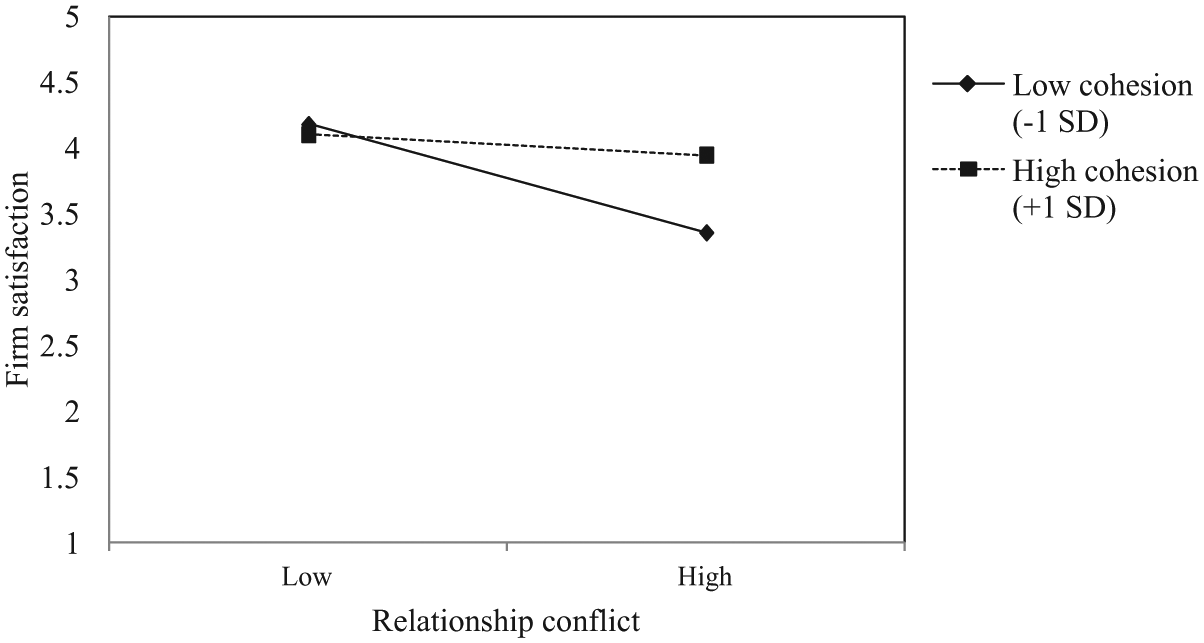
Relationship conflict, cohesion, and firm satisfaction.
Adaptability moderates the effect of relationship conflict on firm satisfaction (β = −.06, p < .01, Figure 2), which supports Hypothesis 3aII. Low relationship conflict and high adaptability are related to enhanced firm satisfaction but high relationship conflict reduces satisfaction regardless whether adaptability is low or high. A moderating effect of open communication on firm satisfaction could not be confirmed; hence, Hypothesis 3aIII was not supported.
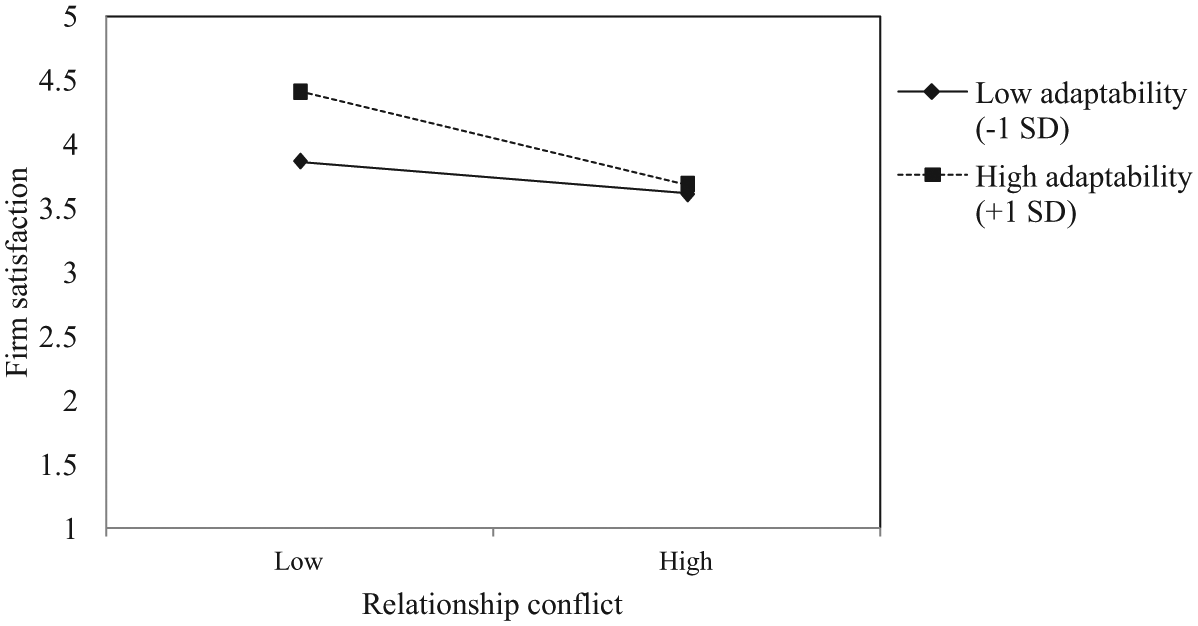
Relationship conflict, adaptability, and firm satisfaction.
A moderating role of family climate was also confirmed for firm performance: Adaptability moderates the effect of relationship conflict on firm performance (β = −.04, p < .05, Figure 3); thus, Hypothesis 3bII was supported. Low relationship conflict and high adaptability go hand in hand with an enhanced firm performance but equal with the results of firm satisfaction, high relationship conflict causes low performance regardless if adaptability is low or high. Our results do not show any moderating effects of cohesion (Hypothesis 3bI) or open communication (Hypothesis 3bIII) on the negative effect of relationship conflict on firm performance; thus, Hypothesis 3bI and Hypothesis 3bIII were not supported.
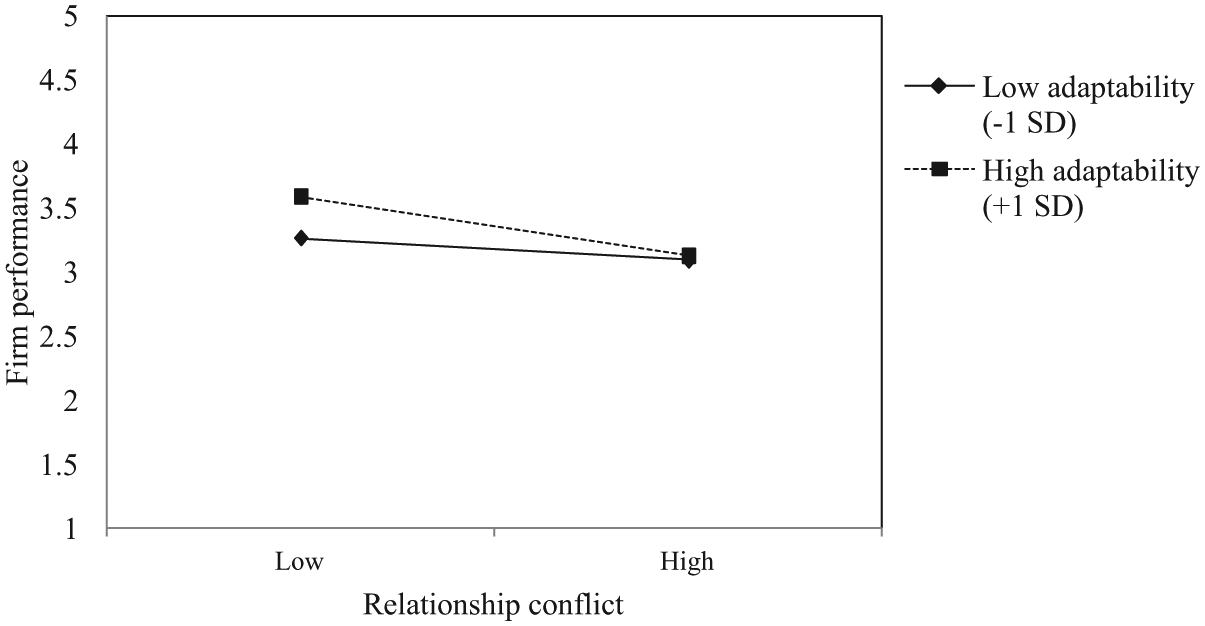
Relationship conflict, adaptability, and firm performance.
Discussion
The study purpose was to examine the effect of relationship conflict on firm satisfaction and firm performance considering the moderating effect of positive family climate. SFBT was the theoretical guide for the study. As predicted, relationship conflict negatively affected firm satisfaction and firm performance. More important, study findings indicated direct and moderating effects of positive family climate on firm satisfaction and firm performance.
Summary
Direct Effects on Business Outcomes
Concerning direct effects, relationship conflict affects firm performance and firm satisfaction negatively, which is consistent with previous research (e.g., Eddleston & Kellermanns, 2007; Jehn, 1995; Jehn & Bendersky, 2003; Jehn et al., 2008; Jehn & Mannix, 2001). Furthermore, direct effects of cohesion, adaptability, and open communication were significantly related to firm satisfaction. Hence, family climate affects the firm satisfaction of family members who are working in the business. However, just adaptability was significantly related to market-oriented firm performance. This finding is unexpected as prior studies showed a relationship of cohesion and open communication to firm performance (see Astrachan & McMillan, 2003; Ensley, Pearson, & Amason, 2002). A reason could be that positive family climate could be seen as something in the background, which keeps the system running by creating resilience in the business owner. Kossek et al. (2001) showed that a change in family climate, such as less open communication or low mutual bonding, could create a negative family climate to evolve that would have a detrimental effect on firm performance. This seems an interesting point that should be examined in greater depth within future research.
Moderating Effects of Family Climate
In line with previous studies that showed effects of psychological climate on work–family outcomes in a care giving setting (Kossek et al., 2001) or the positive effects of a good organizational climate on job-related outcomes (Pritchard & Karasick, 1973), our study shows positive effects of family climate on business outcomes. The findings pertaining to the moderating effects of positive family climate indicated that cohesion reduced the negative impact of relationship conflict on business owner assessed firm satisfaction. This supports previous results of a qualitative study that reported chief among health indicators is family cohesion (Pieper, 2007).
Adaptability moderated the effects on both business indicators when relationship conflict was low, and open communication didn’t show any moderating effect. Thus, we assume that if relationship conflict occurs in a family firm where cohesion and adaptability within the family are very high, a cohesive and adaptable family climate reduces the negative effect of relationship conflict on firm satisfaction. Family members are taking this good cohesive climate with them into the business. In combination with daily business tasks, it fosters a benevolent and productive atmosphere in the business system.
Adaptability also reduced the negative effects of relationship conflict on firm performance but if the relationship conflict rose in intensity and frequency, high adaptability didn’t show this effect any more. Thus, in times of stability and low relationship conflict, highly adaptable families are working together on challenges and business tasks as part of their standard operating procedures, enhancing firm performance and also handling relationship conflicts that come up once in a while. Those families seem to act in a stability-promoting and self-corrective process, which allows them to deflect a conflicting and challenging situation and to apply useful measures. If it comes to disruptions caused by severe relationship conflicts, the results of our study show that the highly adaptable family is using a large amount of their resources to manage these conflicts so that business tasks suffer and firm performance decreases. Thus, high family adaptability seems to be supportive for the business in times of stability but turns into a burden in unstable disruptive times.
Open communication did not show any moderating effect. Olson and Gorall (2003) define communication as a facilitating dimension that enables families to alter their levels of cohesion and adaptability to meet disruptions. Thus, open communication seems to be more fundamental under conditions of relationship conflict because being cohesive or adaptable in times of change is not possible without talking and listening to each other on a regular basis.
Theoretical Implications
Study findings about family climate contribute to SFBT. They support the main proposition of the theory that the family and business systems take available inherent resources, such as positive family climate, and transform them via resource transactions into achievements. For instance, a positive family climate supports daily tasks in the family business when mutual trust and open communication is established. Positive family climate is a form of bonding family social capital that contributes to the resilience capacity of the family members working in the business (Danes & Brewton, 2012). According to our results, positive family climate is productive for the business because it strengthens resiliency to address disruptions caused by relationship conflict. Positive family climate created by highly cohesive and adaptable family members reduces the negative effect of relationship conflict on both business indicators. This undergirds the basic tenet of the SFBT that in times of change and disruption, resources of the family system are transferred to the business system to develop resilience capacity to address disruptions.
Furthermore, the findings about direct effects of positive family climate on both business indicators supported the main proposition of the SFBT that positive family climate, a form of bonding family social capital, can be accessed and used to manage problems of the collective interaction between family and business in the business system (Danes & Brewton, 2012). Results of this study indicated that there is a transfer of family system inherent resources, such as positive family climate, into the business system. Thus, the family supports the business with a variety of resources and improves firm satisfaction and performance by developing a positive and supportive family climate enabling family members to work effectively on business tasks through the access and use of the family’s resilience capacity epitomized by positive family functioning. This study provides insights into what specific characteristics of the complex dynamics of family climate affect which aspects of business outcomes.
Future Research and Limitations
The present study had certain limitations that should be acknowledged. We used shortened scales for several reasons. We had to face practical limitations because when family business owners and managers are asked to complete questionnaires, they do not have time due to a very tight schedule. So we tried to shorten the questionnaire as much as possible. Furthermore, there may be issues of face validity. In particular, respondents may resent being asked questions that appear to be repetitious. From a management perspective, a single item is usually easier to understand than a scale score, which might appear as academic nit-picking (Wanous et al., 1997). However, we acknowledge that shortened scales are a study limitation. Even so, the reliabilities of all scales were satisfying, which should encourage further studies to focus on the potential use of shortened scales.
Furthermore, the distortion of the memories of the respondents can be assumed when it comes to self-ratings of conflict frequency or the intensity of the dimensions of family climate. It is widely assumed that common method bias inflates relationships between variables measured by self-reports. Referring to the work of Conway and Lance (2010) self-reports are clearly appropriate for constructs such as firm satisfaction. For firm performance, other measures might be appropriate unless the authors provide a solid rationale for their choice. In our study, we asked how the company developed in the last 3 years in comparison with its biggest competitor to measure firm performance. This request, to draw a comparison to the biggest competitor, induces a subjective component that can be best answered through self-reports. Therefore, we included this question in our survey.
Due to the theory guiding this study, causal interpretation can be established. However, a follow-up study could be conceived to get data across a longer period, which would allow interpretation over time and insight into changing processes. Furthermore, the study is focusing on Austrian family businesses. It is important to indicate that due to our used concept of family climate, which is based on familial ties and bonds, our results could be different in other countries due to cultural differences. Cultural differences as Shelton, Danes, and Eisenman (2008) pointed out might have an influence on the family climate of family businesses.
This study results point out that open communication seems to be a fundamental construct of family climate. It could be part of future research to examine the facilitating characteristic of open communication in a different organizational context. For instance, if task or process conflict comes up, the differing viewpoints or controversies about task procedures need to be openly discussed for them to be managed successfully. Thus, open communication could be essential to manage task and process conflicts as compared to relationship conflict.
Practical Implications
This study conceptually specified family climate as having three dimensions. Doing so provides a lens into the conditions and family characteristics, where owning families might be able to address relationship conflicts as they affect firm satisfaction and performance themselves, and where external professional assistance might be needed. The family climate dimensions within the study had varying direct and indirect effects.
Those effects indicate that when a family business consultant is assessing the strengths and weaknesses of the owning family, not only should those assessments include strengths and weaknesses in terms of leadership and management of the business but also an assessment of its cohesion characteristics, its adaptability capacity, and its communication patterns.
Owning families experiencing high relationship conflicts that also have low cohesion (lower emotional bonding) will also experience lower firm satisfaction. Families with these characteristics do not have the internal resilience to tackle this level and type of conflict and may need some assistance external to the family. It could be helpful to establish a family manager, mostly a senior family member who is taking care of the owning family. This family manager could set up family events or family days that strengthen familial ties and provide an opportunity to talk openly with each other.
The study findings indicate that low levels of relationship conflict in owning families with high adaptability characteristics can access that internal capacity to address the conflict so it does not influence either firm satisfaction or firm performance. However, a highly adaptive family would still be affected by high relationship conflict because that level and type of conflict will decrease both firm satisfaction and performance. External, professional assistance with family system training is called for in this situation because of its effect on both financial and nonfinancial business goals. Furthermore, this finding speaks to the tendency of many business consultants to attempt and to address relationship conflicts in the business by changing roles and strategies (the study definition of adaptability). The study findings indicate that the use of this structural solution to a situation of high relationship conflict does not target the core symptoms (the reason for the relationship conflict) and, thus, is not effective.
Conclusion
This is one of few studies that empirically investigated the effect of relationship conflict on firm performance and firm satisfaction, as well as the direct effect of family climate on firm satisfaction and firm performance and its moderating effect under conditions of relationship conflict. Furthermore, we addressed the lack of research focusing on the family system in family businesses and family climate a form of its family social capital, which had an important influence on the business, as the results of this study showed. One of the main findings of our study was the direct and enhancing impact of family climate on both business indicators as well as the moderating impact of family climate on the negative effect of relationship conflict on the business.
Future studies might include longitudinal data that would allow interpretation over time and insight into changing processes and the conditions under which family social capital tends to be consumed. Just as businesses need to grasp effects of the global market on their performance, so must the family business discipline need to capture the intricate processes that compose family social capital development and maintenance over time and to capture the competitive advantage those processes have to offer family businesses.
Footnotes
Declaration of Conflicting Interests
The author(s) declared no potential conflicts of interest with respect to the research, authorship, and/or publication of this article.
Funding
The author(s) received no financial support for the research, authorship, and/or publication of this article.