



Abstract
Studies of intensive mothering suggest that fulfilling societal expectations of the “good mother” diminishes maternal psychological well-being; however, studies tend to focus on young mothers. We examine the association between intensive mothering and psychological well-being using a sample of mothers in midlife (n = 1,388) drawn from the 2004-2006 National Survey of Midlife Development in the United States. Intensive mothering is measured as provision of high levels of emotional support to children, high degree of thought and effort put into these relationships, and reduction of paid work to provide more care. Psychological well-being is measured as depressive symptoms, self-rated mental health, and positive and negative affect. Ordinary least squares regression results are mixed: While providing high levels of emotional support predicts more depressive symptoms, worse self-rated mental health, and higher negative affect, higher investments of thought and effort predict better mental health.
A dominant ideology of motherhood—intensive mothering—holds that this experience is among the most emotionally rewarding in a woman’s life. According to this ideology, children, too, should benefit from this approach to motherhood. However, critics point to a darker side of intensive mothering; it places emotional demands on mothers that can induce feelings of guilt, stress, and anxiety. Some popular books critique this ideology. As an illustration, journalist Judith Warner (2006) argues in Perfect Madness: Motherhood in the Age of Anxiety that mothers are entering into a stage of “too-muchness” where they feel pressure to live up to ever-increasing ideals of motherhood, even though it requires time-intensive, emotionally draining efforts that may diminish their own happiness. This conclusion finds support in social science research. For example, in the research introducing of the concept of intensive mothering, Sharon Hays’s (1996) interviews with 38 mothers of toddler-aged children revealed that many reported being “stressed” by their efforts to meet their children’s desires, leading her to conclude that intensive mothering is both “physically and emotionally draining” (p. 10).
Although research documents negative emotional costs of intensive mothering, studies focus almost exclusively on the experiences of mothers with young children, primarily drawing on interviews with mothers of preschool-aged or younger children (e.g., Elvin-Nowak, 1999; Hays, 1996; Wall, 2010). While the demands of mothering, including the pressure to intensively mother, may be greatest in these early years, they are likely to persist across mothers’ lives. This assertion receives support in the only study of which we are aware that examines middle-aged women’s experiences of intensive mothering. Drawing on interviews with 45 mothers between the ages of 35 and 60 years, Dillaway (2006) concludes that “Motherwork perhaps never wanes: once women are mothers, they are always mothers, and they are always impacted by the mothering ideology” (p. 51). Our study extends this small literature by focusing on the link between intensive mothering and psychological well-being among women in midlife. Also contrasting with prior studies of intensive mothering, we use a sample of mothers drawn from a nationally representative study. These two features of our study contribute to our understanding of the generalizability of previous research documenting the relationship between intensive mothering and mothers’ diminished psychological well-being.
Background
The Intensive Mothering Ideology
Drawing on her interview data, Hays outlines the central tenets of intensive mothering in her 1996 book, The Cultural Contradictions of Motherhood. They include the belief that mothers should completely devote themselves to their children’s intellectual and emotional development, creating a child-centric family atmosphere. Intensive mothering requires mothers to steadfastly prioritize their children’s needs and desires above others’, including their own leisure and paid work demands. In short, it involves childcare practices that are “child-centered, expert-guided, emotionally absorbing, labor-intensive, and financially expensive” (Hays, 1996, p. 8). These tasks fall not to fathers, but rather to mothers, who are viewed as having greater child-rearing talent and inclination. The intensive mothering project involves mothers’ investing liberal amounts of time, thought, and effort into ensuring that their children have mentally enriching activities. It also involves responding to children’s unique needs and wants, often requiring their entertainment and appeasement.
The ideology also includes the belief that mothers derive emotional satisfaction and reward from performing these duties. In fact, intensive mothering requires that mothers’ emotional needs be completely fulfilled by their children. The ideology holds that children are “sacred,” “innocent,” and “delightful,” so mothers should always relish opportunities to spend time caring for and playing with them. Furthermore, as Guendouzi (2005) finds in her interviews with eight mothers in the United Kingdom, the intensive mothering ideology posits that simply achieving the status of “good mother” should generate emotional rewards.
Emotional Consequences of Intensive Mothering
Although intensive mothering assumes that not only children but also mothers benefit from these practices, research suggests otherwise. In addition to Hays’s study, other qualitative studies suggest that the emotional stress of intensive mothering partially results from mothers’ neglect of their own well-being (Elliott, Powell, & Brenton, 2015; Elvin-Nowak, 1999; Guendouzi, 2006; Hays, 1996; Wall, 2010). For example, in her interviews with 14 mothers of preschool-aged children, Wall (2010) found that the majority reported foregoing sleep and leisure to put their children’s needs first. Reflecting the weight of these demands, mothers often said they needed to “sit down in front of the TV for an hour” or “give themselves time to do something out of the house” (Wall, 2010, p. 258). Similarly, Elliott et al.’s (2015) study involving interviews with 16 lower-class, Black mothers revealed mothering practices that often drained women’s own emotional energy and sacrificed their friend and partner relationships. The prioritization of children’s needs also characterizes middle-aged mothers, who described in Dillaway’s (2006) study their efforts to keep conversations focused on their teenage and adult children’s interests and feelings rather than their own.
Research also finds that, despite their efforts, many mothers feel inadequate in living up to the intensive mothering ideals. Perceived inadequacy may be especially consequential for emotional well-being because the mother role is central to many women’s identities (Liss, Schiffrin, & Rizzo, 2013), including those in midlife (Dillaway, 2006). For example, in her study of 13 mothers of elementary-school children, Elvin-Nowak (1999) found that mothers often felt inadequate when they failed to devote what they considered to be enough time to their children. These experiences generate guilt for many mothers (Elvin-Nowak, 1999; Guendouzi, 2006; Sutherland, 2010). Providing evidence, Guendouzi’s (2006) study of British mothers revealed how the intensive mothering ideology led many women to feel guilty about any time spent away from their children—an experience reported by both working- and middle-class mothers in her sample. Similarly, Elliott et al.’s (2015) interviews with lower-class, Black mothers revealed that some viewed themselves as “bad” mothers despite their adherence to the ideology of intensive mothering, often blaming only themselves, rather than structural barriers, for their children’s difficulties in school and struggles with addiction. Self-perceptions as “bad” mothers also were reported in Dillaway’s (2006) interviews with middle-aged, middle-class mothers, who felt guilty when taking time for themselves.
Even fewer quantitative than qualitative studies examine the effects of intensive mothering on psychological well-being; however, they, too, draw into question the benefits assumed by the intensive mothering ideology to accrue to mothers engaging in these practices. Rizzo, Schiffrin, and Liss (2012) used an online survey completed by 181 respondents recruited through social media websites to test the hypothesis that endorsement of intensive mothering beliefs relates to lower life satisfaction and higher levels of depression. Drawing on Hays’s (1996) ideology of intensive mothering, they developed items capturing central tenets of intensive mothering identified by Hays: that mothers are better caregivers, mothering should be child-centered, and children are sacred. The study revealed five factors related to intensive mothering: Essentialism, Fulfillment, Stimulation, Challenging, and Child-Centered. They found that the five factors had different associations with psychological well-being, measured as depressive symptoms, life satisfaction, and perceived stress. Mothers viewing parenting as challenging experienced greater depression and stress and lower life satisfaction, compared with their peers viewing the role as less demanding. Endorsement of the child-centered aspects of intensive mothering was not significantly related to depressive symptoms, but it was associated with decreased life satisfaction. Essentialism was related to greater stress and lower life satisfaction. Neither Fulfillment nor Stimulation was associated with psychological well-being.
Although consistent findings are reported by the small number of studies examining the association between intensive mothering and women’s psychological well-being, their generalizability is limited. Studies tend to rely on samples of relatively young women, usually restricting their analyses to women with elementary school-aged or younger children. As illustrations, the mothers in Hays’s study ranged in age from 21 to 42 years, those in Guendouzi’s study from 26 to 55 years, and those in Rizzo et al.’s study from 18 to 49 years. An exception is Dillaway’s (2006) study of women between 35 and 60 years; however, it focused primarily on the implications of women’s images of “good” and “bad” mothers for their experiences of menopause, rather than their consequences for psychological well-being. Also absent from this literature is research using data from a nationally representative study. For example, Rizzo et al.’s (2012) sample was drawn from an online survey that is likely to reflect the experiences of more advantaged mothers (i.e., with computer and Internet access). Using a more representative data set offers not only greater generalizability but also the ability to control for a wide range of social factors that shape both psychological well-being and the likelihood of intensive mothering. The only quantitative study (Rizzo et al., 2012) controls on perceived familial social support, but it neglects other important factors like education, marital status, employment status, physical health, and mother–child relationship quality. In addition, while Rizzo and colleagues examine several indicators of psychological well-being (i.e., depressive symptoms, life satisfaction, and stress) they give less attention to more general emotional outcomes, including both positive and negative ones that are often referenced in the qualitative studies of intensive mothering.
Our study addresses these limitations of earlier research. It includes a wider range of ages of children and mothers than found in prior studies, permitting an examination of whether findings of a negative association between intensive mothering and psychological well-being apply to the broader population of mothers. It examines this association using a sample of mothers drawn from a large, nationally representative survey, thus increasing the generalizability of the findings. In addition, our study examines a wider range of measures of psychological well-being, allowing a more extensive examination of potential costs, and possible benefits, of intensive mothering. Drawing on the findings of prior studies, we test the hypothesis that engaging in intensive mothering practices is associated with lower psychological well-being.
Method
Data
We used data from the second wave of the National Survey of Midlife Development in the United States (MIDUS; Brim et al., 2011). This survey, conducted in 1995-1996, was drawn from the noninstitutionalized U.S. population with access to a landline telephone and aged 24 to 74 years. It involved phone interviews with 3,487 respondents, of whom 3,034 (87%) also participated in follow-up, self-administered questionnaires collecting much of the social psychological data. A second wave was conducted between 2004 and 2006, using the original respondents (MIDUS II, 2004-2006; Ryff et al., 2012). Of the MIDUS I respondents to the initial phone interview, 65% participated in MIDUS II (n = 2,257), with a mortality-adjusted response rate of 70%. Comparison of the MIDUS I and II samples revealed that the second wave contains more highly educated respondents (e.g., 36% of those in MIDUS II have 16 or more years of education vs. 29% of those in MIDUS I, 2004-2006; Ryff et al., 2012).
The present analysis was limited to women respondents in MIDUS II with at least one child and who have valid responses on all dependent variables (n = 1,388). Compared with those omitted from our study sample, mothers included were older, more educated, and in better health, had higher income, and were less likely to be currently employed or have a child younger than 6 years. Mothers included in the study sample also reported fewer depressive symptoms, lower negative affect, and higher positive affect. These results raise the possibility that our findings might not be applicable to mothers who are more socioeconomically disadvantaged and in worse health. Data missing on total household income (19.5%) were imputed using Stata’s ICE program for multiple imputation.
Although two waves of MIDUS are available, we used only one, the most recent. For our research question, the 10 years between waves diminishes the panel data’s utility. Intensive mothering is likely to have rather weak effects on psychological well-being a decade later, given the substantial changes over this length of time in child’s developmental stage and the associated parenting demands. We used the second rather than the first wave because it allowed us to not only examine a sample of mothers whose experiences have been relatively neglected in this literature (i.e., middle-aged and older women) but also capture a more recent point in time. However, as is common in panel studies, the subsequent wave was less representative of the population, due to nonrandom attrition. Our decision to use cross-sectional data does limit our conclusions. Although our analyses permit the determination of whether a significant association exists between intensive mothering and psychological well-being, they do not allow the assessment of causal direction, which is likely to be bidirectional. Mothers’ psychological well-being may be shaped by the degree of their endorsement of intensive mothering—and their psychological well-being may influence their mothering attitudes and practices, as evidenced by research finding that depressed mothers have more negative and fewer interactions with their children (Turney, 2011).
Measures
Intensive Mothering
We operationalized intensive mothering using three measures. The first used an item asking respondents to rate how much thought and effort they put into their relationships with their child(ren) on a scale ranging from 0 (none) to 10 (very much thought and effort). The second measure combined information collected in two items, one asking whether respondents had stopped working to stay home and care for their child(ren) and the other asking whether they had cut back on the number of hours worked to stay home and care for their child(ren). These two items were used to create a dichotomous measure, coded 1 for mothers who had either stopped working or reduced paid work hours to care for their children. The third measure used an item asking respondents how many hours a month they spend giving emotional support to their children. This item was measured continuously, with responses ranging from 0 to 744 hours. To handle outliers, we recoded this item so that the highest response category is capped at giving 250 or more hours of emotional support per month (i.e., more than 3 standard deviations from the mean); this recoding involved less than 2% of respondents.
Our measures of intensive mothering were limited. All three measures—the only relevant ones in either wave of MIDUS—focused on the child-centered component of the intensive mothering ideology, thus tapping only one of the five intensive mothering factors captured in Rizzo et al.’s (2012) scale. Responses to these items pointed to other limitations. In particular, responses to items about thought/effort and hours of emotional support were quite positive, raising the possibility that the social desirability of being a “good mother” leads to overestimates. Furthermore, these reports were likely to be influenced by the difficulty of accurately recalling the precise number of hours of care provided in the past month. The measures also did not address timing issues, a limitation particularly relevant to our study of middle-aged and older mothers. Of particular note, the paid work item asked whether women have ever reduced their commitments to the paid labor force; for some of our respondents, these reductions may have occurred decades prior. Although MIDUS was not designed to investigate intensive mothering behaviors, it is an appropriate data set for this study because it is one of the few nationally representative data sets containing items pertaining to parenting practices and attitudes that capture aspects of intensive mothering.
Psychological Well-Being
We operationalized psychological well-being using four indicators: depressive symptoms, self-rated mental health, and positive and negative affect. We measured depressive symptoms using a mean scale (α = .89) constructed using seven items asking respondents whether they had experienced each of the following in the past 2 weeks: lost interest in most things, felt tired, or had low energy, lost appetite, had trouble falling asleep, had trouble concentrating, felt down or worthless, and thought a lot about death. The scale was from the World Mental Health Organization’s Composite International Diagnostic Interview Short Form (Kessler, Andrews, Mroczek, Ustun, & Wittchen, 1998). Responses ranged from 0 to 7 symptoms. We measured self-rated mental health using responses to the following item: “How would you rate your mental or emotional health?” We coded responses to range from 1 (poor) to 5 (excellent). While self-rated mental health should not be interpreted as the presence or absence of specific mental disorders in respondents, previous research has established that global self-rated mental health is significantly related to symptoms of psychological distress (Fleishman & Zuvekas, 2007). We measured positive and negative affect using mean scales developed for MIDUS (Mroczek & Kolarz, 1998), constructed from items asking respondents how much of the time in the past 30 days they had experienced particular emotions. The six-item positive affect scale (α = .95) included feeling in good spirits, calm and peaceful, satisfied, cheerful, extremely happy, and full of life. The six-item negative affect scale (α = .93) included feeling so sad nothing could cheer them up, nervous, restless or fidgety, hopeless, that everything was an effort, and worthless. Each scale was coded to range from 1 (none of the time) to 5 (all of the time).
Control Variables
We controlled on the following constructs that predict psychological well-being: mother’s age, socioeconomic status, employment status, family structure, mother–child relationship quality, and physical health. Greater psychological well-being is associated with older age, having a spouse or cohabiting partner, paid work, more education and income, fewer—and older—children, and better parent–child relationships and physical health (Jorm et al., 2005; Mirowsky & Ross, 2003; Nomaguchi & Milkie, 2003; Ross & Mirowsky, 1989). Mother’s age was measured in years. Socioeconomic status was measured using indicators of education (number of years completed) and household income (summing personal earnings, spouse/partner earnings, family members’ earnings, Social Security income, income from government assistance programs, and earnings from all other sources). Employment was measured using a dichotomous variable, coded 1 if the respondent is employed either part-time or full-time. We also conducted analyses treating full- and part-time employment as separate categories, with results indicating that the association with psychological well-being does not differ between these groups. Family structure was measured using indicators of marital or cohabitational status, the presence of multiple children in the household, and the presence of any child younger than 6 years in the household. Marital or cohabitational status was represented by three dummy variables (i.e., married or cohabiting [reference group], never married, or formerly married). Married and cohabiting respondents were combined into a single category because of the low number of cohabiting respondents (n = 66). Two other dichotomous variables were included as controls for family structure: family size (1 = presence of multiple children in the household, 0 = 1 child) and children’s ages (1 = presence of any child younger than 6 years in the household, 0 = all children in the household are at least 6). Mother–child relationship quality was measured using respondents’ ratings of their relationships with their child(ren) from 0 (worst possible) to 10 (best possible). Self-rated physical health was measured with a five-category variable ranging from 1 (poor health) to 5 (excellent health).
Analytic Strategy
We conducted bivariate and multivariate analyses. We used correlations to examine bivariate relationships between intensive mothering indicators and variables tapping psychological well-being. We used ordinary least squares regression models to examine the association between intensive mothering and psychological well-being, controlling for factors that could influence both constructs. We estimated separate models for each of the four indicators of psychological well-being: depressive symptoms, self-rated mental health, and positive and negative affect. These models included all three indicators of intensive mothering; however, we also estimated models that included only one indicator at a time, with the substantive conclusions drawn from these models not differing from those derived from the full models that are presented.
We also conducted analyses examining whether the association between intensive mothering and psychological well-being varies by either mothers’ or children’s ages. Because mothering demands are likely to be greatest in the early childhood years, it is possible that not only the likelihood of engaging in intensive mothering but also its consequences for mothers’ psychological well-being are greatest in these years. The early childhood years also coincide for many women with the paid work demands of young adulthood and early middle-age, making potential variation by mothers’ age important to consider. We ran two sets of models to test these possibilities. The first set of models, one for each of the four dependent variables, included the following interaction terms: child(ren) younger than 6 years in household * time/effort put into mother–child relationship, child(ren) younger than 6 years in household * hours of emotional support, and child(ren) younger than 6 years in household * reduced paid work to care for child(ren). The second set of models, one for each of the four dependent variables, included the following interaction terms: mother’s age * time/effort put into mother–child relationship, mother’s age * hours of emotional support, and mother’s age * reduced paid work to care for child(ren).
Results
Table 1 summarizes the study variables. Mothers’ average score on the degree of thought/effort scale, ranging from 0 to 10, was high—nearly 9. Similarly, mothers invested substantial time into providing emotional support to their child(ren), averaging approximately 44 hours a month on this task (or about an hour and a half a day). Mothers also reduced paid work to provide more care, with more than two thirds making this choice. Women reported high levels of psychological well-being, as indicated by average depressive symptoms well below one, average frequency of negative affect between “none” and “ a little,” average frequency of positive affect between “some of the time” and “most of the time,” and average self-rated mental health between “good” and “very good.” Mothers averaged 54 years of age, reported self-rated health between “good” and “very good,” and had more than 14 years of education and total household income more than $70,000. The majority of mothers were White (93%), married or cohabiting (74%), employed (54%), and had more than one child (86%) but none younger than the age of 6 (92%).
Descriptive Statistics.
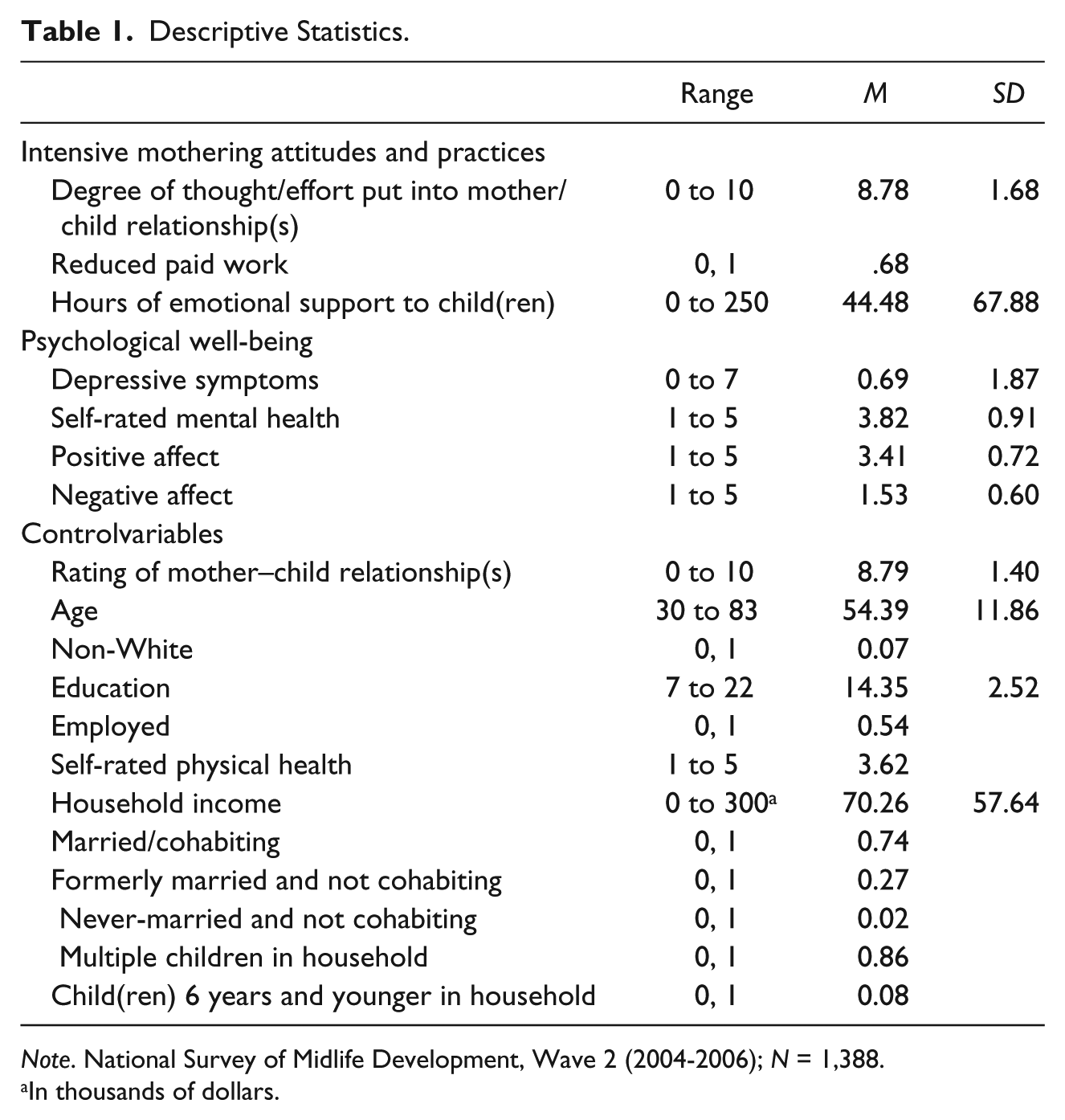
Note. National Survey of Midlife Development, Wave 2 (2004-2006); N = 1,388.
In thousands of dollars.
Table 2 reports the results of bivariate analyses examining two sets of associations: among intensive mothering measures and between intensive mothering and psychological well-being measures. Results reveal some evidence of interrelationships among the intensive mothering measures. Degree of thought and effort put into your relationship with your child(ren) positively correlates with both hours of emotional support (r = .10) and reducing paid work (r = .08). Results also reveal an association between intensive mothering and psychological well-being, though patterns vary across measures. Consistent with our expectations, mothers who give more emotional support to their child(ren) tend to have more depressive symptoms (r = .07) and lower self-rated mental health (r = −.06). In contrast, those who report putting more thought and effort into their relationship with their child(ren) tend to have lower levels of negative affect (r = −.05) and higher levels of positive affect (r = .10). Similarly, those who have reduced paid work report better mental health (r = .07).
Correlations Between Intensive Mothering Items and Psychological Well-Being Measures.

Note. National Survey of Midlife Development, Wave 2 (2004-2006); N = 1,388.
p < .05. **p < .01. ***p ≤ .001.
Table 3 reports the results of regression models examining the relationship between intensive mothering and psychological well-being, net of control variables. Only one indicator of intensive mothering—providing high levels of emotional support—is significant: Providing more hours of support is associated with having more depressive symptoms (p < .05). Several control variables also are significant. Fewer depressive symptoms are reported by older, employed mothers with better self-rated physical health and better relationships with their child(ren), compared with their respective counterparts. Fewer symptoms also are reported by married or cohabiting mothers, compared with formerly married, noncohabiting mothers.
Ordinary Least Squares Regression of Psychological Well-Being on Intensive Mothering Unstandardized Coefficients (Standard Errors).

Note. National Survey of Midlife Development, Wave 2 (2004-2006); N = 1,388.
Married or cohabiting is reference category.
p < .05. **p < .01. ***p ≤ .001.
Mirroring the findings for depressive symptoms, the findings for self-rated mental health reveal that spending more hours per month giving emotional support to child(ren) predicts worse mental health (p < .01). However, another intensive mothering indicator—putting more thought and effort into your relationship with your child(ren)—predicts better mental health (p < .01). Better self-rated mental health is associated with many of the same factors found in the model predicting depressive symptoms, including having a spouse or cohabiting partner, better relationships with child(ren), and better self-rated physical health. Mother’s age and education also are significant predictors, with more educated and older mothers reporting better self-rated mental health than their less educated, younger peers.
In contrast to the findings for depressive symptoms and self-rated mental health, none of the indicators of intensive mothering are significantly associated with positive affect. However, several of the control variables are significant. Reporting greater positive affect is associated with being older, employed, having a spouse or partner and only one child, and reporting better physical health and relationships with child(ren).
Results for negative affect differ from those of positive affect with regard to the intensive mothering indicators. Results indicate that giving more emotional support to your child(ren) predicts higher levels of negative affect (p ≤ .001). Greater negative affect also is associated with being younger, unemployed, having multiple children, and reporting worse physical health and worse relationships with child(ren).
We ran regression models with interaction terms to test whether associations vary by mother’s or children’s age. Of the 18 interaction terms examined, only one term, hours of emotional support * mother’s age is significant at the .003 level required with Bonferroni adjustments made for multiple comparisons (p = [.05/18]; Shaffer, 1995). Furthermore, it only reaches significance in the model predicting negative affect (b = −.01; p < .001). The results indicate that the association between the provision of more emotional support and greater negative affect is weaker among older compared with younger mothers.
Discussion
Our findings are consistent with the relatively small body of research indicating that intensive mothering diminishes women’s emotional well-being. However, our use of a sample of mothers who are older, averaging 54 years of age, than those in prior studies extends the literature by suggesting that the emotional costs of intensive mothering span the course of motherhood. Our findings reveal that mothers providing children with more hours of emotional support report elevated depressive symptoms, worse self-rated mental health, and higher levels of negative affect, compared with their peers contributing fewer hours—and, therefore, having more time for other pursuits. Our findings are consistent with research reporting that mothers’ sacrifice of their own needs and desires to engage with their children, regardless of their age, increases stress and reduces autonomy—both of which diminish emotional well-being (Dillaway, 2006; Elliott et al., 2015; Elvin-Nowak, 1999; Wall, 2010). These findings also resonate with research reporting that mothers’ sacrifices can generate annoyance and anger that, in turn, lead to feelings of guilt (Guendouzi, 2006). Another explanation centers on the children’s life circumstances giving rise to mothers’ intense emotional investments; these circumstances may themselves be distressing to mothers, as research on parents of adult children indicates (Fingerman, Miller, Birditt, & Zarit, 2009).
Although our findings suggest that the intensive mothering ideology affects mothers across their own and their children’s lives, some limited evidence points to the possibility that these negative effects may be more pronounced for younger than older mothers. Our interaction results reveal that the association between providing more emotional support and experiencing greater negative affect is stronger for younger than older women. We offer two possible explanations for this result, one focusing on younger mothers’ experiences and the other on older mothers’. Young mothers may face more stress and anxiety in attempting to meet intensive mothering ideals because the ideology targets this segment of mothers, conveying to them the high stakes of their ensuring children’s proper emotional and intellectual development and future potential. In addition to feeling less targeted by the ideology, older mothers may have greater comfort in navigating dominant social expectations of mothers, stemming from greater confidence in their parenting choices and skills and perhaps a critical perspective on the ideology born from their mothering experiences. Future research should consider how the pressures of intensive mothering manifest themselves and are experienced within families as both children and mothers age.
While most of our results are consistent with intensive mothering’s emotional costs, one finding points to a potential benefit. Higher investments of thought and effort into children are associated with better self-rated mental health. This finding may suggest that some of the activities requiring substantial energy give mothers a feeling of satisfaction with their efforts to ensure their children’s proper development (Lareau, 2002; Wall, 2010). As examples, these activities could include finding the latest intellectually stimulating baby toys, enrolling young children in extracurricular activities, or researching educational and occupational opportunities for teenagers and adult children. Another explanation centers on other benefits mothers may derive from their efforts, namely better relationships with their children. Putting increased thought and effort into children may be tied to better parent–child relationships and parental satisfaction, known predictors of increased psychological well-being among parents (Nomaguchi, 2012; Umberson, 1989).
While we find that emotional support to children and degree of thought and effort are associated with mothers’ well-being, albeit in opposite directions, we find no evidence that reducing paid work commitments in order to provide more care relates to well-being. A possible explanation focuses on the stress of balancing paid work and family. Mothers who reduce their paid work attachments may not, as we hypothesized, experience worse mental health than their peers who retain these attachments because the loss of paid work’s mental health benefits may be offset by not only fewer strains from the competing demands of paid work and family but also less guilt over their time allocations. Another explanation centers on selection processes. Women who have the option of reducing their paid work, or perhaps those choosing to frame a less voluntary cutback as a child-focused decision, may possess other personal or social characteristics that protect their psychological well-being. For example, they are likely to be of higher socioeconomic status, a factor protecting against mental health problems (Mirowsky & Ross, 2003).
Another unexpected finding is the lack of an association between intensive mothering and positive affect. Our findings suggest that, while some intensive mothering practices may adversely affect negative emotional states, they may not detract from positive ones. This pattern resonates with prior research documenting the coexistence of women’s negative and positive emotional experiences of motherhood. For example, Hays’s (1996) study reports mothers’ feelings of not only stress and anxiety but also joy and fulfillment. Further research should examine specific emotions, including both negative and positive ones, to understand how they interact to shape women’s mothering experiences, including potential shifts over the course of motherhood.
Although our study provides insight on the association between intensive mothering and psychological well-being for mothers in midlife, the results should be interpreted with caution, given their reliance on cross-sectional data. As the measures of psychological well-being and intensive mothering are collected at one point in time, results of this study only permit the identification of significant associations. The causal direction between intensive mothering variables and measures of psychological well-being cannot be determined. The association could reflect two causal pathways, and both may be operating. Mothers may experience lower well-being as a result of their intensive mothering practices. Conversely, mothers with lower emotional well-being may be more likely than other mothers to endorse child-centered aspects of intensive mothering, perhaps reflecting efforts to improve their emotional experiences by striving to meet the cultural expectations of mothers.
Another limitation of our study stems from the intensive mothering measures, which tapped a limited range of this construct. While the items taken from MIDUS were consistent with Hays’s (1996) definition of the child-centered nature of intensive mothering, they were not developed to assess intensive mothering, which affects the study’s findings and their interpretation. Other central components of intensive mothering that we were unable to examine, namely the expert-guided, financially expensive, and labor-intensive aspects, may also influence mothers’ psychological well-being, perhaps in ways that differ from those observed in our study.
Other avenues for future research are suggested by our study’s limited attention to structural factors producing variation in the experience of motherhood, particularly race-ethnicity and social class (Taylor, 2011). While all mothers may be influenced to some degree by the ideology of intensive mothering (Dillaway, 2006; Elliott et al., 2015; Elvin-Nowak & Thomsson, 2001; Hays, 1996), its implications for psychological well-being may vary. One source of variation is suggested by Elliott et al.’s (2015) study describing how lower class, Black mothers’ labeling as “bad mothers” by wider society can be reinforced by mothers’ blame of themselves, rather than structural barriers, for any of their children’s shortcomings themselves. These findings raise the possibility that engaging in intensive mothering may have more psychologically detrimental effects for disadvantaged mothers, who face numerous barriers in rearing their children.
This study contributes to discussions about the consequences of intensive mothering by examining a relatively neglected group of mothers—those in midlife. Our findings lend support to arguments about the “darker side of motherhood” that critique the intensive mothering ideology. Our study suggests that mothers’ provision of intense emotional support to children may indeed come at emotional costs for mothers of all ages.
Footnotes
Declaration of Conflicting Interests
The author(s) declared no potential conflicts of interest with respect to the research, authorship, and/or publication of this article.
Funding
The author(s) received no financial support for the research, authorship, and/or publication of this article.