



Abstract
It is a common belief in the fire service that the divorce rate for firefighters is higher than that in the general population. However, no data exists to substantiate this concern. We conducted surveys in 31 U.S. fire departments to assess relationship status, history of divorce, and key health outcomes. Prevalence of divorce among male firefighters was similar to the general population. In contrast, age-standardized prevalence of current divorce among female fighters (32.1%) was more than three times that for females in the general population (10.4%). Prevalence of ever divorce was substantially higher among female (40.0%) compared with male firefighters (24.4%). Married firefighters were less likely to report heavy alcohol use or depression, whereas single firefighters had more favorable body composition. These findings suggest that the rate of divorce among male firefighters is similar to that found in the general public. In contrast, female firefighters report high rates of divorce.
Keywords
Recently, the national status of the U.S. fire service has risen to occupy a uniquely important position in our public safety net. Fire suppression now constitutes less than 5% of the calls fielded by a typical fire department (National Fire Protection Association, 2013). However, firefighters respond to nearly every domestic emergency, including rescues, emergency medical response, vehicle accidents, and incidents involving hazardous materials. Given their extended work schedules (typically 24- or 48-hour shifts), sleep disruption, exposures to environmental toxins, and the toil which results from the physical demands of emergency response, it is not surprising that firefighters face a number of significant health issues, including high rates of cardiovascular disease and cancer (LeMasters et al., 2006). This has lead firefighting to be labeled “a toxic profession” (Bolstad-Johnson, 2013).
Firefighting is not only thought to affect the physical health of firefighters but also widely believed to negatively affect their intimate relationships. It is a common belief in the fire service community that the divorce rate for firefighters is substantially higher than that found in the general population (Barnes, 2000; Gagliano, 2009). For example, a recent article in a leading industry periodical, Fire Engineering, states “the divorce rate for firefighters is three times that of the general population, which is the highest rate in the nation” (Gagliano, 2009). The claim that firefighters face unusually high divorce rates is similarly reflected in materials published by fire service spousal support programs (Mercer, 2013), and programs which provide marital support and resources for the fire service community (Fireproof, 2013). The perception that firefighters face an epidemic of divorce also is prominent in the popular media. For instance, the Dr. Phil television show recently claimed that firefighters are under such great occupational stress that “75 to 90 percent of their marriages end in divorce” (Show, 2008). However, empirical support for these claims about the divorce rate among firefighters is lacking.
In the only recent study to examine divorce rates by occupation, MacCoy and Aamodt (2010) used the 2000 U.S. Census to estimate the percentage of workers within occupational groups who were currently divorced or separated. Based on their analysis, firefighters had a lower rate of current divorce/separation than most other occupations (14.08% for firefighters vs. 16.35% for average across occupations). However, the data provided by this study are not sufficient to conclude that the conventional wisdom about firefighters and divorce is mistaken. First, MacCoy and Aamodt (2010) only provide estimated rates of whether firefighters were currently divorced or separated. The authors note that this only provides the percentage of those who were divorced or separated at the time of the 2000 census. It is possible that firefighters divorce at a high rate but also a have high rates of remarriage, resulting in the divorce rate appearing low at any given point.
Second, MacCoy and Aamodt (2010) did not provide standardized comparisons of the rates of divorce among firefighters and the general population (Hennekens & Buring, 1987). Standardized comparisons, which adjust for demographic differences between firefighters and the general public, are needed to validate claims of an epidemic of divorce in the fire service. Third, the rates of divorce in this study are based on data which are almost 15 years old and a census which occurred prior to September 11, 2001. The fire service was reshaped after the terrorist attacks of 9/11/2001, including an expanded role in homeland security and an increased emphasis on readiness (Durso, 2011). It is arguable that firefighting has become a more complex and stressful occupation and is, therefore, more likely to affect the probability of divorce.
The purpose of this study is to conduct a comprehensive examination of rates of marriage and divorce among U.S. firefighters. Detailed information on relationship status and history of divorce were derived from two large epidemiological studies of 31 fire departments across the United States and its territories. Also, previous research has demonstrated a link between marriage and risk for mental health disorders (Sbarra, Emery, Beam, & Ocker, 2013), morbidity (ScienceDaily, 2014), and early mortality (Sbarra & Nietert, 2009). Thus, this study examines associations among current relationship status and key indicators of health and fitness which are important to the fire service. This study will provide critically needed, objective data to those who provide support services to firefighters and will examine whether the conventional wisdom regarding high rates of divorce among firefighters is correct. It was hypothesized that rates of divorce among firefighters would be significantly greater than that found in the general population.
Method
Sample
Data for the present study were collected as a part of two large epidemiologic cohort studies within the U.S. fire service conducted by the Center for Fire, Rescue and EMS Health Research at the National Development and Research Institutes, Inc., and the University of Texas School of Public Health. The studies were funded by the Assistance to Firefighter Grants program at Federal Emergency Management Agency in the Department of Homeland Security. Institutional review board approvals at all relevant institutions were obtained.
The Firefighter Injury and Risk Evaluation Study (FIRE Study; EMW-2007-FP-02571) was conducted in the International Association of Fire Chief’s Missouri Valley region (Colorado, Iowa, Kansas, Missouri, North Dakota, Nebraska, South Dakota, and Wyoming) in 11 randomly selected career departments. The study was designed to prospectively assess injury and cardiovascular risk factors. All firefighters on duty at the scheduled stations on the scheduled days were solicited for participation. Of firefighters solicited, 97% agreed to study participation. Study details have been published previously (Poston, Haddock, et al., 2011; Poston, Jitnarin, Haddock, Jahnke, & Tuley, 2011).
The Fuel to Fight Study (F2F Study; EMW-2009-FP-01971) was conducted nationally to examine the impact of wellness programs in fire departments, as well as to conduct an in-depth assessment of nutrient intake in career firefighters. Twenty career departments from across the United States and its territories were purposively sampled for the study. Half were departments that had implemented a health and wellness program. The second half were departments matched to be similar with regard to size and setting of the original departments but they had not implemented a health and wellness program. For smaller departments, data were collected from all firefighters on duty the days of data collection. For larger departments, stations were randomly selected for participation. Of the available firefighters solicited for participation, 94.4% consented to study participation. Details about department recruitment and selection have been previously published (Poston, Haddock, Jahnke, Jitnarin, & Day, 2013).
Measures
Measures from the FIRE and F2F studies for the variables used in this article were identical, including standard demographic information (e.g., age, gender), occupational background (e.g., rank, years of service), body composition, physical activity/fitness, tobacco and alcohol use, and anxiety and depression.
Marital status was assessed with the question “Are you . . . ?” with response options of married, divorced, widowed, separated, never married, a member of an unmarried couple. For analyses examining the relationship between correlates of current marriage, firefighters were dichotomized into firefighters who reported being currently married/a member of an unmarried couple or one of the other response categories. History of divorce was assessed by the question “How many times have you been divorced?” with response options of never, once, twice, three or more times.
Body Composition
Height was assessed with a portable stadiometer. Body weight and body fat percentage (BF%) were determined using the Tanita 300, which is a digital scale with bioelectrical impedance. The Tanita 300 demonstrates strong concurrent validity when compared with Dual-Energy X-ray Absorptiometry (DEXA; r = 0.94; p < .001; Rubiano, Nuñez, & Heymsfield, 2000) BF% estimation. It is a commonly used field measure because it is portable and accurate for estimating BF% (Poston, Haddock, et al., 2011; Poston, Jitnarin, et al., 2011). Waist Circumference (WC) was assessed using a spring-loaded tape measure in accordance with standard guidelines (NHLBI Obesity Education Initiative Expert Panel on the Identification, Evaluation, and Treatment of Obesity in Adults [US], 1998). Obesity status was computed for Body Mass Index (BMI; kg/m2), BF%, and WC using standard cut points (NHLBI Obesity Education Initiative Expert Panel on the Identification, Evaluation, and Treatment of Obesity in Adults [US], 1998).
Physical Activity
The Self Report of Physical Activity (SRPA) questionnaire (Jackson & Ross, 1997) provides a global self-rating of physical activity patterns ranging from 0 (avoids waking or exertion) to 7 (engages in >3 hours/week of heavy physical activity such as running, swimming, rowing, etc.) over the previous month. The SRPA’s validity compared with maximal oxygen consumption has been established (Jackson & Ross, 1997).
Tobacco use was classified based on the answers to questions modeled after the Behavioral Risk Factor Surveillance System (Centers for Disease Control Prevention, 2009) and the Department of Defense’s Survey of Health Related Behaviors Among Active Duty Military Personnel (Bray et al., 2009). Questions included (a) Have you ever smoked a cigarette, even a puff? (b) Have you smoked at least 100 cigarettes in your lifetime? and (c) Have you smoked a cigarette, even a puff, in the past 30 days? Those who responded no to the first question were classified as never smokers. Those who had smoked a cigarette but had not smoked 100 cigarettes in their lifetime were classified as experimental smokers. Those who had smoked 100 cigarettes but none in the past 30 days were classified as former smokers. Those who had smoked at least 100 cigarettes in their lifetime and had smoked in the past 30 days were classified as current smokers. Current smokeless tobacco use was assessed with the question “Have you used smokeless tobacco in the past 30 days” with response options of yes or no.
Alcohol use questions were modeled after previously published surveys of occupational health and included the questions: (a) During the past 30 days, have you had at least one drink of any alcoholic beverage such as beer, wine, a malt beverage, or liquor? (b) During the past 30 days, on the days when you drank, about how many drinks did you drink on the average? and (c) Considering all types of alcoholic beverages, how many times during the past 30 days did you have five drinks or more on an occasion? Those who reported not drinking in the past 30 days were classified as abstinent. Those who drank but reported drinking an average of one or two drinks per day were classified as moderate drinkers. Those who reported drinking an average of three or more drinks per day on days they drank were classified as heavy drinkers. Participants who reported a binge (five or more drinks on an occasion in the past 30 days) were classified as bingers.
Anxiety and Depression
Firefighters were asked to self-report whether they ever had a physician diagnosed depressive or anxiety disorder. Current depressive symptoms were assessed with the Center for Epidemiological Studies Short Depression Scale (CES-D 10; Irwin, Artin, & Oxman, 1999). Questions for the CES-D 10 include items that assess presence of feelings and behaviors related depressive symptoms. Those endorsing four or more items in the negative direction are considered to be in the range of concern for depression. The CES-D 10 has been found to be highly reliable in the general population and among patient samples (Radloff, 1977).
Statistical Analysis
Descriptive data were derived and statistical models were conducted using SAS 9.3. Models were developed to examine differences among firefighters who are currently married or in a partnered relationship and single firefighters (married/single), on key health outcome measures. Continuous outcomes were modeled using SAS PROC MIXED, whereas categorical outcomes were examined with SAS PROC GLIMMIX. Both firefighter age and a random factor representing fire department were entered as covariates in each statistical model. To construct a multivariate model predicting current marital/partnered status (i.e., married or partnered vs. single), a three-step model building strategy was used. First, key health variables with statistically significant univariate associations with marital/partnered status were selected as candidate predictors, along with age and gender. Second, for pairs of candidate predictor variables with significant collinearity, their relative predictive ability was examined and the variable with the strongest association with marital/partnered status was retained. Third, the remaining candidate predictor variables were tested in a stepwise fashion until only significant predictors remained in the model. For comparisons of the firefighter data with the general population, estimates stratified by age from the U.S. Census (2010) were used as the standard population and StatsDirect (2010) Statistical Software version 2.7.8 was used to compute the age-standardized rates in our sample using the direct method (Hennekens & Buring, 1987).
Results
Participants
Current marital status was available for 1,456 firefighters (479 from FIRE, 977 from F2F). Of that sample, 49 (3.4%) were women, which is consistent with national rates of women in the fire service (Fox, Hornick, & Hardin, 2006). Also similar to the fire service as a whole (Fox et al., 2006), most personnel described their race/ethnicity as White, non-Hispanic (74.2%). Among the women, 72.4% held the position of firefighter (e.g., firefighter, firefighter/paramedic, driver operator), 18.3% were in the company officer position (e.g., lieutenant, captain), and 10.2% classified themselves as “other.” Among the men in the sample, 68.4% held a firefighter position, 22.2% were company officers, 5% were in chief officer positions (e.g., battalion chief, deputy chief, other chief, or fire chief), and 4.4% classified themselves as “other.”
Current Marital Status
Table 1 presents unadjusted relationship status rates reported by participants stratified by gender and age. A large percentage of both men (45.0%) and women (64.3%) in the youngest age group (19-29 years) reported having never been married. Although rates of marriage were substantially higher in the other age groups for both genders, the overall odds of being currently married were significantly lower in women compared with men (Odds Ratio [OR] = 0.25; 95% Confidence Interval [CI] = [0.14, 0.45]; p < .0001). In contrast, the odds of currently being divorced was much greater in women compared with men across age groups (OR = 3.97; 95% CI = [2.08, 7.56]; p < .0001). Gender was not significantly related to the odds of being part of an unmarried couple.
Unadjusted Current Relationship Status by Age Category.
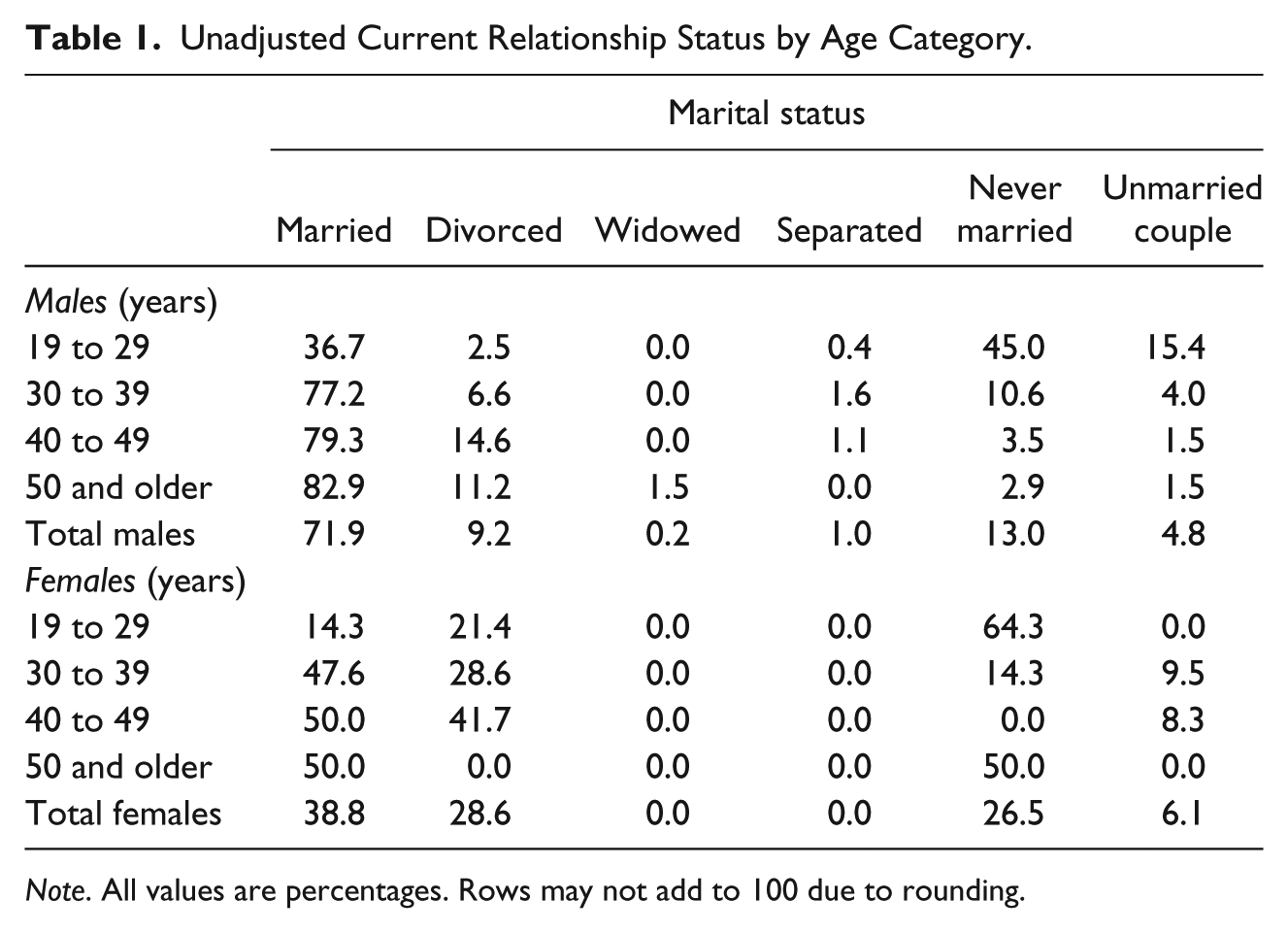
Note. All values are percentages. Rows may not add to 100 due to rounding.
Age/Gender Standardized Prevalence
Table 2 presents age-standardized prevalences of current marriage and divorce stratified by gender among firefighters as compared with the U.S. population. For men, 77.0% were married compared with the U.S. population prevalence of 57.5%. The age-standardized prevalence of currently divorced male firefighters was 11.8% compared with 9.4% of the U.S. population. Among women, the adjusted prevalence of current marriage was 42.6% for the fire service compared with 55.4% in the U.S. population sample. The age-standardized prevalence of divorce among women in the fire service was 32.1% compared with 10.4% in the U.S. population.
Age-Standardized Comparisons of Firefighter and U.S. Population Martial Status.

Note. U.S. prevalence based on 2010 U.S. Census data for 19 to 54 year old males and females.
Prevalence of Ever Divorce
Figure 1 presents the prevalence of ever divorce stratified by age, gender, and marital status (currently married, all participants). Among married firefighters, prevalence of ever divorce was higher among females compared with males (27.3% vs. 19.6%). When all firefighters were examined, prevalence of ever divorce was substantially higher among female firefighters (40.0% vs. 24.4%). Overall, 25% of firefighters reported being ever divorced.

Prevalence of ever divorce among firefighters by age category.
Univariate Associations Among Behavioral Health Factors and Current Martial/Partnered Status
Table 3 provides general and behavioral health factors stratified by married/partnered or currently single and gender. Married/partnered firefighters had significantly higher BMI (F = 6.01; p = .014) and WC (F = 12.49; p ≤ .001) compared with single firefighters. Single firefighters had higher rates of both heavy (F = 9.94, p = .002) and binge drinking (F = 10.57, p ≤ .001) and were more likely to have received a depression diagnosis (F = 14.64, p < .001) or to be currently experiencing significant symptoms of depression (F = 4.91, p = .027).
Associations Among Health Risk Factors and Current Married/Partnered Status.
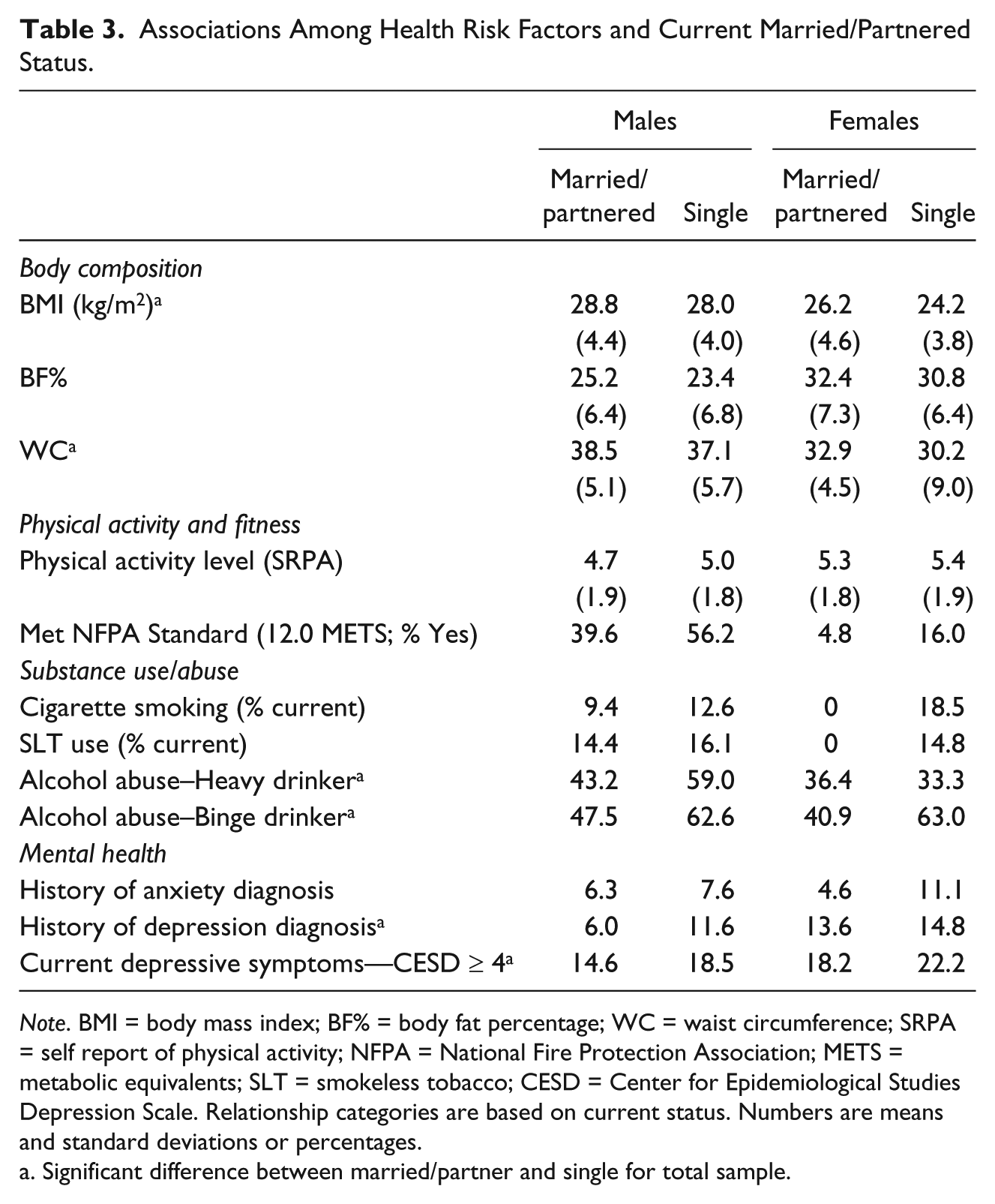
Note. BMI = body mass index; BF% = body fat percentage; WC = waist circumference; SRPA = self report of physical activity; NFPA = National Fire Protection Association; METS = metabolic equivalents; SLT = smokeless tobacco; CESD = Center for Epidemiological Studies Depression Scale. Relationship categories are based on current status. Numbers are means and standard deviations or percentages.
Significant difference between married/partner and single for total sample.
Multivariate Model Predicting Current Marital/Partnered Status
Both age (F = 46.18; p < .001) and gender (F = 12.33; p < .001) were significant predictors in the final multivariate model, with older and male firefighters more likely to be married/partnered. Among the behavioral health factors, WC (F = 0.19; p < .003), heavy drinking (F = 12.45; p < .001), and a previous depression diagnosis (F = 14.95; p < .001) remained as significant predictors in the multivariate model. Firefighters with larger WC and those who did not drink heavily or report a previous diagnosis of depression were more likely to be married/partnered.
Discussion
This study provides the first comprehensive data on prevalence of marriage and divorce among firefighters and the relationship between relationship status and key indicators of firefighter fitness. Among male firefighters, the age-standardized prevalence of current marriage was substantially higher than that found in the general public (77.0% vs. 57.5%), whereas the age-standardized prevalence of divorce was only slightly higher (11.8% vs. 9.4%). For female firefighters, a much different pattern of results was discovered. Females were less likely to be currently married (42.6% vs. 55.4%) and more than three times more likely to be currently divorced (32.1% vs. 10.1%) compared with females in the general public. Thus, although the prevalence of current divorce was only slightly higher among male firefighters than males in the general public, the prevalence of divorce for female firefighters was substantially higher than those found for women in the U.S. population.
According to a recent nationally representative survey, approximately 25% of all U.S. adults (18 years and older) have had at least one divorce (BarnaGroup, 2008). The prevalence of ever divorce for currently married individuals in the general population was approximately 33%. By comparison, the prevalence of ever divorce in the total sample of male firefighters in this study was only 19.6%, whereas among those who were currently married/partnered, it was 24.4%. Thus, the prevalence of ever divorce among male firefighters was lower than that found in the general public. However, the overall prevalence of ever divorce for female firefighters (40.0%) was much higher than the general public, whereas the prevalence for married females was lower (27.3%). Thus, as a group, female firefighters have a relatively high prevalence of ever divorce.
Several previous studies have found marriage can be protective of health (Miller, Hollist, Olsen, & Law, 2013). For instance, in a large, prospective study recently presented at the annual meeting of the American College of Cardiology, researchers found marriage was independently associated with lower rates of cardiovascular disease in both men and women (ScienceDaily, 2014). In contrast, divorce is associated with higher rates of substance abuse (Doherty & Doherty, 1998; Li, Smith, & Baker, 1994; Magura & Shapiro, 1989; Power, Rodgers, & Hope, 2002), depression (Kamiya, Doyle, Henretta, & Timonen, 2013; Sbarra, Emery, Beam, & Ocker, 2013), and early mortality (Sbarra & Nietert, 2009). This study found the relationship between marriage and key health outcomes in the fire service follows a similar pattern, with married/partnered firefighters being less likely to report heavy alcohol consumption or depression. However, one area where marriage appears to work against health is body composition (Dinour, Leung, Tripicchio, Khan, & Yeh, 2012; Klos & Sobal, 2013; Meltzer, Novak, McNulty, Butler, & Karney, 2013; The & Gordon-Larsen, 2009). Entry into a marriage is associated with an increased risk for obesity and partner concordance for obesity-related behaviors is strongest for couples who have been married ≥2 years (The & Gordon-Larsen, 2009). Consistent with this literature, being married or partnered was associated with less healthy body composition among firefighters.
In summary, this study found the prevalence of divorce among male firefighters to be similar to the general population and male firefighters reported a higher prevalence of currently being married than males in the general public. However, when examining prevalence of marriage and divorce among female firefighters, the prevalence of current and past divorce were high and prevalence of current marriage was low in comparison with the general population. Consistent with previous studies, marriage was associated with a number of positive health outcomes among firefighters, the exception being the finding that married/partnered firefighters tended to have less healthy body composition.
Although this study has a number of strengths, including a large and diverse sample from across the country and detailed data on marriage and divorce, limitations exist. For instance, questions assessing marital status and divorce did not include an assessment of the temporal relationship between divorce/marriage and entering the fire service. Thus, it was not possible to know whether divorces reported by firefighters occurred while they were in the fire service. Second, previously published data on divorce history of those currently married are limited and therefore age- and gender-standardized comparisons for divorce history could not be made. Third, although the size of our sample of female firefighters was consistent with gender representation nationally, their small numbers suggest that results regarding female firefighters in this study should be interpreted with caution. Women in the fire service make up an extremely small proportion of all firefighters (Fox et al., 2006). While limited by sample size, the findings of this study suggest that women’s marital relationships may be negatively affected by being a member of the fire service. Future research should explore whether the findings of the current study are generalizable to the fire service as a whole as well as associations between marital relationship status and important occupations factors for firefighting.
Footnotes
Declaration of Conflicting Interests
The author(s) declared no potential conflicts of interest with respect to the research, authorship, and/or publication of this article.
Funding
The author(s) disclosed receipt of the following financial support for the research, authorship, and/or publication of this article: This study was funded by two grants (EMW-2007-FP-02571 and EMW-2009-FP-01971) from the Assistance to Firefighters Grants program managed by the Federal Emergency Management Agency in the Department of Homeland Security.