



Abstract
The present study examines the relationship between a variety of organizational support factors and work–family outcomes, as well as gender differences in these relationships. A random sample of 229 working adults completed phone surveys, and multiple regression analysis was used to test the proposed relationships. Results showed that certain types of support may differentially benefit women and men, highlighting the value of having a supervisor and organization supportive of work–family balance. For example, having a supportive work–family supervisor was related to lower negative work–family spillover and intent to quit for women, and higher job satisfaction for men. Telecommuting use, on the other hand, was more beneficial for men than women in our sample. Given these findings, organizations should be aware that certain forms of support—particularly supervisor work–family support—may benefit men and women through different mechanisms.
Keywords
In recent decades, there has been a dramatic shift in the demographic makeup of the U.S. workforce. In 2011, women accounted for 47% of all employees in the workforce (U.S. Bureau of Labor Statistics, 2013), and an increasing number of employees are in dual-earner households (Eby, Casper, Lockwood, Bordeaux, & Brinley, 2005; U.S. Bureau of Labor Statistics, 2013). Perhaps, reflecting these changing workforce demographics, organizations have become more responsive to work–family issues, offering a wider array of formal work–family policies as well as fostering a culture supportive of work–family needs. Research has shown that women may take advantage of family-friendly policies to a greater degree than men (Hill, Martinson, Hawkins, & Ferris, 2003), perhaps, because utilizing such resources (e.g., flextime) is more socially acceptable for women than men (Blair-Loy & Wharton, 2004). Furthermore, work resources may serve different purposes and be differentially effective for women and men (Feldman, Fisher, Ransom, & Dimiceli, 1995; Friedman & Greenhaus, 2000). Despite these potential differences in the use and effectiveness of organizational support factors for men and women, these issues are rarely examined in the literature.
This study contributes to the literature in several ways. First, the present article extends previous studies that have examined only one or two specific types of support (Kelly, Moen, & Tranby, 2011; Wang, Lawler, & Shi, 2010), or that have combined all formal policies into a composite measure (Baral & Bhargava, 2010; Odle-Dusseau, Britt, & Greene-Shortridge,2012). Second, the present study answers calls to examine gender differences in the relationship between a variety of organizational support factors and work–family outcomes (Carlson, Grzywacz, & Kacmar, 2010; Parasuraman & Greenhaus, 2002). Although studies have focused on gender differences in mean levels of variables (e.g., in usage of policies, in perceptions of supportive supervisor), few studies have examined gender differences in the relationship between several organizational support factors and work–family outcomes (Parasuraman & Greenhaus, 2002). Given recent research findings that work–life benefits use (as a composite) influences organizational commitment through different mechanisms for men and women (Casper & Harris, 2008), it is clear that more research is needed to further examine the role of gender in these relationships. Third, this is one of only a handful of studies to examine the actual utilization of various organizational policies, as most studies have focused on availability rather than usage (e.g., Baral & Bhargava, 2010; Odle-Dusseau et al.,2012; Wang et al.,2010). Fourth, the majority of research relating to organizational support factors has focused on their relation with negative work–family spillover (e.g., work–family conflict; Brough, O’Driscoll, & Kalliath, 2005), but little is known about how these support factors influence positive work–family spillover (e.g., work–family facilitation or enrichment). Given that different processes may underlie positive and negative work–family spillover (Aryee, Srinivas, & Tan,2005), it is important to examine how organizational resources may relate to both negative and positive outcomes. Finally, the present study examines these relationships with a random sample of Michigan residents, which is unlike the majority of work–family studies that heavily rely on narrowly defined convenience samples (Frone, 2000).
Organizational Support Factors and Work–Family Outcomes
Organizations may offer a variety of supports for families, composed of both informal and formal practices and policies. In the present study, we use the categorization by Hammer, Kossek, Zimmerman, and Daniels (2007) and examine how gender moderates the relationship between: (a) family-supportive organization perceptions (FSOP), which refer to the employees’ perception that the organization is family-supportive; (b) supervisor work–family support, or the employees’ perception that their supervisor is family-supportive; and (c) organizational policies (i.e., flextime, telecommuting, compressed workweeks); on both negative and positive work–family outcomes.
On a broad level, the relationship between each of these organizational support factors and work–family outcomes can be explained through conservation of resources (COR; Hobfoll, 1989) and the principles of fixed resources and resource drain (Edwards & Rothbard, 2000). According to COR, individuals have a finite amount of resources (time, energy, attention), and if resources are spent in one role (e.g., work), there is a decrease in resources available for use in another role (e.g., family). Thus, COR theory serves to explain how people respond to stressors in their environment and how managing those stressors influence outcomes such as negative work–family spillover and intent to quit (Ten Brummelhuis & Bakker, 2012). The COR model proposes that people try to prevent resource loss and seek to attain and sustain resources that are important to them. By offering employees support for their work–family needs, the organization might mitigate the amount of resource drain felt by employees. For example, allowing employees to work flexible hours may reduce time demands attributable to conflicting work and family schedules. Similarly, a supervisor who is family-supportive may provide employees emotional (e.g., serve as a sounding board) or instrumental (e.g., offer suggestions for assistance) support, which can help employees cope more effectively with work or family demands. Empirical research supports the notion that organizational support factors decrease employees’ negative work–family spillover and intent to quit (Clark, 2002; Thompson, Beauvais, & Lyness,1999).
Organizational support factors should be related to positive work–family spillover and job satisfaction, as these resources can be an important source of developmental, affective, and capital gains. Working in a family-friendly environment may engender feelings of positive affect or confidence that carries over and enhances functioning of the family (Wayne, Grzywacz, Carlson, & Kacmar, 2007). COR theory and the concept of resource gain spiral would suggest these individuals are more likely to acquire new resources to help them perform in their family role because resource acquisition is additive (Hobfoll, 1989). Furthermore, a supportive work environment can enhance flexibility, which better enables individuals to integrate their work and family roles (Greenhaus & Parasuraman, 1999). Research has also shown links between organizational support factors and the related concept of work–family facilitation (Aryee et al., 2005), as well as with job satisfaction and organizational commitment (Baltes, Briggs, Huff, Wright, & Heuman, 1999; Casper & Harris, 2008). In sum, both theory and research support the idea that employees can benefit when their organization is supportive of their work–family needs. However, little attention has been paid to the role of gender in these relationships.
Examining the Role of Gender
Although there is evidence that a growing number of men espouse egalitarian values (particularly those with a spouse who is also employed; Parasuraman & Greenhaus, 2002), societal norms and traditional gender role expectations that men should be more invested in the work domain, whereas women should be more invested in the family domain still greatly influence behavior and attitudes toward managing work and family roles (Bagger, Li, & Gutek,2008; Blair-Loy, 2003). For example, based on gendered expectations related to parenting and household duties, women on average continue to take on more child care and household responsibilities than men (Coltrane, 2000; Galinsky, Aumann, & Bond,2011). Given the greater family role demands, working women may experience greater resource drain than working men (Hobfoll, 1989), and as a result may experience greater benefits from organizational support factors. Furthermore, social identity theory (Ashforth & Mael, 1989) suggests that individuals are especially concerned with factors that benefit or threaten their most central identity (e.g., work, family). To the extent that women view their family identity as more central to their self-perceptions than their work identity, women will benefit more than men from informal and formal support factors that allow them to better attend to family needs and responsibilities. This focus on family is also consistent with sex role theory and gender role prescriptions that women should be more concerned with family than with work (Blair-Loy, 2003; Pleck, 1977). Indeed, research has shown that women generally invest more into their family role than their work role (Gutek, Searle, & Klepa,1991), and women with children were more likely than men with children to report they were family-centric (Families and Work Institute, 2004).
Women, more so than men, may also place a greater value on informal forms of organizational support that are of a social nature (e.g., supervisor support; Friedman & Greenhaus, 2000; Wayneet al., 2007), due to differences in socialization regarding relationships (Gilligan, 1980). Specifically, women are socialized to be more dependent on social attachments for their identity, whereas men are socialized to be more dependent on work and professional accomplishments (Gallos, 1989). Research has supported this idea, showing that women tend to utilize social networks at work to increase their pool of useful information and advice more so than men (Friedman & Greenhaus, 2000). There is empirical evidence to support the idea of gender as a moderator of the relationship between informal organizational support (e.g., FSOP, supervisor support) and outcomes. For example, Hill (2005) found that the relationship between a supportive organizational culture and work–family facilitation was positive for working mothers and negative for working fathers. Additionally, Batt and Valcour (2003) found that supervisor work–family support was related to lower work–family conflict for women but not men, and Raghuram,Luksyte, Avery, and Macoukji (2012) found that men’s overall stress levels remained constant regardless of the level of general supervisor support, but women had significantly lower levels of stress when supervisor support was high. For ease of presentation, we have organized our study hypotheses by valence: negatively valenced work–family outcomes include negative spillover and intent to quit, whereas positively valenced work–family outcomes include positive spillover and job satisfaction.
We also predict that the relationship between use of formal policies (e.g., flextime, telecommuting) and work–family outcomes may differ for men and women. Specifically, based on the aforementioned theoretical rationale, we hypothesize that women will experience greater positive outcomes through the utilization of formal organizational policies including flextime, telecommuting, and compressed workweeks. Empirical evidence also supports the idea that men and women react to and benefit from various organizational support policies differently. For example, research has shown that women are more likely than men to highly value flexible work options (Catalyst, 2001), which may at least partially explain why flextime has been shown to reduce work–family conflict (Casper & Harris, 2008) and enhance commitment (Carlson et al., 2010) and job satisfaction (Scandura & Lankau, 1997) more effectively for women than for men. Additionally, using percentage of women employed at a given company as a proxy for gender, Konrad and Mangel (2000) found that the larger the percentage of women employed at a company, the stronger the relationship between the organization’s formal work–life programs and firm productivity. Overall, we hypothesize that women will be more likely to benefit from formal organizational support factors than men.
Although not a main focus of the present study, we also examined the potential differential relationships between negative and positive spillover and the outcomes of job satisfaction and intention to quit. Researchers have speculated that work and family variables are more strongly related to each other for women than men because men are more likely to mentally separate work and family roles than women (Andrews & Bailyn, 1993; Rothbard, 2001). There is some empirical evidence to support this idea. For example, in Kossek and Ozeki’s (1998) meta-analysis, work–family conflict was more strongly related to job and life satisfaction for women than men. Duxbury and Higgins (1991) found a stronger relationship between work–family conflict and quality of work life for women than for men, but the relationship between work–family conflict and quality of family life was stronger for men than for women. Ergeneli, Ilsev, and Karapinar(2010) found that work–family conflict was more strongly related to women’s job satisfaction than men’s, but this also depended on employees’ stress-resilient interpretive habits. Due to the lack of a clear theoretical explanation for these differences, we study these relationships in an exploratory manner.
Method
Procedure
The present study was part of a statewide survey of Michigan residents, 18 years and older, conducted annually by the Center for Urban Studies at Wayne State University. Inclusion into the statewide survey is determined based on a competitive call for proposals. During the first stage of the statewide survey, trained telephone interviewers called a random sample of 5,498 active telephone numbers of Michigan residents. Each number was called up to 8 times over a period of 6 months. Paper copies of surveys were sent to all nonrespondents for whom the center researchers had a mailing address (n = 2,116). Respondents were also given the option to complete surveys over the web. A total of 630 surveys were completed (60% via telephone, 3% via web, and 37% via mail). Using the American Association of Public Opinion Researchers’ approved response rate calculation, which includes removing a portion of the unknown numbers from the sample, a total response rate of 25.5% was obtained. Only full-time employees were included in our sample, which brought the final sample size to 229.
Participants
The sample consisted of 229 working adults employed full-time in a variety of industries. Based on participants’ self-reported job descriptions, we coded these into one of 20 possible industry classifications based on the North American Industry Classification System (www.census.gov). In total, 17 industry sectors were represented in our sample, with the greatest number of individuals working in administration and support (20%, n = 46), professional, scientific, and technical services (15%, n = 34), and health care (13%, n = 29). Forty-one percent (n = 94) indicated that they held supervisory positions. Participants ranged in age from 21 to 70 years (M = 46 years), of which 60% (n = 138) were women, 78% (n = 179) were parents, and 65% (n = 149) were married. The majority of our sample was White (85.6%), followed by Black (7.4%), Hispanic (2%), Asian (2%), and other (3%). We did not limit our sample to only those who were married or parents, but we did include marital and parental status as control variables. Examining work–family outcomes for only those who are married or parents reflects an overly narrow conceptualization of family (Frone, 2003).
Measures
Unless otherwise indicated, all measures used a 7-point Likert-type scale ranging from 1 (strongly disagree) to 7 (strongly agree). Higher scores indicate higher levels of each construct.
Family-Supportive Organization Perceptions
Perception of the degree to which the organization is family-friendly was assessed with a single item adapted from Thompson et al.’s(1999) scale: “In general, this organization is accommodating of family-related needs.” Research has supported the use of such single-item measures if the construct is unidimensional (Loo, 2002). To demonstrate convergent validity evidence for this measure, a separate study was conducted using a sample of 99 adults working at least 20 hours per week. Our measure of FSOP was correlated .72 with Thompson et al.’s (1999) scale, thus supporting the adequacy of our one-item measure.
Supervisor Work–Family Support
A five-item scale developed by Kossek (1990) was used to measure supervisor work–family support. Response options ranged from 1 (strongly disagree) to 5 (strongly agree). An example item is “My supervisor is supportive of my need to juggle work and family responsibilities.” Coefficient alpha in the present study was .95.
Use of Flextime, Telecommuting, and Compressed Workweeks
Use of three separate family-friendly policies was assessed with a scale adapted from Sinclair, Hannigan, and Tetrick(1995). Respondents were asked to indicate if their employer provides, and whether or not they had used, each of the following benefits: flexible work schedules, telecommuting, and compressed workweeks. Because our focus was on utilization, not availability, of policies, responses were coded as 1 if respondents indicated their organization offered the support and they had used it; and 0 if they indicated either (a) their organization did not offer the support or (b) their organization offered the support but they had not used it.
Negative Work-to-Family Spillover
Negative work-to-family spillover was measured with a four-item scale developed by Grzywacz and Marks (2000). Participants responded on a scale of 1 (never) to 5 (all of the time). An example item is “My job reduces the effort I can give to activities at home.” Coefficient alpha in the present study was .73.
Positive Work-to-Family Spillover
Positive work-to-family spillover was measured with a three-item scale developed by Grzywacz and Marks (2000). Participants responded on a scale of 1 (never)to5 (all of the time). An example item is “The things I do at work help me deal with personal and practical issues at home.” Coefficient alpha in the present study was .72.
Job Satisfaction
Job satisfaction was measured with two items from Hackman and Oldham’s (1975) Job Diagnostic Survey. A sample item is “Generally speaking, I am very satisfied with this job.” Coefficient alpha in the present study was .75.
Intent to Quit
Intent to quit was assessed with Cammann, Fichman, Jenkins, and Klesh’s(1979) three-item measure. A sample item is “I often think about quitting.” Coefficient alpha in the present study was .77.
Control Variables
Marital status (single = 0, married or in a committed relationship = 1) and parental status (no children = 0, children = 1) were included as control variables.
Confirmatory Factor Analysis
To provide evidence for the distinctiveness of each of our study variables, we conducted an overall confirmatory analysis with each of our support factors (with the three policies loading on to an overall “policy” factor) and outcome variables. The overall model fit the data well: χ2(1156) = 308.85, p < .001; root mean square error of approximation (RMSEA) = .06; Tucker–Lewis Index (TLI) = .93; Akaike Information Criterion (AIC) = 14057.47. Additionally, this model fit the data significantly better than an alternative one-factor model: χ2(1171) = 1943.97, p < .001; RMSEA = .19; TLI = .26; AIC = 15662.59; χ2 difference (15, N = 229) = 1635.12, p < .001.
Results
As a first step, the pattern of missing data were examined. Excluding items clearly not relevant to some participants (e.g., items asking about child care); there was an average of less than 5% missing data at the item level. Little’s (1988) missing completely at random test was conducted, and the chi-square value for this test was nonsignificant (χ2 = 626.93, df = 598, ns), which indicates that no identifiable pattern exists to the missing data. Thus, missing data were handled via multiple imputations based on the expectation maximization algorithm. Table 1 presents the means, standard deviations, and correlations for study variables separately for men and women. There were significant gender differences in telecommuting usage (t = −2.26, p < .05), with men reporting significantly higher usage (M = 0.30) than women (M = 0.17). No other gender differences were found for the other study variables. Multiple regression analyses were run to test our hypotheses.
Study Means, Standard Deviations, and Intercorrelations.
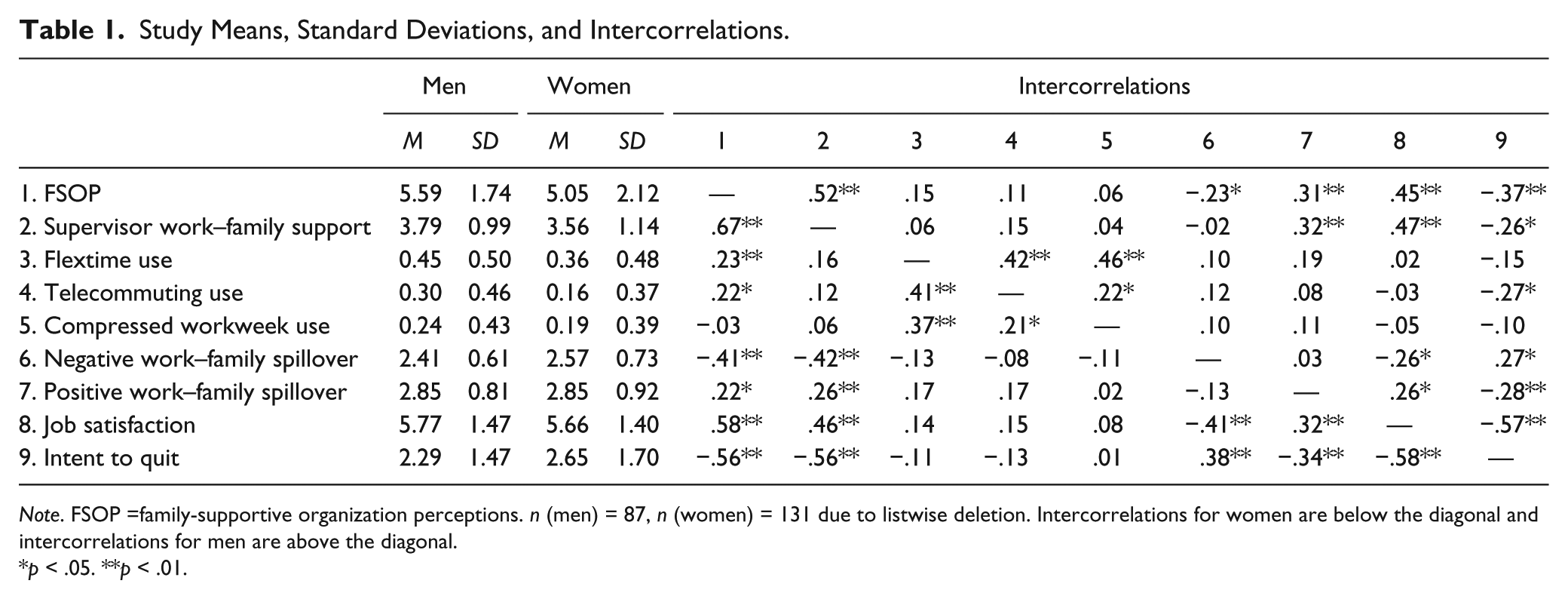
Note. FSOP =family-supportive organization perceptions. n (men) = 87, n (women) = 131 due to listwise deletion. Intercorrelations for women are below the diagonal and intercorrelations for men are above the diagonal.
p < .05. **p < .01.
Turning next to the multiple regression analyses, prior to entering the interaction terms to investigate the moderating role of gender in the relationship between organizational support factors and work–family outcomes, we first entered all control variables and each predictor variable. As shown in Table 2, at this first step, the variables cumulatively explained a significant amount of variance in negative work–family spillover (R2= .18, p < .001), positive work–family spillover (R2= .11, p < .01), job satisfaction (R2= .37, p < .01), and intent to quit (R2= .44, p < .001). FSOP was a significant predictor of negative work–family spillover (β= −.30, p < .001). Supervisor work–family support was a significant predictor of positive work–family spillover (β= .21, p < .05). FSOP (β= .33, p < .001), supervisor work–family support (β= .18, p < .05), negative work–family spillover (β= −.18, p < .01) and positive work–family spillover (β= .15, p < .05) were significant predictors of job satisfaction. FSOP (β= −.15, p < .05), telecommuting use (β= −.13, p < .05), negative work–family spillover (β= .14, p < .05), positive work–family spillover (β= −.12, p < .05), and job satisfaction (β= −.35, p < .001) were significant predictors of intent to quit.
Hierarchical Regression Results for Covariates, Main Effects, and Moderator Analyses.
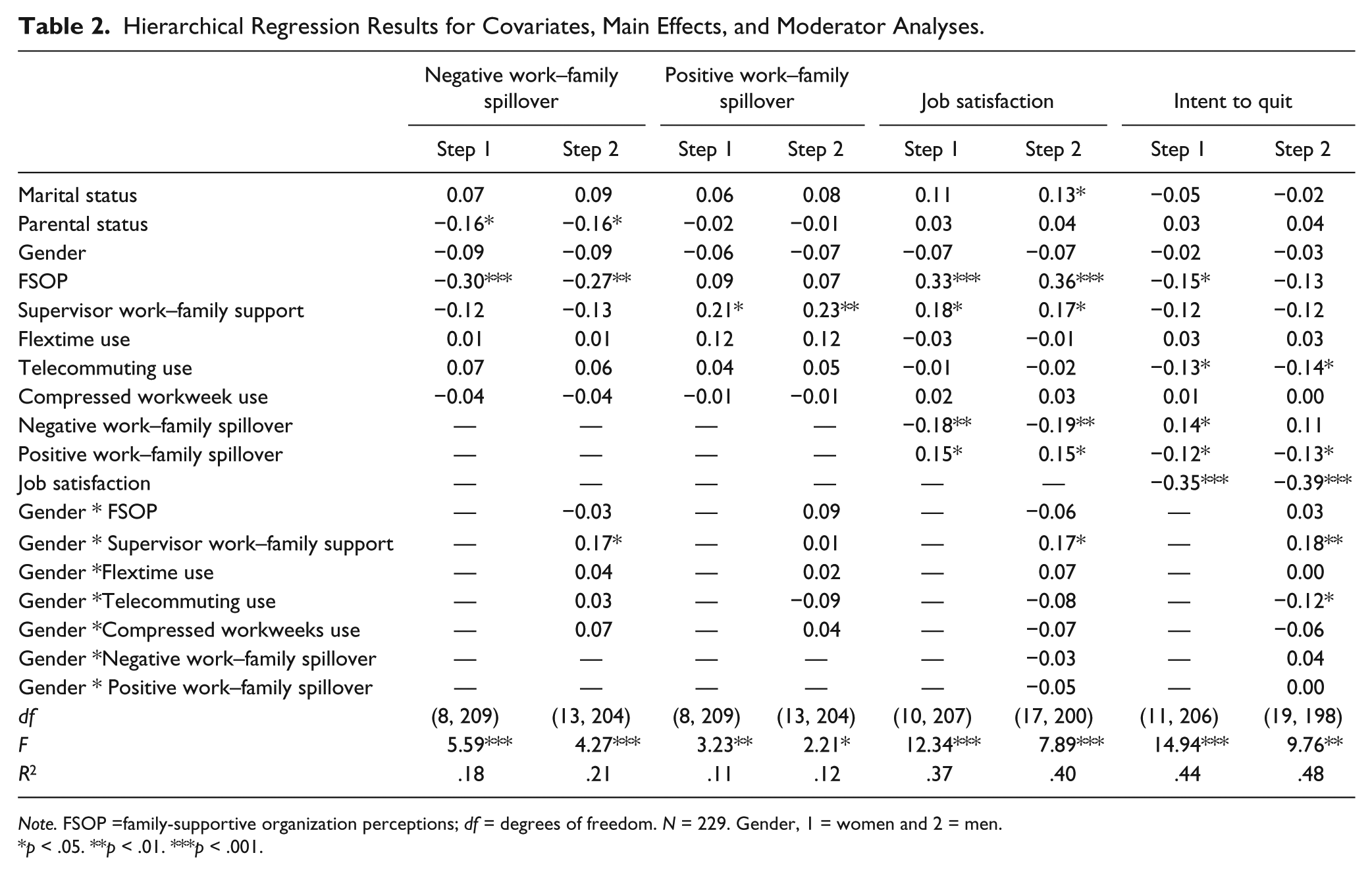
Note. FSOP =family-supportive organization perceptions; df = degrees of freedom. N = 229. Gender, 1 = women and 2 = men.
p < .05. **p < .01. ***p < .001.
Moderating Role of Gender
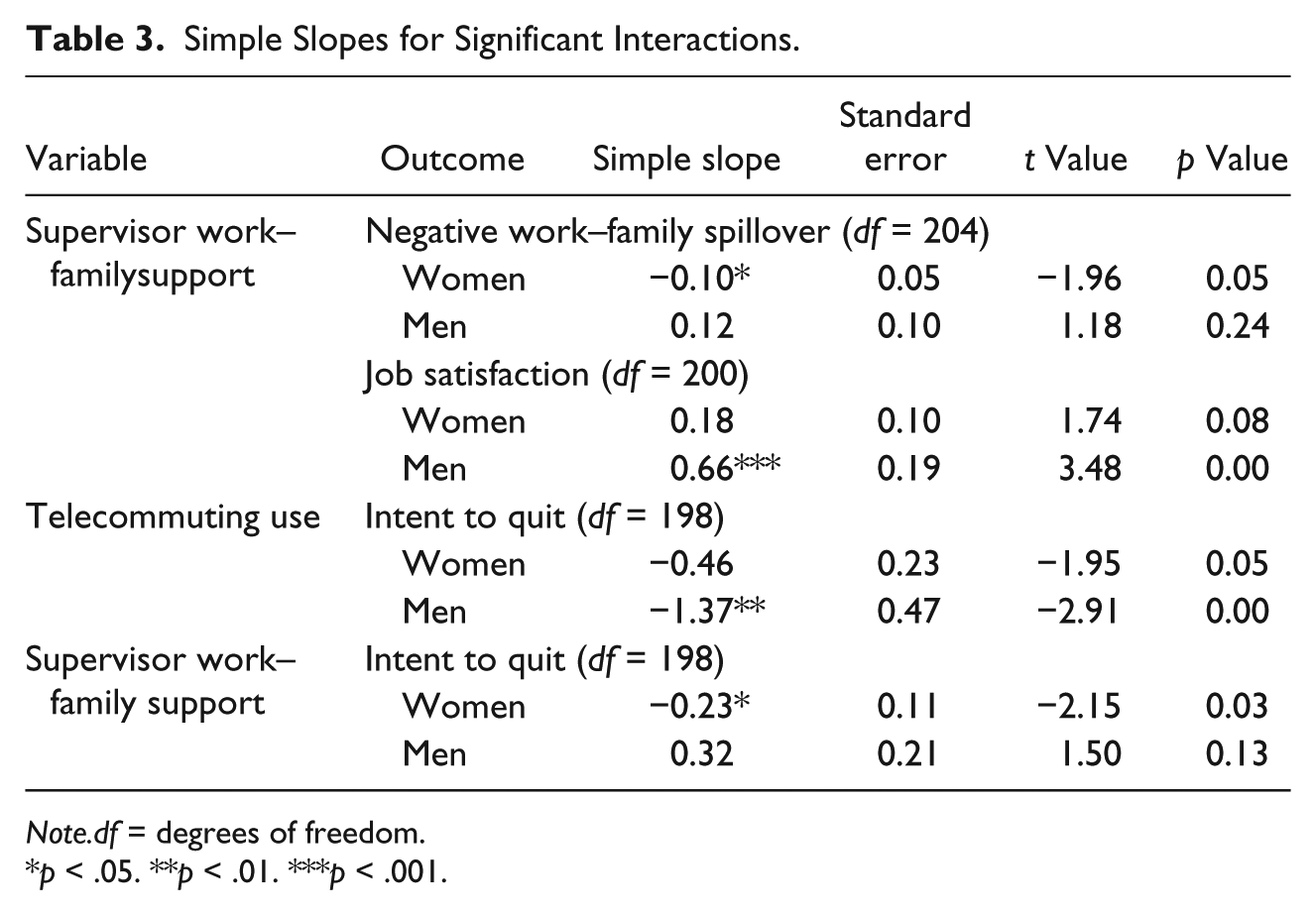
In Step 2, the interaction terms were entered into the regression equation (see Table 2). Significant interaction effects were examined graphically (see Figures 1 through 4) and simple slopes are presented in Table 3. The overall regressions were significant, as the control variables, antecedent variables, and interaction terms cumulatively explained a significant amount of variance in negative work–family spillover (R2= .21, p < .001), positive work–family spillover (R2= .12, p < .05), job satisfaction (R2= .40, p < .001), and intent to quit (R2= .48, p < .01).
Simple Slopes for Significant Interactions.
Note.df = degrees of freedom.
p < .05. **p < .01. ***p < .001.

Gender as a moderator of the relationship between supervisor work–family support and negative work–family spillover.
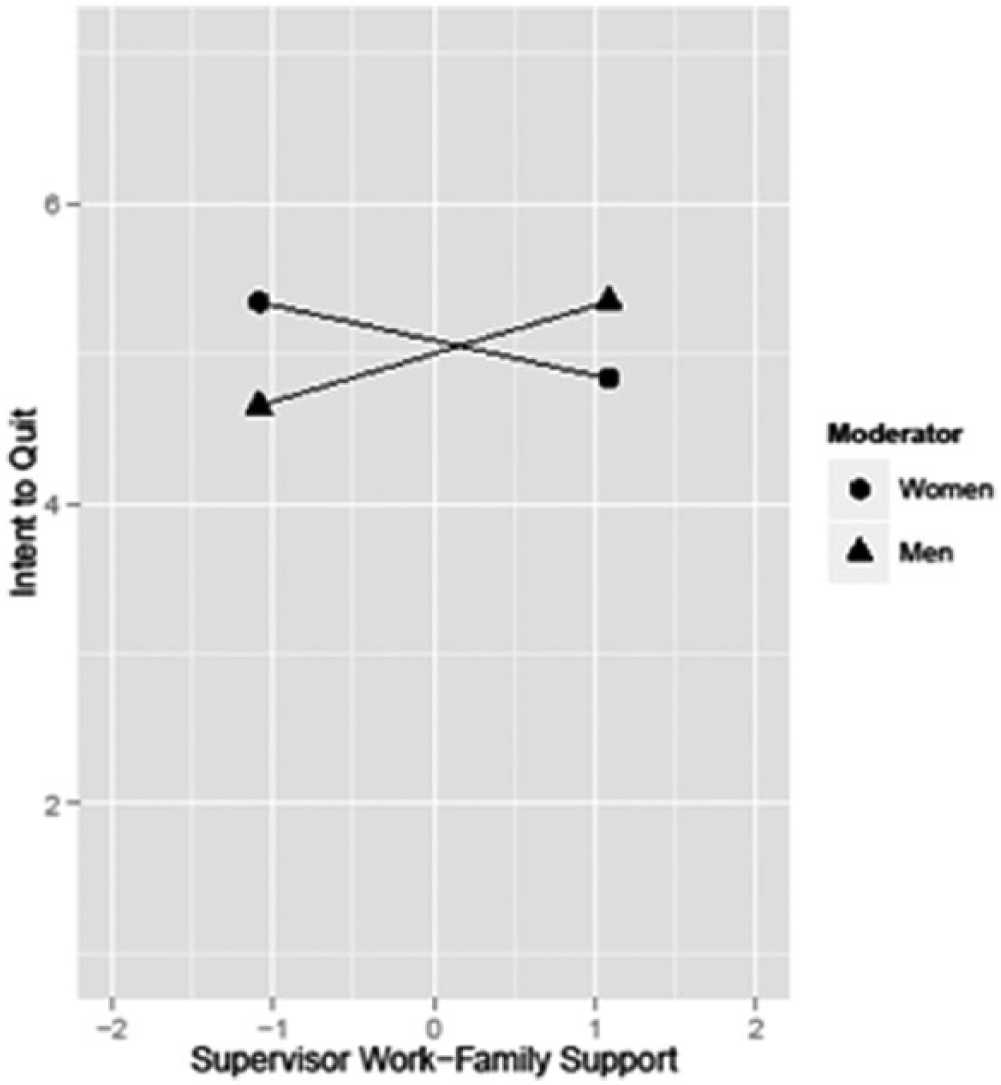
Gender as a moderator of the relationship between supervisor work–family support and intent to quit.
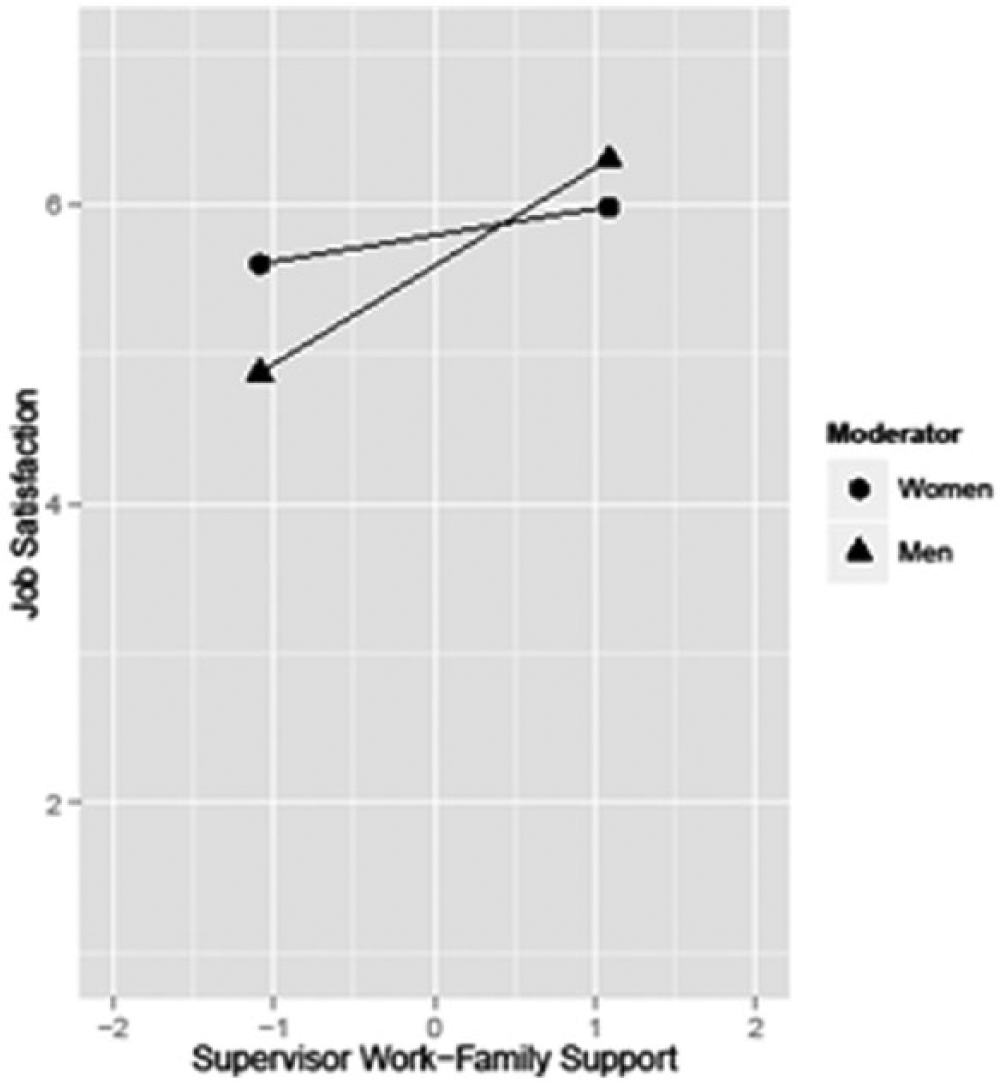
Gender as a moderator of the relationship between supervisor work–family support and job satisfaction.

Gender as a moderator of the relationship between telecommuting use and intention to quit.
Hypotheses 1 and 2 predicted that gender would moderate the relationship between FSOP and work–family outcomes; however,none of the interactions were significant. In support of Hypothesis 3, gender significantly moderated the relationship between supervisor work–family support and negative work–family outcomes (see Figures 1 and 2). The relationship between supervisor work–family support and intent to quit was negative and significant for women (b = −0.23, SE = 0.11, p < .05) but not for men. Additionally, the relationship between supervisor work–family support and negative work–family spillover was negative and significant for women (b = −0.10, SE = 0.05, p < .05) but not for men. Our Hypothesis 4, which predicted that gender would moderate the relationship between supervisor work–family support and positive work–family outcomes, was not supported. Although gender significantly moderated the relationship between supervisor work–family support and job satisfaction (see Figure 3), findings were contrary to our hypothesis. Specifically, the relationship between supervisor work–family support and job satisfaction was positive and significant for men (b = 0.66, SE = 0.19, p < .001) but not for women. Gender did not moderate the relationship between supervisor work–family support and positive spillover. Hypotheses 5 to 10 predicted that gender would moderate the relationship between policy use (flextime, telecommuting, and compressed workweek) and the positive and negative outcome variables. These analyses revealed one significant interaction (Hypothesis 7), but it was in the opposite direction as hypothesized. Specifically, the effect of use of telecommuting on intent to quit was negative and significant for men (b = −1.37, SE = 0.47, p < .01) but not for women. Figure 4 depicts this relationship in terms of conditional mean-levels of intent to quit. Finally, no gender differences were found relating to our research question. Specifically, the relationships between negative and positive work–family spillover and the outcome variables of job satisfaction and intent to quit were not significantly moderated by gender (see Table 2). Thus, the research question was not supported.
Discussion
The goal of this study was to develop a better understanding of how various organizational support factors influence work–family outcomes and the role of gender in these experiences. Results obtained from a random sample of Michigan residents who worked full-time revealed four key findings: (a) some organizational support factors (e.g., FSOP) appear to be beneficial for both men and women; (b) some organizational support factors, particularly supervisor work–family support, may benefit men and women through different underlying mechanisms; (c) supervisor work–family support was the only significant predictor of positive work–family spillover; and (d) contrary to predictions, men appear to use and benefit more than women from telecommuting use. Below, we discuss the implications of these findings on theory and practice and suggestions for future research.
In the present study, we examined three forms of organizational support using Hammer et al.’s(2007) categorization: (a) FSOP, (b) supervisor work–family support, and (c) organizational policies (i.e., flextime, telecommuting, and compressed workweeks). Our results suggest that employees’ perception that their organization is family supportive was the most consistent predictor of work–family outcomes. Specifically, FSOP were related to lower negative work–family spillover and intent to quit, and higher job satisfaction. Gender did not emerge as a significant moderator of the FSOP—outcomes relationships. It appears that both men and women benefit when they perceive their organization as supportive of their desires to balance work and family.
Supervisor work–family support also emerged as an important predictor of work–family outcomes, as it was significantly related to higher positive work–family spillover and job satisfaction. Interestingly, though, men and women appear to benefit in different ways from this form of support. Specifically, at least in our sample, having a supportive work–family supervisor was related to reduced negative outcomes for women (e.g., decreased intent to quit), but enhanced positive outcomes (e.g., increased job satisfaction) for men. As Hammer and colleagues point out, supervisors can show their support for employees’ work and family needs in many different ways: (a) emotional support, (b) instrumental support, (c) role-modeling behaviors, and (d) creative work–family management (Hammer, Kossek, Anger, Bodner, & Zimmerman, 2011; Hammer, Kossek, Yragui, Bodner, & Hanson, 2009). Perhaps, men and women may respond differently to each of these specific forms of supervisor work–family support behaviors. To date, no known studies have examined the mechanisms through which supervisor work–family support may influence outcomes separately for men and women, but based on the results from the present study, this appears to be an area in need of greater research.
Turning next to organizational policies, we found that not only were men more likely to utilize telecommuting than women, but the use of telecommuting was significantly related to less intent to quit for men but not for women. One possible explanation for the gender difference in usage is that many companies have a policy of “formalized discretion” in which the manager decides whether or not to offer family-friendly policies to a particular employee (Kelly & Kalev, 2006). Research has shown that women are less likely than men to negotiate for themselves (Babcock & Laschever, 2003), so it is possible that when organizations have a “formalized discretion” approach to work–family policies, women are less likely than men to ask to use these work–family benefits. In order to examine this possibility, we performed some post hoc analyses to further examine our telecommuting variable. The option of using telecommuting was made available to 31% of our participants. However, when breaking this down by gender, we see that indeed telecommuting was available to a greater percentage of men (39%) than women (26%) in the present sample (and this difference was statistically significant). Furthermore, more men (76%) than women (65%) actually used telecommuting when it was made available to them. Though this difference in usage was not statistically significant in the present sample, these trends provide initial support to the idea of a gender difference in either formalized discretion or in the extent to which women and men ask or negotiate to use such policies.
Another possible explanation for these findings is that women may work in less family-friendly industries, and this is influencing the extent to which women choose to use family-friendly policies. To explore this, we examined the number of policies available (examined as an aggregate) among respondents from the top-eight sectors represented in our data (i.e., Administrative & Support; Professional, Scientific, & Technical Services; Health & Social Assistance; Education Services; Retail Trade; Management of Companies & Enterprises; Transportation & Warehousing; Public Administration). A 2 (men vs. women) × 8 (top-eight NAICS Codes) analysis of variance was run, F(15, 173) = 1.39, ns; neither main effect nor the gender × industry interaction was significant. Analyses specific to telecommuting availability (as opposed to an aggregate policy variable) were also nonsignificant. Thus, our additional analyses suggest these findings are not attributable to the type of industry sectors participants were employed in.
It is possible that telecommuting may be considered more acceptable for men to use than other types of work–family policies such as flextime or compressed workweeks, and that may explain the significant negative relationship between telecommuting use and intent to quit for men. Further examination of the data revealed that in our sample, this does not appear to be the case; 83% of men who were offered flextime used it, compared with 76% for telecommuting, and 65% for compressed workweeks. Interestingly, women were most likely to take advantage of flextime when it was offered to them (80%), were slightly less likely to take advantage of compressed workweeks (71%), and the least likely to take advantage of telecommuting when it was offered (65%). Given these trends, we recommend that future research investigate the possible reasons women may be less likely to take advantage of telecommuting over other workplace policies when made available.
One key finding of the present study is that, with one exception, the use of family-friendly policies was not related to work–family outcomes for men or women in our sample. The current findings support the claim that the use of organizational policies may be a necessary, but insufficient condition to help employees balance the demands of work and family (Allen, 2001). We propose that both men and women may be hesitant to utilize such formal policies, but for different reasons. On the one hand, men may not take advantage of policies as much as women due to fears of social stigmatization (Kossek, Lautsch, & Eaton,2006). Such negative ramifications have been shown in a laboratory study by Butler and Skattebo (2004), who found evidence that men who admitted to experiencing family conflicts received lower performance ratings. On the other hand, women who take advantage of family-friendly policies may be subject to the stereotype that working mothers are less committed to work than men (Konrad & Yang, 2012). Both men and women may desire to take advantage of such work–life policies, but fear that using them may hurt their careers (Blair-Loy & Wharton, 2002). Additionally, many other contextual constraints may influence all employees’ (not just women’s) use of these policies, such as the number of women in one’s work group, opinions, and beliefs from powerful others in the organization, characteristics of one’s supervisor (Blair-Loy & Wharton, 2002, 2004), as well as one’s organizational tenure.
This study also advances our understanding of how organizational support factors relate to positive, in addition to negative, work–family spillover. Our results support the notion that positive and negative forms of work–family spillover are unique constructs that operate in different ways (Grzywacz & Butler, 2005). Thus, if organizations wish to both reduce employees’ negative work–family spillover and increase their positive work–family spillover, the organization may want to ensure that they are offering employees several different forms of support (e.g., ensuring the organization is committed to endorsing a strong family-friendly culture and also offering formal family-friendly policies). Future research should examine the mechanisms through which some of the support factors are related to one form of spillover and not the other.
Limitations and Future Research Directions
A limitation of the present study was the cross-sectional nature of the data. Therefore, these findings can only be interpreted in a correlational sense. Another limitation was the use of a single-item measure for FSOP. Even though FSOP significantly related to three of the four work–family outcomes, the potentially lower reliability for this one-item measure may have attenuated correlations between this variable and outcomes. However, we found a high correlation between our one-item measure and a validated multi-item measure (Thompson et al.,1999), which provides indirect evidence for the adequacy of our measure. Another limitation of the present study was in the use of oversimplified categories relating to gender; future research should move beyond this simple categorization and instead, seek to understand how psychologically richer variables such as gender role moderate these relationships (Eby et al.,2005).
Additional research is needed to examine the role of culture, region, or ethnicity on these relationships. The present study only examined these relationships with Michigan residents, most of whom were White. Researchers have proposed that in societies (or even different regions within the United States) that have more traditional gender ideology, women may be more dissatisfied with the source of negative work–family spillover (Wang et al., 2010); thus, organizational support factors may be more likely to benefit women than men in these cultures or regions. This may also explain why, in our sample, some organizational support factors appear to be helpful for all employees, regardless of gender. Future research also should examine how organizational support factors influence the entire family unit. For example, only one spouse may utilize family-friendly policies (e.g., flextime), but this actually provides a benefit to both spouses. To our knowledge, no research has examined the impact of organizational support factors using couple-level data.
Implications for Practice and Society
On a practical level, if organizations wish to help employees balance the demands of work and family, these results suggest that the organization should not employ a “one size fits all” approach. Additionally, the organizational culture toward work–family balance and the role of a supportive supervisor seem to be critical factors. Thus, organizations may want to consider training and rewarding supervisors for excellence in promoting a supportive work–family culture. This is particularly important in those organizations that utilize formalized discretion regarding their family-friendly policies.
These issues are important for society because empirical research has shown that employees who experience less negative work–family spillover and more positive work–family spillover are less likely to be absent from work, have greater objective job performance, and have better physical health (Van Steenbergen & Ellemers, 2009). Thus, to the extent that organizations can implement and support a variety of organizational support factors, this can help foster a healthier and more productive workforce. Furthermore, by offering formal policies and maintaining a supportive organizational culture toward work–life balance that encourages their use, organizations can retain top-performing employees, especially in competitive markets (Blair-Loy & Wharton, 2004).
Conclusion
The present study contributes to our understanding of how various formal and informal organizational support factors affect employee work–family outcomes, and it also highlights how these relationships may sometimes differ for men and women. Although some forms of support appear to be beneficial for men and women alike (e.g., FSOP), other forms of support appear to have more complex relationships with outcomes depending on one’s gender. These findings suggest that researchers should further examine how these forms of support benefit different groups of employees (e.g., men vs. women, parents vs. nonparents). In the present study, informal support factors were generally more impactful than formal organizational support factors such as flextime and telecommuting. This suggests that even if an organization cannot offer formal work–family policies, they may be able to improve employee well-being through a strategic focus on creating and fostering a supportive work–family culture or by encouraging supervisors to be supportive of employee’s work–family concerns.
Our findings regarding gender differences illustrate the positive effects one’s supervisor can have on work–family outcomes, though supervisor support may be important in different ways for men and women. For women, having a supportive work–family supervisor was related to less negative work–family spillover and lower intent to quit, and for men, having a supportive work–family supervisor was related to greater job satisfaction. Additionally, telecommuting use was particularly beneficial for men, resulting in lower intent to quit. Post hoc analyses revealed that women were less likely than men to have telecommuting offered as an option, and when it was offered, they were also less likely than men to use it. These findings have implications for both research and practice, and highlight the fact that gender cannot be ignored when considering the effects of various organizational support factors on employee well-being.
Footnotes
Declaration of Conflicting Interests
The author(s) declared no potential conflicts of interest with respect to the research, authorship, and/or publication of this article.
Funding
The author(s) received no financial support for the research, authorship, and/or publication of this article.