




Abstract
Children play an important role in shaping the division of labor within couples. This study examines whether the impact of parenthood on the household division of paid work and housework is moderated by child gender, and thereby extends previous work on the effect of child gender on family life. The empirical analysis used fixed effects models and data from the German Socio-Economic Panel (1985-2011, N = 7,572). It showed that both fathers and mothers of boys spend more hours on paid work than parents of girls. This child-gender effect is, however, much stronger for women than for men. There is also suggestive evidence that mothers and fathers of a same-sex child spend more time on housework than mothers and fathers of an opposite-sex child. Overall, the analysis indicates that having a daughter is associated with a more traditional division of labor than having a son.
Introduction
The birth of a baby often affects the parental division of paid work and housework (Neilson & Stanfors, 2014; Sayer, 2005). Yet parents’ patterns of gender specialization differ widely: whereas some couples adopt a traditional male breadwinner model, others maintain a more egalitarian division of labor. Such variations in the parental division of labor are often attributed to differences in parents’ education, earnings opportunities, and gender ideology (Dribe & Stanfors, 2009; Kühhirt, 2012) as well as child characteristics such as the number and age of the children (Bianchi, Milkie, Sayer, & Robinson, 2000; Craig & Sawrikar, 2009; Sanchez & Thomson, 1997). Previous research has paid little attention, however, to whether the division of paid work and housework is mediated by child gender. This gap is surprising in view of the mounting evidence that the gender composition of children has a significant impact on family life.
A growing body of literature has documented that gender of children has wide ranging and significant impacts on parental behavior (for overviews, see Raley & Bianchi, 2006; Lundberg, 2005a). Research on union formation and dissolution for the United States has shown that parents of a son are more likely to marry and less likely to divorce than parents of a daughter (Dahl & Moretti, 2008; Lundberg & Rose, 2003). Fertility analyses have revealed that child-gender composition affects the probability of an additional child being born (Dahl & Moretti, 2008). Finally, there is evidence for the United States that mothers are more involved with daughters than with sons, and that fathers are more involved with sons than with daughters (e.g., Mammen, 2011; Tucker, McHale, & Crouter, 2003; Yeung, Sandberg, Davis-Kean, & Hofferth, 2001; Yoshida, 2012). These findings are often interpreted as evidence that parents, particularly fathers, favor boys over girls (e.g., Dahl & Moretti, 2008).
Research by Lundberg and colleagues showed that child gender affects parents’ labor market behavior as well. According to Lundberg and Rose (2002), fathers increase their working hours in the presence of both sons and daughters, but sons have a substantially and significantly larger effect than daughters. Lundberg (2005b), however, found that the effects of child gender on work hours vary by parents’ education level: Sons relative to daughters reduce specialization among highly educated parents but increase specialization among less educated parents. The only study of child-gender effects on labor market hours using non-U.S. data that I am aware of was conducted by Choi, Joesch, and Lundberg (2008) with data from Germany. The authors found that men who had at some point lived with a male child in their household spent more hours in paid work than childless men. Men who had lived with a female child in their household, in contrast, worked less than childless men.
My study extends current knowledge on the effect of child gender on the parental division of paid work and housework in three ways. First, this study has a greater scope than previous studies, as it also investigates the association between child gender and the number of hours in paid work for mothers. Previous research focused predominantly on fathers’ labor market hours, and to date, only a single, unpublished study by Lundberg (2005b) has examined the effect of child gender on the labor supply of both fathers and mothers. Second, the present study provides a broader picture of the impact of child gender on the parental division of labor by also taking hours spent on household work into account. Third, by adopting a couple perspective, this study examines the effect of child gender on women’s share of paid work and housework. Consequently, the results provide much more detailed insight into the impact of child gender on the division of paid work and housework in couples than previous research.
It should be noted that I used data from Germany in the empirical analysis and that the impact of children on the parental division of labor and other family processes in Germany might differ from that in other countries. Family policies in Western Germany long favored the male-breadwinner model (see Leitner, Ostner, & Schmitt, 2008). Historically, Germany has provided low levels of public child care but long periods of parental leave for mothers (3 years since 1992). In addition, parents receive generous family allowances, and the joint taxation system imposes heavy tax burdens on working wives. All of these factors incentivize mothers to stay home. It was not until 1996 that universal provision of preschool care was introduced for children aged 3 years and older. Only recently has Germany begun to introduce family policies designed to facilitate a more egalitarian division of market and domestic work. Those include 14 months of paid parental leave (since 2007), encouraging also fathers to take parental leave, and legal entitlement to public day care for children older than 1 year (since 2013). Nevertheless, most parents in Western Germany still embrace the male breadwinner model: more than one third of all mothers living with minor children are homemakers or on parental leave, and another third work part-time (Konietzka & Kreyenfeld, 2010).
Fertility in Western Germany has been very low in recent decades; the total fertility rate has stalled at a level of 1.4% since the 1970s (see Goldstein & Kreyenfeld, 2011). Although the two-child family is the most common model in German family life, a substantial proportion of families have only one child. Among women born in the early 1950s, 17% remained childless, 25% gave birth to one child, 38% gave birth to two children, and 20% gave birth to three or more children (Goldstein & Kreyenfeld, 2011). This fertility pattern remained stable for successive birth cohorts.
I find that both mothers and fathers of boys—particularly those born in 1960 or earlier—spend significantly more time on paid work than mothers and fathers of girls. The effect of child gender on labor market hours is marked for mothers, but much smaller for fathers. With regard to hours spent on household work, my analysis showed that fathers and mothers of a same-sex child spend slightly more time on housework than those of an opposite-sex child. The net effect of child gender is that the birth of a boy reduces household specialization relative to the birth of a girl.
Background
Causal explanations for changes in women’s and men’s employment behavior after the transition to parenthood often invoke the household specialization model (Becker, 1981), which postulates that the time allocation between paid work and housework is based on the relative efficiency of husbands and wives in these two areas. According to this model, because couples strive to maximize household utility, the spouse with the higher earning potential will focus on paid work, while the spouse with the lower earning potential will take care of the children and household. This most often takes the form of wives increasing their time spent on housework while husbands concentrate more on paid work.
An alternative explanation—the resource-bargaining perspective—conceives the household division of labor as an outcome of negotiation between partners, who use “whatever valued resources they can to strike the best deal” (Brines, 1993, p. 307). This approach is based on the assumption that for most people, housework is an undesirable task that they would prefer to avoid. The more bargaining power a partner in a relationship has, the lower his or her contributions to domestic labor. The bargaining power of the partners is a function of their resources, particularly their income, and their potential well-being outside the relationship (England & Kilbourne, 1990). A third explanation, the gender ideology perspective, emphasizes that the amount of time spent by women and men on paid work and housework is determined by the individual’s gender ideology. This perspective suggests that parents with less traditional ideologies will display a more egalitarian division of labor (see Davis & Greenstein, 2009).
Why should sons and daughters have different effects on the time their parents’ spend in paid and unpaid work? Studies by sociologists and psychologists have documented discrepancies between parents of boys and parents of girls with regard to their subjective well-being, behavior, and attitudes. These arguments and findings suggest that child gender also affects the parental division of paid work and housework and point toward two competing hypotheses. On one hand, having a son instead of a daughter may increase the tendency of couples to negotiate a traditional division of labor. Several studies have shown that, relative to parents of girls, parents of boys experience greater life and marital satisfaction (Kohler, Behrman, & Skytthe, 2005; Lawrence, Rothman, Cobb, & Bradbury, 2010). Higher subjective well-being among parents of boys may contribute to the finding that the presence of a son significantly reduces the probability of divorce and increases the duration of marriage a couple expects (Dahl & Moretti, 2008; Morgan & Pollard, 2002): As sons create more satisfaction than daughters, parents of sons are less likely to separate or divorce and more likely to stay together. A reduced probability of marital dissolution will increase parents’ incentive to make marriage-specific investments, such as increased specialization in housework by the mother and paid work by the father.
There is a second mechanism explaining why having sons has a positive effect on traditional gender specialization. This relates to the impact of child gender on parents’ gender ideologies. Studies by Warner and Steel (1999) and Shafer and Malhotra (2011) have shown that parents of sons are more likely to hold traditional gender ideologies, which in turn could reinforce a more unequal division of paid work and housework. Both studies argue that fathers of daughters are more committed to gender equity because they are more sensitized to issues of gender inequality than parents of sons. Thus, because of their less traditional gender ideologies, fathers of girls might devote less time to paid work and more time to housework than fathers of boys.
On the other hand, having a son as opposed to a daughter might reduce the likelihood of a traditional division of labor. This hypothesis is motivated by Brines’s (1993) resource bargaining perspective and the evidence suggesting a son preference among fathers (Dahl & Moretti, 2008). According to Brines’s argument, greater bargaining power for the woman translates into a less traditional division of labor within the couple. The bargaining power of spouses is determined, among other factors, by their well-being outside the marriage. If fathers prefer boys to girls, fathers of boys should experience higher emotional costs in case of a divorce than fathers of girls. Therefore, mothers of boys might enjoy higher levels of bargaining power than mothers of girls, and they would have more leverage to negotiate a more egalitarian division of labor.
There may also be a more egalitarian division of labor when sons are present as a result of parents’ tendency toward greater involvement with same-sex children. As Katzev, Warner, and Acock (1994) argue, fathers’ greater involvement with sons may spill over into other activities at home, potentially also increasing the amount of time spent on housework. Thus, one might expect fathers of boys to perform more housework than fathers of girls, and, as a consequence, parents of boys would display a less gendered division of housework.
The impact of child gender on the amount of time parents spend on paid work and housework may, however, have diminished over time due to a decline in the general preference for sons. Two trends have been discussed in the scholarly literature as potentially underlying the decline of son preference. First, egalitarian attitudes—which are irreconcilable with the preference for a specific child gender—have become more widespread in Western societies in recent decades. Second, child-rearing practices and parent–child interactions and activities have become less child-gender specific (see Raley & Bianchi, 2006), meaning that for parents, the rewards of having a son or a daughter have converged over time. Indeed, several studies indicate that the impact of child gender on family processes has weakened in recent decades. Morgan and Pollard (2002) found that the negative effect of sons on divorce rates attenuated sharply after 1980, and Pollard and Morgan (2002) observed a declining effect of children’s gender composition on subsequent fertility in the 1980s and 1990s. Likewise, Lundberg (2005a) found that the effect of child gender on unmarried mothers’ transition to marriage decreased in the 1980s and 1990s.
Empirical research on the child-gender effect in Germany and its decline over time is scarce and relatively inconclusive. Brockmann’s (2001) analysis of Western German data found that the gender of the first child affected the birth of a second child in the pre–World War II period but not in later periods. Hank and Kohler (2003), however, provided evidence of a preference for male children in contemporary Western Germany by showing that parents of girls are more likely to have a second child than parents of boys. Diekmann and Schmidheiny (2004) showed that sons have a negative, albeit nonsignificant, effect on the divorce risk, and that this effect became weaker in the 1980s and 1990s. Taken together, these studies provide suggestive evidence of a preference for sons in Germany that has declined over time.
Method
Data
This study employed data from the German Socio-Economic Panel (SOEP), a nationally representative longitudinal sample that has been conducted annually since 1984 (Wagner, Frick, & Schupp, 2007). The SOEP measures family structure as well as the time spent by all adult household members on paid work and housework, and is therefore well suited to addressing the questions raised in this study. For the analysis, I used data on respondents living in Western Germany from Waves 1985 to 2011. For this time period, the SOEP contains longitudinal data on 23,896 respondents in heterosexual relationships. I restricted the sample to 17,972 adults of core working age, meaning that 5,924 respondents (24.7%) who were either younger than 18 years or older than 55 years at the time of the interview were dropped. Because the present study deals with the effect of having minor children on time spent on paid work and housework, I also excluded 3,759 empty-nest parents (15.7%). Furthermore, I omitted 612 individuals in couples (2.6%) in which one of the two partners was either in education or unemployed.
The study at hand treats child gender as a natural experiment to measure differential time use by parents of girls and boys. Therefore, it is important to keep in mind that parents may have a child gender preference and may continue having children until a child of the desired gender is born (Dahl & Moretti, 2008). Because each child may influence subsequent fertility decisions, only the gender of the first child is randomly assigned, whereas the number and gender of subsequent children is endogenous with respect to parental preferences (see Dahl & Moretti, 2008; Shafer & Malhotra, 2011). For instance, if parents with traditional gender ideologies have a preference for sons, they may continue having children after the birth of a girl. Parents with traditional gender ideologies are therefore more likely to have at least one son than parents with nontraditional gender ideologies. To tackle the problem of “endogenous stopping rules” with regard to child gender, my analysis is restricted to childless couples and one-child parents (see also, Shafer & Malhotra, 2011). Thus, in the analysis, I focused on the effect of having a first-born daughter versus a first-born son and excluded 4,952 respondents (20.7%) who had two or more children throughout the entire observation period. Nevertheless, observations of one-child parents who had a second child at a later point of time are included in the sample. In a supplementary analysis, I extended the sample to parents with more than one child.
Finally, I omitted 1,077 respondents (4.5%) with only one observation. The final sample consisted of 7,572 individuals, who provided a total of 44,206 person-years. Within the observation period, 1,133 women (29.7%) and 1,120 men (29.8%) became first-time parents. In the year of the first interview, 1,295 women (34.0%) and 1,317 men (35.0%) were already parents, and 1,381 women (36.3%) as well as 1,326 men (35.2%) remained childless throughout the observation period.
Measures and Method
In the analysis I examined five independent variables: (a) number of hours spent by gainfully employed individuals on paid work; (b) labor market participation of women; (c) number of hours spent on housework (excluding child care); (d and e) the women’s share of the total time spent by couples on paid work and housework, respectively. Time spent on paid work refers to actual weekly working hours and was captured by the question: “How many hours do you work on average per week including possible overtime?” To examine the effect of child gender on mothers’ labor market participation, I distinguished between gainfully employed women on the one hand and female homemakers who were not unemployed or in education on the other. Time spent on housework was captured by the question: “How many hours do you spend on the following activities on a typical weekday?” Among the activities named were “housework (washing, cooking, cleaning),” “errands (shopping, etc.),” and “repairs in and around the house.” On the basis of the three variables that measured time devoted to housework, errands, and repairs, an additive index (“housework time”) was created, which indicated the total amount of hours spent on household chores on a typical weekday. This index variable was top-coded at 12 hours. Please note that time spent on paid work was measured on a weekly basis, whereas time spent on housework was measured on a daily basis.
To examine the division of paid work and housework within couples, I created two variables indicating the woman’s share of the total time spent by the couple on paid work and housework, respectively. These two variables range from 0 (all paid work or housework is done by the man) to 1 (all paid work or housework is done by the woman). In this analysis, I also included respondents who are not working outside the home and set the working hours of these respondents at 0.
The main explanatory factor in the present study was the presence and gender of a child. Previous studies showed that the impact of children on the household division of labor is greatest after their birth and levels off in subsequent years (e.g., Craig & Sawrikar, 2009). To take into account the time-varying effects of children on parents’ time allocation, child age was represented by a categorical variable distinguishing four crucial phases of parenthood: child is an infant or toddler (0-2 year old), child is of kindergarten age (3-5 years old), child is of preteen age (6-12 years old), and child is a teenager (13-17 years old). The age categories for preschoolers correspond to the parental leave and child care arrangements in Germany. During most of the time period covered in my analysis, parents were eligible for 3 years of parental leave, and children usually entered child care after reaching 3 years of age. I used categorical variables, because I expected that the effect of child age on time spend in paid and unpaid work is highly nonlinear and nonmontonic. The differential effects of sons and daughters on mothers’ and fathers’ time spent on paid work and housework were captured by interaction terms for the child’s age with the child’s gender. Both variables, child age and child gender, are time variant. In light of previous research, I expected that the effect of parenthood on time allocation diminishes when the children grow older (e.g., Kühhirt, 2012). I did not, however, expect that the effect of the child’s gender varied by the child’s age.
Additional regressors used as controls in all empirical models were marital status, age, educational attainment, and year of observation. For maritalstatus, a dummy variable distinguished between cohabiting and married respondents. Respondents’ age was grouped into four categories(18-25 years, 26-35 years, 36-45 years, 46-55 years). Educational attainment was defined according to UNESCO’s International Standard Classification of Education (ISCED). I differentiated five educational levels: education completed to the lower secondary stage (ISCED 0-2); upper secondary education (ISCED 3), postsecondary nontertiary education (ISCED 4), first stage of tertiary education (ISCED 5), and second stage of tertiary education (ISCED 6). I did not control for occupation or job characteristics because changes in working hours are often brought about by a change of job or occupation. If job and occupation changes are triggered by a change in the labor supply, then including job and occupational characteristics in the model would control away part of the effect I am interested in estimating.
To examine whether the impact of child gender on the division of paid and housework changed over time, I conducted separate analyses for respondents born in or before 1960 and those born after 1960. The use of 1960 as a cutoff point was motivated by the findings by Lee, Alwin, and Tufis (2007), which indicated that the gender ideologies of West Germans changed dramatically in the mid and late 1980s. For instance, the proportion of women who rejected a male breadwinner model increased from 30% to 51% between 1982 and 1991, and the respective proportion of men increased from 29% to 49%. Preliminary analysis showed that the vast majority of respondents who had their first child before 1987 (during periods characterized by traditional gender ideologies) were born in or before 1960, whereas most of the respondents who had their first child in 1987 or later (during periods characterized by egalitarian gender ideologies) were born after 1960. 1 Consequently, respondents who were born in or before 1960 started a family during periods characterized by more traditional gender ideologies than respondents who were born after 1960. 2
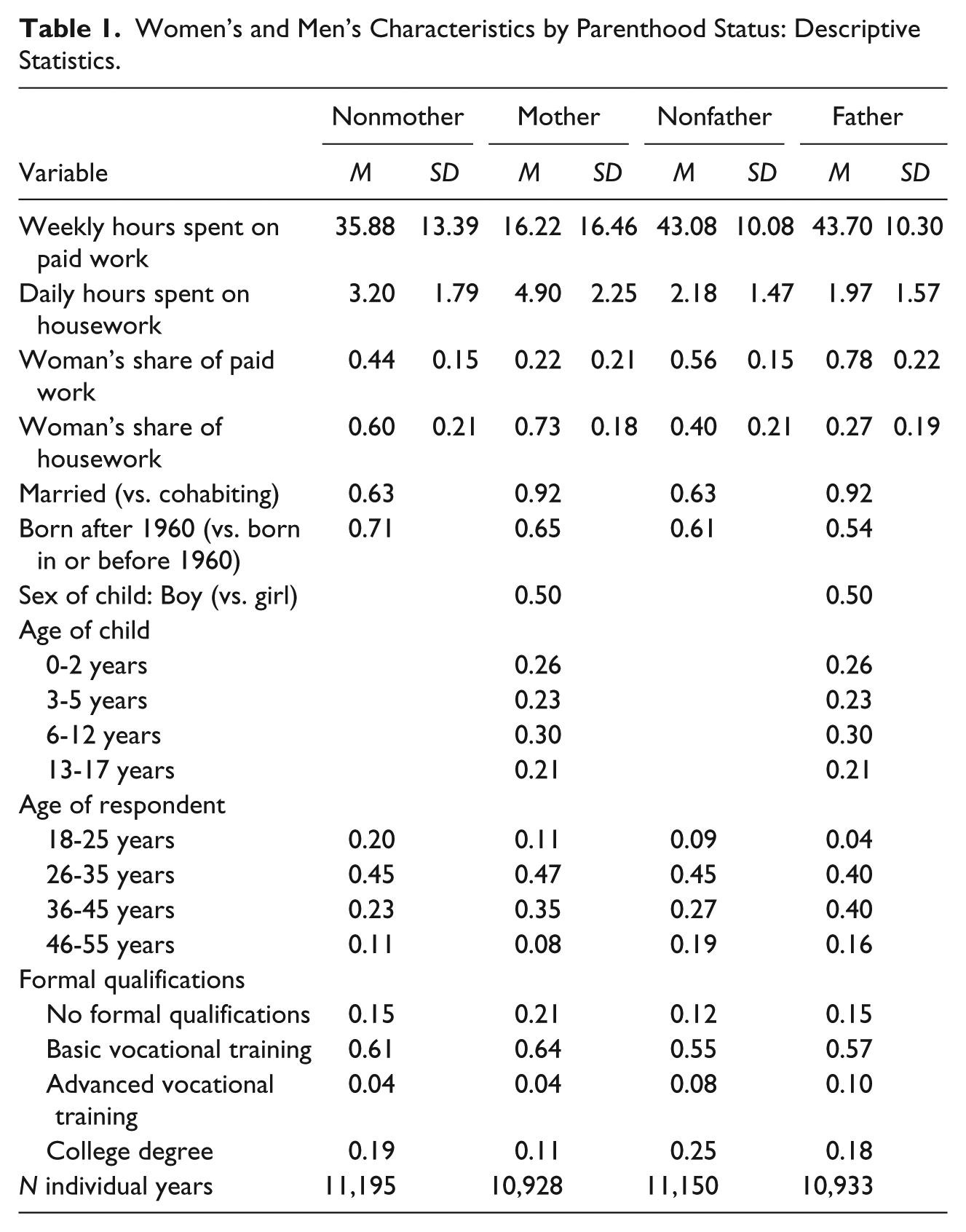
Table 1 provides descriptive statistics for the time spent on paid work and housework as well as for the explanatory variables. The columns “father” and “mother” refer to current parents, and the columns “nonfather” and “nonmother” refer to all men and women who were childless in a given year of observation. Mothers reported significantly fewer weekly hours spent on paid work than nonmothers (16.2 hours vs. 35.9 hours), whereas fathers spent slightly more time on paid work than nonfathers. Obvious discrepancies between parents and nonparents also emerged regarding the time spent on housework. Mothers reported spending roughly 1.5 hours more housework per day than childless women (4.9 hours vs. 3.2 hours), while fathers reported spending slightly less time on housework than nonfathers (2.0 hours vs. 2.2 hours). Consequently, after a baby was born, the women’s share of the couples’ time in the labor market decreased from 44% to 22%, whereas the women’s share of housework time increased from 56% to 78%. Furthermore, Table 1 reports differences between parents and nonparents with regard to marital status, age, and educational attainment. Respondents with children were married in 92% of the observations, compared with only 63% of the observations for respondents without children. Moreover, parents were found to be somewhat older and less educated than nonparents. Of all observations provided by fathers and mothers (with one child), exactly 50% were from parents of a boy. This figure suggests that the risk of divorce does not differ between parents of boys and parents of girls (see also, Diekmann & Schmidheiny, 2004) and that child gender is unrelated to sample attrition.
Women’s and Men’s Characteristics by Parenthood Status: Descriptive Statistics.
Because the birth of either a boy or a girl can be considered a natural experiment, my analysis identifies the causal effect of a child’s gender on the number of hours in paid work and housework. However, estimating the effect of parenthood on time in paid work and housework by means of ordinary least squares (OLS) regression is likely to yield biased results. This is because unobserved characteristics such as stable preferences, attitudes, and values may influence both time use and fertility decisions. This bias can be substantially reduced by estimating fixed effects (FE) models, which use only within-subject information to estimate the regression parameters, and thus control for all observed and unobserved stable characteristics of the respondents (e.g., Allison, 2009). In addition, modeling changes (as estimated by FE regression) instead of levels (as estimated by OLS regression) reduces bias due to persistent reporting error—caused, for example, by the tendency to overreport housework hours (Kamo, 2000; Press & Townsley, 1998).
Results
Effect of Child Gender on Parents’ Labor Supply
As expected, the presence of a child has a substantial negative effect on the weekly labor market hours of gainfully employed women (first column in Table 2). Confirming previous findings, the impact of parenthood on women’s labor market hours decreases as children grow older. Conversely, men’s labor market hours do not vary depending on the presence and age of the child. The interaction terms between child age and child gender included in the model indicate that the labor market hours of mothers of boys and mothers of girls differ significantly. For instance, mothers of a boy aged 0 to 2 years spent 3.79 hours more in paid work per week than mothers of a girl. Such child-gender effects did not emerge for fathers.
Fixed Effects Regression Models Predicting Weekly Hours Spent on Paid Work by Gainfully Employed Women and Men.

Note. All models include age, marital status, educational level, and indicator variables for the survey year. Reference group: Nonparents.
p < .1. *p < .05. **p < .01.
The second and third columns present model estimates for respondents who were born in 1960 and earlier, and those who were born after 1960, respectively (see also, Figure 1). These results indicate that both women and men from the early cohort responded differently to sons than to daughters, and that parents of boys devoted more time to paid work than parents of girls. For instance, mothers and fathers of a son aged 3 to 5 years worked 4.97 and 1.83 hours more per week, respectively, than mothers and fathers of a daughter. The gender-specific effects are quite large and at least marginally statistically significant in all child age groups but one. As the results displayed in the third column indicate, there is no gender-specific effect on labor market hours for men who were born after 1960, which is consistent with the idea that the child-gender effect attenuated over time. Also, the labor market hours of mothers of school-aged children were no longer significantly affected by the gender of their children. Nevertheless, contrary to the attenuation hypothesis, mothers born after 1960 spent significantly less time on paid work when they had a preschool-aged daughter instead of a son.

Predicted weekly hours spent on paid work, by parents’ birth cohort and child’s gender and age.
Unexpectedly, women in the later cohort reported a steeper decrease in working hours on becoming mothers than women in the earlier cohort. This finding may be attributed to the fact that couples in more recent cohorts were less specialized immediately following marriage, resulting in a larger decrease in labor market hours following the birth of a child. Moreover, part-time and marginal employment among mothers in Germany has increased substantially since the 1990s (Konietzka & Kreyenfeld, 2010), due in part to a change in legal regulations in 2001 entitling employees with children to switch from full-time to part-time work. As a result, lower educated mothers in particular worked fewer hours in recent years than they did in the 1980s.
In a second step, I estimated the impact of child gender on women’s labor market participation. Table 3 shows the results of FE logistic regression models, where the dependent variable distinguished between gainfully employed women and stay-at-home women. 3 None of the coefficients for child gender are significant, indicating that mothers of girls did not become homemakers more often than mothers of boys. In addition, the nonsignificant child-gender effects for children younger than 3 years suggest that mothers of girls do not use parental leave more often or stay on parental leave for longer periods than mothers of boys. Consequently, although child gender affects the labor market hours of gainfully employed mothers, it does not affect the propensity of mothers to leave the labor market for child care reasons. The child-gender effect is probably strong enough to affect the working hour of employed mothers, but not strong enough to affect their decisions to join or leave the workforce. It is also conceivable that my analysis—which is based on yearly information—is not accurate enough. Recent research by Lindström (2013) using Swedish register data showed that child gender has a statistically significant effect on the length of parental leave. The estimated child-gender effect, however, is very small (around 1 day).
Fixed Effects Regression Models Predicting Women’s Labor Market Participation.

Note. All models include age, marital status, educational level, and indicator variables for the survey year. Reference group: Nonparents.
p < .1. *p < .05. **p < .01.
Effect of Child Gender on Housework Hours
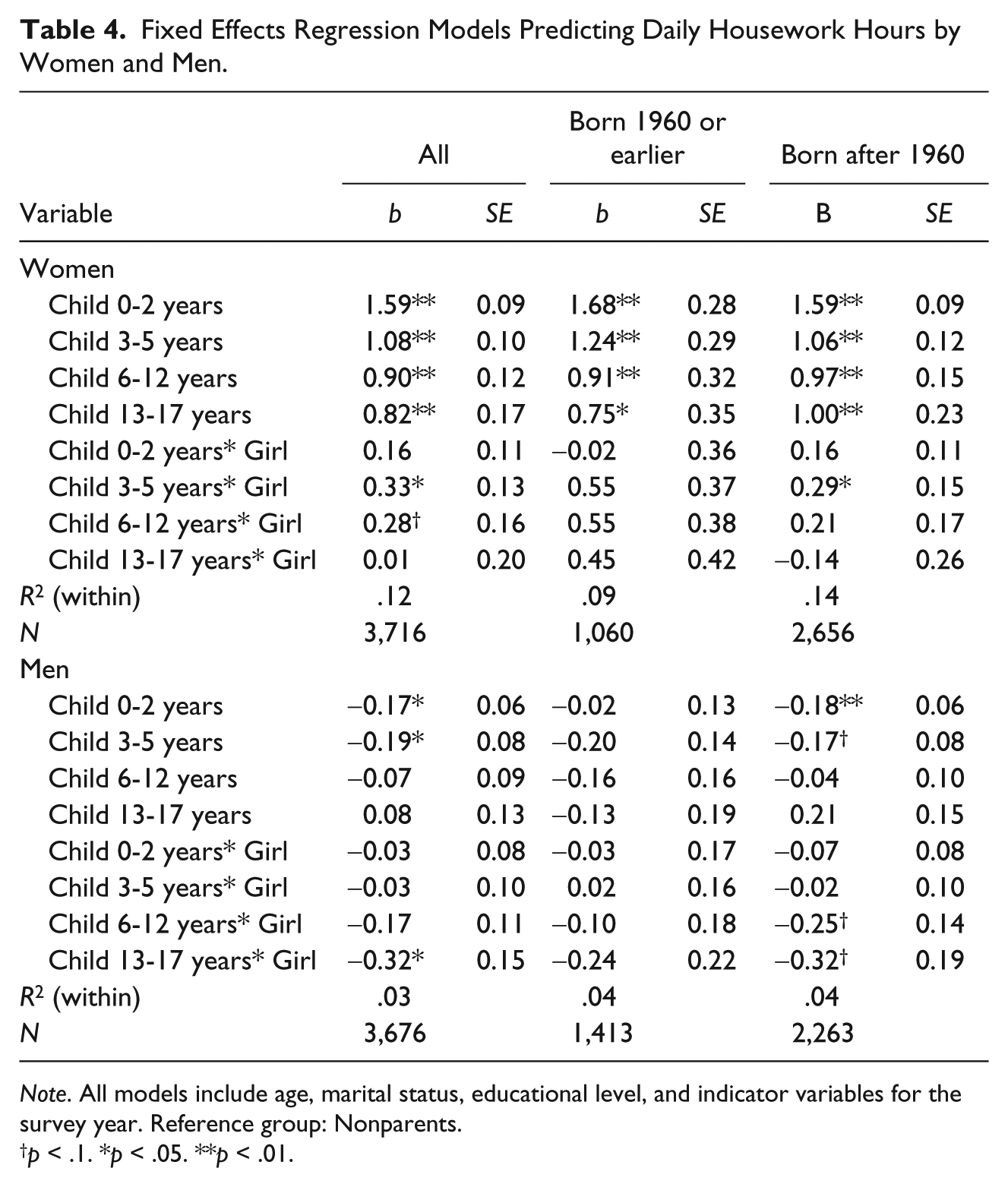
In the next step of the analysis, I examined the effect of child gender on time spent on household work. The results depicted in the first column of Table 4 indicate that parenthood has a strong positive effect on time spent on housework for women and a slight negative effect for men. However, few of the child-gender effects are statistically significant, and these coefficients are quite small. For instance, mothers of a boy aged 3 to 12 years spent around 0.30 more hours on household work on a typical weekday than mothers of a girl. Conversely, fathers of a boy aged 13 to 17 years spent 0.32 fewer hours on housework than fathers of a girl. Separate analyses for parents born in or before 1960 and for those born after 1960 (columns 2 and 3 of Table 3) also did not show a consistent pattern of child gender effects. In summary, there is only modest evidence for the hypothesis that child gender affects parents’ housework time. The results suggest that if an effect does exist, it is that daughters are associated with a more traditional division of housework than sons.
Fixed Effects Regression Models Predicting Daily Housework Hours by Women and Men.
Note. All models include age, marital status, educational level, and indicator variables for the survey year. Reference group: Nonparents.
p < .1. *p < .05. **p < .01.
To further investigate the child gender effect on housework, I estimated separate models for female-typed tasks (washing, cooking, cleaning, errands) and male-typed tasks (house and car maintenance, gardening). The findings (results not shown) suggest that men spend less time on female-typed tasks when they have a daughter instead of a son and that both fathers and mothers of same-sex children spend more time on male-typed tasks than parents of opposite-sex children. However, in these models, only few coefficients reached the level of (marginal) significance.
In addition, in results not shown here, I examined the impact of child gender on the time spent by parents on child care. The results indicated that mothers of a girl aged 0 to 2 years spent 0.34 more hours per day (p = .01) on child care than mothers of a boy, whereas fathers of a boy aged 13 to 17 years spent 0.26 more hours (p = .04) on child care than fathers of a girl. The coefficients lost significance in the regression stratified by cohort but had a similar magnitude. The overall effect of child gender on parental time devoted to child care appears to be smaller than those found in previous studies (e.g., Mammen, 2011). This may be attributed to the fact that the information on child care provided in the SOEP does not include leisure activities with children (e.g., shopping or going to the movies or to sports events).
Effect of Child Gender on the Division of Paid Work and Housework Within Couples
Finally, I tested whether and to what extent child gender affects women’s share of paid housework relative to the total amount of time spent by couples on these activities. The upper panel of Table 5 displays the results for women’s share of paid work and the lower panel those for women’s share of housework. The first column of Table 5 shows that women’s share of paid work decreased on average by 31 percentage points after the birth of a child. Mothers’ paid work share increased with the child’s age but remained significantly lower than that of childless women. The results for the entire sample further show a marginally significant child gender effect for mothers with preschoolers. When I disaggregated the analysis by birth cohort, a striking cohort effect emerged. As the estimates for the early cohort displayed in the second column indicate, women’s share of paid work declined more sharply with the birth of a boy than with the birth of a girl: it decreased on average by 25 percentage points with a boy and by 31 percentage points with a girl (0.253 + 0.062). For the later cohort, the child gender effect is very small and nonsignificant, indicating that the child gender effect on the division of paid work vanished over time.
Fixed Effects Regression Models Predicting the Share of Paid Work and Housework Performed by the Woman.

Note. All models include women’s and men’s age and educational level, the couples’ marital status, and indicator variables for the survey year. Reference group: Nonparents.
p < .1. *p < .05. **p < .01.
The results displayed in the lower panel of Table 5 show that parenthood increased women’s share of housework. For the full sample, having a child aged 0 to 2 years increased mothers’ housework share by 11 percentage points. The interaction terms between child age and child gender indicate that mothers of school-age girls do a greater share of household work than mothers of boys. For instance, the housework share of mothers of a girl aged 6 to 12 exceeds that of mothers of a boy of the same age by 3.6 percentage points. The results do not, however, indicate child gender effects for mothers of preschoolers. Also, the analysis disaggregated by birth cohort in columns 2 and 3 shows no consistent result pattern. In conclusion, similar to the findings displayed in Table 4, the results for mothers’ housework share provide only suggestive evidence for the hypothesis that child gender affects the division of parents’ housework. In an additional analysis (results not shown), I examined the impact of child gender on women’s share of child care. The results for the full sample indicate that mothers of infants and toddlers as well as mothers of teenagers perform a greater share of child care when they have a girl instead of a boy (b = 0.014, p = .07 and b = 0.049, p = .03, respectively). These coefficients became nonsignificant, however, after separating the analysis by birth cohort.
Effect of Number of Children on Parents’ Time Spent on Paid Work and Housework
In a supplementary analysis, I extended the sample to parents with more than one child (Table A1 in the appendix). Because only very few parents reported having four or more children, the sample is restricted to childless men and women and parents with up to three children. The child gender composition is indicated by eight dummy variables. Due to the small number of cases in some of these categories, the analyses are not stratified by birth cohort.
The results in the first column (upper panel) indicate that the number of children is positively associated with women’s hours in paid work. Moreover, these findings show that mothers work significantly more if they have one son instead of one daughter. However, there is no significant child gender effect for subsequent children. In line with the findings reported in Table 2 for the whole sample, Table A1 reports no child gender effect for fathers’ working hours. The results in the second column of Table A1 show a positive effect of parenthood on mothers’ and a negative effect on fathers’ housework time. Mirroring the results depicted in Table 4 for the whole sample, however, there is no evidence for a child gender effect on parents’ time spent on housework.
Why is the child gender effect on women’s labor supply restricted to women with only one child? There are two possible explanations. First, it is conceivable that the results for one-child parents are biased because these parents are a selective group: It may be argued that couples who decide to not have a second child when their first child is a boy hold more traditional gender ideologies than parents whose only child is a girl, and are thus more likely to allocate their time along highly gendered patterns. In this case, we would expect to find that having (exactly) one son is associated with a more traditional division of labor than having a daughter. However, my results suggest that parents of sons tend to have a less traditional division of labor than parents of daughters.
Alternatively, it is conceivable that parents of one child are more driven by their own preferences in their allocation of time between paid work, unpaid work, and spare time than are parents with two or more children. Time and financial constrains may have a greater effect on the time allocation of parents with multiple children, with the result that child gender affects their time allocation decisions only marginally.
Discussion
The transition to parenthood reinforces gender differences in time allocation and strengthens the traditional division of paid work and housework. A range of studies have shown that the amount of time parents spend on paid work and housework is affected by personal resources and attitudes. However, as of yet there has been little research on whether and how child characteristics other than age and number of children affect the parental division of labor. This is somewhat surprising given that child gender is an influential factor in parents’ attitudes and behavior. The present study addresses this gap by broadening the research field—which thus far has looked at the effect of child gender on union formation and dissolution, fertility, and parental involvement—to address the division of paid work and housework in couples.
The previous literature offered theoretical arguments and empirical findings on competing hypotheses about the effect of child gender on the parental division of paid work and housework. Whereas findings on the effect of child gender on marital stability and fathers’ gender ideology lead to the assumption that parents of sons tend to have a more traditional division of labor than parents of daughters, other studies on mothers’ bargaining power and fathers’ parental involvement suggest that parents have a less traditional division of labor when a son is present. My analysis has provided support for the latter hypothesis: all in all, having a daughter instead of a son is associated with greater gender inequality within households. My findings show, in particular, that parents of sons display a more egalitarian division of paid work than parents of daughters. In contrast to the birth of a daughter, the birth of a son increases the labor market hours of both men and women; however, this effect is more pronounced for women than for men. This finding presents a contrast to previous research that focused solely on the effect of child gender on fathers’ working hours and concluded that the birth of a son brings about a more traditional division of paid work. As hypothesized, the effect of child gender on parental time in paid work and housework attenuated over time. A differential effect of sons and daughters on mothers’ and fathers’ paid work time was observed for parents born in or before 1960 but not for those born after 1960.
The positive effects of sons on both women’s and men’s labor market hours suggest that different mechanisms account for the child-gender effects on fathers’ and mothers’ labor supply. The child gender effect on fathers’ labor market hours corresponds most closely with the hypothesis that child gender affects fathers’ gender ideology (Shafer & Malhotra, 2011; Warner & Steel, 1999) and that the birth of a son instead of a daughter makes a father feel more strongly obliged to provide for his family financially. In contrast, the positive effect of sons on mothers’ labor market hours corresponds with the bargaining hypothesis put forward by Lundberg (2005b). According to this hypothesis, a preference for sons on the part of men may increase the mother’s bargaining power to reject a homemaker role. Nevertheless, the strong positive effect of boys on the maternal labor supply might be specific to the German context: Germany’s gender regime is generally characterized as a conservative “male breadwinner model” that undermines women’s efforts to participate fully in the labor force. In fact, in the early 1980s, 70% of West German men favored a male breadwinner family model, and more than 40% still did so 20 years later (Lee et al., 2007). Consequently, the birth of a son might confer greater bargaining power on mothers in Germany and thus have a greater effect on their labor supply than is the case for mothers in a more egalitarian gender regime.
With regard to the effect of child gender on the parental division of housework, my results were less consistent. The analysis provided suggestive evidence that having a son instead of a daughter increases the number of hours spent on housework by men and decreases those of women. Thus, daughters seem to intensify the gendered division of housework within couples more than sons. This finding corresponds most closely with the argument put forward by Katzev et al. (1994) that the greater involvement of parents with same-sex children may spill over into other activities at home and translate into a greater share of overall domestic work. Alternatively, the larger number of hours spent on housework by parents with same-sex children may arise from more shared parent–child housework. Parents may prefer to spend more shared housework time with same-sex children in order to engage in gender role socializing and to teach them gender-stereotypical tasks (Bryant & Zick, 1996).
The present study illuminates the impact of child gender on the parental division of labor; however, it does not reveal what mechanisms produced the differential effects. Nevertheless, it draws attention to the fact that child characteristics modify the impact of parenthood on the division of paid work and housework between parents. Future research should examine the pathways by which child gender affects the amount of time spent by fathers and mothers on paid work and housework. Greater attention should be paid in particular to the question of whether the differential effects of sons and daughters are triggered by differences in preferences or attitudes between parents of sons and daughters, or by differences in the behavior of boys and girls.
Footnotes
Appendix
Fixed Effects Regression Models Predicting Daily Hours Spent on Housework and Paid Work Housework by Women and Men.

| Paid work |
Housework |
|||
|---|---|---|---|---|
| Variable | b | SE | b | SE |
| Women | ||||
| Exactly one son | −14.93** | 0.83 | 1.38** | 0.10 |
| Exactly one daughter | −17.10** | 0.80 | 1.50** | 0.15 |
| One son–one daughter | 2.16* | 1.02 | −0.12 | 0.11 |
| Exactly two sons | −20.62** | 1.12 | 1.90** | 0.15 |
| Exactly two daughters | −20.22** | 0.96 | 1.74** | 0.13 |
| Two sons–two daughters | −0.39 | 1.30 | 0.15 | 0.18 |
| Exactly three sons | −19.63** | 2.01 | 2.28** | 0.27 |
| Exactly three daughters | −18.62** | 3.20 | 2.05 | 0.31 |
| Three sons–three daughters | −1.00 | 3.71 | 0.23 | 0.39 |
| One son and one daughter | −20.38 | 0.87 | 1.89** | 0.11 |
| Two sons and one daughter | −18.85** | 2.36 | 2.10** | 0.21 |
| One son and two daughters | −18.64** | 2.09 | 1.92** | 0.17 |
| Two sons and one daughter–Three sons and three daughters–One son and two daughters | −0.21 | 2.98 | 0.18 | 0.24 |
| R2 (within) | .24 | .10 | ||
| N | 4,524 | 5,504 | ||
| Men | ||||
| Exactly one son | −0.42 | 0.35 | −0.19** | 0.06 |
| Exactly one daughter | −0.93* | 0.38 | −0.22** | 0.06 |
| One son–one daughter | 0.51 | 0.47 | 0.03 | 0.07 |
| Exactly two sons | −0.68 | 0.47 | −0.24** | 0.09 |
| Exactly two daughters | 0.08 | 0.51 | −0.39** | 0.08 |
| Two sons–two daughters | −0.76 | 0.64 | 0.15 | 0.11 |
| Exactly three sons | 0.43 | 0.69 | −0.33* | 0.16 |
| Exactly three daughters | −1.01 | 0.88 | −0.15 | 0.13 |
| Three sons–three daughters | 1.45 | 1.06 | −0.18 | 0.20 |
| One son and one daughter | −0.44 | 0.39 | −0.18** | 0.07 |
| Two sons and one daughter | 0.49 | 0.63 | −0.35** | 0.11 |
| One son and two daughters | 0.67 | 0.55 | −0.21* | 0.09 |
| Two sons and one daughter–Three sons and three daughters–One son and two daughters | −0.17 | 0.79 | −0.14 | 0.13 |
| R2 (within) | .02 | .04 | ||
| N | 5,527 | 5,497 | ||
Note. All models include women’s and men’s age and educational level, the couples’ marital status, and indicator variables for the survey year. Reference group: Nonparents.
p < .1. *p < .05. **p < .01.
Declaration of Conflicting Interests
The author(s) declared no potential conflicts of interest with respect to the research, authorship, and/or publication of this article.
Funding
The author(s) disclosed receipt of the following financial support for the research, authorship, and/or publication of this article: This work was supported by the DFG German Research Foundation (Grant number: PO 1569/2-1).