



Abstract
The present study examines the effect of a supervisor (leadership) position on a father’s time spent on child care (child care involvement). Drawing on time use and work–family research, it adapts the “stress of higher status” hypothesis to child care involvement and explicates the underlying mechanism. The proposed moderated mediation model posits that (1) a leadership position means longer work hours, which explains the lower child care involvement, and that (2) this process depends on the possibility to choose when to start and quit work (flextime), which weakens the work–family border. A Swiss sample (n = 2,820) of tertiary-educated, employed fathers from couple households is used to conduct the analysis. The results provide evidence for both (1) and (2), although, contrary to expectations, flextime does not mean longer work hours for leaders. The issue of child care involvement by fathers in leadership positions has wider relevance for work–family issues, because they are supervisors and thus shape work environments.
Over the past 30 years, a main concern of fatherhood research has been how the workplace affects, and restricts, fathers’ engagement in child care (Russell & Hwang, 2004). In this regard, a crucial aspect of the workplace is whether supervisors and the work environment support and tolerate care obligations (Allen, 2001). This is, in turn, likely influenced by how the supervisors themselves balance work and family obligations (Allard, Haas, & Hwang, 2007). Supervisors who are themselves substantially involved in child care may provide more support for parents and see work and career success as less antagonistic to involvement in the family. The assumption therefore is that the group of fathers in leadership positions is not arbitrarily chosen but constitutes an important group from a sociological work–family point of view.
Holding a leadership position, however, is difficult to combine with significant child care involvement. Managerial and professional occupations entail higher, and sometimes almost boundless, time demands and therefore decrease the time available for child care (Jacobs & Gerson, 2004; Williams, Blair-Loy, & Berdahl, 2013). The first step in the present analysis is thus to examine whether fathers in leadership positions work longer hours and, as a consequence, devote less time to child care. The second step is to specify, and test, the role of flextime in this process. As a form of schedule control, flextime entails the possibility to choose when to start and when to quit work each day. The question is, “Does this mitigate or facilitate the role of long work hours for child care?”
The present article applies the “stress of higher status” hypothesis to leadership and child care time. It argues that the availability of flextime makes the work–family border more permeable, by allowing longer work hours and by allowing working time to crowd out child care time (Clark, 2000; Schieman, Milkie, & Glavin, 2009). This is contrary to seeing flextime as a resource for workers’ home lives, as argued by time availability approaches (Coverman, 1985) as well as proponents of the “resources of higher status” hypothesis (Schieman, Whitestone, & Gundy, 2006). The present analysis also responds to calls for more research on the effect of flexibility (of which flextime is one possible element) on employee’s home lives (Christensen & Staines, 1990; Kossek, Lautsch, & Eaton, 2005).
Research Context
In the otherwise extensive area of work–family research, relatively little is known about how time spent on child care tasks is affected by work characteristics other than work hours and income. In part, this is because the question fits squarely neither into time use nor into work–family research. Dominant approaches in time use research tend to presume that work characteristics influence father involvement mainly indirectly, via available time and within-household bargaining power (for overviews, see Bianchi & Milkie, 2010; Coltrane, 2000; Lachance-Grzela & Bouchard, 2010; Pleck, 1997). This assumption allows time use researchers to omit most other aspects of workplace roles from their analysis. The time availability perspective posits that father involvement results from the interplay between demand for child care (largely determined by family characteristics and the mother’s availability) and the capacity to undertake child care (largely determined by the father’s work hours outside the household; Coverman, 1985).
Conversely, although research on work–family conflict pays detailed attention to many aspects of the work role, including leadership position, in the form of job authority, it tends to take self-reported scales (e.g., work–nonwork intrusion or work–family spillover), rather than actual time use, as dependent variables (for overviews, see Bianchi & Milkie, 2010; Eby, Casper, Lockwood, Bordeaux, & Brinley, 2005; Greenhaus & Beutell, 1985). Even studies explicitly combining work role characteristics and child care involvement often rely on ordinal scales and ultimately focus on qualitative aspects of the family role (e.g., Roeters, Van Der Lippe, & Kluwer, 2010). That work–family and time use research use different dependent variables reflects, of course, their respective research foci. Both strands of research are important to understand the nexus between leadership positions and fathers’ time use.
There have not yet been any direct examinations of the nexus between leadership positions, or managerial roles, and fathers’ child care time. Only Allard et al. (2007) specifically addressed work–family conflict among 77 Swedish manager fathers, including the role played by flextime. They found that manager fathers have more access to flextime but also experience a higher level of work–family conflict. In a bivariate comparison, they found a positive correlation between the availability of flextime and responsibility for child care, but their multivariate models for work–family conflict showed no effect of flextime. Their findings about work–family conflict, however, need not extend to father involvement: A sense of lower work–family conflict does not necessarily depend on more actual father involvement, and it may instead depend on a sense of autonomy and schedule control (Christensen & Staines, 1990; Kossek et al., 2005). However, the findings by Allard et al. (2007) suggest, at the least, that the impact of flextime on father involvement is complicated.
The relevant work–family literature supports much the same conclusions (though a more comprehensive treatment of the vast findings is beyond the scope of this article). People with more job authority, or higher occupational status, or who are self-employed, report that work interferes more frequently with their family life, and that they more often think about work when at home (Schieman et al., 2006; Schieman et al., 2009). High-status jobs, with their ceaseless time demands, often involve working at weekends and working with unpredictable schedules, both of which increase work–family conflict (Eby et al., 2005, p. 143). Previous research also largely supports the assumption that professional and managerial occupations offer more flexibility in general (Allard et al., 2007; Brescoll, Glass, & Sedlovskaya, 2013; Christensen & Staines, 1990; Swanberg, Pitt-Catsouphes, & Drescher-Burke, 2005). Leaders tend to be more trusted by the work organization, and to be given more control over their time (Kossek et al., 2005). The effect of this flexibility, however, is contested. There is evidence that flexibility facilitates the coordination of job and family responsibilities (Eby et al., 2005; Kelly, Moen, & Tranby, 2011), as well as participation in the family (Greenhaus & Powell, 2006). There is also some weak initial evidence that flextime, in particular, increases time spent with the family (Christensen & Staines, 1990). On the other hand, Schieman and Glavin (2008) find that men who have more control over their work schedules are more likely to receive work-related contacts outside of normal work hours and bring work home. Roeters et al. (2010) found evidence that flexibility can deplete family life, while Gerstel and Gallagher (2001) found lower involvement for fathers with more flexibility. Noonan, Estes, and Glass (2007) and Roeters, Van Der Lippe, Kluwer, and Raub (2012) found no association between fathers’ flexibility and their child care time. Though not concerned with leadership specifically, these results suggests that a leadership position inhibits father involvement, partly due to flexibility meaning boundless working-time demands. Therefore, work–family research offers evidence for a more conflicted and complicated role of flexibility, at least in high-status positions.
The Argument
A leadership position is a form of higher status occupation, to which Schieman et al. (2006; Schieman et al., 2009) count executive, professional, and managerial occupations among others. This suggests adapting the “stress of higher status” hypothesis to the relation between leadership position and child care involvement. In its original form, the hypothesis is about work–nonwork interference and spillover, not about child care involvement. Applying the “stress of higher status” perspective to actual time spent on child care is not straightforward, as it requires fleshing out the roles played by work hours and flextime. A first and basic version could be as follows: A father’s leadership position entails high work demands and requires deep work commitment, and thus lowers his availability and energy for child care. Substituting work hours for demands and commitment yields a first time availability hypothesis (Hypothesis 1 [H1]):
There is an assumption here that fathers’ employment hours are “exogenous” with respect to child care time: that fathers do not curtail their employment to accommodate child care. This is tenable only as long as gendered commitments to work and family remain strong (Blair-Loy, 2003; Roeters et al., 2012). However, most research finds that longer work hours do indeed predict lower father involvement after controlling for a variety of variables, including number and age of children (Coverman, 1985; Monna & Gauthier, 2008; Pleck, 1997; Raley, Bianchi, & Wang, 2012).
The stress of higher status argument, however, does not only assert that high-status occupations have negative effects for family roles. It further draws on border theory (Clark, 2000) to argue that high-status positions often entail a form of flexibility, which could make the work–family border more permeable and indicate “work that never ends” (Schieman et al., 2009, p. 970). Because leaders responsible for a number of subordinates tend to be highly committed and devoted to their work role, permeability facilitates the intrusion of work demands into family life, but not the reverse (Blair-Loy, 2003; Clark, 2000). Flexibility thus makes the family role more vulnerable to intruding work demands. This argument can be adapted into a time availability framework by substituting work hours for work demands, and flextime for flexibility. In light of this mechanism, a modification of H1 could be as follows: The interference of leadership roles in family life, via work hours, depends on the presence of flextime. This yields a second time-availability hypothesis (H2):
According to Christensen and Staines (1990), flextime is the formal possibility to choose each day when to start and when to quit working. Two elements determine the degree of flextime: the existence of core work hours when the employee has to be present and the possibility to bank working time (to postpone or push forward work over a certain period of time). Fewer core hours and more banking options mean more discretion over the temporal boundaries of work. From a time availability perspective, flextime is supposed to increase child care involvement by enabling the father to better adjust work hours to family needs and the partner’s work schedule. Contrary to this, the “stress of higher status” hypothesis argues that flextime, and more generally schedule control, makes the work–family border more permeable, and thus facilitates the intrusion of working time into family time (Schieman et al., 2006; Schieman et al., 2009).
In statistical jargon, the adaptation of the “stress of higher status” hypothesis as H2 is a moderated mediation (Hayes, 2013). The model is schematically represented in Figure 1 and comprises three elements. First, there is a direct effect (path c) of leadership on child care involvement, which is not explicable by means of work hours and flextime. Second, there is an indirect effect of leadership on child care involvement, which is explicable by longer work hours (the mediator). This is H1 and refers to paths a and b. According to H2, whether the indirect effect occurs is determined by the availability of flextime (the moderator). The moderation is thought to apply to both steps (paths a and b) in the indirect effect. H2a posits that, by weakening the work border, flextime makes it easier for a leadership role to translate into longer work hours (path d in Figure 1). H2b posits that, by weakening the family border, flextime makes it easier for longer work hours to crowd out child care time (path e in Figure 1).
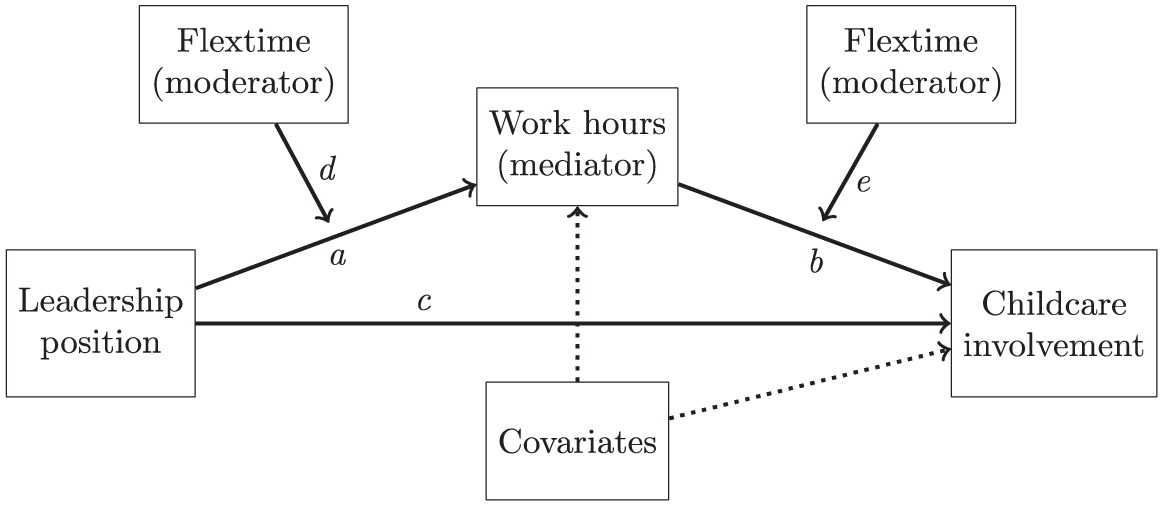
The moderated mediation model proposed to adapt the stress of higher status hypothesis to fathers’ child care time.
Although hypotheses similar to H1 and H2 could plausibly apply more generally, the present study has a narrow scope to make the issue tractable. First, flextime is of course only one of several forms of flexibility, or schedule control, which can be broadly defined as an “employee’s sense of latitude or control regarding the timing of their work, the number of hours they work, and the location where they work” (Kelly et al., 2011, p. 267). Second, the present analysis includes only fathers with a postsecondary (tertiary) education. The main reason is that, on average, higher education means more involvement in child care due to “involved parenthood” ideals (Craig, 2006b; Sayer, Gauthier, & Furstenberg, 2004). On average, tertiary-educated fathers may have a somewhat stronger inclination to using flextime as a means to increase time spent with children. On the other hand, tertiary-educated men also tend to work longer hours and report, on average, higher interference of work in family life (Schieman et al., 2006; Schieman et al., 2009). Due to the combination of involved-parenthood ideals and high work commitment, conflicting time demands from work and family are acute for higher educated fathers. A second reason for restricting the analysis to tertiary-educated fathers is that flextime for lower educated fathers could indicate precarious work in occupations that do not offer enough work (Jacobs & Gerson, 2004). This differs from the notion of flextime as a form of schedule control, as it implies an unpredictable schedule, insecurity, being available “on call,” or generally having too little work (Bianchi & Milkie, 2010).
Data and Measurements
Sample
The Swiss Labour Force Survey is a nationally representative survey conducted by the Federal Statistical Office. It focuses on work characteristics of individual respondents, not households. The Swiss Labour Force Survey waves of the years 2004, 2007, and 2010 provide time use data for child care and housework. These three surveys were pooled because father involvement is a small-variation phenomenon and large samples are needed to find effects. The full questionnaire is online retrievable (Federal Statistical Office, 2010).
In accordance with the specific aims and limited scope of this study (see above), the sample of fathers is narrowed in several ways. Fathers in the sample were selected by household structure: men living with at least one child younger than 15 years in a self-identified “couple with child” household. The term father here includes cohabiting fathers and stepfathers and excludes nonresident and single fathers. This makes sense because the latter are subject to different time constraints and time pressures. As argued above, the sample is further restricted to fathers with postsecondary (i.e., tertiary) education. The arguments above pertain to how work hours and flextime affect time spent on child care, and therefore make little sense on weekends nor for the unemployed or self-employed (Yeung, Sandberg, Davis-Kean, & Hofferth, 2001). Therefore, fathers who are unemployed or self-employed were excluded, along with those whose time diary day happened to be a Saturday or Sunday. Those fathers interviewed on a Monday were asked only about the previous Saturday or Sunday, on which their involvement was less likely hindered by the work role. Excluding missing values casewise resulted in a loss of 7.1% of the cases and an analytic sample of n = 2,390 fathers.
Dependent Variable
The measure is a father’s total primary child care time in minutes per day (child care involvement). It includes time devoted to physical care (feeding, washing, dressing, putting children to bed), interactive care (help with homework, going for a walk, talking, playing), and accompanying (taking children to school or sports classes). The measure captures total child care time not time per child. In telephone-based interviews, respondents were asked to recollect how many minutes they spent in these activities on the previous day. Data on form and quality of father involvement (Craig, 2006a) are unfortunately not available in this data set.
Focal Measures
There is no commonly agreed definition of leadership and no clear demarcation from management (Yukl, 1989). Because the current study assumes that management is a broader term, referring to the oversight of business processes as well as the coordination of subordinates, the variable is referred to as leadership. A leadership position is defined here as a formal supervisory position in the work organization, as operationalized in the number of subordinates, which is surveyed directly (as a categorical variable). Leadership (1 = yes) indicates whether the respondent has any subordinates at all. The mediator is the number of work hours usually worked, measured in hours per week. Finally, flextime is based on directly surveyed information about the two defining elements of flextime: (1) core time hours, when to be present at work; and (2) bank time, which can be saved over a certain period of time (Christensen & Staines, 1990). Flextime (1 = yes) indicates both that there are no core hours and that time can be banked, which contains the two surveyed categories “yearly working time (without blocks of presence)” and “no formal constraints.”
Reducing the categorical variables Leadership and Flextime to binary indicators forgoes much information but is required for the moderated mediation analysis. Where convenient, the results of other possible contrasts will be reported in writing. These additional analyses contrast a leadership position with 10 or more subordinates to a respondent with no or fewer than 10 subordinates. As regards flextime, if working hours are constrained every day to a fixed start and end, an indicator for “No Flextime” is used, whereas if there is the option to bank time, but there are still core hours, “Some Flextime” is used.
Control Variables
The models also include a number of variables known to affect work hours and child care involvement. Among the most important are family characteristics. The age of the youngest child is a very consistent predictor of less time spent on child care, as the need for physical child care as well as the availability of children decrease (Raley et al., 2012; Sayer et al., 2004; Sousa-Poza, Schmid, & Widmer, 2001). A pronounced drop is expected when children reach school age (Monna & Gauthier, 2008). In accordance with the institutional school setting, age of the youngest child is categorized into three levels, following Raley et al. (2012, p. 1435): infant/toddler (aged 0-2 years), preschool child (aged 3-5 years), and school age or older (6-15 years). The second important family characteristic is the number of children (younger than 15 years) living in the household. Parents devote more total time to child care in larger families, although the findings are less consistent with respect to father involvement (Monna & Gauthier, 2008; Pleck, 1997). The number of children is categorized into three levels (1, 2, >2). However, demand for child care also depends on the mother’s absence, measured as the level of employment. Research suggests that mother’s employment positively affects father involvement, albeit in complex ways (Barnett & Baruch, 1987; Pleck, 1997; Raley et al., 2012). Only categorical information is available about the mother’s employment, recoded here into three levels: none (<6 hours weekly), marginal (6-20 hours weekly), and substantial (>20 hours weekly). The mother’s education is a further variable affecting father involvement in child care. Its effects are double: A tertiary-educated mother (1 = yes) means that bargaining resources in the household are more equal and that, among homogamous households, there is a likely preference for time-intensive parenting (Monna & Gauthier, 2008; Raley et al., 2012). A final control variable is the female share of the economic sector. Economic sectors with a higher share of female employees may harbor more tolerance toward family-involved leaders, while having a less pronounced “long-hours culture,” in which prolonged presence at work is taken to signal high commitment (Allard et al., 2007; Mennino & Brayfield, 2002). The measure is based on the 2008 General Classification of Economic Activities. The last two controls are survey year—the data span the years 2004, 2007, and 2010—and language region. The latter is a standard control in multilingual Switzerland, even in studies without comparative focus, because the general level of father involvement is higher in the French-speaking than in the German-speaking part of Switzerland (e.g., Sousa-Poza et al., 2001). The design of this study assumes that these control variables may influence the number of work hours or child care involvement, without affecting the interplay between leadership role and child care involvement.
Method
In accordance with H1 and H2, the centerpiece of the present analysis is a moderated mediation model (Hayes, 2013). The aim is to partition the total effect of leadership on father involvement into a direct effect and an indirect effect (via work hours), conditional on the value of the moderator (flextime). Mediation analyses are becoming widespread in social sciences and psychology, as an attempt to find the processes that underlie a given association between a dependent and independent variable. Using the diagram in Figure 1, c denotes the direct effect, which is not explained by longer work hours. The indirect effect of leadership on child care involvement via work hours is a × b if there is no flextime, and (a + d) × (b + e) if there is flextime. Using this path notation, the two regression models required for the mediation analysis, one for the mediator and one for the outcome, can be put thus:


The second model is a Tobit model, apt to deal with left-censored outcomes (many fathers report zero child care time; Long, 1997). The coefficients of the Tobit model are reported as marginal effects on the censored observable outcome, evaluated at the predictor means (Greene, 2012, p. 848). Although Tobit models are fairly common practice for time use variables (e.g., Craig, 2006b; Sayer et al., 2004; Sousa-Poza et al., 2001; Yeung et al., 2001), their use has not gone unquestioned. Because the zeroes can result from a reference period mismatch (e.g., the father may be usually involved but may have gone on a business trip on the diary day) rather than from being “truly uninvolved,” some have advocated using ordinary least squares (OLS) models (Foster & Kalenkoski, 2013). Because this issue is unresolved, the analysis was conducted in parallel with a Tobit and an OLS model, without any important difference. For father involvement, modelled by OLS, the frequently used mediation framework by Preacher and Hayes is applicable as implemented in the PROCESS program (Hayes, 2013). For father involvement modelled by Tobit regressions, mediation analysis was conducted within the average causal mediation framework, which is nonparametric and thus applicable to Tobit models (Imai, Keele, & Tingley, 2010; Tingley, Yamamoto, Hirose, Keele, & Imai, 2013). The reported results are bootstrap results, with 10,000 resamples, and bias-corrected accelerated confidence intervals (Imai et al., 2010).
Results
Table 1 contains descriptives by leadership position. The last column shows whether the differences between the three levels of leadership are significant. The table is arranged so as to provide a simultaneous overview over the sample descriptives and the correlates of a leadership position. The first row indicates that fathers in leadership positions spend less time on child care. This holds true for father’s time in both physical and interactive care, the two main components of child care. Not only are fathers in leadership positions significantly less involved in child care, they also have more flextime. Work hours increase significantly with the number of subordinates. Other variables also correlate with leadership. Descriptively speaking, this pattern suggests that fathers in leadership positions live, on average, in more traditional households.
Descriptive Means and Percentages by Leadership Position.
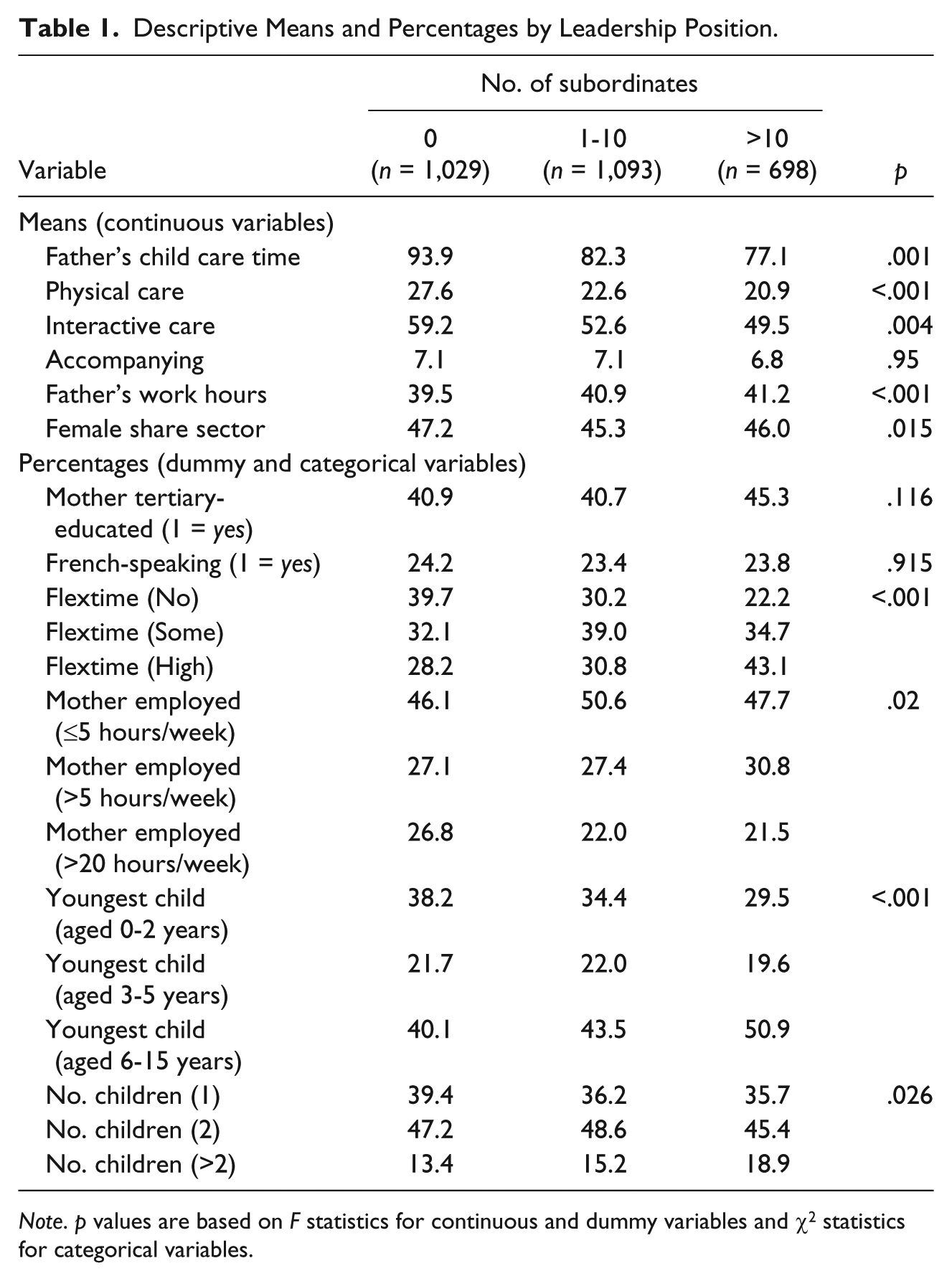
Note. p values are based on F statistics for continuous and dummy variables and χ2 statistics for categorical variables.
Table 2 shows the multivariate regression results. It should be noted, from the outset, that the identified effects and their explanatory power are weak. According to the MacKelvey and Zavoina pseudo R2, the model accounts for only a small part of the variation in father involvement. This is not uncommon, however, for models of father involvement (e.g., Foster & Kalenkoski, 2013; Hook & Wolfe, 2012; Raley et al., 2012; Sousa-Poza et al., 2001). The main reason seems a large error variance in the models due to the method of surveying time use: The question refers to 1 day only, which introduces much randomness into the estimate of involvement (e.g., if the father happened to be on a trip or ill).
Multivariate Models for Fathers’ Work Hours and Time Spent on Child Care.
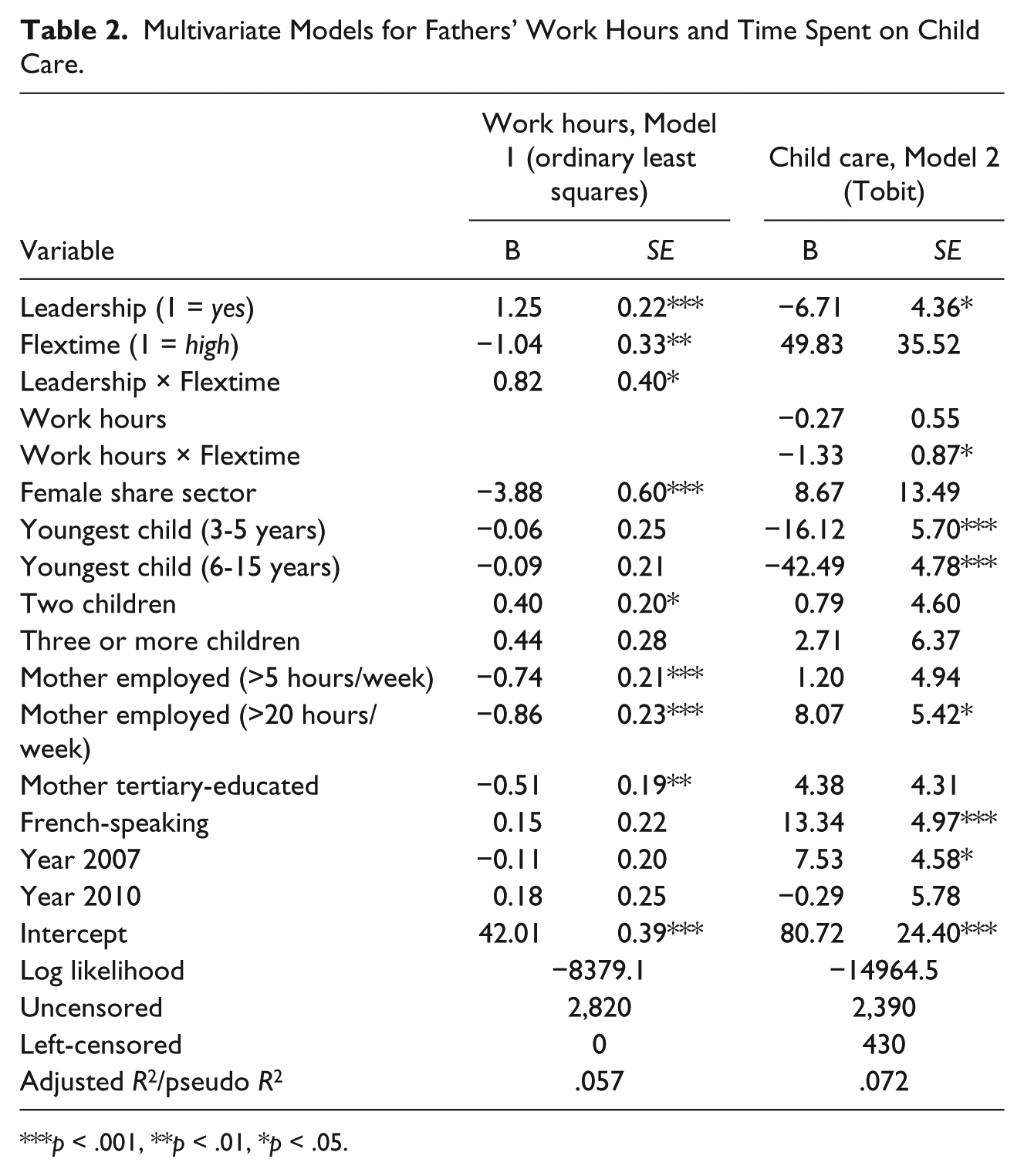
p < .001, **p < .01, *p < .05.
Model 1 predicts a father’s actual paid working time in hours per week. It shows that fathers work less if mothers work more, though the results are agnostic about the direction of this effect. Fathers work a mere 0.86 hours less per week, if the mother is substantially employed (>20 hours weekly), as compared to if she is unemployed (<5 hours weekly). Fathers’ work hours thus remain closely aligned to the normal work hours, unaltered by their partner’s work participation. Moreover, in homogamous couples, where the mother also has postsecondary education, fathers work about half an hour less per week. Model 1 further shows that more gender-integrated sectors allow fathers shorter workdays. Of two average fathers working in economic sectors with 33% and 53% women (the first and third quantile respectively), the first will, on average, work 41 hours, while the second works 40.2. Sectors with a more gender-balanced workforce thus also have shorter workdays. Finally, the strongest effect on work hours is a leadership position, which increases the average by 1.25 hours, while flextime decreases paid working time by almost the same amount (1.04 hours). The situation is displayed in Figure 2 (left panel). Flextime comes with fewer work hours but only among those with no leadership position.
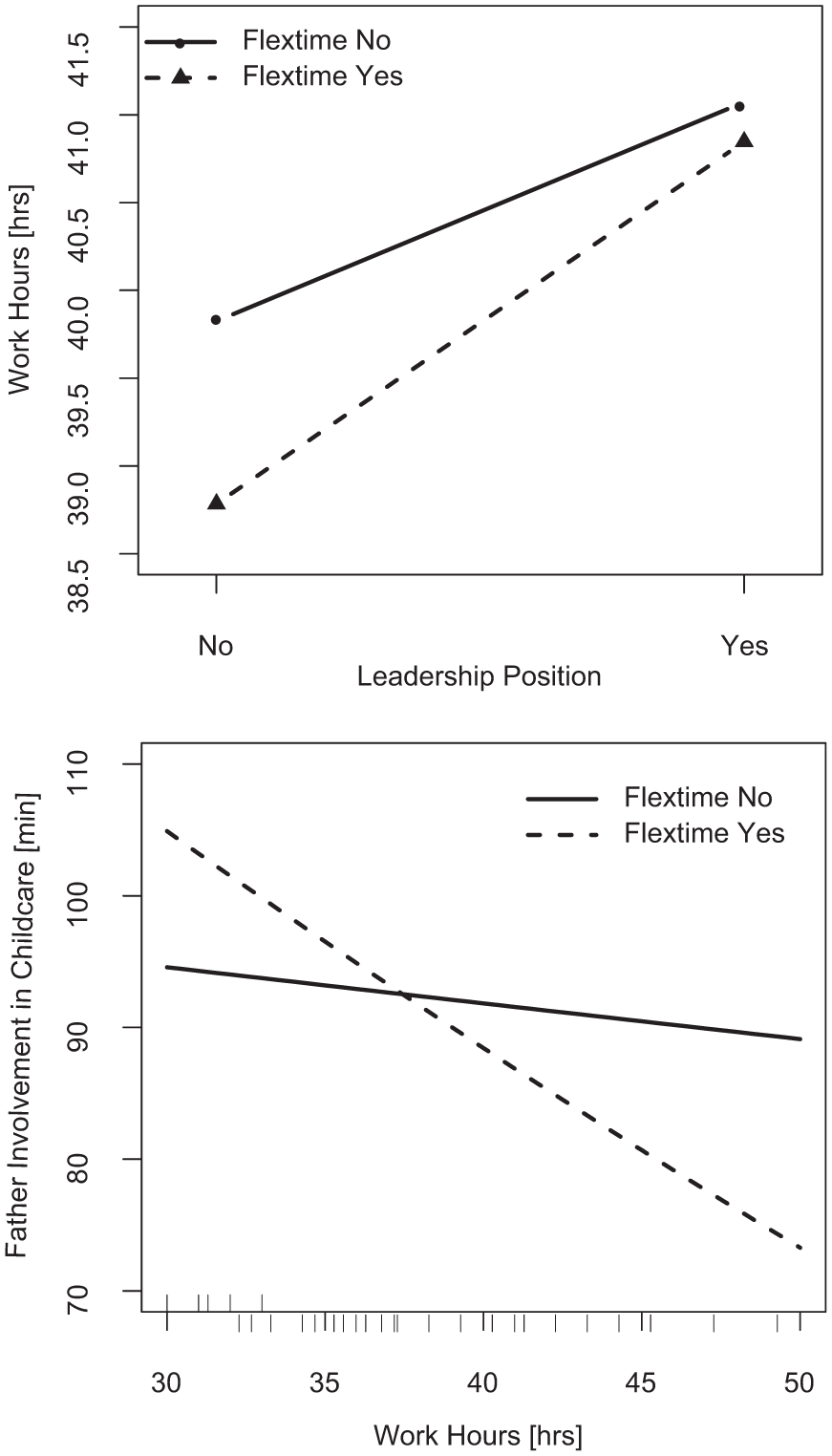
Predicted values to illustrate interaction effects.
Model 2 predicts a father’s expected child care in minutes per weekday. It shows that father involvement slightly increased from 2004 to 2007 and then fell back to the level of 2004. The upward trend in involvement was possibly broken during the economic crisis after 2007, which could have brought about a reorientation toward paid work. The other controls mostly show the anticipated direction of association. The strongest association is between the age of the youngest child and the father’s child care involvement. Compared to an infant or toddler (younger than 3), a child older than 6 means on average 40 minutes less child care on weekdays. French-speaking fathers invest more in child care, about 15 minutes every weekday. Fathers are slightly more involved when the mother is substantially employed (>20 hours weekly), but, as in Model 1, this falls short of a serious redistribution of work: Fathers add a mere 8 minutes daily when the mother works over 20 hours more per week, as compared to when she works 5 hours or less. This indicates once more that a mother’s paid work is rarely compensated by the father’s care work; instead, mothers find alternative care arrangements (e.g., relatives).
Model 2 shows a statistical interaction between work hours and flextime, as shown in Figure 2 (right panel). The moderation is clear: In the absence of strong flextime, there is hardly any association between work hours and child care involvement. The effect of work hours on involvement is not significant when flextime is low (Model 2, Table 2) but becomes significant if evaluated under the presence of flextime (not shown). Low flextime thus impedes the crowding out of child care by work hours. Given a strong degree of flextime, however, a clear negative effect of work hours on child care emerges. Using Model 2 to predict involvement of otherwise “average fathers” (on all other characteristics, Long, 1997, p. 203), fathers with no leadership position contributed 93.2 minutes per weekday, while fathers with a strong leadership role contributed 85.3 minutes per day. The effect size is comparable to the effect of relative education (fathers put in 93.3 minutes if the mother is also tertiary-educated, and 86.4 minutes otherwise). A comparison of Model 1 and Model 2 highlights the different logics behind paid work and child care involvement. Work hours respond to economic factors, such as leadership position, flextime, economic sector, and the mother’s employment, while child care involvement responds to age of children. French-speaking fathers allocate more time to child care but without working fewer work hours.
The picture emerges that leadership positions entail longer work hours, and, for those with flextime, long work hours predict less time spent on child care. These fragments are, however, difficult to put together, without the formal statistical rigor provided by the analysis of moderated mediation. The results of the moderated mediation support the same conclusions. More specifically, the results establish the following
In a simple mediation analysis, without flextime, both the direct effect (c = −8.85, 95% confidence interval [CI: −17.97, −12.03], p < .01) and the indirect effect (ab = −1.73, 59% CI [−2.42, −0.22], p < .01) are significant. About 16% of the total effect is thus via work hours.
Given high flextime, the direct effect is marginally significant (c = −8.85, 95% CI [−17.67, −0.34], p = .04), while the indirect effect is highly significant, (a+d)(b+e) = −4.35, 95% CI [−7.82, −1.28], p < .01. About 33% of the total effect is via work hours.
Given little flextime, the direct effect is marginally significant (c = −8.85, 95% CI [−17.67, −0.34], p = .04), while the indirect effect is not significant (ab = −0.44, 95% CI [−1.95, 1.01], p = .56). About 4% of the total effect is via work hours (not significant).
The test of moderated mediation compares formally compares the results in Points 2 and 3 and shows the difference to be significant (−3.91, 95% CI [−7.86, −0.53], p = .021). The same analysis was conducted based on OLS models (instead of the Tobit Model 2) and PROCESS (Model 58 in Hayes, 2013). The bias-corrected accelerated confidence intervals shows a significant indirect effect only when flextime is present. The index of moderated mediation is also significantly different from zero. Thus, the PROCESS analysis supports the exact same conclusions. The moderated mediation is only marginally significant (p = .056) if having no flextime is contrasted with having flextime, although the pattern of effects remains (i.e., indirect effect is significant only given some flextime). Similarly, the pattern remains if having more than 10 subordinates is contrasted with less than 10, though the moderated mediation is not significant (p = .11).
Point 1 above asserts that work hours represent a mechanism that translates leadership into less child care involvement. This supports H1. Work hours indeed explain part of the link between leadership and child care time, but it is important to point out that the majority of the effect remains unaccounted for. Clearly there are other mechanisms, such as energy depletion or stress, linking leadership position to less time spent on child care. Points 2 and 3 provide evidence for H2 because they show that the indirect effect occurs only when flextime is high. However, the effect plots in Figure 2 tell a more nuanced story. The first step in H2 (H2a) argues that flextime entails weaker work borders, and thus longer hours for leaders. The left panel in Figure 2 shows, however, that flextime acts not as a stress factor for leaders but rather as a resource for nonleaders. Nonleaders with flextime work less, whereas leaders with flextime work about the same as nonleaders. The second step (H2b) asserts that flextime means weaker family borders and that long work hours will have negative effects on child care involvement. This is indeed borne out by the right panel in Figure 2. For those fathers with flextime, child care involvement is much more sensitive to the number of work hours.
Discussion
The current study explored how a formal leadership position affects fathers’ primary child care on weekdays. As argued by Allard et al. (2007), leadership and management positions paradoxically entail longer work hours as well as higher levels of flextime. The main contribution of this study is to examine the interplay of these two elements. The focus was on tertiary-educated partnered fathers, because they may be more willing to use flextime to increase child care time but are at the same time more exposed to conflicting time demands, and because for them flextime does not indicate precarious work.
It is important to note that only the total time that fathers devote to primary child care was studied. Many other important facets of fathering could not be considered (e.g., warmth of the father–child interaction, taking responsibility for child care, and the availability of the father for the children; Craig, 2006a; Lamb, Pleck, Charnov, & Levine, 1985). Another important limitation concerns the moderated mediation analysis. It requires very demanding assumptions for a causal interpretation, which are unlikely to hold in a nonexperimental context (Imai et al., 2010). Even while including some sociodemographic and family variables as controls, it is not random which fathers have a leadership position or a high level of flextime. Less family-oriented fathers may be more likely to attain leadership positions. Potential confounders include motivation, skills, and social and institutional support (Lamb et al., 1985) as well as workplace factors, such as workplace culture, job autonomy, or supervisor support, which could act as confounders in the present analysis (Roeters et al., 2010). Although the present findings are plausible, a causal interpretation thus remains preliminary, and ideally future research could control for such confounding factors.
A permanent problem in research on flexibility and involvement is the possibility of reverse causation; involvement may lead to take-up of flexibility (Russell & Hwang, 2004, p. 490). In the present case, however, this would implausibly imply that fathers who are less involved take up flextime. Another problem, often pointed out, is the implementation gap between availability and actual use of flextime (Allard et al., 2007; Kossek et al., 2005) due to a flexibility stigma (Rudman & Mescher, 2013; Williams et al., 2013). The present results are agnostic in this respect, but it is interesting to note that the mere availability of flextime has a discernible impact on both work hours and family involvement.
Notwithstanding these limitations, the present study makes two important contributions. First, it addresses the persistent conflict between leadership and child care involvement. This is not only important for the fathers themselves—and child care time in child care is an important means to increase parent–child relationship quality (Roeters et al., 2010)—but also an important gender equality benchmark, against which the acceptance of care obligations in the economy can be measured. Second, the study pays close attention to the interplay of work hours and flextime. One basic idea behind the “stress of higher status” hypothesis is that flexibility makes the work–family border more permeable and allows workload to encroach on family life. Substituting flextime for flexibility and work hours for workload suggests a time availability version of the hypothesis, in which work hours mediate, while flextime moderates this role (see Figure 1).
The results indicate that fathers in leadership positions devote less time to child care, even after controlling for some occupational and family characteristics. Instead of enriching family life, a leadership role seems to deplete it in terms of child care time. This resonates with both the previous finding of higher work–family conflict among managers (Allard et al., 2007) and the “stress of higher status” hypothesis (Schieman et al., 2006; Schieman & Glavin, 2008). It provides, however, no direct evidence against positive effects of schedule control in general (Eby et al., 2005; Greenhaus & Powell, 2006). Even though the combination of flextime with long hours crowds out child care time, the experience of leadership and flextime as rewarding and desirable may bring psychological benefits (e.g., work-to-family enrichment). Nevertheless, the results add to a growing body of literature stressing potential adverse effects of flextime.
The proposed model for flextime and work hours is mostly borne out by the appropriate statistical tests. The first finding was that fathers in leadership positions face longer work hours and, as a consequence, spend less time on child care. The second finding was that this mediation is itself moderated by the availability of flextime: Only in the presence of flextime there is a substantial negative impact of work hours on child care time. This provides evidence that flextime makes work–family borders more permeable (Clark, 2000; Schieman & Glavin, 2008), instead of helping adjust working hours to child care. The story, however, is more nuanced. Flextime was not found to increase work hours specifically of leaders; instead, it was found to decrease work hours, specifically of nonleaders. For leaders, flextime is rather a forgone opportunity than a stress factor. This shows that any conceptualization of flextime as either resource or a stress factor (with respect to fathers’ child care involvement) is too simplistic.
The present findings open several avenues for future research to explore. The three dominant time use perspectives draw on time availability, bargaining, and doing gender (Bianchi & Milkie, 2010; Coltrane, 2000; Lachance-Grzela & Bouchard, 2010). However, the time availability perspective is hard to reconcile with the present findings: Flextime does not have the expected positive effect on involvement, and much of the negative effect of a leadership position on involvement cannot be accounted for by work hours and flextime. Although difficult to study, more subtle aspects of time use, such as the rhythm and the fragmentation of working time, as well as the compatibility of work schedules, should be explored. From a bargaining perspective, a leadership position may yield greater resources, which allow fathers to negotiate out of unrewarding domestic work. This could explain the negative association between leadership position and father involvement. However, child care is perceived by many parents as a rewarding and desirable activity, and it is therefore unclear whether the bargaining perspective is applicable at all (Monna & Gauthier, 2008; Raley et al., 2012). The bargaining perspective could even imply that fathers with higher relative resources bargain to swap their share of household chores for child care time. A more promising route to explore would refer to a gender perspective. Child care involvement (to the extent that it would even be perceived at the workplace) may signal lack of commitment to work (Williams et al., 2013). There is even a deeper incompatibility between work and family devotion (Blair-Loy, 2003): Qualities ascribed to leaders and qualities ascribed to caregivers are seen as negatively correlated, in what is called “think manager, think male” attitudes (Schein, 2001). Equally well documented is the perceived incompatibility of feminine-typed communal activities (e.g., showing other-orientedness and caring) with masculine-typed, agentic leadership qualities (Eagly & Karau, 2002). A male leader’s involvement in child care may therefore violate prescriptive attributes of the leader role and the masculine role. Involved fathers are seen as weak, and feminine, workers (Rudman & Mescher, 2013). On the other hand, having achieved a masculine-typed leadership position may also free fathers from compensating or neutralizing deviance by not performing household and child care work (Arrighi & Maume, 2000; Greenstein, 2000). What these conjectures make clear is that the nexus between elite positions in the economy, and involvement in child care, promises further nontrivial insights.
Another avenue for future research is comparative: The present results relate to the Swiss context, because father involvement is embedded in national frameworks of cultural expectations and political institutions. A salient feature of the Swiss context is the relative weakness of father-friendly policies. Switzerland is considered a European laggard with respect to family policy (Bonoli & Häusermann, 2011). There is no statutory right to reduce work and generally little motivation to increase the family compatibility of the labor market. As recently as 2012, the Parliament rejected a paternity leave of 2 weeks (Valarino, 2013). In two separate public ballots in 2002 and 2012, the electorate rejected with a clear majority proposals to reduce working time and to protect part-time work, as well as to increase the number of holiday weeks. Switzerland has one of the highest normal hours limits: the only industrialized nation with a maximum of 50 hours per week (though not for all occupations; Lee, McCann, & Messenger, 2007). Moreover, part-time rates among fathers, though increasing, remain only around 1 in 10. Both public and organizational work-reducing policies (e.g., parental leave, sick days, affordable high-quality child care, and a right to part-time) remain weak. Comparative studies overwhelmingly show Switzerland to pursue market-oriented family policies, with little support for external child care and little welfare state intervention (Mandel & Semyonov, 2006). Moreover, day care costs often increase with income, adding to the incentives for reverting to more traditional family models. All these features of the Swiss context suggest little support for involved fathers. Arguably, in countries with more such support, the association between a leadership position and less involvement could be weaker and the role of flextime more beneficial.
Weak work–family policies have been argued to actually increase women’s access to managerial positions by making the female labor force more selective and by making employers less reluctant to hire women into difficult-to-replace positions (Mandel & Semyonov, 2006). However, this simply means that women who make it into leadership positions already comply with, and reproduce, the “norm of the ideal worker” (Williams et al., 2013), which reserves the best jobs (e.g., in terms of job security, pay, prestige, career options, and the like) for workers with uninterrupted full-time work trajectories. Such workers usually have no care obligations and are thus more likely to have an undivided commitment to work and the work organization (they are “ideal” from the point of view of the work organization). Under such conditions, women’s access to leadership positions does little to make the latter more family-friendly. The same mechanisms that make it difficult for women (especially mothers) to access leadership positions might keep fathers in leadership positions from becoming substantially involved in child care. Conversely, involved fathers in leadership positions could, in principle, make work environments more family-friendly (Allard et al., 2007). Their behavior could effectively challenge the norm of the ideal worker. Ultimately, the behavior of male supervisors—many of whom are fathers motivated to spend time on child care—constitutes the acid test for changes in the workplace.
Footnotes
Declaration of Conflicting Interests
The author(s) declared no potential conflicts of interest with respect to the research, authorship, and/or publication of this article.
Funding
The author(s) disclosed receipt of the following financial support for the research, authorship, and/or publication of this article: This research was funded by the Swiss National Science Foundation (Project Number 4060-40_129250).