



Abstract
The transitional nature of military life positions the family to serve as the primary and most stable influence for adolescents in military families. These military-related transitions and stressors may also put youth at risk for depression and academic challenges. This study examines the relative impact of family structure (family composition at a given time point) and family processes (interpersonal interactions developed over time) on important adolescent outcomes (depressive symptoms and academic performance) for a sample of military youth (N = 995). While family structure, particularly being part of a stepfamily or single-parent family, was related to greater depressive symptoms and poorer academic performance, family processes (family support and parent–adolescent connection) and personal resources (initiative) also accounted for depressive symptomology and academic performance. Importantly, when modeling family processes, no differences were found across family structures. Military youth thrive in diverse family forms in the presence of healthy family processes.
Military service members and their families experience unique work environments that require flexibility, tolerance, and adaptation. These same families also experience what may be considered “usual” for families in the civilian world, including relationship dissolution. And, also akin to other families, military families are best understood by considering their structure (how they appear) as well as what occurs within them (what families do, which we term processes). Both family structure and family processes provide information about the family environment that is linked to important adolescent outcomes. Family structure, the family’s situation and composition at a given time point, has been a consistent predictor of mental health outcomes (e.g., Cavanagh, 2008) and academic performance for youth (e.g., Jeynes, 2005), such that those residing in families other than two-biological-parent families typically report comparatively higher levels of depression and lower academic performance in relation to their two-biological-parent-family counterparts. Youth’s functioning has also been significantly correlated with family processes, which are the transactional patterns of interpersonal interactions developed over time among members of the family (Walsh, 2003). The story of youth success or failure is only partially informed by what families look like.
This study seeks to first examine the influence of family structure on meaningful outcomes for adolescents in military families (hereafter, military youth), including mental health (depressive symptoms) and academic performance. The second purpose of this study is to examine the relationships between family processes (family support and parent–adolescent connection), individual resources (youth initiative), and well-being indicators (depressive symptoms and academic performance). Finally, we seek to determine if and how adaptive family- and individual-level processes differ as a function of family structure, essentially addressing the question of how both family form and functions contribute to military youth development. The matter of how family structures and processes intersect is not only relevant for understanding military families but any other sort of family that experiences transitions, whether due to external forces such as those related to occupation or to forces inside the family, namely how family members interact and support each other.
Family Structure
Family structure refers to “the parental relationship context” within which children are born and reared (Crosnoe & Cavanagh, 2010). Although less is known about family structure within military families and the effect it has on youth outcomes (Blaisure, Saathoff-Wells, Pereira, Wadsworth, & Dombro, 2012), the family structure literature suggests that this is a uniquely influential family characteristic (e.g., Wickrama, Simons, & Baltimore, 2012). In fact, studies have shown that the structure of the family proxies resources, such as time, money, and social support, that shape parent’s interactions with their children (Crosnoe & Cavanagh, 2010). The notion that parents and their children share “linked lives” may come as little surprise as research in the previous decades has noted that family disruptions and current family environment influence youth outcomes (e.g., Hartman, Magalhães, & Mandich, 2011). For instance, growing up in disrupted families (i.e., living in a family not comprised of two biological parents) may lead to particular vulnerabilities, such as low socioeconomic status, strained parental relationships, and increased family transitions (e.g., relocation, changes in household makeup), and increase the likelihood of maladjustment and poorer well-being (Wu, Hou, & Schimmele, 2008). Studies have found that youth residing within disrupted families, including single-parent and stepfamilies, were more likely to report challenges to personal well-being and lower levels of academic success (Cavanagh, Schiller, & Riegle-Crumb, 2006; Fomby & Sennott, 2013); this is often attributed to lower levels of parental monitoring and involvement.
The literature on family structure and adolescent well-being suggests that youth from intact families (i.e., living with both biological parents) exhibit fewer externalizing and internalizing symptoms (Cookston, 1999; Juby & Farrington, 2001; Rebellon, 2002). Conversely, youth from stepfamilies, single-parent families, or other family forms report poorer mental health, including higher levels of depressive symptoms (Strohschein, 2005). Yet the presence of supportive parents (e.g., feeling loved by, cared for by, and able to talk about personal problems with parents) can alleviate the risks to mental health and well-being associated with particular family structures (Barrett & Turner, 2005; Patten et al., 1997).
Evidence also exists linking parental divorce/marital separation with lower levels of academic achievement among adolescents (Sun & Li, 2009). Adolescents’ grade point average and overall school attendance has been found to be negatively related to family structure, such that students from intact families generally outperform those from other family forms (Ham, 2004). Furthermore, changes in family structure as a result of divorce or remarriage seem to be particularly salient for females who often report more adverse outcomes related to school functioning (Ham, 2004). However, studies have noted that the negative association between family structure and academic performance can be altered by parents who are involved in adolescents’ lives (Menning, 2006).
Family and Personal Resources
Youth’s functioning within the context of diverse family structures is highly dependent on the presence of resources, both socially and individually, that they can draw on (Hetherington & Kelly, 2002). Understanding the mechanisms of development, including the influence of social support and the utilization of internal resources, can give insight into the effects specific contexts, such as family structure, have on military youths’ adjustment. Drawing on the bioecological theory (Bronfenbrenner, 2005), we examine the processes occurring through reciprocal relationships youth have with those inside their family, specifically, within parent–adolescent interactions and family support (as a form of social support), as it relates to youth well-being. Furthermore, we explore the mediating influence of youth’s own personal initiative (the cognitive perceptions of self and the willingness to initiate behavior/take action based on those perceptions) as it is predicted to serve as a key component linking family processes and youth outcomes.
Family Processes
Youth whose parents are warm, supportive, accepting, and engaged tend to report lower rates of depression, delinquent behaviors, and risky sexual behaviors (Steinberg, 2001) and are more self-reliant and have higher rates of academic achievement (Melby, Conger, Fang, Wickrama, & Conger, 2008; Steinberg, 2001). Moreover, a supportive family environment (e.g., those adolescents who felt their parent(s) were available when they needed them) acts as a buffer against adversity, such that greater familial support received among adolescents is linked to fewer depressive symptoms and better academic performance (Lucier-Greer, Arnold, Mancini, Ford, & Bryant, 2015; Prelow, Bowman, & Weaver, 2007). For military youth who often experience increased mobility and transition in their lives (Drummet, Coleman, & Cable, 2003), the parent–child relationship is the primary and most stable source of support (Huebner & Mancini, 2008; Huebner, Mancini, Wilcox, Grass, & Grass, 2007).
Personal Resources
Considering that individuals’ biological and genetic factors (e.g., personal characteristics) filter how they interact with the world and play a role in their own development, youths’ developing self and beliefs about themselves provide one of the most influential foundations for personal motivation, well-being, and individual accomplishments throughout all areas of life (Pajares, 2005). These cognitive perceptions of self (i.e., “Can I do these things?”) are most commonly examined through one’s self-efficacy (Hughes, Galbraith, & White, 2011). During adolescence, cognitive skill development becomes more concrete as youth are increasingly able to manage their learning and problem solving (Zarrett & Eccles, 2006). When youths’ cognitive perceptions are higher (i.e., youth have higher self-efficacy), they are more likely to tackle challenging problems, be hardworking, have high internal motivation, not give up easily, and display strong academic performance (Pajares & Miller, 1994; Zimmerman & Kitsantas, 2005).
Present Study
The present study utilizes a sample of military youth to investigate diverse family environments within military families. These adolescents face stressors similar to their nonmilitary peers in addition to the context-specific stressors of military life, such as extended parental absence and transitions that require adjustments to new environments (Faran, Weist, Faran, & Morris, 2004; Lucier-Greer, O’Neal, Arnold, Mancini, & Wickrama, 2014). Although military families do not necessarily experience greater disruption in family structure than their nonmilitary counterparts, they are at an increased risk to experience dissolution given the nature of deployments and its effect on marriages—with those reporting more time spent in deployment also reporting higher rates of marital dissolution (Negrusa, Negrusa, & Hosek, 2014). The relationship between the family and military youths’ outcomes is acutely relevant as those who have experienced parental deployment and multiple transitions, are already at risk for higher rates of depression (Mansfield, Kaufman, Engel, & Gaynes, 2011) and lower academic achievement (Engel, Gallagher, & Lyle, 2010; Lyle, 2006). Understanding the role of the family in outcomes for military youth is a vital next step. Furthermore, as youth’s outcomes are highly associated with the internal resources available for them to draw from (Hetherington & Kelly, 2002), understanding the strengths of military youth and how their internal resources filter the way they interact with others and, consequently, shape their outcomes is yet another imperative next step.
In the current study, we investigate two perspectives on how family environments influence military youth outcomes: the family structure model and the family process model. Moreover, we examine the moderating influence of family structure in relation to family processes. Three hypotheses are examined—all of which account for the age of the participant.
Method
Participants and Procedure
Data were originally collected from 1,036 youth across four military installations, one of which was located outside the United States. Inclusion criteria in the overall research project mandated that adolescents were (a) between the ages of 11 and 18 years and (b) had at least one active duty military parent. To understand influences of family structure, the current study examined youth who lived with both biological parents, a single parent, or a stepfamily. We also recognize that deployment represents another important dimension of family structure. We conducted a series of preliminary analyses that were twofold. One, we examined deployment across family structure and found no statistically significant differences between groups. Two, we then correlated deployment with all other study variables and found no statistically significant correlations. Consequently, unlike other reports from this same data set, we did not include deployment information in the current analyses. Surveys were administered in computer labs on-post in the spring of 2012. The labs were staffed by trained researchers with support from youth services personnel who had regular interaction with the adolescents. Adolescents took an average of 45 minutes to complete the survey. An interactive game was incorporated at preassigned points as a brief diversion to fight fatigue and promote survey engagement.
Over half of the adolescents lived with both biological parents who were married to each other (n = 686; 66.3%); fewer lived in single-parent families (n = 130; 12.5%) or stepfamilies (n = 179; 17.3%). A small percentage of the sample were excluded from the analyses (n = 41; 3.9%) because they did not meet the research criterion (i.e., they reported living in a different family environment, such as with grandparents), thus, the analytic sample consisted of 995 military youth. Youth were between the ages of 11 and 18 years (M = 13.37 years, SD = 1.96 years), and the sample was evenly divided between males (49.7%) and females (50.3%). Participants were racially diverse with youth identifying as European American (39.0%); African American (18.7%); Hispanic/Latino (11.6%); Indian, Alaskan, or Hawaiian native (2.4%); multiracial (19.4%); and other (8.5%); this sample overrepresents minority families compared with published Department of Defense (2014) demographic reports noting that close to 70% of active duty members are White/European American. Of those who knew their parent’s rank, 72.1% were adolescents of enlisted military personnel; this is similar to the overall distribution of officers (18.7%) and enlisted personnel (81.3%) in the U.S. Army (Department of Defense, 2014). Participants generally reported numerous transitions. For example, within the past 5 years, 64.6% of the sample reported changing schools two or more times due to military-related moves, and almost a fifth of the youth reported that their military parent was deployed at the time they completed the survey (17.8%).
Measures
Family Structure
Family structure was determined by two questions related to (a) youths’ reports of parents’ marital status (“What is your parents’ marital status?”) and (b) youths’ reports of household residential makeup (“Currently, who do you live with most of the time?”). Youth were categorized into the following three groups: biological married parents, single-parent family, and stepfamily. This variable was used in Hypothesis 1 as the between-groups variable used to compare the depressive symptomology and academic performance among adolescents from different family structures. In Hypothesis 3, this variable was used as the moderating variable to examine if family processes are similar across family structures.
Family Support
A measure of family support, adapted from Malecki and Demaray’s (2002) Child and Adolescent Social Support Scale, assessed whether adolescents felt cared for and understood within their family. As a prompt, adolescents were asked to consider the family member they turn to first for help or support, and then responded to four items pertaining to that family member (e.g., “They listen to me when I have something to say,” “They really care about me”) on a 4-point scale (1 = not at all true to 4 = very much true). This measure gauged the participant’s perceived connection to and support received from the selected family member. Higher scores indicated more familial support (M = 3.55, SD = 0.53, α = .73). This variable was used in Hypotheses 2 and 3 as a predictor variable to capture family processes. As a point of information, the majority of adolescents reported their mother as the first person they turn to (56.0%; 17.0% father; 12.6% sibling; 14.4% other family member [e.g., aunt, uncle, cousin, grandparent, stepparent]).
Parent–Adolescent Connection During Stress
The Solving Family Problems subscale of the Adolescent Coping Scale was adapted to measure youth’s feelings of whether they can turn to their parent(s) for support when managing stress (Patterson & McCubbin, 1987). Adolescents responded to four items regarding how often they do specific behaviors as a way to cope with problems (“Talk to your father about what bothers you,” “Talk to your mother about what bothers you,” “Do things with your family,” “Try to reason with your parents and talk things out; compromise”) on a 5-point scale (1 = never to 5 = most of the time). Higher values indicated turning to parent(s) more frequently for support during stressful times (M = 3.04, SD = 0.94, α = .74). This variable was used in Hypotheses 2 and 3 as a predictor variable to capture family processes.
Adolescent Initiative
The Initiative subscale of the General Self-Efficacy Scale was used to measure youths’ perceptions of themselves and their willingness to initiate and maintain action (Bosscher & Smit, 1998). Self-efficacy indicators, such as initiative and persistence, have been linked to better academic outcomes, but differ conceptually from indicators of intelligence (Zimmerman, 2000). Adolescents responded to three items (“If something looks too complicated, I will not even bother to try it,” “I avoid trying to learn new things when they look too difficult,” “When trying something new, I soon give up if I am not at first successful”) on a 3-point scale (1 = not like me to 3 = a lot like me). Items were reverse scored so that higher values indicated more initiative (M = 2.55, SD = 0.49, α = .71). This variable was used in Hypotheses 2 and 3 as a mediating variable linking family processes and youth outcomes.
Depressive Symptoms
Depressive symptoms were measured using the Center for Epidemiological Studies–Depression Scale for Children (Faulstich, Carey, Ruggiero, Enyart, & Gresham, 1986). Adolescents rated how often during the previous week they experienced 20 depressive symptoms (e.g., “During the past week, I felt like crying,” “During the past week, I was bothered by things that usually don’t bother me,” “During the past week, I didn’t sleep as well as I usually do”) on a 4-point scale (0 = not at all to 3 = a lot). Values were summed and a continuous variable was used to determine depressive symptomology, such that higher values indicated more depressive symptoms (M = 15.30, SD = 11.24, α = .90). A score of 16 or above has traditionally indicated clinical depressive symptomology. However, others have suggested that scores around 16 represent mild depressive symptomology, while scores above a 22 appear to be a more accurate indicator of clinically diagnosable cases of depression for adolescents (Roberts, Lewinsohn, & Seeley, 1991). When applying this more rigorous cutoff score of 22, a quarter of participants (25.5%) displayed clinical indications of depressive symptomology. This variable served as an outcome variable for all three hypotheses.
Academic Performance
Adolescents were asked what grades were made on their most recent report card on a 5-point scale (5 = mostly As to 1 = mostly Fs). Higher values indicated higher grades (M = 3.80, SD = 0.90). More specifically, 20.9% reported that they received mostly As; 48.6% mostly As and Bs; 22.3% mostly Bs and Cs; 6.2% mostly Cs and Ds; and 1.9% mostly Ds and Fs. Self-reported data on academic performance have been highly correlated with more objective reports (Crockett, Schulenberg, & Petersen, 1987) and is considered a valid source of information. This variable served as an outcome variable for the hypotheses.
Data Analyses
To examine the family structure model and to address Hypothesis 1, analysis of variance models were conducted in SPSS to separately compare depressive symptoms and academic performance among military youth from different family structures (families with two biological married parents, stepfamilies, and single-parent families) controlling for age. To examine the family process model and to address Hypothesis 2, two latent variable, structural equation models were fitted in AMOS also controlling for age (Arbuckle, 2011). First, a mediation model was fitted to examine the relationship between family processes, adolescent initiative, and adolescent well-being. The Sobel test was used to test the significance of the mediation effect.
Then, to address Hypothesis 3, a moderated mediation model was fitted to explore if and how the family process model differs based on family structure. In other words, we compared the three family structure groups to see if the family process model fit similarly across biological parent families, single-parent families, and stepfamilies. For the moderated model, two models were computed, a model in which the parameters in question were constrained to be equal across the groups (suggesting that the model fits similarly across the three family structure groups) and the other where the parameters were allowed to vary freely (suggesting that the model fits differently based on family structure). A nonsignificant chi-square difference test suggests that the equality constraints are consistent with the data and, thus, there is no difference between the family structure groups.
Full information likelihood estimations were used to simultaneously examine multiple relationships in the same model and to account for any missing data (less than 5%). Goodness of fit was assessed using the χ2/df (degrees of freedom) ratio, comparative fit index (CFI), and root mean square error of approximation (RMSEA). A χ2/df ratio below or around 3.0 is believed to indicate acceptable model fit (Carmines & McIver, 1981). When the CFI is close to or above .95 and the RMSEA is less than .06, it is believed to indicate good model fit (Hu & Bentler, 1999).
Results
Family Structure Model
Bivariate correlations among all study variables and descriptive statistics are shown in Table 1. In general, variables were moderately correlated in the expected direction and ranged from .01 to .33. Two separate, one-way analyses of variance were conducted to examine the relationship between family structure and the two outcome variables, adolescent depressive symptoms and academic performance (see Table 2). There was a statistically significant relationship between family structure and depressive symptoms, F(2, 978) = 9.89, p < .001, controlling for age. Bonferroni post hoc analyses suggest that those with two married, biological parents had lower levels of depression than those in stepfamilies (p < .01) and single-parent families (p < .001). Additionally, there was a statistically significant relationship between family structure and academic performance, F(2, 988) = 9.51, p < .001, controlling for age. Bonferroni post hoc analyses suggest that those with two married, biological parents had higher levels of academic performance than those in stepfamilies (p < .01) and single-parent families (p < .001).
Correlation Table Including Means and Standard Deviations (or Frequencies) of Study Variables.
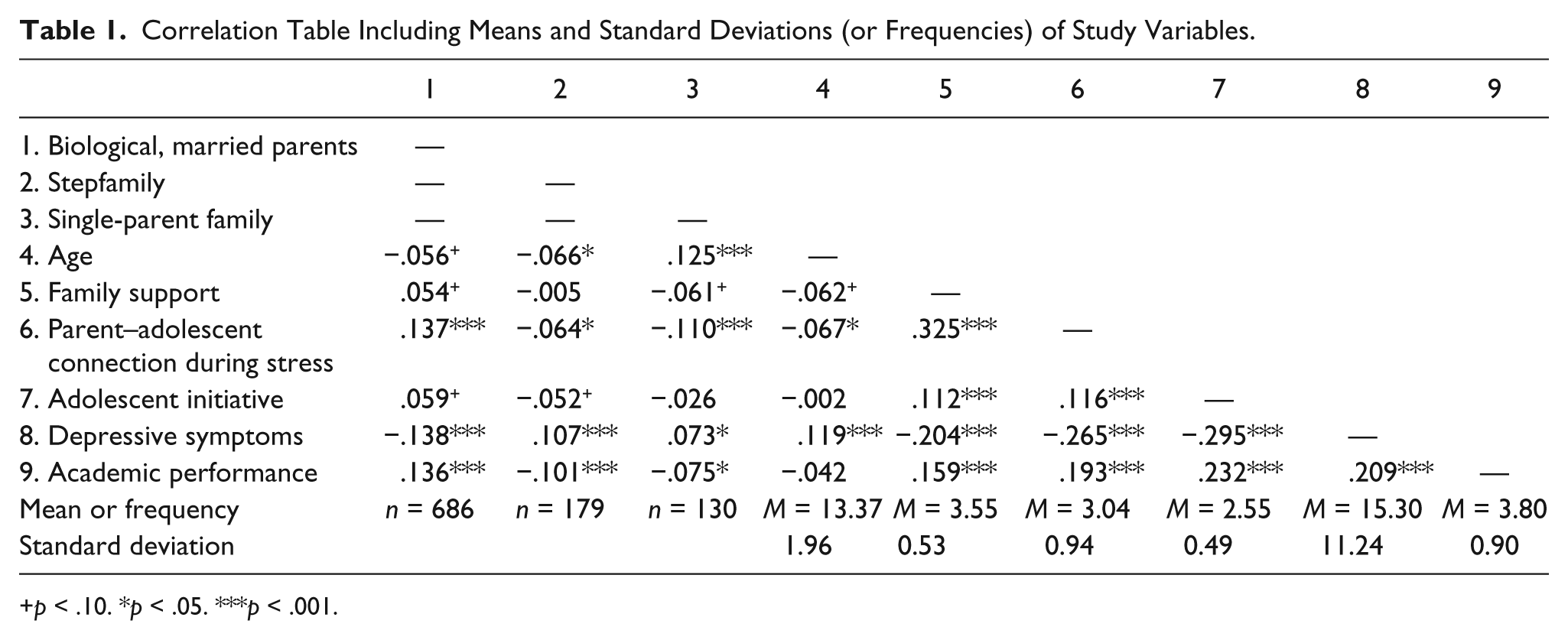
p < .10. *p < .05. ***p < .001.
One-Way Analysis of Variance Comparing the Mean-Level Scores of Depressive Symptoms and Academic Performance Among Adolescents From Three Different Family Structures.

Note. Corresponding letters represent statistically significant mean differences with Bonferroni adjustments.
Family Process Model
To examine the role of family processes on adolescent initiative and, subsequently, well-being (depressive symptoms and academic performance), a mediation model was conducted controlling for age (see Figure 1). Model fit was good (χ2/df ratio = 2.45; CFI = .97; RMSEA = .04). General family support (β = .12, p < .05) and parent–adolescent connection during stress (β = .11, p < .05) were positively related to adolescent initiative. Adolescent initiative was negatively related to depressive symptoms (β = −.30, p < .001) and positively related to academic performance (β = .22, p < .001).

The family process model examining the relationship between family processes (family support and parent–adolescent connection during stress) and adolescent well-being (depressive symptoms and academic performance) mediated by adolescent initiative and controlling for age (not pictured).
The Sobel test was utilized to examine the statistical significance of the mediating effect of adolescent initiative. The post hoc analysis revealed that adolescent initiative significantly mediated the path between general family support and both of the outcome variables: depressive symptoms (z = −2.30, p < .05) and academic performance (z = 2.24, p < .05). Adolescent initiative also significantly mediated the path between parent–adolescent connection during stress and the outcome variables: depressive symptoms (z = −2.15, p < .05) and academic performance (z = 2.10, p < .05).
Finally, a moderated mediation model was fitted to see if the family process model fit similarly among adolescents from different family structures accounting for age. To assess differences among the three family structure groups, we fit two models. Model fit was good for the constrained (χ2/df ratio = 1.79; CFI = .94; RMSEA = .02) and unconstrained model (χ2/df ratio = 1.88; CFI = .94; RMSEA = .03). The first model constrained the structural paths of the structural equation model to be equal across the three family structure groups (χ2 = 285.97, df = 160), and the second model allowed the paths that were free to vary across family structure groups (χ2 = 270.60, df = 144). From the results of the chi-square difference test, there were no overall differences in the family process model among the three family structure groups (Δχ2 = 15.37, Δdf = 16; χ2critical [p = .05, df = 16] = 26.30; 15.37 < 26.30). Individual paths were also examined for differences among the three groups, but no significant path differences were found. In other words, the relationships between the variables (i.e., the family processes depicted in Figure 1) were similar regardless of the type of family structure.
Discussion
Consistent with previous research, our findings support that military youth from continuously intact families (i.e., two married, biological parents) report fewer depressive symptoms and higher levels of academic performance than military youth from stepparent or single-parent families. Furthermore, findings complement the literature related to family processes, such that interpersonal family relationships (family support and parent–adolescent connection during stress) were associated with depressive symptoms and academic performance through adolescent initiative. More specifically, poorer interpersonal family relations were inversely related to adolescent initiative, and low levels of initiative were related to greater depressive symptomology and poorer grades; this relationship was similar across different family structure groups.
Family Structure and Youth Outcomes
Our findings are consonant with those of many other researchers, that is, how families are structured makes a difference in how children and youth grow and develop (Cavanagh, 2008; Jeynes, 2005). It stands to reason, all else being equal, that family stability and predictability are good for children. Naturally, all else is often not equal, so we recognize that intact families can have enormous problems that work against children’s positive development, one example being family violence and another being substance use in families. That being said, youth in military families in instances where biological parent relationships are intact and persistent are less prone to depression and report doing better in school. From a family resource perspective, as well as from a family capital perspective, two-parent (biological) families are better equipped to rear children and to potentially take more of the worry out of being an adolescent in that they typically have more resources pooled together (e.g., Cavanagh et al., 2006; Hartman et al., 2011; Wu et al., 2008). These resources include those which are economic, in that marital disruptions can have a negative impact on family finances, but also include social resources, such as persistent connections with others that in turn provide support to families (Crosnoe & Cavanagh, 2010). Then there are basic and pragmatic resources that include there being two parents to accomplish the demands of individual and family life, whether it be managing household tasks or navigating extracurricular activities of youth.
Of particular significance is the unique situation of military service members and their families because these are families that know transition very well. Between normal and expected relocations, and then the multiple deployments of the military service member, these are families either “on the move” or “shadowed by war” (Drummet et al., 2003; Huebner, Mancini, Bowen, & Orthner, 2009). Consequently, other sources of stability, such as having no parental marital disruptions due to relationship problems, become especially significant, in effect, mitigating the fallout from family disruptions due to military service. We conclude that one side of our three-sided coin of family structure and process is that parental stability is a benefit for military youth mental health and school success. While at first glance this seems a trite conclusion, when placed in the context of loss and uncertainty, and the strains on family members due to transition and change (and transition where there is an element of danger, in the instance of deployment to a war zone), intact family structures are especially significant (Huebner et al., 2007).
Family Processes and Youth Outcomes
A second side of that coin involves what actually transpires in families that affect youth in important ways that, in turn, lead to these same variables of interest, namely depressive symptoms and school success. An argument can be made that, at the end of the day, what matters most is not how families look but rather what they do and how their members interrelate.
We have chosen two exceptionally important aspects of family processes: family support and parent–adolescent connection during stress. We have tested whether these have direct relationships to the youth outcomes, and equally important, whether these family processes variables promote a particular aspect of military youth development we term initiative. Initiative is a pivotal dimension of preparing to walk that trail of middle childhood, adolescence, emerging adulthood, as well as adulthood (Pajares, 2005).
The family support questions assessed the youth’s sense that she or he is valued by the family, is understood, and is listened to; moreover, the youth feels there is someone in the family to turn to. We view this assessment as how the youth feels in an average way, or on a normal basis. This “sense of self” that the youth has forms a platform of security that we surmise leads to greater feelings of competence overall and, in particular, a sense of initiative. A complementary family process dimension is connection to parent(s) when there are difficulties. Our assessment of this focused on taking action (talking with a parent when bothered; doing things with family; talking things out with parents when there are difficulties with them). The significance of this dimension of family process is found in how it models important processes of interpersonal interaction, also important for building a platform of security (e.g., Lamb, 2012). Recall that our measure of initiative gets at how likely a youth is to shy away from trying something if it seems too complicated, avoiding learning new things if they look challenging, and giving up on doing something new if there is no immediate success. These family processes are part of the mix for building the personal capital, life skills, and general competence that youth need developmentally.
Children and youth in military families, along with their parents, experience and confront change and transition as a way of life (Lucier-Greer, Arnold, et al., 2014). Consequently, building the capacity of military youth to take initiative in the face of new tasks, situations, relationships, and environments is core for doing well, both emotionally/mentally and with regard to performance in school life. Our findings clearly demonstrate both the importance of family process for initiative, and for the importance of initiative for mental health and school success. For transitional families, taking initiative is a primary mechanism for navigating new situations and for embracing change, rather than being overwhelmed by it. The youth development literature is clear about the importance of youth self-efficacy for informing developmental outcomes, such as school success and emotional health, even when youth are not faced by extraordinary challenges, such as those associated with having a parent in the military (Zarrett & Eccles, 2006). Consequently, family situations where there are clear transitional challenges that demand more of youth, including pragmatic demands such as caring for siblings, require more with regard to the initiative that youth take.
Family Process and Youth Outcomes Across Family Structures
The more interesting side of the family structure and family process coin involves their intersection. In the instance of this current study, we questioned if these important family processes varied according to family structure or whether across structures, family processes operated in similar ways. If the latter is the case, then we suggest that while structure matters on the one hand, structure does not ultimately control what happens in families.
Our findings indicate that what matters in families is what family members do and how they relate rather than how they are composed. Unequivocally, these family processes play out in similar ways across family structures. The overall process model does not differ, and, of greater significance, neither do the paths between family processes, initiative, depressive symptoms, and school success. Therefore, what families look like is relatively less important compared with how families function. At least in the present study, there is evidence that these family functions and their existence are similar across all family structure types. However, we recognize that additional test of these findings is warranted. Supporting healthy family processes and interactions is also a way to “meet families where they are.” There are numerous transitions and stressors that are outside the control of military families, but how family members respond to and interact with one another (e.g., in the present study we have assessed various dimensions of closeness with family members) is something they can negotiate and navigate with one another. There is a clear implication for family life professionals—that regardless of how families are structured (structure considered broadly, including multiracial families, families with gay and lesbian parents, and transnational families), prevention and intervention activities centered on how relationships are enacted are the pivotal leverage points for change.
Military families are structurally diverse; more than 3 in 10 of youth in this sample were growing up in a family where both biological parents were not present. This represents one specific way in which families can be structured. Also in this sample, almost one in five youth had a parent deployed at the time of the study, which represents another way in which families are structured. However, our earlier research (Lucier-Greer, Arnold, et al., 2015; Lucier-Greer, O’Neal, et al., 2014) as well as that of other investigators (Card et al., 2011) have shown that deployment status is not a particularly powerful element in understanding children’s well-being, which goes against popular opinion. All things considered as it pertains to situations that affect changes in family structure (who is in the family and who is not), the finding that relationship quality/family processes trumps family structure bodes well for military families. From a prevention and intervention perspective, the message is clear for family science practitioners; a primary focus for working with military families and their adolescents should include how youth respond with regard to parental support when stressed, youth feelings about how parents care for them, and steps youth take to act on their environment and situations in positive ways; each of these is supported by the findings of this study. And, while a good marriage is a good thing, clearly the effect of diverse family forms can be benign in certain contexts for children and youth (Demo & Acock, 1996; Lansford, Ceballo, Abbey, & Stewart, 2001). In other words, youth thrive in a variety of family forms in the presence of healthy family processes.
Future Directions in Research and Theorizing
Although the current study provides a meaningful look at the association of family structure, family processes, and youth initiative on essential military youth outcomes, cautions should be noted in the interpretation of these data. First, youths’ reports are cross-sectional so the influence of family structure and environment on future well-being can only be speculated. Longitudinal research would provide a richer understanding of the nuances of and changes in adolescents’ well-being in relation to relevant military-related factors, especially before, during, and after transitional periods. This study improves on many earlier projects in that we have asked youth to discuss their own life experiences as suggested by Milburn and Lightfoot (2013). Second, while previous conceptual and empirical work supports the examination of initiative as a linking mechanism between family processes and youth outcomes, other mediators were not examined which may also be contributors to youth outcomes. Future work should build on these findings and assess specific interpersonal relationships and/or other individual resources that might be influential, linking mechanisms. Third, we support that future research should incorporate multiple respondent reports in studies conducted on youth in military families. Data from multiple respondents would allow for the exploration of adolescent and parents’ perceptions and speak to family-level factors that influence youth outcomes (Oshri et al., 2015). Fourth, we recognize that there are a number of mechanisms that bridge family structure and family process, which should be considered in future research. For example, these may include the availability of parents and the actual time that children spend with parents. Finally, while data were gathered from four fairly representative U.S. military installations, caution should be used in generalizing these findings to all military youth.
This study highlights the importance of both family structure and the processes inherent within family interactions for military youth and the unique role youth play in their own development. Interestingly, while the composition of a family is important to youths’ well-being, it is the processes that occur between youth and their parents that contribute over and above structure to military youths’ outcomes. Our findings suggest that those desiring to influence military families and contribute to the overall health of military youth should focus their efforts on things youth have some say about—their views/beliefs of themselves and the interactions that transpire within their families. Consequently, this study supports that military youth thrive in a variety of family forms in the presence of healthy family processes.
Footnotes
Declaration of Conflicting Interests
The author(s) declared no potential conflicts of interest with respect to the research, authorship, and/or publication of this article.
Funding
The author(s) disclosed receipt of the following financial support for the research, authorship, and/or publication of this article: Funding for this research was supported by the U.S. Department of Agriculture (NIFA award No. 2009-48680-06069, Jay A. Mancini, Principal Investigator).