



Abstract
The current study is based on the responses of 153 married Korean mothers accompanying their youth in the United States or in New Zealand while their spouses remained in Korea. Kirogi means “wild geese” in Korean and has come to refer to split-family transnational living for the sake of children’s education. Spillover, or a positive correlation, between indicators assessing marital and parent–child relationship quality was tested within the transnational family context. It was also hypothesized that mother–child relationship quality and youth’s educational progress would be positively and uniquely predictive of indicators of maternal well-being when compared with marital quality due to education-focused Confucian values among Koreans. Results indicated positive correlations between indicators of marital and parent–child relationship quality; and only measures of marital quality had unique associations with maternal well-being.
Keywords
A growing number of Korean families are living in two countries whereby one parent accompanies their child/children to an English-speaking country for educational purposes while the other parent remains in Korea to support them financially. These families are referred to as “kirogi,” or “goose,” families perhaps because wild geese are traditionally celebrated among Koreans for their lifetime commitment to one partner and are believed to migrate over long distances to bring back food for their offspring (K. Kim, 2009; Ly, 2005). Although direct measurement of the number of kirogi families from Korea is not available, data gathered from the Korean census and educational statistics on Korean student study abroad contribute to informed estimates: as many as 10% of the total number of married families in Korea report that parents live apart; half of these families may be kirogi families due to the increasing number of school-age children reporting study abroad (J. Kim, 2010; Ly, 2005). On the surface, these trends seem to simply underscore the competitive and academically focused parenting of Asian parents (i.e., “tiger mothers”) but a closer examination of such family arrangements reveals how globalization can change the structure, and potentially, the function of middle-class families (Cho, 2005).
Kirogi families emerged recently from a larger cultural context of “educational fever” in Confucian-influenced Korea, which has held learning and self-cultivation in high regard (J. K. Lee, 2006). Within this larger context, many Korean parents seek English education for their children because they believe that this will make their children eligible for high-paying jobs within a more global and Western-influenced future (Chew, 2009). A kirogi mother, quoted in H. Lee (2010), explained that “giving children the opportunity to learn English “is much more valuable than leaving billions of inheritance” (p. 255). A second reason that is frequently cited relates to the exam-focused Korean educational system. A majority of the population is involved in after-school enrichment programs that financially and/or emotionally strains parents despite hopes that it gives their child an edge on the competition (H. Koo, 2007). Accusations of child abuse have recently gained public attention because Korean children are often pressured to study or practice their instruments late into the evening and many have been unable to cope with the stresses of poor performance (e.g., S. W. Koo, 2014). A kirogi parent in Finch and Kim (2013) explained that in order “to live successfully in the family’s homeland, Hannah, 13, would have to give up her drums and piano unless she expected to make music a career” (p. 493). Living transnationally therefore allows parents to not only foster their child’s English language ability but also escape the competitiveness of the Korean educational system. Yet, in the process of trying to guarantee their children’s upward social mobility, couples must cope with the challenges of living separately for an extensive and open-ended period of time. How does the family adapt to such circumstances?
Much previous research has asserted that the perceived quality of the marital bond is the most important compared to perceieved quality of other family bonds for individual adjustment within the family (e.g., Erel & Burman, 1995; Malinen et al., 2010). Since transnationalism and non-Western cultural values may moderate the primary importance of the marital bond over parental bonds as well as highlight the importance of youth’s developmental outcomes for the family, the current study examines the generalizeability of previous findings that were based on coresidential Western families. Kirogi mothers who settle in the United States or in New Zealand are of particular focus in the current study because mothers are the ones who generally accompany children and cope with the opportunities and challenges of living overseas and because mothers are traditionally held responsible for maintaining family cohesiveness (H. O. Kim & Hoppe-Graff, 2001).
The Kirogi Family
Traditional Korean values, rooted in Confucianism, continue to influence marital relations, gender roles, and family obligations despite the rapid modernization of Korean society. Confucian teachings have dictated that the family, as a unit, is more important than individual family members and that within the father-centered household, the main familial relationship is not between spouses but between parent and child (Park & Cho, 1995). The division of household labor has also been traditionally split along gender lines. Whereas men are expected to be the breadwinners for the family, women are expected to take on all household chores and be responsible for their child’s education. Thus, Koreans may be more open to transnational living arrangements and to splitting their families according to traditionally defined gender roles compared to their Western counterparts. Many kirogi family members overseas are subsequently mothers, who care for children and manage their education, whereas many kirogi family members in Korea are fathers, who stay in Korea to work and maintain the family income. Although nontraditional arrangements such as the father accommpanying children overseas and the mother remaining in Korea to maintain the family income are not unheard of (e.g., Kaste, 2012), they are not common.
Mainstream news reports have consistently cited psychological problems among kirogi parents, such as elevated levels of depression and loneliness, marital discord, and financial strain (Onishi, 2008), which stigmatizes them (Ha, 2007). The kirogi family arrangement has been noted to undermine traditional Korean beliefs about the family due to their distance and independence from the father. For example, Koreans may fear that when fathers are not residing with their family, children are less likely to respect their father’s authority, and each parent is more likely to develop enough independence to indicate that they “don’t need each other” (Ly, 2005). Contrary to the somewhat negative attention that kirogi families have had in the media, the available social scientific research has been more optimistic about the cohesiveness of kirogi family ties. An interview study of eight kirogi fathers in Korea reported that the fathers felt that they maintained a stable relationship with their families despite their long periods of separation (Y. J. Lee & Koo, 2006). This is consistent with other interview studies based on the responses of overseas mothers. An interview study of 13 kirogi mothers in the United States indicated that advances in technology (e.g., Skype, Kakao Talk) have made it easier and more affordable to maintain feelings of family cohesion despite their physical distance (Jeong, You, & Kwon, 2013; Y. J. Lee & Koo, 2006). Another small interview study of kirogi mothers in the United States found that the kirogi family arrangement can be seen to promote, rather than undermine, traditional parental roles because mothers felt that their living arrangements allowed them to satisfy traditional Confucian expectations of maintaining strong bonds with children while effectively mobilizing family resources for their children’s success (Finch & Kim, 2013).
While overseas, kirogi mothers face new challenges (e.g., making executive decisions), cope with difficulties related to acculturation, and parenting within a new school system that they did not face before (J. Kim, Agic, & McKenzie, 2014). Although they may be at greater risk for mental health problems, these periods of family separation have also been used as an opportunity to develop independence and an identity that integrates some Western influences within their Korean identity (Jeong, et al., 2013; H. Lee, 2010). For example, interview studies have shown that kirogi mothers take on new responsibilities as the head of household while overseas and to the extent that they can provide a “good environment” for their children in U.S. schools, their situation can foster feelings of being a “strong mother” (Finch & Kim, 2013; Jeong et al., 2013; H. Lee, 2010). Yet the opportuntity to be free of Korean traditions (i.e., being submissive to the husband), obligations (i.e., to in-laws), and beauty ideals (i.e., make-up, designer clothes) have also allowed women the space to explore their “true self” (H. Lee, 2010). Yet identification as a “strong mother” who is more “true” to oneself may have consequences to the marital bond, for better or for worse. Thus, the main question of interest is how interrelated the marital and parental bond is among kirogi mothers, and the extent to which one bond may matter more than the other for mothers’ mental health during periods of separation. Although interview studies have been valuable in their detail, results based on very small and selective samples of kirogi family members leave much more to be desired in understanding the kirogi family experience in general. Both journalistic and small ethnographic studies of kirogi families have demonstrated that some couples maintain strong feelings of marital cohesion whereas others do not. Thus, questions remain regarding which aspects of family life and parenting are the most salient for kirogi mothers’ well-being.
The Family and Kirogi Mothers’ Well-Being
The kirogi family situation is a particularly interesting test of the relevance of different family bonds for one’s well-being because one bond (i.e., the parental bond) is invested in at the expense of another (i.e., the marital bond). Previous family research that examines both the marital and parental bond typically focuses on the interrelatedness of both bonds to each other (e.g., Erel & Burman, 1995) or in the potential negative consequences of marital quality for women and youth (e.g., Finchman, Beach, Harold, & Osborne, 1997; Goldberg & Easterbrooks, 1984). Moreover, much literature has investigated the associations between marital satisfaction and parental depressive symptoms (e.g., Davila, Karney, Hall, & Bradbury, 2003; Finchman et al., 1997), but very little research has been conducted on understanding the unqiue and relative contributions of marital and parental bonds as they relate not only to maternal depression but also maternal happiness, or life satisfaction. In an effort to understand the conditions under which women flourish in midlife, the extent to which the family supports their happiness is necessary.
Whether in coresidence or not, the family can be seen as a complex social system consisting of many subsystems of dyadic relationships that influences and is influenced by each other (e.g., Cox & Paley, 1997). Plotting how these subsystems influence one another and affect individual family members’ well-being is important for understanding family functioning. Research on traditional families in coresidence has consistently found that positive and negative affective qualities in the marital relationship “spillover” to the parent–child relationship (Easterbrooks & Emde, 1988; Kourose, Papp, Goeke-Morey, & Cummings, 2014; Malinen et al., 2010). For example, problems in the marital relationship has been found to be positively correlated with problems in the parent–child relationship. Similarly, satisfaction in the marital relationship has been found to be positively correlated with satisfaction with relationships with children (Erel & Burman, 1995). In addition to “spillover” of affection from marital to parental domains, past studies have found that marital satisfaction is highly correlated to positive developmental outcomes for children (Feldman, Wentzel, Weinberger, & Munson, 1990; Goldberg & Easterbrooks, 1984) and more recent longitudinal evidence indicates that when women feel they are in high-quality marriages, they become warmer toward their children over time (Bonds & Gondoli, 2007). Likewise, when women feel they are going through marital difficulties, research with various methodologies and sophisticated research designs have found that marital conflict feeds into depression, and vice versa, over time (Davila et al., 2003; Fincham, Beach, Harold, & Osborne, 1997). Couples can be caught in a cycle of marital distress and depressive symptoms that may be hard to break out from. Thus, it is widely acknowledged that women and children are more likely to thrive when marriages are deemed highly satisfying by women and when there is a minimum level of conflict between spouses.
The above-referenced findings have helped fuel a growing consensus among family scholars that the marital system is the cornerstone, or executive, of the family that regulates the quality of other family relationships and family member’s psychological adjustment. Since kirogi family members are not in coresidence for prolonged periods of time, the current study questioned whether the marital bond would be the most important for maternal psychological adjustment, given the Confucian-influenced values of traditional Korean culture. Most of the research comparing marital and parental bonds has been based on samples primarily of European/European American families. Research using samples recruited from different cultural backgrounds and family living situations will be essential to help confirm the significance of the marital subsystem for the whole family.
The current study considers whether the cultural background of kirogi mothers that leads them to invest heavily in intergenerational relationships, as well as their current living situation, moderates the “spillover” of positive or negative affect between the marital and parental domains. It is reasonable to expect that the marital bond may not be the most important family bond for maternal well being due to the strong Confucian traditions that emphasize the parent–child bond over the marital bond. Despite modernization of South Korea and the high educational attainment of women in Korea, childrearing is believed to be more important to women’s well-being than in the past (H. O. Kim & Hoppe-Graff, 2001). Mothers in modern middle class families are often the ones who are solely resposible for their children’s welfare and all education-related decisions. It is commonly assumed that Korean women will be happy so long as her children do well academically and can be successfully launched into adulthood (H. O. Kim & Hoppe-Graff, 2001). Thus, the relationship dynamic between mothers and youth as well as youth’s educational progress while overseas may be an important determinant for mothers’ psychological adjustment in the kirogi context in addition to marriage relationship quality.
The Current Study
The current study targeted kirogi mothers who are at a particular time in the family life cycle whereby youth are in middle or high school due to the importance of the adolescent stage for family dynamics. As children transition into and out of puberty, a rearrangement of responsibilities between parents and youth naturally takes place. As adolescents become more cognitively capable and physically mature, they seek greater autonomy in managing their daily activities as a part of their normal development. Parents, as a result of their youth’s development, eventually adjust to the greater independence of their children albeit after a heightening of parental conflict (Steinberg, 1981) and a lowering of marital satisfaction (Cui & Donnellan, 2009). Kirogi youth who are exposed to the relative freedoms that their Western peers enjoy can be distracted from their studies, which mothers may find to be problematic considering that their youth’s education is the main purpose of their stay. Thus, it may be expected that perceptions of their youth’s investment into their studies will be an important factor in understanding variations in maternal psychological adjustment.
Further, kirogi families can choose among several English-speaking nations in the world. Although the United States is a popular destination, its distance and difference in time zones from Korea along with visa restrictions have made New Zealand, Australia, and even the Phillippines and Singapore attractive alternatives. The current study selected the United States and New Zealand as optimal sites for research since much of the above-mentioned research is based on kirogi individuals either in the U.S. mainland or in Hawaii.
The current study posed four research questions. The first question was to explore any differences (i.e., sociodemographic and key variables under study) between the two kirogi samples of mothers and their target youth (i.e., United States and New Zealand). Although some sociodemographic differences may be expected (i.e., the United States is more vast than New Zealand as a host country), motivational and psychological differenes were not expected among kirogi mothers since both groups of mothers are from the same sociocultural context in Korea.
The second question was to test spillover between marital and parent–child domains within the transnational family context. In accordance with previous research findings, positive indicators of relationship quality (i.e., relationship satisfaction with husbands and with youth) was hypothesized to be correlated with each other and negatively with negative indicators of relationship quality (i.e., relationship problems and conflict). However, these research findings were not tested among split-household family members.
Third, we tested the extent to which maternal psychological adjustment would be correlated with indictors of youth’s educational adjustment (i.e., mother’s report of youth’s motivation, maternal satisfaction with educational progress, and school grades). It was hypothesized that positive educational outcomes would signal successful parental investment to the kirogi mother, which would be correlated to lower levels of maternal depressed mood and higher levels of life satisfaction.
Finally, the unique associations between marital and parent–child factors were tested in their relations to maternal psychological adjustment. It was hypothesized that indicators of parent–child relationship quality (i.e., conflict and satisfaction) and perceptions of youth’s educational adjustment would contribute uniquely to indicators of maternal psychological well-being in addition to marital quality (i.e., conflict and satisfaction).
Method
The current study was approved by the institutional review board of the author’s affiliated university. Participating women responded to online postings on Korean community websites related to kirogi issues in the United States and in New Zealand supplemented by snowballing requests and word of mouth. Data collection started in January of 2012 and ended in December of 2013. The survey was translated into Korean and back-translated by two bicultural and bilingual research assistants. Participants completed surveys online or were mailed surveys if online surveys were initiated but incomplete or via a snowball request. In both online and mailed recruitments, both English and Korean versions were available (108 participants completed the survey online [56 or 72% of the U.S. sample, and 52 or 69% of the New Zealand sample]; 100% completed the survey in Korean).
Due to the negative media attention on kirogi families around the time of the study and the resulting stigma placed on kirogi family members, participants were asked to complete a confidential “Mother’s Survey” and given study information that limited use of the term “kirogi.” All participants were compensated modestly as a token of appreciation.
A series of questions was used to determine kirogi status for sample inclusion. Specifically, women had to meet the following criteria: (1) born in Korea, (2) currently married, (3) married to an ethnic Korean spouse, (4) spouse was living in Korea at the time of survey, (5) having a coresidential child between 13 to 18 years (in the event that mothers had two children who fit criterion, they were simply asked to select one to focus on for the purposes of the survey), (6) currently residing in the United States or in New Zealand, and (7) living transnationally for the purpose of educating their youth (i.e., at least one education-related reason was checked for being in the United States or in New Zealand). Regarding the measurement of the latter, a list of possible reasons for living transnationally was created for the study and included space to write in other possible reasons. As can be seen on Table 1, more than two thirds of mothers indicated that they were in the United States or in New Zealand because they were dissatisfied with Korea’s educational system and/or because they desired their children to acquire English proficiency. Approximately a quarter of kirogi mothers additionally indicated the reason “Korean society is too restrictive” and 13% additionally indicated that the relocation allowed them to be free of their in-laws. These responses are consistent with nearly all previous studies on kirogi families about their motivations for living transnationally.
Kirogi Mothers’ Reasons for Living Transnationally in the US or New Zealand.

Note. Numbers in each column do not add up to 100% because mothers were asked to indicate as many reasons as they deemed relevant. ***p < .001.
Measures
Marital Satisfaction
A two-item measure on a 6-point scale (1 = strongly disagree, 6 = strongly agree) asked mothers to indicate the extent to which they agreed with statements expressing satisfaction with their relationship with husbands and how close the relationship is to their ideal (α = .91).
Marital Conflict
The eight-item Relationship Dynamics Scale (Stanley & Markman, 1997) was used to indicate mothers’ report of the general frequency of relationship problems that have been experienced on a 4-point scale (1 = rarely, or none of the time, 4 = most, or all of the time). This scale was particularly useful because the items did not depend on physical contact between spouses. Sample items include “I think seriously about what it would be like to date or marry someone else” and “I feel lonely in this relationship” (α = .91).
Mother–Child Relationship Satisfaction
A two-item scale measured the extent to which mothers agreed with statements expressing satisfaction with their relationship with their target youth and how close their relationship is to their ideal on a 6-point scale (1 = strongly disagree, 6 = strongly agree; α = .77).
Mother–Child Conflict
An 11-item scale that assessed how frequent mothers argued or disagreed with their youth in the past month about topics such as money, school, friends, dating, and substance use on a 4-point scale (1 = never, 4 = almost every day; α = .89; Greenberger & Chen, 1996).
Youth’s Educational Motivation
Mothers reported on youth investment in his or her studies by answering, to the best of their knowledge, how often their adolescent “goes to the library to study or do research” and “keeps up with homework” on a 4-point scale (1 = never, 4 = often, α = .65; Chang, Heckhausen, Chen, & Greenberger, 2010).
Satisfaction With Youth’s Educational Progress
A seven-item scale asked mothers the extent to which they felt satisfied about their youth’s educational experiences on a 4-point scale (1 = very dissatisfied, 4 = very satisfied; Chang et al., 2010). For example, “your child’s grades” and “how much your child is learning English” (α = .88).
Youth’s School Grades
Mothers reported their youth’s school grades on a 6-point scale (1 = mostly Cs and below, 2 = half Bs and half Cs, 3 = mostly Bs, 4 = half As and half Bs, 5 = mostly As, 6 = all As).
Depressive Symptoms
Mothers completed an abbreviated, 10 item, version of the Center for Epidemiologic Studies–Depression Scale (Andresen, Malmgren, Carter, & Patrick, 1994) on a 4-point scale (1 = never, 4 = almost every day, α = .88).
Life Satisfaction
Mothers were asked to rate their perceived satisfaction with life based on their own personal standards by indicating their agreement or disagreement to four items from the Satisfaction with Life Scale (Diener, Emmons, Larsen, & Griffin, 1985) on a 6-point scale (1 = strongly disagree, 6 = strongly agree; α = .84).
Results
Demographic Characteristics of the Study Participants
The current study was based on a sample of 153 kirogi women (78 from the United States and 75 from New Zealand) who have been separated from their spouses on average for 4.42 years (SD = 3.18), ranging from as short as 5 months apart to as long as 20 years apart. Table 2 summarizes sample characteristics of mothers and their target youth by country of overseas residence. As expected, kirogi women were approaching midlife (M age = 45.88 years, SD = 4.62) and reported high educational attainment (69.30% had at least a 4-year college degree). On average, target youth were in their peak years of adolescence (M age = 15.72 years, SD = 1.90) and overseas for 4.72 years of schooling (SD = 3.08). Participants also reported that their spouses had high educational attainment (85.60 % of mothers indicated that their husbands had at least a 4-year college degree). Most mothers had either one child or two children (36.6% and 51.0%, respectively).
Sample Characteristics of Korean Kirogi Mothers of an Adolescent Residng in the United States and in New Zealand.
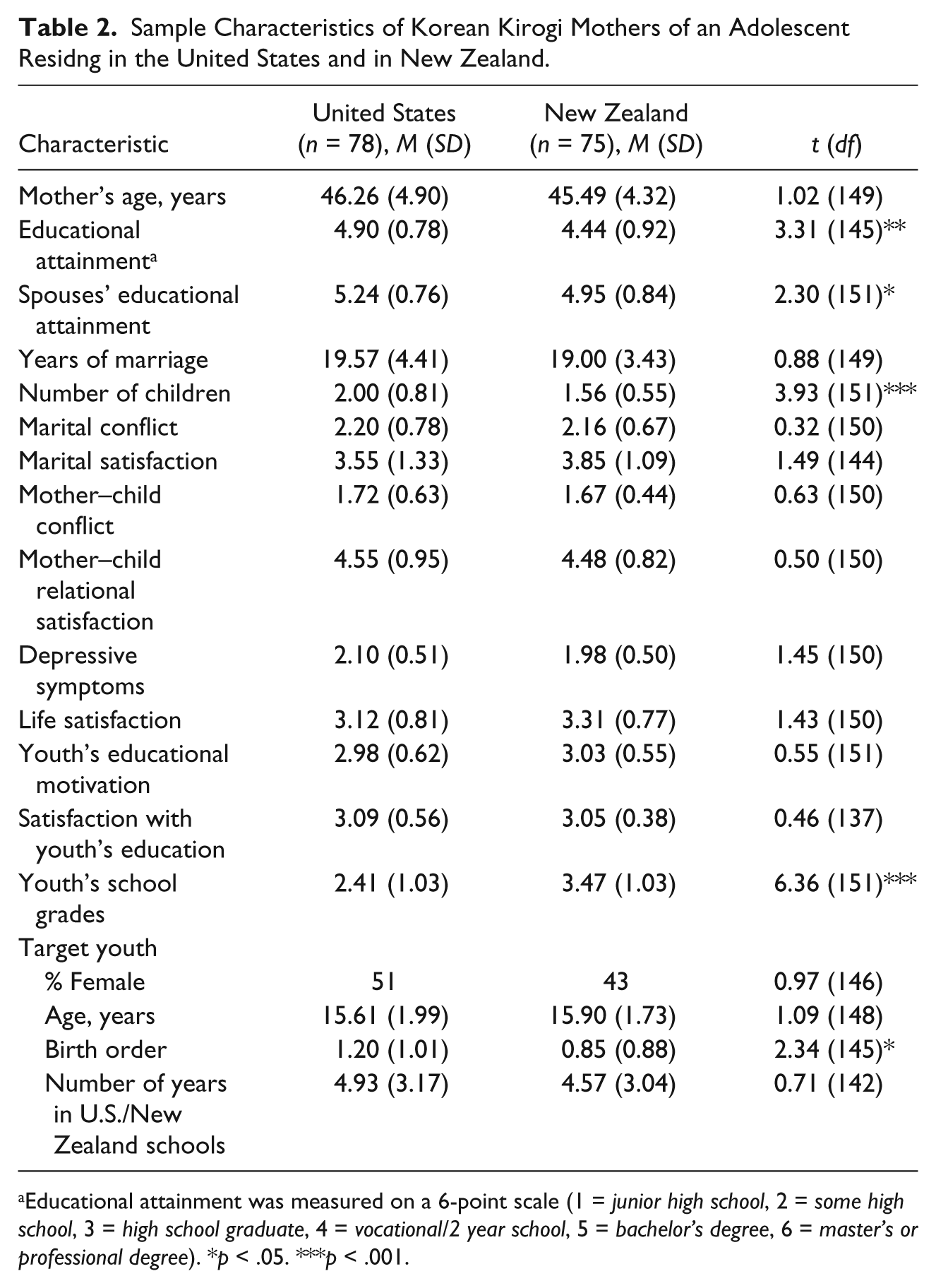
Educational attainment was measured on a 6-point scale (1 = junior high school, 2 = some high school, 3 = high school graduate, 4 = vocational/2 year school, 5 = bachelor’s degree, 6 = master’s or professional degree). *p < .05. ***p < .001.
Are Kirogi Mothers in the United States and in New Zealand Similar or Different?
The first research question tested for demographic (i.e., educational attainment, age, family size), psychological (i.e., depressed mood, life satisfaction, indices of mother–child relationship quality, indices of marital quality, youth’s educational progress), and motivational differences (i.e., reasons for living transnationally) between the U.S. and New Zealand subsamples of kirogi mothers. As expected, significant demographic differences were found but very few psychological and motivational differences were found (see Tables 1 and 2). As can be seen on Table 2, for example, kirogi mothers who resided in the United States and their husbands had somewhat higher educational attainment and had slightly more children on average than their counterparts who resided in New Zealand; but there were no significant differences in maternal age, target youth gender, age, and years of schooling overseas. There were also no significant mean level differences on psychological variables (i.e., marital quality, parental relationship quality, and well-being measures) between kirogi mothers residing in New Zealand and in the United States. Only one variable related to the target child was significantly different. Kirogi mothers in the United States reported much higher school grades of their youth than mothers in New Zealand (Ms = 4.59 and 3.53, respectively).
In terms of their motivation to live overseas, Table 1 illustrates that out of the eight reasons measured for living transnationally, only two were significantly different between the two samples of mothers. Table 1 also shows that most mothers residing in New Zealand cited children’s English language acquisition, and their interest in seeing that their child enter a top Korean university as reasons for living transnationally compared to mothers in the United States. Thus, it appears that New Zealand generally attracts kirogi families that are more traditional in their emphasis on mainstream Korean educational goals (need for English and desires for child to enter a top Korean university) but are very similar otherwise.
Is There Spillover Between Marital and Parent–Child Domains?
The second aim was to examine whether maternal reports of marital relationship satisfaction was significantly and positively correlated with mother–child relationship satisfaction and whether perceived marital problems would be significantly and positively correlated with mother’s report of conflict with youth. This would confirm a spillover between marital and parent–child domains and be consistent with much previous research based on families in coresidence. As can be seen on Table 3, there was evidence of spillover despite the prolonged separation and distance between spouses. Mothers’ reports of marital relationship problems were positively and significantly correlated with level of mother–child conflict (r = .37, p < .001), and marital satisfaction was also positively correlated with mother–child relationship saitsfaction, although to a lesser extent (r = .18, p < .05). It is interesting to note that positive indicators of relationship quality were not significantly associated with negative indicators of relationship quality (i.e., no evidence of crossover).
Descriptive Statistics and Correlations Among Key Study Variables.
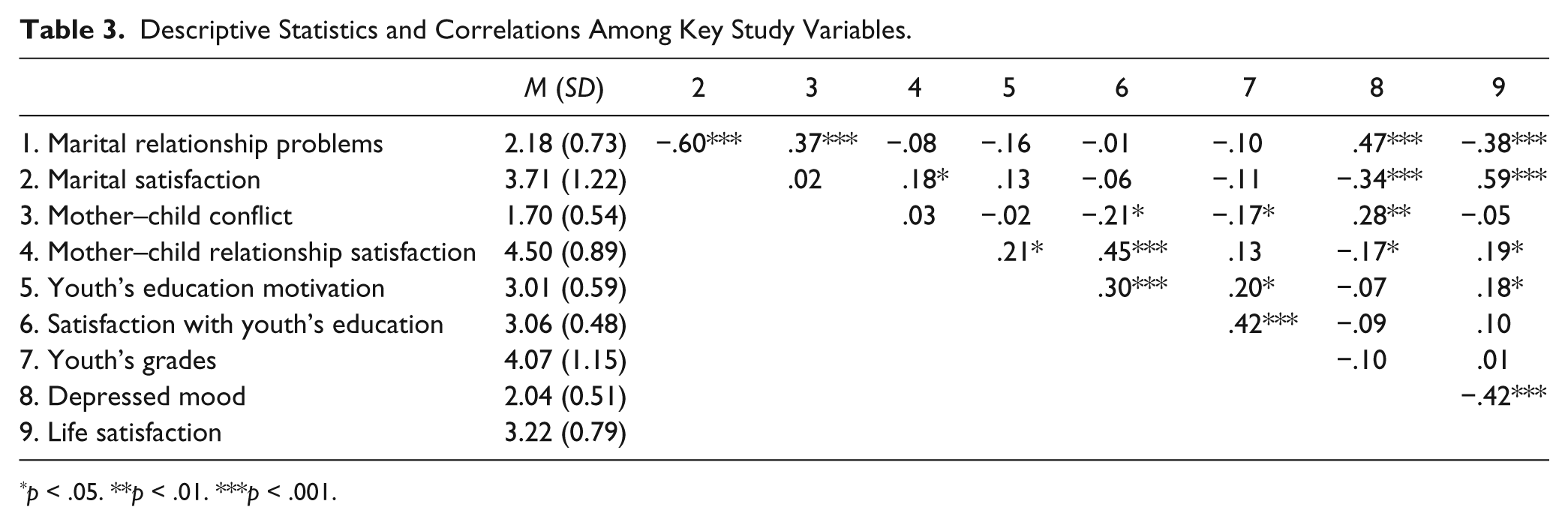
*p < .05. **p < .01. ***p < .001.
Does Youth’s Educational Adjustment Correlate With Maternal Psychological Adjustment?
Due to the heavy investment mothers have made in youth’s education, it was hypothesized that mothers’ perceptions of their youth’s educational adjustment would be significantly and positively correlated with life satisfaction and negatively correlated with depressed mood. Contrary to expectations, and as shown in Table 3, all three indicators of youth’s educational adjustment were not significantly correlated with either indicator of maternal psychological adjustment with one exception. Mother’s report of youth’s educational motivation was positively correlated with life satisfaction (r = .18, p < .05). Thus, there was little support for the suggestion that kirogi mothers’ well-being depended on youth’s educational progress. This was contrary to hypotheses, which were based on their motivations for living transnationally.
Which Family Bond Is Important for Understanding Maternal Psychological Adjustment?
Maternal Depressed Mood
A preliminary analysis was conducted to examine the extent to which social demographic factors needed to be controlled for in a regression analysis predicting depressed mood (i.e., mother’s educational attainment, mother’s age, youth’s gender, country of residence). Results indicated that youth’s gender was the only variable that was significantly associated with maternal self-report of depressive symptoms. Mothers reporting on a target daughter were significantly less depressed than mothers reporting on a target son, t (145) = 2.59, p < .05. Thus, youth’s gender was entered in Step 1 followed by indicators of marital relationship quality (i.e., marital satisfaction and marital problems) and mother–child relationship quality (i.e., mother–child relationship satisfaction and mother–child relationship conflict) in Step 2. It should be noted that since measures of youth’s educational progress (i.e., school grades, perceived educational motivation, and satisfaction with youth’s educational progress) were uncorrelated to mother’s report of depressed mood in the previous set of analyses, these variables were not included.
Results from hierarchical two-step linear regression analyses indicated that marital factors more than mother–child factors contribute uniquely to maternal depressive symptoms. The complete model accounted for 24% of the variance in maternal depressive symptoms, adjusted R2 = .243, F(5, 140) = 10.30, p < .001. Youth’s gender in Step 1 explained significant variance, adjusted R2 = .039; F(1, 144) = 6.85, p =.01, and the set of indicators for marital and mother–child relationship qualities explained significant additional variance, ΔR2 = .224; ΔF(4, 140) = 10.71, p < .001. Marital problems was the only independent variable that significantly and uniquely contributed to maternal depressive symptoms, B (SE) = .22 (.07), p < .01; β = .32. We also found that with the addition of Step 2 predictors youth’s gender (Step 1) became nonsignificant, indicating that family relationship dynamics explained the lower levels of maternal depression among mothers reporting on sons versus mothers reporting on daughters.
Life Satisfaction
The same preliminary analyses conducted on depressed mood were conducted on life satisfaction (see above) and indicated that social demographic variables in the study were not significantly associated with life satisfaction. Therefore, no demographic controls were included in multivariate analyses predicting maternal life satisfaction among kirogi mothers. Since perceived levels of youth’s educational motivation were significantly correlated with maternal life satisfaction, we included this measure with the two measures of relationship quality for the marital and the mother–child relationship for a total of five predictors.
Results did not support the hypothesis that quality of the mother–child relationship would be an important (i.e., unique) predictor of maternal life satisfaction despite cultural traditions that would predict such an outcome. The only predictor that was significantly and positively related to maternal life satisfaction was mothers’ marital satisfaction, B (SE) = .37 (.06), p < .001, β = .58. The complete model accounted for 35% of the variance in maternal life satisfaction, adjusted R2 = .350; F(5, 144) = 17.02, p < .001.
Discussion
This study set out to understand the extent to which the quality of different family bonds were associated with each other; as well as the unique contributions of marital and parental bonds and youth’s educational progress to kirogi women’s psychological adjustment. The present study was well suited to investigate these questions because of the relatively large sample size compared to past studies of kirogi families and the incorporation of two popular destinations (i.e., the United States and New Zealand). It was found that even though participants in the study lived transnationally from their husbands for long periods of time, and despite sharing in the Confucian-based cultural values that emphasize the importance of the mother–child bond, the results were generally consistent with the growing consensus among family scholars that the marital relationship is the foundation of all other family relationships (e.g., Erel & Burman, 1995).
Results from this study indicated that kirogi mothers’ well-being while overseas depended more on the quality of their marriages relative to the quality of their mother–youth bond or youth’s educational outcomes despite the prolonged and open-ended nature of their separation. These findings add significantly to the present literature on kirogi families in terms of knowledge content. It is the first to provide evidence that the quality of marital relationship varies systematically with kirogi women’s psychological adjustment despite their physical distance and the cultural emphasis on the mother–child relationship. Previous descriptive studies have concluded that it is possible to stay connected and intimate in a marriage due to physical distance (Jeong et al., 2013; Y. J. Lee & Koo, 2006). However, this study provides evidence that the quality of marriages matters more than relationships with youth and youth’s developmental outcomes.
The current study’s results may be due to the particular family life stage of the sample since all kirogi mothers were parenting a youth in middle or high school. Due to the increase in youth autonomy during this time, mothers may be refocusing or rearranging their priorities by shifting interest from childrearing to their marriages (Gorchoff, John, & Helson, 2008). As can be seen by the regression predicting maternal depression, the physical distance between spouses may make this time especially more difficult for overseas kirogi mothers experiencing marital difficulties rather than less immune from them. On the other hand, the more mothers were highly satisfied with the quality of their marriages while overseas, the happier they were perhaps because their overseas stay gave them greater freedom to pursue other life goals that were not pursued due to child care responsibilities. Thus, the flexibility of the family with an increasingly globalized world can be for better or for worse. It can be an opportunity for personal happiness given strong and healthy marital relationship quality but it can also be a trap for loneliness and depression given problematic and difficult marital relations despite physical separation. These results can be used to help transnational mothers make decisions related to living abroad with youth. Many may assume that greater parent–child investment can help to alleviate marital difficulties, particularly due to cultural scripts that value parental sacrifice. However, the current study results suggest that marital problems not only spillover to the parent–child relationship but also contribute more to depression than does their youth’s educational progress or relationship quality with mothers.
Contrary to hypotheses, there was no evidence that youth’s educational progress mattered for maternal well-being even though mothers personally sacrificed a great deal by immigrating to another country for the sake of their youth’s education. These findings suggest that kirogi mothers are not necessarily the stereotypical “tiger mothers” who push their kids to excel. Instead, kirogi mothers may be genuinely searching for the best educational environment for their youth and not necessarily concerned about school performance, per se. The lack of correlation between indicators of youth’s educational progress and mothers’ adjustment is also consistent with a past study of midlife mothers of older youth in college, which found that the same indicators of educational progress were not significantly related to mothers’ feelings of parenting satisfaction (Chang & Greenberger, 2012). Therefore, it is likely the case that youth’s academic functioning is not important to parents’ psychological adjustment despite the sacrifices some parents make for their children’s education.
This study contributes to the broader study of transnational families, which has mainly focused on working-class families originating from Latin America or the Philippines whereby parents separate from their children in search of financially rewarding work, which can reproduce global economic inequalities (Parreñas, 2005; Schmalzbauer, 2004, 2008). Contrary to this larger body of research, kirogi mothers are highly educated middle class women who settle in select countries not as workers but as consumers of English education. Thus, kirogi mothers do not have to cope with the difficulties of “mothering from afar,” such as managing the daily activities, food preparation, and emotional needs of their children indirectly through others who live with their child or children (Parreñas, 2005). Instead, they dedicate themselves to their youth’s academic socialization and English-language acquisition. Although they would be considered to be an “elite” among transnational families, it is important to keep in mind that they are also motivated by upward social mobility with the hopes of using global networks to maximize their buildup of cultural and human capital (K. Kim, 2009; H. Koo, 2007). Thus, future studies should examine the adult social, educational, and psychological outcomes of former kirogi youth to understand the extent to which this family strategy is successful and adaptive.
Since the current study relied on the responses of mothers during the time they resided in Western English-speaking countries, it is possible that cultural differences may have been underestimated. Future studies comparing transnational families with coresidential families in Korea and other familistic cultures can help to determine the role of culture in moderating the significance of the marital bond for family functioning and individual well-being. Despite this limitation, the current study suggests that even when women may be heavily invested in their parenting role, they generally do not rely on and invest in their children for their personal well-being. Rather, their relationship quality with spouses were unique and significant correlates to their well-being even though they do not live as a unit, which is similar to the pattern of coresidential couples. Thus, while rapid technological advancements and globalization appear to change the structure of families, these study results are consistent with a growing number of studies based on other types of transnational family forms (i.e., astronaut husbands, parachute kids, etc.) that indicate that family functions largely the same (e.g., Lam, Yeoh, & Law, 2002; Suárez-Orozco, Bang, & Kim, 2011).
Footnotes
Acknowledgements
The author acknowledges the research assistance received from Mihyun Ahn and Boram Lee.
Declaration of Conflicting Interests
The author(s) declared no potential conflicts of interest with respect to the research, authorship, and/or publication of this article.
Funding
The author(s) disclosed receipt of the following financial support for the research, authorship, and/or publication of this article: Partial funding for data collection was provided by the Pacific Basin Research Center at Soka University of America.