



Abstract
Although parenting is clearly linked to academic engagement in adolescence, less is known about links between parenting and academic engagement in emerging adulthood. A diverse sample of college students (N = 633; 53.1% female, 45.7% White/European American, 28.3% Asian American/Hawaiian/Pacific Islander, 26.4% Hispanic/Latino American, 21.6% Black/African American, and 2.8% Native American/American Indian) answered surveys about mothers’ and fathers’ parenting style, parent–offspring relationship quality, academic attitudes, academic behaviors, and academic performance. Emerging adults with more permissive mothers viewed grades as less important than emerging adults with less permissive mothers. Mothers’ authoritarian parenting, mothers’ permissive parenting, and relationship quality with father were differentially related to academic engagement depending on emerging adults’ gender. Both mothers’ and fathers’ parenting characteristics may affect the academic engagement of emerging adults via past parenting behaviors and current quality of the parent–offspring relationship, despite decreased physical proximity of emerging adults and their parents.
Although parenting is clearly linked to academic engagement among adolescents (Spera, 2005; Steinberg, Lamborn, Dornbusch, & Darling, 1992), less is known about links between parenting and academic engagement among emerging adults. Limited evidence suggests that parenting may have implications for academic engagement beyond adolescence, including study skills and grade point average (GPA; Turner, Chandler, & Heffer 2009; Weiss & Schwarz, 1996). Academic engagement is vital to emerging adults because of its association with college retention and starting salary (Svanum & Bigatti, 2009; Thomas, 2000).
According to Bronfenbrenner’s (1986) ecological systems theory, the family, as part of the microsystem, is one of the most proximal influences on the individual. However, as offspring age, physical proximity to parents tends to decrease (Arnett, 2000; Bailey, Haggerty, White, & Catalano, 2011), and it is unclear whether parenting from earlier periods of development has an enduring effect on academic engagement. It is also possible that current relationship quality between parents and emerging adults affects their academic engagement. Relationship quality refers to a sense of commitment and security which remains present despite decreased physical proximity, an indicator of the current relationship (Pierce, Sarason, & Sarason, 1991). In contrast, parenting style refers to behaviors that are more salient when offspring live in their parents’ home. Thus, this article aims to examine the associations of both parenting style and parent–offspring relationship quality, which we refer to as parenting characteristics, with emerging adults’ academic engagement.
Academic engagement is typically assessed with measures of academic performance such as GPA (e.g., Abar, Carter, & Winsler, 2009; Weiss & Schwarz, 1996), given the association between academic performance and college student retention (Allen, Robbins, Casillas, & Oh, 2008). However, academic performance is only one dimension of the broader construct of academic engagement. For instance, academic attitudes, such as achievement motivation and academic self-efficacy (Robbins et al., 2004), and academic behaviors, such as class attendance (Moore, 2003), are also components of academic engagement. In this article, we include academic attitudes (grade importance), academic behaviors (class attendance), and academic performance (GPA) to capture this broader construct. This inclusion of multiple components of academic engagement allows for a more nuanced understanding of the association between parenting characteristics and academic engagement, as various aspects of parenting may be differentially linked to academic attitudes, behaviors, and performance (e.g., Gonzalez, Doan Holbein, & Quilter, 2002).
Parenting Style
Baumrind (1966) identified four parental authority styles, each of which is theorized to differentially influence offspring: authoritative, authoritarian, permissive, and rejecting–neglecting. Following up on Baumrind’s (1966) work, Maccoby and Martin (1983) conceptualized parenting style on two dimensions: control/demandingness and warmth/responsiveness, though some researchers conceptualize the warmth/responsiveness dimension as support or acceptance (Strage & Brandt, 1999). In this conceptualization, authoritarian parents score high on control and low on warmth, permissive parents score high on warmth and low on control, and authoritative parents score high on control and warmth. The current article does not explore rejecting–neglecting (low control, low warmth) parenting, which is less frequently measured.
Because authoritative parenting is warm and responding but also conveys high demandingness, this style is more likely to facilitate secure attachment among offspring than authoritarian and permissive parenting (Ainsworth, 1979). According to attachment theory, secure attachment fosters an autonomous, exploratory style that facilitates positive working habits such as independent reading, planning for the future, and taking the initiative to solve academic problems. Securely attached students tend to have better academic performance and adjustment (Fass & Tubman, 2002; Holt, 2014; Larose, Bernier, & Tarabulsy, 2005; Mattanah, Lopez, & Govern, 2011). This process is consistent with Bowen’s (1978) theory that the differentiation of self from family, which is associated with secure attachment among college students (Skowron & Dendy, 2004), is important for adjustment outcomes in later life (Skowron, Wester, & Azen, 2004). Thus, these theories would posit that emerging adults with more authoritative parents would have better academic engagement, whereas emerging adults with more authoritarian or permissive parents would have worse academic engagement.
Empirical research has found that authoritative parenting is associated with emerging adults’ better study skills and higher GPA (Abar et al., 2009; Turner et al., 2009). Some research suggests that authoritative parenting may be more important for men’s GPA than for women’s GPA (Hickman, Toews, & Andrews, 2001). Authoritative parenting is also positively associated with academic adjustment (Hickman, Bartholomae, & McKenry, 2000; Love & Thomas, 2014). In contrast, authoritarian parenting is associated with poorer study skills for both genders (Abar et al., 2009), lower GPA for women (Wintre & Yaffe, 2000), but higher GPA for men (Weiss & Schwarz, 1996). Permissive parenting has not been found to be associated with GPA (Turner et al., 2009; Wintre & Yaffe, 2000), and is only marginally associated with better study skills (Abar et al., 2009). Thus, among emerging adults, there is some evidence that authoritative parenting is associated with better academic engagement. There are mixed findings for authoritarian parenting, and little evidence that permissive parenting is associated with academic engagement among emerging adults.
Quality of Parent–Offspring Relationship
Relationship quality is the strength of the interpersonal bond between parent and offspring; in particular, the current article focuses on relationship quality depth, or emerging adults’ feelings of commitment and security in their relationships with their mother and father (Pierce et al., 1991). Theories to explain the link between parent–offspring relationship quality and academic engagement propose that close emotional bonds provide a secure foundation for success in areas outside the family, including academic challenges (Crosnoe & Elder, 2004). Thus, high-quality parent–offspring relationships are considered beneficial (Aquilino, 2005).
There is little research on the associations between parent–offspring relationship quality and academic engagement among emerging adults. However, among adolescents, supportive relationships with parents, secure attachment, and low parent–offspring conflict predict better academic performance (Amato & Fowler, 2002; Crosnoe & Elder, 2004; Dotterer, Hoffman, Crouter, & McHale, 2008; Holt, 2014; Mattanah et al., 2011). Similarly, sense of belonging with parents is associated with academic motivation (Guay, Marsh, Senécal, & Dowson, 2008). These findings are consistent with the theory that close emotional bonds provide a secure foundation for success with academic challenges (Crosnoe & Elder, 2004). Thus, although there is little research on direct links between relationship quality and academic engagement, research on related constructs suggests an association between relationship quality and academic engagement.
Parents’ and Offspring’s Gender
Past work indicates that mothers’ and fathers’ parenting style are associated with emerging adults’ development, but these associations may differ by parent (Wintre & Yaffe, 2000). Some academic engagement research has assessed mothers’ and fathers’ parenting characteristics jointly (e.g., Love & Thomas, 2014; Strage & Brandt, 1999) or averaged mothers’ and fathers’ scores (e.g., Hickman et al., 2001). Others have assessed only one parent (e.g., Abar et al., 2009; Holt, 2014; Turner et al., 2009). Few studies have included both mothers’ and fathers’ parenting and their association with emerging adults’ academic engagement (for an exception, see Wintre & Yaffe, 2000). Unique assessment of mothers’ and fathers’ parenting is important, as it allows for the examination of relative associations of mothers’ and fathers’ parenting characteristics with academic engagement. Mothers and fathers frequently have different roles in the family; for instance, mothers’ parental involvement is perceived as high in almost all domains, whereas fathers are perceived as high in protection, teaching responsibility, and discipline (Finley, Mira, & Schwartz, 2008)—a more authoritarian role. Theoretically, these differences in perceived parenting may lead to unique influences on offspring. For instance, there are differences in how mothers’ and fathers’ parenting characteristics are associated with emerging adults’ substance use (Padilla-Walker, Nelson, Madsen, & Barry, 2008; Schwartz et al., 2009). In light of differences by parent gender, the current article considers mothers’ and fathers’ parenting characteristics separately.
In addition to postulating the importance of parenting in general, ecological systems theory suggests that parents’ influence on offspring will vary by individual characteristics such as gender (Bronfenbrenner, 1986). Thus, the associations between parenting characteristics and academic engagement may differ by offspring’s gender. It may be that offspring’s gender influences the way they respond to parenting because of inherent or socialized differences between men and women. For example, authoritative parenting is positively associated with men’s, but not women’s, GPA (Hickman et al., 2001). Additionally, the association between authoritarian parenting and GPA is negative for women, but positive for men (Weiss & Schwarz, 1996; Wintre & Yaffe, 2000). It may also be that individuals are more susceptible to the parenting of their same-gender parent because role modeling of the same-gender parent is highly salient to offspring. For instance, mothers’ permissiveness is associated with impulsiveness and indirectly associated with alcohol use and abuse for women, whereas fathers’ permissiveness is associated with these characteristics and behaviors for men (Patock-Peckham & Morgan-Lopez, 2006).
The Current Study
Given the importance of academic engagement for emerging adults, as well as ecological systems theory’s proposition that the family is influential (Bronfenbrenner, 1986), the current research examines whether mothers’ and fathers’ parenting characteristics are associated with academic engagement. To expand on previous research, we include mothers’ and fathers’ parenting characteristics separately, use gender as a moderator, and use multiple indicators of academic engagement. In summary, the aims of the current article are to: (a) examine the associations of parenting style and parent–offspring relationship quality with academic engagement (attitudes, behaviors, and performance) and (b) determine whether these associations differ by parent and offspring gender. Based on past research, we expect that emerging adults with more authoritative parents will have better academic engagement, whereas emerging adults with more authoritarian or permissive parents will have worse academic engagement. We expect that emerging adults’ academic engagement will be more highly associated with the parenting characteristics of their same-gender parent than the parenting characteristics of their opposite-gender parent.
Method
Participants
Participants were part of the University Life Study, a longitudinal study of undergraduate students at a large, Northeastern university. The University Life Study used a longitudinal burst design, with participants responding to a web-based survey and 14 consecutive daily surveys for 7 consecutive semesters. Eligibility requirements included being a first-year, full-time student under the age of 21 years at the beginning of the study, being a U.S. citizen or permanent resident, and residing within 25 miles of campus. Participants were selected via stratified sampling to recruit a diverse sample with respect to gender and the four largest race/ethnicity categories. Control variables were assessed in Semester 1 (S1), perceived recent relationship quality was assessed in Semester 4 (S4), and perceived past parenting style and academic engagement were assessed in Semester 5 (S5); thus, the current article used data from S1, S4, and S5. A total of 744 participants provided consent and completed the S1 baseline survey, a response rate of 65.6%. The retention rate (i.e., percentage that completed the S4 and/or S5 survey) was 91.9% (N = 684). Due to missing data, the final analytic sample was 85.1% (N = 633).
The final analytic sample (N = 633) was 53.1% female, aged 19 to 22 years at S5 with a mean age of 20.5 years (SD = 0.5). Participants could identify as more than one race or ethnicity; thus, the sample was 45.7% White/European American, 28.3% Asian American/Hawaiian/Pacific Islander, 26.4% Hispanic/Latino American, 21.6% Black/African American, and 2.8% Native American/American Indian (although stratification occurred with respect to the four largest race/ethnicity categories, some participants identified as Native American/American Indian and were included in analyses). We used five t tests and seven chi-squares to determine whether participants in the analytic sample differed from participants not in the analytic sample on S1 variables. Participants in the analytic sample were more likely to be female (χ2 = 8.8, p < .01), more likely to have married parents in S1 (χ2 = 3.3, p < .05), more likely to identify as Hispanic/Latino American (χ2 = 3.5, p < .05), less likely to identify as Asian American/Hawaiian/Pacific Islander (χ2 = 4.2, p < .05), and viewed grades as more important at S1 (t = 2.4, p < .001) than participants not in the analytic sample. Groups did not differ on age, parents’ education, other races, S1 class attendance, or high school grades. Parenting characteristics were only measured in later semesters, and therefore could not be compared.
Procedures
Eligible participants received recruitment letters with a $5 preincentive and a pen in the fall of their first year at the university. At S1, S4, and S5, participants earned $20 to $40 for completing the larger survey, $3 per day for completing each daily survey, and a $13 to $18 bonus for completing all 14 daily surveys. The study was approved by the university’s institutional review board and participant confidentiality was protected by a federal certificate of confidentiality.
Measures
Perceived Past Parenting Style
In S5, participants responded to items from the Parental Authority Questionnaire (Buri, 1991) to assess three parenting styles: authoritative parenting (e.g., “As I was growing up, once family policy had been established, my father discussed the reasoning behind the policy with the children in the family”), permissive parenting (e.g., “As I was growing up, my father seldom gave me expectations and guidelines for my behavior”), and authoritarian parenting (e.g., “Whenever my father told me to do something as I was growing up, he expected me to do it immediately without asking any questions”). Because of survey length, we used 5 of the original 10 items for each of the three subscales, for a total of 15 questions. Two items, one from the mothers’ authoritativeness scale and one from mothers’ permissive scale, were removed due to low factor loadings. These items were also removed from the fathers’ scales for consistency between mothers’ and fathers’ scales. Participants rated their agreement with each statement separately for their biological or adoptive mother and biological or adoptive father on a 5-point scale ranging from strongly disagree (1) to strongly agree (5). Reliability of the subscales was adequate: α = .72, for mothers’ and α = .78, for fathers’ authoritativeness; α = .78/.82, for authoritarianism; and α = .67/.69, for permissiveness; and comparable to earlier work using the longer subscales with emerging adults (α = .74-.87; Buri, 1991).
Perceived Recent Parent–Offspring Relationship Quality
In S4, participants separately rated the quality of their relationship with their biological or adoptive mother and their biological or adoptive father using the Depth subscale from the Quality of Relationships Inventory (six items; Pierce et al., 1991). Participants answered questions (e.g., “How significant is this relationship in your life?”) on a 4-point scale from not at all (0) to a lot (3). Reliability in the current sample was adequate: α = .91, for mothers and α = .94, for fathers, and comparable to the original research with emerging adults (α = .83-.86; Pierce, 1994; Pierce et al., 1991).
Importance of Grades
At S5, participants responded to the prompt, “Getting good grades is important to you,” on a 5-point scale from not at all (0) to very important (4; Rhoades & Maggs, 2006).
Recent GPA
Past research has shown that self-reported academic performance is a valid measure of actual performance (Cole & Gonyea, 2010). In S5, participants reported their most recent semester GPA on an 11-point scale from less than .99 to 4.0, which was recoded so that the GPA scale went from 0 to 4.0.
Recent Class Attendance
For up to 14 days in S5, participants responded to the question, “Did you attend all your classes?” Scores were calculated as the ratio of days on which participants attended all their classes to their total number of days with classes. All participants who responded on at least 1 day were included. Participants who did not report class on any daily surveys were excluded from analyses using this variable (n = 13).
Covariates
Because research has demonstrated that gender, parents’ education, parental marital status, and race/ethnicity may be associated with parenting style or moderate the association between parenting and offspring’s outcomes (Dornbusch, Ritter, Leiderman, Roberts, & Fraleigh, 1987; Gasper, Stolberg, Macie, & Williams, 2008; Kapungu, Holmbeck, & Paikoff, 2006), we included gender, parents’ education, parental marital status, and race/ethnicity as covariates in all analyses.
Gender
At S1, participants reported their gender, coded as male (1) or female (0).
Parents’ education
At S1, participants answered, separately for their mother and father, “What is the highest level of education your mother/father (or female/male guardian) completed?” Response choices ranged from completed grade school or less (0) to graduate or professional school after college (5). If participants reported both parents’ education, responses were averaged. Otherwise, the single response was used in analyses. Participants who responded don’t know or does not apply for both parents were excluded (n = 10).
Parental marital status
Parents’ marital status was assessed at S1, and marital status changes were assessed in subsequent semesters. If participants reported at S1 that their biological or adoptive parents were married to each other, and did not report a marital status change by S5, they were coded as parents married (1). All other nonmissing responses were coded as parents not married (0), indicating that their biological or adoptive parents were not married to each other.
Race/ethnicity
Participants reported whether they identified with five racial/ethnic categories: White/European American, Asian American/Hawaiian/Pacific Islander, Hispanic/Latino American, Black/African American, and Native American/American Indian. Dichotomous variables represent whether participants identified as a particular race/ethnicity (1) or not (0). Thus, in analyses, there were four total race/ethnicity variables, with White/European American as the reference group.
Results
Means and standard deviations for parenting characteristics, grade importance, class attendance, and GPA are presented in Table 1. As gender was a moderator of interest, correlations between variables, separately by gender, are also presented in Table 1. To address both Aims 1 and 2, we performed 12 regressions. We centered parenting variables, gender, and covariates. For each parenting characteristic (authoritative, authoritarian, permissive, relationship quality), we performed three regression models, to address grade importance, class attendance, and GPA. Each model included covariates in Step 1, mothers’ and fathers’ parenting characteristic variables in Step 2, and the interactions of the parenting characteristic variables with offspring gender in Step 3. Step 2 tests the associations of parenting style and parent–offspring relationship quality with academic engagement (Aim 1), and Step 3 tests whether these associations differ by parent gender and by offspring gender (Aim 2).
Correlations by Gender.

Note. ATT = authoritative parenting; ARN = authoritarian parenting; PER = permissive parenting; RQ = relationship quality; GPA = grade point average. Correlations above the diagonal represent the correlations for women (N = 296-338); correlations below the diagonal represent the correlations for men (N = 252-300).
p < .05. **p < .01.
Authoritative Parenting
Neither Step 2 nor Step 3 in the models with authoritative parenting were significant, indicating that mothers’ and fathers’ authoritative parenting were not associated with grade importance, class attendance, or GPA (Table 2). Results were consistent with the bivariate correlations (Table 1).
Standardized Coefficients in Linear Regressions for Authoritative Parenting.

Note. GPA = grade point average; AA/H/PI = Asian American/Hawaiian/Pacific Islander; H/L = Hispanic/Latino American; B/AA = Black/African American; NA/AI = Native American/American Indian; ATT = authoritative parenting.
p < .05. **p < .01. ***p < .001.
Authoritarian Parenting
For grade importance, the change in R2 for Step 2 was significant (ΔR2 = .02, p < .01). Mothers’ authoritarian parenting was significant, indicating that emerging adults with more authoritarian mothers tended to view grades as more important than emerging adults with less authoritarian mothers. In Step 3, the change in R2 was also significant (ΔR2 = .01, p < .05; Table 3). Specifically, the interaction between gender and mothers’ authoritarian parenting was significant, indicating that men with more authoritarian mothers tended to view grades as more important, whereas this association was weaker for women (Figure 1).
Standardized Coefficients in Linear Regressions for Authoritarian Parenting.
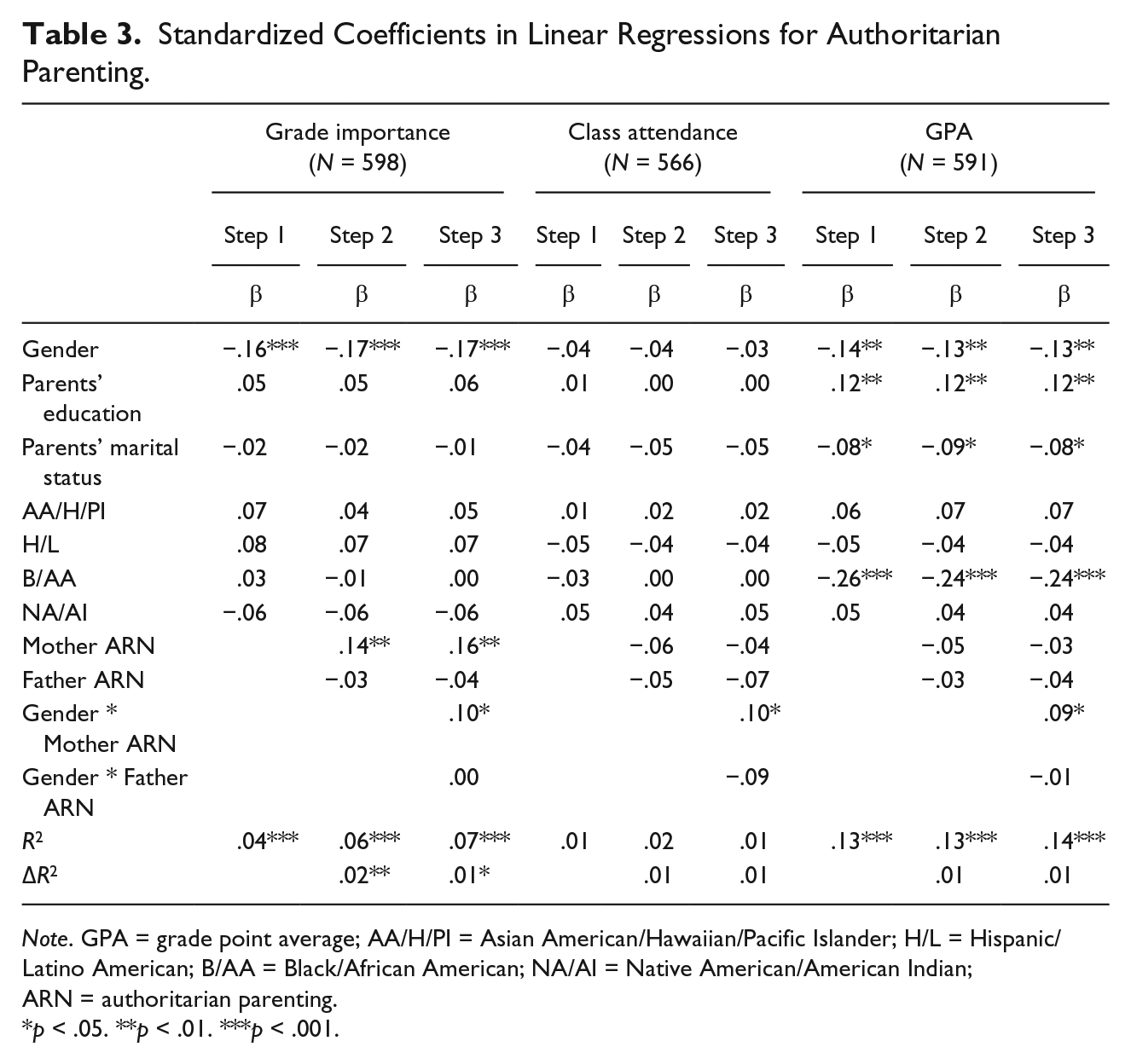
Note. GPA = grade point average; AA/H/PI = Asian American/Hawaiian/Pacific Islander; H/L = Hispanic/Latino American; B/AA = Black/African American; NA/AI = Native American/American Indian; ARN = authoritarian parenting.
p < .05. **p < .01. ***p < .001.

Interactions of gender with mother authoritarianism, mother permissiveness, and relationship quality (RQ) with father.
For class attendance and GPA, the changes in R2 for Step 2 and Step 3 were not significant. However, in Step 3 there were significant interactions between gender and mothers’ authoritarian parenting for class attendance and GPA (Table 3). Because it is difficult to detect interaction effects in regression models (McClelland & Judd, 1993), we chose to interpret the significant interactions even though the change in R2 was not significant. Women with more authoritarian mothers tended to attend class less frequently and have lower GPAs (Figure 1), whereas this association was weaker for men. Results were consistent with the bivariate correlations (Table 1).
Permissive Parenting
For grade importance, the change in R2 for Step 2 was significant (ΔR2 = .01, p < .05). Mothers’ permissive parenting was significant, indicating that emerging adults with more permissive mothers tended to view grades as less important. In Step 3, the change in R2 was also significant (ΔR2 = .01, p < .05; Table 4). Specifically, the interaction between gender and mothers’ permissive parenting was significant, indicating that men with more permissive mothers tended to view grades as less important, whereas this association was weaker for women (Figure 1). The regression results for grade importance and GPA were consistent with the bivariate correlations. For class attendance, whereas permissive parenting was not significant in the regressions, the bivariate correlations showed mother’s permissiveness was positively associated with class attendance for women (Table 1).
Standardized Coefficients in Linear Regressions for Permissive Parenting.

Note. GPA = grade point average; AA/H/PI = Asian American/Hawaiian/Pacific Islander; H/L = Hispanic/Latino American; B/AA = Black/African American; NA/AI = Native American/American Indian; PER = permissive parenting.
p < .05. **p < .01. ***p < .001.
Relationship Quality
The change in R2 for Step 2 was not significant, indicating that parent–offspring relationship quality was not associated with grade importance, class attendance, or GPA (Table 5). These regression results were in contrast with the bivariate correlations, which show that relationship quality with mother was positively associated with grade importance, class attendance, and GPA for women, and that relationship quality with father was positively associated with GPA for women and with grade importance and GPA for men (Table 1). For grade importance, the change in R2 for Step 3 was significant (ΔR2 = .01, p < .05; Table 5). The significant interaction between gender and relationship quality with father indicated that men with better quality relationships with their fathers tended to view grades as more important, whereas this association was weaker for women (Figure 1).
Standardized Coefficients in Linear Regressions for Relationship Quality.
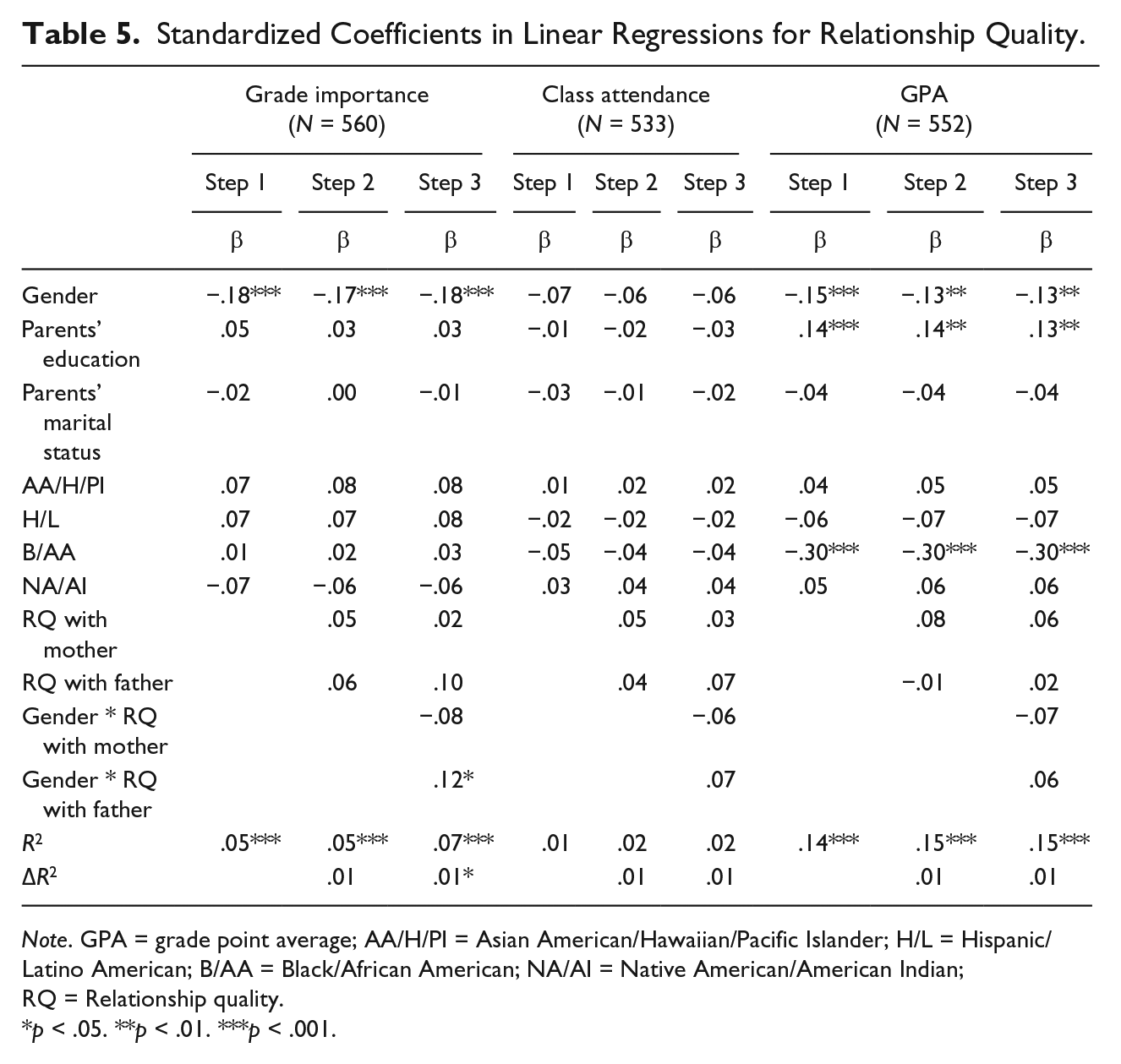
Note. GPA = grade point average; AA/H/PI = Asian American/Hawaiian/Pacific Islander; H/L = Hispanic/Latino American; B/AA = Black/African American; NA/AI = Native American/American Indian; RQ = Relationship quality.
p < .05. **p < .01. ***p < .001.
Step 1 included control variables. It is notable that across regression analyses, men tended to view grades as less important and had lower GPAs than women. Also, emerging adults with less educated or unmarried parents, and emerging adults who identified as Black/African American, tended to have lower GPAs than other emerging adults (Tables 2-5).
Discussion
The current article examines links between parenting characteristics and emerging adults’ academic engagement. Findings expand on previous research by demonstrating gender differences in the associations between both mothers’ and fathers’ parenting characteristics and academic engagement. Historically, research on parenting and emerging adulthood has not identified the differential role of mothers and fathers. However, research has begun to address this concern in areas outside of academic engagement (e.g., Padilla-Walker et al., 2008). By including both parents, we were able to examine how mothers’ and fathers’ parenting characteristics distinctly related to male and female emerging adults’ academic engagement.
Results indicate notable gender differences. With regard to academic attitudes, men whose mothers were more authoritarian and who had better quality relationships with their fathers viewed grades as more important, whereas these associations were weaker for women. Men whose mothers were more permissive viewed grades as less important, an association that was also weaker for women. Additionally, overall, men viewed grades as less important than women did. Baumrind’s (1966) original theory posits that parenting style affects offspring’s characteristics, and thus, men’s attitudes may be affected by parenting style and parent–offspring relationship quality. In contrast to women, who already have a stronger orientation toward grades than men do, men’s academic attitudes may be contextually influenced by authoritarian parenting, permissive parenting, and relationship quality.
Consistent with past research (Wintre & Yaffe, 2000), women with more authoritarian mothers attended class less frequently and performed more poorly in classes; these associations were weaker for men. Women perform more poorly under pressure than men do (Shurchkov, 2012), and thus, women may experience the high demandingness of authoritarian parenting (Baumrind, 1966) as high pressure, resulting in lower academic engagement. However, conclusions should be made with caution because the interaction between gender and mothers’ authoritarian parenting did not add significantly to the variance in academic behaviors and performance.
Results indicate a positive association between mothers’ authoritarian parenting and academic attitudes (grade importance) for men. Past work with adolescents indicates that authoritarian parenting is associated with performance orientation (orientation toward getting high grades) instead of mastery orientation (orientation toward understanding concepts; Gonzalez et al., 2002). Emerging adults with authoritarian mothers may also be oriented toward high grades, thus reflected in grade importance. In this case, grade importance would reflect a continuation of performance orientation from adolescence. Individuals with mastery orientation tend to be more persistent and engage in more challenging work, and hence, some scholars argue that mastery is the preferred orientation (Gonzalez et al., 2002). Thus, although we conceptualized grade importance as a positive attitude given associations of GPA with college retention and starting salary (Allen et al., 2008; Thomas, 2000), grade importance may reflect a less preferable academic attitude, performance orientation.
Overall, parenting characteristics were more frequently associated with academic attitudes than with behavior or performance. We speculate that for emerging adults living on a university campus, many ecological factors (e.g., social interactions with friends, roommates, romantic partners, and instructors; academic and nonacademic activities) may influence academic behaviors and performance more strongly than parenting characteristics do. These more proximal factors may be particularly salient during college, when emerging adults make their own time-use decisions, compared with during high school, when parents structure more of adolescents’ time. For example, the current research was consistent with previous research that has failed to show associations between specific parenting styles and emerging adults’ academic behaviors and performance (Abar et al., 2009; Turner et al., 2009; Wintre & Yaffe, 2000). However, past work has demonstrated associations between parenting style and adolescents’ academic behaviors and performance (Aunola, Stattin, & Nurmi, 2000; Dornbusch et al., 1987; Heaven & Ciarrochi, 2008). Because the current article measured academic attitudes, behaviors, and performance, we reason that physical proximity to parents may be more important for behaviors and performance than for attitudes.
In contrast to predictions, we did not find that emerging adults with more authoritative parents had better academic engagement, as would be suggested by attachment theory (Ainsworth, 1979; Fass & Tubman, 2002; Holt, 2014; Larose et al., 2005; Mattanah et al., 2011). Because we did not assess attachment style, we do not know its association with parenting characteristics in the current sample. It may be that our measure of authoritative parenting is not an indicator of attachment style. However, it may be that secure attachment, as facilitated by authoritative parenting, is not as important in academic pursuits as it is in social pursuits (Wei, Russell, & Zakalik, 2005).
Limitations and Future Research
The current article has some limitations which could be addressed in future research. First, future research should consider a longitudinal design in which parenting characteristics are assessed across adolescence and emerging adulthood, to determine if associations between parenting characteristics and academic engagement endure beyond adolescence. Longitudinal research also should examine parents’ relative influence at different points in college and how parents influence the trajectory of academic engagement over time.
Second, our sample size allowed us to detect relatively small effect sizes for the associations between parenting characteristics and academic engagement; thus, although we found statistically significant associations, the amount of variance in academic engagement explained by parenting style was relatively small. Future work should address other ecological factors that also contribute to emerging adults’ academic engagement, as discussed above.
Third, future research should examine moderators, which could illuminate circumstances under which parenting characteristics are more or less strongly associated with academic engagement. For instance, ethnic/racial group may moderate this association, as some scholars have argued that the construct of parenting style may have different meanings for different ethnic and racial groups (Quintana et al., 2006). Other possible moderators of the association between parenting style and academic engagement include residential status (living at home vs. away), difficulty of major, and communication with parents. Fourth, future research should examine mechanisms involved in the association between parenting characteristics and academic engagement, such as achievement orientation, academic self-regulation, emotional support, sense of well-being, and social integration.
There are several opportunities for future research to improve measurement in the area of parenting style and academic engagement. Reliability of the parenting style measure in our sample was lower than in past research (Buri, 1991), perhaps because we only used half of the original items. The current article used self-reported GPA based on evidence of its validity (Cole & Gonyea, 2010). However, other research questions the validity of self-reports of academic performance (Caskie, Sutton, & Eckhardt, 2014), suggesting that future research should use primary sources of grades. Additionally, grade importance was measured by a single item with limited variability, and future research should use more rigorous measurement of academic attitudes. Future research should also address domains of academic engagement that were not included in the current article, such as scholarly interactions with classmates and peers, time spent studying, and engagement in internships or research projects (Kuh, 2001).
Conclusions
Overall, our findings provide some support for Bronfenbrenner’s (1986) ecological systems theory, in that mothers’ parenting style and fathers’ relationship quality were associated with emerging adults’ academic engagement. Past parenting style and current parent–offspring relationship quality may be important not only in adolescence, when individuals live in closer proximity to their parents, but also during emerging adulthood. This phenomenon appears to be stronger for academic attitudes than for academic behavior or performance. Additionally, results suggest that individuals’ characteristics, specifically gender, interact with the microsystem (Bronfenbrenner, 1986); mothers’ authoritarian parenting and relationship quality with father were differentially related to academic engagement depending on emerging adults’ gender. Thus, although we cannot determine causality, there is theoretical support for the enduring association of parenting style and the current association of relationship quality with college students’ academic engagement.
Footnotes
Authors’ Note
The content is solely the responsibility of the authors and does not necessarily represent the official views of the National Institute on Alcohol Abuse and Alcoholism, the National Institute on Drug Abuse, or the National Institutes of Health.
Declaration of Conflicting Interests
The author(s) declared no potential conflicts of interest with respect to the research, authorship, and/or publication of this article.
Funding
The author(s) disclosed receipt of the following financial support for the research, authorship, and/or publication of this article: This research was supported by Grant RO1 AA016016 from the National Institute on Alcohol Abuse and Alcoholism to Dr. Jennifer Maggs, and by Grants T32 DA017629, P50 DA10075, and P50 DA039838 from the National Institute on Drug Abuse.