




Abstract
Although research has documented the negative effects of family transitions generally on child and maternal outcomes, transitions into and out of mothers’ relationships with partners who are not the father(s) of their child(ren) are less well understood. Through thematic analysis of semistructured interviews, this study investigated how 21 mothers and their 21 children (aged 9 to 18 years) responded to mothers’ relationship formation following the dissolution of previous relationships. Mothers tried to protect their children from the negative impact of family instability by either limiting contact with partners or maintaining continuity through continued child contact with former partners. When faced with relationship transitions, children endeavored to manage threats to their relationships with their mothers and their mothers’ former partners. When children felt they successfully managed these threats, they were more positive about their mothers’ subsequent partners. The tension between the strategies adopted by mothers and children has implications for family practitioners.
As a result of demographic shifts in relationship formation and childbearing, children are increasingly liable to be exposed to changes in family structure over the course of their childhood (Teachman & Tedrow, 2008). A growing number of children have experienced family instability, as their parents move into and out of relationships (Bumpass & Lu, 2000; Lunn, Fahey, & Hannan, 2010). To date, research on family instability has tended to focus on its influence on child and maternal outcomes, rather than its influence on subsequent family relationships. This study aims to fill this gap by investigating how mothers and children approach mothers’ new romantic relationships after experiencing the dissolution of at least one previous romantic relationship where the mother was dating a partner who is not the other parent of their child(ren) (sometimes called stepparents). This study focuses specifically on maternal relationship instability because most children of unmarried parents in Ireland live primarily with their mothers (Hadfield & Nixon, 2012, 2013) and, thus, mothers’ transitions into and out of romantic relationships are likely to be more proximal to the children involved.
Family Transitions
Family transitions are typically considered to occur when a residential parent (i.e., a parent whose child lives with them the majority of the time) dissolves or enters into a romantic relationship—this can involve marriage, divorce, cohabitation, or entrance into or dissolution of a dating relationship. Although some aspects of transitioning into a relationship are neutral or positive—such as mothers’ declines in material hardship or depression levels (Osborne, Berger, & Magnuson, 2012) and improvements in child behavior for children from higher income families (Ryan, Claessens, & Markowitz, 2015)—in general, residential family transitions tend to be stressful and negative for mothers and children (Magnuson & Berger, 2009). Both residential and dating transitions increase maternal stress and harsh parenting (Beck, Cooper, McLanahan, & Brooks-Gunn, 2010), with the introduction of a cohabiting stepfather negatively influencing mother–adolescent closeness (King, 2009). Furthermore, these transitions are associated with delinquency, conduct problems, behavior problems, psychological distress, and poorer health for residential children. These outcomes have been found where transitions are operationalized as occurring through residential or marital changes (e.g., Bachman, Coley, & Carrano, 2011; Bzostek & Beck, 2011; Goodnight et al., 2013; Magnuson & Berger, 2009) and where transitions are operationalized as total maternal partnership changes, regardless of residence of partner (e.g., Cooper, Osborne, Beck, & McLanahan, 2011; Osborne & McLanahan, 2007). Family instability continues to have an impact on the children involved across their life course; being associated with a reduced likelihood of university completion, early family formation, an increased likelihood of having multiple marriages, and for men to have children outside of marriage (Fomby & Bosick, 2013; Hofferth & Goldscheider, 2010).
The negative effects of family transitions in general on child and maternal outcomes have been well documented, but those transitions specifically involving a mother and her romantic partner who is not the other parent of her child(ren) are less well understood. Research indicates that mothers’ transitions into or out of relationships with men who are not the father(s) of their child(ren) are important to child outcomes (Beck et al., 2010; Cooper et al., 2011; Osborne & McLanahan, 2007; Ryan et al., 2015), but these are often grouped together with transitions into or out of relationships with the child(ren)’s father (e.g., Goodnight et al., 2013). Approximately 50% of the children born to unmarried mothers in the Fragile Families study had experienced three or more transitions by 5 years of age (Cooper, McLanahan, Meadows, & Brooks-Gunn, 2009), indicating that mothers who are unmarried at the birth of their child are relatively likely to transition into and out of relationships with men who are not the biological fathers of the child. One third of the children in the National Longitudinal Survey of Youth experienced at least one family transition between the ages of 6 and 12 years (Magnuson & Berger, 2009) indicating that these transitions are relatively common in nationally representative samples as well. Considering that the chance of transitioning out of a marriage/cohabiting relationship or into a new relationship increases with time and stepfamilies have traditionally resulted from couplings that contain older children (Teachman & Tedrow, 2008), it is likely that there is a significant group of children who have multiple experiences of their mother’s transitions into and out of romantic relationships with men who are not their fathers.
It is difficult to evaluate the impact of a mother transitioning into or out of a relationship specifically with a man who is not the father of her child(ren) because most research on family transitions consolidates all family transitions together (e.g., Bachman et al., 2011), focuses on the transition into or out of a first family (e.g., Hogan, Halpenny, & Greene, 2003), or into a stepfamily (e.g., Kinniburgh-White, Cartwright, & Seymour, 2010). This is problematic because it is not just the number of family structure transitions that can affect well-being but also the type of transition (Cooper et al., 2009). In one study that directly looked at stepfamily transitions, Osborne et al. (2012) found entering a residential stepfamily was associated with neutral or positive effects for maternal well-being, whereas stepfamily dissolution was associated with adverse effects. The introduction of a stepparent or a mother’s partner to a family is associated with an extended period of destabilization and stress (Beck et al., 2010; Hetherington & Kelly, 2002). Unlike in a transition from a two-parent biological family to a single-parent family, the person transitioning into and out of these families is not the child’s biological parent—it is the mother’s partner. The experience of a mother’s partner’s transition into and then out of a child’s life may establish a different context for relationship development with mothers’ subsequent partners than that established by the transition out of a two-parent biological family. It is unclear how mothers and children experience the dissolution of these relationships and how this shapes the context of the development of mothers and children’s subsequent relationships with mother’s partners. This study seeks to address this gap in the literature.
Ganong and Coleman (2004) define a stepfamily as a family:
In which at least one of the adults has a child (or children) from a previous relationship. . . . A stepparent and stepchild do not have to live together all of the time, or even part of the time, to have a relationship together and to share family membership. (p. 2)
By this definition, a romantic partner of a mother or father is a stepparent, and stepfamily membership is not necessarily dictated by residential or marital status. This definition of stepfamilies has been used by others, who similarly conceptualize nonresident, romantic partners of a parent to be stepparents (e.g., Suanet, van der Pas, & van Tilburg, 2013). However, most studies of stepfamilies take a narrower approach—operationalizing stepfamilies as only those involving a residential parent’s marriage (e.g., Ganong, Coleman, Fine, & Martin, 1999), a residential parent’s marriage or cohabitation (e.g., Teachman & Tedrow, 2008), or either parents’ marriage or cohabitation (e.g., Stewart, 2001). Thus, although many scholars would consider the mothers’ partners in this study to be stepparents, others would only give them that title following cohabitation or marriage. For this reason, we consistently refer to the romantic partners of the mothers in this study as mothers’ partners rather than stepparents while simultaneously drawing on the stepfamily literature.
Development of Relationships Between Children and Their Parents’ Partners
There is limited research specifically focusing on how mothers’ nonresidential partners (i.e., a partner who does not live the majority of the time with the mother) influence child outcomes, but having a close relationship with a residential stepfather is beneficial for children, being associated with fewer internalizing and externalizing problems, fewer failing grades, as well as decreases in depressive symptoms (King, 2006; King, Amato, & Lindstrom, 2015). However, many stepchildren do not develop a close relationship with their stepparent(s) (Hadfield & Nixon, 2012; King, 2006). Difficulties relating to acquiring a stepparent have been offered as an explanation of why stepchildren tend to have lower levels of well-being than children in nuclear families (Ganong & Coleman, 2004), so it is important to understand why some children develop warm and positive relationships with their parents’ partners while others do not. Some children are reluctant to develop a relationship with a stepparent regardless of the stepparent’s affiliation-seeking efforts (Ganong et al., 1999). Ganong, Coleman, and Jamison (2011) found that some children disliked their residential or nonresidential stepparent from the start and continuously rejected a relationship with him or her; these children perceived that there were no benefits to a relationship with their parent’s partner. A number of factors appear to influence children’s rejection of a relationship with their parents’ romantic partner, such as child’s age, the genders of the stepparent and stepchild, the quality of the mother–child relationship, and children’s views of the stepparents’ personal qualities (Ganong et al., 2011; King et al., 2015; Kinniburgh-White et al., 2010). Presumably, any experience children had with previous partners of their parents’ would also have an impact on children’s predisposition toward their parents’ subsequent partners, but this has not been considered in previous research.
Mothers are central to the development of stepparent–stepchild relationships (Weaver & Coleman, 2010). There is powerful societal pressure for mothers to act as a protector against threats to their children (Hays, 1996). Mothers see themselves as having a “mother-in-charge” role which involves them, “directing and controlling their children’s behavior” (Nelson, 2006, p. 783) to safeguard their children and create a positive family environment (Weaver & Coleman, 2010). Mothers engage in gatekeeping behaviors that facilitate or inhibit their partners’ involvement in their child(ren)’s lives. Gatekeeping is typically investigated in the mother–father relationship, but it has been suggested that “mothers might exert even more control over stepfather-stepchild relationships than they do over relationships between biological fathers and children” (Adamsons, O’Brien, & Pasley, 2007, p. 142). Therefore, it is important to include mothers’ perspectives when investigating relationships between children and mothers’ partners.
Theoretical Frameworks
Primarily, this study is guided by the bilateral model of parent–child relations (Kuczynski, 2003), which characterizes parent–child relationships as having bidirectional influences, interdependent power asymmetry, and equal agency. This framework has a dialectical orientation. Parent–child power dynamics take place in the context of an interdependent relationship, and thus, although there may be absolute differences in power, children and parents both have resources on which they can draw. Parents attempt to balance the vertical and horizontal elements of their relationships with their children in order to accommodate companionship and mutual enjoyment in these relationships (Nixon, Greene, & Hogan, 2012). Both children and mothers are concerned with maintaining a close and cohesive relationship with one another; mothers attempt to take the mother–child relationship and children’s needs into account when forming and dissolving romantic relationships (Sano, Manoogian, & Ontai, 2012; Weaver & Coleman, 2010). Thus, in the context of family instability, children may hold considerable power within the family unit.
This study also draws on concepts from attachment theory. Although attachment theory (Bowlby, 1969) has generally been used to describe aspects of the mother–child relationship, it also predicts that children are able to form attachments to significant others and each of these relationships may influence children’s adjustment (Howes, 1999). Children who have experienced multiple relationship transitions may, therefore, have had multiple attachment relationships with different caregivers during the course of their childhood. Planitz and Feeney (2009) used attachment theory to conceptualize how previous relationships affected negative beliefs about stepfamilies. They found “expectations embodied in negative working models of attachment tend to be self-fulfilling” (p. 94) in that when stepfamily members hold negative views of stepfamily functioning, they may be less able to constructively respond to family problems. If people have negative expectations of their relationships, these relationships may prove less likely to succeed (Mikulincer & Shaver, 2007). The experience of family instability may lead to negative expectations for future family relationships, and so understanding how these relationship transitions shape mothers’ and children’s views of their family and the role of mothers’ partners is critical to understanding positive stepfamily development.
The Present Study
Research on family transitions has tended to be quantitative and focused on maternal or child outcomes. Although there are a few notable exceptions, most of the research in this field has been drawn from two large-scale, American, cohort studies—the Fragile Families and Child Wellbeing Study (e.g., Beck et al., 2010; Bzostek & Beck, 2011; Osborne et al., 2012) and the National Longitudinal Survey of Youth (e.g., Goodnight et al., 2013; Hofferth & Goldscheider, 2010; Magnuson & Berger, 2009; Ryan et al., 2015). From this research, it is clear that family instability creates stress and tends to be negative for mother and child outcomes, but less known about relationship development and family dynamics following the dissolution of mothers’ romantic relationships. The few qualitative studies on family transitions have been largely based on interviews with one member of the household (Hogan et al., 2003; Sano et al., 2012) and do not address how experiences of family instability shape the context of further relationship development.
Through interviews with mothers and children in Ireland who have experienced the formation and dissolution of at least one romantic attachment between a mother and her partner who is not a biological parent to her child(ren), the current study seeks to contribute to research on family instability by elucidating how the experience of previous relationship transitions shapes the context of relationship development with mothers’ subsequent partners. Ireland has high rates of cohabitation (Lunn et al., 2010) and more than a third of births are registered outside of marriage (Central Statistics Office, 2013). In the aftermath of marital breakdown, people in Ireland are much more likely to form cohabiting relationships than remarry (Lunn et al., 2010). Dating and cohabiting relationships are relatively unstable (Beck et al., 2010; Bumpass & Lu, 2000), and so, these family formation trends indicate many children in Ireland are likely to experience multiple family transitions. The central research question is thus: How do mothers and children approach children’s relationship development with mothers’ partners when they have experienced the dissolution of at least one previous relationship between a mother and her partner who is not a biological parent to the child(ren)?
Method
Sample Recruitment and Characteristics
Data from parents and children were collected as part of a larger study on the development of stepfamily relationships (N = 43 families). The inclusion criterion for the current analysis were families where children lived at least half the time with their biological mother, were aged between 9 and 18 years, and had experienced the dissolution of at least one relationship between their mother and her romantic partner. The 21 families included in this analysis were accessed through a variety of sources: information letters sent home with all of the children at primary and secondary schools in Dublin (n = 13 families), an information letter posted on forums on an Irish parenting website (n = 5 families), and through snowballing (n = 3 families), where participants recommended the study to others they knew. The information letter asked for “nontraditional families (such as single-parent families, stepfamilies, and remarried families)” to contact the researchers if they were interested in participating. These sampling techniques were chosen to try to gain a broad, community sample of diverse families.
In the study, family dissolution was said to have occurred when the romantic relationship between a mother and her partner who was not the biological parent of the study child(ren) ended. Many of the children’s nonresident fathers (i.e., fathers whose child(ren) do not live with them a majority of the time) had also had relationship transitions, but because of the disparateness of nonresident fathers’ participation in their child(ren)’s lives, only the mothers’ relationship dissolutions were investigated for the purposes of this research. Although some studies have focused solely on cohabiting or marital transitions (e.g., Goodnight et al., 2013; Osborne et al., 2012), others have recommended that nonresidential romantic relationships be included in research on relationship transitions (Beck et al., 2010; Osborne & McLanahan, 2007). Consequently, this sample includes mothers and children who experienced the dissolution of at least one dating, cohabiting, or marital relationship with the mother, where her partner was not a biological parent of the child(ren).
Forty-two participants from the 21 families were interviewed for this study. In 15 families, the mother and her resident child(ren) were interviewed. Four full-sibling pairs and two half-sibling pairs were included in the sample. In the remaining six families, the children were younger than 9 years and were not interviewed. The mothers’ (n = 21) mean age was 37.4 years (range: 26-50 years). There was an average of 2.0 (range: 1-5) children in the households, with 8 of the 21 households including children who had different fathers. Four of the participating children were born to a married mother, with the other 17 born to an unmarried mother. Thirteen of the mothers were not currently in a romantic relationship, four were dating a nonresidential partner, three were married, and one was cohabiting. Three of mothers had completed a graduate degree, 16 had at least some college education, one had finished secondary school, and one had not completed secondary school. Seven of the mothers were students, five were in part-time work, five were stay-at-home parents, two were employed full-time, and two described themselves as unemployed.
The children (n = 21; 14 boys) were an average age of 12.4 years (range: 9-18 years). The children had experienced an average of 1.9 (range: 1-4) of their mothers’ relationship dissolutions. For the eight children whose mother was currently in a relationship, the children’s relationships with their mother’s partner had lasted between 4 months and 9 years (M = 32.5 months, SD = 36.6). The other 13 children had all had a relationship with at least one of their mothers’ partners within the past 5 years and were aged 6 years or older when those relationships ended.
Data Collection
Data collection involved individual semistructured interviews with mothers and their residential children. The interviews took place between March 2012 and June 2013 and were conducted by the first author, in participants’ homes (n = 34) or in a private room on the university campus (n = 8). The mothers’ interviews lasted an average of 61 minutes (SD = 19 minutes) and the children’s interviews lasted an average of 26 minutes (SD = 8 minutes). All interviews were audio recorded and transcribed. This research was approved by the School of Psychology Research Ethics Committee. Fifty Euros were offered for family participation. A pilot study involving two families (n = 6: 2 mothers, their romantic partners, and each mothers’ child) was carried out before data collection began.
Mothers were interviewed alone first and were subsequently asked for written consent to individually interview their child(ren). If mothers consented for their child(ren) to be interviewed, the child(ren) were asked to give their written assent as well. This analysis draws on responses to questions pertaining to mothers’ relationships with former partners and how those relationships have influenced their and their children’s subsequent relationships with their partners. Mothers were asked about former relationships, how the relationship dissolved, child(ren)’s relationship with former partner(s), current contact with former partner(s), and how they thought those relationships had affected subsequent relationships. Children were asked questions relating to the same topics, but were also asked whether they would like to still have contact with their mother’s former partner(s). Because not all members of even residential stepfamilies consider themselves to be in a stepfamily (Kellas, LeClair-Underberg, & Normand, 2008), participants were asked questions with references to the names of family members, as opposed to their roles within the family. All participant names and identifying information has been changed.
Analytic Approach
Narratives relating to mothers’ and children’s perceptions of how former relationships were associated with subsequent relationship development were subjected to a thematic analysis (Braun & Clarke, 2006) by the first author. All interviews were transcribed by the first author, reviewed repeatedly, and evaluated line-by-line with a view to identifying participants’ perceptions of the dissolution of the stepfamily and the development of subsequent stepfamily relationships. After multiple thorough readings of the transcripts, data relevant to the research question were coded inductively, with codes deriving from the content of the data as opposed to the researchers’ presuppositions. Then, the codes were reexamined, related codes were grouped together, and these codes were sorted into potential themes (Braun & Clarke, 2006). These initial themes and the data relating to each were reviewed by the second author, at which point both authors developed the themes together.
Attempts were made to ensure rigor throughout data collection and analysis. Observational notes about the data were written after each interview and new memos were added while reviewing and coding the transcripts. Furthermore, a negative case analysis was conducted wherein both authors discussed emerging interpretations and looked for elements in the data which contradicted those interpretations (Seale, 1999). Researcher triangulation was also employed with both authors regularly meeting to discuss the first author’s coding and emerging themes and then to refine the final themes together. Both authors discussed discrepancies to achieve agreement and the joint generation of themes (Bryman & Burgess, 1994). Finally, a third, independent investigator examined the analysis and excerpts from the original transcripts to ensure reliability of analysis. The two themes identified in this study reflect a consensus about the pathways through which the dissolution of a mother’s romantic relationship may shape mothers’ and children’s approaches to subsequent relationships with mothers’ romantic partners.
Results
No children in this study were categorically positive about the introduction of a new partner of their mother’s following the dissolution of their mother’s previous relationship—their views ranged from tentative positivity to negativity. Willow (aged 9 years) felt guarded positivity about the idea of her mother forming a new romantic relationship, saying, “is this guy gonna be my dad and I’d hope that he’s nice cause if he’s not nice then I wouldn’t really have a nice stepdad so I’d kinda be slightly worried.” Most of the children were considerably more negative. They did not want their mothers to form romantic relationships; for example, Charlotte (aged 15 years) explained, “I don’t like the idea of her bein’ with someone,” and “I don’t really like new men comin’ in . . . and like just disruptin’ everything.”
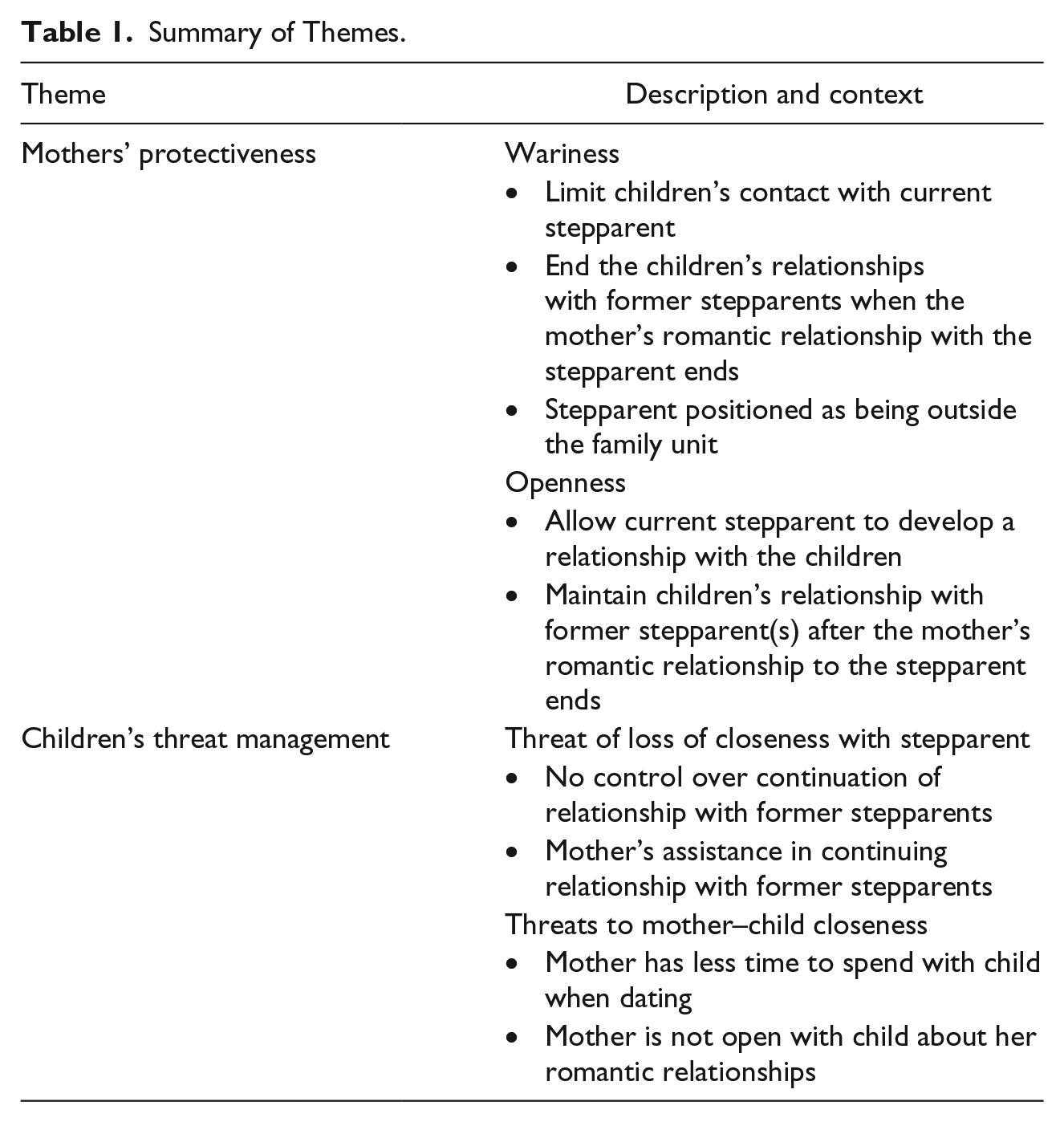
If children have negative working models of attachment and negative expectations about their relationships with their mothers’ partner(s), this may impede or prevent the development of a close relationship with that partner (Planitz & Feeney, 2009). Children’s negative reaction to their mothers’ new partners may hinder relationship development because stepparents pull away from children who do not show an interest in developing a relationship with them (Ganong et al., 1999). Thus, children’s openness to the development of a relationship with their mother’s partner is important to how that relationship develops. For this reason, it is noteworthy that none of children in this study were especially positive about the introduction of a new partner of their mother’s and many were overtly negative. This led the authors to question what it was about the experience of a mother forming a relationship and having that relationship dissolve that lead children to not be positive about the development of subsequent relationships with their mothers’ partners. A thematic analysis of the mothers’ and children’s interviews revealed two themes: Mothers’ protectiveness over their children and the children’s management of threats to their relationships and family dynamic (Table 1).
Summary of Themes.
Protectiveness
Mothers generally viewed relationship transitions as harmful for their children. Although these mothers each had between one and four dissolved romantic relationships with a partner who was not the parent of their child(ren), nearly all expressed that they “never wanted to bring people in and out of their [children’s] life” (Emily) because “there’s nothing worse than introducing ‘em to loads of people and they keep leavin’” (Mia). The mothers’ protectiveness emerged in the choices that they made around their partner’s relationship initiation and relationship dissolution. They took control of the negotiation of how their children transitioned into and out of these relationships, situating themselves as the decider of when and under what circumstances the relationship between their partner and their child(ren) developed and ended. Two different approaches emerged among the mothers when it came to child contact with the mothers’ partner—some were wary and limited their child(ren)’s contact with their current and former partner(s), whereas others were open and worked to develop the relationship between their child and their current partner as well as maintaining their children’s contact with their former partner(s) where they considered it to be beneficial.
Wariness
Sixteen of the mothers were wary about their children meeting or developing relationships with their partners. Their experiences of relationship dissolution had led them to view former partners as being inconsequential to the children’s lives and to view current partners as having the potential to negatively influence their children. It was not their partners per se whom they considered to be possibly negative for their children, but rather the possibility of future relationship dissolution. They felt that they needed to limit contact between their partner(s) and their children in order to safeguard their children’s well-being.
Mothers who were wary of the impact of their partners based on their previous relationships tried to protect their children from the negative influence of dissolution by limiting their children’s contact with subsequent partners. They attempted to change their behavior based on their previous experiences, which tended to mean they were “more guarded the second time, you know that way? . . . for the kids’ sake” (Eleanor). Eleanor explained that her son, “doesn’t need another father . . . he’s had enough fathers.” Moira, who had had three long-term, nonresidential relationships in which her daughter met her partners, felt her daughter had been negatively affected by the dissolution of those relationships:
[Curtis, Moira’s former partner] was kind of with us a lot and then he was gone and she still asks about that person. She’d still say, “Oh where’s Curtis and why doesn’t he come to visit?” . . . It definitely has affected her. She wonders where those people have gone.
Consequently, Moira, “didn’t let him [Arlo, Moira’s most recent partner] spend a huge amount of time” with her daughter, severely limiting their interactions, “because I was trying to like change may be the things I done before to try and make it a better situation.” These mothers felt that their relationship dissolution had generally had a negative impact on their children and, thus, they were wary about contact or relationship development between their children and their subsequent partners. They viewed themselves as having considerable agency in shielding their children from negative outcomes by limiting their children’s contact with subsequent partners.
The majority of the mothers believed it would not be beneficial to their children to facilitate the continued relationship between their former partner and their children. Thus, they made the decision—generally with no input from their children—to end these relationships when their own romantic relationships ended, because they “didn’t feel it was right that an ex-boyfriend should have a relationship” (Sinead). The mothers who terminated contact between their partner and their child(ren) after their own relationship dissolution tended to view their partner’s role as being relatively immaterial to their child(ren)’s lives and as existing solely as a consequence of their own continued romantic relationship with that person. These mothers did not allow for the continuance of the relationship between their former partner and their child(ren) even when the child(ren) were vocal about wanting that relationship to continue.
Wariness around the impact of multiple partners on their child(ren) meant many of the mothers positioned their partners as outsiders. Ava explained: “the children and I are the home—other people can just be there sometimes.” In this way, the mothers positioned their connection to their child(ren) as being the primary family relationship; mothers’ partners were either not considered to be family members at all or were considered to be nonessential family members. The mothers limited the potential roles available to their residential or nonresidential partners to “friend” (Eleanor), “mammy’s boyfriend” (Mia) or “other nonrelative” (Emily), thereby attempting to decrease the potentially negative impact of relationship dissolution.
In summary, most of the mothers engaged in gate closing toward romantic partners as a result of their perception that previous relationship dissolution was damaging to their children. They limited initial contact with current partners, stopped contact with previous partners, and positioned their current partner as being outside the family unit. This wariness toward current and former romantic partner involvement reflected the mothers’ attempts to protect their children from the negative effects of family instability.
Openness
Five of the mothers believed that fostering their children’s close connection to current and former partners was the best way to protect their children from any negative impact of their romantic relationship dissolution. These mothers thought if close relationships between their partner and their children could be formed and maintained—even in the face of the dissolution of their romantic relationship—this would benefit their children. Their experiences in previous relationships had indicated the best strategy for relationship initiation and dissolution was to be open to having their partner(s) involved with their child(ren) during and after the romantic relationship. For example, Éilís, whose two previous partners had been nonresidential, decided to allow her current partner, Thomas, to have a role in her children’s lives. This approach stood in contrast to the gate-closing approach which she had adopted in the past:
I thought at that stage, you know, it would be too complicated to kinda let him [Thomas] in . . . then I kinda stepped back and I said, “Well hang on a minute. I done that with Caleb’s [son] da. I done that with Shane’s [son] da. If I take a chance it might actually work out. . . . I took a chance and I done it the opposite way to see whether it would work, because it hadn’t worked.
Éilís’ previous gate-closing strategy had not resulted in long-lasting relationships, so she changed tactics and attempted to form a lasting romantic relationship by having Thomas cohabit and including him in her family life. She viewed this openness toward the development of her children’s relationship with Thomas as having the potential to protect her children and provide a more advantageous family situation for them by strengthening her own romantic relationship.
These mothers endeavored to continue managing the emotional bonds and connections between their partners and their children after their own romantic relationship with their partner had ended. These mothers were open to their children continuing a relationship with former partners because they believed it would be more hurtful for the children if contact was not facilitated. They framed their efforts to maintain the relationship between their former partner(s) and their children as a necessity for ensuring their child(ren)’s welfare. They acted as protectors of their child(ren), attempting to ensure that the child(ren) “didn’t experience any loss” (Katalin) by working to maintain the former partner–child relationship. Unfortunately, despite their efforts, some of the former partners were not interested in continuing a relationship with the children, leaving mothers frustrated that they could not maintain wanted continuity in their children’s lives. Ava reported that her former partner:
Really was saying, “Oh, I want to see the kids” . . . which actually never happened. She used to tell them that she loves them very much and then no more contact, so of course he [son] takes some insecurity now.
Thus, by being open to relationships continuing between their children and former partners, these mothers sought to protect their children from experiencing the loss of a significant relationship. However, some former partners were not willing to continue their relationships with the mothers’ children, and mothers’ attempts to maintain continuity were stymied.
This theme of protectiveness concerns the mothers’ role as a guardian and caretaker of their children. The mothers believed their actions were critical to their children’s well-being and they attempted to negotiate their own romantic relationships in a way which would have the least negative impact on their children. This involved either limiting contact between their child(ren) and former/current partners or being open to integrating current partners into their children’s lives and working to maintain contact with former partners. As in other studies of mothers’ relationship management in stepfamilies (e.g., Weaver & Coleman, 2010), these mothers viewed themselves as having an integral role in the formation and maintenance of their children’s relationships with their romantic partners.
Managing Threats
This second theme, reflected solely in the children’s narratives, relates to the children’s management of threats to their relationships. Some of the children were concerned about the threat of a loss of closeness to their mother’s partner; they had experienced the dissolution of their mother’s previous relationship(s) where they had limited control, and thus were apprehensive about the idea of their mother having a new partner who might also be taken out of their lives. The children’s family experiences had also led them to view a potential new partner as a rival for their mother’s time and attention, and therefore as a threat to the closeness of their relationship with their mother.
Threat of Loss of Closeness With Mother’s Partner
For most of the children, the end of their mother’s romantic relationship with her partner meant the immediate termination of their own contact with that partner, regardless of their own desire to continue the relationship. The children learned that developing a close relationship with their mother’s partner might ultimately be damaging to themselves, because they had no control over the continuation of the partner–child relationship. Kyle (aged 13 years) described finding out that his mother was no longer engaged to her partner of 4 years, Niall, and that Kyle was no longer going to move house when his mother just said, “Niall’s not comin’ around here anymore.” Some of the children found the immediate cessation of contact with their mother’s partner to be upsetting. The children had formed close, long-term relationships with an adult that ended suddenly or with little warning. The children who wanted to continue a relationship with their mother’s former partner, but were unable to do so, were frustrated by their lack of influence. Philip (aged 13 years) “was kind of upset, actually” that his mother was no longer dating Jude, a partner who “was always sayin’, ‘Oh, we should build, like, a motorbike’ and all that”; Philip’s contact with Jude ended when his mother’s relationship did and he “didn’t ever get the chance” to build the motorbike with Jude. By stopping contact between the former partner and the child when the child wanted to continue that relationship, the mothers hindered the children’s ability to control their own relationships. The children felt that “the house wasn’t the same when he [mother’s partner] wasn’t there” (Samuel, aged 11 years), but did not have any power to change the situation.
After experiencing the cessation of contact with an important figure in their life, these children realized that developing close relationships with their mothers’ partners carried a risk of loss; they attempted to obviate future losses of close relationships by not being as open to the development of subsequent relationships with their mothers’ partners. Charlotte (aged 15 years), explained that, based on her mother’s previous relationships, she did not think her mother’s current residential partner was likely to be a long-term figure in her life and she did not want to form a relationship with him because she was thinking about, “if he leaves and all.” She said,
He’d want to get to know me more but I don’t. So I don’t really talk to him or interact with him . . . It’s not that I don’t like him. It’s just I don’t want to get to know him.
Some of the children wanted to maintain a relationship with their mother’s former partner(s) and were assisted in this by their mothers. These children had developed close relationships with their mother’s partner(s) and both they and their mothers felt these relationships should continue. Although her mother’s relationship with her stepfather, Enda, had ended a few years previously, Willow (aged 9 years) explained:
He’s almost like a stepdad or something cause he’s really really nice and kind and he cares for me as if I was like his own child or something . . . we always visit him because he’s really special and nice.
Willow had not realized her mother’s romantic relationship had ended for nearly a year after its dissolution because of Enda’s continued involvement in her life. Darragh (aged 13 years) continued to see his mother’s former partner, “quite a lot”; “every second weekend we’d stay in his house.” These children were more positive when describing their mothers’ current partners or when thinking about the possibility of their mothers’ future partners than children who were not given the option to continue contact with their mothers’ former partner(s). Tristan (aged 11 years) described that if his mother began dating again and her partner, “was really nice I’d probably be happy with it. Like Enda [his mother’s former partner].” They tended to be more open to subsequent relationship development between themselves and their mothers’ partner(s), possibly because they felt that the future of their relationships with their mothers’ partner(s) was less threatened. In previous relationship dissolution(s), these children had exercised their agency in continuing relationships which were important to them. In contrast, children whose agency was constrained when the former partner–child relationship was forcibly ended by the dissolution of the mother–partner relationship were more likely to be overtly negative about future relationships with their mothers’ partners. The experiences of some of the children showed them that the formation of a new relationship with their mother’s partner came with the threat of the loss of that relationship and so they approached new relationships with their mother’s partner with caution.
Threats to Mother–Child Closeness
The children in this sample described their relationships with their mothers as being close and highly important to them. Liam (aged 18 years) described his closeness to his mother by stating, “I grew up with just me and my ma . . . we have a relationship that like, I don’t know. It’s weird like. I just tell her anything really.” Many of the children indicated that the introduction of a romantic partner of their mothers’ was a threat to this closeness. Their previous experiences of their mothers’ romantic relationships had shown them that their mother’s dating had the potential to negatively affect their relationship with their mother and, thus, they were wary about their mother’s subsequent romantic relationship formation.
When a mother begins a romantic relationship, she may alter her parenting and find it difficult to divide her time between her partner and her child (Gibson-Davis, 2008). Penelope (aged 14 years) explained, “I always find it hard if she starts seeing somebody to accept it because it means that she starts having less time with us [Penelope and her siblings] and I think it makes me feel a bit less important.” Willow (aged 9 years) described the benefit of the dissolution of her mother’s most recent relationship: “now that my mom didn’t spend as much time with Enda [mother’s former partner], she spent some time with us some more.” The children felt that if their mother formed a new relationship, she would have less time available for them and this threatened the closeness of their mother–child relationship; therefore, they were wary of their mothers’ subsequent partners.
Some of the children did not necessarily have a problem with their mother dating, but were more upset that their mother was not open with them about her romantic relationships. Aifric (aged 11 years) “didn’t really like it” that her mother was dating because her mother, “didn’t say that he was her boyfriend and so then afterwards then she was like sort of hinting about it and then I got it and then afterwards I was really upset about it.” Charlotte (aged 15 years) did not know her mother was dating until her mother became pregnant; she said “but when [she] did get pregnant, I was like, ‘Well why wouldn’t you tell me?’ and stuff.” Charlotte explained, “sometimes it feels like she leaves us [Charlotte and her siblings] out of stuff. And like, with the way I have to find out everything for myself.” Although the mothers may have been attempting to avoid difficulties for their children by not informing them that they were dating, the result was that these children felt uninformed and excluded. This exclusion stood in contrast to the children’s conception of an open and close relationship with their mother.
Children of single mothers tend to act as their mother’s social support system and to form an intimate and cohesive parent–child bond (Nixon et al., 2012); when the mothers spent considerable time away from their children or were secretive about their dating, the children felt this caused their relationship with their mother to be less close. The children were thus more wary of their mother dating because their previous experiences of her romantic relationships meant they could predict that her dating would have a negative impact on the closeness of their own mother–child relationship. By indicating that they did not want their mother to date or by not being open to a relationship with their mothers’ partners, the children were attempting to mitigate the threat to their own mother–child relationship.
In summary, children’s experiences with their mothers’ previous partners had generally led them to be more wary of the involvement of their mother’s subsequent partners in their lives. Some children did not want to form close relationships with their mothers’ partners because of the threat of the loss of this relationship. They were also concerned about the impact of their mothers’ dating on the mother–child relationship, viewing the introduction of previous partners as having a negative impact on the closeness of this relationship.
Discussion
This study builds on research showing that family instability is stressful and generally has a negative impact on parents and children (Beck et al., 2010; Hetherington & Kelly, 2002). The strength of stepparent–stepchild relationships is important to both stepfamily and child outcomes (Coleman, Ganong, & Fine, 2000; King, 2006), and dating relationships can have an important impact on children and mothers as well (Beck et al., 2010). Both mothers’ positioning and children’s responses to their stepparents’ affinity-seeking efforts are critical to the formation of a close stepparent–stepchild relationship (Ganong et al., 2011; Weaver & Coleman, 2010), and presumably to children’s relationship with mothers’ dating partners as well. A thematic analysis of mother and child interviews resulted in two themes which elucidate the influence of relationship transitions on the approaches to subsequent relationships with mothers’ partners. The first theme related to mothers’ attempts to protect their children, generally through increased wariness around subsequent partners, although a minority became more open to their child(ren)’s relationships with subsequent partners. The second theme was concerned with how the children reacted to mothers’ subsequent partners by attempting to manage threats to their relationships. Although some cautiousness at the start of a new relationship is prudent, the continuation of this guardedness and negativity toward a mother’s romantic partner has the potential to negatively affect what might otherwise be a close relationship between the child and that partner. The findings from this study revealed that both mothers and children tended to respond to relationship transitions by being more guarded about the development of relationships with mothers’ subsequent romantic partners.
Mothers tended to view themselves as the arbiter of their children’s best interests, whereas the children attempted to manage perceived threats to their family relationships. These two positions created a tension over how relationships with mothers’ partners should be approached, with the mothers’ actions on occasion leaving the children feeling disempowered when they were not able to control their mother’s dating or the formation and dissolution of their own relationships. Although other research has shown that mothers believe their children have considerable influence over their decisions to enter into, stay in, or dissolve a romantic relationship (Sano et al., 2012; Weaver & Coleman, 2010); most of the children in this study did not feel they had power over these decisions. The mothers may have been considering their children’s needs and felt they were responding to their children’s preferences, but this did not translate into a sense of agency for the children. Some of the children had close relationships with their mothers’ partners, which were ended following the dissolution of the romantic relationship. Following this, these children were hesitant to form a relationship with a new partner of their mothers, possibly because they would be similarly unable to control their experience of the dissolution of that relationship. In contrast, children whose mothers facilitated the continuation of the relationship between their child(ren) and former partner(s) tended to be more positive about the development of a relationship with their mothers’ subsequent partner.
Children’s perspectives on their mother beginning another dating relationship revealed how potential new partners were positioned as a threat to the mother–child relationship. Single mothers have significant demands on their time and resources and these demands become more strained when mothers form romantic relationships. Moving from a single-parent family to a stepfamily can involve increased social and economic resources (King, 2006). However, children whose mothers had multiple previous transitions may view any benefits of partnering as being temporary and not worth the decreased time and attention from their mother. Based on their experiences of family instability, children viewed their mothers’ dating as a threat to mother–child closeness as opposed to something likely to be positive for themselves or their family.
These findings highlight the importance of considering children as agents in the development and dissolution of their relationships with their mothers’ partners. While mothers’ actions were underpinned by a desire to protect their children, at times the wishes and desires of mothers were at odds with those of their children. In line with contemporary models of parent–child relationships, these findings highlight the value of conceptualizing parent–child relationships in terms of dialectical tensions and agency on the part of both parents and children (Kuczynski, 2003). Based on previous relationship experiences, children attempted to exercise their agency by opting out of or being resistant to a relationship with a potential new stepparent. However, children in the study also experienced constraints in their sense of agency when mothers dictated the terms of relationships with either former or current partners, and this had the potential to undermine closeness in the mother–child relationship.
This research also has implications for the use of attachment theory (Bowlby, 1969) to understand stepfamily relationship formation and dissolution. Some of the children had formed long-standing attachments to their mothers’ partners and felt secure in those attachments, but these relationships tended to end abruptly when their mother’s romantic relationship dissolved. Because children who are separated from an attachment figure take some time before they are able to form another attachment and relational competence is influenced by previous attachment relationships (Bowlby, 1969), the finding that children tended to be relatively negative about their mothers’ subsequent partners is perhaps unsurprising. However, not all of the children in the sample had formed a close, long-lasting relationship with a former partner of their mothers’ and yet none were positive about subsequent partners, indicating that the loss of an attachment relationship is not necessary for this wariness.
As with most of the research on family instability (see Gibson-Davis, 2008, for a notable exception), this study is limited by its lack of inclusion of father’s relationship transitions. Many children spend considerable time with their nonresident fathers (King, 2006) or are resident with them. Presumably, both mothers’ and fathers’ relationship transitions shape the context of children’s subsequent relationships with their parent’s partners, but this study did not investigate the influence of fathers’ relationship transitions.
The reliance on once-off interviews is a further limitation. A key finding that emerged was that children whose mothers attempted to maintain continuity were more open to the development of relationships with subsequent partners of their mothers’. It is possible that a larger sample size or a longitudinal method would elucidate further patterns in the data. Transitions experienced before the age of 5 years may have more of an effect on child outcomes (Goodnight et al., 2013), but it is not clear what influence the timing of transitions has on children’s subsequent relationship development. Younger children may be less affected because they have fewer memories of their mother’s former partner (Peterson, Grant, & Boland, 2005) or may be more affected by the early loss of a significant relationship (Howes, 1999). Similarly, it is unclear whether the changes that mothers make to their relationship strategies have any value toward limiting children’s negative outcomes in the context of family instability. Given that each relationship transition is an additional risk factor for children (Osborne & McLanahan, 2007), it seems likely that these protective measures are not successful, but more research would clarify this. It is possible that certain strategies on the part of the mothers may be effective at limiting the negative effects of relationship transitions on children, whereas other strategies are harmful or ineffective. Longitudinal research involving several interviews with mothers and children over time would shed light on these issues and elucidate the processes through which relationship transitions affect family relationships and outcomes.
Finally, the views of mother’s partners after multiple relationship transitions are worthy of study. The development of a stepparent–stepchild relationship is not only consequent on the actions of the child but the stepparent needs to be interested in forming that relationship as well (Ganong et al., 2011). It is unclear how men react to forming relationships with their partner’s children after experiencing previous transitions into and out of relationships with women who have children. Former stepparents are sometimes still considered family members (Schmeeckle, Giarrusso, Feng, & Bengtson, 2006) and it is possible that some stepparents may have competing responsibilities to their former stepchildren in the same way that some biological parents do (Manning, Stewart, & Smock, 2003). Conversely, these men’s experiences of the dissolution of their previous relationship(s) with their partners’ child(ren) may make them more wary of relationships with subsequent partners’ children in much the same way as those experiences did for the children in this sample.
This research fills a gap in the family instability literature, which has thus far been predominately quantitative, focused on outcomes, and drawn from large-scale American cohort studies, by investigating how mothers’ and children’s experiences of relationship(s) with previous partners shaped the context of subsequent relationship development in Ireland. It has illuminated some of the family dynamics which may underlie mothers’ partners’ engagement in parenting and family responsibilities. Children who have experienced at least one of their mother’s transitions out of a romantic relationship are relatively negative about developing a relationship with their mother’s subsequent partner(s), perhaps because of the tension between their mothers’ protective behaviors and their own threat management. Children who felt agentic and whose mothers attempted to maintain continuity in their relationships with the mothers’ former partners were more positive about subsequent partners of their mothers’. Because the development of close stepparent–stepchild relationships are important to child outcomes and family functioning (Coleman et al., 2000; King, 2006), this may be an area which clinicians and practitioners could focus on when working with families experiencing transitions.
Footnotes
Declaration of Conflicting Interests
The author(s) declared no potential conflicts of interest with respect to the research, authorship, and/or publication of this article.
Funding
The author(s) disclosed receipt of the following financial support for the research, authorship, and/or publication of this article: Dr. Hadfield was funded by a Postgraduate Research Studentship from Trinity College Dublin.