




Abstract
This study examined household income and maternal cognitive stimulation as moderators of the association between family structure and 48-month-old child emerging literacy and math skills. The data set was the Early Childhood Longitudinal Study–Birth cohort (N = 7,300). Controlling for selection factors (race/ethnicity, child gender, maternal education, maternal depression, child attendance in preschool/day care, and 9-month child cognition), the study found support for the moderation hypothesis for household income and maternal cognitive stimulation. The main take-home message was that resources such as household income and mothers’ cognitive stimulation seem to be more strongly and positively associated with early literacy and math skills among children with married parents in comparison to children living in stable single-mother households, stable cohabiting households, or households in which mothers transition from married to single parent. Cognitive stimulation partially mediated the moderating effect of income on stable single-mother household. Implications for research and programs are discussed.
A growing body of research has shown that on average children have better academic and emerging literacy outcomes when they reside in homes with two parents, although the effects of two-parent households on children tend to be small after controlling for other factors that influence children (Sun & Li, 2001). One explanation for the association between family structure and child academic performance is that children who live with both parents have more resources available to them. In particular, family structure is often believed to be a proxy for resources such as time and money (Crosnoe & Cavanagh, 2010). Researchers have typically examined these resources as mediators of the association between family structure and child outcomes (Amato, 2010). Few studies have examined whether the associations between family structure and child outcomes are also moderated by family resources. It is often just assumed that changes or stability in household structure have the same effects on all children. But this may not be the case (Amato, 2010). In the present study, I argue and test whether the relationship between family structure over the course of 3 years and preschoolers’ emerging literacy and math skills is influenced (moderated) by household income and mother’s time spent in cognitively stimulating activities with the child.
I focus on children’s early literacy and math skills because these have been shown to be consistently strong predictors of later literacy abilities and academic achievement (Pearson & Hiebert, 2010). Moreover, young children’s literacy and math skills may be particularly sensitive to family disruptions. Younger children rely heavily on parents’ nurturance and intellectual and language stimulation for the development of emerging literacy (Crosnoe, Leventhal, Wirth, Pierce, & Pianta, 2010; Hsin, 2009), and these may be negatively affected when parents experience family structure changes. I used the Early Childhood Longitudinal Study–Birth Cohort (ECLS-B) data to address this topic because it is one of the few large longitudinal data sets with school readiness test results for children and because it contains comprehensive family structure information.
Background
Researchers have suggested that family structure identifies the family’s position in the opportunity, reward, and social standing systems of society (Crosnoe & Cavanagh, 2010). Family structure is therefore a proxy for resources such as time and money (Crosnoe & Cavanagh, 2010). As the theory goes, resources are more abundant in two-parent families and less abundant in single-parent families. These resources include opportunities to specialize in tasks associated with income generation, child care, child rearing, and housework (Welch, 2010). Crosnoe and Cavanagh (2010) have suggested that the resources associated with family structure shape how parents interact with their children and therefore have positive or negative effects on children’s outcomes. A substantial body of research has shown that households with coresiding biological parents are more likely than households with other family structures (e.g., mother-only households) to have higher economic and human capital levels, including higher education levels, income levels, and employment status (Fomby & Sennott, 2013; Kennedy & Fitch, 2012; Wu, Hou, & Schimmele, 2008). Studies have also shown that coresiding biological parents are more likely than other family structures to invest time in children, including providing higher levels of parental support, supervision and monitoring, and more consistent discipline (Carlson & Berger, 2013; Thomson, Hanson, & McLanahan, 1994).
The association between household income and child outcomes has been well established (Han, Lee, & Waldfogel, 2012; Kohen & Guèvremont, 2014). Children who reside in higher income families obtain higher scores on tests of IQ, achievement, math, reading, and behavioral competencies (Dahl & Lochner, 2005; G. J. Duncan, Morris, & Rodrigues, 2011). Higher levels of household income are also associated with higher levels of literacy among children preparing to enter school (Dilworth-Bart, 2012; Han et al., 2012). The reasons for these robust associations are multifaceted. Studies have shown that parents with higher income levels provide their children with a wide range of community-based activities as a means to cultivate their children’s talents (Lareau, 2003). Higher income parents also have the financial resources to obtain better quality services, such as higher quality childcare (NICHD Early Child Care Research Network, 2004). They are also likely to have the financial resources to live in communities with better quality preschool programs and schools. Income is also closely linked to parental education, and parents with higher levels of education are likely to engage in more cognitive stimulation of children, such as reading to children or helping with homework (Hofferth & Sandberg, 2001). The idea that family structure is a proxy for resources is consistent with the notion that household income will mediate the association between family structure and young children’s literacy and math skills.
The second resource associated with family structure, parental time invested in children, may also be associated with children’s early literacy and math skills. However, overall parental time availability may be less important to children’s early literacy and math abilities than parental time spent in providing cognitively stimulating interactions, activities, and learning materials. For example, Cates et al. (2012) found that time spent reading, teaching, and engaging in other reciprocal verbal interactions were all related to toddler language outcomes. The risks for later academic difficulties are often attributed to lack of preschool language use and exposure (Kamhi & Laing, 2001; Miller et al., 2006). Other researchers have shown that cognitive stimulation provided at home and in preschool are positively associated with higher math and reading achievement when children are in first grade (Crosnoe et al., 2010). Thus, the present study focuses on mothers’ cognitive stimulation rather than all time spent with children.
Moderators of Family Structure
In this article, I suggest that family income and cognitive stimulation will moderate the association between family structure and child emerging literacy and math. Family stress theory posits that certain family structures can produce stress on biological parents and children (Fomby & Cherlin, 2007). This may be particularly true among single-parent families or families in which there is instability, such as when intact unions dissolve and parents form new residential partnerships (Dush, Kotila, & Schoppe-Sullivan, 2011). According to family stress theory, stress is associated with negative outcomes for family members particularly when there are too few resources in the family. The framework for the ABC-X model suggests that an event “A” interacts with “B” (the family’s crisis-meeting resources) and “C” (the definition the family makes of the event) to produce “X” (the crisis; Hill, 1958, p. 141). Applying family stress theory, resources such as higher levels of household income (“B”) may moderate the stress associated with family structure (“A”).
There are several ways in which household income may moderate the association between family structure and child outcomes. Researchers have suggested that greater household income brings predictability and stability into the homes of children who are experiencing other forms of adversity (Raver, Roy, & Pressler, 2015). For example, higher income individuals tend to have more workplace flexibility and predictability in work schedules, thus enabling parents to better attend to young children’s needs (Weigt & Solomon, 2008). The increased stability associated with higher income may offset the stressful effects of family structural characteristics on young children’s outcomes. Individuals with higher levels of household income also may be able to afford to purchase higher quality babysitting and child care (Ford, 2010), which also may buffer the negative effects of stressful family structures. The current study thus hypothesizes that higher levels of family income when children are 48 months old will moderate the negative effects of family structure (single-mother households or families in which there is instability) on 48-month-old children’s emerging literacy and math skills.
Researchers have also suggested that higher levels of parental involvement moderate the effects of single parenthood on child outcomes (Bronfenbrenner & Morris, 2006). Few studies have actually examined the moderating effect of parental involvement on the association between stress and child outcomes. Clinicians have documented the positive effects of effective parenting as a buffer of many adverse childhood events (O’Connell, Davis, & Bauer, 2015). In a somewhat related fashion, Martin, Ryan, and Brooks-Gunn (2010) found that fathers’ supportive parenting had a buffering effect on young children’s school readiness when mothers scored at or below average on supportiveness. Moreover, maternal cognitive stimulation has been shown to moderate the association between mothers’ emotional support and preschoolers’ perceptual abilities during a problem-solving task (Hubbs-Tait, Culp, Culp, & Miller, 2002). On the basis of these studies and family stress theory, the present study hypothesizes that higher levels of maternal cognitive stimulation at 48 months will moderate the negative effects of higher stress family structures on 48-month-old children’s emerging literacy and math skills.
It is also possible that maternal cognitive stimulation of children not only will moderate the effects of family structure types on child outcomes but also may mediate (i.e., explain) the moderation effect of household income on child outcomes. That is, household income may buffer the effects of more stressful family structures on child outcomes because higher income mothers engage in higher levels of cognitive stimulation with their children. Similar explanations have been suggested for the effects of socioeconomic status on young children’s brain development (Hackman, Farah, & Meaney, 2010). Thus, the current study examines whether cognitive stimulation mediates the moderating effects of income on family structure.
As noted above, stressful family structure types are those in which mothers reside as single parents with no father present in the household or families in which there has been instability. Instability is defined here as family structure changes (see Harcourt & Adler-Baeder, 2015), which may entail a residential exit of one parent (usually the father) from the household or a residential entrance of a parent or romantic partner into the household. The recent wave of family instability research has shown that higher levels of instability are associated with more negative outcomes in children (Cherlin & Seltzer, 2014; Ryan & Claessens, 2013). The current study therefore examines family structure changes and stability from infancy through age 4. The instability household types include those in which two biological parents are married and coreside when the child is an infant and then separate or divorce, two biological parents cohabit when the child is an infant and then separate, and single mothers reside with the child as an infant and then later coreside with the biological father (through either marriage or cohabitation). It is also possible that mothers’ romantic partners may coreside with the mother and child. These nonbiological fathers may bring further instability to the family (Goldberg & Carlson, 2015). One of the limitations of the ECLS-B data set is that a small number of mothers reported living with a romantic partner.
There is also evidence that cohabitation may be a source of stress for families with young children. Goldberg and Carlson (2014) have pointed out that because cohabitation is associated with less couple commitment and greater instability (i.e., increased likelihood that the parents will not stay together), cohabiting parents may be at greater risk for parental stress and, consequently, benefit more from different sources of support (e.g., higher income levels). However, not all researchers find a negative association between cohabitation and parental stress or well-being (Musick & Bumpass, 2012). I therefore examined the moderating effects of household income and cognitive stimulation on the associations between cohabitation and child outcomes as research questions.
Selection Factors
Selection factors are an important consideration in studies examining the effects of family structure on children. Confounding factors that might explain associations between family structure and child outcomes were identified to be controlled in regression models. Mothers with higher levels of education are more likely to coreside with the child’s father than to reside as single mothers with no spouse or partner present in the household (Raver et al., 2015). The linkage between mothers’ completion of college and child outcomes has been well established by researchers (G. J. Duncan et al., 2011). There is also evidence that African American and Hispanic parents are less likely to coreside than non-Hispanic White parents (Fomby & Estacion, 2011). Maternal depression is also likely to be higher among mothers heading households alone or who have experienced changes in family structure (Sia, Leventhal, Northrup, Arunyanart, & Weitzman, 2013). There is also much evidence that maternal depression is associated with lower levels of child academic ability (Hair, McGroder, Zaslow, Ahluwalia, & Moore, 2002). In addition, I controlled for child gender because boys tend to have lower literacy skills when they begin school (Hoglund & Leadbeater, 2004). Child age at 48 months was controlled because of differences in the timing of the child outcome data collection within each round of the ECLS-B. Child cognitive ability at 9 months and preschool or day care attendance have been shown to be correlated with later child literacy (Crosnoe et al., 2010). Finally, household income and maternal cognitive stimulation when children are infants are likely to predict later child outcomes (Fagan, 2011).
Method
Data Source
The ECLS-B is a nationally representative probability sample of 10,700 children born in the United States in 2001 (National Center for Education Statistics, 2005). The ECLS-B sample was designed to represent the nearly 4 million children born in the United States in 2001. The study oversampled Asian and Pacific Islander children, American Indian and Alaska Native children, Chinese children, twins, and low– and very low–birth weight children. Children were excluded from the study if (a) they were born to mothers younger than 15 years, (b) their parents placed them for adoption at or shortly after birth, or (c) they died before the age of 9 months. A clustered, list frame sampling design was used to select children from registered births in the National Center for Health Statistics vital statistics system. Births were sampled from 96 core primary sampling units (e.g., counties, county groups). The children recruited for this study were followed at approximately 9 months, 24 months, 48 months, and kindergarten entry.
The study collected data from primary caregivers (mostly mothers), resident and nonresident fathers, child care providers, teachers, and school administrators. Data about children were collected from the parents through direct observation and testing and from teachers. Primary caregivers included biological, adoptive, foster, and stepmothers and a very small percentage of fathers. Resident fathers included biological, adoptive, foster, and stepfathers. Nonresident fathers were only birth fathers. More than 14,000 births were sampled and fielded. Of these, 76% (n = 10,700) of primary caregivers were interviewed at 9 months. About 92% (n = 9,850) of primary caregivers who completed the 9-month survey completed the 24-month protocol, and 82% (n = 8,750) of those who completed the 9-month survey completed the 48-month survey. Because of the need to protect the confidentiality of ECLS-B participants, studies using these data are required to round all sample sizes to the nearest increment of 50.
Analytic Sample
The present study makes use of the primary caregiver interview and child testing, both of which were conducted in the child’s home. The sample for the present study included children whose biological mothers completed the primary caregiver interviews at 9 and 48 months. The sample was further restricted to children who resided with their biological mother at these times. I also omitted children who lived with adoptive or foster parents and guardians during these times. These criteria resulted in the omission of 2,700 children from the original sample of 10,700 children. Next, I dropped 550 cases (7.2%) because they were missing math test data and an additional 100 cases (1.5%) that were missing literacy test data; only cases with complete outcome data were included in analyses (White, Royston, & Wood, 2011). These steps yielded a sample of 7,300 children.
Missing case analyses revealed that children were more likely to be missing literacy and math scores when their families had lower levels of household income at 48 months, t(8,000) = 12.39, p < .001; t(8,000) = 11.58, p < .001, respectively; when mothers engaged in lower levels of cognitive stimulation at 48 months, t(7,950) = 9.15, p < .001; t(7,950) = 7.69, p < .001, respectively; and when their families were Hispanic, χ(4) = 253, p < .001. There were no missing data for household income, less than 0.1% missing data for cognitive stimulation at 48 months, and 0.4% missing data on race/ethnicity.
Missing Data
Observations with missing data on independent variables and covariates (in the sample of 7,300) were analyzed with multiple imputation (MI). SPSS uses fully conditional specification as the MI procedure. I also tested for possible outliers and skewness in the data. All variables were included in the imputation equations, and 10 imputed data sets were created. The fraction missing was 3.4% for child cognitive ability at 9 months, 4.8% for maternal depressive symptoms at 48 months, and less than 0.1% for measures of race/ethnicity, education, income, cognitive stimulation at 9 and 48 months, and preschool attendance at 48 months.
Participant Characteristics
The largest percentage of mothers in the study was non-Hispanic White (45.2%), followed by Hispanics (17.7%), African Americans (15%), and Asian Americans (11%; Table 1). The median education level of mothers at 48 months was some college. The mean annual household income category ranged from $30,001 to $35,000 at 9 months and $35,001 to $40,000 at 48 months. Mothers reported the following family structures: stable married relationship with the biological father (63.5%), stable single mother (13.4%), stable cohabiting (8.9%), married to single mother (7.8%), cohabiting to single mother (3.5%), single mother to cohabiting (2.3%), and single mother to married (0.1%). I combined the last two family structures into one category, which I call single-mother to two-parent household, because of the small number of mothers who were single at 9 months and then married at 48. Children were on the average 52.89 months of age at the 48-month interview.
Participant Characteristics and Descriptive Statistics for Study Variables (N = 7,300).
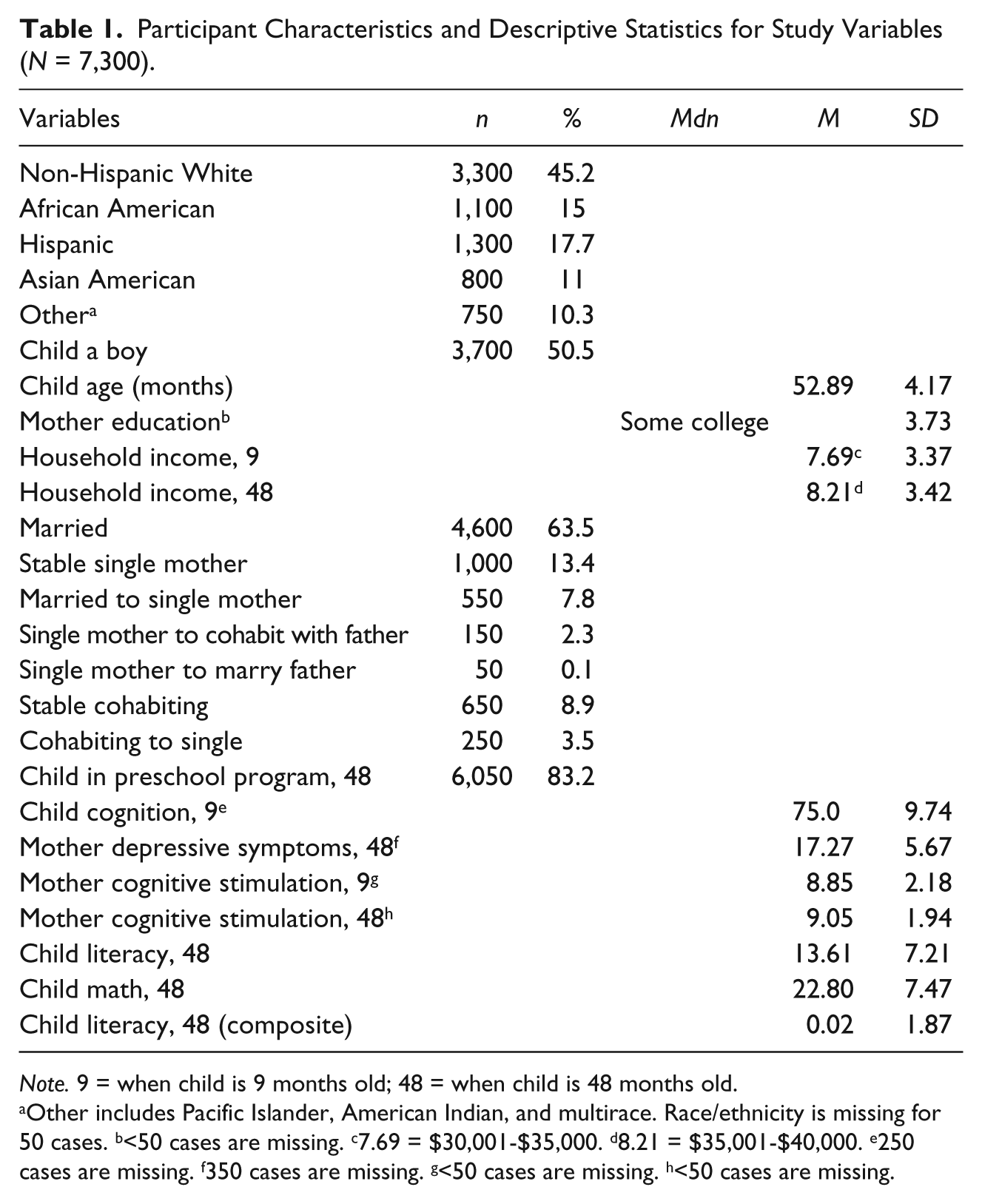
Note. 9 = when child is 9 months old; 48 = when child is 48 months old.
Other includes Pacific Islander, American Indian, and multirace. Race/ethnicity is missing for 50 cases. b<50 cases are missing. c7.69 = $30,001-$35,000. d8.21 = $35,001-$40,000. e250 cases are missing. f350 cases are missing. g<50 cases are missing. h<50 cases are missing.
Measures
Emerging Literacy Skills
The ECLS-B used a 37-item assessment of emergent literacy at 48 months. Content areas included letter recognition (8 items), letter sounds (6 items), early reading—recognition of simple words (4 items), phonological awareness (10 items), knowledge of print conventions (8 items), and matching word (1 item). The majority of items were selected from published instruments, including the PreLAS (S. E. Duncan & De Avila, 1998), Peabody Picture Vocabulary Test—Third Edition (Dunn & Dunn, 1997), and the Preschool Comprehensive Test of Phonological and Print Processing (Lonigan, Wagner, Torgesen, & Rashotte, 2002). Skip rules were incorporated into the assessment to allow children to skip over difficult questions that were similar to earlier questions that they had not been able to answer correctly. There was no ceiling effect for the test, but there was a floor effect for about 10% of the children tested. The floor effect suggests that the literacy assessment did not measure accurately for the children with the lowest level of literacy skills. Item response theory (IRT) calibration and scoring were used to calculate an overall literacy scale score for each child. Reliability (α) of the IRT-based literacy scores was .81. Total scores ranged from 4.29 to 34.68 for the analytic sample, with a mean of 13.61 and a standard deviation of 7.21.
Math Skills
The preschool mathematics assessment included a core form with 28 items administered to all children and two supplementary forms. The core assessment included items on number sense, geometry, counting, operations, and patterns. To lessen floor and ceiling effects, a basal form with 9 easier items related to shapes and counting was administered to children who correctly answered fewer than 11 items on the core form, and a ceiling form with 8 items including simple number and word problems was administered to children who correctly answered 21 or more items on the core form (National Center for Education Statistics, 2005). The core assessment incorporated skip rules to allow children to skip questions beyond their ability level. There was no evidence of a strong floor or ceiling effect for the mathematics assessment. Reliability (α) of the IRT-based mathematics scores was .88. Scores on the mathematics assessment ranged from 4.52 to 41.55 for the analytic sample, with a mean of 22.80 and a standard deviation of 7.47.
Family Structure
I constructed variables measuring children’s family structure at 9 and 48 months. To construct this measure, I used two items from each of the mother questionnaires at 9 and 48 months asking mothers to indicate with which adults the child currently resides and whether the parents are married or not. Mothers who indicated the child lived with the biological mother and father at both time periods and who also indicated they were married were coded as stable married households (reference group). Mothers who indicated the child lived with the biological mother and father at both time periods and were not married were coded as stable cohabiting households. Mothers who indicated that the child lived with their married biological mother and father at 9 months but only with the mother at 48 months were coded as married to single-mother households. Mothers who indicated that the child lived with their cohabiting biological mother and father at 9 months but only with the mother at 48 months were coded as cohabiting to single-mother households. Mothers who indicated that the child lived only with the mother at 9 months but with both biological mother and father at 48 months were coded as single mother to two-parent households. Children who resided with the mother only at 9 and 48 months were coded as stable single-mother households.
Moderators
One item was used from the mother questionnaire at 48 months to measure total household income. Mothers were asked about their total household income from all sources. Respondents estimated their income within a range of $5,000 (e.g., $15,001-$20,000). There were 13 potential responses that were treated as a continuous variable in this study. The income categories ranged from 1 = ≤$5,000 to 13 = ≥$200,001. Income was centered by subtracting the mean for the sample from each respondent’s reported income category. A test for outliers was also conducted on total household income by standardizing this variable. Standardized scores of +/−3 indicate possible outliers. There was no indication of outliers on household income. The ECLS-B did not adjust for income based on the Consumer Price Index.
Mothers were asked three questions when children were 48 months old regarding their involvement in child activities related to cognitive stimulation during the past month. The items included the following: read books to the child, told stories to the child, and sang songs to the child. All questions were scaled from 1 = not at all to 4 = every day. These data were treated as a continuous variable in this study. The items were summed so that a high score indicated higher levels of cognitive stimulation (range = 3-12, α = .62 at 48 months). Cognitive stimulation was centered by subtracting the mean of the composited score for the sample from each respondent’s composited score. There was no indication of outliers for cognitive stimulation at 48 months. Researchers have found that a composite of these items (father reports) is significantly related to child cognition and social behavior (Cabrera, Fagan, Wight, & Schadler, 2011).
Controls
Household income and cognitive stimulation at 9 months (α = .62) were included as controls. The measures for these variables were described above. Depressive symptoms at 48 months were measured using the Center for Epidemiological Studies Depression Scale–Short Form (CESD-SF; Ross, Mirowsky, & Huber, 1983), which comprises 12 of the 20 items from the full CES. The CESD is a self-report scale that measures the absence or presence of negative thoughts, feelings, and behaviors during the prior week. The measure is based on parents’ responses to questions on how many days in the past week the respondent felt bothered, had a poor appetite, could not shake the blues, had trouble keeping focus, felt depressed, felt everything was an effort, felt fearful, had difficulty sleeping, talked less than usual, felt lonely, felt sad, and could not get going. Items were rated on a 4-point Likert-type scale (1 = rarely to 4 = most or all days). Higher scores indicated more depressive symptoms (α = .89 at 48 months). Depressive symptom indexes were constructed for mothers by summing the 12 CESD-SF items.
Child cognitive ability at 9 months was controlled using the Bayley Short Form–Research Mental Scale (BSF), which is an adaption from the Bayley Scales of Infant Development (BSID-II; Bayley, 1993) especially designed for the ECLS-B. Field staff received extensive training in the administration of the various standardized tasks for the Bayley (National Center for Education Statistics, 2005). The BSF assessed memory, vocabulary, problem solving, early counting, and reasoning. These separate scales were added together to form a total raw score. IRT true-score equating was used to place the BSF results on the same 0- to 178-point scale used by the BSID-II. The BSF mental scale score is an estimate of the number of items a child would have answered correctly had the full BSID-II been administered. The α reliability of the BSF was .79.
Child gender, child age at the 48-month survey, and mother’s race/ethnicity were also included as controls. The following race/ethnicity categories were constructed: Hispanic, African American, non-Hispanic White (reference group), Asian American, and other (Pacific Islander, American Indian, and multirace). Mother’s highest education level at 9 months was also controlled using one item that asked respondents to indicate their highest grade (or GED) completed in school. Finally, child attendance in a preschool program at 48 months was controlled using one item that asked mothers whether the child is currently enrolled in preschool.
Data Analyses
Principal components analysis (PCA) was conducted to explore the possibility that math and literacy scores should be combined into a composite measure. PCA is largely used as a data reduction method (Costello & Osborne, 2005). The math and literacy variables were first standardized before conducting PCA. Next, MI with 10 iterations was conducted to handle missing data. Pearson correlations were then calculated to examine potential collinearity among independent variables and covariates. Multiple regression analyses were conducted to examine the study hypotheses. Moderation effects were calculated by multiplying the family structure variables by household income at 48 months (centered) and then by maternal cognitive stimulation at 48 months (centered). To examine whether cognitive stimulation at 48 months mediates the moderating effect of household income on family structure, I ran regression with and without cognitive stimulation in the model. In addition, the Baron and Kenny (1986) test for mediation, followed by the Sobel test, were used to test for mediation (Preacher & Leonardelli, 2005-2010). Baron and Kenny suggest the following criteria for testing mediation effects: The independent variable must be significantly associated with the dependent variable, the independent variable must be significantly associated with the mediating variable, the mediating variable must be significantly associated with the dependent variable, and the mediating variable must significantly reduce the association between the independent and dependent variables.
Results
Preliminary Analyses
PCA revealed that child math and child literacy loaded on one factor, explaining 87.62% of the variance in the data set (eigenvalue = 1.75). Moreover, the correlation between these variables was .75. I therefore summed the standardized child math and child literacy scores, which I refer to as “child literacy” (α = .86).
Pearson correlations revealed possible collinearity between household income at 9 and 48 months (r = .75, p < .001; results not shown Table 2). I therefore only used income at 48 months in the multivariate analyses. There were no correlations above .70 among the other independent variables and covariates. The correlation matrix showed a significant association between household income at 48 months and cognitive stimulation at 48 months (r = .18, p < .001; Table 2). There was a moderately strong correlation between cognitive stimulation at 9 and 48 months (r = .44, p < .001). Income at 48 months and cognitive stimulation at 9 and 48 months were significantly associated with child literacy at 48 months (rs = .41, .14, .16, respectively, ps < .001). With the exception of married parents, all family structure variables were negatively and significantly associated with child literacy (rs range from −.06 to −.18, ps < .001).
Pearson Correlations.
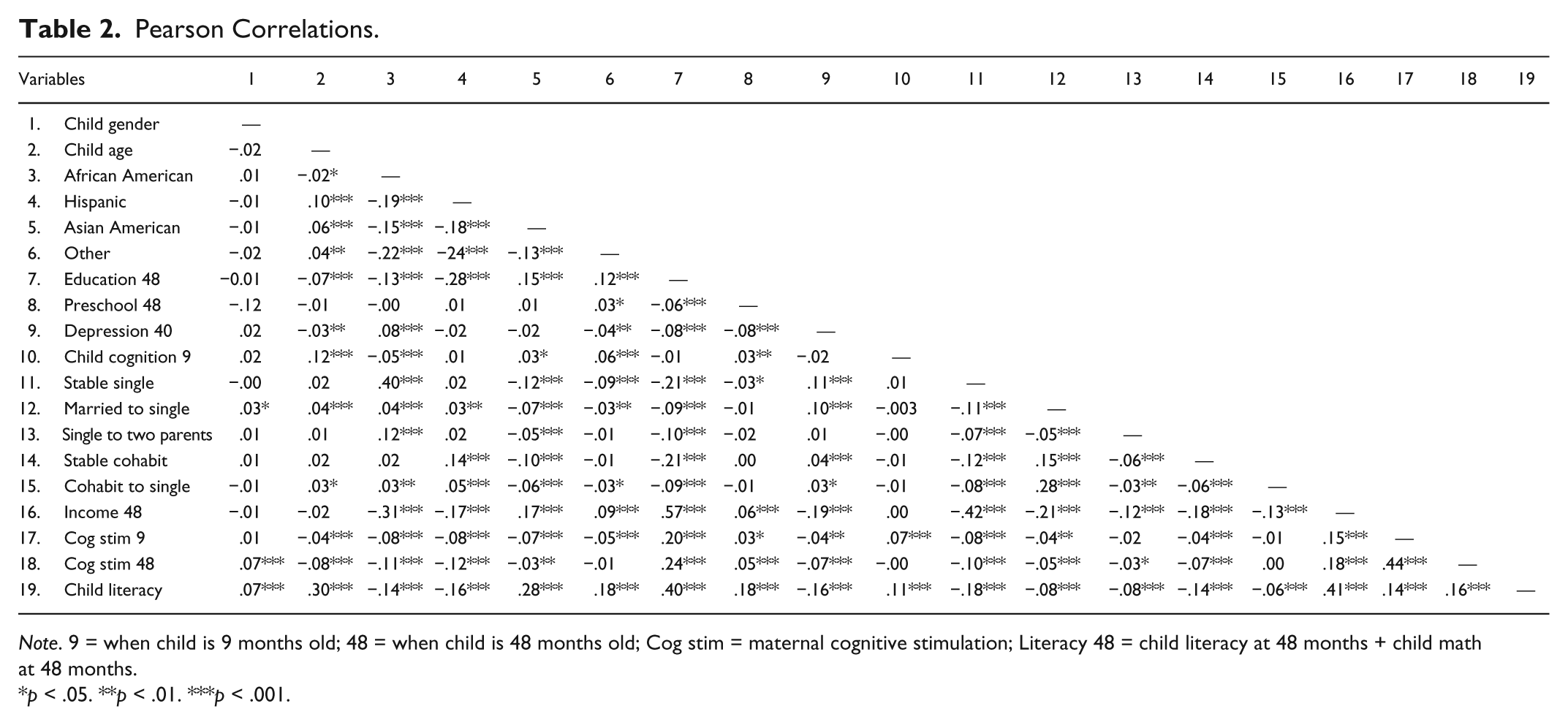
Note. 9 = when child is 9 months old; 48 = when child is 48 months old; Cog stim = maternal cognitive stimulation; Literacy 48 = child literacy at 48 months + child math at 48 months.
p < .05. **p < .01. ***p < .001.
Multivariate Analyses
I first report on the moderation effects (Table 3, Model 2). Household income at 48 months significantly moderated the association between stable single-parent family structure (married households were the reference group) and child literacy at 48 months. Figure 1 shows that household income seemed to have a stronger positive effect on child literacy in married-parent households than in single-parent households. The slope for married households was b = .13, p < .001, whereas the slope for stable single households was b = .08, p < .001. The slopes are equivalent to a 6% SD increase in child literacy for married households and a 4% SD increase for stable single households per unit change in income (1 unit change = about $5,000).
Child Literacy (Literacy Plus Math) at 48 Months Regressed on Family Structure Variables, Controls, and Moderation Variables.

Note. 9 = when child is 9 months old; 48 = when child is 48 months old; Cog stim = maternal cognitive stimulation.
Married mothers are the reference group.
p < .05. **p < .01. ***p < .001.
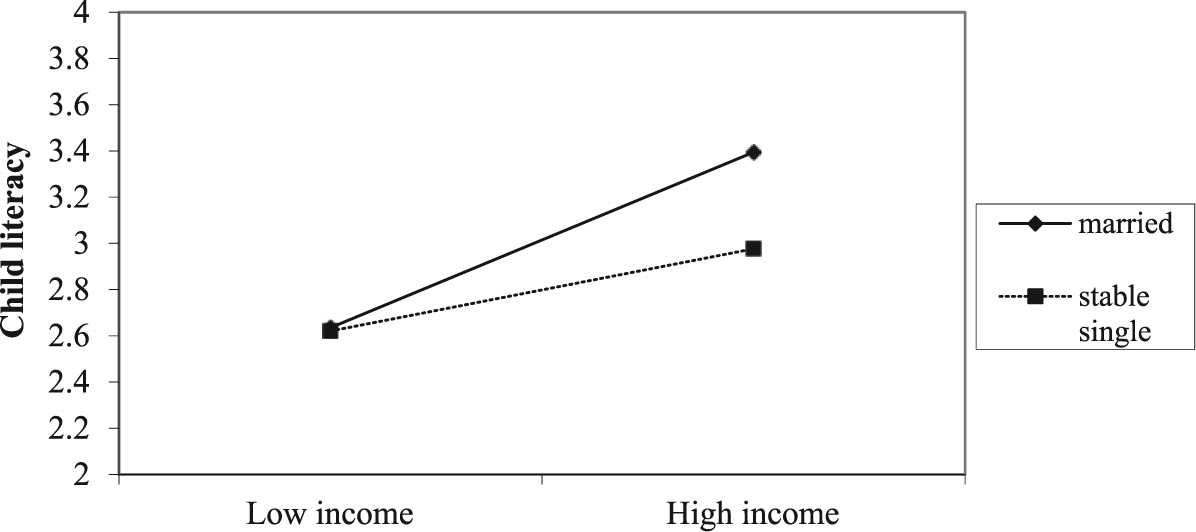
Moderation effect of household income on stable single versus stable married family structures.
Household income at 48 months significantly moderated the association between stable cohabiting family structure and child literacy. Figure 2 shows that household income seemed to have a stronger positive effect on child literacy in married-parent households than in stable cohabiting households. The slope for married households was b = .13, p < .001, whereas the slope for stable cohabiting households was b = .065, p < .001. The slopes are equivalent to a 6% SD increase in child literacy for married households and a 3% SD increase for stable cohabiting households per unit change in income.

Moderation effect of household income on stable cohabiting versus stable married family structures.
Cognitive stimulation at 48 months significantly moderated the association between stable single family structure and child literacy. Figure 3 shows that cognitive stimulation also seemed to have a stronger positive effect on child literacy in married-parent households than in single-parent households. The slope for married households was b = .069, p < .001, whereas the slope for stable single households was b = −.01, ns. The slopes are equivalent to a 4% SD increase in child literacy for married households and less than 0.1% SD decrease for stable single households per unit change in cognitive stimulation (range = 3-12).
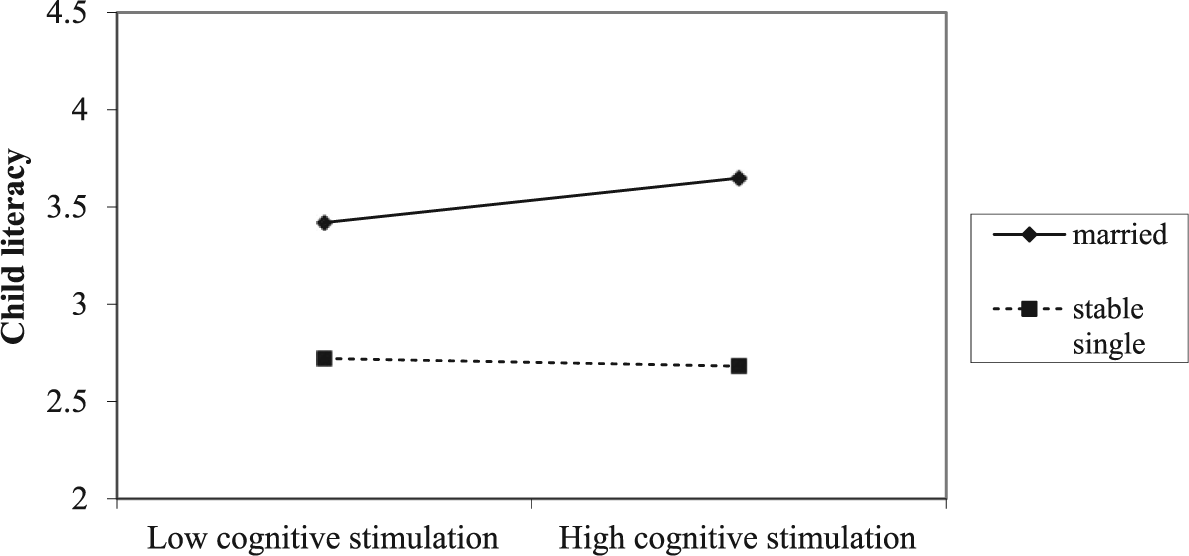
Moderation effect of cognitive stimulation on stable single versus stable married family structures.
Finally, cognitive stimulation at 48 months significantly moderated the association between married to single family structure and child literacy. Figure 4 shows that cognitive stimulation seemed to have a stronger positive effect on child literacy in married-parent households than in single-parent households. The slope for married households was b = .069, p < .001, whereas the slope for married to single households was b = −.001, ns. The slopes are equivalent to a 4% SD increase in child literacy for married households and less than 0.1% SD decrease for married to single households per unit change in cognitive stimulation (range = 3-12).
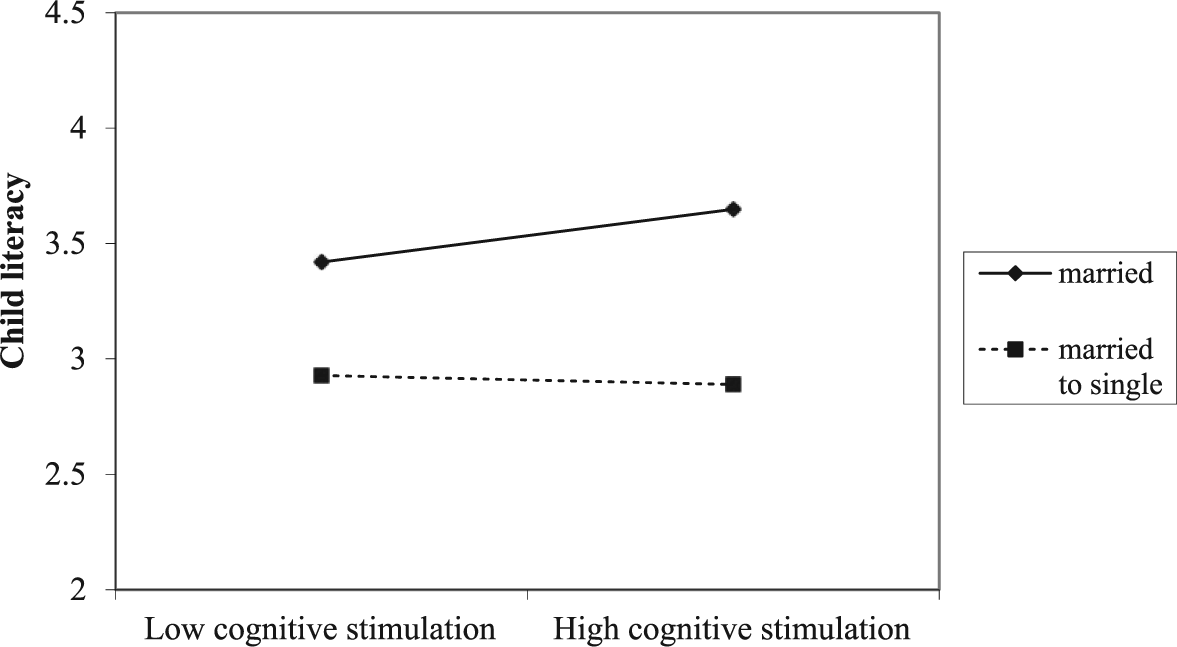
Moderation effect of cognitive stimulation on married to single versus stable married family structures.
Maternal cognitive stimulation at 48 months was examined as a possible mediator of the moderating effect of household income on family structure. Only one possible mediation effect met the criteria of Baron and Kenny (1986), and that was the mediating effect of cognitive stimulation on the association between stable single household × household income and child literacy. Table 3 (Model 2) shows that this interaction term was significantly associated with child literacy (b = −.06, p < .01) when cognitive stimulation at 48 months was in the model, and cognitive stimulation at 48 months was significantly associated with literacy (b = .08, p < .001). In addition, stable single household × household income was significantly associated with cognitive stimulation at 48 months (b = .05, p < .05) when cognitive stimulation was treated as the criterion variable. The Sobel test further revealed that this mediated moderation effect was significant (t = 2.39, p = .017). The slope for stable single household × income when cognitive stimulation was not in the model was b = −.07 (see Model 3); the slope for this moderation effect when cognitive stimulation was added to the model was b = −.06 (see Model 2). In short, household income had a greater positive effect on child literacy among married mothers compared with stable single mothers, and this effect was partially explained by married mothers engaging in higher levels of cognitive stimulation when they also had more income.
Multiple regression analyses revealed three significant family structure main effects on child literacy at 48 months (Table 3, Model 1, shows analyses with no moderation effects). Compared with children of married parents, child literacy was lower among mothers who transitioned from single-mother to two-parent households (b = −.37, p < .01), who were stable cohabiting (b = −.34, p < .001), and who were stable single (b = −.21, p < .01). Child literacy was positively related to mothers’ cognitive stimulation at 9 months (b = .02, p < .05) and mothers’ cognitive stimulation at 48 months (b = .06, p < .001). Finally, household income at 48 months was positively related to child literacy (b = .11, p < .001).
Discussion
The goal of the present study was to examine whether the associations between family structure and preschool-age children’s emerging literacy and math skills are moderated by two resources: household income and maternal cognitive stimulation. The results of the study supported the moderation hypothesis in relation to three family structure variables: stable single mother, stable cohabiting, and married to single-mother households (compared to married households). Based on family stress theory, I expected that household income and maternal cognitive stimulation would have a stronger positive influence on children residing in higher stress family structure types (e.g., stable single-mother households) in comparison to children in married households. The results were not consistent with these expectations. Rather, household income and maternal cognitive stimulation had stronger positive influences on the association between married households and child literacy than on the association between other family structure types and child literacy. That is, the presence of greater amounts of resources of income and cognitive stimulation did not compensate for the absence of married parents. It is noteworthy, however, that the moderation effects were small.
The main take-home message of the present study is that there seems to be something about married households that enables young children to benefit more than children in other family structures from higher levels of household income and cognitive stimulation. Married parents may use more of their financial resources to support children. Parents in stable single households may need to use more of their expendable income to purchase services (e.g., babysitting) that would otherwise be provided by a coresiding spouse. The added costs associated with being a single parent may mean that less income is available to purchase resources that may directly enhance children’s preacademic skills. In the case of stable cohabiting households, researchers have suggested that cohabitors are less invested (i.e., invest fewer resources) in children than are married parents (Dew, 2007). Married individuals function as shared economic entities (e.g., shared bank accounts) to a greater extent than cohabiting couples who tend to function more independently (Wilk, Bernhardt, & Noack, 2009). Parents who keep their finances separate from each other may feel they have less to spend on children because they budget on the basis of their own earnings. Future research should address these mechanisms by exploring how married parents and parents in other family structures handle their finances in relation to the family, and in particular, in relation to children.
I also explored whether the moderating effect of household income on family structure could be explained by mothers’ cognitive stimulation of children. That is, the reason that income moderates the association between family structure and child literacy is that higher income mothers in several family structure groups engage in more cognitive stimulation. The results supported mediated moderation. That is, there was a significantly stronger positive association between household income and child literacy among married mothers compared with stable single mothers because married mothers with more income provided more cognitive stimulation. It is noteworthy that cognitive stimulation only partially mediated the moderating effect of household income on child literacy. An important area for future research will be to examine other possible mediators. For example, Lareau’s (2003) qualitative research suggests that higher income children are exposed to many extracurricular activities that serve to enhance their learning.
There are several possible explanations for the finding that cognitive stimulation has a stronger positive effect on children in married households than children in stable single or married to single-mother households. One possible explanation is that the quality of maternal cognitive stimulation is higher among married mothers who provide more stimulation to their children, whereas quality does not increase among more engaged mothers in other family structure groups. It has been well established that parents engage in lower quality interactions (e.g., are less supportive) when they are under higher levels of stress (Cabrera et al., 2011). Single mothers and mothers who have transitioned from married to single-mother households are likely to have higher stress levels, and their stress may be manifested in lower quality interactions with children even when they spend more time with children. High-quality literacy support, rather than just frequency (as was measured in this study), might be more important for child literacy (Carter, Chard, & Pool, 2009; for review, see Scarborough & Dobrich, 1994).
Another possible explanation is that children in married households are exposed to their fathers’ cognitive stimulation to a greater extent than are children in stable single or married to single-mother households. Research evidence has shown that coresiding fathers are more involved than nonresidential fathers in most aspects of parenting, including cognitive stimulation (Coley & Schindler, 2008). Moreover, children who are exposed to higher levels of stimulation from one parent tend to be exposed to higher levels of stimulation from the other parent (Baker, 2013). Unfortunately, the ECLS-B had a very low rate of participation among nonresidential fathers. It was therefore not feasible to include fathers’ self-reports of their involvement with children because the current study included children residing in both coresidential and nonresidential households.
It is noteworthy that three of the family structure variables were significantly associated with child literacy (i.e., main effects) in the multivariate analyses: mothers who transition from single-mother to two-parent households, parents in stable cohabiting households, and stable single-mother households. These findings are consistent with previous studies that find significant but small negative associations between family structure and children’s academic skills (e.g., emerging literacy) during early childhood after statistically controlling for other factors, such as maternal depression, maternal education, preschool attendance, and child gender (Sun & Li, 2001). These results are also consistent with studies that have shown the importance of examining family structure changes or instability (i.e., mothers’ transition from single-mother to two-parent households) in relation to child literacy (Fomby & Cherlin, 2007).
A limitation of this study was that the ECLS-B data did not include variables that could be used to specifically assess the extent to which household income resources were used for children. Instead, I was able to measure only the household income obtained by members of the household. In addition, the ECLS-B data did not include a measure of the quality of mother’s interaction with the child at 48 months. It is possible that quality of mother–child interaction would be a stronger moderator of the association between family structure and child literacy/math than amount of maternal cognitive stimulation of children. There were also concerns about missing data in the present study. Families with lower levels of income were more likely to be missing data on child literacy and math. The results of this study may therefore overestimate child literacy and therefore not generalize to families with more economic risk.
The present study was one of the first to examine household income and maternal cognitive stimulation as moderators of the association between family structure and children’s emerging literacy/math skills. The findings of this study supported the moderation hypothesis in relation to three family structure groups: stable single-mother households, stable cohabiting households, and mothers who transition from marriage to single-mother households. There is a need to continue research into this area to explain the mechanisms through which household income and cognitive stimulation act as moderators. That children score higher on emerging literacy and math when their married parents have higher income levels and when married mothers engage in higher levels of cognitive stimulation compared with children residing in other family structures would seem to have implications for early childhood programs. Specifically, early childhood programs may need to invest more resources to assist children (regardless of household income or maternal cognitive stimulation) residing in stable single-mother households or households in which there is family instability to become ready for school. For example, programs serving large numbers of children in these higher stress family structures could consider recruiting volunteers to read to children during program attendance.
Footnotes
Declaration of Conflicting Interests
The author(s) declared no potential conflicts of interest with respect to the research, authorship, and/or publication of this article.
Funding
The author(s) received no financial support for the research, authorship, and/or publication of this article.