



Abstract
This study examines the ways in which family and cultural context influence the romantic prospects of rural women in later life. Using a feminist life course perspective, we interviewed 14 single women over the age of 50 years who lived in rural Appalachia. Grounded theory methods were used to analyze in-depth interview data. Contextualized romantic forecasts of midlife and older rural women are presented. We found that women who were highly integrated into an extended family network, typically their own family of origin, had little if any interest in romance in later life. Women who were not highly integrated into a kin network were most hopeful about finding a romantic or marriage partner. We conclude that place-based kin networks mattered in the romantic forecasts of midlife and older single women, and discuss implications for future research.
Recently, scholars have investigated the romantic lives of older women (Carpenter, Nathanson, & Kim, 2006; Tsunokai & McGrath, 2011), yet less attention has been given to how these women’s social context and family experience influence their decision to pursue romantic relationships. The Administration on Aging’s (2014) most recent demographic profile states that 54% of American women aged 65 years and older are unmarried. Although it is unknown whether this percentage will change remarkably over the next 20 years, the number of older single women will likely grow as more and more baby boomers move into later life (Wang & Parker, 2014). Given that new romantic relationships have the potential to affect the giving and receiving of support (Mahay & Lewin, 2007; Musick & Bumpass, 2012), family scholars should understand single midlife and older women’s openness to these relationships (Sassler, 2010).
Because we wanted to investigate family experiences and social context, we focused our study on midlife and older, working class women in rural, coalfield Appalachia known for a strong local culture, family ties, economic disadvantage, and high rates of chronic health problems (Behringer & Friedell, 2006; Mather, 2004; Wood, 2005). Using a feminist, life course perspective, we explored the ways in which family experience and social context influenced the desire for romantic relationships in later life among middle-aged and older women who were single and lived in a rural context. Our research questions were (a) How do midlife and older, single, working-class women perceive dating and romantic relationships in later life and (b) What role do family experience and place play in these rural women’s desire to pursue romance in later life?
Romantic Relationship Formation in Later Life
There are several pathways by which women find themselves single in later life. Of the 54% of unmarried older women in the Administration on Aging (2014) profile, 35% said they were widowed, 15% divorced or separated, and 4% never married. Similarly, a variety of factors influence single older women’s desire to pursue romantic relationships in later life. Moorman, Booth, and Fingerman (2006; N = 308) studied widows’ desire to remarry and found that being younger and having lower levels of happiness predicted a greater interest in remarriage. Single women who do enter into new relationships later in life face complex challenges regarding sexual expectations, familial expectations, and proscribed gender roles (Calasanti & Kiecolt, 2007; Silverstein & Giarrusso, 2010). These challenges may be especially true for new wives who are in a position to make decisions regarding the care and finances of a spouse who develops dementia (Roberto & Jarrott, 2008). Adult children may resent a new wife’s authority in their father’s life (C.W. Sherman & Baurer, 2008).
Watson, Bell, and Stelle (2010) examined the cultural narratives of eight single older women aged 64 to 77 years (some were widowed, others divorced) as they navigated transitions into later life marriage. Many of the women reported that they had no desire to remarry before they met their future husband. Commonly, the women in this study endorsed traditional gender roles, were anxious not to be perceived as the kind of woman who chased men, and were surprised to be awakened sexually after they married again. Although this study draws attention to the cultural discourses older women may use to construct their romantic lives, the researchers only spoke to women who were remarried and did not capture the ideas of women who will not remarry or who are interested in nonmarital romantic relationships. Moreover, the researchers did not assess how particular social contexts play into women’s romantic decision making in later life.
Theoretical Perspective
Rather than a marriage market perspective that emphasizes the relational economy and where dating and marriage are seen primarily through the lens of a “trading relationship” (Casper & Bianchi, 2002, p. 272; Moorman et al., 2006) or a “supply-demand dynamic” (Fitzpatrick, Sharp, & Reifman, 2009, p. 123), we wanted to explore the ways in which midlife and older, rural women discussed intimate family ties, romance, as well as their plans for dating. To address our research questions, we integrated relevant ideas from a feminist intersectional approach (Ferree, 2010; Few-Demo, 2014) and life course theory (Connidis, 2012; Elder & Giele, 2009).
Watson et al. (2010) discussed the importance of obtaining narrative data for relationship research: The narratives link “back to relationships earlier in life, then proceed through the period of life alone to the development of a new relationship. Thus they constitute a more far-reaching story than has been available from focused surveys or interviews” (p. 308). We used concepts from life course and feminist theories to help obtain our participants’ far-reaching stories: locational and relational intersectionality (feminist theory), and turning points and agency (life course theory). These concepts helped sensitize us to important family and cultural issues, such as life changing experiences (i.e., turning points), as we designed the study and analyzed the data.
Intersectionality
Intersectionality “is the negotiation of a politics of location” (De Reus, Few, & Blume, 2005, p. 449); and refers to the intersection of social locations such as race, class, age, place, and gender. For example, two people identifying with the same racial and gender categories may have very different histories with class, education, and/or sexuality (Allen, Lloyd, & Few, 2009). Social institutions and cultural conditions may uniquely structure the romantic lives of older women sharing similar social locations. For instance, how did being embedded within poor, rural communities matter in these women’s stories?
As a component of intersectionality, place intersects with race and class, among other key areas of social stratification, in that both families and individuals need access to a family place, a place to call home. Thus, place includes the physical and emotional connectedness to a geographic location. This concept of place is similar to the use of homeplace as a metaphor that is helpful for theorizing about “the marginalized families, immigrant families, and culturally displaced families that are now a part of the American demographic landscape” (Dilworth-Anderson, Burton, & Klein, 2005, p. 48). One key theme of the conceptualization of homeplace is that African Americans have had to develop a sense of homeplace in the context of slavery, and then institutional segregation. Even the most poor White Appalachians do not share a history of slavery and discrimination that African Americans anywhere in the United States have experienced. Rather, for the White, working-class Appalachian women in this study, place was operationalized as a history in a particular geographic location via a strong connection to one’s family of origin.
Ferree (2010) says that intersectionality research generally falls into one of two types: locational intersectionality and relational intersectionality. Researchers using locational intersectionality “have illuminated what [ . . . ] socially devalued individuals face, but also used their standpoint theoretically to gain insights into the workings of the intersectional system of disadvantage” (Ferree, 2010, p. 428). Instead of examining disadvantaged groups, researchers using a relational intersectional lens look at struggles and conflicts (Ferree, 2010). We intentionally used both of these methods. In terms of locational intersectionality, we paid attention to the ways in which class and place structured the older women’s lives. In terms of relational intersectionality, we looked at the ways in which the women used larger cultural discourses to construct their relational past and present lives.
Turning Points
Life course theorists posit that individuals are embedded within complex familial relationships over generations (Bengtson & Allen, 1993). Moreover, individual lives happen within particular places and during particular times (i.e., contexts). Life course perspective differs from a family life cycle approach in that life course theorists recognize that there is complexity in when and how individuals experience important roles and transitions, such as motherhood, marriage, and singlehood in later life (Allen, 1989). Concepts in life course theory help family researchers understand the complexity of individual lives, particularly in terms of how people make choices within the constraints of their family and social contexts.
Although there are many key concepts in life course theory, we operationalized turning points and agency for the purposes of this study. The concept of turning points refers to the normative and nonnormative transitions individuals make over the life course. Normative transitions are turning points that most people in a given culture experience and may include becoming a grandmother, retirement, becoming a caregiver, and the death of parents or a partner; these “developmental turning points are more easily identified in age-dependent trajectories” (George, 2009, p. 169). Nonnormative transitions are turning points of a more personal nature and may include leaving an abusive partner or a religious conversion experience; these critical events are typically visible only in retrospect (George, 2009). In our study, paying attention to turning points in the women’s narratives helped us think about antecedents to new romantic trajectories in each woman’s life course (Allen, 1989; Sharp & Ganong, 2007). We combine this concept with locational intersectionality in the organization of the findings because we found that turning points were closely associated with structural circumstances in the women’s lives such as opportunities for higher education, employment, and retirement decisions.
Agency
Agency, a term used to describe the role of choice in decision making over the life course, is a complex social–psychological process that goes beyond “a vague sense of human freedom or individual volition” (Hitlin & Elder, 2007, p. 171). Generally, agency refers to one’s ability and desire to make choices within the constraints of the social context. Agency is a useful term because it moves beyond the “nature versus nurture debate,” and implicitly asks what kinds of choices people have given social constraints such as poverty, place, ageist prejudice, and family obligations (Schafer, Ferraro, & Mustillo, 2011). Specifically, we pay attention to the language the older, rural women used to account for their relational histories. The language people use to understand their relational experience is drawn from larger cultural discourses about dating, marriage, and romance (Gubrium & Holstein, 1990; J. Sherman, 2009; Swidler, 2001). Thus, we combine the concepts of agency and relational intersectionality in the organization of our findings.
Method
We drew from constructivist grounded theory methods of open and focused coding (Charmaz, 2006) in conjunction with our guiding theoretical perspective to collect and analyze life course histories of midlife and older White working-class, Appalachian women (N = 14). This type of qualitative data collection and thematic analysis allowed us to generate a storyline grounded in the participants’ perceptions of their experiences and thus answer our research questions. We have changed the place names, the women’s names, and some minor details of their stories to protect their privacy. Data presented in the sample demographic table (Table 1) were not changed as we felt these were potentially crucial details in understanding the women’s experience.
Sample Description and Romantic Forecasts (N = 14).
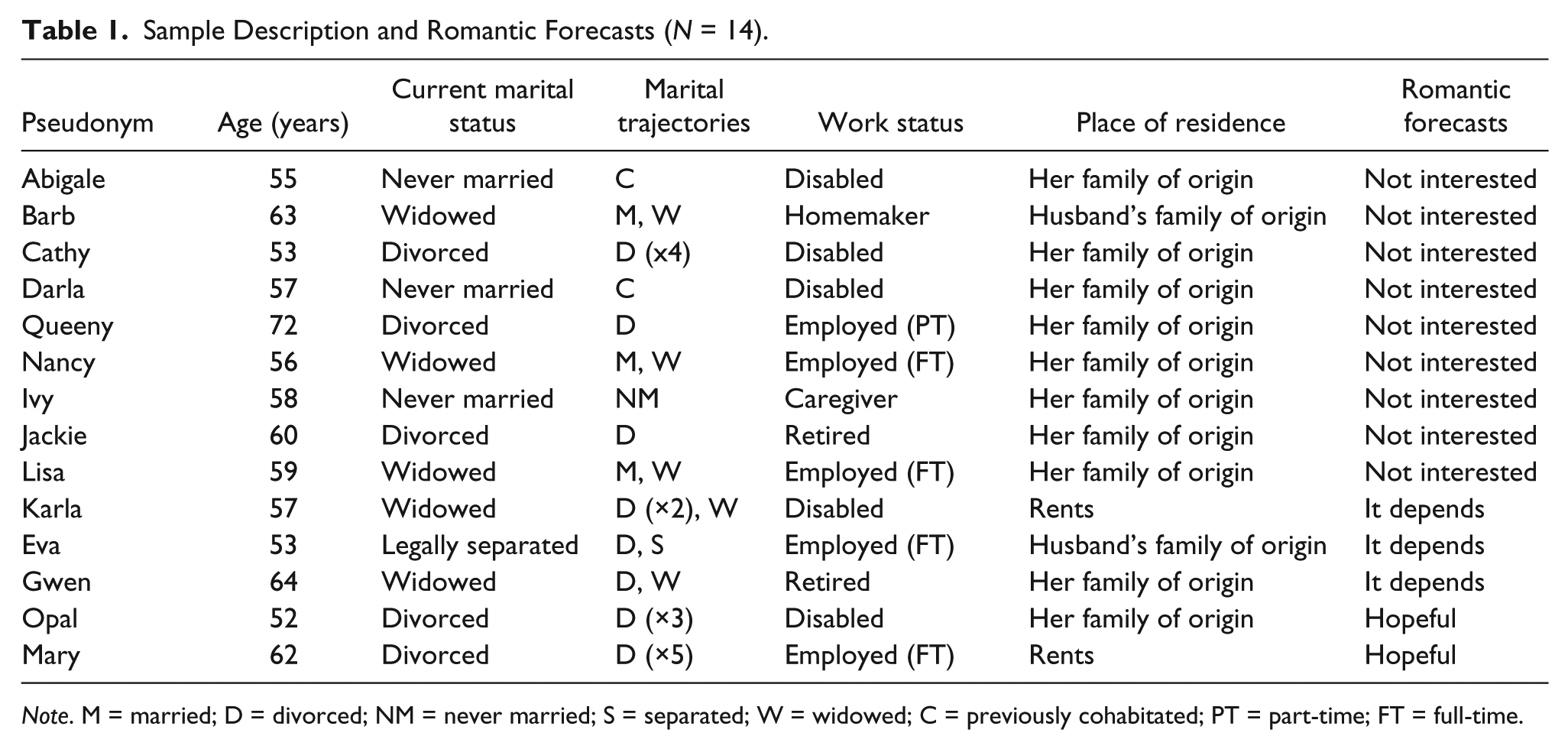
Note. M = married; D = divorced; NM = never married; S = separated; W = widowed; C = previously cohabitated; PT = part-time; FT = full-time.
Sampling Strategy
We recruited women from rural, working-class communities in the Appalachian regions of Virginia and West Virginia using purposive sampling. Eligibility criteria were that participants must be (a) between 50 and 74 years old, (b) currently single, (c) working class (determined by education and profession), and (d) born and currently living in an Appalachian county as defined by the Appalachian Regional Commission (a federal agency developed during the War on Poverty). Local newspapers and widely posted fliers were used to advertise for participants. Also, news of the study was spread word of mouth by participants and community members such as store clerks. Fourteen White women volunteered to participate in the study. Notably, we sought to interview men, but only three volunteered and did not provide enough data to warrant inclusion into this study. This research was approved by Virginia Tech’s institutional review board.
The first author conducted the interviews in the participants’ homes, with the exception of one interview which took place in a gatekeeper’s home because the participant did not want to disturb her daughter who worked night shifts and slept during the day, and another interview where the woman requested to be interviewed in her car rather than the home she shared with her mother. For the most part, the women lived by themselves or with a somewhat financially dependent adult child; two women were caregivers for their parents and lived with them. The women all lived in rural locations, though some residences were more rural than others (some people had neighbors who were closer in physical distance, and in some cases, nonfamily neighbors). Most of the women lived on family property surrounded by the homes of immediate family members and extended kin. In four interviews, family members came into the room while the women were talking, but these participants seemed no less or no more forthcoming in describing or reflecting on their histories. Interestingly, in these four cases, the younger visitor stayed inside the doorway until the woman had finished answering a question, and then explained the reason for their visit when the woman gave the younger person her attention. Occasionally, a visitor stayed for a while to listen and once attempted to join the conversation.
Data Collection
Participants were interviewed using a semistructured, open-ended protocol designed to elicit participants’ stories about their close relationships over the life course. The interview began by asking about the woman’s family life in childhood, then moved to transitions into adulthood (including questions about educational decisions and first marriages) and adult turning points (parenting, divorce, and breakups), and ended with the women’s thoughts about their current romantic lives. Interviews lasted approximately 2 hours, were recorded with digital recorders, and then transcribed in Atlas.ti qualitative data management software.
Data Analysis
When we reached saturation with the interviews (continued interviews did not produce any new insights when writing theoretical memos), we began open coding using an iterative process. The first author began by reading through her process notes (i.e., short notes she made to herself after interviews and during transcription), then made a list of possible codes. Both authors reread all transcripts and engaged in the process of open coding (coding every meaningful segment of data using the list of possible codes and adding new codes), by which we generated an exhaustive list of possible codes. We then began creating a coding scheme, organizing codes into seven categories, each with subcodes reflective of these broader focused codes: Family of Origin (e.g., storying mother/describing daddy), Romantic Relationships (e.g., bargaining), Perceptions of Social Life (e.g., romanticizing childhood poverty), Self-Perceptions (e.g., continuity with family), Religious Life (e.g., finding God), and Place (e.g., home as ever-present). We coded all interviews with this coding scheme. After coding, we employed the constant comparative process, examining quotes under individual codes and combining some codes to make sure all quotes within a code were analytically similar. After combining some codes, we further reduced and reorganized the overlap among the seven main coding categories into a more streamlined coding scheme. For example, we had three codes that dealt with employment issues (family employment, work stories, and perceptions of work). We combined these employment-related codes, creating one code. The final coding scheme had three categories: Family of Origin (7 codes; e.g., Family Time is Seasonal Time), Romantic Relationships (5 codes; e.g., Maintaining a Friendship), and Social Structural (11 codes; e.g., Talking Class) all of which were informed by the women’s responses and the sensitizing concepts from our theoretical framework.
Next, we looked at the most saturated and salient codes, and began to think of them in terms of process and structure. Some codes, such as “place,” which we defined as physical proximity and emotional connection to one’s family of origin, cut across processes, such as the subcodes “describing childhood” or “storying mom.” Seeking to understand how these codes fit together, we began to write the storyline of the women’s experience with close relationships, going back to theoretical memos from the data collection phase. The storyline presented in the findings was a process of focused coding according to Charmaz (2006). On the basis of the final storyline we developed to explain the women’s varying perceptions of relationships with intimacy and kinship, we present a theory about the late-life romantic forecasts of working-class, single women in rural Appalachia.
Findings
In the findings, we present a storyline about why most of the midlife and older single women in our study did not want to pursue romantic relationships later in their life. The women followed different routes to a “single” status—(Table 1) never-married, widowed, and divorced—but all had, at best, ambivalent experiences with men in their lives. Only two women, Mary and Opal, said they were “hopeful” they would find a romantic partner and hoped to remarry some day. Three other women, Karla, Gwen, and Eva, socialized with other women where they sometimes met men, but said they had little interest in dating or getting remarried, and did not actively try to attract men as did their younger friends. The other nine women said they had no interest in finding a romantic partner, stating that they were already fulfilled in their relationships with their closest family and kin. To make sense of these findings, first we looked at the context that shaped the women’s intimate and family experiences.
Context: Locational Intersectionality and Turning Points
Place and Family of Origin: “It Was Hard, but It Was Good”
The most prominent theme in the women’s accounts of their family and intimate lives concerned the living conditions of rural Appalachia during their childhood in the 1950s and 1960s. Their earliest experiences of intimacy were strongly connected to work shared among family members in the context of their rural economic circumstances. All 14 participants said that their childhoods were full of work, and almost all (n = 12), with the exception of Mary and Opal, spoke of their childhood as being “full of love.” The women described family life in terms of everyday life and of seasons and special time, despite some of the hardships their families of origin endured. This seasonal family time was strongly connected with family work and a tradition most of the women wanted to carry on in later life. Jackie described special family times that she continues to emulate:
There were chores to be done, yes. But when your chores were done, you entertained your friends. And at that time kids liked to get out and hike. Our mother was a great believer in outside fires, after dark. She’d build a bon fire and we might not have but just a few marshmallows, but you always had something to cook over that fire. And she had a big cast iron kettle and I remember her making that full of soup. And they would be so many kids there, you get a good bowl of soup but there was no seconds to go back for.
Similarly, Barb said, “We worked during the day and then on the weekends, especially, we could get out and enjoy one another and have company and visit each other.” Here, the women described the ways in which class and place intersected to shape their families’ relationships during childhood.
Participants did not discuss vacations, and rarely mentioned outings that required discretionary money, such as when Opal described going to the nearest city a few times during her childhood where there used to be an amusement park. Typically, time spent not working around the home was used to maintain and strengthen relationships with extended kin. As did Jackie, Nancy said, “My mom and dad fed everybody that come in. My mom cooked three meals a day, every day. They was always kids [siblings and cousins] around us all the time.” Abigale said,
We were surrounded by my mom’s brothers and sisters, and they had kids that were the same age as us so we always had somebody to play with. [ . . . ] Compared to today’s standards, I say we done really good.
Several women pointed out that things children today take for granted, such as store bought snacks and entertainment, were nonexistent. Ivy noted that “back then there was no extra activities.” Related, Karla who had moved away from her rural family during childhood, recalled visits where she noticed that her country cousins felt grateful to be treated to a soda pop after a long day’s work weeding the family garden, echoing other women’s description of store-bought food as a rare treat.
Despite descriptions of hard times and abuse experienced in her childhood and in her romantic relationships with local men, Cathy’s comments summed up the feelings of many women, and illustrates how the physical place which characterized their family life was a protective factor for poor, White, rural families by strengthening intimate ties. For example, with Cathy, although she describes moving frequently in childhood, she was “raised” in one place, a community that she perceived as safe. She said,
When you’re raised up in a rural area, back in the hollers, where it’s all family, and you raised your own food, your chickens, your . . . I mean, it was a good life. You didn’t have these automobiles and stuff to run up and down these roads. And these 4-wheelers trying to run over top of you. And motor cycles. Everybody walked to everybody’s house. If somebody come down the road walking and you wasn’t busy that day, you’d go to talking to them and walking down the road. And the next thing you’d know you stop at somebody else’s house and start talking. It was a good life, a hard life, a really hard life, but a good life. I enjoyed it. With all I been through I enjoyed it.
Similarly, when Nancy described her life between high school and marriage, she said that she lived with her brother out of state for 4 years, but it was never home. When asked why she decided to move back after 4 years, she said, “I never permanently moved. I just went out to help him [with the kids] and then after they got bigger and I got tired of staying . . . I just headed back home.” A sense of place, connected to the women’s family of origin and their home, was developed in childhood, and continued to be salient throughout most of the women’s intimate lives, whether in partnerships with men or in connections to their families and kin.
Transition to Mothering
Because most of the women lived in close physical proximity to kin, nurturing younger family members was an important aspect of the women’s intimate lives and played a part in their romantic forecasts. All of the participants, except the three never-married women, had biological children. And one woman, Jackie, had adopted another child when she discovered that she could have no more than one biological child. Becoming a mother was an important turning point for those women and mothering activity was an important context for their intimate sense of self even in later life. For example, Gwen reported being close to her two adult daughters and grandchildren, and also said that she enjoyed a close friendship with a young woman with whom she had worked. Describing how they became close Gwen said,
We worked together for a long time and then she quit work and while I, I’m quite a few years older than her, and I was working with her when her mother died, and then a few years later her dad died, and she called me mom for a long time. And we’re still close.
Barb had a similar, valued experience where she volunteered at her grandchildren’s elementary school saying that she was the experienced “grandma” giving advice to the other, younger mothers who also volunteered.
Highlighting the importance of family relationships, the women who divorced when their children were young described that being a good mother was of continuing importance for their sense of self. Cathy shows that despite having little autonomy, time, or money, she felt pride at having taking care of her children:
When I first was married, [my husband] wouldn’t take me down at mom’s or dad’s because he didn’t want me to go around my family. So at Christmas I bought my son a red wagon; I put pillows in there and put him on it and would walk to dad’s. That was about 6 miles. I always left early enough to get back home, to fix supper before he got in. [ . . . ] But I always made sure that my kids always had food on the table, and a roof over their head, and clothes on their backs. That was one thing that I learnt growing up that I took with me. . . . And I don’t know how I done it, but I did it. I was only drawing $206 a month with my two kids. But I paid my rent, my electric, you know things I had to have out of that. And then I’d go to the store once a month.
Cathy also mentioned that she always kept a garden to supplement their store bought food, again creating a connection to place in terms of her childhood family and home. Cathy’s mothering is characterized by her desire to maintain continuity and strong ties with her family of origin.
Other divorced mothers had a more difficult time maintaining connections between past and present, suggesting that divorce was a turning point that had set them on a trajectory that weakened their connection to place and compromised their intimate lives. After finding out that her former partner had fathered a child with another woman, Eva said that the knowledge of that child hurt her sense of self as a mother and affected how she felt about her former partner. For a while after their separation, she held out hope that they would reunite. She maintained their home on the land of his family of origin and refused to give him a divorce. Then she found out that another woman was pregnant by him:
But after that, I can’t say that I don’t care about his well being, but after that, well . . . it changed. She took something I wanted; cause I wanted more [children]. Even though I came from a bigger family, I wanted more.
Although Eva reported ambivalent relationships with her two adult children, she found meaning in her relationships with two women in her small community who were much younger than her, and for whom she served as a kind of mother, similar to Barb and Gwen above. Eva’s mothering activity with her younger friends played out in an unexpected way in regard to her romantic forecast in that the younger women sometimes introduced Eva to single men.
Abigale, Ivy, and Darla, who were never married and did not have children of their own, discussed feeling conflicted about not having children and expanding their family of origin. Regardless, all three lifelong never-married women reported close relationships with their nieces and nephews (Allen, 1989; Milardo, 2010). Darla explained how she had a difficult time dealing with the pain of not being able to fulfill the normative mother role. She said,
I always wanted kids, always . . . everybody tells me I raised this bunch around here. But they ain’t done that well. . . . What am I saying . . . I always wanted kids and I went through a bad, bad realization of not having kids. And I drank, took up smoking when I was 30. I never did smoke cigarettes until I was 30. [I guess I] needed a crutch. And, well, to make a long story short I ain’t had kids.
Ivy, too, expressed some bitterness over “not paying her debt to society,” because she chose not to get married and have children. She said others in the community sometimes acted as if she had not “paid her dues” as a woman. Nevertheless, all three women felt that they mothered others in their kin networks though the children they “raised” were nieces and nephews. Both Abigale and Ivy described heavy involvement in the lives of her nieces and nephews, saying that when the kids were younger, these aunts drove them to school, and that they took every opportunity to “spoil” them, such as giving them gifts or helping facilitate involvement in after school activities. Ivy, in particular, felt ambivalence that her nieces and nephews were moving away from home to take work out of state. Reflecting the feelings of other mothers and aunts who had witnessed the out-migration of their children, Ivy was proud of the younger generations accomplishments, sharing their graduation and military photographs, yet lamented that the young adults left home and family ties, severing their connection to place. It was important for these women’s family identity to be available and involved in the lives of younger family members, thus affecting their romantic forecasts.
Spirituality and Conversion Experiences
Religious faith and a personal relationship with God was a very important turning point in most of the older women’s intimate lives (n = 10), reflecting their evangelical Christian background wherein an emotional, close relationship with God is emphasized. A major turning point for nine women, more than half, was a religious conversion experience in midlife; another woman had a conversion experience as a teenager. Even the four women who did not describe a conversion experience, described themselves as “believers.” Jackie was especially descriptive about her conversion experience:
I’ll tell you what. I didn’t know what it was. I couldn’t eat; I couldn’t sleep; I was happy nowhere I went, content nowhere I went. And they were having revival at Little Goodman Branch Church, [ . . . and] somebody invited me to come to church and I went that night. And that preacher preached and I grabbed the back of the seat and I hung on for dear life. Well, the next night I went. When they made that altar call I was the first one down the aisle. And it was a good decision. It really was. It took some of the friends away, a couple, but they were, they were not bad people, but used language that I didn’t appreciate. And didn’t understand I had made [a change]. And that decision was the best decision I ever made, was to humble myself, and it made me a stronger, better person. It really does. Cause things don’t get too bad to pray. And you’re never alone. You always have someone to talk to and rely on. [Italics added.]
Karla described such an emotional experience, but said that she had begun to make lifestyle changes and attend church services with various family members before “getting saved” during a revival. Moreover, Karla had recently had her conversion experience weeks before our interview, and she talked about her ongoing struggle to live a Christian life, which included developing a personal relationship with God, and making sense of The Bible.
Similar to Karla and Eva who talked about the challenges of leading a Christian life, Mary who had been a Christian many years, said that sometimes her faith waned, but that it was a part of being a Christian. She said lately she had not been attending church like she should but said,
Yeah I still pray to God; I still believe in God. I don’t feel like I backslid on God. I just feel like I’m not where I need to be. And I think my Christianity and stuff, I just don’t know how people live without it. But I think sometimes we get to where we question God about things and I find myself doing it sometimes. And I know a lot of its probably pity, you know, but I guess we all do it.
Thus, a personal relationship with God was a key turning point in the life experiences of women who were currently single and it was linked to the family relationships (families typically worship together intergenerationally) and the rural communities in which they lived. In addition to their intimate religious feelings, a conservative Christian sense of morality and gender norms influenced their romantic forecasts as detailed below.
Discourses: Relational Intersectionality and Agency
Sexual Agency: “Men Don’t Care Who They Sleep With”
When asked why she was not interested in dating, Lisa was typical of those who were uninterested when she explained,
Well, for one thing, you know, as far as relationships with men, there’s not any really any decent, good men anymore, you know. They all think women are alike. The single men that are out there, they don’t think of women with morals and stuff. They just think we’re wild and we’re not! So I don’t fool with them. I mean, they’re just . . . like I say, I don’t ever say “Never,” I might meet somebody next week and might like them. But I’ve never asked the Lord for anybody.
Ivy made a similar comment and elaborated that men “want to more or less experience marriage before they actually get to know you.” Queeny, the oldest participant, said that in her late 60s, she had dated a man for 2 years, but after discovering that a younger woman was secretly living with him, she gave up hope. These women were not necessarily overtly negative about sexuality—Queeny was very forthcoming about enjoying sex within marriage—but discussed their perceptions, and disappointment, that men wanted to rush things sexually outside the context of marriage. In rejecting men and dating, these midlife and older women were exercising their agency to have control over their intimate lives and sexual selves. It is not that the women did not have opportunities for romance, rather that their previous experiences with men had led them to believe that any involvement with a man would necessarily cause a conflict between his sexual advances and her desire to have sex only within the context of marriage. In response to that assumed conflict, the women simply opted out.
Related, some women said they felt conflicted about dating because of their religious beliefs, but did not outright reject the idea of being involved with a man. Abigale said that she had always felt that her sexual relationship with her boyfriend was wrong because he was legally married to someone else. After they broke up and she became a Christian, she said she lost interest in dating or remarrying. Generally, the women had little expectation that they would find a “godly man.” Eva explained why she broke up with one man she dated:
But the reason we split up was I had gotten back in to church and I told him that, you know, the reason I don’t go to church now is that you don’t live a double standard life. To me, sleeping with somebody’s wrong and I know God forgives us but it’s a sin to repeat a sin. So when I told him that I was in church we just split. And then I helped him out financially and he stuck me [did not repay his debt]. And I ended up having to file bankruptcy back then.
Mary, who was bothered that she had been married and divorced five times said that those experiences had soured her on marriage:
But one thing I always said I would never, ever live with anybody. And I guess I’ve always been a Christian for years and years and years . . . but I said the way I feel now, I think it’s better to live with somebody then to just up and marry them.
In the past, Mary had practiced agency by marrying quickly to avoid sex outside of marriage, negotiating between her relationship with God and the men in her life. But it had not worked out for her. She reevaluates her previous stance in light of her divorces and concludes that living together might be the more moral choice, suggesting that even in a relationship with God, one’s agentic action can shift and evolve. Interestingly, seeing happy couples in church sometimes caused Karla to reflect on finding a partner. She lamented her lack of a traditional partnership with a man:
Sometimes when I’m at church I’m thinking, everybody’s sitting there together. It would be nice to have somebody sitting beside me. But then I think of all the aggravation that goes with it. I mean, it would be nice to have somebody to go to dinner with or go on trips or do stuff with. But then you have to deal with the other part of it too, and it’s really not even worth it to me. And then who knows, I might find a godly man (laughs). And I might have a wonderful life, what’s left, you know.
Karla’s sense of agency seems compromised in which she sees married couples at church in terms of an idealized life, a life that has thus far been unreachable.
Maintaining Independence: “If Someone Else Came Into the Picture It Could Change Things Drastically”
Although Karla was not actively seeking a romantic partner because she perceived it to be too messy and challenging to a godly life, she differed from Cathy who said she felt that the romance part of her life was over. Cathy explained how she coped with feelings of loneliness when they arose, by comparing her relatively quiet life with the reality of marital conflict that she saw in others:
And all I have to do, I think about being lonely and you know sometimes cry and all that. Cause you know you ain’t got nobody to hold you or nothing like that, and then I go over to [my brother’s] house [where they constantly bicker and fight], or go to the other [sister]’s house, and nope, changed my mind. Don’t have to worry about that no more.
Similarly, Barb reflected the sentiments of many women when she said,
I’m satisfied with being me, with who I am. And the life I have now, yeah. No, no one else. The way I feel right now, that’s the way it would be. No, not a chance. But, things may change, you never know. But the way I feel now, no. It would be no one. Just me and the family, me, my kids, and grandkids. I’m happy that way.
Jackie explained that in addition to valuing her independent life where she had “good work and a good income,” she had already found her one true love, her ex-husband. She said,
I think I haven’t really dated, or wanted to date anybody, I knew there was nobody I could care for like I cared for him. And it wouldn’t have been fair to anyone else to offer just part of your heart.
When asked if there had ever been any possibility of she and her ex-husband reuniting she said, No, but
about seven or eight years before he [died], he quit drinking. And he became the person I knew. But he was never the person I could trust . . . I thought [about him], “You done it once, and you’ll do it again.”
Similar to the instances where some of the women expressed sexual agency by foregoing romantic involvement, these women chose to remain on the same life course trajectory they had begun as young women.
A Discourse of Risk: “I Think of the Financial Reasons”
Like Jackie who noted that she had a good income and did not necessarily need a man, others commented on finances when discussing dating in midlife. Darla said, “If one came in there with a big rich pocket book” she might say yes, but like others, she said she was not looking and did not expect romance to find her. Similarly, Eva explained how her long-time legal separation complicated her dating life, saying of her husband. “Well, he paid my car insurance, that was part of the legal separation, and I’m on his health insurance. And my big thing was I didn’t really find anybody else I wanted.” Later, the issue of money came up again when talking about finding a partner. She said,
So still yet, to me, if I was to marry somebody else it would be for long term. Not just because I wanted a companion. It would be because I loved him and needed him and could spend the rest of my life with him happy. And then, sometimes too, with me, it’s love, but at my age I feel that financially somebody should be there for me too. I mean even though I work, it’s like his money’s my money too.
Eva discussed money concerns more than other women, but she was particularly financially vulnerable under the terms of her separation agreement. She was basically homeless because she had agreed to give the house that she had lived in for years to her husband since it was on his family property, and she felt that it would not be right for her to take away his heritage. Moreover, if Eva remarried, she stood to lose social security benefits associated with her husband. Under federal law, women (widowed and divorced) who have been married 10 years or more to a male worker are entitled to a social security benefit on the basis of his contributions equivalent to the length of their marriage (Harrington Meyer & Wilmoth, 2006). If women remarry, they are not eligible for these benefits as these benefits are based on a woman’s relation to a man, rather than an entitlement related to her labor in the home. Eva had worked for pay most of her adult life; however, most of these jobs did not provide a so-called “family wage” associated with traditionally masculine jobs, and she would not have as much social security benefit compared with her ex-husband.
Though other women did not explicitly discuss money, those who did are consistent with the findings above that women’s expectations for marriage include a man who can amply provide for his family. When the women were young, they simply followed the family structural pattern of their parents, endorsing traditional gender roles. Though the women still used the discourse of traditional gender roles in describing men and problems of the younger generation, their financial vulnerability caused some women to think of these issues in later life using a discourse of risk, highlighting issues of relational intersectionality.
Three Romantic Forecasts
Below, we present a summary of the romantic forecasts of the midlife and older Appalachian women interviewed for this study (Table 1). These designations of desire for an intimate relationship with a man, or of marriage (not interested, it depends, and hopeful) are more like nodes on a continuum than discrete categories. Consider that Queeny, the oldest participant (72), dated a man from her church when she was in her 60s. During that time, she might have been an “it depends” woman because she would only date “Godly” men. When he quit going to church and they broke up because she discovered that he was having a sexual relationship with another woman, she began to invest more of her time with her family (several of whom lived with her in her home or next door on family land), and said she was no longer interested in romantic relationships. Thus, for those who had it, a place-based family network functioned as a safe haven and source of intimacy for those who had negative romantic experiences even in later life.
Not Interested
In the first type of romantic forecast, we found that a high degree of family integration, which may be particular to Appalachian culture, greatly influenced these midlife and older women’s desire to pursue romance and dating in later life. Midlife and older women who more integrated into their families of origin had lived in closer proximity and for longer times than the women who had not. The nine women who were highly integrated into their families of origin consistently used “we” language to answer questions about her childhood or family life, and were not interested in pursuing romantic relationships in later life. It is not simply that these women felt more emotionally close to their parents or siblings, but, as illustrated above, that they had, for many years, shared daily life and a sense of self with family members who lived in close proximity. As illustrated above with the case of Queeny, if romance failed these women, they had a place (often the house they grew up in) with dense emotional ties to support them and give them a sense of continuity and meaning.
It Depends
The three women who used the language of “it depends” to describe their interest in dating all were struggling to maintain ties with their extended families, particularly their own family of origin. Eva did not have close ties with her ex-husband’s (legally separated) family of origin despite living on their property. She felt close to her own family, but they lived in another Appalachian county, nearly a 3-hour drive away. Gwen had moved back to be near her family of origin 2 years prior to the interview. She reported being intentional in regard to her relationship with her sister, the only other surviving member from her family of origin, because they were the only two left. Likewise, Karla had experienced the death of many members of her extended family of origin, and had recently returned to the town of her extended family. She said that although she did not live “close” to her remaining family members (meaning next door, as they lived in the same small town), she tried to reach out to the ones who were left, including her former in-laws.
Hopeful
Two women reported feeling hopeful about romance in later life and were actively seeking out opportunities to meet men. Mary’s story supports the proposition that a long time in one place facilitated highly integrated families. Although Mary reported loving her mother and other family members, she was not highly integrated into a place-based kin network, and therefore did not get intimate fulfillment from her family of origin. Mary reported a traumatic childhood, and she did not live within an extended kin network. Indeed, most of her siblings and their children lived out of state, as did her own children. Over the course of her adulthood, she also moved several times to find work out of state. She was the only participant who used consistently negative language to describe the community where her family of origin lived. She drew on contemporary discourses about and expectations of romantic love within marriage. Likewise, Opal lived with her mother in the house where she was raised, yet she perceived it as a temporary situation, rather than being home, while she was unemployed due to health problems. She had hopes that she would recover enough from her heart condition to move out of state where she thought she could likely get a job and meet a man.
Discussion
The research questions guiding this study focused on the ways in which family and culture influenced rural women’s desire to pursue romantic relationships in later life. Using the women’s collective life story of a rural childhood full of work and intense family ties, we posit that the more integrated a woman was into her extended family of origin (or for Barb, her former husband’s family of origin), the less likely it was that she would seek out a new partnership (Table 1). Generally, most women reported receiving much fulfillment from family life, rather than particular relationships, and that entering into a new relationship—with the possibility of becoming a wife again—would disrupt family life. Contrary to Giddens’s (1992) conceptualization of pure relationships, which focus on the individual, from childhood throughout adulthood, most women prioritized family as a whole rather than particular members. For the rural, White women of this study, place is a key concept in integration into family of origin. That is, the women needed the physical proximity to family members and kin networks to maintain their sense of integration into their extended family of origin. The more geographic proximity, and more history in place, the more integrated the women were into their families of origin. Conversely, women with more complicated or negative relationships to their families of origin, expressed more open attitudes toward pursing romance in later life. Both Mary and Opal’s more hopeful stories support the findings of Moorman et al. (2006) where younger women and less happy women reported the most interest in remarriage (after widowhood).
In addition to place, a gendered sexual self mattered in how the women experienced their intimate selves. Typically, the men in their lives did not fulfill their role expectations, such as being a good provider. Drawing on an intersectionality perspective (Ferree, 2010), because these women saw unemployment or low employment as a man’s personal failure rather than a systemic failure in which men are barred from good employment on the basis of racial discrimination, for example, these implicit beliefs about gender perhaps contributed to some women’s lack of desire to find a new partnership in later life. Although many women discussed the conflict between their relationship with God and their relationship with men (i.e., men’s expectations regarding sex before marriage), religiousness was not a salient factor in determining whether they wanted to pursue a romantic relationship. That is, those who had least interest in dating were not necessarily the most religious. In fact, Mary who arguably had the most interest in finding a romantic partner was one of the most religious of the women. One of the implications of this study that warrants further investigation is the relationship between rural Appalachian women’s beliefs about gender and race and how that intersects with their religious perspectives on sexuality to further understand their intimate lives. As Budgeon (2015) argues, singlehood often remains a stigmatized identity, but for most of these women, religious beliefs moderated feeling stigmatized, as it was more important to care for their families and abstain from sex outside of marriage.
One limitation of this research is that we conducted only one interview per person. Their perceptions regarding family life and romantic relationships may change over time, such as was reported by Queeny. On the other hand, people’s perceptions of their previous experience, specifically perceptions of their childhood and romantic relationships, were contributing factors in how they made meaning about family life and their expectations for the future (Bogdan & Biklen, 1998). For example, we found that the women consistently used discourses of individual choice and a religious worldview, regardless of their desire to date or pursue romantic relationships later in life. The use of these discourses are unlikely to change over time as they are drawn from the larger culture rather than developed strictly from the women’s family experience or local culture (Moore & Radtke, 2015; Swidler, 2001).
In conclusion, family and cultural contexts shaped midlife and older women’s expectations about romance and marriage in later life. The finding that a place-based, kin network seemed to be a moderating factor in these women’s romantic lives is an important contribution in the study of later life families. Place is typically not operationalized in family research, yet could be an important factor in other issues affecting families across the life span, particularly in regions with strong local cultures such as Appalachia.
Footnotes
Acknowledgements
We thank Erin Lavender-Stott and Elizabeth Sharp for their suggestions on an earlier version of this article.
Declaration of Conflicting Interests
The author(s) declared no potential conflicts of interest with respect to the research, authorship, and/or publication of this article.
Funding
The author(s) disclosed receipt of the following financial support for the research, authorship, and/or publication of this article: This research was supported in part by the Hettie M. Anthony Dissertation Fellowship from Kappa Omicron Nu and Center for Gerontology Futures Board Award.