



Abstract
The aim of this study was to examine parenting desire, intention, and experience among a sample of lesbian, gay, and bisexual individuals (N = 568) from Portugal between the ages of 18 and 76 years. Approximately 7% (n = 38) reported having children, with the majority stating a biological kinship with their children primarily from previous heterosexual relationships. The central focus of the current study includes participants without children (n = 530), on average 12 years younger than those with children. Among this group, 65% stated a desire to have children and 56% stated the intention to have children in the future. A multiple regression revealed that young age, involvement in lesbian, gay, bisexual, and transgender events, and low religiosity significantly predicted parenting intention. To further explore the effects of age on parenting intention, an analysis of variance was conducted. Younger participants reported significantly stronger parenting intention, and these differences were detected between each age/developmental group.
Keywords
Introduction
For much of history, lesbian, gay, and bisexual (LGB) parenting has been opposed, prohibited, or outright attacked, but recent legal developments and changes in social attitudes about same-gender marriage and parenting are promising a new and propitious era for LGB-parented families. Policies supporting and legislation legalizing same-gender marriage and parenting represent momentous advancements in human and civil rights for LGB people. By gaining fundamental marriage and parenting rights, LGB people are able to secure innumerable legal benefits, and for the first time in history, they are able to openly and purposefully partake in creating socially recognized families. These changes are profound, creating opportunities and pathways for LGB individuals to actualize their desire and intention to start their own families. Considering the recentness and complexities of same-gender marriage and parenting policies, little is known about how these dynamic changes are affecting LGB individuals’ aspirations to rear children or about the factors associated with LGB parenting. The purpose of the current study is to address this gap in our understanding by exploring factors that relate to parenting desire, intention, and experience in a large sample of LGB Portuguese individuals.
Same-Gender Family Policy in Portugal
While parenting is not exclusively a domain of marriage, the legalization of same-gender marriage has included social and policy discussions about LGB parenting and child rearing. This is especially true for Portugal, the eighth country in the world to legalize same-gender marriage in 2010. The Netherlands was the first country to pass legislation legalizing same-gender marriage in 2001. Currently, 21 countries have legalized same-gender marriage including The Netherlands-2001, Belgium-2003, Spain-2005, Canada-2005, South Africa-2006, Norway-2009, Sweden-2009, Portugal-2010, Iceland-2010, Argentina-2010, Denmark-2012, Brazil-2013, France-2013, Uruguay 2013; New Zealand-2013, United Kingdom-2014 (except Northern Ireland), Luxemburg-2015, Ireland-2015, United States of America-2015, Greenland-2016, and Finland-2017.
While all 21 countries have taken various paths to legalizing same-gender marriage and parenting, these policy changes have progressed along two principal routes that include legislative actions and court rulings (Herek, 2009; Valenti, 2015). Legislative approaches have typically involved political debate subject to compromise, while court rulings have often bypassed such political concessions by issuing direct court orders and judicial rulings. In Portugal, same-gender marriage and parental rights progressed through a legislative process and involved a lengthy political debate. To win support for a same-gender marriage bill, a compromise was struck to appease religious and social conservatives. The final legislation legalizing same-gender marriage was approved with the provision that same-gender couples could not adopt children or access reproductive technologies, which was at the time a unique situation in the world. Similar to Portugal, the Italian Parliament in 2016 recognized same-gender civil unions (not marriage), and this legislation includes the child-rearing provisions originally approved in Portugal (i.e., banning adoption and reproductive technologies).
The legislative compromise denying LGB parenting rights in Portugal was made even with abundant research contradicting the negative stereotypes about LGB individuals and their fitness to parent (Anderssen, Amlie, & Ytterøy, 2002; Crowl, Ahn, & Baker, 2008; Patterson, 2006; Tasker, 2005). In their position article, the American Psychological Association (APA; 2005) acknowledges the profound forms of oppression that often plague LGB families, stating Unlike heterosexual parents and their children, however, lesbian and gay parents and their children are often subject to prejudice because of their sexual orientation that can turn judges, legislators, professionals, and the public against them, sometimes resulting in negative outcomes, such as loss of physical custody, restrictions on visitation, and prohibitions against adoption. (APA, 2005, p. 5)
Based on decades of comparative studies between children raised by same-gender and different-gender parents, the APA report concluded that “there is no evidence to suggest that lesbian women or gay men are unfit to be parents or that psychosocial development among children of lesbian women or gay men is compromised relative to that among offspring of heterosexual parents” (APA, 2005, p. 12). Moreover, major medical and mental health organizations in the United States and in Portugal have issued policy statements supporting LGB marriage and parenting (American Academy of Pediatrics Committee on the Psychosocial Aspects of Child and Family Health, 2013; Gay and Lesbian Medical Association, 2013; Ordem dos Psicólogos Portugueses, 2003).
Nonetheless, prejudice regarding LGB parenting continues, often motivated by conservative religious and political beliefs. Studying 993 Portuguese individuals, Costa, Caldeira, et al. (2014) found that participants expressed a biased heteronormative view of parenting, rating heterosexual parents as more competent and better for child development than lesbian or gay parents. In another study (Costa, Almeida, et al., 2014), close to 300 Portuguese university students were surveyed, and the majority were against LGB equal marriage and parenting rights. Efforts to overturn the bans on LGB parenting in Portugal have succeeded after five attempts. The Portuguese Parliament recently overturned the bans on parenting by same-gender couples (February, 2016), specifically allowing adoption by same-gender couples, coadoption by a same-gender partner, and assisted reproduction by same-gender couples and single women. However, the data for the current study were collected when the parenting prohibitions were in place.
It is relevant to note that stigma, prejudice, and stereotypes have the potential to cause harm by detrimentally affecting the perceptions, beliefs, behaviors, health, and psychosocial well-being of LGB individuals (Institute of Medicine, 2011), and that stigmatizing LGB individuals as unsuitable for marriage and parenting perpetuates long-standing negative bigotry. Examining a large sample of LGB individuals in the United States, Rostosky, Riggle, Horne, and Miller (2009) explored the impact of legislative campaigns to ban same-gender marriage. They found that LGB participants living in locations with campaigns to ban same-gender marriage had significantly higher rates of psychological distress. The researchers concluded that “marriage-amendment campaigns increase the minority stress and psychological distress of LGB adults, thus creating a harmful environment that may adversely affect health and well-being” (Rostosky et al., 2009, p. 62).
Sexual stigma is internalized when LGB individuals inculcate and self-direct society’s negative and prejudicial beliefs (Herek, 2009). Reconciling conservative religious upbringings and beliefs can be especially complex areas for LGB individuals regarding self-stigma. Based on a community survey of over 2,000 LGB adults, self-stigma was significantly higher among individuals reporting higher levels of religious and political conservatism (Herek, Gillis, & Cogan, 2009). In another study, Barnes and Meyer (2012) found that LGB participants involved in nonaffirming religious communities had higher levels of self-stigma, and the researchers concluded that “non-affirming religious settings present a hostile social environment to LGB individuals” (p. 512). Among a sample of Italian lesbians and gay men, religiosity and right-wing political conservatism were also significantly related to higher levels of self-stigma and anxiety (Lingiardi, Baiocco, & Nardelli, 2012).
An Italian study (Pacilli, Taurino, Jost, & van der Toorn, 2011) examined how LGB individuals internalize stigma about parenting inferiority. The researchers found that compared with lesbians, gay men thought they were less competent as parents and perhaps “have internalized prejudicial attitudes suggesting that gay men are inadequate or perhaps even dangerous when it comes to parenting” (Pacilli et al., 2011, p. 591). The researchers also found that LGB participants reporting higher levels of self-stigma and political conservatism judged same-gender parents as less competent than different-gender parents, and this pattern was especially true for gay men.
LGB Parenting Intention and Desire
Considering the recent nature of same-gender marriage and parenting policy, very little research has been published that explores LGB parenting desire and almost none have examined parental intention. As same-gender marriage and parenting is debated and legislated, social science researchers are beginning to examine LGB individuals’ desires and attitudes about getting married and having children. In many cases, researchers have explored anticipative desires and attitudes because LGB marriage and family policies were not sanctioned or fully enacted when they collected their data. Moreover, only one U.S. data set (Gates, Badgett, Macomber, & Chambers, 2007; Riskind & Patterson, 2010) included findings about actual intention and not just desire of LGB individuals to become parents.
In the United States, one study (D’Augelli, Rendina, Sinclair, & Grossman, 2007) examined young lesbian and gay youth between the ages of 16 and 22 years regarding their aspirational desire to marry and have children. Surveying over 100 LGB youth from three community service agencies over a 2-year period, the researchers found that two thirds of the male and 80% of the female youth stated a long-term committed relationship was extremely or very important. Almost 70% of the LGB youth stated they would be extremely or very likely to marry, with female youth being significantly more likely to report a strong likelihood to marry (if legalized) compared with young males. Regarding interest in becoming parents, both male and female youth expressed similar parenting desires, with less than 15% of the youth stating it would be unlikely to raise children.
Two groups of researchers (Gates et al., 2007; Riskind & Patterson, 2010) examined data from the 2002 National Survey of Family Growth to study parenting intentions, desires, and attitudes among LGB individuals in the United States between the ages of 15 and 44 years. While both groups concluded that LGB individuals were less likely than heterosexuals to state a desire to have children, almost half of gay men and lesbians “do want to become parents . . . [and] many intend to realize this ambition” (Riskind & Patterson, 2010, p. 81). Riskind and Patterson (2010) reported that younger LGB individuals were significantly more likely to report a desire and intention to have children; however, the researchers did not conduct any further analysis between various age groups. The findings from these U.S. studies are remarkable as same-gender marriage was illegal in the United States and the Defense of Marriage Act (1992) was still in place.
Baiocco, Argalia, and Laghi (2014) explored marriage desire and same-gender family attitudes in Italy by surveying a large group of lesbian and gay young adults between the ages of 18 and 35 years. Similar to the research participants in the aforementioned U.S. study (D’Augelli et al., 2007), same-gender marriage is not legal in Italy; thus, participants’ desires and thoughts regarding marriage could only be queried as an aspirational goal. Baiocco et al. (2014) found that gay men had significantly lower desire to marry compared with lesbian women. There were no significant differences between age groups (18-21 years, 22-26 years, 26-35 years) respective of marriage desire, and this may have been due to the limited age range of the sample. For women in the study, significant factors associated with a higher desire for marriage and same-gender family legalization included lower levels of self-stigma, political progressivism, and higher levels of education as well as being out with one’s family and being in a stable relationship. The same factors were found among gay men but involvement with the gay community was also a significant factor. The researchers postulated “the positive effect of the LGBT community confirmed the protective effects of community involvement to develop and maintain a positive sense of the self and as a mechanism to reduce the stress caused by a heterosexist society” (Baiocco et al., 2014, p. 195).
Studying Italian gay men and lesbians between the ages of 18 and 35 years, Baiocco and Laghi (2013) found LGB individuals reported significantly lower parenting desire and intention compared with their heterosexual counterparts, with lesbians reporting higher desire and intention compared with gay men. For both gay men and lesbians, but especially for gay men, social support was more likely to be perceived as insufficient, which was associated with a lesser intention to become parents. Age was only significant among women in which older heterosexual and lesbian women reported a stronger parenting desire. The results regarding age and parenting desire remains incomplete, and it is unclear whether the differing results among LGB Italian (Baiocco & Laghi, 2013) and American (Riskind & Patterson, 2010) individuals were based on cultural, legislative, or methodological differences. As the sample population in the Baiocco and Laghi (2013) study did not include adults beyond the age of 35 years, more research is needed to fully examine how age and life stage relate to LGB parenting desire and intention.
A large sample of heterosexual and LGB parents in Australia and New Zealand were queried about their connections with family and friends as well as their psychological well-being (Power et al., 2015). Power et al. (2015) found LGB parents did not differ in measures of psychological well-being compared with their heterosexual counterparts, but did report less connection with their family of origin and stronger friendship connections. Other studies have reported that lesbian and heterosexual parents did not differ in their satisfaction with social support from friends and family (e.g., Bos, van Balen, & van den Boom, 2004). Nevertheless, this may not be true for same-gender couples in countries with higher levels of sexual stigma. The lack of, or low satisfaction with family and parental support might derail gay and lesbian individuals with parenting desire from having children. Patterson and Riskind (2010) have pointed out that there is a dearth of studies about specific barriers for gay and lesbian individuals who want to have children, but social support and involvement with the LGBT community are among the important external factors involved in the decision (Rabun & Oswald, 2009; Touroni & Coyle, 2002).
Based on the reviewed evidence, we anticipate the following hypotheses: (a) lesbian and bisexual women will report a stronger parenting intention than gay and bisexual men; (b) younger participants will report a stronger parenting intention than older participants; (c) parental and friendship support, relationship status, and relationship satisfaction will be associated with parenting intention; and (d) individual variables (age, gender, sexual orientation, relationship status, relationship satisfaction, religiosity), social support (parental support, friendship support), and LGBT community involvement will significantly predict parenting intention for LGB people. While not the central focus of the current study, we also aim to describe parenting experiences and practices of kinship among the subsample of LGB individuals with children. In light of the policy prohibitions on LGB parenting that were in place until recently, almost nothing is known about LGB-parented families in Portugal.
Method
Participants
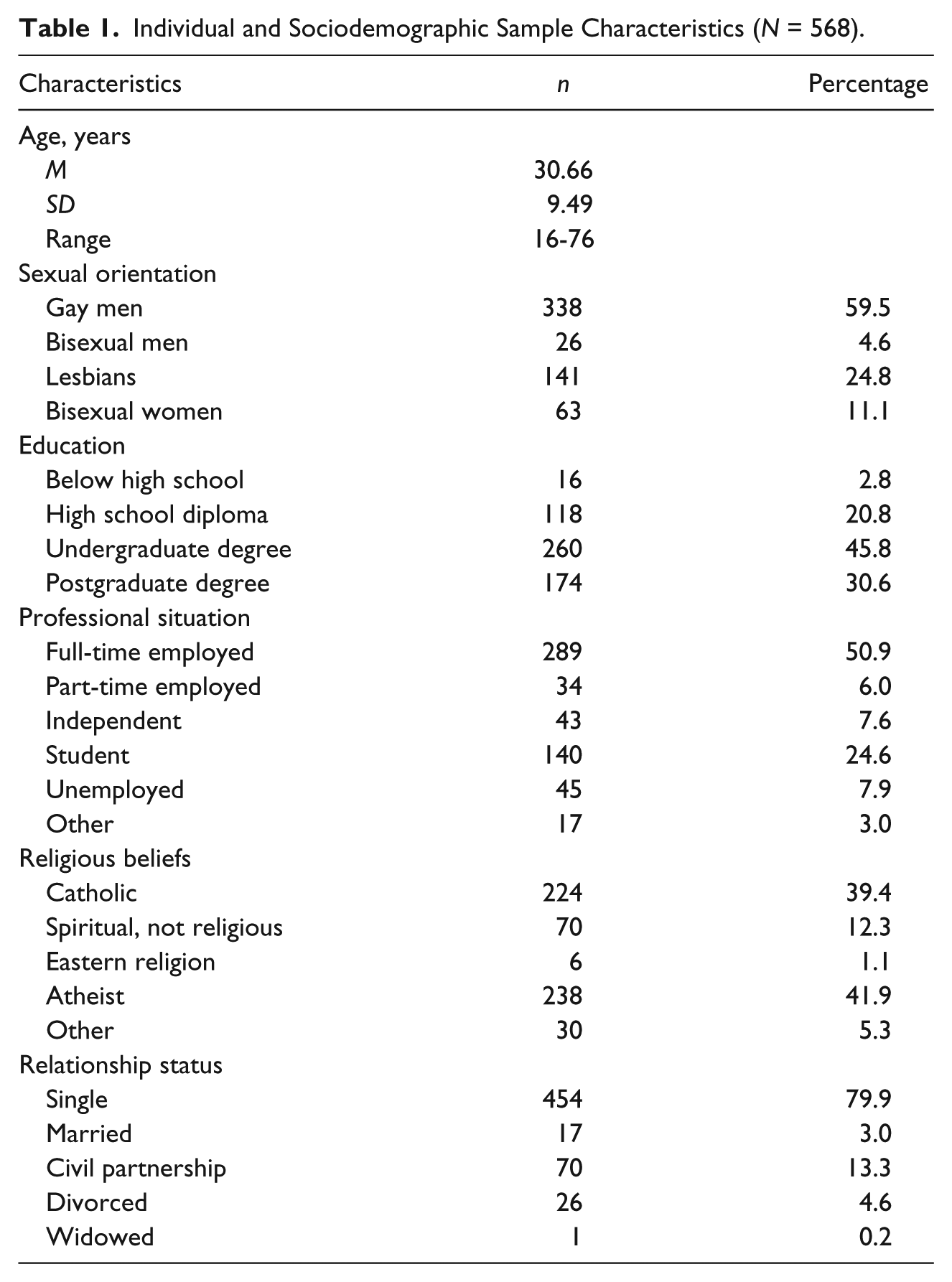
The sample consisted of 568 participants, aged between 18 and 76 years (M = 31, SD = 10), from which 64% were gay or bisexual men and 36% were lesbian or bisexual women, and no participant identified as transgender. This sample was highly educated, with 76% of the participants having at least a college degree. Over half of the sample was full-time employed, a quarter were students, and the remainder were unemployed or otherwise employed. Although most of the sample resided in larger cities (50% from Lisbon and 14% from Oporto), all geographical regions of Portugal (20 districts) were represented. Almost all participants were Portuguese citizens (98%). Table 1 presents full sociodemographic characteristics for this sample.
Individual and Sociodemographic Sample Characteristics (N = 568).
Measures
Individual and Demographic Characteristics
Participants were asked specific questions about their demographic and personal characteristics, including (a) age, (b) gender, (c) sexual orientation, (d) education, (e) professional/educational status, (f) nationality, (g) place of residence, (h) relationship status, (i) relationship satisfaction, (j) religious background (“What is your religion?”), and (k) religiosity (“How often do you practice your religion?”), measured on a 5-point Likert-type scale.
Perceived Support and Community Involvement
Participants were asked how satisfied they were with the support received from their parents (parental support) and their friends (friendship support), measured on a 5-point Likert-type scale (from 1 = very unsatisfied to 5 = very satisfied). Participants were also asked if actively involved in an LGBT organization (involvement in LGBT organizations) and in LGBT-related events (involvement in LGBT events), both measured in a yes or no format.
Parenting Experiences
Participants were asked whether they had children, in a yes or no format. Those who reported having children, were asked how many children they had, kinship arrangement (biological, legal/adoptive, social/affective), and pathway to parenting (prior heterosexual conception, donor insemination, coparenting, adoption). Participants with children were also asked if they had the intention to have more children in the future (yes or no).
Parenting Aspirations
Participants who reported not having children were the primary focus of the study, and queried about their parenting desire and intention. They were asked if they would like to have children in the future (parenting desire) in a yes or no format. Regarding parenting intentions, participants were asked if they had a real intention to have children (parenting intention), measured in a yes or no format. Their strength of parenting intention (strength of parenting intention) was measured using a 6-point Likert-type scale (from 0 = no intention to have children at all to 5 = high intention and willingness to make all the changes needed to have children).
Procedures
The study was publicized through Portuguese LGBT organizations’ websites and mailing lists, through LGBT-related websites and blogs, and through LGBT-related news websites. The only inclusion criterion was that participants identified as other than heterosexual. Participants were directed to an online questionnaire hosted on Google Docs. On the first page of the questionnaire, participants were provided informed consent (i.e., basic goals of the study, how to withdraw from the study, and that participation was voluntary and anonymous), as well as how to complete the questionnaire. The completed questionnaires were downloaded onto IBM SPSS Statistics version 20. All statistical analyses were performed using IBM SPSS Statistics version 20.
Results
The main purpose of this study was to examine parenting aspirations (desire and intention) among Portuguese LGB individuals without children. In addition, a small portion of the total sample (n = 38) reported having children. Considering the dearth of information about LGB individuals with children living in Portugal, we included frequency data for this subgroup of participants (i.e., demographics, kinship arrangements, pathways to parenting, and intention to have more children). The majority of research participants reported having no children (n = 530) and we provided frequency data regarding their parenting desire and intention. A multiple linear regression analysis was conducted to examine how sociodemographic variables (i.e., age, gender, sexual orientation, education, relationship status, relationship satisfaction, religiosity, parental support, friendship support, and involvement in LGBT events) predicted participants’ strength of parenting intention. Results from the regression were further explored by examining potential differences in parenting intention between participants at various age/developmental levels through a one-way analysis of variance.
Parenting Experiences
Participants who reported having children (n = 38) represented 6.7% of the sample. This subsample included equal percentages of men (50%) and women (50%). Specific to sexual orientation, 32% identified as gay men, 34% as lesbians, and 34% as bisexuals. Mean age was 42 years (SD = 9), ranging from 23 to 65 years. Regarding relationship status, 16% were single, 11% were married, 26% were in a civil partnership, and 47% were divorced (either from same-gender or different-gender relationship). When asked about their children, half of this subsample reported having only one child, 40% had two children, and the remainder had three or more children (10%). The overwhelming majority reported biological kinship with their children (83% for first child and 84% for other children), 7% to 8% (first and other children, respectively) reported legal/adoptive kinship, and 8% to 10% social/affective kinship (first and other children, respectively). Over a third (40%) stated they intended to have more children in the future. Figure 1 depicts the different pathways taken by participants to become parents.

Pathways to parenting.
Parenting Aspirations
Over 500 (n = 530) participants stated they did not have any children and this group was utilized for all statistical comparisons. Regarding basic demographics, 66% identified as men and 34% as women with 62% identifying as gay men, 24% as lesbians, and 14% as bisexual individuals. The mean age for this subsample was 30 years (SD = 9) and ranged from 16 to 76 years. The majority of participants were single (85%), 3% were married, 11% were in a civil partnership, 1% were divorced, and only one participant reported being widowed. When asked about parenting desire, 66% of the participants answered yes, and 56% stated having parenting intention. Figure 2 illustrates the different pathways participants would likely take to become parents. Men and women differed in their choices of parenting paths. Men were more likely to choose surrogacy or adoption, whereas women were more likely to select donor insemination.

Desired pathways to parenting.
Predicting Strength of Parenting Intention
A standard multiple linear regression was calculated to investigate whether specified sociodemographic variables would predict the strength of parenting intention. The predictor variables included (a) individual demographic variables (i.e., age, gender, sexual orientation, education, relationship status, and relationship satisfaction); (b) religiosity; (c) social support (i.e., parental and friendship support); and (e) involvement in LGBT events. Age, religiosity, relationship satisfaction, friendship support, and parental support were measured as continuous variables. The remaining variables were dummy coded (gender: 0 = women and 1 = men; sexual orientation: 0 = gay/lesbian and 1 = bisexual; relationship status: 0 = unmarried and 1 = married/civil partnership; education: 0 = less than college degree and 1 = at least college degree; involvement in LGBT event: 0 = no involvement and 1 = involvement). Multicollinearity diagnostics indicated no collinearity violations (Tabachnick & Fidell, 2007).
A significant regression equation was found, F(10, 325) = 10.194, p < .001, with an R2Adj of .221. The results from this analysis showed that age was the strongest predictor of the strength of parenting intention (p < .001), followed by religiosity (p = .001) and involvement in LGBT events (p = .001). Thus, young age, low religiosity, and involvement in LGBT events were significantly associated with a higher strength of parenting intention. However, gender, sexual orientation, level of education, relationship status, relationship satisfaction, parental support, and friendship support did not significantly predict the strength of parenting intention (Table 2).
Multiple Regression Analysis for the Strength of Parenting Intention.

Note. LGBT = lesbian, gay, bisexual, and transgender.
p < .001. **p < .005.
Effects of Age on the Strength of Parenting Intention
Considering the high impact of age on the strength of parenting intention, a one-way analysis of variance to examine whether the strength of parenting intention differed by age/developmental stage was conducted. Participants were divided into age groups based on psychosocial developmental milestones: Group 1: youth = 16 to 24 years, Group 2: early adulthood = 25 to 34 years, Group 3: middle adulthood = 35 to 44 years, Group 4: middle/later adulthood = 45 to 76 years (Newman & Newman, 2014). The researchers split middle adulthood (typically seen as ages 35-60) into a narrower age range because of the biological and social factors associated with individuals having their first child. The mean age for a mother having her first child has been steadily increasing and is now approximately 29.2 in Portugal (Central Intelligence Agency, 2016) and 26.3 in the United States (Mathews & Hamilton, 2016).
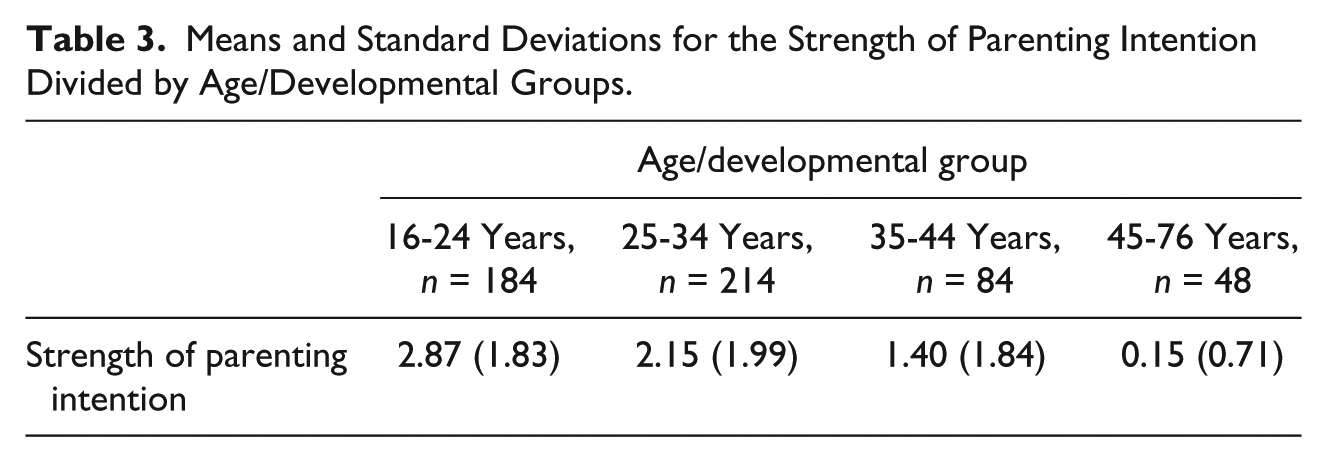
The effect of age was significant, F(3, 530) = 33.243, p < .001, η2 = .159, with younger participants reporting significantly stronger parenting intention than older participants (Table 3). To further investigate the main effect of age on the strength of parenting intention, pairwise comparisons among the four groups were run using Bonferroni post hoc tests. Significant differences were found in all pairwise comparisons (all p < .01), indicating that the strength of parenting intention was the highest among the youngest group (16-24 years), and significantly decreased in each developmental age group. Noteworthy, the strength of parenting intention among the youth group (16-24 years) was on average almost twice as much as in the middle adulthood group (35-44 years).
Means and Standard Deviations for the Strength of Parenting Intention Divided by Age/Developmental Groups.
Discussion
This study was the first to examine parenting desire, intention, and experience among LGB individuals in Portugal. Overall, the results highlight that the majority of Portuguese LGB people without children aspire to become parents. Although same-gender couples are allowed to marry in Portugal, they were until very recently legally precluded from adopting a child or accessing assisted reproduction. Thus, it is noteworthy that almost 70% of the participants reported parenting desire and over half reported their intention to do so. These numbers are in line with recent studies conducted in Italy and in the United States, although these studies have also pointed out how heterosexual men and women are more likely to want and plan to have children than are gay men and lesbians (Baiocco & Laghi, 2013; Riskind & Patterson, 2010). Our findings contrast both the U.S. and Italian data (Baiocco et al., 2014; D’Augelli et al., 2007), as male and female participants in the current study reported similar parenting intentions.
Previous research has shown that women, regardless of their sexual orientation, have a stronger desire to parent than men (Bos, van Balen, & van den Boom, 2003; D’Augelli et al., 2007, van Balen & Trimbos-Kemper, 1995). However, no gender differences in parenting intention were found among LGB participants in the current study. In fact, from the subsample of LGB individuals who had children, there were a similar number of male and female LGB parents. Furthermore, from the 308 same-gender marriages celebrated in Portugal in 2014, 59% were male same-gender marriages (Instituto Nacional de Estatística, 2015), but no national data regarding the number of gay- and lesbian-parented families are available, as these families were not legally recognized by the Portuguese State. These indicators call for further study as gay and bisexual men seem to have as much intention to form a family that includes children as lesbian and bisexual women. It would also be of interest to further compare how gay, lesbian, and bisexual individuals’ parenting intention compare with that of heterosexual men and women, and whether gender differences in the desire to have a family exist among heterosexuals in Portugal.
We did find a significant age effect on parenting intention. The strength of parenting intention was significantly higher in younger participants, and it significantly decreased with age. The fact that participants in the youngest age group (16-24 years) reported the strongest intention to have children is remarkable when considering the average age for women to have their first child in Portugal is 29.2 (Central Intelligence Agency, 2016) and 26.3 in the United States (Mathews & Hamilton, 2016). Age was the strongest predictor of parenting intention followed by religiosity, and LGBT community involvement, while none of the other sociodemographic variables examined (i.e., gender, sexual orientation, level of education, relationship status, relationship satisfaction, parental support, and friendship support) were significant predictors of parenting intention. More than suggesting that parenting intention decreases with age, this finding convey generational gaps in parenting intention. In contrast with an Italian study in which older LGB individuals (up to 35 years old) revealed a stronger parenting intention (Baiocco & Laghi, 2013), in Portugal, youth had the strongest intention. Noteworthy, the strength of parenting desire among the 16 to 24 age group was on average twice as much as among the 35 to 44 years. Not surprisingly, the oldest group (45-76 years) revealed a minimal intention to become parents.
Specifically, our data indicate young generations are likely to plan to form a family headed by gay or lesbian parents, and this finding is in line with previous U.S. studies (D’Augelli et al., 2007; Riskind & Patterson, 2010). Considering that older adults likely came of age when legalization of same-gender marriage seemed unimaginable, examining how marriage and parenting equality affects older adults represents an interesting line of inquiry. For example, would older LGBT individuals feel same-gender marriage and parenting policies arrived too late in their life to meaningfully plan for children?
Surprisingly, there was no effect of perceived parental and friendship support on parenting desire, which suggests that other factors may be more important regarding aspirations to have children than the support from family and friends. Furthermore, being in a committed relationship or the level of satisfaction with the relationship were also independent from parenting intention in our sample. D’Augelli et al. (2007) found that youth, particularly female youth, attached high importance to same-gender marriage and parenting, but these aspirations were not associated in our sample of LGB Portuguese individuals. We argue that recent achievements in LGBT rights, in particular marriage equality, may play an important role as it gives new meanings to LGB youth’s developing identities and relationships (Lannutti, 2005). Simply stated, social and public policy advancements are opening a full range of family planning and parenting options that were once socially and legally prohibited for LGBT individuals. Such options might diminish the need for substantive familial and friendship support that was likely a necessity when LGB marriage and parenting were illegal. Levels and types of support for LGB individuals that contemplate and become parents represents an important area of future research.
Involvement in the LGBT community (measured as involvement in LGBT events) was also found to predict parenting intention. It has been previously reported that the involvement with the LGBT community offers some protection from heterosexist pressures and oppression, and offers positive role models for LGB youth (Haldeman, 2007). In fact, the identification with the LGBT community is linked to a positive gay identity (Gonsiorek & Rudolph, 1991), as earlier work about the identity milestones for lesbian and gay individuals has shown (Cass, 1979). The present results confirm that these protective factors may have an effect on youth being able to aspire to become parents. Moreover, involvement with LGBT community organizations and activities may provide a social space that facilitates discussions about the new advances in LGB marriage and parenting policies, which in turn fuels increased desires for LGB families that include children.
Religiosity negatively predicted participants’ intention to have children. Previous research has shown that religious affiliation and level of religiosity are significant predictors of negative attitudes toward gay men and lesbians and particularly toward marriage equality and LGBT-parented families (Costa, Caldeira, et al., 2014; Whitley, 2008). These religious-based negative attitudes are likely to be internalized by gay, lesbian, and bisexual individuals, who may come to endorse religious arguments that they are not fit to be parents. Among LGB individuals, religiosity is partially responsible for their self-stigma, and endorsement of negative beliefs about gay- and lesbian-parented families (Baiocco et al., 2014; Costa, Pereira, & Leal, 2015). Therefore, it is not surprising that religiosity was found to be significantly associated with lower parenting intention.
LGB Kinship and Parenting Experience
A very small subsample of the current study (7%) reported having had children. This low percentage of LGB parents is in sharp contrast with recent U.S. statistics on the number of LGB people with children. Henehan, Rothblum, Solomon, and Balsam (2007) found that among same-gender couples, 39% of women and 20% of man had children, while Herek, Norton, Allen, and Sims (2010) reported that 30% of gay men and lesbians had children, namely through adoption and step parenting. A close look at the characteristics of this sample and the public policy situation in Portugal helps clarify our differing findings. The mean age of these parents (42 years), combined with the fact that about 80% of them had children in previous heterosexual relationships confirms that to date, most LGB-parented families in Portugal are not planned within same-gender relationships. Similarly to other European countries where same-gender parented families are yet to be legally recognized (e.g., Italy), most gay and lesbian individuals have had children within heterosexual relationships, and later identified as gay, lesbian, or bisexual (Lelleri, Prati, & Pietrantoni, 2008). The case of Spain offers possible insight into how marriage and parenting policies will affect LGB parenting in Portugal. Like in the current study, early studies in Spain showed that most LGB parents have had children in previous heterosexual relationships (González & López, 2009). However, a more recent study in Spain has shown that the majority of LGB families are now planned through adoption and donor insemination (Galán, Barbero, & Martín-Chiappe, 2015).
While planned parenting by same-gender couples is now becoming a possibility in Portugal, same-gender couples to date have needed to either postpone having children or circumvent the discriminatory laws in Portugal about LGB parenting. For example, among this sample, some mothers had donor insemination, most likely in Spain. Some female same-gender couples have also utilized self-insemination, with a “donor friend.” Moreover, gay, lesbian, and bisexual individuals could still adopt a child as a single parent, regardless of their sexual orientation (Costa, Pereira, & Leal, 2012). As shown in Figure 2, gay and bisexual men seem keener on adopting a child or having a surrogate, whereas bisexual and lesbian women seem to prefer donor insemination. These findings reinforce that LGB youth are not only planning to become parents but also that they are seriously considering the available options to fulfill this desire. It is also noteworthy that LGBT research is no longer exclusively dedicated to the mental health disparities and social problems negatively affecting LGBT individuals, but rather examining positive life goals and aspirations (e.g., Riggle, Whitman, Olson, Rostosky, & Strong, 2008). This represents a very important research trend that this study subscribes.
Limitations
There are limitations to this study that require acknowledgment. The survey was presented as part of a study about parenting desire and attitudes toward same-gender parenting, which may have resulted in an overrepresentation of LGB people who had some desire to parent. However, the incidence of people who expressed this desire was similar to that reported in previous studies (Baiocco & Laghi, 2013; Riskind & Patterson, 2010). A second limitation regards the data collection method; online participants are more likely to have higher education and higher economic status than offline participants. To the extent that these background characteristics may influence parenting desire is unknown. A final limitation regards the sample distribution in that more than half of the participants were men, only a small percentage of bisexual individuals were represented, and no self-identified transgender individual took part in this study. Future studies should endeavor to collect a more balanced and diverse sample, particularly with a higher number of bisexual and transgender individuals.
While not a limitation of research methodology, this study represents one of the very first explorations of LGB parenting in Portugal, which limits comparisons with previous findings. We recommend future researchers, community-based organizations, and governmental agencies in both Portugal and the United States start collecting basic information and statistics about LGB families and parenting. This study focused on sociodemographic variables and their impact on parenting intention. Other individual variables may influence LGB people’s aspirations, namely levels of self-stigma and personal experiences of victimization or discrimination, which we suggest future studies should explore.
Conclusion
This study has shown likely generational gaps in parenting intention among Portuguese LGB people. While gay, lesbian, and bisexual individuals have been having and raising children for decades, it is recent in Portugal that LGB people can clearly and realistically express their desire and intention to be parents within the context of being able to legally wed and secure basic parenting rights. Findings from the current study portend that the number of planned same-gender families with children in Portugal will increase in the near future, as younger LGB people act on their aspirations to become parents. Options that were heretofore not legally available to older LGB people.
The new generation of LGBTQ [Queer/Questioning] parents are planning to become parents in collaboration with their coming-out, their gender transitions, and their partnerships. Younger LGBTQ people no longer wonder if parenting is a possibility; now it is often an assumed reality and birthright. (Lev & Sennott, 2013, p. 255)
If our data do portend an LGB baby boom in Portugal and other countries, there will be a continued need to explore the legal, policy, social support, and psychosocial needs such new families will not only require but also deserve.
Footnotes
Declaration of Conflicting Interests
The author(s) declared no potential conflicts of interest with respect to the research, authorship, and/or publication of this article.
Funding
The author(s) received no financial support for the research, authorship, and/or publication of this article.