




Abstract
Despite its prevalence, intimate partner economic abuse has received less scholarly attention in sub-Saharan Africa. Using qualitative enquiry, this study describes the experiences of economic abuse among 18 women in the Eastern Region of Ghana. Economic abuse occurred in a variety of forms, including extortion, denial of income-earning activity, and attempts to deny women’s economic independence and financial self-sufficiency. Findings point to the pervasiveness of economic abuse among both high- and low-income women. While economic dependency among nonworking women was associated with sexual violence, working and independent women experienced physical and emotional violence on questioning intimate partner’s economic abuse.
Keywords
Introduction
Although defined variedly, economic abuse has largely been understood as behaviors or attitudes that control women’s ability to acquire, use, and/or retain economic resources, thus threatening their economic security and potential for self-sufficiency (Adams, Sullivan, Bybee, & Greeson, 2008; Fawole, 2008). This means economic abuse could range from denying women their most basic needs such as food, clothing, shelter, and so on, to more complex needs including their economic independence and inability to fully participate in household purchasing decisions (Sanders & Schnabel, 2006). While less documented and underresearched, recent literature in sub-Saharan Africa shows that economic abuse is rife, requiring immediate scholarly and policy attention (Ardayfio-Schandorf, 2005; Fawole, 2008). For instance, in their study on the prevalence and perceptions of intimate partner violence (IPV) in Ibadan, Nigeria, Fawole, Salawu, and Olarinmoye (2010) estimated the rate of economic abuse against women as 23.2%. In another study involving female sex workers in Abuja, economic abuse (37.7%) ranked next to sexual violence followed by physical and emotional violence, respectively.
It has been documented that economic abuse cuts across diverse backgrounds (Postmus, Plummer, McMahon, Murshid, & Kim, 2011; Usta, Makarem, & Habib, 2013), yet emerging literature across several regions of the world shows poverty and patriarchy as inextricably linked to such forms of abuse (Lambert & Firestone, 2000). The relationship between poverty and economic abuse is complex. Poorer women are more likely to depend on their male partners and such dependence may be deployed as a tactic for controlling women, leading to abuse (Adjei, 2015; Mann & Takyi, 2009). Contrarily, abuse threatens women’s economic security, stifles their entrepreneurial creativity, and prevents them from achieving economic independence (Pollet, 2011; Sanders, 2015; Stylianou, Postmus, & McMahon, 2013). In sub-Saharan Africa, where patriarchy is commonplace, socioeconomic inequality and poverty combine with discriminatory cultural practices to expose women to various forms of abuse, including economic abuse (Tuwor & Sossou, 2008). Such practices have often promoted inequities in educational opportunities for female children, early conjugal unions for young girls, and the exclusion of females from inheriting property based on their gender (Mill & Anarfi, 2002; Shabaya & Konadu-Agyemang, 2004). Additionally, the payment of expensive bridewealth during marriage ceremonies has been cited as central to various types of abuse including economic abuse, especially as this symbolizes “loss of rights” by the bride’s family and “transfer of rights” to the groom (Nwabunike & Tenkorang, 2015; Takyi & Gyimah, 2007).
Similar to other forms of abuse, economic abuse can be dreadful and may have several other negative consequences for women. First, it may lead to poverty which in turn can increase women’s vulnerability to the same form of abuse. Secondly, economic abuse is likely to increase risks to other types of violence, including physical, emotional, and sexual violence (Pollet, 2011; Postmus et al., 2011). For instance, data from some cross-sectional studies show strong positive associations between economic abuse and both physical and emotional violence (Antai, Antai, & Anthony, 2014). Third, economic abuse and/or the other types of abuse may have deleterious health consequences for victims including trauma, depression, and other mental and physical ailments (Fawole, 2008).
Despite the impact of economic abuse on women’s lives, academic literature on this important topic has remained scant with very little contribution from sub-Saharan Africa, where these forms of abuse are rife. Moreover, existing studies on economic abuse against women mostly employ survey methods that often fail to provide an in-depth understanding of the phenomenon and explore the perspectives of women experiencing intimate partner economic abuse (Sanders, 2015). We use qualitative in-depth interviews collected from victims of intimate partner violence (IPV) in the Eastern Region of Ghana to fill these important research gaps.
Economic Abuse in Ghana
Ghana’s Domestic Violence Act, passed in February 2007, makes specific reference to economic abuse as one that deprives or threatens to deprive individuals of economic or financial resources they are entitled to by law. This includes (or attempts at) disposing, hiding, hindering, and damaging property in which others have material interest (Domestic Violence Act, 2007). Although widespread and acknowledged as a punishable offence, Ghanaian civil laws rarely punish perpetrators of economic abuse (Cantalupo, Martin, Pak, & Shin, 2006). Part of the problem may be that Ghanaian women rarely problematize economic abuse and as a result do not report their experiences (Ardayfio-Schandorf, 2005). Other reasons may be related to the difficulties in producing documentary evidence, which are often required to back victims’ claims that they have been abused. It is thus not too surprising that economic abuse is hardly measured in Ghanaian surveys and that scholarly literature on this topic is limited.
Some evidence from the Domestic Violence and Victims Support Unit shows that economic abuse may be the most common type of violence in Ghana, with the Eastern Region recording the second highest prevalence (9.4%) following the Central region (Institute of Development Studies, Ghana Statistical Service [GSS] and Associates, 2016). Also, domestic violence cases in the region, increased by about 50% between 2012 and 2013 (Ghana News Agency, 2014). Thus, the Eastern Region (one of the 10 administrative regions of Ghana) is most useful and convenient setting for this study. While the region has continuously recorded high rates of domestic violence cases in the country, no systematic effort has been made to understand reasons for the high incidence and prevalence. The only known documented evidence in the Eastern Region is a study that explored differences in IPV experiences for women identifying with matrilineal and patrilineal groups (Sedziafa, Tenkorang, & Owusu, 2016).
Although differences in IPV rates were attributed to the differing matriarchal and patriarchal norms, it was clear that issues of gender inequality, patriarchy, and economic dependence was widespread across both kin groups. Reports of economic abuse was rife among all women but differed in severity and character for women belonging to matrilineal and patrilineal kin groups. In patrilineal societies, economic abuse was very severe and was followed by retaliation to husband’s physical, emotional, and sexual violence. In matrilineal societies, however, economic abuse preceded emotional and physical violence and was less severe (Sedziafa et al., 2016). Matrilineal women’s access to lineage and economic resources such as land meant they were more economically independent and less vulnerable to violence than women belonging to the patrilineal kin groups. Thus, the theoretical pathways to explaining economic abuse become relevant.
Theoretical and Empirical Considerations
Theoretically, established causes of IPV against women are dominated by feminist explanations, which echo socially scripted patriarchal norms that accept and justify gender-based relations and violence (Hunnicutt, 2009; McPhail, Busch, Kulkarni, & Rice, 2007). Patriarchy may be considered a system, comprising structures and practices in which men dominate, including control of resources and exploitation of women (Walby, 1990). Applying this perspective to economic abuse against women, patriarchy manifests in the private sphere by retaining control over female partners’ financial resources through restriction and subordination of participation in economic development. In many instances, male partners dominate in the economic sphere while restricting women to subordinate roles within the family (Raphael, 2000; Schuler, Hashemi, Riley, & Akhter, 1996). To this end, women may experience lack of income, or more specifically feminized poverty (Chant, 2007); thus, they are forced to depend on their male partner for basic livelihood needs, such as food and housing. Economic dependency has implications for increased likelihood of abuse (Cantalupo et al., 2006; Mann & Takyi, 2009; Oduro, Deere, & Catanzarite, 2015; Tenkorang, Owusu, Yeboah, & Bannerman, 2013) and inability to leave an abusive partner (Kim & Gray, 2008; Koepsell, Kernic, & Holt, 2006). In other instances, when men cannot adequately provide for basic household needs because of economic difficulties, women’s active economic engagement breeds abuse due to traditional norms that normalize women’s subordinate position (Boonzaier, 2008). Abusive men feel emasculated in the presence of women’s economic independence and control of resources within household settings and subsequently, may undermine their female partners’ full economic well-being through abuse (Anderson & Umberson, 2001; Moe & Bell, 2004). Similarly, for working women in India, research finds high self-reported prevalence of emotional, physical, and sexual violence than for nonworking women (Dalal, 2011).
Contrary to the feminist theoretical perspective, exchange theory proposes the principle of costs and benefits of the use of violence in intimate relationships (Bornstein, 2006; Jasinski, 2001). In this regard, abusive men could lose financial support if they use violence against their female partners who contribute significant proportion of household wealth, as abuse may lead them to dissolve the relationship. By contrast, economically dependent women who contribute less household wealth than their partners are an economic burden on abusive male partners who can use economic resources as a means to dominate and abuse female partners. Some studies conducted using Ghanaian data show that when women’s economic status is significant to household upkeep, the magnitude of IPV is less (Mann & Takyi, 2009; Oduro et al., 2015). Likewise, Weaver, Sanders, Campbell, and Schnabel (2009) indicate that poorer women are more likely to suffer domestic abuse, are less able to leave abusers and tend to suffer more severe violence. One of the reasons for women’s continued stay in abusive relationships is because of their economic vulnerability, that is, fear of losing access to shelter and being deprived of other basic needs (International Center for Research on Women, 2006). In India, Panda and Agarwal (2005) find that women’s ownership of a dwelling or of a house and agricultural land is a deterrent to both physical and psychological abuse, both in the long and short terms. This finding implies that women’s economic assets substantially lessen an abuser’s ability to control them as well as increases the victim’s ability to escape violence (Sanders, 2015). Guided by both exchange and feminist theories, this research examines forms of economic abuse and the complex interaction between economic abuse and other types of violence in Ghana.
Method
Study Setting
This study was conducted in the Eastern Region of Ghana, one of the country’s 10 existing administrative regions. The Eastern Region covers an area of 19,323 square miles and is considered the sixth largest in terms of land mass (Kwapong, 2010). Also, with a total population of over 2 million people from different ethnic backgrounds, the Eastern Region is ranked the third most populous region in Ghana (Kwapong, 2010). The region is semiurban, and its capital city, Koforidua, is about 83.7 km from Ghana’s capital city, Accra (GSS, 2010). The latest population and Housing Census in Ghana indicates a population of about 49% males and 51% females, and a literacy rate of about 63%—higher than the national average of 58% (GSS, 2010). However, there are gender differences in literacy rates (73.5% for males and 56.3% for females). The region has several districts including the Lower Manya Krobo (LMK) and New Juaben (NJB) districts.
This qualitative study is part of a larger research project that recruited a sample of 30 women in the LMK and NJB districts who had experienced various forms of IPV, including economic abuse in marriage or cohabiting relationship. Recruitment procedures were conducted in consultation with the local chiefs of both districts, who were supportive of the researchers’ interests in addressing domestic conflicts in their respective communities. Although local permission was sought by the second and third authors, contact with the communities was facilitated by the third author who is a Senior Research Fellow at the Institute of Statistical, Social and Economic Research located at the University of Ghana. It is important to note that the second and third authors and one of the research assistants had prolonged engagement with the community as local members, thus, the community elders and members already knew and trusted them. Informants who were local opinion leaders were contacted by the third author after inquiring about them from community members. The informants were briefed about the study and the type of respondents needed. Informants were further asked to make the necessary contacts which led to obtaining permission from eligible participants to provide their personal contact information to the third author and the primary research assistant who are both fluent in the respondents’ main languages, Akan (Twi) and Ga-Adangbe (Krobo), respectively.
Sample
Purposive sampling was used to select suitable participants with knowledge of the research topic (Bowers, House, & Owens, 2011). However, snowball method was also employed to facilitate the referral of other participants (Penrod, Preston, Cain, & Starks, 2003). To increase diversity in the sample, equal numbers of women from the LMK and NJB districts were recruited into the study given that these districts represent the population of the two major dissimilar ethnic groups in the Eastern Region (GSS, 2010). Eligibility criteria included being female who had suffered intimate partner abuse within the context of a legitimate marriage or cohabitation for a year and is aged 18 years or older. Thirty women participated in the interview at a convenient time and place, between June and July, 2014. Out of the 30 participants who participated in the interview, 18 (8 from NJBD and 10 from LMKD) of them narrated experiences of economic abuse in addition to psychological, physical, and sexual violence.
Data Collection
Data were collected by the second and third authors with the help of four trained research assistants who had graduated from the University of Ghana. Research assistants were trained by the second and third authors in community entry techniques, value neutrality, objectivity, and how to sensitively probe for information in qualitative research. The interview guide was originally in English and translation was performed by an expert in Twi and Krobo, the primary indigenous languages in the NJB and LMK, respectively. Respondents were interviewed at their choice of venue and in their own languages, and interviews were audiotaped. Same-sex interviewers were employed to ensure the interview sessions were less threatening. Interviews lasted between 30 minutes and 1 hour on the average and were conducted in the local language without interpretation. Participants requiring professional help were referred to an expert with whom prior arrangements had been made for possible counseling. Three participants made use of these counselling arrangements.
Respondents were asked questions about the presence of IPV, types of violence, perceived causes of violence, reaction to violence and victims’ help-seeking behaviors using a semistructured interview guide, which was pretested under similar conditions. Employing a semistructured interview guide allowed study participants to freely express their views in their own terms and enhanced the depth of data collected. Detailed recounting of experiences of IPV, including economic abuse to researchers was encouraged by engaging measures that minimized socially desirable responses during interviews. Also, some member-checking strategies were employed to enhance the reliability of the data. These include asking follow-up questions to participants to clarify their answers and going through the data with participants to correct inconsistencies.
Data Analysis
The General Inductive Approach was employed as the analytical strategy for this study (Thomas, 2006). This approach was helpful in condensing the data, establishing links between the research objectives and the textual data and identifying the underlying experiences of women in the raw data (Thomas, 2006). Analysis was performed by all authors after reading the transcripts several times and developing emerging themes using open coding (Strauss & Corbin, 1998). The transcripts of the women’s narratives about intimate partner economic abuse were further analyzed by extracting relevant and identical statements and phrases in a systematic manner. The statements and phrases were organized to generate the following findings which were subjected to content analysis informed by feminist and exchange theoretical propositions (Hsieh & Shannon, 2005). Generally, the interpretation of the data was guided not only by the extant literature but also the cultural knowledge possessed by the authors of the communities under study. The quotations were verbatim statements from the findings, which were usually selected to support summary statements made from the findings, and were selected to substantiate the conclusions.
Findings
Participants
Table 1 presents some background information of the respondents. All the women from the NJB district were Akans. Conversely, their counterparts from the LMK district were Krobo. Women ranged in age between 26 and 60 years with an average age of 43.3 years. All respondents identified as Christians, perhaps because this is the dominant religion in Ghana. Except one woman from NJB district who had no biological children, all respondents had biological children, ranging from one to eight. Generally, older respondents had more children, than younger participants. The women from the NJB had more children on average (3.9) compared with their counterparts from the LMK (2.1). It is also notable that the respondent with the highest level of education—a master’s degree—was from NJB. All respondents were married under the customary law, except one from LMK and three from NJB who were married under the ordinance. With the exception of one from the NJB who was a health services administrator, the rest of the women from both districts had low-income jobs and almost all worked in the informal sector, typically petty trading. Half of the women were still married to their abusive husbands, and one from each district were widowed. The NJB women were far more likely to be divorced (5/8th) compared with one fifth of their counterparts from the LMK who were divorced from their abusive husbands. Notably, three women experienced economic abuse as outcomes of sexual, physical, and emotional IPV, four women narrated husband’s tactical deployment of economic abuse, while another eight and three recounted economic cheating and husband’s extortion of money, respectively.
Background Characteristics of Respondents.
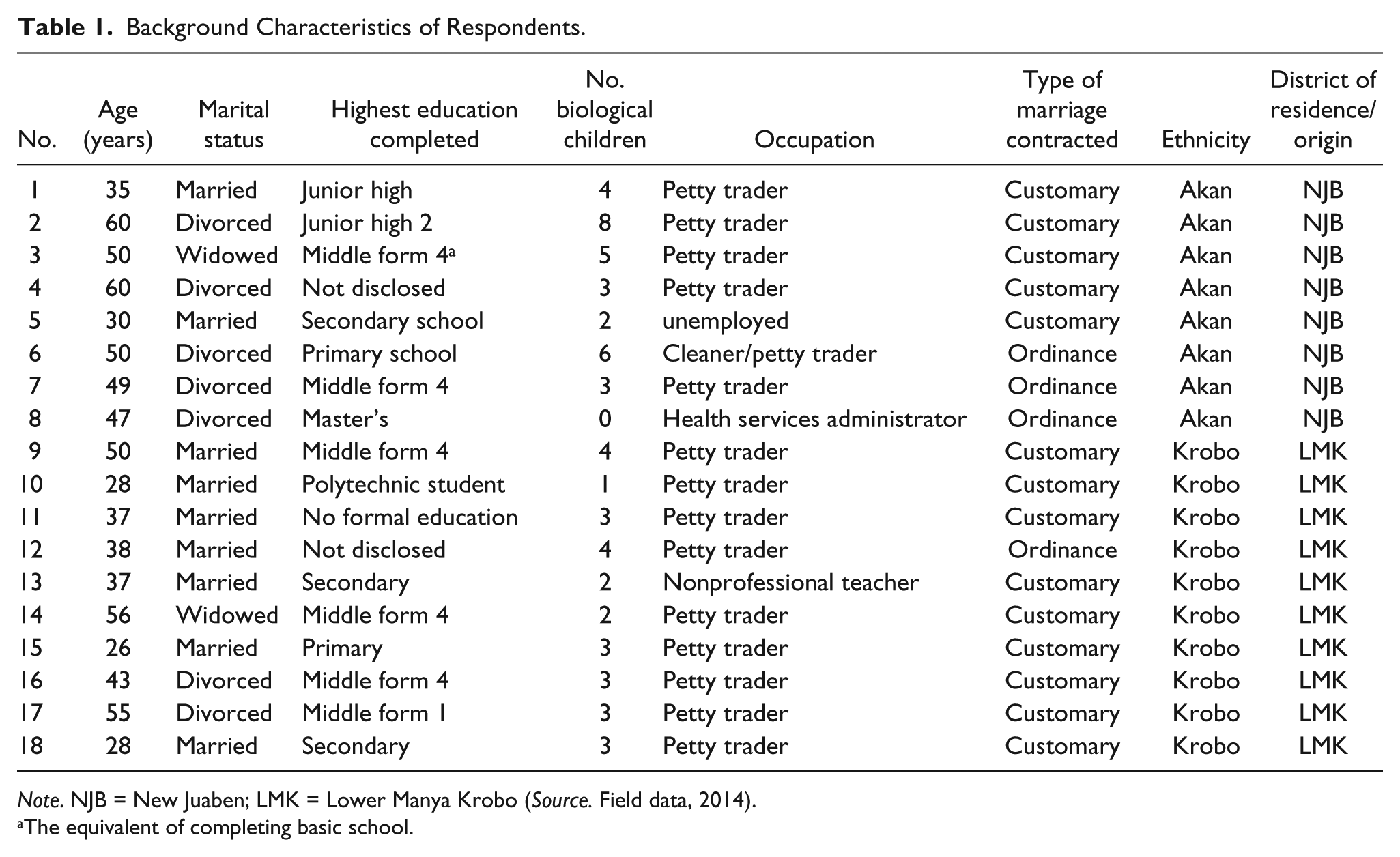
Note. NJB = New Juaben; LMK = Lower Manya Krobo (Source. Field data, 2014).
The equivalent of completing basic school.
Economic Abuse Follows Women’s Sexual (Un)Availability
Women participants alluded to economic or financial bully on the part of their partners in their domestic interactions. More than half of women (with the majority from the LMK district) reported their husbands held greater economic power, which they believed reinforced men’s control of domestic affairs, including their sexual interactions. For most economically dependent female participants, economic abuse accompanied sexual violence. Women narrated experiences of unwanted but consensual sex with partners just so the partner would make money available for household upkeep or take care of them:
If I deny him sex I should be ready to suffer the consequences. The night I denied him sex, he went to work the next day without giving me housekeeping money and when I complained he said he wanted me to know that he was the one who married me and not the other way round. (Married, 26 years, petty trader, three children, LMK)
Economic Abuse Often Precedes Physical and Emotional Violence
Participants who were employed, and mostly from the New Juaben district, faced male partners’ neglect of family responsibilities. On questioning why their partners would abandon financial obligations to the well-being of the family, women participants said this triggered mutual couple disagreement and physical violence on the part of their partners. Working women from both districts recounted their experience of financial neglect in the following quotes:
“I asked him [my husband] why he goes to his mother anytime he makes money . . . Just that, he slapped me . . . ” (Divorced, 51 years, petty trader, six biological and one adopted children, NJB).
he won’t provide for the family, it really became a problem. I asked him to support our family financially and he was provoked, he chased me with a knife and beat me for talking about money. I didn’t report him. I would rather work hard to provide for my children than report my husband’s abuse. Due to my hard work, my children have been able to attend secondary school and even further. (Married, 48 years, petty trader, five children, LMK)
Tactics of Economic Abuse Against Women
Participants believed economic independence on the part of women commanded respect and promoted their participation in domestic decision making, which served as a “check” against male partners’ dominance in domestic relations. However, according to the women’s narratives, male partners deployed tactics that threatened their financial independence. Some participants reported that their husbands convinced them to disengage from public paid work and engage in full-time house work and child care for monetary reward. Yet the promise of getting paid for domestic work was never fulfilled. Male partners also used accusations of infidelity to stop their wives from their public paid work. Many more women experienced this in the LMK district, where the majority of participants were uneducated, unemployed, and dependent on their spouses:
Then my husband told me to stop working at the hospital and he was going to pay me for staying at home to take care of our child, so I stopped but the money he promised to pay, he did not. So I can say he made me lose one job because that is what I would have been doing right now. (Married, 28 years, former health care assistant, one child, LMK)
“He stopped me from working for my manager because he accused me of sleeping with him” (Married, 28 years, petty trader, three children, LMK).
Other women from NJB district recounted their experiences of economic restriction as follows:
Hmm . . . errrm [silent] my mother gave me money to work, but my husband was not happy about my mother’s help, [silent] he seized it from me . . . When I went hawking he would accuse me of talking to men, very insignificant accusations, he hit me when I came back from work. It was foolishness, so I left. (Divorced, 60 years, farmer, eight children, NJB)
One woman from NJB recounted that her economic engagement was cut short and her economic dependence reinforced by her husband’s disapproval of her job. Her husband deployed a tactic of “protection” and implied her job was indecent and unbefitting to her status as a married woman.
eeeh [silent] I was working as a waitress in a big drinking spot [bar] behind Jackson park but he told me to stop working there so now [sic] am at home, [because] my husband complained of the closing time and the kind of customers who came there, that it was not good for me as a married woman to be at such a place in the midst of people who abuse alcohol. (Married, 26 years, former waitress, two children, NJB)
Economic Cheating in Domestic Relationships
Most employed women in the LMK district reported investing their money into taking care of the household in times when their male partners had no job or low-income-earning employment. However, when their husbands could and were believed to be earning income, women reported their male partners deliberately refused to provide economic assistance to the household and their ailing businesses; instead, these men depended on and depleted their finances. This put the women in debts and led to many conflicts and domestic fights:
my husband was not having any job, and I started selling [petty trading] so we can survive, but after he had his job, he knew me no more. He forgot I have also fed him before and that was the genesis of the conflict in my marriage. He just refused to support the home financially, even now that he has a job. (Married, 50 years, petty trader, four children, LMK) this man [husband] does not help me in anyway. So I borrow money from friends to feed the children, when my debtors come for their money, he [husband] gets angry and insults me that I don’t know how to manage money . . . if he goes to buy food, he will eat it all by himself and does not care whether we have eaten or not. We are always quarrelling in the house so there is no joy in my marriage. (Married, 38 years, petty trader, four children, LMK)
One woman who had cohabited for 10 years and had three children, believed investing her time and financial resources into the well-being of the relationship had gone unrecognized and unappreciated. She also felt economically cheated at the time of the dissolution of her relationship:
he promised I should help him and he will marry me. He was not getting a lot of money like I was, so I was the one taking care of the house. I became pregnant with my third child, and gave birth 3 months before he got a very good job. After, he told me I should leave, I didn’t leave till he packed my things and threw them out one day and I left with a lot of sorrow. (Cohabited, 37 years, petty trader, three children, LMK)
In the following narrative, another woman from the NJB district told similar experience of economic cheating:
I took care of my husband when he was sick, but when he became well, he didn’t take care of me and the house . . . he left me to stay with another woman. (Divorced, 60 years, farmer, three children, NJB)
Extortion of Money and Women’s Counterstrategies
Some women said their husbands forcefully took money from them, while other women recounted experiences of extortion and stealing. Women used various tactics to escape extortion including hiding money from their husbands to avoid conflict in intimate partnerships:
my husband takes any money that comes to me even when the money is in the bank. He will worry me so much until I give it to him. I work very hard but I am not able to use my own money. He collects it and spends it on other women in town. It got to a point he came home only when he needed money. (Divorced, 47 years, Health Administrator, no child, NJB) My husband was taking my money without asking me, now I don’t let him know about my finances just as I don’t want to know about his. (Married, 35 years, petty trader, two children, NJB)
Similarly, a woman from the LMK district put her husband’s extortion behavior in the following quote:
he restricted me on how I use my money and made me use all my money to buy cement and blocks, which were used to renovate their extended family house. He also sometimes steals my money when my employees bring the money home. Due to this I instructed them to deposit the daily sales at the rural bank. This made him hate my employees and he started maltreating me. (Divorced, 43 years, petty trader, three children, LMK)
Implications of Economic Abuse on Women’s Health
Women associated their experience of economic abuse with adverse health outcomes including physical and emotional distress such as headaches, trauma, and so on. Husbands denied economically dependent women access to money for health care even in the face of ill health. According to one woman from the LMK district, she had sustained life-threatening injuries from physical IPV, and she needed medical attention. She remained indoors for three days until her husband’s friend visited and gave money for the required health care:
My husband came home one evening and I had just finished cooking yam. He took the yam and threw it at me and it hit my eyes and he slapped me a number of times. My eyes were seriously hurting and swollen for days. I could not go to the hospital because I was not having health insurance and he also refused to give me money. I was indoors for three days until one of my husband’s friends visited us. He asked me what happened to my eyes and I told him what had happened so he gave me some money to go to the hospital. (Married, 41 years, unemployed, four children, LMK) Yes it does a lot [affects the victim emotionally and psychologically]. If God does not intervene the woman can die because it is a very frustrating situation or even go mad because it makes the woman think too much . . . some of these actions are very hurting. I did not suffer any physical violence but severe emotional violence. I was shy to tell anyone about it so I kept it to myself and was really suffering within. It is never a good situation to go through; it has many effects on the human body. It could lead to several sicknesses like hypertension, stroke and even madness or death of the victim. It got to a point I thought it would have been better if I was dead. (Divorced, 47 years, health administrator, no child, NJB)
Discussion
Preliminary and exploratory findings from this study suggest economic abuse against women is rife in the Eastern Region of Ghana. Yet studies examining the lived experiences and perspectives of women on economic abuse are conspicuously missing in Ghana and sub-Saharan Africa in general. This study fills an important scholarly gap by employing qualitative methods to document the experiences of 18 ever-married/cohabited female victims of intimate partner abuse in the Eastern Region of Ghana. The findings indicate that intimate partner economic abuse occurred in a variety of forms, including extortion, stealing of female partners’ money, denial of income-earning activity, employment restrictions, and male partners’ chronic economic dependency, which in turn sabotages the finances of the women. Consequently, men’s economic abuse undermines women partners’ economic independence and financial self-sufficiency. As well, it affected their health negatively in several ways, including hindering victim’s ability to seek health care for injuries sustained from physical violence. Most crucially, the findings demonstrate that women experienced economic abuse differently. For unemployed women, economic abuse followed their sexual unavailability; however, this was not the case for employed women. Among employed women, there is evidence of men’s economic abuse preceding physical and emotional violence. Women’s narratives indicate that economic abuse may not occur in isolation, but rather associated with other forms of IPV including emotional, physical, and sexual violence. For instance, it was observed that unemployed women who were not capable of contributing to household purchases risked being denied access to money whenever they refused sex with husbands. Hence, these women had consensual sex with their partners, though sexual intercourse appeared unwanted. It is possible that male partners deliberately withheld money from their wives who had refused sex just to stamp their economic superiority over their female partners. In this case, men’s economic abuse which follows women’s sexual unavailability could be recognized as a demonstration of masculinity and assertion of power (Hunnicutt, 2009; Sokoloff & Dupont, 2005). However, employed women who challenged or questioned their partners’ economic exploitative attitudes experienced physical and emotional violence. Similar to findings from Dalal (2011) in India, working women had the financial power to question male partner’s misbehavior or exploitation although at the risk of experiencing emotional and physical IPV. Women’s narratives about these forms of economic abuse are similar to those documented in other studies (Moe & Bell, 2004; Rothman, Hathaway, Stidsen, & de Vries, 2007; Sanders, 2015).
Furthermore, women self-reported male partners’ economic controlling attitudes and employment restriction. Interestingly, economic abuse through employment restriction occurred covertly when male partners tactically conveyed “protection” of wives from the risks of employment in the public context; that is, engaging with “dangerous” customers and unfavorable work schedules that threatened normative marital identity. For some women, engaging in public-paid work meant they had to face male partners’ accusations of infidelity as a deterrent from work. Other women narrated being coerced by male partners to commit to full-time house work and child care for monetary reward, albeit, the promise was never fulfilled. Thus, consistent with feminist theoretical assumptions, these tactics of economic abuse point to the complex interaction between women’s financial independence and the patriarchy. As conventional patriarchal identity is tied to domination, IPV might be perpetrated by some men (including those in the low-income category) against high-income female partners to establish control, which they perceive as misplaced in the household (Anderson & Umberson, 2001; Boonzaier, 2008). Because high-income women challenge traditional male authority, male partners sometimes resist such feminine power through violence and economic sabotage (Vyas & Watts, 2009).
Women of different economic statuses experienced economic abuse differently. Whereas economically dependent women experienced economic abuse through men’s neglect or abandonment of household fundamental needs, for working and financially independent women, economic abuse involved “economic cheating”—in which the male partner extorts and steals from the woman, and intentionally sabotages her economic well-being. This level of “economic cheating” by male partners plunges women into debts, resulting in a cycle of women’s economic insufficiency and risk of further abuse at a time when male partners begin acquiring good income and attain economic control of the household. This form of economic abuse often led to situations where the victims and dependent children were starved of basic necessities such as food. As emphasized by exchange theorists, women’s economic independence is important in reducing the risk of exposure to intimate partner economic abuse. Exchange theorists underscore the costs and benefits of using violence against a partner in intimate relationship in which some men with high purchasing power in the household would use violence as a means of creating fear and domination in the home. This is because such men believe they would not lose if the woman with low purchasing power leaves the relationship (Sanders, 2015). Meanwhile, an abusive man is likely to avoid the use of violence when partner’s household contribution of wealth is significant (Kim & Gray, 2008; Koepsell et al., 2006). In this study, employed women actively participated in household purchases, mobilized resources to take care of themselves and provided basic household needs as well as cater for children’s education. Notwithstanding, they were still subjected to some form of economic abuse mainly “economic cheating.”
Differences in divorce rates were noted across women interviewed from the two research sites. For instance, the divorce rate appeared to be high among women participants in the NJB compared with the LMK. Women from the NJB are mainly matrilineal (traces ancestry and inheritance through the maternal line), while those from the LMK are patrilineal (traces ancestry and inheritance through the paternal line). The question of why there is high rate of divorce from abusive relationships in the NJB could be answered by prevailing matrilineal norms that observe weak marital bonds (Takyi & Gyimah, 2007) and also transfer of economic privileges to women (Lockwood, 1995; Takyi & Dodoo, 2005). Specifically, divorce from abusive relationships may be difficult when poor women cannot return high bridewealth. This is particularly true for ethnic groups espousing patrilineal norms, where bridewealth tends to be more expensive, with the involvement of the permanent incorporation of the wife and children of the husband’s lineage. However, among the matrilineal Akans, bridewealth is a token amount, allowing to some extent, women’s self-dependence in marriage (Takyi & Gyimah, 2007). Also, the high rate of divorce may be due to higher employment and education among women in the NJB district, compared with those in the LMK. While education may help women understand, identify, and reject abuse (Jewkes, 2002), employment provides women the financial resources to leave abusive relationships and establish new life elsewhere (Kim & Gray, 2008; Koepsell et al., 2006; Weaver et al., 2009). It is noteworthy that abused women devised countertactics to protect their economic independence including saving money in the bank and hiding assets from an abusive partner.
Implications of the Findings
To our knowledge, this is the first known qualitative study on economic abuse against women in Ghana. The findings, although exploratory and preliminary, may provide Ghanaian policy makers an in-depth understanding of the nature and forms of economic violence against women in the country. Coalitions against psychological, physical, and sexual violence must also pay particular attention to economic abuse. This is because economic abuse often precedes and mediates the occurrence of other forms of IPV, such as psychological, physical, and sexual violence. Both formal (police, lawyers) and informal (community and family elders) domestic violence service providers must be educated on economic abuse to help in their assessment and tackling of this form of abuse. Economic abuse, in this study, occurred across both low- and high-income-earning women. This underscores the relevance of addressing the complex norms that inform IPV in Ghana. Norms that reinforce male dominance in all spheres, including the economic context should be addressed. As Sanders (2015) argues, strategies to encourage women’s independence could run contrary to an abuser’s goals of establishing and maintaining control. Thus, measures aimed at achieving economic independence for women must be developed carefully while optimizing victims’ safety. For dependent women and their children, it is important to establish and strengthen short-term financial aid that may empower and set them up toward their economic liberation.
Strengths and Limitations of the Study
As the foremost known study on intimate partner economic abuse in Ghana, this study adds to the scant but growing body of literature on domestic violence in Africa, including Ghana. The study benefits from the diversity of participants recruited from different neighboring communities around the LMK and NJB districts in Ghana’s Eastern Region. Also, the inclusion of women with different income and occupational profiles enhanced the external validity of our findings. The study provides an important platform for researchers to examine economic abuse nationally so appropriate interventions can be developed toward addressing this form of abuse.
In particular, nationally representative surveys that employ quantitative methods are required to examine the theoretical concepts and ideas developed in this study. In spite of the strengths, it is important to acknowledge that as data were collected from women in the Eastern Region of Ghana, it may be difficult to generalize our findings to the experiences of Ghanaian women across the country. Given that this qualitative study is part of a larger research project from which only 18 recounted experiences of economic violence, future research can focus on exploring in further detail the experiences of economic abuse among many different ethnic groups in Ghana.
Conclusion
This study explored the experiences of economic abuse against a small sample of women in the Eastern Region of Ghana. Findings reveal economic abuse occurs with other forms of IPV such as emotional, physical, and sexual violence. Depending on whether women were gainfully employed, they risked experiencing different forms of economic abuse. For unemployed women who relied on husband’s finances, economic abuse was tied to their sexual unavailability to partner. Employed women narrated experiences of financial sabotage such as husband’s chronic economic dependency and abandonment of family’s financial obligations. Additionally, economic abuse threatened women’s health including their ability to seek health care for physical injuries sustained from IPV. While at risk of further abuse, employed women actively participated in household purchases and mobilized resources to care for themselves and their children. The findings from this study are crucial for informing policies that economically empower women against patriarchal abuse. Policies must pay attention to women’s risk of economic abuse even when they are economically empowered. In the future, quantitative research can be conducted to better capture nationwide incidence and prevalence of economic violence against women in Ghana.
Footnotes
Declaration of Conflicting Interests
The author(s) declared no potential conflicts of interest with respect to the research, authorship, and/or publication of this article.
Funding
The author(s) disclosed receipt of the following financial support for the research, authorship, and/or publication of this article: We are grateful for funding from the Social Sciences and Humanities Research Council of Canada (SSHRC).