




Abstract
This study investigates the relationship between parenting styles and three specific types of anxiety among children, with an attempt to monitor the distinctive role that each parental dimension plays with regard to elevated anxiety. Study participants included 101 children, ages 11 to 13 years, from various elementary schools. The study found that lack of autonomy granting by either parent is uniquely related (controlled for parent’s acceptance) to high anxiety levels and specific anxiety types in children, especially separation anxiety and school anxiety. With respect to parental acceptance, a unique negative correlation with children’s overall anxiety was found only for the father, while the mother’s low acceptance was negatively correlated with social anxiety for highly anxious children. Ultimately, it was found that children who perceived their parents as authoritarian (highly controlling and strict disciplinarians) were significantly more anxious than the children who perceived their parents as authoritative (encouraging independence while maintaining limits and behavioral control).
Introduction
The factors associated with anxiety disorders of children are divided into two major categories, including biological variables and environmental variables. The category focuses on the environmental variables related to stressful life events and parental characteristics. Particularly prominent is the body of research that deals with the effects of parenting styles on children’s emotional development, especially with respect to anxiety disorders etiology. The study on parenting styles developed under a broader area that deals with the process of socialization that exists between parent and child in the family. Theorists and researchers have focused on different types of parental behavior within parent–child relations, which are assumed to explain personality and emotional characteristics of children. Two of the most basic parental dimensions identified in this context are parental control (or demandingness) and parental acceptance (or responsiveness; Darling & Steinberg, 1993; Maccoby & Martin, 1983; Steinberg, 2001). Typical expressions of parental control in its positive form are setting limits and monitoring the child’s behavior alongside autonomy granting (Steinberg, Lamborn, Dornbusch, & Darling, 1992). Negative parental control is underlined by exaggerated patterns of discipline toward the child, such as overregulation, over-overprotection, and stiff guidelines on how to think and feel—signs of psychological control (Barber, 1996; Schwarz, Barton-Henry, & Pruzinsky, 1985; Steinberg, Elmen, & Mounts, 1989). The dimension of parental acceptance is characterized by aspects of warmth, responsiveness, and additional parental behaviors, such as active listening and giving praise. In addition, the term refers to the emotional and behavioral involvement of parents in the life and activity of the child (Maccoby, 1992). On the basis of these dimensions, Baumrind conceptualized the parenting styles known as authoritative, authoritarian, and permissive (Baumrind, 1971; Maccoby & Martin, 1983). These parental configurations reflect distinct types of parenting characterized by attitudes and behavior toward the child and constitute a form of marital climate.
The body of research in question presents compelling evidence for the role parenting plays with regard to the development of patterns of anxiety among children. These pieces of evidence indicate that parenting styles characterized by overcontrol (as reflected in preventing autonomy and overprotection) and lack of acceptance (as expressed in the absence of warmth and rejection) are associated with increased anxiety and anxiety disorders in children (e.g., Erozkan, 2012; Hudson & Rapee, 2001; Mattanah, 2001; Spokas & Heimberg, 2009; Wei & Kendall, 2014; Wolfradt, Hempel, & Miles, 2003). However, a review of the research literature accumulated up to 2004 shows a fairly consistent link between aspects “parental control” and children’s anxiety, whereas the aspects of “parental acceptance” gain merely limited and partial support in this context (Ginsburdg, Hopkins, Siqueland, Masia-Waener, & Hedtke, 2004).
A most comprehensive meta-analysis research conducted several years ago (McLeod, Wood, & Weisz, 2007) reinforced these trends. It has also shed more light on the subject by finding a clear preference for the parental control dimension over the dimension of parental acceptance with regard to the development of anxiety in children. Moreover, a detailed analysis of 47 studies suggested that the subdimensions of parental control and acceptance (e.g., granting autonomy vs. prevention of autonomy and overinvolvement; warmth and acceptance vs. rejection), rather than these dimensions per se, could play a crucial role in the formation of anxiety in children. In this regard, the researchers found that autonomy granting alone accounts for up to 18% of the variance of children’s anxiety, while the unique contribution of parental control itself is relatively modest in this context (about 4% of the variance). The meta-analysis also found the subdimensions of “parental control” to be consistently better related with children’s anxieties than the subdimensions of “parental acceptance.” Accordingly, the researchers concluded that the general dimensions, parental control, and parental acceptance, have a differential effect on children’s anxiety, while their subdimensions may also play a unique role within the framework of this etiology.
Apart from the necessity for further clarifying the unique role that these dimensions play with respect to elevated anxiety as a trait of children, their role with respect to specific types of anxieties is yet to be ascertained. Surprisingly, this issue has not received sufficient empirical effort, since the etiologic literature on anxiety notably focuses on the general phenomenon in children and does not offer an organized framework for examining the relationship patterns with specific anxieties. According to some empirical evidence, parental behaviors of acceptance and control may also vary in their role with respect to specific patterns of children’s anxiety. For example, based on an observational study, Hummel and Gross (2001) found a strong negative correlation between the degree of parental acceptance (mothers and fathers) and the level of social anxiety of their children. The researchers suggested that the particular link between parental nonacceptance (i.e., rejection) and social anxiety in children stems from a condition in which parents who do not accept the child, create a platform of social interactions of unpleasant experiences for the child, causing him to gradually develop a response pattern of social insecurity and withdrawal. Moreover, Cheek and Melchior (1990) suggested that anxiety in social contexts appears due to lacking a repertoire of social skills, which exposes the child to inefficient social experiences, leading to the development of discomfort and unpleasant social feelings. This state, in turn, might escalate to expressions of social avoidance and social anxiety. Spokas and Heimberg (2009) demonstrated, in this context, that the relationship between parental overprotection and social anxiety is mediated by the child’s external locus of control perceptions. Parental practices that violate the child’s acquisition of independence, self-confidence, and sense of control, could put him in a state of emotional vulnerability and anxiety, particularly in social contexts characterized by physical separation from the parents.
A few researchers have tried to propose a theoretical framework associating between certain patterns of parenting and specific anxiety patterns in children. Based on the principles from control theories, Wood, McLeod, Sigman, Hwang, and Chu (2003) formulated a theoretical link between parental overcontrol and the development of separation anxiety among children. In their view, parents who do not allow independent experiences suitable for the child’s developmental stages hinder the child’s development of an adequate sense of control, capability, efficacy, and autonomy. These children feel increasingly dependent on their parents as they fail to cope with situations outside the home. Wood et al. argue that such a development pattern in children, which is consentingly reinforced by parent, might evolve into a specific disorder of separation anxiety among children with trait anxiety.
Research Objectives and Hypotheses
This evidence indicates that the style of parenting may play an important role in the development of a specific anxiety, but as stated before, more specific empirical data are required to examine the unique effect of parenting on specific types of children’s anxiety. Because of the inconsistency of the findings and the need to better understand the distinct significance of each of the parental dimensions with respect to children’s general anxiety, further empirical effort is required.
The present study aims to reduce these particular gaps in the research on children’s anxiety by examining separately for both parents: (a) the unique association of each parental dimension (control and acceptance) with the general anxiety level and (b) the unique association between these parental dimensions and the specific types of anxiety in middle childhood children: separation and social anxiety. We hypothesized that parenting styles characterized by low autonomy granting (reflecting excessive parental control) and/or lack of acceptance will be related with increased anxiety in their children. As for the specific anxiety types, we expected that parental autonomy granting will be uniquely negatively correlated with separation and social anxiety in children, while parental acceptance will be uniquely negatively correlated with social anxiety in children. Distinguishing between maternal and paternal parenting styles in relation to children’s emotional outcomes is less common in previous research (Panetta, Somers, Ceresnie, Hillman, & Partridge, 2014), therefore it is considered essential to test these hypotheses separately for the mother and the father.
Method
Participants and Procedure
The study consisted of 101 children: 54 girls and 40 boys (7 children did not report their gender) from three regular education elementary schools in northern Israel. The ages range of the children included in the sample was 10 to 13 years (M = 11.5, SD = 0.56). Younger children were excluded to rule out patterns of anxiety that normally appear in early childhood development and to ensure that the children would be capable of successfully completing the research questionnaires.
On receipt of the necessary approval from the Ministry of Education regarding the study’s procedure, we applied to some regular education elementary schools to get their consent to administer questionnaires among children from the fifth and sixth class at school. When three schools had given their agreement, we sent applications for parents to provide their permission for their child filling out several anonymous questionnaires within the discussed research.
The study included only children who explicitly agreed to take part and whose parents approved their participation. Individuals who refused to fill out the questionnaires received an alternative educational task from the teacher in charge. Each process started with brief instructions, explaining the study objectives, and instructing the participants about filling out the questionnaires properly. It was also clarified that no student was obligated to take part in the research and that any student could withdraw at any time. Participants were asked to complete three anonymous questionnaires in the following order: Mother–Father–Peer scale (assessing the parental dimensions), the Parental Authority Questionnaire (classifying parenting styles), and an anxiety questionnaire (measuring and identifying levels and patterns of anxiety). In addition, they were asked to report a few demographic details (age, gender, birth order). A representative of the research staff was present throughout the whole process discussed above, and all the required measures were taken to guarantee strict ethics adherence.
Measures
Mother–Father–Peer Scale
A questionnaire on the children’s relationships with their parents (Mother–Father–Peer scale—MFP; Epstein, 1983), was designed to assess the dimensions of parental control and acceptance via the children’s self-report (each participant reports on his/her mother and father separately). For the study’s purposes, only two scales were used from the original questionnaire (total 23 items): the parental acceptance scale (11 items), which measures the child’s perception regarding the acceptance he or she experienced from each parent (e.g., “enjoys being with me”) and the autonomy scale (12 items), which measures the degree of parental control over their child by assessing the extent of autonomy they grant, according to the child’s perception (e.g., “encourages me to make decisions for myself”). The response scales range from 1 (strongly disagree) to 5 (strongly agree). Total scores for the acceptance and autonomy scales are obtained from the average responses on each scale, after the opposite items were inversely formulated. A higher score on each scale indicates a higher level of the index in question. The questionnaire was originally validated against different measures of ego strength and adjustment, and its scales have demonstrated high levels of internal reliability (α > .80; Epstein, 1983). The Hebrew version of the questionnaire has been used in various studies and displayed internal consistency reliability between .71 and .84 (see Mayseless, Scharf, & Sholt, 2003; Scharf, 2007).
The present study obtained sufficient internal reliability values for both father (.65 ≤ α ≤ .85) and mother (.70 ≤ α ≤ .81). Low reliability was obtained for the father’s autonomy scale, and since removing items did not improve it significantly, it was decided to retain all the scale’s items. In the present study, as expected, positive correlations were obtained between parental acceptance of both parents and paternal autonomy granting (r = 0.53, p ≤ .001), as well between parental acceptance of both parents and maternal autonomy granting (r = 0.53, p ≤ .001).
Parental Authority Questionnaire
An assessment of the overall parenting styles of the parents of the children in the study was made by using the Parental Authority Questionnaire (PAQ; Buri, 1991), based on the child’s self-report. The questionnaire contains 30 items and is used to classify parents into to one of Baumrind’s three parenting styles conceptualization (Baumrind, 1971): Authoritative (10 items, e.g., “As I was growing up, once family policy had been established, my parents discussed the reasoning behind the policy with the children in the family”), Authoritarian (10 items, e.g., “As I was growing up my parents did not allow me to question any decision they had made”), and Permissive (10 items, e.g., “As I was growing up my parents seldom gave me expectations and guidelines for my behavior”). The response scales for an item range from 1 (strongly disagree) to 5 (strongly agree). The index for each parenting style is the sum of the relevant items of each scale. Thus, the total score for each parenting scale ranges from 10 to 50, and a higher score reflects a higher specification of the style. Parenting style is determined by the highest score of the three scales for each participant. It is a valid questionnaire with a relatively high internal reliability and test–retest reliability (.74 to .78; see Buri, 1991; Smetana, 1995), widely used in Israel (e.g., Mayseless et al., 2003) and around the world to measure the three styles of parenting.
The internal consistency coefficients obtained for the three scales of parenting styles in the current study were sufficient (.72 ≤ α ≤ .78). In addition, the study found statistically significant values of discriminant and criterion validity, similar to those found at the original questionnaire’s validation. For example, a negative association was found between the authoritative scale and the authoritarian scale in the questionnaire (r = −0.21, p ≤ .05), and a positive association was found between the authoritative scale of the PAQ questionnaire and the parental acceptance scale of the MFP questionnaire (r = 0.58, p ≤ .001). Also, a negative association was found between the authoritarian scale of the PAQ questionnaire and the parental acceptance scale of the MFP questionnaire (r = −0.44, p ≤ .001).
Anxiety Questionnaire (SCARED)
To assess the general anxiety level and the specific types of anxiety among the children who took part in the current study, they completed the Screen for Child Anxiety–Related Emotional Disorders (SCARED) questionnaire that was developed by Birmaher et al. (1999) and is designed to identify primary anxiety disorders in children. The questionnaire contains 41 items divided into five scales corresponding to the DSM-IV’s classification of children’s anxiety disorders: Panic–Somatic (13 items, e.g., “When I am afraid, I feel like I’m going to pass out”); Generalized Anxiety Disorder (9 items, e.g., “I worry that things do not work out for me as I want”); Separation Anxiety (8 items, e.g., “I have bad dreams that something bad happens to my parents”); Social Anxiety (7 items, e.g., “I feel nervous when I’m with people I do not know well”); School Anxiety (4 items, e.g., “I am worried or afraid when I have to go to school”). Scale response for an item ranges from 0 (not true) to 2 (very true). The total score for each anxiety type is calculated by summing the responses for all the scale’s items. Many studies show that the instrument is valid for the measurement of anxiety in children and its reliability is high (see Birmaher et al., 1999; Isolan, Salum, Osowski, Amaro, & Manfro, 2011; Muris, Merckelbach, Van Brakel, & Mayer, 1999). The Hebrew version of the questionnaire is used in Israel for the purpose of screening children with anxiety and to pre-identify types of specific anxiety disorders (e.g., Bar-Haim, Dan, Eshel, & Sagi-Schwartz, 2007).
In the current study, we used the overall anxiety score, which reflects the child’s general anxiety level, and three scales of anxiety relevant to the research hypotheses (separation anxiety, social anxiety, and school anxiety). However, the other scales of the questionnaire were not eliminated in order not to undermine its validity as an index of the general anxiety level for children. The general anxiety scale is obtained by summing all the items in the questionnaire. Internal reliability data obtained in the study for all the anxiety scales of the questionnaire were acceptable (.69 ≤ α ≤ .90).
Results
First, we displayed the descriptive statistics for the scales used to measure the study’s variables, then the correlations between the parental dimensions of autonomy and acceptance and the anxiety scales were analyzed. Finally, the differences in the anxiety levels by parenting style were analyzed. Table 1 presents the means, standard deviations, and reliability data for the dimensions of parenting, the parenting styles, and the anxiety variables.
Means, Standards Deviations, and Reliability Data for the Parental Dimensions, Parenting Styles, and Anxiety (N = 101).
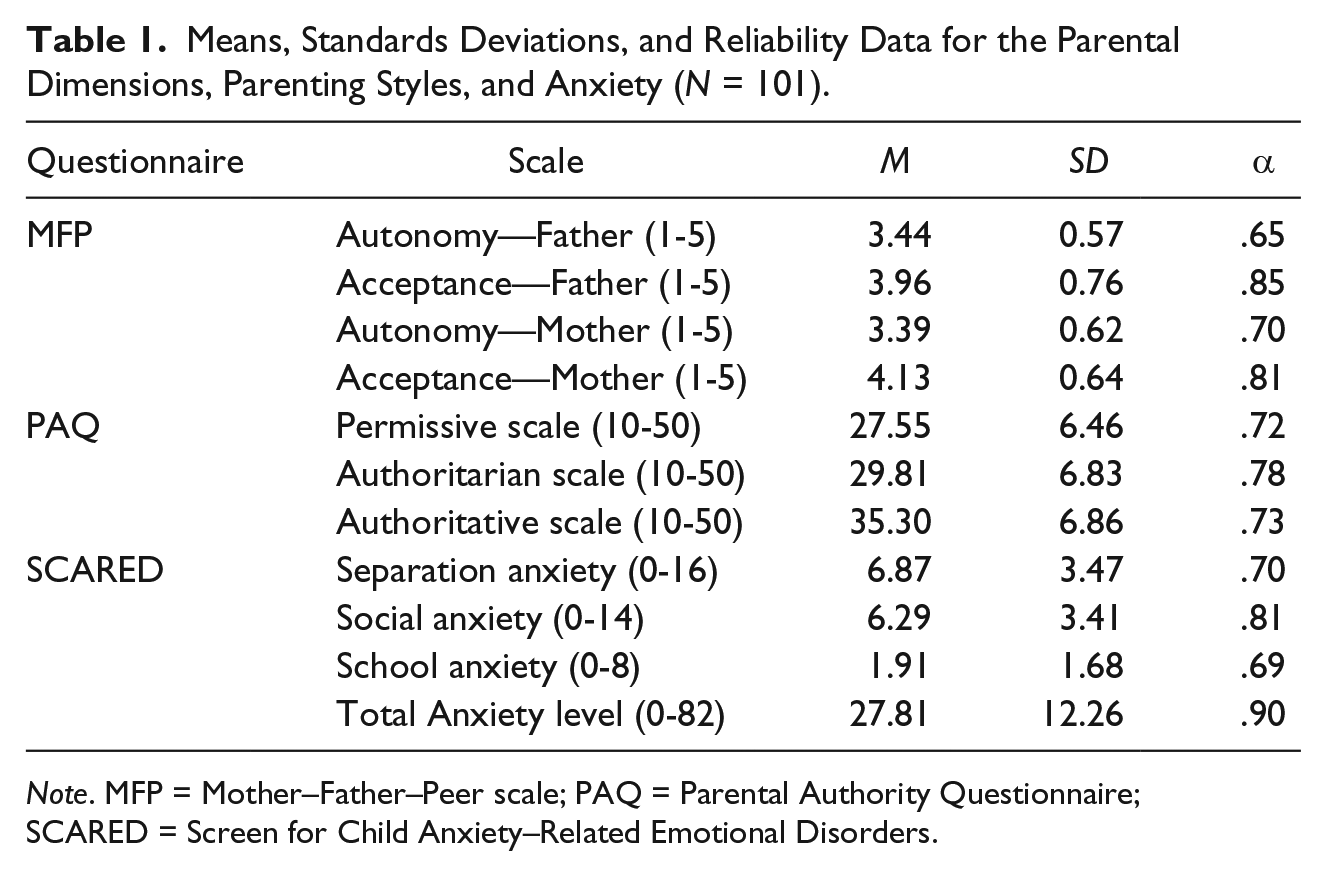
Note. MFP = Mother–Father–Peer scale; PAQ = Parental Authority Questionnaire; SCARED = Screen for Child Anxiety–Related Emotional Disorders.
The Relationship Between Parental Autonomy and Acceptance and the General Anxiety Level in Children
It was hypothesized that the lack of autonomy granting by parent and lack of parental acceptance would be related with increased anxiety in children. To examine the relationship between the parental dimensions and the general anxiety level among the sample’s children, we conducted standard regression analysis for predicting the total anxiety score from parental autonomy granting and acceptance for the father and the mother separately. In the absence of a significant effect for the demographic variables (sex and birth order) on the anxiety levels among the study participants, the following analyses will be presented for the entire sample without distinguishing between the groups. The results of these analyses are shown in Table 2 (Analyses 1 and 2).
Regression Analyses Predicting the General Anxiety Level From Maternal And Paternal Dimensions (N = 101).

Note. r = partial correlation after controlling for the additional predictors in the equation. The maternal acceptance variable was omitted from the equation in Analysis 3 due to its insignificant contribution to the explained variance.
p ≤ .05. **p ≤ .01. ***p ≤ .001.
The results of Analysis 1 and 2 show that autonomy granting significantly explains the variance of the children’s general anxiety level for both parents, while the parental acceptance dimension explains the anxiety variance in question only for the father. The negative correlation between the variables confirms, as expected, that lack of autonomy and low parental acceptance are associated with increased anxiety in children. Apart from the unique contribution that each parental dimension has to explaining the general anxiety level (except for the maternal acceptance), the current findings also demonstrate that parental control rather than parental acceptance, has a higher contribution in predicting children’s anxiety level. Furthermore, the regression analysis for the mother and the father separately shows that the former’s dimensions explain up to 33% of the total variance of the general anxiety level in the children in the sample, while the latter’s dimensions explain up to 43% of the variance of the anxiety in question.
To examine whether the paternal and maternal dimensions have a distinct parenting contribution to predicting the level of the children’s anxiety, we also conducted a regression analysis in steps (see Table 2, Analysis 3). The father’s variables were entered together into the regression equations as a first step. Entering the mother’s variables into the equations as a second step yielded a statistically significant additional contribution of 2.3% of explained variance of the children’s general anxiety level (F[1, 96] = 3.97, p ≤ .05), and improved the predictive ability of the parental variables to 45%. The source of the contribution to the extra explained variance was exclusively due to the mother’s autonomy granting, with no significant contribution of her parental acceptance dimension.
The Relationship Between Parental Autonomy Granting and Parental Acceptance and Specific Anxiety Types in Children
To examine the unique correlation of the parental dimensions with specific patterns of anxiety in children, in the second stage we conducted partial correlations analyses between parental autonomy granting and acceptance (each variable was controlled alternately) and various anxiety types, for each parent separately. As mentioned above, we hypothesized that parental autonomy granting would be negatively correlated with separation and social anxiety, while parental acceptance would be negatively correlated with social anxiety. Table 3 shows the partial correlations between the parental dimensions and the specific anxieties.
Partial Correlations Between Parental Dimensions and the Specific Anxiety Scales.
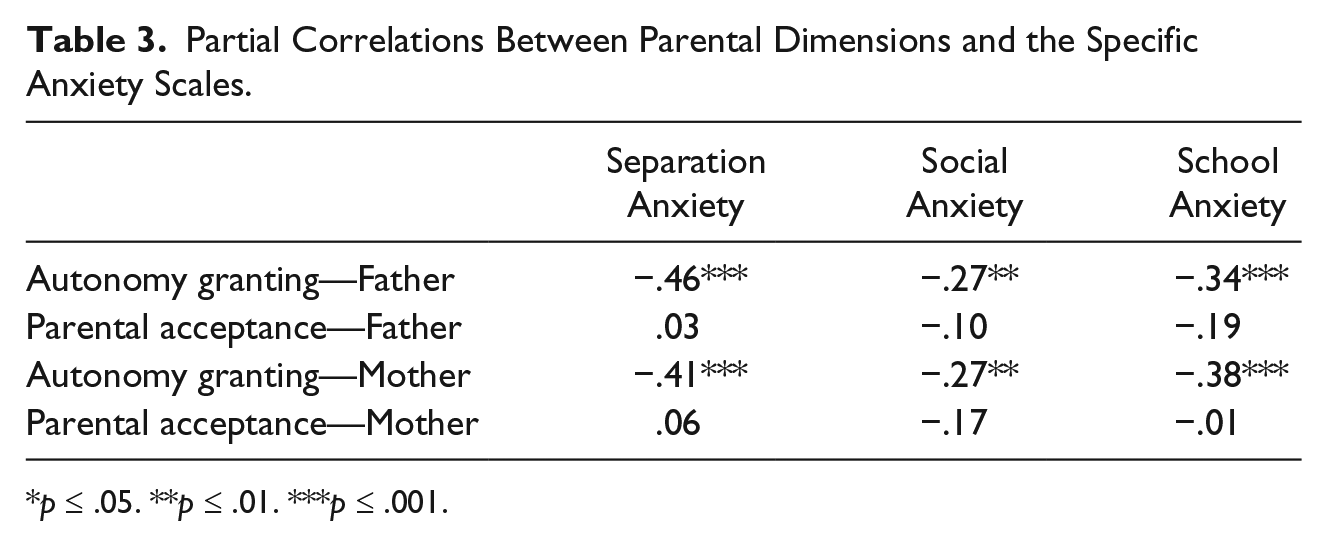
p ≤ .05. **p ≤ .01. ***p ≤ .001.
The data in Table 3 show similar trends for both parents, which indicate that autonomy granting is the dominant parental factor among the two dimensions even when it comes to specific patterns of anxiety. As expected, autonomy granting was uniquely and negatively correlated with patterns of separation anxiety and school anxiety, and to a lesser extent with patterns of social anxiety. The difference between the partial correlation with separation anxiety and the partial correlational with social anxiety is statistically significant for the father (t = 1.95, p ≤ .05). In contrast, when controlling for the autonomy granting variable, the parental acceptance dimension is not significantly correlated with any specific anxiety type. Hence, the recorded significant zero-order correlations between the parental acceptance dimension and the specific anxieties of separation anxiety, social anxiety, and school anxiety for both parents (for the father: r = −0.24, −0.27, −0.39; for the mother: r = −0.21, −0.35, −0.25, respectively), are meaningless for our purpose and do not support the hypothesis of the unique association with specific anxiety types.
It is noteworthy, however, that an examination of these correlations among the highly anxious group of children (as belonging to the upper median group of the anxiety scores in the sample), shows a medium and significant connection between the maternal acceptance dimension and social anxiety (r = −0.46, p ≤ .001; n = 51). At the same time, the correlations for the father’s parental dimensions with the children’s anxiety types remain unchanged.
The Effect of Overall Parenting Styles on the General Anxiety Level and Specific Anxiety Types in Children
As part of the examination of the relationship between parenting and children’s anxiety, we also examined the differences in anxieties’ levels between groups of children according to their perception of their parents’ parenting style. Measuring parenting styles via the PAQ provides an additional empirical angle for the examination of the relationship with children’s anxieties. Based on the questionnaire’s scores, the sample was divided into three groups of parenting styles: authoritative, authoritarian, and permissive. The group of children who perceived their parents as permissive (n = 6) was not included in the following analysis due to its small size. In practice, the anxieties’ levels were compared between two groups of children: children who perceived their parents as authoritative (n = 72) and children who perceived their parents as authoritarian (n = 23).
The analysis was preceded by examining the possibility of matching the unbalanced sized groups based on relevant background variables which are recognized in the literature to have strong link to children’s anxiety (age, gender). This option was rejected in the absence of justification for reducing the samples for the purpose of comparison, because both groups tested obtained similar values for these variables. Table 4 presents the means and standard deviations of the general anxiety level and the specific anxiety types by parenting styles.
Means, Standard Deviation, and t Test Scores for the Differences Between Parenting Styles Groups in Children’s Anxieties.
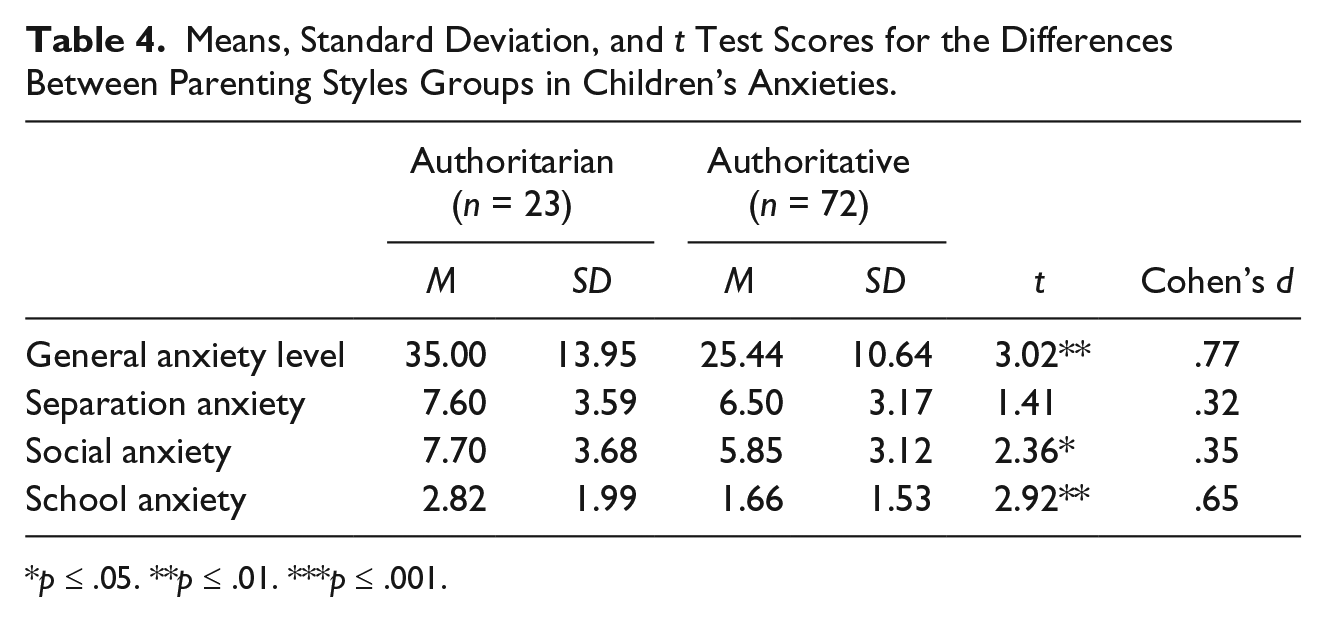
p ≤ .05. **p ≤ .01. ***p ≤ .001.
Table 4 shows the significant differences between the two groups, both in the general anxiety level and in the specific patterns of school anxiety and social anxiety (a similar trend was found for separation anxiety, but it was not statistically significant). According to the findings, children who perceive their parents as authoritarians have higher levels of anxiety in general and of two specific anxiety types in comparison to children who perceive their parents as authoritative. This strengthens our hypothesis regarding the relationship between parental excessive control and lack of acceptance (which characterize the authoritarian parent) and children’s increased anxiety.
Discussion
The current article deals with two main research questions. The first addresses the relationship between the parental dimensions of control (in the context of granting autonomy) and acceptance, overall parenting styles, and the children’s general anxiety level. The second addresses the association between these parental variables and specific anxiety patterns among children. To observe the unique connections between each parental dimension and children’s anxieties, we controlled for the common effect of parental autonomy and acceptance by using partial correlations analyses. A methodological approach in this spirit was also used in Mattanah’s study (2001), given the need to investigate the distinct effect of the two parental dimensions where there existed a strong correlation between them. The findings obtained in the present study are essentially in line with previous findings (Bayer, Sanson, & Hemphill, 2006; Hudson & Rapee, 2001; Peter, Meesters, Schouten, & Hoge, 2004; Wei & Kendall, 2014; Wolfradt et al., 2003), showing a clear and significant link between lack of parental autonomy granting and acceptance (for the father) and elevated anxiety levels in children (accounting for 45% of the explained variance of the latter). The findings revealed a significant contribution of maternal autonomy granting, beyond the contribution of the paternal dimensions to explaining the general anxiety level. This may indicate the possibility of a gender-specific parental effect which is relevant to children’s anxiety. The gender aspect of parenting styles is a significant output of the current study, due to its ability to examine the relations with children’s anxieties for mothers and fathers separately. Differential parenting between the two parents is given less empirical attention and is yet to be elucidated (McKinney & Renk, 2008), particularly in relation to children’s social and emotional outcomes (Panetta et al., 2014). The mutual and differential effects of the mother and the father observed here stress the need to distinguish between their parental role in the contexts of children’s development, and should be considered as consolidating an examinable theoretical framework for further research in this specific area.
The findings also clarify the superiority of parental control over the dimension of parental acceptance, with respect to children’s anxiety, based on its dominant weight in explaining the variance of latter variable. This finding is consistent with the relevant research reviewed in MacLeod et al. (2007), and is in line with the authors’ conclusion regarding the differential effect of parental control and acceptance (and their subdimensions). Accordingly, parental autonomy granting may play a crucial role in relation to children’s anxieties, and its absence may put children at risk of developing anxiety (or, conversely, anxious children might cause parents to overprotect them by limiting their independence).
Moreover, controlling for maternal autonomy granting revealed no significant association between maternal parental acceptance and the general anxiety of children. This suggests that the effect of maternal acceptance on the child’s anxiety level is not unique, but is due to its joint effect with autonomy granting. Accordingly, in the absence of the negative consequences related to the mother’s failure to grant autonomy, lack of maternal acceptance of the child per se might not be related to children’s anxiety. Seemingly, this finding is most surprising, since it contradicts the psychological premise regarding the mother’s crucial role in the child’s emotional development. However, it joins a considerable number of previous studies that have not found a significant effect for maternal acceptance on the child’s anxiety level (e.g., Gruner, Muris, & Merckelbach, 1999; Hirshfeld, Biederman, Brody, Faraone, & Rosenbaum, 1997; Mattanah, 2001).
Alongside these findings, we also received some interesting evidence regarding the differential relationships of the parental dimensional with specific types of children’s anxiety, which can be understood by Wood et al.’s (2003) theoretical framework that was adopted here. Examining the partial correlations (when controlling the parental acceptance dimension) between parental autonomy granting and the children’s specific anxieties shows that the former was uniquely and significantly associated with all three anxiety types tested. The strongest connection for both parents separately was with patterns of separation anxiety and school anxiety, while the connection with social anxiety was less significant. These findings confirm the theory of Wood et al. (2003) regarding the link between lack of parental autonomy granting and separation anxiety among children. According to them, when a parent does not allow the child to have adequate independent experiences, and also tends to overprotect him, he might hinder the child’s development of a sense of control and efficacy, and as a result the latter may tend to experience helplessness repeatedly. Consequently, the child may develop a growing pattern of dependence on the parents, manifested by detachment difficulty and refusal due to the insecurity and anxiety involved. The findings are relevant to both parents equally, and they provide support to this theoretical route concerning the development of separation anxiety in children.
As for the corresponding link between the lack of autonomy granting and school anxiety, this finding may suggest that excessive parental control over the child is related to the child’s anxiety toward school, primarily due to the difficulty of separating from the parents. This explanation is in light of literature associating between the two phenomena (e.g., Comer, 1992; Gittelman, 1986; Kahn, Nursten, & Carroll, 1981; Sue, Sue, & Sue, 1994), and is supported by the fact that often the pattern of school anxiety is a specific expression of separation anxiety.
The third finding in the series refers to the possible consequences of the parental failure to provide autonomy on the social competence and emotional adjustment of their children. Apparently, there is a common etiological denominator for these three anxiety patterns, arising from the lack of experiences that reinforce the child’s feelings of competence and independence. This conclusion is consistent with the classical developmental theories (e.g., Erikson, 1950), highlighting the value of independence as a fundamental developmental task. In line with some previous research findings (Cheek & Melchior, 1990; Spokas & Heimberg, 2009), this finding magnifies the significance of the child’s psychological and behavioral independence and underscores it in the social context where, especially during adolescence, separation from the parent is most common (i.e., school, meetings with friends, classes, etc.). Hence, parental practices that undermine and hinder the child’s acquisition of self and social autonomy might put him at risk of anxiety in social contexts, particularly as he grows older.
As for parental acceptance, this dimension was not uniquely related with one of the specific anxiety types tested, but only in the highly anxious children group. As mentioned, this group obtained a significant negative partial correlation between maternal acceptance alone and a social anxiety pattern. This finding is intriguing, because it may imply that in certain circumstances maternal acceptance plays an important role with respect to specific anxiety among children, particularly social anxiety.
Nevertheless, the findings partially support the relation between parental rejection and emotional coldness and various symptoms of shyness and social withdrawal in children, as found in a small number of studies (e.g., Hummel & Gross, 2001; Rubin, Cheah, & Fox, 2001; Spokas & Heimberg, 2009). Possibly this parental negative treatment influences the attribution styles the child develops, when frequent negative feedback promotes a perception of a threatening and hostile world, which also reduces his self-concept. As a result, the child’s perceptions, and expectations of negative consequences of social events in his life increase. Our results limit this explanation solely to anxious children, who seem more vulnerable to these maternal effects. Nevertheless, in contradiction to almost all the trends identified in the current study, this connection was obtained for the mother alone, and it is evident to that the issue of parental gender in the etiology of children’s anxiety remains obscure. Our suggestion here, in which the mother plays a more substantial role in the formation of specific types of anxiety among children, requires further examination.
Our final test attempts to strengthen the findings of a few studies connecting between overall parenting styles (according to Baumrind’s conceptualization) and the emergence of anxiety in children (Wolfradt et al., 2003). The results primarily reflect the expected convergence between the relevant theoretical structures (as measured separately by MFPS and PAQ), which reinforces the construct validity of the measurements, and proves the consistency of the children’s responses in the study. We also found that children who perceived their parents as authoritarian obtained significantly higher scores in social and school anxiety as well as in the general anxiety level, compared with children who perceived their parents as authoritative (the same trend was found for separation anxiety, which was approaching significance). These findings are generally consistent with various findings (Erozkan, 2012; Panetta et al., 2014; Wolfradt et al., 2003; Wei & Kendall, 2014), suggesting that parenting style, as perceived by the child, may have a substantial effect on the latter’s psychopathology, particularly when it comes to anxiety. This finding is also consistent with the previous evidence presented in this study, linking between parental overcontrol and low acceptance (typical of the authoritarian parenting style) and increased anxiety in children.
The research findings are limited in several respects. First, all the parenting indexes used in the study are based on self-report of the child according to his subjective perception. Since children’s perceptions of their parents’ parenting styles may not match the parents’ actual style, the current conclusions linking between parenting and children’s anxieties must be restricted accordingly. To reinforce the associations that underlie the current study’s conclusion, a further examination using both parents’ and children’s reports on the parent’s styles and the child’s anxieties is required. Yet many researchers ascribe great importance to the child’s view of the parent’s characteristics (e.g., Barber, 1996; Steinberg, 2001), due to its significance with respect to developmental and adaptive aspects.
Using a single informant has another methodological implication related to the validity of the findings. Campbell and Fiske (1959) warned about the potential of correlational inflation caused by single source measurement. This raises a concern that the relatively high correlations obtained in the current study show stronger connections than they actually are.
Moreover, for convenience, the various anxiety patterns were measured using a single tool, which also produced the general anxiety total score. However, for further investigation of the anxiety types studied here in context of parenting styles, it is essential to use more rigorous and specific diagnostic methods for assessing children’s anxiety disorders.
Finally, this study’s findings are based on a correlational design which does not address the aspect of parent–child causality. Hence, while the connections between parental control and children’s anxieties found here may imply parental influence, it is essential to properly interpret these findings and equally consider the opposite direction of influence. The possibility that children’s anxiety elicits certain protective behaviors from parents (e.g., limiting autonomy) is both statistically and theoretically reasonable, especially the sort of children’s anxieties discussed in this article. Therefore, the study’s conclusions must be further examined via special research designs (such as a longitudinal study), to illuminate and validate the causal direction they may suggest with respect to parental control and the child’s separation and social anxiety.
Footnotes
Author’s Note
The study was conducted in accordance with the ethical standards of the American Psychological Association.
Declaration of Conflicting Interests
The author(s) declared no potential conflicts of interest with respect to the research, authorship, and/or publication of this article.
Funding
The author(s) received no financial support for the research, authorship, and/or publication of this article.