



Abstract
Late-life repartnering is a phenomenon developing as life-expectancy increases, creating complex stepfamilies constructed in old age. Adult children and parents’ well-being could be influenced by adult children’s experiences of one parent’s late-life repartnering after the death of the other parent. Our aim is to explore how these two life events intertwine in the lives of adult children heuristically using existential phenomenology. Semistructured qualitative interviews with 27 adult children were chosen from a larger study on the meaning of late-life repartnering from an intergenerational family perspective. Criterion sampling included adult children of a widowed parent who repartnered at or above the official retirement age in Israel. Two themes emerged—(1) loyalty conflict: (a) visible and/or hidden, (b) hypothetical thoughts and feelings about the deceased parent in the context of the parent’s new partner and (2) comparison between the deceased parent and parent’s new partner. Findings are discussed using the existential figure−ground concept illustrating the two life events intertwining.
Keywords
Introduction
Late life repartnering and parental death are two life events experienced by adult children who have lost a parent due to death while the other parent repartnered after becoming a widow/widower. Hence, the aim of this article is to explore, from the adult children’s perspectives, the experience of a parent’s late-life repartnering after the death of the other parent, and the possible intertwining of these two life events.
Late-Life Repartnering
The literature on late-life repartnering includes several definitions of the phenomenon: beginning the relationship at or above the official retirement age (Moustgaard & Martikainen, 2009); starting the relationship at age 50 years (Brown, Bulanda, & Lee, 2012; Brown, Lee, & Bulanda, 2006), or at age 55 years and older (De Jong Gierveld, 2004). Another definition restricts the phenomenon to partners who had a lifelong marital relationship in which each had previously raised a family with children and grandchildren (Blinded for review). In the present article, late-life repartnering excludes the divorced and refers only to widows and widowers who repartnered at or above the official retirement age in Israel. Both partners had children and grandchildren from their lifelong marriages and their repartnering relationship took the form of remarriage, cohabitation, or living apart together.
Late-life repartnering among persons aged 65 years and older is a relatively new phenomenon worldwide with low prevalence of no more than 10% (Davidson, 2002). It is more accepted in modern societies (De Jong Gierveld, 2004) and usually occurs within a mid-high socioeconomic status (Davidson, 2002). As life expectancy increases, the phenomenon is likely to continue to develop as an option in old age (De Jong Gierveld, 2004).
In Israel, a society culturally located between tradition and modernity (Lavee & Katz, 2003), the phenomenon has not yet received recognition as a normative choice in old age (Blinded for review). This could explain why, no data on late-life repartnering are available from the Central Bureau of Statistics (2014).
Repartnering creates a type of stepfamily constructed in old age (Blinded for review). Step-relationships are unexpected (Coleman, Ganong, & Russell, 2013) at any age and require those involved to adjust to the new family structure (Baxter et al., 2009). This is especially true in old age, when repartnering is perceived as having more of a partnership role than a family structure (Blinded for review). This might explain why most of the empirical literature on late-life repartnering refers to partners’ issues of widows (Davidson, 2002) and widowers (van den Hoonaard, 2012) studied mainly from their individual (e.g., Davidson, 2002) or dyadic perspectives (e.g., Blinded for review). In the few studies referring to familial aspects of late-life repartnering, conflicts were addressed. These included issues concerning inheritance, jealousy, and anger regarding priority changes, threat to the memory of the deceased parent (Spalter, 2010), and caregiving expectations (Blinded for review) and experiences (Sherman, 2012). However, some adult children encourage late-life repartnering because of its advantages for both generations. These include enhancing the parent’s self-esteem, social capital, and sources of support (Spalter, 2010) and reducing the children’s worry (Blinded for review) which might have increased with the parent’s widowhood (Stuifbergen, Van Delden, & Dykstra, 2008). Adult children’s experiences with parents’ late-life repartnering as positive and/or negative could have significant influence on family dynamics and on quality of life of parents and children alike (Blinded for review). Therefore, it is important to examine adult children’s experiences with parents’ late-life repartnering, including the impact of the death of the deceased parent.
Adult Children and Parental Death
Adapting to the death of a parent is a multidimensional personal and familial process. Parental death affects identity, social interactions, family, spirituality, intimacy and sexuality, work productiveness, and health (Lund, 2001). Adult children confront their own mortality when a parent dies (Kiel, 2003), which might lead to reevaluation of their own life course (Black & Santanello, 2011). As with the loss of anyone close (Lund, 2001), initial reactions to parental death might include anger, sadness, fear, shock, disbelief, relief, guilt, loneliness, confusion, and depression (Kiel, 2003). Grief might be accompanied by thoughts about the deceased and events related to the death (Lund, 2001), perceived simultaneously as expected and unexpected (Black & Rubinstein, 2013).
Adult children’s difficulty in discussing and sharing experiences related to parental death derives from the merging of past experiences with the parent and the present situation of the parent’s physical absence, along with focusing on the “here and now” of coping (Black & Rubinstein, 2013). Other findings indicate that children, who report a positive relationship with the parent and express ongoing loss, might idealize the parental relationship. Sharing memories and reminiscing about past experiences connected to the deceased parent is an acceptable means of escape from reality. It brings comfort and helps ease existential loneliness that accompanies the experience of loss (Kiel, 2003). For adult children, communication with the deceased parent (e.g., writing them letters about life events) was found to reduce the trauma and pain of the unbearable reality of death, providing an escape from the despair associated with the inevitable finality of life (Ata, 2012). Bereaved religious persons were found to be less anxious than those who were not religious. Religious affiliation can provide strength and resilience, which contribute to coping with death (Ata, 2012). However, it is unclear whether these findings are restricted to those who were religious prior to the parent’s death or also includes those who became religious or strengthened their belief as a result of the death. After the death of a parent, adult children lose the opportunity to find answers to hitherto unresolved questions, including identity aspects related to change of self and worldview. Parental death might serve as a turning point in their own and their family’s lives (Black & Santanello, 2011). With time, sadness generally decreases, improving the emotional state of the bereaved adult-child (Kiel, 2003).
Parents create familial norms, beliefs, morals, and attitudes. Parental roles have symbolic meanings such as father as provider, protector, authority, friend, and critic (Black & Santanello, 2011). Thus, parental death influences family dynamics (Black & Rubinstein, 2013), potentially reinforcing these patterns. Children were found to receive comfort through support from family and friends. Their social ties were strengthened, and life purpose was focused on involvement in family life (Kiel, 2003).
Heuristic Framework: Existential Phenomenology
Parental death and repartnering of the surviving parent are two separate occurrences in the adult-child’s life. From an existential phenomenological perspective, the two might be mutually constitutive (Valle, King, & Halling, 1989); similar to the Gestalt figure–ground concept. A figure has an object-character that is spatially cohesive and enclosed, filling a space inside its border. A ground has a material character that extends behind the figure (Shapiro & Hamburger, 2007). Based on this conceptualization, we examined how, if at all, adult children experience late-life repartnering of their surviving parent (as figure) in the context of the deceased parent’s death (as ground), and how, if at all, parental death (as figure) is experienced retrospectively in the context of late-life repartnering (as ground).
A way of interpreting the adult-child’s situation is through the existential phenomenological concept of the life word (Lebenswelt), which includes the following four dimensions (van Deurzen, 2010): The physical world (Umwelt) represents people’s relationship with nature. Through this dimension, the adult children might perceive the deceased parent’s physical absence from their world as the natural course of life. The social world (Mitwelt) represents being-in-the-world with others. It refers to the adult-child’s feelings toward the repartnered parent and the new partner, and how repartnering influences the adult-child’s relationship with them. The personal world (Eigenwelt) is the inner world not shared by others. This refers to how the adult-child, who lost a parent and whose surviving parent has repartnered, copes with the existential sense of death (May & Yalom, 1995). It also represents how the adult-child, who cannot control a parent’s death or repartnering, known as existential thrownness, uses situated freedom of choice, constrained by life situations, to cope with such events (Sartre, 1991). The spiritual world (Uberwelt) represents creating meaning and a sense of belonging to a scheme of things. It refers to how the adult-child makes sense of the parent’s death, the surviving parent’s repartnering, and the essence of family (van Deurzen, 2010). In existential terms, temporality is experienced as relative and subjective (May, 1983). Thus, we ask how it is expressed in the experience of adult children whose parent repartnered after the other parent’s death. The four dimensions intertwine to compose the individual’s holistic life-world (van Deurzen, 2010).
Both parental death (Black & Santanello, 2011) and the subsequent late-life repartnering (De Jong Gierveld & Merz, 2013) are significant life events for adult children. Therefore, when examining the adult children’s experiences, it is necessary to understand the essence of the possible interplay between these two events.
The research questions are accordingly: (a) How do adult children experience parental death after late-life repartnering of their surviving parent? (2) How might the death of one parent and late-life repartnering of the surviving parent intertwine?
Method
Data for this article are drawn from a larger qualitative study on late-life repartnering from a family intergenerational perspective (ISF No. 1583/11). Analysis is based on the phenomenological tradition (Smith, Flowers, & Larkin, 2009), referring to “lived experience” of adult children who, after parental death, experienced late-life repartnering of their surviving parent.
Sample and Sampling
Criterion sampling for the larger study (Patton, 2002) included older couples who repartnered after the official retirement age in Israel (men 65+; women 60+). Both partners were previously in a lifelong marriage that included adult children and grandchildren. The larger study included 37 adult children whose parents were either widowed or divorced. Criterion sampling of the subsample for this article included 27 adult children whose parents had repartnered after widowhood with a partner who was also widowed with children (Table 1).
Demographic Information.
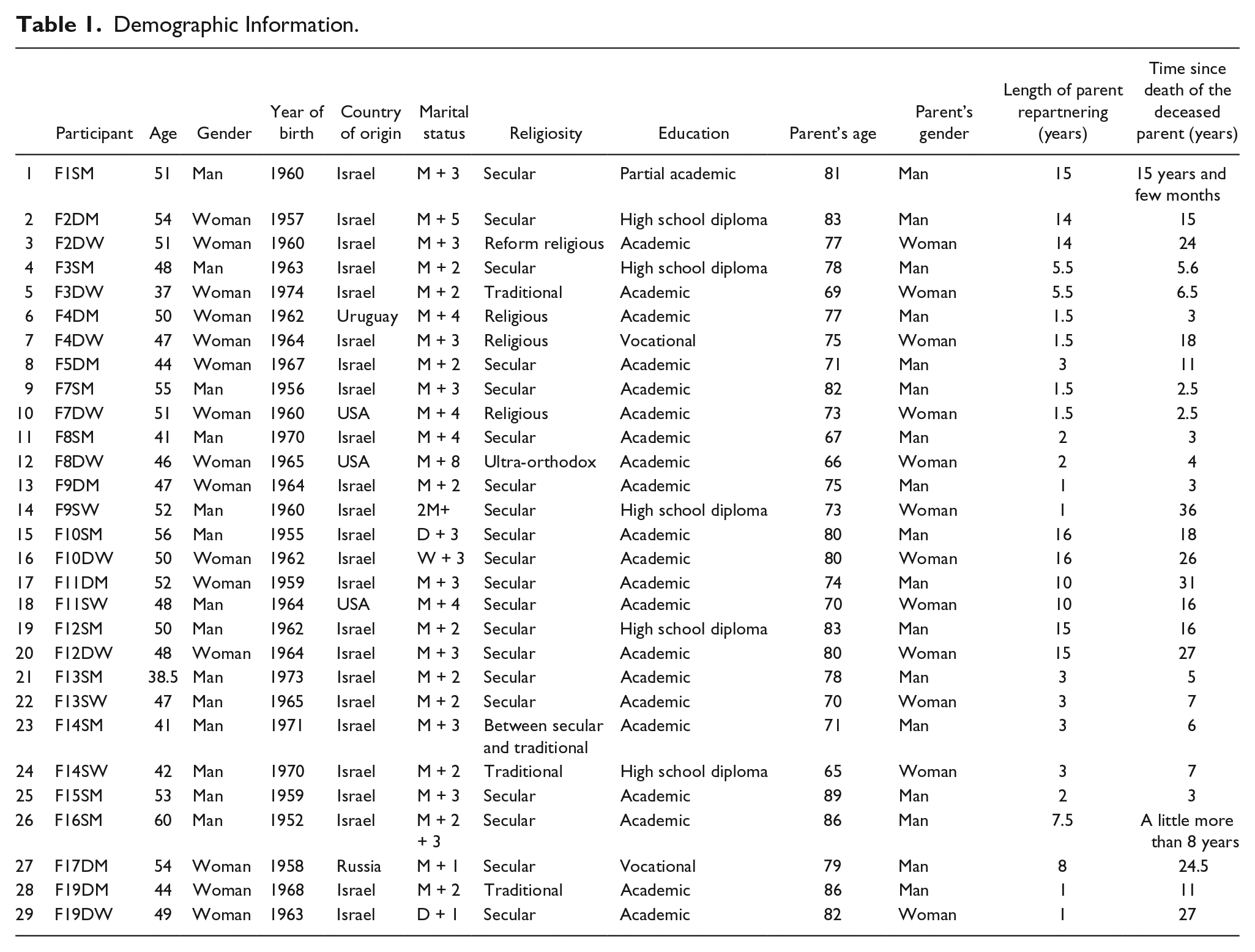
Demographic information for the 27 adult children was as follows: Between 37 and 60 years old, all of them had children, most were married, and two were divorced. All except five were born in Israel and had an academic or professional education. All of them were Jewish and defined themselves as secular, traditional, or religious. The parent’s repartnering had occurred between 1 and 16 years previously. Time since death of the deceased parent was between 2.5 and 27 years. Participants were coded in the same way as in the larger study (e.g., the man’s son in Stepfamily3 was coded Stepfamily3SM).
Recruiting Participants
Participants were recruited via professionals working with older persons throughout Israel. They were contacted by phone and were provided with information about the study. After they were found to meet the study criteria and agreed to participate, the older partners contacted one of their adult children and asked them to participate in the study. Thus, the parents chose the adult children, who were interviewed at a time and place convenient for them. Most interviews were conducted at the child’s home, lasted about 1 hour, were audio-recorded in Hebrew, and transcribed verbatim. To preserve the original meaning, the quotes chosen for this article were translated from Hebrew into English by the second author, who is bilingual.
Research Tool and Data Collection
Semistructured face-to-face interviews were conducted with each participant separately to learn about late-life repartnering from an intergenerational family perspective, from November 2011 until the end of 2012. The interviews were based on an interview guide (Kvale & Brikmann, 2008) developed for the adult children’s generation. The opening question was “Tell me the story of your parent’s late-life repartnering.”
The interview guide included several content areas. Those relevant for this article were intergenerational relationships in the family including the relationship with the parent before and after repartnering, and with his or her partner, attitudes toward the parent’s late-life repartnering in particular, and to the phenomenon in general. The interview guide did not include specific questions related to the experience of parental death. However, when the interviewees initiated such content during the interviews, the interviewer probed further. According to the interviewee’s answers, additional questions were formulated during the interview regarding content, meaning, contrast, follow-up, probing, and clarification (Kvale & Brikmann, 2008).
Analysis
In the process of data analysis, we identified adult children’s experiences of parental death and decided to examine them further although this was not the primary purpose of the larger study. We analyzed the data based on the phenomenological tradition (Smith et al., 2009). In the first step, we read and reread each interview while listening to the recordings and making initial notes including descriptive comments of events, behavior, emotions, and thoughts, linguistic comments such as repetitiveness, and conceptual comments relating to ideas and perceptions of partnership, for example, “partnership should be for life.” This process helped us identify units of meaning, and the second step included identifying the relationships between them. For example, we examined the relationship between “relationships are eternal” and “loneliness in old age.” This process was conducted in-depth for each interview separately. In the third step, we identified units of meaning whose themes went beyond the individual interview and emerged across interviews. Identifying patterns by comparing units of meaning that emerged in different interviews assisted the creation of new categorical structures of the findings. This step was accomplished using a process of abduction (Charmaz, 2006), which means that, after a possible theme had emerged inductively, we examined it deductively on the rest of the data to derive at a conceptual structure. When such a conceptual structure was identified through the abduction process with the rest of the data, the theme was confirmed. This process resulted in two main themes, which are presented in the “Findings” section.
Trustworthiness
Trustworthiness was achieved in several ways. All the interviews were audio-recorded and transcribed verbatim so that we could check that the emerging interpretations were based on the original data. Notes and memos, including thoughts, emotions, and ideas, were documented by each researcher throughout the entire process. As part of the larger study, the research team held periodic meetings to discuss disagreements regarding coding, units of meaning, and themes. The discussion continued until agreement was reached and changes were made accordingly (Kvale & Brikmann, 2008).
Ethics
The study received approval from the ethics committee for experiments on humans of the university research authority (Approval No. 224/11). Each participant signed a letter of consent after receiving a brief explanation of the study to ensure voluntary participation. The letter included the option of withdrawing at any stage and ensured confidentiality by promising to alter identifying information. Code labels were used to replace participants’ real names and identifying information was altered. The interviewer was a graduate social work student, who was familiar with creating a rapport and showing empathy without taking on the role of therapist (Kvale & Brikmann, 2008). Finally, we informed participants how to receive emotional help, if needed, due to disclosure of sensitive issues. This need did not arise at any stage of the study.
Findings
Late-life repartnering of the surviving parent in the context of parental death had occurred as a significant life event. Participants raised relevant content about loss in the context of their parent’s death, on their own initiative. This highlighted loss as relevant to the experience of late-life repartnering and we therefore investigated it further. From the adult children’s perspective, the continuous presence of the deceased parent plays a role in shaping the experience of the surviving parent’s repartnering. The first theme relates to loyalty conflict and is addressed in two subthemes. One refers to visible/hidden loyalty conflict. The other refers to speculations about the deceased parent’s attitudes in light of past acquaintance with the new partner. The second theme compares the deceased parent with the new partner as shaping attitudes toward late-life repartnering. Illustration of these themes is based on choosing quotes that supply rich, thick descriptions to represent these experiences (Smith et al., 2009).
Loyalty Conflict
Visible–Hidden
This subtheme deals with sanctification of the deceased parent, illustrated by two examples. The woman’s son in Stepfamily14 expresses visible loyalty conflict through his emotional difficulty versus his reasoning: Mom told me that she met a new partner. It was a bit difficult at first because it was instead of Dad, [. . .] it’s seven and a half years since his death. The partnership, I think, [began] two years later. If it had started today, it would [also] be difficult for me. “Time is not the essence here.” On the one hand, [the partnership] takes someone else’s place, but on the other hand, my mother also has a life and she needs to live. You have an inner struggle. For me, it was important that it would be only after the year of mourning [. . .] it’s her life, but still, it doesn’t suit me today either. It doesn’t suit me, of course it doesn’t suit me. Mom lived with Dad for maybe 40 years, and someone else came [. . .] it’s difficult to accept, although you see that it’s good for Mom, it shrinks in comparison to what I feel [. . .] we [Mom and I] see each other about once a week, as a rule. I refuse to drive Friday night since Dad [passed away]. I go to the synagogue and believe more, and everything that happens in life [. . .] is not how it used to be. When Dad was alive, there was more joy, more getting together; more fun. These are two different worlds, at least for me. What changed is that there is no more Dad [. . .] as far as I’m concerned, everything changed. I’d say my quality of life changed by 80% [. . .] we continue to get together on holidays but it’s not the same joy, it is certainly not the same joy. There’s not the same willingness to come because you don’t have the bonus of saying I’m going to my parents [. . .]. That’s it, that’s what I miss the most. (Stepfamily14SW, age 42, mother’s age 65, widowed 7 years, repartnered 3 years)
The son brings two voices: emotion and reason, each relating differently to the experience of time concerning the two life events. The voice of reason refers to his mother’s late-life repartnering as creating a new family structure representing the present. He understands that his mother deserves to live a fulfilling life. Therefore, he restricted his objection to repartnering to the first year of mourning. The voice of emotion refers to his father’s death and represents the past. Emotionally, the mourning is timeless and not restricted to the first year of his father’s death. Thus, regardless of its timing, repartnering does not belong. The longest and most significant time is when his parents were together. The time element is dismissed when compared with the family history and the experience of the late-life repartnering carries a deep sense of emotional betrayal. Lack of acceptance of the new situation is expressed by the son’s repeated statement: “it doesn’t suit me.” The constitutive event of his father’s death continues to accompany him, leading to an overall turnaround of his life experience, especially losing the meaning of the family. He describes having fewer reasons to visit, and less joy. Simultaneously, he has strengthened his religious worldview, influencing the essence and the frequency of family gatherings.
An examination of the two occurrences in the son’s life, his father’s death and his mother’s repartnering, reveals a dissonance between his mother’s improved quality of life and the worsening of his own. This dissonance creates loyalty conflict: accepting the new family structure or preserving the original one. The inner struggle is presented as having no solution. Beginning and ending with the emotional voice indicates its significance regarding the son’s perception of his mother’s late-life repartnering.
The woman’s daughter in Stepfamily2 illustrates hidden loyalty conflict: The fact that I miss my father very much does not make the presence of my mother’s new partner problematic [. . .]. It took my mother a long time to realize that [repartnering] does not mean disloyalty toward my father [. . .] when it came up one day, she asked: “Do you think he [current partner] will let me be buried here?” [. . .] When my father died, it was a great shock. She didn’t think about her own burial, she was too young—52—my age. Who buys a burial plot at that age? She told me that she heard that due to the lack of burial space, people can be buried above or below their spouse, so I told her [. . .] “now you have a dilemma, you have two options; either on top of Dad or next to him [her current partner] . . . we joke about it. If he offers you, there’s a really nice view there. Perhaps it’s worth it.” I hope she will tell me what she wants. I prefer that she decides, not me, that she won’t leave the decision to us. (Stepfamily2DW, age 51, mother’s age 77, widowed 24 years, repartnered 14 years)
The daughter raises her mother’s burial issue, bringing up the need to address issues of eternal loyalty. “The fact that I miss my father very much does not make the presence of my mother’s new partner problematic.” The daughter’s ability to contain both her father and her mother’s new partner in her life subdues her need to cope with the question of loyalty. However, it seems that it reoccurs with the burial issue. Her mother cannot be buried beside both her partners. The daughter does not want to be the one to make such an eternal decision as stated: “I hope she will tell me what she wants. I prefer that she decides, not me, that she won’t leave the decision to us.” The daughter’s attempt to avoid the decision making on the burial issue could point toward conflict not openly discussed. The daughter is not concerned what the decision will actually be, but rather who will make it is what matters to her. As such, the content of the conflict remains hidden. Yet by not being the one making the decision, she does not necessarily avoid its consequences. The daughter uses humor known as a technique to reduce conflict and assists dealing with it: “We joke about it. If he offers you, there’s a really nice view there.”
Loyalty conflict among adult children to late-life repartnering parents was expressed openly and hidden. The son in the first quote represented it openly by weighing his mother’s needs against his own. Whereas in the second quote, loyalty conflict was hidden within the burial issue serving as a way to avoid having to make a final decision concerning loyalty.
Hypothetical Thoughts and Feelings About the Deceased Parent
This subtheme presents adult children’s preoccupation with hypothetical thoughts and feelings about their deceased parent in the context of the new partner. Prior acquaintance between stepfamily members, including the deceased parent, is a case in point. Two illustrations are presented with a joint comparative analysis that follows.
The perspective of the man’s daughter in Stepfamily4: I’ve known her as long as I can remember because she and her husband were good friends of my parents [. . .] when we were mourning, it was the first time we had seen her for many years. She made us laugh, reminding us of times gone by [. . .], she brought some joy for the half hour she was there [. . .] They decided quite quickly to get married and we were really happy because we knew she was not someone new; she was someone new-old with whom we renewed the relationship [. . .] What always troubled me was what my mother would have thought of it, especially because it’s someone she knows. I don’t know, I really hope that she’d be happy for my father, but I don’t know, I’m not at all sure because I don’t really know what she thought of her. I think the root of the friendship was my father and her husband. It wasn’t my mother and her, so I don’t know. (Stepfamily4DM, age 50, father’s age 71, widowed 3 years, repartnered 1.5 years)
The perspective of the man’s son in Stepfamily7: We have been acquainted with the lady for many years. We know the wonderful couple: my father’s current friend and her late husband, who were a great couple [. . .] and my parents became close friends with them [. . .] First of all, I was happy to see her [my father’s partner]. She came when we were mourning. I was glad that this partnership happened [. . .] it’s not only me; my sister, too, it’s a wonderful idea because they come from the same background [. . .] for all of us, it’s fantastic and I assume that if her late husband would have known about it and my mother would have known about it, they would have been happy. (Stepfamily7SM, age 55, father’s age 82, widowed 2.5 years, repartnered 1.5 years)
Both quotes refer to past acquaintance with the parent’s new partner as helpful. Prior acquaintance helps reduce the anxiety and difficulty of receiving a new person into the family. It eases the need to adjust because it is something new yet old. However, when considering the hypothetical attitudes of the deceased parent, the prior acquaintance has an additional role. Late-life repartnering might sometimes create loyalty conflict based on betrayal of the lifelong marriage and sanctification of the deceased. As such, the deceased parent’s feelings as potentially betrayed influence the adult children’s attitude toward the surviving parent’s late-life repartnering. For the man’s son in Stepfamily7, prior acquaintance helped relieve loyalty conflict because his deceased mother also accepted the “great couple.” He presents a unified front regarding the new partnership, including himself, his sister, and the deceased on both sides. However, the sentence “this partnership happened” indicates that their supportive attitude expresses their retroactive coming to terms with the situation. The parent’s repartnering was not an initiated action but just “happened.” It is a “wonderful idea,” for which no one takes responsibility. The recruitment of the living and the dead to support late-life repartnering, along with its random occurrence, helps its acceptance. The son tries to cope with the gap between the reality of his father’s repartnering and normative expectations by prior acquaintance with the new partner, thus making the situation easier to accept. For the man’s daughter in Stepfamily4, prior acquaintance has the opposite effect. She is not sure how her deceased mother would have reacted and therefore is hesitant to give her full approval, possibly increasing loyalty conflict. Her doubt relates to the specific new partner rather than to the phenomenon.
Deceased Parent and Parent’s New Partner: Comparisons
This theme refers to adult children’s comparisons between their deceased parent and their parent’s new partner, leading to either satisfaction or discontent. Three illustrations follow: satisfaction with difference, discontent with difference, and satisfaction with similarity. Discontent with similarity was not found.
The woman’s daughter in Stepfamily12 illustrates satisfaction with difference between her father and her mother’s new partner: When the partner arrived, it was a very different experience because he’s very adoring. He used to write and leave her these messages on every occasion [. . .] full of praise [. . .] It was very embarrassing at times, but for her, it was a lot of fun. Let’s say she’d make a Friday night meal. He’d stand in front of all of us and my brother would kick me and say: “Here we go again,” and then he [Mom’s partner] would raise his glass and make a toast to Mom for preparing everything: “Look at all the delicious dishes. Look at the chicken, look and look.” She’s our mother. As children, we took it for granted that when you come home to Mom there’s a Sabbath meal, right? He would be surprised every time [. . .]. My father was very different. He didn’t show his feelings. That wasn’t his style at all. Certainly not standing in front of everyone and telling everyone how wonderful she is. I think she has gained something; she experienced two different kinds of relationships, opposites. Every time I’d say, if my father would have seen whom my mother chose the second time around, he’d turn in his grave. What a man [my father was]. He had a dominant presence, was very physical. My father was a man of action, and now, she chose this kind of “softy,” who can hardly handle a drill. But I think she has benefited and has a very nice life. (Stepfamily12DW, age 48, mother’s age 80, widowed 27 years, repartnered 15 years)
The difference between her father and her mother’s new partner is described as enrichment to her mother’s life and enables the daughter to reflect on her family. Although she feels uncomfortable with the new partner’s behavior, it provides an opportunity to examine her mother’s functionality within the family throughout the years. Thus, late-life repartnering could serve as a way to reexamine intergenerational relationships within families, helping the daughter appreciate what was formerly taken for granted.
The woman’s daughter in Stepfamily9 illustrates discontent with difference: I really try to think what is so difficult for me with the partner, how she makes me feel inside. I asked my children when we were all together: “Do you think I’m the problem?” They said: “No Mom, she’s just a difficult personality, who needs a lot of attention.” For my children, it’s not easy with her, either. She’s very, very different from my mother, extremely different. They were very attached to my mother and loved her very much. My mother was a very involved grandmother. My children aren’t happy going to the partner; they don’t want it. My son always asks: “Tell me, Mom,”—he calls her the army general: “Is the army general coming?” They prefer it when she doesn’t come [. . .] On the one hand, there is the difficulty, on the other hand, we are all happy that Dad is in a relationship . . . that means we have to ignore it and give in. (Stepfamily9DM, age 47, father’s age 75, widowed 3 years, repartnered 1 year)
At the beginning of the quote, the daughter expresses self-doubt and wonders if her negative emotions toward the partner are legitimate. She might be afraid to jeopardize the repartnering relationship and does not want to risk her father−daughter relationship. She feels torn between her need to please her father and her difficulty to cope with his partner’s personality. Even though she is happy for her father, she refers to his partner as “the partner,” never as “my father’s partner,” and her children’s reference to the “the army general,” rather than “the partner” might indicate their difficulty in fully recognizing her as such. This might be because the daughter compares the new partner unfavorably with her mother. The relationship with her mother was characterized by closeness, great involvement, and love, whereas contact with the partner is perceived as unpleasant and has a bad influence on the family atmosphere. Although no objection was described regarding late-life repartnering as a phenomenon, comparison with the deceased parent might place the new partner at a disadvantage.
The man’s daughter in Stepfamily17 illustrates satisfaction with similarity: I don’t feel any difference. She [the partner] accepts us so openly, just like my mother. [. . .] Probably Mom chose such a person for him [father] from above, out of concern for him; a good wife, like Mom was. (Stepfamily17DM, age 54, father’s age 79, widowed 24.5 years, repartnered 8 years)
The daughter is happy, thankful, and finds comfort in the resemblance between her father’s new partner and her late mother. She feels that they have regained an element of the mother’s presence, and both she and her father have benefited; as if the mother has sent something of herself to them in the image of the new partner. This case is unique among all the participants in that the new partner seems to fill a certain maternal lack. The resemblance to the deceased mother has become an advantage. For the daughter, what matters is the function “like mother was.” To say: “She [the partner] accepts us so openly” is also exceptional. Usually, this is reversed and the adult children are preoccupied with accepting the partner as a new family member. The sentence “I don’t feel any difference” strengthens, for the daughter, that the partner also represents the continuity of motherhood and does not just create a new family situation.
Discussion
The findings presented how two main events in the lives of adult children, parental death and the subsequent late-life repartnering of the surviving parent, interact and influence them. These findings are discussed as figure and ground (Valle et al., 1989), heuristically using the theoretical framework of existential phenomenology. Three positions are discussed: deceased parent as figure and late-life repartnering and/or the new partner as ground, difficulty discerning figure from ground, and late-life repartnering and/or the new partner as figure and the deceased parent as ground.
Deceased Parent as Figure and Late-Life Repartnering and/or New Partner as Ground
Here, as a part of the inner world (Eigenwelt), the adult children’s main experience is of loss, for example, Stepfamily14SW: and everything that happens in life [. . .] is not how it used to be. When Dad was alive, there was more joy, more getting together, more fun. I’d say my quality of life changed by 80% [. . .] it is certainly not the same joy”).
The essence of the loyalty conflict that could arise in late-life stepfamily relationships is the difficulty of turning the figure of the deceased parent into ground, to make room for the surviving parent’s partner as the new figure (e.g., Stepfamily2DW: “she asked: ‘Do you think he [current partner] will let me be buried here?’ [. . .] I prefer that she decides, not me”). This constitutes acceptance that the deceased parent is no longer part of the physical environment (Umwelt; van Deurzen, 2010) and that his or her physical space was filled by a new figure, the parent’s new partner (e.g., Stepfamily14SW: “Mom told me that she met a new partner. It was a bit difficult at first because it was instead of Dad”). The tangible grave and the question of where to be buried (Stepfamily2DW) could be interpreted as a metaphor for the loyalty conflict (Smith et al., 2009).
When the figure of the deceased parent and fear of desecrating the parent’s memory and place in the family are at the forefront, accepting the new partner as part of the family might be difficult. In such cases, the figure of the partner and the repartnering relationship do not make a difference because the focus of the adult-child is on the parent’s lifelong relationship. This type of experience is consistent with findings regarding stepfamilies constructed at earlier stages of the life-course, indicating that the duration of the step-relationship has an effect on its legitimacy (Clawson & Ganong, 2002). The perception of phenomenological time as relative (May, 1983) is what causes the lifelong marital relationship to be perceived as figure. For example, Stepfamily14SW: it’s seven and a half years since his death. The partnership, I think, [began] two years later. If it had started today, it would [also] be difficult for me. “Time is not the essence here.”
Consistent with being-in-the-world with others (Mitwelt), stepfamily relationships constructed in old age because of late-life repartnering are not only shorter than those constructed in earlier life stages, but the family members involved have to deal with a lifelong marital relationship that previously existed (Coleman, Ganong, & Russell, 2013; e.g., Stepfamily14SW: “Of course it doesn’t suit me. Mom lived with Dad for maybe 40 years, and someone else came”).
Another way of being-in-the-world with others (Mitwelt), in which attention remains fixed on the experience of parental death, is by not granting meaning to the figure of the deceased parent but to the parent’s previous function in the life of the adult-child. Therefore, the reaction toward change in the family structure is influenced by how the new partner fulfills those parental functions (e.g., Stepfamily17DM: “I don’t feel any difference [. . .] a good wife, like Mom was”). In addition, change in the adult-child’s spiritual world (Uberwelt; van Deurzen, 2010), as expressed in worldview and lifestyle due to parental death, might contribute to the continued focus on the experience of loss. An example is the strengthening of religious faith that sometimes occurs after parental death, leading to lifestyle change and reconstruction of family life (e.g., Kiel, 2003), as illustrated by Stepfamily14SW: “since Dad [passed away], I go to the synagogue and believe more”).
Finally, another possible explanation could be related to illegitimacy of late-life repartnering as a phenomenon in cultures such as Israel, located between tradition and modernity (Blinded for review). Adult children experience ambivalence in their inner world (Eigenwelt). They have difficulty accepting late-life repartnering and/or the partner but, at the same time, are grateful for the good effect that it has on the parent (e.g., increasing well-being) and on themselves (e.g., decreasing caregiving burden; Blinded for review). Adult children’s preoccupation with their deceased parent might serve as justification (Scott & Lyman, 1968) for objecting to the new family structure. Their pain due to parental death might become stronger within a conflictual family constellation (Martin & Doka, 1999) enabling expression of difficulty with the new family structure without having to dismiss it.
Difficulty Discerning Figure From Ground
In this situation, both experiences stand alongside each other in the lives of the adult children, exemplified by their comparisons between the new partner and the deceased parent. The world of interaction with others (Mitwelt) distinguishes figure from ground. Both relationships are evaluated in relation to one another and are therefore simultaneously figure and ground. The negative perception of the relationship with the partner in Stepfamily9 is compared with what was experienced when the deceased parent was alive (“She’s very, very different from my mother, extremely different. They were very attached to my mother […] My children aren’t happy going to the partner”). The positive perception of the repartnering relationship in Stepfamily12 is possible in light of what was lacking in the lifelong marital relationship and vice versa: he’s [Mom’s partner] very adoring [. . .] My father was very different. He didn’t show his feelings [. . .] certainly not standing in front of everyone and telling everyone how wonderful she is [. . .] if my father would have seen whom my mother chose the second time around, he’d turn in his grave).
The centrality of being-in-the-world with others (van Deurzen, 2010) as constructing experience was found also in previous research on step-relationships at earlier life stages, indicating that a close relationship with the new partner influences the perception of the stepfamily relationship and the relationship with the new partner (Schmeeckle, Giarrusso, Ferg, & Bengtson, 2006). By examining previous family relationships in light of the new family situation, adult children gain a different perspective on past family relationships, for example, Stepfamily12DW: When the partner arrived, it was a very different experience [. . .] It was very embarrassing at times [. . .] As children, we took it for granted that when you come home to Mom there’s a Sabbath meal, right? He would be surprised every time.
The different reactions of each of her mother’s partners to her mother’s cooking efforts cause the daughter to reexamine past family dynamics. This is consistent with the phenomenological perception of time determining the past in light of the present (May, 1983).
Late-Life Repartnering and/or New Partner as Figure and Deceased Parent as Ground
The deceased parent and/or the previous family structure serve as ground to repartnering. The deceased parent’s prior acquaintance with the new partner helps adult children accept the new family situation of late-life repartnering and perceive it as positive, for example, Stepfamily7SM: We have been acquainted with the lady for many years […] it’s a wonderful idea because they come from the same background [. . .] I assume that if her late husband and my mother would have known about it, they would have been happy.
The advantages of late-life repartnering such as partner providing support (Blinded for review) help overcome the adult children’s potential doubt about whether the deceased parent would have approved of the new partner. In such a case, repartnering is the figure and is accepted, regardless of the deceased parent’s hypothetical consent and in spite of loyalty conflict and refer to the adult-child’s inner world (Eigenwelt; e.g., Stepfamily4DM: “What always troubled me was what my mother would have thought of it, especially because it’s someone she knows”). The adult children’s account is that prior acquaintance turns the new partner from unknown to known (Clawson & Ganong, 2002; e.g., Stepfamily4DM: “They decided quite quickly to get married and we were really happy because we knew she was not someone new; she was someone new–old”).
Figure–Ground Positions and Grief
The three figure–ground positions show how the two events in the adult children’s lives are intertwined but have different influences. However, why do some adult children emphasize one event as figure and the other as ground?
A possible explanation might be related to intuitive (emotional) and instrumental (cognitive) functional patterns of grief for the deceased parent (Martin & Doka, 1999). Adult children preoccupied with parental death as figure require emotional involvement, and therefore might be more intuitive in their grief. This might make it more difficult for them to accept that the surviving repartnered parent has continued with life, for example, Stepfamily14SW: My mother also has a life and she needs to live. You have an inner struggle […] it’s her life, but still, it doesn’t suit me today either […] it’s difficult to accept, although you see that it’s good for Mom, it shrinks in comparison to what I feel”
Nevertheless, adult children who experience instrumental grief might have more ability to direct their attention to the present and to accept their remaining parent’s repartnering. This is because such processes require cognitive functioning regarding the finality of death when considering their remaining parent’s quality of life (e.g., Stepfamily2DW: “The fact that I miss my father very much does not make the presence of my mother’s new partner problematic,” and Stepfamily12DW: “I think she has gained something; she experienced two different kinds of relationships, opposites [. . .] I think she has benefited and has a very nice life”). Our findings indicate that adult children who accepted late-life repartnering presented a more rational attitude toward it (e.g., Stepfamily2DW) in comparison with those for whom acceptance was difficult (e.g., Stepfamily14SW). An exception to this was found when repartnering was accepted for emotional reasons (Stepfamily17MD: “She [the partner] accepts us so openly, just like my mother. [. . .] Probably Mom chose such a person for him [father] from above, out of concern for him”), possibly because the partner’s functioning reminded her of her mother’s parental functioning.
Findings illustrate phenomenological time which is subjective and relative (Ellenberger, 1958) regarding the two life events of parental death and late-life repartnering. Time is not necessarily referred to as the chronological continua between the two events but to the way time is experienced (e.g., Stepfamily7SM, 2.5 years since mother’s death, gladly accepts the repartnering: “I was glad that this partnership happened [. . .] it’s not only me, my sister, too” whereas Stepfamily14SW, 7 years since father’s death, has difficulty accepting the repartnering: “‘Time is not the essence here.’ it doesn’t suit me today either. It doesn’t suit me, of course it doesn’t suit me. [. . .] it’s difficult to accept,”).
In addition, our findings relate to how the adult children experience the temporality of life through parental death (Umwelt) along with the continued presence of the deceased parent in the personal (Eigenwelt) and interpersonal worlds (Mitwelt). This is illustrated by adult children talking about the deceased parent when asked about the surviving parent’s late-life repartnering. The parent’s late-life repartnering might retrigger previous grief emotions and cognitions toward the deceased parent. The assumption that changes in the family structure, whether negative or positive, are stressful and require adjustment (Carter & McGoldrick, 2005) coincides with adult children’s experiences.
Limitations and Implications for Future Research
Data for this article were drawn from a larger study on late-life repartnering from an intergenerational family perspective (ISF No. 1583/11). The fact that adult children’s grief was not part of the original design of the larger study has led to several limitations. First, the larger study lacks systematic information such as the type of relationship with the deceased parent, the manner of death, and the bereavement process. This could have enriched understanding for the interplay between parental death and the surviving parent’s late-life repartnering. However, data revealed rich information volunteered by participants when sharing their experiences during the interviews. Thus, systematic data analysis provided sufficiently rich information to derive conceptual structures for the findings.
Second, participants were chosen by their parents, who repartnered in old age and took part in the larger study. The parent’s choice might have been influenced by the type of relationship with the particular child. Although this might be a limitation, the scope of the larger study did not allow participation of more than one child per partner. Thus, this sample represents the experiences of adult children who are in contact with their parents following late-life repartnering. It does not include adult children who have cutoff their relationship with their parents following late-life repartnering. The requirement of the larger study that all three generations participate reduced the chance to recruit adult children who cut ties with their repartnered parent. Such experiences have yet to be studied.
Third, data were not analyzed according to demographic variables such as the gender of the child−parent dyads and the age of both child and parent at the time of the parent’s death, which might have provided additional understanding of the phenomenon. However, qualitative research and particularly existential phenomenology emphasizes the experience of the participant which is derived at inductively. The data are subjective because the experience studied is what is meaningful for the participants. Our aim as researchers was to understand these experiences. Thus, the content brought up by the participants is what was analyzed. Analysis was conducted with the attempt to stick to the concepts used by the participants rather than categorize them into predesigned categories (Smith et al., 2009) including demographic variables. The participants did not bring up gender when describing their experience of their parent’s late-life repartnering after parental death as part of their meaning system related to the two events. Therefore, gender has not been a part of the analysis process. Examination of gender on the perspectives of the adult children is interesting yet subject to a different article using a different theoretical framework.
Along with limitations, the findings regarding intertwining of late-life repartnering and parental death present new understanding of adult-child−parent relationships. These understandings are important due to the ongoing development of the late-life repartnering phenomenon. The findings indicate meanings of late-life repartnering for adult children in the context of parental death and vice versa, emphasizing loyalty conflict. Such conceptualization has been studied in stepfamilies constructed early in life (e.g., Baxter et al., 2009) but not within stepfamilies constructed late in life. Loyalty conflict could be perceived as threatening because of the emotional content regarding parental death. The new understandings are related to comprehending grief in new late-life family structures. Such understandings provide a basis for further empirical study and might enrich practical interventions, taking into account the relationship between parental death and repartnering in late-life stepfamilies.
Footnotes
Declaration of Conflicting Interests
The author(s) declared no potential conflicts of interest with respect to the research, authorship, and/or publication of this article.
Funding
The author(s) disclosed receipt of the following financial support for the research, authorship, and/or publication of this article: The research reported in this article was supported by a grant from the Israel Science Foundation (ISF; Grant No. 1583/11).