



Abstract
We investigate whether the anticipated risks of increasing maternal work hours for mother–adolescent relationships differ across family structures: Do intensive mothering norms exacerbate these risks particularly for mothers in two-parent biological families or does their partners’ greater involvement significantly mitigate these risks? We predict mothers’ accessible time, engaged time, and the quality of their relationship with their adolescent children using the National Study of Adolescent to Adult Health. Although the association between mothers’ labor force participation and mothers’ accessible time is significantly weaker in stepfather families relative to two-parent biological families, family structure does not moderate the associations between mothers’ labor force participation and mother’s engaged time or the quality of her relationship with her adolescent. We conclude that mothers face strong normative pressure to privilege their relationship with their child even in the face of long work hours and weaker family support.
Keywords
Mothers’ labor force participation rose dramatically over the past 40 years: from 47% in 1975 to 71% in 2012 (Galinsky, Aumann, & Bond, 2009; U.S. Bureau of Labor Statistics, 2013). This remarkable change has altered family life in numerous ways, including improving maternal health and families’ economic security (Frech & Damaske, 2012; Greenhaus & Powell, 2006; Ross & Mirowsky, 1995). Initially, scholars feared that increasing maternal employment would substantially reduce the time mothers spend with their children (Gottfried, Gottfried, & Bathurst, 1995), but the time reductions have been minor (for a review, see Bianchi, 2000).
Rising maternal employment overlapped with another family change that affects mothers’ time and relationship with their children—changes in family structure (e.g., Bianchi & Milkie, 2010; Demuth & Brown, 2004; Milkie, Nomaguchi, & Denny, 2015). Since the 1970s, marriage rates have declined, while nonmarital fertility, cohabitation, and divorce rates have risen (Bumpass & Lu, 2000; Teachman, Tedrow, & Crowder, 2000). As a result, nearly a quarter of children live in a single-parent household and another 10% live within a married or cohabitating stepfamily (National Research Council, 2011).
We argue that these family dimensions not only intersect in time but also in their effect on mothers’ ability to spend time and maintain a positive relationship with their children. The weak association between maternal labor force participation and her time and relationship with her adolescent children could mask family structure differences and largely reflect experiences of the most common family structure—families with both biological parents present. This “traditional” family structure likely provides the most social support and facilitates mothers’ ability to coordinate their work and family responsibilities. Family structure differences create unequal constraints and opportunities for mothers’ behaviors and time management and, thus, mothers in other family structures may face greater challenges maintaining their time and relationship with their adolescent children as their work hours increase.
In examining this hypothesized conditional relationship, we focus on adolescents for several reasons. First, parental involvement and monitoring during adolescence is associated with a host of positive developmental outcomes (e.g., Demuth & Brown, 2004; Larson & Richards, 1994; Milkie et al., 2015). Second, mothers’ time is particularly important during adolescence (Bianchi & Milkie, 2010; Han, Miller, & Waldfogel, 2010; Han & Waldfogel, 2007; Milkie et al., 2015) given that adolescence is a stressful developmental stage (Rudolph & Hammen, 1999). Finally, while two prior studies have explored these conditional relationships for younger children (Hofferth, 2001; Kendig & Bianchi, 2008), we are unaware of any studies that examine this hypothesized conditional relationship for adolescent children. We also expand beyond prior research by using more complex family structure measures and predicting multiple dimensions of mothers’ time and relationship with their children.
Background
Mother–Adolescent Time and Relationship Quality
Mothers’ time with their children can be characterized by the extent to which mothers are available to their children (“accessible time”) versus directly focused on their children (“engaged time”), with each playing an important role for children’s well-being (Milkie et al., 2015). Theoretically, mothers’ accessible time facilitates parental monitoring (Demuth & Brown, 2004; Kurz, 2000) and constrains delinquent adolescent behaviors (Demuth & Brown, 2004; Laird, Pettit, Bates, & Dodge, 2003). It may also provide an opportunity for adolescents to share how they are doing and discuss their concerns (Kurz, 2000), which may improve the mother–child relationship. Mothers’ engaged time—including activities such as eating family meals, working on school projects together, and participating in leisure activities together (Milkie, Kendig, Nomaguchi, & Denny, 2010)—facilitates the transmission of mothers’ love to the child and provides opportunities for mothers to teach their children valuable lessons and skills (Larson & Richards, 1994). Engaged time is also positively associated with adolescent self-esteem (Parker & Benson, 2004) and academic achievement (Astone & McLanahan, 1991; Spera, 2005). In sum, both mothers’ accessible and engaged time are theorized to improve the mother–child relationship and multiple adolescent outcomes.
The standard, theoretical expectation is that increases in maternal labor force participation impinge on mothers’ time with their children and, thereby, weakens the mother–child relationship (e.g., Gottfried et al., 1995). Yet these claims are weakly supported in prior research. First, increases in maternal labor force participation are associated with small declines in mother’s accessible time. Employed mothers spend about 6 fewer hours per week in total child care time relative to nonemployed others (Bianchi, Wight, & Raley, 2005) and, among employed mothers, each additional hour of work is associated with one less minute of childcare per day (Sayer, Bianchi, & Robinson, 2004). Second, prior research regarding the effects of mothers’ labor force participation on their engaged time is mixed. Roeters, Lippe, and Kluwer (2010) find that mothers’ work hours are negatively associated with mothers’ and children’s shared activities, while Hofferth (2001) finds that mothers’ work hours are uncorrelated with the amount of engaged time mothers spend with their children. Furthermore, Zick, Bryant, and Österbacka (2001) find employed mothers are actually more likely to spend time helping their child with homework relative to nonemployed mothers. Finally, mothers’ work hours are positively correlated with their reported relationship quality with their school-age child (Roeters et al., 2010). This salutary benefit could arise because maternal employment is associated with improved maternal physical health and psychological and emotional well-being (Frech & Damaske, 2012; Ross & Mirowsky, 1995) and may improve her family interactions (Greenhaus & Powell, 2006).
Families and Ecological Systems Theory
Our expectation that family structure moderates the association between maternal labor force participation and maternal–adolescent time and relationship quality derives from theoretical arguments in ecological systems theory (EST) and family systems theory. EST asserts that different social contexts interact to influence child development (Bronfenbrenner & Morris, 2006). For example, maternal employment (an “exosystem”) and the family (a “microsystem”) jointly produce unique environments for children’s experiences (Bronfenbrenner, 1986). Within the family, both EST and family systems theory (Cox & Paley, 2003; Rosa & Tudge, 2013) note that different relationships, called “family sub-systems,” can affect child development. To define these family subsystems, we consider how parents and children are socially and biologically related to each other because parental norms vary according to their relationship with the child (Cherlin, 1978; Furstenberg, 2014; Hofferth & Anderson, 2003). We examine four family structure groups: families with (1) a biological mother and biological father present in the home (“two-parent biological families”), (2) a biological mother and stepfather (“stepfather families”), (3) a stepmother and biological father (“stepmother families”), and (4) single mothers.
Prior research demonstrates that, on average, mothers’ time and relationship quality often differs across two-parent family structures. Compared with two-parent biological families, adolescents living with a stepfather are less likely to eat dinner with their biological mother (Thomson, Mclanahan, & Curtin, 1992) and report lower relationship quality with their biological mother (King, 2009). Adolescents in father–stepmother families eat fewer family meals than those in two-parent biological families, spend less time in shared activities with their stepmothers (Thomson et al., 1992), and describe their relationship with their stepmothers as less close and less supportive relative to adolescents living with their biological mother (Ganong & Coleman, 1987; Pruett, Calsyn, & Jensen, 1993). Finally, it is worth noting that single mothers spend more time with their children than married mothers (Kendig & Bianchi, 2008) and have an equally positive parent–child relationship (Lleras, 2008) in multivariate analyses that control for single mothers’ lower average socioeconomic status.
Hypotheses
Drawing on prior theoretical arguments and empirical research, we propose three competing hypotheses for how family structure conditions the association between maternal labor force participation and mother–adolescent time and relationship quality.
The Null Hypothesis—The Enduring Power of Maternal Norms across Family Structures—predicts no family structure moderation, such the association between maternal labor force participation and mother–adolescent time and relationships is consistent across family structures. Dominant modern motherhood norms for “intensive mothering” (Hays, 1998) stress that mothers should primarily focus on their children and invest large amounts of time into childrearing. Despite rising maternal labor force participation, mothers are still expected to perform the majority of child care tasks (Bianchi, 2000; Coltrane, 2000) and be the most interactive and available parent (Hays, 1998; Walzer, 1996). These ubiquitous norms of “good” mothering could dictate women’s investment in their children regardless of their labor force participation and family structure.
Hypothesis 1—Different Norms for Different Mothers—suggests that family structure conditions the association between maternal labor force participation and mother–adolescent time and relationships because of variation in maternal norms for intensive mothering and maternal employment by family structure. These norms determine the extent to which mothers are socially supported or punished when trying to combine work and family responsibilities.
All mothers are likely aware of intensive mothering norms (Elliott, Powell, & Brenton, 2015; Hays, 1998; McCormack, 2005), yet the societal application of these norms is strongest for mothers in two-parent biological families (Arendell, 2000). Mothers in other family structures view intensive mothering norms as less obtainable (McCormack, 2005). Concomitantly, Americans have differential expectations for maternal labor force participation for mothers in different family structures (Cotter, Hermsen, & Vanneman, 2011; Donnelly et al., 2015; Sylvester, 2001). Single mothers are expected to maintain employment and work sufficient hours to financially provide for their children. Given they likely spent time as a single mother before remarrying, mothers in stepfather families may continue to feel increased responsibility for their child’s economic security. Reflecting these differing norms, mothers in two-parent biological families are the least likely to be employed (U.S. Bureau of Labor Statistics, 2016) and, if employed, work fewer hours (Hout & Hanley, 2003) compared with mothers in other family structures. Thus, we hypothesize that the “costs” of maternal employment for mothers’ time and relationship with their adolescent children could be weaker for mothers in other family structures compared with mothers in two-parent biological families. Prior research with younger children provides some support for this hypothesis: There is a weaker relationship between maternal labor force participation and mothers’ time with children for single mothers relative to mothers in two-parent families (Hofferth, 2001; Kendig & Bianchi, 2008).
Hypothesis 2—Cumulative Disadvantages—suggests that family resource deficits exacerbate other family constraints, akin to a “cumulative disadvantage” perspective (DiPrete & Eirich, 2006). These family constraints include the lack of a coresidential partner, the presence of a resident partner who is less willing or able to substitute for the mother’s time, the need to negotiate and coordinate with their adolescent’s nonresidential biological parent, and the need to attend to their own or their partner’s nonresidential children. These constraints can impinge on mother’s time and emotional energy.
Mothers in two-parent biological families are least likely to face any of these family constraints: They have a co-residential partner who is the child’s biological father, which makes him the most likely partner to provide child care and other household assistance when mothers work long hours (Thomson et al., 1992). Furthermore, two-parent biological families are the least likely to have nonresident children or the need to coordinate with a nonresidential parent. In contrast, single mothers likely face several of these family constraints. Without a partner in the home, they must individually manage the household and may need to negotiate with their child’s nonresidential father. Likewise, while a stepfather is present in stepfather families, he may not reliably provide child care (Thomson et al., 1992). Furthermore, stepfather families may need to coordinate care with the adolescent’s biological father or provide for the stepfather’s nonresidential, biological children. Finally, stepmothers can rely on the child’s coresidential, biological father for child care, but stepmothers may need to coordinate with the adolescent’s biological mother. Given their greater family constraints, we hypothesize that the “costs” of increasing maternal employment could be greater for mothers in these nontraditional family structures compared with mothers in two-parent biological families.
The Current Study
In our examination of whether and how family structure moderates the association between maternal labor force participation and mother–adolescent time and relationship quality, we build on previous research in several ways. As noted above, we focus on adolescents rather than younger children (Hofferth, 2001; Kendig & Bianchi, 2008) and include more detailed measures of family structure. In addition, we measure multiple dimensions of mothers’ time and relationship with their adolescent children. We measure mothers’ accessible time as the mothers’ availability before school, after school, and at bedtime. We measure mothers’ engaged time as the count of shared activities and frequency of their communication. Finally, we measure the overall relationship quality using a scale validated in previous studies (Brown, 2006; Bulanda & Majumdar, 2009). Together, these extensions further our understanding how maternal employment and family structure jointly influence children’s lives.
Data and Methods
We use data from the National Longitudinal Study of Adolescent to Adult Health (Add Health), a nationally representative sample of adolescents in Grades 7 to 12 in the United States during the 1994-1995 school year (Udry, 2003). This is the only data set that allows us to examine maternal labor force participation, family structure, and all three dimensions of mother–adolescent relationships. We rely on data from the Wave 1 in-home interview (N = 20,745), but drop adolescents who are older than 17 years (n = 3,429), do not live with a mother (n = 856), live in alternative family structure such as a foster family (n = 1,154), and do not have a valid Wave 1 survey weight (n = 1,250). Our final sample is 14,056 adolescents.
Most of our variables have low levels of item nonresponse (i.e., less than 5%); however, 14% of the sample are missing their mother’s occupation and 22% are missing their family income. To address missing data due to item nonresponse, we multiply impute 25 data sets, assuming multivariate normal distributions, using the “mi impute mvn” command in Stata 13. We include all variables used in our analyses as well as several supplementary variables (such as variables capturing fathers’ employment when a father is present in the home) in our imputation models. To ensure that we can adequately test moderations by family structure and to allow multiple processes to work differently by family structure (Von Hippel, 2009), we have separate imputation models for each family structure subsample. We pool the family structure imputations and appropriately combine the statistical estimates from these imputed data (Rubin, 1987). In general, results using the imputed data are similar to those using a complete case analysis (N = 10,162) with one exception (noted in the “Results” section).
Dependent Variables
Mothers’ Accessible Time
Adolescents reported on their residential mother’s availability at three points during the adolescent’s day: (1) before the adolescent leaves for school, (2) when she or he is home after school, and (3) when she or he goes to bed. Response options are never (=0), almost never (=1), some of the time (=2), most of the time (=3), and always (=4). For mothers’ availability before and after school, respondents could indicate that their mother “takes me to school” or “brings me home from school,” respectively. We recoded these values to be equivalent to the “always” available option (=4).
Mothers’ Engaged Time
Adolescents reported whether they did the following activities with their residential mother in the past 4 weeks: shopping; playing a sport; attending a religious service or church-related event; attending a movie, play, museum, concert, or sports event; working together on a project for school. We summed affirmative answers to each of these activity questions to count the number of shared activities. Adolescents also reported whether they discussed the following topics with their residential mother in the past 4 weeks: dating or parties, personal problems, school work or grades, other school-related activities. We summed affirmative answers to count the number of discussed topics.
Mother–Adolescent Relationship Quality
Using an approach validated in prior research (Brown, 2006; Bulanda & Majumdar, 2009), we sum adolescent responses to queries about the following four dimensions of their relationship with their residential mother (Cronbach’s α = .85): how close the adolescent feels to his or her mother, how warm and loving his or her mother is toward the adolescent, how satisfied the adolescent is with his or her communication with his or her mother, and how satisfied the adolescent is with his or her relationship with his or her mother. The original items ranged from 0 to 4 and higher values indicate better relationship quality.
Independent Variables
Mother’s Labor Force Participation
Based on adolescents’ reports of their residential mothers’ weekly work hours, we create the following four categories: no employment (0 hours), part-time employment (1-34 hours), full-time employment (35-49 hours), and overtime employment (50+ hours). In supplemental models available on request, we use a continuous measure of mothers’ work hours, coupled with a dichotomous indicator that the mother is not employed. We focus on the categorical measures because mothers view part-time and full-time work hours as distinct categories (Buehler, O’Brien, Swartout, & Zhou, 2014) and the BIC fit statistic indicates that they fit the data better than the continuous measures.
Family Structure
Based on Add Health’s constructed family structure measure, we identify the following four groups: (1) families with the adolescent’s biological mother and father in the home (the reference group), (2) stepfather families with the adolescent’s biological mother and her residential partner, (3) stepmother families with the adolescent’s biological father and his residential partner, and (4) single mother families.
Control Variables
We control for several adolescent characteristics: sex (1 = female), age (measured in years), race/ethnicity and nativity status (in seven categories: non-Latino White with two U.S.-born parents [omitted category], non-Latino Black with two U.S.-born parents, Latino with two U.S.-born parents, “other” race with two U.S.-born parents, Latino with an immigrant parent, non-Latino Asian with an immigrant parent, and “other” race with an immigrant parent). To control for social class differences, we include the Duncan socioeconomic index (SEI) score for the mother’s occupation, her educational attainment in five ordered categories, and family income. Finally, we control for several confounding household characteristics: the number of co-residential children, whether there is a co-residential child younger than 6 years (=1), whether there is a co-residential grandparent (=1), region, and whether the neighborhood is reportedly unsafe (=1).
Analytic Strategy
For all outcomes, we use ordinary least squares (OLS) regression models using sample weights and controlling for survey design effects. We first estimate additive models that include all analytic variables. We then estimate models that interact family structure and maternal labor force participation. Given that mothers in two-parent biological families are considered to have the most traditional family structure, we use them as the reference group and compare mothers in other family structures at similar levels of labor force participation with this group. In supplemental models (available on request), we rotate the reference group to compare various combinations of mothers’ family structure and labor force participation. We test whether, as a group, the interactions with family structure are statistically significant using Wald tests. We only present parameter estimates for the interactive models with statistically significant Wald test results. All other results are available on request.
Results
Descriptive Statistics
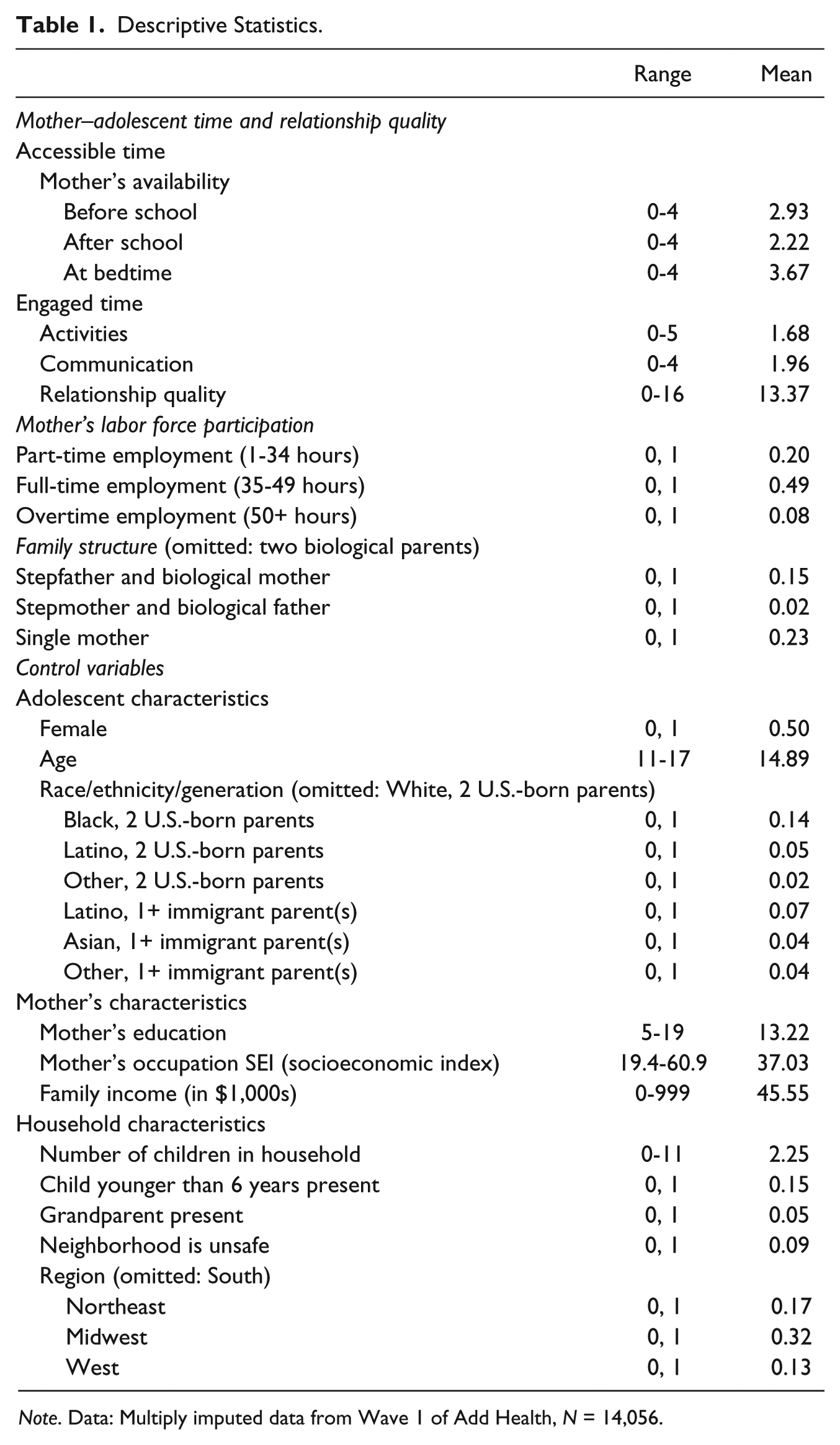
Table 1 provides descriptive statistics for the final analytic sample. Regarding mothers’ accessible time, mothers’ average availability before school is 2.93, which approximates to mothers being there “most of the time.” Mothers are less available after school; their average availability score is 2.22, which resembles being there “some of the time.” Mothers are most available at bedtime, with a score of 3.67 out of 4, and approximating being “always” available. Regarding mothers’ engaged time, mothers average 1.68 activities and 1.96 communication topics with their adolescent children in the past 4 weeks. Overall adolescents report high relationship quality with their mothers, with a mean of 13.37 on a 16-point scale.
Descriptive Statistics.
Note. Data: Multiply imputed data from Wave 1 of Add Health, N = 14,056.
Most mothers of these sampled adolescents work for pay. Only 23% of mothers are not currently employed. Twenty percent of mothers are employed part-time (less than 35 hours per week), half are employed full-time (35-49 hours per week), and 8% work overtime (50 or more hours per week). While two-parent biological families are the most common family structure, 15% of adolescents in this sample live with their biological mother and stepfather, 2% live with their biological father and stepmother, and 23% live with a single mother.
Additive Associations
Selected coefficients from additive multivariate models predicting the associations between (1) mothers’ labor force participation and family structure and (2) mother–adolescent time and relationship quality are presented in Table 2. (The full model with control variables is available on request.) Panel A contains additive models estimating mothers’ accessible time, Panel B estimates mothers engaged time, and Panel C estimates overall relationship quality.
Selected coefficients from multivariate OLS regression models predicting mother–adolescent time & relationship quality.

Note. N = 14,056.
Not employed = omitted category. bTwo biological parents = omitted category.
p < .05. **p < .01. ***p < .001.
Overall, maternal labor force participation is negatively associated with mothers’ accessible time but is not significantly associated with their engaged time. Mothers employed part-time, full-time, and overtime are significantly less available at all three time points in the child’s day than mothers who are not currently employed (p < .001). Relative to mothers not currently employed, mothers working full-time are predicted to score one full point lower in their before-school availability (b = −1.05) and nearly one and a half points lower in their after-school availability (b = −1.46). Differences in bedtime availability are smaller (b = −0.11). Mothers who work overtime have significantly lower relationship quality with their adolescent child (b = 0.25; p < .05) compared with those who are not employed, but mothers who work part-time or full-time are not significantly different in their relationship quality.
Family structure is associated with mothers’ accessible time, engaged time, and relationship quality. Panel A shows that single mothers are less available after school (b = −0.11; p < .05) and at bedtime (b = −0.09; p < .001) relative to mothers in two-parent biological families, whereas mothers in other family structures are not significantly different from mothers in two-parent biological families. Turning to mothers’ engaged time in Panel B, mothers in two-parent biological families engage in more activities with their adolescent children relative to mothers in all other family structures (p < .01). Yet single mothers and mothers in stepfather families communicate about a greater number of topics with their adolescents than mothers in two-parent biological families (p < .001). Finally, mothers in two-parent biological families have higher relationship quality with their adolescent children than mothers in all other family structures (p < .01).
Conditional Associations
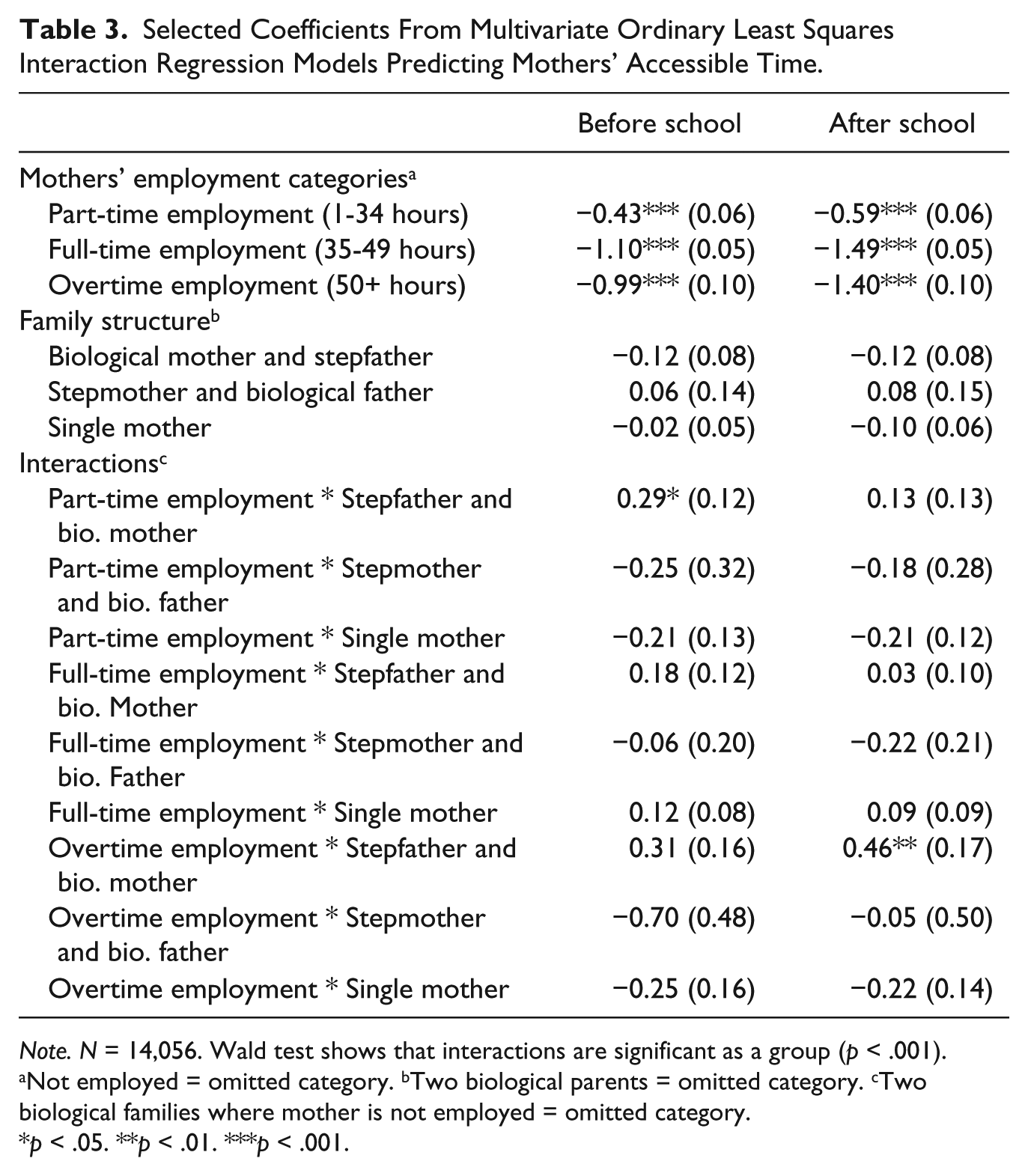
Next, we test whether family structure moderates the relationship between maternal labor force participation and mothers’ time and relationship with their adolescent children. We generally find no evidence of a significant moderating relationship. However, for mother’s availability before and after school, the association between maternal labor force participation and mothers’ accessible time is weaker for mothers in stepfather families than two-parent biological families. Selected coefficients from these models are presented in Table 3. Mothers living with the child’s stepfather are significantly more available before school when they work part-time (p < .05) and more available after school when they work overtime (p < .01) compared with mothers in two-parent biological families, though the magnitude of the differences is small. It is worth noting that the difference for mothers’ availability before school is not statistically significant in models using complete case analysis. To better demonstrate these differences, Figure 1 displays the predicted values for mothers’ before-school availability by mothers’ labor force participation and family structure, while Figure 2 does the same for mothers’ after-school availability. Although mothers in stepfather families are significantly more available before school when they work part-time (Figure 1) and after school when they work overtime (Figure 2) compared with their counterparts in two-parent biological families, the overall pattern shows that the relationship between mothers’ labor force participation and their accessible time is otherwise similar across family structures.
Selected Coefficients From Multivariate Ordinary Least Squares Interaction Regression Models Predicting Mothers’ Accessible Time.
Note. N = 14,056. Wald test shows that interactions are significant as a group (p < .001).
Not employed = omitted category. bTwo biological parents = omitted category. cTwo biological families where mother is not employed = omitted category.
p < .05. **p < .01. ***p < .001.

Mothers’ predicted availability before school by labor force participation and family structure from multivariate interactive models.
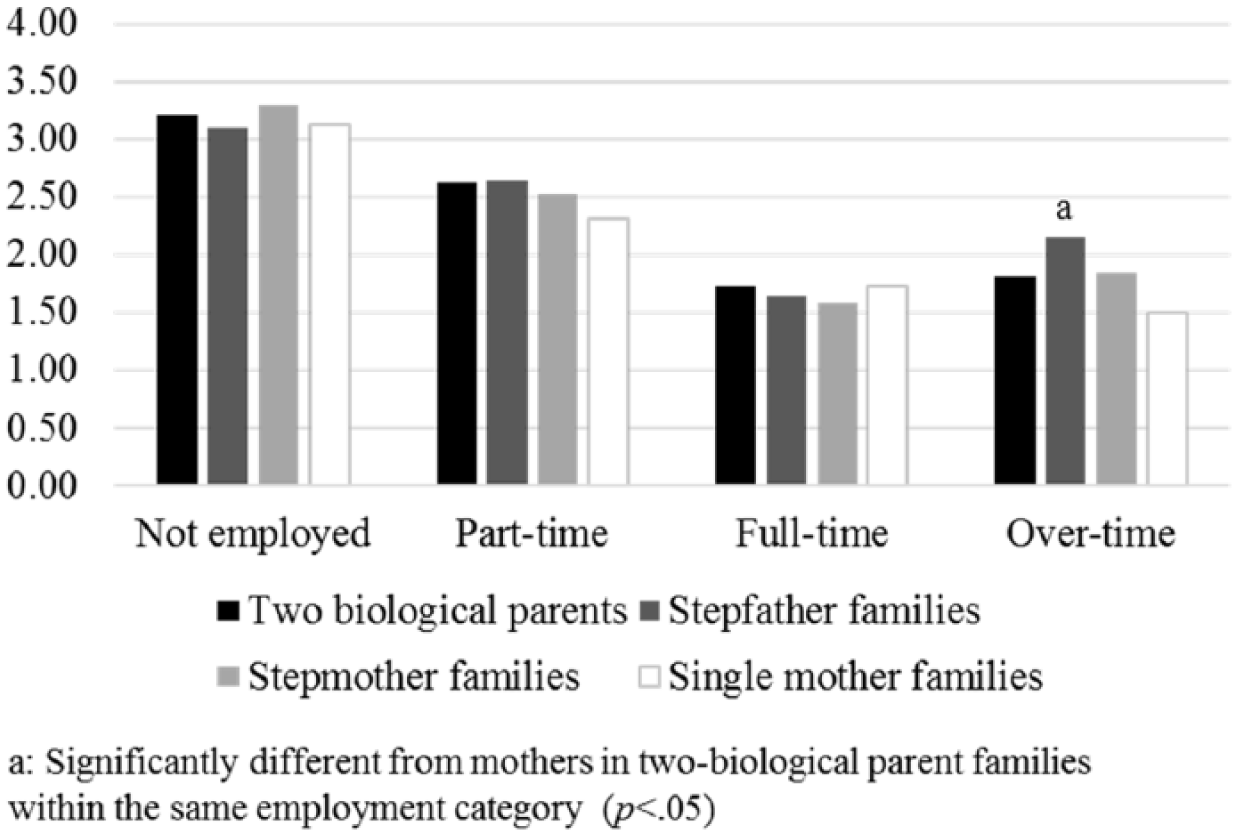
Mothers’ predicted availability after school by labor force participation and family structure from multivariate interactive models.
Discussion
Given the historical shifts in children’s family structures (Bianchi, Robinson, & Milkie, 2006) and the importance of the family system for parent–child relationships (Cox & Paley, 2003), we explore whether family structure moderates the relationship between mothers’ labor force participation and mother–adolescent time and relationships. We propose two possible forms for a moderating relationship, as well as discuss why we may not find a statistically significant moderation. We test these hypotheses using multiple measures of mothers’ accessible time and engaged time, as well as a validated measure of the quality of the mother–adolescent relationship.
Overall, we find limited evidence that family structure moderates the relationship between maternal labor force participation and these outcomes for adolescents. Only two of our six measures of mother–adolescent time and relationship quality indicate a significant moderating relationship. Specifically, we find that the association between mother’s labor force participation and her accessible time before and after school is significantly weaker in stepfather families relative to two-parent biological families. Although the magnitude of the difference is small, the findings suggest that, among mothers working part-time, those in stepfather families are more available before school than those in two-parent biological families. Similarly, among mothers working overtime, those in stepfather families are more available after school than mothers in two-parent biological families. These results support our second hypothesis (Different Norms for Different Mothers), which argues that the relationship costs of maternal labor force participation are greatest for those in two-parent biological families and weaker for those in other family structures. We speculate that mothers in stepfather families make additional provisions to be available for their adolescent—even if they work overtime—either because these mothers are less able to rely on their partners to provide childcare or because they want to bolster their child’s sense of security in light of their history of family structure change.
Most results, however, support the Null Hypothesis (Enduring Norms of Motherhood) with no significant family structure moderation for the association between mothers’ labor force participation and all other outcomes. Furthermore, in the additive models, mother’s labor force participation does not predict mother’s engaged time and only predicts the quality of her relationship with her adolescent child at very high work hours. In other words, mothers are just as likely to do similar numbers of activities, communicate about similar numbers of topics, and have similarly high-quality relationships with their adolescent regardless of whether they work relatively long hours and live in family structures with less social support. This is quite notable considering the structural differences in parent subsystems across family structures. Given that we find no relationship between maternal labor force participation and most mother–adolescent relationship indicators, we speculate that mothers engage in a host of unmeasured strategies to maintain their relationship with their child, especially in the face of increased work hours. We interpret this as indicating the strong normative pressures for mothers to privilege their relationship with their child.
This normative pressure is likely strongest for biological mothers and may be weaker for stepmothers. In the additive models, we find that adolescents in stepmother families engage in fewer activities and have substantially lower relationship quality with their stepmother compared with those living with both biological parents. Our results do not support the idea that the relationship between maternal employment and mother–adolescent time and relationship quality works differently for stepmothers relative to biological mothers, but only 2% of adolescents in our analytic sample live in stepmother families, which limits our ability to detect significant differences. Future research could explore these patterns using a sample including a larger number of adolescents in stepmother families.
Future research could also consider two additional lines of inquiry and build on the current study. First, it would be interesting to examine these patterns with fathers and test whether the associations between fathers’ employment and fathers’ time and relationships with their adolescent children vary by family structure. Although traditional fatherhood norms differ from motherhood norms, instead focusing on fathers’ economic contributions to the family (Doherty, Kouneski, & Erickson, 1998), fatherhood norms have shifted to promote father involvement in their children’s lives (Morman & Floyd, 2006). Yet the ability for fathers to successfully meet both the traditional economic goals and newer involvement goals could depend on family structure. Second, with more detailed measures of mothers’ engaged time, future studies could explore potential differences across specific types of activities, such as play activities versus academic activities versus household management activities (e.g., shopping). Theoretically, such differences are plausible given prior research demonstrating that mothers’ education predicts differences in how mothers spend their time with their children, especially for activities related to the enhancement of children’s academic and cultural capital (Kalil, Ryan, & Corey, 2012). Future research could then explore whether mothers’ work hours and family structure interact to generate differences in how mothers spend time with their adolescent child.
These results are not without limitations. First, we rely on adolescents’ reports of their mothers’ current employment and paid work hours, which could lead to measurement error. Second, Add Health did not collect data on mothers’ work schedules (i.e., whether they work in the evenings or weekends, or work a rotating shift). Mothers’ nonstandard work schedules are associated with parental monitoring and mother–child closeness among adolescents (Han et al., 2010; Han & Waldfogel, 2007), suggesting that the timing of mothers’ work is an important dimension of these relationships. Third, Add Health did not collect information on the timing of various family structure changes. We suspect that stepfathers vary in how much they engage with their adolescent stepchild according to how long they have been part of the adolescent’s family life. Future research should explore this heterogeneity and examine whether it influences mothers’ time and relationship quality with their children. Fourth, by focusing on adolescents, we may be missing the developmental stages in which most mother–child engaged time occurs. Adolescents spend more time with their peers (Crosnoe & Johnson, 2011; Steinberg & Morris, 2001), which may explain why we find no significant relationship between maternal employment and mothers’ engaged time. Finally, the data are relatively old, but this is the only data set we know of that directly measures mothers’ availability in relation to the adolescents’ routine schedule and includes measures of the mother–adolescent relationship quality and, thus, measures multiple, important dimensions of the mother–adolescent relationship. Furthermore, prior research has not examined these processes for adolescents and Add Health allows us to examine the mother–child relationship during this critical developmental stage.
Despite limitations, the article makes several contributions. To our knowledge our study is the first to explore whether family structure moderates the link between maternal labor force participation and mother–adolescent time and relationship quality. We also examine multiple dimensions of mothers’ time and find that the results are contingent on the outcome. Furthermore, our study reaffirms the gendered dimensions of maternal employment. Women are expected to work alongside men, but they are also still expected to do the majority of the care for children (Bianchi, 2000). Our findings suggest that mothers face tremendous normative pressure to prioritize their relationship with their child even when structural supports are lacking in the home. Additional research could consider whether various employment policies and practices can ameliorate these tensions and, thereby, benefit family well-being.
Footnotes
Acknowledgements
We thank Edward Yu, Adam Lippert, Susana Quiros, Jennifer Van Hook, and Michelle Frisco for help on previous drafts, as well as helpful comments from an anonymous reviewer.
Author’s Note
Sarah E. Patterson is now affiliated to University of Western Ontario, London, ON, Canada.
Declaration of Conflicting Interests
The author(s) declared no potential conflicts of interest with respect to the research, authorship, and/or publication of this article.
Funding
The author(s) disclosed receipt of the following financial support for the research, authorship, and/or publication of this article: This research uses data from Add Health ( ), a program project directed by Kathleen Mullan Harris and designed by J. Richard Udry, Peter S. Bearman, and Kathleen Mullan Harris at the University of North Carolina at Chapel Hill, and funded by grant P01HD31921 from the Eunice Kennedy Shriver National Institute of Child Health and Human Development (NICHD), with cooperative funding from 23 other federal agencies and foundations. This work was supported by a grant to the Population Research Institute at The Pennsylvania State University for Population Research Infrastructure from the National Institutes of Health (R24-HD041025; PI: Van Hook); a grant from the Eunice Kennedy Shriver NICHD (P01HD062498, PI: Landale); and a NICHD Family Demography Training grant (T-32HD007514, PI: King).