



Abstract
The sibling relationships of youth in foster care has garnered increased attention over the past few years indicating the potential protective role these relationships can have. Despite this growth, very little is known about how foster parents perceive the sibling relationships of youth in foster care and ways to promote these relationships. Thematic analysis was used to analyze semistructured interviews of 15 foster parents. Three major areas emerged as a result of the analysis: (a) the experience of sibling relationships in foster care, (b) how sibling relationships should be treated in foster care, and (c) ways to promote sibling relationships. All of the foster parents in this study discussed the importance of sibling relationships for the youth in their care and offer ways to promote these relationships through collaboration and education. Implications for foster parent training and child welfare practice are discussed.
Keywords
Literature Review
The goal of foster care is to either temporarily remove children from an unsafe and/or unfitting home environment until it becomes safe and suitable for the child, or permanently remove the child if the home environment does not change (Pecora, Whittaker, Maluccio, & Barth, 2000). In most cases, children are removed from their homes and placed in foster care due to issues of child abuse and/or neglect. Permanent removal often results in parents losing their parental rights. The youth’s legal guardian then becomes the state.
The foster care system served over 420,000 youth in the United States in 2015 (U.S. Department of Health and Human Services [USDHHS], 2016). This number has steadily increased over the past 4 years. The majority of youth in foster care live in traditional foster care placements with a nonrelative caregiver (45%), and 30% of youth live in relative foster homes or kinship homes (USDHHS, 2016). These national statistics provide a snapshot of the number of youth served in foster care and where they live, but the number of youth in foster care who have siblings and whether these youths are placed with their sibling is not systematically tracked (Herrick & Piccus, 2005).
Siblings are difficult to track as child welfare administrative databases are not set up to capture the broad range and complex nature of sibling relationships that a youth may have (i.e., full, half, step), if a sibling is placed in foster care before or after an individual child is placed in care, or if a sibling is born while they are in care. Lery, Shaw, and Magruder (2005) expanded the way siblings were identified through the California State system by using four different methods to identify siblings: (a) full, (b) half, (c) step siblings with maternal ties or paternal ties, and (d) similar removal address. Lery et al. (2005) suggest that broadening the search and definition of sibling would enable child welfare workers to identify sibling relationships that were not divulged during typical system inquiry. The lack of certainty of sibling relationships within the foster care system from a tracking perspective is indicative of a dearth of research about sibling relationships within the foster care system. Recently, interest and scholarship surrounding siblings in foster care has increased. Scholars have been examining the protective nature of sibling relationships for those in foster care (Hegar & Rosenthal, 2011; Leathers, 2005; Waid & Wojciak, 2017; Wojciak, 2017; Wojciak, McWey, & Helfrich, 2013) and interventions that can help promote sibling relationships while in care (Wojciak, 2017; Kothari et al., 2017; Linares et al., 2015). Despite this growth in understanding sibling relationships in foster care, we do not have a solid understanding of how foster parents perceive sibling relationships of youth in their care. This is of particular interest since 45% of youth in foster care are served by nonrelative foster parents (USDHHS, 2016).
Sibling Relationships in Foster Care
Sibling relationships are believed to be one of the most enduring and significant relationships an individual may have throughout their life. The significance of these relationships may be evident in the role they play in development. Siblings teach one another social skills such as conflict resolution, develop empathy, and prosocial behaviors, as well as improve academic competence (Kramer & Conger, 2009; Stormshak, Bullock, & Falkenstein, 2009; Taumoepeau, & Reese, 2014). Bank and Kahn (1980) asserted that siblings at times will serve as a supplemental attachment figure when there is a lack of dependable parental caregiver, highlighting the importance of sibling relationships.
Unfortunately for youth in foster care, there are a number of reasons why siblings may not be placed together that can include but are not limited to: large sibling groups, sibling abuse, differing developmental needs, and time entering into the foster care system (Shlonsky, Bellamy, Elkins, & Ashare, 2005; Smith, 1998; Whelan, 2003). This separation has significant effects on these children. Not only do siblings play a role as an attachment figure, they may provide a positive relationship that safeguards against other effects of trauma. Recently, scholars showed that to survive significant trauma, youth in foster care will turn to their sibling who may act as a parental figure, fostering a sense of safety among themselves (Lee-Messner & Stevenson, 2014). Siblings placed together also offer one another a sense of belonging, continuity of familial relationships, and safety (Leathers, 2005; Shlonsky, Webster, & Needell, 2003). Wojciak et al., (2013) found in a sample of foster youth that a youth’s perception of a warm sibling relationship significantly mediated the relationship between experiencing trauma and having internalizing symptoms. The majority, 75%, of this national sample was separated from their sibling. Youth who reported a warm sibling relationship desired more contact, and wanted to see siblings more frequently then they currently did. Within the literature, there is growing evidence of the protective role that siblings can play for one another while in foster care (Washington, 2007). As a result of this growth, McBeath et al. (2014) was able to provide an overview of the complexities of sibling relationships in foster care and described two empirically supported intervention to improve sibling relationships and developmental processes of youth in care. As empirical understanding and support of siblings in foster care is growing, understanding sibling relationships from those who care for them, foster parents, are lacking. Little is known about the foster parent’s role in promoting sibling relationships or even their perception of sibling relationships of youth in foster care.
Role of Foster Parents
Foster parents serve as a full-time substitute caregiver providing parental care to children whose biological parents cannot provide suitable care for them (Cooley, Farineau, & Mullis, 2015; Gillis-Arnold, Crase, Stockdale, & Shelley, 1998; Isomäki, 2002). Foster parents hold a significant responsibility to ensure and maintain the safety, mental well-being, medical care, and medication adherence for the youth in their care (Barnett, Boucher, Neubacher, & Carpenter-Song, 2016). In addition to direct care, foster parents also take on roles of resource utilizer, advocate for collaborative relationships with children’s biological family, networker with other foster families, and continue to build trusting relationships with the child’s service providers and community resources (Cooley et al., 2015; Cooley & Petren, 2011; Daniel, 2011).
Given the multitude of roles, foster parents often experience a vast amount of ambiguity in their role as they are a caregiver and a professional member of the team responsible for the child’s best interest (Geiger, Hayes, & Lietz, 2013). This ambiguity of responsibility leads to the balancing of their role as a treatment professional (implementing intervention strategies, behavior focus discipline, supervision, and providing structure) and parental role (providing a nurturing environment, supportive relationships, and age-appropriate relational parenting; Isomäki, 2002). While balancing a professional and parental role, foster parents also represent the front line of high demand care for youth in foster care who face a range of developmental challenges, physical health concerns, mood disorders, and generalized acting out from various foster placements (Cooley & Petren, 2011; Pasztor, Hollinger, Inkelas, & Halfon, 2006). Unlike shift workers or live in parents in agencies with foster youth, foster parents do not clock out of shifts which emphasizes the never-ending nature of their responsibilities (Lo et al., 2015; Westermark, Hansson, & Vinnerljung, 2007). As a result, foster parents provide a unique perspective into the lived experiences of youth in foster care.
Foster Parents and Siblings in Foster Care
Smith (1996) conducted a study exploring caseworker and foster mother’s attitudes about sibling placement. Smith reports that 56.5% of the sample of caseworkers and foster mothers reported the sibling relationship as being “very important,” with a little less than half (43.5%) viewing sibling relationships as no more than “fairly” or “somewhat” important for the children’s development. The lack of importance that two of the most important people making decisions about sibling relationships of youth in foster care have is discouraging for youth that are separated from their sibling. Beckett (1999) reported that local authorities/agencies knew very little about research surrounding sibling relationships and only one agency used this information when planning for the youth’s case and making decisions about the youth. The lack of knowledge and systematic use/tracking of siblings is alarming as sibling relationships are one of the most enduring relationships of an individual’s life as people typically outlive their parents and meet their partners later in life. Despite low levels of importance for sibling relationships in these studies, significant changes in policy have occurred to promote sibling relationships. The Fostering Connections to Success and Increasing Adoptions Act of 2008, provided policy that states that reasonable efforts should be made to place siblings together and that if they cannot be placed together that reasonable efforts are made to ensure they have visitation (42 USCA § 671(a)(31)).
As demonstrated, siblings placed together can serve a protective role; however, these youths have experienced trauma that resulted in their foster care placement in addition to stress associated with entering a new home. As a result, siblings can often be the target with whom youth take their frustrations out on and such actions can be demonstrated in aggressive behaviors toward one another (Linares et al., 2008). Siblings with lower sibling warmth and more aggression are likely to have been separated from their sibling if they were initially placed together (Linares, Li, Shrout, Brody, & Pettit 2007). Furthermore, if youth act out after having a sibling visit, foster parents may limit the youths’ interaction to protect them from getting hurt or acting out after the visit (James, Monn, Palinkas, & Leslie, 2008). Given these findings, Linares et al. (2015) created a sibling intervention designed to target aggressive sibling relationships and use foster parents as the facilitator to improve these relationships. Her intervention positively increased foster parents mediating role in helping decrease sibling aggression of siblings in the intervention group.
Foster parents play a pivotal role in the lives of youth in out of home placement; yet little is known about foster parent’s perspectives about sibling relationships of youth in foster care. Foster parent’s perspective about whether sibling relationships are important or are protective can influence their commitment to promote the sibling relationship of youth in their care. More important, how do foster parents promote sibling relationships of youth in their care? Therefore, the purpose of this study is to add to the scant literature of foster parent perspectives about sibling relationships of youth in foster care. More explicitly exploring how sibling relationships are treated within the system and how they believe siblings relationships can best be promoted within the system.
Method
Sample
A total of 23 foster parents signed up to participate in the study, but only 15 foster parents completed an interview. Foster parents who did signed up but did not participate were the result of not being able to get in touch with foster parents at the scheduled time for the interview. Most of the foster parents reported that they lived in the Midwest (n = 12) with other foster parents from the Northeast (n = 1), Southwest (n = 1), and Southeast (n = 1). The majority of foster parents were female (n = 13), married (n = 12), and non-Hispanic White (n = 12) with 3 foster parents reporting that they were Latino. The ages of the foster parents ranged from 27 to 55 years old with the average age of 39.2 years. The length of time they have served as a foster parent ranged from 1 year to 20 years with the average length of time involved with the foster care system being 7.8 years. All 15 foster parents reported that they themselves have at least one sibling and that they have fostered youth with a sibling.
Procedure
Recruitment
Foster parents were recruited from across the country using social media and targeted recruitment e-mails to foster care agencies. The researchers created a Facebook page to promote a larger qualitative study about sibling relationships of youth in foster care. The goal of the page was to provide information about the study and recruit participants. The Facebook page had 155 likes. In addition to the Facebook page, contact information of directors of foster parent organizations and foster care agencies were identified online and a recruitment e-mail was sent to them. The recruitment e-mail described the purpose of our study and provided a link to our Facebook page. The targeted contacts were asked to distribute the Facebook link to their listserv of foster parents to recruit foster parents for the study.
Once potential participants connected to the Facebook page, there was a summary of the study, contact information of the research team was available if they had questions, and a link to an online Qualtrics survey for potential participants. The online survey consisted of the informed consent, demographic information, as well as contact information and the best time for a member of the research team to reach the participant. A member of the research team called the potential participant at the time they requested to set up an interview time or conduct the interview at that specific time if the participant preferred that time.
Interview
When potential participants were reached, the interviewer described the study to the participant and went over informed consent. All interviews were audio recorded to ensure that the foster parent’s thoughts were accurately captured. Once all questions the participant had were answered and consent was obtained, the interviewer then began a semistructured interview to better understand sibling relationships of youth in foster care from the perspective of foster parents. The semistructured interview consists of 17 questions. Examples of the questions include the following: how do you define sibling relationships, how are sibling relationships promoted within the foster care system, and what barriers exist. Interviews varied in length from 15 minutes to 60 minutes with most interviews lasting 30 minutes. The length of the interview was dependent on the level of detail that participants shared about their experience. Participants answered all 17 questions for each interview. All interviews were transcribed verbatim for analysis.
Data Analysis
Thematic analysis was used to qualitatively analyze the responses provided by the foster parents in this study. To ensure analytic rigor with qualitative analysis, we will be explicit about our analytic process (Creswell, 2013). Braun and Clark’s (2006) six questions and phases were used to guide our thematic analysis. For our initial coding, teams of two researchers coded the interviews independently then met with one another to generate the initial codes that we used to move forward with the remaining phases of thematic analysis. As the team members met to discuss their independently coded interviews, they would discuss any discrepancies that occurred between their codes. Discrepancies centered on the wording of the initial codes and were resolved when the coders mutually agreed on a final code. Once this was completed with all the interviews, all codes and quotations were collected into one coding table to clearly identify themes as outlined in phase four of thematic analysis. All researchers independently identified themes from the coding table we generated. We met as a team to identify the themes to ensure there was consistency among the six of us and that it met our condition of what was considered a theme. A theme was confirmed if the theme was expressed by multiple participants. We then went on to phase five, which was defining and naming our themes: experiences of sibling relationships, how sibling relationships should be treated in foster care, and ways to promote sibling relationships in foster care. In the final phase, the first author wrote the discussion of themes in a results section. All other research team members confirmed the results presented below.
Trustworthiness
Qualitative data analysis requires a heightened awareness of the data and openness to the nuances of social life and the role the researchers have as well (Anfara, Brown, & Mangione, 2002; Creswell, 2013). As such, it is important for the researchers to orient the readers to who they are and how that can influence their coding of the data. The first and fourth authors have extensive experience with siblings involved in the child welfare system and have worked to promote sibling relationships in multiple ways. The first author has volunteered for an organization that reunites siblings who are separated due to their placement in foster care for the past 10 years and does research to better understand sibling relationships to improve policy and practice. The fourth author was a foster parent who adopted a sibling group from the foster care system and has helped train other foster parents in therapeutic fostering. The sixth author is interested in research regarding sibling relationships. All the authors are systemically trained therapists with an orientation toward conducting socially justice informed research and see the importance of brining an important and unheard voice to the child welfare literature.
Results
Foster parents offered keen insight into the experiences of sibling relationships of youth in foster care. The results were conceptualized in a cyclical pattern that can be used to understand and improve the treatment of siblings in foster care, and to highlight the importance of these relationships within the foster care system. Through our coding process, three major areas emerged: (a) the experience of sibling relationships in foster care, (b) how sibling relationships should be treated in foster care, and (c) ways to promote sibling relationships, all from the perspective of foster parents working with these youths each day.
The Experience of Sibling Relationships in Foster Care
From the foster parent interviews, it was apparent that the experiences siblings have while in foster care could differ as much as the individual sharing the experience. Despite this variety, several themes emerged that provide background for what siblings’ experience while in foster care. The themes for this section include the following: understanding the complexity with sibling placement, the importance of time spent with one another, and sibling visitation.
Understanding the Complexity With Sibling Placement
Overwhelmingly, foster parents reported that siblings should be placed together when it is beneficial for all children and discussed some of the negative behaviors they noticed if siblings were separated.
I think if they are separated and they were close to begin with. If they leaned on each other for support while they were with bio-parents, I think it is going to impact their behavior. They might act out or they might shutdown. (FP28)
Another foster parent shared, They feel that connection, they feel, I mean they just, behave a little, I don’t want to say better, but it has less of an impact if they aren’t separated. . . . It creates more anxiety when they are separated than when they are together. They just do the regular brother sister thing. It’s a feeling they know. They know that they’re not worrying and wondering if they don’t see them. (FP16)
While many foster parents shared the benefits that having siblings placed together provides for the youth, there were some that noted the difficulty that can happen, particularly if there is a parentified child or if there has been sibling abuse. Foster Parent 2 shared why siblings might be separated, “It’s not healthy for the siblings to be placed together. Sometimes an older sibling has done something to the younger one. A lot of them have a lot of behavioral issues that would not be healthy for younger siblings.” Another foster parent could not quite identify the words to describe what can happen to sibling relationships, she stated that sibling relationships are, “Strained. They’re still siblings, but they have more yuck with them” (FP6). Another shared, In our case and other cases that I have heard of. As long as there is not a reason that one of the children has perped [sic] on the other child, if there is not a reason that the siblings can’t be together, I always felt that [local agency] makes every effort to keep them together. (FP27)
Overall, it appears that all foster parents were in favor of siblings being placed together, yet they understand that there are legitimate reasons as to why siblings cannot be placed together. Safety was often the reason cited for why siblings were separated, but foster parents also shared how it may be the lack of homes or foster parents with licenses and means to have a larger sibling set. Foster Parent 4 shares, I think it’s hard because I see a lot of siblings have to get split up because there are not enough foster families that can take a sibling set of three, a sibling set of five and so they usually only, it’s usually not because the family doesn’t want to take them, but a lot of time it’s because most people are licensed for one.
Foster parents may only have limited space or lack the ability to accommodate sibling groups.
Maybe someone only has room for one boy, or a boy and a girl or someone only has so much room. I think the age has a big impact. Someone will take the nine-year-old, but won’t take the sixteen-year-old sibling. (FP16)
Within the system when siblings are separated, there is often a need, whether enforced by practice and policy for siblings to spend time together.
Sibling Visitation
Multiple foster parents talked about the impact that visitation can have on the youth in their home. Foster Parent 6 talked about the importance of sibling visitation being led by the siblings and the relationship they have with one another to avoid negative behaviors that result because of the visitation.
I think it [sibling visitation] depends on the siblings and I think I would really like to see more educated watching of their behavior and let the kids’ kind of direct the visits or how many there might need to be. Because the mandated visit you know when they don’t work, it just creates such up roars in acting out that you’re constantly, you don’t get that chance to move forward. If the kids are able to get together and even if it’s only two out of the three that have the healthier relationship then let’s continue their visits because the kids have gone through so much. I just think it kind of prolongs some of the healing process.
Foster Parent 4 describes some of the negative aspects associated with sibling visitation that may inhibit the healing process that Foster Parent 6 is alluding to, primarily how youth tend to act out after visitation with their sibling.
They go to a visit and usually they are not fun because they are confined to a room, or a living room, or the majority of ones I’ve seen are all supervised. Sometimes they go out to the mall or to the park, but um when they’re supervised they have to be confined to one room. They can’t, like if it’s supervised one social worker has to be watching both of them at the same time and if one child has to go to the bathroom at a restaurant they all have to go so that one is not left alone. . . . I think those visits are the most damaging to children. I mean the system will never portray it that way. They want to portray that these are really good things to get kids back together, but when all the hurt happens and all the anxiety happens, it’s always at visits. It is not when they are away from visits. . . . If you want to promote more sibling bonding and interaction, there needs to be more focus on the kids.
Foster Parent 25 further expands on the benefit of supervised versus unsupervised sibling visitations.
An unsupervised visitation when they are at home, it is different. If they are in a supervised visitation in a small setting, say an office somewhere, they do not really get to play or do anything. Maybe they are not use to playing with each other. Maybe they are used to sitting together and watching TV or playing games.
These foster parents are highlighting the importance of how sibling visitation is influencing the health and well-being of the sibling relationship. For siblings to not be “used” to playing together, magnifies the impact that separation can have on the sibling relationship. It is within the idea of promoting sibling relationships that Foster Parent 3 urges others not to use visitation as a punishment. “Try not to use visits as punishment for anyone but still allowing it no matter what choices have been made or behaviors have been displayed by anybody. Still allowing that time for them to be together.” The time together is important for siblings.
Importance of Time Spent With One Another
Foster parents in this study understood the complexity of maintaining sibling relationships within the foster care system, whether they live together. These foster parents understood the unique role siblings play in each other’s lives throughout the course of their life, let alone during their time in foster care.
I think it is very important for them to have a positive relationship and for them to be there with each other because they are the only brother and sister they have. I don’t want them to feel like they are alone in this world and at least they have each other. To comfort each other when they start asking questions about their adoption. For me, it is important to keep them together. (FP28)
Siblings are not just there when they have questions, they are there because they live life together. Foster Parent 21 shared more about this.
This [sibling relationship] is in all likely the one stable relationship they are going to maintain from the cradle to grave. So, whatever we can do to make sure that if they are separated that they get together and they still see each other as family and as siblings, the better the chances that the relationship will stand to be healthy after they have been through the system.
She goes on to say “If they are together, they live life together. Ours spend every waking moment together. They go to school together. They play and they have their activities that they do” (FP21). It is the idea of playing together; doing “normal” things together that seems to be the most important to these foster parents. Foster Parent 3 stated that foster parents need to “facilitate as many opportunities as possible and build as many informal connections for opportunities or abilities for them to connect.” “That is pretty important . . . siblings playing or working together. In a healthy home environment, you’ve got certain activities that you’ve got the siblings playing or working together” (FP27).
How Sibling Relationships Should Be Treated in Foster Care
It was clear from the responses that each of the foster parents in our study were very supportive of sibling relationships and thought that there should be changes to ensure these important relationships are maintained while in foster care. Siblings in foster care undoubtedly enter into foster care with a myriad of experiences that can influence their relationship with their sibling. As demonstrated here, foster parents have seen the benefits of siblings placed together and why sometimes, if it is healthier for both children to be separated. Despite the reason for separation, foster parents talked about the importance of maintaining the sibling connection. For instance, Foster Parent 3 stated, “sometimes in foster care, they [siblings] are disjointed or disconnected or not in the same home. Broken links, in that sibling picture.” The foster parents expressed frustration at the lack of support that sibling relationships had within the system.
A lot of times, the [siblings] are not protected because they either have their individual case workers or there is such a high turnaround of CPS case workers, that the system doesn’t even recognize or make the effort to have these children grouped together or make an effort for them to see each other on a weekly or monthly bases. (FP28)
Here we share how foster parents think sibling relationships should be treated. Foster parents state that sibling relationships should be protected and should be a higher priority in the system.
One such place is policy. Foster Parent 21 stated, In terms of policy, I think it goes back to, we have to protect that relationship. Policies need to be in place that would not allow children to be completely cut off from one another. . . . Make sure we are careful about how we maintain their relationship and not cutting them off cold turkey or altogether. Making sure that it is not 3 months, 4 months before they come back to see each other.
Foster Parent 3 states, I wish that sibling relationships would take a higher priority than the relationships with the parents and more resources could be devoted to keeping the siblings together. Whether through foster care or the adoption process, more resources would be focused on helping the siblings stay connected.
Foster parents also state social workers should treat siblings consistently across the system.
It depends on the worker. Every worker treats them differently. There are some that hold it in the highest of regards even when a break or split may actually be more beneficial to the children. There are some that are more concerned with simply finding a place to put them. (FP1)
Foster parent’s offer additional ways to promote sibling relationships in the foster care system.
Ways to Promote Sibling Relationships in Foster Care
The majority of foster parents’ suggestions had to do with relationships and mutual work among key players within the system. Four themes emerged that foster parents talked about changing: the need for foster parents to collaborate, for key players to work together to promote sibling relationships, to bring awareness of sibling relationships by educating others about the importance of the sibling relationship, and, last, ways to improve the system.
Foster Parent Collaboration
Foster parents talked about the importance their role can have in facilitating and nurturing sibling relationships; however, there are some challenges that may prevent that. Here are some solutions the foster parents in this study suggested.
The opportunities for the foster families to connect right away from day one. Like here is foster care, here is the list of foster families that kids are staying with, here’s their contact information. I find that I happened to stumble upon the other families and I had to forge my own connections. (FP3)
Foster Parent 16 further shows how the relationship between foster parents can help promote the sibling relationship. “I would think it would be the foster parent to talk to the other foster parent. Can we have them see each other more often, can we have them talk, can we have them do sleepovers?” In these instances, foster parents want to be able to provide that connection, but feel limited within the system to do that. They would like the system to help support the connection between foster parents who have sibling groups. Foster Parent 3 shares the effort she has exerted to connect with foster families and provide siblings with natural experience despite separation.
I have made a point to connect with the foster families that have the foster siblings. I actually have a good friend who we take sibling sets or parts of sibling sets because we know that were going to be hanging out quite a bit and we make it a point to get all the kids together. That has been huge for the siblings we have had. Especially since they get to enjoy each other’s company in a comfortable environment. It’s not the two hour time frame you have to fight for attention and spend time with your siblings, it’s just about having fun without a time clock.
Whether foster parents felt like they needed more support from the system or found ways to help promote sibling relationships within their connections with other foster parents, multiple foster parents stated that they were the ones who were most influential in promoting sibling relationships. “Whether they end up separated or together, we as foster parents need to value that relationship for whatever it is worth to them, not us” (FP7). Foster Parent 21 also shared, Well the foster parents are the most influential if they create a sense of family and what that means for these kids. A lot of whom were neglected, don’t really understand who a family is and don’t have the sense of we protect each other, we take care of each other. If the foster family has established that, it makes for a healthy foster family but certainly it strengthens the bonds between brothers and sisters when they feel this is your family. This is who you need to take care of and who you need to be. You need to have a relationship with them forever and have each other’s backs. The foster parents have the most influence by example and by words.
Foster parents not only highlighted the importance of their role, they also mentioned the importance of other key players within the system that need to promote the sibling relationship.
Key Players Need to Promote Relationship
Foster parents shared how it is a whole systems approach to be able to promote the sibling relationship. “I think it has to come from the foster parents, from the ad litem, from the children themselves. Of course, you would have to have the backup of the CPS case worker for all this to take place” (FP28). The successful working relationship between the foster parent and case worker is important to promoting these relationships. “I would say that [sibling relationships] is directly related to the foster parents’ willingness to do it and the reunification workers willingness to coordinate schedules” (FP25). Foster Parent 6 discusses how a court appointed special advocate (CASA) can be helpful in bridging the relationship and information gap between case worker and foster parent.
I am thinking right now; the most influential person would be perhaps the CASA workers if they [children] are lucky enough to have one. I am not saying that social workers are not helpful but if they have twenty or forty cases they’re not as accessible or maybe not gonna give you a little extra information on the side. I’m not saying the other ones are doing anything illegal, it’s just they have more time to be more down to earth to be able to talk with you and to talk with the kids.
Given the complexity of the foster care system, according to these foster parents, it takes effort on everyone’s part to ensure the sibling relationship is maintained and nurtured. Many foster parents thought that a way to increase sibling promotion is by raising awareness of sibling relationships in the foster care system and how important they can be for youth.
Awareness Through Education About the Sibling Relationship
Education about the sibling relationship meant two different things to these foster parents. First, foster parents wanted to know about the other siblings the youth had. “It would be nice to be able to have a little bit more access to, when a child comes to you, to know they have siblings out there. To know a little bit more of that history and dynamic” (FP6). “I think there should be policy that at least everyone knows where each other are and that the kids have the chance to be together” (FP25). Second, foster parents wanted more education about siblings in foster parent trainings and to bring awareness to the broader community about the needs of siblings in foster care. For instance, multiple foster parents shared that there should be changes in the way they receive training about siblings or the way the system works around siblings.
I provide a training class on (sibling relationships), and I spoke around the state and at different conferences to talk to other foster parents about the value of sibling relationships. Calling on them to remember and find the value in their own sibling relationships and pose for them what it’s like to be a youth in care, having that relationship with your own siblings. Helping them understand the value in it for themselves and listening to what’s in their own suitcase and helping them, or enabling them to respect, and nurture, and maintain those relationships with siblings. (FP7)
One foster parent even shared the need for training foster parents about sibling relationships was so important that they believed the system needed updating. “I think old school foster parents need to be either re-schooled or unlicensed and that their needs to be more hours in the home or in a community setting for the families to spend time together” (FP25). Another foster parent shared how they want to educate the public about the importance of sibling relationships.
Regarding ways to promote sibling relationships, I think in part showing studies and getting data out to decision makers and foster parents who really have the most influence on the child and helping everyone understand the importance of those relationships and the long-term effects of those relationships on mental health and development inside of children especially young children. If everyone understood the importance these relationships, more people would step up to make sure they are protected. (FP21)
In addition to foster parent collaborations, getting key players involved, and building awareness of the sibling relationships; foster parents had important thoughts about improving the system.
Ways to Improve the System
While many foster parents understood the foster parent’s role in promoting the sibling relationship they did suggest ways the system could be improved, primarily with more support for caseworkers. For instance, Foster Parent 28 jumped into a litany of improvements, “employ more case workers, raise their salaries, limit the number of cases they hold . . . overall more case workers without such a high turnover rate and higher wages for them.” Another foster parent shared, trying to reduce the amount of turnover on the caseworkers. They just seem so burned out. . . . Every time we got a new caseworker our information wasn’t always passed on or they didn’t really know everything about the case. (FP2)
Foster Parent 2 also explains the impact that case worker turnover has on the youth.
I think when kids build relationship with their case workers they are trying to find security and a bond that they can finally trust. There’s a lot of turn around that’s hard on the kids, then information gets lost and that’s not good for the kids.
Foster parents also talked about improving the relationships between key players in the system. Foster parents wanted more information on the youth to be able to better support them and their relationships. “The confidentiality of what we are dealing with means [agency] is not always forthcoming on where the other kids are, who are they staying with and how do we get in contact with them” (FP21). The foster parent goes on to say, “Make sure confidentiality isn’t an obstacle for these families finding each other and making sure these kids get together.” Foster parents also wanted more flexible regulations for policy with regard to placement.
I think that if they could alter their rules a little more than we could have the room to take siblings right now. I can take one child, where if they loosened up the little policies and say that we could stick two girls in the same room with more than a three-year age difference. (FP16)
The foster parents in this study know firsthand the experiences these youths have, the influence their sibling can play in their life, and the nuances that occur within the foster care system. Their suggestions of collaboration among foster parents and key players, bringing awareness of the sibling relationship to foster parents and the public, and improving the system by increasing support to caseworkers and looking at policy, highlights their investment into the process and more important, the sibling relationships.
Discussion
The findings of this study emphasize the complex nature and experiences of youth with siblings in foster care. Prior to this study, the perceptions and thoughts of sibling relationships from the foster parents who serve them was largely missing from the empirical literature. Promoting sibling relationships for these youth is important for multiple reasons. First, the sibling relationship is a place for intervention that is relatively inexpensive and can have a positive impact on decreasing internalizing behaviors (Wojciak et al., 2013) and for predicting resilience (Wojciak, McWey, & Waid, 2018), a trait that is important for youth who have experienced adversity as many in the child welfare system have. Second, as many of the foster parents stated, sibling relationships are often the longest relationships we have in our lives as we outlive our parents and meet our partners later in life. Siblings have the potential to provide one another psychological support and affection to one another throughout the lifespan (Cicirelli, 1982) and consider their sibling an important person throughout their life (Cicirelli, 1996). However, for youth in foster care, if these relationships are not supported there is a chance that they cannot build that long-lasting relationship to be there for one another after their time in foster care. In a qualitative investigation of what siblings mean to one another while in foster care, siblings overwhelmingly discussed the positive aspects and supports their siblings provided; however, the separation and the impact it had on their relationship was also shared (Wojciak, 2017). The youth reported feeling like their sibling was “their mother’s other kid,” or that they would push their siblings away to protect themselves from getting hurt by their sibling. As Foster Parent 6 said, there can be a lot of “yuck” that siblings experience, and they need help to be able to heal their relationship. Foster parents who are educated about the role siblings play in one another’s lives and have the tools to help siblings who may have some “yuck” or who behave in a parental role, could be beneficial to these youths and their longtime relationship with their sibling.
In this study, we learned that sibling relationships vary by the individuals and that more should be done to assess the sibling relationship quality of the siblings when making decisions about placements. Most foster parents in this study thought youth should be placed with their sibling, except for instances of sibling abuse. When siblings were separated, for whatever reason, more should be done to ensure that they have quality time together, preferably unsupervised and in a more natural setting.
Based on these experiences, foster parents shared what they thought should be done with sibling relationships in the system. Multiple foster parents thought that sibling relationships should be a higher priority and protected in terms of placements and visitation with one another. The foster parents understand the intricacies of the foster care system, the complexity of the sibling relationship and offered ways to promote the sibling relationship, primarily through collaboration with one another and between key players. Foster parents’ believe, a concerted effort among all those working to support the youth can improve sibling relationships.
Sibling relationships should be a priority for all players involved. Based on this study, we propose a cyclical pattern/feedback loop that can be used by all key players to improve the sibling relationships of youth in foster care. The themes listed above creates an iterative process that can continually be built on by key players to promote sibling relationships of youth in foster care. Please see Figure 1 for a visualization of the cyclical pattern/feedback loop. For instance, an interested person could use their experiences, talk to youth, or read existing research to understand what the current experiences of siblings are. Then they can reflect on what should be happening for these siblings regarding placement, visitation, relationship promotion, and so forth, and then make educated suggestions for ways to promote these relationships. It is important to note, that this cyclical pattern/feedback loop can also be used to help improve the overall well-being of all youth in foster care as well as sibling relationships.
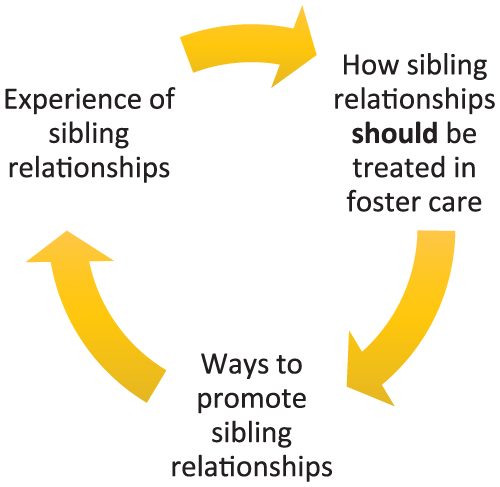
Feedback loop to understand and promote sibling relationships in foster care.
Implications
Foster parents stated that change needs to be made in policy regarding sibling placement, training for foster parents about sibling relationships, more information regarding siblings in foster care, and better retention of case workers. Below is a discussion of these concerns and possible solutions. When children are removed from their home, the pressure is on to find an appropriate placement that can accommodate the siblings, yet there are often many difficulties that can occur that make a conjoint placement with all siblings possible. For example, within the extant literature, reasons for sibling separation has been clearly demonstrated. Siblings may have different levels of specialized needs or if there is a large number of siblings with specialized needs, there may not be a foster home that is licensed to accommodate those or have the resources to care for that child (Kosonen, 1996), there may be difficulties between the siblings such as aggression or sibling abuse (Smith, 1996), sibling groups may be too large for one foster family to accommodate or the age range between siblings is large and foster parents have licensing for one age group (Shlonsky et al., 2003; Wulczyn & Zimmerman, 2005).
Given the description of why siblings may be separated, policy regarding licensure may be an area to improve sibling separation. Particularly, if awareness and education about sibling relationships is expanded to not only foster parents and case workers but also to all administrators, and practice and policy makers that are setting the licensure requirements. Case workers and foster parents, may feel like their hands are tied or that there are no good options when they are trying to make sibling placements. For instance, there may be a sibling set of three youth, but there is only a placement for two of these youths. The siblings would have to be separated. However, consideration should be made by child welfare administrators to reduce the required square footage per child when foster families are interested in foster sibling groups, particularly if there is no known sibling abuse between the siblings. For this to happen, there would need to be more sibling relationship education during initial foster parent training, as they consider the bounds of the licensure they seek. Such changes would allow larger sibling groups to be placed into a single foster home.
Second, the foster parents discussed the lack of information regarding the number of children in a sibling group, the existence of other siblings already placed in foster care, and existing issues that occur between siblings (i.e., aggressive behavior or perpetration) seems to be an area of great concern for foster parents. Due to the heavy caseloads of caseworkers and the lack of priority of the sibling relationship, as discussed by these foster parents, limited information is collected and distributed to foster parents regarding sibling relationships. Foster parents often feel like they do not have all the information they need and would like to have a more open relationship with caseworkers to ensure they are doing their best to provide for the children in their care (Wojciak, 2017). The foster parents in this study stated how they are the ones who could probably ensure siblings can get together and to help maintain or build the sibling bond of youth in their care, yet often lack the information or ability to even make these connections.
One way to address this issue would be to create a position within each agency that is dedicated to collecting sibling information, researching whether there are other siblings already in foster care, and collect information from the biological family, teachers, and other relevant community members that can be shared. Perhaps this person could follow the guidelines outlined by Family Finding (familyfinding.org) to increase the chance of finding family connections. Having a dedicated employee ensure this information is shared can help maintain levels of confidentiality necessary given the agencies practices and policy. This would give the foster parents a more accurate depiction of the strengths and issues within the sibling relationships. Furthermore, if such a position existed, it would address the other concern foster parents reported which is the high turnover of caseworkers and the variability of interest in promoting sibling relationship of caseworkers. Having a dedicated sibling person at the agency would indicate that siblings are a priority, something that the foster parents in this study said should be happening.
The prioritizing of sibling relationships would also entail that sibling visitation is occurring. If foster parents are connected with the foster parents of the other siblings, they can create opportunities for siblings to connect and engage in activities that will maintain the sibling relationship. However, to ensure foster parents are connecting, it is necessary that both sets of foster parents are aware of the influence siblings can have on one another and the role that they can play as foster parents in promoting the sibling relationship or not. By implementing these changes in the foster care system, many of the needs siblings have in the foster care system may be addressed and the relationships maintained and strengthened. Foster parents may also be aware of other opportunities available to youth that would be beneficial to siblings who are separated. One such opportunity would be to get the siblings in their care connected with Camp To Belong (Camptobelong.org), a nonprofit that offers a week-long camp experiences designed for siblings separated from one another due to foster care placement. Foster parents finding ways to ensure sibling relationships are maintained is important as warm sibling relationships of youth in foster care have the potential to be a great source of support (Wojciak, 2017), provide one another with a sense of belonging (Leathers, 2005), and are associated with lower levels of internalizing and externalizing behaviors (Hegar & Rosenthal, 2011).
Limitations
The results and implications of this study are cautioned by a selection bias. Foster parents were recruited from across the country by multiple methods. They had to read an e-mail or come across our Facebook and decide that they want to participate in the study. These foster parents in this study were interested in supporting sibling relationships of youth in foster care. Furthermore, despite the researchers effort to recruit nationally, these are the perspectives of only 15 foster parents, the majority of whom resided in the Midwest. In the future larger sample size and geographic regions would be beneficial.
Future Direction
In the future, it would be beneficial for foster parent agencies to systematically collect data from foster parents about their experiences and challenges with sibling relationships to continually reflect on the current experiences of sibling relationships, what should be done, and ways they can promote these relationships within their practices, trainings, and policy. Researchers should take an ecological perspective of what factors are influencing siblings in foster care. The growth of sibling research within foster care and empirically supported interventions (Kothari et al., 2017; Linares et al., 2015; Wojciak, 2017) is a good start, but youth in foster care have multiple people, other than themselves, making decisions about their familial relationships. Researchers could continue to learn about the role foster parent’s play in maintaining or stifling sibling relationships. What are the factors and decision-making processes foster parents have surrounding siblings and/or youth with siblings in their care? Additionally, researchers should also examine the same processes from case worker perspectives, judges, guardian ad litems and so forth. Gaining an understanding from all key players would enable researchers to suggest systemically informed practices and policies.
Conclusion
Our study highlights the roles and stances that foster parents play with sibling relationships in foster care. Foster parents reported being very supportive of sibling relationships, believe they should be high priority, maintain a high regard for agencies and recognize the need for promotion within education and awareness of siblings within the foster care system. This finding suggests that foster parents play a significant and crucial role in sibling’s lives outside of the sibling relationship itself. Improving the quality of sibling relationships may come from a promotion of the valuable roles that foster parents play. These roles can take place as trainers, educators, sources of knowledge, and mediators for collaboration within agencies for sibling relationships. The recommendations and perspectives of these parents may be especially instructive in improving foster family interactions, further portraying an understanding and awareness with siblings and foster care community. Overall, promoting sibling relationships through these experiences, outcomes, and given roles could lead to an improvement of sibling relationships in the foster care system.
Footnotes
Declaration of Conflicting Interests
The author(s) declared no potential conflicts of interest with respect to the research, authorship, and/or publication of this article.
Funding
The author(s) received no financial support for the research, authorship, and/or publication of this article.