




Abstract
Despite claims of “new” and “involved” fathers, research shows men’s actual fathering practices remain relatively unchanged. Increasing attention is being paid to the influence of child and family services on father engagement with calls from researchers and practitioners for a game change in parenting interventions. In this article, we draw on case study data to examine how gender impacts on maternal and child health services’ engagement with new fathers in respectful relationships programs. Our analysis shows that gender shapes men’s fathering and consequently their involvement in programs that seek to engage men as fathers. These gendered behaviors intersect with the practices, policies, and orientation of the Maternal and Child Health Service. The findings hold important implications for designing strategies to engage men in family services.
Keywords
Introduction
Many researchers have noted that despite the prevalent “new father” discourse, male parenting practices and the division of parental responsibilities remain relatively unchanged in Western societies (Eerola & Mykkänen, 2015; Elliot, 2016; Höfner, Schadler, & Richter, 2011). Fathers’ continued adherence to provider role scripts is reflected in Australian labor data reporting that partnered fathers continue to participate in fulltime employment at more than double the rate of partnered mothers (Kecmanovic & Wilkins, 2013). In 2001, 65.8% of partnered fathers and 25.1% of partnered mothers were employed full-time (Kecmanovic & Wilkins, 2013). These divisions remained 10 years later with 66.8% of partnered fathers and 29% of partnered mothers employed full-time in 2010 (Kecmanovic & Wilkins, 2013). Although Kecmanovic & Wilkins’ analysis did not distinguish between same and opposite sex partners, recent findings from the Household, Income and Labour Dynamics in Australia (HILDA) Survey specify that the transition to parenthood triggers a gendered division of labor for heterosexual couples (Wilkins & Lass, 2018). This longitudinal study found that over the 2006-2016 period heterosexual women in de facto relationships with dependent children spent on average 28 hours on housework, 29 hours on care work, and only 20 hours in paid work per week (Wilkins & Lass, 2018). In comparison, heterosexual men in de facto relationships with dependent children spent on average 17 hours on housework, 14 hours on care work, and 42 hours in paid work per week (Wilkins & Lass, 2018). Similarly, married heterosexual women with dependent children spent on average 30 hours on housework, 24 hours on child care, and 22 hours in employment per week (Wilkins & Lass, 2018). In contrast, married heterosexual men with dependent children spent on average 15 hours on house work, 11 hours on child care, and 47 hours in paid work per week (Wilkins & Lass, 2018). Fox attributes persistent divisions of labor between mothers and fathers to the deeply gendered nature of parenting responsibilities arguing that “parenthood creates gender more thoroughly than any other experience in most people’s lives” (2001, p. 6; 2009).
The disjuncture between the cultural ideals of involved fatherhood and shared caregiving, and actual parenting practices is reflected in the parenting support context where services and programs continue to be oriented toward mothers rather than mothers and fathers as coparents (Panter-Brick et al., 2014). The challenges of engaging fathers in child and family services are well-documented with research finding that mother-centric practices, policies, and orientation exclude or inhibit father engagement (Ferguson & Gates, 2015; Fletcher, May, St George, Stoker, & Oshan, 2014; Maxwell, Scourfield, Featherstone, Holland, & Tolman, 2012; Panter-Brick et al., 2014). This article investigates the question: How does gender impact on service providers’ engagement with new fathers in respectful relationships programs delivered in health settings? A gender lens is particularly important in health settings where institutions that deliver health care have defined gender regimes and where parenting is named but women are spoken about (Connell, 2012; Schofield, 2009). Recent research has called for a “game change” in child and family services highlighting the powerful impact of professional and institutional practices on fathers’ engagement experiences (Ferguson, 2016; Mykkänen, Eerola, Forsberg, & Autonen-Vaaraniemi, 2017; Panter-Brick et al., 2014; Storhaug, 2013). A study of barriers and enablers to father involvement in United Kingdom Family Centres by Ghate, Shaw, and Hazel (2000) identified several institutional-level factors that influence father engagement. They developed a classification system to describe the orientation of service providers’ work with men based on three elements of service orientation: center priorities and policies, service provision and activity, and the atmosphere and “feel” of centers (Ghate et al., 2000). Three descriptive categories were identified: a gender-blind approach where service providers are blind to the differing needs of service users treating men as synonymous with women users, a gender-differentiated orientation which recognizes and accommodates differences between men and women users, and agnostic where views on working with men were not identifiable (Ghate et al., 2000). To identify the gender phenomena that influence father engagement in the health context, the results of a case study based in maternal and child health services were analyzed using a novel analytical framework. The framework combined a three-phase father engagement model with Risman’s (2004) multidimensional theory of gender (see Figure 1). The three-phase engagement model involves “getting” fathers (recruiting fathers and getting them to attend initially), the second stage involves “keeping” fathers (retaining fathers attendance through to course completion), and the final phase “engaging” fathers (refers to actively engaging fathers; Pfitzner, Humphreys, & Hegarty, 2017). The data analysis was also framed by Risman’s (2004) concept of gender as a multidimensional social structure that operates simultaneously at individual, interactional, and institutional levels. The individual level focuses on the development of gendered selves; how men and women develop a preference for gender-typical behavior through identity work and socialization (Risman, 2004; Risman & Davis, 2013). Drawing on interactionists’ contributions to gender theory that see gender as an interactional accomplishment or something men and women do, the interactional dimension explains how gender is enacted through social interaction (Butler, 1990, 2004; Risman, 2004, 2011; West & Zimmerman, 1987). Risman (2004) describes the institutional dimension as including legal regulations, organizational practices, the distribution of resources and ideological discourses. This article focuses on the first phase of the process: “getting” fathers. Findings are discussed in tandem with recent research literature and are reported in relation to the three dimensions in Risman’s model: individual, interactional, and institutional.

Father engagement model.
Case Study: Method and Data
This article draws on findings from a case study of the Baby Makes 3 (BM3) program, a 3-week respectful relationships program for first time parents incorporated into New Parent Groups run by Maternal and Child Health Services (MCHS) in Victoria, Australia. The MCHS is a free, voluntarily accessed, primary health service offered to all Victorian families with children aged from birth to school age (Department of Education and Early Childhood Development [State of Victoria], 2011). As part of this service all new parents are invited to attend a New Parent Group (NPG) 6 to 8 weeks after the birth of their baby (Department of Education and Early Childhood Development [State of Victoria], 2011). The NPG (meeting during the daytime) was attended almost exclusively by new mothers, while the 3-week respectful relationships program (offered in the evenings) was actively inclusive of mothers and fathers. The BM3 pilot program was rolled out across seven municipalities in a largely urban, middle class, well-educated, and culturally diverse region of Victoria from 2013 to 2015. At sites involved in the pilot project, the 3-week BM3 program was built into NPGs, with parents able to self-select out of the program (Whitehorse Community Health Services, 2014).
The BM3 program was purposefully sampled to provide an information rich case for the in-depth study of father engagement in a respectful relationship program (Patton, 2002). BM3 is one of the very few Australian respectful relationships programs that target fathers in health settings. The program was developed by a community health service and delivered in partnership with local MCH Services. It aims to prevent intimate partner violence by promoting equal and respectful relationships between men and women during the transition to parenthood (Flynn, 2011; Whitehorse Community Health Services, 2014). BM3 was designed as a primary prevention program, as such it is a universal intervention targeting all first time parents in the pilot region rather than those “at risk” or already experiencing or engaged in violence (Bouma, 2012; Whitehorse Community Health Services, 2014). The program involves a group format where 8 to 10 couples attend three 2-hour sessions with their babies. Each group is cofacilitated by one male and one female facilitator. Sessions involve mixed- and single-gender group discussions, role plays, and homework exercises (Flynn & Whitehorse Community Health Services, 2011).
Data were collected from multiple sources including interviews, focus groups, and documentary sources between July to November 2014. There were 43 study participants comprising: 15 fathers aged 25 to 54 years who participated in the program and 13 nurses who recruited parents into the program were interviewed; and 15 program facilitators participated in two single-gender focus groups. Fathers were recruited for interview during the final session of the BM3 program. Nurses were recruited during site visits to the BM3 pilot sites. Facilitators were approached to participate in the study at their regular community of practice meeting and a follow up email invitation was forwarded by the BM3 Manager on the researchers’ behalf. The interviews and focus groups were semi-structured with respondents answering open-ended questions on a series of topics (Kitzinger, 1994; Kvale, 1996). The fathers were interviewed over the phone, while the interviews with nurses and the two facilitator focus groups were conducted face-to-face. Researchers have found that telephone and face-to-face interviews obtain similar results and can be used in the same study (Sturges & Hanrahan, 2004; Vogl, 2013). Telephone interviews were selected for fathers due to the logistical challenges of face-to-face participation for parents of newborn children. This design also reflected a conscious decision by the program management and research team not to reinforce gendered parenting practices by asking fathers to take time away from child care work or assuming mother-centric childrearing models among the participant families. The fathers interviewed over the phone seemed relaxed and readily shared intimate information. Rapport was easily established, although this was undoubtedly influenced by the researcher’s previous face-to-face contact at recruitment visits. Our experience confirms those of other researchers who have found that telephone interviews can elicit more sensitive details due to the higher degree of anonymity (Vogl, 2013). Both the interviews and focus groups were audiotaped with consent and transcribed. The interviews ran for 30 to 45 minutes and the focus groups for around one hour. Documentary sources reviewed included BM3 Implementation Guide, Program Manual, previous evaluation reports as well as MCH Services guidelines, policies, and annual reports.
Data from the interviews, focus groups, and document review were collated and thematically analyzed to develop a thick description of how gender impacts on service providers’ engagement with new fathers in respectful relationships programs delivered in health settings (Lincoln & Guba, 1985). Drawing on Bazeley (2013) and Miles and Huberman (1994), we engaged in a two-stage coding process using NVivo 10. First-level coding involved descriptive coding labelling passages of data with codes that summarized the data segments (Bazeley, 2013; Miles & Huberman, 1994). Second-level coding built on these summaries refining, interpreting, and grouping them into smaller analytical categories, themes, or constructs (Bazeley, 2013; Miles & Huberman, 1994). This phase explored the interrelatedness of data within and across themes to construct meaningful explanations (Bazeley, 2013). This two-stage coding process is cyclical with researchers constantly moving from data to description to analysis (Bazeley, 2013; Miles & Huberman, 1994). The interview and focus group transcripts were de-identified and pseudonyms were used in all reporting. Ethics approval was received through the University of Melbourne.
Findings
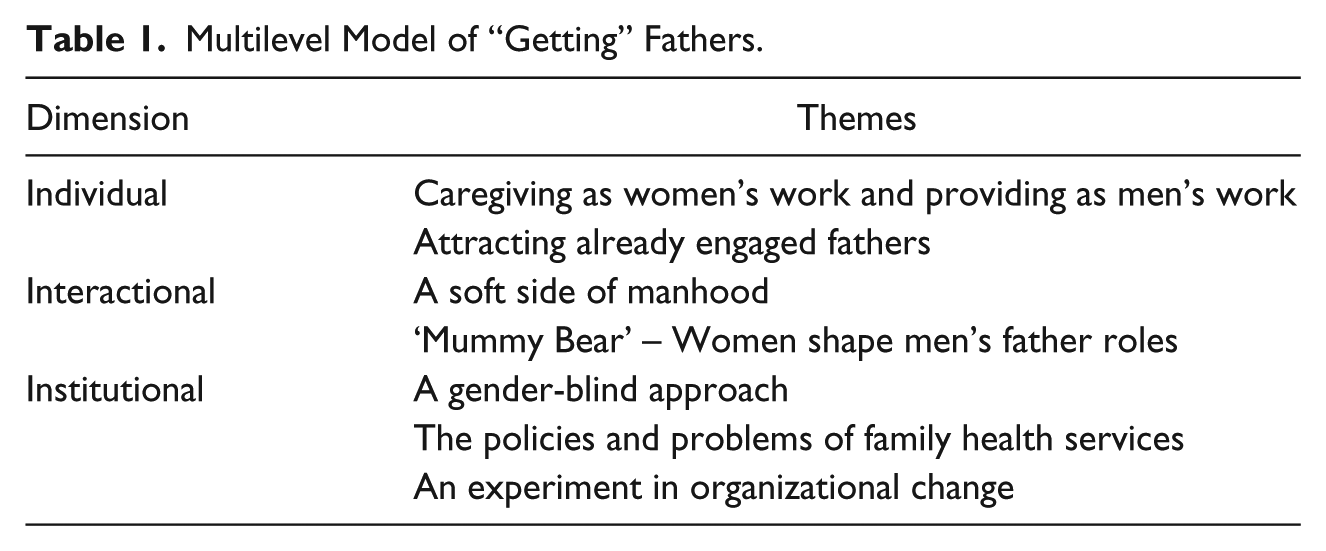
Discussions about what motivates father participation in BM3 revealed that a complex, multidimensional interplay of gender-related factors shapes men’s father identities, behaviors, and ultimately their decisions to participate. Gender phenomena that impact on father participation will be discussed in relation to the three dimensions of gender identified in Risman’s (2009) model. Table 1 summarizes the gender phenomena identified as influencing “getting” fathers according to this multilevel model. It is important to remember that these three levels are not discrete and that each level influences the others (Risman, 2004). As a consequence individual gender factors may operate at more than one level.
Multilevel Model of “Getting” Fathers.
The Individual Level
I think it’s all a part of their own image and how they see themselves. (Kate, nurse)
Discussions with study participants about motivations for father participation revealed that the behavior men associate with the father role heavily influenced their participation decisions. In a 2006 study of 115 first time Australian fathers, Habib and Lancaster (2006) drew on McCall and Simmons’s (1978) role identity theory to develop a conceptual framework for theorizing new fathers’ paternal identities and behaviors. They distinguish between two facets of men’s paternal identities: their father status content being men’s subjective perceptions of how fathers behave and father status prominence which pertains to the level of importance men’s father identities have to their sense of self (Habib, 2012; Habib & Lancaster, 2006). The prominence of a man’s father identity among his other identities, such as worker, peer, husband, son, or sportsman, is believed to influence the likelihood of performing role-related behavior with higher-order identities more likely to be enacted (Habib, 2012; Habib & Lancaster, 2006). This framed our understanding of gender factors identified as impacting on men’s perceptions of fatherhood and consequently service provider engagement with fathers which are presented as two sub-thematic categories: caregiving as women’s work and providing as men’s work and attracting already engaged fathers.
Caregiving as Women’s Work and Providing as Men’s Work
The prevalence of traditionalist perceptions of the work of caring for babies was emphasized by four fathers who reported that father engagement in BM3 is inhibited by men’s perceptions of caregiving as “women’s work”: The people that aren’t going are the ones that probably to be honest probably still go to the pub on Friday night or Saturday night and aren’t home, leave their wife to do everything. I’m not stereotyping but that’s just reality. I’m sure that’s probably why they’re not. (Craig, father) Unfortunately, there is still that stereotype of babies as women’s work. (Luke, father) I suspect that some of them think that this is all something for the mothers to deal with and they shouldn’t have to be involved. I think that that culture needs to be broken somehow, which is, I suspect, a big part of the issue, that they just think “Oh, no, that’s a mothers group thing, you go along to that.” Somehow that culture needs to be broken. (Scott, father)
Like these fathers, some female facilitators and two nurses felt that community perceptions of caregiving as “women’s business” inhibit father engagement in BM3: So you’ve got your dads that actually just don’t think it’s their role and they’re the ones that actually need to sit there and hear this, but they’ve got football training . . . This is the exact reason why we’re doing this sort of thing but the ones that don’t think it’s part of their responsibility, don’t think it’s part of their responsibility to go to a Baby Makes 3. (Sarah, female facilitator) A few of the women say “Oh I couldn’t get my husband to drag along to anything to do with stuff like this. I want to come but he doesn’t’ . . .” I said to this mum “Because he thinks it’s women’s business?” She went, “Yeah definitely.” (Alice, nurse)
Since the new parents’ groups which lead into BM3 are services for caregivers, they are also seen as women’s business. Alice commented: I still think there’s a view in our communities that the new parents group is mothers’ group . . . I personally think that’s a bit of a barrier why we’re not getting so many dads for the Baby Makes 3 program because the mothers—they feel like the mothers have got this mothers’ group and it’s a women’s business sort of focus. (Alice, nurse)
Many of the female facilitators agreed with Alice explaining that despite the recent name change NPGs are still colloquially called mothers’ groups. These discussions about parental responsibility and childcare suggest that many people see men and women as having distinct parental gender roles. It seems that childcare is not part of the paternal role nor is participation in related programs, such as BM3.
Aligning with the participants’ beliefs that men tend to see caregiving as women’s work, many nurses reported that men who perceive their father role primarily as provider are unlikely to participate in BM3: I think men think a lot of their main role is to be the provider of the finances. Even though we’ve come in leaps and bounds from how it used to be in the 40s and 50s, it’s still very much that mentality. (Jenny, nurse)
One father echoed this breadwinning discourse: My job is obviously to make sure that we’re still getting money and everything, as well as do what I can when I’m here. (Scott, father)
A successful economic provider must generate an income and overall six nurses and three fathers identified fathers’ work commitments as a barrier to “getting” fathers. Many female facilitators agreed commenting that fathers’ employment and financial responsibilities preclude or limit their involvement in BM3 and the MCHS more widely: Well I know when I send my letter out it says dear parents and then a father will say, “Is that the mothers group?” I’ll say “No, it’s not it’s the parent group and everyone is welcome.” But the fact of the matter is that they are mostly going to work so then they don’t come. (Helen, female facilitator and nurse) It’s not anyone’s fault. That’s just the way it is. You guys need to work outside the home. (Michelle, female facilitator)
The nurses and female facilitators beliefs that men’s conceptualizations of fatherhood as financially providing limited men’s involvement in BM3 was reinforced by the fathers who participated in this study. In discussions about why all fathers do not attend BM3, several fathers positioned themselves as “involved” fathers and highlighted the otherness of their conceptualizations of fatherhood. Discussing the similarities and differences between himself and the other fathers in his group, Christopher commented that There were five on the first night and then it basically dropped to three . . . Between the fathers you could certainly see that the three of us that remained are probably very similar in views, thoughts and appreciation of the transition that needs to happen. Perhaps the other two who didn’t necessarily follow through . . . you wouldn’t want to condemn them or anything. But I think their views, if you like, on how things needed to work probably seemed a bit dated, compared to how the rest of—the three of us I think have got a bit more of a modern thinking of how much fathers need to get involved in the upbringing of babies and helping out and things like that. (Christopher, father)
In contrast to these views, two nurses reported that men’s father roles have changed believing that involved fathers are the norm: I think the role of fathers has changed a lot and they expect to be more involved in, in their child’s life. I think you know a couple of generations ago they weren’t even in the delivery room and it was women’s business and it was their job to go and earn the money and it was the mothers’ job to raise the child and I think that society influence has really changed that and they want to be part of their life. (Emilie, nurse) I also think it’s become more acceptable for dads to be much more involved in the parenting. Over the years there’s been much more of a change in that, that it’s much more of a shared thing than dad goes to work and mum looks after the kids. (Susan, nurse)
Together these comments suggest that men who see the father role as provider are less likely to respond to strategies that seek to engage them as caregivers. Confirming recent research, the nurses’ responses indicate that the breadwinner discourse continues to be the dominant discourse about fatherhood (Eerola & Mykkänen, 2015; Höfner et al., 2011; Wall & Arnold, 2007). These findings align with research on gender, work, and family that continually highlights the centrality of “providing” in establishing men’s gender identities (Loscocco & Spitze, 2007; Nock, 2001; Pyke, 1996). Although the participants in this study believe that paternal ideologies of fathers as economic providers strongly shape men’s paternal behavior, it is important to note that where men view their father role as provider, their worker, and father identities may overlap (Olmstead, Futris, & Pasley, 2009). It is unclear whether the importance men place on their participation in paid work is an expression of their understanding of their paternal responsibilities or evidence that they attribute a higher status to their worker identities than their father identities.
Attracting Already Engaged Fathers
Given the complexity of the gender influences on new fathers’ identities it is not surprising that participants consider that BM3 is attracting “involved” or already engaged fathers. This was reinforced by nurses, fathers, and facilitators: I think that we are preaching to the converted a little bit. I think we are capturing the people who are interested but you’ve got to start somewhere. (Emilie, nurse) The ones that need to be there, they’re not there. (Sarah, female facilitator) The people that aren’t going are the ones that really need to be there so the fact that we’re turning up and all that sort of thing—I’m not saying that we didn’t need to go. I got lots out of it but I think there’s probably some truth in that, that the people who most need to be there aren’t actually the ones that are going. (Scott, father)
These discussions confirm the fathers’ reports that the men attending BM3 already view the father role as a caregiving role. It suggests that the program may have limited appeal for men who do not associate caregiving with the father role or who do not place a high level of prominence on this aspect of their fathering identity.
The Interactional Level
Relational theorists contend that social interactions are a means of “doing gender” explaining that the performance of family work, particularly child care and housework is strongly defined as feminine (Kan, Sullivan, & Gershuny, 2011; Sullivan, 2013). Analysis of the data identified several interactional level factors that influence “getting” fathers. These have been grouped into two categories: “a soft side of manhood” and “mummy bear.”
“A Soft Side of Manhood”
Bird (1996) believes male homosocial, heterosexual interactions maintain hegemonic masculinity by promoting emotional detachment, competitiveness, and the sexual objectification of women. Based on in-depth interviews and field observations of men from an academic community in Northwestern United States, Bird (1996) explored the connection between men’s individual masculinities and gender norms in small group homosocial interactions. She found that male homosocial interactions among heterosexual men promote men’s adherence to hegemonic masculinity while suppressing practices associated with nonhegemonic masculinities, such as emotionality (Bird, 1996). Aligning with Bird’s work, fathers (Simon, Scott, and Luke) suggest that traditional masculine discourses discourage emotional expression among men and that this inhibits men’s participation in BM3: I can see that some people think that they’re too manly to go to something like this, which I think is ridiculous, but perhaps that’s part of the reason. (Scott, father) It could just be that male stereotype of being stoic and not wanting to speak and not be talking about your feelings . . . some of the guys didn’t feel it was their place to be discussing babies and feelings. (Luke, father) I was surprised to see a male there, I didn’t think there would be. I don’t know but I thought there’d be just women or something, yeah. I was surprised yeah. I think we’re quite anonymous in a lot of ways, like males when it comes to communication, talking and stuff. Because it’s almost as if he was—like for him to want to do that group, it’s like—it’s a soft side of manhood I suppose, isn’t it? When you’re talking about your emotions and your feelings. (Simon, father)
Simon added, Yeah like so he put himself out there. So when I first met him it was like, well you’re putting yourself out there, so well I might as well as well. Because I think—like being a male nurse myself, I probably—yeah I still respected that but I don’t know if everyone would respect a male doing that. They’d be like, “oh the bloody little poofter” or something like that . . . Bit of a tough guy sort of attitude, yeah. (Simon, father)
Two nurses confirmed these fathers’ belief that dominant masculine discourses discourage the expression of emotion among men. For instance, Alice said “I just find them generally not as open as the women” explaining that I think there’s a society thing. They’ve got to be the big, brave, wiser, stronger bloke . . . I think there’s society, environmental things that men have to break through to talk about their mental health generally. (Alice, nurse)
Likewise, Jade commented, They find it hard to talk about emotions . . . We’ve got men that aren’t articulate, vocal, they don’t want to do it, they don’t know how to do it. They haven’t had role models to do it. (Jade, nurse)
These responses suggest that men’s enactment of dominant masculine discourses may inhibit father engagement in discussion-based programs like BM3 and health services more generally. Research by Ghate et al. (2000) on father engagement in Family Centres across England and Wales showed that men perceived these activities as passive, unconstructive gossip. The positioning by the men who participated in BM3 of their father selves as “alternative” aligns with findings by Ghate et al. (2000) that male users of family centers are “the ‘wrong’ sort of men” described by other men as deviant or feminine (p. 16). Similar findings were made by Dolan (2014) in his study of fathers who participated in a “dads only” parenting program in the United Kingdom. Dolan (2014) found that fathers’ decisions to participate in parenting programs were influenced by their perceptions of male users of such services as “suboptimal men” (p. 818). The “otherness” of fathers who adopt caregiving responsibilities was also identified by Höfner et al. (2011) in work on men’s fatherhood discourses during the transition to parenthood that showed that many men who adopt caregiving role are perceived as feminized men. These findings suggest that fathers’ adherence to hegemonic practices and values may lead to them avoiding “feminine” activities, such as BM3.
“Mummy Bear”—Women Shape Men’s Father Roles
Resonating with research evidence that fatherhood is constructed interactionally, focus group discussions with the male facilitators highlighted the role of women in shaping men’s father identities and behaviors (Fagan & Barnett, 2003; Maurer, Pleck, & Rane, 2001; McBride et al., 2005). They described men reporting that their partners police their child care activities: That looking over their shoulder, not trusting them you know that sort of stuff and they came up with the word “just doing that mummy bear role” that’s what they called it. (Mark, male facilitator) One of the dads said that my partner’s too much of a lioness, she won’t let me so she says you can have, you can do the next hour and a half but she is standing there behind me the whole time. (David, male facilitator)
Discussing father involvement, one nurse confirmed the male facilitators’ reports that maternal perceptions of fatherhood influence paternal behavior: I think, too, it’s probably the fault of some mothers who hover and if the dads don’t do it the way they like it, instead of just rely on them to do it their way, you know, it’s either my way or no way. So I think mothers actually do put the dads down a little bit. So it makes them a bit reluctant to initiate anything. (Kate, nurse)
These comments indicate that many women see caregiving as primarily women’s responsibility and so act on the assumption that they have ultimate responsibility (and therefore oversight) for men’s caregiving. The attempts by fathers participating in BM3 at “undoing gender” by participating in caregiving were sometimes met with resistance and seen by their partners as transgressing gender roles. The facilitators’ reports suggest that mothers’ gendered expectations and perceptions of parental responsibilities influence men’s father identities; in turn shaping their responses to parenting programs. These findings highlight the interactional aspect of paternal identity negotiation and confirm Fox’s (2001) finding based on in-depth interviews with 40 heterosexual couples transitioning to parenthood in Toronto that interpersonal negotiations between men and women in intimate relationships are deeply gendered.
The Institutional Level
The following discussion details how gender is constituted through MCH Service organizational practices and processes and its impact on father engagement.
A Gender-Blind Approach
Participants identified the MCH Service’s approach to working with men as a significant obstacle to father engagement echoing research that has shown that staff attitudes and behaviors set the tone of a service (Ghate et al., 2000; Weeks, 2004). In the present study, only two of the thirteen nurses interviewed reported that they had received training for working with male clients. Discussions with nurses about how they work with fathers revealed a “gender-blind” service orientation where nurses do not differentiate male and female service users: Same way as we work with mums. (Jade, nurse) I talk to them exactly the same as I would with mums. (Jenny, nurse) It doesn’t worry me . . . It’s just part of the normal conversation, whether they’re there or not. (Liz, nurse)
Commenting that “I don’t know if we make them involved,” one nurse indicated that the service does not develop relationships with fathers.
We don’t have much to do with dads except maybe asking questions around violence but that’s towards the mum about dad you see. We often talk about dad as an afterthought, you know, like as kind of a follow on conversation rather than how are you going dad? (Jo, nurse)
This indifferent, and consequently exclusive, approach to working with fathers was confirmed by the fathers in discussions about their experiences with nurses. Six of the fathers reported they were excluded from the service relationship: Yeah, probably a little bit exclusionary, only because the Maternal and Child Health Nurses focus on my partner and the baby. (Luke, father) The mums group, the mums walk, the mums this, the mums bloody everything and there’s no parent there. (Simon, father)
Discussing his experience of the maternal and child health service Daniel said: I guess from my perspective that relationship is certainly through my wife rather than necessarily a direct relationship. (Daniel, father)
He added that: I was just sort of a third party to the discussion. (Daniel, father)
Asked whom he thought MCH Services provided services for, Matthew replied “mothers” saying: I guess the name kind of alludes to that. They could call it the Parental Health Services if they wanted to form something with more inclusion. (Matthew, father)
These descriptions of nurse practice match Ghate and colleagues’ description of gender-blind service and are also evident in Maternal and Child Health policy documents. Acker’s (1990) work on gendered organisations showed that gender is embedded in organisational structures and processes. She explained that organizational logic can take material form with institutional documents containing symbolic indicators of the gender structure (Acker, 1990). A review of Victorian Maternal and Child Health policy documents confirmed participant reports of a gender-blind service orientation. One of the most striking elements impacting on father engagement in this context is the invisibility of fathers in MCH Service guidelines, practice, and data reporting (Department of Education and Early Childhood Development [State of Victoria], 2011, 2012, 2014b, 2014c, 2014d). Referral policies and systems filter men’s access to MCH Service limiting father engagement from the outset. In Australia, as in the United Kingdom, mothers are the clients referred to early childhood services and the party with which the service develops a relationship (Department of Education and Early Childhood Development [State of Victoria], 2011). Unlike for mothers, routine data is not collected about fathers, their presence at appointments is optional, and their details are not required to be recorded (Department of Education and Early Childhood Development [State of Victoria], 2011, 2014a). As others have rightly argued, these policies communicate to fathers that their involvement in childcare services and by extension the care of their children is not important (Burgess, 2009; Ferguson et al., 2004; C. L. McAllister, Wilson, & Burton, 2004).
It appears that one consequence of the gender blind service culture discussed above is the development of feminized environments which men perceive as psychologically inaccessible and as catering for women (and children) (Ghate et al., 2000; Weeks, 2004).
My perception is that they might think it’s just a mother and baby service. (Laura, nurse) Well, I think a lot of them just feel that it’s not a place for them and that’s something that mum does. (Jenny, nurse)
Like these nurses, many of the fathers interviewed think men see MCH as a service for women: I think some of them might look at it as it’s a ladies thing. (Arjun, father) I think it’s probably seen as something for mothers and babies, not really involving the fathers. (John, father)
Psychological accessibility extends to the naming of services, recognizing that attendance may be inhibited by association with stigmatized services, such as domestic violence services (Weeks, 2004). Aligning with this research evidence, BM3 is marketed as a healthy relationships program rather than a domestic violence primary prevention program (Whitehorse Community Health Services, 2014). Despite this effort to avoid stigmatization, it appears that housing the program within an organization badged for women and children adversely influences father engagement. Seven of the nurses identified the name of their service as barrier to father access: It’s a shocking name, a shocking name for our role . . . I think if we could change our title that would help . . . it’s changing that perception that it is just all about the mother and the women. (Susan, nurse) We’re maternal and child health and when they break it down there isn’t—the dads not in it. (Jo, nurse)
Similarly, many female facilitators and one male facilitator believe that the service environment inhibits father engagement: There’s no mention of dads—it’s the maternal and child health. They can feel a bit excluded I think. (Jennifer, female facilitator) I think language is very important . . . you know don’t underestimate it so “child maternal health” there’s no father in that. (Mark, male facilitator)
In contrast to these reports, two nurses believe their service has become father inclusive and provides a welcoming setting for men: I think it is much more acceptable for men to come to the centre now and we’ve tried to make the centres more men friendly so like we have more car magazines and things in the waiting room rather than Women’s Weeklies and we welcome the men to come. (Emilie, nurse) I think now we are far more inclusive of fathers and we present it more as a family thing. We don’t hone in on mum especially other than from a health perspective because they’ve just had a baby. So I think the environment is inviting and we are inviting to fathers. (Prue, nurse).
One father interviewed confirmed these nurses’ views: I thought it would be for the family as well. I thought it’d be for the mum and dad to go with the baby. Then when I got there I saw some of the pamphlets on the walls for the—they were advertising like a Chinese dads group so I thought—I knew—they had photos of the dads with the kids so I knew it was pretty family oriented as soon as I walked in. I was expecting it to be like that. (Michael, father)
With the exception of these three participants, it appears that fathers perceive MCH centers as feminized environments (Ghate et al., 2000). The nurses’ and female facilitators’ comments indicate that the name of the service acts as a psychological barrier to father engagement.
Reflecting on the physical environment of social service delivery, Weeks (2004) has argued that the key to creating psychologically accessible services is the provision of a “neutral doorway,” a nonstigmatizing entry point. Although embedded in a mainstream service, the Maternal and Child Health setting is not perceived by fathers as a neutral and welcoming environment. It is clear that men’s responses to respectful relationships programs offered from MCH Services are significantly affected by feminized service environments and their experiences of service delivery as exclusionary.
The Polices and Problems of Family Health Services
Victorian MCH Services’ marginalization of fathers is evident not only in nurses’ work with fathers but also in their operational policies. Ten participants, five fathers and five nurses, reported that the operating hours of Maternal and Child Health Centres inhibit father engagement in the service: My wife goes on her own because it’s during work hours. (Ahmet, father) I went to a lot of these meetings in the early—when I was on paternity leave, for example, but now it’s just not feasible for me to go because I’m working. (Scott, father) A lot of the time they want to come but because we offer basically a 9-5 or 8-4 service it’s difficult for them to leave work and be available. (Emilie, nurse)
These comments confirm previous research findings that service scheduling is a critical factor in father engagement (Gross, Julion, & Fogg, 2001; Spoth, 1993). Delivering programs at times inconvenient to many fathers and working mothers covertly aims services at at-home mothers limiting the engagement of fathers (and some working women). As McAllister, Burgess, Kato, and Barker (2012) have noted, When provision of support remains predicted on the daily availability of mothers as primary caregivers, “parent” comes to mean “mother” and fathers (and working mothers) remain marginal to services and interventions, as well as to their evaluation. (p. 60)
The MCH Services’ marginalization of fathers extends to BM3 program marketing where fathers are explicitly excluded from program promotion. While a written invitation to parents to participate in BM3 was included in the information pack given to mothers at the home visit and mothers may have heard about BM3 at NPG sessions, there were no direct invitations to fathers and it appears that this information was not reaching them. Twelve of the fifteen fathers had no or very little knowledge about BM3 before attending on the first night: I had no idea. (Matthew, father) I wasn’t sure what I was getting into. (Quan, father)
The female facilitators confirmed the fathers’ reports regarding their lack of knowledge about BM3 prior to attending: In my experience the first week we always ask them what’s your expectation and 90% say “I don’t know.” They just look at the wives and say “I don’t know why I’m here.” (Lisa, female facilitator)
Several female facilitators reported that men were reluctant to attend and only came because of their partners: In every group there’s been a reluctance. “Oh, my wife has made me come.” “I’m just coming because I have been told it would be good.” So that’s often a hurdle. (Christine, female facilitator)
Like his female colleagues, one male facilitator commented on men’s reluctance to attend: I observe and I see the men resistant and struggling to be there so they name that up “not really comfortable here,” “not really, just doing it for me partner.” (Mark, male facilitator)
The dads’ discussions about their reasons for attending confirm the facilitators’ reports that father attendance is mother-driven. Six fathers indicated that their wives strongly influenced their decision to participate with one father commenting that most fathers were “dragged along” by their partners. Recalling what his partner had told him about BM3, John said “nothing more than it was on and we were going.” Likewise, Peter said “my wife said she wanted to do it and I just agreed for that reason alone” while Michael commented “It was basically my wife’s idea.”
Mirroring these fathers’ experiences (or lack thereof) of BM3 program promotion, several of the nurses explicitly acknowledged that they did not engage fathers in BM3. Four of the nurses positioned father engagement as outside their role; “it’s not really in our scope of practice.” These nurses distanced BM3 father recruitment from their service referring to BM3 as “an outside thing” and stressing that “it’s not run by us.” Other nurses’ discussions about BM3 promotion indicate that father engagement is not a priority. Two nurses cited workloads and competing demands on their time as reasons for their limited recruitment efforts: I suppose at my home visits and the centre visits I don’t mention it, which is probably something that I could do. It’s really only New Parent Group that reminds me to talk about it because there’s so many other things that we talk about. (Jenny, nurse)
Although only four nurses reported they did not engage fathers in BM3, discussions with other nurses about how to get more fathers involved in BM3 revealed an awareness of the exclusionary nature of their current approach: Most of the contact—the majority of information is provided through the mothers via the mothers’ group . . . It’s the rare father that comes to the New Parent Group/Mothers’ group. So really haven’t had the opportunity to directly engage them. (Prue, nurse)
Discussing how they could get more fathers involved, many of the nurses suggested a personal approach either inviting the dads face-to-face or over the phone. The inclusive language used in the nurses’ explanations for suggesting a personal approach indirectly acknowledges the marginalizing nature of existing MCH practice: Because people feel special if they are approached personally. I think they feel more important [italics added] and it’s perhaps more relevant to them rather than just a poster on a wall. (Emilie, nurse) So chatting to the dads directly about it saying that we haven’t forgotten about you [italics added] kind of almost makes them feel involved. (Jo, nurse)
Similarly, two female facilitators’ descriptions of the current approach connotes the marginalization of dads: I think it’s how you get—you’re starting off via the women, so I think they already feel like they’re not as important [italics added]. (Sarah, female facilitator) Well the fathers only hear from the mother. I mean we don’t speak to them [italics added]. (Margaret, female facilitator)
This study indicates that the “gender-blind” service orientation of MCH Services adversely influences “getting” fathers. While the nurses professed to enjoy working with fathers, they continue to deliver mother-centric service provision missing opportunities to engage fathers. Although Ghate et al. (2000) describe gender-blind service orientation as an effort to treat users equally, this study indicates MCH Services’ staff are actively excluding fathers from their practice. This service provision is reflective of a wider policy environment where fathers are not positioned as service users. This study indicates that MCH Services see father involvement as optional and not as users in their own right.
An Experiment in Organizational Change
During the 3-year BM3 project, a variety of recruitment methods were piloted to increase father engagement. One pilot site ran Family Nights as part of their NPG where one of the sessions was held during the evening and mothers attended along with their partners and babies. The Family Nights were cofacilitated by the nurse running the daytime NPG sessions and the male facilitator taking the BM3 sessions. One of the male facilitators who participated in the focus group had facilitated Family Nights as a lead in to BM3. Describing Family Nights as a “deliberate strategy” to put a face to the program, he explains he uses these sessions to gauge the parents’ responsiveness to the program material and tailor his approach to the BM3 program proper accordingly: I love it because I get a chance to meet these people before the program starts, both you know, both mums and dads so when they arrive on night one I have a little bit of an understanding of who they are and their experiences and the themes that we talk about at the Parent Night [Family Night] are very much what Baby Makes 3 covers and then we go into more detail. So it’s sort of a nice little entry point as well so I can sense how they react or respond to what’s being presented. (Steven, male facilitator)
While none of the female facilitators had firsthand experience of Family Nights, many of them felt these sessions make “a huge difference” in “getting” fathers because they familiarize the fathers with one another and the male facilitator prior to the program: I think that’s makes a big difference because they’re all meeting, they all know him. They don’t know me at all. That’s okay. He is the one that’s the first point of call as well. I think that makes a huge difference. (Christine, female facilitator) It’s them gelling. (Sarah, female facilitator)
Likewise, Emilie, a nurse who has co-facilitated Family Nights with the male BM3 facilitators believes Family Nights promote father engagement by building relationships among fathers prior to the first session. She commented: Well they are happier too because they’ve met the other dads in the group and they’ve met the facilitator and so they, they have developed a level of confidence and trust I think in the other people in the group and so that they can see the value in it. It’s not so scary if they have already met everybody at least once. (Emilie, nurse)
Although the two staff with firsthand experience as well as many of the female facilitators believe Family Nights play an important role in recruiting fathers, the one father who attended a Family Night indicated it had minimal impact on his engagement. Discussing the experience Paul said “I can’t I actually can’t really remember what happened.” In terms of using Family Nights as a recruitment mechanism for BM3, Paul said the male facilitator “briefly mentioned it.”
Another two sites introduced phone calls to fathers to increase numbers. The two male facilitators who made these calls had divergent views on their impact on fathers. One reported that he uses the phone calls to convey to the dads that “It’s safe for him to come. Its inclusive for him, it’s actually made for him to come.” Another reported he felt resistance from fathers when calling to invite them to BM3 with the fathers’ responses to the phone calls indicating that they too see this area as “women’s business.”
This particular program just gone I made some calls and I found it quite difficult. Like I say I’m trying to mirror and match what was on the end of the phone but there was this real resistance . . . They would say “oh I’ll go get my wife” and I’ll say “no, that’s okay I can give you all the details.” It was all, a couple of them defaulted to just “I’m going to get my wife, she knows all about it.” “No, no nah I need to talk to you.” [laughter] So there is this real reluctance and often they do come to the program you know what is this about, my wife wants me here. (Jason, male facilitator)
The fathers’ reluctance to take the male facilitator’s calls is an example of them acting out their gender identity. This facilitator’s comments confirm participants’ reports that many fathers still see caregiving as women’s work and suggest that fathers may be reluctant to accept invitations to participate in women’s domain. His experience and those of the other facilitators underscore Risman’s (2004) emphasis on the interrelatedness of gender phenomena across the three dimensions. The facilitators’ experiences demonstrate that these conditions influence strategies that seek to engage men as fathers in MCH Service settings. As Risman (2004) argues, gendered institutions depend on our willingness to “do” gender. It seems that father engagement within the MCH Service is partly shaped by how individual men see themselves as fathers as well by men and women doing gender. In the home the causal processes that constrain men and women to do gender are strong, the causal processes that constrain men and women to do gender in the MCH setting appear equally powerful (Risman, 2004).
Discussion
This study revealed that men’s paternal role identities and the gendered Maternal and Child Health Service setting play critical roles in fathers’ participation decisions. Our study indicates that programs like BM3, may have limited appeal for men who do not associate caregiving with the father role. This finding aligns with the views of some commentators that work with men around parenting and gender equality may be reaching those who need it least (Berlyn, Wise, & Soriano, 2008; Jewkes, Flood, & Lang, 2015). For example, Morrell and Jewkes’s qualitative study of 20 South African men’s engagement in carework found that men who choose to engage in carework on the basis of a political commitment to fairness were more likely to support gender equality. Notably, this research also found that men’s engagement in carework was motivated by a range of factors and those men who engaged in carework due to necessity, such as poverty or illness, were less likely to support gender equality. While Morrell and Jewkes’ (2011) study did not find a linear relationship between men providing care and support for gender equity, these findings taken together with those from the current study suggest that men who engage in carework as a matter of personal choice rather than necessity are more likely to be attracted to parenting and couples programs.
The fathers interviewed largely positioned themselves as enacting alternative fatherhood discourses based on their engagement in care work. It is possible that these fathers’ self-perceived “otherness” influenced their perceptions of why other fathers were not participating in BM3. There could be greater slippage in the rigid dichotomy between modern/caregiver and traditional/provider fatherhood discourses envisioned by the self-identified “involved” fathers in this study. Fathers are not clients of MCH Services and their contact details are not routinely recorded. Therefore, we were unable to contact fathers who declined invitations to the BM3 program. The absence of fathers who choose not to engage in BM3 means that it is unclear whether the identified barriers to engagement simply sustain rigid construction of parenting binaries. From a small qualitative study it is not possible to provide conclusive findings regarding the relationship between fathers’ engagement in carework and their engagement in parenting support programs, such as BM3. While a limiting factor, we do not believe this detracts from the overall conclusions of this study. We sought to provide insights into the impact of gender on men’s involvement in Australian family health services through a case study of the BM3 program. The data provided by the fathers in our sample offer valuable insights for future policy and practice. Additionally, the BM3 pilot was conducted in a largely middle-class area of Victoria and it is unclear whether the gender-related factors identified by fathers in this study’s sample would hold the same weight for fathers from other populations. Likewise, while the resident population living in the pilot region is culturally diverse, the BM3 program is an English language speaking program and parents without adequate English literacy skills are likely to have self-selected out of the program. Bearing in mind the need to identify what works for whom and in what circumstances, localized masculinities and other social variables should invariably inform father engagement strategies and programs in the future (Casey et al., 2013; Jewkes et al., 2015; Pawson, Greenhalgh, Harvey, & Walshe, 2005). Future work could shed light on the differential impact of gender on service providers’ engagement with diverse father populations.
Much of the work on engaging fathers in parenting focuses on micro-level strategies to recruit individual men. Unusually, Ferree (2010) has critiqued gender perspectives on families for failing to consider the multi-institutional relationships that prevail between families and economic and political structures, arguing that most research frames issues in terms of individual rather than institutional change. A central finding of this study was that individual men’s constructions of fathering and ingrained cultural expectations regarding the parenting roles of men and women intertwine with gendered Maternal and Child Health Service structures and breadwinning discourses at the institutional level to shape men’s fathering and ultimately their involvement as fathers in programs such as BM3. An important implication of this study derives from the finding that MCH Services reinforce a gendered division of labor that marginalizes fathers from caregiving including engagement in care-related programs such as BM3. These findings indicate that parallel interventions are required at the institutional level to promote father involvement in childcare. Recent research by Zuo (2004) and others reinforces this implication arguing that structural changes are required to shift perceptions of breadwinning as a male responsibility and facilitate the transformation of fathering scripts (Davis & Greenstein, 2009). Some researchers also suggest that men’s participation in care work would in itself be a gender equality intervention (Elliot, 2016; Morrell & Jewkes, 2011).
Conclusion
Current Victorian MCH Services give center stage to women’s passage through motherhood. If men’s passage to fatherhood was viewed with a similar level of attention this might not only increase father engagement in parenting support services, but also potentially increase father participation in care work contributing to the transformation of fathering practices. Valuing men’s transition to fatherhood and including them in related services may promote more gender equitable divisions of parental responsibilities and facilitate institutional change beyond health settings. Individual- and service-level support for shifts in fathering would challenge economic and workplace structures that reinforce male breadwinning models and provide an opportunity to reconfigure structural inequalities that support violence against women, the gender wage gap and gender segregation in workplaces.
Footnotes
Declaration of Conflicting Interests
The author(s) declared no potential conflicts of interest with respect to the research, authorship, and/or publication of this article.
Funding
The author(s) disclosed receipt of the following financial support for the research, authorship, and/or publication of this article: This research was funded by an Australian Postgraduate Award and a Melbourne Social Equity Institute Strategic Australian Postgraduate Award through the University of Melbourne.
