



Abstract
The current study aimed to investigate the intergenerational transmission of parenting and internalizing problems in children. Serial mediation models were used to assess parental psychological control and child emotion regulation as mediators in linking grandparents’ parenting (care or overprotection) and children’s internalizing problems. The sample consisted of 150 Chinese children (Mage = 8.54, SD = 1.67) and their parents. The parents reported the grandparents’ parenting and children’s internalizing problems, and the children reported on their emotion regulation. Both the children’s ratings and behavioral observations were used to assess the parents’ psychological control. The results showed that grandmothers’ parenting was significantly associated with children’s internalizing problems, and this relationship was mediated by perceived (but not observed) parental psychological control and children’s emotion regulation. These results highlighted the differential role of children’s perceptions of parental control and the observed parental psychological control on internalizing symptoms in children.
Introduction
How do parenting behaviors develop? This has been a concern that has fascinated developmental psychologists for decades. One of the interpretations is from the theories on the intergenerational transmission of parenting, which indicates that the parenting that parents received as a child could have an impact on their child rearing attitudes and practices (Van Ijzendoorn, 1992). Both harsh (e.g., Bailey, Hill, Oesterle, & Hawkins, 2009; Simons. Whitbeck, Conger, & Wu, 1991) and constructive parenting (e.g., Chen & Kaplan, 2001) can be transmitted generationally. Furthermore, numerous studies have demonstrated that parents’ rearing behaviors can influence children’s socioemotional development (e.g., Chang, Schwartz, Dodge, & McBride-Chang, 2003; Landry, Smith, Swank, Assel, & Vellet, 2001). Thus, it seems that the parenting behaviors of grandparents (G1) can have an indirect impact on children’s developmental outcomes (G3) through influencing the parenting behaviors of children’s parents (G2).
Among all important parenting behaviors that intrigue psychologists, parental psychological control, a parenting behavior that is defined by the use of psychological and emotional manipulation, including guilt induction, love withdrawal, and the invalidation of feelings if children do not comply with parents’ expectations (Barber, 1996; Rogers, Buchanan, & Winchell, 2003), has gained increasing attention. A growing body of research has found that parental psychological control is associated with negative developmental outcomes in children (e.g., Barber, 1996; Barber & Harmon, 2002), especially with internalizing problems, such as anxiety (Barber, Olsen, & Shagle, 1994; Nanda, Kotchick, & Grover, 2012; Silk, Morris, & Steinberg, 2003) and depression (Barber & Harmon, 2002). Therefore, to ameliorate its deleterious impact on children’s psychological well-being and to screen out potential groups that might be at risk of exerting psychological control, it is of great importance to understand the mechanisms by which parental psychological control might exert its influence on children’s psychological well-being and to investigate the antecedents of parental psychological control.
First, although parental psychological control has been linked with children’s internalizing symptoms in many studies, the mechanisms underlying the relationship between parental psychological control and children’s internalizing problems are not clearly understood (Costa, Soenens, Gugliandolo, Cuzzocrea, & Larcan, 2014; Soenens, Vansteenkiste, Luyten, Duriez, & Goossens, 2005). Preliminarily, emerging research has proposed that parental psychological control might influence children’s ability to regulate their emotions, which also has detrimental effects on their psychological well-being (Cui, Morris, Criss, Houltberg, & Silk, 2014; Luebbe, Bump, Fussner, & Rulon, 2014; McEwen & Flouri, 2009).
The associations between children’s deficits in emotion regulation and children’s psychopathologies have been well-documented in a great number of studies (Cui et al., 2014). Emotion regulation is broadly defined as an extrinsic and intrinsic process of modulating the occurrence, form, intensity, or duration of internal states and physiological processes to meet with contextual demands (Eisenberg & Morris, 2003; Thompson, 1994). Difficulties with regulating emotions are often related to a series of psychopathological symptoms, especially internalizing problems (Cui et al., 2014). For instance, a meta-analysis of 114 studies measuring the association between self-reported emotion regulation and psychopathological symptoms (including anxiety and depression) has found that maladaptive emotional regulatory strategies, such as avoidance, rumination, and suppression, are more likely to result in depression and anxiety with a medium-to-large effect size, whereas adaptive regulatory strategies, such as problem solving and reappraisal, are negatively related to psychopathology (Aldao, Nolen-Hoeksema, & Schweizer, 2010). Specifically, many of these reviewed studies have demonstrated a significant association between emotion regulation and psychopathological symptoms in children and adolescents. In addition, the physiological indexes, such as respiratory sinus arrhythmia, were used as reliable biomarkers of the ability to regulate emotions in many studies (Berntson, Cacioppo, & Quigley, 1993). The results were similar to those from the psychological measurement and showed that, among children and adolescents, poor emotion regulation capabilities were correlated with more psychopathological symptoms (see Beauchaine, 2001, 2012, 2015). These findings highlighted the fact that children’s deficits in regulating their emotions might serve as an underlying mechanism associating parental psychological control and children’s increased internalizing symptoms.
Furthermore, the ways in which parental psychological control might affect children’s emotion regulation capabilities could be explained by the definition of and the theoretical framework of parental psychological control proposed by Soenens and Vansteenkiste (2010). As aforementioned, psychological control is defined as a parenting behavior in which parents might manipulate children’s emotions to force children to meet their expectations. In other words, it involves emotional manipulation, and parental love as well as acceptance are contingent on whether child’s behaviors meet the parents’ needs and expectations (Cui et al., 2014; Morris et al., 2002). This might have deleterious effects on the children’s ability to regulate emotions, such as a fear of expressing negative emotions.
Moreover, based on self-determination theory, parental psychological control is assumed to undermine children’s basic need for autonomy and relatedness, which may have further deleterious impacts on children’s emotion regulation. First, psychologically controlling parents try to force children to comply with their own needs and are likely to ignore children’s needs for autonomy, which might impede the child’s volitional functioning (Barber, Stolz, Olsen, Collins, & Burchinal, 2005; Cui et al., 2014; Soenens & Vansteenkiste, 2010). Such parenting strategies might create a coercive and negative emotional family climate, which might in turn result in the child’s emotional insecurity. This is assumed to be a risk factor for the development of deficits in emotion regulation in children (Morris, Silk, Steinberg, Myers, & Robinson, 2007). Furthermore, psychologically controlling behaviors are likely to increase the psychological distance between parents and children. Children appear to be close to their parents by displaying their loyalty to their parents on the surface; however, this kind of loyalty and relatedness could be inauthentic and untrustworthy because it is gained by following parents’ requests instead of children’s volitions (Soenens & Vansteenkiste, 2010). Due to the lack of authentic relatedness, children are likely to feel insecure about expressing their own feelings and thoughts to their parents, especially when these are contradictory with the parents’ expectations. As a result, they are more likely to develop maladaptive strategies, such as suppression and rumination, to regulate their emotions, leading to further deficits in socioemotional functions (Aldao et al., 2010). Therefore, children’s abilities to regulate their emotions might be impeded by parental psychologically controlling behaviors due to their lack of relatedness to the parents. Hence, parental psychological control, as a way to manipulate children’s emotion, might undermine children’s basic needs for autonomy and relatedness, thus creating a negative emotional climate and insecure family context and further damaging children’s functioning in emotion regulation.
Additionally, given the significant impacts of parental psychological control on child psychosocial development, it is also crucial to understand the antecedents of these parenting behaviors, not just their underlying mechanisms, in order to mitigate the intergenerational transmission of parental psychological control (Q. Wang, Chan, & Lin, 2012). According to Belsky’s (1984) model of the antecedents of parenting, pressures from within (pertaining to parents’ personality characteristics), such as parents’ developmental history, are the most powerful origin of controlling parenting. For example, parents who experienced caring parenting behaviors from their parents tend to feel autonomous in their actions and to establish self that is independent from others as well as a positive self-image, which is speculated to be positively associated with autonomy-supportive parenting behaviors instead of intrusive behaviors such as parental psychological control (Bugental & Grusec, 2006; Q. Wang et al., 2012). In addition, parents’ inclination to shame might be affected by the rearing style and behaviors they received from their parents, which further influences the likelihood of conducting psychologically controlling behaviors. For instance, low maternal care or high maternal overprotection was identified as a risk factor for shame beliefs (Goss & Allan, 2009), which means that parents who received a low amount of care or overprotective parenting are prone to feel shameful about themselves. Consequently, to reduce this feeling of shame, they are likely to develop critical or rejecting parenting, such as parental psychological control with certain external strategies of shifting blame outward, appearing angry or acting with hostility (Lewis, 1974; Mills et al., 2007; Tangney & Dearing, 2003). Therefore, parents’ childhood experience with their parents appear to have significant effects on their use of controlling behaviors with their own child.
The present study strived to fill in gaps in the previous research in five aspects. First, although there was a great deal of research regarding the role of psychological control on adolescent’s internalizing symptoms (Soenens & Vansteenkiste, 2010), limited research has been devoted to testing the relationship between parental psychological control and internalizing problems in middle childhood (Barber & Harmon, 2002).
Second, there is only scant empirical research trying to associate parents’ early experiences and their psychologically controlling behaviors (Soenens & Vansteenkiste, 2010). Third, most previous studies only examined psychological controlling behaviors via parental self-report or children’s report. Compared with these reporting methods, behavioral observation provides us with a window to see real-time parenting behaviors and to objectively evaluate parenting behaviors based on the same criteria defined by researchers, which decreases systematical personal biases (Gardner, 2000). Furthermore, it is also of great interest to compare the influence of observed parental psychological control with that of children’s perception to better understand how parental psychological control exerts its influence on children.
Finally, few studies on parental psychological control have been conducted in families outside of Western cultural contexts (Olsen et al., 2002). The limited investigations with Eastern participants have demonstrated mixed results. For instance, while Fung and Lau (2012) find that perceived psychological control is not significantly related to children’s behavioral problems among a Chinese Hong Kong sample, another study with South Korean samples indicates that it is positively related to children’s depressive symptoms (Soenens, Park, Vansteenkiste, & Mouratidis, 2012). These intertwined findings might be due to the collision between the traditional values of the Eastern culture and the emerging influence on parenting form the Western culture.
Taken Chinese culture for example, based on the philosophical value of Confucianism and the collectivist ideology, traditional Chinese parents’ socialization and parenting practices are described as high control, low affection, and high inhibition (Chao, 1994; Liu & Merritt, 2018; Matsumoto et al., 2008). Therefore, some negative parenting (e.g., harsh parenting) seems to be related with less maladaptive emotional outcomes compared with Western families (M. Wang & Wang, 2018). More recently, however, many have suggested that although Chinese parenting is still largely influenced by traditional cultural values, a Western and child-centered approach has gradually been incorporated in contemporary parenting in China, particularly among more highly educated Chinese parents (Xu et al., 2005). For example, positive family expressiveness is found to be significantly associated with children’s emotion regulation in urban Chinese family (Gao & Han, 2016), and Chinese parents’ support for autonomy is related to fewer depressive symptoms of children in their middle childhood (Yan et al., 2017). Additionally, studies also demonstrate that in Chinese family, the emotional process such as the association between parental emotion socialization and child externalizing and internalizing symptoms might be similar to the patterns found in Western families (e.g., Jin et al., 2017; Tao et al., 2010). These differential findings suggest that more studies are needed to be done with the comparatively understudied non-Western samples.
Taken together, the current study aimed to investigate if the childrearing behaviors of G1, specifically grandmothers’ care and overprotection, can influence the parental psychological control behaviors of G2, and how psychologically controlling behaviors of G2 could further associate with internalizing symptoms of G3, in a group of Chinese families. Based on theoretical consideration and a literature review, we hypothesized a serial mediation model, which is demonstrated in Figure 1.

The hypothesized model.
Method
Participants
The sample consisted of 150 families with children who participated in a large project on family emotional processes and child functioning. Data were obtained from parent–child dyads (121 biological mothers and 29 biological fathers) in a major city in China. Children ranged in age from 6 to 12 years (M = 8.54, SD = 1.67; 58% male), and all children were attending primary schools. Parents ranged in age from 25 to 59 years (M = 39.22, SD = 4.07). One hundred and fourteen (76.0%) families in the sample had an annual income higher than the average of the city (i.e., approximately US$18,500 per annum). The majority of the parents (94.0%) held a bachelor’s degree or higher. Most parents (94.7%) were currently married.
Procedure
All procedures were approved by the sponsoring university’s internal review board. Parents and children signed informed consent after arriving at the research laboratory. Then, they participated in two interaction tasks, a collaborative task and a conflict resolution task. All interaction tasks were implemented and videotaped by trained experimenters.
In the collaborative task, the dyads played an Etch-A-Sketch game in which parent–child dyads were asked to copy a picture of a house and a tree in 4 minutes using an Etch-A-Sketch. The Etch-A-Sketch is a drawing toy with two knobs, one that draws horizontal lines and the other vertical lines, which has been widely used in studies on family interactions (e.g., Corapci, Radan, & Betsy, 2006; Han & Shaffer, 2013; Kazak, 2004). The parent and child were told that they could only control one knob, without touching the other one. Necessary negotiations were needed to accomplish this task. For the conflict resolution task, the dyads were asked to individually grade a list of conflict issues (e.g., lack of attention, housework) according to the frequency of the conflicts (1 = never, 2 = sometimes, 3 = always). Then, they were told to have a 5-minute discussion on the issue that they both thought to be the most frequent conflict or on which they had disparate opinions (e.g., the child graded the issue 1, whereas the parent graded it a 3). They were asked to reach a mutually agreed solution.
Following the interaction tasks, the dyads were asked to complete several questionnaires individually in separate rooms. For children, all questionnaire items were read to them and explained by the experimenters when the children had any questions or confusion. The entire testing procedure lasted 3 hours, on average. Families received RMB 150 and a toy as compensation for their time spent in the experiment, and they were debriefed after the study.
Measures
Grandparents’ Parenting
The Parental Bonding Inventory (Parker, Tupling, & Brown, 1979) includes a Care subscale (12 items) and an Overprotection subscale (13 items) to assess the parenting that parents received from their own parents (both father and mother) in their first 16 years of life, using a 4-point scale (0 = very like, 1 = moderately like, 2 = moderately unlike, 3 = very unlike). The Care scale measures to what extent grandparents showed warmth to parents (e.g., my mother spoke to me in a warm and friendly voice), and the Overprotection scale measures the extent to which grandparents wanted to regulate parents strictly and intrusively with demands for high accomplishment and obedience (e.g., my mother tried to control everything I did). The Chinese version of Parental Bonding Inventory was used in the current study, with two items (Items 11 and 13) deleted due to inadequate psychometric properties among Chinese samples (Yang, Zhou, Chu, Liu, & Liu, 2009). In the present study, Cronbach’s α is .894 for the Care subscale and .883 for the Overprotection subscale.
Parental Psychological Control
Parental psychological control was assessed through two methods, namely, child self-report and behavioral observation. Children reported on perceived psychological control by their mother and father, respectively, via a brief Chinese version of the Parental Psychological Control Scale (Barber, 1996; Shek, 2005), including five items for each parent, such as, “My mother always wants to change my thoughts” and “My mother wants to control everything in my life.” Questions were posed in a 5-point Likert format, from (1) never to (5) always, with scores oriented such that higher scores suggest greater levels of perceived parental psychological control. The questionnaire was proved to have adequate validity and reliability to measure perceived psychological control. Cronbach’s α in the current study is .689 and .804 for maternal psychological control and paternal psychological control, respectively. Because for the behavioral observation, the researchers could only observe the parenting behaviors of the parent who participated in the experiment, only the perceived parental psychological control of the coming parent was examined in the current study to compare the impact of the perceived and observed psychological control.
In addition, observed parental psychological control was measured by behavioral coding of the videos of the two interaction tasks (collaborative and conflict tasks) between the dyads, according to the coding scale adapted from an established family coding system.
A group of trained coders independently coded parental psychological control during two separate interaction tasks and conferenced the final coding for each parent on a 1-7-point Likert-type scale. Parents who were scored 7 showed a high intensity of psychological control behaviors, such as lecturing, guilt induction, and love withdrawal, whereas those who scored 1 displayed acknowledgment of and support for children’s ideas, opinions, and feelings. The interrater reliability for the collaborative task (α = .93) and for the conflict task (α = .89) was good.
Child Emotion Regulation
Children reported on their abilities to regulate their negative emotions, namely, anger, sadness, and worry, using the Child Emotion Regulation Scale (Zeman, Cassano, Suveg, & Shipman, 2010; Zeman, Shipman, & Penza-Clyve, 2001). The Dysregulated Expression subscale of the Child Emotion Regulation Scale was used to measure inappropriate emotion expression (e.g., “I do things like slam doors when I’m mad”) using a 3-point Likert-type format (1 = hardly ever, 2 = sometimes, 3 = often). In addition, because of the low internal consistency of the Dysregulated Expression over Worry subscale (α = .154), it was deleted in further analysis. For the reliability for the revised Dysregulated Expression subscale of the current sample, the coefficient α was .574, which was lower than expected. The lower estimates for this scale were similar to the results found in other studies. which may be due to the relatively few items (i.e., 3) on the subscale (Kline, 2000; Suveg et al., 2004). Given the relatively clear pattern of results, the scale was still included in the study.
Children’s Internalizing Symptoms
The parent reported on the children’s psychosocial functioning over the past 6 months using the Children Behavior Checklist for Ages 6–18 (Achenbach & Dumenci, 2001), which is a widely used rating scales and checklist to assess children’s mental health with adequate reliability and validity (Achenbach & Rescorla, 2003; Krol, de Bruyn, Coolen, & van Aarle, 2006; Nakamura, Ebesutani, Bernstein, & Chorpita, 2009). The Children Behavior Checklist for Ages is composed of 118 items, with two broadband scales—the Internalizing and Externalizing subscales. The former assesses children’s anxious, depressed, and somatic symptoms as well as withdrawal behaviors, whereas the latter measures children’s aggressive and delinquent behaviors. Because emotion dysregulation is more likely to result in internalizing rather than externalizing problems in the Chinese population (e.g., Han et al., 2016), the Internalizing subscale was used in the current study. Items are rated on a 3-point Likert-type scale ranging from 0 (not true) to 2 (very true). Cronbach’s α for this subscale in the current sample is .813.
Analytic Plan
First, preliminary analyses were performed to evaluate the descriptive statistics, correlations among study variables as well as any group differences of study variables based on demographic characteristics. Then, a series of mediation analyses were performed to identify whether perceived or observed parental psychological control and children’s negative emotion dysregulation serially mediated the relations between grandparents’ parenting and children’s internalizing symptoms. These serial moderation models were tested using the SPSS PROCESS macro (Hayes, 2012), developed by Hayes and Matthes to test moderation and mediation models.
Results
Preliminary Analyses
The rates of missing data ranged from 0% to 2.7%. The majority of the missing data on the questionnaires resulted from participants’ nonresponses (i.e., purposefully not responding to certain items), and unexpected loss of behavior coding data (i.e., video files were damaged due to technical difficulties). Means and standard deviations of study variable are displayed in Table 1 and descriptive statistics and the correlations among study variables are displayed in Table 2.
Means and Standard Deviations of Study Variables.

Note. n (mother) = 121, n (father) = 29; PC = psychological control; M = maternal report, F = paternal report; PBI = Parental Bonding Inventory; CEMS = Child Emotion Management Scale; CBCL = Child Behavior Checklist.
Correlations Among Main Study Variables and Descriptive Statistics.
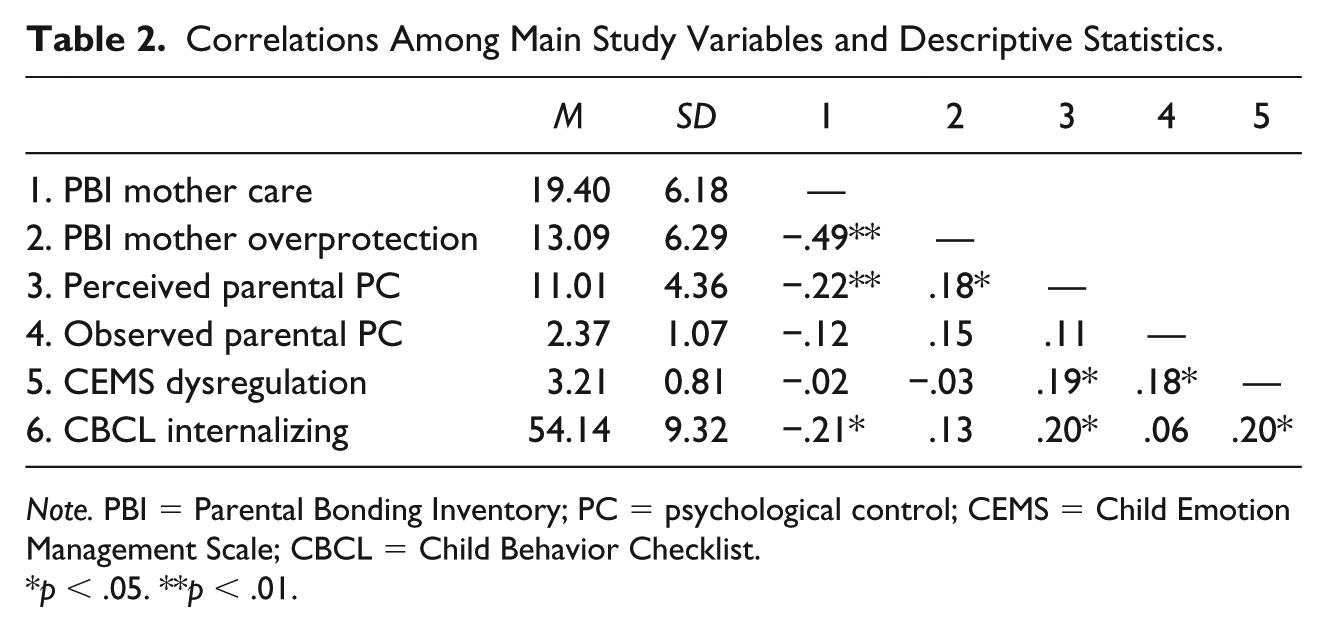
Note. PBI = Parental Bonding Inventory; PC = psychological control; CEMS = Child Emotion Management Scale; CBCL = Child Behavior Checklist.
p < .05. **p < .01.
Correlational analyses showed that the child’s gender, the total household income (an index of family socioeconomic status) and the child’s age were not significantly associated with any of the study variables. For this reason, these factors were not included in further analyses.
Furthermore, considering that descriptive statistics on major studied variables from mothers and fathers were reported separately, we implemented t tests to investigate the potential differences between the mothers (n = 121) and fathers (n = 29). The results showed that there were no significant differences between mothers and fathers on major study variables, except for grandmother’s care, t(144) = 2.12, p < .05, and observed parental psychological control, t(53) = −2.47, p < .05. Specifically, fathers scored higher than mothers on maternal care they received in childhood, and mothers scored higher than fathers on observed parental psychological control.
Serial Mediation Models
The serial mediation analyses investigated whether parental psychological control and child emotion regulation mediated the association between grandmothers’ parenting and children’s internalizing symptoms. SPSS PROCESS macro (Model 6 in PROCESS) was executed with perceived or observed parental psychological control along with child emotion regulation as mediators in one analysis. All paths for the serial mediation models are shown in Figure 2. Ordinary least squares path analysis was used in this procedure to determine the direct and indirect effects of the grandmothers’ parenting on child psychopathological symptoms.
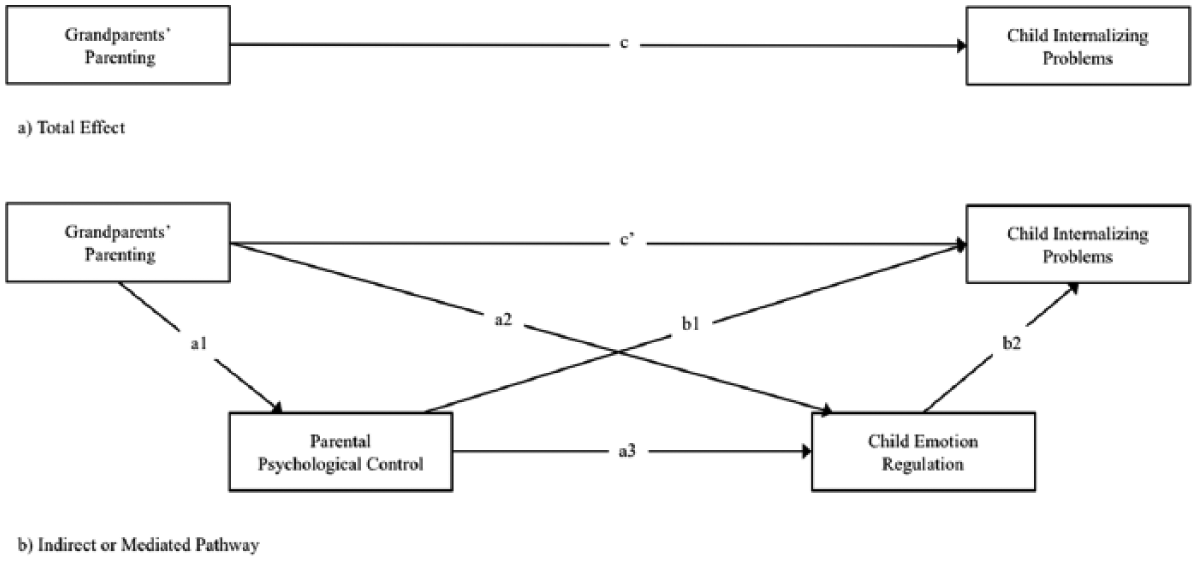
Serial mediation models with parental psychological control (perceived or observed) and child emotion regulation as mediators of grandparents’ parenting (care or overprotection) on children’s internalizing problems. And all pathways for the serial mediation models were displayed.
Because there existed two types of grandmothers’ parenting (care or overprotection), and two measures of parental psychological control (perceived and observed), the serial mediation analyses were run four times using perceived parental psychological control as one mediator and grandmother’s care as an independent variable (Model 1), then again with grandmother’s overprotection as an independent variable (Model 2). Similarly, two more path analyses were conducted with observed parental psychological control replacing the perceived one as one mediator and with grandmother’s care (Model 3) and grandmother’s overprotection (Model 4) as independent variables, respectively.
All variables were centered, and the coefficients for each pathway in these eight models are shown in Table 3. We first tested whether perceived psychological control and child emotion regulation sequentially mediated the relationship between the grandmother’s care and the child’s internalizing problems. As shown in Table 3 (Model 1), the total effect (c) of the grandmother’s care on the child’s internalizing problems was significant (β = −.19, p < .05), but the direct effect (c’) was no longer significant when controlling for the effects of the mediators (β = −.15 [−.32, .01], p > .05). The specific indirect effect of grandmother’s parenting on child psychopathology through both perceived parental psychological control and child emotion regulation (a1a3b2) was significant (β = −.01 [−.02, −.00], p < .05). In Model 2, we tested this serial mediation with grandmother’s overprotection as the independent variable, but no significant results were found in terms of the total effect (β = .10, p >.05), the direct effect (β = .08 [−.08, .24], p >.05) or any indirect effect (a1a3b2: β = .01 [−.00, 02]; a1b1: β = .02 [−.01, .06]; a2b2: β = −.01 [−.04, .03]; ps >.05). With regard to the observed parental psychological control as the mediator, the total effect and the direct effect of grandmother’s care on the child’s internalizing symptoms (tested as Model 3) was significant. However, none of the specific indirect effects was significant. Last, none of the total effects, the direct effects or the indirect effects of grandmother’s overprotection on child internalizing symptoms (tested as Model 4) was significant.
Path Coefficients From Models Estimated using PROCESS.
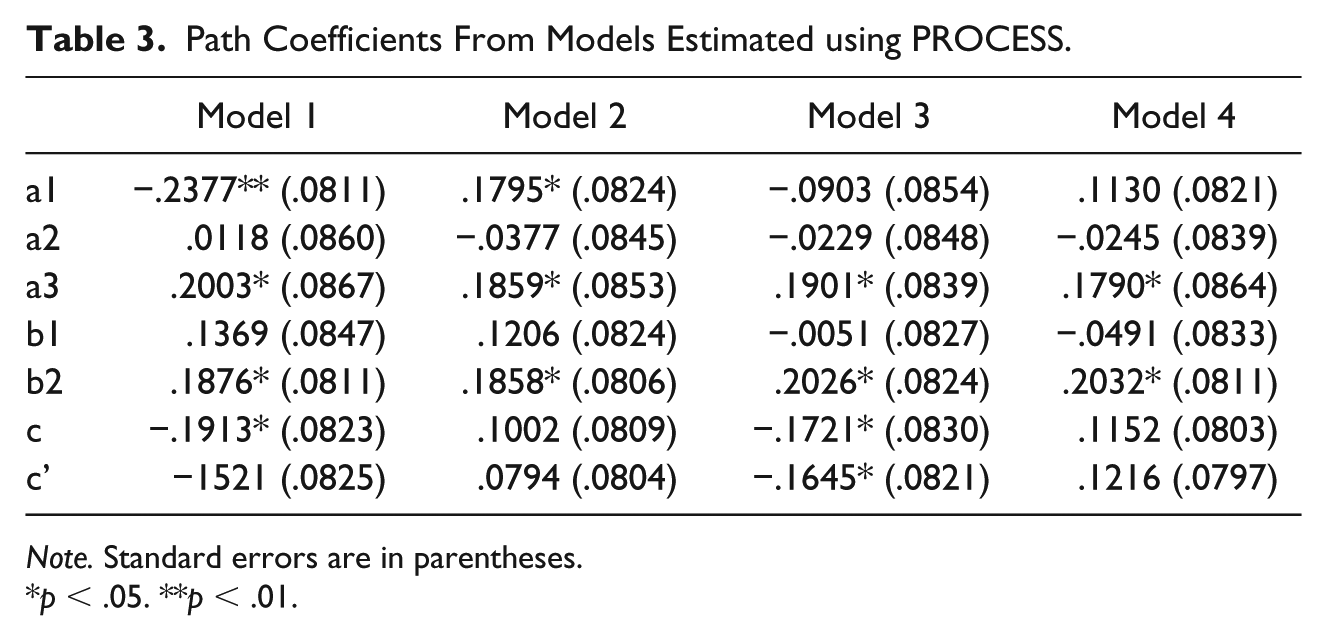
Note. Standard errors are in parentheses.
p < .05. **p < .01.
Discussion
The primary goal of this study was to investigate whether children’s emotion regulation (G3) served as an underlying mechanism associating the psychological control of their parents (G2) and their own internalizing problems and to identify whether the parenting styles of grandparents (G1) foreshadowed the psychologically controlling behaviors of G2. Serial mediation models were used to test whether parental psychological control and child emotion regulation serially mediated the association between the parenting style of G1 and internalizing symptoms of G3. We found that grandmother’s care from G1 was related to less perceived (but not observed) psychological control of G2, which further led to less internalizing problems of G3 through better child emotion regulation. The current study contributed to the existing literature by showing the significant role of emotion regulation in explaining the detrimental effects of perceived psychological control as well as identifying the intergenerational factors that might foreshadow parental psychological control.
Differences in Observed and Perceived Parental Psychological Control
First, an interesting and noteworthy finding is that perceived parental psychological control served as a potential influencing factor for child emotion regulation, whereas the observed psychological control does not. There are two possible interpretations for this finding. One is that perceived and observed psychological control might serve as underlying mechanisms in a different nature. This interpretation is consistent with Barber’s (1996) speculation, that is, the impacts of psychological control are mainly dependent on the extent to which children perceive these behaviors as controlling behaviors. Furthermore, numerous studies have demonstrated the crucial impacts of the perception of the parenting and family atmospheres on emotion regulation, from early childhood to adulthood (e.g., Brenning, Soenens, Van Petegem, & Vansteenkiste, 2015; Houltberg, Henry, & Morris, 2012; Jaffe, Gullone, & Hughes, 2010; Luebbe et al., 2014; Yan, Han, & Li, 2016). However, observed parental psychological control measured actual controlling behaviors rather than to what extent children perceived them. It is possible that parental psychological control is relatively high, but the child does not regard them as controlling behaviors, and vice versa. To what extent children perceive parental psychological control has an impact on how they perceive the family context and their relationship with parents. If children think that they are being highly controlled psychologically, they are more likely to consider the context as coercive and the relationship as insecure, which further impairs their abilities to regulate emotions. By contrast, if children do not consider that they are psychologically restrained, regardless of the actual situations, they might not think negatively of their family context or attachment with parents. Consequently, the extent to which the children perceived parental psychological control wields more impact on the children’s development.
An alternative explanation is that the difference between the influence of perceived and observed psychological control results from the use of different measures. In fact, emerging studies have demonstrated that observed negative parenting styles and practices indeed wield significant impacts on behavioral-level emotion regulation (e.g., McCullough, Harding, Shaffer, Han, & Bright, 2014; Turpyn, Chaplin, Cook, & Martelli, 2015) and on children’s brain development, as well (Whittle et al., 2016). However, the correlations between the perceived and observed parental psychological control in the current study was relatively weak, which might render it possible to interpret differentiated results as a consequence of disparate methodologies apart from distinct underlying mechanisms. Therefore, further studies should be implemented to further investigate the distinct roles of perceived and observed parental psychological control in children’s emotional development. Another caveat is that the perceived parental psychological control and children’s emotion regulation were both reported by the children themselves, and the correlation may be inflated due to their common source. Further studies should be conducted to investigate the current models by incorporating multiple methods (e.g., physiological methods) to measure children’s emotion regulation to reduce common source bias.
Cultural Consideration
Our results show that parental psychological control significantly and positively associate with children’s internalizing problems through their impact on children’s abilities to regulate emotions in the current Chinese sample. This finding might be explained by Soenens’s (2010) theoretical model of parental psychological control based on the self-determination theory, which postulates that psychological control is negatively associated with individuals’ developmental adjustments due to its impairing role on universal needs, namely autonomy, competence, and relatedness. Parental psychologically controlling behaviors might indicate a lack of autonomy support toward children, which could potentially stifle children’s volition and create a coercive family context. Additionally, children might be more likely to form an insecure relationship with their dominant parents due to less interpersonal trust which might render them to feel unsafe to express their own feelings and thoughts and further develop maladaptive strategies, such as rumination and suppression, to regulate emotions. Although some have stated that parental psychological control might be harmful only in the society where independence is highly valued (e.g., Western culture) our findings with Chinese families are still consistent with those conducted within Western cultural contexts.
Indeed, Chinese traditional culture emphasizes interdependency and interpersonal harmony and psychological control seem to not deviate from this cultural value. Some studies find psychological control is not associated with maladaptive child outcomes (i.e., academic achievements and self-esteem) in some groups with collectivistic orientations (e.g., Rudy & Halgunseth, 2005). However, many have suggested that although Chinese parenting is still largely influenced by these traditional cultural values, a Western and child-centered approach has gradually been incorporated in contemporary parenting in China, particularly among more highly educated Chinese parents (Xu et al., 2005). For example, the cultural values and parenting styles in Mainland China are changing rapidly that less parental control and greater autonomy support to children seem to be associated with more desirable outcomes (Fung & Lau, 2012). The current study finding supports this new trend, which is less perceived parental psychological control is associated with more positive child outcomes.
Conclusion, Limitations, and Future Directions
In conclusion, the current study made one of the first attempts, using serial mediation models, to explore the explanation for the detrimental effects of parental psychological control on children’s well-being as well as its antecedents among Chinese children in their middle childhood. The investigation of child emotion regulation as a potential mediator and parenting style of G1 as one of the potential antecedents expanded the existing literature on parental psychological control by showing its underlying mechanism and predictors.
However, the present study is subject to certain limitations. First, in the current study, only children’s self-reported emotion regulation was examined, which cannot comprehensively reflect children’s abilities to regulate their emotions. Future studies should include more objective measurements on children’s emotion regulation such as the physiological measurements and behavioral coding. Second, adopting only questionnaire methods and cross-sectional data, some core features of emotion regulation and psychopathology might be difficult to disentangle. Future research should incorporate multiple measures on emotion regulation and follow longitudinal approaches to produce a clearer distinction between emotion regulation and psychopathological symptoms. Third, the results with behavioral observation need to be interpreted with caution, as the laboratory observation on parenting might be particularly subject to the social desirability bias in which participants might intentionally show less negative parenting behaviors and more positive parenting behaviors. Fourth, in our study, parents were not asked about whether they lived with their parents, which meant that if grandmothers were still actively involved in parenting the child, current interpretations regarding the effects of the parenting styles of G1 on parents might be contaminated by the direct effects of grandmother’s parenting on the children’s development. Future studies should pay attention to this issue when investigating intergenerational transmission of parenting. Finally, the current study examined specific antecedents in the categories of pressures from within. Given the notion that human behaviors are determined by the interactions of environmental, personal, and interpersonal factors (e.g., Belsky, 1984), future research should be devoted to simultaneously testing the antecedents of psychologically controlling behaviors from the aspects of pressures from within, pressures from above (relevant to social–contextual factors) and below (relevant to their children’s behaviors) to produce a more comprehensive understanding of these complex interactions (Soenens & Vansteenkiste, 2010).
Despite these limitations, the current findings shed light on the underlying mechanisms of parental psychological control and its antecedent parenting factors. These findings also have practical implications. First, practitioners could implement interventions that can help parents explore the impact of the parenting styles they received on their own parenting behaviors. In this way, parents might develop healthier parenting behaviors that can promote healthy relational, emotional, and psychological outcomes for their children. For example, Siegel and Hartzell (2013) proposed an inside-out approach to parenting, aiming to help parents make sense of their own childhood experience and further free them from patterns of the past that imprison them in the present. Meanwhile, the practitioners could also improve children’s emotion regulation ability to counteract the potential negative impact of parental psychological control. Last, based on cognitive therapy, practitioners might be able to adjust children’s perceptions of psychologically controlling behaviors to ameliorate their detrimental influences.
Footnotes
Authors’ Note
Jia Li and Nigela Ahemaitijiang contributed equally to this work.
Declaration of Conflicting Interests
The author(s) declared no potential conflicts of interest with respect to the research, authorship, and/or publication of this article.
Funding
The author(s) disclosed receipt of the following financial support for the research, authorship, and/or publication of this article: This research was funded by the National Natural Science Foundation of China (31500898).
