



Abstract
Few studies have examined the familial configurations of adopted children and how these configurations differ from those of nonadoptees. As a result, this study examines the relationship between adoption status and inequalities in the family structure of children. Our results indicate that adopted children are more likely to live in nuclear families compared with nonadopted children. Part of this is driven by the comparatively limited presence of adoptees in single-mother, single-father, and other types of nonnuclear families. Foreign-born adoptees are more likely to live in nuclear families compared with U.S.-born adoptees, but adoptees from racial and ethnic minority groups are less likely to live in such families compared with their White counterparts. These race-ethnic inequalities in family structure are however moderated by foreign-born status. Accordingly, our results indicate that foreign-born Black and Hispanic children have the highest odds of residing in nuclear families among the U.S. population of adopted children.
Keywords
Introduction
Family living arrangements play a fundamental role in children’s social and psychological development (Landale, Oropesa, & Noah, 2014; Landale, Thomas, & Van Hook, 2011; Manning & Lichter, 1996). In addition, variations in these arrangements can result in unequal access to resources and inequalities in child well-being that have many long-term consequences. It is against this backdrop that evidence on recent transformations in the familial characteristics of children must be understood. Today, children are more likely to live outside two-parent family contexts than they were in previous decades (Ellwood & Jencks, 2004). Driven by these changes, recent studies have increasingly investigated how well children fare in single-parent, blended family, and extended family configurations (Kennedy & Bumpass 2008; Manning, Brown, & Stykes, 2014; Sweeney, 2010). Few studies have, however, incorporated the outcomes of adopted children into the analysis of children’s living arrangements. This gap in the literature is surprising and persists despite the growing significance of adoption as a family-building strategy.
The main objective of this study is to bridge this gap by examining the relationship between adoption status and the likelihood of living in nuclear family contexts. This objective is motivated by three concerns. The first is that there are very few empirical descriptions of the living arrangements of adopted children and how these arrangements differ from those of nonadoptees. While adoptive families are now more common than they were in the past (Ruggles, Genadek, Goeken, Grover, & Sobek, 2017), and their contributions to child development well documented (Borders, Black, & Pasley, 1998; Hamilton, Cheng, & Powell, 2007; Monique Van Londen, Juffer, & van IJzendoorn, 2007), it remains unclear whether the ways in which they are configured are structurally different from those of nonadoptive families.
The second concern is driven by evidence showing the implications of family living arrangements for the welfare of children. Research shows that residence in single-parent families is negatively associated with academic achievement, poverty status, and long-term health trajectories among children (Garg, Melanson, & Levin, 2007; McLanahan & Sandefur, 1994). Similarly, residence in extended and blended families can have negative implications for child development (Astone & McLanahan, 1991; Zvoch, 1999). In contrast, children in two-parent families do well in a range of outcomes compared with other children. Yet the question of whether adoptees are more likely to reside in family contexts that promote child welfare than nonadoptees has not been extensively addressed with national-level data.
The third concern is that very little is known about inequalities in family living arrangements that exist within the population of adopted children. This concern is significant because adoptees vary in their social and demographic characteristics. One such variation is found in their national origins. While many of them are born in the United States, a significant number of them are not, and are adopted from foreign countries (Fong & Kwok, 2013). Despite these differences, few studies have examined whether the structural characteristics of the families of foreign-born adoptees differ from those of U.S.-born adoptees. Moreover, there are no systematic studies examining how the families of foreign-born adoptees differ from those of other foreign-born children. What we know about the significance of foreign-born status for children’s living arrangements continues to remain restricted to studies on the characteristics of the children of immigrants (Landale et al., 2011; Landale et al., 2014). Another dimension of inequality that could potentially affect the family arrangements of adoptees is that associated with race and ethnicity. Evidence indicates that the ethnoracial diversity found among adoptees is greater than that found in the overall population of children (Kreider, 2003; Kreider & Lofquist, 2015). Yet the question of whether this extensive diversity is associated with differences in the living arrangements of adoptees still remains unanswered.
In this study, therefore, we address these gaps in the literature by using data from the American Community Survey (ACS) to examine the family configurations of adopted children. In the process, we pay specific attention to the question of whether differences in the family structure of adoptees are circumscribed by variations in foreign-born status and ethnoracial characteristics. Our results indicate that adopted children are more likely to live in families with two, married parents than nonadoptees. Accordingly, we find that adoptees are more likely to live in familial environments theoretically associated with the promotion of child development outcomes compared with nonadoptees. Our results, however, show that there is a negative association between ethnoracial minority status and the likelihood of adoptees residing in such contexts. Specifically, we find that Black and Hispanics are among the least likely to live in such families among adopted children. We, however, find that these racial and ethnic differences are strongly moderated by foreign-born status with Black and Hispanic adoptees from foreign countries more likely to live in nuclear families than their U.S.-born peers. In fact, our results show that foreign-born Blacks and Hispanics are the most likely to live in nuclear family contexts in the overall U.S. population of adopted children.
Background
Over the years, various studies have shown how specific components of family contexts can affect the well-being of children. This body of work shows, for example, that parental characteristics are important determinants of children’s psychological, emotional, and social adjustment (Davis-Kean 2005; McLoyd 1998; Tudge, Hogan, Snezhkova, Kulakova, & Etz, 2000), and that sibling characteristics play a similar role in shaping these outcomes (Powell & Steelman, 1995). While family structure features very prominently in this literature, our understanding of its relevance for the well-being of adopted children is undermined by a lack of research examining how the configurations of their families differ from those of other children. This does not mean that we know nothing about the structural characteristics of adoptive families. Previous research indicates, for example, that adoptive families are structurally diverse and could range from traditional two-parent families to families with single parents, to single parents who are divorced, widowed, or separated (Kreider & Lofquist, 2015; Shireman, 1994, 1996).
For the most part, adoptees are generally well adjusted across these types of families (Groze & Rosenthal, 1991). However, variations in the structure of their families can expose them to several types of challenges that are now increasingly acknowledged in the literature. For example, adoptees in single-parent families are more likely to live in low-income environments and to be involved in postplacement family therapy compared with adoptees in two-parent families (Groze, 1991; Groze & Rosenthal, 1991). Like other children in single-parent families, adoptees in such families also lack the benefit of having parents with coresident spouses with whom the burdens of parenting can be shared.
Systematic studies examining whether adopted children are more likely to live outside two-parent family contexts compared with other children are nevertheless limited. Despite the lack of research examining such differences, a number of factors can be identified as possible mechanisms that can contribute to differences in family structure between adoptees and nonadoptees. Among the most important is parental selection. In other words, adoptive parents are socioeconomically different from other parents in ways that are possibly aligned with the type of family-building strategies used by the two. For example, adoptive parents have higher levels of educational attainment and higher incomes compared with nonadoptive parents (Hamilton, Cheng, & Powell, 2007; Thomas, 2016; Werum, Davis, Cheng, & Browne, 2018); however, both characteristics are positively associated with entry into marriage and with the formation of two-parent families (Horowitz, Parker, & Rohal, 2015). Adoptive parents are also positively selected on attributes associated with higher levels of family cohesion (Levy-Shiff, Zoran, & Shulman, 1997; Zhang & Lee, 2010). As such, the families of adopted children may have lower prospects of disruption due to divorce or separation compared with families with other types of children.
Foreign-born status and race-ethnic differences are two additional factors that could contribute to family structure differences between adopted and nonadopted children. Both factors are also complex and can affect these differences in several directions. For example, we know from prior studies that foreign-born children are more likely to live in two-parent families compared with U.S.-born children (Brandon, 2002; Landale et al., 2011). Much of this disparity is, however, driven by the selectivity of immigrant parents as well as by family reunification policies that increase the odds that immigrant children will live in nuclear families (National Academies of Sciences, Engineering, and Medicine & Committee on Population, 2016). Because this type of selectivity is linked with the attributes of parents, it does not apply to the characteristics of U.S.-born parents adopting children from abroad.
A more relevant dimension of selectivity useful for understanding why these parents are different is that related to their social and demographic attributes. Parents who adopt from abroad are more highly educated and wealthier compared with other adoptive parents (Thomas, 2016; Werum et al., 2018). This implies that their socioeconomic profiles are even more strongly associated with the formation of nuclear families. Another relevant factor that could affect the familial characteristics of these parents is related to various origin-country prerequisites on who is allowed to adopt. In many cases, foreign countries either have clear preferences for U.S. adoptive parents who are married or have explicit prohibitions against adoptions by single parents and unmarried couples (Jones, 2017; Milbrand, 2012).
With regard to racial and ethnic characteristics, prior studies provide various insights into how these characteristics can influence the family structure of adoptees. Research indicates that racial and ethnic minority children are typically overrepresented in nonnuclear family contexts such as single-parent families and nonparent families (Kreider & Fields, 2005). Whether or not such patterns are replicated among adopted children remains unknown partly because many adoptees live in families with parents who are not from minority groups (Ishizawa, Kenney, Kubo, & Stevens, 2006). Further complicating our understanding of the significance of racial and ethnic minority status is the fact that adoptees from these groups include children from other countries. However, there is limited research examining the joint significance of race-ethnicity and foreign-born status for the living arrangements of these children.
Taken together, previous studies provide useful pointers into the factors that can theoretically result in variations in the family structure of adopted children. Missing from these studies, are direct empirical assessments of the strength of these influences. In this study, therefore, we advance research on the living arrangements of adoptees by examining three research questions. First, is adoption status associated with differences in family structure among U.S. children? Accordingly, we start our analysis by investigating whether adopted children are less likely to live in adverse structural family contexts compared with nonadopted children. Second, to what extent is foreign-born status associated with variations in the family structure of adoptees? This question is addressed from two perspectives by assessing (a) family structure differences between foreign-born adoptees and other foreign-born children and (b) family structure differences between foreign-born adoptees and U.S.-born adoptees. Third, is the relationship between race-ethnicity and family structure among adoptees moderated by foreign-born status? In short, the analysis examines whether the familial configurations of adoptees in racial and ethnic minority groups vary depending on whether or not they were born in other countries.
Data and Method
We examine these questions using data from a recent 5-year sample of the ACS. These data are available in the Integrated Public Use Microdata Samples database of the University of Minnesota. Now containing the largest source of data on children in the United States, the ACS was designed to replace the previous long-form questionnaire of the decennial U.S. census. Beyond the advantage related to its size, the ACS provides individual-level information on measures such as income, education, and foreign-born status, as well as household-level information useful for examining the characteristics of families. In this study, we use data for the 5-year period between 2011 and 2016 and restrict the analysis to the outcomes of children younger than 18 years.
Measures
Dependent Variable
We construct a binary dependent variable that indicates whether children live in families with two, married parents. This allows us to approximate residence in nuclear families, which research indicates is positively associated with indicators of child well-being such as time spent with parents, educational attainment, and emotional adjustment (Fauber, Forehand, Thomas, & Wierson, 1990; Guttmann & Rosenberg, 2003; Harris, Furstenberg, & Marmer, 1998; Yeung, Sandberg, Davis-Kean, & Hofferth, 2001). Additionally, our dependent variable allows our analysis to reflect the increasing scholarly recognition of nuclear families as families with married parents and either their biological or adopted children (e.g., Blackwell, 2010). This approach of incorporating marriage in our dependent variable differs from that used in studies in which marital status is merely used as a control. In this study, it is used to underscore the centrality of parental marital status to family formation processes that can affect the types of living arrangements in which children reside. Apart from our main dependent variable, we create four dummy variables indicating whether children live in nuclear families, with single mothers, single fathers, and other family types to conduct sensitivity tests investigating variations in living arrangements across more diverse family types.
Independent Variables
Our key independent variable is a binary measure of adoption status. This variable is constructed using household relationship codes that indicate children’s relationship with their household head. Two additional independent variables are also used in the analysis. The first, foreign-born status, is measured as a dummy variable indicating whether children were born in a country other than the United States. The second, race-ethnicity, is operationalized using five dichotomous measures indicating whether children were non-Hispanic White, Black, Hispanic, Asian, or from other race-ethnic groups.
Controls
We control for other child- and household-level characteristics that are likely to be associated with variations in family structure. Child-level controls include age and birth order. Household-level controls include parental characteristics such as the race of household heads, which, along with our measure of child race, helps us account for the possible incongruence between the race of children and that of their adoptive parents. We also control for family income, family size, and the number of adopted children within families. Furthermore, given that prior studies show a positive association between educational attainment and marriage, we also control for the highest parental level of schooling within households. Similarly, we control for parental employment status.
Analytical Strategy
Our research questions are examined using logistic regression models that estimate variations in children’s odds of living in nuclear families. However, because the clustering of children within households can produce biased estimates of standard errors, we estimate our regression models with robust standard errors that account for household-level clustering. We conduct the analysis itself in two stages. First, we examine the relationship between adoption status and the likelihood of living in nuclear families as well as the extent to which this relationship is mediated by other factors. In the process, we further investigate the implications of foreign-born status for variations in the structure of families of adopted and nonadopted children. Second, we focus on the outcomes of adopted children to examine racial and ethnic differences in the odds of living in nuclear families and the extent to which these differences are moderated by foreign-born status. We end our analysis by testing whether our main findings are sensitive to our choice of dependent variable. Thus, we reestimate our main models using multinomial regression models that examine the relationship between our key independent variables and a dependent variable that accounts for a more diverse set of family types. While these estimates provide support for our findings, we did not present them as our main results because of sample size and other issues, which we later discuss.
Results
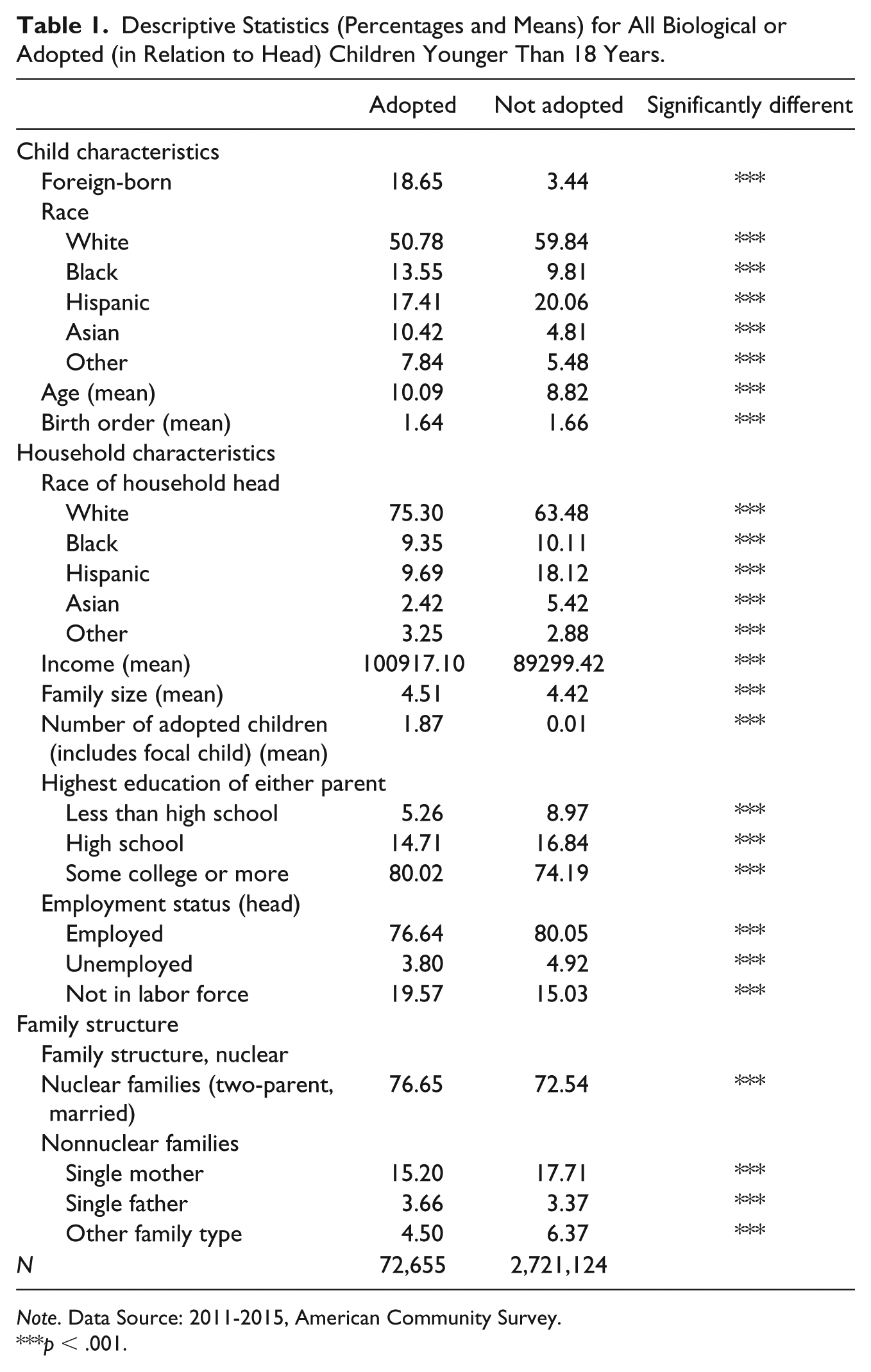
Table 1 presents summary estimates of the characteristics of adopted and nonadopted children in the sample. The most notable individual-level differences observed between the two are found in their demographic characteristics. Adoptees, for example, are about six times more likely to be foreign-born compared with nonadoptees. In fact, Table 1 indicates that one in every five adopted children is from a country other than the United States. This finding suggests that, despite the recent declines in international adoptions, foreign-born adoptees still maintain a notable presence in many American families. Consistent with previous studies, adoptees are more likely to be from racial and ethnic minority groups compared with nonadoptees. Part of this is driven by the overrepresentation of Black, Asian, and other race children in the adoptee population. On average, adoptees are also about a year and a half older than nonadoptees whereas no differences in the birth order are observed between the two.
Descriptive Statistics (Percentages and Means) for All Biological or Adopted (in Relation to Head) Children Younger Than 18 Years.
Note. Data Source: 2011-2015, American Community Survey.
p < .001.
Other differences between adoptees and nonadoptees are found in the characteristics of the households in which they reside. Approximately 75% of adopted children live in households headed by White parents compared with 63% among nonadoptees. Given that 50% of all adoptees are from racial minority groups, this suggests that adoptive families are more likely to contain parents and children of different racial groups compared with nonadoptive families. Another distinguishing characteristic of adoptees is that they live in comparatively larger families and in families with other adopted children. As expected, adoptive families are also characterized by their favorable socioeconomic characteristics—on average, they are wealthier families and have resident parents with higher levels of education. Finally, Table 1 shows the main differences in family structure between adoptees and nonadoptees. While most children generally live in nuclear families, regardless of adoption status, the percentage of children in such families is higher among adoptees. The specific types of nonnuclear families in which children reside also vary between the two groups with nonadoptees being more likely to live with single mothers and in other nonnuclear family types compared with adoptees.
Table 2 presents results from logistic regression models analyzing the predictors of living in nuclear families for all children in the sample. The baseline estimates (Model 1) indicate that, on average, adoptees are 24% more likely to live in nuclear families compared with nonadoptees. Model 2 includes controls for additional demographic characteristics of children; subsequently, adoptees’ higher odds of living in nuclear families are enhanced and continue to remain statistically significant. Model 2 also shows a remarkable association between family structure and foreign-born status. Compared with U.S.-born children, foreign-born children are more than 1.5 times more likely to reside in nuclear families. Family structure differences associated with foreign-born status thus appear to be much stronger compared with those associated with adoption status.
Logistic Regression Predicting Family Structure (Two-Parent, Married vs. Not) of Children Younger Than 18 Years in the United States, Odds Ratios Presented.

Note. Standard errors are in parentheses. Data: American Community Survey, 2011-2015.
p < .05. **p < .01. ***p < .001.
Adding controls for the parental and household characteristics of children in Model 3 results in contrasting implications for adoption status and foreign-born status. Specifically, the prior family structure difference between adoptees and nonadoptees is no longer statistically significant, although the odds ratios show a slight persistence of the advantage of adoptees. More generally, the higher odds of living in traditional nuclear families observed among adoptees in the first three models may also reflect the influence of other unobserved factors. Until recently, for example, many U.S. states prohibited same-sex couples from adopting (Reilly, 2016), which gave traditional nuclear families more opportunities to adopt children. Outside the United States, some of the major origin countries of foreign-born adoptees had similar rules that gave greater preferences to parents in nuclear families (U.S. Department of State, 2018). In terms of the difference between all foreign-born and all U.S.-born children, Model 3 shows that the difference between the two remains considerable even after parental and household characteristics are controlled.
Model 4 turns attention to the question of whether foreign-born status moderates the relationship between adoption status and family structure. As shown by the interaction term in the model, the strong buffering influence of foreign-born status is not equally experienced by all immigrant children. Among this group, foreign-born adoptees are significantly less likely to live in nuclear families compared with their nonadopted counterparts.
Apart from adoption status and foreign-born status, there are other notable determinants of residence in nuclear families shown in Table 2. With the exception of Asian children, all children from racial minority groups are less likely to live in nuclear families compared with non-Hispanic White children. Furthermore, birth order is positively associated with residence in nuclear families, possibly reflecting a greater preference for children among married parents compared with parents in other family types. A similar finding is reported in the results showing the effects of family size on family structure. On average, children in larger families are more likely to live with two married parents compared with children in smaller families. Finally, as expected, the odds of living in nuclear families are socioeconomically differentiated with the highest odds of living in such families found among children with highly educated parents and those in the wealthiest family quartile.
In summary, the results so far show two major findings. First, adoptees are disproportionately more likely to reside in families with two married parents compared with nonadoptees, but this disparity is explained by differences in their demographic and household characteristics. Second, there is also a greater presence of foreign-born children in these contexts, which is robust to the influence of these factors.
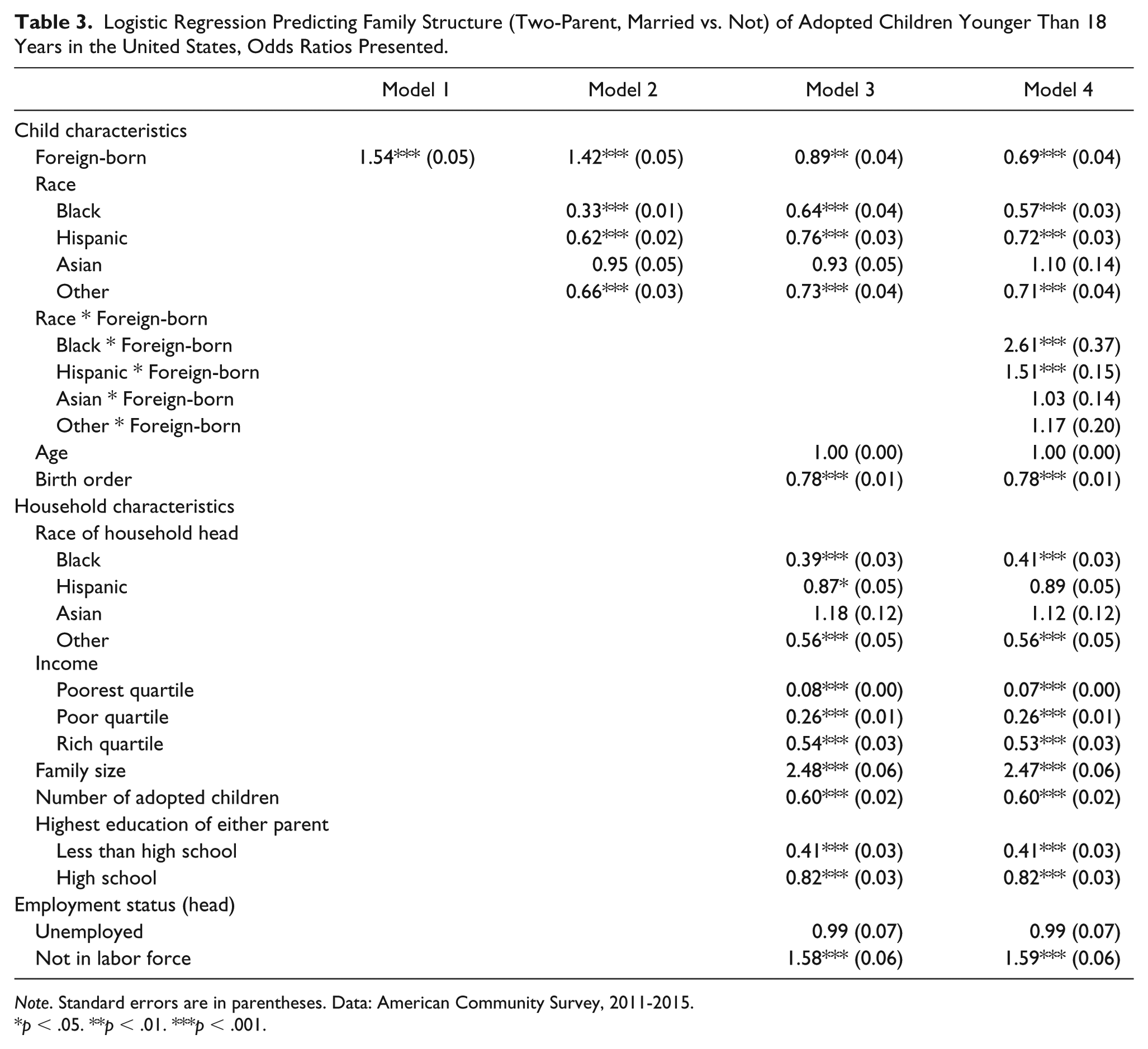
Restricting the analysis to the sample of adopted children, Table 3 explores the significance of foreign-born status further and the extent to which it moderates the influence of racial and ethnic characteristics on inequalities in family structure. Beginning with the examination of gross differences between foreign-born adoptees and their U.S.-born adoptees, Model 1 shows that the former are about 50% more likely to live in nuclear families compared with the latter. This disparity remains after racial and ethnic differences are controlled (Model 2), but this is completely reversed after other household characteristics are controlled (Model 3). Instructively, the reversal is consistent with the notion that foreign-born adoptees generally live in families with the type of social characteristics that would have qualified them for selection as adoptive families. Many origin countries of foreign-born adoptees have rules that require U.S. adoptive parents to meet income thresholds, be married, and have a specific number of children already living in their families (Skellenger, 2017). China, for example, requires prospective American adoptive parents to have a net worth of at least $80,000. Similarly, South Korea and Ukraine have minimum income requirements and generally limit eligibility (U.S. Department of State, 2018).
Logistic Regression Predicting Family Structure (Two-Parent, Married vs. Not) of Adopted Children Younger Than 18 Years in the United States, Odds Ratios Presented.
Note. Standard errors are in parentheses. Data: American Community Survey, 2011-2015.
p < .05. **p < .01. ***p < .001.
Both Models 2 and 3 also show racial and ethnic differences in family structure among adoptees. Compared with their White counterparts, adoptees who are either Black, Hispanic, or from other race-ethnic groups are significantly less likely to live in nuclear families (Model 2). This may be associated with recent observations that adoptees from racial minority groups are more likely to live outside two-parent families when they have same-race parents (Kreider & Raleigh, 2016). As the results show, these racial inequalities increase after accounting for household characteristics and are most pronounced in comparisons between Black and White adoptees. In Model 3, for example, the former are recorded as being 35% less likely to live in nuclear families with two-married parents compared with Whites, the largest comparative differences across race-ethnicity.
Model 4 examines the specific question of whether racial and ethnic differences in family structure among adoptees are moderated by foreign-born status. Surprisingly, the interaction terms indicate that the generally lower odds of living in nuclear families among adoptees from minority groups are not experienced by their same-race counterparts from foreign countries. Indeed, the highest odds of living in nuclear families are found among Black foreign-born adoptees, who are followed by their foreign-born peers who are Hispanic. These findings are observed after controlling for factors such as the race-ethnic characteristics of household heads and their socioeconomic attributes. Thus, greater tendency for foreign-born adoptees to live in nuclear families does not depend on the racial characteristics of their parents or by the fact that they generally live in socioeconomically more favorable environments. As previous studies suggest, foreign-born adoptees usually have married parents who live in households that are similar with what is considered to be the American, normative family ideal (Werum et al., 2018).
We test the sensitivity of our main findings by estimating multinomial regression models that predict variations in the odds of living in a more diverse set of family types—single mother, single father, and other types of families. The results, provided in the appendices, show at least four sets of findings. The first is that adopted children are significantly less likely to live in single-mother and single-father families (relative to nuclear families) compared with nonadoptees after other factors are controlled (Appendix A). Similar results are found in terms of the role of foreign-born status suggesting that, even when family structure is conceptualized as a more diverse set of outcomes, foreign-born children remain comparatively less likely to reside in nonnuclear family contexts compared with U.S.-born children. Second, our tests indicate that the interaction between foreign-born status and adoption status is associated with significantly higher odds of living in single-mother, single-father, and other family types than in two-parent families (Appendix A). In other words, among the foreign-born, adoptees are more likely to reside in single-mother, single-father, and other nonnuclear family contexts compared with nonadopted children. Stated another way, this finding is consistent with results presented in Table 2 (Model 4) showing that foreign-born adoptees are less likely to live in nuclear families than in other foreign-born children. Another finding revealed by the sensitivity tests is that foreign-born adoptees are less likely to live in nonnuclear family contexts, such as in the two types of single-parent families, compared with U.S.-born adoptees (Appendix B). Finally, adoptees from racial minority groups, especially Blacks and Hispanics, are generally more likely to live in nonnuclear families such as single-mother, single-father, and other families than their White counterparts.
Tests of the moderating influence of foreign-born status on adoptee racial and ethnic differences did not yield substantive results due to the failure of the multinomial models with these interactions to converge. One explanation for this is that in each racial group there were very few cases of foreign-born adoptees who live in single-mother, single-father, or other types of nonnuclear families. Nonetheless, the general conclusion from the sensitivity tests is that the main findings from the analysis are robust to the conceptualization of family structure as a diverse set of multinomial outcomes.
Discussion and Conclusion
Notwithstanding recent research on the welfare of adopted children, few studies have systematically examined the structure of the families in which they reside. As a result, it is easy to assume that adoptees live in families with structural characteristics that are similar to those of other children. Using data from the recent sample of the ACS, our analysis expands what we know about the structural configurations of adoptive families in several important ways. We demonstrate that adoption status is associated with significant variations in the family structure of children. Furthermore, we draw attention to the importance of foreign-born status and ethnoracial differences for understanding inequalities in the family structure among adopted children. By demonstrating the salience of these inequalities, we also contribute to the broader incorporation of adoptees into the literature on the living arrangements of children. In so doing, we provide four clarifications to our understanding of the living arrangements of adoptees.
First, we specifically show that adopted children are more likely to live in traditional families with two, married parents compared with rest of the U.S. child population. More than most previous studies, therefore, our study demonstrates that adoptees generally have access to the types of familial environments linked with the most positive long-term consequences for the well-being of children. Children in nuclear families, for example, benefit from lower exposure to poverty and experience enhanced health outcomes compared with children in other types of families (Hao, 1995; Mauldon, 1990). While the greater presence of adoptees in such families in our analysis is unquestionable, we also show it is partly driven by the favorable socioeconomic attributes of their parents. As such, our findings are consistent with the possibility that parents who adopt are positively selected on observable characteristics such as income and schooling that could predict the formation of nuclear families.
Second, our results clarify the role of foreign-born status for understanding the familial configurations of adoptees. Starting with the analysis of differences between foreign-born and U.S.-born children, we confirm that the former are more likely to live in nuclear families compared with the latter. Notably, however, our results indicate that this buffering influence of foreign-born status is mainly driven by the outcomes of nonadopted children. This may reflect the fact that the structure of most immigrant families is affected by factors such as gender norms in origin countries and family reunification policies (Glick, 2010; National Academies of Sciences, Engineering, and Medicine & Committee on Population, 2016). As the results suggest, these factors, which contribute to the greater presence of immigrant children in nuclear families, do not appear to be major influences of the structure of families that adopt foreign-born children. Where the foreign-born status of adoptees matter is in comparisons between foreign-born adoptees and their counterparts born in the United States. Our results indicate that the former have more access to nuclear family environments than the latter but that this disparity is entirely explained by variations in the demographic and household characteristics of the former.
Third, our analysis finds that adopted children from racial minority groups have familial structural characteristics that closely mirror those of other children from racial minority groups. As observed among their nonadopted peers, we find that much of the race-ethnic disadvantage is driven by the outcomes of Black and Hispanic adoptees. Our sensitivity tests further indicate that it is among these children that we find some of the highest odds of living in single-mother or single-father families. These inequalities are concerning. They imply that many adoptees from racial minority groups not only deal with some of the challenges associated with adoption status but also with the constraints of residence in family environments most often associated with having an absentee parent. Indeed, previous studies indicate that adoptees from racial and ethnic minority groups are more likely to live in families with parents who are divorced, widowed, or separated (Kreider & Fields, 2005).
Finally, our results indicate that the odds of living in such nonnuclear family environments among adoptees from minority groups are highly conditional on foreign-born status. As we show in the analysis, unlike their U.S.-born counterparts, Black and Hispanic adoptees who are foreign-born are generally more likely to reside in nuclear families. In fact, these adoptees have some of the highest odds of living in such families among the population of adopted children. That this finding holds even accounting for differences in the demographic and household characteristics of children is significant. It implies that residence in nuclear families among these children is not driven by their demographic characteristics or those of their parents but by other factors unaccounted for in the analysis.
Several possibilities are likely to explain these findings. For one, they could reflect the fact that married couples with preferences for adoptees from racial minority groups are more likely to pursue international adoptions compared with other parents. Marriage involves a longer relationship commitment that allows couples to make the high levels of investment needed to adopt children from other countries. At the same time, we cannot ignore the role of origin country prerequisites for prospective adoptive parents in contributing to the disproportionate presence of foreign-born adoptees in nuclear families. It is still unclear why these influences would lead to disproportionately higher odds of living in such families for Black or Hispanic foreign-born children. Perhaps these odds reflect the long-term influence of policies in specific origin countries in the recent past on the current race-ethnic composition of foreign-born adoptees in U.S. families.
The main limitations of the study are tied to the constraints associated with our use of the ACS data. Because these data are cross-sectional, they do not allow us to examine the extent to which family structure changes after the adoption of children. Consequently, it is difficult to examine the question of whether nuclear families with adopted children are less likely to be affected by divorce or separation compared with other nuclear families. The ACS also does not allow us to answer questions related to the status of children adopted by the spouses (step parents) of their biological parents nor does it allow us to identify children who no longer live with their adopted parents. While the ACS is useful for providing a general overview on the living arrangements of adoptees, it is not suited for examining the full range of processes that determine whether or not adopted children live in nuclear families. Other limitations in the analysis include our inability to distinguish between public and private adoptions and between children living in various types of extended families. Although these influences are difficult to examine with our data, they represent important issues that could be more systematically examined in future studies.
Footnotes
Appendix
Multinomial Regression Predicting Family Structure (Reference = Two-Parent, Married) of Adopted Children, Odds Ratios Presented.

| Model 1 | Model 2 | |
|---|---|---|
| Single mother | ||
| Foreign-born | 0.74*** (0.03) | 0.78*** (0.08) |
| Race | ||
| Black | 4.10*** (0.07) | |
| Hispanic | 1.70*** (0.07) | |
| Asian | 1.26*** (0.11) | |
| Other | 1.72*** (0.09) | |
| Single father | ||
| Foreign-born | 0.63*** (0.04) | 0.72*** (0.04) |
| Race | ||
| Black | 1.52*** (0.04) | |
| Hispanic | 1.05 (0.04) | |
| Asian | 0.78* (0.06) | |
| Other | 1.01 (0.05) | |
| Other family structure | ||
| Foreign-born | 0.39*** (0.03) | 0.46*** (0.08) |
| Race | ||
| Black | 1.55*** (0.07) | |
| Hispanic | 2.01*** (0.06) | |
| Asian | 0.66*** (0.13) | |
| Other | 1.48*** (0.08) | |
Note. Model 2 includes all controls. Standard errors are in parentheses. Data: American Community Survey, 2011-2015.
p < .05. **p < .01. ***p < .001.
Declaration of Conflicting Interests
The author(s) declared no potential conflicts of interest with respect to the research, authorship, and/or publication of this article.
Funding
The author(s) disclosed receipt of the following financial support for the research, authorship, and/or publication of this article: We acknowledge assistance provided by the Population Research Institute at Penn State University, which is supported by an infrastructure grant by the Eunice Kennedy Shriver National Institute of Child Health and Human Development (P2CHD041025).