



Abstract
In this study, we examined parental self-efficacy (PSE) in light of Bandura’s distinction between efficacy expectations and outcome expectations, and their links to parenting practices. We used a sample of 968 parents of children aged 11 to 18 years and examined the factor structure of items measuring PSE and parents’ outcome expectations, as well as the links between these two cognitive aspects and parenting practices. The results suggested that PSE and our measure of parents’ outcome expectations constituted two distinct factors and were not part of the same overall factor. Additionally, the analyses showed that PSE might be seen as a unidimensional construct with multidimensional aspects and was more strongly linked to parenting practices than were parents’ outcome expectations. In general, this study offers a comprehensive model of two different parental cognitive mechanisms as antecedents of parenting behaviors in different developmental periods.
Introduction
Parental self-efficacy (PSE) describes parents’ beliefs in their ability to parent and to influence their children’s development and is an important factor not only for parents’ behaviors (Bandura, 1977; Jones & Prinz, 2005) but has also an indirect effect, via parenting practices, on behavioral outcomes in children (Glatz & Buchanan, 2015b). Although PSE has received major attention in research, one problem is the lack of distinction from other similar cognitive constructs that are often used interchangeably (Črnčec, Barnett, & Matthey, 2010; Wittkowski, Garrett, Calam, & Weisberg, 2017). One example is the lack of distinction between parents’ efficacy expectations (i.e., PSE) and outcome expectations, which according to Bandura (1977, 2006) are separate constructs.
In the current two-part study, we start from Bandura’s (1977) self-efficacy theory, and from the existing operationalizations of PSE. In the first study, we perform an in-depth examination of the factor structure of PSE, testing whether an existing measure of PSE is distinct from a measure that we operationalize as parents’ outcome expectations. In Study 2, and in line with Bandura’s theory (1977, 1997), we explore links between PSE and outcome expectations to parenting practices among parents of children aged 11 to 18 years. Thus, this two-part study provides a theoretical model for understanding how different cognitive factors—that is, parental beliefs in their abilities and parental beliefs regarding the outcomes of their behaviors—are linked to their caregiving behaviors across different developmental periods.
Conceptualization of Self-Efficacy and Outcome Expectations
As an important cognitive factor in generating and regulating behaviors, a person’s self-efficacy is defined as “beliefs in one’s capabilities to organize and execute the course of action required to produce given attainments” (Bandura, 1997, p. 3). As an important addition to this definition, Bandura (1977, 2006) has made a distinction between efficacy expectations (i.e., self-efficacy) and outcome expectations: “Perceived self-efficacy is a judgment of capability to execute given types of performances; outcome expectations are judgments about the outcomes that are likely to flow from such performances” (Bandura, 2006, p. 309). Hence, self-efficacy involves a person’s perceptions about personal competence and about possessing the necessary capabilities to act in a given way. Outcome expectations describe person’s perceptions about whether this given action will result in the expected outcome. Theoretically, both of these expectations play a key role in human behaviors (Bandura, 1977, 1984, 2006), but they should be differentiated because they represent different mechanisms in the determination of behaviors. How these concepts are related, however, is not clear-cut (Pajares, 1997). Despite the theoretical differentiation between efficacy expectations and outcome expectations, there is little empirical research exploring the relation between the two concepts and their links to behavior.
There are contrasting theoretical viewpoints as to whether self-efficacy and outcome expectations have different and independent influences on a person’s behavior. On the one hand, Bandura (1984) argued that outcome expectations, without efficacy beliefs, are not necessarily enough to change behavior. A person might believe that a particular behavior will result in a given attainment, but if the person has doubts about whether he or she can perform this particular behavior, the belief about the outcome will not guide behavior (Bandura, 1977). In other words, outcome expectations should not uniquely contribute to behavior when efficacy expectations are controlled. Other researchers have argued that these two concepts are indeed independent, but that outcome expectancies can also influence people’s behaviors independent on the level of self-efficacy (e.g., Eastman & Marzillier, 1984; Pajares, 1997). Specifically, a person might believe that a particular course of action will produce a given outcome (i.e., having high outcome expectations), but might not believe that he or she can perform the necessary activity (i.e., having low self-efficacy). In such case, the person is less likely to get involved in given activity. Similarly, a person who perceives that he or she can perform the necessary act (i.e., having high self-efficacy), but believes that there are other obstacles for this act to result in the desired outcome (i.e., having low outcome expectations), is less likely to act as well.
The Distinction Between Parental Self-Efficacy and Parents’ Outcome Expectations
PSE is one specific dimension of a person’s self-efficacy (Bandura, 1977), and is defined as: “ . . . a parent’s beliefs in their ability to influence their child and the environment in ways that would foster the child’s development and success” (Jones & Prinz, 2005, p. 342). Scrutinizing the definition of PSE, in contrast to that of personal self-efficacy, it does not distinguish between parents’ efficacy expectations and their outcome expectations. Rather, from this definition, it is possible to locate core elements of both efficacy expectations and outcome expectations. Parents’ efficacy expectations represent parents’ perceived ability to parent in a specific way that will have an influence on the child. Outcome expectations are represented by the notion that this specific parenting behavior will result in children’s positive development and adjustment.
Following the definition, measures of PSE have not distinguished between parents’ efficacy expectations and their outcome expectations. For example, Bandura (2006) suggested a structure of questions aiming at what parents can do rather than what they will do, such as “How much can you do to make your child see school as valuable?” Although this type of question would capture parents’ beliefs about their abilities, it is difficult to know what cognitive aspects are in focus. In fact, this question can get at both parents’ efficacy expectations and their outcome expectations: Parents with low levels on this question might (a) believe that they cannot perform the behavior that would make the child see school as valuable because they do not have what it takes to perform such a behavior (i.e., parents’ efficacy expectations); (b) believe that they cannot make the child see school as valuable because the required parenting behavior does not lead to the expected outcome (i.e., outcome expectations); or (c) both of these options. However, because this, and other similar questions, asks parents what they can do, it can be argued to get at parents’ beliefs about their capability to execute given performance (i.e., efficacy expectations), and might not clearly cover parents’ outcome expectations. Other researchers have used similar wordings in their measures of PSE (e.g., “I can soothe my baby when he or she is distressed”; Črnčec, Barnett, & Matthey, 2008), whereas other researchers have used more general language to refer to PSE (e.g., “I have all the skills needed to be a good parent”; Badr, 2005, for reviews, see Črnčec et al., 2010; Jones & Prinz, 2005). These questions might also be argued to measure parents’ beliefs about their abilities to act in certain ways more so than parents’ beliefs about the outcome of such behaviors. This, however, is yet to be examined.
Parents’ Outcome Expectations
There are limited ideas about how to operationalize parents’ outcome expectations. Drawn from the general definition (Bandura, 1977, 2006), parents’ outcome expectations should deal with parents’ beliefs about whether their parenting behaviors will result in certain expected outcomes. One potential way to differentiate parents’ outcome expectations from parents’ efficacy expectations is to conceptualize outcome expectations as being partly dependent on external factors (e.g., a person’s beliefs about external factors that might hinder their behaviors to result in a given outcome rather than about personal competence or capabilities). In the context of parenting children, outcome expectations might be conceptualized as parents’ perceptions about external factors that, although they think they can parent in a specific way, hinder the expected outcomes in their child.
Several external factors might be relevant to explain why parenting practices do not lead to expected outcomes. One potentially critical factor for parents is whether they believe their parenting efforts will have an expected outcome lies within the child’s temperament. Specifically, parents might believe they have the prerequisite to act in a given way, but the child might hold certain traits that prevent an expected outcome to flow from the specific act. This conceptualization involves a trait of the child as an external and essential factor for whether specific parenting practices will result in an expected outcome. In one study (Glatz, Stattin, & Kerr, 2011), parents’ perceptions of their child’s unresponsiveness to their corrections were shown to be important for parents’ feelings of powerlessness as well as their parenting practices. This conceptualization might be applied to parental outcome expectations, as it focuses on an external factor for parenting failure—the child is not responsive to or open for their influence (i.e., parents’ outcome expectations)—and should, theoretically, be different from parents’ beliefs about their ability and competence to act in a certain way (i.e., parents’ efficacy expectations).
Similar operationalizations have been made in the few studies in which parents’ outcome expectations regarding parenting behaviors and effects of parenting behaviors have been studied. For example, Dilorio et al. (2001) studied parents’ communication with their adolescent about safe sex practices or other issues related to sex and measured parents’ outcome expectations by asking whether parents thought their adolescent would listen to and follow their guidelines on this aspect. Parents’ efficacy expectations, on the other hand, was measured by asking parents how sure they were that they could communicate to their adolescent about safe sex practices and other sex-related aspects. In the study by Dilorio et al. (2001), the distinction, thus, lay in the parents’ beliefs in their ability to act in a certain way and whether this behavior would have the expected outcome (i.e., that the child would listen and act accordingly).
The Link to Parenting Practices
The theorized link (Bandura, 1977, 1997) between PSE and parenting behaviors has been supported in several studies: A higher level of PSE predicts more positive parenting (such as warmth and responsiveness) and less negative parenting practices (such as inconsistent and harsh discipline; e.g., de Haan, Prinzie, & Deković, 2009; Dumka, Gonzales, Wheeler, & Millsap, 2010; Glatz & Buchanan, 2015b; Slagt, Decović, de Haan, van den Akker, & Prinzie, 2012; Verhage, Oosterman, & Schuengel, 2013). Although these studies show an important pattern—parents’ perceptions about their influence on their children are important for their subsequent parenting behaviors—they have not differentiated between parents’ efficacy expectations and outcome expectations, making it difficult to conclude what factor is driving this link. Hence, these studies leave unanswered questions about the cognitive mechanisms behind parenting behaviors and there is a need to examine the hypothesized link between PSE and parenting from the perspective of parents’ efficacy and outcome expectations. A more nuanced understanding of PSE that examines potential overlap between parents’ efficacy expectations and their outcome expectations might inform about the mechanisms in which parents’ cognitions are translated into behaviors.
Study 1
In the first study, we examined the factorial structure of an established PSE measure (Bandura, 2006) and our measure of parents’ outcome expectations, to answer the question whether these are separate constructs or if they are part of an overall construct of PSE. Our measure of parents’ outcome expectations focuses on parents’ perceptions of their child’s unresponsiveness to their socialization practices, as a way to capture parents’ perceptions of the usual outcomes of their parenting behaviors (i.e., outcome expectations), rather than their abilities to act in certain ways in their parenting role (i.e., efficacy expectations). This measure has been used elsewhere (Glatz et al., 2011; Kerr, Stattin, & Pakalniskiene, 2008) and has been linked to parents’ feelings of powerlessness—a concept that is similar to parents’ efficacy expectations—and problematic child behaviors (Glatz et al., 2011). Knowing if established PSE measures deal with parental beliefs in their parenting capabilities (i.e., parents’ efficacy expectations), or a combination of parental beliefs in their parenting capabilities and their beliefs regarding the outcomes of parenting, is necessary for theory development. This knowledge has important implications for our understanding of how parents perceive themselves and their parenting role and what factors might have an impact on their perceived influence.
Method
Procedures and Participants
Data for both studies came from a project including reports from parents (N = 1,077) collected in the United States in 2014 (Kiang, Glatz, & Buchanan, 2017). Parents of children in 6th to 12th grade responded to questions through a secure Internet-based platform. If parents had multiple children in the specified age range, they were asked, randomly, to answer the questions about their youngest child, a middle child (for parents of three or more children), or oldest child. The majority of the participants reported on their biological child (90%), but some parents reported on their adoptive child (5%) or stepchild (5%).
For our analyses, we used parents who reported on a biological child (n = 968; 482 mothers and 486 fathers). This sample was ethnically representative according to national Census data (U.S. Census Bureau, 2014) and included 633 European Americans (65%), 153 Latin Americans (16%), 124 African Americans (13%), and 58 Asian Americans (6%). Of the children who were being reported on by parents, 55% were boys and 45% were girls. Yearly family income was distributed as follows: less than $20,000 (8%), $37,999 to $20,000 (16%), $61,999 to $38,000 (25%), $101,000 to $62,000 (28%), and over $101,000 (23%). The median income of participants was 38,000 to 61,999, which falls within the median income for the whole country (53,657) in 2014 (U.S. Census Bureau, 2014). Concerning parental education, 1% had less than a high school education, 16% had a high school education only, 26% had some college or vocational education, 38% had a college degree only, and 19% had a graduate or professional degree. Compared with the U.S. population, parents in the present study had somewhat higher level of education (U.S. Census Bureau, 2014).
Measures
Parental self-efficacy
We used a 23-item scale adapted from Bandura (2006) that has been introduced to measure parents’ perceived influence in four domains: Children’s school-related performance; children’s leisure time activities; setting limits, monitoring the child’s activities, and influencing peer affiliations; and exercising control over high-risk behavior. Parents got the following stem question: “How much can you do to . . . ” followed by 23 aspects. Response options ranged from 1 (nothing) to 9 (a great deal). The construction of the PSE scale is presented in the “Results” section and all items are listed in Table 1.
Standardized Factor Loadings From EFA and CFA on the Measures of PSE and Parents’ Outcome Expectations.

Note. n = 968. EFA = exploratory factor analysis; CFA = confirmatory factor analysis; PSE = parental self-efficacy; PSE 1 = parents’ perceived influence over school adjustment and leisure-time activities; PSE 2 = parents’ perceived influence over potential negative behaviors outside of their direct socialization practices; Out exp. = Parents’ outcome expectations. Factor loadings in parentheses indicate cross-loadings or factors that loaded below .40 on any of the factors, and were not included in the CFAs.
Parents’ perceptions of the child’s unresponsiveness to their socialization
To measure outcome expectations, we used parental reports of how their child normally reacts to their parenting attempts (i.e., if the child follows their rules and regulations; Kerr et al., 2008), which should be closely linked to parents’ expectations about potential outcomes of their socialization practices (i.e., future outcomes of a hypothetical behavior). Hence, as this measure captures parents’ experiences of how the child normally reacts to their parenting attempts, it should be a good indicator of their judgments about outcomes that are likely to result from a certain parenting behavior. Parents responded to five statements on a Likert-type scale ranging from 1 (does not apply at all) to 4 (applies exactly): “Often does something after being told several times that it is not allowed,” “Often gets angry when he or she is rebuked,” “You often need to tell him or her several times when he or she has done something wrong to get him or her to stop,” “Although we reprimand him or her for a specific behavior he or she continues to do it,” and “Usually it is sufficient to scold him or her once to prevent him or her from doing something that is not allowed.”
Demographic variables
As item loadings might vary from individual to individual (see Preacher, Zhang, Kim, & Mels, 2013), the following demographic factors were used as covariates: Child’s gender and grade in school, household income, and parents’ gender and ethnicity.
Strategy of Analysis
Analyses in both studies were performed using Mplus 7.11 (Muthén & Muthén, 1998-2012) with the Maximun Likelihood estimator. All variables approximated normal distributions. We examined model fit using three indices: comparative fit index (CFI), Tucker–Lewis index (TLI), and root mean square error of approximation (RMSEA). CFI and TLI values between.90 and .95, and RMSEA values between .05 and .08 are considered indicators of an acceptable fit between the hypothesized model and the data (Byrne, 2012).
Exploratory factor analysis (EFA)
We used EFA as a first step to explore the factor structure for the study variables. In this analysis, we compared models with 1 to 5 factors using theoretical relevance, model fit, Eigenvalue, and parsimony as criteria for choosing the most adequate number of factors that increased the accuracy of explanatory power (see Preacher et al., 2013). Thus, we performed a model selection based not only on theory but also on the clarity and differentiation between dimensions. We assigned items to a factor if the items loaded greater than .40 on the respective factor, and for clarity reasons, we removed items that cross-loaded (i.e., loadings greater than .30 on two or more factors).
In the EFA, we included the items of both the PSE and the parents’ outcome expectation scales (in total 28 items). We had two goals with this EFA. First, we examined if the original four domains of PSE (i.e., influence on school-related performance, influence on leisure time, setting limits and monitoring peers activities, and control over high-risk behaviors) presented by Bandura (2006) were found in the current data. As item loadings might vary from individual to individual and from sample to sample (see Preacher et al., 2013), we did not expect the four dimensions to be exactly reproduced, but we did expect multidimensionality. Second, we tested the idea of a differentiation between PSE and outcome expectations as suggested by Bandura (1977, 2006).
Additional factor models
Based on the items selected in the exploratory phase, we performed a series of confirmatory factor analysis (CFA). The first CFA was a correlated traits model including the PSE items and the outcome expectation items. In this model, we controlled for the potential impact of demographic factors (child’s gender and grade in school, household income, parents’ gender, and parents’ ethnicity) at item level. For parsimony reasons, the demographic factors that did not have a coherent pattern of influence on the items of interest were subsequently removed. The final correlated traits model was compared with two alternative, more complex, factor models: A higher order model and a bifactor model. We chose this approach of progressively increased complexity to better understand the underlying structure of the constructs (see Reise, Moore, & Haviland, 2010).
The higher order model was used to examine whether items from Bandura’s (2006) PSE-scale and items from our scale of parents’ outcome expectations were indeed distinct factors, but that the correlation between these factors were explained in terms of a higher order factor. In the bifactor model, we examined the multidimensional aspect of the measures in more depth by testing whether potential subdimensions explained part of the common covariance between the items, while another general factor explained the additional covariance among the items (see Reise et al., 2010). In comparison with a higher order model, a bifactor model maintains a unidimensional structure on the target domain that is of most interest while at the same time recognizing multidimensionality on this construct.
Results
Results From the EFA
In the EFA, we included the items from both the PSE scale and the outcome expectations scale (in total 28 items). A three-factor solution offered the clearest pattern (see Tables 1 and 2, for factor loadings and model fit statistics). For the PSE items, we found support for two factors, which included only two cross-loadings (the following items loaded on both factors: “How much can you do to spend time with your children and their friends” and “How much can you do to work with other parents in the neighborhood at keeping it safe for your children” and were deleted in following analyses). The two factors represented (a) parents’ beliefs about their influence on children’s school adjustment and structured after-school activities and (b) parents’ beliefs about their influence on children’s potentially negative activities taking place outside of parents’ direct socialization practices. Additionally, the results suggested a third distinct factor including all but one outcome expectation item (the “You encourage your child to express his or her emotions” item did not load above .30 on any of the factors). A revised EFA excluding the two items with cross-loadings from the PSE scale as well as the item with a factor loading below .30 from the outcome expectation scale offered an acceptable fit to the data, χ2 = 1459.43 (228), p < .001, RMSEA = .08, CFI = .93, TLI = .90. This factor solution was used in further analyses.
Summary of Fit Indices for the EFA and CFAs.

Note. n = 968. EFA = exploratory factor analysis; CFA = confirmatory factor analysis; PSE = parental self-efficacy; df = degrees of freedom; RMSEA = root mean square of approximation; CFI = comparative fit index; TLI = Tucker–Lewis index. Revised models did not include items that cross-loaded on the factors or loaded below .40 on any of the factors.
Model chosen to be the most adequate based on the criteria for model selection, and therefore used in the next step of the analytical procedure.
Results From the CFAs
Based on the factor solution gained in the exploratory phase (excluding the three problematic items), we applied a correlated traits model in which we examined the associations among the three factors and the impact of the demographic variables on all PSE and outcome expectation items. Two control variables showed a coherent pattern of influence on the items of interest: The child’s grade in school and parents’ ethnicity. Parents of children in the higher grades reported lower levels on the PSE items, but higher levels on the outcome expectation items compared with parents of children in the lower grades. Concerning parents’ ethnicity, a follow-up analysis of variance showed that African American parents reported the highest levels, and Asian American and European American parents reported the lowest levels on the PSE items. The final correlated traits model (including only the two significantly associated control variables) produced an acceptable model fit, χ2 = 1919.95 (272), p < .001, RMSEA = .08, CFI = .90, TLI = .87. For factor loadings and model fit statistics, see Tables 1 and 2. To better understand the structure and the relation among the two PSE factors and the parents’ outcome expectations factor, this model was compared with two additional, more complex models: A higher order model and a bifactor model.
Do PSE and Parents’ Outcome Expectations Measure a Higher Order Factor?
The first model we compared the correlated traits model with was a higher order model. In this model, we examined whether the three distinct factors (“parents’ beliefs about their influence on children’s school adjustment and structured after-school activities,” “parents’ beliefs about their influence on children’s potential negative activities taking place outside of parents’ direct socialization practices,” and “parents’ outcome expectations”) together measured a second-order factor. That is, we tested whether these three factors were part of a larger, overall construct. This model, χ2 = 2507.96 (276), p < .001, RMSEA = .09, CFI = .87, TLI = .83, produced a significant increase in χ2 compared with the correlated traits model, χ2Δ = 481.28 (1), p < .001, and the CFIs in these two models differed with more than .010, and therefore offered a worse fit to the data than did the correlated traits model. Additionally, based on the factor loadings, it is questionable whether parents’ outcome expectation (.08) related to the higher order factor in the same way as the two PSE sub-factor did (.71 and .68). Hence, based on the results of this analysis, the PSE sub-factors and parents’ outcome expectations should be considered distinct factors that do not tap onto a higher order factor.
Do the PSE items measure a general factor as well as multiple dimensions?
Next, we compared the correlated traits model with a bifactor model. In this model, we examined the existence of a general PSE construct while at the same time recognizing multidimensionality of this construct (i.e., by the two sub-factor of PSE). This model produced an acceptable fit to the data, χ2 = 1303.47 (250), p < .001, RMSEA = .07, CFI = .94, TLI = .92. In fact, this model was shown to fit the data significantly better than the correlated traits model reported above, χ2Δ = 616.48 (22), p < .001; CFIΔ > .010, and therefore, offered a more comprehensive picture of the factor structure of PSE and parents’ outcome expectations. The majority of the PSE items loaded significantly, and strongly, on both the general PSE factor and at most, on one of the sub-factor of PSE (only three-factor loadings were nonsignificant on the first PSE sub-factor, see Table 3), supporting the idea of a unidimensional construct including aspects of multidimensionality.
Standardized Factor Loadings for the PSE Items From the Bifactor Model.

Note. n = 968. PSE = parental self-efficacy; G PSE = general PSE factor; PSE 1 = parents’ perceived influence over school adjustment and leisure-time activities; PSE 2 = parents’ perceived influence over potential negative behaviors outside of their direct socialization practices. Numbers in italic are nonsignificant; all other factor loadings are statistically significant (p < .001).
Study 2
Based on the results of Study 1, in Study 2, we examined the link between the two sub-factor of PSE and parents’ outcome expectations on the one hand and parenting practices on the other. Here, we examined both the uniquely shared variance and the interaction between the general PSE factor and parents’ outcome expectations as predictors of parenting practices. The aim of Study 2 was to examine link between different cognitive mechanisms (i.e., parents’ beliefs in their parenting abilities and beliefs about the outcomes of parenting parents’ beliefs) and parenting behaviors.
Method
Measures
Parenting practices
We used parents’ reports on measures of parental involvement, positive parenting practices (Frick, Christian, & Wootton, 1999), and discussion during punishment. The parental involvement scale included 10 items. Examples are as follows: “You have a friendly talk with your child,” “You play games or do other fun things with your child,” and “You attend PTA meetings, parent teacher conferences, or other meetings at your child’s school.” The positive parenting practices scale consisted of six items, such as “You reward or give something extra to your child for obeying you or behaving well,” “You compliment your child when he or she does something well,” and “You hug or kiss your child when he or she has done something well.” The discussion during punishment scale (Glatz & Buchanan, 2015b) included three items. Parents got the following stem question: “How often does each of the following occur in your home when your child misbehaves” along with three statements: “You encourage your child to talk about his or her misbehavior,” “You try to discuss with your child reasons for his or her behavior,” and “You encourage your child to express his or her emotions.” Response options on all three parenting scales ranged from 1 (never) to 5 (always).
Strategy of Analysis
We applied the bifactor model to a structural equation model by adding regression paths between the PSE and outcome expectation factors on the one hand and parenting practices on the other. The interaction term of PSE and parents’ outcome expectations was also included as a predictor of parenting, and before computing the interaction term, both variables were mean-centered. According to recommendations (Reise et al., 2010), the correlations between the two PSE sub-factor on the one hand and the general PSE factor on the other were set to be equal to zero.
For the parenting measures, as it was composed of 20 items, which could lead to measurement error due to correlated residuals or sampling error (see Little, Cunningham, Shahar, & Widaman, 2002), we used a parceling approach. We used an a priori questionnaire construction approach, with each parcel including items from the three dimensions attested in previous studies (i.e., positive parenting, parental involvement, and discussion during punishment, see Frick et al., 1999; Glatz & Buchanan, 2015b). All three parcels had good reliability (Chronbach’s alphas of .85, .85, and .82, respectively).
Results
The bifactor model with regression paths between the general PSE factor and parents’ outcome expectations on the one hand and parenting practices on the other showed a good fit to the data, χ2 = 1541.61 (327), p < .001, RMSEA = .06, CFI = .94, TLI = .92. The standardized coefficients from this model are reported in Figure 1.
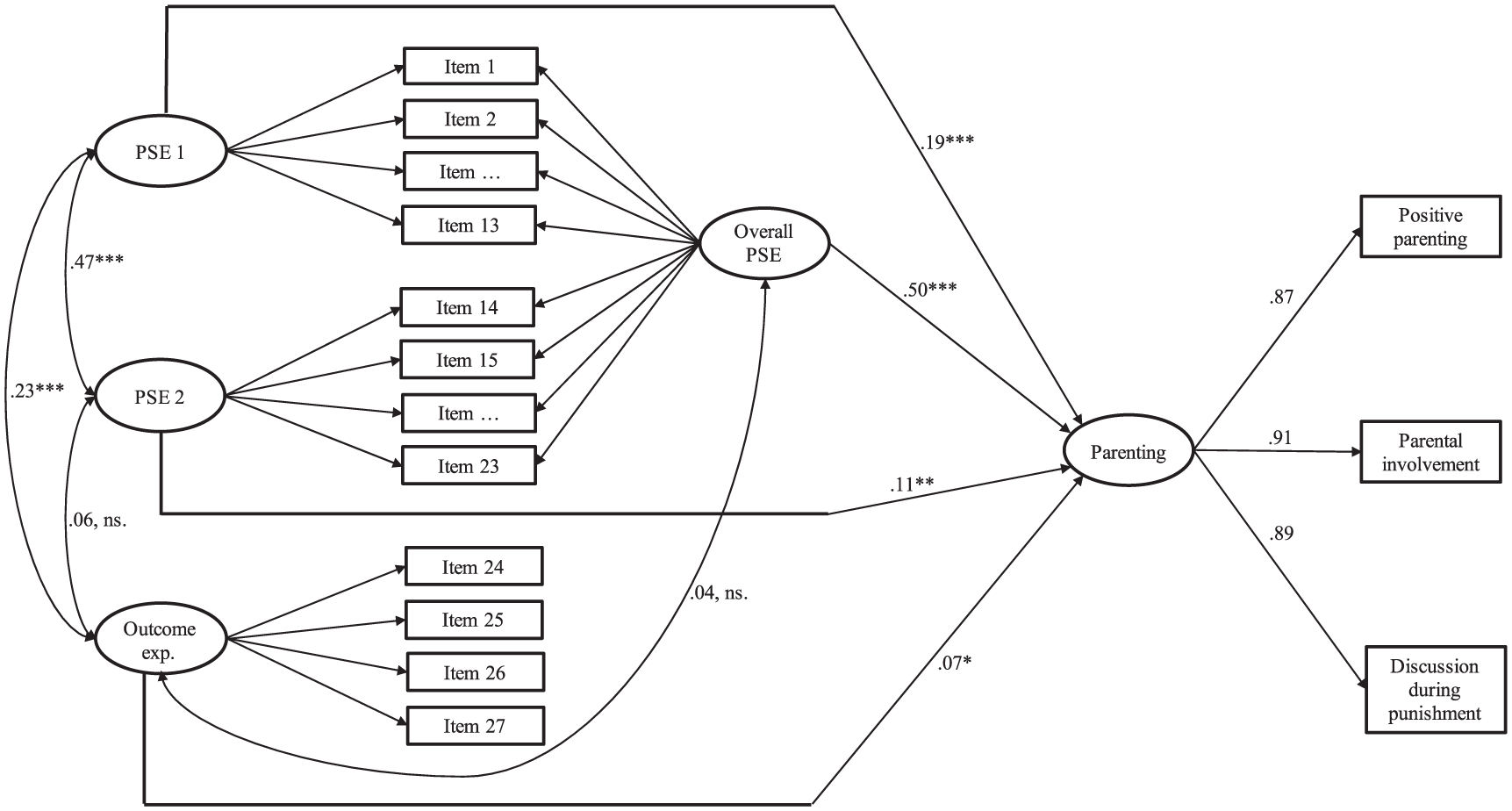
Bifactor SEM model with standardized coefficients.
In this model, the two PSE sub-factor correlated significantly with each other (r = .47, p < .001), and the first PSE sub-factor (parents’ beliefs about their influence on children’s school adjustment and structured after-school activities) was significantly correlated with parents’ outcome expectations (r = .23, p < .001). The correlation between the second PSE sub-factor (parents’ beliefs about their influence on children’s potentially negative activities taking place outside of parents’ direct socialization practices) and parents’ outcome expectation, however, was not significant (r = .06, p = .161), and not the correlation between parents’ outcome expectation and the general PSE factor either (r = .04, p = .317).
Concerning the regression coefficients, the results showed that both the general PSE factor (β = .50, p < .001) and parents’ outcome expectations (β = .07, p = .002) were significant predictors of parenting practices. The more parents believed they could influence their child (i.e., high PSE) and the more they perceived the child as responding to their socialization attempts (i.e., positive outcome expectations), the more positive practices they reported. Furthermore, both PSE sub-factor were significantly linked to parenting practices (β = .19, p < .001; β = .11, p = .003, for the first and second PSE sub-factor, respectively). Hence, these sub-factor explained variance in the parenting construct over and above the variance explained by the general PSE factor. Finally, the interaction term between the general PSE factor and parents’ outcome expectations was not significantly linked to parenting practices (β = −.06, p = .155).
General Discussion
In this study, we examined the conceptualization and operationalization of PSE. Specifically, we examined whether it was distinguished from a measure that tap into parents’ outcome expectations—in the form of parents’ perceptions of their child’s unresponsiveness to their socialization attempts as an external factor preventing an expected outcome to flow from parenting practices. Additionally, we examined how these two cognitive aspects were related to parenting practices, both their unique association and their interactive association. In general, the results suggested that the measure used to operationalize parents’ outcome expectations was tapping into something different than the established PSE measure (adapted from Bandura, 2006), and was differently related to parenting practices. Below, we discuss the implications of the results for theory, methodology, and practice.
The Relation Between Parents’ Efficacy Expectations and Outcome Expectations
In this study, we operationalized parents’ outcome expectations using a measure of parents’ report of their child’s usual reactions to their parenting attempts. This operationalization is in line with earlier studies (Dilorio et al., 2001) and focuses on one important external factor—the child’s temperament in the form of unresponsiveness—that might prevent parenting practices to have the desired outcome. The results showed that the items of this scale loaded on a different factor than did the items of the established PSE scale, and that these two factors were weakly correlated. This result suggests that although the PSE measure might include aspects of both parents’ outcome expectations and their efficacy expectations, it might tap more into parents’ efficacy expectations or their personal capabilities, and that our measure of outcome expectations captures something over and above what is included in the PSE measure.
Furthermore, we tested the distinction between the established PSE measure and parents’ outcome expectations in more depth by examining the possibility that these two constructs were indeed distinct, but that they together made up an overall, higher order factor. The data did not support this idea. All in all, the results suggest that PSE can surely be used as a label, but it is important to acknowledge that it probably deals with parents’ perceptions about their abilities to act in certain ways specifically and to separate such perceptions from perceptions concerning the outcomes of their parenting practices. Researchers need to be clear about what constructs they are studying and make sure that their operationalization of the constructs reflect a distinction between parents’ efficacy expectations and outcome expectations. From now on, we will use the label PSE and parents’ efficacy expectations interchangeably.
PSE as a Multidimensional Construct
In line with Bandura’s (2006) idea of PSE as a multidimensional construct, we found support for more than one dimension of PSE. However, in contrast to Bandura’s four-dimensional structure, our data supported a bifactor structure including one general factor of PSE explaining part of the common covariance among the items, and two other, sub-factor of PSE that explained additional covariance among the items. These results suggest that PSE should not be considered either a unidimensional construct or a multidimensional construct, but it should be acknowledged that both are needed in the understanding of PSE as a cognitive construct. The same idea was pointed out by Bandura (2006) in his discussion about the importance of high interitem correlations in the specific domains, but at the same time measuring the total score of the full scale (i.e., a description similar to the description of a bifactor model). However, to our knowledge, this type of factor structure modeling has not been carried out with empirical data on PSE. The use of bifactor modeling in this study allowed an in-depth examination of the multidimensionality of PSE as a construct, as it offers a way of measuring one aspect while simultaneously, and in the same analytical model, measuring diverse aspects of this same aspect (Reise et al., 2010). This analytical method is seldom used in psychology research but can be considered in future research as a way of capturing the full complexity of PSE, in itself and related to other constructs. The results also shed light on the theoretical meaning of PSE. Specifically, some parents might feel less efficacious on some aspects of parenting, but more efficacious on other aspects. Additionally, some parents might feel efficacious in general although they lack a sense of efficacy in certain subdomains. These results are important in theorizing about PSE and the meaning of PSE in different subdomains.
As an additional support of multidimensionality, the two PSE sub-factor related differently to parents’ outcome expectations. The measure of parents’ outcome expectations was significantly correlated with the first sub-factor of PSE (i.e., parents’ beliefs about their influence on children’s school adjustment and structured after-school activities), but not with the second sub-factor (i.e., parents’ beliefs about their influence on children’s potential negative activities taking place outside of parents’ direct socialization practices). This result might be explained by the different child behaviors at reference in these scales. The outcome expectation items dealt with direct parental socialization when parents are faced with different child behaviors (e.g., limit setting and rules when the child misbehaves), whereas the second PSE-factor on the other hand, dealt with behaviors that take place outside of parents’ direct control (e.g., peer affiliations and potential drug use), and might capture parents’ beliefs about other types of parenting practices. To summarize, then, it is important to acknowledge the multidimensional nature of PSE—both theoretically and analytically—as these dimensions might be more or less linked to other parental cognitive constructs.
The Link to Parenting Practices
Although PSE has been shown to predict increases in positive parenting practices (e.g., de Haan et al., 2009; Dumka et al., 2010; Glatz & Buchanan, 2015b; Slagt et al., 2012; Verhage et al., 2013), prior studies have not disentangled the influence of parents’ efficacy expectations from those of outcome expectancies, making it unclear which is driving these associations. In this study, we performed an examination that offers a first understanding concerning the relation between, and the importance of these two cognitive factors in generating and regulating parents’ behavior. The two measures were differently related to parenting practices: PSE was more strongly linked to parenting than were parents’ outcome expectations. This strengthens results from earlier studies (e.g., de Haan et al., 2009; Dumka et al., 2010; Glatz & Buchanan, 2015b; Slagt et al., 2012; Verhage et al., 2013) showing a link between PSE and parenting practices, suggesting that these studies might have tapped into parents’ efficacy expectations and not parents’ outcome expectations. Although PSE was the strongest predictor, parents’ outcome expectations still did explain unique variance in the parenting factor. As was brought up in the introduction, there have been some contradicting ideas about the relation between PSE and parents’ outcome expectations and whether these are related uniquely to parenting or if parents’ outcome expectations are dependent on PSE (Bandura, 1984, 1977; Eastman & Marzillier, 1984; Pajares, 1997). The result of this study is partly in line with Bandura’s (1977) suggestion that efficacy expectations overpower outcome expectations. However, although a weaker predictor, the results of this study support the idea that parents’ beliefs about the result of their parenting practices might indeed be a unique predictor of behaviors independent of efficacy expectations. As a further support of this idea, the interaction of PSE and parents’ outcome expectations was not significantly linked to parenting practices.
Demographic Factors as Predictors of PSE and Outcome Expectations
In this study, we examined the impact of several demographic variables on PSE and parents’ outcome expectations. The first significant control variable was the child’s age. In line with earlier research (Ballenski & Cook, 1982; Glatz & Buchanan, 2015a), parents of adolescents reported lower levels of PSE than did parents of preadolescent children. However, at the same time, parents of adolescents reported higher levels of outcome expectations compared with parents of children in the younger grades. One explanation for this finding is that with age, children become better at regulating their behaviors (e.g., Eisenberg, Duckworth, Spinrad, & Valiente, 2014), and parents’ might expect more mature reactions to their socialization attempts the older the child gets (e.g., less defiance and noncompliance). An alternative explanation for developmental differences might be that adolescents are better at keeping secrets about behaviors that they are not allowed to do than are younger children. Hence, adolescents might still be defiant—thus, not being open for parents’ socialization—but be better at hiding such behaviors than are preadolescents.
Parents’ ethnicity showed a consistent pattern of associations with the study variables. African American parents reported more PSE, which is in line with earlier research (Buchanan, Grzywacz, & Costa, 2013; Glatz & Buchanan, 2015a), but ethnicity did not relate as strongly to parents’ outcome expectations. Hence, the child’s unresponsiveness to parenting socialization, as an indication of parents’ outcome expectations, might be somewhat stable, whereas parents differ more on the level of efficacy expectations depending on their ethnicity.
Limitations and Strengths
Some limitations of this study should be acknowledged. First, the data were cross-sectional and the results concerning the links between the cognitive predictors and parenting do not inform about causality. Second, in this study, we used only positive parenting practices. It is possible that PSE and parents’ outcome expectations might be differently linked to other types of parenting practices. The link between parents’ outcome expectations and parenting should be further studied using longitudinal data and different parenting behaviors. Third, some demographic variables that were not examined in this study might have produced other results. Parents who had multiple children in the specified age range, were asked, randomly, to answer the questions about their youngest, middle, or oldest child. In the analyses, however, and based on our research questions, we did not examine associations depending on the birth order of the child. Additionally, we were not able to include the age of the parent or number of years of being a parent in the analyses. These are all potentially important demographic variables to examine in relation to PSE and parents’ outcome expectations.
A fourth limitation concerns the operationalization of parents’ outcome expectations. This study represents a first attempt to operationalize parents’ outcome expectations in relation to PSE and parenting. Although our measure deals with parents’ perceptions of whether their parenting behaviors have an effect on their children, there might be other ways to operationalize parents’ outcome expectations that might give further insight into this concept. One specific issue is that our measure did not ask parents about outcomes of a specific parenting practice, but rather asked how the child normally reacts to their rule setting (as one example of parenting practice). One can argue that this should be closely linked to parents’ expectations about potential outcomes of their socialization practices (i.e., future outcomes of a hypothetical behavior). However, an additional way to measure parents’ efficacy expectations and outcome expectations would be to ask parents if think they have the ability to act in a certain way and whether this certain behavior will have an effect on the child’s behavior. Additionally, in our conceptualization of parents’ outcome expectations, the child’s unresponsiveness was used as an external factor for parenting successes, which is in line with earlier operationalizations of this construct (Dilorio et al., 2001). This is, of course, only one external factor that might prevent an expected outcome to take place. There are other important external factors that can explain whether a specific parenting behavior will result in a specific outcome. More research is needed to fully understand the concept of parents’ outcome expectations and the relation to PSE.
Despite the limitations, this study has several strengths. We examined the constructs in a large, ethnically and gender-wise, representative sample of parents of children in different developmental stages. By controlling for children’s age and parents’ ethnicity, we increased the likelihood that the associations in fact reflect associations between the main variables. This is especially important as Bandura (2002) argued that self-efficacy differs by context. Furthermore, the use of a well-established PSE measure (Bandura, 2006) increased the validity of the results. Examining the factor structure of this measure, in itself and related to parents’ outcome expectations, is a unique contribution to the literature, and deepen the understanding of different parental cognitive processes and their links to parenting behaviors.
Practical and Theoretical Implications
Parents’ perceptions are essential aspects of being a parent and important determinants of parenting practices. However, a lack of distinction between parents’ perceptions about their abilities to act in certain ways and their perceptions about the outcomes of their parenting practices presents a bias in our understanding of parenting and might lead to incorrect assumptions. To get a better understanding of parenting, it is crucial to distinguish between different reasons why parents perceive a lack of influence. This study represents an initial step in advancing the use of psychometrically sound measures that can be used in clinical screening and selection of appropriate interventions (Črnčec et al., 2010). The results suggest that it is important to focus on different aspects of parents’ cognitive processes in interventions and screenings, as these might have different links to parenting practices. For example, parents’ might need different support depending on if they lack confidence in their parenting practices (i.e., parents’ efficacy expectations) or if they perceive that their child is unresponsive to their socialization efforts (i.e., parents’ outcome expectations). What cognitive mechanisms are at play should guide models to understand underlying processes of parenting and implementation of this knowledge into practice.
Footnotes
Declaration of Conflicting Interests
The author(s) declared no potential conflicts of interest with respect to the research, authorship, and/or publication of this article.
Funding
The author(s) disclosed receipt of the following financial support for the research, authorship, and/or publication of this article: This project was funded by grants from the Swedish Research Council (Grant Number: 350-2012-283).