



Abstract
The present study explored how Turkish husbands and wives in arranged or self-selected marriages differ in terms of the love, partnership, and problems components of marital satisfaction. Four hundred and fifty-six heterosexual couples participated in the study. Indeed, 33% of the marriages were identified as arranged. Marital satisfaction was measured by using the Love for Spouse, Partnership, and Problems with Partner scales (from the Marriage and Relationship Questionnaire), all of which had previously been shown to demonstrate measurement invariance across genders and cultures. According to the results of multivariate analysis of covariance (controlling for length of marriage and education), (a) spouses in self-selected marriages reported more love relative to those in arranged marriages, (b) wives reported more problems than their husbands regardless of marriage type, and (c) the wives in arranged marriages reported significantly less partnership than both the husbands and the wives in self-selected marriages. Results are discussed within a cross-cultural perspective.
Keywords
Marriage is generally considered as a basic institution in almost all societies. It involves important interpersonal and personal implications associated with the well-being of individuals, families, and hence of societies in general (e.g., Bachand & Caron, 2001; Laub, Nagin, & Sampson, 1998; Proulx, Helms, & Buehler, 2007; Robles, Slatcher, Trombello, & McGinn, 2014; Stack & Eshleman, 1998). Accordingly, understanding different aspects of marital satisfaction has been quite a popular topic among related researchers (Bradbury, Fincham, & Beach, 2000; Reis, 2013). However, the relevant body of knowledge involving marital quality has been generally limited to Western style love marriages and relatively few studies have examined how marital satisfaction differs in different types of marriages and cultures.
Exploring marriages in different cultures may provide important opportunities, not only for testing the universality of variables that have been found to influence marital quality in Western contexts but also by presenting new research opportunities within a more expanded theoretical outlook, as cultures may be likely to differ in many ways such as initiation and conceptualization of marriages, of the roles of wives and husbands, and relationships with extended families (Allendorf & Ghimire, 2013; Imamoğlu & Selcuk, 2018). For example, in some Eastern cultures, marriages may be arranged to serve more instrumental functions such as the alliance of two extended families, rather than the more Western emphasis on personal relationship and satisfaction (e.g., Dion & Dion, 1993; Lalonde, Hynie, Pannu, & Tatla, 2004). Accordingly, cultures, in which mate choice can reflect the preferences of the spouses or of the kin, may provide natural experimental contexts to explore the impact of being able to (or not) choose one’s spouse on marital functioning and satisfaction. Also, in view of cultural differences in conceptualization of gender roles, questions involving the differential impact of different marital arrangements on satisfaction of women and men can be tackled.
An important challenge posed by the above noted opportunities involves the problem of identifying those aspects of marital satisfaction which are considered important by both spouses across cultures, and hence, developing measuring instruments which are not only relevant to a particular cultural setting but also suitable for cross-cultural and cross-gender comparisons. In this vein, invariance testing, which is a form of covariance structure analysis, can be utilized to assess whether measures, such as those composing marital satisfaction, are defined similarly across different groups (e.g., Byrne & Campbell, 1999; Lucas et al., 2008). For example, previous research utilizing invariance testing (Lucas et al., 2008; G. E. Weisfeld, Dillon, et al., 2011) demonstrated that measures tapping love, partnership, and problems components of marital satisfaction, from the Marriage and Relationship Questionnaire (MARQ; Russell & Wells, 1993), were defined similarly by wives and husbands from such diverse cultures as the United States, Britain, Turkey, and China.
The present study explored the impact of spouse-choice on those love, partnership, and problems components of the marital satisfaction of Turkish wives and husbands. Turkey, being a traditionally collectivist culture (Hofstede, 2001), provided a suitable context for the present aims because both arranged and self-selected marriages exist in Turkish urban settings where the great majority of the population resides (United Nations, 2014), as explained more fully later on.
Arranged or Self-Choice Nature of Marriages and Satisfaction of Spouses
As noted, a basic difference between marriages derives from the way they have been initiated; that is, by the decisions mainly of prospective spouses themselves or of their family elders. The former type has been generally referred to with such words as self-selected, self-initiated, self-choice, free-choice, autonomous, love or love-based marriages to emphasize the intermingled roles played by free-choice, and love in its formation. Accordingly, in the more individualistic Western world, where this type of marriage is more prevalent, most people seem to consider choosing one’s spouse based on free will and romantic love as a necessary precondition for marriage (e.g., Sprecher, Sullivan, & Hatfield, 1994). On the other hand, the latter type, often referred to as arranged or sometimes as family-initiated, tends to be more prevalent in the more collectivist cultures of Asia and Africa; however, due to international migration, its existence seems to have extended to some Western countries as well (Penn, 2011).
In the more collectivist contexts, marital decisions are considered too important to be based solely on the feelings or decisions of young people because those decisions are assumed to have wide-ranging implications, not only for the couples but also for their families and kins (e.g., Fox, 1975). Thus, culturally relevant variables such as family background, reputation, and economic status seem to be considered more in decisions involving prototypically arranged marriages, whereas self-choice marriages seem more likely to be based on such personal factors as romantic love, emotional intimacy, feelings of infatuation, and personal compatibility.
The trend away from arranged marriages toward self-selected marriages in the 20th and 21st centuries is often explained as Westernization, accelerated by worldwide communication networks and social media; at the same time, economic forces have been documented as crucial influences. Rubio (2014, following Rosenzweig & Stark, 1989) hypothesized that “arranged marriages serve as a form of informal insurance” and the need for arranged marriages decreases as agriculture declines and education, formal employment, and urbanization increase (p. 2). Rubio’s demographic analyses of several countries, including Turkey, support this hypothesis. In a similar vein, in their analysis of the decline in preference for a son (rather than a daughter) in South Korea since 1991, Chung and Das Gupta (2007) found a positive relationship between having a marriage arranged by parents and son preference. However, even more important than religious or personal beliefs were societal factors like urbanization and education (particularly education of women) as drivers of these social changes (Chung & Das Gupta, 2007, 2011).
Regarding the Westernization explanation, it should be noted that “the feeling of love, in all its forms, from gentle support to passion, is not uniquely ‘modern’ or ‘Western’” (Hart, 2007, p. 351), but the priority given to it seems to differ in the self-choice or arranged marriages. While love is regarded as a precondition in the former, as noted, it is expected to grow after marriage in the latter type. For instance, the Turkish proverb, “There is a miracle in the wedlock,” points to the expected growth of positive feelings after marriage. Furthermore, as Pillsworth and Barrett (2017) point out, only a small minority of cultures have completely autonomous choice of spouse by the younger generation; most cultures can be placed on a spectrum, with parental and child influence on mate choice varying in degree. “Additionally, parent and offspring preferences appear to diverge predictably, with parents emphasizing a mate’s social quality and daughters emphasizing inherent (genetic) quality” (Pillsworth & Barrett, 2017). This spectrum of parent and offspring influence is reflected in the contemporary Turkish pattern, as considered later on.
Recently researchers have explored these more fine-tuned midpoints on the choice spectrum. Hamid, Stephenson, and Rubenson (2011) found that Pakistani women who had a say in their marriage were nearly twice as likely to agree with their husbands on how many children they would have, as compared with their counterparts in parent-arranged marriages. In an interesting finding, Das Gupta (2014) documented that Indian women who said that they chose their spouse with their parents (intermediate points on the choice spectrum) had the “greatest autonomy in household decisions and decisions regarding children” (Das Gupta, 2014, p. 381).
How do we make sense of these complex and fascinating patterns of results? On the one end, self-choice marriages, which, as noted, are based on free will, personal affection, physical attraction, and compatibility, may be expected to lead to higher marital quality than those arranged by the families. On the other end, spouses in arranged marriages, which tend to be approved by the parents and kin, may be more likely to benefit from their support (Applbaum, 1995), and from higher status and resource-acquisition potential in the partner, as judged by parents (Bovet, Raiber, Ren, Wang, & Seabright, 2017). Unfortunately, the few studies that have explored marital satisfaction in those two type of marriages have not produced a consistent picture; some studies, including those in Turkey, concluding that satisfaction tends to be stronger in self-selected than in arranged marriages (e.g., Allendorf & Ghimire, 2013; Demir & Fişiloğlu, 1999; Hortaçsu, 2007; Imamoğlu, 1993; Lev-Wiesel & Al-Krenawi, 1999; Pimentel, 2000; Xu & Whyte, 1990), others reporting the opposite (e.g., Madathil & Benshoff, 2008; Yelsma & Athappilly, 1988), and still others reporting no significant differences (e.g., Hoelter, Axinn, & Ghimire, 2004; Myers, Madathil, & Tingle, 2005; Regan, Lakhanpal, & Anguiano, 2012; Schwartz, 2007).
Several methodological problems or limitations, operating on many levels, may account for those conflicting findings. As Henrich, Heine, and Norenzayan (2010) pointed out, there is a dearth of family research based on mature, non-Western populations; and, when research is conducted in non-Western groups, it often fails to take into account cultural differences in values (e.g., the importance of personal choice and independence from family, and other differences aforementioned). These theoretical shortcomings cascade into methodological problems when instruments which are psychometrically appropriate for Western groups are simply imposed on other societies. Another cascade of issues arises when multiple different instruments of Western origin are utilized in multiple dissimilar non-Western groups, and resulting comparisons fail to take these differences into account. The methodological problems are numerous, including measuring different aspects of marital quality, not controlling for possible confounding variables (e.g., marriage duration, spouses’ education level), using small samples, using a very small number of measurement items or generally using measures that have not been tested for measurement invariance across gender and culture. Thus, there is need for further research which considers the above noted limitations to shed light on this mixed picture of findings.
Gender Differences in Marital Satisfaction
Although some investigators did not find any gender differences (e.g., Broman, 2005; Kurdek, 2005), many studies, conducted in different cultures, generally reported that wives’ marital satisfaction tends to be lower than that of husbands (e.g., Jackson, Miller, Oka, & Henry, 2014; G. E. Weisfeld, Wendorf, Weisfeld, Imamoğlu, & Shen, 2000; Whiteman, McHale, & Crouter, 2007). Thus, those studies suggest that modest but significant gender differences may generally be expected in marital satisfaction.
In this regard, gender scholars have referred to the role played by women’s subordinate role in society as well as in marriage, and have noted that this unequal division of power (as well as the inequitable division of household tasks and child care) tends to be associated with women’s lower marital satisfaction (e.g., Ball, Cowan, & Cowan, 1995; Brezsnyak & Whisman, 2004; Imamoğlu & Selcuk, 2018). However, women in self-choice marriages, enabling more autonomy in marital initiation, seem to be more satisfied with their marriages relative to their counterparts in arranged marriages (e.g., Pimentel, 2000; Xu & Whyte, 1990).
Initiation of Marriages in Turkey
As noted, Turkey, classified as a collectivist society (Hofstede, 2001), provides a unique setting to explore the marital impact of spouse choice because of the rapid social change it has been going through. Historically, during the Ottoman Empire, marriages were normatively arranged and the prospective spouses were consulted only at the discretion of their kinsmen. However, the new family law, accepted after the establishment of the secular Turkish Republic in 1923, requires the freely expressed intention and consent of the marrying couple at the civil marriage ceremony. Thus, with the support of other laws and regulations aiming to secure gender equality in different domains of life, and the accompanying trends toward more individualistic values (Imamoğlu & Karakitapoğlu-Aygün, 1999), a rapid social change has occurred in initiation of marriages, as in numerous areas of the society. However, the trend toward individualism in Turkey does not seem to be accompanied by a decrease in relatedness, as would be expected from a bipolar individualist–collectivist classification of cultures (Imamoğlu, 2003). For example, compared with the more individualist Sweden, the Turkish sociocultural context is still characterized by a stronger emphasis on close ties with the family, relatives, neighbors, and social groups (Imamoğlu, Küller, Imamoğlu, & Küller, 1993). In line with this interdependent social network, the extended families of the marrying couples are considered to become relatives, as indicated by the Turkish word hısım, which refers to marriage-related kinship as different from biological kinship.
In line with the coexistence of individualistic trends together with the strong emphasis on relatedness, often many gradations of the degree of family and spouse involvement or consent seem to exist between the prototypical arranged and self-choice marriage types; for example, according to a recent study by the Turkish Ministry of Family and Social Politics (which is congruous with earlier reports; e.g., Atalay, Kontaş, Beyazıt, & Madenoğlu, 1993), based on a representative sample of 23, 279 respondents older than 18 years (Turgut, 2011), about half of the first marriages in Turkey were arranged by the families; however, in the majority of cases, those marriages were initiated by the families together with the consent of the couples, while in only 9% of the cases the marrying persons’ consent was not obtained. In fact, even in the lowest socioeconomic status (SES) group, less than 13% of marriages were arranged solely by the families without personal consent. In a similar vein, self-choice marriages generally involved family approval, while less than 3% of the marriages were formed solely by personal choice without family approval (Turgut, 2011).
In line with the individualistic trends noted above, self-selected marriages, in Turkey, tend to be more common among the better educated, younger cohorts from the upper SES group (e.g., Atalay et al., 1993; Fox, 1975; Hortaçsu, 2007; Imamoğlu & Yasak, 1997). In fact, in a factor analytic study (Imamoğlu & Yasak, 1997) choosing one’s spouse was found to load under the Modernism Factor, associated with having less traditional, more modern marital attitudes, lower number of children and years of marriage. Also, according to a second-order factor analysis, Modernism Factor was associated with the factors of SES (i.e., education and occupational status) and socioeconomic power (i.e., increased participation in breadwinning role and decision making, and age at marriage). Accordingly, the better educated men and women with relatively more economic power seem likely to select their spouses at older ages and have relatively more egalitarian relationships. Thus, being better educated and marrying at older ages seem to play pivotal roles in the emergence of modernism, especially for women, who may be more likely, not only to select their husbands but also to contribute more to family budget, participate more in decision making; hence, experience more egalitarian, and possibly, satisfying marital relationships. However, although couples in self-selected marriages appear more likely to represent the more progressive segments of the Turkish society, in view of the rapid social changes taking place, maintaining harmonious relations with spouses and with the extended families may not be easy, especially for women who may face problems in fulfilling the demanding gender-related and kin-keeper roles expected of them (Imamoğlu, 2000; Imamoğlu & Selcuk, 2018).
Those trends do not seem to be unique to Turkey but to be consistent with trends observed in other collectivist cultures (e.g., China: Xu & Whyte, 1990; Ethiopia: Erulkar, 2013; India: Jejeebhoy, Santhya, Acharya, & Prakash, 2013; Prakash & Singh, 2014; Nepal: Allendorf & Ghimire, 2013; Ghimire, Axinn, Yabiku, & Thornton, 2006; Hoelter et al., 2004). In congruity with the Turkish trends, investigators working in different cultural contexts often pointed to the important role played by education and nonfamily activities (e.g., nonfamily work, living, media exposure, and participation in youth clubs) in exposing young people to different ideas about marriage, and in triggering the transition from arranged to self-choice marriages. Some consequences of such changes seem to be marrying at later ages, greater valuing of and access to economic resources, delayed child bearing, increased valuing of the compatibility of personal characteristics of potential partners, women’s increased sense of agency, and increased spousal discussion. However, those changes appear to be associated not only with possible gains in marital harmony but also with the possibility of increased marital conflict and dissolution when the higher marital expectations may not be met (Imamoğlu, 2000; Prakash & Singh, 2014). Thus, more research seems to be needed to understand the role of self-selection of one’s partner on different components of marital satisfaction.
In the current study, we aimed to contribute to the existing literature in the following ways: (a) To our knowledge, this is the first study that has explored marital satisfaction differences between arranged and self-choice marriages by using scales that have been tested for measurement invariance. As noted, the Love Scale, Partnership Scale, and Problems with the Partner Scale (all from the MARQ, described below) have demonstrated strong invariance across genders and cultures (Lucas et al., 2008; G. E. Weisfeld, Dillon, et al., 2011), and thus, they are reliable measures for use with this Turkish population; (b) both Turkish husbands and their wives were participants in this study, offering us a more substantial view of marital dynamics than what is commonly found in other studies; (c) the MARQ scales focus on both positive and negative elements of interpersonal relations, giving us a deeper understanding of different components of marital satisfaction; and (d) based on a quite large sample, representing two type of marriages, and controlling for possible confounding variables (e.g., cultural and urban background, marital duration, education, age, and number of children), hopefully the impact of some of aforementioned problems were minimized.
Overview and Hypotheses of the Study
As noted, in the present research, we aimed to explore the impact of type of spouse-choice (i.e., marital initiation mainly by spouses themselves or their families), gender, and their interaction on the love, partnership, and problems components of marital satisfaction, as exemplified in Turkish urban marriages, by using measures which, as noted above, had previously been demonstrated to be appropriate for this purpose. Also, the present research was part of an extensive cross-cultural project, hence providing an opportunity to consider some of the present within-culture results within a cross-cultural framework. Specific questions addressed and expectations were as follows:
In congruity with earlier reports noted above (Allendorf & Ghimire, 2013; Demir & Fişiloğlu, 1999; Imamoğlu, 1993; Lev-Wiesel & Al-Krenawi, 1999; Xu & Whyte, 1990), we expected that marital satisfaction would be higher in self-choice (relative to arranged) marriages, and that agentic involvement in spouse-choice would have a significant impact particularly on the love and partnership components of marital quality. We did not generate a hypothesis involving marriage type difference in problems with partners because although spouses in self-selected marriages, on the one end, may be expected to experience relatively more positive emotions, on the other end, they may also have more resentments and quarrels when their higher marital expectations (e.g., involving the type of treatment they deserve) may not be met (Imamoğlu, 2000). In this vein, spouse-choice was not found to be associated with problems in the Nepalese rural marriages (Allendorf & Ghimire, 2013).
In line with the findings noted above (e.g., Jackson et al., 2014), as well as the prevalent role differentiation based on male power and the asymmetric marital expectations for husbands and wives in Turkey, as in different parts of the world (e.g., Steil, 1983; Yücel, 2015), we expected that wives would be likely to report lower marital satisfaction involving lower partnership and more problems relative to their husbands (Hypothesis 2). We further expected that the above noted partnership gender effect would be modified by type of marriage because in view of findings involving lower power and lower levels of communication reported by the wives in arranged marriages (e.g., Imamoğlu, 1993, 1995), we expected that they would be likely to experience even lower partnership relative to both their husbands and counterparts in self-selected marriages (Hypothesis 3). In view of cross-cultural findings suggesting that spouses do not seem to differ in romantic love (e.g., Lucas et al., 2008), we did not generate any gender-related hypotheses involving love for spouse.
Method
Participants
The sample consisted of 456 heterosexual married Turkish couples (N = 912), selected from different urban settings in Turkey, where the great majority (73% to 80%) of the population resides (Türkiye’de Kır Kent Nüfusu, 2016; United Nations, 2014). Participants were contacted by different means; for example, reliance on the assistance of “muhtars,” or the elected officials responsible for certain record-keeping duties in a vicinity, and modified “snowball” sampling techniques. To obtain the assistance of muhtars, interviewers (i.e., 26 trained psychology students) were provided with official documents indicating the municipal governors’ support for conducting the study. The rate of rejection was about 4%. Age of the participants ranged from 19 to 68 years (M = 36.29, SD = 9.94). More specifically, age of the husbands ranged from 19 to 68 years (M = 38.33, SD = 10.09), while that of the wives ranged from 19 to 65 years (M = 34.19, SD = 9.34). Length of marriages ranged from 1 to 40 years (M = 11.76, SD = 9.46). However, 79% of the couples had 1 to 7 children (M = 1.52, SD = 1.16). As determined by the occupational status of the husbands, most couples represented the middle and upper SES groups (56% and 30%, respectively). Mean years of education was 11 and 13 for wives and husbands, respectively. In terms of initiation, 33% were initiated by the families and are referred to as arranged, while the rest were initiated by the couples and hence are referred to as self-selected or self-choice. As shown in Table 1, the couples in arranged marriages were older, were married for a longer period of time, were less educated, and had more children relative to those in self-selected marriages.
Descriptive Statistics and Differences Between Marriage Type Groups.
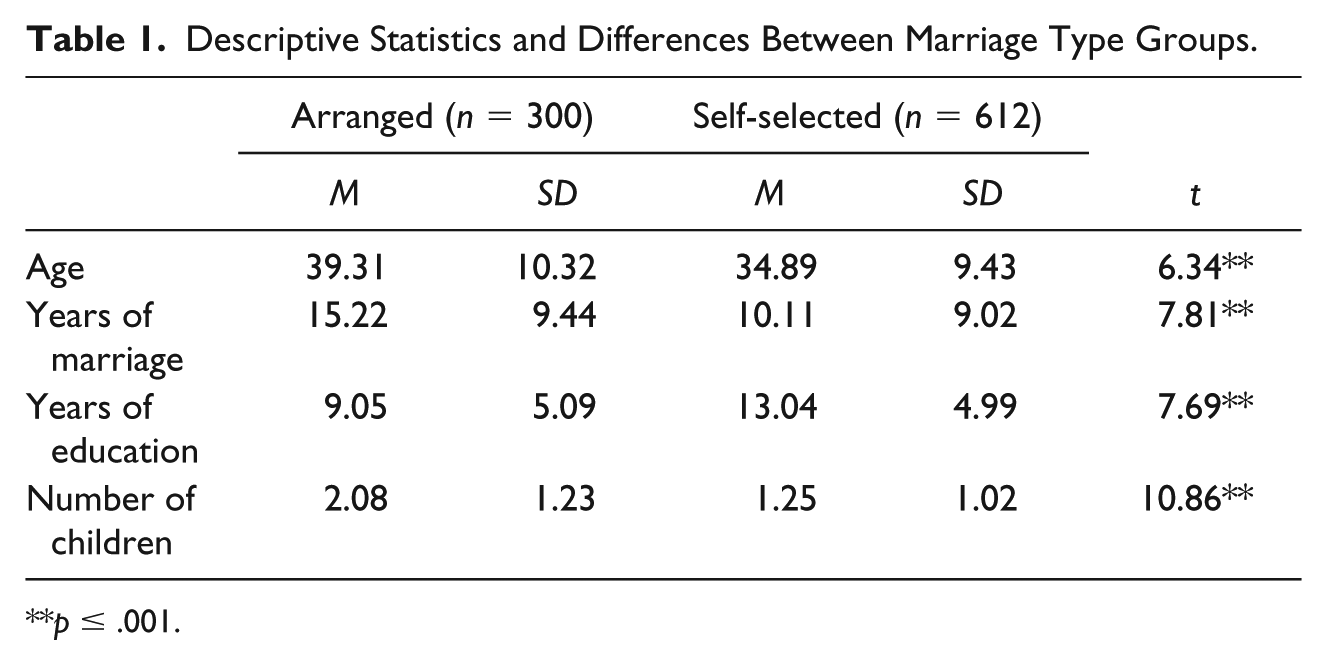
p ≤ .001.
Measures and Procedure
Turkish versions of the Love, Partnership, and Problems with Partner scales from the MARQ, developed by Russell and Wells (1993), were administered to each husband and wife, as part of a larger cross-cultural study. MARQ represents a short form of the general Marriage Questionnaire (Russell & Wells, 1986), which has been adapted to Turkish by Imamoğlu with additional items, considered relevant for the Turkish context, one of which involved type of marriage (Russell, Wells, & Imamoğlu, 1989).
Type of marriage was determined on the basis of participants’ reports as to whether their marriage was arranged or self-selected. Love, Partnership, and Problems with Partner Scales were chosen because (a) they have been reported to be measuring distinguishable aspects of marital quality with good psychometric characteristics; (b) have been demonstrated to have strong measurement invariance across genders and such diverse cultures as the United States, Britain, Turkey, and China; and (c) to be unrelated to social desirability (Lucas et al., 2008; Russell & Wells, 1993; G. E. Weisfeld, Dillon, et al., 2011). In all the scales, participants were asked to respond to the questions using 5-point Likert-type scales (1 = not at all/none/never; 5 = very/all/extremely).
Love Scale
This scale consists of nine items that inquire about the individual’s emotional attachment to his or her spouse with high scores suggesting feeling more loving toward his or her spouse (e.g., “How much do you love your spouse?” and “Do you enjoy cuddling your spouse?” See the appendix for the whole scale). Cronbach’s alpha of the scale, as reported by Russell and Wells (1993), was .90, and in the present study it was .89.
Partnership Scale
This scale consists of nine questions that inquire about the individual’s perceptions of his or her spouse’s contribution to their social relationship with high scores suggesting high support and mutual understanding (e.g., “Is your spouse kind to you?” and “Does your spouse understand you?” See the appendix for the whole scale). In the present study, the scale was found to have an alpha coefficient of .88, same as reported by Russell and Wells (1993).
Problems With Partner Scale
This scale consists of seven items that inquire whether the individual finds his or her spouse’s personal characteristics as satisfying or dissatisfying with high scores suggesting negative perceptions and conflict (e.g., “How often do you have a serious quarrel?” and “Is your spouse really nasty to you?” See the appendix for the whole scale). Russell and Wells (1993) reported an alpha of .80, while in the present study it was found to be .69.
The couples were asked to answer the questionnaires privately and to keep them anonymous. On completing the questionnaires, the husbands and wives were instructed to seal their booklets in separate envelopes and put the two envelopes in a third envelope.
Main research hypotheses were tested using the multivariate analysis of covariance (MANCOVA) technique because it has several advantages over some other possible techniques. For instance, compared with running a series of analyses of variance or regressions, MANCOVA provides a test of the impact of independent variables (i.e., marriage type, gender, and their interaction) on both general marital satisfaction (i.e., multivariate effects) as well as its components of love, partnership, and problems (i.e., univariate effects); and provides protection against inflated Type I error due to multiple tests of correlated dependent variables. Another important advantage is that it enables to test whether the mean differences among groups are statistically reliable after adjusting for preexisting differences on one or more covariates (Tabachnick & Fidell, 2001), as further explained below.
Results
As reported above, there were significant differences between the couples in arranged marriages and those in self-selected marriages involving the demographic variables of age, education, length of marriage, and number of children (see Table 1). In view of this problem, first, we considered the association of those demographic variables with the marital satisfaction variables, and tested whether they interacted with our independent variables (i.e., gender, marriage type, and their interaction) in predicting marital satisfaction. Second, we tested our hypotheses by conducting MANCOVA, as noted above, controlling for the initial demographic differences.
Demographic Variables as Predictors of Marital Satisfaction
The love and partnership components of marital satisfaction were positively correlated (r = .76, p < .001), while perceived problems was negatively correlated with both (r = −.61, and −.64, respectively, p < .001). To explore the association of those marital satisfaction variables with the initial demographic difference variables (i.e., age, education, length of marriage, and number of children), we first calculated the bivariate correlations (see Table 2), and then conducted three separate regression analyses in which the demographic difference variables were considered as predictors, and the marital satisfaction variables served as criterion variables.
Bivariate Correlations Between Marital Satisfaction Variables and Demographic Variables (N = 912).
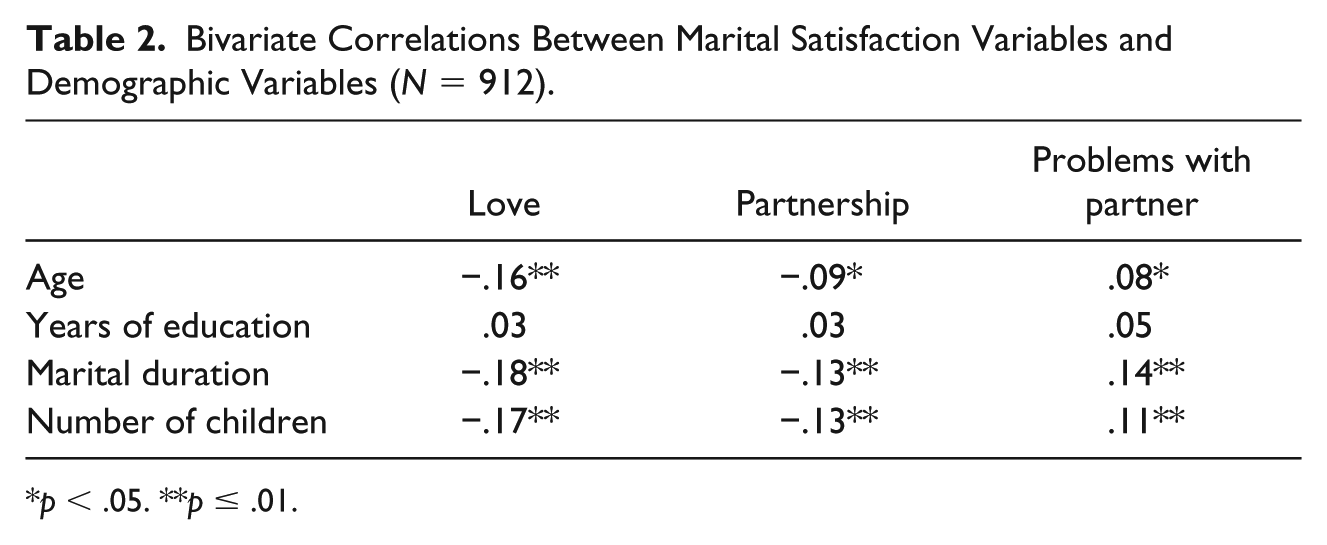
p < .05. **p ≤ .01.
Results indicated that only the number of children negatively predicted love (β = −.12, p < .05), while a negative trend was obtained for length of marriage (β = −.14, p = .08). Those variables explained 4% of the variance in reports of love. As for partnership, of which 2% of the variance was explained, length of marriage (β = −.17, p < .05) and number of children (β = −.10, p < .05) appeared as negative predictors. Demographic variables explained 4% of the variance in problems; age (β = −.23, p < .01) serving as a negative predictor, while length of marriage (β = .33, p < .01) and education (β = .15, p < .01) as positive predictors.
To check whether the effects of those initial difference variables on marital satisfaction varied as a function of our independent variables (i.e., gender, marriage type, and their interaction), we conducted three separate multiple regression analyses, for each of the three dependent variables of love, partnership, and problems. Those analyses indicated that the interactions of the demographic variables with the research variables considered were not significant; hence indicating that they could be used as covariates.
MANCOVA Results
We should note that because the marriage type groups involved unequal sample sizes, the more robust Pillai’s trace was used in the multivariate analyses to compensate for this difference (Tabachnick & Fidell, 2001).
Initial Analysis
The 2 (marriage type: arranged, self-selected) × 2 (gender: wives, husbands) MANCOVA on the marital satisfaction variables of love, partnership, and problems with partner by controlling for the above noted prior differences (i.e., age, number of children, length of marriage, and education) indicated that of those four covariates, only length of marriage and education uniquely adjusted the marital satisfaction measures. Furthermore, length of marriage was highly correlated with the potential covariates of age and number of children (correlation coefficients being .87 and .67, respectively). Hence, to avoid a possible problem of multicollinearity (involving highly correlated covariates), in the final analysis, we removed the statistically redundant covariates of age and number of children, since they would not adjust the marital satisfaction measures over and above the significant covariate of length of marriage (Tabachnick & Fidell, 2001).
Final Analysis
The results of the final 2 × 2 MANCOVA on the dependent variables of love, partnership, and problems with length of marriage and education as covariates are presented in Table 3. As shown in Table 3, the covariates of length of marriage and education made unique significant adjustments both in the combined dependent variables of marital satisfaction as well as for each of the dependent variables of love, partnership, and problems. Thus, the results explained below have been controlled for any differences involving marital duration and education.
Multivariate Analysis of Covariance Summary: Impact of Type of Marriage, Gender, and Their Interaction on Love, Partnership, and Problems With Partner, Controlling for Years of Marriage and Education.
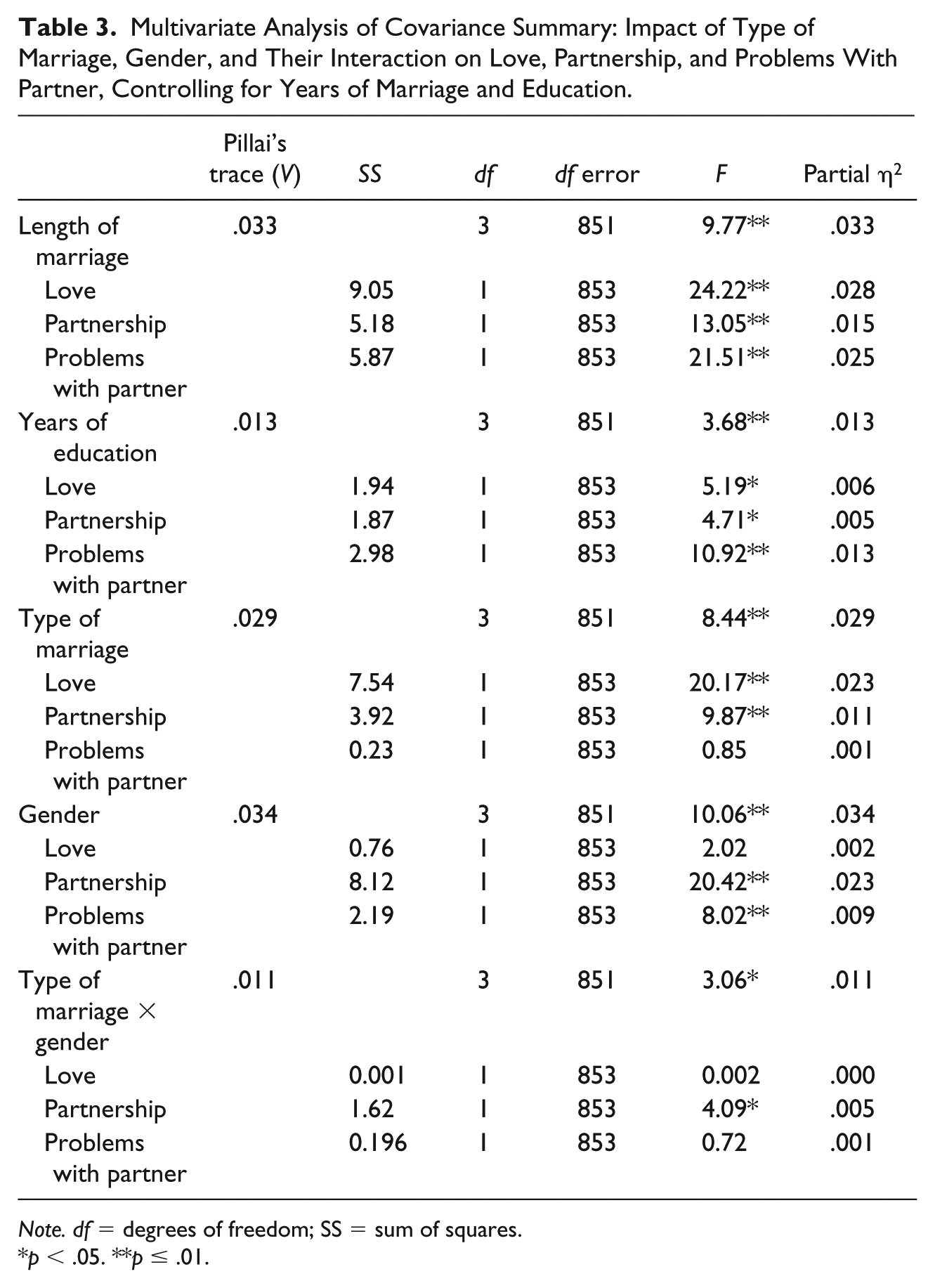
Note. df = degrees of freedom; SS = sum of squares.
p < .05. **p ≤ .01.
As can be seen in Table 3, the multivariate main effect of marriage type was significant, indicating that the marriage groups differed in marital satisfaction; however, the univariate tests indicated that marriage type effects were significant only for love and partnership. As shown in Table 4, spouses in self-selected marriages reported more love and partnership than those in arranged marriages.
Means and Standard Deviations for Partnership, Love, and Problems With Partner Scales by Gender and Type of Marriage.
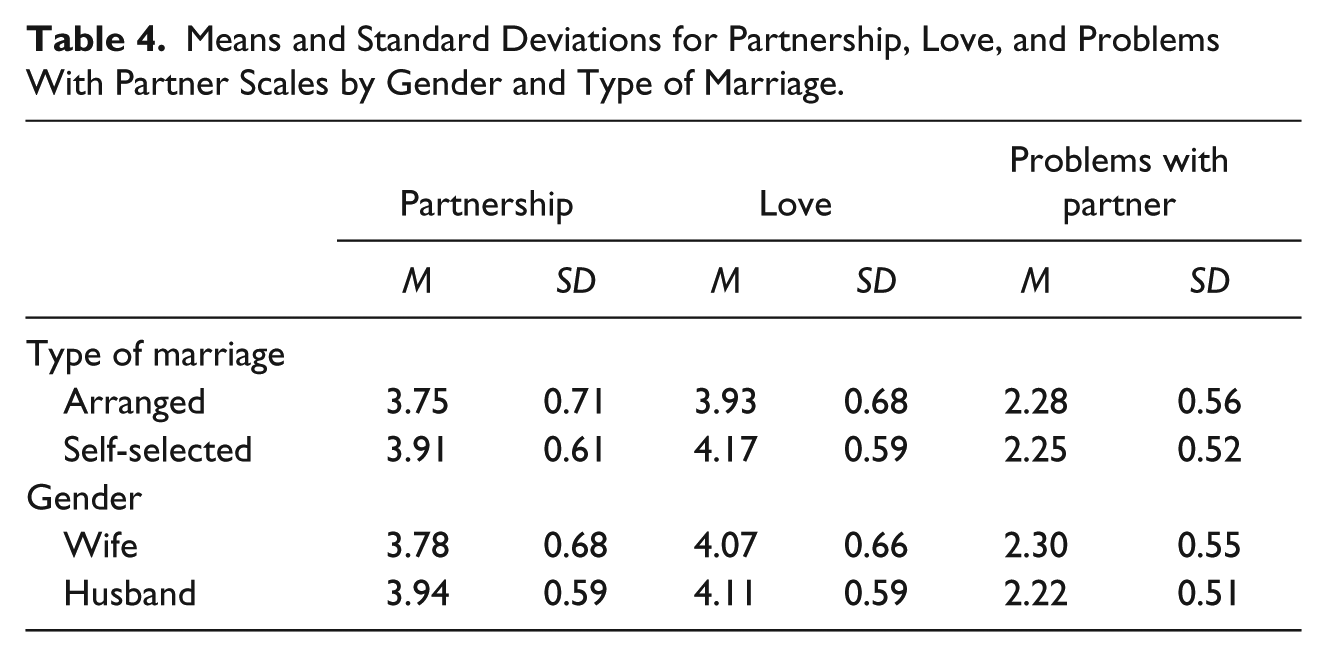
The significant multivariate gender main effect, shown in Table 3, indicated that the wives and husbands differed in their reports of marital satisfaction; however, the univariate gender effects reached significance only for partnership and problems with partners. Those gender effects indicated that wives reported less partnership and more problems relative to their husbands, as can be seen in Table 4.
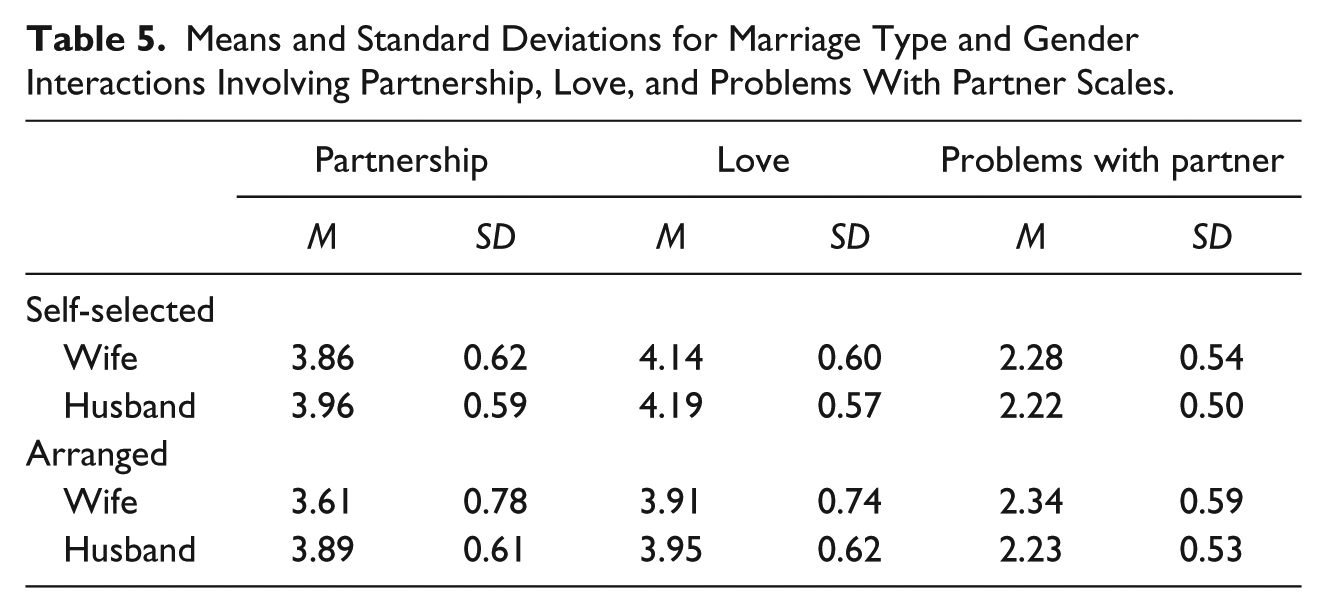
Finally, the multivariate marriage type and gender interaction also reached significance; however, as shown in Table 3, that interaction effect was found to be significant only for partnership (also see Table 5). According to the follow-up Tukey test results, the above noted marriage type and gender main effects for partnership were modified to indicate that the wives in arranged marriages reported less partnership than their spouses as well as the wives and husbands in self-selected marriages (see Table 5). 1
Means and Standard Deviations for Marriage Type and Gender Interactions Involving Partnership, Love, and Problems With Partner Scales.
Discussion
As expected, results indicated that marital satisfaction tends to be higher in self-selected than in arranged marriages, in congruity with some previous reports from Turkey and other cultures (e.g., Demir & Fişiloğlu, 1999; Hortaçsu, 2007; Imamoğlu, 1993; Lev-Wiesel & Al-Krenawi, 1999; Xu & Whyte, 1990). As for gender differences, our results indicated that, as expected, husbands were more satisfied with their marriages than the wives, in line with previous reports (e.g., Jackson et al., 2014; Stevenson & Wolfers, 2009; G. E. Weisfeld et al., 2000; Whiteman et al., 2007).
More specifically, our results indicated that the two types of marriages differ mainly in terms of the romantic love component of marital satisfaction. Both husbands and wives in self-choice marriages reported greater love relative to those in arranged marriages (even after controlling for marital duration). Thus, regardless of gender, being able to choose one’s spouse seems to be particularly associated with the infatuation and romantic love aspect of marital relationship, in congruity with findings from other cultures (e.g., Nepal; Allendorf & Ghimire, 2013; China; Pimentel, 2000).
It is important to note that the marriage types did not differ significantly in terms of perceived problems and conflict. Although one needs to be cautious in interpreting a null finding (as it may simply be due to a small sample and low power), the present sample was large enough to afford 86% power to detect even a difference of 0.3 standard deviations (Cohen’s d) between the two marriage types (Imamoğlu & Selcuk, 2018). Accordingly, any difference that may exist between those marriage types in terms of perceived problems seems likely to be much smaller than that in romantic love. As will be remembered, we were not able to state a specific hypothesis regarding problems but had only noted that although spouses in self-choice marriages may experience more positive feelings, they may also be likely to have higher marital expectations based on more egalitarian marital schemas (e.g., as to how they deserve to be treated by their spouses), and possibly likely to feel resentment and conflict when those expectations may not be fulfilled (Imamoğlu, 2000). In congruity with the present results, Allendorf and Ghimire (2013) also found that although spouse choice was associated with satisfaction and togetherness, it was not significantly associated with problems in rural Nepalese context.
Although the self-selected and arranged marriages did not seem to differ in terms of the problems component of marital satisfaction, the wives, independent of the nature of their marriages, reported more problems than the husbands, as expected. Accordingly, women seem more likely to perceive their husbands as having negative personal characteristics, such as being nasty, irritating, argumentative, and embarrassing; hence report having a serious row more often. This gender main effect is congruent with findings from the cross-cultural study, of which the present study is a part (Dillon et al., 2015). Women may be likely to report more conflict, in such diverse cultures as the United States, Britain, and Turkey, possibly because, being in a more subordinate position, they may in fact be likely to experience more marital problems, regardless of culture or type of marriage (Imamoğlu & Selcuk, 2018). As noted before, in spite of the general trend toward egalitarianism in Turkish marriages, still traditional role differentiation based on male power is quite prevalent (Imamoğlu, 2000; Yücel, 2015), as in different parts of the world; for instance, even in dual-career Western marriages “despite an essentially supportive orientation, both partners seem to endorse some level of male dominance” and “there is a consistent pattern of inequality in both the domestic and occupational spheres” (Steil, 1983, p. 53).
As for partnership, although both gender and marriage type differences appeared to be significant, those main effects were modified by their interaction. According to this gender and marriage type interaction only the wives in arranged marriages reported significantly less partnership than not only their counterparts in self-selected marriages but also the husbands in both types of marriages. The present finding adds to the previous reports of lower marital satisfaction of the wives in arranged marriages (e.g., Blood, 1967; Xu & Whyte, 1990), by suggesting that the wives’ experience of insufficient partnership with their spouses in arranged marriages appears to play an important role in their relatively lower marital satisfaction.
The above noted finding appears to exemplify how the traditional understanding of gender roles may influence marital quality by ascribing asymmetric relational obligations to wives relative to their husbands. The traditional Turkish culture provides higher expectations for women (relative to men) to serve as relationship keepers by being validating, understanding, and supportive of their “breadwinning” husbands’ (as well as children’s and the extended families’) needs (Imamoğlu & Yasak, 1997), possibly resulting in higher perceptions of partnership by husbands (relative to wives), particularly in arranged marriages, as reflected in such practices as using the Turkish word for family, aile, to refer to a wife, in the traditional segments of the society (Imamoğlu, 2004). However, in the absence of such high expectations for men, the husbands, particularly in arranged marriages, who may be likely to have marital schemas that emphasize the traditional segregated gender-role aspects of marriages, may be less responsive to their wives’ needs for partnership and emotional sharing. Accordingly, women in arranged marriages perceive lower levels of psychological sharing, and report having feelings of living in different worlds from their husbands and experiencing more loneliness (Demir & Fişiloğlu, 1999; Imamoğlu, 1993, 1995). On the other hand, in the more progressive segments of the society with the more prevalent change toward self-choice marriages and egalitarian relations, both spouses’ marital schemas may be more likely to emphasize partnership and sharing of psychological worlds (Imamoğlu, 2000).
Before concluding, it should also be noted that the results involving the association of demographic variables with the components of marital satisfaction indicated that the highly correlated variables of length of marriage and number of children were negatively associated with the components of partnership and love. As for the perceived problems component, age appeared as a negative predictor while length of marriage and education appeared as positive predictors. Our results also indicated that the impact of those demographic variables on marital satisfaction did not differ as a function of the independent variables involving gender and marriage type. However, in view of the fact that spouses in self-choice marriages were relatively younger, better educated, married for shorter time periods, and had fewer children than those in arranged marriages, we controlled for those prior differences in the analyses. Accordingly, since the number of children and age, which were highly correlated with length of marriage, provided no reliable unique adjustment, the above noted final MANCOVA results were based on scores adjusted for any prior differences in education and marital duration. As noted, length of marriage generally has been found to be negatively associated with marital satisfaction across cultures (e.g., Amato, Johnson, Booth, & Rogers, 2003; Wendorf, Lucas, Imamoğlu, Weisfeld, & Weisfeld, 2011), while education generally has been found to be positively associated with variables related with modernization and marital quality (e.g., Allendorf & Ghimire, 2013; Hoelter et al., 2004; Hortaçsu, 2007; Prakash & Singh, 2014; Yücel, 2015). Present results extended those findings by indicating that the impact of marital duration tends to be quite pervasive, influencing all three components of marital satisfaction, regardless of marriage type or gender. On the other hand, our results indicated that although education was positively associated with the modernization trend toward self-choice marriages, in line with the related studies, a weak trend was found for it (together with young age and marital duration) to be also associated with perceiving more problems with the spouse, regardless of marriage type or gender. Hence, our results suggest that in countries such as Turkey, undergoing rapid social change, the more educated spouses (relative to those less so) may be likely to be somewhat more critical of their spouses. However, it should also be remembered that although adjustment was made for prior differences (and hence our findings can be said to more clearly reflect the effects of our independent variables on marital satisfaction), the above noted pattern of results involving marriage type, gender, and their interaction, did not change whether those initial differences were controlled or not, hence suggesting that the present findings tend to be quite robust.
Limitations, Strengths, Conclusions, and Suggestions
One basic limitation of the present study is that the results are based on cross-sectional, self-report data. Also data were collected only from Turkish couples residing in urban settings. Although selecting the sample only from urban settings may be seen as a limitation, we think that it may also be considered as a strength of the study. First, as noted earlier, due to massive internal rural–urban migration starting from the 1950s onward, the great majority of the Turkish population has for some time been residing in urban settings; hence, urban settings provide a good representation of the majority population. More important, since our particular aim in the present study was not to study Turkish marriages in general (through a sample representative of the whole population) but to explore the impact of spouse-choice on marital satisfaction, limiting the study to urban couples enabled us to control for the possible confounding by rural–urban differentiation. Still at several points in the article, we have referred to similar trends observed in our study and those from some rural settings (e.g., Nepal; Allendorf & Ghimire, 2013; Hoelter et al., 2004). Nevertheless, more research is needed to explore the degree to which the present results can be generalized to self-choice or arranged marriages in different settings from other cultures. At this point, we may also consider possible concerns about sample selection. Although total random selection could not be claimed due to the nature of the study, various means were utilized to overcome bias in sample selection. As noted, a large number of trained psychology students who contacted participants used not only a modified “snowball” sampling technique but they also utilized the assistance of “muhtars,” or the elected officials responsible for certain record-keeping duties in a vicinity. With the assistance of muhtars, it was possible to obtain a large heterogeneous sample from different urban settings representing different SES groups, and hence to control for possible limitations of the referral system.
We think that the present study also has a number of other strong aspects. First, as noted, to our knowledge, this is the first study to explore marital satisfaction in arranged and self-selected marriages using scales, which have been shown to have strong cross-cultural and cross-gender invariance (Lucas et al., 2008; G. E. Weisfeld, Nowak, et al., 2011), and were found to be unrelated to social desirability (Russell & Wells, 1993). Additionally, the wives in our sample are married to the husbands in the same sample, providing more of a credible glimpse into the actual lives of these couples. Furthermore, the fact that the present study was part of an extensive cross-cultural investigation, provided an opportunity to view findings within a cross-cultural perspective when relevant (e.g., the gender difference in problems).
Second, by obtaining separate measures of Love, Partnership, and Problems with the Partner, as distinguishable aspects of marital quality (Russell & Wells, 1993), we were able to differentiate more clearly between the impact of marriage-type, gender, and their interaction on those components of marital satisfaction. These findings may contribute significantly to a resolution of the related conflicting findings referred to in the introduction. It appears that, in general, regardless of type of marriage, wives identify more Problems with the Partner (e.g., bad habits, taking the wife for granted, being cruel, etc.; see the scale items in the appendix) than husbands do. Hence, being in a more subordinate position, wives seem likely to experience more problems and conflict, not only regardless of the type of marriage but also of culture, as suggested by our cross-cultural findings (Dillon et al., 2015). Results for the Love scale, which measures the more positive emotional connection between spouses, show a clear delineation between arranged and self-choice marriages. Our findings suggest that the main impact of being able to choose one’s spouse seems to be on romantic Love; and this affects both husbands and wives, who seem to be less emotionally bonded in arranged marriages. Last, we see an interactive effect, whereby women in arranged marriages were found to have the lowest partnership scores. Wives whose marriages were arranged reported less kindness, sympathy and respect from their husbands than vice versa (see the partnership scale items in the appendix); women in arranged marriages seem distinctly disadvantaged in terms of the daily give-and-take of married life.
In sum, our results suggest that husbands in self-selected marriages appear as the most satisfied group, whereas the wives in arranged marriages appear as the most disadvantaged group in terms of all three components of marital satisfaction. Regarding the two intermediary groups, although the wives in self-selected marriages, seem satisfied in terms of the infatuation and love aspect of marital quality (just as their husbands), they (relative to their husbands) still appear likely to tackle more problems and conflict (just as the women in arranged marriages); on the other hand, the husbands in arranged marriages, seem less satisfied in terms of romantic love (just as their wives), but (unlike their wives) they do not seem to report problems with their spouses or partnership, most likely in congruity with their marital schemas, which emphasize the segregated gender-role and obligation-based aspects of marriages. Thus, our study cautions against making generalizations about global marital satisfaction differences between these two marriage types but rather suggests adopting a more nuanced approach toward considering both marriage type, as well as gender, and interactive effects involving different aspects of marital satisfaction and harmony. We think that our findings, derived at with such a nuanced outlook, have not only shed some light on the controversial findings (referred to in the introduction) involving self-selected and arranged marriages but also would have informative implications for family psychologists working with couples from these different type of marriages.
In concluding, we also suggest that arranged and self-choice marriages should not be viewed as prototypic polar opposites but as representing differences in relative degrees of involvement by parents and spouses because, as noted before, in most arranged marriages, families get the consent of the individuals while in most self-choice marriages consent of the parents is also taken in Turkey, as in some other cultures (e.g., India; Allendorf, 2013). Still it is noteworthy that even relatively more self-involvement in spouse-choice appears to have a significant impact on the romantic love or infatuation and (in interaction with gender) on partnership aspects of marital quality. In view of numerous studies pointing to the beneficial effects of positive emotions as well as partner responsiveness (i.e., perceiving the partner as understanding, validating, and caring) and perceived kindness of the partner (which is part of the partnership scale) on psychological health and relationship well-being (e.g., Dillon et al., 2015; Fredrickson, 2001; Gable, Reis, Impett, & Asher, 2004; Reis, 2013; Selcuk, Gunaydin, Ong, & Almeida, 2016), we suggest that future researchers further explore the implications of spouse-choice on personal and relationship well-being. Future researchers may also explore whether marital satisfaction benefits from similar psychological and relational mechanisms in self-selected and arranged marriages; for example, although romantic love was found to be an important differentiating variable between self-choice and arranged marriages, our cross-cultural research indicated that the positive association between spousal humorousness and love for one’s spouse, which was found in all the cultures studied (i.e., China, Russia, Turkey, the United Kingdom, and the United States), did not differ in terms of marriage type in Turkey (G. E. Weisfeld, Nowak, et al., 2011). In this regard, in line with Henrich et al.’s (2010, p. 82) call for “institutionalized incentives” (from granting agencies to scholarly journals) to encourage researchers to “further the goal of expanding and diversifying the empirical base of the behavioral sciences,” we suggest that the MARQ (some scales of which offer measurement invariance across gender and culture) may present unique opportunities in this direction, in that it has been tested in multiple cultural and subcultural groups (C. C. Weisfeld, Weisfeld, & Dillon, 2018), thus allowing for systematic comparisons using the same instrument. Finally, we suggest that future studies pay more attention to the impact of individual difference characteristics of spouses involved in different types of marriages; for example, Turkish spouses with related–individuated (or balanced) self-construals were found likely to be more satisfied (than those low in relatedness and individuation) with their relationships, regardless of marriage type (Imamoğlu, 2009; Imamoğlu & Selcuk, 2018). Hence, we suggest that future researchers consider the impact of individual differences in self-construals and personality characteristics, as also listed in Gottman and Notarius’ (2002) research agenda for the 21st century, on spouses’ marital satisfaction in different marriage types.
Footnotes
Appendix
Declaration of Conflicting Interests
The author(s) declared no potential conflicts of interest with respect to the research, authorship, and/or publication of this article.
Funding
The author(s) disclosed receipt of the following financial support for the research, authorship, and/or publication of this article: The author received funding from University of Detroit Mercy and Orta Doğu Teknik Üniversitesi.