




Abstract
The multifactorial decision to become a parent has mostly been investigated in mothers. It would seem that those who decide to have children in response to internal or external pressure, as compared with by pleasure or choice, have a less adaptive parenting experience. Guided by self-determination theory, the present study postulates that prenatal motivation to have a first child is associated for both mothers and fathers with postnatal parental satisfaction through basic psychological needs satisfaction. Results support the hypothesized mediational model and indicate that motivation to have a child significantly predicts parental satisfaction when basic psychological needs satisfaction is considered. The present study underlines the importance of basic psychological needs satisfaction for a positive parenting experience in both parents.
Many factors are associated with the decision to have a child, a topic that has mostly been investigated in mothers. Previous research shows two types of motivation behind the desire to become a mother: personal values associated with motherhood and the need to comply with the social norms that define maternal roles (Lemieux & Mercier, 1987). However, oral contraceptives, safe abortions, and feminism are some of the most recent social changes that have affected women’s decision to become mothers (Gillespie, 2000). The motivation to have a child may also be explained by self-determination theory (SDT; Deci & Ryan, 1991), a framework for understanding human motivation, which determines behavior regulation, well-being, and human development, and takes into account three fundamental psychological needs: the need for competence, autonomy, and relatedness (Deci & Ryan, 2008). In studying motivation, previous theories postulated that behavior is motivated by desired outcomes and goals (Deci & Ryan, 2000). SDT addresses regulatory processes by which outcomes are sought, and these processes consider the content of the goals and the psychological needs implicated in the behavior (Deci & Ryan, 2000). The present study draws on SDT to understand parental satisfaction in first-time mothers and fathers.
Deci and Ryan (1991, 2000) consider needs to be innate, not learned behavior. Psychological needs are important for learning, interpersonal relationships, and managing our physical and social environment, and meeting these needs enables optimal psychological health (Deci & Ryan, 2000). The first of these three psychological needs is competence, or the necessity of perceiving ourselves as effective at interacting with our environment, and reaching our full potential (Ryan, 1995). The second psychological need is autonomy, which is the ability to make our own informed decisions and perceive ourselves as responsible for our own behaviors (Ryan, 1995). Last, the need for relatedness is that of feeling connected to our social environment and respected by others (Ryan, 1995). Understanding these three needs led to research on intrinsic motivation and other regulators involved in behavior (Deci & Ryan, 2000). Intrinsic motivation is defined as the regulation of behavior based on personal gain of pleasure. It is the active process of internalizing the behavior itself that motivates the person to complete it. This type of motivation is related to increased learning, performance, and well-being (Deci & Ryan, 2000).
However, not all behaviors are regulated by gain of pleasure. Extrinsic motivation is the process of internalizing a behavior, more specifically, when external regulations are reconstructed into self-regulation through social sanctions or requests and are accepted as one’s own (Deci & Ryan, 2000). External regulation occurs when a behavior is regulated by external consequences, corresponding to rewards or punishments. According to SDT, this type of motivation is externally regulated by contingencies and does not entail a feeling of free will (Deci & Ryan, 2000). Introjected regulation occurs when an individual internalizes external pressures and performs a behavior to avoid feeling guilty or anxious. In other words, the regulation is internal, but caused by external factors (Deci & Ryan, 2000). Identified regulation involves internalization of behavior, as it requires accepting and recognizing the value of this specific activity (Deci & Ryan, 2000). Behaviors resulting from this type of motivation are not done for enjoyment or satisfaction; rather, they are carried out because the individual perceives them as important (Deci & Ryan, 2000). Last, integrated regulation is the most self-determined form of external regulation. It involves fully integrating a behavior into certain aspects of one’s life. Following this integration, the behavior becomes part of the individual’s identity and values (Deci & Ryan, 2000). Introjected, identified, and integrated regulation processes vary in that they can be either autonomous or controlled. When the internalization is less important, such as with introjected regulation, the motivation is more controlled. More precisely, behavior is controlled by consequences decided by others or by internal pressure (Deci & Ryan, 2000). Autonomous motivation occurs when an individual makes his or her own decision, such as in integrated regulation (Deci & Ryan, 2000). The last concept SDT addresses is amotivation, which is apparent when the individual is not motivated to have certain behaviors. It entails the lack of a sense of efficacy and control. In other words, the individual displays no self-determination to reach a goal or outcome (Deci & Ryan, 2000).
In line with SDT, it appears that mothers who decide to have children because of internal or external pressure, as compared with pleasure or choice, have a less adaptive parenting experience. Mothers with a more controlled motivation have higher chances of developing depressive symptoms (Gauthier, Guay, Senécal, & Pierce, 2010). Moreover, autonomous motivation in the decision to have a child is positively related to self-efficacy beliefs and positive relationships, and negatively associated with incompetence. These results demonstrate that all three basic psychological needs are implicated in a mother’s adjustment in the transition to parenthood (Gauthier et al., 2010). Autonomous motivation in parenting tasks has also been associated with mothers’ parental satisfaction. When mothers are motivated intrinsically or show identified regulation in child care tasks, they tend to be more satisfied in their role as a parent (Jungert et al., 2015). Despite these findings, no prior research has assessed the link between motivation to become a parent and parental role satisfaction.
As for fathers, a qualitative study evaluating their perception of the key elements contributing to their decision to have a first child shows that fathers consider personal, interpersonal, socioeconomic, and temporal characteristics in their decision making (de Montigny Gauthier & de Montigny, 2013). Contrary to the idea that fathers are less interested in family-related issues, most participants desired and planned the arrival of their first child, and only a minority identified their partner’s influence as a deciding factor (de Montigny Gauthier & de Montigny, 2013). Relating these results to SDT, it would seem that fathers are often intrinsically motivated to have their first child, a type of motivation that is related to optimal well-being (Deci & Ryan, 2000). Additionally, a study on fathers’ motivation and their involvement with their children found that fathers are more involved when intrinsically motivated (Bouchard, Lee, Asgary, & Pelletier, 2007). When fathers consider their involvement to be important (identified regulation) or find it satisfying (intrinsic regulation), they participate more in child care (Bouchard et al., 2007). Furthermore, these fathers value activities with their children rather than feel forced into them (Bouchard et al., 2007).
As previously mentioned, SDT postulates that competence, autonomy, and relatedness are needed for healthy psychological and social development. Satisfaction of these needs is related to interpersonal and intrapersonal well-being and growth, and occurs in optimal social contexts (Brenning & Soenens, 2017; Patrick, Knee, Canevello, & Lonsbary, 2007; Van den Broeck, Ferris, Chang, & Rosen, 2016). An individual demonstrates autonomy support when he or she supports other individuals’ feelings of choice by taking their perspective, encouraging their initiative and responding to their thoughts, questions, and initiatives. This engenders a feeling of freedom and importance for the person receiving the support (Deci & Ryan, 2008).
Often, these supportive relationships are observed in settings where the relationship is hierarchical. For example, according to a meta-analysis on SDT and basic psychological needs in the workplace, satisfaction of autonomy, competence, and relatedness is associated with increased well-being and intrinsic motivation in the workplace, which is also related to better work performance (Deci & Ryan, 2000; Van den Broeck et al., 2016). Yet psychological needs satisfaction also has positive consequences in friendships and romantic relationships, which are more mutual than hierarchical. In a study evaluating how need fulfillment is associated with healthy romantic relationships, results demonstrate that individuals who perceived their needs as met in their relationships had higher levels of self-esteem, positive affect, relationship satisfaction, commitment, and more adapted conflict responses (Patrick et al., 2007). As postulated above, feeling autonomous, competent, and connected may lead to intrinsically motivated behaviors, which is associated with more adaptive couple behaviors and greater happiness (Patrick et al., 2007).
Just as mutual support between partners is important for marital satisfaction, support during parenthood is associated with positive outcomes for parents. Parents who are rated as being more “autonomy supportive” perceive themselves as being more competent in their parenting roles (Grolnick & Ryan, 1989). Furthermore, future mothers’ perception of their relationship in the prenatal period is an important determinant of optimism about parenting roles (Harwood, McLean, & Durkin, 2007). Conversely, when women receive less social support than they expected in the prenatal period, they show poorer adjustment to parenthood (Harwood et al., 2007). Another study guided by SDT and conducted among fathers concludes that partner support is related to father involvement, even when controlling for marital satisfaction (Bouchard & Lee, 2000). More specifically, the more fathers perceive that their partner supports them in their parenting role, the more they participate in child care. These feelings of being supported are also associated with a higher sense of competence and greater enjoyment of parenting (Bouchard & Lee, 2000). Moreover, in a study using SDT as its theoretical framework, mothers’ support of fathers’ basic psychological needs was found to be a determinant of fathers’ parental satisfaction (Morisset Bonapace, 2015). When combined, these results point to the importance of psychological needs satisfaction in positive parenting experience, particularly for parenting satisfaction.
Based on the principles of SDT, our study aims to determine how prenatal motivation to have a child is associated with postnatal parental satisfaction in first-time parents. Mothers and fathers reporting more self-determined motivation to have a child in the prenatal period are expected to be more satisfied with their role as parent once their child is born. Additionally, it is hypothesized that this association will be partially mediated by perceived partner support of basic psychological needs in the postnatal period.
Method
Participants
To test these hypotheses, 246 heterosexual couples were recruited in prenatal classes in the Quebec City area (Quebec, Canada) as part of a larger longitudinal study. Couples received no compensation for their participation. Eligible couples had to be cohabiting, expecting their first child (for both partners), and at the prenatal assessment, the expectant mother had to be at least in her 24th week of pregnancy. Subsequent exclusion criteria include premature birth (less than 36 weeks of pregnancy) and serious health problems of the infant.
During the initial contact, the average age of the women and men included in the study was 29.70 years (SD = 3.63) and 31.94 years (SD = 4.44), respectively. As for the participants’ level of education, 55.9% of women and 45.6% of men held a university degree. Most of the couples included in the study were cohabiting unmarried couples (79.8%), while 19.9% were married. This proportion of unwed couples is slightly higher than the 69% population statistic for first-born children in Quebec in 2013 (Institut de la statistique du Québec, 2014). However, this proportion of unmarried couples can be explained by participants’ high education level (Lachance-Grzela & Bouchard, 2009). On average, couples had been living together for 4.92 years (SD = 2.88). Most of the participants worked full time (74% of women and 78% of men) and had a household income of $80,000 a year or more (57% of couples).
Procedure
Interested couples were contacted by telephone for a short interview, during which sociodemographic information was collected. Participants were then sent e-mails with links to online questionnaires: one to be filled out during the prenatal period and a second about 2 months after the expected date of birth.
Measures
Motivation to Become a Parent
The Motivation to have a Child Scale (Gauthier, Senécal, & Guay, 2007) includes 25 items rated on a Likert-type scale from 1 (not at all) to 7 (very strongly; e.g., “I decided to have a child because I would have felt guilty if I did not have a child”; Cronbach’s α = .85). This measure makes it possible to determine autonomous and controlled motivations with five subscales: intrinsic motivation, identified regulation, introjected regulation, external regulation, and amotivation. The self-determination to have a child is calculated based on procedures found in SDT literature (Deci & Ryan, 2002). The subscales are combined using the following formula: (2 × intrinsic motivation + extrinsic motivation by identified regulation) − (motivation extrinsic by introjected regulation + 2 × extrinsic regulation by external regulation). A higher score indicates a more self-determined motivation to have a child.
Parental Satisfaction
The Cleminshaw–Guidubaldi Parent Satisfaction Scale (Guidubaldi & Cleminshaw, 1985), adapted for parents of 2-month-old children (Picard-Lessard, 1995), was used to measure parental satisfaction. Participants evaluate on a scale from 1 (not at all) to 7 (totally agree) whether they agree with six statements (e.g., “I am comfortable in my role as a parent”). Scores can vary from 6 to 42 with a higher score indicating a higher level of satisfaction. To get a fuller picture of the parenting experience, parents’ dissatisfaction was also measured. Six items from the Parenting Sense of Competence Scale (Gibaud-Wallston, 1977) based on factorial analyses made by Gilmore and Cuskelly (2009) were used (e.g., “Being a parent makes me tense and anxious”). The parental dissatisfaction scores were reversed and an average of both scales was used for the analyses. Both subscales show acceptable reliability (Cronbach’s α of .85 and .77, respectively)
Basic Psychological Needs
To measure basic psychological needs satisfaction by the partner, the Partner Support for Parenting Role Scale was used (Bouchard & Lee, 2000). Originally, the purpose of this scale was to measure fathers’ perception of their partners’ interpersonal behaviors toward their parental role according to SDT’s basic psychological needs; it was adapted to also evaluate mothers’ perception of needs support. This scale is composed of three subscales, one for each psychological need, and each subscale is composed of four items (e.g., “My partner respects my opinion when we take a decision concerning our child”). Participants evaluate each item on a 7-point Likert-type scale ranging from almost never to almost always (Cronbach’s α = .91).
Results
Based on Hayes’ (2018) regression method, a simple mediation model analysis was used to determine how psychological needs satisfaction accounts for an effect in the relationship between motivation to have a child and parental satisfaction. Analyses applied to the collected data were carried out independently for mothers and fathers.
Preliminary Analyses
Means, standard deviations, and Pearson bivariate correlations were used to observe trends and determine if the postulated relationships between variables were significant (Table 1). Notably, motivation to have a child was not significantly correlated with parental satisfaction for mothers (r = .113, p = .09), but correlated significantly for fathers (r = .302, p < .01). In other words, when fathers’ motivation to have a child is more self-determined, they are more satisfied with their role as a parent. For both parents, self-determined motivation to become a parent was positively and significantly related to their basic psychological needs satisfaction, where r = .217, p < .01 for mothers, and r = .220, p < .01 for fathers. Last, basic psychological needs satisfaction was positively and significantly related to parental satisfaction for both mothers (r = .225, p < .01) and fathers (r = .300, p < .01), meaning that the more their three basic psychological needs are fulfilled, the more both parents are satisfied with their parental role.
Pearson Correlations Between Motivation to Have a Child, Parental Satisfaction, and Psychological Needs Satisfaction for Mothers and Fathers.
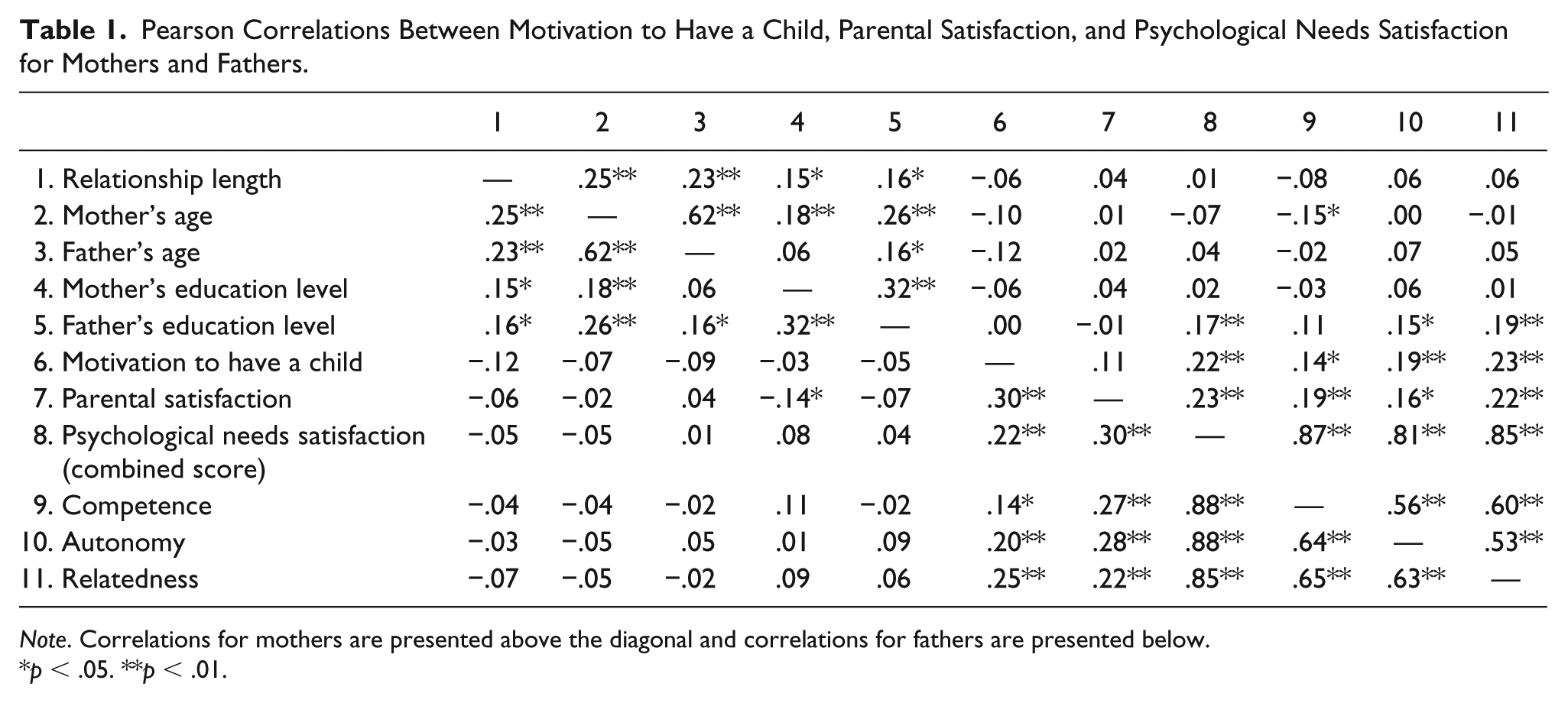
Note. Correlations for mothers are presented above the diagonal and correlations for fathers are presented below.
p < .05. **p < .01.
Mediation Analyses
Using the SPSS PROCESS macro developed by Hayes (2018), two mediation models were tested, one per gender, with motivation to have a child as the predictor, basic psychological needs satisfaction as the mediator and parental satisfaction as the outcome. The program estimates relationships between variables through a series of ordinary least square regression models (Hayes, 2018). Using bootstrapped confidence intervals (CIs), direct and indirect effects were observed. The analysis was completed using 10,000 bootstrapping resamples. Mediation coefficients are generated for three paths. Specifically, the path between predictor (motivation to have a child) and mediator (basic psychological needs satisfaction; Path a), between the mediator and outcome (parental satisfaction) while controlling for the predictor (Path b), and lastly the path for the direct effect of the predictor on the outcome while controlling for the mediator (Path c’). The mentioned paths are presented in Figure 1. For the mediation model used to observe fathers’ data (Figure 2), the mothers’ education level was entered as a covariate, given its significant correlation with the outcome variable (r = −.14, p < .05).
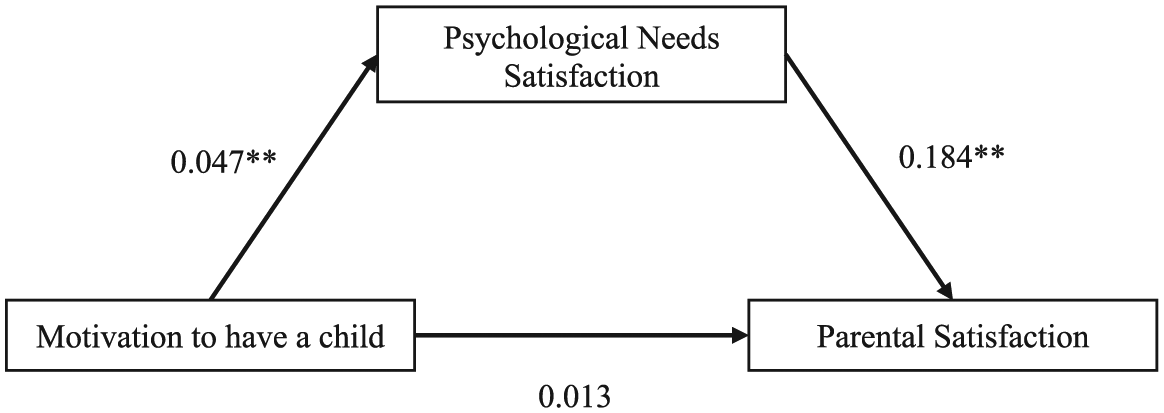
Mediation model representing the relationship between motivation to have a child and parental satisfaction among mothers.

Mediation model representing the relationship between motivation to have a child and parental satisfaction among fathers while controlling for mothers’ education level.
For mothers, the direct effect was not significant, b = 0.013, bias-corrected and accelerated (BCa) CI [−0.013, 0.038]. In other words, motivation to have a child does not directly predict parental satisfaction, which is consistent with the absence of a significant correlation between these variables. However, a significant completely standardized indirect effect was found for Path ab through psychological needs satisfaction, b = 0.046, BCa CI [0.011, 0.095]. Therefore, when a mother is more self-determined to have a child, she tends to be more satisfied with her parental role when she feels her psychological needs are met by her partner.
When the mediation model of fathers’ motivation to have a child and parental satisfaction is examined with mothers’ level of education entered as a covariate, a significant direct effect is found (b= 0.038, BCa CI [0,018, 0.059]). That is, fathers’ motivation to have a child significantly predicts parental satisfaction, when controlling for psychological needs satisfaction. The more self-determined a father is to have a child, the more satisfied he is in his role as a father. Additionally, a significant indirect effect of the motivation to have a child on parental satisfaction through psychological needs satisfaction, b = 0.059, BCa CI [0.018, 0.108], was found, while controlling for mothers’ education level. In other words, when a father’s motivation is more self-determined, he will be more satisfied with his parental role if his psychological needs are met by his partner.
Discussion
This study sought to determine how prenatal motivation to have a child is associated with postnatal parental satisfaction in first-time parents. It was postulated that parents with a more self-determined motivation to have a child in the prenatal period would be more satisfied with their parental role in the postnatal period. It was also hypothesized that this relationship would be partially mediated by perceived partner support for basic psychological needs in the postnatal period.
In mothers, results support a fully mediated process, where the relationship between prenatal motivation to have a child and parental satisfaction in the postnatal period is significant only when basic psychological needs are considered. As a result, when first-time mothers have a more self-determined motivation to become a parent, they feel more satisfied in their parental role when their needs for competence, autonomy, and relatedness are fulfilled by their partner. These results are in line with previous work demonstrating that when mothers are more self-determined in their decision to become parents, they tend to have a more positive and satisfying relationship with their partners and to feel more competent and autonomous in their role (Gauthier et al., 2007).
In fathers, results support the hypothesized mediational model. Fathers are more satisfied with their role as parent to their 2-month-old child when they were more self-determined to have a child in the prenatal period. Additionally, when their basic psychological needs are met, a more self-determined motivation to have a child leads to higher levels of postnatal parental satisfaction.
Overall, results obtained by this study are coherent with past research, which demonstrated that autonomous motivation in parenthood is associated with psychological needs satisfaction (Gauthier et al., 2010) and parental satisfaction (Bouchard et al., 2007; Jungert et al., 2015). Previous findings also supported that needs fulfillment contributes to parental satisfaction and a better adjustment to parenthood (Bouchard & Lee, 2000; Harwood et al., 2007). However, while previous studies linked the motivation in parenting tasks and parental satisfaction, this study is the first to demonstrate that prenatal motivation to become a parent also contributes to parental satisfaction in both mothers and fathers. Particularly, fathers’ motivation to have a child is directly associated with their satisfaction, demonstrating that their personal characteristics significantly contribute to their experience of parenthood, along with their partners’ influence. Therefore, both parents should be taken into account when attempting to explain mothers’ and fathers’ experience.
Moreover, most research on parenting focuses on postnatal factors to explain parental outcomes (e.g., Bouchard & Lee, 2000; Jungert et al., 2015). Yet these results support the importance of considering prenatal variables to better grasp the reality of new mothers and fathers. This study is also the first to demonstrate that motivation to have a child, psychological needs satisfaction, and parental satisfaction interact in a mediational process. The finding that motivation to have a first child predicts psychological needs satisfaction illustrates that being autonomously motivated contributes positively to the couples’ relationship. Self-determined parents could enact their parental role in a way that elicits more supportive behaviors from their partner, such as by taking more initiative and being more self-confident. For instance, a father who is confident and takes initiative could in turn cause his partner to respond to his initiatives in a positive way, by showing gratitude and appreciation, thus supporting this father’s autonomy.
Our results also have possible clinical implications, both for preventing and resolving difficulties in the transition to parenthood. The existence of a mediational model associating motivation to have a child with parental satisfaction underlines the potential detrimental effect for parents with less self-determined motivation. The type of motivation that future mothers and fathers describe could help identify parents at risk of experiencing a difficult transition into parenthood. Additional support could then be offered to these future mothers and fathers to help them define their role as parents. Furthermore, based on the mediational role of psychological needs satisfaction, interventions could be developed to foster supportive behaviors between partners, targeting the need for competence, autonomy, and relatedness. For example, partners could learn to better support their spouse’s need for competence by being less critical and by reinforcing their abilities when taking care of their child. These interventions could be offered prenatally to parents displaying controlled motivation as a means of preventing dissatisfactory parental experiences or postnatally to improve parental satisfaction. Future research could examine if support from other sources than the partner could also contribute to the association between motivation to have a child and parental satisfaction. Overall, the findings show a novel way of applying SDT concepts and further confirm this theory’s relevance in mutual relationships.
This study has some strengths. First, prior studies on the transition to parenthood and parental experience often looked at mothers’ and fathers’ experience separately (Bouchard et al., 2007; de Montigny Gauthier & de Montigny, 2013; Gauthier et al., 2010; Harwood et al., 2007). However, given that parenting is most often a partnership, it is most relevant to examine the impact one parent has on the other and on the couple’s experience. Second, while in past research, motivation to become a parent was often measured retrospectively during the postnatal period (de Montigny Gauthier & de Montigny, 2013; Gauthier et al., 2010), this study measured motivation to become a parent in the prenatal period. This minimizes the effect of the recall biases that can occur when participants are asked to remember how they felt in the past or, in this case, what motivated them to have a child.
Nonetheless, there are also limitations to this study. The sample was composed of highly educated heterosexual couples and, therefore, generalization is limited to this population. Any impact of education on the transition to parenthood may be overlooked due to the homogeneity of the sample on this characteristic. Moreover, the mediator and outcome variables were measured only once in the postnatal period, about 2 months after the birth of the child. Further research should include more postnatal data collection to explore the evolution of parental satisfaction in relation to basic psychological needs satisfaction. Given that the satisfaction of these needs, parental role satisfaction, and the overall parental experience may also change with the age of the child, it would also be of interest to evaluate these variables at other time points in parents’ lives. Self-determination was also examined with an index score, which means that information about how different types of motivation specifically contribute to the present model was not considered. Future research could investigate the different types of motivation separately and provide a more detailed understanding of the associations demonstrated in the present study. Last, the present data was analyzed individually and does not include dyadic analysis, which is used to evaluate interdependence between couple variables. This type of analysis would require direct measurement of partner’s supportive behavior rather than the perception of partner support. Additional research could include this type of analysis to further explore the impact of one parent’s experience on the other’s.
Overall, the present study underlines the importance of basic psychological needs satisfaction for a positive parenting experience among both parents. The need for competence, autonomy, and relatedness should further be studied to be better understand the processes involved in optimal parenting experiences. Based on these findings, the type of motivation to have a child could help identify parents at risk for a difficult adjustment to parenthood. Interventions fostering supportive partner behaviors could be developed to help new parents through this transition, particularly when their motivation is more controlled and less autonomous.
Footnotes
Declaration of Conflicting Interests
The author(s) declared no potential conflicts of interest with respect to the research, authorship, and/or publication of this article.
Funding
The author(s) received no financial support for the research, authorship, and/or publication of this article.