



Abstract
Intergenerational factors have been suggested as a critical interactional context shaping African American fathers’ beliefs and parenting practices. However, relatively little attention has been given to the identification of underlying processes guiding the association between intergenerational factors and African American fathers’ involvement with their children. The current investigation builds the case for fathering role ideologies and sense of parenting competence as mediators. The sample was composed of 185 African American fathers (M = 32.20 years, SD = 8.24) residing in a midsized city in the Southeastern region of the United States. Results revealed that fathering role ideologies, but not sense of parenting competence, mediated the relationship between African American fathers’ intergenerational factors and their involvement. Findings from this investigation highlight underlying mechanisms guiding the relationship between intergenerational factors and African American fathers’ involvement with their children. Implications for intervention and prevention programming for African American fathers are discussed.
Keywords
Brief Introduction
Deficit-focused scientific perspectives, which have often portrayed African American family life as dysfunctional and problematic, have characterized African American fathers as uninvolved in and disengaged from the parenting of their children (Cochran, 1997; Gadsden, Davis, & Johnson, 2015). To provide a more representative description of the strengths and challenges associated with African American fathers’ involvement and engagement with their children, scholars have articulated the importance of a socially embedded approach (Bowman, 1990; Clayton, Mincy, & Blankenhorn, 2003; H. P. McAdoo & McAdoo, 2002). Supporting empirical evidence, while acknowledging the greater likelihood that African American fathers will live outside of the home, has demonstrated that African American fathers, both residential and nonresidential, are involved and engaged in the lives of their children (Bryant & Zimmerman, 2003; J. Jones & Mosher, 2013; Thomas, Krampe, & Newton, 2008).
Still, studies have noted that there may be contextual and systemic factors that directly and indirectly influence African American fathers’ involvement and engagement with their children (Brown, Kogan, & Kim, 2017; Coley & Chase-Lansdale, 1999; Edin, Tach, & Mincy, 2009; Fagan, 1998; Fagan & Palkovitz, 2007; Jarrett, Roy, & Burton, 2002; Johnson, 1998). Intergenerational factors, namely African American fathers’ experiences and associations with their own fathers, have been suggested as a critical interactional context that may shape perceived fathering roles and beliefs as well as their involvement (Bowman & Forman, 1997; Brown et al., 2017; Coates & Phares, 2014; Fagan, 1998; Hunter et al., 2006; Roopnarine, 2004; Shears, Robinson, & Emde, 2002). The preponderance of this work has utilized qualitative designs and relied on smaller, nonrepresentative samples (e.g., teen fathers, low-socioeconomic status fathers); thus, limiting conclusions and the ability to generalize, more broadly, among African American fathers. Seeking to bridge these gaps and build on the collective body of literature, the current investigation examines the association between African American fathers’ intergenerational experiences and involvement among a sociodemographically diverse sample of African American fathers. Additionally, a primary aim of this study is to shed much-needed light on underlying processes by investigating African American fathers’ role ideologies and their perceived parenting competence as mediators.
Intergenerational Factors and Father Involvement
Empirical studies have demonstrated the intergenerational transfer and continuity of parenting practices (Belsky, 1984; Campbell & Gilmore, 2007; Conger, Schofield, & Neppl, 2012; van Ijzendoorn, 1992). These investigations have identified both direct and indirect pathways that highlight how early experiences and interactions with one’s own parents influence child-rearing behaviors and practices, including involvement, warmth, and harsh parenting (Capaldi, Pears, Patterson, & Owen, 2003; Chen & Kaplan, 2001; Davis-Kean, 2005; Neppl, Conger, Scaramella, & Ontai, 2009). Furthermore, studies have demonstrated that an individuals’ interpretation and assessment of their childhood relationships with their parents as well as observed interactions (i.e., observed interactions between parents and their parents/caregivers) influence the development of their own parenting schemas, working models, and ideologies (Bowlby, 1988; Corcoran & Mallinckrodt, 2000; Paley et al., 2005; Ricks, 1985).
Investigations focused on understanding the intergenerational transfer of parenting among fathers have highlighted that family of origin experiences and interactions (e.g., experiences with fathers or father figures) are important contexts for understanding the development of men’s parenting ideologies and related practices (Belsky, Jaffee, Sligo, Woodward, & Silva, 2005; Doherty, Kouneski, & Erickson, 1998; Kerr, Capaldi, Pears, & Owen, 2009; Snarey, 1993; van Ijzendoorn, 1992). Pleck’s (2007) framework suggests that these experiences may influence later parenting in two ways: (a) compensation for their fathers’ involvement or (b) modeling of their own father’s involvement. Furthermore, intergenerational continuity and transfer are associated with the development of working models (e.g., schemas and representations) and beliefs about fathering as well as actual parenting practices (Furstenberg & Weiss, 2000; Guzzo, 2011). For example, studies have demonstrated that the intergenerational transfer of parenting practices reflects contextual (e.g., family structure, social capital) and relational factors (e.g., childhood relationship quality, involvement with father; Bouchard, 2012; Goodsell, Bates, & Behnke, 2011; Shaffer, Burt, Obradović, Herbers, & Masten, 2009; Wilson, 1986). Collectively, this work highlights the continued need to examine parenting within an intergenerational context as well as emphasize how sociocontextual and demographic factors may shape the intergenerational influence of father involvement.
Intergenerational Influence of Father Involvement Among African American Fathers
The influence of intergenerational factors on African American fathers’ involvement with their children has been a recurring theme in the empirical literature (Bowman & Forman, 1997; Brown et al., 2017; Furstenberg & Weiss, 2000; Hunter et al., 2006; Shears et al., 2002). These discussions have centered on describing intergenerational continuity in parenting; namely, how frequency, quality of contact, and closeness with one’s father becomes a model for involvement with one’s own children. On close inspection of the literature, quantitative studies exploring this question have been largely equivocal. Some studies with ethnically diverse and African American samples have revealed associations between one’s past and current relationship their father or father figure and involvement with their own children (Brown et al., 2017; Coley & Hernandez, 2006; Furstenberg & Weiss, 2000). Using data from a predominantly African American and Latino sample of low-income fathers, Coley and Hernandez (2006) found that contact with one’s father during childhood predicted involvement among nonresidential fathers. Similarly, also using a predominantly Latino and African American sample of fathers from the National Longitudinal Study of Youth, Hofferth, Pleck, and Vesely (2012) found that grandfathers’ positive parenting and involvement were directly associated with fathers’ positive parenting of their own child. Highlighting within group variation among 139 African American young adult fathers, Brown et al. (2017) found that a high-quality relationship with one’s birth father was related to father involvement.
On the other hand, some studies have not demonstrated a relationship between intergenerational factors and father involvement (Coates & Phares, 2014; Shears et al., 2002). While Shears et al. (2002) found that childhood relationships with one’s father was associated with self-views and ratings among a predominantly Latino and African American sample, they were not associated with actual involvement; thus, suggesting that additional factors may better illuminate this relationship. Also, work by Coates and Phares (2014) found that childhood experiences with one’s father was unrelated to later involvement among a sample of nonresidential, low-income African American fathers. Taken together, this work suggests that there may be important mediating factors that better illuminate the intergenerational influence of father involvement among African American fathers.
Though often based on smaller samples, some of the most compelling evidence regarding mechanisms and processes underlying the intergenerational influence of father involvement among African American fathers comes from studies employing qualitative and ethnographic methodologies (Allen & Doherty, 1996; Coles, 2002; Hunter et al., 2006; Roy, 2006; Roy & Dyson, 2010). Furthermore, much of this work has focused on specific demographic populations among African American fathers (e.g., teenage fathers, low-income, unwed fathers). For instance, Allen and Doherty (1996) found that childhood experiences and interactions with their fathers influenced the parenting role ideologies of young African American fathers as well as actual involvement with their children. Similarly, demonstrating a life span influence of intergenerational relationships, Roy and colleagues (Roy & Dyson, 2010) found that relationships with fathers and father figures, both past and present, shape African American young fathers’ ideologies about parenting and how they navigate parenting roles and responsibilities. Despite the rich, contextualized, and ecologically embedded depictions of African American men and fathers in these studies, there still remains a need for research to examine processes associated with the intergenerational influence of parental involvement with more representative samples of African American fathers.
The Mediating Role of Fathering Ideologies and Beliefs
Though fathers’ intergenerational experiences may exert an influence over later involvement (Belsky, 1984; Pleck, 2007; van Ijzendoorn, 1992), one’s cognitions about fathering may act as important mediating factors. These cognitions, which include both general ideologies about fathering and individual beliefs, may reflect “a combination of objective societal expectations and subjective personal meanings one attributes to parenting” (cf. Bronte-Tinkew, Carrano, & Guzman, 2006; Cast, 2003). Furthermore, studies have indicated that fathering role ideologies and beliefs may be more proximal to parental involvement (Freeman, Newland, & Coyl, 2008; Perry & Langley, 2013) than intergenerational factors. Of particular interest to the present study are the mediating role of both role ideologies and fathers’ own sense of parenting competence.
Fathering Role Ideologies
To date, scholars have highlighted the multifaceted nature of fathering role perceptions (e.g., provider, supporter, coparent, moral guide, disciplinarian; McBride et al., 2005; Olmstead, Futris, & Pasley, 2009; Rane & McBride, 2000). Mirroring the larger literature, studies specific to African American fathers also have highlighted diverse perspectives on the roles of fathers (Black, Dubowitz, & Starr, 1999; Bowman & Forman, 1997; Cazenave, 1981; Diemer, 2002; Hamer, 1997; Julion, Gross, Barclay-McLaughlin, & Fogg, 2007; Leite & McKenry, 2006; McBride et al., 2005; Murray & Hwang, 2015; Threlfall, Seay, & Kohl, 2013). Furthermore, Doherty et al. (1998) suggests that role flexibility may be particularly relevant for African American biological and social fathers. Overall, these studies indicate that African American fathers endorse a number of roles that map onto being positive role models for their children and contributing to positive outcomes, including setting firm guidelines in the context of a close, warm, and nurturing father–child relationship (Gadsden, Wortham, & Turner, 2003; Ransaw, 2014; White, 2006).
These ideologies can shape parent-related intentions as well as impact subsequent interactions, practices, and behaviors (Bronte-Tinkew et al., 2006; Cast, 2003; Halme, Åstedt-Kurki, & Tarkka, 2009; Pleck & Stueve, 2004; Tamis-LeMonda & Cabrera, 1999). Bronte-Tinkew et al. (2006), using a multiethnic sample from the Early Childhood Longitudinal Study, found that fathers who perceived their roles as active and engaged reported involvement across several dimensions (e.g., cognitive stimulation, warmth, nurturing). Also, Minton and Pasley (1996) suggest that fathers’ investment in parenting (i.e., the various roles of fathers), a key component of role identity, is related to their involvement. Other investigations have noted similar associations between fathering role ideology dimensions and involvement (Fox & Bruce, 2001; Freeman et al., 2008; Goldberg, Tan, Davis, & Easterbrooks, 2013). However, studies that examine within group variation among a diverse sample of African American fathers remain sparse. Though, some evidence can be gleaned from qualitative investigations with small concentrated samples. For instance, Hamer (1997), using a sample of 38 nonresidential African American fathers, found that role confusion (i.e., uncertainty about role as father) influenced involvement with young children. Additionally, Paschal et al. (2011) found that perceived fathering roles were associated with enacted behaviors among teen African American fathers.
Given the subjective and variant nature of role ideologies, early social contexts and interactions as well as experiences across the life span may be an important factor (Hamer, 1997; Marsiglio & Cohan, 2000; Minton & Pasley, 1996; Roy, 2006). Furthermore, these experiences have the potential to shape cognitive models and ideologies about fathering, which shape both the quantity and quality of involvement (Pleck & Stueve, 2004; Tamis-LeMonda & Cabrera, 1999). Hunter et al.’s (2006) qualitative investigation of African American young adult males demonstrated the various ways in which father absence shaped beliefs about fatherhood as well as the transition to paternal caregiving. Though laying a foundation, studies have yet to formally test fathering role ideologies as an explanatory factor in the relationship between intergenerational factors and involvement.
Fathers’ Sense of Parenting Competence
Parents’ sense of competence includes one’s perceptions of their ability in the parenting role (cf. Teti & Gelfand, 1991). These beliefs about their parenting competence (e.g., one’s perceptions of their ability in the parenting role; cf. Teti & Gelfand, 1991) are also shaped by social experiences. Although the collective body of work in this area has been mixed, research has shown that childhood interactions with fathers are related to beliefs about parenting and assessments of their ability in this domain of parenting (e.g., Furstenberg & Weiss, 2000; Hunter et al., 2006; Shears et al., 2002). For example, research has suggested that fathers’ sense of parenting competence may be particularly relevant for understanding interactions with their own children (Bogenschneider, Small, & Tsay, 1997; de Haan, Prinzie, & Deković, 2009; Fagan & Barnett, 2003; Jacobs & Kelley, 2006; Johnston & Mash, 1989; Minton & Pasley, 1996; Ohan, Leung, & Johnston, 2000).
Bogenschneider et al. (1997) noted associations between parenting competence and fathers’ parenting of their adolescent children, including greater monitoring and responsiveness. Investigations also have demonstrated relationships between parenting sense of competence and involvement among multiethnic samples of fathers (Bouchard, 2012; Cabrera & Bradley, 2012; Kershaw et al., 2014; Kwok, Ling, Leung, & Li, 2013; Miller, 1994; Perry & Langley, 2013; Shears et al., 2002). Shears et al. (2002), for instance, found that among a sample primarily composed of African American and Latino fathers, there was a positive relationship between perceived fathering competencies and fathers’ engagement with their children. Studies using data from the Fragile Families and Child Well-Being Study also support the role of fathers’ parenting competence. For example, Perry and Langley (2013) found that low-income, nonresidential fathers’ attitudes and beliefs were linked to paternal engagement with their young children. Supporting the potential mediating role of fathers’ sense of competence and parenting beliefs, this investigation did not find a direct association between fathers’ involvement with their fathers and paternal engagement. Focused solely on African American fathers in the Fragile Families and Child Well-Being Study, Perry, Harmon, and Leeper (2012) found that married fathers’ assessment of their parenting abilities were associated with greater involvement. Though not disentangling the specific contributions of fathers, research also has linked parents’ confidence in their ability to have an impact on their child’s school performance to their home and school involvement (Ardelt & Eccles, 2001; Grolnick, Benjet, Kurowski, & Apostoleris, 1997; Hoover-Dempsey & Sandler, 1997).
The link between parents’ intergenerational experiences and involvement may be explained by their personal beliefs about their parenting competence. However, studies have primarily focused on parenting sense of competence as a mechanism for understanding the link between parents’ and children’s personality traits and parenting behaviors (de Haan et al., 2009; Egberts, Prinzie, Deković, de Haan, & van den Akker, 2015). For instance, de Haan et al. (2009) found that parenting sense of competence mediated the relationship between fathers’ personality characteristics and overreactive parenting. Additionally, this study found similar patterns for both mothers and fathers of adolescents. Investigations also have demonstrated that parenting self-efficacy mediated the association between parental social support and multiple parenting behaviors, including warmth, limit-setting, and harsh discipline (e.g., Izzo, Weiss, Shanahan, & Rodriguez-Brown, 2000; MacPhee, Fritz, & Miller-Heyl, 1996). Although this work has suggested that parenting sense of competence may be an important mechanism guiding the association between intergenerational experiences and father involvement, there are no known studies that have formally tested whether African American father’s beliefs and assessments about their parenting abilities mediate the link between intergenerational experiences and involvement.
Gaps in the Existing Literature
Studies with African American fathers have described the complex and multilayered ways in which intergenerational experiences shape perceived roles, beliefs, and involvement. However, despite the contributions of this collective body of work, three main gaps remain. First, although linking fathers’ ecological experiences to involvement, much of the existing literature has been based on larger studies with multiethnic samples or qualitative studies with smaller samples of African American fathers. Thus, very little is known about within group variation in these relationships. Second, much of the available literature on African American fathers has been based on young, unmarried, and/or nonresidential samples and not fully reflected sociocontextual, ideological, and parenting diversity among this population. Third, among a broader population of African American fathers, studies have not adequately explored role ideologies and beliefs (i.e., perceived parenting competence) as key explanatory or mediating factors.
Goals of the Current Study
To address these gaps, we utilize Belsky’s (1984) parenting determinants process model, which describes how fathers’ social experiences influence shape parenting beliefs and behaviors, as a guiding framework. Specifically, to investigate the mediating role of role ideologies and competence beliefs, we examine three pathways—(a) the association between intergenerational factors and fathers’ parenting practices; (b) the relationships among intergenerational factors, fathering beliefs, and ideologies; and (c) the associations among fathers’ beliefs, ideologies about parenting, and their parental involvement. First, this study explores how intergenerational factors (childhood relationship with father, childhood observations of fathers’ interactions with their father/father figure, beliefs about their father) are associated with fathers’ self-reported involvement (communicative setting, home and school involvement). Although studies have highlighted associations between intergenerational experiences and parenting processes among fathers, the equivocal nature of this literature has suggested that these experiences may have more distal impacts. Thus, an equally important goal of this investigation is to unearth mechanisms guiding this relationship, with a specific focus on examining the mediating role of fathering ideologies and parenting sense of self competence. As indicated in Figure 1, it is hypothesized that fathering role ideologies and sense of parenting competence will mediate the association between African American fathers’ intergenerational factors and involvement with their children. In particular, we posit that fathers reporting more positive observed and direct interactions with their fathers growing up will report more active and engaged fathering ideologies (a path), which in turn will be associated with greater reported involvement (b path).
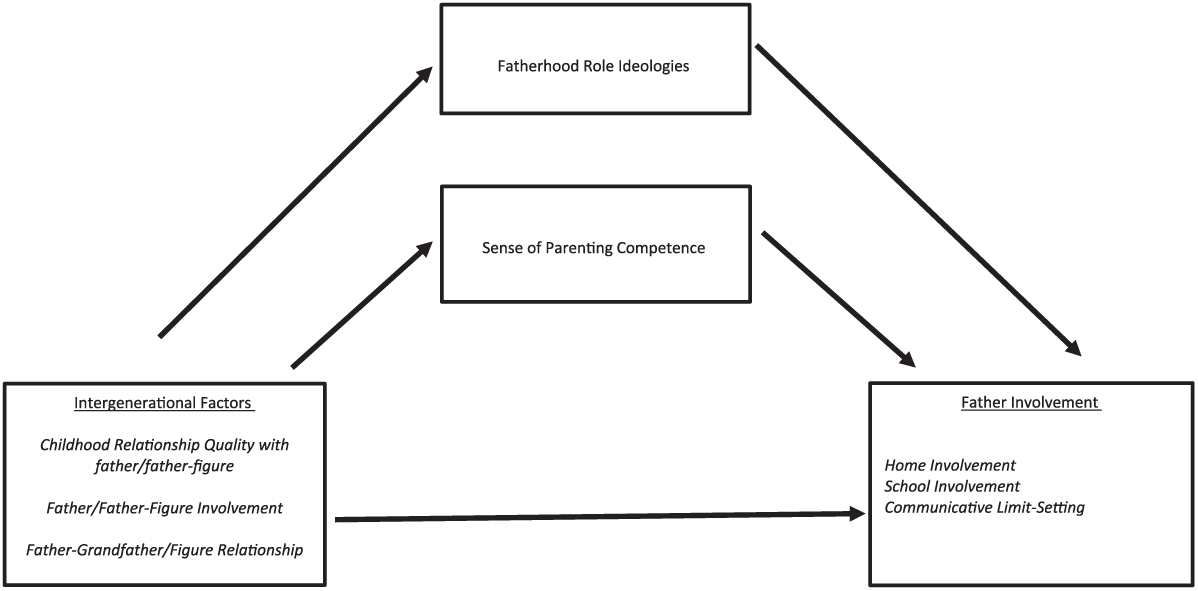
Study conceptual model.
Method
Participants
The data presented are from a community-based investigation exploring sociocontextual influences on African American fathers’ parental engagement and involvement. The sample was composed of 185 African American fathers (M = 32.20 years, SD = 8.24, Range = 21-65 years) with an adolescent child (M = 12.60 years, SD = 2.20, Range = 9-16 years). Participants resided in a midsized city in the Southeastern region of the United States. Sixty-six percentage of participants were residential fathers. Fifty-six percentage of participants were married and living with their spouse, 36% currently single or separated, and 8% cohabiting (living together, but not married). Eight percentage (n = 13) of single fathers were primary caregivers of the participating child. The majority of the sample (82%) reported full-time employment status. Thirty-nine percentage of fathers had a high school education or equivalent (GED), 27.8% had a vocational/associate’s degree, 25.4% received an undergraduate degree, and 12.1% had a graduate degree. The majority of fathers (83%) indicated that they were the biological father of the target child. Of the nonbiological fathers, 3% were adoptive fathers, 14% were stepfathers, and 1% were other family members (i.e., grandfathers). Sixty-four percentage of participants identified the target child as female.
Procedure
Recruitment
After obtaining human subjects approval through the university’s internal review board, fathers were recruited widely from community sources (e.g., community centers, barbershops). As studies have noted the challenges of recruiting fathers (e.g., Coley & Morris, 2002), three primary recruitment strategies were employed. First, the initial recruitment phase entailed targeting community stakeholders and organizations to discuss the study objectives and disseminate study recruitment materials. Second, flyers advertising the study were posted in a variety of community locations and settings (e.g., barbershops, community centers, churches, local businesses). Third, given the ability to reach a broader and more diverse population of fathers in the recruitment area, multimedia recruitment materials (i.e., radio commercials, e-mail listservs) were utilized. Disseminated materials (e.g., investigation examining the experiences of African American fathers) were consistent across recruitment method (e.g., flyers vs. radio commercial).
Research Staff Training and Demographics
All research staff participated in a brief training, which included details about the study goals and protocols as well as information about recruitment strategies for research with African American fathers. In particular, research staff were instructed to clearly communicate that residential or nonresidential fathers, who have at least one adolescent child were eligible to participate in this investigation. Also, staff were trained to answer various follow-up questions regarding the study protocol. The recruitment team was composed of four African American women, two African American men, and one European American female.
Survey Administration
All surveys were administered in locations convenient to fathers (i.e., neighborhood libraries, barbershops, community centers). Before participants began the survey, research staff read aloud the study protocol, consent form, and confidentiality procedures (i.e., assignment of ID numbers to provide anonymity). Participants were able to ask for additional clarification regarding the consent and survey administration procedures. To address any literacy issues, all fathers were given the option of having the survey read aloud by a member of the research staff. Across the entire recruited sample, one participant chose to have the survey read aloud.
Measures were administered via a written survey questionnaire. For questions relating to interactions with (e.g., involvement, socialization) and assessments of the child (e.g., grade point average, academic/career expectations), participants were instructed to answer questions in relation to the identified target child. Before answering child-specific questions, fathers completed a brief demographic questionnaire pertaining to the target child (e.g., age, gender, current living arrangements, biological status). Surveys took approximately 60 minutes to complete. After survey completion, participants were debriefed regarding the study goals and compensated with a $25 cash gift card.
Measures
Intergenerational Factors
The Father Presence Scale (Krampe & Newton, 2006) measured retrospective accounts of childhood interactions with fathers as well as intergenerational family experiences. To address these multidimensional aspects of intergenerational relationships, the current investigation assessed three domains—(a) childhood involvement with the father (e.g., “My father/father figure helped me learn new things”; six items; α = .95); (b) father’s relationship with his own father (e.g., “My father felt close to his father/father figure”; six items; α = .91); and (c) current beliefs about the father/father figure (e.g., “I look up to my father/father figure”; eight items; α = .97). Fathers responded on a 5-point scale (1 = strongly disagree, 5 = strongly agree). Mean scores were computed with higher scores indicating greater involvement. Investigations have utilized this scale with African American samples and demonstrated good reliability (Thomas et al., 2008).
Fathering Role Ideologies
Seven items from the Early Childhood Longitudinal Study–Birth Cohort assessed beliefs regarding the role of fathers in child rearing and development. This scale was originally adapted from the Role of the Father Questionnaire (Palkovitz, 1984). Due to a less than optimal reliability (α < .65), two items were omitted from the adapted seven-item scale (“It is difficult for fathers to express affectionate feelings toward their child”; “The activities a father does with their child don’t matter. What matters more is whether he provides for them”). The resulting reliability for the five-item scale was .70. Fathers indicated agreement with each item on a 5-point scale (1 = strongly disagree, 5 = strongly agree). Final sample scale items included the following: (a) “A father should be as heavily involved as the mother in the care of the child” and (b) “The way a father treats his child has long-term effects on the child.” Mean scores were computed for each subscale, with higher scores indicating the extent to which fathers believe that they should be involved and engaged with their child. Previous studies have utilized this scale and demonstrated good reliability with samples including African American fathers (e.g., Bronte-Tinkew et al., 2006).
Parenting Sense of Competence
This 14-item scale measured fathers’ parenting efficacy and confidence in child rearing (e.g., “I honestly believe I have all the skills necessary to be a good parent to my child”; Johnston & Mash, 1989). Fathers indicated agreement with each statement on a 6-point scale (1 = strongly disagree, 6 = strongly agree). Appropriate items were reverse coded and mean scores were computed. Higher scores indicate a greater sense of parenting competence. Previous studies have demonstrated good reliability with multiethnic samples of fathers (Fagan, 2008; Ohan et al., 2000). Reliability for this scale was .74.
Father Involvement
Father involvement was assessed across three dimensions—(a) home involvement, (b) school involvement, and (c) communicative limit-setting. Home involvement, which was composed of nine items, measured involvement activities within the home context (e.g., discussions, helping with homework; Grolnick & Slowiaczek, 1994). The second dimension, school involvement measured fathers’ participation in school-specific activities (14 items; e.g., attending parent–teacher conferences; attending child’s school-related and/or extracurricular activities; Grolnick & Slowiaczek, 1994). Communicative limit-setting assessed parents’ ability to maintain open communication while establishing boundaries and limits regarding child behavior (four items; “I try to make rules which take into account my child’s individual needs into consideration”; “I try to explain the reasons for the rules I make”). Mean scores were computed for each subscale, with higher scores indicating greater involvement. Previous studies with multiethnic (Grolnick et al., 1997) and African American parents (Cooper & Smalls, 2010) have demonstrated reliability of these measures. To our knowledge, these measures have not be used in a sample of African American fathers. However, reliabilities for home (α = .87), school involvement (α = .95), and communicative limit-setting (α = .72), scales were good.
Demographic Factors
Multiple demographic variables were included in this investigation as control variables. Specifically, this investigation controlled for father residential status (1 = residential, 2 = nonresidential), marital status (1 = married, 2 = living together, not married, 3 = separated or divorced), biological status (1 = biological; 2 = nonbiological), number of children, father education level (1 = less than high school, 2 = high school education/equivalent, 3 = associate degree/2-year degree, 4 = bachelor’s degree, 5 = graduate degree), father age, and child gender (1 = female, 2 = male).
Results
Preliminary Analyses
Table 1 shows correlations among key study and demographic variables. Fathers who had more involved fathers growing up reported a greater parenting sense of competence (r = .19, p < .05), home (r = .20, p < .01), and school involvement (r = .32, p < .001). Fathers with more supportive (r = .24, p < .01) and involved (r = .20, p < .01) fathers reported more active fathering role ideologies than fathers who had less supportive and involved fathers as a youth. Fathers who reported a more positive father–grandfather relationship also reported more active and engaged fathering role ideologies (r = .26, p < .001). Parenting sense of competence was positively related to fathering role ideologies (r = .42, p < .001), home (r = .28, p < .001), school involvement (r = .34, p < .001), and communicative limit-setting (r = .40, p < .01). Similarly, father role ideologies were positively associated with home (r = .28, p < .001), school involvement (r = .32, p < .001), and communicative limit-setting (r = .28, p < .01).
Correlations and Means (Standard Deviations) for Study Variables.

Note. FRI = fathering role ideologies; PSOC = parenting sense of competence. Child gender: 1 = female, 2 = male; Father education level: 1 = less than high school, 2 = high school education/equivalent, 3 = associate degree/2-year degree, 4 = bachelor’s degree, 5 = graduate degree; Residential status: 1 = residential, 2 = nonresidential; Biological status: 1 = biological, 2 = nonbiological.
p < .10. *p < .05. **p < .01. ***p < .001.
Additionally, there were bivariate associations between demographic variables and the core study variables. Fathers with a higher level of education (r = .21, p < .05) reported greater parenting competence. Older fathers reported a greater parenting sense of competence (r = .18, p < .05), less school involvement (r = −.17, p < .05), and more communicative limit-setting (r = .17, p < .05) than younger fathers. Also, residential status was associated with greater home (r = .39, p < .001) and school involvement (r = .39, p < .001). Residential fathers were more likely to report greater childhood involvement with their own fathers (r = −.19, p < .05).
t Tests revealed differences between father demographic factors and key study variables. Fathers with a male target child (M = 3.92, SD = 0.65) reported greater parenting competence than fathers with a female target child (M = 3.74, SD = 0.51, p < .05). Also, fathers with sons reported greater involvement (M = 2.87, SD = 0.72, p = .056) than fathers with a female target child (M = 2.81, SD = 0.85). Residential fathers reported greater home (M = 3.05, SD = 0.70, p < .001) and school (M = 3.71, SD = 0.70, p < .001) involvement than nonresidential fathers (M = 2.36, SD = 0.84; M = 3.03, SD = 0.82).
Data Analytic Strategy
A structural equation model using Mplus was utilized to accomplish the study goals (Version 7.4; Muthén & Muthén, 2015). Mplus uses full information maximum likelihood, which does not delete cases with missing data and thus minimizes biased parameter estimates (Enders & Bandalos, 2001). To test our mediation hypotheses, an indirect effects model using bootstrapping methods was employed. Thus, bootstrapping methods were used to estimate the hypothesized paths (e.g., direct and indirect relationships), which will more accurately estimate Type I error rates and provide greater power in the detection of mediating relationships (MacKinnon, Lockwood, Hoffman, West, & Sheets, 2002). A bootstrap sample of 10,000 was used in the current investigation to produce bias-corrected confidence intervals (CIs). With the bootstrapped procedure, if the CI does not contain zero, there is evidence of mediation. Recent work has demonstrated the accuracy of the bootstrapping procedure in detecting mediation and indirect effects (MacKinnon et al., 2002; Shrout & Bolger, 2002; Preacher & Hayes, 2004). Child (gender) and father (education level, age, number of children, current marital status, residential status, biological status) characteristics were entered into the initial model as covariates.
Fathering Role Ideologies as Mediator
Intergenerational factors were marginally associated with involvement (β = .16, p < .10; see Table 2). Greater intergenerational involvement was related to the endorsement of fathering roles reflecting active engagement in the lives of their children (β = .23, p < .01). Also, more involved and engaged role ideologies were related to greater involvement (β = .28, p < .01) among fathers. There was a significant indirect effect of role ideologies on the association between intergenerational factors and involvement (β = .07, p < .05, CI [0.01, 0.10]). The model accounted for 8% and 35% of the variance in fathers’ role ideologies and involvement, respectively. Child gender, father age, and marital status, which were not significant, were omitted to improve the overall model. The final model indicated that there was good model fit (comparative fit index = .99; root mean square error of approximation = .03).
Indirect Effects of Intergenerational Factors on Father Involvement via Fathering Role Ideologies.
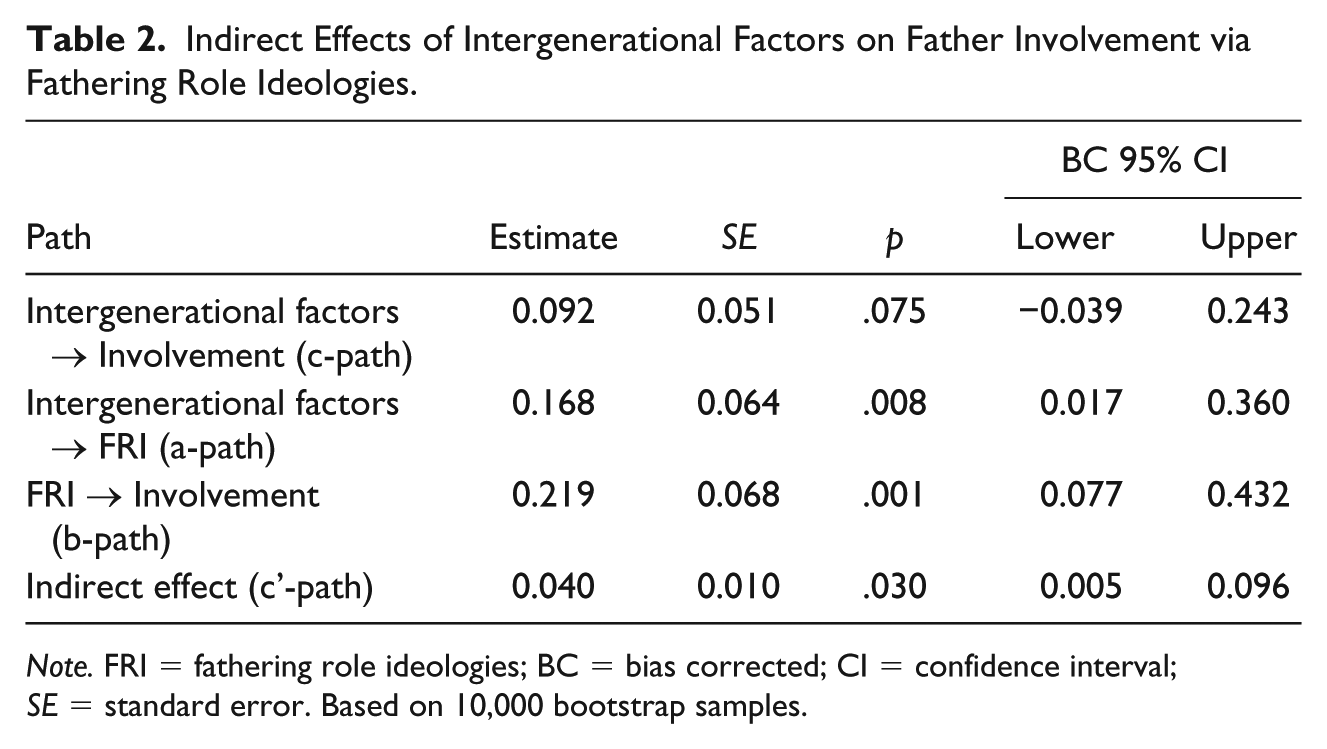
Note. FRI = fathering role ideologies; BC = bias corrected; CI = confidence interval;SE = standard error. Based on 10,000 bootstrap samples.
Parenting Sense of Competence as a Mediator
As noted in Table 3, intergenerational factors were positively associated with involvement (β = .18, p < .05). Greater intergenerational involvement was not related to fathers’ parenting competence (β = .09, ns). However, a greater sense of parenting competence was related to more involvement (β = .33,p < .001) among fathers. There was not a significant indirect effect of parenting competence on the association between intergenerational factors and involvement (β = .03, ns, CI [−0.03, 0.08]). The model accounted for 9% and 38% of the variance in fathers’ perceived parenting competence and father involvement, respectively. The hypothesized model fit the data adequately (comparative fit index = .92; root mean square error of approximation = .07).
Indirect Effects of Intergenerational Factors on Father Involvement via Parenting Sense of Competence.

Note. PSOC = parenting sense of competence; BC = bias corrected; CI = confidence interval; SE = standard error. Based on 10,000 bootstrap samples.
Discussion
Although studies have demonstrated a relationship between African American fathers’ intergenerational factors and involvement with their children (J. L. McAdoo, 1988; Roy, 2006; Wilson, 1986), there has been some indication that there may be critical explanatory processes guiding this association. The bulk of this evidence, however, has been based on qualitative studies with smaller, nonrepresentative samples of African American fathers. This investigation sought to address this primary gap by formally testing fathering role ideologies and parenting sense of competence as mediators of the relationship between intergenerational factors and African American fathers’ involvement. Overall, there were two main contributions of this investigation—(a) some support for the association between intergenerational experiences and involvement among a sociodemographically diverse samples of African American fathers and (b) initial evidence that fathering role beliefs, but not perceived parenting competence, mediates this relationship.
In line with prior studies of African American fathers (Allen & Doherty, 1996; Bowman & Forman, 1997; Furstenberg & Weiss, 2000; Gadsden & Hall, 1996; Hofferth et al., 2012; Hunter et al., 2006; Roopnarine, 2004), our study revealed that intergenerational factors were associated with greater involvement among African American fathers. Our investigation found that fathers who reported more positive interactions with and assessments of their fathers as well as observations of their fathers’ interactions with their own fathers also reported greater involvement with their own adolescents. Recent investigations suggest that this association might be particularly relevant for positive experiences with fathers. For example, Brown et al. (2017) found that young African American fathers who had a close and nurturing relationship with their biological fathers were more involved in caregiving and play activities with their own sons. Also, similar findings have been noted in a sample of predominantly Latino and African American fathers where grandfathers’ positive involvement was directly associated with fathers’ positive parenting of their own child (Hofferth et al., 2012). Furthermore, studies with multiethnic samples also have demonstrated how family of origin relationships influence fathers’ involvement (Furstenberg & Weiss, 2000). In conjunction with existing research, our investigation provides some support for the modeling hypothesis (Pleck, 2007) as well as the intergenerational continuity of paternal engagement and behavior.
Though it should be noted that the bivariate relationships in our investigation were more robust than our regression analyses, which controlled for demographic and contextual characteristics. Other studies also have found small effects or not demonstrated an association among African American fathers (Coates & Phares, 2014; Shears et al., 2002). For instance, Coates and Phares (2014) found that fathers’ closeness to their own fathers was unrelated to involvement among a sample of low-income African American fathers. Shears et al. (2002) found that, while family or origin experiences were associated with fathers’ beliefs and assessment of their parenting skills, they were not associated with involvement. There are a couple of explanations that help contrast with our findings. First, the null effects observed in these students, in combination with our study, may reflect sample and design differences. Both Coates and Phares (2014) and Shears et al. (2002) examined these relationships among nonresidential or unwed African American fathers. Our study included a sizeable number of married fathers and investigations (e.g., Perry et al., 2012) have suggested that marital status might influence the strength of associations.
Second, our findings potentially suggest that, while intergenerational factors may have some impact on involvement, these relationships may be more distal, signaling the importance guiding mechanisms or moderators. For instance, existing studies have emphasized that sociodemographic and contextual factors are key to understand the association between intergenerational factors and later parenting practices (e.g., involvement; Bouchard, 2012; Coley & Hernandez, 2006; Roy, 2006). In line with Pleck (2007), our findings provide some support for this relationship and suggest that fathers may model interactions with their own fathers. However, in combination with existing work, our findings suggest that these relationships may be more indirect.
Thus, a larger goal of our investigation concerned the identification of the mechanisms through which intergenerational factors might shape involvement. Mechanisms, particularly beliefs and ideologies about fathers, are of particular interest given indications in the intervention literature that they are malleable. Existing studies suggest that fathering role ideologies and perceived parenting competence may be explanatory factors for African American fathers (Hunter et al., 2006). However, much of this work has relied on qualitative studies with small, nonrepresentative samples. Using a sociodemographically diverse sample of African American fathers, this study explored the potential mediating role of—(a) ideologies about the roles and contributions of fathers and (b) beliefs about one’s own competence in the parenting domain. Our findings noted some differentiation, with fathering role ideologies, but not parenting sense of competence, mediating the association between intergenerational factors and involvement. The link between fathering role ideologies and involvement parallels other investigations (Bronte-Tinkew et al., 2006). Our investigation fills existing gaps by formally examining the mediating role of fathering role ideologies. In this study, fathers who reported more positive interactions and greater involvement with their own fathers growing up were more likely to endorse that fathers should be active in the child-rearing process. Furthermore, child-rearing beliefs that reflected fathers as active and engaged in the everyday lives of their children were directly associated with their involvement with their children. Given that some studies have not demonstrated a relationship between intergenerational factors and involvement (Coates & Phares, 2014), this finding suggests a potential pathway through which intergenerational factors can influence African American fathers’ involvement.
Despite indications that parenting sense of competence may be an important mechanism (de Haan et al., 2009; Egberts et al., 2015), this was not realized in our investigation. We did find that, while parenting sense of competence was not associated with intergenerational factors in this study, parenting sense of competence was related to fathers’ self-reported involvement with their children. Thus, it is possible that parenting sense of competence may be influenced by more proximal interactions. For instance, studies have noted that coparenting and marital relationships as well as current relationships with children have more direct influences on fathers’ current ratings of parenting competence (T. L. Jones & Prinz, 2005). Additionally, research by Roy and Dyson (2010) suggest that socially constructed masculinities are an important lens to view fathers’ parenting-related beliefs, particularly their perceptions of their parenting competencies. In fact, parenting sense of competence may more closely reflect fathers’ own experiences or beliefs about parenting, which may or may not differentiate from larger fathering role ideologies. Studies have suggested that fathering masculinities are a product of African American men’s social experiences, including interactions within their communities as well as larger societal messages (e.g., negative stereotypes about African American fathers; Roy, 2006). Thus, fathers’ sense of competence may be shaped by larger fathering ideologies or potentially moderate the association between other fathering beliefs and related masculinities.
Although our findings provide some support for the mediating role of fathering ideologies, this study is not without limitations. First, this investigation included retrospective accounts of fathers’ experiences with their own fathers. Although this account provides some insight, current assessments of this relationship as well as other parenting-related factors may have influenced perceptions of the childhood relationship. Multigenerational studies could more optimally illuminate the transactional nature of father–child relationships and implications for the development of parenting beliefs and behaviors. Moreover, given indications that longitudinal designs are more optimal for testing mediation (Maxwell & Cole, 2007), multiwave data would shine additional light on the underlying processes guiding the ways in which intergenerational factors shape later involvement. Still this investigation begins to build the case for the mediating role of fathering beliefs. Additionally, this investigation was based on a sole reporter. However, given the historical exclusion of African American fathers’ own perspectives in related parenting research, this investigation’s focus on fathers’ beliefs and ideologies as well as their own reported parenting practices provides much-needed insight into the examined processes. Though this study examined two ideological dimensions (e.g., general beliefs about the roles of fathers, perceptions of parenting competence), future investigations should explore additional dimensions of general and father-specific beliefs. Further, given indications that fathers’ race-related experiences and beliefs shape their parenting practices (Cooper et al, 2015; Cooper et al., in press; Jones & Neblett, 2019), future investigations should examine race-specific fathering ideologies (i.e., perceptions regarding the importance of involvement among African American fathers) and how social context may shape them.
Additional studies are needed to parse out the indirect ways that intergenerational factors may potentially influence the examined associations. Research has explored such mediating or moderating factors and has found that positive relational schema (i.e., general positive feelings in emotionally intimate relationships; Brown et al., 2017), the positive adjustment and social competence of parents in adolescence and young adulthood, and parent academic attainment (Belsky, Conger, & Capaldi, 2009) mediate the relation between positive intergenerational parenting. Also, prospective studies should examine how other sociodemographic factors, for both fathers and children, may affect these relationships. For instance, although the majority of fathers in our study were biological fathers, existing studies have demonstrated that male relatives (i.e., grandfathers, uncles) or social fathers are likely to engage in fathering roles. Furthermore, studies have suggested that this may influence role flexibility among these surrogate fathers (Doherty et al., 1998). Future studies should explore how intergenerational context, role ideologies, and beliefs vary across relationship status (biological vs. nonbiological). Also, our bivariate associations indicated that child gender was associated with fathers’ parenting sense of competence, with fathers of sons feeling more confident in their parenting abilities than fathers with daughters. Thus, in line with prior work (Bronte-Tinkew, Ryan, Carrano, & Moore, 2007), uncovering the complex ways that child gender, particularly during adolescence, can shape the impact of fathering roles and beliefs would be contributory to the existing literature.
Conclusions and Implications
Bolstering existing intervention and prevention research (e.g., Caldwell et al., 2010; Fagan & Stevenson, 2002), our findings have implications for fathering-focused programming. As studies have emphasized the complexity of one’s intergenerational experiences in relation to parenting (Pleck, 2007; van Ijzendoorn, 1992), this study suggests that fathering beliefs can be a mechanism underlying how intergenerational factors influence involvement. Fatherhood programs targeting African American fathers have suggested that addressing unique ecologies (e.g., childhood family contexts, negative stereotype awareness) are critical to address barriers to involvement (Julion, Breitenstein, & Waddell, 2012). Although social experiences in childhood can affect adulthood behaviors, existing preventative interventions (e.g., Mazza, 2002) have demonstrated that fathering beliefs are malleable and linked to father involvement and engagement with their children. Thus, interventions addressing barriers to involvement should emphasize the complex interplay between fathering role ideologies and the multitude of experiences that shape these beliefs. Importantly, this investigation supports the critical importance of addressing African American fathers’ social ecology across the life span, including the role of intergenerational factors as well as how fathers’ beliefs and perceptions of competence shape involvement.
Footnotes
Acknowledgements
We would like to thank the fathers who participated in this investigation. Also, we would like to thank Strengths, Assets, & Resilience (StAR) and African American Youth Development (AAYD) lab members, staff, and community stakeholders for their assistance in recruitment and data collection.
Authors’ Note
Latisha Ross is now affiliated with University of Virginia, Charlottesville, VA, USA.
Declaration of Conflicting Interests
The author(s) declared no potential conflicts of interest with respect to the research, authorship, and/or publication of this article.
Funding
The author(s) disclosed receipt of the following financial support for the research, authorship, and/or publication of this article: This research was supported by a National Science Foundation Career Award (Grant #:1150963/1833349) awarded to the first author.