



Abstract
The article explores the association between housework, earnings, and education. In contrast to the majority of existing studies from Western countries, this article tests the bargaining theory in the Czech Republic. Given the high female labor force participation coupled with a tendency for women to drop out of the labor market for several years after childbirth, the country provides an interesting context to test the theory. Using data from the first wave of the Czech Household Panel, we apply multilevel mixed-effect regressions and analyze the index expressing the relative division of housework between the male and female partners. We demonstrate that in this institutional context, economic factors such as the woman’s education and her absolute or relative earning have little explanatory power for the way housework is shared. Furthermore, we show that the man’s education is a better predictor of the division of housework than the woman’s education.
There is a large body of literature exploring the link between partners’ relative resources and the division of housework (Baxter & Hewitt, 2013; Evertsson & Nermo, 2007; Sullivan & Gershuny, 2016). Yet despite the plethora of empirical work testing the importance of relative resources for the division of housework, the majority of empirical studies come from West European countries, the United States, or Australia. The questions of whether and how relative resources matter in other contexts have been neglected to a large extent. Yet there is growing evidence that context does matter. This means that the findings from Western Europe might not be easily transferable to other societies. Moreover, previous studies also do not provide a clear answer to the question of which resources are important in which context. For example, Aassve, Fuochi, and Mencarini (2014) suggested that relative income was particularly important in countries with less gender equality, whereas in the more gender egalitarian countries, relative human capital (education) played a greater role. Yet, contrary to the findings of Aassve et al. (2014), Fuwa (2004) did not find any differences in the role of relative income between Western and Eastern Europe despite major differences in the levels of gender equality.
This article contributes to the existing research in three ways. First, it analyzes a large data set from the Czech Republic, a European country with some of the most traditional views on the roles of men and women. In terms of female employment rates, the country represents a hybrid case. Of all of the countries that form the Organization for Economic Co-operation and Development (OECD), Czech mothers with small children have one of the lowest employment rates (similar to Turkey), and an overwhelming majority of the Czech population believes that children should stay in maternal care until they reach the age of 3 years (Hašková & Dudová, 2017). However, Czech mothers with school-aged children have one of the highest full-time employment rates in Europe (similar to Scandinavia, see the OECD Family Database). Given the relatively high female labor force participation coupled with a tendency to drop out of the labor market for several years after the birth of a child, the Czech Republic provides an interesting context to test relative resource theory.
Second, this article contributes to the existing research by analyzing multiple indicators of relative resources. Following a recent study by Sullivan and Gershuny (2016), we study both relative earnings and relative education. We argue that relative income might not always be the best way to express the bargaining power of the individual as it misrepresents currently nonemployed individuals. Such exclusion might be particularly problematic in a context where the majority of mothers with young children temporarily leave the labor market, as is the case in the Czech Republic. Thus, any conclusion about the importance of relative resources should not be based exclusively on partners’ earnings.
Third, the majority of recent studies exploring the role of relative resources do not control for gender ideology (Evertsson & Nermo, 2007; Hook, 2017; Killewald & Gough, 2010; Sullivan & Gershuny, 2016). Yet past research shows that attitudes toward gender roles are a major predictor of the division of housework and could explain the link between housework and relative resources (Nitsche & Grunow, 2016). Thus, this work takes into account gender role ideology.
Division of Housework and Partners’ Resources: Theoretical Background
In the social sciences, there is a long tradition of research on the link between partners’ relative resources and the division of housework. A classical formulation of the rational choice theory and New Home Economics suggests that one of the major gains of marriage is interdependency and specialization between spouses (Becker, 1973). As specialization raises productivity, it maximizes a couple’s joint utility. Therefore, in a rational household, housework and child care is provided in return for economic support. One partner specializes in the household labor by taking care of the household production (meal preparation, care for children), and the other specializes in paid work. To maximize joint utility, the partner whose time is less expensive (has lower earning potential) should specialize in domestic tasks (Becker, 1973). The specialization argument implies that the greater the advantage of one partner in the labor market, the greater the share of domestic work that should be carried out by the other partner.
The classical formulation by New Home Economics did not consider the issue of power. Yet, as early as 1960, Blood and Wolfe advanced the idea that housework is an indicator of marital power (Blood & Wolfe, 1960, see Sullivan & Gershuny, 2016). Following this argument, bargaining/relative resource theory claims that the decision about the division of housework is a result of bargaining processes within the household. In particular, this theory maintains that the partner with higher resources has greater power to avoid housework (Evertsson, 2014; Sullivan & Gershuny, 2016). Thus, as women’s relative human capital and earning potential grow, their bargaining power raises, and their involvement in domestic chores should decrease. In reverse, men’s time spent on housework should grow as their relative advantage in terms of relative resources weakens.
However, gender researchers have found that increased resources do not always equate to less housework (Brines, 1994; West & Zimmerman, 1987). According to the compensatory gender display theory, gender influences the division of housework not only indirectly through earnings but also directly as it is linked to a set of gendered expectations (Bittman, England, Sayer, Folbre, & Matheson, 2003; West & Zimmerman, 1987). Household labor is socially constructed as “woman’s work,” while providing for the family is typically considered “man’s work.” Therefore, in the anticipated division of roles, the wife is economically dependent on the husband, who is the breadwinner and earns most of the family income. When a couple deviates from this normative expectation, and the woman makes more money than her partner, the couple might adopt a more traditional division of housework to offset the deviation from the norm. The “doing gender” hypothesis suggests that these nontraditional couples might adopt compensatory traditional behavior in private to reassert their normality (Brines, 1994).
The discussion about the link between partners’ relative resources and the division of housework was further expanded by Gupta’s (2007) autonomy model. He argued that it is women’s absolute—not relative—earnings that explain their housework hours. When absolute earnings are added to the model, the explanatory power of relative earnings diminishes. Therefore, women’s housework is affected by their own earnings regardless of their husbands’ earnings. He speculated that women with higher absolute earnings might use their own income to outsource housework by purchasing help with household tasks.
Although we acknowledge that the absolute earnings matter for the total number of hours women spend on housework, it is not clear how women’s absolute earnings affect the relative division of housework between men and women. Making more money helps the woman do less housework, which could decrease her relative contribution to the chores. However, it is also possible that the woman’s capacity to purchase domestic services from an external source might affect not only her contribution but also her partner’s contribution to housework. For example, the male partner might be less willing to do chores if he knows that the woman does less housework herself and that somebody else can do it. In this case, the relative division of housework would be unaffected by woman’s absolute earnings. Thus, we do not consider the autonomy model in explaining the relative contribution of men and women to household chores. Nevertheless, all models control for women’s personal resources.
Housework and Partners’ Resources: Empirical Evidence
So far, the empirical evidence on the link between partners’ relative resources and the division of housework is mixed. The majority of empirical works tested the bargaining/relative resource theory using relative income/earnings. Nevertheless, some more recent studies expanded the analysis by including measures of human capital. In the following section, we first review recent evidence on the role of relative earnings. Afterward, we summarize the main findings concerning the role of relative human capital and its importance for the division of domestic chores.
Partners’ Relative Earnings and the Division of Housework
Several studies from the past decade have provided supportive evidence for the bargaining/relative resource theory. For example, using Swedish data collected during the 1990s, Evertsson and Nermo (2007) reported that increases in women’s relative earnings were associated with decreases in their share of housework. Similarly, Sullivan and Gershuny (2016) analyzed data from the British Household Panel Survey and found that the greater woman’s relative wages were, the less housework she did on average. Likewise, Baxter and Hewitt (2013) showed that relative income plays an important role in Australia as well.
Nevertheless, there is mixed evidence about whether the link between relative resources and the division of housework is linear (as predicted by the bargaining theory) or nonlinear (as predicted by the “doing gender”/compensatory gender display hypothesis). Studies from the 1980s and 1990s showed that the division of labor in households in which women became the primary breadwinners was even more traditional (Bittman et al., 2003; Brines, 1994). Married women continued to do most of the household chores, and both sexes considered this uneven arrangement to be mostly fair (Lennon & Rosenfield, 1994). In newer studies, Aassve et al. (2014) found support for gender display hypothesis in Belgium, France, Romania, and Russia but not in Norway and Bulgaria. Similarly, Evertsson and Nermo (2004) found nonlinearity in the relationship between economic dependency and women’s housework duration in the United States but not in Sweden (Evertsson & Nermo, 2004). Baxter and Hewitt (2013) reported results consistent with the “doing gender” hypothesis in Australia, where relative earnings were associated with women’s housework but only until women earned over three fourths of the household income. A recent study by Hook (2017) showed no additional decline or increase of housework time after the 50th percentile of women’s relative earnings, finding no support for the compensatory gender display hypothesis.
Partners’ Relative Human Capital and the Division of Housework
In general, studies exploring the role of partners’ relative resources have tended to focus on earnings/income. Although partners’ relative income constitutes a clear and direct measure of relative resources, there are also some limitations to using this indicator. In particular, studies exploring the importance of relative earnings have not fully considered relative resources for couples where one of the partners—at least temporarily—drops out of the labor market. If they included nonemployed partners, they usually assumed that this partner has zero economic resources/power. However, this might not be a realistic assumption, particularly for women with relatively high earning potential who decide to take some time out of employment to take care of children with the prospect of returning to their jobs (Sullivan & Gershuny, 2016). Thus, there might be some advantages to using different measures, such as education, to explore the importance of relative resources.
Relative education as a measure of relative human capital should be related to the division of housework in the same way that relative income is. Yet studies focusing directly on the importance of relative education are less common and provide an even less conclusive picture than those exploring the role of relative earnings (Aassve et al., 2014; Bianchi et al., 2000; Evertsson & Nermo, 2004). For example, in support of bargaining theory, Sullivan and Gershuny (2016) found that in British households where women’s relative human capital substantially outstripped that of their husbands, women spent the lowest number of hours doing housework. The authors concluded that changes in women’s resources (both earnings and education) are the most important factor behind the changing division of housework. Evertsson and Nermo (2007) also demonstrated that the growth in women’s educational attainment is associated with a decrease in their housework time and a slight increase in men’s housework time. At the same time, they showed that women’s share of housework was highest in families where both spouses had low education. To sum up, empirical works have suggested that women with more education do less housework, and more educated men do more housework (Coltrane, 2000; Sullivan, Billari, & Altintas, 2014; Treas & Tai, 2016). However, the results regarding partners’ relative education were less conclusive across institutional contexts (Aassve et al., 2014; Bianchi et al., 2000; Evertsson & Nermo, 2004).
Moreover, the interpretation of the effects of relative education is complicated by conceptual confusion as to the extent to which education is a measure of human capital investment or an indicator of ideology or attitudes (Coltrane, 2000; Van Berkel & De Graff, 1999). For example, according Van Berkel and De Graaf (1999), education matters not because it is a proxy for human capital/economic potential but because it liberalizes values. Indeed, the importance of gender ideology for the division of labor has been repeatedly demonstrated (Aassve et al., 2014; Evertsson, 2014). For example, Nitsche and Grunow’s (2016) analysis of German longitudinal data demonstrated that relative and absolute earnings played only a minor role in the division of household chores after controlling for the gender ideologies of both spouses. Other studies have also indicated that the impact of gender ideologies on the allocation of household work is conditioned by the interaction of the attitudes of both partners (Greenstein, 1996; Jansen & Liefbroer, 2006). The discussion about the importance of the gender ideology for the division of housework is further complicated by the fact that the relationship seems to be reciprocal. In other words, gender attitudes affect the division of housework, but the division of housework also affects our beliefs about what the man’s and woman’s jobs are (Carlson & Lynch, 2013). However, for the purpose of this article, this is not a major caveat. We are primarily interested in education as a proxy for human capital. Gender ideology is used as a control as it might confound the effect of relative resources and particularly education. In contrast to most of the recent work testing bargaining theory that did not include gender attitudes, this study controls for gender ideology in all models to distinguish between education as a proxy for attitudes and as a measure of human capital.
Country Context: Czech Republic
Most existing studies have explored data from Western Europe, the United States, or Australia (for the exception, see Aassve et al., 2014). To contribute to the dearth of research from other social contexts, this article explores a large-scale data set from the Czech Republic. This country is a hybrid case in terms of welfare regime classification and female employment patterns. On one hand, the labor force participation of mothers with children 6 to 14 years of age is among the highest in the OECD countries. In 2014, 86.6% of mothers in this group worked compared with 86.4% of Danish and 89.2% of Finnish mothers (OECD Family Database). 1 On the other hand, the labor force participation of mothers with children younger than 3 years of age is among the lowest in the OECD countries, at 22.3%. Only in Slovakia and Hungary are mothers with young children less likely to work than in the Czech Republic, at 16.7 and 13.4%, respectively.
The low labor force participation of Czech mothers with young children is accompanied by generally traditional attitudes toward child care and gender roles. Using the International Social Survey Programme (ISSP) 2012 data, Salin, Ylikännö, and Hakovirta (2018) show that the attitudes toward the division of paid work and unpaid care for preschool children have remained rather traditional in the Czech Republic, similar to other Central and Eastern European countries. In these countries, if a small child is present at home, more than 50% of the population prefer the male breadwinner model (father working full-time and mother staying home) as the best way to divide paid work and unpaid care between parents. This stands in stark contrast to the Nordic countries, where less than 10% of respondents supported such a family model, or even Western European countries with conservative welfare regimes, such as Germany or France, where less than 20% are in favor of such an arrangement (Salin et al., 2018).
Furthermore, analysis of the ISSP 2012 data demonstrates overwhelming support for long parental leaves among Czech women. With regard to the open question about the preferred duration of parental leave, less than 4% of women wished for a leave that would last 12 months or less. In contrast, over 75% of women wanted a leave that would last at least 3 years. This support is considerably higher than in Western European countries. For example, such a long parental leave is preferred by less than 17% of women in France and Germany and only by 6% of women in Sweden (Hamplová & Šalamounová, 2015). Such high support for long parental leaves and low support for institutional child care has been consistently shown in other Czech surveys (Hamplová & Šalamounová, 2015).
Moreover, education seems to have relatively little effect on these attitudes. Among women with a university degree, only 5% of respondents preferred a parental leave of 12 months or less, and 68% said that the parental leave should last at least 36 months (Hamplová & Šalamounová, 2015). In addition, a strikingly high proportion of Czech women declared that leave should be taken by the mother (67%—only mother, 23%—mostly mother). In contrast, in Germany or France, the option “only mother” is chosen by only around 13% of women and the option “mostly mother” by about one third of women. In Sweden, there was practically no support for the option “women only,” and the preference for sharing parental leave by both parents prevails (Hamplová & Šalamounová, 2015). Moreover, the Czech family policy can be characterized as explicitly genderizing because it promotes different gender roles for men and women by supporting long maternal leave, provides low access to public child care for children younger than 3 years of age, and does not explicitly encourage fathers to share in the child care (Saxonberg, 2013).
The traditional division of labor along gender lines is also visible in housework distribution. The traditional division of housework, where most of the housework is done by women, is prevalent among Czech couples and most often is consistent with their gender attitudes (Aassve, Fuochi, Mencarini, & Mendola, 2015; Klímová Chaloupková, 2018). Women spend considerably more time doing housework than men and are responsible for most of the housework tasks (Aassve et al., 2015; Chaloupková, 2005). Moreover, there is no evidence that this pattern shifts over time, despite some changes in declared attitudes (for comparison of the ISSP 2002 and 2012 data, see Džambazovič & Hamplová, 2013). As for the role of economic resources, in a previous study based on the Czech ISSP 2002, relative income and level of education did not have any predictive power for the hours spent on housework. However, it affected partners’ relative contribution to household chores, and the patterns were consistent with the “doing gender” hypothesis (Chaloupková, 2005). Yet the sample size was relatively small, the income measures were very crude, and only one respondent from the household filled in the questionnaire.
Hypotheses
Built on the theoretical framework presented above, we formulate the following hypotheses.
As previous comparative studies show, in societies characterized by traditional gender ideology, individual characteristics have a smaller effect on housework division than in less traditional countries (Fuwa, 2004; Knudsen & Wærness, 2008; Stier, Lewin-epstein, et al., 2007). Although economic rationality would dictate the adjustment of the division of housework, strong gender norms are likely to trump the economic rationality. Nevertheless, we suggest that though insufficient on their own, relative resources might still play an important part in explaining the division of household labor for couples who have more liberal views on his and her roles (Carriero & Todesco, 2018). Thus, we also test whether the effect of relative earnings is moderated by gender ideology.
We expect that the “doing gender” arguments apply when traditional attitudes toward gender roles are prevalent. If women have the same or lower income than their partners, it does not threaten his or her gender identity. This pattern fits in with the Czech Republic’s “egalitarian essentialism,” where women are expected to contribute to the household finances but to assume a traditional role at home (Begall & Grunow, 2015). The same mechanism is likely to be at play when relative education rather than income is analyzed.
Data
The Czech Household Panel Survey (CHPS) is a nationally representative longitudinal survey based on interviews with all adult household members and children aged 12 years and up. In this article, we use the information from the first wave collected in 2015. The original sample consisted of over 5,000 households. For the purpose of our analysis, we selected only couples with a female partner between the ages of 25 and 64 years to focus on the economically active population. In total, we obtained information on the division of domestic tasks for 3,224 respondents (reports on 2,278 couples). In the analysis of earnings, the number of respondents was reduced to 1,769 (988 couples) due to the high number of missing values (nonresponse) in the income variable for at least one partner.
In a supplementary analysis, we also estimated models separately for men and women. As the main conclusions did not change, they are not reported in the article.
Dependent Variable
The dependent variable was constructed using answers to four questions about who does a given chore in the household, defined as cooking, cleaning, doing laundry, and grocery shopping. The responses could vary on from “always me” to “always my partner” on a 5-point scale. Respondents could also select the response “somebody else.”
Based on the responses about who does which chore, an index expressing the division of domestic labor was produced. Its value varies from −8 (if everything is done by the male partner) to 8 (if everything is done by the female partner). If housework is shared equally, the value of the index amounts to 0. Less than 1% of the sample chose the option “somebody else,” therefore these observations were omitted from the analysis.
Because both partners answered the questions independently, the value of the index could differ between the male and female partners in the same household. This variation within the household reflects the fact that the responses are based on the subjective evaluation of one’s own contribution to housework.
In the regression analyses, we used this linear index as the dependent variable. However, we also tested a categorical measure distinguishing between traditional, semitraditional, and nontraditional arrangements. 2 Because models with this categorical measure did not change the main conclusions of this study, they are not reported in the article.
Independent and Control Variables
Earnings were based on the reported monthly net income from employment in thousands of Czech crowns. The questions were answered by both employed and self-employed respondents. Nonemployed individuals with zero earnings are included in the analyses. Relative earnings were calculated in the following manner: the woman’s earnings were deducted from the man’s earnings, and the result was divided by the total combined spousal income (similarly, see Sullivan & Gershuny, 2016).
Human capital was measured by the level of education. Given the low number of respondents with only primary education, we worked with three categories: (a) primary education or secondary school without high school diploma, (b) secondary school with high school diploma—this category also includes postsecondary nonuniversity education, and (c) university level (bachelor, masters, or doctorate). This classification represents the principal educational divides in the Czech Republic. Relative human capital refers to the relative education of partners measured by these three categories. We distinguished between homogamous couples (equal levels of education), couples in which the woman partnered up (she has less education), and couples in which the woman partnered down (she has more education). In the additional analyses, we also tested a linear measure of relative human capital (difference in years of schooling), but the overall conclusions were not affected, and thus the results are not reported in the articel.
All models controlled for age, sex, type of union (married vs. cohabiting), duration of union (in years), women’s employment status, men’s employment status (currently in employment/self-employment or not), number of children, and gender ideology. Gender ideology is expressed as a summary index of responses to the three following items: (a) a man’s job is to earn money, and a woman’s job is to look after the home and family; (b) a preschool child is likely to suffer if his or her mother works; and (c) parents should stay together even if they do not get along. These three items constituted a single factor and were highly intercorrelated. Some authors argue that to explain the division of housework, the interaction between men’s and women’s gender ideology has to be considered. In the additional models, we tested this assumption on couples where both partners answered the battery on gender roles. However, the interaction term between men’s and women’s attitudes was not significant. Thus, we did not include the interaction to maximize the sample size.
Method
In the models, we use information for both partners if they both filled in the questionnaire. Using multiple observations from the same household has several advantages. For example, we can consider the attitudes of both partners, or we can consider the fact that the relative housework is based on a subjective evaluation of each partner. To account for the interdependence between observations from the same household, we adopted a multilevel mixed-effect approach in Stata 15 (xtmixed, similarly, see Hamplová, 2018). These models treat respondents as nested within the same households and account for the interdependence and similarity between observations. In such cases, the use of ordinary least squares regression would be inappropriate as the standard linear models are built on the assumption of independence between observations (Wooldridge, 2009). A similar approach to studying domestic labor using multiple observations from the same household has been used by other scholars (Auspurg, Iacovou, & Nicoletti, 2017; Nitsche & Grunow, 2016). In the additional analysis with a categorical dependent variable (not reported in the article), we adopted generalized structural equation models with an mlogit link (gsem). All models were also reestimated separately for men and women (not reported in the article). In this case, ordinary least squares and multinomial logit regressions were used.
In the first step, we analyze the role of education in the division of housework. The first model includes all control variables (age, respondent’s sex, the duration of the union, whether the couple is legally married, number of children living at home, and each partner’s employment status). This model serves as a baseline. Afterward, we enter information on the partners’ education. Model 2 incorporates only the female partner’s education; Model 3 adds the male partner’s educational level. These models show the extent to which men’s and women’s schooling is associated with the division of domestic tasks. However, these two models treat the male and female education levels independently and do not consider the role of relative education. Thus, the final model directly measures whether the woman has higher, the same, or lower education than her partner. A similar modeling strategy is used in the analyses of relative income. After reporting the baseline model for the subsample for which the income information is not missing, we enter the woman’s income (Model 2) and the partners’ relative income (Model 3). Finally, Model 4 tests whether the link between relative income and the division of housework is nonlinear as predicted by the “doing gender” theory.
Results
Descriptive Statistics
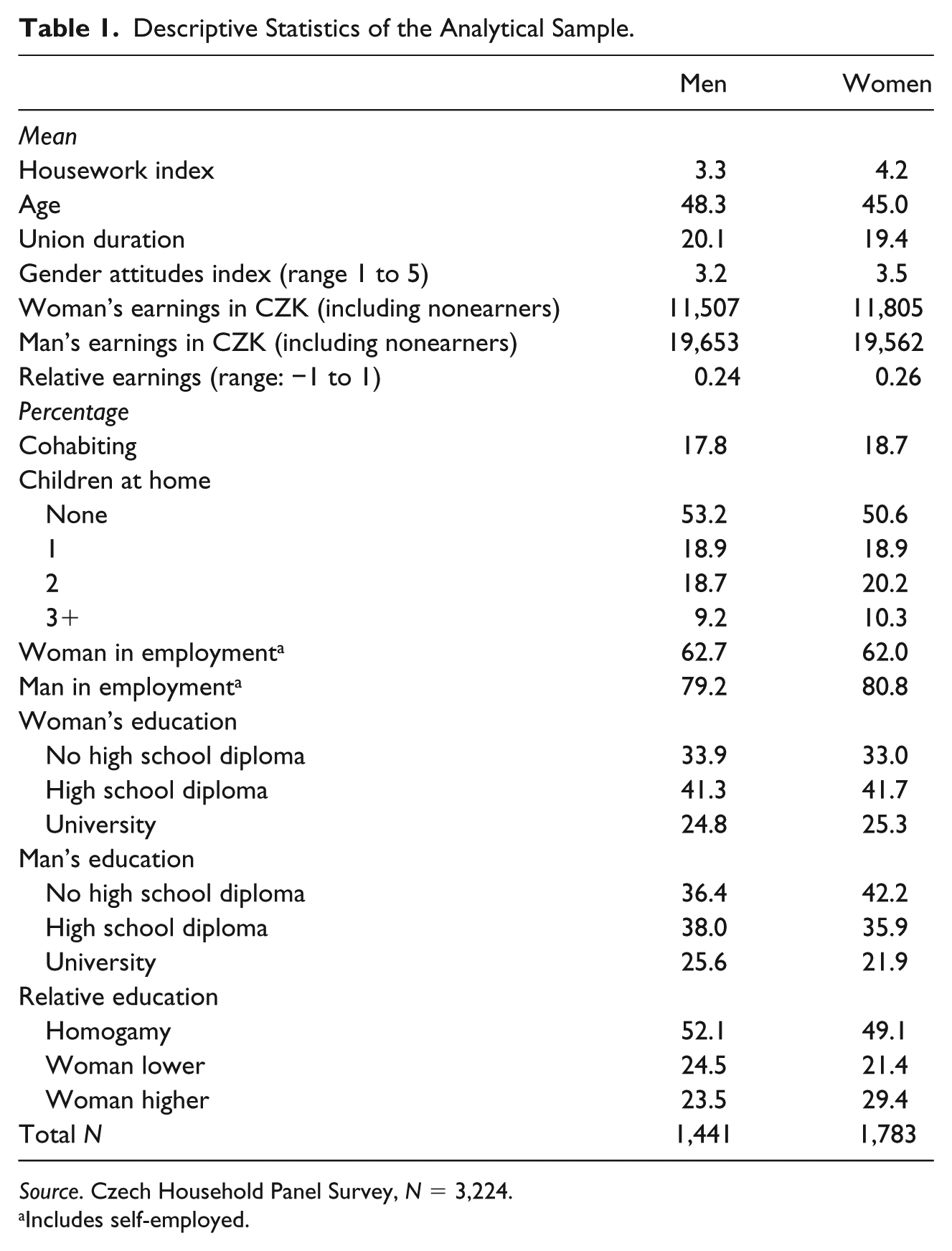
Table 1 reports the descriptive statistics for the male and female respondents separately. The mean age of the male and female respondents is 48.3 and 44.9, respectively. Around 80% of the couples are married; the mean duration of union is about 20 years. Approximately half of the sample do not have a minor child at home. Among the families with children, around 40% of households report one minor child at home, further 40% declare two children, while 20% of mothers and fathers live with three or more children. The women are less likely to work for pay and report significantly lower earnings. However, on average, the women achieved higher education than the men; approximately half of the couples are educationally homogamous.
Descriptive Statistics of the Analytical Sample.
Source. Czech Household Panel Survey, N = 3,224.
Includes self-employed.
As expected, in the typical Czech household, domestic work remains the woman’s responsibility (see Table 2). Using a 17-point index, where −8 means that all housework is done by the man, 8 means that all housework is done by the woman, and 0 means that housework is shared equally, the respondents reported a mean value of 3.8. Both sexes tended to boost their estimated share of housework, but the overall difference between male and female respondents was small: the mean value of the index expressing the division of housework was 3.9 for men and 4.2 for women.
Mean Value of Index: Division of Housework (−8 = Everything Done by Man, 0 = Equal Share, 8 = Everything Done by Woman).

Source. Czech Household Panel Survey, N = 3224.
Includes self-employed.
As for education, both men and women with higher education reported a more egalitarian division of housework. However, the differences were generally negligible. Moreover, there was very little variation by partners’ relative education. Table 2 also reports the mean value of the index by the type of union and the number of children. Even though cohabiters tended to be more egalitarian, the number of children did not seem to be linked to the division of labor at all.
Multivariate Results: Human Capital and the Division of Housework
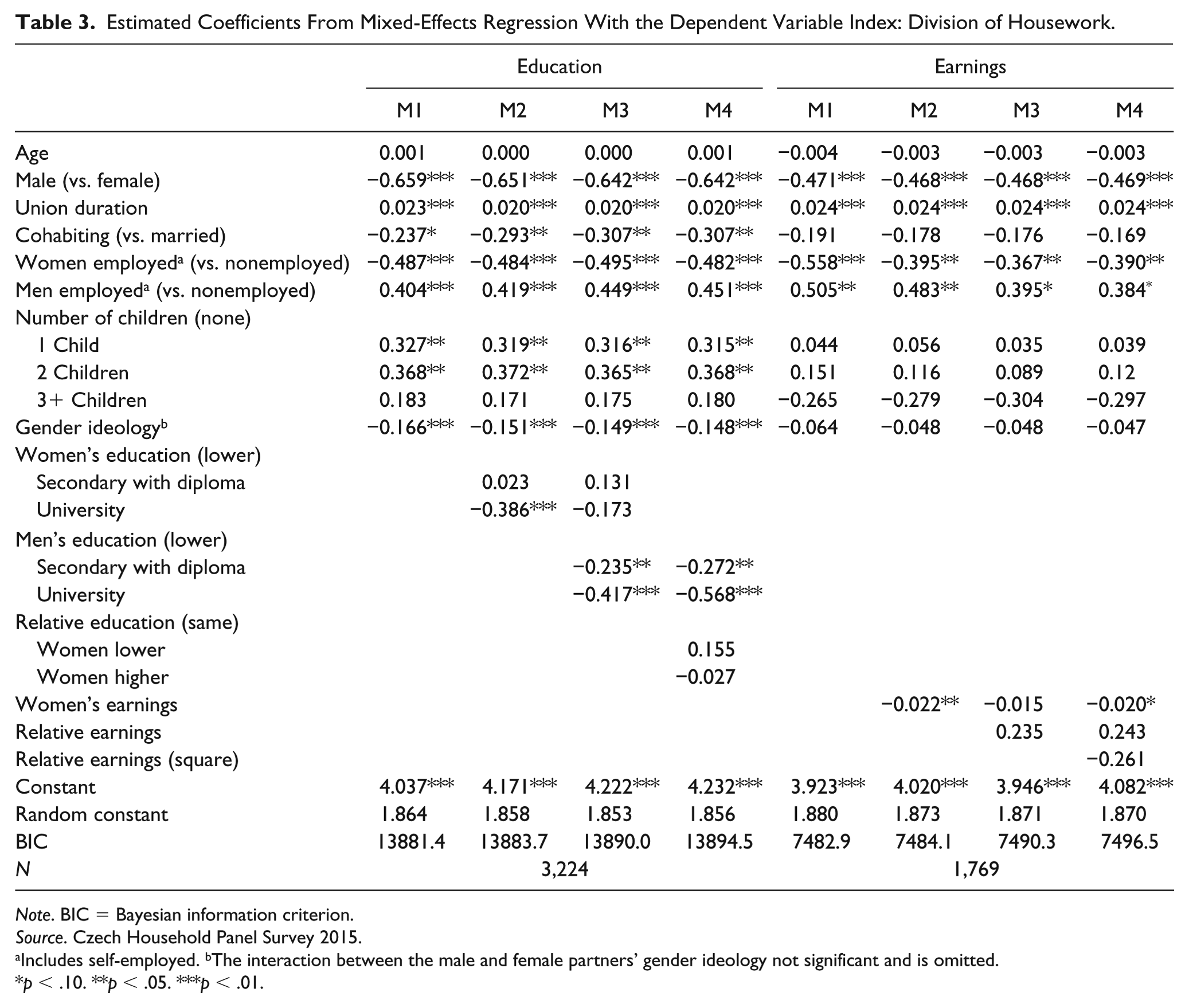
In the first step, we analyzed the role of human capital (education) in the division of domestic work. In this case, we have information for the whole sample. Table 3 (left-hand side) reports the coefficients from the multilevel mixed-effect linear regression with the dependent variable division of housework (index from −8 to 8) for the entire sample. The first model controls for the respondent’s age, sex, union type and duration, number of children at home, gender attitudes, and both partners’ employment status. This model demonstrates that being employed was negatively associated with the individual’s share of housework and that working individuals performed a significantly lower share of housework than those currently nonworking. This finding applied to both men and women.
Estimated Coefficients From Mixed-Effects Regression With the Dependent Variable Index: Division of Housework.
Note. BIC = Bayesian information criterion.
Source. Czech Household Panel Survey 2015.
Includes self-employed. bThe interaction between the male and female partners’ gender ideology not significant and is omitted.
p < .10. **p < .05. ***p < .01.
The presence of children was positively associated to the traditional division of labor after controlling for other sociodemographic characteristics. However, controlling for men’s and women’s employment, the link between the number of children and the division of housework was nonlinear. In families with three or more children, the man tended to perform a higher share of housework compared with families with one or two children. We can only speculate as to whether the birth of the third or higher order child prompted men to do more housework or whether the man’s higher involvement made the birth of another child more likely.
Moreover, the traditional division of domestic work increased with union duration. Model 1 shows that cohabiters and individuals with a more liberal gender ideology reported a less traditional division of housework. Some authors argue that to understand the role of gender ideology, the attitudes of both partners need to be considered. Thus, we examined an additional model in the subsample where answers from both partners were available. Yet, contrary to this expectation, the interaction term between male and female gender attitudes was not significant. Thus, to maximize the sample size, we did not include the interaction in the reported models.
The next model entered the woman’s human capital into the equation. It showed that women with more education tend to do less housework, but the main divide is between women with and without university degrees. We should note that the association between higher education and the division of housework was significant after controlling for gender ideology. Hence, the role of education cannot be exclusively explained by a liberalization of attitudes, as some authors suggest. In the next step, men’s education was factored into the equation. The third model showed that men with higher education were more likely to participate in housework. Importantly, the association between the woman’s education and the division of housework ceased to be significant once the man’s education was entered into the equation. In other words, Czech women with a university education tended to do a lower share of housework not because of their personal resources but because they were often married to highly educated men who were more willing to participate in housework.
The final model directly tested the role of relative human capital as it included the measure of educational homogamy. In Hypothesis 1, we predicted that the role of relative human capital would be relatively weak in the Czech context. Model 4 confirms this expectation. If men’s education is controlled for, there is no significant association between relative education on the division of housework. This model also provided a test for Hypothesis 2, predicting that if her resources are higher than his are, the gender neutralization process might enter into the picture. Model 4 did not corroborate this prediction as female hypogamy did not increase the likelihood of a more traditional division of housework.
Multivariate Results: Earnings and the Division of Housework
In the next step, we analyzed the role of relative earnings in the division of domestic labor. We must note that nonemployed individuals with no earnings are included in the analysis. They are assumed to have zero resources. The modeling strategy closely followed the approach in the previous section on human capital, but the analysis was limited to the subsample for which information on earnings was available. Given the large nonresponse for income variables, the sample size was reduced 3 to 1,769 individuals (see right-hand side of Table 3). The subsample is not significantly different from the complete sample in terms of division of housework (mean value for the complete sample = 3.79, for the subsample = 3.78), age, education, union duration, or legal form of the union. However, in the subsample with income, nonworking couples are slightly underrepresented.
The first model, on the right-hand side of Table 3, is a baseline model that controls for age, sex, union type and duration, employment, number of children, and gender ideology. It demonstrated that the characteristics of the union (type and duration) as well as employment played a role similar to that of the full sample that was used for the analysis of education. Yet the effect of gender ideology was weaker and nonsignificant, which might be the result of a smaller sample size. Moreover, there were no major or significant differences between couples with and without children. The next model tested the importance of the woman’s earnings and showed that women with higher incomes tended to do lower shares of housework. Yet the estimated coefficient was rather low: If the woman’s income increased by 1,000 Czech crowns (approximately 40 euros), it produced a 0.02-point shift on a 17-point scale.
The main goal of this article is to test the bargaining perspective. Thus, Model 3 factored in partners’ relative income. The larger the value, the larger the man’s advantage over the woman. The relative resource theory predicts that the partner with fewer resources should do a higher share of housework. The estimated coefficient was positive as predicted but not significant. Thus, we cannot conclude that relative earnings are associated with the division of housework. In this, the model with relative earnings again corroborates Hypothesis 1, predicting that the effect of relative resources would be weak in the Czech context. Moreover, the model indicates that if relative earnings are controlled for, the effect of the woman’s personal income ceased to be significant. The finding that personal income is not significant once relative income is controlled for can be attributed to the relatively high correlation between the woman’s earnings and her contribution to the family’s income. In other words, if the woman makes only a little money, she usually contributes relatively less. In additional models, we also tested the logged earnings and account for this collinearity, but the overall interpretation of the results would not change.
In a supplementary analysis, we explored the possibility that the role of relative earnings varied by gender ideology. For example, it is possible that the relative resources and economic rationality mattered only for couples that were liberal enough to consider a nontraditional division of labor. Yet this hypothesis was not confirmed.
Finally, the last model in Table 3 tested Hypothesis 2, predicting that if women outearn their husbands, the couple might adopt an even more traditional division of labor to compensate for the gender deviation. It is possible that women who outearn their partners compensate for their nonnormative role by doing a higher share of housework to confirm their femininity and that men in such couples avoid housework to confirm their masculinity. Thus, the final model included the square term of relative earnings to test the gender compensatory theory. If the link between relative earnings and division of housework is nonlinear, the square term of relative earnings would be significant, and the Bayesian information criterion of the model with the square term would decrease. However, the CHPS data did not confirm such a prediction. Therefore, our analysis did not provide any support for the “doing gender” hypothesis in the Czech context.
Conclusion and Discussion
The article explored the association between the division of housework and the woman’s absolute and couples’ relative resources in Czech households. This country represents a specific institutional context where a high level of female labor participation is blended with traditional gender role norms and behavior. Although women are expected to work, this expectation does not hold for mothers of young children that tend to drop out of the labor force for several years. Women, even those highly educated, massively support the mother’s economic inactivity after childbirth. Moreover, the country is a typical example of “egalitarian essentialism,” in which egalitarian attitudes toward employment and women’s financial responsibility coexist with the idea that women find self-fulfillment at home (Grunow, Begall, & Buchler, 2018).
We argued that in such a context, the role of relative resources might be relatively weak. Although the rational actor framework would suggest that higher resources translate into higher bargaining power, the traditional views of what men’s and women’s jobs are might trump rational decision making. Furthermore, if women’s resources become too high, it might threaten the strong expectations about men’s and women’s roles. As predicted by the “doing gender” hypothesis, women who outperform their husbands might confirm their femininity by doing a higher share of housework, while men in such households might avoid doing a “woman’s job” to assert their masculinity.
These hypotheses were tested using the first wave (2015) of the CHPS. In particular, this article focused on the effect of economic resources (earnings) and human capital (education) on the division of domestic tasks in such context. We argued that relative earnings might not be a sufficient indicator of relative resources as it misrepresents the standing of currently nonemployed individuals. This might be particularly problematic in a country where the majority of mothers leave the labor market after childbirth for an extended period of time. Moreover, unlike the majority of recent studies, we also control for gender ideology, which helps us distinguish between education as a proxy for human capital and as a proxy for liberal attitudes.
Our analysis shows that both men and women agree that the majority of daily chores are done by women. As for economic resources, the data provide only partial support for our hypotheses. As expected, partners’ relative resources do not play a major role in predicting the division of housework in the Czech context. This applies to both relative earnings and relative human capital. However, in contrast to our prediction, we did not find any support for the gender compensatory theory. Our analyses show that relative resources do not matter even for households where women outperform men and that such couples do not have a need to compensate for their gender deviance. A possible explanation is that as the distribution of housework is highly skewed toward women, there is a little space for “doing more gender.”
There is only one measure of an individual resource that seems to matter: men’s education. In contrast to the standard bargaining theory, the more educated the male partner is, the higher share of housework he does (for similar results, see Cunningham, 2005). The finding that it is men’s not women’s education that matters also suggests that, in the Czech households, the division of housework is determined by men, not by women. It seems that it is not women’s bargaining power that is important but men’s willingness to participate in the chores. Overall, such a result would indicate that women might have little power to negotiate unless men are open to the possibility. Here, it might be noteworthy to mention that the Czech Republic is a country with one of the highest divorce rates in the world, where around 50% of marriages end in divorce. We can only speculate as to whether the low chance to renegotiate the domestic duties plays any role.
The finding about the role of men’s education raises other important questions. For example, there is still the question of why more educated men are willing to do higher share of housework even if we control for gender attitudes. It is possible that our measure of gender attitudes is imperfect and does not fully capture the gender ideology relevant for the division of housework. In this case, it would mean that the differences between more and less educated men are primarily driven by the more liberal attitudes of highly educated men. Second, highly educated men might be affected by their social networks, where participation in housework is more common (Rözer, Mollenhorst, & Volker, 2018). Even though they personally might not believe in an egalitarian division of housework, they are expected do to more chores as many men in their social networks do. Finally, it is possible that some of the differences could be attributed to the type of work they do. Their jobs are likely to be less physically demanding and more flexible, which would give them less “excuse” for avoiding chores.
Furthermore, our analyses confirmed that gender ideology matters. Yet, unlike some previous studies (e.g., Nitsche & Grunow, 2016), we did not find any support for the hypothesis that the interaction between the man’s and woman’s attitudes matter. Rather, our data showed that the respondent’s gender ideology was important. It is possible that having liberal attitudes leads to participation in/withdrawal from household chores irrespective of the partner’s attitudes or amount of housework.
In general, our study supports the idea that in the traditional context of the Czech Republic, relative resources play a relatively minor role. As studies on general value orientations suggest, despite the rapid transformation of the Czech Republic in many domains in the past three decades, the society still maintains a relatively conservative and traditional orientation. In such context, cultural expectations and values trump economic rationality. Furthermore, the relatively traditional division of housework and low importance of relative resources might be explained by the fact that a great deal of couples with a traditional division of chores are satisfied with the way the housework is handled in their households (Klímová Chaloupková, 2018).
Finally, we must note that our study has some limitations. In particular, unlike some studies, our dependent variable does not express the amount of time devoted to household chores but rather the evaluation of one’s own share of household tasks. This means that we are not able to explore the effect of on men’s and women’s total contributions. If female empowerment and resources reduce the housework hours for both wives and husbands, the relative share might not change. Yet women of high resource can still be relieved from some of the burden. Also, we need to mention that there is a great deal of missing values in the income variable. Even though the sociodemographic characteristics of the subsample with valid values are generally not different from those of the sample as a whole, we cannot eliminate the possibility that our subsample might not differ in some unobserved characteristics.
Footnotes
Declaration of Conflicting Interests
The author(s) declared no potential conflicts of interest with respect to the research, authorship, and/or publication of this article.
Funding
The author(s) disclosed receipt of the following financial support for the research, authorship, and/or publication of this article: This work was supported by the grant from the Czech Science Foundation under Grant 17-12099S.
