



Abstract
Previous research suggests that more negative or less positive couple communication can be stressful and that chronic stress can lead to less healthy patterns of physiological stress functioning. Our goal was to investigate whether couples’ observed communication behaviors and reported relationship conflict were related to diurnal cortisol patterns, an important indicator of hypothalamic–pituitary–adrenal axis functioning. Sixty-two couples (n = 124 individuals) reported marital conflict and were video-recorded engaging in a coded conflict discussion. Diurnal cortisol samples were collected. Results suggested that men’s greater observed communication quality predicted women’s higher awakening cortisol levels as well as men’s steeper decreases in cortisol across the day (i.e., slopes), men’s greater reported conflict predicted women’s lower awakening levels, and, in some models, women’s greater reported resolution predicted women’s lower awakening levels and men’s steeper slopes. These findings suggest that less positive and more negative marital conflict contribute to dysfunction of the hypothalamic–pituitary–adrenal axis.
Extensive research has suggested a link between marriage and health, with marital status, marital satisfaction, and marital communication predicting health outcomes (Fincham & Beach, 2010), and higher marital quality predicting lower mortality risk (Robles, Slatcher, Trombello, & McGinn, 2014). More specifically, marital interaction patterns are associated with health; negative marital communication is associated with poorer perceived health, more chronic health problems, more symptoms of illness, and less healthy patterns of immune functioning (for a review, see Robles et al., 2014). In contrast, positive communication is associated with faster wound healing (Gouin et al., 2010) and healthier patterns of immune response (Gouin et al., 2009; Graham et al., 2009). Stress physiology may be an important mechanism linking marital interaction to health (e.g., Slatcher, Selcuk, & Ong, 2015), as couples repeatedly exposed to the stress of negative interaction may suffer the effects of chronic overactivity of physiological stress systems. This chronic activation may result in wear and tear on the body, or allostatic load, which is related to negative health outcomes (McEwen, 1998).
One important indicator of physiological stress functioning is patterns of diurnal cortisol secretion. Cortisol is a regulatory hormone released by the hypothalamic–pituitary–adrenal (HPA) axis, a primary branch of the human stress response. A normative diurnal cortisol rhythm involves a relatively high waking cortisol level (i.e., intercept), an increase in levels shortly after awakening (cortisol awakening response [CAR]), and a decline in levels (i.e., slope) throughout the remaining hours of the day. A less healthy pattern of diurnal cortisol secretion may involve a lower waking level, a weaker CAR, a flattened slope (dampened declines across the day), and/or too much or too little total secretion across the day (e.g., Lucas-Thompson & Hostinar, 2013). These patterns allude to a dysregulation of the HPA axis and are associated with myriad negative health outcomes as well as mortality (Edwards, Heyman, & Swidan, 2011; Slatcher, 2014). Given that communication and diurnal cortisol are both related to health, diurnal cortisol patterns may reflect an underlying pathway by which communication behaviors are linked to health. However, research has not investigated the link between observed communication behaviors and diurnal cortisol, the purpose of this study.
Observation of Couple Communication Behaviors
To directly observe couples’ communication behaviors, researchers frequently use couple “problem-solving” or “conflict” discussion tasks, whereby couples are prompted to discuss the most frequent and/or intense area(s) of conflict in their relationship (Heyman, 2001). These discussions are coded for the frequency and/or intensity of different positive (e.g., humor, affection, interest) and negative (e.g., anger, contempt) communication behaviors by observers. Such observation of behaviors eliminates the self-report and retrospective bias present in questionnaire research (Hahlweg, Kaiser, Christensen, Fehm-Wolfsdorf, & Groth, 2000). Given that couples’ communication behaviors in these tasks tend to be relatively consistent across time (Gottman & Levenson, 1999a), behaviors in such tasks are typically interpreted as trait-like patterns of interaction. Such behaviors have been shown to be predictive of divorce and marital quality, although there is inconsistent evidence regarding the ability of negative or positive couple communication behaviors alone to predict relationship outcomes (e.g., Lavner & Bradbury, 2012; Markman, Rhoades, Stanley, Ragan, & Whitton, 2010). If high levels of negative behavior are balanced by high levels of positive behavior, or low levels of positive behavior are balanced by low levels of negative behavior, research suggests a high level of marital stability; as such, ratios of positive to negative (P/N) communication behaviors during conflict are especially predictive of relationship adjustment and outcomes (Gottman, 1993, 1994; Gottman & Levenson, 1999b). In fact, stable marriages can be reliably differentiated from unstable marriages by comparing their P/N ratios of 5:1 and 0.8:1, respectively (Gottman, 1993; Gottman, Coan, Carrere, & Swanson, 1998). The balance model of couple communication posits that the ratio of P/N interaction is most important for marital quality and stability across a variety of types of marriages, over and above positive or negative behaviors separately (Gottman, 1993; Gottman et al., 1998).
Couple Communication and Acute Stress
It is no secret that marital interactions can be stressful, particularly if characterized by high levels of negativity with relatively low levels of positivity. The body’s reaction to stressful stimuli is to activate physiological pathways that mobilize energy to promote actions that are adaptive in the context of stress, preparing an individual to respond to the threat by “fleeing, fighting, or cowering in fear” (McEwen, 1998, p. 171). For example, when the HPA axis is activated, the body has an acute cortisol response. The degree of negativity and/or positivity during couple conflict may increase or decrease the degree of threat perceived from a marital interaction. This difference in the stressfulness of a marital interaction based on couple communication behavior is reflected in differential physiological responses to conflict. Indeed, research suggests that observed negative communication behaviors during marital conflict discussions increase acute cortisol responding to and impair physiological recovery from marital conflict (Aloia & Solomon, 2015; Feinberg, Jones, Granger, & Bontempo, 2013; Miller, Dopp, Myers, Stevens, & Fahey, 1999; Robles, Shaffer, Malarkey, & Kiecolt-Glase, 2006). In contrast, positive communication behaviors reduce cortisol reactivity and improve recovery (Feinberg et al., 2013; Laurent et al., 2013; Robles et al., 2006).
Implications of Couple Communication for Physiological Dysregulation
Thus, the positivity or negativity of couple communication behaviors have implications for the intensity of the acute HPA axis response to marital conflict. When such a threat has passed, the HPA axis should be deactivated, and cortisol levels should return to baseline. However, if stress is chronic rather than acute, full deactivation of the stress system may not occur. The resulting accumulated exposure to stress hormones can lead to stress-related damage on multiple organ systems. This allostatic load is likely to lead to myriad negative health outcomes (McEwen, 1998). The dysfunction of the stress system that may occur from chronic stress and allostatic load may be reflected in an individual’s pattern of diurnal cortisol (Edwards et al., 2011; Slatcher, 2014). Down-regulation of the HPA axis may occur from chronic stress and may result in a diurnal cortisol pattern marked by attenuated HPA axis functioning across early morning and later day times, whereby morning levels are lower and diurnal cortisol slopes are flattened (Fries, Hesse, Hellhammer, & Hellhammer, 2005). This pattern of cortisol secretion is related to negative physical and mental health outcomes (see Edwards et al., 2011).
Social interactions serve as stressors that may activate the stress system repeatedly and, thus, be particularly impactful for the functioning of the stress system (e.g., Koss, Mliner, Donzella, & Gunnar, 2016; Lucas-Thompson, Lunkenheimer, & Dumitrache, 2017). Research suggests that there are associations between self-reported communication behaviors and diurnal cortisol patterns, suggesting that the way in which couples communicate has implications for their levels of chronic stress and, thus, stress physiological functioning. Such studies have found that individuals who report higher levels of positive behaviors in their relationships (e.g., verbal and physical affection, support quality) show healthier patterns of diurnal cortisol (e.g., greater CARS, steeper slopes, lower total secretion; Floyd, 2006; Floyd & Riforgiate, 2008; Turner-Cobb, Sephton, Koopman, Blake-Mortimer, & Spiegel, 2000). Positive relationship characteristics may have long-lasting effects on diurnal cortisol, as individuals who felt understood and appreciated by their spouses at an initial evaluation were shown to have greater CARs and steeper cortisol slopes at a 10-year follow-up (Slatcher et al., 2015). In contrast, spouses who report a greater number of marital problems have flatter diurnal cortisol slopes and weakened CARs (Barnett, Steptoe, & Gareis, 2005). In addition, partner aggression is related to flatter diurnal cortisol slopes (Kim et al., 2015; Saxbe et al., 2015). These studies illustrate that more negative or less positive marital behaviors are linked to patterns of stress physiological functioning suggestive of dysregulation and negative health outcomes. Relationships characterized by interactions that are more negative or less positive are often stressful, and thus, partners may experience greater allostatic load from repeated activation of stress systems. This physiological dysregulation may be reflected in partners’ less healthy diurnal cortisol patterns.
However, diurnal cortisol research has exclusively investigated relations with self-reported interaction behaviors; no research to our knowledge has studied how observed communication behaviors during a conflict discussion are related to diurnal cortisol patterns. Given that observed problem-solving behaviors may represent persistent patterns of couple interaction (e.g., Gottman & Levenson, 1999a), allostatic load may increase over time from engagement in more negative and less positive marital interactions. As such wear and tear predicts poorer health over time (McEwen, 1998), further research is needed to investigate how observed couple communication is associated with indicators of stress physiological function, including patterns of diurnal cortisol. Such research can help us examine if the way in which couples communicate, measured objectively, is associated with their patterns of stress functioning.
The Current Study
In sum, the literature suggests that marital communication behaviors can be stressful for couples if they are more negative and less positive and that this repeated stress can lead to physiological dysregulation. However, no research has investigated how observed couple communication behaviors are related to individuals’ diurnal cortisol patterns. Because of evidence that divorce and lower marital quality are especially predicted by ratios of P/N communication behaviors during conflict rather than absolute scores of positive or negative communication behaviors (Gottman, 1994), and because of the dearth of diurnal cortisol research utilizing this ratio method to operationalize couple communication behavior, we investigate the extent to which this ratio of observed positive communication behaviors to negative behaviors predicts diurnal cortisol for men and women in committed relationships. We hypothesize that greater P/N observed behavior ratios predict healthier diurnal cortisol patterns (e.g., higher waking levels and/or steeper cortisol slopes across the day). Second, we explore whether self-reports of the frequency/intensity and resolution of marital conflict predict diurnal cortisol. We hypothesize that reports of less frequent/intense marital conflict and greater resolution predict healthier patterns.
Method
Participants
Participants in this convenience sample were 62 couples (n = 124) who were recruited through advertisements in local parenting magazines, classifieds, and church bulletins. Advertisements were placed in mediums targeting a diversity of neighborhoods. Participants were recruited for a larger study on family relationships and adolescent stress (Lucas-Thompson & Granger, 2014). There were 98 couples in this larger study; the 62 couples included in the current study were those for whom both members of the couple returned saliva samples. Couples were heterosexual and had been married or cohabitating for at least 2 years prior to the study (length of relationship mean (M) = 16.03 years, standard deviation (SD) = 5.81 years). In addition, all couples had at least one child in the home who was between the ages of 10 and 17 years. Participants were middle aged on average (men’s M = 44.40 years, SD = 6.23 years; women’s M = 43.36 years, SD = 11.05 years). Household income had a large range across the sample, from $3,375 to $450,000 (Mdn = $85,936.86, SD = $68,531.04). On average, both members of couples had completed years of education corresponding to an associate’s degree or vocational training beyond high school. The sample was relatively diverse in terms of race/ethnicity (women: 72% White, 13% Black, 8% Asian, and 7% other/multiple; men: 66% White, 18% Black, 7% Asian, and 10% other/multiple).
Procedures
These procedures were part of a larger study (Lucas-Thompson & Granger, 2014). Participants first provided informed consent. Participants then completed a widely used procedure to observe conflictual interactions between partners (e.g., Heyman, 2001). Participants independently rated areas of relationship conflict. A research assistant then selected the three to four most conflict-producing topics. Couples were videotaped for 15 minutes as they discussed and tried to work toward a resolution of the topics. After the conflict discussion, participants also answered questionnaires using Audio Computer Assisted Self Interview software. Participants were then debriefed and paid $30 for participation and transportation.
Couples were then invited to provide diurnal cortisol samples and were given $10 for providing these samples. Participants were asked to provide saliva samples using Salivettes® to assess diurnal cortisol patterns for two back-to-back school or work days following the laboratory visit that were similar in schedule. Instructions emphasized the importance of not only taking the samples at the correct times but also accurate reporting of collection time. Participants were asked to take a saliva sample immediately after waking up in the morning, 30 minutes after waking, at 4 p.m., and before brushing their teeth for bed. Participants were sent reminders through e-mail or text message to collect the samples. Participants froze samples until returning them in a pre-addressed, postage-paid envelope back to the laboratory.
Measures
Observed Communication Behavior
Conflict discussion recordings were coded for positive and negative communication behaviors (Cummings, Kourous, & Papp, 2007). Each tape was coded by two observers, and there were seven coders in total. Many of the coders were the same research assistants who completed data-collecting procedures; however, the coders did not code interactions with the participants for which they collected data. Members of couples were coded by different observers. Participants were scored for the degree of each conflict behavior on a scale from 0 = absence of behavior to 2 =very strong display. Negative behaviors included nonverbal and verbal anger, defensiveness, withdrawal, physical distress, physical aggression, threat, pursuit, and insult. Positive behaviors included support, physical affection, calm discussion, problem solving, and humor. Coders were trained using training videotapes, which were not part of this study, and achieved ≥70% reliability (based on interclass correlation coefficients [ICCs]) during training. Ratings that were discrepant between coders were consensus coded. Prior to consensus coding, adequate reliability was achieved (ICCs > .82). P/N communication behavior ratios for each partner were calculated by dividing the sum of positive communication behaviors by the sum of negative plus positive communication behaviors (i.e., positive behaviors/total behaviors).
Measurement of Diurnal Cortisol
Saliva samples were assayed in duplicate (and averaged) for cortisol concentrations at the University of Trier. Saliva samples were first centrifuged at 2,000g for 10 minutes. A solid phase time-resolved fluorescence immunoassay with flouromeric end point detection (DELFIA) was utilized to analyze salivary cortisol levels for all samples. The intraassay coefficient of variation was between 4.0% and 6.7%. The corresponding interassay coefficients of variation were between 7.1% and 9.0%.
Self-Reported Conflict
The Conflict subscale from the Braiker–Kelly Partnership Questionnaire (Braiker & Kelly, 1979) was used to measure intensity and frequency of conflict. This subscale includes five questions (e.g., “When you and your partner argue, how serious are the problems or arguments) rated on a 9-point Likert-type scale from 1 = not at all to 9 = very much. A mean marital conflict was calculated for each person (Cronbach’s α, women = .79; men = .76).
The 13-item Resolution subscale from the Kerig Conflicts and Problem-Solving Scales (Kerig, 1996) was used to measure the conflict resolution. Participants rated the extent (never, rarely, sometimes, or usually) to which each statement (e.g., “We feel worse about each other than before the fight”) typically reflects the outcomes of their disagreements. Calculating a composite of positive and negative aspects of resolution provides a full picture of resolution as it is constructive in relation to destructive. This way of measuring resolution has been found to be a strong predictor of marital adjustment and satisfaction, even surpassing the predictive power of conflict frequency, efficacy, avoidance, collaboration, or physical or verbal aggression (Kerig, 1996). Therefore, a weighted score was calculated for each participant, such that higher scores reflected a greater degree of resolution. To calculate weighted scores (e.g., Lucas-Thompson et al., 2017), positive resolution scores were multiplied by 2, negative resolution scores were multiplied by −2, and these aggregate scores were summed with answers to two questions (“We don’t resolve the issue but agree to disagree,” and “We each give in a little bit to the other”) that represent neutral resolution outcomes. Negative and positive resolution scores were significantly correlated for women r = −.57, p = .00, as well as for men, r = −.43, p = .00, suggesting that problematic and constructive resolution were associated in our sample. Cronbach’s α were .64 and .53 for women and men, respectively.
Potential Control Variables
Participants reported family income, relationship duration, age, ethnicity, education, and depressive symptoms. Separate variables were created for Asian race, Black race, and Other/Multiple race(s), which were all dummy coded, using White as the reference category. Given established links between partner depression and couple communication (Rehman, Gollan, & Mortimer, 2008), partners’ depressive symptoms were an additional potential control variable.
Analytic Plan
Data Preparation
All variables were tested for normality. Variables transformed due to skewness were individual diurnal cortisol variables, as well as self-reports of resolution (men only) and marital conflict, as well as potential control variables of depressive symptoms, age (women only), and family income. Results of Little’s missing completely as random (MCAR; Little, 1988) test were nonsignificant (p = .860), suggesting that data were missing at random.
Control Variable Analyses
To determine what control variables to include in the models, potential control variables were tested as predictors of diurnal cortisol intercept and/or slope in Mplus (Version 7.11, Muthén & Muthén, 2013). In addition, correlations among communication predictor variables and these demographic variables were also tested.
Testing the Conceptual Model
Structural equation and latent growth curve modeling were utilized to assess whether observed or self-reported marital conflict were associated with diurnal cortisol. First, a dual latent basis growth curve model (GCM; McArdle & Epstein, 1987) for both partners was estimated in Mplus to model cortisol intercepts (awakening level) and slopes (change across the day) and to examine associations among partners’ diurnal cortisol intercepts and slopes. The factor loadings for the slope were constrained at 0 and 1 for waking and bedtime samples, and the factor loadings for all samples in between were freely estimated. Due to challenges with model identification in such complex models and our relatively small sample, this step was completed without covariates. Model fit was examined using criteria suggested by Hu and Bentler (1998), including root mean square error of approximation (RMSEA), comparative fit index (CFI), and standardized root mean square residual (SRMR).
Men’s and women’s GCMs were then fit into separate structural equation models to examine associations among cortisol intercepts/slopes and communication predictors; these models were estimated separately for men and women to limit the number of parameters in our model to avoid problems with model identification. Maximum likelihood estimation with robust standard errors was utilized. Structural equation models were tested first without control variables. Then, in order to limit the variable to sample size ratio to avoid problems with model identification, sensitivity analyses were conducted adding demographic control variables to the models one by one. Covariances among all communication predictor variables were modeled in structural equation model analyses.
Results
Descriptive Statistics, Bivariate Correlations, and Demographic Differences
Bivariate correlations, means, and standard deviations are presented in Tables 1 and 2. All correlations between communication predictor variables were in the expected direction. There were also demographic differences in communication. Reduced P/N communication behaviors were observed in couples who reported shorter relationship duration, women and men who were Black (relative to other races), and couples in which the female partner had more depressive symptoms. Women who had been married for longer reported fewer depressive symptoms, and women who were another race other than Asian/Asian American reported less marital conflict. Additionally, women’s and men’s self-reported resolution was greater for those who had been married for longer and reported greater levels of education. Men also reported greater levels of resolution if they were with women who reported fewer depressive symptoms.
Bivariate Correlations of Communication Predictor Variables and Observed Cortisol Variables With Control Variables and Descriptive Statistics for Control Variables.
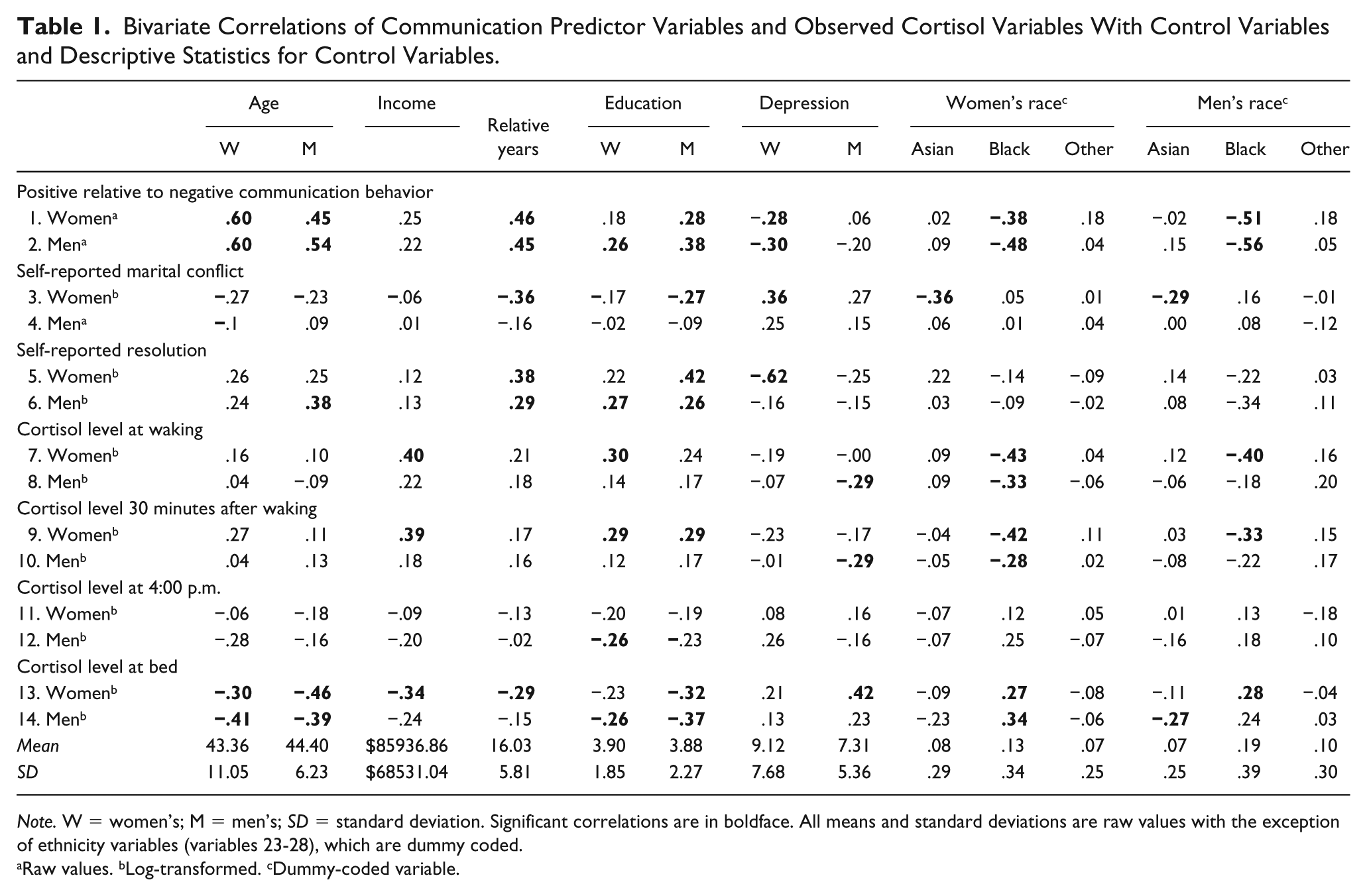
Note. W = women’s; M = men’s; SD = standard deviation. Significant correlations are in boldface. All means and standard deviations are raw values with the exception of ethnicity variables (variables 23-28), which are dummy coded.
Raw values. bLog-transformed. cDummy-coded variable.
Bivariate Correlations and Descriptive Statistics for Communication Predictor Variables and Observed Cortisol Variables.
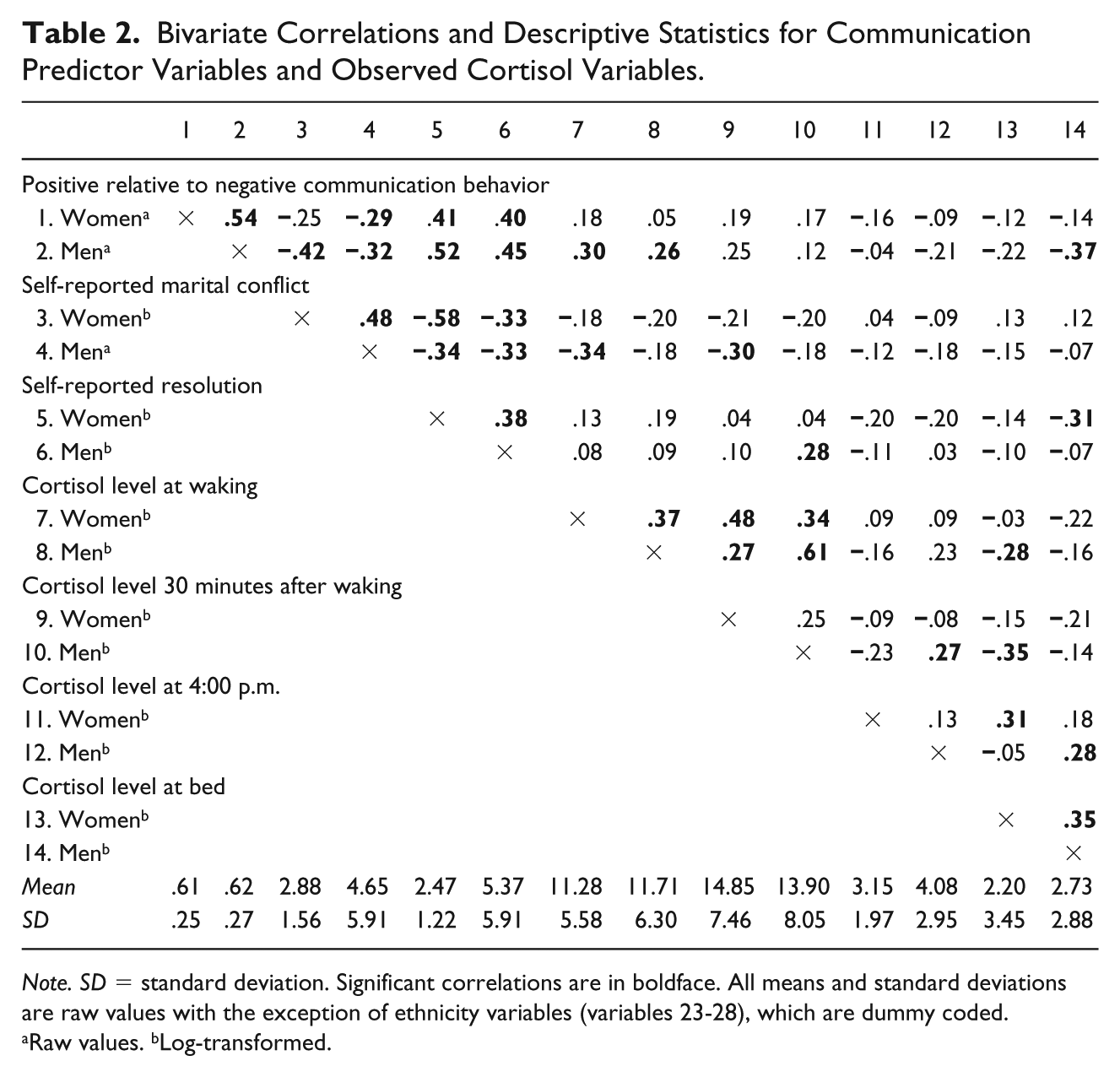
Note. SD = standard deviation. Significant correlations are in boldface. All means and standard deviations are raw values with the exception of ethnicity variables (variables 23-28), which are dummy coded.
Raw values. bLog-transformed.
Analyses in Mplus also revealed demographic differences in latent cortisol variables. Women’s cortisol intercepts were higher for women who were older, as demonstrated by standardized regression coefficients (β = .37, standard error [SE] = .19, p = .050); had higher family income (β = .55, SE = .16, p = .001); reported a higher level of education (β = .39, SE = .14, p = .005), and were White relative to Black (β = −.59, SE = .15, p < .001). Women’s diurnal cortisol slopes were flatter (i.e., less negative) for women who were younger (β = −.56, SE = .20, p = .006), had been married for fewer years (β = −.05, SE = .02, p = .020), reported lower family income (β = −.62, SE =.15, p < .001), were less educated (β = −.53, SE = .14, p < .001), reported more depressive symptoms (β = .46, SE = .16, p = .003), and were Black relative to White (β = .61, SE = .16, p < .001). Women also had flatter cortisol slopes if their partners reported more depressive symptoms (β = .61, SE = .19, p = .001). Men’s cortisol intercepts were higher when they also reported fewer depressive symptoms (β = −.38, SE = .12, p = .001). Men’s slopes were flatter for those who reported lower family income (β = −.46, SE = .15, p = .002), younger age (β = −.38, SE = .15, p = .013), a lower level of education (β = −.53, SE = .13, p < .001), more depressive symptoms (β = .40, SE = .16, p = .02), and Black race relative to White race (β = .41, SE = .18, p = .022). All significant predictors in these analyses were included as covariates in sensitivity analyses as described below.
Are Partners’ Diurnal Cortisol Patterns Associated?
A dual latent basis GCM was estimated in Mplus using diurnal cortisol intercepts and slopes (see Figure 1). Women’s and men’s cortisol individual cortisol scores were allowed to covary. The dual growth model was estimable and fit well, χ2(14) = 9.87, p = .771; RMSEA = .00; CFI = 1.00; SRMR = .06. Fixed effect estimates for the diurnal cortisol growth curves indicated that cortisol tended to decline throughout the course of the day; more negative estimates corresponded to steeper slopes throughout the day. There were significant associations among all women’s and men’s latent cortisol variables: Women’s higher intercepts were significantly associated with women’s (β = −.70, SE = .20, p < .001) and men’s (β = −.60, SE = .15, p < .001) steeper cortisol slopes as well as associated with men’s higher intercepts (β = .53, SE = .09, p < .001). Men’s higher intercepts were significantly associated with women’s (β = −.75, SE = .13, p < .001) and men’s (β = −.72, SE = .10, p < .001) steeper slopes. Men’s and women’s slopes were also significantly and positively associated (β = .86, SE = .13, p < .001).
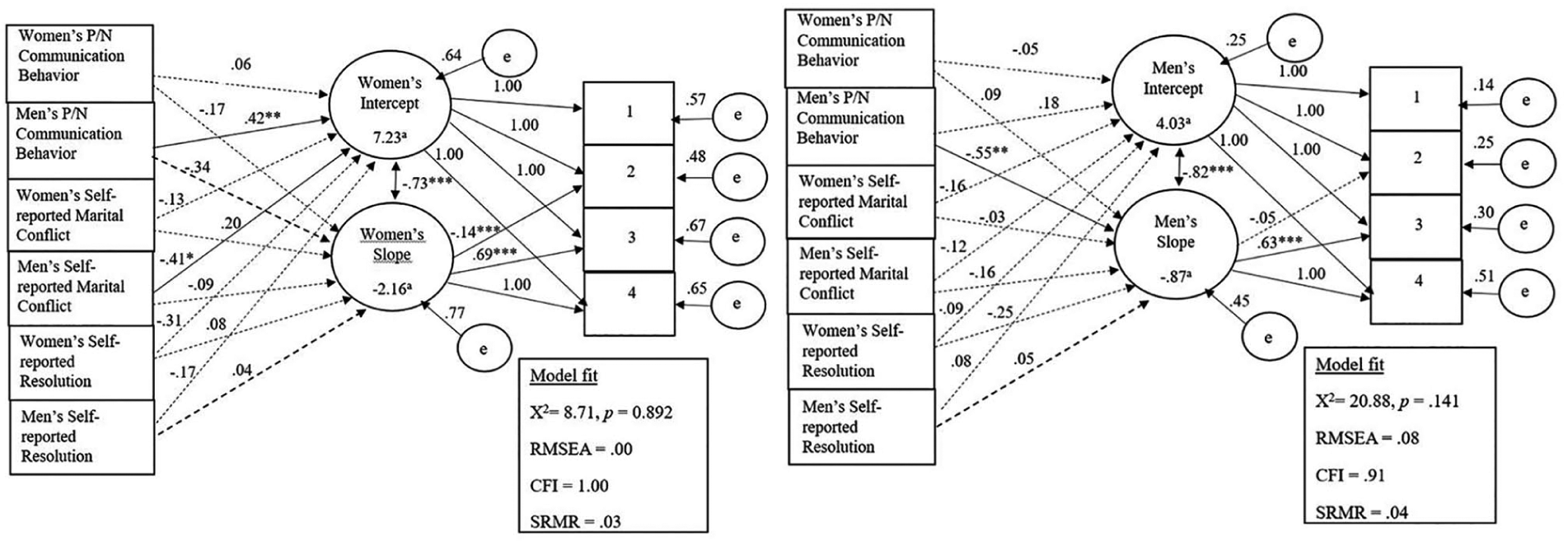
Results of the structural equation model testing the associations between communication variables and diurnal cortisol patterns.
Does Couple Conflict Predict Diurnal Cortisol Patterns?
To limit the number of parameters in our model to avoid problems with model identification, the structural equation modeling (SEM) models that included conflict were tested using separate growth curve models (see Figure 1) for women and men. The communication variables (women’s and men’s P/N behavior, women’s and men’s self-reported marital conflict, as well as women’s and men’s self-reported resolution of conflict) were tested as predictors of cortisol intercepts and/or slopes.
For women, the SEM fit relatively well. Men’s P/N communication behavior significantly predicted women’s cortisol intercepts, as did men’s self-reported marital conflict. On average, women’s cortisol intercepts increased as men’s P/N communication behavior increased and as men’s self-reported marital conflict decreased. No other communication variables were significant predictors of women’s cortisol intercepts or slopes, although women’s greater self-reported resolution was a trend-level predictor of women’s lower cortisol intercepts (p = .08), and men’s greater P/N communication behavior was a trend-level predictor of women’s steeper downward slopes (p = .07). Sensitivity analyses indicated that models were relatively stable. Results continued to suggest that men’s greater P/N communication behavior and men’s lower self-reported marital conflict predicted women’s greater cortisol intercepts except when adding age to the model. Also, women’s greater self-reported resolution became a significant predictor of women’s lower cortisol intercepts when controlling for family income and education. Finally, men’s greater self-reported resolution was a trend-level predictor of women’s lower intercepts when including women’s depressive symptoms and education.
For men, the SEM demonstrated relatively good fit according to chi-square and SRMR, but RMSEA and CFI indices were outside cutoff values for a relatively good fit. In this model, men’s P/N communication behavior predicted men’s cortisol slopes: For men who demonstrated a higher P/N ratio, cortisol slopes were more negative (suggesting faster recovery). Men’s cortisol intercepts and slopes were not predicted by any other communication variables. Sensitivity analyses again indicated model stability when adding demographic controls. Men’s P/N communication behavior continued to be associated with men’s slopes. When family income was added into the men’s SEM, women’s self-reported resolution became a trend-level predictor of men’s cortisol, with greater levels of resolution predicting steeper slopes. When women’s depressive symptoms were added into the model, this association became significant.
Discussion
The goal of this study was to investigate whether observed communication behaviors predict diurnal cortisol patterns in addition to self-reported marital conflict and/or self-reported resolution. As hypothesized, we found significant associations among observed communication variables and diurnal cortisol patterns when controlling for the well-established links between self-reported conflict and resolution to diurnal cortisol. Results suggested that men’s greater observed communication quality is significantly associated with men’s steeper cortisol slopes, women’s higher cortisol intercepts, and marginally associated with women’s steeper cortisol slopes. Men’s more positive communication quality is thus positively associated with patterns suggestive of healthy physiological function for both men and women.
These findings are consistent with research that links less positive or more negative observed communication to less healthy patterns of acute cortisol responding (e.g., Aloia & Solomon, 2015; Laurent et al., 2013) as well as research that finds links among self-reported communication behaviors and diurnal cortisol (e.g., Barnett et al., 2005). However, our study extends the literature in being the first to link observed communication quality to individuals’ day-to-day diurnal cortisol patterns. It may be that the stress of conflict with men who are more negative and/or less positive in couple interactions contributes to greater allostatic load over time, leading to men’s flatter diurnal cortisol slopes and women’s lower waking levels. Alternatively, men who display patterns of diurnal cortisol production indicative of greater allostatic load may, as a result, behave more negatively in couple interactions, and women who display such cortisol patterns may provoke more negative communication quality in their partners.
Although the focus of this study was on observed communication behavior, there were also interesting links between self-reported conflict behaviors and diurnal cortisol, consistent with past research (e.g., Barnett et al., 2005). Specifically, men’s greater self-reported marital conflict predicted women’s lower cortisol intercepts. As the stress of more frequent/intense marital conflict may lead to greater allostatic load, it may be that women who are with men who report greater marital conflict display a lower cortisol intercept as a result of allostatic load and attenuated HPA axis functioning as a result of experiencing more frequent marital conflict. Women who display patterns of diurnal cortisol more indicative of allostatic load may also, as a result of poor physiological health, be more likely to participate in marital conflict, and thus, their husbands may report greater conflict.
Interestingly, women’s greater self-reported resolution (in models with family income and women’s education) significantly predicted, and men’s greater self-reported resolution marginally predicted (in models with women’s education and women’s depressive symptoms), women’s lower cortisol intercepts. It may be that greater resolution of conflict is stressful for women, as they are often the ones who carry the burden of resolving conflicts in their relationships (Christensen & Heavey, 1990). Thus, greater resolution of conflict may be a reflection of the greater effort that women must put into resolving conflicts with their spouses, which could explain a greater allostatic load for women who report greater levels of resolution.
Results also suggested that women’s greater self-reported resolution predicted men’s steeper cortisol slopes (in models with women’s depressive symptoms and family income). Men who have healthier physiological stress functioning may be better able to resolve conflict with their wives, or women’s more positive perceptions of marital conflict resolution may have a positive effect on men’s physiological stress functioning. This is in opposition to the above findings that resolution negatively affects women’s stress functioning; it may be that resolution of conflict is more helpful in reducing allostatic load for men than for women, as men may feel less responsible for initiating conflict resolution (Christensen & Heavey, 1990), and thus, for men, reported resolution of conflict is more of a reflection of conflict being resolved and less of a reflection of the greater effort put into resolving conflict.
Previous research has also found cross-partner associations between men’s communication and women’s stress physiology; for example, men’s more positive conflict behaviors are associated with women’s steeper cortisol recovery (Robles et al., 2006). It is interesting that only men’s observed communication and only men’s self-reported frequency/intensity of conflict predicted women’s cortisol. These findings are in line with other research suggesting that women are more physiologically sensitive to their partners’ communication behaviors than to their own behavior (e.g., Kiecolt-Glaser et al., 1996) and to marital interaction qualities in general (Kiecolt-Glaser & Newton, 2001). This pattern may be due to women holding more “relationally interdependent self-representations,” leaving their physiology more vulnerable to both positive and negative marital interactions than men (Kiecolt-Glaser & Newton, 2001, p. 494). In contrast, consistent with our findings, other studies suggest that men’s physiology is more strongly associated with their own behavior than with their wives’ (Miller et al., 1999).
Furthermore, as indicated in all GCMs, there were significant associations between lower cortisol intercepts and flatter cortisol slopes for both men and women as well as across partners. This pattern suggests that some individuals were likely to display attenuated HPA axis functioning. This pattern of unhealthy diurnal cortisol secretion has been related to family adversity (Koss et al., 2016) as well as to emotional and health problems (see Edwards et al., 2011) and is indicative of greater allostatic load (Fries et al., 2005). Interestingly, these findings also suggest that those with diurnal cortisol patterns indicative of attenuated HPA axis functioning tend to have partners with similarly unhealthy diurnal cortisol rhythms. These findings are consistent with research that suggests that partners’ levels of diurnal cortisol output (Saxbe & Repetti, 2010) as well as diurnal cortisol slopes (Liu, Rovine, Cousino Klein, & Almeida, 2013) are positively associated. In addition, individuals’ within-person fluctuations in their own diurnal cortisol patterns are associated with similar changes in their partners’ cortisol patterns (Liu et al., 2013), suggesting that such similarities in diurnal cortisol patterns are likely the result of partners coregulating their physiology over time, whereby spouses directly influence each other’s stress physiology, or through shared marital stressors (Liu et al., 2013; Saxbe & Repetti, 2010). Given that participants in our study were in relatively long-term relationships, it may be that partners’ diurnal cortisol patterns have synchronized through many years of coregulation, or that shared marital interactions have contributed to each partner’s allostatic load throughout time, and thus, partners’ diurnal cortisol patterns have become more similar over time. Longitudinal research should be conducted to examine these possibilities.
Although this study makes important contributions, there are several limitations. Our sample size was relatively small for such complex models. Loss of significance when adding controls in sensitivity analyses were likely due to accompanying reductions in power. Although model fit was adequate for most key models, a few of the models demonstrated less than adequate model fit, likely as a result of our small sample size, especially in the case of ethnicity when sample sizes were cut considerably. However, even when model fit was less than adequate, most results suggested the same key findings. We were also unable to control for partners’ cortisol intercepts and slopes in our models due to our small sample.
Methodologically, limitations of this study included potential order effects: Respondents’ answers to questionnaires about marital conflict may have been influenced by the conflict discussion task that preceded it. However, the likelihood of this effect was diminished by the fact that questionnaire instructions emphasized that participants should respond with answers regarding what is typical in their relationship. Diurnal cortisol was only collected for two back-to-back days, the minimum number of days suggested for conducting high-quality diurnal cortisol research (Ryan, Booth, Spathis, Mollart, & Clow, 2016). Furthermore, internal consistency of the resolution measure was less than adequate; also, given that our study was cross-sectional and not experimental in nature, longitudinal studies could assess the potential effects over time of conflict behaviors on diurnal cortisol patterns, and intervention studies could be conducted to facilitate the drawing of cause-and-effect conclusions for associations among diurnal cortisol patterns and couple conflict behaviors.
Our findings may not generalize to couples with different relationship characteristics, including those in less long-term relationships who do not have children and/or same-sex couples. Given that our sample was composed of parents in relatively stable relationships, future studies should also investigate whether our results generalize to couples who are not parents and/or who are in different stages (e.g., dating phase) of their relationships. Last, our sample was composed solely of heterosexual couples; future research should investigate how diurnal cortisol patterns and conflict behaviors may be associated in same-sex marriages. In addition, although the sample was ethnically and economically diverse, the sample tended to be relatively high income and mostly White. The findings of this study should be replicated with a larger, more diverse sample.
The findings of the current study may inform the work of therapists. Given that all models suggested associations among men’s reports of marital conflict and women’s less healthy diurnal cortisol rhythms, using husbands’ reports of marital conflict in addition to women’s reports may aid couples’ therapists in assessing health risks in female clients. In light of associations among men’s greater observed communication quality and both women’s and men’s healthier diurnal cortisol rhythms in most models, therapists may choose to target husbands’ communication behavior in preventing negative health outcomes in couples.
In conclusion, this study found relations of observed communication behaviors (in addition to self-reported relationship conflict and resolution) and diurnal cortisol patterns. Specifically, patterns suggested that more positive behavior displayed by male partners was related to women’s higher intercepts and men’s steeper slopes, whereas more frequent and intense conflict reported by men was related to women’s lower intercepts, and in some models, better conflict resolution reported by women was associated with women’s lower intercepts and men’s steeper slopes. These results support that, in general, less positive and more negative marital conflict is a stressor that appears to contribute to allostatic load for couples. Our findings suggest that dysfunctional diurnal cortisol functioning may serve as a link between the stress of marital conflict and health. In being the first to investigate the association among individuals’ characteristic diurnal cortisol patterns and observed couple communication behaviors, this research adds to a body of literature that investigates the possible pathways between marital interaction and health, with implications for interventions that target partner communication behaviors.
Footnotes
Declaration of Conflicting Interests
The author(s) declared no potential conflicts of interest with respect to the research, authorship, and/or publication of this article.
Funding
The author(s) received no financial support for the research, authorship, and/or publication of this article.
