



Abstract
This study examined the relationship between parent and young adult child perceptions of parental work–family conflict and work and family satisfaction. Data were collected from 112 parent–child dyads, and children perceived parents to experience significantly more strain-based work–family conflict than parents reported. Parent and child did not differ in ratings of five other dimensions of parent’s work–family and family–work conflict. Parent and child ratings of the parent’s experience of all three dimensions of work–family conflict and one of three dimensions of family–work conflict were positively correlated. Four actor–partner interdependence models using multilevel modeling tested dyadic effects of work–family or family–work conflict on work or family satisfaction. Negative actor effects were found for behavior-based work–family and family–work conflict and for strain-based family–work conflict on family satisfaction. Negative actor effects existed for behavior-based work–family and family–work conflict on work satisfaction, and behavior-based work–family conflict also had a negative partner effect on work satisfaction.
Keywords
Conflict between work life and family life often has troublesome consequences for both dimensions (Allen, Herst, Bruck, & Sutton, 2000; Bruck, Allen, & Spector, 2002; Eby, Casper, Lockwood, Bordeaux, & Brinley, 2005; Kreiner, Hollensbe, & Sheep, 2009; Major, Klein, & Ehrhart, 2002). Consistent with family systems theory, this study contends that tension between work and family is experienced and created by the family unit as a whole, rather than by one individual. The impact of parents’ work and their work–family conflict on children has been a matter of great concern in the work–family literature. Little research has addressed children’s perceptions of their parents’ work and tensions between work and family, but research on various aspects of parent–child communication has generally found low levels of understanding between parents and children. The degree of commonality between parent and child is key to how individuals understand themselves and their family, impacting perceptions of satisfaction (Harter, Neimeyer, & Alexander, 1989), feelings of self-competence (Ohannessian, Lerner, Lerner, & von Eye, 2000), and reports of adjustment (Ohannessian, Laird, & De Los Reyes, 2016; Ohannessian, Lerner, Lerner, & von Eye, 1995). Thus, in this study, we investigated the degree of consistency between a parent’s and young adult child’s retrospective perceptions of the parent’s work–family and family–work conflict and the parent’s satisfaction with work and family to identify gaps between the two perspectives. We also investigated the contribution of parent’s and child’s perspectives on work–family conflict to the parent’s work and family satisfaction.
Family Systems Theory
Family systems theory provides a context for understanding the interconnectedness of family members and of their beliefs and behavior by arguing that “the child’s behavior leads to the parents’ behavior and the parents’ behavior leads to the child’s, in a circular fashion” (Bavelas & Segal, 1982, p. 103). Thus, a family systems approach argues that a family unit is developed and supported through interactions that help to create, enact, and sustain the family’s shared beliefs, meanings, and values (Bavelas & Segal, 1982; Bowen, 1966; Yerby, 1995). Family systems theory is a valuable tool for understanding how families grow and cope as a unit because it provides a space for researchers to “conceptualize the social processes in which . . . a particular group of people can conceptualize their world and hence the purposeful action they wish to undertake” (Checkland, 1999, p. 54).
Though original conceptualizations of family systems theory argued that the family unit cannot be reduced to a level any smaller than the whole (Bowen, 1966), Yerby (1995) took a different stance, arguing that “reality is reflectively constructed as persons and groups interact with one another” (p. 51). In Yerby’s frame, the individual plays an important and specific function because reality is generated from the experiences of both the group and the individual.
This connection between the individual and the family provides a theoretical basis for understanding work–family conflict. In a systems approach, the parent brings his or her experiences from work as inputs into the family system, where they influence the family as a whole. Likewise, a person’s family experiences become inputs into the work system. The interplay between these work and family experiences influence and are influenced by the family as a whole and the members of the family.
Work–Family Conflict
Researchers have investigated many aspects of the push and pull between familial obligations and work responsibilities, substantiating the effects of work–family conflict on psychological distress (Allen et al., 2000; Eby et al., 2005; Major et al., 2002; Zhang et al., 2012), relationship strain (Cho & Allen, 2012), and mental and physical health consequences (Allen et al., 2000; Eby et al., 2005; Wang, Afifi, Cox, & Sareen, 2007; Zhang et al., 2012). Furthermore, researchers have also examined the implications that conflict between work and family can have for both job and family satisfaction and success (Bruck et al., 2002). Though this work varies in the specific constructs under study, this line of research is largely focused on learning how individuals can “[b]alance between work and home . . . a much sought after but rarely claimed state of being” (Kreiner et al., 2009, p. 704).
The impact work–family conflict has on family satisfaction is well documented. Dating back to the 1980s, researchers were finding that for individuals with high levels of work–family conflict, family satisfaction was low (Adams, King, & King, 1996; Frone & Rice, 1987). This association has been found in more contemporary studies as well, with researchers finding that work–family conflict negatively influences a variety of aspects of family life, such as satisfaction, self-efficacy, connectedness, and happiness (for reviews see Ford, Heinen, and Langkamer [2007] and Allen et al., [2012]).
Although at its inception research on work–family conflict was unidirectional, focusing on the impact work had on family (Carlson, Kacmar, & Williams, 2000), studies have since shifted to a more fluid conceptualization of the tension, emphasizing both work–family and family–work conflict. This emphasis on the directionality of the conflict purports that there are moments when work interferes with family (WIF) and moments when family interferes with work (FIW), and that these two dimensions of interference are fundamentally different (Carlson et al., 2000; Frone, Russell, & Cooper, 1992; Frone, Yardley, & Markel, 1997; Gutek, Searle, & Klepa, 1991). Researchers have further explained experiences of work–family/family–work conflict by purporting that three distinct types of tension exist: time-based, strain-based, and behavior-based (Greenhaus & Beutell, 1985). In time-based conflict, time spent in one context interferes with the other context; in strain-based conflict, tension from one context carries over to the other; and in behavior-based conflict, the skills that make a person successful in one context do not work in the other. Taken together, this suggests that there are six dimensions of tension between work and family to consider: time-, strain-, and behavior-based work–family and family–work conflict (Gutek et al., 1991). This more comprehensive understanding of work–family conflict is particularly relevant to the current study because it creates a space for understanding how different types of tension may function both within the family unit as a whole and for individual members of the family.
Work–family conflict and parent–child relationships
Experiences with work–family conflict often stem from one individual, but impact the family as a whole. Researchers have long been concerned with the effects of work–family conflict on children. This research on parenting and work–family conflict has found that a parent’s work–family conflict is related to children’s mental health (Dinh et al., 2017), emotion regulation and lability (Matias et al., 2017), externalizing and internalizing behaviors (Hart & Kelley, 2006; McLoyd, Toyokawa, & Kaplan, 2008; Vieira, Matias, Ferreira, Lopez, & Matos, 2016), self-control (Ferreira et al., 2018), and work centrality (Lim & Kim, 2014). Reducing a parent’s work–family conflict can improve outcomes for children. Research on an intervention to reduce work–family conflict found that the intervention produced positive results for 9–17-year-old children of the employees, with benefits for children’s general affect and affective response to stress (Lawson et al., 2016) and their sleep patterns (McHale et al., 2015). This body of research tends to include parent and/or teacher’s reports of children’s behavior, especially for very young children. Though some research on older children includes children’s reports of their own behavior, few studies investigate their perceptions of their parents (for an exception, see Lim and Kim [2014]).
Understanding in Parent–Child Relationships
Though little research on parent work–family conflict addresses children’s perceptions of their parents, these perceptions are important to a family systems view. Family members experience the family context differently, and these differences in perception become part of the family’s reality. Thus, the child’s perceptions of the parent’s work–family conflict likely play a role in the parent’s work and family experiences.
As in other close relationships, parents and children often hold contrasting perceptions of each other’s thoughts and behaviors. In general, research on understanding parent–child relationships has found that parents and children do not understand each other very accurately. In studies of empathic accuracy between parents and adolescent children, most parents and children are not able to perceive what their relational partner is thinking during a conversation. In one study (Sillars, Koerner, & Fitzpatrick, 2005), 76% of parents and children were not able to match even some of the thoughts reported by the partner. In another study (McLaren & Pederson, 2014), the consistency of parents’ and children’s perceptions of each other’s thoughts averaged between 0.12 and 0.15 on a scale where 0 represented clearly different reports, 1 represented some similarity, and 2 represented matching reports.
Some research has investigated the types of mistakes parents and children make in their perceptions of each other. McLaren and Sillars (2014) asked parents and adolescents to describe hurtful events nominated by either the parent or the child. Parents and children averaged 29% similarity in their reports of each other’s reactions and motives and, even for similarity in factual features of the events, reached only an average of 3.43 on a 5-point scale. Sillars, Smith, and Koerner (2010) investigated the content of the thoughts parents and children attributed to themselves and each other during a conversation. They found that parents over-attributed negative thoughts and avoidance to their child and children over-attributed controlling thoughts to their parents. Parents thought more about process of the conversation, whereas children thought more about content.
Divergence between parents and children has direct implications for individual and relational outcomes. Ohannessian et al. (2000) examined the impact of parent–child discrepancies in reports of family functioning. They found that child self-competence was directly and negatively associated with discrepancies between child and parent reports of family functioning. Droser (2020) explored agreement in perceptions of relational uncertainty and interference from a partner in bereaved parent–child pairs. Discrepancies in reported type of uncertainty or interference from a partner between parents and children led to higher levels of experienced uncertainty and interference for parents. The implications of divergence extend into the relational context, as McLaren and Sillars (2014) and McLaren and Pederson (2014) found that greater understanding and similarity in description of hurtful events were associated with positive relational outcomes for parents and children.
Goals of the Study
Previous research has established the negative effects of parental work–family conflict for parents, children, and the family as a whole. However, little research has addressed the child’s perspective on his or her parent’s experiences. The present study sought to investigate how a parent and young adult child understands the parent’s work–family and family–work conflict and satisfaction with work and family. Given that research has established that parents and children do not have a strong understanding of each other’s thoughts and motivations, children likely do not match parents in their perceptions of that parent’s work–family conflict. Accordingly, the first two research questions address the nature of the differences between and relationships among parents’ and children’s ratings of the parent’s work–family conflict.
RQ1: How are parent and child ratings of parent work–family conflict correlated?
RQ2: How do parent and child ratings of parent work–family conflict differ?
Given that parents’ behaviors impact young adult children’s perceptions of work (Lim & Kim, 2014), these behaviors and perceptions hold importance for the child’s future attitudes and behaviors. Viewing the family as a system, the child’s perceptions are also important to understand because they form a part of the family context as a whole, providing a feedback loop that further influences the parent’s choices. Further, divergence in perspectives between parents and children often meets with problematic repercussions, both individually and relationally. After examining how the parent’s and young adult child’s understandings of the parent’s work–family conflict and family and work satisfaction relate to one another, the study further sought to understand whether the parent’s and young adult child’s perceptions of work–family and family–work conflict influenced their own and the other’s perceptions of the parent’s work and family satisfaction.
RQ3: How do parent and child perspectives on the parent’s work–family conflict influence parent work and family satisfaction?
Understanding how perceptions held by the parent and the child interrelate within the context of the parent’s work and family experiences allows for a richer understanding of this important aspect of family life. This dyadic approach provides an important piece of information about how parental work relates to the family system.
Method
Participants
Participants in the current study were parent–adult child dyads (n = 112). Specifically, to be eligible for participation, parents must have worked full-time or part-time when the child last lived with the parent. A majority of the children were white (n = 84, 75%) females (n = 85, 75%), and their ages ranged from 18 to 33 years (M = 19.98, SD = 1.65). Children reported a median annual household income of $100,000, ranging from $25,000 to $200,000,000 per year (missing n = 84). About half of the parents were male (n = 56, 49%), and about half were female (n = 57, 51%), with an average age of 52.04 years (SD = 5.20, missing n = 2, range: 39–71 years). Parent–child pairs who participated were largely mother–child (n = 57, 51%), followed by father–child (n = 55, 49%), and there was one stepfather–child pair (n = 1, 1%). All participants reported on their current experiences if the child was currently living at home, or their past experience at the time when the child last lived at home with the parent.
Procedures
Parent–child dyads were recruited from undergraduate college classrooms at a medium-sized private university in the western United States. Specifically, if they met the criteria for participation, college students were asked to complete an online survey, and to recruit their parents to complete a separate survey. The surveys were designed as part of a larger study on work–family conflict and satisfaction. The questionnaire was hosted on Qualtrics, a secure, online survey-building website, and contained 84 items. In compliance with institutional review board guidelines, parents and children consented to participate and were told that participation was strictly voluntary. Students received extra credit for their participation. Each parent–child pair created a unique code that was entered at the start of the survey to allow responses from each of the partners to be matched and paired together. The survey was open for 6 weeks, over two separate time periods. After the second data collection period, data were downloaded and stored in a secure location.
Measures
For reliabilities and descriptive statistics for all measures, see Table 1.
Descriptive Statistics (N = 113 dyads).
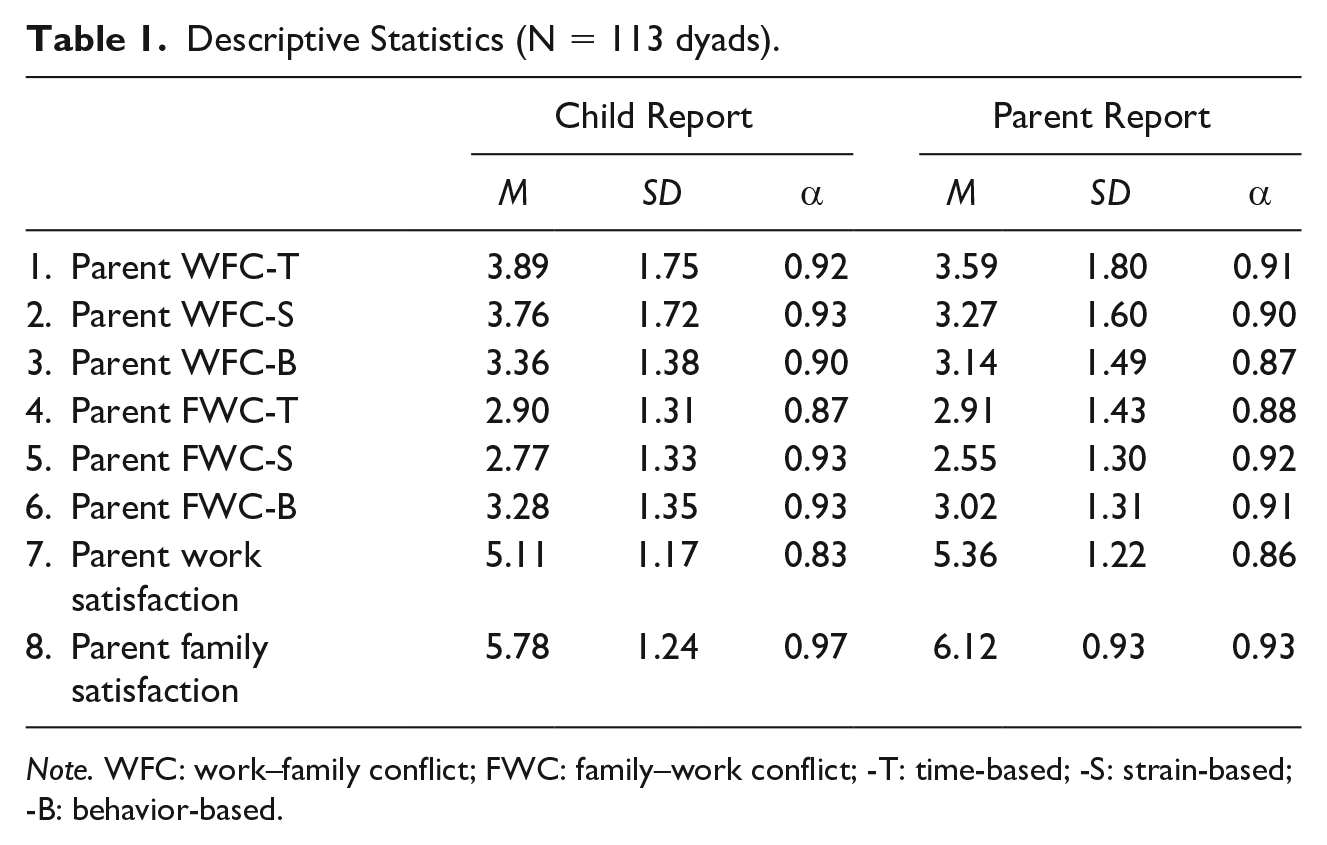
Note. WFC: work–family conflict; FWC: family–work conflict; -T: time-based; -S: strain-based; -B: behavior-based.
Work–family/family–work conflict
Perceptions of work–family and family–work conflict were defined as the extent to which one perceives work to interfere with family and vice versa, and were measured using Carlson et al.’s (2000) multidimensional measure of work–family conflict. The 18-item scale reflects the bidirectional nature of work–family conflict, and contains items measuring all six aspects of work–family conflict in distinct subscales: strain-based, time-based, and behavior-based FIW and WIF. Participants were asked to indicate on a 7-point Likert-type scale how much they agreed (1 = strongly disagree, 7 = strongly agree) with statements such as “my parent had to miss family activities due to the amount of time he/she had to spend on work” (child survey), and “due to stress at home, I was often preoccupied with family matters at work” (parent survey). For both parents and children, the subscales yielded high reliability.
Family satisfaction
Family satisfaction was defined as the overall perception of the parent’s familial well-being as reported by parents and children. It was measured using two items from Staines and Pleck’s (1983) family satisfaction scale, which is designed to gauge overall feelings of family life and satisfaction. Specifically, parents and children indicated on a 7-point Likert-type scale how satisfied and happy they perceived the parent to be with their family (1 = extremely dissatisfied, 7 = extremely satisfied). The scale was highly reliable.
Work satisfaction
The current study defined work satisfaction as how fulfilled parents were in their job, and how fulfilled children perceived their parents to be at their job. As such, it was measured using Hackman and Oldham’s (1974) 5-item general work satisfaction scale. The scale asked participants to indicate their level of agreement (1 = strongly disagree, 7 = strongly agree) with a number of different items such as “generally speaking, I was very satisfied with this job” (parent), and “my parent often thought of quitting this job (reverse-coded)” (child). For both parents and children, the overall scale and the subscales yielded high reliability.
Analyses
RQ3 asked how parent and child perspectives on work–family conflict influence the parent’s work and family satisfaction. To answer this question, four actor–partner interdependence models (APIMs) were tested. APIMs are useful for exploring the dynamic interplay between relational partners (Kenny, Kashy, & Cook, 2008), and therefore, this form of analysis was a logical methodological approach for the current study. Prior to testing the models, we ran tests to determine whether variables related to characteristics of work and family relationships affected the outcome variables. Specifically, for both parent and child, we tested correlations between the outcome variables of family and work satisfaction and possible control variables of parent’s weekly work hours, and the percentage of time the child lived with the parent at the time under consideration (we did not include income due to the high proportion of missing values). We also ran t-tests for both parent and child to examine differences in the outcome variables of work and family satisfaction due to job persistence (whether the parent still works at the same job reported on in the survey). In the corresponding models, sex of the participant along with any of these variables that resulted in significant effects for a particular outcome variable were included as control variables.
We followed the Kenny et al. (2008) procedures for conducting APIM using the interaction model in multilevel modeling (MLM). Four separate models were tested using SPSS version 25, two with parent and child perceptions of parent’s work satisfaction as the dependent variable and the other two with parent and child perceptions of parent’s family satisfaction as the dependent variable. Each model includes the participant’s own reports of parent’s WIF or FIW (time-based, strain-based, and behavior-based); the other dyad member’s reports of parent’s WIF or FIW (time-based, strain-based, and behavior-based); and the participant’s role (parent or child) as predictors, along with control variables. A significant main effect for the participant’s own report is called an actor effect and indicates that, for all participants, their own report of the independent variable affects their own report of the dependent variable. In this case, parent’s report of the independent variable affects parent’s report of the dependent variable, and child’s report of the independent variable affects child’s report of the dependent variable. A significant main effect for the other dyad member’s report is called a partner effect and means that, for all participants, their partner’s report of the independent variable affects their own report of the dependent variable. So, in this case, child’s report of the independent variable affects parent’s report of the dependent variable, and parent’s report of the independent variable affects child’s report of the dependent variable. Each model also includes interactions between the role (parent/child) variable and the actor and partner WIF or FIW variables as predictors. A significant interaction effect would indicate that the effect of that particular independent variable on the dependent variable differs for parent and child.
Results
Bivariate correlations among all variables for parents and children were assessed (see Tables 2–4). Most work–family and family–work conflict and satisfaction variables were correlated within the family member’s own reports (see Table 2 for children’s and Table 3 for parents’ data).
Child Reports of Parent Work–Family and Family–Work Conflict, Work and Family Satisfaction (N = 112).
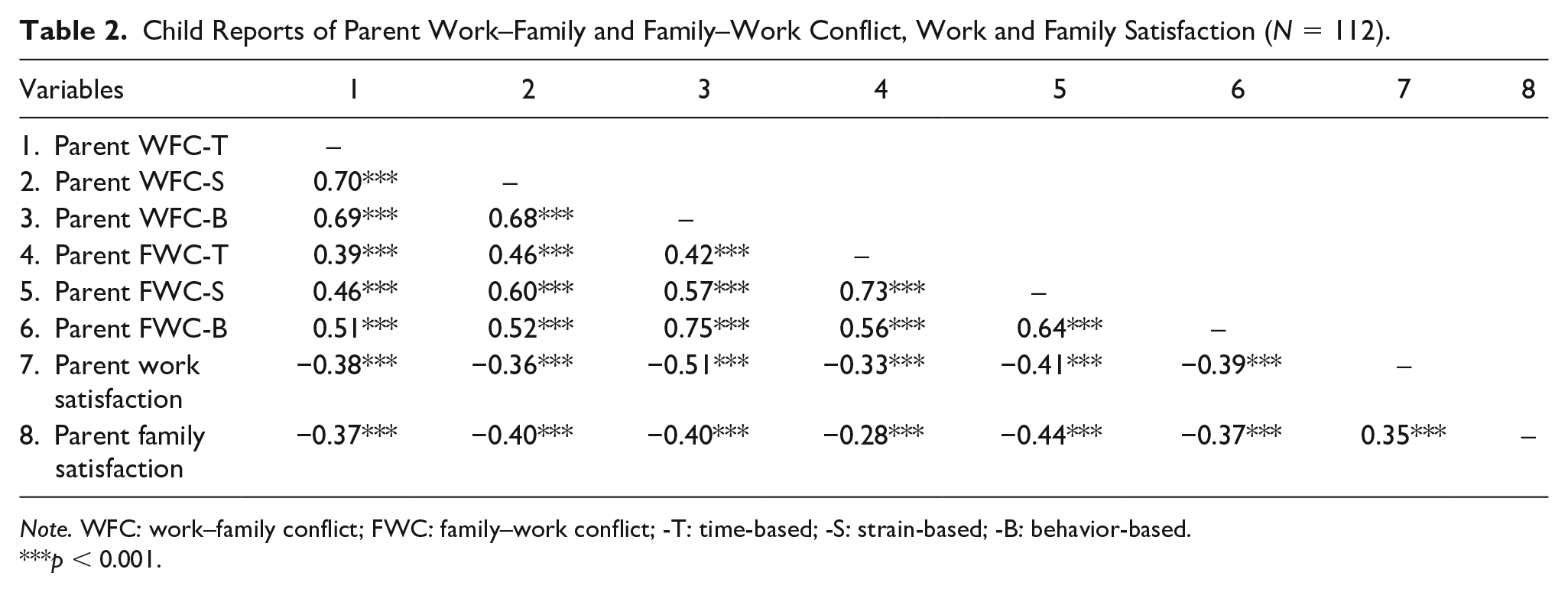
Note. WFC: work–family conflict; FWC: family–work conflict; -T: time-based; -S: strain-based; -B: behavior-based.
p < 0.001.
Parent Reports of Parent Work–Family and Family–Work Conflict, Work and Family Satisfaction (N = 113).
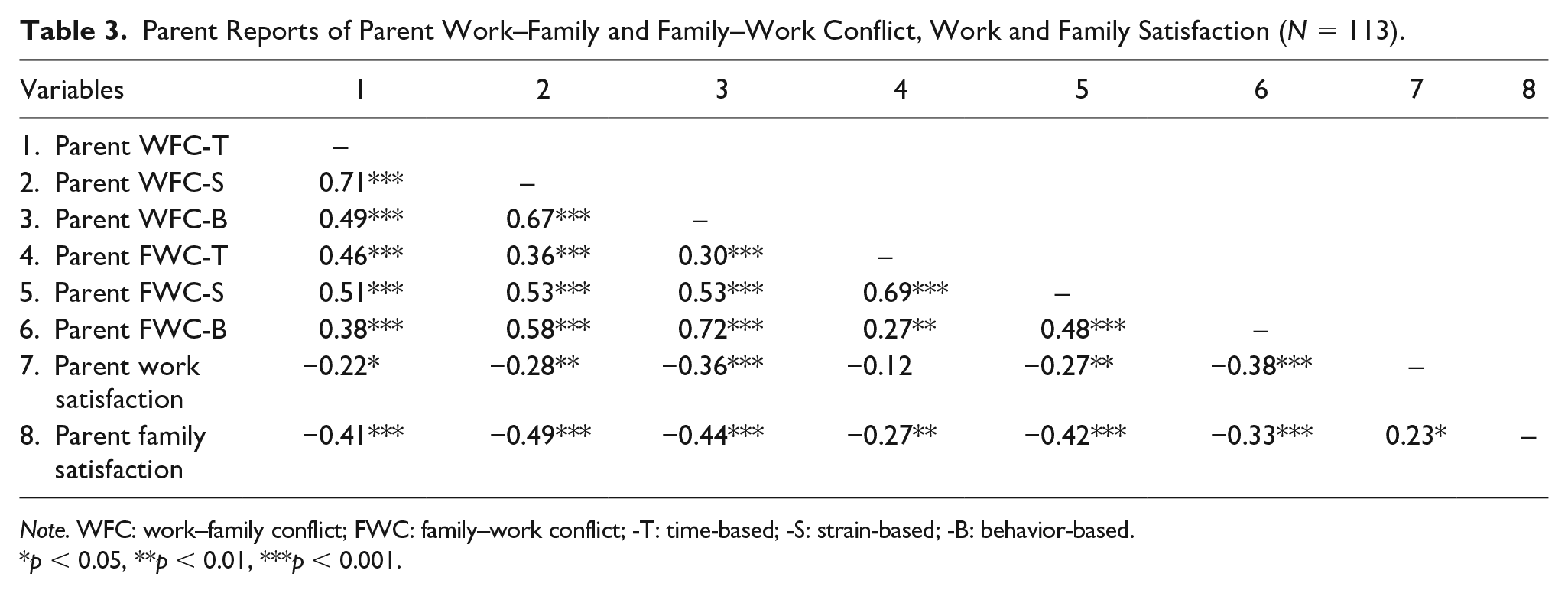
Note. WFC: work–family conflict; FWC: family–work conflict; -T: time-based; -S: strain-based; -B: behavior-based.
p < 0.05, **p < 0.01, ***p < 0.001.
In answer to RQ1, which asked about the nature of correlations between parent and child reports of work–family conflict, many of the parent’s reports of WIF and FIW and satisfaction also correlated with the child’s reports, though both parties’ perceptions of parent time-based FIW were less often significantly correlated with the other party’s reports (see Table 4 for correlations between children’s and parents’ data). In examining correlations between parent and child ratings of the same measure, parent–child correlations for the three types of WIF were positive and moderate. For the three types of FIW, the parent–child correlation was nonsignificant for time-based conflict and was positive and weak for strain-based and behavior-based conflict.
Correlations of Parent and Child Reports of Parent Work–Family and Family–Work Conflict, Work and Family Satisfaction (N = 113).

Note. WFC: work–family conflict; FWC: family–work conflict; -T: time-based; -S: strain-based; -B: behavior-based.
p < 0.05, **p < 0.01, ***p < 0.001.
A series of paired-samples t-tests were run to evaluate similarities and differences between parent and child on perceptions of parent’s work–family conflict in order to address RQ2. Results from this analysis revealed that parent and child differed significantly on their reports of parental strain-based WIF, with the child perceiving parent’s strain-based WIF (t[111] = 6.95, p < 0.001) to be higher than parents reported. However, parent and child did not differ significantly in their perceptions of parent’s time-based and behavior-based WIF and parent’s strain-based, time-based, and behavior-based FIW.
Along with sex of the participant, we also considered variables related to work and family relationships as possible control variables. First, we tested correlations between parent’s weekly work hours and the outcome variables. The parent’s report of work hours was negatively correlated with the parent’s own reported family satisfaction (r = −0.40, p < 0.001) and the child’s report of the parent’s family satisfaction (r = −0.21, p = 0.03), so the number of hours the parent worked per week was included as a control variable in the models with family satisfaction as the dependent variable. In those models, mean substitution was used for missing data for parent weekly work hours (n = 2, 0.89%). We also tested correlations between the parent work and family satisfaction variables and the percentage of time the child lived with the parent at the time under consideration. None of the correlations were significant, so the percentage of time the child lived with the parent was not included as a control variable.
Finally, independent-samples t-tests were run to examine differences in the outcome variables of work and family satisfaction due to job persistence (whether the parent still works at the same job described in the retrospective accounts). The t-tests were run separately for parents and children. According to the parent’s report of job persistence, those who continued working at the same job had significantly higher work satisfaction by both parent (M = 5.48, SD = 1.19, n = 95) and child (M = 5.28, SD = 1.09, n = 95) reports than those who did not continue at that job (parent report: M = 4.66, SD = 1.23, n = 17, t[110] = −2.61, p = 0.01; child report: M = 4.18, SD = 1.22, n = 17, t[110] = −3.76, p < 0.001). Also, for parents, those who continued working at the same job were perceived by their child to have greater family satisfaction (M = 5.91, SD = 1.16, n = 95) than those who did not continue at that job (M = 5.06, SD = 1.46, n = 17, t[110] = −2.66, p < 0.01). For children who reported their parents continued to work at the same job, parent work satisfaction was greater by both parent (M = 5.48, SD = 1.12, n = 97) and child (M = 5.26, SD = 1.07, n = 97) reports than for those children whose parents did not continue at that job (parent report: M = 4.52, SD = 1.55, n = 15, t[16.31] = −2.31, p = 0.03; child report: M = 4.16, SD = 1.43, n = 15, t[110] = −3.53, p = 0.001). As a result, job persistence was included in all models for both work satisfaction and family satisfaction.
Actor–Partner Interdependence Models
RQ3 asked how parent and child perspectives on parent’s work–family and family–work conflict relate to their perceptions of the parent’s work and family satisfaction. Four MLM models were used to test the APIM for different subsets of these variables (see Table 5 for fixed effects and Table 6 for covariance parameters of the models).
APIM Fixed Effects for MLM Models.

Note. WFC: Work–family conflict; FWC: family–work conflict; *p < 0.05, **p < 0.01, ***p < 0.001; †parent weekly work hours not included in the work satisfaction models.
APIM Covariance Parameters for MLM Models.
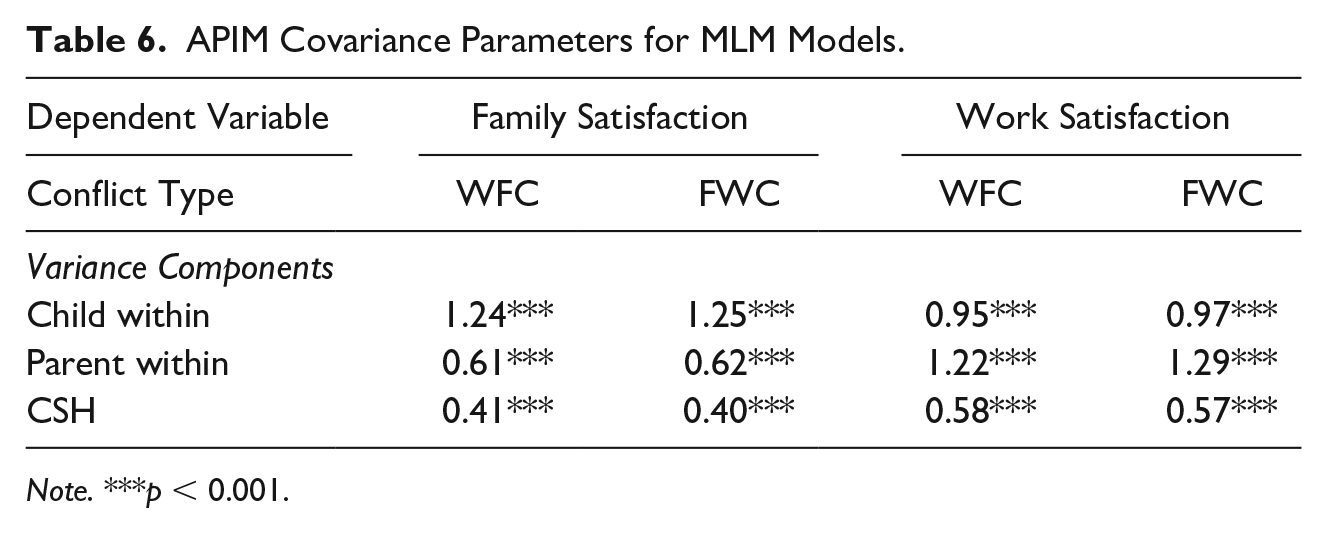
Note. ***p < 0.001.
Family Satisfaction
Two MLM models tested the APIM with parent and child perceptions of parent’s family satisfaction as the dependent variable. In the first model, control variables (sex, work hours, and job persistence), the WIF variables, along with the parent–child role variable and the interaction terms, were entered as predictors (pseudo R2 = 0.24) This model revealed three significant main effects (see Table 5). First, the control variable of parent’s weekly work hours was negatively related to parent’s family satisfaction; the more hours the parent worked, the lower the participant rated the parent’s family satisfaction. In addition, actor reports of parent’s behavior-based WIF produced a significant, negative main effect on perceptions of parent’s family satisfaction. The higher a participant rated the parent’s behavior-based WIF, the lower he or she rated the parent’s family satisfaction. Dyadic role (parent or child) also produced a significant main effect on perceptions of parent’s family satisfaction. The parent rated his or her own family satisfaction significantly higher than the child rated the parent’s family satisfaction. No interaction effects were significant.
In the second model, the control variables (sex, work hours, and job persistence), the FIW variables, along with the parent–child role variable and the interaction terms, were entered as predictors (pseudo R2 = 0.23). This model revealed four significant main effects (see Table 5). As in the previous model, the control variable of parent’s weekly work hours was negatively related to parent’s family satisfaction; the more hours the parent worked, the lower the participant rated the parent’s family satisfaction. Also, actor reports of parent’s strain-based FIW and behavior-based FIW produced significant, negative main effects on perceptions of parent’s family satisfaction. The higher a participant rated the parent’s strain-based FIW, the lower he or she rated the parent’s family satisfaction. Similarly, the higher a participant rated the parent’s behavior-based FIW, the lower he or she rated the parent’s family satisfaction. Again, the dyadic role (parent or child) also produced a significant main effect on perceptions of parent’s family satisfaction. The parent rated his or her own family satisfaction significantly higher than the child rated the parent’s satisfaction. Again, no interaction effects were significant.
Work Satisfaction
Two MLM models also tested the APIM with perceptions of parent’s work satisfaction as the dependent variable. In the first model, control variables (sex and job persistence), the WIF variables, along with the parent–child role variable and the interaction terms, were entered as predictors (pseudo R2 = 0.23). This model revealed three significant main effects (see Table 5). The control variable of job persistence was a significant, positive predictor of work satisfaction; when the parent continued to work at the job participants referenced in these retrospective accounts, perceptions of work satisfaction were greater than when the parent had changed jobs. Actor reports of parent’s behavior-based WIF produced a significant, negative main effect on perceptions of parent’s work satisfaction. The higher a participant rated the parent’s behavior-based WIF, the lower he or she rated the parent’s work satisfaction. The same pattern was observed for the partner effect; partner reports of parent’s behavior-based WIF produced a significant, negative main effect on perceptions of parent’s work satisfaction. The higher a parent rated his or her own behavior-based WIF, the lower the child rated the parent’s work satisfaction, and the higher a child rated the parent’s behavior-based WIF, the lower the parent rated his or her own work satisfaction. There were no significant interaction effects.
In the second model, the control variables (sex and job persistence), the FIW variables, along with the parent–child role variable and the interaction terms, were entered as predictors (pseudo R2 = 0.21). This model revealed three significant main effects (see Table 5). Again, the control variable of job persistence was positively related to parent’s work satisfaction; when the parent was still working at the same job as participants recalled in their retrospective accounts, participants rated parent’s work satisfaction higher than when the parent had changed jobs. As in the first work satisfaction model, actor reports of parent’s behavior-based FIW produced a significant, negative main effect on perceptions of parent’s work satisfaction. The higher a participant rated the parent’s behavior-based FIW, the lower he or she rated the parent’s work satisfaction. Dyadic role (parent or child) also produced a significant main effect on perceptions of parent’s work satisfaction. The parent rated his or her own work satisfaction significantly higher than the child rated the parent’s satisfaction. As in all of the other models, there were no significant interaction effects.
Discussion
The goals of this study were to examine the relationship between parents’ and their adult children’s perspectives on the parent’s work–family conflict and satisfaction with work and family life. Interestingly, though we investigated six types of work–family conflict (i.e., time-based, strain-based, and behavior-based conflict from work to family and from family to work), the only significant difference between parent and child reports was that the child ratings of parental strain-based WIF were significantly higher than the parent ratings. The pattern of association revealed that correlations were moderate for parent and child ratings of the parent’s work to family conflict and weak for parent and child ratings of the parent’s family to work conflict. In fact, for FIW, the parent–child correlation was positive but weak for strain-based and behavior-based conflict and nonsignificant for time-based conflict.
In examining the relationships among the dyad members’ ratings of the parent’s work–family conflict and satisfaction with work and family, four APIMs tested a set of work–family conflict variables (either WIF or FIW) with one domain of satisfaction (either family or work). In three of the four models, children rated satisfaction lower than did parents. In the models involving family satisfaction, actor ratings of behavior-based WIF and FIW and actor ratings of strain-based FIW were negatively related to satisfaction. In the models involving work satisfaction, actor and partner ratings of parent’s behavior-based WIF and actor ratings of behavior-based FIW were negatively related to satisfaction.
Three major features of these findings are of particular interest. First, children think parents are less satisfied with both family and work and bring home more strain from work than parents report. This extends work on the perception gap between parents and children into the context of work–family conflict and may be explained in several different ways. Perhaps parents report higher satisfaction with family and work and lower strain-based WIF through social desirability, and children are less affected by a social desirability bias because they are not reporting on their own attitudes. If this were the case, though, ratings of other variables would likely show the same pattern. Another explanation is that children are biased in their assessments of their parents’ opinions and thoughts. Such a bias would be consistent with findings on empathic accuracy in parent–child dyads, in which both parents and children inaccurately attributed negative thoughts to the other (Sillars et al., 2010). It is also possible that parents talk more about their negative than their positive thoughts and feelings about work, so that children get an overly negative perception of their parents’ satisfaction with work, family, and the amount of strain their parents experience at work. The negativity bias (Ito, Larsen, Smith, & Cacioppo, 1998) means that even a few complaints from parents could be overshadowing positive statements they make. Given that parents model attitudes toward work and family for their children, and that their work–family conflict indirectly affects their children’s attitudes toward work (Lim & Kim, 2014), children may be developing more negative attitudes toward work and family life as a result of this negativity bias. Seeking out opportunities to talk about their own perceptions with their children and to give their children more opportunities to observe their work (when possible) might allow parents to give their children a more accurate assessment of how work and family roles play out in the parent’s life.
A second finding of this study is that though children have a more negative view of their parent’s satisfaction with work and family and strain-based WIF than their parents do, their perceptions are positively correlated with their parent’s for these constructs. In contrast, children’s perceptions of how the family affects their parent’s work are not consistently or strongly correlated with parents’ perceptions. Assuming that many of these parents are performing their paid work in a different physical location than their children, children have less opportunity to observe how family life is affecting the parent in the workplace than they do to observe how work is affecting the parent within the family. Additionally, parents might be withholding complaints about how the family affects their work in order to spare their children’s feelings. Considering the inaccuracy of children’s understanding of their parents’ FIW, and the fact that these variables are negatively related to family satisfaction and work satisfaction, it is no wonder that there is a discrepancy between parent and child perceptions of the parent’s work and family satisfaction. A further reason why children have a poorer understanding of their parents’ family–work conflict than their work–family conflict may rest with the fact that parents and children both perceive parents’ strain-based and time-based FIW to be lower than their WIF (see Table 1). (Ratings of behavior-based WIF and FIW are quite similar, which makes sense because the construct is based on conflict caused by a discrepancy between successful behaviors in work and home contexts, so a person should be likely to score similarly on both WIF and FIW contexts of the variable.) Even if parents are not withholding complaints about family interfering with work to spare their children’s feelings, with low levels of FIW, they do not have much fodder for conversation. Regardless of the reason, children do not have a good understanding of how their parents’ family life affects their work. Given the importance of family and work roles in the lives of adults, parents may wish to have more open conversations with their children to help them prepare for the choices they will need to make about family and work in their adult lives.
Finally, most of the significant effects in the dyadic model included actor or partner perspectives on behavior-based conflict as a predictor of family or work satisfaction. Behavior-based conflict does not align with many policy initiatives that may alleviate strain- or time-based conflict. Problems of time conflict can be addressed with programs that increase workplace flexibility of time or space (e.g., schedule control [Schieman & Young, 2010]) or provision of resources that can add support to family life (e.g., convenience of child care [Payne, Cook, & Diaz, 2012]). Problems of strain can be addressed, obviously, by reducing the root causes of strain, but also with stress-reduction techniques such as exercise (Clayton, Thomas, Singh, & Winkel, 2015), child caregiver attentiveness (Payne et al., 2012), and social support from the employer (Kelly et al., 2014). Behavior-based conflict, though, requires the development of skills that work well in the given environment as well as the ability to recognize which skills are appropriate in varied circumstances. Someone who experiences behavior-based conflict also might be able to state that their existing skills and behaviors are ineffective without being able to identify the skills that would be more effective. Thus, behavior-based WIF and FIW are challenging issues to address. Workplaces seeking to improve employees’ work satisfaction and reduce their work–family and family–work conflict might consider offering employees training in skills they need to succeed at work, skills (such as parenting and relationship skills) they need to succeed in their families, and in how to select the appropriate skill to use in different circumstances.
Family Systems Theory
A goal of this paper was to examine the experience of work–family conflict within parent–child relationships by framing the tension using family systems theory. This study found that parents and children have some similarities in their perceptions of the parents work and family experiences, but also differ significantly in that children believe their parents’ experience is more negative than the parents report, with children having an especially divergent perception of the parents’ experience with FIW. Thus, the parent’s experiences with work, which impact the entire family in multiple ways, are perceived differently by the child and the parent. But, consistent with family systems theory (Bowen, 1966), the perceptions of the two family members affect each other. Not only are many of the parent’s and the child’s ratings of the parent’s work–family conflict and satisfaction variables correlated with each other (see Table 4), the dyadic analyses found that the partner effect for parent’s behavior-based WIF was a significant predictor of work satisfaction ratings (indicating that each dyad member’s ratings of the parent’s work satisfaction were related to the other dyad member’s ratings of the parent’s behavior-based work–family conflict). The latter finding was surprising, especially since parent and child ratings of the behavior-based family–work conflict variable were weakly correlated with each other. These findings, then, showed that children’s and parents’ perceptions of the parents’ experiences are intertwined, but do not match. Given the importance of family and work as areas of focus in most adults’ lives, these are areas that parents may want to discuss more with their children.
Limitations and Future Research
The population in the current study consisted mostly of white parent–child pairs. Therefore, a large limitation of this study is the lack of diversity in the sample. Specifically, understandings of work differ across cultures (Wight, Bianchi, & Hunt, 2013), and thus the predictive relationships found within the current, predominantly white sample may not extend to parent–child dyads within different ethnic groups. As such, future research should make an effort to explore the relationships between work–family and family–work conflict, and work and family satisfaction within different, more diverse populations.
Furthermore, many of the participants in the current study were college students who were not living at home with their parents at the time of the survey, so many of their experiences were retrospective. Future research should therefore explore these relationships within a younger population of children, and with children who are currently living at home. Given that most of these young adult participants were full-time, traditional-aged college students, the lack of understanding of their parents’ family and work experiences is somewhat to be expected. Their understanding will likely change and develop as they launch their adult lives. For those who maintain close relationships with their parents, understanding between the two on these aspects of the parents’ experience might increase as they age and begin to discuss these aspects of their own lives with their parents.
Footnotes
Authors’ note:
Veronica A. Droser is currently affiliated with The College at Brockport, Brockport, NY, USA.
Declaration of Conflicting Interests
The author(s) declared no potential conflicts of interest with respect to the research, authorship, and/or publication of this article.
Funding
The author(s) received no financial support for the research, authorship, and/or publication of this article.
