



Abstract
This study aims to explore whether individual gender-role attitudes moderate potential policy effects on planned childbearing. This is done by employing a typology of earner-carer and traditional-family support in multilevel analyses, pooling data from 2010 for 23 countries. It is expected that individuals preferring earner-carer arrangements react more positively to earner-carer support, while individuals preferring traditional-family arrangements react more positively to traditional-family support. The results show that gender-role attitudes moderate the effect of family policies on mothers’ and childless men’s planned childbearing. Gender-egalitarian mothers have stronger childbearing intentions with higher income replacement in earner-carer support. Contrary to expectations, gender-egalitarian childless men have stronger childbearing intentions with higher income replacement in traditional-family support. Moreover, the results show that both family policies and gender-role attitudes influence childbearing intentions independently, and that family policies play a role mainly for childless respondents.
Keywords
Introduction
Low fertility has been a concern for policymakers in European and other wealthy low-fertility countries for a considerable number of years. Policymakers have, therefore, launched different types of family policies to support childbearing. Some of these policies are meant to help individuals to fulfil their childbearing goals by enabling parents to combine childbearing and work outside the home (see Korpi, 2000; Lewis, 1992; Orloff, 1993). These policies can be referred to as earner-carer support, as they enable parents to be both earners and carers. Other policies are meant to facilitate childbirth by enabling mothers to care for their children at home instead of taking paid employment outside the home (see Korpi, 2000; Lewis, 1992; Orloff, 1993). These policies can be conceptualized as traditional-family support, as they facilitate a stricter gendered division of paid and unpaid work in the family, with a stay-at-home mother. Building on arguments by Neyer and Andersson (2008), it can be assumed that different groups of individuals are differentially influenced by family policies in their childbearing behavior. Moreover, childbearing goals differ by gender and parity (Billingsley & Ferrarini, 2014; Kaufman, 2000; Lappegård, Neyer, & Vignoli, 2015). This is put to the test by studying how the effects of incentives created by family policies differ depending on which of the two gender arrangements childless women and men, as well as mothers and fathers prefer: earner-carer or traditional-family.
Specifically, family policies that help parents combine childbearing and work do so by providing earnings-related benefits and shorter or longer periods of leave that can be shared between parents, thereby facilitating more gender-equal earner-carer arrangements. 1 Policies that support stay-at-home mothers instead give lower, flat-rate benefits during longer periods of leave, making it less likely that fathers will share the leave and thereby favoring a traditional gendered division of paid and unpaid work (Ferrarini, 2003; Korpi, 2000). Here, it is argued that if individuals advocate earner-carer arrangements, then family policies supporting such an arrangement may influence their childbearing decisions more than other types of family policies. Conversely, individuals who prefer a traditional gendered division of paid and unpaid work in the family may react more positively to family policies supporting stay-at-home mothers. It is, therefore, relevant to take individuals’ gender-role attitudes into account, showing which type of gender arrangement they prefer, when studying the possible effects of family policies on childbearing decisions.
To do so would contribute to research on family policies and their impact on childbearing decisions which, to some degree, has been limited by how family policies have been conceptualized (see Korpi, Ferrarini, & Englund, 2013; Korpi & Palme, 1998). Rather than using time-invariant typologies, unidimensional scales, or expenditures, as in earlier studies (e.g., Crompton, 1999; Lewis, 1992; Mandel & Semyonov, 2006; Pfau-Effinger, 1998), this study argues that it is the benefits that individuals can expect to receive, that is, policy options that influence individuals’ childbearing decisions. In contrast to earlier research strategies, this study employs indicators measuring policy options in the form of the benefits individuals can expect to receive through family policies. Moreover, family policies are divided into earner-carer support and traditional-family support to capture the two types of gender arrangements they can support. Finally, both types of family policies will be taken into account simultaneously, as countries may support both gender arrangements to different degrees.
The aim of this study is to explore whether individual gender-role attitudes moderate potential policy effects on childbearing intentions. Studying childbearing intentions has the advantage that it captures potential responses to policy options in a more direct way than studying childbearing itself, which may be influenced by a lack or failure of fertility control, among other factors. For the present study, two macro-level indicators of family policies supporting the aforementioned gender arrangements will be combined with individual-level data on childbearing intentions, gender-role attitudes, and a number of demographic and socioeconomic factors for 23 countries for the year 2010.
Identifying the knowledge gap
Family policies are arguably connected to childbearing decisions. This has been shown in both comparative studies on country level and studies on micro-level within a single country or comparing a few countries. Higher expenditures on single types of policies, such as family allowances, and expenditures on a broader range of family policies were both connected to higher fertility in cross-country comparative studies (e.g., Gauthier & Hatzius, 1997; Luci-Greulich & Thévenon, 2013). Studies have also shown that the “speed premium” 2 in Sweden impacted the timing of births (Hoem, 1993). Another example is that policies giving fathers incentives to take parental leave positively impacted second and third births in Sweden and Norway (Duvander & Andersson, 2006; Lappegård, 2010). In Austria, finally, an increase in the duration of parental leave in 1990 had a positive impact on second births (Lalive & Zweimüller, 2009).
Family policies also influence an important precursor to childbearing: the intention to have a child. 3 A study of 10 European countries showed that the policy setup in a country influences childbearing intentions, as women in countries where the policy setup supports earner-carer arrangements expressed stronger childbearing intentions (Fahlén, 2013). An influence of family policies on childbearing intentions has also been shown for countries outside of Europe. For example, a study demonstrated that in South Korea, childcare leave and family allowances were connected to stronger childbearing intentions in younger women (Choi, Yellow Horse, & Yang, 2018).
Although previous research demonstrates relationships between family policies and childbearing decisions, Neyer (2005) and Gauthier (2007) deem the findings to be inconclusive as no consistent effect of family policies could be found. This article argues that this is partly due to how family policies have been conceptualized. Earlier studies, for example, have used time-invariant regime typologies, unidimensional scales or expenditures instead of policy options. Using these conceptualizations of family policies leads to a number of issues. The first problem is that welfare regime typologies often include both causes and outcomes in their typologies (Korpi & Palme, 1998), and gender-regime typologies (e.g., Crompton, 1999; Lewis, 1992; Pfau-Effinger, 1998) are also subject to this disadvantage. To give one example, Pfau-Effinger’s (1998) typology includes both causes and outcomes, as it emphasizes the role of cultural norms, institutional arrangements, and social practices. Second, single-scale measures of family policies (see Mandel & Semyonov, 2006) do not reflect the fact that countries may simultaneously support different gender arrangements in the family (Korpi et al., 2013). Finally, expenditures on family policies are not detailed enough to separate theoretically important characteristics of policies (see Bolzendahl, 2011; Esping-Andersen, 1990), such as those supporting different divisions of paid and unpaid work in the family. Moreover, expenditures measure policy usage post-factum, not the policy options that individuals can weigh when making their childbearing decisions.
The approach employed in this study avoids these limitations. First, it does not use static regime labels, and, therefore, avoids mixing causes and outcomes. Moreover, countries’ family policies vary along the dimensions of earner-carer support and traditional-family support simultaneously. In this way, the fact that countries often support both gender arrangements to different degrees is accounted for. Third, the approach chosen avoids the issues associated with the use of expenditures, as it builds on indicators of family policy transfers as set out in national legislation, and, thus, measures policy options, not policy usage post-factum (see Ferrarini, 2003; Korpi, 2000; Korpi et al., 2013) (for a more detailed description, see the Data section).
Aided by this typology of earner-carer support and traditional-family support, Ferrarini (2003) demonstrated that higher levels of both types of family policy were connected to higher fertility in Western countries for the years 1970–1995. Wesolowski and Ferrarini (2018) found a connection between earner-carer support and higher fertility in Western and Eastern European countries for the time period 1995–2010. The results were expanded by a larger cross-country comparative study of 21 European countries indicating that higher levels of family policy benefits are connected to stronger first-birth intentions, regardless of which gender arrangement they support, while higher levels of earner-carer support are connected to stronger second-birth intentions (Billingsley & Ferrarini, 2014).
Another issue accounted for by the approach selected for this article is that larger cross-country comparative studies have often assumed that policies affect everyone in the same way. However, as Neyer and Andersson (2008) argue, macro-level and individual-level data should be combined in analyses, as different groups of individuals are differently influenced by family policies. We can, thus, expect the influence to vary by, for example, gender, educational level, and labor market attachment. Inconsistent results of earlier studies might partly be due to their not taking this differential impact into account. As argued earlier, the influence of family policies is likely to differ depending on which gender arrangement individuals prefer. If individuals seek earner-carer arrangements and family policies support such an arrangement, one could expect their potential response to family policies to be stronger than otherwise. However, the potential policy response of individuals who seek a traditional gendered division of paid and unpaid work could be stronger if family policies support such a division.
The approach also avoids presuming that the educational level of individuals indicates which gender arrangement they prefer (cf. McDonald, 2013). Individuals with higher education may not necessarily prefer earner-carer arrangements, that is, have more egalitarian gender-role attitudes. Rather, gender-role attitudes as such are important for childbearing decisions notwithstanding educational level, indicating that individuals with egalitarian gender-role attitudes have weaker childbearing intentions (see Kaufman, 2000; Lappegård et al., 2015). The influence of gender-role attitudes 4 should, therefore, be studied directly rather than through proxies. Moreover, and also connected to Neyer and Andersson’s (2008) argument, studies have shown that analyses should be divided by gender and parity, as women and men, as well as nonparents and parents, differ in specific ways in their childbearing decisions (e.g., Billingsley & Ferrarini, 2014; Kaufman, 2000; Lappegård et al., 2015).
To summarize, previous research supports the importance of studying childbearing intentions as an important part of the whole childbearing decision-making chain from intentions to actual childbirth. Specifically, the literature points to a knowledge gap concerning childbearing intentions in relation to incentives offered by family policies that support the two different gender arrangements: earner-carer and traditional-family support. This is because childbearing intentions can be expected to differ depending on how well policy orientations meet individuals’ gender-role attitudes. It is, thus, expected that individuals preferring earner-carer arrangements will react more positively to earner-carer support, while individuals preferring traditional-family arrangements will react more positively to traditional-family support.
Data
For the analyses, data from the European Social Survey (ESS) Round 5 (European Social Survey, 2010) were merged with institutional family policy data from the Social Policy Indicators database (SPIN, 2019), developed at Stockholm University, which contains information on social policies in a larger number of countries. The analysis is based on ESS respondents, aged 18–49 years, from 23 European countries 5 and data on family policies for every country for the year 2010. This year constitutes the most recent year that the ESS contained questions on childbearing intentions and gender-role attitudes.
Childbearing intentions
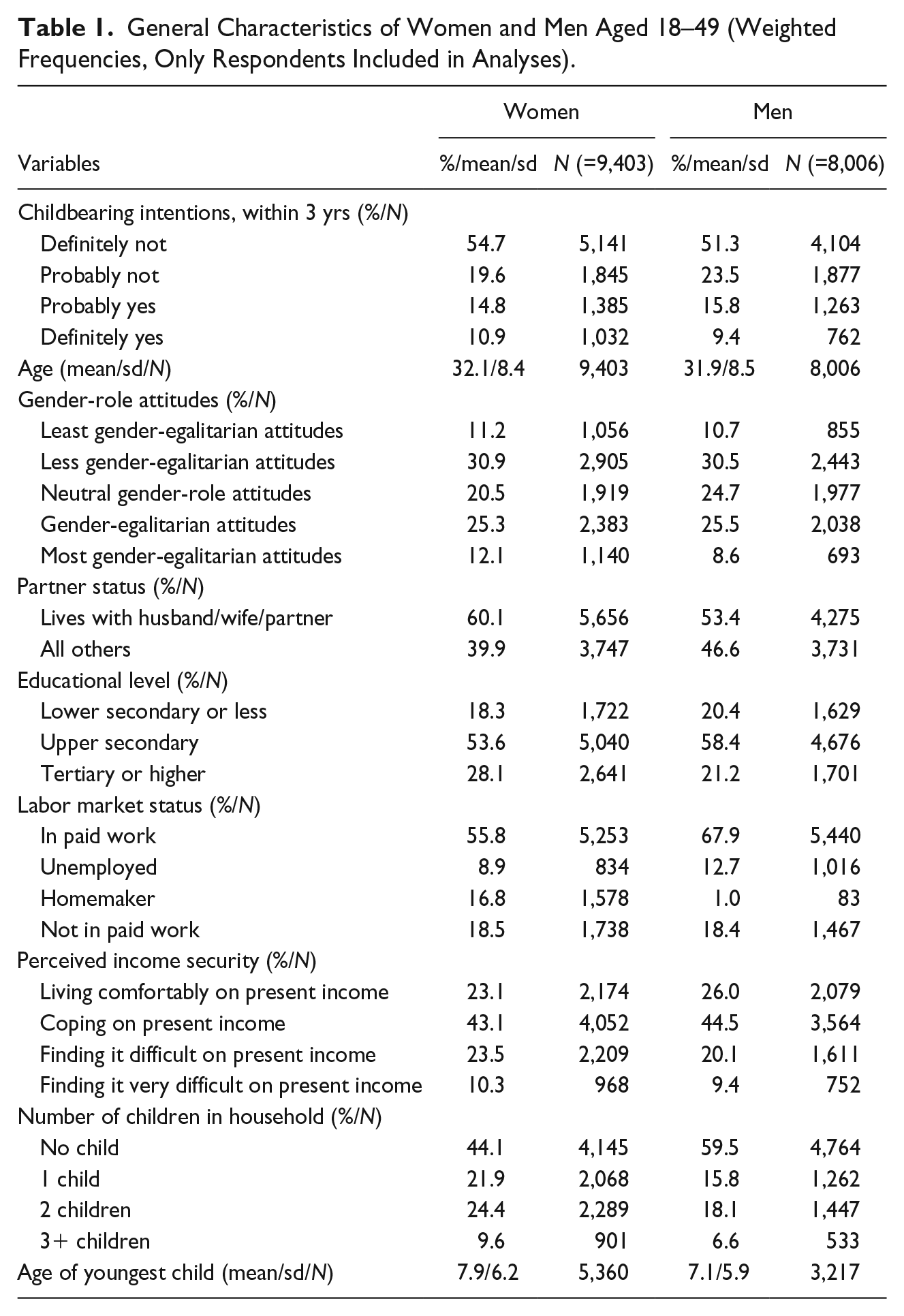
The outcome variable of interest for this study, Childbearing Intentions, was measured by a question asking whether the respondent planned to have a child within the next three years, retrieved from the ESS. The response alternatives were given on a 4-grade scale: definitely not, probably not, probably yes, and definitely yes (see Table 1 for descriptives). The measure is assumed to be interval level, in line with earlier research (see Billingsley & Ferrarini, 2014; Thomson & Brandreth, 1995).
General Characteristics of Women and Men Aged 18–49 (Weighted Frequencies, Only Respondents Included in Analyses).
Family policy dimensions
The main predictors at the country level are two variables: one measuring the extent of family policies supporting earner-carer arrangements, Earner-Carer Support; and the other measuring the extent of family policies supporting a gendered division of paid and unpaid work, Traditional-Family Support. The family policy variables are based on information about how much a typical wage earner can expect to receive after the birth of a child, that is, the options and incentives given by the relevant type of support, as set out in each respective country’s legislation. As such, they also show the broader family policy orientation of a country regarding the gender arrangement(s) supported.
This information is used to calculate the dimensions as follows. Family policy transfers included in Earner-Carer Support are earnings-related maternity leave and dual parental leave (which can be shared by both parents). 6 These benefits are employment related and give mothers and fathers a certain percentage of their preleave income to stay at home with their newborn child during a period that differs in length from country to country. Both maternity and parental leave give women incentives to enter and stay in the labor market precisely because they are earnings related (Bäckman & Ferrarini, 2010). Dual parental leave supports care of the child by both parents, as it can be shared between them. In the year 2010, a portion of this leave was set aside for each parent as a nontransferable right in Sweden, Norway, Finland, and Germany (of the countries included), thereby especially supporting care by fathers (because mothers mostly take the majority of parental leave). The features of earnings relatedness and the possibility to share the leave between the parents supports a more gender-equal earner-carer arrangement.
Family policy transfers falling under Traditional-Family Support are not related to previous employment. These comprise childcare leave allowances (or home care allowances) that mostly pay low, flat-rate amounts for prolonged leave after earnings-related parental leave. Maternity grants, paid in connection to childbirth, are also included in this dimension together with cash and fiscal child benefits, as well as tax deductions for a male breadwinner family (marriage subsidies). Marriage subsidies support female homemaking, while child benefits reproduce preexisting gender structures, as they do not promote a more gender-equal division of paid and unpaid work in the family (see discussion in Montanari, 2000). As the mentioned benefits and allowances are not earnings related and were not found to support a more gender-equal sharing of paid and unpaid work, they are seen as supporting stay-at-home mothers.
Benefits are estimated for a model family consisting of two adults, both of whom are earning or have been earning an average production worker’s wage. One of the adults works full time and the other is on leave. The family also consists of two children, one of which is newborn and the other below school age. Earner-Carer Support is calculated as the annual net amount of earnings-related, postnatal maternity and dual parental leave benefits paid during the first year after childbirth, as a percentage of an average production worker’s annual net wage. This measure takes into account both taxation and the duration of the benefit during this first year after childbirth.7,8 A shorter duration, thus, results in a lower replacement rate, even if the formal replacement rate for one week is 100%; that is, 100% for eight weeks gives a lower replacement rate than 80% for 30 weeks, when divided by an annual net wage. To capture the full degree of earnings relatedness, the parent on leave is assumed to have worked for two years before the birth of the child, earning an average production worker’s wage. This is a long enough period to entitle the parent to full earnings-related benefits. Traditional-Family Support is calculated as the annual net amount of childcare-leave benefits, maternity grants, cash and fiscal child allowances, and marriage subsidies, as a percentage of an average production worker’s annual net wage. The childcare-leave component takes into account how much of an average net wage is replaced during the first year after the termination of earnings-related parental leave, and, thus, also takes into account the duration of the leave during the year.
These two variables are calculated for every country included in the analyses and provide us with two separate dimensions measuring replacement rates with continuous scores: Earner-Carer Support and Traditional-Family Support. In the analyses at hand, they are each centered on their respective means and divided by 10 to facilitate the interpretation of the resulting coefficients. By this operation, the results show how much, on average, childbearing intentions would change per 10 percentage point increase in the replacement rate of each type of family policy support, respectively.
Figure 1 gives a visual overview of how the countries included in the analyses are positioned in relation to each other, in 2010, in the multidimensional space of the family policy typology used in this study and shows that countries do support both types of family policies to different degrees. Figure 1, thus, also gives an impression of the broader family policy orientation of a country when it comes to the gender arrangement(s) they support.
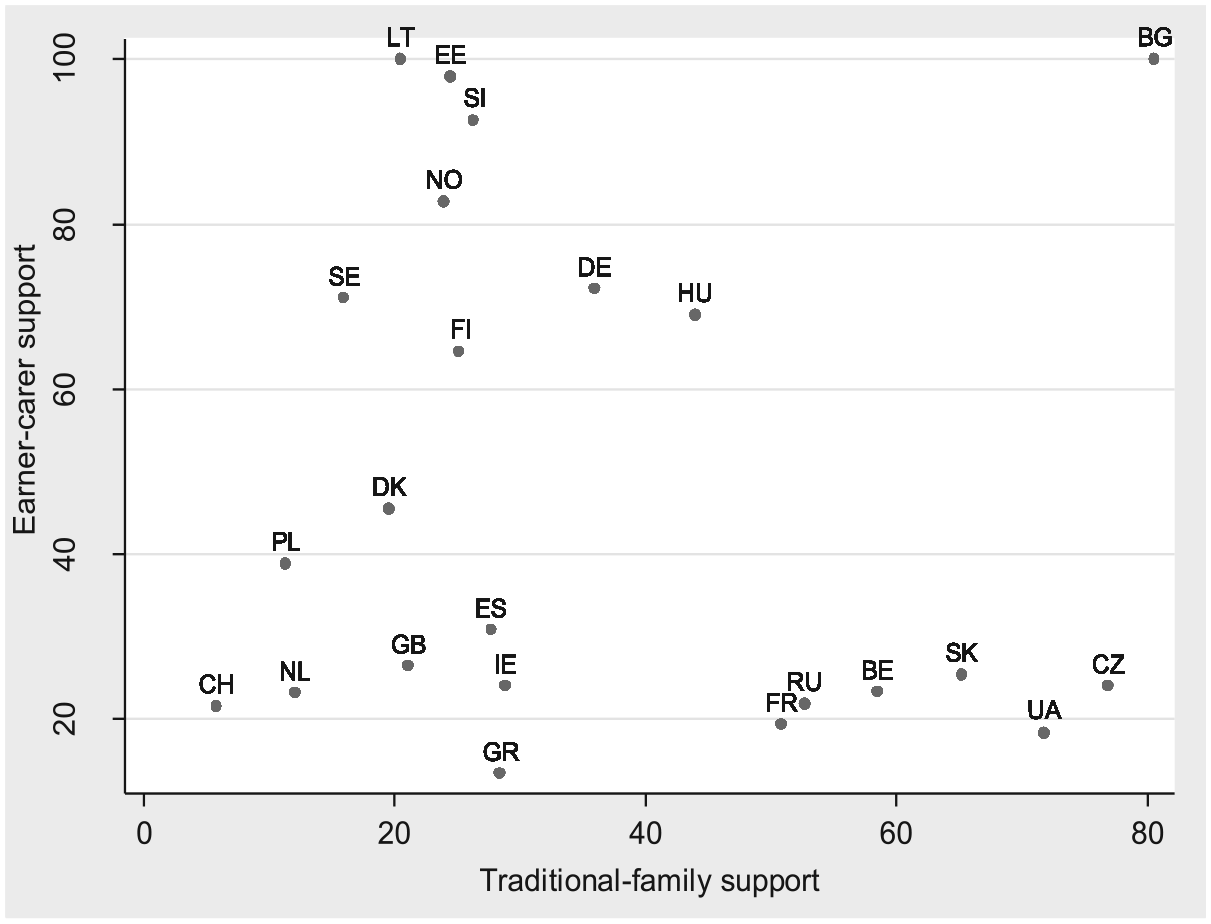
Family policy dimensions and constellations in 23 countries for 2010.
As can be seen in Figure 1, France, Russia, Belgium, Slovakia, Ukraine, and the Czech Republic have higher scores on the traditional-family support dimension and lower scores on the earner-carer support dimension. Switzerland, the Netherlands, Poland, Great Britain, Spain, Ireland, and Greece show lower levels of both earner-carer and traditional-family support. Lithuania, Estonia, Slovenia, Norway, Germany, Sweden, and Finland show higher levels of earner-carer support and lower levels of traditional-family support. Denmark is positioned close to the mean value of earner-carer support, which is around 46.4% of an average production worker’s annual net wage. 9 Hungary and Bulgaria have higher levels of both types of family support. The diagram shows that there is considerable variation in the institutional setup of family policies in the countries included in the analyses, and that there is no distinct geographical clustering of countries.
Gender-role attitudes
The main predictor on individual level was Gender-Role Attitudes. This was measured with a question from the ESS asking whether women should be prepared to cut down on paid work for the sake of the family. The choice of this variable was inspired by Andringa, Nieuwenhuis, and van Gerven (2015), and is meant to serve as a gender-role attitude closely connected to family life and the labor market. The response alternatives were given on a 5-point scale from strongly agree to strongly disagree. Strongly agree denoted the least egalitarian gender-role attitudes, while strongly disagree denoted the most egalitarian gender-role attitudes, with the categories in between denoting successively more egalitarian gender-role attitudes (see Table 1 for descriptives). A linear specification was used in the analyses. 10
Control variables
Several demographic and socioeconomic control variables from the ESS were included in the models based on factors identified as influencing childbearing decisions in earlier research (see Table 1 for descriptives). Age in years was centered on the mean, and modelled as a curvilinear covariate by adding a squared age term. This is done to account for the first increasing and then decreasing childbearing intentions of women at different ages. Partner Status distinguishes those living with husband/wife/partner from all others. Educational Level, originally measured in seven International Standard Classification of Education (ISCED) categories, was recoded into three categories: lower-secondary, upper-secondary, and tertiary education. Labor Market Status captured the respondents’ main activity during the last seven days. This variable was recoded into four categories: paid work, unemployed, homemaker (doing housework, looking after children or other persons), and not in paid work (e.g., including those that are studying). Perceived Income Security was measured by asking if the respondents could live comfortably, were coping, were finding it difficult, or were finding it very difficult to live on their present income. This variable was included as a proxy for the respondents’ economic situation because questions that capture income more directly had too many missing values.
Number of Children in Household was calculated from the household grid using information on the respondents’ relationship to household members. As the information in the ESS does not allow for clearly separating stepchildren and adopted children from biological ones, this variable includes both. Moreover, this variable only includes children living in the same household as the respondent. The variable Age of Youngest Child also used information from the household grid concerning the respondent’s relationship to household members and the year they were born. Both variables were included to capture at what stage the respondent was in his/her childbearing.
Table 1 gives an overview of the general characteristics of the respondents included in the analyses, separately for women and men 18–49 years old, in all countries together.
Interesting to note in Table 1 is that a majority of the respondents do not intend to have a/another child within the next three years, with more than 50% of women and men stating that they definitely do not want to have a child during that time period. The mean age of women was slightly higher than that of men: 32.1 years compared to 31.9 years. Regarding gender-role attitudes, the picture is slightly divided. More than 40% of the respondents can be regarded as less gender-egalitarian, 20–25% as having a neutral attitude, and 34–37% as gender-egalitarian. A majority of the respondents are living with a partner, but women do so to a higher degree than men: 60.1% compared to 53.4%. More than 50% of the respondents have upper-secondary education, men to a higher degree, however. Women have tertiary education more often than men: 28.1% compared to 21.2%. A majority of the respondents are in paid work. Here, however, men do so to a higher degree than women: 67.9% compared to 55.8%. Of the women, 16.8% stated that they were homemakers, while only 1% of the men did the same. Regarding perceived income security, only around 25% of the respondents stated that they were living comfortably on their present income, while around 40% stated that they were coping. Finally, more than 40% of the women and almost 60% of the men have no child, and around 46% of the women and 34% of the men have one or two children. The mean age of the youngest child is between seven and eight years.
Method
The analyses utilized linear multilevel regression with random intercept at the country level. Multilevel regression with random intercept allows for combining variables on aggregate level with variables on individual level in a way that accounts for the fact that individuals are clustered within higher level units and, thus, are more similarly influenced by the context given by the higher level units (see Hayes, 2006; Hox, 2010). In the analyses at hand, family policy variables at the country level were combined with individual-level variables, and the analyses accounted for the fact that individuals are influenced in their childbearing intentions by the family policy context in the country they live in. Multilevel regression also allows one to estimate how much of the total variation in the model is due to the variation on aggregate level, that is, how strong the influence of the context is. This is commonly estimated by the intraclass correlation (ICC) (see Hayes, 2006; Hox, 2010).
Models were estimated for childless women, childless men, mothers, and fathers in accordance with the results of earlier studies demonstrating that intentions differ by gender and parity (e.g., Billingsley & Ferrarini, 2014; Kaufman, 2000; Lappegård et al., 2015). All analyses were weighted in accordance with recommendations from the ESS team (European Social Survey, 2014).
The first step of the analytical procedure was to conduct multilevel analyses with the random intercept only, an empty model, to estimate the ICC. The next step was to conduct multilevel regressions including all variables described earlier (Table 2). To account for the expected moderating effect of gender-role attitudes, a cross-level interaction term of Earner-Carer Support and Gender-Role Attitudes was added (Table 3), after which this interaction term was replaced by an interaction term of Traditional-Family Support and Gender-Role Attitudes (Table 4). Akaike’s Information Criterion (AIC) was used to assess whether the model fit of the analyses in Tables 3 and 4 (which include the interactions) represented an improvement compared to that of the analyses in Table 2 (with only main effects). If the AIC decreases, the model fit increases. Significant results from the interaction analyses will be shown in graphs for predicted childbearing intentions (Figures 2 and 3), visualizing how gender-role attitudes moderate the effect of family policies for certain groups of respondents.
Intentions to Have a Child Within the Next Three Years, Women and Men without and with Children, Multilevel OLS Regressions, Weighted Analyses, Robust Standard Errors.
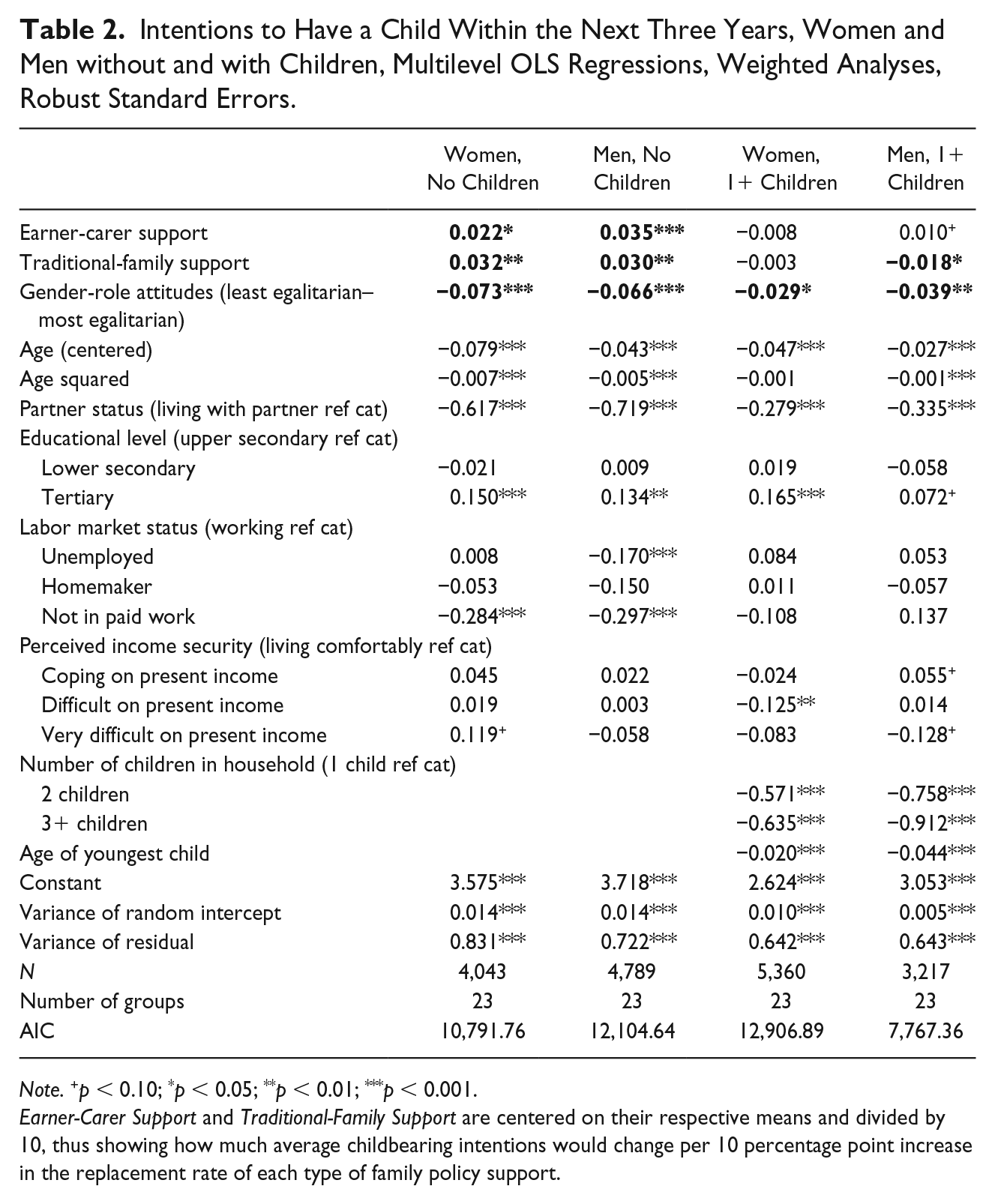
Note. +p < 0.10; *p < 0.05; **p < 0.01; ***p < 0.001.
Earner-Carer Support and Traditional-Family Support are centered on their respective means and divided by 10, thus showing how much average childbearing intentions would change per 10 percentage point increase in the replacement rate of each type of family policy support.
Intentions to Have a Child Within the Next Three Years, Interaction Earner-Carer Support with Gender-Role Attitudes, Multilevel OLS Regressions, Weighted Analyses, Robust Standard Errors.

Note. +p < 0.10; *p < 0.05; **p < 0.01; ***p < 0.001.
Earner-Carer Support and Traditional-Family Support are centered on their respective means and divided by 10, thus showing how much on average childbearing intentions would change per 10 percentage point increase in the replacement rate of each type of family policy support.
Intentions to Have a Child Within the Next 3 years, Interaction Traditional-Family Support with Gender-Role Attitudes, Multilevel OLS Regressions, Weighted Analyses, Robust Standard Errors.
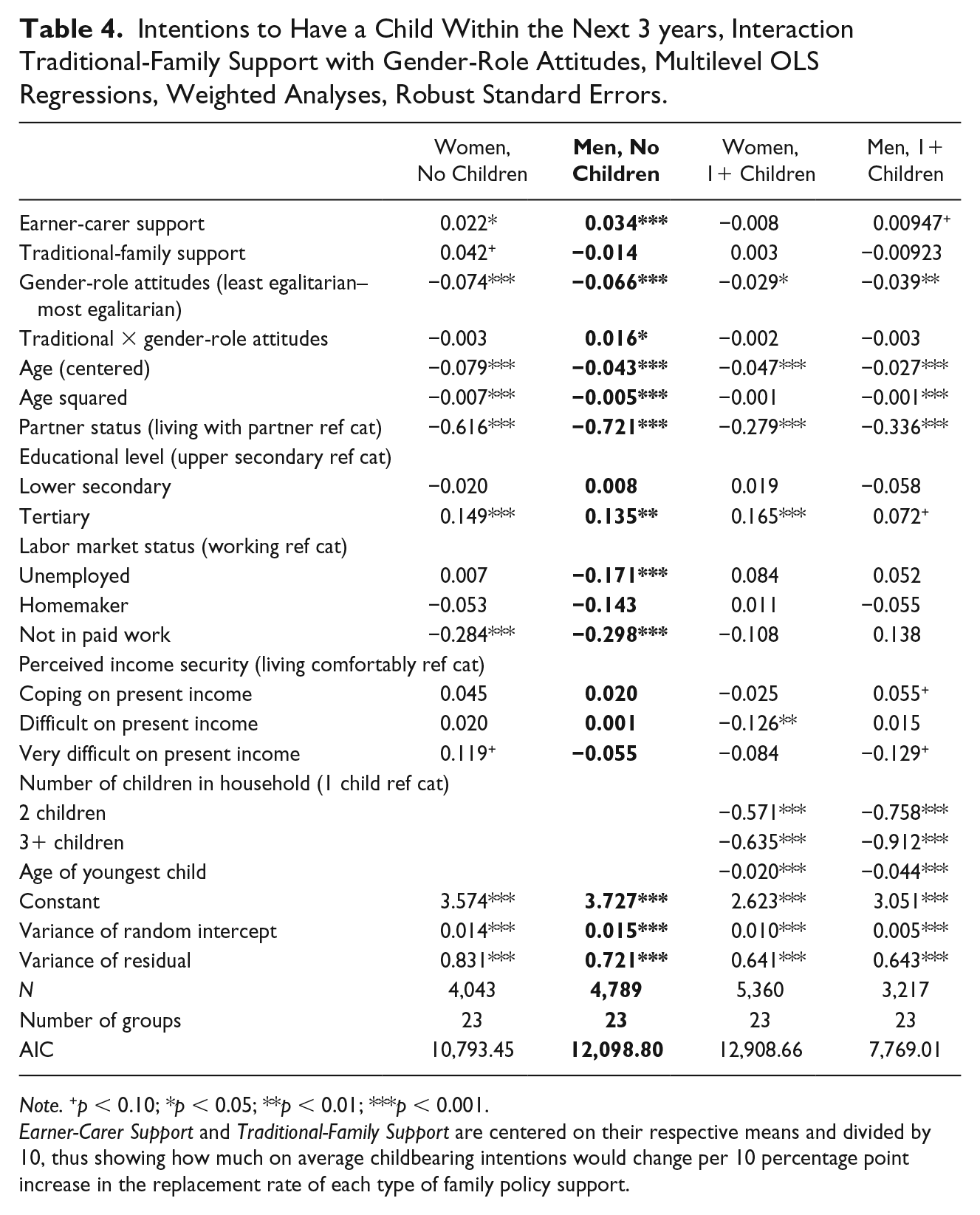
Note. +p < 0.10; *p < 0.05; **p < 0.01; ***p < 0.001.
Earner-Carer Support and Traditional-Family Support are centered on their respective means and divided by 10, thus showing how much on average childbearing intentions would change per 10 percentage point increase in the replacement rate of each type of family policy support.
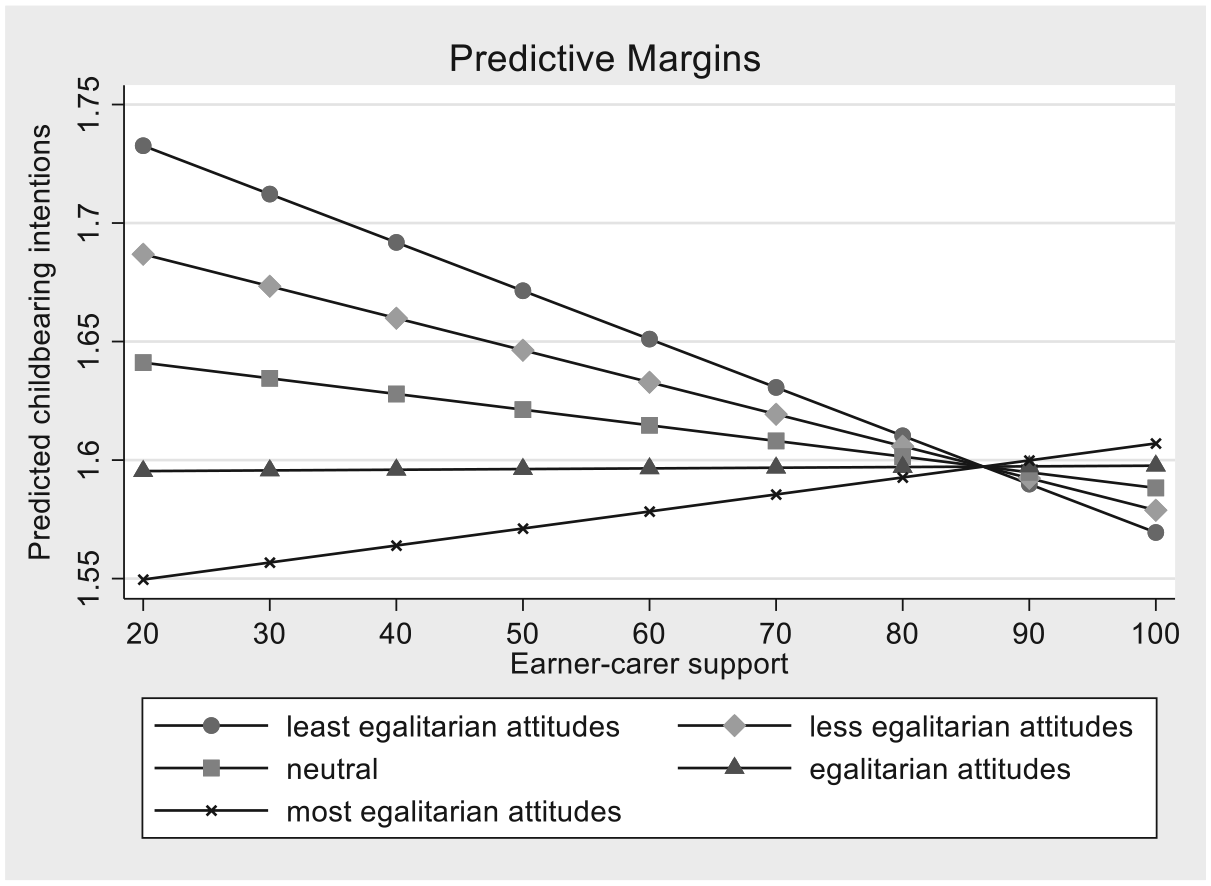
Predicted childbearing intentions by levels of earner-carer support and gender-role attitudes for mothers.

Predicted childbearing intentions by levels of traditional-family support and gender-role attitudes for childless men.
Some limitations of multilevel regressions are important to mention. If the number of observations on country level is too small, the significance of country-level estimates will be unreliable, as the standard errors are too small and one risks false positive results (Bryan & Jenkins, 2016). Bryan and Jenkins (2016), therefore, recommend at least 25 countries for linear multilevel regressions to avoid downward-biased standard errors of the country-level estimates. Moreover, only a few country-level variables and cross-level interactions should be included, as one otherwise might have to increase the number of countries. For the present study, 23 countries were pooled, which is slightly fewer than the 25 recommended by Bryan and Jenkins (2016). Therefore, only two macro-level variables were included in the analyses. Moreover, only one cross-level interaction was included at a time, in order to keep the analyses as parsimonious as possible and to avoid downward-biased standard errors (see Bryan & Jenkins, 2016). The risk of false positive results can, however, not be totally avoided.
Results
The results section describes the results of the multilevel regressions. First, however, comes a note on the result for the empty model, done to calculate the ICC. These analyses showed that around 2% of the total variation was due to the clustering of respondents within countries, that is, due to the country context. This is a “small” to “medium” variation on country level (see Billingsley & Ferrarini, 2014; Duncan & Raudenbush, 1999), which shows that most of the variation in childbearing intentions is found on individual level.
Before the analysis of whether gender-role attitudes moderate the effect of family policies, Table 2 shows the results for childless women, childless men, mothers, and fathers for only the main effects. The description will focus on the main factors of interest, family policies, and gender-role attitudes, while the control variables will only be summarized briefly.
As shown in Table 2, the coefficients for both Earner-Carer Support and Traditional-Family Support are positive and significant for childless women and men; higher income replacement is, thus, connected to stronger childbearing intentions. For mothers, the coefficients for family policies are not significant, while the coefficient for Traditional-Family Support is negative and significant for fathers, showing that higher income replacement is connected to weaker childbearing intentions. The coefficient for Gender-Role Attitudes is negative and significant for all respondents, implying that both nonparents and parents with more gender-egalitarian attitudes tend to have weaker childbearing intentions.
Regarding the demographic and socioeconomic control variables, it is interesting to note that higher educational level is connected to stronger childbearing intentions for all categories but fathers. Unemployment only matters for childless men, as they have significantly weaker childbearing intentions than working men. Not being in paid work matters for both childless women and childless men, with both groups having significantly weaker childbearing intentions. Not surprisingly, not having a partner is connected to weaker childbearing intentions, as is the number of children a parent has. Childbearing intentions also get weaker the older the youngest child is.
Table 3 shows the results of the interaction of Earner-Carer Support with Gender-Role Attitudes to test if gender-role attitudes moderate the effect of family policies supporting earner-carer arrangements.
As observable in the third column of Table 3, the interaction effect of Earner-Carer Support and Gender-Role Attitudes is positive and significant for mothers. The AIC decreases by 2 points from 12,906.89 (see Table 2, third column) to 12,904.29, which means that the analysis with the interaction term has better model fit than the one without. The results of the control variables are basically the same as in the previous table.
Figure 2 demonstrates how Gender-Role Attitudes moderate the effect of Earner-Carer Support on mothers’ childbearing intentions to facilitate interpretation of the significant result.
Mothers tend to have weaker childbearing intentions the more gender-egalitarian they are, as can be seen by the lines in Figure 2. With increasing income replacement in earner-carer support, the childbearing intentions of mothers with less gender-egalitarian attitudes weaken, especially for those with the least egalitarian attitudes. This is shown by the downward sloping lines for those mothers. Childbearing intentions for the most gender-egalitarian mothers, however, increase with increasing income replacement in earner-carer support. At a replacement rate of around 90–100%, the most gender-egalitarian mothers have stronger predicted childbearing intentions than less egalitarian mothers.
Table 4 shows the results of the interaction of Traditional-Family Support with Gender-Role Attitudes to test if gender-role attitudes moderate the effect of family policies supporting stay-at-home mothers.
As can be seen in the second column of Table 4, the interaction effect of Traditional-Family Support and Gender-Role Attitudes is positive and significant for childless men. The AIC decreases by 6 points from 12,104.64 (see Table 2, second column) to 12,098.80, showing that the model fit improved when the interaction term was included. The results of the control variables again hardly differ from those in Table 2.
Figure 3 shows a graph visualizing how Gender-Role Attitudes moderate the effect of Traditional-Family Support on childbearing intentions for childless men to facilitate the interpretation of the significant result from Table 4.
Less gender-egalitarian childless men have the strongest childbearing intentions, and higher income replacement in traditional-family support does not change the strength of their childbearing intentions. This can be observed in the horizontal line for childless men with the least egalitarian attitudes in Figure 3. The lines for respondents with more gender-egalitarian attitudes start from successively weaker childbearing intentions but increase steadily with higher income replacement before finally converging where they intersect the line for least egalitarian attitudes. The graph, thus, shows that higher income replacement in traditional-family support is connected to increasingly stronger childbearing intentions the more gender-egalitarian childless men are. One could say that they “catch up” with their less egalitarian counterparts at a replacement rate of 80%. At higher replacement rates than 80%, gender-egalitarian childless men have stronger predicted childbearing intentions than their less egalitarian counterparts do.
To summarize the main results, gender-role attitudes seem to moderate the effect of earner-carer support on childbearing intentions of mothers in the expected way. The more gender-egalitarian mothers are, the stronger their childbearing intentions get when earner-carer support is provided at high replacement rates. For childless men, the moderating effect of gender-role attitudes is contrary to expectation, as the childbearing intentions of gender-egalitarian men increase along with increasing replacement rates for traditional-family support. Here, it was expected that the childbearing intentions of less gender-egalitarian respondents would increase with higher levels of traditional-family support. As the results also show, no consistent moderating effects of gender-role attitudes could be established in interactions with the two types of family policy. However, it is important to note that family policies and gender-role attitudes influence childbearing intentions independently of each other, as shown in Table 2.
Discussion
This study set out to explore whether individual gender-role attitudes moderate potential policy effects on planned childbearing. The justification for the study was a knowledge gap identified in previous research concerning childbearing intentions in relation to family policies supporting earner-carer and traditional-family arrangements. Specifically, the analysis explored whether the influence of family policies on individuals’ childbearing intentions is stronger when they are in accord with individuals’ gender-role attitudes, that is, when family policies support the gender arrangement that individuals prefer. The rationale of the study put forward that individuals preferring earner-carer arrangements would react more positively to earner-carer support, while individuals preferring traditional-family arrangements would react more positively to traditional-family support.
The analyses yielded two results. In line with the idea that gender-egalitarian mothers, that is, those who prefer an earner-carer arrangement, had stronger childbearing intentions the more family policies supported this arrangement, while the childbearing intentions of less gender-egalitarian mothers weakened (Figure 2). This means that for gender-egalitarian mothers, the predicted effect of family policies was stronger when the policies accorded with their gender-role attitudes. So for these mothers, it seems to matter which type of family policy is supported by the country where they live. Furthermore, it is noticeable that earner-carer arrangements are supported to a high degree, as shown by the increase in strength in childbearing intentions when higher earnings replacement is provided. One interpretation of this result is that gender-egalitarian mothers may have experienced and appreciated that family policies supporting earner-carer arrangements helped them to reconcile childrearing and paid work in practice. This, in turn, makes their childbearing intentions stronger. In contrast, mothers who instead sought a traditional gendered division might not appreciate high support for earner-carer arrangements, and their childbearing intentions consequently weaken.
Against the background of the rationale stated earlier, childless men, however, were found to respond in a bewildering way. Gender-egalitarian childless men’s predicted childbearing intentions increased with stronger support for gender-traditional family arrangements, even surpassing those of their least egalitarian-minded counterparts (Figure 3). So for gender-egalitarian childless men, one could say that stronger support for gender-traditional family arrangements overruled the influence of gender-egalitarian attitudes. Here, it seems as if money matters more than which gender arrangement childless men prefer. In contrast, the results for fathers showed that higher levels of support for gender-traditional family arrangements were connected to weaker childbearing intentions (Table 2). Perhaps one could argue that fathers have experienced that being the sole breadwinner is not an easy task, and strong support for gender-traditional family arrangements might not be appreciated by them. This is, however, out of the scope of this article and could be explored by further studies.
Although indicating that the effects of family policies vary according to individuals gender-role attitudes, the study did not find consistent moderating effects. Rather, higher levels of both types of family policies were correlated with stronger childbearing intentions for childless respondents (see also Billingsley & Ferrarini, 2014), while more gender-egalitarian attitudes were correlated with weaker childbearing intentions (see also Kaufman, 2000; Lappegård et al., 2015). Interesting to note here is that for the most part family policies and gender-role attitudes influence childbearing intentions independently of each other, and family policies seem to matter most for childless individuals’ childbearing intentions.
Reasons for the result that gender-role attitudes do not seem to moderate the potential effects of policies on childbearing intentions in a consistent way could include modelling issues. As countries often support both gender arrangements to different degrees, it might have been more sensible to include cross-level interactions of both types of family policy and gender-role attitudes. However, 23 countries on the aggregate level put some restrictions on the analyses, as discussed in the method section, and the strategy of only including one cross-level interaction at a time was chosen to avoid false positive results.
Childbearing intentions capture one part of the childbearing decision-making process from intentions to actual childbirth. It would, therefore, be relevant to study whether a moderating effect would be visible in the realization of childbearing intentions. It could also be the case that family policies and average gender-role attitudes in a country are so well aligned that there is not enough variation to capture the proposed moderating effect of gender-role attitudes. In this case, too few individuals would deviate from the average gender-role attitudes and the family policies in place in a country are already in line with what individuals prefer (on average). To conclude, these questions call for more research before the identified knowledge gap can be closed or dismissed.
Supplemental Material
Appendix_-_All_about_the_money_191130 – Supplemental material for It’s All about the Money? Family policies, individual gender-role attitudes, and childbearing intentions in an international perspective
Supplemental material, Appendix_-_All_about_the_money_191130 for It’s All about the Money? Family policies, individual gender-role attitudes, and childbearing intentions in an international perspective by Katharina Wesolowski in Journal of Family Issues
Footnotes
Acknowledgements
This article has benefited greatly from the constructive comments of my colleagues at the Swedish Institute for Social Research and the Demography Unit at the Department of Sociology, Stockholm University, as well as from colleagues at the Department of Sociology, Uppsala University. I wish to express my gratitude, especially to Professor Elizabeth Thomson and Erika Willander for all the help and advice they have provided.
Declaration of Conflicting Interests
The author declared no potential conflicts of interest with respect to the research, authorship, and/or publication of this article.
Funding
The author received no financial support for the research, authorship, and/or publication of this article.

Supplemental Material
Supplemental material for this article is available online.
Notes
References
Supplementary Material
Please find the following supplemental material available below.
For Open Access articles published under a Creative Commons License, all supplemental material carries the same license as the article it is associated with.
For non-Open Access articles published, all supplemental material carries a non-exclusive license, and permission requests for re-use of supplemental material or any part of supplemental material shall be sent directly to the copyright owner as specified in the copyright notice associated with the article.
