



Abstract
In Quebec, social changes have reshaped family roles and social expectations for fathers. This article examines Quebec fathers’ conceptions of their paternal role and their experience of paternal involvement. Twenty-six fathers (n = 26) participated in five group interviews. Thematic analysis of their discourse shows that their paternal experience is rooted in various conceptions of the paternal role. Many issues are experienced as dualities: the complexity of inventing a paternal role without having models, being present with their child while being providers, recognizing themselves as fathers despite lack of recognition from family or social circles, and wanting to take action with their child yet being unable to do so. The importance assigned to paternal involvement by fathers in this study shows their desire to develop and maintain paternal engagement during the preschool period, and it highlights the necessity of adapting family services to better support fathers through the transition to fatherhood.
Introduction
The past 20 years or so have seen the emergence in the West of a movement to promote paternal involvement, which is defined as the biological or surrogate father’s ongoing participation in, and concern for, the physical, psychological, and social development of his child (Forget, 2009, p. 82). The importance of fathers’ involvement for the well-being and development of families is increasingly recognized internationally. The MenCare campaign and the World Health Organization have recently taken a stand in this regard, highlighting the positive impact fathers can have on the health of women and children around the world (Levtov et al., 2015; World Health Organization, 2015). In the West, the influence of this social movement can be observed by analyzing social and health policies, which now include concrete measures to support paternal involvement. For example, as of 2016, 75% of high-income countries recognized fathers’ right to paid paternity leave at the time of the birth of their child, compared to 45% of middle-income countries and 42% of low-income countries (WORLD Policy Analysis Center, 2019). This social movement also manifests through an increase in studies addressing various facets of fatherhood, as well as in the development of services and programs aimed at reaching fathers and supporting their engagement (Ball & Daly, 2012; Devault et al., 2015).
While the impact of paternal involvement on child development and family health is well documented (Allen et al., 2012; Cabrera et al., 2011; Cabrera et al., 2012), the voices of men and fathers remain largely absent from the dominant discourse concerning children and parenthood. Studies focusing on parental experience rarely distinguish fathers’ experience from that of mothers, and it is evident that studies focusing on the specific experience of mothers are much more numerous than those focusing on the specific experience of fathers (Lacharité et al., 2016). As a result, mixed and qualitative studies are only beginning to address the paternal experience as fathers conceive, live, and tell it (Lacharité & Gagnier, 2015). The aim of this study is to fill this gap by looking at fathers’ conceptions and experiences of their engagement, and the more specific issues they encounter within the family, and more particularly with their child. To this end, it is designed as a study of one case, that of Quebec, a province in Canada where the social role of father is in transition.
Background
The Importance of Paternal Involvement
Over the past 40 years, the role of fathers has importantly evolved, and paternal involvement has become an increasingly important part of the family experience. As a result, paternal involvement has become an issue of interest to researchers and policy-makers. (Cabrera et al., 2014; Marsiglio et al., 2000; Villeneuve 2010) as well as the target of programs and interventions (Doherty et al., 2006; Pruett et al., 2009). Paternal involvement was first conceptualized in terms of three components: direct father–child interaction (i.e.. interacting through games, care, or recreational activities), accessibility of the father (i.e.. being available for the child without necessarily interacting, such as when watching the child in the park while chatting with a friend), and planning of the child’s daily life (i.e.. ensuring that someone takes care of the child and that the resources necessary for the child’s well-being are available) (Lamb et al., 1985). More recently, Pleck has proposed a new conceptualization of paternal involvement in order to bring it into line with recent advances in the field of parenting and to integrate the qualitative dimensions of parenting. This new conceptualization is based on three main dimensions: (a) positive engagement activities, that is, all interactions between father and child that may contribute to the child’s development; (b) warmth and responsiveness shown by the father in his interactions with the child; and (c) control, which includes child supervision and involvement in decision-making concerning the child. It also includes two auxiliary domains: (d) indirect care, which includes activities carried out for the child but without the child, so that they have access to material and social resources to ensure their well-being, and (e) process responsibility, which refers to “parental consciousness,” and implies taking the initiative and anticipating what is necessary to organize or carry out for the child’s well-being (Pleck, 2010, 2012).
Numerous studies have highlighted the contribution of paternal involvement to the health of their children and spouse, as well as to their own health (Allen et al., 2012; Plantin et al., 2011; Pleck, 2007). Indeed, children growing up in a heteroparental family in which both parents are involved benefit from the resources (financial, emotional, and social) that each brings, but also from a diversity of interactions that enrich their development (Pleck, 2012). In this regard, mothers encourage the expression of emotions, while fathers are more likely to stimulate the control of emotions in their children (Gordon et al., 2012). As a result, children with engaged fathers have superior cognitive development and psychosocial functioning (Allen et al., 2012; Cabrera et al., 2011), better language skills (Cabrera et al., 2007), and more developed relational and social skills (Ramchandani et al., 2013).
Paternal engagement is also associated with better well-being and greater conjugal satisfaction among mothers (McClain & Brown, 2017), as well as a decrease in maternal stress and conjugal conflict (Cabrera et al., 2012). A shared belief by both parents in the importance of the father’s role and his involvement in the care of the children acts as a protective factor for the conjugal relationship, reducing the risk of the couple separating (Hohmann-Marriott, 2009). Finally, paternal engagement is also a determining factor for the health and well-being of men themselves (Plantin et al., 2011). Engaging in interactions with their children and in the roles associated with fathering leads fathers to learn about themselves, understand themselves better, review their priorities and values, and become more mature (Ashbourne et al., 2011).
While these studies provide a better understanding of the impact of paternal involvement on all family members, several aspects of men’s parental experience remain to be studied. Indeed, few studies have explored men’s perceptions of the paternal role and the links between their perceptions of the paternal role, their experience of fatherhood, and their behaviors during the transition to fatherhood (Morman, 2006; Nešporová, 2019).
Recognizing paternal involvement in Quebec
As with changes observed in other Western countries, family structures and the roles assumed by each family member have rapidly evolved in Quebec in recent decades (Devault et al., 2015). While tasks were traditionally performed according to the gender of the parents, families now have a greater tendency to negotiate the division of paid work, household tasks, and responsibility for childcare (Allen et al., 2012). Combined with the evolution of male realities (Roy et al., 2014), this shift in family forms and organizations has allowed a redefinition of the paternal role along with the privileges, rights, and responsibilities associated with it. At the same time, the Quebec scientific community has developed an interest in fathers and their importance for child development. Studies in this emerging field of research have helped identify fathers’ aspirations, strengths, challenges, and needs, while taking into account the father–child relationship and co-parental dynamics, as well as the personal and environmental factors that influence their parental trajectories (Labarre & Roy, 2017).
In the wake of contemporary family transformations and the consolidation of scientific discourse that values the father’s contribution to child development and family well-being, paternal involvement has also become a political concern in Quebec (Conseil de la famille et de l’enfance, 2008; Villeneuve, 2010). Various efforts have been made to apply other concrete measures to incorporate paternal involvement into social and health policies. For example, the Quebec Parental Insurance Plan (QPIP) allows each father to take between three and five weeks of paid paternity leave, depending on the type of plan chosen by the couple. Fathers also have access to 35 weeks of parental leave, which parents divide between themselves according to their preference during their child’s first year of life. Since its inception in 2006, fathers’ participation in this plan has increased considerably, from 28% when it was introduced to 79% in 2015 (Government of Quebec, 2017).
Fathers’ Experience of Their Paternal Role
Becoming and being a father are major elements in men’s lives. The transition to fatherhood is often presented as a complex and challenging period in which many norms, expectations, and values must be negotiated by the father, his spouse, and his social circle (Ives, 2014; Moraes & Granato, 2016). Many men feel pressure to perform in the face of new social expectations towards fathers or have difficulty adapting to the rapid personal, marital, family, and professional changes brought about by the birth of their child (Chin et al., 2011; Machin, 2015). Achieving the right balance between the need to provide for one’s child and the desire to be present for the child is a major challenge for fathers (Genesoni & Tallandini, 2009; Ives, 2014). Moreover, some studies highlight the gap that exists between the knowledge developed on effective interventions for fathers and the services they receive (Gervais et al., 2017), as well as the attitude of practitioners towards them (de Montigny et al., 2017b).
Faced with these numerous social changes related to paternal involvement in Quebec and the poor representation of fathers’ experience in the vast field of family studies, it seems relevant to explore conceptions of paternal involvement from the point of view of Quebec fathers themselves. The objective of this study is to describe fathers’ conceptions of their paternal role and the issues they face engaging with their children. The research questions for this study include: (a) How do fathers today perceive their paternal role? (b) What is men’s experience of developing and maintaining their engagement with their child?
Methodology
Design
This qualitative and descriptive study is based on focus groups conducted with fathers of children under the age of 5 years. Collective interviewing was the preferred method of data collection, in order to generate resonances and put individual experiences into perspective while evolving a detailed description of fathers’ experience (Vreeswijk et al., 2014). This study was approved by the research ethics committee of the University of Québec in Outaouais, as well as the ethics committee of the participating health and social services centers.
Procedures
Two recruitment strategies were used to enroll interested fathers to the study. The first was to circulate a short description of the study through various social media (Facebook and website of the Centre for Studies and Research on Family Intervention, the research center the two first authors are affiliated with). The second recruitment strategy relied on key informants working with families, who proposed the study to fathers using their organization’s services. An effort was made to obtain a sample representing a variety of family situations in terms of number of children, age of parents, socioeconomic status, and type of service accessed by the family.
The three-hour focus groups were held on university premises or at community organizations. Each father signed a consent form and completed a short questionnaire with sociodemographic information. Participants retained the right to withdraw from the study at any time without prejudice. The confidentiality and anonymity of the participants’ comments were explained.
A guide using open-ended questions was developed and validated by a committee of experts, researchers, and experienced clinicians in psychology, nursing, psychoeducation, and midwifery, with many years of combined experience of working with fathers and families. This guide was used to lead the focus groups in a way that is objective to facilitate construction of a collective discourse and an explanation of fathers’ experience. During each focus group, three themes were addressed: (a) the fathers’ conception of paternal involvement; (b) the fathers’ experience of their paternal role; and (c) their representations of a father’s place within their community. These themes were addressed with questions such as “What do you think a good father is?”, “Do men experience difficulties as fathers? If so, what kind?,” and “What do men need to be good fathers?” Each focus group was co-facilitated by the principal investigator and a research assistant. To the objective to develop a rich and nuanced collective discourse, the participating fathers were invited to interact among themselves and to contrast their positions. The focus group discussions were audio-recorded and transcribed in full.
Participants
Five focus groups were held; each interview involved four to seven fathers. The selection criteria were the following: (a) having a child under 5 years of age; (b) having received services from a health, social, community, or educational institution in their area in the past six months; and (c) being able to speak, read, and understand French.
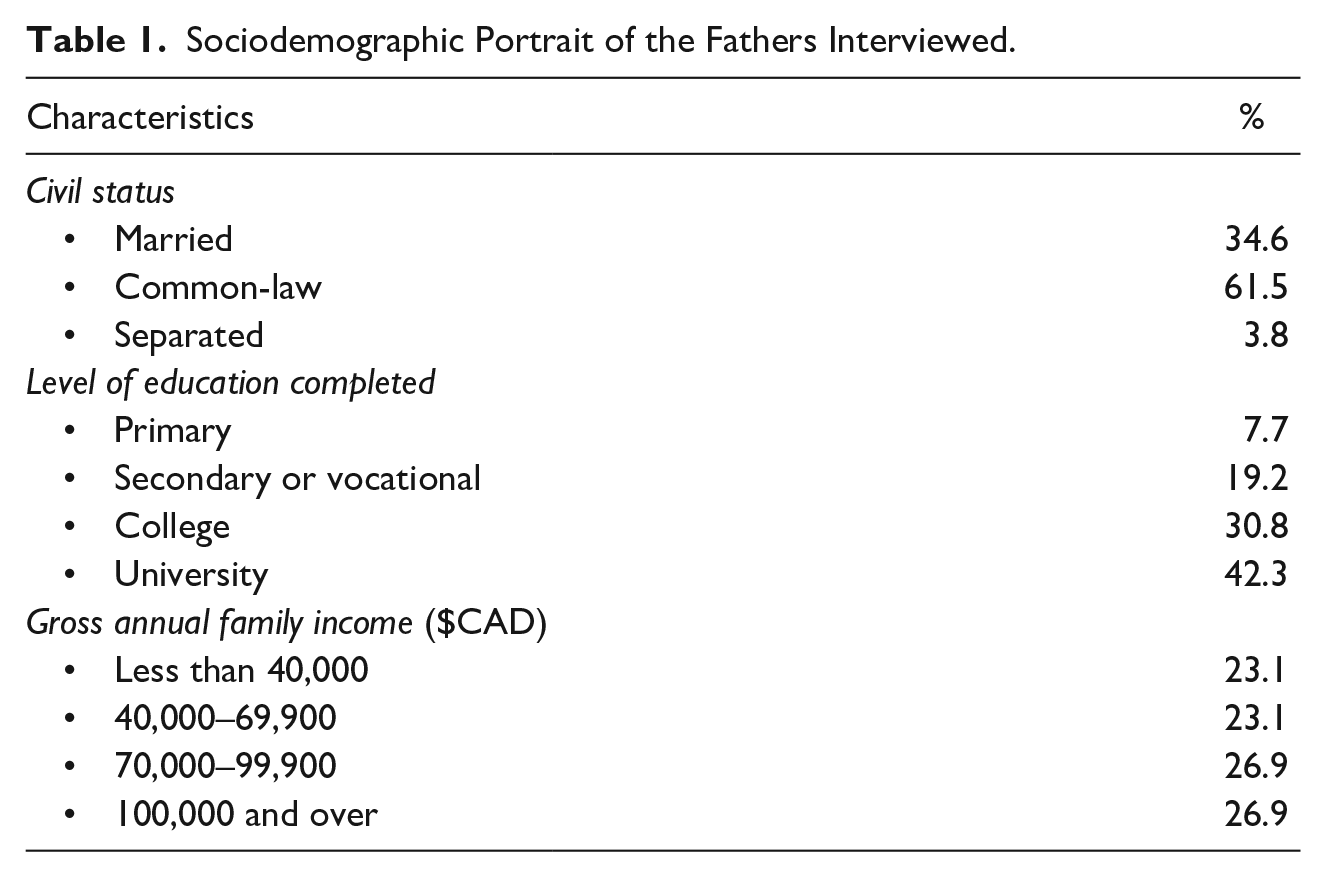
The sample consisted of 26 fathers (n = 26). The fathers we met had an average age of 30.9 years (SD: 4.3 years) and their spouses’ average age was 29.8 years (SD: 3.5 years). First-time fathers made up 38.5% of the sample, while 18.5% of fathers had two children and 23% had three or more children. On average, their youngest child was about 18 months old at the time of the meeting. About 96% of the fathers lived as a couple with the mother of their most recent child. The average length of their union with the mother of their child was eight years, with a range from 1 to 16 years. The vast majority of fathers interviewed (96%) had taken paternity leave, for an average duration of 8.3 weeks. Table 1 presents the main sociodemographic characteristics of the participants.
Sociodemographic Portrait of the Fathers Interviewed.
Data analysis
The data collected were submitted to thematic content analysis. Thematic analysis aims to transpose a corpus of data into a number of themes that make it possible to analyze the experience described by the participants (Paillé & Mucchielli, 2012). Following the procedure proposed by Paillé and Mucchielli (2012), the principal investigator and a research assistant first read through the verbatim transcript of each focus group to obtain an overview of the material collected. In a second step, they independently reviewed and annotated all the verbatim statements, with the objective of bringing out the central themes of the participants’ discourse while noting recurring themes and their possible groupings. In a third step, the themes and sub-themes identified by the researcher and assistant were compared and discussed with all the authors in order to refine the division and grouping of the themes. Finally, the principal investigator conducted a fourth reading of the dataset to verify the accuracy of the themes, validate their robustness, and group them into thematic categories.
Results
Two main themes emerged from the comments of the fathers’ comments: paternal role conceptions and issues experienced by fathers. Figure 1 presents the thematic tree of elements discussed in this section.
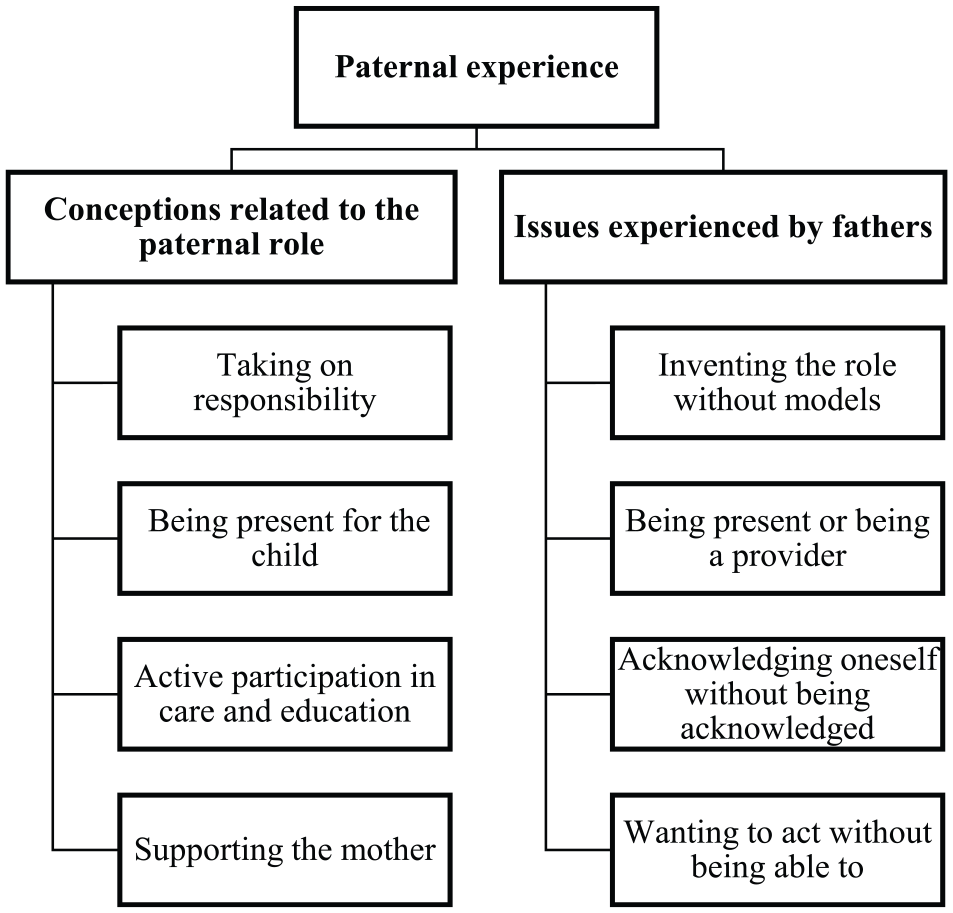
Conceptions of the paternal role and issues experienced by fathers.
Conceptions Related to the Paternal Role and Paternal Involvement
The participants’ discourse revealed several representations related to their role as fathers. This role was articulated around four conceptions associated with paternal involvement: (a) taking on the responsibility of decisions for the well-being of the child and the family; (b) being present and caring for the child; (c) actively participating in the child’s care and education; and (d) providing support for the spouse and mother of the child.
Taking on responsibility
According to the fathers interviewed, a good father is first and foremost a responsible father who puts the child at the center of his life. This involves incorporating children into their daily lives and making decisions based on their well-being. In that respect, participants mentioned that they had accepted a job or changed jobs, changed their social activities, and taken better care of their health to be able to assume the responsibilities involved in the role of father on a daily basis. One participant said: “A good father, 90% of the decisions he makes are for his child. Being a father is the top of the list in my choices now. Or at least, as often as possible.”
Present for the child
Fathers mentioned that an engaged father is a father who is present and attentive to the needs of his child. They emphasized the importance not only of their physical presence, but also the affection they give their children and their psychological availability when they are with them.
When I see my kids, I want to be there 100%. I have trouble doing it, but when I am there, I want to be there. . .. I’d rather have an hour when I’m there, rather than a parent who’s there, but not completely.
Active participation in the child’s care and education
Participation in child care and education is important for fathers. They mention being involved in care from birth, and are happy to share this responsibility with the child’s mother. As one participant explained: “My girlfriend, it was five days before she changed diapers [after the baby was born]. Taking a bath, dressing her, undressing her, giving her to the mother. . .it’s the father’s role to do that.” As the child grows and the need for physical care decreases, fathers’ involvement changes to include education and support for the child’s development. For the fathers we met, educating children requires deep respect and guidance. One father explained: I think that children, they’re lent to us, and then we’re there to try to guide them as best we can without imposing stuff on them. The path, we light the way, there’s your path. . .. It’s often the father who gives a push in the back. A gentle little push to say: “Look, it’s that way”, and “overcome your fears, overcome your worries”.
Educating also involves developing a role of authority with the child, as well as establishing the limits that the child must respect. Fathers were particularly concerned about the need for these limits and the importance of being consistent: The most difficult thing, I think, and also the most important, is to be consistent. Then, in educating your child, making the limits clear, and that the mother and father have the same limits at the same places.
Supporting the spouse and mother of the child
Finally, a key component of the father’s role mentioned by participants concerned supporting the mother and forming a parenting team to provide the best possible environment for the child. “A good father is a good husband because I believe that the foundation on which the child rests is the couple,” summarized one participant. This support for their spouse was very important for fathers, which led them to agree to make compromises in order to support their spouse, for the well-being of the whole family: Supporting means taking more on oneself for the greater good of the whole. It means sometimes pretending that something doesn’t bother us so that things go well overall.
This desire to support led the fathers to develop complementary patterns with their partners. For some, this meant working more to allow the mother to stay at home longer: My girlfriend took two years [of parental leave]. I was working double shifts for that. I thought to myself, when my baby is very small, he needs a little more from his mother. Although I’m there every night, I’m there every morning. But I said to myself, “I’ll work hard, my girlfriend will be able to breastfeed longer, stay home longer.” I saw a kind of benefit to that.
For other fathers, this complementarity took the form of sharing tasks and responsibilities related to the child. For these fathers, the parenting team was very important: they shared in child care and education, decision-making, housework, and seeking financial resources with their spouse. Teaming up with their spouses also meant reserving individual free time for themselves, as well as time for their couple.
Issues Central to the Paternal Experience
The second theme dealt with the issues that were central to fathers’ paternal experience and that took the form of dualities. Despite the pride and importance they attached to their role as fathers, participants reported certain dualities in their paternal experience. These dualities reflected in a pragmatic way the tension between their aspirations as fathers and the realities and norms with which they were confronted on a daily basis, and which constituted pitfalls in the realization of their paternal role. Four dualities emerged from their discourse: (1) inventing a paternal role that reflected their aspirations, but without having a role model to do so; (b) having to choose between a sustained presence with their child, or working to provide for the material needs of the family; (c) wanting to be acknowledged as a full-fledged parent, but remaining in the shadow of their spouse; and (c) wanting to act without having the power to do so, due to a lack of knowledge and skills.
Inventing one’s role as a father without a model
The first duality that emerged from the discourse of the interviewed fathers concerned the difficulty of developing their role as fathers in the absence of suitable models. Indeed, the fathers sought to invent a paternal role that echoed their desires for physical and emotional presence within the family. This role differed greatly from the traditional fatherhood model with which they were raised, the majority having had fathers who were providers or who were not very present.
My biggest worry is that I didn’t have a father because my parents separated young and then I was always with my mother. From when I had my first daughter all the way until the fifth, I still have doubts about whether I’m doing the right thing because I don’t have a role model.
Being present or being a provider
Several fathers mentioned having difficulty finding a balance between their desire to have a significant presence with their child and the need to work to ensure their child’s material well-being. In fact, they felt a social pressure to become actively involved with their child as well as a strong pressure to assume a caregiving role associated with stereotypes of traditional masculinity. One father explained this duality in this way: “You cannot be a father at home and be a provider, but you are still stuck with the idea that you should be.”
Acknowledging oneself without being acknowledged
Taking on the role of father in a context where fathers receive little acknowledgement from those around them was another duality reported by the participants. Men find it particularly difficult to compare themselves with their spouse, whom the child seems to love more and who also seems to love her child more easily and fully. One participant expressed this issue of acknowledgement in this way: At first, what’s hard about being a father is thinking, “I’m glad he was born.” Then after that, you say to yourself, “Okay, but what am I doing? What’s going on here?” Your heart doesn’t fill up on its own! Not as much as the mother’s anyway. . .. And then you feel that your child, really, doesn’t love you as much as he might love his mother.
In addition, some fathers felt that few people asked about their well-being, with the attention of family and care providers being focused more on that of the infant and mother. This was sometimes compounded by unsolicited “advice” from people who were often well intentioned, but whose initiative was perceived by fathers as a lack of confidence in their ability to care for their child. Their pride in their role as fathers was thus hampered by a lack of recognition that weakened their paternal experience and caused emotional upheavals, which were difficult for the fathers themselves to identify.
When we came home on day two, my girlfriend went to bed, I had the baby. I started crying, but for no reason. Then I called my mom. . .. I don’t even know why I was crying. All the emotions were coming out. No one had ever asked how I was doing, whether at the hospital or anywhere else. Even though I had been through stress too, although in a different way than my spouse. [. . .].
Wanting to act without the power to act
Fathers also mentioned that they felt very helpless in terms of what they would like to do, whether to help their spouse at the time of birth, to support her in breastfeeding, or to take care of the child, and in terms of the tools at their disposal to act.
Your wife’s psychological distress, you have to deal with that. So, you say, “Okay. Where do I have to go? What do I have to say?” Then, even if you try to say, “Well, no, look, they don’t know what they’re talking about.” She’s going to look at me and say, “What do you know?” And it comes back to us, we’re stuck dealing with the psychological side of things and sometimes we don’t know how to do it.
The fathers we met frequently felt that they lacked the resources and support to assume their role as fathers in the way they would have liked. Because of their lack of knowledge, they had to proceed by trial and error. This adaptation proved difficult for some of them as their children’s needs changed and evolved rapidly, especially during the first months.
But no matter how much you want to apply all this, you have your own personality, your tiredness, your impatience. Then at some point you may have experience as a parent, but your child is constantly changing. At some point when there’s a baby, you think okay, now we’ve got it. Now it’s all right. The routine, the sleep, the bottle, at such and such time, everything. Then three weeks later, bam! It changes, all the time. You’re always on the move. You always have to readjust.
Discussion
By exploring fathers’ conceptions surrounding the paternal role, this study has presented a diverse and nuanced portrait of what it means to be an engaged father for Quebec fathers and the dualities that are central to their paternal experience.
As supposed by other research, the fathers attached great importance to their presence with their children (Machin, 2015; Pålsson et al., 2017), and all mentioned the desire to be present for their child and to contribute in an active way to their learning and growth (Creighton et al., 2017). Moreover, the fathers we met endorsed the culture of paternal involvement, which implies greater gender equity in the care provided to children. As expressed by fathers in others studies, they embraced the changing social relationships and norms of the contemporary family (Ives, 2015), as well as a supportive role with respect to their spouse and child (de Montigny et al., 2016; Gervais et al., 2015). This emphasis on supporting the child’s mother illustrates how couples “co-construct” the paternal role on a daily basis (Matta & Knudson-Martin, 2006; Stueve & Pleck, 2001). It also highlight how parental behaviours are defined within the co-parental subsystem according to personal inclinations, developmental stages, and the parents’ economic and cultural context (Cabrera et al., 2014). The fact that the children of the majority of fathers (73%) interviewed were under the age of two in a society where breastfeeding is valued and in particular deemed highly important by fathers likely explains in part the importance fathers placed on supporting their partners. Indeed, a study by de Montigny et al. (2018) identified support for their spouses as an important component of breastfeeding success according to Quebec fathers. Moreover, the measures put in place in Quebec over the past 10 years, such as paternity leave and measures to support father involvement as a lever to achieve equality between women and men, seem to be bearing fruit. Indeed, the fathers interviewed presented several conditions identified by Matta and Knudson-Martin (2006) as promoting men’s involvement with their children, namely, adherence to an egalitarian gender ideology, valuation of women’s work, and greater emotional attunement.
Unlike the fathers met by Nešporová (2019), whose discourse centered on the small changes in their daily lives that had occurred since the birth of their child, the fathers in this study reported a significant transformation in their lives since the birth of their child, as well as some challenges in the construction and integration of their paternal identity. The dualities reported by fathers contribute to existing knowledge by providing a better understanding of the interactions between men’s conceptions and aspirations in relation to their paternal role, and the family and social conditions in which that role is exercised.
In fact, father’s experience of developing and maintaining engagement with their child revealed a certain complexity in aligning their expectations of themselves, their aspirations, and the social messages they received in relation to their paternal role. This difficult in alignment generated certain dualities, with which fathers had to deal. They also confirmed that the transition to fatherhood provided an impetus to question the fathers’ values and priorities, which were reorganized according to their conceptions of the paternal role as showed in previous studies (Creighton et al., 2017; Kowlessar et al., 2015; Lacharité & Gagnier, 2015).
Fathers had few models around them to inspire and model this role of engaged father, which they often constructed in opposition to the traditional model of father, perceived as authoritarian, often absent, and having little closeness with his children. This lack of a positive paternal role model, reported by Barclay and Lupton (1999), seems to persist despite visible social and family changes as well as the emergence of a new paternal role in Quebec (Devault et al., 2015; Forget, 2009), making the transition to fatherhood more complex for men. For the fathers in this study, the absence of a paternal role model translated to a lack of purpose and power over the role of father that they wanted to develop in keeping with their values and needs, a pattern identified by Kings and colleagues (2017). The importance the fathers attached to their role as providers, a crucial element in the definition of “good father” highlighted in a few studies (Morman, 2006; Ralph & Ralph, 2016), conflicted with their conception of an engaged father, who is available and present for his child. In this study, fathers wanted to be emotionally and physically involved, but they also felt the pressure to “provide”, to protect and guide their families (Ferreira et al., 2015; Johansson et al., 2016).
Finally, the experience of the fathers raised recognition issues that are rarely mentioned, and that, according to Ives (2014), men themselves often have difficulty putting into words. Indeed, fathers rarely reported being perceived by their family and by care providers as a full-fledged parent, but rather as a source of support for the mother. While support for the mother was part of their conception of the paternal role, the fathers confirmed that they felt the weight of this responsibility, as identified by Ledenfors and Berterö (2016), as well as a certain distress associated with feeling unable to “effectively” support their spouse. This emphasis by family and friends on the father’s supporting role demonstrates that fathers are still exposed to social mechanisms and interactions that define fatherhood as an auxiliary form of parenthood within the family, which contributes to a certain difficulty for fathers to recognize themselves as fathers and important parents for their children.
The dualities recounted by fathers highlight the contradictory messages to which they are exposed in relation to their role with their families, despite Quebec society’s advances in policies and programs to support father involvement. These dualities also illustrate how men’s paternal identity is the result of complex interactions between their personal attitudes and beliefs on the one hand, and on their experiences of being a father in different spheres of their lives on the other (Pleck, 2007).
The dualities reported by fathers suggest that some would benefit from workshops that would allow them to exchange with other fathers about their experience and their relationship with their child in order to give it meaning and importance that would be appropriate for them. Programs targeting all spheres of fathers’ lives (personal, parental, marital, professional, and social spheres) should also be prioritized in order to develop a coherent social discourse that recognizes the importance of fathers. In addition, programs aimed at promoting or supporting paternal involvement should include a variety of activities to reach not only fathers but also mothers, children, and providers of family care, as well as decision-makers and the media, in order to support the development of a shared positive vision of fathers.
In terms of research, these data represent an invitation for further studies to better understand fathers’ experiences of fatherhood. As fathers’ attitudes and beliefs towards parenthood are important determinants of paternal involvement behaviours (Macon et al., 2017; Pleck, 2012), fathers’ experiences of their relationships within their families and with their communities merit investigation. Fathers’ perceptions of their needs in terms of formal and informal support must also be documented, as well as their perceptions of the support they receive and the services they can access when they encounter difficulties in their parenting role.
Limitations and Strengths
Our study has certain limitations, the first being that it specifically documents the stories of Francophone Quebec fathers. This implies experiences rooted in a particular sociocultural context, as well as norms and values associated with fatherhood that are specific to Quebec, a province that stands out from other Canadian provinces and territories in terms of social policies that support paternal involvement. Having been recruited primarily through family health and community organizations, participants were attending family services at the time of the interviews, suggesting a form of paternal involvement that may have been reflected in their discourse. In this sense, the experience of the fathers we met is not representative of all fathers, particularly those who are not reached by health and social services or those who are socially excluded. Further studies would be needed to better understand the plural realities of fathers, including the transition to fatherhood and the intersections of father and worker roles. Nevertheless, the strength of this study lies in its focus on fathers’ voices and the space created for fathers collectively to share and give meaning to their experiences. The richness of the exchanges between the participants makes it possible to draw a portrait of the paternal experience, by documenting in an original way the fathers’ conceptions of their role and the dualities they experience while developing and maintaining paternal engagement with their child during the pre-school period. As fathers are living in a context that limits their perception of their own experiences and expression of their feelings (Gervais et al., 2015), exploring fathers’ experience calls for an atypical methodological approach. Rather than administering questionnaires on their behavior with their child or the difficulties they meet, this study looked at fathers’ relational experience and highlighted the ways in which fathers’ experiences were influenced by their family and social context, which allowed a better understanding of the dualities fathers experienced in a society where paternal involvement is highly supported by institutions and policy.
In conclusion, the importance given to paternal involvement by fathers in this study confirms the receptivity and sensitivity of parents to this period of their lives (Creighton et al., 2017) and invites practitioners to implement practices adapted to the reality of fathers in order to support their engagement, for the good of the whole family (de Montigny et al., 2017a). For example, welcoming fathers and exploring with them their conceptions of their paternal role represent essential interventions to better understand their needs and behaviours (Fox et al., 2015) and to better support them in developing and maintaining their engagement with their child. Informing future parents about the importance of paternal engagement and introducing fathers to the pleasures of the father–child relationship are two important objectives that practitioners must integrate into their practices with families. Finally, promoting mutual support among new parents and avoiding confining the father to his supporting role are two essential concepts for working with young families.
Footnotes
Acknowledgements
The authors would like to thank the participating fathers, as well as the research assistants who were involved in data collection and data entry.
Authors’ Note
Kevin Lavoie is now affiliated with Social Sciences Faculty, Université Laval, QC, Canada and Julie Garneau is now affiliated with Cégep de St-Jérôme, St-Jérôme, QC, Canada.
Declaration of Conflicting Interests
The author(s) declared no potential conflicts of interest with respect to the research, authorship, and/or publication of this article.
Funding
The author(s) disclosed receipt of the following financial support for the research, authorship, and/or publication of this article: This work was supported by a grant from Avenir d’enfants.
