



Abstract
A large proportion of the children of immigrants are in mixed-nativity families, with one immigrant and one native-born parent. Despite their significant presence, the theoretical and empirical underpinnings for understanding mixed-nativity families’ acculturation and social integration are lacking. Using nationally representative data from the Education Longitudinal Study of 2002, we compare the parent-child and family-school relationships of mixed-nativity families—separating those with immigrant mothers from those with immigrant fathers—to those of immigrant-only and native-only families. We find that parent-child relationships in mixed-nativity families are similar to those of native-only families in that they enforce more rules and share fewer family meals. However, families with immigrant mothers—including those with native-born fathers—are less connected to their children’s schools and to other parents. Our results highlight the need to consider mixed-nativity families as distinct from both immigrant-only and native-only families.
Introduction
In the United States, nearly a quarter of the school-aged population has at least one immigrant parent (Fortuny et al., 2009). Among the children of immigrants, approximately 40% are in mixed-nativity families with just one immigrant parent (Ramakrishnan, 2004; Rumbaut, 2004). Not only are the families of these “2.5 generation” children well represented across different countries and regions of origin (Bean & Stevens, 2003), they are also a potentially growing population, given that more than half of recent marriages involving immigrants are mixed-nativity marriages (Lichter et al., 2015). Yet relatively little research has focused on mixed-nativity families in the United States, despite the potential implications of such families for understanding immigrant-origin families’ adaptation and integration. Moreover, existing research on mixed-nativity families has generally overlooked the possibility of differential impacts of having an immigrant mother versus an immigrant father. Given gender differences in both childrearing responsibilities and acculturation processes, whether the immigrant parent in mixed-nativity families is the mother or the father likely matters for parental relationships with children and schools.
To address this heterogeneity among immigrant households, we compare mixed-nativity families, including immigrant mother-only (with native-born fathers) and immigrant father-only (with native-born mothers) families, to immigrant-only (two immigrant parents) and native-only (two native-born parents) families across two areas of socialization: parent-child relationships and family-school relationships. Existing studies have shown that parent-child relationships in immigrant families are distinct from those in native-born families (e.g., Fuligni, 1998) and that immigrant parents tend to face more challenges in establishing relationships with their children’s schools compared to native parents (e.g., Turney & Kao, 2009a). However, much less is known about how the presence of a native parent might alter such patterns and whether it matters if the immigrant parent is the mother or the father. On the one hand, prior work suggests that mixed-nativity families may be more socioeconomically advantaged, which may facilitate their social integration (e.g., Iceland & Nelson, 2010). On the other hand, the significant social barriers immigrant families face may mean that mixed-nativity families are not as fully integrated as native families, and they may in fact continue to experience some of the same challenges as other immigrant families.
We begin with an overview of theories of assimilation and their implications for mixed-nativity families before summarizing the small body of relevant studies that highlight the unique position of mixed-nativity families. We then turn to the literature on parent-child and family-school relationships among immigrant-origin families, describing what is known, why mixed-nativity families may differ, and why it is important to distinguish between mixed-nativity families with immigrant mothers and those with immigrant fathers.
Mixed-nativity Families and Assimilation
Sociological theories of immigrant assimilation suggest a number of possibilities for mixed-nativity families. Gordon’s (1964) classic straight-line assimilation theory viewed marital assimilation (i.e., intermarriage between groups) as a byproduct of structural assimilation processes, described as large-scale entry into the social groups of the host society. In other words, the very presence of mixed-nativity families presupposes full or close to full social integration. More recent theories of immigrant assimilation have challenged this straightforward view. Alba and Nee’s (2003) new assimilation theory, for example, argues that immigrant acculturation to mainstream norms and interactions with families from different backgrounds often occurs, intentionally or not, as they pursue socioeconomic mobility. Thus, how similar mixed-nativity families are to native families may depend on their socioeconomic status (SES). Yet another possibility is that immigrant-origin families opt to selectively acculturate, choosing to retain some traditional norms and maintaining close ties to the ethnic community, as suggested by segmented assimilation theory (Portes & Rumbaut, 2001; Portes & Zhou, 1993). If so, mixed-nativity families may still meaningfully differ from native families. However, scholars that have explicitly theorized about mixed-nativity families largely assume that the presence of a native-born partner will lead to rapid or at least much smoother integration into U.S. society (Bean & Stevens, 2003; Stevens et al., 2012).
Empirical studies of mixed-nativity families in the United States, which have tended to focus on their socioeconomic assimilation, have found that they are more acculturated and socially integrated. For instance, Iceland and Nelson (2010) observe that mixed-nativity households are generally less residentially segregated from native households compared to immigrant households. Stevens et al. (2012) note that arrival in the United States at an earlier age and higher educational attainment, indications of social integration, are associated with mixed-nativity marriages among immigrants. Research on the children of mixed-nativity families, however, has yielded conflicting results. Some studies show that the 2.5 generation in the U.S. experience poorer educational outcomes compared to their first and second generation peers (Emonds & Tubergen, 2014; Furtado, 2009; Siahaan et al., 2014), while others find that they do better than their peers with two immigrant parents (Duncan & Trejo, 2011; Ramakrishnan, 2004) or two native parents (Chiswick & DebBurman, 2004). These mixed results suggest that there are overlooked nuances in how acculturated and integrated mixed-nativity families are in the United States. Notably, though prior studies often allude to the supposed advantages of mixed-nativity families in family and social dynamics, few provide substantive analyses of such factors.
Parent-Child Relationships in Immigrant-Origin Families
While parent-child relationships have been widely studied in immigrant families (for a review, see Foner & Dreby, 2011), we know less about how the presence of a native-born parent might affect such relationships. For example, some researchers suggest that immigrant parents are slower to acculturate and more focused on “retaining traditional family life” (Zhou, 1997, p. 84). Immigrant parents may also enforce strict discipline with their children because they fear harmful “American” values (Foner & Dreby, 2011; Gans, 1992; Perreira et al., 2006). Indeed, Portes and Rumbaut (2001) find that very few immigrant parents wish to raise their children the “American” way, preferring either their home country’s way or a mix of practices. As a result, immigrant parents may be more likely to closely monitor their children and to place restrictions on their activities (Nieri & Bermudez-Parsai, 2014; Schneider & Lee, 1990). However, immigrant parents’ behaviors are not static. Kao (2004) argues that among Asian immigrant-origin families in the United States, the parents of first-generation adolescents are more strict than the parents of second-generation adolescents, suggesting acculturation to native parenting styles. Given the additional presence of a native-born parent, mixed-nativity families may be particularly likely to acculturate to “Americanized” parenting norms.
Parent-child relationships may also vary depending on which parent is the immigrant. Some scholars assert that women are the carriers of ethnic culture (Dion & Dion, 2001; Phinney et al., 2001), and there is some evidence from empirical studies in non-U.S.-contexts that support this perspective. For example, Costigan and Dokis (2006) find that Chinese-Canadian immigrant mothers report lower levels of acculturation than fathers across a range of areas, including parenting beliefs. Similarly, Leyendecker et al. (2006) show that Turkish immigrant women in Germany—even those married to native men—report a greater orientation to Turkish culture and a lower orientation toward German culture. These gender differences in acculturation may mean that mixed-nativity families with immigrant mothers and native-born fathers are more like their immigrant-only counterparts than those with native-born mothers and immigrant fathers. However, given the general dearth of research on gender differences in acculturation among parents in mixed-nativity unions in the United States, it remains unclear whether patterns observed in other contexts similarly apply.
Family-School Relationships in Immigrant-Origin Families
Researchers have been cognizant of the growing share of school-aged children that come from immigrant-origin families, and a large body of research has been devoted to the relationships between immigrant-origin families and schools. Studies find, for example, that immigrant parents in the United States report lower involvement and less contact with their children’s schools (Cherng & Ho, 2018; Kao & Rutherford, 2007) as well as less social support from family, friends, and other parents (Kao & Rutherford, 2007; Turney & Kao, 2009a). These disadvantages may be due to the greater number of obstacles immigrant parents face, including logistical, linguistic, and social barriers (Perreira et al., 2006; Suárez-Orozco et al., 2008; Turney & Kao, 2009b), although with increased time in the United States, immigrant parents report similar levels of involvement as native-born parents (Terriquez, 2012). In this respect, mixed-nativity families may be at an advantage relative to families with only immigrant parents, since the former may benefit from the knowledge and social networks of native-born co-parents. However, mixed-nativity families likely do not enjoy the same advantages as native families. For example, Turney and Kao (2009a) find that families with just one immigrant parent report more social support than families with two immigrant parents but less social support than families with two native-born parents. In other words, the presence of a native-born parent might facilitate the development of social supports, though not at the level of those found among families with two native-born parents.
Because mothers are typically viewed as central figures in family-school relationships (Coleman, 1987; Coleman & Hoffer, 1987; Lareau, 2000; Small, 2009), it is important to consider the gender of the immigrant parent in mixed-nativity families. Even in contexts where mixed-nativity families might benefit from the intervention of the native-born parent, responsibilities may still be highly gendered. In one particularly apt, albeit limited, example, Valdés (1996) describes the case of the mixed-nativity Sotelo family in the United States, where the undocumented mother was largely “responsible for negotiating the system” even though her native-born husband was the one with knowledge of “how the system worked” (p. 74). Given such gendered responsibilities, mixed-nativity families with native-born mothers may have an advantage because of their greater mainstream cultural and linguistic fluency. Gilardoni (2010), for example, finds that in Italy, children in mixed-nativity families with native-born mothers have more social ties, particularly to native-born peers. The presence of a native-born mother may thus offer mixed-nativity families access to more and broader social ties.
Study Motivation
Both theoretical frameworks and empirical studies of immigrant assimilation have largely overlooked the position of mixed-nativity families. While existing work generally assumes that mixed-nativity families integrate into the mainstream with relative ease, how such families manage parent-child and family-school relationships may depend on whether the immigrant parent is the mother or father. To address gaps in our knowledge of how mixed-nativity families are adapting to life in the United States, our study poses two research questions. First, how do mixed-nativity families compare to their immigrant-only and native-only counterparts in their parent-child relationships? For mixed-nativity families, the presence of a native-born parent may mean parenting norms more similar to those of native families, but this may also depend on the gender of the immigrant parent, as immigrant mothers are often considered more oriented toward “traditional” culture. Second, how do mixed-nativity families compare to immigrant-only and native-only families in their family-school relationships? The presence of a native parent in mixed-nativity families may provide access to more “mainstream” social networks, but given the central role of mothers in developing and sustaining school-based relationships, mixed-nativity families’ family-school relationships may depend on maternal nativity.
Data and Methods
We use data from the Education Longitudinal Study of 2002 (ELS: 2002), a nationally representative study conducted by the National Center for Education Statistics (NCES) of students who were 10th graders in 2002. ELS: 2002 has an overall weighted response rate of about 89%, with about 12,570 responses to the parent survey conducted only in the base year (all sample sizes are rounded to the nearest tens, per NCES disclosure rules). Our sample is restricted to cases with base-year parent and student surveys that were not missing information on parents’ nativity. Because nativity status was only asked of students’ biological parents (and not for other non-biological guardians), we restricted the sample to those not missing information on parent/guardian relationships to student. We also removed a small number of cases where the parent respondent reported living with the student less than half the time as such parents may not be the primary caregiver of the student. The final analytic sample consists of approximately 11,830 cases.
Study Measures
Study measures are described briefly below and in greater detail in Appendix A.
Parental Nativity: We identify four types of families based on parental nativity. The first category, “immigrant-only,” includes families in which both biological parents were born in Puerto Rico or a country other than the United States. Among mixed-nativity families (those with one immigrant parent and one U.S.-born parent), we distinguish between families with only an immigrant mother and those with only an immigrant father. For simplicity, we refer to the former families as “immigrant mother-only” and the latter as “immigrant father-only” although the actual survey respondent may not be the immigrant parent. When referring to the three aforementioned family types as a whole, we use the term “immigrant-origin families.” Finally, “native-only” includes families where both the mother and father were born in the United States, excluding Puerto Rico.
Parent-Child Relationships: We examine two aspects of parent-child relationships. The first is a summative index of parental enforcement of rules, including whether parents enforce rules about maintaining a certain GPA, homework, chores, TV, and curfew (Cronbach’s alpha: 0.58, range: 0 to 5). Higher values on the scale indicate enforcement of more rules. The second is a measure of familial closeness as indicated by the number of days per week parents share a daily family meal with their child (range: 0 to 7). Family meals are cited as a familial obligation in immigrant families (Fuligni et al., 1999) and are also associated with adolescents’ well-being (Eisenberg et al., 2004).
Family-School Relationships: We also explore multiple aspects of family-school relationships. The first is an index of parental school involvement, a measure that sums the number of school activities parents were involved in (including belonging to the school parent-teach organization [PTO], attending PTO meetings, participating in PTO activities, volunteering at the school, and belonging to other organizations with parents from their children’s school), with higher values representing greater parental school involvement (Cronbach’s alpha: 0.72, range: 0 to 5). The second is an index of parental school contact, which measures the frequency with which parents contacted their children’s schools about the school program, their children’s post-high school plans, their children’s course selection, volunteer opportunities, information on how to help their children with academics at home, and providing information for school records (Cronbach’s alpha: 0.72, range: 0 to 18). 1 Higher values represent greater frequency of contact. The third is an index of parental school-based social ties, which sums the number of parents of their children’s school friends that parents reported knowing (range: 0 to 6). Lastly, we examine an index of parental school-based social support, which measures how often parents ever received favors, gave favors, or received advice from other parents at their children’s school (Cronbach’s alpha: 0.90, range: 0 to 9). Higher values represent more social support.
Family, Student, and School Characteristics: Our models take into account two measures of family SES. First, family income approximates the economic resources of families. We also include a measure of maternal education. We use maternal education both because it is consistent with our focus on the differences between families with immigrant mothers and families with native-born mothers and also because prior studies have shown that maternal education is a very strong predictor of parental involvement with their children’s schools (see, for example, Weininger et al., 2015). However, in supplemental analyses (available upon request), we estimate two sets of alternative models, with one set using highest parental education and the other using an NCES-created composite measure of SES that combines family income, parental education, and parental occupation. Results are very consistent with the main analyses presented here. Additional family characteristics include family composition, including whether or not the biological mother and father are in home and the number of in-home siblings. Student self-identified race/ethnicity includes the categories White, Black, Latino, Asian, and Other. Although such categories are broad, sample size limitations preclude further disaggregation by ethnic subgroups, a limitation we will return to. Additional student characteristics include gender (female=1), and, as a proxy for achievement, students’ 10th-grade test scores obtained from the standardized tests administered by NCES as part of the ELS: 2002 study. In models estimating family-school relationships, we additionally take into account how long families have resided in their current community (years in community), as well as a number of school characteristics that are likely related to families’ opportunities for building social networks, including whether or not their child attended a public school, an urban school (based on the sampling frame of ELS: 2002 drawn from the 1999–2000 Common Core of Data and Private School Survey), and a categorical measure of the school’s 10th-grade class size (i.e., enrollment).
Analytic Strategy
We begin with descriptive analyses comparing immigrant-only, mixed-nativity, and native-only families on parent-child relationships and family-school relationships. We then turn to multivariate regression models to examine whether descriptive patterns hold even after accounting for our primary measures of family, student, and school characteristics. For all outcomes, we first estimate a baseline model that includes only family nativity status. We then introduce remaining family and student characteristics in Model 2 in order to test whether differences in parent-child and family-school relationships are accounted for by factors such as family SES and student race/ethnicity, among others. In addition, for family-school relationships (including parental school involvement, school contact, school-based social ties, and school-based social support), we estimate a third model (Model 3) that includes community and school characteristics. A small number of cases with missing values on covariates (3% or less) were recoded as described in Appendix A. To take into account the sampling design of ELS: 2002, all estimates are weighted using procedures outlined by NCES (Ingels et al., 2004). All analyses were conducted in Stata (version 14).
Results
Descriptive Findings
Table 1 provides descriptive statistics for all study measures and comparisons by family nativity. Mixed-nativity families comprise about 6% of our total sample and about one-third of immigrant-origin families. We find that mixed-nativity families consistently differ from families with two immigrant parents in terms of parent-child and family-school relationships. Parents in mixed-nativity families with native mothers enforce more rules on average than parents in immigrant-only families. Parents in mixed-nativity families also share on average fewer daily meals with their children compared to parents in immigrant-only families. In terms of family-school relationships, parents in mixed-nativity families report on average greater parental school involvement, higher frequency of parental school contact, and more school-based social ties and social support compared to immigrant-only families. However, differences between mixed-nativity families and native-only families in family-school relationships suggest a persistent disadvantage in families with immigrant mothers. Mixed-nativity families with immigrant mothers, like their immigrant-only counterparts, report on average less parental involvement, fewer school-based social ties, and less school-based social support compared to native-only families. In contrast, mixed-nativity families with native mothers largely do not differ from native-only families, with the exception of slightly fewer school-based social ties.
Weighted Descriptive Statistics.

Note. adenotes statistical differences from Native-only, bfrom Immigrant-only (p<0.05). Ns are rounded to the nearest tens per NCES disclosure rules. Standard deviations are in parentheses.
Multivariate Results
Since parent-child and family-school relationships may be shaped by differences in family, student, and school characteristics, we turn to multivariate analyses that take such factors into account. For all analyses, we show results using immigrant-only families as the reference group in Panel A and using native-only families as the reference group in Panel B.
Table 2 displays results from weighted linear regression models estimating two aspects of parent-child relationships: parental enforcement of rules (Models 1a–2a) and shared family meals (Models 1b-2b). For both outcomes, Model 1 includes only family nativity and Model 2 introduces family and student characteristics, including measures of family SES, race/ethnicity, and student achievement. We find that mixed-nativity families generally exhibit patterns of parent-child relationships that are more similar to native-only families than immigrant-only families. On the parental enforcement of rules scale, parents in immigrant-only families score about 0.16 points lower (about 15% of a standard deviation) than native-only families (p<0.01). In contrast, neither mixed-nativity families with immigrant mothers nor those with immigrant fathers differ from native-only families in this regard. That is, parents in mixed-nativity families tend to enforce as many rules as parents in native-only families, unlike their immigrant-only counterparts, who tend to enforce fewer rules (Model 2a, Panel B).
Coefficients from Weighted Linear Regression Models Estimating Parental Enforcement of Rules and Shared Family Meals.

Note. Ns are rounded to the nearest tens per NCES disclosure rules. Due to missing values, Ns vary for each outcome. Standard errors in parentheses. ***p<0.001, **p<0.01, *p<0.05, +p<0.10.
Mixed-nativity families, like native-only families, also share fewer family meals than immigrant-only families. Even after accounting for family and student characteristics, both types of mixed-nativity families share meals about 0.29 fewer days (about 16% of a standard deviation, p<0.05) and native-only families about 0.24 fewer days (about 14% of a standard deviation, p<0.05) per week with their children compared to immigrant-only families (Model 3a, Panel A). Overall, such findings suggest a strong acculturative pull among mixed-nativity families toward “Americanized” (i.e., native) parenting norms characterized by a greater reliance on rules and fewer shared family meals.
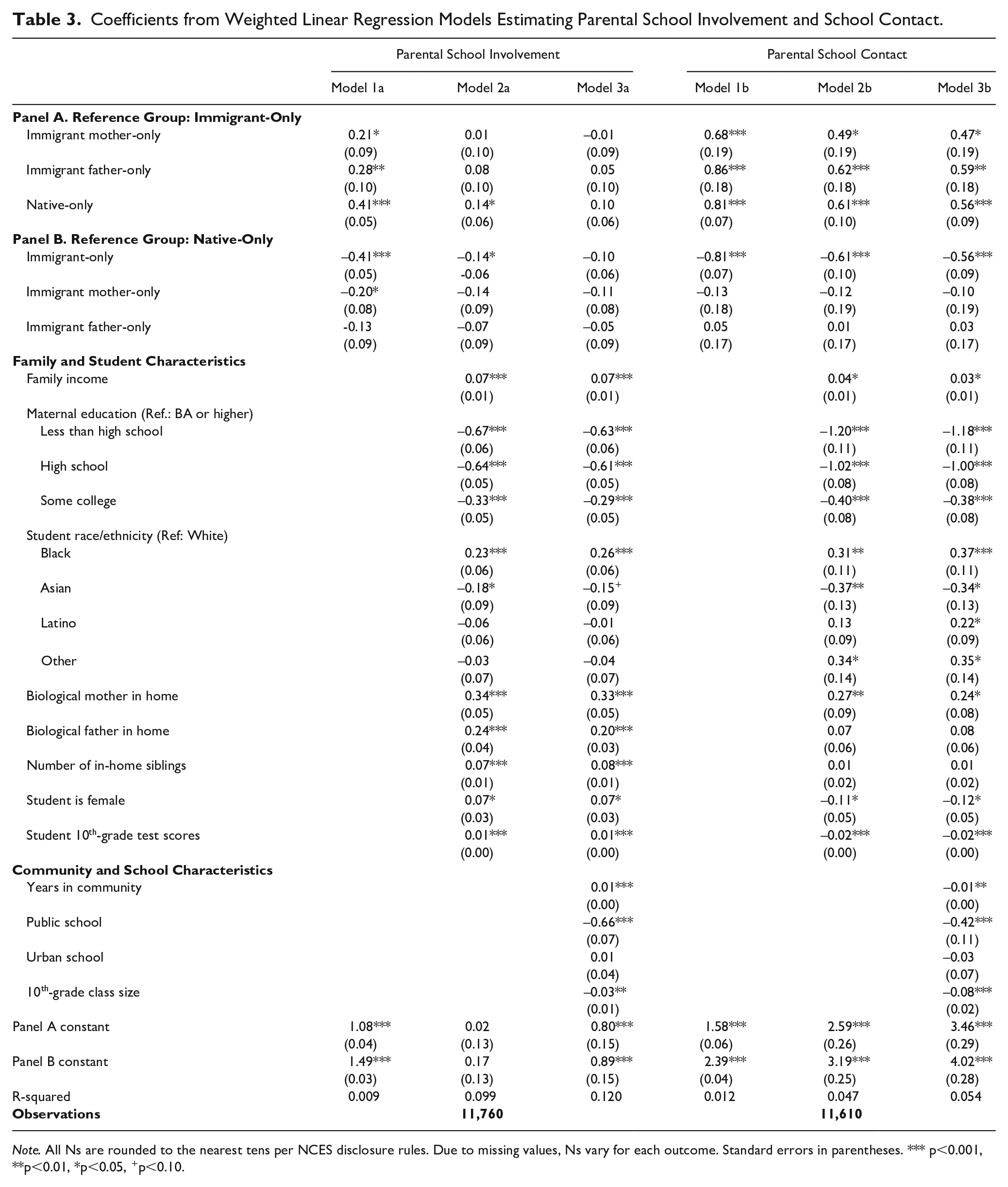
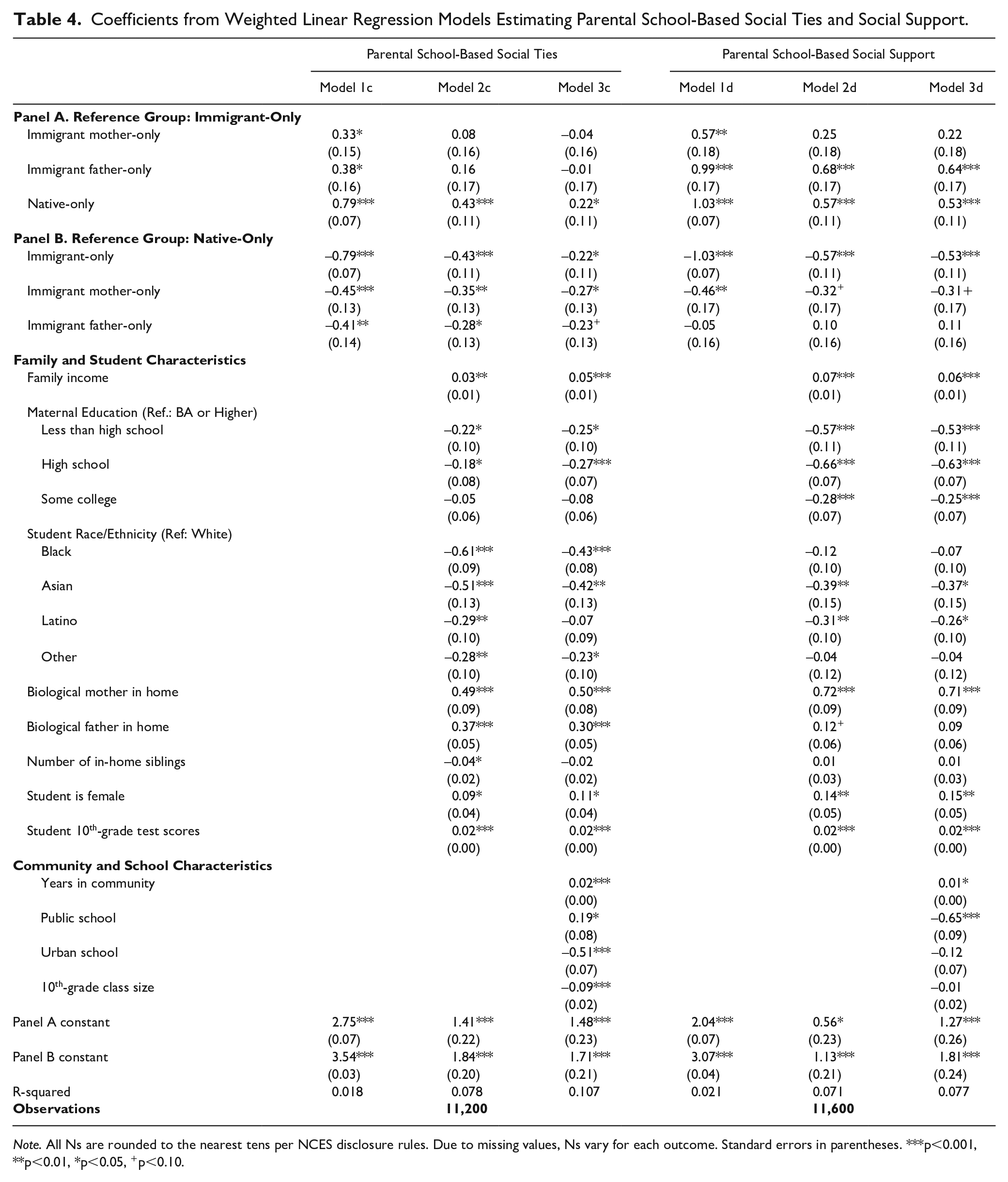
Next, we turn to family-school relationships. Table 3 shows the results from weighted linear regression models estimating parental school involvement (Models 1a-3a) and parental school contact (Models 1b-3b) while Table 4 shows results for parental school-based social ties (Models 1c-3c), and parental school-based social support (Models 1d-3d). Models 1 include only family nativity, Models 2 introduce family and student characteristics, and Models 3 additionally include families’ length of residence in the community as well as school characteristics.
Coefficients from Weighted Linear Regression Models Estimating Parental School Involvement and School Contact.
Note. All Ns are rounded to the nearest tens per NCES disclosure rules. Due to missing values, Ns vary for each outcome. Standard errors in parentheses. *** p<0.001, **p<0.01, *p<0.05, +p<0.10.
Coefficients from Weighted Linear Regression Models Estimating Parental School-Based Social Ties and Social Support.
Note. All Ns are rounded to the nearest tens per NCES disclosure rules. Due to missing values, Ns vary for each outcome. Standard errors in parentheses. ***p<0.001, **p<0.01, *p<0.05, +p<0.10.
As shown in Model 1a, mixed-nativity families report greater parental involvement in school activities (such as involvement with parent-teacher organizations and volunteering in schools) compared to their immigrant-only counterparts (Panel A). However, compared to native-only families, only families with immigrant mothers report less parental school involvement (Panel B). The greater parental involvement of mixed-nativity families compared to immigrant-only families is largely explained by family and student characteristics, as shown in Model 2a (Panel A), as is the lower parental involvement of immigrant mother-only families compared to native-only families (Model 2a, Panel B). Notably, it is only with the addition of community residence duration and school characteristics that immigrant-only families exhibit similar levels of parental involvement as native-only families (Model 3a, Panel B).
Turning to parental school contact, we find mixed-nativity and native-only families to be similar in their more frequent contact with their children’s schools compared to immigrant-only families (Model 1b, Panel A). Unlike with parental school involvement, these differences in parent-initiated school contact persist net of family, student, and school characteristics (Model 3b, Panel A). Accounting for such factors, the level of parent-initiated school contact remains about 0.47 points greater (nearly one-fifth of a standard deviation) in mixed-nativity families with immigrant mothers (p<0.05) and about 0.59 points greater (nearly one-fourth of a standard deviation) in mixed-nativity families with native-born mothers (p<0.01) compared to immigrant-only families. Parents in native-only families similarly score about 0.56 points greater on the scale of parent-initiated school contact (about one-fourth of a standard deviation, p<0.001) compared to immigrant-only families.
Next, we examine parents’ school-based social ties as measured by connections to other parents from their children’s schools (Table 4). As with descriptive patterns, the baseline model (Model 1c), shows that parents in mixed-nativity families know more parents of their children’s friends compared to immigrant-only families (Panel A) but fewer parents compared to native-only families (Panel B). Once family and student characteristics are accounted for (Model 2c), mixed-nativity families no longer maintain an advantage over their immigrant-only counterparts in the number of other parents from their children’s schools they report knowing. However, even after taking into account family, student, and school characteristics, immigrant-only and mixed-nativity families continue to have fewer connections to other parents compared to native-only families (Model 3c, Panel B), with the evidence being stronger for mixed-nativity families with immigrant mothers. Immigrant-only families score about 0.22 points lower (about 11% of a standard deviation, p<0.05) and immigrant mother-only families about 0.27 points lower (nearly 14% of a standard deviation, p<0.05) on the scale of school-based social ties compared to native-only families. Immigrant father-only families also score lower on the scale of parental school-based ties compared to native-only families, though the finding is only marginally statistically significant (p<0.10).
Beyond knowing other parents of their children’s school friends, we also tested whether families differed in the amount of social support they report from parents at their children’s schools, including giving and receiving favors as well as receiving advice. At baseline, mixed-nativity and native-only families report more social support than immigrant-only families (Model 1d, Panel A). However, accounting for differences in additional family and student characteristics only helps to explain the advantage immigrant mother-only families have relative to immigrant-only families (Model 2d, Panel A). The advantage among families with native mothers (including immigrant father-only and native-only families) persists net of family, student, and school characteristics (Model 3d, Panel A). Mixed-nativity families with native-born mothers and native-only families continue to score about 0.64 points (p<0.001) and 0.53 points higher (p<0.001), respectively, on the scale of parental school-based social support (about 27% and 22% of a standard deviation, respectively). In contrast, families with immigrant mothers remain at a disadvantage in terms of school-based social support. Immigrant-only families score about 0.53 points lower (more than one-fifth of a standard deviation, p<0.001) on the scale of parental school-based social support compared to native-only families, and there is also some evidence (p<0.10) that mixed-nativity families with immigrant mothers have less social support than native-only families.
We also note a number of important relationships between family characteristics that, while not the focus of this study, provide important context for our findings. First, the presence of mothers in the home is consistently and positively associated with all measures of family-school relationships, but the presence of a father less so, underscoring the critical role of mothers in particular for school-based social ties and support. Second, we find variations in patterns of parent-child and family-school relationships among Asians and Latinos, the two groups with the largest proportions of immigrant-origin families in our study. The parents of Latino adolescents enforce more rules and the parents of Asian adolescents fewer rules compared to their White counterparts (Table 2, Model 2a). Moreover, Latino families generally do not differ from White families on most measures of family-school relationships, particularly once school characteristics are accounted for, but Asian families persistently remain disadvantaged relative to White families, particularly in their social ties with and social support from other parents (Table 3, Models 3a-d). This suggests racial and ethnic variation in immigrant-origin families’ experiences, though data limitations—discussed further below—preclude further analyses by subgroups.
While patterns of relationships between measures of family SES and parent-child relationships are less consistent, we find that family SES is consistently associated with family-school relationships in ways that highlight advantages among families with college-educated mothers. Families with less educated mothers report lower school involvement and contact, and generally fewer social ties and support from other parents compared to families where mothers have a college degree (Table 3, Models 3a-3d). Such results are consistent with prior research showing class-based differences in parental involvement (Horvat et al., 2003). However, it is worth pointing out that despite mixed-nativity families’ socioeconomic similarity to native-only families in our study, we nevertheless find that they have fewer social ties and less social support. Similarly, the number of years a family has resided in a community is generally positively associated with family-school relationships. While mixed-nativity and native-only families have on average resided in their community for more years than immigrant-only families, accounting for length of time in community does not always explain disadvantages among immigrant-only families, which suggests other factors at work that shape the social integration of immigrant-origin families.
Discussion
In this study, we compared the parent-child and family-school relationships of mixed-nativity families—both those with immigrant mothers and those with immigrant fathers—to immigrant-only and native-only families. We find that mixed-nativity families, regardless of the gender of the immigrant parent, have parent-child relationships that are more similar to those of native-only families. Compared to immigrant-only families, mixed-nativity and native-only families enforce more rules and share fewer family meals with their children. However, our results suggest that mixed-nativity families with immigrant mothers, though not those with native-born mothers, share some disadvantages in family-school relationships with their immigrant-only counterparts, notably having fewer school-based social ties and social support than native-only families.
Our analyses suggest that mixed-nativity families are more acculturated to “Americanized” parenting practices. This is consistent with prior conceptualizations that posit mixed-nativity families experience more rapid assimilation to the U.S. mainstream (Bean & Stevens, 2003; Stevens et al., 2012). However, these patterns are not necessarily positive. That parents in immigrant-only families enforce fewer rules for and share more meals with their adolescent children can be viewed as indications of greater trust and closeness between parents and children in such families. Immigrant parents across racial and ethnic backgrounds are typically viewed as more strict (Foner and Dreby 2011; Kao 2004; Nieri & Bermudez-Parsai, 2014), but rather than enforcing rules, such parents may instead rely on an implicit understanding with their children about family obligations. This “immigrant bargain” between immigrant parents and their children, in which children recognize and respect their parents’ sacrifices by exhibiting good behavior and high academic achievement (Fuligni, 2001; Louie, 2012; Smith, 2006; Suárez-Orozco et al., 2008), might explain why immigrant parents are less likely to maintain explicit rules. Given that mixed-nativity families, regardless of the gender of the immigrant parent, are just as likely as native parents to maintain rules suggests that the presence of a native co-parent weakens the immigrant bargain and changes parenting practices. Understanding whether such immigrant advantages persist in mixed-nativity families would better illuminate the tradeoffs immigrant-origin families make as they adapt to life in the United States.
Despite their acculturation to “Americanized” parenting practices, our results show that mixed-nativity families with immigrant mothers remain less socially integrated than families with native-born mothers. Families with native-born mothers, including those with immigrant fathers, contact schools more frequently and report more social support from fellow parents than immigrant-only families. Such differences suggest that mixed-nativity families with native-born mothers may be more comfortable than families with immigrant mothers in adopting an assertive approach to family-school relationships, much like native-only families. Findings thus highlight the difficulties in broader social integration faced by families with immigrant mothers, and challenge the notion of intermarriage between immigrants and natives as an adequate indicator of the disappearance of social barriers.
We note several limitations to our study. First, we have limited data about immigrant characteristics that might additionally influence acculturation and integration, such as embeddedness in co-ethnic communities and social networks beyond the school setting. We do show, however, that mixed-nativity families generally do not differ socioeconomically from native-only families (as measured by family income and maternal education). Moreover, compared to their immigrant-only counterparts, immigrant parents in mixed-nativity families have resided in the United States for a longer period of time—28.6 years compared to 16.1 years for immigrant mothers and 28.6 years compared to 17 years for immigrant fathers. These all suggest an acculturation “advantage” among mixed-nativity families, consistent with prior research (Iceland & Nelson, 2010; Stevens et al., 2012). However, even if immigrant parents in mixed-nativity families are more positively selected, we show that they continue to differ from native-only families in important ways that suggest assimilation is not purely based on socioeconomic factors.
We also note that our measures of parenting practices and social capital resources are somewhat narrow. Parenting involves much more than the rules parents enforce or the number of meals they share with their children. However, we believe these indicators are consistent with the dynamics of immigrant-origin families found elsewhere in the literature. Our measures also do not fully capture the breadth of relationships and resources available to parents. For instance, we do not have measures of ethnic social capital, and it is possible that immigrant mothers, even those with a native-born co-parent, rely more on resources in immigrant communities. Nevertheless, our measures of social ties and resources represent the sort of mainstream connections that immigrant-origin families may lack and that are often essential for navigating the U.S. educational system (Fernández-Kelly, 2008; Smith, 2008).
Lastly, given sample size limitations, we are unable to examine finer ethnic categories that may mask differences among immigrant-origin families. While mixed-nativity families are well represented across regions of origin, there are still racial and ethnic variations in the share of immigrant-origin families that are of mixed-nativity (Bean & Stevens, 2003; Ramakrishnan, 2004; Rumbaut, 2004). This suggests racial and ethnic differences into the selection of mixed-nativity unions, and possibly interracial and interethnic unions as well. Because parental race/ethnicity data was only collected for the parent respondent, we cannot fully account for instances where the co-parent is of a different race/ethnicity. However, research has shown that mixed-nativity unions tend to be between co-ethnics rather than interracial or interethnic (Lichter et al., 2015; Qian & Lichter, 2001). In our sample, about 3% of students with two immigrant parents, 17% of students with immigrant mothers, 8% of students with immigrant fathers, and 4% of student with two native parents identified as multiracial. Thus, while mixed-nativity unions in our sample are more likely to be interracial, the majority of unions are still likely within racial and ethnic groups. Nevertheless, racial and ethnic variation in immigrant assimilation, particularly for mixed-nativity families, is deserving of further research.
Conclusion
Our study makes a number of contributions. First, the variations we find in the parent-child and family-school relationships of mixed-nativity families raise an empirical point about how immigrant-origin families are defined. In our reading of the existing literature, immigrant families are often defined on the basis of mothers’ nativity or the presence of any immigrant parent, definitions that overlook mixed-nativity families. However, if researchers choose to base immigrant origins on maternal nativity, they may overestimate acculturation when they include mixed-nativity families, who we show actually look more similar to native-only families in parent-child relationships. Similarly, if researchers base immigrant origins on the presence of any immigrant parent, they risk underestimating the specific challenges to social integration faced by families with immigrant mothers.
From a theoretical perspective, our study sheds light on complexities in the acculturation processes of immigrant-origin families. Existing theories often take the presence of mixed-nativity families as evidence of assimilation. While mixed-nativity families may acculturate in some ways, those with immigrant mothers still experience significant disadvantages in their social integration. Our findings suggest that the position of mixed-nativity families with immigrant mothers may be doubly precarious—in acculturating to “Americanized” parenting norms, mixed-nativity families may lose the closeness that is often seen as a strength of the immigrant family (Nieri et al., 2016) while remaining at a disadvantage in connecting with mainstream social networks. Mixed-nativity families, rather than being a simple case of assimilation into the American mainstream, are instead symbolic of the often-conflicting processes of acculturation and integration faced by immigrant-origin families in the United States.
Footnotes
Appendix
Description of Study Variables.

| Measure | Description |
|---|---|
|
|
Immigrant is defined as born in Puerto Rico or a non-U.S. country. If both biological parents were immigrants, family nativity was coded as “immigrant-only.” If only the biological mother or only the biological father was an immigrant, family nativity was coded as “immigrant mother-only” or “immigrant father-only,” respectively. If both biological parents were born in the U.S., family nativity was coded as “native-only.” |
|
|
|
| Parental enforcement of rules | A summative measure of the number of rules parents reported enforcing, including the following: (a) “Maintaining a certain grade average”; (b) “Doing homework”; (c) “Doing household chores”; and (d) “Watching television.” Coded ‘1’ for “Yes” and ‘0’ for “No.” An additional item, “How often do you make and enforce curfews for your tenth grader on school nights?,” was also included and coded ‘1’ for “Always” and ‘0’ for “Never,” “Seldom,” and “Usually.” Cronbach’s alpha: 0.58. Range: 0 to 5. Missing responses on individual items were coded as ‘0’ with the exception of a small number of cases (<1%) missing on all five items that were treated as missing. |
| Daily family meals per week | “In a typical week, how many days do you eat at least one meal with your tenth grader?” Response categories were “0 days a week” to “7 days a week.” Range: 0 to 7. About 1% missing values. |
|
|
|
| Parental school involvement | A summative measure of the number of school activities parent respondent or spouse/partner reported participating in, including the following: (a) “Belong to the school’s parent-teacher organization (PTO)”; (b) “Attend meetings of the PTO”; (c) “Take part in the activities of the PTO”; (d) “Act as a volunteer at the school”; and (e) “Belong to any other organization with several parents from your tenth grader’s school.” Missing responses on individual items were counted as non-participants with the exception of a small number of cases (<1%) missing on all five items that were treated as missing. Cronbach’s alpha: 0.72. Range: 0 to 5. |
| Parental school contact | A continuous measure of the frequency with which parents reported contacting their adolescent’s school about the following: (a) school program for this year; (b) student’s plans after leaving high school; (c) student’s course selection; (d) participating in school fund-raising activities or doing volunteer work; (e) information on how to help student with specific skills or homework; and (f) providing information for school records. Response categories were “None” (coded as ‘0’), “Once or twice” (coded as ‘1’), “Three or four times” (coded as ‘2’), and “More than four times” (coded as ‘3’). Missing responses on individual items were counted as no contact except the small number (<2%) missing on all six items, which were treated as missing. Cronbach’ alpha: 0.72. Range: 0 to 18. |
| Parental school-based social ties | A summative measure of the number of parents of their children’s school-friends’ parents reported knowing. For up to three of their tenth grader’s close friends, parents were asked whether the friend attended the same school, and whether they knew the friend’s mother and father. Missing responses for individual items were counted as not knowing the parent except the small number (5%) missing all responses, which were treated as missing. Range: 0 to 6. |
| Parental school-based social support | A continuous measure of the frequency with which parents of their children’s friends: (a) gave advice about teachers and/or courses; (b) did a favor; and (d) received a favor from the parent respondent. Response categories were “None” (coded as ‘0’), “Once or twice” (coded as ‘1’), “Three or four times” (coded as ‘2’), and “More than four times” (coded as ‘3’). Missing responses on individual items were counted as no contact except the small number (<2%) missing on all three items, which were treated as missing. Range: 0 to 9. |
|
|
|
| Student race/ethnicity | Based on student self-reported race/ethnicity. “Latino” includes those who reported being “Hispanic or Latino/Latina” regardless of race. “Other” includes “Native Hawaiian or Other Pacific Islander,” “American Indian or Alaska Native,” and those who selected more than one race. Missing values imputed by NCES. |
| Family income | A 13-category measure of family income from all sources in 2001. Ranges from “None” to “200,001 or more.” Missing values imputed by NCES. |
| Maternal education | Mother’s highest level of education, including less than high school, high school, some college (including attending or graduating from 2-year school and attending college, but with no 4-year degree), and bachelor’s degree or higher (including completing a MA and other advanced degree). Missing values were imputed by NCES. |
| Biological mother/father in home | Two separate measures that indicate whether the biological mother resides in the home and whether the biological father resides in the home. |
| Number of in-home siblings | NCES-created measure that sums the number of the tenth grader’s in-home siblings, including adoptive, half-, and step-siblings. The 2% of missing cases were replaced with the mean of the whole sample (1.46). Range: 0 to 7 or more. |
| Student is female | Taken from student self-reported gender in the base year of survey. Missing values were imputed by NCES. |
| 10th-grade test scores | An NCES-created average of the math and reading standardized scores from an NCES-administered test of ELS: 2002 students. Range: 20.91 to 81.04. |
| Years in community | “How many years have you lived in your current neighborhood?” The 1% of missing cases were replaced with the mean of the whole sample (10.78). Range: 0 to 50 years. |
| Public school | Whether or not the 10th-grader was enrolled in a public school. Based on NCES sampling data from the Common Core of Data. |
| Urban school | Whether or not the 10th-grader was enrolled in an urban school. Based on NCES sampling data from the Common Core of Data. |
| 10th-grade class size | A seven-category measure of school Grade 10 enrollment. Taken from the NCES sampling roster. Categories are the following: 1–99, 100–199, 200–299, 300–399, 400–549, 550–699, and 700 or more students. |
Authors’ Note
Phoebe Ho is now affiliated with University of North Texas, Denton, TX, USA.
Declaration of Conflicting Interests
The author(s) declared no potential conflicts of interest with respect to the research, authorship, and/or publication of this article.
Funding
The author(s) disclosed receipt of the following financial support for the research, authorship, and/or publication of this article: Phoebe Ho acknowledges support from the Institute of Education Sciences, U.S. Department of Education, through Grant #R305B090015 to the University of Pennsylvania. The opinions expressed are those of the authors and do not represent views of the Institute or the U.S. Department of Education. Grace Kao is grateful for support from the Faculty of Arts and Sciences, the MacMillan Center, and the Council for East Asia at Yale University. This work was supported by Laboratory Program for Korean Studies through the Ministry of Education of Republic of Korea and Korean Studies Promotion Service of the Academy of Korean Studies (AKS-2016-LAB-2250002).
