



Abstract
Although families with children are particularly vulnerable in hurricanes, little is known about factors affecting families’ evacuation decisions. Following Hurricane Irma, we evaluated multiple factors potentially influencing mothers’ evacuation decisions and evacuation intentions for future hurricanes. Mothers of children under 18 years (N=536) completed an online survey assessing sociodemographic, hurricane-related, family, and psychological factors, as well as intentions regarding future evacuation. Logistic regression analyses identified factors associated with increased evacuation likelihood. Mothers’ reported reasons for evacuating highlighted family and psychological factors as most critical in decision-making. Mothers who evacuated for Irma or experienced more Irma-related loss/disruption reported significantly greater intention to evacuate for future hurricanes than mothers who did not. Mothers prioritize the safety and comfort of their children and keeping their family together when deciding whether to evacuate. Developing a Family Disaster Plan may facilitate evacuation decisions.
A key consequence of climate change is the increase in climate-related disasters (Crimmins et al., 2016). In 2017 alone, a series of severe hurricanes wreaked havoc on the United States, causing damages of over $200 billion (Drye, 2017). Mandatory evacuation orders are one of the primary strategies used by the U.S. government to keep individuals safe during dangerous impending storms and other extreme weather events (U.S. Department of Homeland Security, 2019a). Although many individuals living in vulnerable areas evacuate in anticipation of an extreme weather event, not all do. Factors affecting individuals’ decisions to stay or go have consequently been an intense focus of past disaster research (e.g., Bowser & Cutter, 2015; Thompson et al., 2017). A recent systematic review found that families with children have consistently shown a higher likelihood of evacuating than individuals without children (Thompson et al., 2017), yet few studies have addressed issues specific to families with children (e.g., managing younger children and travel with larger size family) when considering the evacuation decision-making process. Thus, the current study aimed to describe the role of family issues, in addition to sociodemographic, hurricane-related, and psychological factors, in predicting mothers’ evacuation decisions for an impending hurricane.
Family Factors
Although most individuals experience conflicting motivations when considering whether to evacuate or not (Riad et al., 1999), this may be especially true for parents. For example, parents may need to simultaneously consider factors such as young children with special needs, pets, and parental work requirements. Having multiple children may require greater resources to evacuate (e.g., paying for larger, or more than one, hotel room). Notably, recent work suggests that making evacuation decisions is particularly stressful for families (La Greca et al., 2019), but additional research is needed to understand key factors that contribute to evacuation decisions for families with children.
Critically, although past work demonstrates that women are more likely to evacuate than men (Thompson et al., 2017), no research has focused on factors that may be important to mothers’ evacuation decisions. One study investigating the gender disparity in evacuation found that women perceive their risk to be higher and are more likely to be in a caregiving role (Edwards & Bateman, 2002). More recent qualitative work found that mothers prioritized relational factors (e.g., checking on neighbors and packing toys to keep children calm) when preparing for a hurricane, whereas fathers were more task-oriented (e.g., securing the home; Hung, 2018).
Family factors remain largely unaddressed in research on evacuation decision-making and remain a critical gap in the evacuation literature. In particular, little is known about how family composition (e.g., ages and number of children), parental work requirements, or the need to find travel and lodging to accommodate a larger family or younger children impact evacuation decisions. Likewise, psychological factors relevant to family issues, such as wanting to keep the family together or fearing for the safety of one’s children, have not yet been addressed in research on evacuation behaviors.
Moreover, past work suggests that families that have children or family members with special needs are more likely to evacuate (Solís et al., 2010; Thompson et al., 2017). While having more children is usually associated with evacuation (Thompson et al., 2017), one study found mixed results regarding the number of children in a family; for about two-thirds of the families surveyed, each additional child was associated with an increased probability of evacuation (Hasan et al., 2011). However, the opposite was true for the remaining families. The authors suggested that families with children younger than six may perceive their risk to be higher and thus be more likely to evacuate; however, they did not have the data available to test this hypothesis. The extent to which having young children in the home impacts evacuation decisions thus has yet to be addressed and was explored in the current study.
Pet owners are also less likely to evacuate, and those who own dogs seem especially unlikely to evacuate (Heath et al., 2001; Thompson et al., 2017). However, a study of households who failed to evacuate after receiving a mandatory evacuation order found that individuals who had both pets and children were at lower risk for evacuation failure (Heath et al., 2001). This again demonstrates the conflicting motivations that families experience when making evacuation decisions, and underscores the need to understand how families, particularly mothers, prioritize various family-related factors.
Sociodemographic and Hurricane-related Factors
Several factors identified in previous research on hurricane evacuation decisions are also likely to be relevant to mothers with children. Specifically, past work suggests that older individuals, racial/ethnic minorities, and individuals living in vulnerable homes (e.g., mobile homes) are less likely to evacuate, while those who receive official mandatory evacuation orders and live in a high-risk area are more likely to evacuate (Bowser & Cutter, 2015; Huang et al., 2016). Past studies offer conflicting evidence on the role of socioeconomic factors in predicting evacuation (Thompson et al., 2017). The literature is also mixed regarding whether experiencing a previous storm predicts intentions to evacuate for future storms, although previous evacuation decisions consistently predict subsequent evacuation decisions (Thompson et al., 2017). Receiving warning information about an impending storm from the media and from family and friends also appears to play a role in evacuation decisions (Thompson et al., 2017), though this has not yet been evaluated in mothers specifically.
Psychological factors
In addition to the aforementioned factors, little is known about psychological factors relevant to evacuation decisions, although recent findings indicate that parents report evacuation experiences to be highly stressful (La Greca et al, 2019). Past work incorporating psychological variables has almost exclusively focused on individuals’ perceptions of risk, finding that individuals are more likely to evacuate when they estimate the threat to their personal safety and the integrity of their home to be greater (Huang et al., 2016; Thompson et al., 2017). Likewise, other studies have found that individuals with a stronger belief in their ability to survive the storm are less likely to evacuate (Elder et al., 2007; Morss et al., 2016). The impact of psychological variables such as fear, worry, and stress remain largely unstudied, and may be particularly important when considering mothers’ evacuation decisions, as mothers must consider not only their own safety but also that of their children. Mothers may perceive a storm as threatening because they consider the storm’s potential adverse impact on their children, and thus feel stressed and worried before a storm.
Future Hurricane Intentions
Finally, a critical question to be addressed is what do families (especially those who experienced a hurricane and an evacuation) intend to do when the next storm inevitably emerges? Intention is a key variable in predicting future behavior (e.g., Theory of Planned Behavior; Azjen, 1991). Expectations of evacuating for a future hurricane are linked to actual evacuation behavior (Kang et al., 2007), and past research suggests that individuals with previous hurricane experience are more likely to evacuate (Hasan et al., 2011; Solís et al., 2010). However, factors that contribute to mothers’ future evacuation intentions, particularly those that are family-oriented (e.g., balancing safety of children with wanting to keep the family together when one parent is required to stay for work), remain unknown. Thus, we sought to understand how mothers with previous hurricane experience intend to act for a future storm and to describe factors relevant to their intention.
Current study
Hurricane Irma, which struck South Florida in September 2017 as a Category 3 and 4 hurricane (Alanez & Fleshler, 2017), provided an ideal context to evaluate mothers’ reasons for evacuation and their future evacuation intentions. Because the storm was projected to be highly destructive to South Florida (Potenza, 2017), it led to massive evacuations throughout the state (Allen, 2018). The storm was projected to cause extensive damage and flooding, which led to the state of Florida’s broadest evacuation orders ever and resulted in the largest mass evacuation in American history (Allen, 2018).
Therefore, following Hurricane Irma, we evaluated sociodemographic, hurricane-related, family, and psychological factors associated with mothers’ evacuation decisions (Aim 1). Additionally, we asked mothers to rate their own perceptions of the importance of various factors in their decision-making process, such as family considerations, perceptions of danger or safety, and worries about their home, as well as media exposure and transportation issues (Aim 2). Finally, we examined mothers’ intentions to evacuate for future hurricanes, as well as the association between mothers’ future intentions and their past evacuation/hurricane experiences (Aim 3).
Methods
Participants
Participants were 536 mothers of children under the age of 18 years, residing in one of five South Florida counties (Monroe, Miami-Dade, Broward, Lee, and Collier) directly affected by Hurricane Irma. As demonstrated in Table 1, most mothers were White, non-Hispanic, under the age of 35, and spoke English as their primary language. Roughly half of the sample did not complete college, and approximately 60% had a gross family annual income of less than $75,000. Most mothers reported having two or fewer children at home. Almost two-thirds of mothers reported evacuating their homes for Irma. Although slightly less than half reported living in mandatory evacuation zones, almost three-fourths of mothers had experienced a previous hurricane, and roughly one-quarter had previously evacuated for a hurricane threat.
Mothers’ Socio-demographic, Hurricane-related, Family, and Psychological Factors (N = 536).

Note. aVulnerable homes include apartments, condos, or houses without hurricane impact glass or shutters, as well as mobile structures.
Procedures
This study was part of a broader project assessing Irma-related storm experiences among South Florida families (e.g., La Greca et al., 2019). The Institutional Review Boards at the relevant universities approved all procedures and materials. In late December 2017, about three months after Hurricane Irma, we recruited parents of children under 18 years of age via boosted posts on Facebook that specifically targeted South Florida residents in order to simultaneously reach the five counties included in the study. From the boosted Facebook posts, parents accessed an online Qualtrics survey, where they consented to participate and completed study questionnaires in either English or Spanish (99.5% completed in English). Additionally, participants completed items to verify their status as parents (e.g., child’s age and birth date, which were checked to ensure a match). Those who completed the surveys chose to either receive a $25 gift card or to directly donate their $25 to a hurricane relief organization. We closed the survey portal once we neared 600 respondents due to funding constraints.
Although the study recruited parents generally, most (96.8%) participants were mothers; as such, we excluded the 18 men who participated and focused the present study on mothers. In all, 584 parents completed surveys and received compensation. A total of 30 parents were excluded from analyses because they did not pass our standard validity check protocol. Specifically, participants were excluded if they did not: (a) submit a valid physical address located in a target county; (b) correctly respond to several “road block” items to ensure a human, not a computer, was completing the survey; and (c) provide consistent responses (e.g., child’s birthdate and age matched). Most of the excluded participants failed to provide complete or consistent child birth date and age information (n=27). (See La Greca et al., 2019 for details).
Measures
Sociodemographic, hurricane-related, and family factors (Aim 1)
Mothers completed a number of sociodemographic items used as predictors of evacuation, including their age, race/ethnicity, gross family annual income, education level, and home type. Home type was coded as “vulnerable” (1) or “not vulnerable” (0), with “vulnerable” homes including apartments, condos, or houses without hurricane impact glass or shutters, as well as mobile structures. We also asked which county mothers lived in during Hurricane Irma, as the storm was originally projected to hit Southeast Florida (Miami-Dade, Broward, and Monroe counties) but ended up having a greater impact in Southwest Florida (Lee and Collier counties). Mothers also reported (yes/no) on whether they lived in a mandatory evacuation zone during Irma, had evacuated during a previous hurricane, and whether they evacuated for Irma. We also assessed whether families had specific characteristics that might complicate their evacuation plan, including having a family member with special needs (e.g., autism or diabetes) and if a parent was required to stay near home during the storm for work. We also asked mothers to list what types of pets they owned, if any. Most items were scored 1 (yes) or 0 (no).
Psychological factors (Aim 1)
In addition to assessing socio-demographic, hurricane-related, and family factors, our model predicting evacuation included psychological factors relevant to evacuation decisions. We used the Hurricane-Related Traumatic Experiences (HURTE-II; La Greca, 2017) to assess mothers’ perceptions of stress and safety before the storm. The HURTE-II, based on an earlier version of the measure, assesses youths’ and adults’ hurricane-related experiences (La Greca et al., 1996; La Greca et al., 2010). Three items related to “before the storm” experiences were used to predict mothers’ evacuation decisions. One item assessed mothers’ pre-hurricane stress level (Overall, how stressed were you before the storm?) and another assessed the level of concern about personal safety (Overall, how safe did you feel before the storm?). These items were rated on a scale from 0 (not at all) to 3 (a whole lot). The third item assessed before-the-storm concerns about potential damage to ones’ home (At any time before the hurricane, did you think that the hurricane might cause major damage to your home, or that you might lose your home?). It was rated as 0 (no) or 1 (yes).
Perceived reasons for evacuating or staying 1 (Aim 2)
Based on personal experiences with the evacuation process, prior disaster literature (Bowser & Cutter, 2015; Riad et al., 1999), and pilot data, we developed a measure to capture factors that might affect mothers’ decisions to evacuate their home or to shelter in place. Mothers who evacuated for Irma rated the extent to which each of 18 different reasons influenced their decision to evacuate on a scale from 0 (not at all) to 4 (a whole lot). Items included reasons such as “thinking your or your family’s lives may be in danger,” “having a young child at home,” “wanting to keep the family together during the event,” and “seeing news and other media reports about the hurricane” (Table 3). Mothers who did not evacuate responded to a similar set of items about the extent to which the same factors influenced their decision to remain at home (Table 4). For example, mothers who evacuated responded to “having transportation” while mothers who sheltered in place responded to “not having transportation.” See Tables 3 and 4 for a complete list of the items.
Future evacuation intentions and descriptive responses (Aim 3)
Mothers were asked what they would do if another hurricane headed toward their hometown, with the following response options: 1 (definitely stay), 2 (probably stay), 3 (unsure), 4 (probably evacuate), and 5 (definitely evacuate). As a follow-up, mothers wrote short explanations of why they would or would not choose to evacuate in the future.
Data analysis
For Aim 1, a logistic regression analysis evaluated sociodemographic, hurricane-related, family, and psychological factors that differentiated those who evacuated from those who sheltered in place. All variables were entered in the model simultaneously. We also assessed the bivariate associations of each predictor with evacuation, the outcome variable (Table 2; right column). A Pearson correlation was used to evaluate the association between continuous predictors, and a Chi-Square test was used for categorical variables. For Aim 2, descriptive analyses examined self-reported factors that were influential in mothers’ decisions to evacuate or to shelter in place. For Aim 3, a multiple regression analysis examined how evacuating for Hurricane Irma and loss/disruption due to Hurricane Irma related to intention to evacuate for a future storm. This analysis was conducted in a hierarchical fashion, with the factors that significantly predicted evacuation in Aim 2 entered in the first block, and evacuating for Irma and loss/disruption due to Irma in the second block. Finally, to summarize mothers’ open-ended responses regarding why they would stay or evacuate for a future hurricane, research team members reviewed the responses and collaboratively developed a list of common themes observed in the data. Research assistants then used the list of themes to code each response.
Results of Logistic Regression Analysis Examining Predictors of Evacuation in Mothers.

p<.001, **p<.01, *p<.05.
Note. Bivariate associations reflect p-values from Chi-Square tests for categorical variables, and Pearson correlations for continuous variables.
Results
Predictors of evacuation (Aim 1)
Logistic regression analyses (Table 2) revealed that living in a mandatory evacuation zone, evacuating for a previous hurricane warning, having only young children at home (under age 7 years), and concerns about damage to one’s home each significantly and uniquely predicted evacuation for Hurricane Irma. Having more children at home, owning dogs, and being required to stay near home for work or having a partner who was required to stay near home were associated with a reduced likelihood of evacuation. Interestingly, feelings of stress and safety before the storm did not predict evacuation above and beyond the other factors, even though before-storm stress was associated with evacuation at the bivariate level (p < .001). County of residence and racial/ethnic minority status were also associated with evacuation at the bivariate level, but not in the regression model with other factors controlled. Of note, we also ran the model with a variable that coded for mothers who reported owning pets, but not dogs (e.g., cats, fish, reptiles, etc.), and it did not significantly predict evacuation.
Mothers’ Perceptions of Reasons for Evacuating/Sheltering in Place (Aim 2)
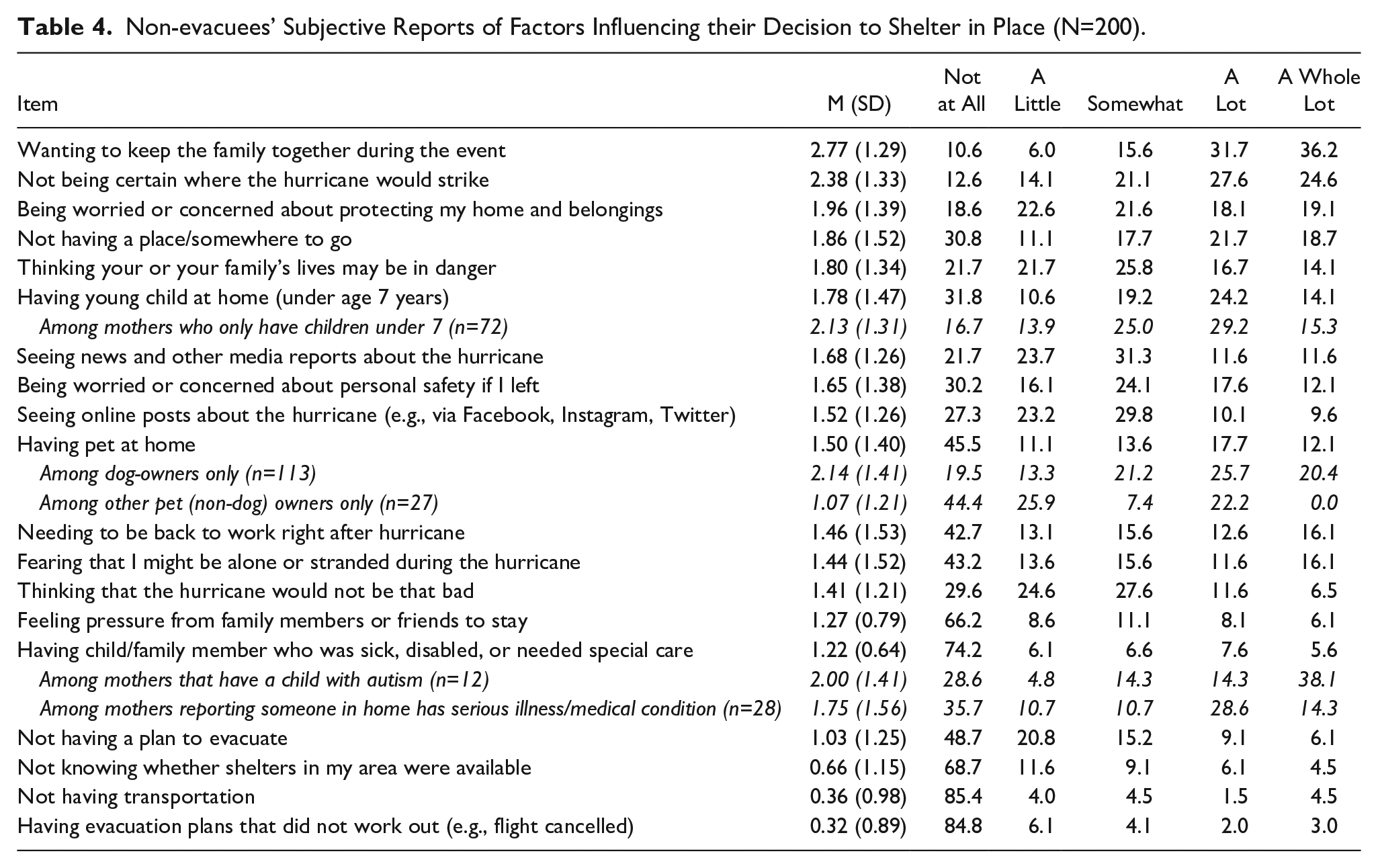
Means, SDs, and percentages for mothers’ reports of the extent to which various factors influenced their decision to evacuate or shelter in place are listed in Table 3 (for evacuees) and Table 4 (for non-evacuees). Perhaps most notable is that among evacuees, roughly two-thirds perceived that having a young child at home influenced their decision to evacuate “a whole lot.” Other influential factors for evacuees included safety concerns, seeing news and media reports about the hurricane, not being sure where the hurricane would strike, and wanting to keep the family together during the storm.
Evacuees’ Subjective Reports of Factors Influencing their Decision to Evacuate (N=336).

Non-evacuees’ Subjective Reports of Factors Influencing their Decision to Shelter in Place (N=200).
Interestingly, 28% of mothers who chose to evacuate reported that being in a mandatory zone had no bearing whatsoever on their evacuation decision. This aligns with our finding that 141 mothers (42% of evacuees) chose to evacuate despite not receiving mandatory evacuation orders. Mothers who evacuated in the absence of mandatory state orders almost universally endorsed being influenced by seeing news and media reports, as well as by thinking their or their family’s lives may be in danger.
For non-evacuees, keeping their family together during the storm, being uncertain where the hurricane would strike, and being worried about protecting their home and belongings were particularly important to their decision to shelter in place. One factor that appeared to influence mothers’ evacuation decisions was having a place to go; 69.2% of non-evacuees said that not having a place to go influenced their decision, and 88.7% of evacuees noted that having a place to go was influential. Interestingly, only 33.8% of non-evacuees reported that feeling pressure from family and friends impacted their decision, whereas nearly 80% of evacuees endorsed this factor as at least a little important.
As expected, certain family factors, including having a young child, having pets (particularly dogs), and having family members with special needs, were endorsed more highly by mothers to whom the items were relevant. For example, among mothers who evacuated and reported that they only had children under the age of 7 years, 98.2% endorsed having a young child at home as at least a little important to their decision (compared to 67.2% of all mothers who evacuated).
Future Evacuation Intentions (Aim 3)
Nearly half of mothers indicated that they would definitely or probably evacuate if a future hurricane was headed their way (n = 250, 46.6%), whereas one-quarter said they would definitely or probably shelter in place next time (n = 136, 25.3%) and another one-quarter were unsure (n = 150, 28.4%). Variables that predicted evacuation for Irma (number of children, having a young child, owning dogs, self or partner being required to stay home for work, evacuating for a previous hurricane, and living in a mandatory zone; see Table 2) were included in the first step of a multiple regression analysis (F = 3.57, p < .01, R2 = .05). When Irma-specific experiences were entered in Step 2, findings indicated that evacuating for Irma (β = .67, t = 5.75, p < .001) and experiencing more loss and disruption due to Irma (β = .07, t = 2.79, p < .01) were uniquely associated with greater intention to evacuate for a future storm, even when the variables that predicted evacuation for Irma were included in the first step of the model (F = 7.98, p < .001, R2 = .13). Notably, in the first step of the model, the only variable that significantly predicted intention to evacuate for a future storm was living in a mandatory zone during Irma. However, this variable became nonsignificant when evacuating for Irma and experiencing more loss and disruption due to Irma were added in the second step; this is perhaps due to the shared variance between living in a mandatory zone and evacuating for Irma.
In addition to quantitative data, nearly all mothers (n=518, 96.6%) provided open-ended responses about why they would or would not evacuate for a future hurricane. Among those indicating they would probably or definitely stay home in the future, the most common themes were related to perceived safety and security. Specifically, these mothers felt their homes were secure and could weather a future storm. They also felt capable and prepared, and many said they felt safer at home than on the road: “Our home was perfectly fine, and I would rather stay where I know I am safe than risk running out of gas or being stuck in traffic during the storm.” Others described that they would not evacuate in the future because Hurricane Irma was not as bad as media reports projected it to be: “News hyped the hurricane too much. Less hassle and better off riding it out at home.” Some mothers said evacuating was not worth the stress, particularly when their homes did not end up incurring much damage, and cited specific evacuation challenges including traffic, cost, and difficulties related to traveling with pets and small children: We spent hundreds of dollars that financially we didn’t have to stay at [bad] hotels, and our house didn’t receive that much damage. The traffic to get back into the Keys was awful as well. There’s no way I would do that again. Next hurricane I would make sure to be stocked on food and water and generators and just stay home. Our home was in the direct path of the hurricane when it was still CAT4 and was completely unharmed. We had storm shutters on every window and the stress of driving in major traffic with such a tiny baby was awful. [My] spouse is an essential employee at his job. We have a child and two dogs. If I left, I would have to travel through all the madness alone with them.
Mothers who indicated they would probably or definitely evacuate in the future almost exclusively cited concerns about the safety and comfort of their family. Interestingly, only 9 (6.6%) of those who said they would stay home for a future hurricane described children as a major factor influencing their intention, whereas 87 (35%) of those who planned to evacuate specifically cited their children as their rationale for future evacuation. Many of these mothers stated it was simply not worth the risk to stay home and wanted to protect their children from physical or psychological harm: Leading up to Irma was very scary. It ended up not hitting the part of [county] where I live as badly as it could have, but I would still choose to evacuate. My kids are my priority and I would rather know for certain that they will be safe. I would evacuate immediately. As early as possible. So that I do not have to go through the stress and anxiety of not knowing if my child and I will be safe if we stay. There was tons of damage to my home. Having three little kids seeing and worrying about their house is not stress they need.
Likewise, some mothers explained that they would evacuate in the future specifically because they have young children: “Having young children makes me want to evacuate. If they are older, I would probably stay.” Several also discussed the difficulty and discomfort of dealing with the aftermath of the hurricane, and would evacuate in order to have power and water, particularly if they had small children or children with special needs: Although going through the hurricane wasn’t as bad as expected for our area, the weeks after without electricity were too rough for two kids under 2 years old. It’s simply too hot and too humid when their little bodies are used to temperature-controlled living areas. It was too stressful on our young children and I was pregnant at the time. I will never stay again because of the stress leading up to it and the amount of time without water and electricity. As stressful as it was to leave, our home sustained damage. I have two children with autism, they would have been absolutely terrified to stay during the storm, witness the damage afterwards, and also have to go without electricity for as long as our area did.
Overall, mothers’ responses suggest that for many, family factors such as having young children are particularly relevant to evacuation decisions. Concerns for children’s well-being may explain why some families choose to evacuate even when not residing in a mandatory zone.
Discussion
Severe hurricanes are becoming more frequent in the United States (Crimmins et al., 2016), and evacuation is a critical method for keeping individuals safe during storms (U.S. Department of Homeland Security, 2019a). To our knowledge, this is the first investigation to identify factors distinguishing evacuation decisions specifically within a sample of mothers with children, a particularly vulnerable group during hurricanes (Bonanno et al., 2010; Norris et al., 2002). This study fills a gap in the literature by examining multiple factors associated with actual evacuation decisions, as well as mothers’ perceptions of what most influenced their decision-making process when facing severe weather events.
Sociodemographic Factors
We found little evidence that sociodemographic factors, such as age, racial/ethnic minority status, or education level, influence a family’s likelihood of evacuation. Although this is somewhat inconsistent with past work (Thompson et al., 2017), other research suggests that sociodemographic factors may have indirect effects, affecting evacuation primarily through their influence on other variables (e.g., individuals with fewer financial resources may feel more concerned about home damage; Huang et al., 2016). It may also be the case that, for mothers, family factors supersede the effects that sociodemographic factors might normally exert (e.g., evacuating even when you do not have the resources to do so because of worries about children).
Hurricane-related Factors
We found that certain hurricane-related factors were important to mothers’ evacuation decisions, in line with past work (Bowser & Cutter, 2015; Huang et al., 2016; Thompson et al., 2017). First, mothers residing in mandatory evacuation zones had nearly five times the odds of evacuating as those in non-mandatory zones. However, when asked directly, over one-quarter of evacuee mothers reported that being in a mandatory zone did not affect their decision to evacuate (many of whom were not under mandatory evacuation orders). These mothers are an important group for emergency planners to consider. Families may evacuate even when they do not need to because of fears or worries about their children. The news media may also play a large role in influencing families, as viewing news and media reports about the storm was frequently endorsed by mothers who evacuated. Extreme reports from the media about the storm may heighten mothers’ worries and concerns, particularly about how their children may be affected.
Second, mothers who had prior evacuation experience had two and a half times the odds of evacuating as those without evacuation experience. Past evacuation experience may indicate that families are familiar with the logistical details of evacuation and have an evacuation plan. Given the massive evacuation of Florida residents for Hurricane Irma, high numbers of Florida families will likely evacuate for future storms. As such, it will be critical for emergency planners to effectively communicate who should evacuate versus shelter in place, and to provide “family friendly” shelters. Planners should consider the family factors that influence evacuation decisions and should target special messages to mothers and families.
Third, we did not find that one’s home vulnerability predicted evacuation, in contrast to prior studies (Bowser & Cutter, 2015). Perhaps mothers perceive their risk to be high regardless of the actual status of their home; even if they have impact glass or shutters, they may still fear exposing their children to the storm.
Other hurricane-related issues that were important for non-evacuees were not being certain where the hurricane would strike and not having a place to go. Little can be done to reduce the “cone of uncertainty” surrounding a hurricane’s path, but families can make a plan in advance of a hurricane. Over half of the non-evacuee mothers noted that not having a plan to evacuate was a factor in their decision to stay home, underscoring the importance of developing a Family Disaster Plan in advance of hurricanes. Emergency managers should advertise relevant resources (e.g., Make a Plan; U.S. Department of Homeland Security, 2019b) to families who live in hurricane-prone areas and should disseminate such resources to families via schools.
Family Factors
Family factors were strongly associated with mothers’ evacuation decisions. Specifically, one critical family factor was the number of children within a household. In contrast to prior research (Hasan et al., 2011; Thompson et al., 2017), we found that mothers with more children were significantly less likely to evacuate than smaller households. This may reflect the greater logistical challenges and financial burdens associated with evacuating more family members, as evacuation may require multiple cars, additional hotel rooms, and more money for meals.
Additionally, mothers who only had children under the age of 7 years had two times the odds of evacuating as mothers with older children. Mothers’ subjective reports also commonly cited having a young child as an important factor in the evacuation decision. This is consistent with prior research (Hasan et al., 2011), and suggests a need for hurricane and evacuation-oriented resources and materials developed specifically for families with young children. For example, the Department of Homeland Security’s Ready.gov website contains information for individuals with disabilities, pets and animals, but does not contain information specific to families with young children (U.S. Department of Homeland Security, 2019b). Family-friendly shelters equipped to handle young children for extended periods of time also are important resources.
Another critical finding was that evacuation was less likely if one or both parents were required to stay near home for work (regardless of mandatory evacuation zone status). This finding aligned with mothers’ subjective reports that wanting to keep their family together was a primary factor influencing their decision to shelter in place. Families of first-responders or others with work requirements (e.g., police, medical personnel, and hospital workers) may shelter in place in order to avoid being separated from loved ones during the storm. Thus, parental work commitments may deter some families from evacuating, even when safety concerns indicate the need to do so. Given many mothers’ motivation to keep their families together throughout a storm, first responders’ workplaces might make suitable arrangements for the families of essential personnel who are required to stay nearby (e.g., hospitals requiring medical staff to remain on site might consider offering hospital rooms to families in the event that their homes are in mandatory evacuation).
Finally, dog ownership was associated with reduced likelihood of evacuation, and further, among households that had dogs, mothers reported that having pets was highly influential to their decision to shelter in place. This highlights the need for pet-friendly shelters and hotels (particularly dog-friendly), and supports the need for Family Disaster Plans to include plans for pets. The Make a Plan resource described earlier includes information about planning for pets and outdoor animals; such resources may provide more options for pet-owners (e.g., pet-friendly shelters and emergency preparedness kit for pets; U.S. Department of Homeland Security, 2019c) and alleviate this source of stress when making evacuation decisions.
Psychological Factors
Finally, mothers’ concern that the hurricane could result in serious damage to their home was associated with a more than three-fold increase in their likelihood to evacuate. Interestingly, feeling stressed or unsafe before the storm was not associated with evacuation when other factors were controlled. Nevertheless, it is likely that safety concerns are paramount in mothers’ evacuation decision-making process. Mothers who evacuated reported that the two most influential factors in their decision to evacuate were thinking their or their family’s lives may be in danger and being worried or concerned about personal safety. Worry and fear appear to be strong drivers of evacuation decisions, perhaps especially for mothers who worry not only for their own safety but also that of their children.
Mothers’ Future Evacuation Intentions
When asked directly, most mothers indicated that they would probably or definitely evacuate in the future. Mothers were more likely to intend to evacuate if they had evacuated for Irma or had experienced higher levels of loss and disruption due to Irma. Notably, nearly half of mothers in non-mandatory zones said they would probably or definitely evacuate in the future. Future research should continue to pursue the question of why some individuals choose to evacuate “unnecessarily,” and the extent to which this is related to family and psychological factors.
Mothers who reported an intention to evacuate in the future largely attributed this intention to worrying about the physical safety and comfort of their children. Also important, however, were the difficulties of living with young children without power or water.
In contrast, mothers who intended to shelter at home in the future described the difficulties associated with evacuating with children or pets, the stress of driving and dealing with traffic, and the financial burden of evacuation. Regardless of future intention, mothers also explained that issues such as their home’s ability to weather a storm and the storm’s strength and path would impact their decisions in the future, in line with research that finds storm characteristics are a significant predictor of evacuation decisions (Huang et al., 2016).
Finally, some mothers felt that Irma was not as bad as the media projected it would be. They felt frustrated about seemingly exaggerated media reports and the hype surrounding the storm, and said they would not evacuate in the future because of this. Similarly, Morss et al. (2016) found that individuals who perceived a hurricane warning message to be “overblown” were more likely to view the source as unreliable. In our sample, many of the mothers who evacuated reported that news or media reports about the storm were a major factor in their decision to evacuate. This highlights the need for greater attention to the ways that the media frames hurricane- and disaster-related coverage, and the importance of conveying messages to families that accurately portray the potential risk of an impending storm.
The media portrayal of Hurricane Irma may have seemed incongruent with mothers’ lived experience. Recent work suggests that one factor moderating the relationship between evacuation intention and behavior is confidence; individuals who evacuated previously are likely to do so again, but only if they felt highly confident that evacuating was the right choice (Goldberg et al., 2020). Mothers who feel they should not have evacuated for Irma may be less likely to evacuate for a future storm, even if the media or local government suggest it.
Strengths and Limitations
The primary strength of this study is its population; mothers with children are a vulnerable, yet understudied, group in hurricanes and other natural disasters. Further, this study fills a gap in the literature by evaluating family and psychological factors that differentiate families who evacuate and those who do not, as well as identifying factors relevant to mothers’ decisions to evacuate or shelter in place. The study sample was large and relatively diverse. Collecting open-ended responses in addition to our survey measures allowed us to more fully describe the reasons why mothers chose to evacuate or not.
However, several limitations may be addressed in future research. First, while our study focused on mothers, we do not have the data to make comparisons to other groups (e.g., fathers, adults without children in the home); thus, we cannot conclude whether our findings are specific to mothers or if they may reflect experiences of parents or of women generally. Second, the data came from retrospective self-reports collected three months after the storm. Third, we employed a cross-sectional study design; thus, we cannot make any causal claims. It is possible that our data reflects mothers’ post-hoc justifications for their evacuation decisions, rather than the factors that influenced their decision-making process at the time. Additionally, we used Facebook to recruit participants, and thus our data may not represent mothers who do not use social media. Over two-thirds of U.S. adults report using Facebook, and this percentage is fairly consistent across racial/ethnic groups, income levels, and age (Perrin & Anderson, 2019). However, many of our participants shared our recruitment post, creating the possibility for a network effect, in which our participants are more similar to each other than would be expected by chance. Other limitations include not asking about home ownership, which may be critical to evacuation decisions as homeowners may be more concerned about staying home to protect their property.
Implications
Regardless of their ultimate decision, mothers value keeping their family together, and prioritize the safety and security of their children, home, and belongings when making decisions about whether to evacuate. Family factors such as having multiple children, having young children, owning dogs, and parental work requirements are also critical factors in mothers’ evacuation decisions. Mothers also report that information and advice from others, whether it comes from news outlets, family and friends, or social media, influences their decision to evacuate. Finally, mothers with previous evacuation experience are likely to evacuate again. Helping families develop a Family Disaster Plan in advance of a hurricane may facilitate families’ safety and reduce disaster-related distress. Hurricane preparedness materials and community shelters that are targeted toward mothers with children are needed. Findings also have implications for emergency planners as they consider how to help families with children prepare for future storms.
Footnotes
Acknowledgements
We would like to thank our undergraduate research assistants, Ashley Ortiz, Niayah-Symone Hayes, and Neha Rajan, for their help with data analysis, as well as BreAnne Danzi for her help with data collection.
Declaration of Conflicting Interests
The author(s) declared no potential conflicts of interest with respect to the research, authorship, and/or publication of this article.
Funding
The author(s) disclosed receipt of the following financial support for the research, authorship, and/or publication of this article: Funding for this project was provided by the University of Miami College of Arts and Sciences. The project was also supported by funds from a University of Miami Distinguished Professorship (AML) and from Florida International University Research Funds (JSC).
