



Abstract
Early life disadvantage has enduring effects on health into adulthood. In this analysis, we are interested in the social reproduction of health inequality across generations within families. We use data from the National Longitudinal Study of Adolescent to Adult Health, a representative sample of U.S. adolescents in grades 7–12 and their parents (N = 11,171) interviewed during the 1994–1995 school year and followed into young adulthood. We investigate whether the intersection of family structure and parents’ health predicts poor health in early adulthood and several potential explanations for health continuity across generations. We also examine whether social mobility across generations changes the association between parent and child health. Results indicate an intergenerational persistence in health, net of childhood socioeconomic context, childhood health, educational attainment, and social mobility. Findings suggest that adult health reflects the transmission of resources and practices across generations within one’s family, reproducing health inequalities.
Keywords
It is well established that health is related to socioeconomic status, with more resources leading to better health. Building on research on the social gradient in health first discussed over two decades ago, more recent research on health inequality has investigated the health impacts of disadvantage experienced at various life stages and how early life conditions shape health across the life course. A large body of research suggests that early disadvantage has enduring impacts on health and well-being into adulthood, operating through a number of proximal mechanisms such as stress and health behaviors (Ferraro et al., 2016; Graham, 2002; Hayward & Gorman, 2004; Miech & Shanahan, 2000; O’Rand & Hamil-Luker, 2005; Pearlin et al., 2005; Schafer et al., 2009; Willson & Shuey, 2016).
Although families provide the meso-level social context within which socioeconomic advantages and disadvantages are experienced and transmitted across generations, health research predominately examines processes that operate across the span of the individual life course within one generation. Even research on the health effects of early life conditions and the accumulation of disadvantage only implicitly addresses the intergenerational transmission of health inequality across generations within families. Partly the result of a paucity of data connecting multiple generations, there is little understanding of the extent to which health inequality is passed down through families or the mechanisms through which this occurs—an omission noted as problematic, but seldom examined in literature (Bauldry et al., 2012; Boardman et al., 2012;Case et al., 2005; Palloni et al., 2009).
In this analysis, we are interested in the social reproduction of health advantage and disadvantage across generations within families. A main contribution of this study is its attention to the intersection of family structure and health in influencing continuity in health across generations. We use data from the National Longitudinal Study of Adolescent to Adult Health (Add Health) to examine continuity in health across parent (G1) and child (G2) generations. Add Health is a longitudinal study of a nationally representative sample of U.S. adolescents in grades 7–12 and their parents. Respondents were interviewed during the 1994–1995 school year and followed into young adulthood (aged 24–32). We investigate whether children with unhealthy parent(s) are more likely to experience poor health in early adulthood and several potential explanations for the reproduction of health advantage and disadvantage across generations. In addition, we examine whether social mobility across generations changes the association between parent and child health.
Health Continuity across Generations within Families
From the health literature we know that childhood socioeconomic disadvantage has long-term negative effects on a variety of adult health outcomes, including mortality (e.g., Hamil-Luker & O’Rand 2007; Hayward & Gorman, 2004; Pudrovska, 2014; Schafer et al., 2011; Shuey & Willson, 2014). Research seeking to identify the mechanisms through which disadvantage impacts health has focused on the ways in which poverty and other disadvantaged statuses, including race/ethnicity, increase exposure to more proximal health risk factors such as stress, harmful health behaviors, physical overload at work, and toxins and other health hazards (see, for example, Goosby, 2013; Lloyd & Taylor, 2006; McEwen & Wingfield, 2003; Pais, 2014; O’Rand & Hamil-Luker, 2005). Theories of cumulative inequality suggest that the harmful health effects of exposure to disadvantage accumulate over the life course and are, at least partially, supported by evidence from longitudinal studies demonstrating an accumulative process that begins early in life and generates growing health disparities between advantaged and disadvantaged groups over time (e.g., Dannefer, 2003; Ferraro & Shippee, 2009; Lynch 2003; Willson et al., 2007). However, despite the influence of the life course perspective’s emphasis on the interdependence of lives and the intergenerational context of life course processes (Elder et al., 2003), relatively few studies of health inequality explicitly investigate health within the context of family or across generations (see the exceptions noted above).
Existing research on the transmission of inequality across generations is rooted in classic social stratification and status attainment literature, which largely focus on class mobility, often examining educational attainment, occupation, intergenerational earnings, and wealth persistence (for example, see Bowles & Gintis, 2002; Breen & Jonsson, 2005; Erikson & Goldthorpe, 2002). This work emphasizes the influence of the socioeconomic attainment of one generation on the life chances of subsequent generations through a mix of formal and informal social institutions that lead to the passing of social, economic, and biological resources from parent to child (Boardman et al., 2012; Mare, 2011). Although there is limited social science research on the intergenerational transmission of health, an emerging area of research points to the link between parental physical health and children’s health and well-being (Garbarski, 2014; Hardie & Turney, 2017; Willson & Shuey, 2019). Understanding the transmission of health is complicated by the non-trivial contribution of genetic factors, and although previous studies using data on twins and adoptees attempt to quantify the degree of heritability across a number of health outcomes, research has demonstrated that a sizeable proportion of the association between the health of members of multiple generations reflects shared familial and environmental factors, such as parental socioeconomic status and neighborhood characteristics (e.g., Piraino et al., 2014; Madsen et al., 2014; Romeis et al., 2000; Thompson, 2014).
Because of its relationship with socioeconomic status, the role of health in the transmission of inequality across generations is difficult to determine. Parents’ socioeconomic status affects children’s life chances directly by providing access to resources such as education for their children, as well as indirectly through their own health status, which in turn has implications for children’s economic resources, caregiving responsibilities, and available social support (Boardman et al., 2012; Wagmiller et al., 2008). Research also suggests that parents’ socioeconomic status operates indirectly through its effect on their offspring’s health status in childhood, which acts as a “mechanism through which socioeconomic status is transferred across generations” (Haas, 2006, p. 339). Childhood health may also affect educational attainment, as well as family formation, and subsequent socioeconomic status and health in adulthood (Bauldry et al., 2016; Haas et al., 2011; Jackson, 2010). That the social reproduction of inequality across generations operates, at least in part, through health points to the importance of incorporating family context into health studies, as well as health into the study of family processes. And in fact, scholars suggest that we need to examine health disparities, and their role as both causes and consequences of social stratification, across two or even multiple generations (Mare, 2011).
The Role of Family Structure
Understanding health across generations within families also requires consideration of the relationship between family structure and health. Although it is difficult to determine the causal order, research suggests that marriage and marriage-like relationships are associated with better physical and mental health for both parents and children across a number of measures, including specific health conditions and self-rated health (SRH; for review, see Koball et al., 2010). In contrast, studies suggest that children living with single parents have worse physical and mental health outcomes on indicators that include accidents, injuries, behavioral problems, and SRH (Bramlett & Blumberg, 2007; Bzostek & Beck, 2011). The mechanisms generating this relationship include the protective effects of greater economic resources, which impact more proximal factors such as the ability to purchase nutritious foods and safe housing, as well as lower levels of stress (for parents and children) and higher levels of social support (Lee & McLanahan, 2015; for a review, see Waldfogel et al., 2010). In addition, there is some evidence that illness creates additional parenting challenges for single parents that may be buffered for married parents in poor health (Sitnick et al., 2016). Examining the relationship between family structure and health is complicated by methodological concerns related to the selection of healthier people into marriage, making it difficult to disentangle the health benefits of marriage from the effect of better health on the likelihood of entering marriage or other long-term partnership in the first place (for review, see Koball et al., 2010).
Evidence suggests that the health benefits of partnership extend from parents to their children across the life course. Children of married parents experience protections against negative early life outcomes such as low birth weight and neonatal mortality (e.g., Scholer et al., 1999; Salihu et al., 2005). They also exhibit better health in adolescence and young adulthood than children raised in single-parent or divorced families (LaVeist et al., 2010). Limited research also suggests that these protections continue across the life course and result in greater life expectancy (Hayward & Gorman, 2004). In addition to the extension of the protections of greater economic resources in two-parent households to children, other mechanisms for the effect of marriage and cohabitation on the next generation include the transmission of positive health behaviors and the role of greater social and emotional support in discouraging risky behavior (for review, see Barrington, 2010). Conversely, children in single-parent households fair worse across a number of measures of physical and mental health, and the past few decades has seen research investigating the various mechanisms through which divorce, separation, and instability effect children’s health (for review, see Bzostek & Beck, 2011).
Health is intertwined with other forms of inequality that are transmitted across generations. These chains of inequality link generations across multiple statuses including socioeconomic status, marital status, and health status. Parents’ histories of advantage and disadvantage influence not only their own health but also the types of families that they form and the health and educational attainment of their children. The intersection of parent health and family structure provides one indicator of the meso-level context within which children grow up. Having two parents provides socioeconomic and social advantages, however these advantages may be less pronounced for families with a parent in poor health. Families with a parent in poor health may have a diminished capacity to accumulate resources important for their children’s long-term health, with children in single parent households at an even greater disadvantage. The main objective of this analysis is to investigate the intersection of family structure and parents’ health on the health of the next generation. First, we examine health continuity across generations through binary regression models, estimating the association between parent health within various family structures during their child’s adolescence and the likelihood of the child experiencing poor health in early adulthood. Second, we investigate the extent to which childhood socioeconomic context explains the reproduction of health across generations by including variables for parent educational attainment and income. Third, we examine whether health continuity across the generations remains net of childhood health and educational attainment, which are two possible pathways through which socioeconomic status operates to reproduce social inequality. Finally, we examine the effect of intergenerational social mobility, comparing educational attainment across the generations and asking whether mobility changes the association between parent and child health.
Methodology
Data and Sample
This research makes use of restricted-use survey data from Waves I and IV of the Add Health (Harris, 2009). Add Health is a nationally representative sample of adolescents in grades 7–12 in the United States in 1994–1995 who have been followed through adolescence and into adulthood. Approximately 200 students from each of a combined 145 middle and high schools across the United States were randomly selected to complete an in-home interview, resulting in a total sample of 20,745 adolescents at Wave I. The original Wave I respondents were then interviewed one year later (Wave II), five years later (Wave III), and seven years later for Wave IV, at which time respondents were between the ages of 24 and 32 years. Of the eligible respondents from Wave I, 76% were successfully re-interviewed at Wave IV, resulting in 15,701 participants.
A parent, usually the resident mother, of each adolescent respondent interviewed in Wave I was also asked to complete a 40-minute interviewer-assisted questionnaire. Over 85% (17,670) of the parents of participating adolescents in Wave I completed the parental interview. If the adolescent’s mother or other female guardian was not available at the time of the interviewer’s visit, an attempt was made to reschedule the interview. When that was not possible, the adolescent’s father or other guardian served as the respondent.
This study limits the Add Health sample to Wave IV participants (referred to as “respondents” or “children” throughout) whose parent (biological, step or adoptive) completed the parental interview at Wave I and provided valid responses to questions related to their health and socioeconomic status (N = 13,338). Respondents whose parent interview was completed by grandparents, second-degree relatives or non-relatives (such as foster parents), were excluded (N = 12,734). Additional cases were excluded from the analysis as the result of discordant accounts between the parent and child regarding their family’s structure (e.g., a respondent report of living in a single-parent household combined with a parent report of the presence of a current spouse/partner; N = 11,804). While more than half of these discrepancies appear to be cases in which the parent’s current partner is living outside of the child’s household, the uncertainty regarding the partner’s involvement in the respondent or child’s life made it difficult to classify family structure without introducing error. The final analytic sample further excluded missing data on respondent variables (N = 11,171). Stata 15 and Wave IV cross-sectional sampling weights were used to adjust for Add Health’s complex sampling design (Chen & Chantala, 2014).
Measures
Dependent Variable
Respondent health
The dependent variable in this analysis is a binary indicator of fair/poor SRH (coded 1) compared to good/very good/excellent health at Wave IV, when respondents were between the ages of 24 and 32. The frequent use of SRH in many social surveys rests on a large body of evidence supporting SRH as a valid measure of physical health status (see Idler & Benyamini, 1997 for a comprehensive review). In addition, its validity and stability across repeated observations appear fairly robust to differences in respondent’s age (Bailis et al., 2003; Boardman, 2006).
Independent Variables
Family structure and parent health
We chose a multi-category specification for our predictor of primary interest because of our focus on the intersection of family-level resources. Developing a measure capturing both family structure and the health status of the parent(s) within each family was a three-step process. First, information from a series of Wave I questions inquiring about respondents’ relationships to all members of their household was used to construct a three-category variable comparing families with two parents to those with either a single mother or single father. Second, the health of the parent generation was measured according to the same self-rated question used to assess the health of their children (described earlier). In addition to being asked to rate their own health at Wave I, the parent respondent was also asked to rate the health of their current spouse/partner if they indicated being in a marriage or marriage-like relationship. Third, the information from steps one and two was combined, generating a seven-category variable that captures the overlap of health and family structure for both two-parent and single-parent families. Our analyses also include a separate indicator of the presence of a biological parent within the household (no biological parent = 1). The intersection of parental health and family structure also could be tested by specifying an interaction between these two variables. Sensitivity analyses using this interaction model revealed identical model fit. Because the interaction model includes empty cells for two unhealthy parents in single families and for ease of interpretation, we include the multi-category variable in our analyses.
Early life socioeconomic context
Early socioeconomic origins were measured with indicators of parents’ highest level of educational attainment and relative income, provided by the parent respondent in Wave 1. Responses compare high school graduates, some college, and college graduate and beyond with less than high school (reference category). When data were available on the educational attainment of two parents, the highest level of attainment across the two was used. Relative income was measured according to parents’ reported household income at the time of the Wave I interview and was coded into quartiles, with the lowest income quartile serving as the reference category in multivariate analyses. A category for missing responses on the income measure was created in order to retain cases with missing values in the analysis. 1
Social mobility
Social mobility across generations is measured by comparing parents’ educational attainment (Wave I) with children’s educational attainment by Wave IV. Responses were coded to indicate whether children’s educational attainment was lower than, equal to, or higher than their parent’s (based on the highest level of attainment for those with more than one parent). A separate indicator of whether the respondent is a college graduate or beyond is also included in the analysis to capture this significant educational milestone.
Poor childhood health
An indicator of poor childhood health, constructed using measures of low birth weight and childhood disability, was included in the analysis as a potential mechanism through which social inequality is transmitted across generations. In Wave I, parents were asked whether their child has a disability (yes = 1) and to recall the weight of their child at birth. Low birthweight (yes = 1) was coded consistent with the World Health Organization’s definition (weight at birth of less than 5 pounds, 8 ounces or 2,500 grams; Wardlaw, 2004) and was combined with the childhood disability measure due to the small number of cases responding yes to each separate measure. The final measure of poor childhood health indicates those who were low birthweight or were reported by a parent to have a disability at Wave I.
Other control variables related to health
The age of the responding parent is measured as a continuous variable divided by a constant of 10 so that the interpretation of a one-unit increase in
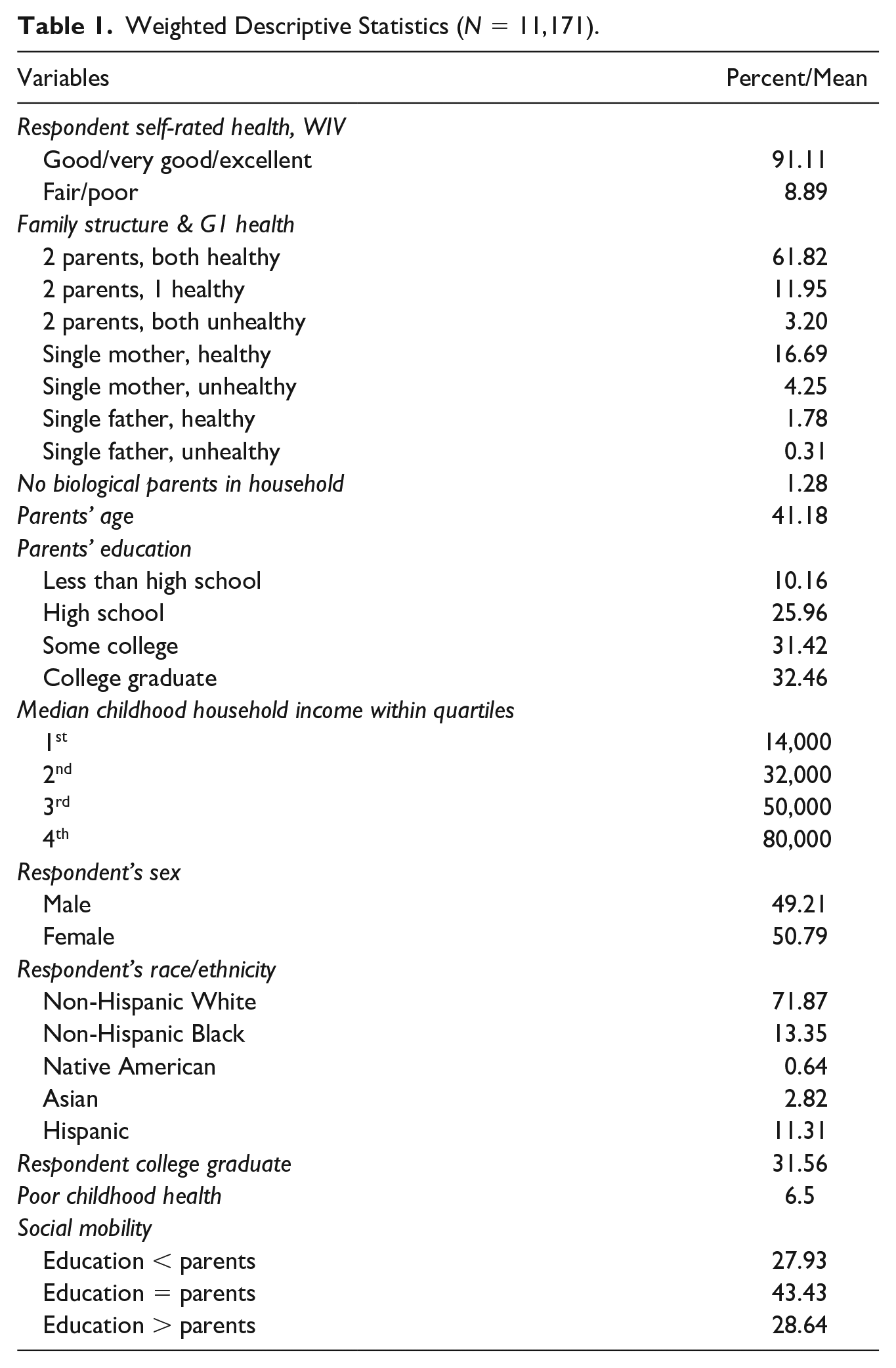
Weighted Descriptive Statistics (N = 11,171).
Analytic Strategy
We used a series of modified Poisson regression models to estimate the association between parent(s)’ health and the health of their children in young adulthood. Variables were introduced into models predicting poor health in four models that address our research questions. Model 1 contains the indicator of family structure and health, as well as key controls associated with the health outcome (age, gender, and race/ethnicity) to examine continuity in health across generations. Model 2 investigates the extent to which socioeconomic context during childhood and adolescence (captured by parents’ educational attainment and income in Wave I) explains this relationship. Model 3 examines whether health continuity operates through childhood health and educational attainment, and Model 4 examines whether mobility across generations changes this relationship.
There are several advantages to using modified Poisson regression models for this analysis. A Poisson regression model modified by the use of a robust error variance procedure known as sandwich estimation can be implemented when binary outcomes are independent (Zou, 2004). This technique provides a direct estimate of the risk ratio and has become a popular alternative to logistic regression. Estimating the risk ratio instead of the odds ratio has at least two advantages for our purposes here. First, the difference between unadjusted and adjusted odds ratios estimated from nested logistic models can differ even in the absence of confounding (Hauck et al., 1991). This is because the inclusion of a control variable that explains any of the variation in the outcome will alter the coefficient of the predictor of interest, even if it is uncorrelated with that predictor (Karlson et al., 2012). Risk ratios, on the other hand, do not share this property (Hauck et al., 1991). 2 Second, odds ratios estimated from logistic models will be upwardly biased, sometimes severely so, when the study outcome is relatively common ( >10%) across strata used in an analysis (Greenland, 1987; McNutt et al., 2003). The risk ratio is not susceptible to this potential bias as the occurrence of poor SRH in our data exceeds the 10% threshold for six of the seven categories of our predictor of primary interest. The estimated risk ratios, as they appear in our models, capture the likelihood of experiencing poor self-rated health in Wave IV as a function of respondent’s family structure and parents’ health, net of modelled covariates. Each model includes Wald-tests for pairwise comparisons of the multi-category family structure-parent health variable.
Results
Referring to Table 1, most respondents report good health in early adulthood (91%) and most were living with two healthy parents in adolescence (61.82%). The next most common experience was living with a single, healthy mother (16.69%), followed by two parents, one of which was in fair or poor health (11.95%). About one-third of parents were college graduates (32.46%) and just over 10% did not graduate from high school (10.16%). Similarly, approximately one-third of respondents were college graduates (31.56%). As a result, approximately 43% of respondents’ educational achievement was the same as their parents, while almost equal percentages achieved less and more education than their parents (27.93% and 28.64%, respectively).
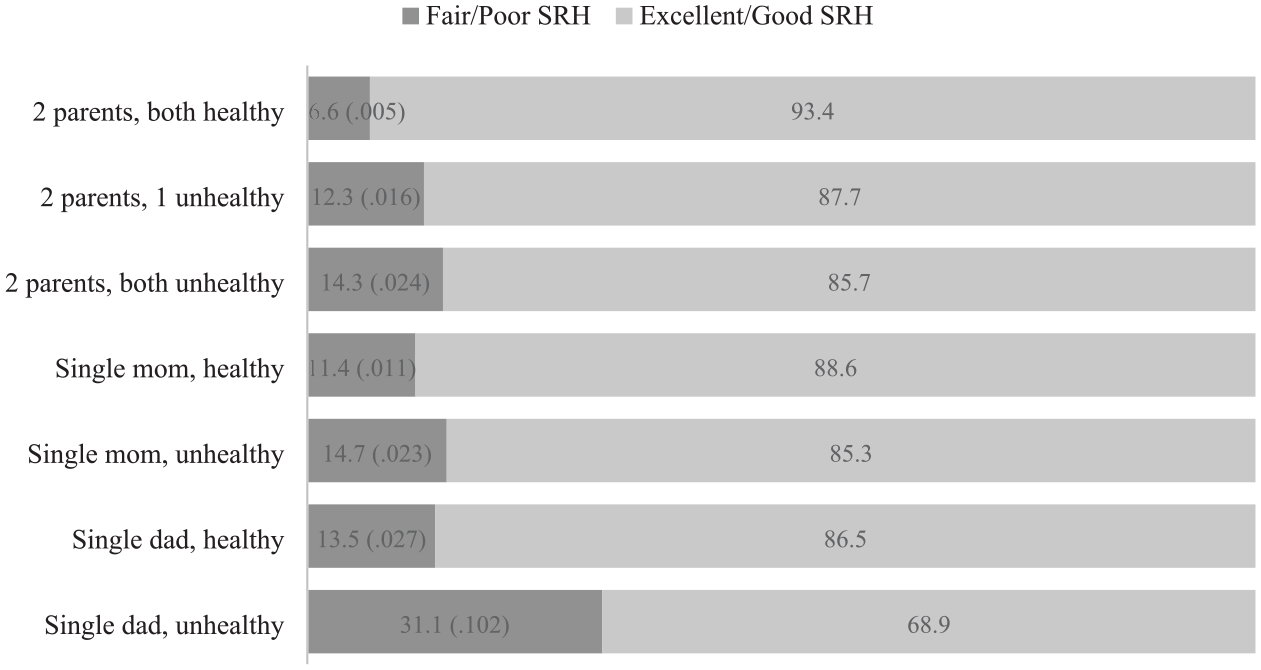
Table 2 displays the bivariate association between parent’s health-family structure and respondent SRH. The lasting advantage of having two healthy parents in adolescence is apparent as the proportion of respondents in poor health who experienced this family structure-health combination when young (6.6%) is considerably smaller than all other combinations. Respondents’ reports of fair/poor health range from 11.4% for those whose single mother was healthy to 14.7% for those with a single mother who was unhealthy. A large proportion of respondents reporting fair or poor SRH lived with a single father who was unhealthy (31%), although because of the small number of cases in this category (N = 35), these results should be interpreted with caution.
Weighted Percentage Distribution (and Standard Errors) of G2 SRH (W4) by G1 Health and Family Structure (W1) (N = 11,171).

Note: Data come from the Add Health.
W1 = Wave I; W4 = Wave IV.
Pearson’s
Test of homogeneity of odds ratios of G2 poor self-rated health by G1 health and family structure (W1) = 91.77 (p < .001), reference category = 2 parents, both healthy.
We next included variables representing several potential explanations for the correspondence of parent and child health in modified Poisson regression models. Wald tests for pair-wise comparisons of the family structure-parent health variables (denoted with superscripts in Table 3) were performed. Because these were consistent across the models, we discuss them in Model 4. Model 1 of Table 3 presents the effects of the health of parents in various family structures on respondents’ SRH in adulthood including controls for parents’ age and respondents’ gender and race/ethnicity. Compared to two-parents families in which both parents are healthy, all other parental health and family structure configurations increase the risk of poor health in adulthood. Two-parent families in which both parents are in poor health almost doubles the risk of respondents’ poor health compared to two-parent families in which both parents are healthy (RR = 1.917, p < .001). Not surprisingly, in two-parent families, having one parent who is unhealthy (RR = 1.782) is not as detrimental as having two unhealthy parents. Single-parent households in which the parent is unhealthy severely increases the risk of poor health in adulthood, particularly among families headed by a single father who is unhealthy (RR = 4.614, p < .001, CI 2.178–9.775).
Risk Ratios (and Standard Errors) from Modified Poisson Regression Analysis of Self-rated Poor Health by Parent Health, Family Structure, Demographic Characteristics and Socioeconomic Status (N = 11,171).

Note: Data come from the Add Health.
p < .05, **p < .01, ***p < .001.
Significantly different from 2 parents, 1 unhealthy, p < .05.
Significantly different from single father, unhealthy, p < .05.
Model 2 introduces controls for parents’ education and income during the respondent’s adolescence to examine the extent to which these factors explain the persistence of health advantage or disadvantage across generations. With the addition of these variables, the risk of poor health in adulthood is slightly reduced, but the results remain largely unchanged. Parents’ education significantly reduces the risk of respondents’ poor health at higher levels of education, but income quartile is not a significant predictor of health net of these other factors.
Childhood health and educational attainment are two mechanisms through which socioeconomic status and health are transmitted across generations. In Model 3, compared to those with lower levels of education, respondents with college degrees have a significantly lower risk of poor health in adulthood (RR = 0.348, p < .001). Net of other variables in the model, poor childhood health is not a statistically significant predictor of SRH. Although education is protective of health, the inclusion of these variables does not explain the effects of parental health-family structure and the magnitude of these variables remains largely unchanged.
In the final model we include a measure comparing the educational attainment of parents and children to examine whether intergenerational mobility changes the association between parent and child health. Net of the effect of parental educational attainment seen in the previous model, compared to children who attain the same level of education as their parents, those with a lower level of education are at a significantly higher risk of poor health (RR = 1.583, p < .01). Upward mobility through education does not significantly affect SRH in young adulthood, and intergenerational mobility does not change the relationship between parental health-family structure and respondents’ health. Finally, across all of the models, Wald-tests indicate that single-father families in which the father is unhealthy significantly increase the risk of poor health in adulthood compared to both single-mother families in which the mother is unhealthy and two-parent families with one unhealthy parent. Other comparisons were not significantly different, suggesting that the effect of one unhealthy parent in a two-parent family may be as detrimental to children’s long-term SRH as other intersections of family structure and parent health that are considered less advantageous.
Discussion
Although life course sociology points to the importance of considering linked lives and connections across generations, research on processes of intergenerational transmission of status largely overlooks the social reproduction of health advantage and disadvantage across generations within families. Overall, there is little research on the extent to which health inequality is passed down through families or the mechanisms through which this occurs. Previous research suggests that a large part of the association between the health of multiple generations is likely due to shared social and environmental contexts and it is important to gain a better understanding of the extent to which socioeconomic and family context in adolescence contributes to the transmission of health advantage and disadvantage across generations.
The findings demonstrate an enduring intergenerational persistence in health. Respondents with a parent in poor health were themselves significantly more likely to experience poor health in adulthood, regardless of family structure. These associations were not explained by mechanisms that have been examined in the previous literature—the intergenerational persistence of health remained in the presence of controls for childhood socioeconomic conditions, poor childhood health, human capital accumulation through education, and social mobility.
There is also evidence of the enduring role of family structure on children’s health as both single-mother headed and single-father headed family structures were associated with increases in the risk of respondent poor health in adulthood, net of income. If that parent was in poor health, the risk was even higher. A large literature concludes that two-parent families (particularly biological parents) are more protective for children’s health than other family forms and our findings suggest that these protections extend into adulthood. Although the largest health disadvantage relative to two healthy parents was experienced by respondents who lived with a single father in adolescence, whether the father was in poor health or not, this finding is based on a small number of cases and warrants further research. In 1994, the time of the Add Health interview, single-father families comprised only about 3% of families in the United States (U.S. Census Bureau, 2018). Research from multiple disciplines has produced somewhat contradictory findings on the health of children living with single fathers. Some studies based on data from the 1980s and 1990s found that although single fathers were better off economically than single mothers, adolescents living with single fathers have a higher risk of drug use and take part in other risky behaviors more frequently than children living in other family forms, including single-mother headed families (for review, see Ziol-Guest & Dunifon, 2014). More recent research has found little to no difference in the well-being of children in these families compared to those living with two biological parents (e.g., Bramlett & Blumberg, 2007). Overall, previous literature sheds little light on our findings and further research is needed on father-only families and child health.
Social mobility has the potential to loosen the link between the socioeconomic advantages and disadvantages of one generation and those of the next (Mare, 2011). Although little research has investigated the role of intergenerational social mobility on health in adulthood, there is some evidence that upward mobility does not hold the promise of improved health from one generation to the next (Willson & Shuey, 2016). We did not find evidence that upward social mobility improved SRH, however, downward social mobility across the generations was clearly associated with a greater risk of poor health. To reduce the possibility that health selection (or in other words, poor health leading to downward social mobility) is responsible for this association, we included a control for childhood poor health. However, this measure is imperfect and therefore health selection cannot be completely ruled out as an explanation for this finding. While this analysis provides some additional evidence that the detrimental health effects of early disadvantage may be irreparable, further research utilizing more refined measures of mobility could be informative.
Although our models include a number of potential explanations examined in the prevailing literature, continuity in health across the generations could be the result of mechanisms we were unable to measure, such as shared non-cognitive skills and personality traits, as well as proclivities often learned within the family context, such as perseverance and risk aversion, which may influence health through health behaviors. However, accumulating research demonstrates that shared genotypes are not the primary link between the behaviors of parents and their children and that social selection into shared health behaviors is as important as genetic selection (for a review, see Bauldry, et al., 2016).
Despite the important and unique opportunities provided by Add Health’s intergenerational data, there are several factors that should be considered when interpreting the results of this study. First, although our measure of SRH does not include the specific health condition experienced, advancements in medicine and changing social conditions may have resulted in disease profiles that differ over the period that the two generations were observed, making comparable experiences of disease difficult to measure (Jemal et al., 2005). The use of SRH mitigates this problem as it is a global health perception based on the absence or presence of disease as well as a self-assessment of functional health status (Krause & Jay, 1994). Second, only one parent, typically the mother, was interviewed in Wave I of Add Health and this parent reported their partner’s general health. Therefore, the reliability of measures of parents’ health in two-parent families relies in part upon the accuracy of mothers’ perceptions of their partners’ health. There is a large literature documenting the unpaid work of women in families to manage family health and to promote the health of their spouses (e.g., Reczek & Umberson, 2012), so although not ideal, we believe the measure is reasonable. Third, we do not distinguish between stepparent families and families that include two biological parents, although we do control for the presence of a biological parent in the household. Research suggests that children living in stepfamilies have poorer health compared to those living with two biological parents (e.g., Ziol-Guest & Dunifon, 2014), which could result in smaller differences between the effects of two parent families and the other family structures on health. Our analysis out of necessity misses some of the nuance of complex family living arrangements. Here our main objective is not a detailed analysis of complex living arrangements, but instead to account for the number of parents children have available as resources in the social reproduction of health advantage and disadvantage across generations. In this regard, we contribute to the literature concerned with the transmission of resources across generations that reproduce health inequalities. Finally, our measures of childhood family environment are static, capturing at one point in time during adolescence experiences that may change over time. Information on family history would be more informative, however data limitations do not allow for this level of detail.
Families provide the social context within which socioeconomic advantages and disadvantages are experienced and transmitted across generations. Sociologists have long been interested in the role of family experiences in shaping children’s life chances and as a mechanism in the reproduction of poverty and inequality (for review, see McLanahan & Percheski, 2008). However, only recently have researchers focused on the extent to which and social mechanisms through which health inequality is passed down through families. Incorporating the intergenerational transmission of inequality within families into the study of health disparities can advance our understanding of the social pathways through which existing inequities in health are reinforced and through which inequities in population health may be reduced.
Footnotes
Declaration of Conflicting Interests
The author(s) declared no potential conflicts of interest with respect to the research, authorship, and/or publication of this article.
Funding
The author(s) disclosed receipt of the following financial support for the research, authorship, and/or publication of this article: This research uses data from Add Health, a program project directed by Kathleen Mullan Harris and designed by J. Richard Udry, Peter S. Bearman, and Kathleen Mullan Harris at the University of North Carolina at Chapel Hill, and funded by grant P01-HD31921 from the Eunice Kennedy Shriver National Institute of Child Health and Human Development, with cooperative funding from 23 other federal agencies and foundations. Special acknowledgment is due Ronald R. Rindfuss and Barbara Entwisle for assistance in the original design. Information on how to obtain the Add Health data files is available on the Add Health website ( ). No direct support was received from grant P01-HD31921 for this analysis.