




Abstract
The parents of children with dyslexia often experience more parenting stress and depressive symptoms compared to other parents. Studies have shown that supporting and encouraging such parents help in reducing their frustrations, fear, anger, and low self-esteem towards their children. The purpose of this study was to identify and examine the different types of support needed by the parents of children with dyslexia and to explore the relationships between the required support with the parents’ marital status. Fifty questionnaires were distributed to the parents of children with dyslexia and analyzed. The findings showed that the type of support needed for parents of children with dyslexia could be grouped into social, peer-to-peer, financial, and government support. Furthermore, the analysis indicated that there were no significant differences between the social (p = 0.4014), peer-to-peer (p = 0.5020), and government (p = 0.7121) support with parents’ marital status. However, based on one-way ANOVA analysis, there was a significant difference found between the parents’ marital status and financial support (p = 0.0241). Accordingly, it is anticipated that the implication of this research could be used as a guide and a reference for supporting and encouraging parents of children with dyslexia and other learning disabilities.
Introduction
Dyslexia mainly refers to the learning disability associated with children, which include reduced educational attainment and academic self-esteem (Ross, 2019). However, while dyslexia has no single agreed explanation or definition of its cause, it has been associated with many detrimental outcomes that are primarily associated with children’s inability to learn and process information (Norton et al., 2015). Moreover, it tends to become more apparent in children once they reach school, although it can be possible to detect signs in preschool children (Snowling, 2013).
The most significant symptoms of dyslexia are regarding the difficulties that children face regarding their reading, writing, and spelling abilities, although it can also affect other areas such as working memory, sequencing, orientation, time management, and more. Therefore, raising and educating children with dyslexia is a challenging task (Multhauf et al., 2016). Parents of such children are at risk of psychological health problems that are prone to exacerbate over time (Brehaut et al., 2011). Previous studies have shown that the parents of children with dyslexia often display negative feelings regarding their children’s future life and academic pursuits (Burden, 2008; Ozonoff et al., 2002). These behaviors not only affect the children but also have a negative impact on the parents’ life as well (Rauf et al., 2018).
Research on dyslexia has generally focused more on the children with dyslexia, thereby paying less attention to the parents of children with dyslexia, and most of the existing research on dyslexia has tended to focus on supporting the children, for example, by developing techniques for children with dyslexia (Aboras et al., 2012; Alawadh, 2016), raising the needs to overcome their challenges (Peer & Reid, 2001; Politt et al., 2004; Reid, 2012), and providing support (Bull, 2003; Elbro et al., 1998). However, combining the support needed for the parents of children with dyslexia in raising their children is as helpful as helping the children themselves. In fact, parents are encouraged to attach themselves with relevant support groups to strengthen the social intervention in raising their children and towards improving their health condition (Committee on Early Childhood & Care, 2011). Thus, parents of children with dyslexia need to be supported with appropriate interventions for the well-being of both parties.
Another contributing factor towards the type of support needed by parents of children with dyslexia concerns marriage, given that it connects people to social groups, other individuals, and to other social institutions (Wade et al., 2013; Waite, 1995). Studies globally have shown that the strength of an individual’s social network determines their level of well-being, which is associated with beneficial outcomes such as longer life and better health (Helliwell et al., 2009).
Furthermore, studies conducted in Seoul (Han et al., 2013), South Africa (Cramm et al., 2012), Belgium (Hooghe & Vanhoutte, 2011), Germany (Winkelmann, 2009), and five other Asian countries have all indicated that a high level of life satisfaction is associated with strong social ties. Therefore, it can be anticipated that being married could serve as a cushion in contrast to the psychological suffering associated with raising children with dyslexia. Specifically, in this study, we hypothesized that married parents would suffer fewer difficulties in raising their children with dyslexia than individuals who were single, divorced, separated, or widowed. To accept or to reject the hypothesis, we identified and examined the different types of support needed by the parents of children with dyslexia and explored the relationships between the required support with the parents’ marital status.
Literature Review
Effects of Stress and Social Support on Mother-Child Interactions in Single- and Two-Parent Families
The direct effects associated with the absence of a child’s father include those resulting from the increased social, emotional, and financial stress on the mother, which can also affect the mother–child interaction. Life circumstances that are common to single-parent families, such as increased daily stress, more chaotic home life, task overload, decreased financial resources, and reduced social support, may influence maternal adjustment, parenting behavior, and child development. For instance, in single divorced women, financial stress predicts increased maternal demands and child-rearing restrictions (Varin-Mignano, 2013). Social and practical support for parents has also been linked to maternal adjustment, confidence, and parental self- esteem (Leahy-Warren et al., 2012).
It was hypothesized that single parents would face more stressful life changes compared to their married counterparts, have less supportive social networks, and generally have more difficulty in coping (Weinraub & Wolf, 1983). The pressures faced by married women centered around their home and family, whereas for single women, the stresses centered around changes in employment or responsibilities, living conditions, or personal goals. Compared to married mothers, single parents work significantly longer hours and tend to face more stressful life changes (Weinraub & Wolf, 1983). In addition, they tend to be more isolated and less consistent in their social contacts, less involved in organizations and parenting groups, and less supported emotionally in their parenting role. For example, a single parent such as a mother lacks social contact and practical and emotional support within her own home that might be available to a mother in a stable marriage (Weinraub & Wolf, 1983).
Nevertheless, regardless of gender, single parents fared no better or worse than married parents in their ability to exercise effective control, to display maternal nurturance, to easily communicate with their children, or the extent of maturity demands of a child (Wallerstein & Kelly, 2008). Single-parent families may also be characterized as experiencing more changes with less social support and being exposed to much higher risk regarding parenting behaviors compared to two-parent families. Emotional and/or parenting support and satisfaction surrounding the extent of support are associated more positively with mother–child interactions (Weinraub & Wolf, 1983). Opposingly, choosing to spend too much of that limited and precious time with the child could leave the single parent feeling lonely, isolated, and frustrated, perhaps increasing the single parent’s irritability towards the child.
Single parents seeking support and emotional contacts outside the home may, therefore, lead to more difficult and less gratifying experiences with their child. It is not too surprising, then, that increased social contacts are correlated with less effective mother–child interaction in single-parent families. The married mother has less conflict between meeting her own needs for emotional support and intimacy and meeting the needs of her child, since she can spend time with her husband and child without frequently having to choose one over the other (McLanahan & Adams, 1987).
Social Support, Stress, and Psychological Distress among Single Mothers
Insufficient economic resources are a further significant contributing factor to social dysfunction and depression among all groups of people, but single mothers appear to be particularly vulnerable in this case. The average income for a single mother with children is one-third of the income of married couples with children across all racial and ethnic lines (Park, 2018). Single mothers tend to have lower income due to low-earning capacities, lack of child support from non-residential parents, and low public assistance levels (Larson et al., 2017). One of the most difficult challenges facing single parents in raising their children without the support of another adult for decision-making, discipline, and child-related guidance.
Simmons-Hall (2018) contend that the continuing involvement of the father is important in reducing parental stress levels, while Carreras et al. (2019) suggest that the benefits of the father’s presence are contingent on the quality of the relationship between the father and mother. Therefore, having a social support network appears to reduce psychological distress and parental stress among single mothers. Tran and McInnis-Dittrich (2000) discovered that financial stress associated with single parenthood was less harmful than the dangers afforded through social isolation. Single mothers who feel socially isolated from either their family or friends showed consistently higher levels of psychological distress (Richard, 2018).
Financial stress, parental stress, and social support appear to influence the levels of psychological distress among single mothers. Further, the increased levels of parental stress associated with raising a child alone, the financial challenges of a single and often inadequate income, and the lack of social support are the factors that place female-headed families at risk. Similarly, single mothers having less support are more likely to experience more parental and financial stress, and, as a result, suffer from more psychological distress (Tran & McInnis-Dittrich, 2000). This implies that improving a single mother’s financial situation or employing efforts to alleviate parental stress is a necessary but not sufficient element in alleviating psychological distress in single mothers.
Support groups that focus on parenting issues have the dual benefit of providing single mothers with helpful insights about child-rearing as well as offering a natural support system to combat social isolation (Dowd, 1999). Working with families to reconnect and thus gain valuable support is essential for single mothers. Through joint counseling, support groups, and mediation, social workers can be instrumental in reuniting families or creating surrogate family support systems for the isolated single mother (Ulbrich & Warheit, 1989).
Materials and Methods
Research Design
This study applied the quantitative research method using a survey technique through the administration of an online questionnaire. The sample in this study was based on stratified random sampling, which is suitable for obtaining a sample from a large population (Rubin & Babbie, 2016). The questionnaire was posted on various Malaysian social media (Facebook) support groups, which included the “Dyslexia.my Parents Support Group,” “Rakan Disleksia (RD),” and “Pertubuhan Sokongan Ibubapa Dyslexia Malaysia.” The survey took around two months to collect the data.
Material
The instrument used in this research was partitioned into three parts. Section one related to the demographics of the respondents, which included their marital status, gender, number of children with dyslexia, and gender of the children with dyslexia. Section two consisted of questions on early symptoms of children with dyslexia and challenges faced in taking care of them. The questions included the type of information they wanted to know more about dyslexia and nature of their children with dyslexia. The last section consisted of questions about the support the parent received concerning their children with dyslexia.
Two PhD students reviewed the designed questionnaire along with two dyslexia specialists, regarding the construct of the questionnaire, comprehension, and contextual relevance. Several changes were made to the questionnaire, as suggested by the reviewers following the pilot test. An online link was also created to collect responses for the participants in the main study.
Participants
The sample consisted of 50 parents having at least one child with dyslexia. The mean number of children from the sample was equal to three, and 94% of the participants were women (mothers). The remaining participants were men (fathers), in which 92% were married while the remainder were either divorced or widowers. The participants were selected applying purposive sampling, based on a prerequisite condition (Etikan et al., 2016). The prerequisite condition was that the participant must be a Malaysian who had at least one child with dyslexia, and the parent should have received at least one type of support.
Data Analysis
The data were analyzed using SAS JMP for Windows 10. Both descriptive and inferential statistical methods were employed to analyze the feedback. To determine the relationship between the type of support needed for parents of children with dyslexia and their marital status, a univariate analysis of variance (ANOVA) was performed, with the parents’ marital status as the independent variables and statements representing the type of support as dependent variables. The general null hypothesis was that “There is no significant difference between the types of support and the parents’ marital status.”
Results and Discussion
Support for the Parents of Children with Dyslexia
The effects of dyslexia can be troublesome for children and their parents. As such, there is a genuine risk that parents’ anxieties will be transmitted to their children (Rose, 2009). Therefore, the parents of children with dyslexia need support to improve their approach to raise their children and to enrich them with the best possible support and encouragement (Rauf et al., 2018). The various support needed for parents of children with dyslexia was extracted from the responses received from the questionnaire, which were grouped into peer-to-peer, government, social and financial support, as illustrated in Figure 1.
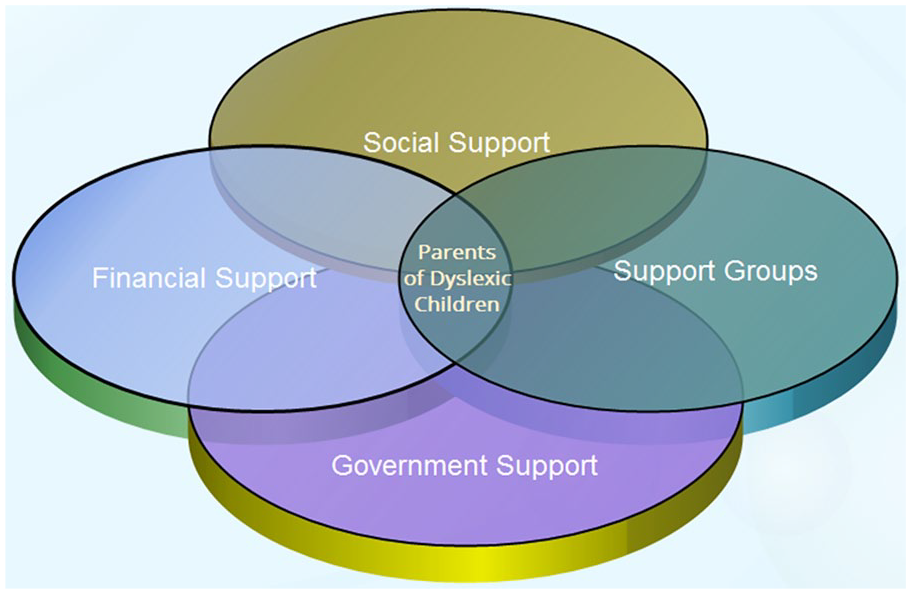
Different Types of Support for Parents of Children with Dyslexia
Support group (Peer-to-Peer)
A peer-to-peer support or a support group is a unique form of service in which people who share a common issue come together and support one another since they face common challenges and share similar experiences (Association, 2014). Collaborative platforms are also created to provide mutual support and friendships, and to obtain new information or knowledge about children with dyslexia (Papageorgiou & Kalyva, 2010).
A qualitative study has suggested that parents perceive benefits from support groups, and the effect can be seen across different types of support and conditions (Shilling et al., 2013). Parents who join support groups tend to have less child-related stress and feel less isolated from society (Papageorgiou & Kalyva, 2010). Indeed, it also increases the parents’ confidence level by talking with other family members (Wang & Michaels, 2009).
Four themes of the main reasons for support groups have been identified in a study by (Shilling et al., 2013), which includes the learning from the experiences of others, sharing a social identity, supporting others, and for personal growth. Similarly, (Papageorgiou & Kalyva, 2010) observed that 64.5% of parents that participate in support groups are regularly updated and informed about new developments in learning disabilities (LD), like new treatments. Other reasons are to learn and receive advice about new methods of handling LD children, and to meet and socialize with other parents of LD children or who require psychological support (Papageorgiou & Kalyva, 2010).
Peer-to-peer support provides numerous benefits, including helping parents of children with dyslexia to feel more positive about themselves, reducing their stress and feelings of depression, and seeing their children relationships improve (Buck, 1977). Therefore, it is highly encouraged for parents of children with dyslexia to participate in support groups to listen and learn based on other parents experiences, which include obtaining information to gain a much better understanding about specific disabilities; learning about typical growth patterns of children with dyslexia, and their development, teaching strategies, and techniques in managing child behaviors; and to understand and utilize funds and support mechanisms (Wang & Michaels, 2009).
Government support
The government plays a significant role in supporting parents of children with dyslexia. According to (Wang & Michaels, 2009), 27.35% of parents want more professionals to interact with their children with dyslexia and to provide professional training on how to handle the affairs of their children. Also, 22% of parents want the government to increase social awareness regarding dyslexia and regarding the needs and privileges of children with dyslexia (Wang & Michaels, 2009).
Therefore, it is of vital importance that the government work with qualified dyslexia professionals to devise clear and definitive definitions of dyslexia and that they refer to gaining the proper support from educators, empowering them to help pupils in their care to fulfill their academic potential. In Malaysia, the government has supported the parents of children with dyslexia by increasing special education programs in several public universities and special education teachers’ training institutes (Nasir & Efendi, 2016).
Furthermore, more schools have been designed to be more accessible and dyslexia-friendly, making it compulsory for each new school, whether it be public or private, to follow the universal design (Nasir & Efendi, 2016). The Malaysian government has also provided educational programs and support services to parents to ensure their children do not leave school because of dyslexia (Arukesamy, 2017).
Social/Family support
Social support is the advice and encouragement received by the parents of children with dyslexia from either their spouse, extended family members, or friends (Papageorgiou & Kalyva, 2010). This type of supports plays a vital role in the mutual obligation and communication between parents and their children (Papageorgiou & Kalyva, 2010). It also helps to reduce the level of stress and depression of parents (Meadan et al., 2010) and to improve their lifestyle, especially when they involved in recreational activities or community programs (Meadan et al., 2010).
The family is a central support system for the parents of children with dyslexia, as it is an essential factor in parent–child interactions (Heiman & Berger, 2008). Family support helps parents to share their feelings and problems and to receive different interventions strategies in taking care of their children with dyslexia (Heiman & Berger, 2008). Parents often feel better supported when they are included in decisions regarding their children, are treated with proper respect, and areinvolved in childcare (Leitch, 2008). Therefore, in order for parents to fully understand their own needs and the needs of their children, an effective intervention program for parental support within and outside the family is needed.
Financial support
Financial support helps the parents of children with dyslexia an opportunity to attain services like additional educational aid and to satisfy the children’s daily needs (Cen & Aytac, 2017). Financial support is crucial because once it is provided, parents can focus more on their child’s disability and manage them better (Cen & Aytac, 2017).
Analysis of the Various Support for Parents in Raising Children with Dyslexia
In this study, different statements were used in the questionnaire to represent and capture the various support received by the parents of children with dyslexia. The responses were then analyzed to the parents’ marital status, with the results presented in Table 1.
Relationships between Support and Parent’s Marital Status.
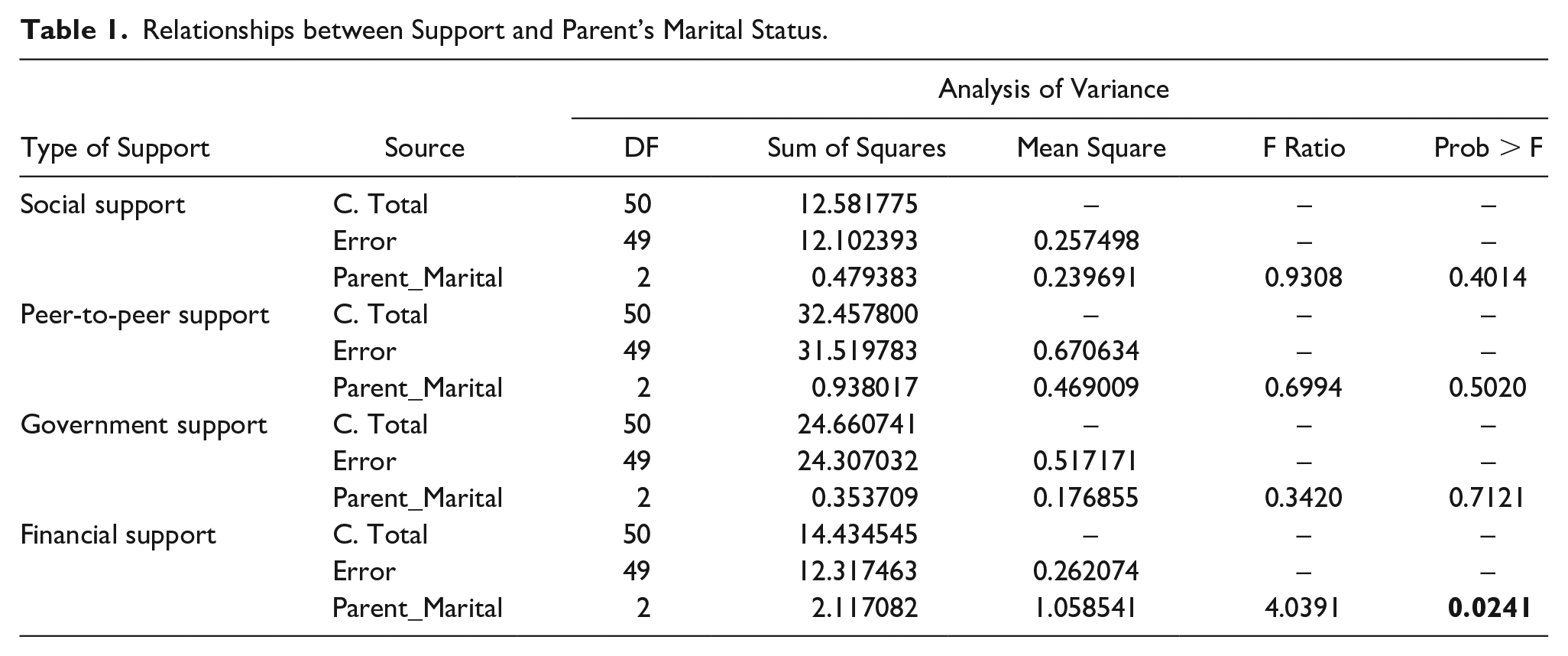
As shown in the table, the result representing the social support indicates that, generally, the difference among the parents’ marital status on the statements representing the social support received by parents of children with dyslexia is insignificant [F(50) = 0.93, p > 0.05]. This implies that family and friends do not isolate children with dyslexia regardless of the parents’ marital status, but instead, they support and encourage them. Additionally, most of the respondents agreed that social/family support helped them to feel more accepted and secure as parents. Therefore, married parents may acquire more supportive family members and friends compared to single parents (divorced and widowed).
For the support groups (peer-to-peer), the result indicates that the difference among the parents’ marital status on the statements representing their involvement with parents of children with dyslexia is insignificant [F(50) = 0.70, p > 0.05]. This means that irrespective of the parents’ marital status, they have an equal opportunity to gain from their involvement in support groups, helping them to feel safer and more comfortable in sharing their thoughts, opinions, and experiences with other parents. Also, the responses revealed that regardless of the parent’s marital status, the main reason they tended to join a support group was to gain knowledge and improve their understanding regarding dyslexia, which would help them to improve their children’s conditions.
Regarding government support, the result has also shown that, generally, the difference among the parents’ marital status on the statements representing the level of government support received by parents of children with dyslexia is insignificant [F(50) = 0.34, p > 0.05]. The responses also revealed that most of the parents of children with dyslexia faced difficulties in locating a specialist doctor or teacher for their children. Further, they want society to understand and become more aware of dyslexia. Also, from the responses, it was observed that most of the parents requested support from the government in providing more visual-audio learning aids in schools to assist their children in fulfilling their academic potential. The parents also requested the government to increase awareness campaigns regarding dyslexia and other LD in society.
In contrast to the results of the three types of supports as mentioned, the result regarding financial support indicated that, in general, the difference among the parents’ marital status on the statements representing the extent of financial support received by the parents of children with dyslexia is significant [F(50) = 4.04, p < 0.05]. Accordingly, this indicates that married parents experienced less financial burden in raising their children with dyslexia when compared to single parents having limited sources of income. Moreover, single parents experienced more mental stress and economic burden whenever the price of medicine and therapies increased compared to married parents. The results also suggest that banks and insurance companies in Malaysia do not entirely support LD in the community. The responses also suggested that most of the parents had self-sponsored therapy and day-care for their children. As such, this shows that only a minor number of insurance companies cover LD treatments.
Nevertheless, it is evident from the findings of this study that there is a significant difference between the marital status of parents and financial support. Moreover, from reviewing the literature related to this issue, it also reveals there is little direct financial support available to families towards the costs associated with dyslexia. Therefore, it is recommended that government and other charitable foundations become more active in financially supporting the parents of children with dyslexia.
Challenges Faced by Parents in Raising Children with Dyslexia
As this study has shown, parents face many challenges in raising and controlling children with dyslexia. The most prominent challenges include:
The limited knowledge or understanding of children with dyslexia by the general public makes it difficult for parents tasked with raising children with dyslexia.
Parents find it difficult to access reasonably priced centers for intervention programs as most programs and centers are expensive or inaccessible to these parents.
There are limited support programs for children with dyslexia, thereby shifting the entire responsibility to parents to confront the challenges of children with dyslexia.
Due to limited intervention programs, support, and limited awareness of dyslexia by parents, they are often characterized as having inadequate skills in handling children with dyslexia.
The educational system specifically designed for children with dyslexia is restrictive, making it difficult and confusing for parents to decide on the child’s school and education.
In certain cases, parents experience tantrums and outbursts of behavior from their children with dyslexia due to frustration or anger, thereby alarming and deterring parents in gaining the required support and skills for their children.
In most cases, parents feel a sense of low self-esteem towards their children, which is a demoralizing factor that hinders parents in providing the necessary support and care to the children.
Teachers have limited knowledge of dyslexia, making it difficult for them to communicate about the disability and LD appropriately to their parents. As such, parents find it difficult to prepare and continue to raise their children from an early stage.
Conclusion
This study has investigated the varied types and forms of support needed and expected by the parents of children with dyslexia. In undertaking this examination, the relationships between the required support and the marital status of parents have also been explored. The results from analyzing 50 distributed and returned questionnaires from the parents of children with dyslexia revealed that the type of support needed for parents of children with dyslexia could be grouped into social, peer-to-peer, financial, and government support. Furthermore, the analysis also indicated that there were no significant differences between social, peer-to-peer, and government support to the parents’ marital status. However, based on one-way ANOVA analysis that was carried out, there was a significant difference between the parents’ marital status and financial support offered to parents. Accordingly, the findings and implications raised in this research could be used as a guide or reference in supporting and encouraging parents of children with dyslexia.
There are several limitations inherent in this study. One limitation concerns the different types of supports among parents of children with dyslexia and does not compare the type of support received according to their respective locations and family/personal circumstances. Second, the analysis only involved 50 respondents who were surveyed. Therefore, acquiring a larger sample of participants could provide more accurate details regarding the type of support needed by parents of children with dyslexia and the issues they faced. In future, the researchers of this study should aim to analyze the different types of support needed by these parents based on their locations and family/personal circumstances.
Footnotes
Declaration of Conflicting Interests
The author(s) declared no potential conflicts of interest with respect to the research, authorship, and/or publication of this article.
Funding
The author(s) disclosed receipt of the following financial support for the research, authorship, and/or publication of this article: This research is supported by University of Malaya Research Grant RP059B-17SBS
