



Abstract
The primary aim of this paper is to examine the links between young women’s schematic configurations about work and family with their educational attainment at critical transitions of early adulthood. More specifically, as opposed to assessing the effect of educational expectations and personal background factors on educational outcomes separately or independently, the present research examines the significance of young women’s schematic profiles, that is, work-family orientations, highlighting the interconnectedness of how young women combine various attitudes and expectations about family, education, and work. Thus, this paper investigates the extent to which belonging to certain latent classes of work-family orientations are associated with the amount of education women are obtaining in early adulthood. Using data from the Relationship Dynamics and Social Life study, I examine how combinations of work-family schemas are associated with young women’s levels of education, and the role of personal background variables in shaping these work-family orientations.
Educational expectations are often considered to be among the most significant factors related to an individual’s educational attainment and later socioeconomic status (Haller & Portes, 1973; Sewell et al., 1969; Sewell & Hauser, 1980). However, as young people’s future goals about work and career are not always considered separately from their attitudes and expectations about family (Eccles, 1994; Greene & DeBacker, 2004; Johnson-Hanks et al., 2011; Marini et al., 1996; Weinshenker, 2006), research has shown that gender ideologies related to family and work are also significant to educational outcomes, especially for young women (Kimmel, 2000; Padavic & Reskin, 2002). While some studies show that young women generally hold more egalitarian gender ideologies compared to their male counterparts (Bolzendahl & Myers, 2004; Davis & Greenstein, 2004; Fan & Marini, 2000), young women’s attitudes about work and family are found to be more closely related and significantly more influential to their educational expectations, compared to the impact of these attitudes among young men (Davis & Pearce, 2007). This greater significance of gendered ideologies about work and family on young women’s future trajectories thus warrants further examination of specifically how young women’s various attitudes about family and work may be related to the education they obtain in early adulthood.
As such, the primary aim of this paper is to examine the links between young women’s work-family orientations and their educational attainment. Building on prior studies that have explored the significant and varying relationships of education, work, and family across different social backgrounds (Brand & Davis, 2011; Musick et al., 2012; Weinshenker, 2006), this paper’s examination of work-family orientations highlights the interconnectedness of how young women combine various attitudes, expectations, and identities about family, education, and work, essentially as configurations of schema. The central question of this study thus concerns the extent to which belonging to certain latent classes of work-family orientations may be associated with the amount of education women are obtaining in early adulthood. Through a series of multinomial logistic regressions using survey data from the Relationship Dynamics and Social Life study (RDSL 2008–2011), I examine which combinations of schemas about work and family that a woman has between the ages of 18 years and 20 years are significantly associated with the level of education she has obtained two years later.
Background
Forming the theoretical background for this study of how young women’s work-family orientations are related to subsequent educational attainment are (a) the Theory of Conjunctural Action (TCA; Johnson-Hanks et al., 2011), and (b) an identity-based model for culture in action (Miles, 2014). Drawing from Sewell’s model of structure as the recurrent patterning of social life (1992), the Theory of Conjunctural Action framework describes how schemas and materials interact to shape individual behavior and action at specific conjunctures, particularly in family contexts (Johnson-Hanks et al., 2011). Schemas, which are developed primarily through interactions in social contexts, are underdetermined ways of perceiving and acting through which individuals make sense of the world around them (e.g. ideas, values, and habits of the mind). Individuals have access to multiple schemas that may be partially contradictory, competing with one another, or mutually reinforcing. Materials, which are distinct from but interdependent with schemas, consist of the physical objects and conditions that instill and reinforce schemas in an individual’s perceptions and experiences. Material conditions and constraints may require individuals to adjust available schemas or to develop new ones, but new and existing schemas can also influence how material structures change or develop over time. Moreover, schemas and materials interact in particularly significant ways during conjunctures, or short-term configurations of structure in which an individual’s action may occur. Conjunctures, such as an unintended pregnancy, admittance to a college out-of-state, lay-off from work, or an unexpected end to a committed romantic relationship, pose opportunities for individuals to draw from available materials and a range of schemas, in response to a specific set of circumstances (Johnson-Hanks et al., 2011).
In a similar vein, Miles’ identity-based model for culture in action also elaborates upon the process through which individuals negotiate between identities and behavior (2014). Recognizing that people have multiple identities and try to behave in identity-consistent ways, Miles highlights that situational cues (i.e., materials) and meanings held by the individual (i.e., schemas) interact to activate salient identities that can direct and influence less salient ones (Stryker & Serpe, 1994). As an extension of situational cues that interact with an individual’s schematic meanings, Miles notes that resources are also necessary for individuals to verify salient identities and act in ways that are identity-consistent. Without the necessary capacity—in the form of material resources, cultural capital, social roles, or skills (Bourdieu, 1986; Dumais, 2002)—to enact and maintain the self, individuals may be required to adjust their identities and schemas.
On one hand, the TCA framework is particularly notable in the way that it maintains the tension and multidimensionality of overlapping structures in an individual’s life experiences. When considering the conjuncture of an unintended pregnancy between two working individuals, for example, does reproduction construct the context for work, or does work form the context for reproduction (Johnson-Hanks et al., 2011)? The TCA framework highlights the significance of how multiple structures “conjoin” or come together at specific conjunctures, through which individuals have the opportunity to draw from a range of schemas. In light of this broader theoretical framework, the identity-based model for culture in action proposes that identity salience may be one of the organizing principles by which individuals draw from specific schemas to influence subsequent outcomes (Miles, 2014). Taken together, the multiple schemas described in the TCA framework and multiple identities in the identity-based model for culture in action motivate further examination of how the certain combinations of salient schemas that young women form about their future work and family may be significant to their educational outcomes in early adulthood.
Given the diversity of young women’s goals and expectations related to career, marriage, and family (Greene & DeBacker, 2004), the present study builds on prior work that has identified four unique work-family orientations among young women, or combinations of schemas that young women hold regarding parenting, partnering, education, and work (Lee, 2018). By using latent class analysis (LCA), work-family orientations do not constrain the relationship between work and family as independent or unidirectional, but, instead, recognize the interplay between schemas that involve parenting, partnering, education, and work, while also identifying which schemas may be more salient within these distinct schematic configurations.
These four latent classes of work-family orientations held by young women include: Career-Family Idealists (CFI), Family Agnostics (FA), Independent Maternalists (IM), and Family Conventionalists (FM), each of which I will describe in further detail in the following section. Each of these work-family orientations represents different configurations of schemas and salient identities that are held by young women in the transition to adulthood. 1
Description of Work-Family Orientations
Of the four work-family orientations in this study, the first class, CFI, comprise about 33% of the sample. CFIs are most likely to give the highest response for educational expectations (graduate school) and are also likely to agree that work is a major source of satisfaction in their lives. The salience of this class’ expected identity as “spouse” is very high, as is their expected identity as “mother.” While CFIs are likely to agree that motherhood is one of the most fulfilling experiences in life, the centrality of motherhood among CFIs is not quite as high as some of the other latent classes. If CFIs were to “get pregnant now,” they are likely to strongly agree that this would be the “worst thing,” that they would have to quit school, and that they are not yet prepared to handle the responsibilities of parenting. However, CFIs are least likely to agree that one may have trouble getting pregnant if one waits for the perfect time.
The second class, FA, about 14% of the sample, are likely to report their educational expectations as attending a four-year college or graduate school. FAs are most likely to strongly agree that they expect work to be a major source of satisfaction in their lives. The salience of this class’ expected identities as “mother” and “spouse” is extremely low, especially in terms of “becoming a mother.” FAs are least likely to consider motherhood as the most fulfilling experience in a woman’s life. If FAs were to become pregnant at the present conjuncture, they are likely to respond that they would have to quit school, that getting pregnant would be “the worst,” and that they are not prepared for the responsibilities of parenting. FAs are likely to disagree that they would marry their partner if they were to get pregnant.
The third class, IM, about 25% of the sample, are likely to expect to attend a four-year college or a vocational/technical/community college, and most likely to consider motherhood as one of the most fulfilling experiences. The salience of this class’ expected identities as “spouse” and especially as “mother” is very high. However, relative to previously mentioned classes, this class is not as likely to expect work to be a source of major satisfaction. If IMs were to become pregnant at the present conjuncture, they would not consider getting pregnant to be the “worst thing,” are likely to respond that they would not quit school, and are most likely to expect not to marry their current partner. IMs also believe that they would be prepared to handle the responsibilities of parenting, and they are most likely to agree that it is difficult to wait for the perfect time to be become pregnant.
Lastly, FC, who comprise about 28% of the sample, are most likely to expect to attend a four-year college or vocational/technical/community college, and are least likely to strongly agree that they expect work to be a major source of satisfaction. The salience of this class’ expected identities as “mother” and “spouse” is very high, but not as high as CFIs or IMs. FCs agree that motherhood is one of the most fulfilling experiences, and they are most likely to expect to marry their current partners if they become pregnant. If FCs were to become pregnant at the present conjuncture, they are not nearly as likely as CFIs and FAs to respond that this would be the “worst thing,” and would likely agree that they could handle the responsibilities of parenting.
Prior work has shown that young women’s work-family orientations are significantly associated with sociodemographic factors, such as parents’ income, parents’ education, race/ethnicity, and religious participation (Lee, 2018). The present study will be an extension of this research to explore two central questions: first, the significance of these latent classes for young women’s educational attainment in early adulthood; and second, the extent to which young women’s work-family orientations may be related to the effect of sociodemographic characteristics on educational outcomes.
This Study
As the theoretical implications of the TCA framework and identity-based model for culture in action would suggest, I expect the unique work-family orientations held by young women to be significantly associated with measures of their educational attainment. For those work-family orientations in which education and work are more salient aspects of young women’s identities, that is, CFIs and FAs, I expect membership in these latent groups to be positively associated with higher educational attainment. Since CFIs consider both their educational and family goals to be of equal importance, it is likely that educational attainment among CFIs would not be deterred even with aspirations of marriage and parenthood. FAs, who do not have strong aspirations for parenting or partnering, would also be likely to be able to continue pursuing higher levels of education through early adulthood. On the other hand, I expect the FCs to be most closely associated with lower educational attainment. While the centrality of motherhood is significant to the schematic configurations of both IMs and FCs, work and career are still salient aspects of the schemas held by IMs, relative to FCs whose priorities are heavily focused on marriage and parenthood.
However, considering the significance of material contexts and resources to schemas in TCA (Johnson-Hanks et al., 2011), the possible impact of young women’s personal background characteristics upon work-family orientations and educational outcomes must also be taken into account. Previous research makes clear the significant associations of parents’ education, occupation, and income with young people’s educational aspirations and attainment (Buchmann & Diprete, 2006; Cohen, 1987; Mau & Bikos, 2000; Rhea & Otto, 2001). In particular, studies suggest that higher levels of mother’s education are closely linked to adolescents adopting more egalitarian attitudes about gendered family roles (Blee & Tickamyer, 1995; Cunningham, 2001; Thornton et al., 1983), which is likely to contribute to further academic and career achievement among young women. Additionally, studies show that religious service attendance is significantly and positively associated with higher educational outcomes (Glanville et al., 2008; Muller & Ellison, 2001), and that individuals from lower socioeconomic status families are significantly more likely to attend community colleges or be enrolled in postsecondary education part-time (Baker & Velez, 1996; Kao & Tienda, 1998; Reynolds & Burge, 2008). Prior work also reveals significant variations in the relationships between education, work, and family based on socioeconomic status, as the negative effects of a college education on marriage and fertility are found to be concentrated among women from less advantaged social backgrounds (Brand & Davis, 2011; Musick et al., 2012). As the work-family orientations of young women in the United States are likely to be interrelated with such contextual factors as family socioeconomic status, race/ethnicity, and religious participation, I will further examine the extent to which young women’s work-family orientations might mediate or help to explain the effect of these personal background characteristics on educational attainment in early adulthood.
Data and Methods
To answer my research questions, I use data from the Relationship Dynamics and Social Life (RDSL), 2 an innovative study designed to follow the relationship patterns and social contexts of young women between the ages of 18 years 20 years from one county in Michigan (N=1003) that was chosen because of the racial, ethnic, and socioeconomic diversity of its residents (Barber et al., 2011). These data are a representative, population-based sample, drawn from women residing in this county who were selected from the state driver’s license and personal identification card databases.
The first component of the study, launched in 2008, consisted of 60-minute, face-to-face, baseline survey interviews assessing aspects of family background; demographic information; a wide range of attitudes, values, and beliefs; current and past friendship and romantic relationships; education; and career trajectories. Following the baseline survey, all respondents were invited to participate in a journal-based mixed methods follow-up survey (by Internet or phone) for approximately two years. With a range of detailed measures on respondents’ relationships, education, attitudes, and schemas, the RDSL is a unique dataset particularly useful for examining the complex and dynamic nature of young women’s changing attitudes and relationships during early adulthood. Of the initial sample, 95% agreed to participate in the follow-up journal study. Each quarterly journal collected updates about respondents’ attitudes and education—the latest of the educational data which are the focus of the present analyses.
Independent Measure
Using 10 selected schematic indicators from the RDSL’s baseline survey (See Table 1), I draw upon the four latent classes of work-family orientations identified in Lee (2018) as the representative combinations of attitudes, expectations, and identities that young women hold with regard to parenting, partnering, education, and work. This measure of work-family orientations highlights common patterns in how young women combine these various schemas about their present and future relationships, education, and work. Taking into account the covariation of numerous attitudinal measures, LCA is essentially a data reduction technique that suggests a small number of latent classes in the population and uses patterns of individual survey responses to assign the probabilities that each case or person belongs to one of these classes (i.e., gamma estimates). Using LCA allows me to employ a set of profiles that reflect the most representative schematic configurations among young women in these analyses (Collins & Lanza, 2010).
Survey Measures Included in Latent Class Analysis of Work-Family Orientations (RDSL).
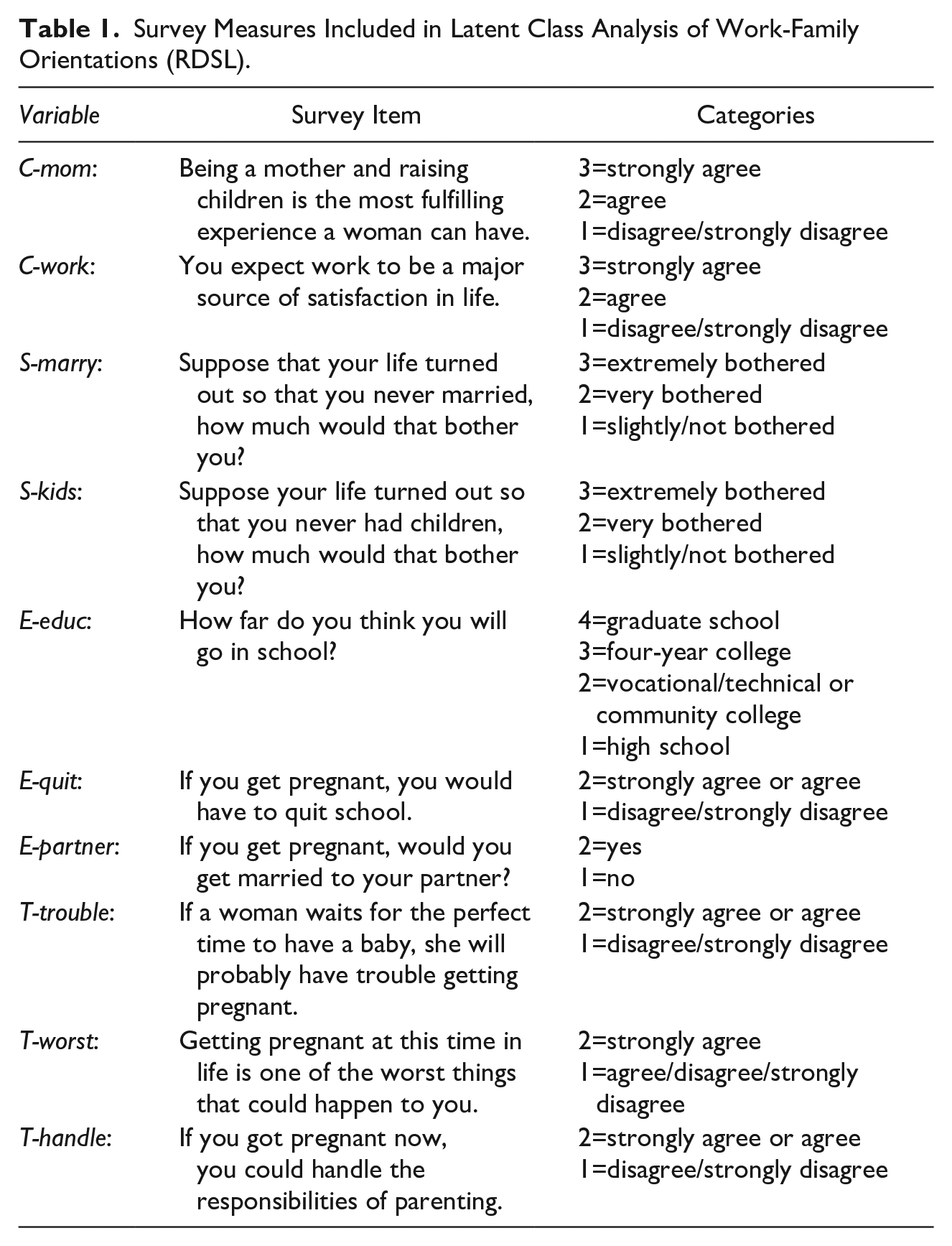
Furthermore, the main independent variable for this study is a categorical measure of young women’s latent class membership in one of these four work-family orientations at baseline. Based on the highest probability of an individual belonging to a latent class, respondents have been assigned to their most likely work-family orientation. 3 More specifically, as outlined in the summary of conditional probabilities for an individual’s responses to the selected survey indicators (Lee, 2018), the four categories of work-family orientations applied to this study are: (a) CFIs, (b) FAs, (c) IMs, and (d) FC. (See Table 2 for details about each latent class.)
Proportions and Conditional Probabilities of Responses for Four Latent Class Work-Family Orientations at Baseline (RDSL).

Note. SE in parentheses.
N = 984, entropy = 0.71.
Dependent Measure
As the main dependent variable, I use the measure of respondents’ highest level of education completed by ages 20 years to 22 years, drawing from the last available follow-up journal data on educational outcomes (approximately two years after the baseline measures of work-family orientations used in this analysis). The ordinal categories for this measure of educational attainment are (a) less than high school, (b) high school (c) some college or associate’s degree at a vocational/ technical/community college, and (d) some college or bachelor’s degree at a four-year postsecondary institution.
Personal Background Factors
Personal background factors that I further include in my analyses include survey measures of parents’ income, mother’s education, race/ethnicity, respondent’s religious attendance, and age. It is notable that I am focusing my analyses on factors that are specifically significant to young women in the U.S. context, given that the majority of pregnancies of women in this age range of early adulthood are unplanned; access to reproductive health care is limited for many low-income individuals; education, work, and family outcomes vary significantly by socioeconomic status and race/ethnicity; and that there are generally higher levels of religiosity in the United States, which are significantly related to patterns of family formation (Casares et al., 2010; Kim et al., 2016; Kramer et al., 2007; Peterson & Bonell, 2018). Moreover, as measures of family socioeconomic status, I use an ordinal variable of parents’ combined income, with categories of (a) $15,000 or less, (b) $15,000–45,000, (c) $45,000–75,000, or (d) $75,000 or more. 4 I also include mother’s education as an ordinal measure of whether the respondent’s mother has attended some college or higher, with categories of (a) less than high school, (b) high school or GED, (c) some college, and (d) bachelor’s degree or higher. In addition, as a measure of religious participation, I use a categorical measure of whether the respondent attends religious services on a regular basis, with categories of (a) more than once a week, (b) once a week, (c) few times a month or year, and (d) never. As control variables, I include a continuous measure of the respondent’s age, and a nominal measure of whether the respondent identifies as (a) white or (b) non-white. 5
Analytic Strategy
With the baseline measure of membership in each latent class work-family orientations and subsequent measures of young women’s education, I first conduct a multinomial logistic regression to examine the statistical associations between young women’s work-family orientations (at baseline) and their educational attainment at ages 20–22 years. Then, I assess the statistical significance of personal background characteristics to educational attainment, comparing the changing coefficients of these personal background variables after adding work-family orientations to the expanded multinomial logistic regression. More specifically, I examine measures of parents’ income, mother’s education, respondent’s race/ethnicity, religious attendance, and age, so as to evaluate the extent to which work-family orientations may mediate the effect of these personal background variables on educational attainment. Lastly, I compare the results of the full multinomial logistic regression model with an additive regression model of young women’s educational attainment using the attitudinal measures about pregnancy, family, education, and work without latent classes (Table 1). This final analysis will be used to strengthen the justification for applying this approach of latent class work-family orientations.
Results
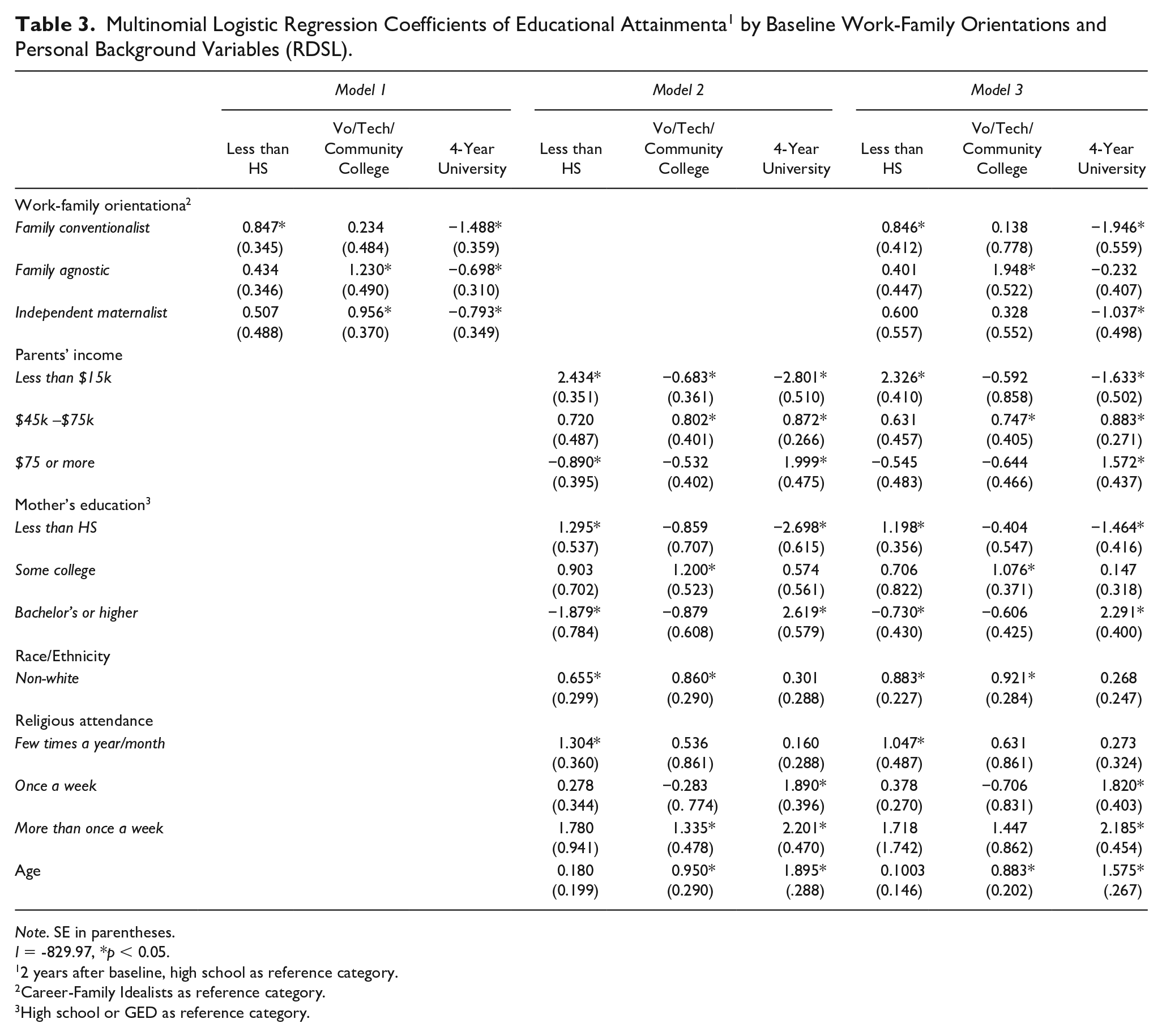
Statistical analyses using multinomial logistic regressions indicate that certain work-family orientations are more significant than others in models predicting educational outcomes at different levels of educational attainment. In the first model of variations in educational attainment by work-family orientations (see Model 1 in Table 3), I find that CFIs are significantly more likely to have completed a bachelor’s degree-level education by age 22 years, compared to all other work-family orientation groups (CFIs as reference category). Results in this first model of work-family orientations also suggest that, compared to CFIs, FAs and IMs are significantly more likely to have completed some vocational/technical/community college education, and FCs are significantly more likely to have completed less than a high school education. In models not shown here, I find that FCs are also less likely than all other work-family orientations to complete a bachelor’s degree-level education, and FAs are more likely than all other work-family orientations to have completed vocational/technical/community college education.
Multinomial Logistic Regression Coefficients of Educational Attainmenta 1 by Baseline Work-Family Orientations and Personal Background Variables (RDSL).
Note. SE in parentheses.
l = -829.97, *p < 0.05.
2 years after baseline, high school as reference category.
Career-Family Idealists as reference category.
High school or GED as reference category.
Examining how personal background characteristics may be related to young women’s educational attainment, I find that parents’ income, mother’s education, race/ethnicity, religious attendance, and age are all statistically significant before including work-family orientations in the multinomial logistic regression. As shown in Model 2 of Table 3, lower parents’ income is significantly associated with less than high school educational attainment, while higher parents’ income is significantly associated with completing a bachelor’s degree-level education. Similarly, I find that having a mother who completed some college education is positively associated with respondents completing some vocational/technical/community college education, while having a mother with a bachelor’s degree or higher is negatively associated with respondents not finishing high school and positively associated with respondents also completing a bachelor’s degree-level education. In terms of religious attendance, results indicate that more frequent religious service attendance is positively associated with respondents completing a bachelor’s degree-level education by age 22 years.
In the subsequent analysis, I have added work-family orientations to the multinomial logistic regression of personal background characteristics and educational attainment. These results are shown in Model 3 of Table 3. Comparing first the results from Model 1 with Model 3 in Table 3, I find that the coefficients of work-family orientations on educational attainment remain fairly consistent, with few changes. Controlling for background factors, FAs are significantly more likely than CFIs to have completed some years of schooling at a vocational/technical/community college, while IMs and FCs are still less likely than CFIs to have completed a bachelor’s degree-level education. Mainly, the two changes in the expanded model with personal background variables are that there is no longer a statistically significant difference in FAs completing a bachelor’s degree-level education, and no statistically significant difference in IMs completing a vocational/technical/community college education, compared to CFIs. It is possible that part of the variation in these associations is being accounted for by other variables included in the model.
Comparing across the results in Models 2 and 3 in Table 3, I have further examined how the effects of personal background characteristics on educational attainment may be mediated or explained by young women’s work-family orientations. Based on a series of mediation analyses that I have conducted using a Stata module for decomposing the total effects of categorical variables (Buis, 2011), I find that there are indeed significant mediation effects of work-family orientations on the relationship between certain personal background characteristics and highest level of education completed (p < .05).
Results indicate that the effect of mother’s education on completing some vocational/ technical/community college education is significantly mediated by the FA orientation, where 4% of the total effect of mother’s education is accounted for by the indirect effect of work-family schemas held by FAs. For women who are FAs, it may be that their more educated mothers have instilled a value for education in them that has them presently downplaying the necessity of family formation, so they can focus on getting at least a two-year degree. Results also show that the FC orientation has a mediating effect on the relationship between mother’s education and completing some bachelor degree-level education, with 6% of the total effect of mother’s education being accounted for by the schemas held by FCs. In this case, women with a FC orientation have mothers with lower education, and it may be partly the schemas picked up from their mothers and other significant individuals that downplay educational achievements in favor of family formation, which mediate the relationship between mother’s education and educational attainment for them.
In terms of the relationship between parents’ income and completing some bachelor degree-level education, I find that parents’ income is significantly mediated by the CFI and IM orientations—where 7% of the total effect of parents’ income on educational attainment can be explained by its influence through the schemas held by CFIs, and 2% of the total effect of parents’ income can be explained by its influence through the schemas held by IMs. As discussed earlier, when resources such as family income are more readily available, young women are free to assume they can afford as much education as they desire, and parents and other adults are likely to be assuming and encouraging higher levels of education in addition to normative female family aspirations of becoming a wife and mother someday (Brand & Davis, 2011; Buchmann & Diprete, 2006; Cohen, 1987; Mau & Bikos, 2000; Rhea & Otto, 2001). Conversely, when resources such as family income are more limited, as is the case for many IMs, young women from such disadvantaged backgrounds may be more likely to adjust their aspirations for continued years of education (i.e., focusing on achieving a two-year degree in early adulthood) while they place greater immediate importance on motherhood. These patterns are consistent with prior work that has highlighted the significance of family context and constraints in shaping the expectations that young women hold about work and family (Weinshenker, 2006).
In addition to the mediating effects of work-family orientations on the relationship between socioeconomic variables and educational outcomes, results indicate that the effect of religious attendance on completing some bachelor degree-level education is significantly mediated by the CFI orientation, where 2% of the total effect of religious attendance is accounted for by the schemas held by CFIs. This is in line with other studies showing that religious service attendance, controlling for religious affiliation, is positively related to education attainment and stronger preferences for marriage and childbearing (Lehrer, 2010; Pearce & Thornton, 2007).
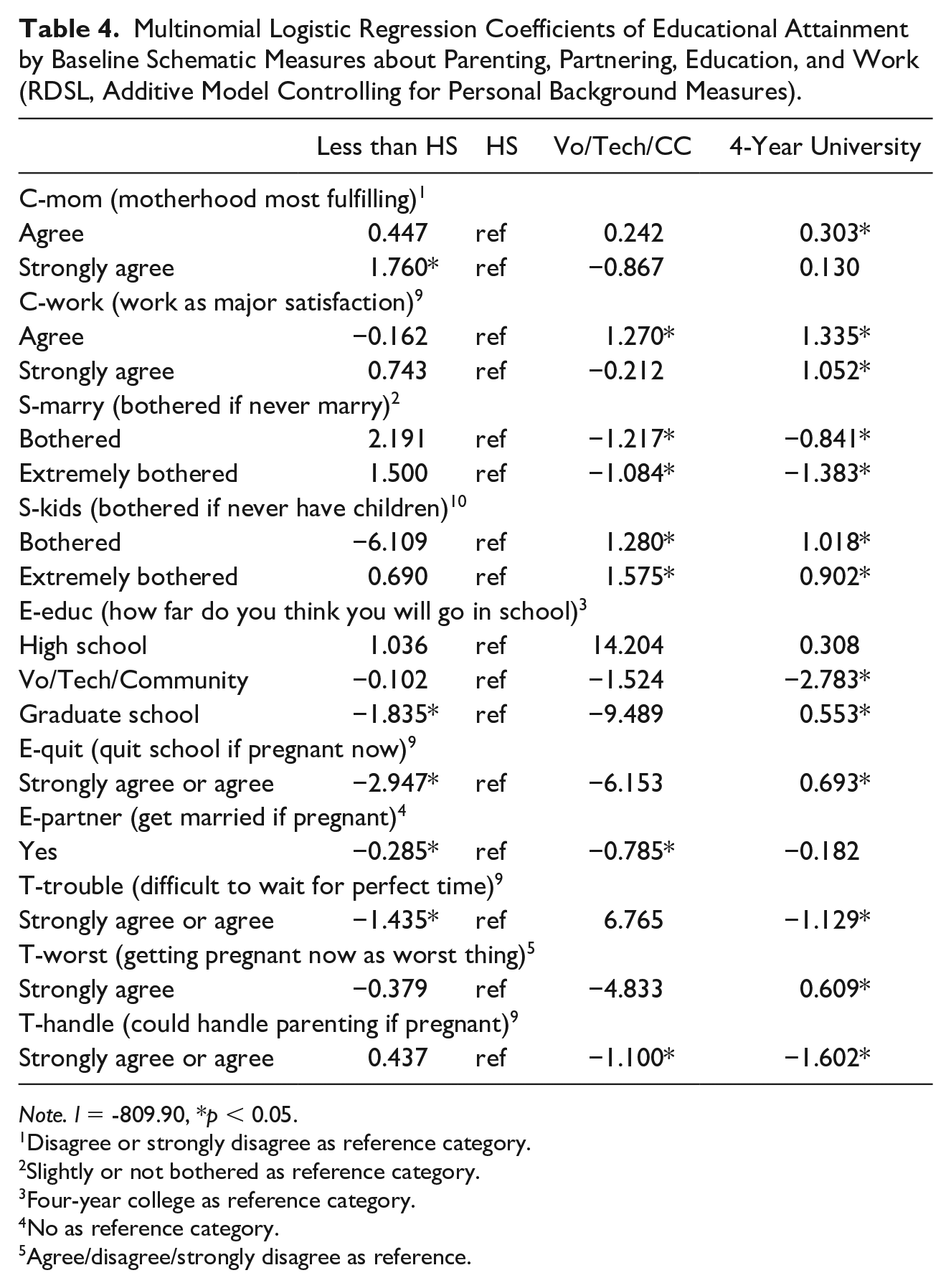
To lend further support for the use of work-family orientations in the aforementioned analyses, I estimated a multinomial logistic regression of educational attainment using the 10 individual schematic measures, instead of work-family orientations, as an additive model. These results, presented in Table 4, indicate that each of the 10 schematic measures is statistically significant in relation to educational attainment, controlling for personal background characteristics. However, in conducting a likelihood ratio test to assess the goodness of fit in the additive model compared to the model using work-family orientations, I find that there is not adequate evidence to reject the work-family orientations model in favor of the additive model with personal background characteristics (p = .999). In addition, the interpretability of the additive model presents critical challenges, as the statistical associations of the individual schematic measures are inconsistent across the different levels of education.
Multinomial Logistic Regression Coefficients of Educational Attainment by Baseline Schematic Measures about Parenting, Partnering, Education, and Work (RDSL, Additive Model Controlling for Personal Background Measures).
Note. l = -809.90, *p < 0.05.
Disagree or strongly disagree as reference category.
Slightly or not bothered as reference category.
Four-year college as reference category.
No as reference category.
Agree/disagree/strongly disagree as reference.
For example, the additive model shows that there is a positive and statistically significant association between the centrality of work to young women’s identities (i.e., “You expect work to be a major source of satisfaction in life”) and having completed vocational/technical/community college education as well as a bachelor’s degree-level education. The direction of the relationship between the schema for the centrality of work and educational attainment is quite clear. However, the same conclusion cannot be drawn for other schemas that have a more complex relationship with educational attainment. For instance, the schema for the centrality of motherhood (i.e. “Being a mother and raising children is the most fulfilling experience a woman can have”) is positively associated with having completed less than a high school education, while it is also significantly and positively associated with having completed some years of schooling at a four-year college or university. Given that young women indeed hold distinct expectations for parenting, partnering, education, and work in different combinations, the results of this additive model may provide a variable-centered analysis that highlights which schematic measure is significant in what way at which levels of education. The person-centered approach of using latent class work-family orientations, however, provides a valuable shift of focus toward more clearly understanding how unique configurations of schemas held by subgroups of individuals in the population may be significantly associated with young women’s educational outcomes at different levels of attainment.
Conclusion
This study highlights the significance that different combinations of schemas about parenting, partnering, education, and work, together with resources, have in influencing young women’s educational outcomes in early adulthood. Results suggest that the most significant difference in educational attainment is the greater likelihood that young women who are CFIs will have completed a bachelor’s degree-level education by age 22 years, compared to IMs and FCs. This configuration of schema, prizing career and family achievements, whether stemming from parental values and encouragement, the availability of family resources to make these kinds of aspirations possible, the quality of schools, the modeling of positive family interactions, or some combination of these, coheres to encourage these young women to make choices and have the resources to successfully pursue higher education straight from high school. These patterns not only have significant demographic implications, as young women today are increasingly delaying marriage and childbearing for both educational and financial reasons (Martin, 2017; Pew Research Center, 2018), but may also become significant to understanding the intersections of work, education, and family life among young women navigating the unequal challenges presented by COVID-19 across varying social contexts (McLaren et al., 2020).
It is important also to consider the significance of personal background variables, such as parents’ income, mother’s education, and religious attendance, and their role in shaping work-family orientations. In fact, I find that there are significant mediation effects of certain work-family orientations on the relationship between specific personal background characteristics and educational attainment—specifically, with the CFIs and IMs helping to explain part of the relationship between parents’ income and educational attainment; the FAs and FCs helping to explain the relationship between mother’s education and young women’s educational attainment; and the CFIs helping to explain part of the relationship between religious attendance and educational attainment. While these associations are consistent with much of the literature on women’s experiences of education and family (Buchmann & Diprete, 2006; Cohen, 1987; Cunningham, 2001; Glanville et al., 2008; Mau & Bikos, 2000; Muller & Ellison, 2001; Rhea & Otto, 2001; Weinshenker, 2006), these findings highlight more generally the importance of understanding the role of family context and mothers’ education and work in shaping children’s expectations. Especially considering the prevalence and varied experiences of working mothers, more research is needed to continue to examine these patterns intergenerationally.
Lastly, results in this study underscore the importance of understanding and modeling the interconnectedness of schemas and materials in the study of young women’s work-family lives (Johnson-Hanks et al., 2011). The schematic configurations of young women, which have direct significance for educational outcomes, are not independent from the socioeconomic resources and material contexts in which young women’s educational and family experiences are embedded. In fact, this study illustrates that the overall effect of various personal background characteristics may be manifested through the indirect effect of work-family orientations that young women hold and are likely to draw from at critical conjunctures in the transition to adulthood.
One limitation to this study is a short and early window in adulthood through which to observe educational attainment. Research indicates that women particularly of racial/ethnic minorities are more likely to complete higher levels of education at later ages (Musu-Gillette et al., 2016). Despite this limitation in the scope of available data, a significant contribution of the present analysis is that it highlights the influence of work-family orientations on the educational transitions of young women out of high school age and into post-secondary education trajectories. Future research may further investigate the educational trajectories of women throughout the life course, and how work-family orientations continue to matter, particularly in conjunction with significant life events such as pregnancy, marriage, and divorce. Overall, this paper contributes to the larger discussion of how young individuals’ experiences of combining schemas about work and family may influence their educational attainment in the first few of years of early adulthood.
The major strength of this data and analysis is the ability to extend prior work that has helped to identify and describe the multiple schemas and identities that are present among young women in the transition to adulthood, particularly with regards to expectations about family, marriage, work, and education (Davis & Pearce, 2007; Greene & DeBacker, 2004; Lee, 2018). This study is a critical first step in examining the significance of young women’s work-family orientations to substantive outcomes in early adulthood, and in doing so, brings together the TCA and the identity-based model for culture in action (Johnson-Hanks et al., 2011; Miles, 2014). By using the person-centered approach to examine young women’s work-family orientations, this study highlights the importance of understanding how various schemas are in interaction with one another to influence young women’s educational attainment in early adulthood.
Supplemental Material
JFI_wfo_education_appendix_final – Supplemental material for The Relationship between Young Women’s Work-Family Orientations and Educational Transitions in Early Adulthood
Supplemental material, JFI_wfo_education_appendix_final for The Relationship between Young Women’s Work-Family Orientations and Educational Transitions in Early Adulthood by Bo-Hyeong Jane Lee in Journal of Family Issues
Footnotes
Declaration of Conflicting Interests
The author declared no potential conflicts of interest with respect to the research, authorship, and/or publication of this article.
Funding
The author received no financial support for the research, authorship, and/or publication of this article.

Supplemental Material
Supplemental material for this article is available online.
Notes
References
Supplementary Material
Please find the following supplemental material available below.
For Open Access articles published under a Creative Commons License, all supplemental material carries the same license as the article it is associated with.
For non-Open Access articles published, all supplemental material carries a non-exclusive license, and permission requests for re-use of supplemental material or any part of supplemental material shall be sent directly to the copyright owner as specified in the copyright notice associated with the article.
