



Abstract
Previous research details women’s career launch and childbearing timing strategies without fully theorizing how such work–family plans may be developed alongside men. Overlooking men’s role in this process obscures how women’s partners can shape their work–family experiences. This study examines how young dual-professional couples plan two careers while timing childbearing. Interviews with 40 partners from 21 mostly White different-sex couples reveal that partners plan simultaneous career launches; sequence men’s career launches before women’s; or independently pursue career plans. These career launch strategies are not tightly linked to whether couples agree to forgo parenthood; delay childbearing; or initiate childbearing soon. In some couples, women had thought in more detail about childbearing timing in relation to the partners’ careers than men had. These couple-level data show that men’s career plans more directly shape women’s career plans than childbearing plans do because men and women can view childbearing as separate from career planning.
Keywords
Introduction
Cultural ideals and material conditions surrounding work, family, and gender in the United States create conflict for young heterosexual women who want to launch professional careers and also begin childbearing (Blair-Loy, 2003; Stone, 2008). Women who want to start having children while beginning professional careers violate raced and classed ideal worker norms (Acker, 1990), intensive mothering norms (Blair-Loy, 2003; Dow, 2019; Hays, 1996), and gender norms (Ridgeway, 2011). Further, workplaces and the state provide little material support for working parents (Collins, 2019; Stone, 2008). As a result, even race- and class-advantaged women can feel like they have to choose between launching a career or initiating childbearing (Blair-Loy, 2003); compromising both (Bass, 2014); or carefully timing when to start careers and when to start childbearing (Beddoes & Pawley, 2014).
However, these strategies to reconcile starting careers and initiating childbearing overlook how men’s work–family desires and plans may shape women’s plans and actions. Young professional men with whom these women are likely to be partnered (Schwartz, 2013) increasingly support women’s participation in paid work (Dernberger & Pepin, 2020) and want to share financial responsibility for the household (Lamont, 2020). Yet, they hold more variable beliefs about sharing childcare (Kaufman, 2013). These young men endorse involved fatherhood (McGill, 2014) even as they continue to see working as their primary role (Gerson, 2010) and continue to support gender-traditional motherhood (Dernberger & Pepin, 2020). With multiple and sometimes competing desires for timing career launch and childbearing across men and women in aspiring dual-professional couples, it is necessary to examine what couples do—not just what women do—to launch partners’ careers while timing childbearing. Moreover, orchestrating one’s own career launch alongside that of a partner may present couples with other challenges that scholars need to theorize more directly.
Guided by a framework for gendered projectivity and linked lives (Wong, 2018), this study uses in-depth interviews with 40 mostly White, heterosexual partners from 21 couples actively graduating from graduate and professional school to identify dyadic strategies that aspiring dual-professional couples use to launch two careers while timing childbearing.
Background
Work Devotion, Family Devotion, Gender, and Women’s Work–Family Plans
Conflict over launching careers and timing the initiation of childbearing among aspiring professional heterosexual women stems from raced and classed cultural constructions and material conditions of work, family, and gender (Dow, 2019). The work devotion schema (Blair-Loy, 2003) is a masculine, White, upper-class cultural model for a fulfilling life that calls for complete commitment to paid work while expecting childcare needs to be met by someone else. Ideal workers (Acker, 1990) who are able to adhere to work devotion have traditionally been professional men with wives at home who care for their children. The material conditions of many professional workplaces in the United States reflect this logic of work devotion. Employers reward long work hours (Cha, 2010), especially for new employees (Goldin, 2014), but offer little to help workers meet their parenthood goals and responsibilities (Collins, 2019).
The family devotion schema (Blair-Loy, 2003) is a feminine, White, upper-class cultural model for a good life that calls for complete commitment to intensive parenting while expecting financial support from someone else. Under this model, the best parents are intensive mothers (Hays, 1996) who selflessly meet all their children’s and husbands’ needs. Individualized and all-consuming motherhood is reinforced by the material conditions surrounding parental leave and childcare in the United States (Collins, 2019). A lack of policies supporting paid leave and childcare often makes it financially untenable and logistically impossible for women to build careers while raising very young children (Ruppanner et al., 2019).
Underlying the work and family devotion schemas is a classed and raced gender schema that links women to family and men to work (Ridgeway, 2011). This gender schema constructs women as suited to, and desirous of, marriage and family, and men as suited to, and desirous of, working outside the home. This cultural schema undergirds structural realities like the gender pay gap (U.S. Census Bureau, 2019) and gendered occupations that are perceived as more or less “family-friendly” (Grönlund & Öun, 2018). Taken together, these cultural and material conditions pattern what is ideal and possible in work and family for all men and women.
Young aspiring professional women who want children face a conflict between launching careers and starting a family because the simultaneous engagement in both activities violates all three cultural ideals. Practically speaking, they also face inflexible professional workplaces that leave no room for activities outside of paid work and lack material support for parental leaves and childcare. The question of how to start a career while beginning to have children may thus be relevant to young women of a certain race and class background who have reached a life stage in which they are normatively expected to launch careers and/or get married and have children (Wong, 2018): upper-middle class White women who have completed schooling and are looking for jobs—particularly if they are also in a romantic relationship—may grapple with how to launch a career while timing the transition to parenthood as they imagine what constitutes a good and fulfilling life. At this turning point, these women may consider it too difficult to pursue a career and start childbearing. They may feel the need to prioritize one or the other, or compromise both to begin careers and parenting.
Prior research on how young women respond to these work and family pressures point to three strategies women use to time their career and parenthood transitions. Some prioritize building their careers over starting to have children by delaying childbearing or forgoing it altogether (Blair-Loy, 2003). Others attempt to do both by reducing their career ambitions to accommodate anticipated family responsibilities (Bass, 2014). Finally, some delay pursuing careers to prioritize having children first (Beddoes & Pawley, 2014; Stone, 2008).
These strategies assume that women are partnered with high-earning men who plan to focus on work without considering childbearing timing or future parenting duties (e.g., Stone, 2008; Stone & Lovejoy, 2019). Yet, there is reason to explicitly consider men’s role in shaping women’s career launches and the couple’s childbearing timing. Decisions about pursuing careers and whether and when to have children may be better understood as couple-level phenomena, and not just choices women face alone (Wong, 2018). Understanding what couples do to pursue partners’ career launch and childbearing desires—rather than just what women do—can better illuminate the work–family strategies of young professional women while shedding more light on how young professional men address these issues.
Men’s Work–Family Plans
One reason career launch and childbearing timing has not been theorized for aspiring professional men may be due to alignment in the cultural constructions and material conditions of work devotion, family devotion, and gender for race- and class-advantaged men (Blair-Loy, 2003; Ridgeway, 2011) Professional men who follow the tenets of work devotion meet masculinized ideal worker norms while upholding the feminized family devotion schema. They fit fatherhood norms that emphasize financial provision, and meet hegemonic masculinity norms (Cha, 2010). Sequencing or otherwise reconciling career launch with the initiation of childbearing may be less consequential for men because being a good worker is the same as being a good father and a good man. Indeed, past cohorts of men envisioned linear career paths that would not be affected by childbearing (Orrange, 2007).
However, cultural and material conditions surrounding gender, work, and family are changing for contemporary young professional men. Race- and class-privileged men increasingly want, are expected, and likely need, to share financial responsibilities with similarly educated women who aspire to their own careers (Lamont, 2020). These men also want and expect to be involved fathers (Kaufman, 2013; McGill, 2014). At the same time, men largely see career attachment as imperative for themselves and more optional for women (Gerson, 2010). They support gender-traditional motherhood (Dernberger & Pepin, 2020), especially if their partners want it or if it “makes financial sense” due to inconsistent support for working parents (Kaufman & White, 2014).
Given these multiple and sometimes conflicting desires for timing career launch and childbearing, young women, young men, and couples may show a wide variety of responses to career launch and childbearing decisions in early adulthood. In this study, I ask: What dyadic strategies do young professional couples use to plan two career launches, and how do their childbearing timing considerations relate to their career launch strategies?
Couples’ Work–Family Plans
Research on couples’ work–family plans centers on how partners prioritize or time each person’s career activities relative to each other and to their parenthood goals. Studies show that when dual-earner couples have to reconcile his and her career opportunities, couples often prioritize men’s careers (Pixley & Moen, 2003). Further, when dual-career couples anticipate demanding periods of work for either partner, couples opt to delay childbearing (Altucher & Williams, 2003). Yet, few studies examine whether and how men’s career plans, women’s career plans, and the couple’s childbearing plans intersect.
One recent study indirectly addresses this issue. Miller et al. (2019) find three patterns of dyadic work orientations among young middle-class couples, one of which includes equal work commitment for both partners for now—when they become parents, they expect women to downsize or leave their jobs. Because their study focuses on dyadic patterns of work orientation, they do not explicitly analyze how childbearing considerations intersect with partners’ orientations toward work other than recognizing how some couples saw women’s careers as contingent on future childbearing. These authors do not discuss how childbearing timing might matter to men nor how it might shape both partners’ careers. Thus, examining aspiring dual-professional couples’ career launch plans and childbearing timing remains relevant.
Examining Couples’ Plans Using a Framework for Gendered Projectivity and Linked Lives
I use a framework for gendered projectivity and linked lives (Wong, 2018) to guide my exploration of couples’ strategies to plan two careers and time their transition to parenthood. This framework emphasizes focusing on partners’ joint actions as they navigate cultural and structural challenges related to career launch and family building. It proposes that, to act together as a romantic unit, partners must synchronize their plans for the future and coordinate their individual and joint behaviors to work toward that goal. Alignment of both partners’ plans and actions—given each person’s structural and cultural resources and constraints—positions couples to achieve shared outcomes in work and family. Using this framework, it is possible to observe concordance and discordance in partners’ work–family plans, and alignment and misalignment in partners’ behaviors to step toward their goals. This framework also points out that partners’ work–family plans can be systematically patterned by gender given cultural models for work, family, and gender, as well as women’s and men’s material resources for, and challenges to, launching careers and transitioning to parenthood. Thus, it is possible for partners’ career and childbearing plans to be aligned in gender complementary ways.
Building on this framework, I propose that aspiring dual-professional couples can try to launch two careers simultaneously or sequentially while initiating, delaying, or forgoing childbearing. For example, one joint and egalitarian strategy would be one in which men and women pursue career launches simultaneously. Each person can adjust their ideal career plans to enable the other to pursue to their profession, while jointly agreeing to delay childbearing until later. I expect couples who plan to simultaneously launch careers to delay or forgo childbearing because starting two professional careers while transitioning to parenthood may be emotionally and logistically overwhelming (Altucher & Williams, 2003). Another joint couple-level plan for timing two career launches and starting to have children is a strategy in which partners sequence their career launches while initiating childbearing. Because partners’ work–family plans can be systematically patterned by gender, I expect that a gender complementary pattern in which the man launches his career first while the woman delays her career launch will be more common. This couple might also agree that they can start having children, as the woman’s delayed career launch will afford her time to care for the couple’s newborn. A gender-reversed scenario, though possible (e.g., Kramer et al., 2015), may be rarer.
I also expect to observe some instances of discordance across partners—perhaps he has more traditional work–family desires while she prefers the couple to have a more egalitarian arrangement (Gerson, 2010). This framework allows for inductive theorization of how partners may be misaligned and how they reconcile it. More broadly, this framework permits a more detailed study of how men’s and women’s career launches are related, how both partners’ career launch plans may be related to the couple’s childbearing timing, and what processes (i.e., prioritizing one person’s career over that of the other and/or initiating childbearing) contribute to gender inequality in work and family.
Method
Data come from interviews with 40 partners of 21 aspiring dual-professional couples recruited in a Midwestern metropolitan area. I interviewed 21 graduate and professional school students from local universities who were in the final year of their degree programs and actively conducting a national job search or applying for further education after graduation. I also interviewed 19 of their different-sex romantic partners who were pursuing professional careers as well. Talking to both partners of a couple (when possible—two partners declined to participate after they had initially been recruited as part of a couple; I discuss my analysis of these cases below) allowed me to directly identify the dyadic strategies young professional couples use to plan two career launches. Studying relatively advantaged partners who had significantly invested in becoming professionals and who had to make real choices about job applications allowed me to document the actual agentic strategies couples used to pursue two careers given a high level of both resources and constraints (e.g., Blair-Loy, 2003), rather than the hypothetical strategies that people might generate when imagining future work–family plans.
I also restricted my sample to couples without children to directly document how couples’ childbearing timing considerations related to the partners’ career launch strategies. Childbearing timing may be salient to non-parents in their late-twenties who have entered a life stage in which many contemporary highly educated Americans start making plans and decisions about long-term relationships, marriage, and children (Manning et al., 2014). Finally, I used purposive theoretical sampling (Gerson & Damaske, 2020) to ensure representation of key characteristics in my sample that may affect career planning and family timing more generally. First, I balanced marital status because married and unmarried couples may differ in their division of labor (Bianchi et al., 2014): 10 couples were married, and 11 couples were in a relationship but unmarried. Second, so I could analyze how gender shaped career planning and childbearing timing within dyads, I recruited couples based on the gender of the active job or training opportunity seeker: I looked for couples in which the woman was graduating and actively looking for jobs; the man was graduating and searching for work; and both partners were graduating and actively job searching. Lastly, I sampled across professional fields including the social sciences and humanities; science, technology, engineering, and mathematics (STEM); and professions like public policy, medicine, business, and law to identify similarities in couples’ career launch and childbearing timing strategies regardless of idiosyncratic career launch requirements across professions. Interviewees’ characteristics appear in Table 1. I use pseudonyms and omit names of specific geographic locations to protect interviewees’ identities.
Descriptive Characteristics of Interview Participants.
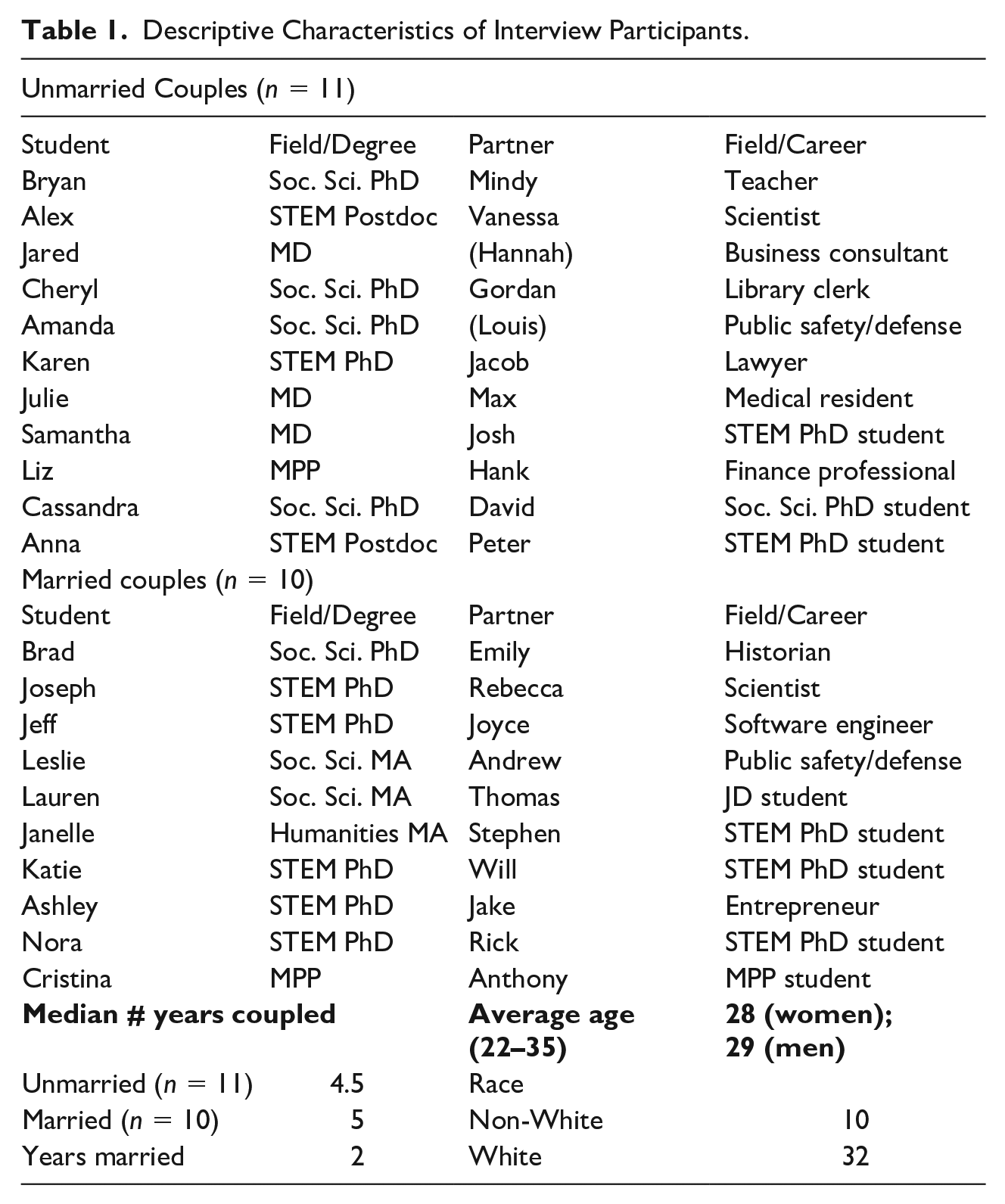
Note: Parentheses indicate that an individual did not participate in the study.
Between January and April 2013 (the months leading up to students’ graduation in Spring 2013) I used email announcements, campus flyers, and snowball sampling to recruit couples to participate in semistructured, in-depth interviews. I interviewed each student and partner individually to detail their immediate, postgraduation career plans; their long-term career plans; whether and how they discussed these plans with their partners; how they saw their careers fitting in with their personal and family goals; and whether they spoke about their desires for childbearing with their partner. Interviews took place in-person in a private office or at a location of the participants’ choosing. If interviewees did not live within driving distance of me, I conducted phone interviews instead (n = 6). Interviews lasted 1 hour on average.
I recorded and transcribed all interviews and then coded them in several rounds. First, I open-coded (Gerson & Damaske, 2020) individual transcripts to identify major themes in how participants made career plans in the short-term as well as for the next few years with their partners. Next, I considered partners’ transcripts together and coded whether the emergent themes in career planning from the individual interviews matched at the couple level (e.g., both partners described the same career launch timeline). I also coded whether partners referred to each other’s career plans, and whether partners described their career plans as joint or separate. Then, I repeated these two rounds of coding for childbearing timing. Interviewing both partners and coding their transcripts separately, and then together, was crucial for identifying couples that shared a plan for two career launches and agreed on childbearing timing, and couples that were less synchronized in their dual-career plans or family desires. Finally, I grouped couples based on the intersections of their career planning strategies and childbearing timing approaches.
In an early round of analysis, I tried to code work and childbearing narratives simultaneously. However, interviewee’s descriptions of launching careers and starting families were largely disconnected from one another—a finding I describe below—so I coded career launch strategies and childbearing timing strategies separately, and allowed the intersections of work and family to emerge on their own. Further, because I emphasized directly identifying dyadic approaches to planning careers and childbearing, I initially excluded two couples in which one partner did not join the study from the analysis. After I uncovered the major career planning and childbearing timing themes among the 19 couples with partner interviews, I revisited the two student interviews that were missing their partners’ interviews. These two interviews were similar to those of other students whose partners participated in the level of detail with which they discussed their partners’ careers and the couple’s childbearing considerations. Thus, I included these individual cases as additional data to support my findings.
Findings
Table 2 summarizes couples’ career planning strategies, childbearing timing orientations, and their intersections. Couples used three strategies to plan two partners’ career launches and had four approaches to family timing that were not as tightly linked to their career planning strategies as expected. Still, certain configurations of couples’ career planning and family timing facilitated simultaneous career launch and childbearing for men and women whereas others created more work–family conflict specifically for aspiring professional women.
Couples’ Career Launch and Childbearing Timing Strategies.
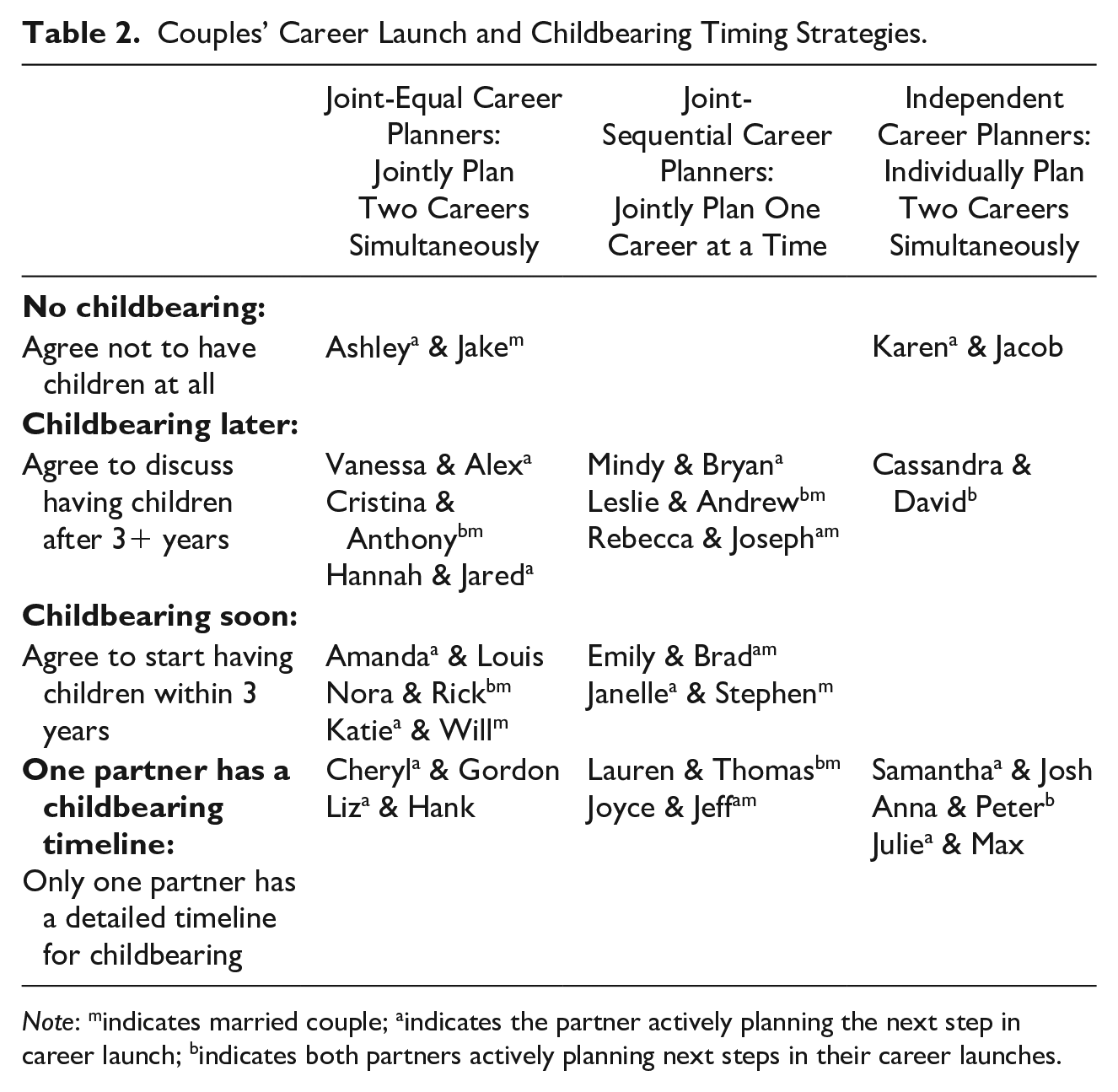
Note: mindicates married couple; aindicates the partner actively planning the next step in career launch; bindicates both partners actively planning next steps in their career launches.
Planning Two Careers
Partners’ three strategies to plan two professional careers reflected different logics about partnerships among race- and class-advantaged heterosexual couples. Joint-equal career planners (n = 9) jointly planned two simultaneous career launches. They saw their two career plans as part of a broader, couple-level plan for their life together, and took very specific, interdependent steps to achieve two professional careers. The gender of the person graduating and actively searching for jobs may have influenced this strategy. Five joint-equal career planners were actively planning women graduates’ next career steps and two couples were actively planning both partners’ postgraduation career launches. Perhaps when women looked for jobs, couples also considered men’s careers and made shared plans.
Jared and Hannah jointly planned to simultaneously launch careers in medicine and business consulting, respectively. Jared was a medical school student actively applying for medical residencies. His long-distance partner Hannah was a business consultant who was accepted to an MBA program. Jared described meticulously thought-out details for timing and co-locating both careers to align the partners’ professional paths: The whole plan while we were doing long distance was for me to go to residency in [East Coast city] in order to be in the same place when she’s in business school. So I applied to all the hospitals in [East Coast city]. I wouldn’t apply anywhere else. [Residency is] three years, so she decided to work another year, go to business school for two years, then [we] both would be getting a job at the same time, three years from now. It’s a lot of logistics.
Jared’s description of lining up the timing and location of his medical residency with Hannah’s work and MBA program revealed the interdependence of each person’s career plans. Jared only applied to hospitals near where Hannah would go to school, and Hannah delayed her entry to business school to ensure both partners could launch careers at the same time.
Partners Cheryl and Gordon had similarly intertwined career plans that they developed as a couple. Cheryl was applying for geographically restricted postdocs in pursuit of an academic career. Gordon was changing careers and planning to pursue a nursing degree. Both partners reported talking back and forth to formulate and execute their shared plans:
Cheryl: We were just talking about this today—about getting the prerequisites in place for him for either Southern University’s nursing program or Northeast University’s nursing program [because] these seem like the most likely possibilities [for my postdoc].
Gordon: It started with her saying, “I know people in [two geographic areas]. I can get a job there with a group of people as a postdoc.” Then we go on to, do they have nursing programs and the kind I want to take? Which one offers the better nursing program, which one’s more prestigious? The idea would be that she can do her postdoc in the two- to three-year window, which would be the same two- to three-year window that I could do the nursing [program]. So, by the time that’s finished, we finish simultaneously.
Each partner was involved in developing the other’s plans for career launch. As evidenced by Gordon’s description of the couple’s back-and-forth planning process, the couple’s goal was to launch their careers in “the same two- to three-year window.”
Joint-equal career planners’ shared plans for a simultaneous career launch reflected the logic that partners should be invested in each person’s activities. Partners knew each other’s career preferences while recognizing each other’s professional limitations, allowing them to make interdependent career plans that complemented one another’s professional goals while accounting for one another’s professional constraints and keeping the couple together.
Joint-sequential career planners (n = 7) cooperatively planned one partner’s career launch at a time. Both partners worked on launching one person’s career first and stated they would do the same for the other partner as soon as the first career was settled. This strategy was gendered: six joint-sequential career planners consisted of men who were actively leaving school and job searching and women who contributed their human, emotional, and social capital to help launch men’s careers first. Relationship characteristics also shaped this strategy. Six of the seven couples were married, and joint-sequential career planners had the longest average relationship time (nearly 7 years total; 3 years on average married). Perhaps marriage and relationship length enabled partners to accumulate relationship capital (Geist & Ruppanner, 2018)—credit for helping one person first that partners trusted would be repaid over time.
Spouses Joseph and Rebecca displayed this consecutive strategy to plan two science careers. Joseph was a STEM PhD student looking for industry jobs in several key cities. Rebecca also had a STEM graduate degree and worked in a research lab. Joseph described their sequential career launch plan as follows: The plan would be for me to get a position first so we know the area and then she is going to start applying. Rebecca has actually compiled most of the job stuff—we have a huge spreadsheet we go through and I make cover letters—so in perusing [job ads for me] she kind of sees what’s available for her. Her position is probably easier to get, is what we’re thinking, because she has her degree and two years’ experience in a position, which is really important.
Joseph and Rebecca jointly evaluated each person’s job prospects and concluded that the couple should plan his career first given the perceived relative difficulty of his job search. Pooling efforts would ease Joseph’s job search and the couple imagined leveraging Joseph’s new professional network to then help Rebecca find work wherever they moved. She said: Most jobs are got through a connection, like knowing a person who knows another person, and we should try and go through that route, as far as [my job search in] a new location. I’ll know people in his group, so the more people I know, the more word of mouth helps me.
Rebecca helped Joseph compile job ads now, and he was expected to use his workplace connections to support her job search later (it is unknown whether they followed through).
Partners Bryan and Mindy also used a sequential strategy to plan two careers. Bryan was planning an academic teaching career and Mindy was planning to complete more schooling to advance her own teaching career. Mindy’s frustration with Bryan’s delayed graduation prompted the couple to focus specifically on planning his career launch. Mindy said: Over the past few years, I was like, “Are you ever going to do this and get going?” That put the fire under him to get his dissertation done. It’s kind of like being in limbo when you’re waiting for your partner to figure out what’s going on because I don’t want to put down roots, start a program, or start a job that I can’t move. If he is going to end up being in [lists three geographically distant cities] or something like that—it’s important for us to be together, and since I have waited this long to figure out the next step, I would rather know what’s going on with him first before I figure out what I’m going to do.
Mindy felt tension over wanting to advance their careers while keeping the couple together but did not know where Bryan might launch his career. Through simple inertia of having waited so long for Bryan to start planning, Mindy did not want to make her own career plans until she knew Bryan’s plans. To move both partners forward together, then, she helped Bryan plan his degree completion and his job search. Bryan took Mindy’s initiative positively: I needed a good fire under my ass to get me to try to finish this program because otherwise I’d probably continue to dither around for an indeterminate length of time. Yeah, she’s been really helpful, helping me look for jobs, helping me read my cover letters. I think having it be the two of us and knowing we’re in this together and we’re going to make broad-minded and long-term-in-scope decisions about where we want to be in our lives has sort of given me more of the drive to get me moving in this direction.
For Bryan and Mindy and other joint-sequential career planners, collaboratively setting up one career first helped reduce uncertainty, thus laying the groundwork for other future planning.
Joint-sequential career planners worked together to plan men’s career launches first. Though these highly educated, mostly White couples gave idiosyncratic reasons for prioritizing men’s career launches (his job is harder to find; he is less motivated), these actions ultimately reinforced a dynamic in which it was more important to establish men’s, and not women’s, careers (e.g., Rao, 2017). This strategy shows that heterosexual couples’ prioritization of men’s careers directly shaped the trajectory of women’s careers. Men’s career plans were thus immediately relevant factors that could create challenges for women’s careers.
Unlike joint-equal or joint-sequential career planners who made interdependent career plans together, independent career planners (n = 5) individually planned each person’s respective careers in parallel, but not necessarily jointly. Marital status could have contributed to this independent planning strategy, as all five of these couples were unmarried. Relationship time may not have been a factor, though, as the average time these couples spent together was similar to the average relationship time of 5 years for all couples in the sample.
Social science PhD student partners Cassandra and David displayed this autonomous pattern. Cassandra described her and David’s job applications as independent activities: We are mostly doing our own thing, together. You’re more likely to solve the dual-body problem in the long term and have the kind of career you want if you are willing to tolerate distance now and just pursue the best opportunities available, so we haven’t really been trying very hard to be in the same place. I don’t want one of us to totally sacrifice our career.
Cassandra and David thought they would be better off in the long run by individually investing in their respective careers now. Thus, the two partners made separate plans to pursue the best available options for each person without constraining the other person.
Josh, a STEM PhD student whose partner Samantha was actively applying to medical schools, also described independently making plans to pursue each career separately in the immediate future, even if they had to be in a long-distance relationship for the time being: She’s going to apply to a wide range of schools. I think it’s pretty much decided that wherever she gets in, she’s going to go. I expect to stay in [Midwestern city] until I finish my PhD program. If she were out of town [for medical school] then hopefully I’d work longer hours and then finish, so that would be the end goal.
Josh thought that being apart would facilitate his time to degree and allow him to join Samantha sooner. Like the other independent career planners, Josh and Samantha thought they would get the best long-term outcome if each person separately focused on their respective careers now.
Although couples thought this independent strategy would provide a strong foundation for other plans in the future without hindering each other’s professional pursuits now, making separate plans required partners to consider maintaining their relationship at a distance, which Cassandra said sometimes caused tension: This may be a test that we don’t pass at this stage. The way I see it, a relationship needs to be at a certain level of maturity to handle distance. [David] seemed worried that it might not work, and I was a little bit more confident, so there was a bit of tension there.
Partners sometimes worried that their relationships would not successfully accommodate both partners’ professional pathways because independently pursuing careers could direct partners away from, or into conflict with, one another. For these independent career planners, discussing this worry helped partners feel more confident in using this career launch strategy.
Childbearing Timing
The couples’ three career planning strategies were not as tightly linked to their four childbearing timing approaches as expected, as seen in the lack of strong clustering in Table 2. That couples using the same career planning strategies had different orientations to childbearing timing indicates that race- and class-advantaged couples’ logics to plan careers can be separate from their approaches to family timing.
The couples that wanted no children (n = 2) demonstrated this lack of connection between career planning and childbearing processes. Rather than expressing incompatibility of parenthood with professional careers in describing desires to be childfree, these couples more often referenced other lifestyle preferences. Joint-equal career planner Ashley emphatically said: We definitely do not want kids. It’s extremely expensive, it’s a huge time commitment, you would have no sleep, a lot less time, money, everything. We really like spending time with each other, like going on trips, going hiking, cooking, and, you know—let’s do more of that.
Like the other partners that wanted to remain childfree, Ashley mentioned lifestyle desires and hobbies—but not career considerations—in explaining her childbearing desires.
Even when partners considered their careers when thinking about childbearing timing, the way they talked about it was not as tightly linked to their specific career planning strategies as expected. For example, couples that agreed to start having children later (n = 6) were distributed across all three career planning strategies. These partners focused on launching careers first and pushed off discussing childbearing plans for three or more years. Despite their social advantages, all felt too much uncertainty in their careers to start having children now: Cristina, joint-equal career planner: Not right now, basically because we don’t have jobs. I cannot manage uncertainty—I paralyze myself when I need to apply for jobs in five cities. I mean it’s too much for me, and I think for him too. But we have talked several times about having kids. I would say probably in four to five years. Joseph, joint-sequential career planner: We know we want to wait longer. You know, settling with jobs, location. . .once I have something that’s semi-permanent, I think it would probably be at least two years [after that]. David, independent career planner: Yeah, sometime in the future. I just don’t know how near that future is, you know? When I have roots set down. When we actually know where we’re going to be. When we actually know we’re going to be in the same place.
Cristina, Joseph, and David used different career planning strategies, but all agreed with their partners to talk about childbearing after establishing careers. Thus, planning to initiate childbearing was a separate, subsequent task that partners would negotiate after setting up careers. Still, joint-equal and joint-sequential career planners discussed childbearing plans differently from independent career planners insofar as the two joint career planners were more likely to specify the number of years they wanted to wait before having children.
The couples that deliberately planned to start having children soon (n = 5)—if not now, certainly within 3 years—offered some additional evidence that childbearing timing and joint career planning strategies could be just loosely related. Those who wanted to start childbearing soon were joint-equal and joint-sequential, but not independent, career planners. Perhaps an individual-centered approach to separately plan two careers in the immediate future made it unlikely that partners would use a couple-centered approach to plan childbearing in the same timeframe. The couple-centric logic to start childbearing soon may also be due to four of these five couples being married. Otherwise, partners who wanted to start childbearing soon all concluded that there was no “good” time to have children, so they agreed to have them now: Rick, joint-equal career planner: I feel that nobody is ever prepared for it, their first kids. It’s never a good time for anybody. Nobody’s better prepared than anybody else and I think we’re ready for it, so I see no reason why not. Brad, joint-sequential career planner: You know, there’s no good time to have kids, but now actually is the best of any time, which means we are going to do it.
Because there was no “ideal” time to have children given both partners’ ambitious career goals, these couples thought having kids soon was just as good as delaying childbearing.
The final orientation to childbearing timing was, again, expressed by couples across all career planning strategies. In these couples only one partner had a childbearing timeline (n = 8). This pattern was gendered: women, but not men, stated a detailed ideal timeline for having children. Marital status could have shaped this pattern of childbearing timing. Six couples were unmarried, indicating that marriage might have been a prerequisite for some (i.e., men) to start considering other family activities. Yet, these couples had the same average relationship duration (5 years) and age (28 years old) as the other couples so neither relationship length nor youth explained this pattern. The distinguishing factor was that these race- and class-advantaged men had vaguer ideas about childbearing timing in the context of their careers than women did.
Joint-sequential career planners Thomas and Lauren expressed different levels of detail regarding childbearing timing in their separate interviews:
Thomas: It’s not something that we discuss as something in the very near future. Maybe in a year or two, but those conversations have mostly been abstract. I guess I hadn’t really thought about a timeline.
We talked about [children] a lot when we first got married [nine months ago] ‘cause I’d like to have kids in the next three years. I think if I finish my coursework then have a kid—that’s the best time to have a child while I’m in grad school. Thomas would be working and I have a couple of years where I have more flexibility with my time.
Although Thomas “hadn’t really thought about a timeline,” echoing sentiments of older cohorts of aspiring professional men (Orrange, 2007), and considered these discussions to be abstract, Lauren gave an in-depth ideal timeline for childbearing that accounted for both career launches.
Independent career planners and aspiring medical doctors Julie and Max also differed in the level of detail with which they considered childbearing timing:
I am a fore-planner, so yeah, I have thought about it. In my head, maybe we get engaged in those next two years and we get married not that long after that, and then when I’m a third- or fourth-year resident, that’s a much better time while I’m doing my residency to maybe start a family.
I thought about it, yeah. Not with any detail, but yeah. . .whenever we can fit that into our busy schedules. I mean the pregnancy part is less of a burden on me.
Julie provided a clear timeline for having children given both partners’ career launch demands. Max, however, like other men without detailed ideas about childbearing timing, saw it as “less of a burden” for himself individually because he did not have to physically carry and give birth to a child. Thus, he did not have a specific idea about how or when having children would fit in with the partners’ career launches beyond “whenever we can fit that into our busy schedules.”
Overall, couples in which only one partner had a childbearing timeline shows that the logics guiding dual-career planning and those guiding childbearing timing can be distinct and not necessarily aligned within the same couple. Partners can make shared career plans, but not necessarily have shared childbearing timelines.
Intersections of Career Planning and Childbearing Timing
Certain intersections of career planning and childbearing timing reduced work–family conflict for couples. Others created conflict for women, despite their numerous advantages.
Joint-equal career planners who wanted to start childbearing soon reduced conflict in combining career launch with childbearing by explicitly laying out the shared steps each partner would take to weave family plans into their career paths. STEM PhD students Will and Katie wanted to start childbearing during a “stable” time in their careers. Will said: It’d be good if we had some stability career-wise, at least during the actual birth. Recently we’ve been thinking we’re approaching that point. I have a pretty stable situation [in my graduate program] and Katie would be done with graduate school and have a job and be fairly stable and so I think in the near future we’ll go ahead with trying.
Making interdependent career plans to achieve what partners deemed “stability” in their careers, while sharing the work of planning the transition to parenthood for the near future, could enable men and women to both launch careers despite the couples’ plans to have children soon.
Joint-sequential career planners who wanted children soon, on the other hand, put women at risk of compromising their career launches to start childbearing. Social science PhD student Brad was looking for academic jobs nationally and internationally. His wife Emily, who also held a social science doctorate and worked for a museum, did not plan to find a new job until Brad secured employment. The couple wanted to have children soon so Brad thought, “If we had a kid it would really explain that gap in her resume when we moved [for my job].” He saw having a child to be a good explanation for why Emily might be unemployed after moving for Brad’s career. Yet, planning his career launch and having a child before Emily started a new job could delay her career progression and restrict her options later.
Joint-sequential career planners in which only women had a detailed childbearing timeline may also experience challenges to combining two career launches with initiating childbearing. First, these couples prioritized men’s career launches, which slowed women’s career launches and could constrain women’s career options in the future. Second, only the women in these couples had thought about childbearing timing, which could mean that women may become primarily responsible for any family plans among these partners. Third, not only were these women the only partners with clear ideas about childbearing timing, they also often specifically wanted to have children soon. If men planned to launch careers first and had not thought about childbearing timing, while women wanted children soon and did not expect to launch careers until later, women’s career launches could be further delayed or even derailed if they took on the work of planning the transition to parenthood on their own. Social science MA student Lauren reflected on how this process might apply to her, given that Thomas was launching his career first and had not considered childbearing timing: [I tell him], “you gotta make a decision!” That makes it difficult for me because if he doesn’t want to have kids in the next three years—I don’t know. I mean I’d like to be able to do everything now, but it’s just not possible. It’s too late to have kids once you get past a certain age, but it’s never too late to go back to school, to get a new job. So I view this time as kind of being more pressure to have children and I can move other stuff ‘til later.
Focusing on Thomas’ career launch, independently figuring out when to have children, and wanting to start childbearing soon all created tension around Lauren’s preferred timing for career launch and her transition to parenthood, but the combination of all these factors created an especially challenging context for Lauren’s work–family plans relative to Thomas’ plans.
Discussion
Guided by a framework for gendered projectivity and linked lives (Wong, 2018), this study examined how young, dual-professional couples planned two career launches while considering childbearing timing. Interviews with 40 partners from 21 couples revealed that race- and class-advantaged heterosexual partners leaving school and looking for jobs attempt to: jointly launch both partners’ careers simultaneously; jointly sequence men’s career launches before women’s; or independently pursue each person’s career plans separately. These strategies are not as tightly linked to couples’ childbearing timing as expected. Couples agree to forgo parenthood; delay childbearing until both partners’ careers are established; or initiate childbearing soon regardless of either partners’ professional activities. In some couples, though, women had thought in greater detail about childbearing timing in the context of the partners’ career launches than men had.
Although the gendered projectivity and linked lives framework alerts scholars to the possibility of misalignment in men’s and women’s work–family plans, the weak alignment between partners’ career launch plans and their childbearing timing was unexpected. This pattern suggests that planning careers and considering childbearing can be separate projects that do not always go together or operate under the same logics. Further, couples might not always link career considerations to parenthood preferences, as in the case of partners who did not want children for lifestyle, but not career, reasons. The decoupling of career launch and childbearing timing strategies suggests that conceptualizing childbearing timing as a factor that consistently and unilaterally compromises women’s professional career launch plans perpetuates a “myth” (Cech, 2016) about how family processes shape gender inequality during career launch.
Although childbearing timing did not strongly influence men’s and women’s career launch strategies, the gendered joint-sequential career planning strategy does reveal that women’s career launches can be contingent on men’s career launches. The prioritization of men’s career launches highlights the persistence of cultural schemas linking work to men/masculinity among mostly White, upper-middle class groups (Blair-Loy, 2003; Ridgeway, 2011) and represents an immediate challenge to women’s career launches.
This study also reveals that “discordance” across partners does not always mean “direct disagreement” across men and women. For example, independent career planners were discordant with each other insofar as they made separate rather than joint career launch plans. Such a strategy stems from uncertain yet rigid material workplace conditions characteristic of professions including medicine, law, and academia. With no way to guarantee entry into the types of careers these men and women wanted, partners thought they had to “pursue the best opportunities available” to each person at any cost. Further, couples in which only women had a detailed childbearing timeline were discordant not because partners disagreed about childbearing, but because partners differed in how much they had thought about their work–family pathways. This gendered dyadic misalignment underscores an enduring raced and classed cultural link between family and women/femininity and disconnect between family and men/masculinity (Bass, 2014; Blair-Loy, 2003; Orrange, 2007; Ridgeway, 2011). These cultural forces could eventually contribute to women’s experience of conflict in work and family: men who did not think about childbearing timing might be unlikely to incorporate family considerations into their career plans, thereby creating conditions that may push women to compromise their careers to accommodate men’s careers and the couple having children.
Discordances aside, partners in this study generally agreed on their career launch and childbearing timing strategies, perhaps because partners with higher levels of dyadic cohesion were more likely to volunteer for the study. In particular, joint-equal career planners, especially those who wanted to start childbearing soon, demonstrated that work–family decision making was not always a zero-sum problem requiring prioritization of one person’s career over that of the other, work over family, or family over work. Rather, deliberate and interdependent coordination to simultaneously launch two careers and initiate childbearing, along with freedom from raced and classed barriers to such joint action, could facilitate gender egalitarianism and work–family integration.
Still, meticulous joint planning reflects an individualized response to wider material barriers to starting careers and becoming parents at the same time. Were there no such constraints, the pattern of not having detailed childbearing timelines might be more prominent for both women and men, not just some men. Instead, even these advantaged partners often thought it was “too much” to launch two careers while starting childbearing. The logic that there was “no good time” to transition to parenthood among those who wanted to start having children soon also reflects the lack of material conditions that support simultaneous career launch and childbearing. Additional research is necessary to document whether any of these work–family plans are successful, which could then allow scholars to identify the material conditions that facilitate work–family integration.
Another topic that should be more carefully explored in future research is how marriage shapes couples’ career launch strategies and childbearing timing. Married couples in this study were less likely than unmarried couples to independently plan career launches and were more likely to want to start having children soon. Such findings could reflect differing levels of commitment to a shared future across marital status. Yet, all men and women emphasized being committed to their partners and seeing a future for their relationship. Further, if relationship duration can (imperfectly) measure commitment, married and unmarried couples were partnered for a similar length of time (Table 1). Finally, the unmarried couples in the sample often described themselves as “functionally married” and the married couples insisted that they would not make different work–family plans if they were unmarried. Therefore, it is unclear from these data exactly how marriage informed couples’ career launch and childbearing timing strategies beyond structuring couples’ use of different career launch and childbearing timing strategies.
Limitations aside, these novel couple-level data extend the literature on gender, work, and family by showing that men’s career plans more directly shape women’s career plans than childbearing plans do because couples can implicitly prioritize men’s career launches and can view childbearing as separate from career planning.
Footnotes
Acknowledgements
I owe thanks to Jennifer Augustine, Allison Daminger, Caroline Hartnett, Andrea Henderson, Katherine Lin, Sarah Patterson, Léa Pessin, and Carla Pfeffer for reading drafts of this manuscript. Thank you to Megan Routh for providing research assistance. Earlier versions of this work were presented at the Work and Family Researchers Network and the American Sociological Association meetings and to working groups at the University of Chicago.
Declaration of Conflicting Interests
The author declared no potential conflicts of interest with respect to the research, authorship, and/or publication of this article.
Funding
The author received no financial support for the research, authorship, and/or publication of this article.
