




Abstract
This study examines the mobilization of close and supportive relationships following widowhood and whether these trajectories differ by educational level or gender. It is assumed that widowed spouses call up social relationships to compensate for their spousal loss and accompanying cuts in subjective well-being. Using longitudinal data from the German Ageing Survey (N = 7,012; observations = 20,816), fixed effects models were estimated. Widowhood results in increases in the network size and the providers of support up to the fourth post-widowhood year. After that, starting decreases reach pre-widowed levels around seven years after widowhood. The most pronounced changes were found for widowed spouses with university degree and for widowed women. The overall mobilization of social relationships is thus limited in time and widowed spouses without vocational degree, as well as men in part, are the most vulnerable to the adverse social consequences of widowhood.
Widowhood is one of the most stressful life experiences that calls for considerable psychological and social adjustment: The widowed spouses usually have to cope with emotional distress and grief due to the loss of a confidant and face a decrease in the crucial part of their socializing and supporting network (e.g., Bennett, 2008; Hatch, 2018; Stroebe & Shut, 2010). This may even hold true for those who were long-term caregivers for their partners and who might well feel relief from worries and workload (Keene & Prokos, 2008). Therefore, there is a large body of research examining the consequences for the surviving spouse. A number of studies focus on the psychological well-being and health-related outcomes with the main finding that the detrimental consequences of widowhood attenuate over time (overviews in: Wilcox et al., 2003; Wörn et al., 2018). Notably, less often addressed are the social implications of widowhood even though social relationships are strongly related to physical and mental well-being—either directly as they provide social integration and informal assistance, or indirectly as they help to cope with the negative implications of widowhood. The few existing studies using longitudinal data provide some striking results. On average, the number of close relationships, frequency of contact and interaction, and support received from others increase after bereavement, or at least remain stable (Dean et al., 1992; Donnelly & Hinterlong, 2010; Kalmijn, 2012), whereas immediately after the event, widows and widowers tend to intensify long-standing and very close relationships with their children (Guiaux et al., 2007; Isherwood et al., 2017; Roan & Raley, 1996; Scott et al., 2007). Later on, friends, wider kin, and new relationships gain in importance (Ha, 2008; Pai & Ha, 2012; Zettel & Rook, 2004) including growing engagement in volunteering activities (Li, 2007). Increases are, however, of temporary nature, as between the third and the fifth post-widowhood year, gains in social participation and support plateau and then begin to decrease, reaching pre-loss or even lower levels in the long-run (Ferraro & Barresi, 1982; Ferraro et al., 1984; Guiaux et al., 2007). While there is evidence that at least during the first post-widowhood years, social contacts and support increases to strengthen coping and to compensate for the spousal loss, little is known about potential heterogeneity within the group of widowed spouses. With few exceptions (Ha, 2005; Ha et al., 2006; Isherwood et al., 2017), literature on the differential effects of widowhood upon the quantity and functioning of social relationships can hardly be found. Moreover, most studies focus on late-life widowhood, are restricted to small sample sizes or cover only short periods of time.
Using data from the German Ageing Survey (see Vogel et al., 2020), the present study extends prior research in three ways: First, it is aimed to replicate the described post-widowhood trajectories in social relationships based on large-scale longitudinal data and considering women and men from middle to late adulthood. Three significant aspects of social relationships are examined: the number of close relationships, the number of potential supporters offering emotional and cognitive support, and the number of providers of instrumental and material help. Second, potential groups of widowed spouses who may be at risk of social isolation or lack in support or care are investigated. It is tested whether women (compared to men) and the better-educated (compared to the lesser-educated) are more successful at mobilizing social relationships in order to compensate for widowhood-related losses. Third, the theory of social production functions (TSPF) is applied (Ormel et al., 1999) because it provides a powerful line of argument for why widowed spouses aim for compensation and why compensation may vary between different groups. In many studies on the social implications of widowhood, theoretical arguments are often ad hoc or remain vague (Utz et al., 2002).
Theoretical Background
The Theory of Social Production Functions
The TSPF is a general theoretical framework defining basic human needs and context-specific opportunities to meet them, described in a series of nested production functions (e.g., Lindenberg, 2013; Ormel et al., 1999): The major premise is that all individuals seek social and physical well-being. Physical well-being is comprised of comfort and stimulation. Social well-being results from status, affection, and behavioral confirmation by others. These various aspects of subjective well-being are achieved by activities, endowments, and the use of resources.
Within this hierarchy of social production functions, social relationships are a valuable resource (e.g., Nieboer & Cramm, 2018). Being married and living with a spouse in particular is multifunctional and effective because marital interaction and cooperation contribute to virtually all aspects of subjective well-being (Ormel et al., 1999, pp. 67, 78; also see Schaan, 2013): Spouses are a source of physical and mental arousal due to joint activities, entertainment, and conversation. They are highly qualified to provide affect and confirmation via feelings of love, belonging, and mutual acknowledgment. The possession of diverse resources such as money or information, assistance in doing chores, and joint efforts to achieve reasonable maintenance realize both comfort and status. Although partnership may also entail tension, stress, workload, and other costs, an overall positive trade-off is reasonable to assume, otherwise the partnership is likely to be terminated. Viewed in this light, the loss of a spouse can be seen to result in a pronounced deterioration in several aspects of subjective well-being (Lindenberg, 2013, p. 81) and, as claimed elsewhere, translates to a profound “resource deficit” (Antonucci et al., 2001, p. 655).
Compensation for the Deceased Spouse
Assuming that individuals act rationally “they will try to find alternatives to compensate for losses” (Nieboer et al., 1999, p. 116; also see Nieboer & Cramm, 2018). One promising strategy, among others, is to turn to alternative relationships (e.g., Rook & Charles, 2017). This argument is similar to the convoy model in social-gerontology according to which close relationships of the widowed spouse are called upon to bridge the emerged gap (Antonucci et al., 2001; Kahn & Antonucci, 1980). And it is consistent with prominent support models even though they admit that supporters other than the intimate partner are less efficient in contributing to well-being (Litwak, 1985) or less preferred (Cantor, 1979). Accordingly, mobilizing a net of (new) relationships serving diverse needs is expected to be a powerful strategy to reduce the risk of severe hazards to the widowed spouse’s well-being.
Variations in Compensation
The access to and the efficacy of social relationships, however, may vary between individuals and also change over time. The social production functions are context-specific, implying that the ways to obtain subjective well-being, the intensity of its deterioration due to the loss but also the ways to react are neither homogenous nor stable. Rather they depend on individual resources (e.g. social competencies, money, education, health), structural opportunities (e.g. family size) and constraints (e.g. role expectations; Nieboer et al., 1999; Ormel et al., 1999). These elements enable or limit the means that contribute to subjective well-being in general, and predict the availability and efficacy of social relationships in particular. The mechanisms that drive social relationships are explored in gerontological family research more precise than in the TSPF. For instance, adult children’s motivation to accompany and support their parents depends on children’s opportunities (like geographical distance), parent’s needs, normative obligations, feelings of affection, and motives of reciprocation (e.g., Leopold & Raab, 2013; Lowenstein & Daatland, 2006; Parrott & Bengtson, 1999; Silverstein et al., 1995)—some of which have been already applied to parents’ late-life widowhood (e.g., Ha et al., 2016; Isherwood et al., 2016). These predictors of social relationships, however, differ for several groups of individuals, according to the type and duration of relationships, and they change over time. This has to be taken into account when studying the social relationships of the widowed spouses. Following, a number of hypotheses about differential effects is developed.
Timing
Right after widowhood, close and long-standing relationships are the most likely to be addressed (Guiaux et al., 2007; Isherwood et al., 2017; Roan & Raley, 1996; Scott et al., 2007). They are intensified or rekindled where they have been inactive. They are the most responsive to the needs of the widowed spouse and they are a rich source of support because they are characterized by high attachment, a long history of support exchange, inherent credit of trust, and—in case of family ties—a strong commitment to care for each other when necessary. Adult children and siblings are particularly suited to undertake part of the deceased spouse’s tasks and duties and contend with the grief-related and practical needs of the widowed spouse. Friends and other age-peers add companionship, advice, and encouragement, and neighbors contribute assistance with daily living as they live nearby (Ha, 2008; Isherwood et al., 2017; Pai & Ha, 2012; Zettel & Rook, 2004). At the same time, few terminations are likely for relationships that are mainly maintained via the deceased spouse, such as common friends or in-laws. However, increases in contact with and support from close relationships stop around the third year following widowhood (e.g., Guiaux et al., 2007). The focus on and the emergency function of close and supportive relationships seems to weaken as time passes but widowed spouses may gain capacity to make efforts to establish new ties in the long-run in order to secure social participation and solid informal support (Lamme et al., 1996). This may be attained by greater involvement in the neighborhood, leisure time activities or volunteering (Li, 2007). Overall, empirical evidence suggests that gains in (supportive) relationships reach their maximum between the third and fifth post-widowhood year (Ferraro & Barresi, 1982; Ferraro et al., 1984). Based on these considerations, mobilizing social relationships and support may unfold gradually over time. A non-linear dynamic is hypothesized: A sharp post-widowhood increase in the number of close social relationships and support reaches a peak and levels off around four years after widowhood (H1).
Education
Compared to those with lower education, the highest educated tend to be more active in their jobs, in their leisure-time, and in the voluntary sector; they are more likely to live in urban areas and have a greater pool of diverse resources including social skills (Farkas, 2003; Ross & Mirowsky, 2006). This implies better access to social interaction and being more attractive exchange partners. Studies on personal networks confirm that (older) adults with higher formal education can draw on more social capital, and have larger and more diverse networks, but at the same time report less geographical proximity and lower contact frequency than those with less formal education (Cornwell & Schafer, 2016; Jusri & Kleinert, 2018). Some longitudinal studies suggest a widening of the educational gap in different aspects of social ties during late adulthood (Fischer & Beresford, 2014). Others show lower support levels for the higher-educated in later life probably due to less face-to-face contact and less need for private help because of greater opportunities to purchase required assistance and services (Shaw et al., 2007). There is evidence that after widowhood, higher education results in more close relationships and more frequent contacts (Ha, 2005). Taken these findings, high educational levels are assumed to be linked to greater success in mobilizing existing relationships and cultivating new relationships and support in case of need, compared to lower levels of education. It is hypothesized that higher-educated widowed spouses experience a steeper post-widowhood increase in the number of close social relationships and support levels than less-educated widowed spouses (H2).
Gender
Gender differences in social networking and support exchange are well documented (e. g., Carr, 2004; Cornwell & Schafer, 2016; Fischer & Beresford, 2014; Shaw et al., 2007; Stronge et al., 2019): On average, women are more relationship-oriented. They have larger and more diverse networks, maintain closer ties, and are more involved in informal support exchange than men. Men, in general, are more focused on their spouses as confidants and a source for support, and their contacts are largely maintained and mediated by them. Within the family in particular, women often perform the role of the “kinkeeper” (Rosenthal, 1987). Research on intergenerational relationships, for instance, shows that middle-aged and older mothers are more frequently in contact with their adult children, feel closer to them, and provide a greater diversity of support than fathers do (Hank, 2007; Schmid et al., 2012). Taken considerable shifts in gender roles within the recent decades, gender differences in social relationships and support might narrow in younger cohorts of men and women but empirical evidence is rare (recent exception for intergenerational relationships see Fingerman et al., 2020). Apart from likely variations across the cohorts and building on the existing findings, here, widows are assumed to be in a better position to adapt to network losses than widowers. They might have more opportunities to activate and mobilize social relationships, and request consolation and assistance in case of need than widowers who may be more vulnerable due to their lack of social resources. Because for a long time, research on widowhood relied on samples of women only, not many studies addressed gender differences in the social implications of widowhood. Widowed mothers are found to receive more support from their children than widowed fathers (Ha et al., 2006; Kalmijn, 2007). Likewise, widowed women have larger social networks (Collins, 2017, 2018) and are more likely to build new relationships (Lamme et al., 1996) than widowed men who are found to face a higher risk of social isolation and loneliness (e.g., Isherwood et al., 2017). On the other hand, widowed men are more likely to re-marriage than widowed women (e.g., Wu et al., 2014) and—despite having smaller networks—are also involved in intergenerational support exchange or provide voluntary work as a source of social inclusion (Collins, 2018). Nevertheless, it is hypothesized that women experience a steeper post-widowhood increase in the number of close social relationships and support levels than men (H3).
Method
Data and Sample
To test the hypotheses, the longitudinal data from the German Ageing Survey (DEAS) were used (Vogel et al., 2020). The DEAS is a multi-topic study that provides data to examine the changes and diversity in the living conditions of the middle-aged and older population as well as on the process of individual ageing. The first DEAS wave was conducted in 1996 as a nationally representative sample of 4,838 respondents from the German community-dwelling population aged 40 years to 85 years. Follow-up studies were carried out in 2002, 2008, 2011, 2014, and 2017, with large refreshment (baseline) samples in 2002 (N = 3,084), 2008 (N = 6,205), and 2014 (N = 6,205). In all baseline samples, men were oversampled to have enough male respondents up to old age for differentiated analyses like on transition to widowhood. After the latest wave in 2017, 39,446 face-to-face interviews have been conducted with 20,129 respondents.
For the present analysis, the unbalanced longitudinal sub-sample of 9,663 respondents (persons) from wave 1 to wave 6 was selected, providing 28,556 interviews (person-years).
In Germany, around one percent of the population aged 40 years to 45 years is widowed, with growing incidence in the following age groups (Statistisches Bundesamt, 2019, p. 33). To capture a broad range of transitions to widowhood in adulthood and not to limit on late-life widowhood, the entire age range covered by the longitudinal sample was used (40–97 years). Only respondents who are at risk of losing their spouse were taken into account, meaning those who were married (including registered partnership) in at least one wave. Those who transitioned to divorce, separation, or re-marriage after widowhood over the subsequent panel waves were excluded. The proportions of item non-response within the panel-waves were small to moderate (less than 4%). Only persons with complete information on marital status, duration of widowhood, gender, and educational level were included. Missing values for the dependent variables and the covariates were imputed using mean substitution based on a combination of birth cohort, age, gender, and educational level. This resulted in a final analytical sample of 7,012 persons (3,082 women and 3,930 men). They provided 20,816 person-years with 3.4 observations on average.
As in other ageing studies (e.g., Banks et al., 2011), panel attrition is a critical issue: it is high especially in the first follow-up interview (for instance, 48% of the 2014 baseline sample did not participate three years later) and is affected by socio-economic, demographic, and social characteristics, but except for age, the effects are small to moderate (Klaus et al. 2019, p. 24). Prior research suggests that changes in partner status increase permanent attrition (Voorpostel & Lipps, 2011). This may produce biased estimations if it is systematically linked to changes in the variables of primary interest. Due to the nature of panel attrition, it is rather impossible to observe whether the risk of attrition is higher among those widowed spouses who suffer cuts to or losses in their social relationships, compared to those who experience stability or increase. Using DEAS baseline information, panelists were found to rate higher in several aspects of social relationships than attritors, however, the magnitudes of the mean differences between the two groups were small to moderate as effect sizes did not exceed 0.30 (Cohen’s d). Still, the effects of widowhood on social relationships may be somewhat overestimated, which is important to recall when concluding the results. Yet, it was decided to refrain from the imputation of missing panel waves because directions of its application to panel data are vague and improvements in fixed effects (FE) estimates seem to be limited (Young & Johnson, 2015).
Data Analysis
To estimate the trajectories of social relationships following widowhood, FE panel regression models are computed (Allison, 1994; Brüderl & Ludwig, 2015). FE models are based on intra-individual change and provide estimates of the effects that changes in the predictor variables have on change in the outcome variable. They eliminate bias stemming from time-constant heterogeneity as (un-)observed factors that are stable over time are ruled out as confounding variables. This is crucial in determining, for example, if those who lose their spouse differ from those who do not lose their spouse in such time-constant characteristics. This implies that it is automatically controlled for gender and, thus, men’s oversampling does not affect the estimations. FE estimators improve causal interpretations and tend to be more consistent than random effects (RE) models. This gain is however at the cost of efficiency: FE-estimations usually have larger standard errors resulting in lower statistical power than RE models. Therefore, the Hausmann test was applied to decide which model is more appropriate to the present analysis. Without exception, the RE effects were of the same direction but significantly higher than FE effects, suggesting biased RE estimates. Thus, FE models were preferable. To minimize for bias due to time-varying heterogeneity, it was explicitly controlled for a number of potential covariates (see measures section). Panel-robust standard errors were estimated to account for overestimation due to possible autocorrelation and heteroscedasticity resulting from the fact that longitudinal data are clustered within persons.
Measures
Dependent Variables
Two major dimensions of relationships (e.g., Bengtson, 2001) were considered: Structural characteristics describe the existence and availability of social relationships; functional characteristics define the qualitative resources that can be drawn from them. To cover both dimensions, three indicators were computed commonly used in studies on (support) networks (e.g., Fischer & Beresford, 2014; Guiaux et al., 2007; Leopold & Raab, 2013). The size of the close network as a structural measure was measured by asking: “Please give me the names of the people you have regular contact with and who are important to you.” Respondents could name up to eight people, which were summed up. The number of anticipated providers of emotional or cognitive support was assessed through two questions: “Do you have someone you can turn to when you need comfort or cheering up, for example, when you are feeling sad?” and “When you have important personal decisions to make, do you have anyone you can ask for advice?” Respondents were allowed to name up to six potential supporters in each category, and the combined number of the two categories was used for the analysis. The number of people who provided instrumental or material support within the 12 months prior to the interview was counted, representing the factual support. Instrumental support refers to help with housekeeping such as cleaning, small repair jobs, or shopping. Material support covers regular financial transfers and monetary or non-monetary gifts. The particular people named for the different types of support might overlap and thus, the number should not be interpreted as the count of distinct supporters. All three indicators excluded spouses and professional supporters and services (e.g. mobile nurse), as the focus was on private help beyond the spouse. The measures are mutually dependent because a large network involves a greater pool for support and vice versa. Still, they cover distinct aspects of social relationships indicated by moderate correlations between .17 and .35.
(Time Since) Widowhood
To depict the effects of spousal loss and its dynamic thereof, the time passed since widowhood was included. It is indicated in years and ranges from 0 (pre-widowhood) up to seven years after widowhood. Observations of more than seven years were excluded due to their small frequency and because such a long time change in social relationships can hardly be attributed to the experience of widowhood. In the analytical sample, 462 transitions to widowhood were observed (7%) and the mean age at widowhood was 62 years (SD = 12, range: 41 to 90). Compared to other longitudinal studies that track married respondents (Guiaux et al., 2007; Ha et al., 2006) the share of observed transitions and the mean age at widowhood were lower for two reasons: Observations in the present start in middle adulthood (age 40+ years) which decreases the overall risk of widowhood in the sample. The panel-intervals are higher (six resp. three years) than in other studies, which contributes to an increasing panel mortality especially following widowhood. Due to men’s lower life expectancy and their greater rate of re-marriage widespread in many Western nations (Wu et al., 2014), women are more often affected by widowhood (60%) than men (40%). To test for non-linear age trajectories the indicator included both a linear and quadratic term.
Moderators
To test for differential post-widowhood trajectories, interactions between time since widowhood and educational level and gender were included. Education was indicated by an internationally standardized measure of educational attainment named ISCED (UNESCO, 2006) distinguishing three levels of formal educational: no vocational degree (6%), vocational degree (51%), and university degree (43%). Gender was a dummy variable with score 1 for women.
Control variables
To disentangle changes in social relationships due to widowhood from changes related to other time-varying characteristics, three variables were included that were identified to influence social relationships in other studies. The personal networks and the support patterns of individuals change with age due to changing opportunities to maintain and make use of (supportive) relationships and due to changing needs (Ajrouch et al., 2005; Klaus & Schnettler, 2016; Shaw et al., 2007). To comprise non-linear ageing effects, it was controlled for age in years by including a linear, quadratic, and a cubic term. Health increases the need for support and limits the opportunities to keep in contact with others (e.g., Aartsen et al., 2004; van Groenou & van Tilburg, 1997) and thus, it was controlled for a subjective assessment of health ranging from 1 (excellent) to 5 (very poor). A dummy variable was included that splits observations before 2008 from those occurring on or after 2008 for two reasons: to control for time trends in (support) networks (for intergenerational relationships see Steinbach et al., 2020), and to account for the shift in the survey mode in 2008 from paper-pencil to computer-assisted interviews. Table 1 shows the descriptive statistics for the variables separately for the educational groups and gender. For the estimates, health and period were mean-centered, and age was centered at 60 years since at that age widowhood was most pronounced in the sample.
Descriptive Statistics (Pooled Sample).
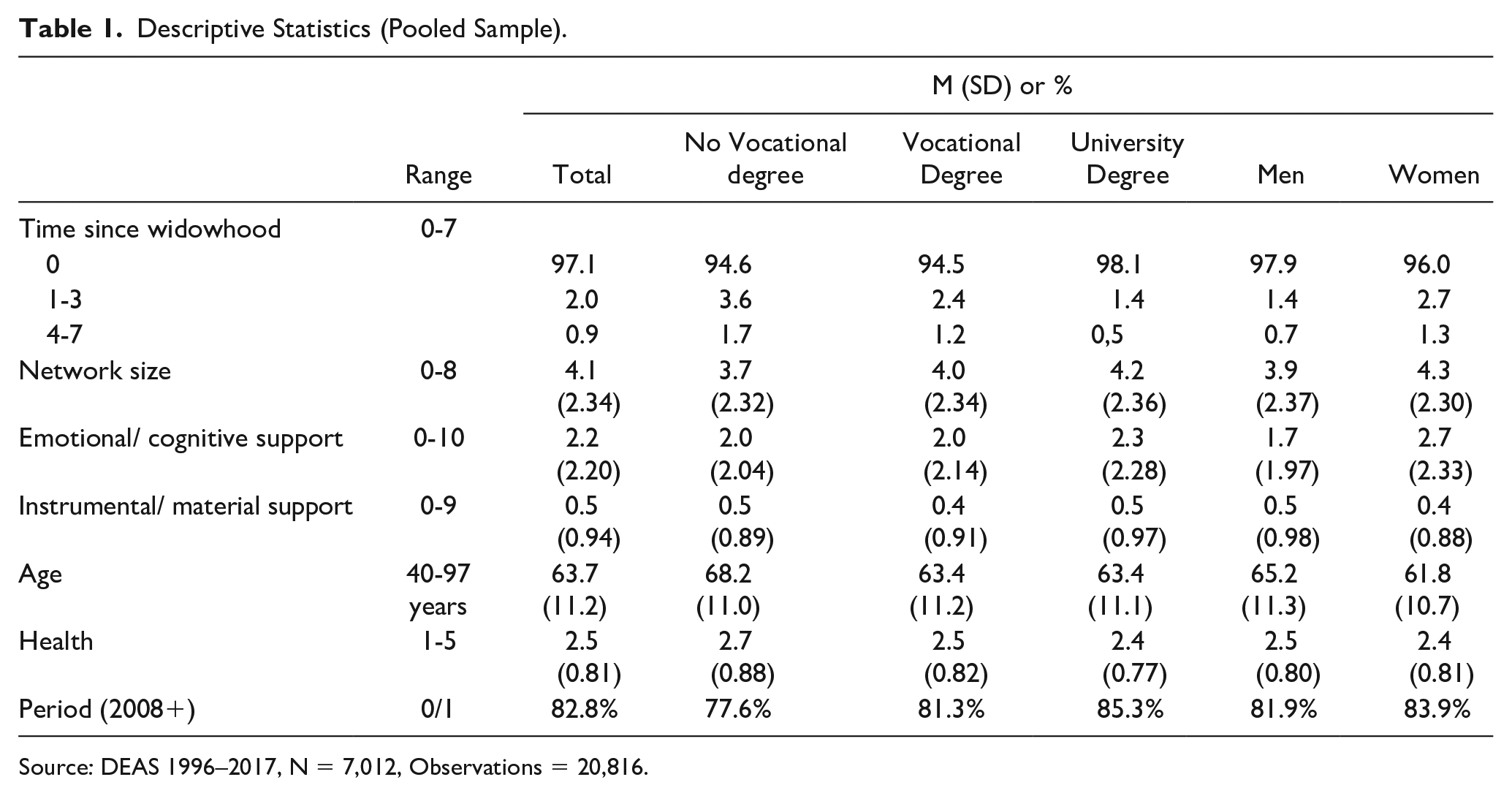
Source: DEAS 1996–2017, N = 7,012, Observations = 20,816.
Results
The network size and both support indicators were regressed on time since widowhood, adjusted for the set of controls. The effects of the controls were neither reported nor interpreted because their estimations were based on all respondents including those who did not experience widowhood during the time of observation and, thus, might be biased. Unstandardized coefficients and robust standard errors were provided in Tables 2 and 3. To illustrate the dynamics in the social relationships and for ease of interpretation, in case of significant estimates, the predicted margins based on the estimations were plotted in Figures 1 to 3.
Changes in (1) Network Size, (2) Emotional/Cognitive Support, and (3) Instrumental/Material Support Following Widowhood (Fixed Effects Linear Regressions).

Note: Controlled for age, subjective health, and period.
Source: German Ageing Survey 1996-2017, *p < .05, **p < .01, ***p < .001.
Changes in (1) Network Size, (2) Emotional/Cognitive Support, and (3) Instrumental/Material Support Following Widowhood by Educational Level and Gender (Fixed Effects Linear Regressions).
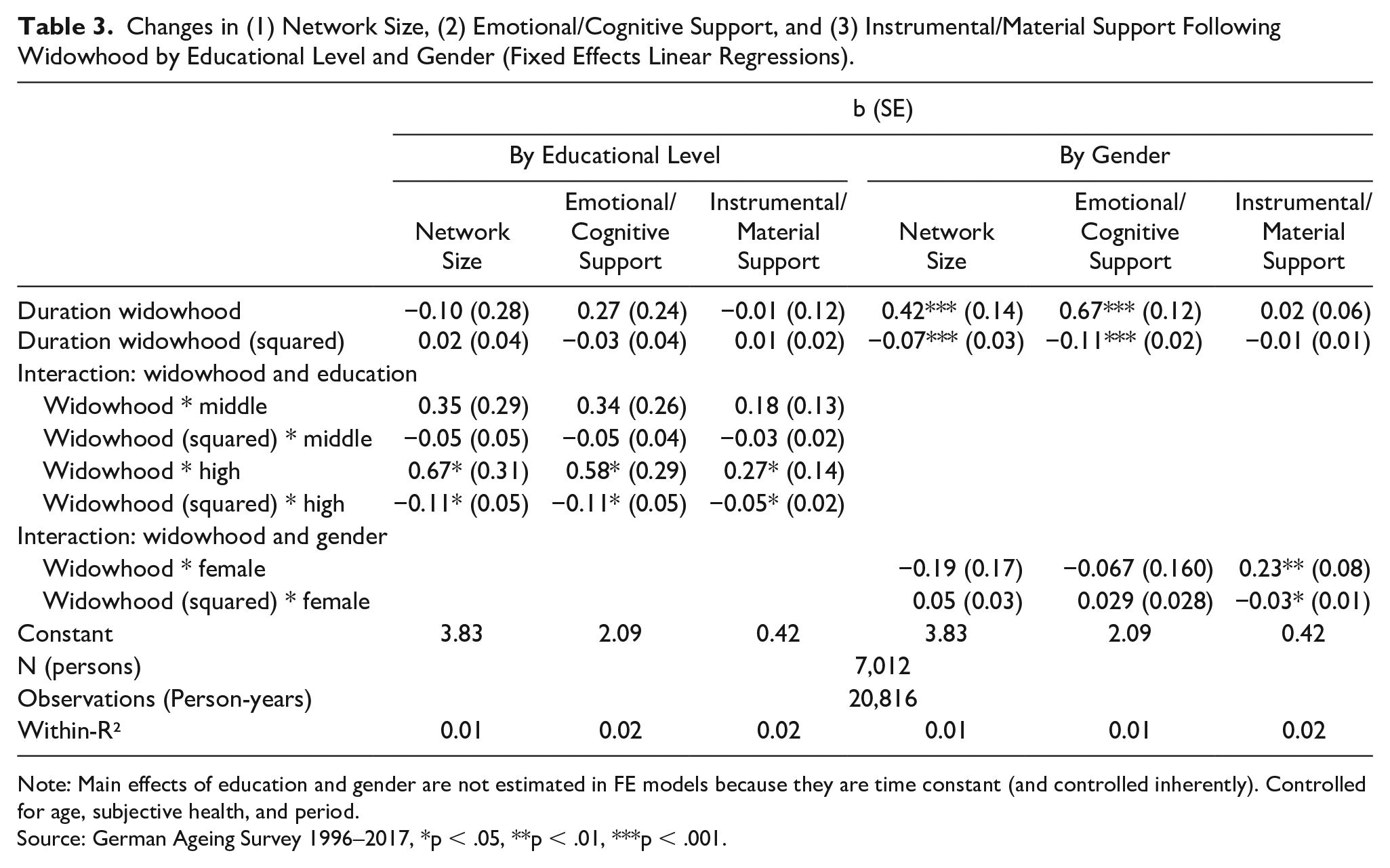
Note: Main effects of education and gender are not estimated in FE models because they are time constant (and controlled inherently). Controlled for age, subjective health, and period.
Source: German Ageing Survey 1996–2017, *p < .05, **p < .01, ***p < .001.

Post-widowhood trajectories (predicted margins).

Education-specific post-widowhood trajectories (predicted margins).
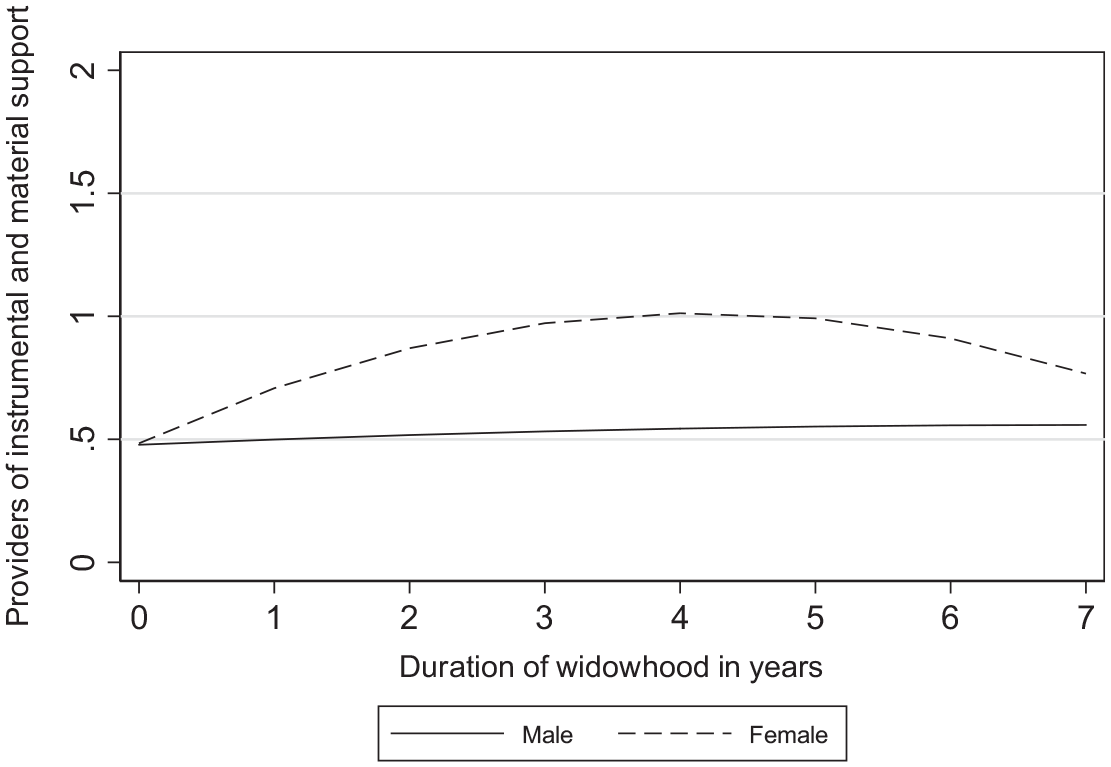
Gender-specific post-widowhood trajectories of instrumental and material support (predicted margins).
Post-Widowhood Dynamics
In Table 2, the overall trajectories were examined—controlled for age, health, period, and time-constants like gender. The findings indicated reversed u-shaped dynamics for all three observed aspects of social relationships following widowhood.
Initial increases were observed in the size of close network members (b = .30, p < .001), in the number of perceived potential providers of emotional and cognitive support (b = .63, p < .001), and in the number of factual supporters of instrumental and material help (b = .17, p < .001). All of these increases, however, not only attenuated in the long-run but also began to decrease. The quadratic terms showed significant negative effects on the network size (b=-.04, p<.01), emotional and cognitive support (b=-.09, p<.001), and instrumental and material support (b=-.02, p<.01).
The illustrated trajectories in Figure 1 help to describe the processes in more detail. The mobilization of social relationships and receiving of support culminated between the third and forth year after widowhood, and—except for the providers of instrumental and material support—regressed to pre-widowhood levels around the end of the observation in the seventh year. On average, the number of close relationships increased from four people before widowhood by 0.5 people four years after widowhood (Figure 1A). Widows and widowers perceived an increase from around two potential emotional and cognitive supporters in pre-loss times to around three supporters three years after widowhood (Figure 1B). The number of reported providers of instrumental and material support increased from 0.5 on average to 0.8 in the fourth post-widowhood year (Figure 1C). These dynamics suggest that, overall, close and supportive relationships can be created, intensified, and employed to compensate for the losses due to the death of the spouse. This activation and mobilization was found to be substantial, but limited in two ways: First, except for the number of emotional and cognitive supporters, the increases remained below one person on average. Second, except for the number of instrumental and material supporters, the increases were clearly of a temporary nature and approaching pre-widowhood levels as time passed. Around seven years after the transition to widowhood, the surviving spouses reported similar levels of close ties and support as before widowhood, abstaining from their spouses who are usually key figures in one’s (support) network.
Education
A differential look for different levels of formal education (first set of models in Table 3) revealed that the reversed u-shaped post-widowhood trajectories were most pronounced for widowed spouses with a university degree. When including the interaction terms, the coefficients for the time since widowhood refer to those without any vocational degree (reference group) and, for them, indicated no significant widowhood effects at all: neither for network size (b = -.10/ b = .02), nor emotional and cognitive (b = .27/ b = -.03) or instrumental and material support (b = -.01/ b = .01). This suggests that the social relationships among the lowest educated did not significantly change after transition to widowhood, as also illustrated in Figure 2.
According to the predicted margins in Figure 2, the middle educated spouses seemed to follow the overall temporal patterns, but did not differ significantly from the reference group, as can be read from the interaction terms in Table 3 (widowhood * middle educated) that were not significant for any of the considered aspects of social relationships. However, for the highest educated widows and widowers, the trajectories were significantly different from those of the reference group (Table 3). Widowed spouses holding a university degree experienced a significant stronger increase in the network size (b = .67; p < .05), but also a stronger decrease (b = -.11; p < .05) compared to those without any vocational degree. The same patterns were found for the number of emotional and cognitive supporters (b = .58; p < .05/ b = -.11; p < .05) and instrumental and material supporters (b = .27; p < .05/ b = -.05; p < .05).
The predicted trajectories in Figure 2 specified that those with university degrees reported the fastest and steepest post-widowhood increases, reaching their peaks earlier than the less-educated groups. Three years after widowhood, they reported five close relationships compared to a stable number of four close relationships among those with no vocational degree (Figure 2A). Similar trajectories were observed for receiving support. In the third post-widowhood year, the highest educated perceived 3.2 emotional and cognitive supporters, compared to 2.7 among the lowest educated (Figure 2B). In the same year, the highest educated reported 0.8 providers of instrumental and material support, compared to 0.5 among the lowest educated (Figure 2C).
As described in the overall trajectories, the stronger mobilization of social relationships for the highest educated was followed by stronger and steeper falls after they had reached their maximum. All three educational groups showed similar same levels of close and supportive ties around the fifth and sixth post-widowhood year. Due to few observations, the confidence intervals after the sixth year largely overlapped and, thus, indicated no significant differences between the educational groups. Nevertheless, widowed spouses with a university degree seemed to be most successful in mobilizing their social resources to mitigate the negative effects of widowhood in the first three years, compared to their less-educated counterparts. Those with no vocational degree in particular, may lack private support and companionship.
Gender
Turning to gender, no diverging trajectories for men and women were found in terms of the network size and the emotional and cognitive support (second set of models in Table 3). For widowers, the number of close relationships followed the described curvilinear dynamic (b = .42/ b =-.07, p < .001), which was also found for the number of potential providers of emotional and cognitive support (b = .67/ b = -.11, p < .001). The corresponding dynamics for widows were similar because the interaction terms were proved to be insignificant for both the network size (b = -.19/ b =.045) and the emotional and cognitive support (b = -.07/ b = .029).
Clear gender differences, however, emerged for instrumental and material support. Whereas no significant changes in the number of providers of instrumental and material support were revealed for widowers (b = .02/ b = -.01), their female counterparts experienced a significantly different dynamic. Figure 3 illustrates that widows’ instrumental and material support follows the overall pattern, which means a substantial increase followed by a decrease in the long-run. In the fourth year after widowhood, the number of available supporters differed by 0.5, and afterwards started to converge. Around seven years after widowhood, widows and widowers reported the same level of support.
Discussion
Using a nationally representative survey of the population in Germany, aged 40 years and older, the present study aimed to add to the existing literature on the implications of widowhood in three different ways. First, based on longitudinal data, FE panel regressions were used to study the post-widowhood trajectories in several facets of social relationships. Second, differential trajectories, by education and gender, were tested in order to identify groups of widowed spouses who might be vulnerable in terms of social integration and their ability to receive support. Third, several ideas from prominent models of support and gerontological family research were embedded in the broad framework of the TSPF (Ormel et al., 1999) in order to derive hypotheses. As a general mechanism, it was assumed that widowed spouses mobilize alternative relationships to cope with the emotional stress and to compensate for the functions and responsibilities previously performed by the deceased spouse in order to mitigate the accompanying cuts in subjective well-being. More detailed, differential levels of compensation were hypothesized depending on the time passed since widowhood, the widowed person’s educational level and gender.
The findings showed that, overall, the post-widowhood development of close and supportive relationships followed a non-linear pattern. Widowhood resulted in increases in the number of close network members and in the number of supporters up to the fourth post-widowhood year. After that the increases turned into decreases falling to the pre-widowed levels around the seventh year. These results confirmed prior findings (Ferraro & Barresi, 1982; Ferraro et al., 1984; Guiaux et al., 2007). Existing evidence was extended as findings highlighted that the compensation effects were limited not only in time but also in amount. The initial increases were of a temporary nature and their magnitudes remained below an average of one person. The results differed from Hypothesis 1, in which increases were proposed but subsequent decreases down to pre-widowhood levels were not anticipated. How can these unforeseen limitations in compensation be interpreted in light of the underlying theoretical premises and the empirical findings from related branches of research and what are the implications for widowed spouse well-being?
First of all, investments in a new partnership were disregarded in this study, mainly due to data limitations which do not allow the full identification of re-partnering in early DEAS waves. Nonetheless, the support models discussed here imply re-partnering is a promising strategy to substitute the lost spouse and also the TSPF admits that full compensation is lacking “unless it concerns a new comparable partner relationship” (Nieboer et al., 1999, p. 117). The literature about post-widowhood dynamics suggests that making new contacts becomes beneficial as time passes, and this certainly includes a new partnership or re-marriage. In the long-run, it could yield a milder decrease in the number of social relationships and support levels than observed in the present study. Thus, to obtain a more complete picture about the social implications of widowhood, future studies should take re-partnering into account while simultaneously considering that the opportunity of a new partner is not available to everyone to the same degree (for gender and age differences see de Jong Gierveld, 2004; Wu et al., 2014).
Second, the assumed mobilization of social resources might have been overrated. The present findings complement studies that attributed the overall decline of relationships in old age to the growing inability to replace lost relationships with new relationships (van Groenou et al., 2013). Hypothesis 1 has probably overlooked that the social resources of the studied age group are limited compared to those available in young adulthood. The potential of the long-standing network, especially of the old-aged widowed spouse, may increasingly decline because relevant age-peers like siblings, friends, and even older confidants and family members are increasingly threatened by losses in health, mobility, and by death. And the opportunities to form new relationships may be decline with age (Ha, 2005) as social activities decline. To pursue this consideration, the implications of widowhood need to be addressed according to the age at widowhood (see qualitative study by Isherwood et al., 2017).
Third, if the compensatory power of relationships is indeed decreasing with age, future theoretical reflections should pay more attention on alternative strategies available to ensure well-being, especially in late life widowhood. Resources and activities beyond social ties may gain in importance for well-being. For instance, financial resources may entails better housing, health care, and recreational activities, and can be spent to purchase professional services and convenient products that help the widowed spouse to get by in everyday life. Another strategy may be the weighting of several aspects of well-being, a mechanism proposed within the framework of TSPF (Nieboer & Lindenberg, 2002). If, for instance, social well-being and stimulation cannot be adequately attained (by compensating ties), long-term widowed spouses may be able to focus more on other aspects that can be realized more easily such as comfort. Finally, processes of adaptation as described in psychological studies may be effective. Severe cuts in life satisfaction converge to the pre-widowhood level after a phase of recovery (e.g., Lucas et al., 2003). These u-shaped post-widowhood trajectories in mental health together with the reversed trajectories in social relationships found in the present study may be interpreted as indirect evidence for the discussed buffer-function of social relationships (e.g., Anusic & Lucas, 2013).
In addition to this overall pattern, the major contribution of the present study is to reveal that educational level and gender make a difference. No significant changes in the network size and support emerged for widowed spouses without any vocational degree. They differed significantly from those with a university degree, who experienced a pronounced reversed u-shaped change in all considered aspects of social relationships which was in line with Hypothesis 2. Hypothesis 3 was confirmed partly as no gender differences were found for the network size and the number of emotional and cognitive supporters. But women and men diverged in their trajectories of instrumental and material support: Whereas widowers remained stable at the low pre-widowhood level, widows basically followed the overall pattern, yet ranging above the pre-widowhood level after seven years.
Therefore, this study strongly suggests that the compensation mechanism does not work for all widowed spouses in the same way. The group-differences were less prominent than expected, but emerged despite the low statistical power of the (FE) models. Gender and educational differences in social resources known from the literature for middle and old age, appear to widen in the wake of widowhood, probably due to unequal resources and opportunities to socialize and invest in reliable and responsive social relationships from which to draw when required. Widowed spouses with little or no vocational training may be more vulnerable to the adverse consequences of widowhood than their higher educated counterparts. This also, in part, applies to widowers compared to widows. The group differences level out in the long-term but emerge and reach their peak during the first, most sensitive years and, thus, cuts in the subjective well-being may be severe. Recalling the buffer-function of social relationships, it comes as no surprise that widowed men are found to suffer steeper cuts in mental and physical health than widowed women up to higher rates of mortality (e.g., Schaan, 2013; Wörn et al., 2018). The present findings emphasize the need for more research on differential social implications of widowhood, with the primary aim to identify those who are most prone to social isolation and deficient provision or care. Further research is recommended to include other demographic and socio-economic characteristics. For instance, the age at widowhood might have an influence not only on the chances for re-partnering but also on the access to social resources in general.
The strengths of this study include a dynamic perspective on widowhood using large-scale longitudinal data on the middle and old-aged population, the consideration of important facets of social relationships, and the emphasis on inter-individual differences. In addition to the critical discussion of the theoretical sources that need to be revisited, some other limitations warrant further investigation. As admitted in the method section, selective panel attrition related to widowhood could possibly be a limitation on the data evoking an overestimation of the effects. Although the bias emerged to be marginal because attrition tests revealed only small to moderate effects, this study calls for replication based on alternative data and larger samples of widowed spouses.
Future studies may benefit from a broader set of indicators for social relationships that specify the quality of support, and rge the needs and potential deficits of the widowed spouse. As known from other studies, the number of social ties and supporters is correlated to, but not equivalent to, the amount and quality of assistance. To get a deeper understanding of the nature and the dynamic of the mobilization process, it is worth considering changes in the composition of the networks. Studying investment strategies in different types of relationships may extend the knowledge on the implications of widowhood because the meaning and efficiency of social relationships depend on their type (Merz & Huxhold, 2010). It also might be fruitful to adjust for characteristics of the marital relationship. The satisfaction with the marital relationship may affect the perception of the factual loss and thus, may predictive for the need for compensation. Time-consuming and exhausting caregiving activities during the terminal illness of the spouse are likely to impact the pre-widowhood nature of the (support) network which, in turn, may be reflected in post-widowhood trajectories. According to a recent qualitative study, most of the long-term caregivers suffered a significant reduction of their social contacts already before spouse’s death (Collins, 2018).
Footnotes
Declaration of Conflicting Interests
The author declared no potential conflicts of interest with respect to the research, authorship, and/or publication of this article.
Funding
The author received no financial support for the research, authorship, and/or publication of this article.
