



Abstract
This study examined family dynamics and parent–child relations that stem from the intersection of languages, cultures, and aspirations of first-generation parents and their U.S.-raised children. Based on 50 in-depth interviews with young adults from ethnically diverse immigrant families, this study explored reflections and distinctive themes characteristic of the participants’ immigrant childhoods and relationships with parents. From a more mature perspective of young adulthood, participants’ narratives demonstrated acceptance of the unique features of their family dynamics and appreciation of their immigrant parents’ idiosyncrasies and sacrifices. Despite some struggles to bridge generational and cultural gaps through language and cultural brokering, these young adults were highly motivated by their parents’ aspirations and work ethic to uphold their end of the immigrant bargain and achieve success. The study has important implications for educators, counselors, and other practitioners working with immigrant parents and their children.
Keywords
Children and adolescents growing up in immigrant families experience unique linguistic, cultural, and parenting contexts that influence their development and life trajectories. Current trends show that youth who are either immigrants themselves or are children of immigrants are a continuously growing segment of the U.S. population. Over 18 million U.S. children live in immigrant families, which represent 26% of all children nationwide and as high as 40% in New Jersey (Batalova et al., 2020), a state where the present study took place. The vast majority (88%) of these children were born in the U.S. to immigrant parents and thus represent the second generation; the remaining 12% were foreign-born and arrived in the U.S. at various ages (Batalova et al., 2020). While extant studies have focused on the experiences of immigrant parents, researching the perspectives of young adults on their immigrant childhoods can help advance our understanding of immigrant family dynamics.
Acculturation and Parent−Child Relations
Families with foreign-socialized parents and their U.S.-born and -raised children are influenced by at least two cultural perspectives, languages, and frames of reference that affect family dynamics and produce distinctive parent−child relationships (Foner & Kasinitz, 2007; Portes & Rumbaut, 2014). Normative developmental tasks and family transitions can become more complicated for immigrant families due to additional challenges of negotiating cultural rules, social interactions, and parenting practices (Falicov, 2016).
Based on the relations between immigrant children, their parents, and the ethnic community, three types of acculturation may develop: consonant, dissonant, and selective (Portes & Rumbaut, 2001). Consonant acculturation occurs when both parents and children learn American culture and abandon their native language and culture at about the same pace. Dissonant acculturation occurs when children lose their parents’ culture and learn American ways and the English language much faster than their parents; this may undermine parental authority as parents rely on their children to navigate the host society. The third possibility, selective acculturation, occurs when both parents and children gradually learn American ways while remaining embedded in their ethnic community. In this case, parental authority is preserved, parent−child conflict is low, and children develop into full bilinguals (Portes & Rumbaut, 2001).
Cultural Gaps and Intergenerational Conflicts
Immigrant parents socialized in foreign cultures and their children raised in American society have different life experiences and frames of reference, which may contribute to intergenerational tension and conflict (Portes & Rumbaut, 2014; Suarez-Orozco & Suarez-Orozco, 2001). Mainstream American lifestyles and practices that are normal to second-generation youth may be unfamiliar or threatening to their immigrant parents who came of age in a different society (Falicov, 2016; Foner & Kasinitz, 2007). Immigrant children and adolescents have to navigate between the different languages, standards, and rules used at home and those used in larger society, while also dealing with developing their own identity and fitting in with their peers (Nesteruk et al., 2015). Normative generational conflicts can be exacerbated by the cultural gap and the differing rates of acculturation among family members (Portes & Rumbaut, 2001).
Studies of immigrants from various national backgrounds have explored common sources of intergenerational conflict in families, some of which include: individualism and Americanization versus connection to family and retention of heritage culture and language; the reversal of roles when children serve as culture and language brokers to their parents; issues of authority and discipline; high academic expectations; gender-related double standards in dating, and pressure to marry within an ethnic group (Foner, 2009; Foner & Kasinitz, 2007; Portes & Rumbaut, 2014; Rumbaut & Portes, 2001; Zhou, 2009).
Language and Cultural Brokering
Children, adolescents, and young adults from immigrant families often serve as language brokers for their nonfluent parents and family members by translating documents (e.g., letters, forms, bills, contracts), interpreting interactions and acting as mediators in-person and over the phone in a variety of contexts (e.g., schools, doctors’ offices, hospitals, grocery stores, immigration and social services offices), assuming adult-like roles and helping their families meet the challenges of migration (DeMent et al., 2005; Lazarevic et al., 2014; Orellana, 2009). With the exception of immigrants in professional occupations who are English-proficient, language brokering is a common phenomenon among immigrant families from different national origins and ethnic groups when parents lag behind their children in acquiring new language and sociocultural skills (Weisskirch, 2017). Decades of research on language brokering show mixed evidence of how various dimensions of language brokering are linked to both positive and negative academic, relational, and health outcomes for both children and adults in immigrant families (Morales & Hanson, 2005; Shen et al., 2017).
Intertwined with language brokering, children in immigrant families also perform cultural brokering that involves engaging two sets of cultural norms of behavior and communication to connect their families to local information and resources (Katz, 2014; Lazarevic et al., 2014). Compared with their parents, younger members of immigrant families have more opportunities to not only learn the new language, but also become well versed in the host cultural norms through their experiences in school and interactions with native peers. Thus, they often find themselves explaining various aspects, concepts, and acceptable practices of the new culture to their parents (Katz, 2014; Lazarevic et al., 2014; Orellana, 2009; Weisskirch, 2017).
Influence of Immigrant Drive on the Second Generation
The expectations and attitudes of parents who migrated to the U.S. to give their children “a better life,” frame the immediate environment of immigrant children and exert a strong influence on the development of children’s ambitions and subsequent academic achievements (Fuligni & Fuligni, 2007; Portes & Rumbaut, 2001). First-generation immigrants from different ethnic and economic backgrounds hold very optimistic views of the opportunities available to their children in the U.S. and share strong aspirations for their success (Louie, 2012; Rumbaut & Portes, 2001; Suarez-Orozco & Suarez-Orozco, 2001). The children of immigrants grow up with an awareness of parental sacrifices, hard work, and struggles, often feeling pressured to repay the debt by realizing their parents’ dreams for themselves and to fulfill family obligations by helping support parents and younger siblings (Kang & Raffaelli, 2016; Louie, 2012; Trieu, 2016). This feeling of obligation to make their parents proud and their sacrifices worthwhile provides a sense of purpose, serves as a source of academic motivation, and connects the second generation to their immigrant parents (Fuligni & Fuligni, 2007).
Studies of Immigrant Young Adults
A small number of qualitative studies, mostly with Asian Americans, examined perceptions of adolescents and young adults from immigrant families to understand their dynamics and parent−child relationships (Juang & Meschke, 2017; Kang et al., 2010; Pyke, 2005; Qin, 2008; Xiong et al., 2004−2005). Throughout their childhood and adolescence, participants reported experiencing high academic pressures (e.g., expectation of “perfect” grades), while being restricted in social time with friends. Parent−child relationships were further complicated by the language barrier and lack of attention to youths’ personal problems and emotional well-being that manifested in conflicts and communication problems.
Although many young adults retrospectively “redeemed” their immigrant parents, some reported carrying these scars into young adulthood and vowed to parent their children differently—with more love, affection, and emotional support (Juang & Meschke, 2017; Kang et al., 2010). Immigrant parents who adjusted their parenting practices by lessening control, tuning into their children’s emotional needs, and maintaining communication beyond academic topics, retained emotional connections with children and maintained healthy family dynamics (Qin, 2008). These are important findings that affect several generations (e.g., immigrant parents, their U.S.-born children, and even future grandchildren), pointing to a need for more research on this topic with different ethnic and national origin groups.
The purpose of this article is to expand our understanding of family dynamics and parent−child relationships in immigrant families from the perspectives of young adults. Using a diverse group of participants, the present study examines young adults’ reflections on their immigrant childhoods and how their families negotiated different cultures, languages, and frames of reference.
Methods
This article draws on in-depth personal interviews with 50 young adults from immigrant families as part of the larger study on the second generation. The study was conducted at a large public university in the Northeast with a diverse academic environment and a large population of minority students representing all ethnic and economic backgrounds. The university has been designated as a Hispanic serving institution and holds social justice as its core value. To participate in the study, potential respondents had to meet the following criteria: (a) aged between 18 and 30 years old; and (b) born in the U.S. to immigrant parents or had immigrated to the U.S. before age 12. Recruitment was conducted through a combination of e-mails and class announcements in the university, personal contacts of the research team members outside of the university, and snowball sampling. Half of the participants were interviewed by the author and the other half by two advanced undergraduate students who received training in conducting qualitative research. Prior to the interview, participants signed a consent form and filled out detailed demographic information.
Guided by a phenomenological approach (Patton, 2002), this study aimed to explore the lived experiences of young adults from immigrant families. The interview guide was comprised of open-ended questions concerning family dynamics, acculturation, parent−child relationships, and family immigration history. During interviews, participants were encouraged to give examples and share related stories in order to elicit their perspectives on the experience of growing up in an immigrant family. Throughout data collection and analysis, phenomenology directed me to consider the participants’ retrospective accounts, paying attention to their descriptions, judgments, and interpretations of meanings. Recruitment and interviewing of participants continued until data saturation was achieved.
Sample Description
The sample included 37 females and 13 males; average age of the participants was 22 years old (range 18−30). The majority of the participants (66%) were born in the U.S.; the remaining 34% were foreign-born and immigrated at a young age. The vast majority of the participants (78%) had undergraduate degrees (completed or in progress), 18% were in graduate school, and 4% reported high school as their highest education. Occupations of the participants (full time/part-time) included: childcare provider, teacher, tutor, barman, policeman, office clerk, dental assistant, engineer, gas station attendant, small business owner, and retail sales.
Participants’ parents have resided in the U.S. for an average of 27 years and were born in the following countries: Argentina, Armenia, Bangladesh (4), Brazil (2), Bulgaria, Chile (3), China, Colombia (3), Croatia, Cuba (2), Dominican Republic (3), Ecuador (8), El Salvador (2), Greece (2), Hong Kong (2), India (8), Indonesia (2), Iraq, Jordan (2), Macau, Macedonia (4), Nigeria (2), Palestine (3), Peru (6), Philippines, Poland (4), Portugal (10), Puerto Rico (3), Romania (6), Russia, Spain, Syria (2), Turkey (2), Uzbekistan (4). Parents’ educational attainment included: 34% college/post-graduate, 43% high school, 23% secondary education. In terms of jobs, 42% were in professional occupations or were business owners, 43% were employed in unskilled/ semi-skilled jobs, and 15% were stay-at-home mothers.
Data Analysis
The interviews, which lasted 60−90 minutes, were tape recorded and transcribed verbatim. I reread interview transcripts and field notes and wrote detailed summaries noting core concepts and themes emerging from the data (Strauss & Corbin, 1998). During the early stages of data analysis for the larger study, members of the research team practiced peer debriefing and discussed independent coding for interviews, which contributed to a qualitative version of inter-rater reliability. The credibility of findings was increased by using investigator triangulation, reflexivity, and consideration of diverse perspectives (Patton, 2002). In a constant comparative analysis, I further evaluated salient patterns and themes that reoccurred across narratives and were significant to the participants’ experiences. I compiled memos with a record of emerging themes and maintained files with representative quotes. To ensure confirmability, copies of transcripts, demographic information summaries, field notes, and data analysis files were retained.
Findings
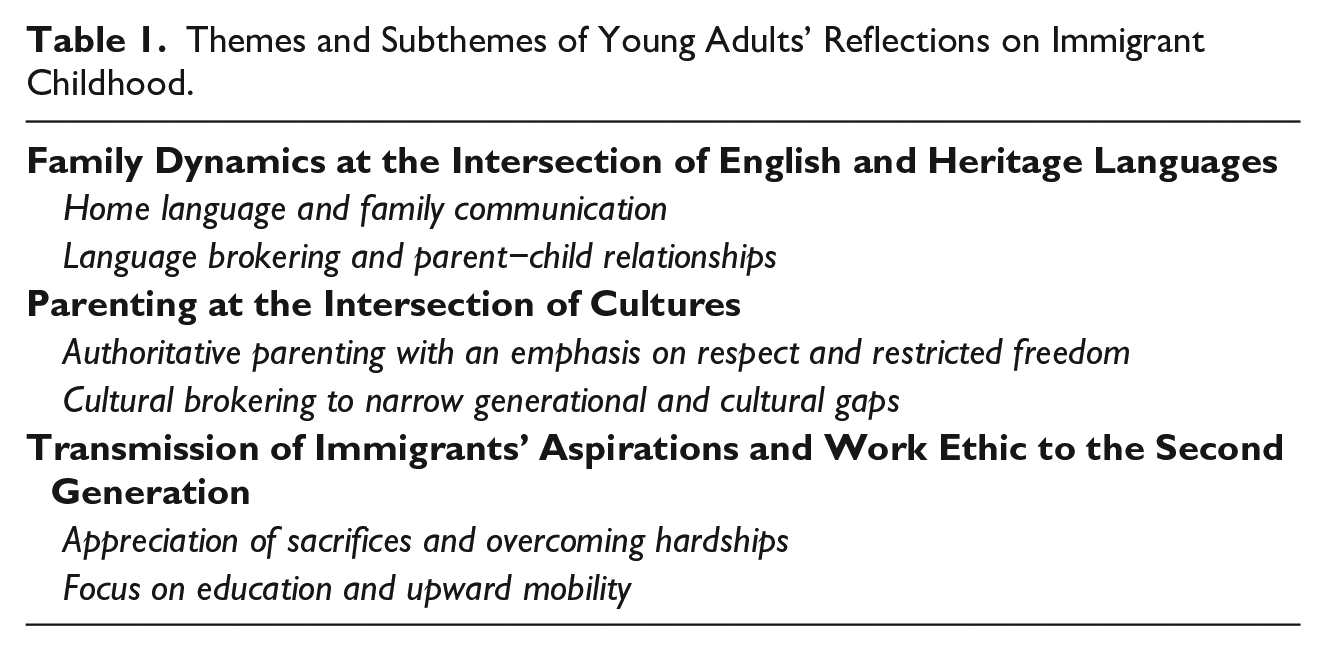
The results of the analysis indicate both similarities and differences in the experiences of these young adults from diverse backgrounds. In this section, I will discuss common themes related to: (a) family dynamics at the intersection of English and heritage languages; (b) parenting at the intersection of cultures; and (c) transmission of immigrants’ aspirations and work ethic to the second generation. A summary of the themes and subthemes is listed in Table 1. When presenting quotes to illustrate the findings, the authors of quotes will be introduced based on the countries of origin of their parents (e.g., “Chinese young man” or “Columbian-Argentinean female”). I am not assigning ethnic labels to the participants, nor do these labels represent how they may self-identify.
Themes and Subthemes of Young Adults’ Reflections on Immigrant Childhood.
Family Dynamics at the Intersection of English and Heritage Languages
Home language and family communication
English is reported by study participants to be their dominant language, the language they feel most comfortable using in their daily life. Based on the participants’ responses, it appears that first-born children retain more heritage language than subsequent children do (“For my younger brother, it was just pure English”). Interestingly, all participants state that they prefer to speak English with their siblings, even when both are proficient in a heritage language. A Palestinian female, who is a fluent bilingual conversing with her parents in Arabic, comments, “I don’t imagine me sitting with my sister and speaking in Arabic.” Similarly, a Bosnian female describes, “With my brother we speak English; only sometimes he’ll yell at me in our language, as a joke.” English is reported as the dominant language even by the participants who did not begin to learn it until kindergarten and who spoke their heritage language for the first five years of life.
Recounting family communication, many participants describe speaking a mixture of English and heritage language, where a parent would speak Turkish, Arabic, or Spanish, for instance, and a child would respond in English. A Polish male explains, “I speak broken Polish, my mother speaks broken English. Somehow we manage to communicate.” A minority of the participants, however, report a communication breakdown that resulted from their parents’ rudimentary English and their own limited knowledge of the heritage language. When there is no common language, family communication is affected, as Chinese female shares, “I’m not fluent in Chinese, and it’s hard to explain things to my mom. She doesn’t know much English, so she takes things the wrong way.” In families like this one, generational conflicts may be exacerbated by the language and communication barriers.
Only a small number of participants say that at home they speak their heritage language. For example, a Portuguese female explains how, “Growing up it was definitely a no-no to speak English. If we spoke in English, we would be yelled at.” Parental resistance to English becoming a home language is reported in families who fit certain criteria: family resides in an ethnic enclave, parents are employed in ethnic business and/or have limited interactions with mainstream society, parents have low educational attainment and claim to have no long-term plans to stay in the U.S.
Nevertheless, the majority of participants name English as their home language, particularly in families where parents want to assimilate (“we came here to adopt a new culture and language”) and have longer residence in the U.S. Also, when parents’ jobs require English, the shift in a family’s home language happens faster. Many participants describe the transition to English that occurred over time, as their “parents became more Americanized,” or “started going to school to get a degree,” or made a commitment to learn or improve their English. A Colombian-Argentinean female shares, “Growing up, I remember speaking Spanish mostly. But my mom has always wanted to learn English. So now, she’ll be like, ‘Just talk to me in English.’” Other participants similarly describe their parents’ efforts to improve their English skills by requesting children’s help in correcting their English grammar and pronunciation.
The analysis of participants’ narratives shows a common path of shifting family languages: parents and children transition from speaking heritage language only, to mixing it with English, to finally abandoning their heritage language to speak only in English. A Peruvian female sums up the process, “It used to be only Spanish. Then it became Spanglish. Now it’s just pure English.” She laughs and adds that parents revert to Spanish only to reprimand her and her siblings.
Language brokering and parent−child relationships
A common theme among the interviewees was language brokering—when children translate documents and interpret verbal communication in various settings (e.g., school, bank, doctor’s/ lawyer’s/government office, car dealership) for their immigrant parents. Due to the added responsibility of language brokering, many participants state that they feel more mature and independent (“I had to grow up faster”). It is important to note that not all study participants reported language brokering. Some had educated, English-fluent parents who did not need their children’s translation to function in the host society. However, immigrant parents who did not know English depended on their children in many important matters. A Turkish female recalls, “. . .always translating: call a credit card company, a cable company, insurance, or when you get a letter from the bank—you know you have to translate it!” A daughter of Pakistani parents explains, “That’s the reason why we’re so responsible and know a lot of things other kids my age might not. As a 12 year old, I had to learn about the hemoglobin level and iron deficiency because of my mom’s blood issues.” As a young teen, she was responsible for keeping up with doctors’ appointments and reading prescriptions carefully to ensure her mother took the right dose of medication.
Informed by the extant literature, one of the interview questions asked participants whether their responsibilities as language brokers gave them more power than children typically have in a family. Interestingly, none of the participants reported a decline of parental authority. An Ecuadorian female explains, “I had a lot of responsibilities. But still my mom held the power, I couldn’t take over that.” A Polish male elaborates on why translating did not result in a power shift, “You do the translation and take care of some things for your parents, but they still make the decisions. You’re literally just a translator.” Despite their language-brokering responsibilities, study participants report that great respect for their parents’ authority prevented them from taking advantage of the situation by deceiving their parents or translating to their advantage. A Puerto-Rican-Salvadorian female admits she never dared to lie to her mother, “I remember translating during parent-teacher conferences, and I’d be scared to translate something wrong. My parents were strict, I couldn’t lie to them.”
Although many participants view language brokering in a positive light and accept it as their responsibility to family (“we had to help one another,” “my parents could depend on me, even at a young age”), many also describe it as a stressful experience. A young woman with Peruvian parents recalls, “It was aggravating, because [I felt] I shouldn’t be doing this.” With age, she became more understanding of her parents’ situation and describes language brokering as “something I have to do because of the sacrifices they made.” Many participants also feel that translating for adults in the family resulted in deeper connections. A Dominican participant believes these translating interactions “built a stronger trust and a bond between us, especially with my father.” When young adult children move away from home, many are still called on to help with translation or to provide feedback on important documents for their parents—responsibilities that add to the demands of their busy lives.
Reflecting back on when they were younger, the interviewees admit to feeling embarrassed by their parents’ limited knowledge of the English language. Several participants recalled situations when the things their parents said in English did not sound right due to poor language skills, difficulties with idioms, or comic misunderstandings. However, as they matured, participants learned to appreciate their parents and their cultural quirks: “It doesn’t embarrass me at 24, but when I was younger it embarrassed me!” Related to this sentiment, many children also remember wanting to blend in and not be different from their English-monolingual peers, particularly if residing in communities with few immigrants (“when I was little, I wanted to only speak in English, like others”). However, those participants who grew up in ethnic enclaves and those who attended diverse schools, do not report feeing embarrassed by their heritage language (“we were all the same”). A more comprehensive discussion of heritage language, ethnic identity, and “fitting in” was detailed in a previous publication from this study (Nesteruk et al., 2015).
Parenting at the Intersection of Cultures
Authoritative parenting with an emphasis on respect and restricted freedom
All the participants report that respect towards parents, elders, and older siblings was a value emphasized in their homes. The second generation grows up with strong values of family cohesiveness and respect (“there is a lot of respect and closeness [in my family],” “family is really important to me”). When participants challenged their parents’ authority or talked back growing up, they were deemed disrespectful and “too American.” Immigrant parents pushed back against such attitudes and behaviors, as described by a Palestinian female, “My mother always said, ‘Don’t think I’ll accept this. Just because you see it on TV it doesn’t mean it is the right way to treat your parents!’” Another participant quotes her Indian mother, “Oh, now you’re going to talk back to me? You think that you’re that cool American kid? No, not in my house!” Immigrant parents instilled a strong expectation for respectful behavior in their children. Consequently, many of the narratives in the study concur with the statement by a Peruvian young woman, “The way I speak to my parents is different; some people will just talk back and disrespect their parents, but I can’t do that.”
Participants describe their parents as very involved, caring, and motivated to give them a better life. They use descriptors that would fit the authoritative parenting style: “[My parents] explain things and tell me a reason why I have to do something,” and “I have a good relationship with my parents.” At the same time, these authoritative parents are reported to be quite strict, placing much importance on proper behavior. A Bosnian female recalls how at the sight of a child throwing a tantrum in public her mother would comment, “If that were you, I would be pulling you by the ear and you would never do this to me again. This is our culture; we don’t behave like this.” Interestingly, participants note that their parents became more lenient with their younger children, who reportedly turned out less respectful than the older siblings who experienced stricter parenting.
When discussing their upbringing, many participants feel that, compared with their peers with U.S.-born parents, they experienced restrictions of freedom and overprotection. Due to their lack of familiarity with the new environment, immigrant parents limited their children’s “hanging out” with friends and forbade sleepovers, as will be described in the next subtheme. A daughter of immigrants from Chile and Colombia had a 9 p.m. curfew as a teenager, which prevented her from joining her friends who “were just going out at 9 p.m.” Other participants experienced similar restrictions growing up and some continue to live with a parent-imposed curfew, despite being legal adults, which reportedly inhibits their independence. A daughter of Indian parents’ shares: “I’m 21 and I still have to ask my mom’s permission if I can go to the movies with my friends.” A Nigerian female notes that her American friends have more freedom, especially after they turn 18, “But my curfew is still 11 p.m., and my friends laugh at me! They don’t even ask me to go places because they know my parents would say no.” Participants report feeling different growing up, and a handful admitted hating their parents for not being allowed to do “the same things our American friends were allowed to do” and struggling to explain it. However, with their immigrant friends (of any national background) there would just be “this understanding of our immigrant parents.” Participants found solace in exchanging stories with peers from immigrant families and it helped them feel less alone.
As the children of immigrants develop into young adults, they gain a new appreciation of their parents’ protective parenting style. Many participants discuss that now they understand their parents better and interpret their past restrictions of freedom as a way of parents “looking out” for them. Both young men and women share their conviction that this parenting approach saved them from getting in trouble growing up, especially “considering the town” or the neighborhood some lived in. They admit that if their parents were not strict, they “would be in bad stuff and wouldn’t be in school.” An Ecuadorian female sums up a common sentiment, “It’s good that immigrant parents keep their customs. The children may hate it, but it protects them and keeps them goal oriented.”
Cultural brokering to narrow generational and cultural gaps
Because their immigrant parents did not experience childhood and adolescence in the U.S. and relied on their original culture as a frame of reference, many participants describe their parents as “stuck in the old ways” or having a “different mindset.” As a result, they feel that their parents did not always have the best advice for them and did not know how to guide them. A Syrian male explains, “Our parents didn’t grow up here, so they don’t know how to handle it.” The normative generational gap is widened by an additional, cultural gap between the foreign-socialized immigrant parents and their American-raised children. In such families, children may have to perform cultural brokering for their immigrant parents. Participants recall having to explain the concept of “bullying” or the practice of “spirit week in school.” They also had to normalize the idea of “hanging out” with friends at the shopping center or the tradition of a beach weekend after senior prom. Some had to convince their Hispanic parents that fraternity was not a gang and sorority was not a cult.
Another example, mentioned by almost all of the participants, was the American practice of sleepovers, which was perceived negatively and forbidden by immigrant parents of both girls and boys. A Peruvian female comments, “Sleeping over is a big American thing! Every little girl has sleepovers, but I wasn’t allowed to, because it wasn’t right for a girl to be outside the home overnight.” Boys experienced similar restrictions, as shared by a male participant from Poland who recalled “crying and having a fit about it,” but never being able to participate in a sleepover because his parents did not accept their children “sleeping in other people’s houses.”
Masters of code-switching, and attuned to cultural differences, children of immigrants also recall having to ask parents to lower their voice in public, be less direct, and less confrontational in interactions with “the Americans.” Over time, in some families, cultural brokering extended to young adults questioning their parents’ traditional views about same-sex relationships or challenging their parents’ stereotypes about other ethnic groups. As addressed in a previous publication from this study (Nesteruk & Gramescu, 2012), the second generation socialized in the United States turned out more open-minded than their immigrant parents. In time, these young adults confront their parents’ racist or ignorant beliefs, leading to family conflict and also to the development of more progressive views in the first generation.
First-generation immigrants are often highly motivated individuals who come to the U.S. seeking a better life for themselves and their children. It is not surprising that participants report that their immigrant parents place considerable emphasis on education and studying, while attributing little importance to their social relationships with peers. An Albanian female recalls how her mother used to give her “whack advice” in response to her sharing about a conflict with a friend, “Mom would be like, ‘oh stop trying to be American, why would you want to be friends with her? Calm down, go wash the dishes and do your homework.’” Similarly, a Chinese female shares, “Like relationships in school, or girls fighting over a boy—it was not important to my parents. It was all about grades.” Another participant did not tell her parents that she was bullied in elementary school until years later—she felt that her parents “would not understand” and thus would be of no help.
Lacking personal experience of growing up in the U.S., many immigrant parents may operate based on the rules of their countries of origin circa when they left. A Polish male sums up: “My parents wouldn’t see it as 2008 America; they would see it as 1988 Poland.” If they tried to offer helpful advice or guidance to their children, it was often rejected or deemed as irrelevant in the U.S. context. When parents were of no help, younger children sought advice from their older siblings. A Russian male recalls, “I’d talk to my sister because she’s obviously more Americanized than my parents.” Similarly, a Portuguese young man remembers he did not think his parents “would actually understand” his problems at school or with friends, so he would call his older brother or sister. Essentially, older children used their own experiences to guide their younger siblings. It is important to note that immigrant parents who were more acculturated due to their education or work were reported to be better able to relate to their children’s general concerns, peer relations, or assist with homework.
Transmission of Immigrants’ Aspirations and Work Ethic to the Second Generation
Appreciation of sacrifices and overcoming hardships
Participants report that their parents immigrated to the U.S. to seek a better life and opportunities or to escape persecution. These young adults grew up hearing stories of sacrifices and overcoming hardships, which are highly motivational to the second generation. A Romanian female reflects, “For me, anything is possible because my parents came here with nothing, no English, just two suitcases and a baby. They struggled and worked long hours [so we could have a good life].” Along the way, immigrant parents had to take any jobs they could to support their family. Hence, a constant reminder to their children, as shared by a Peruvian female, “What we go through is for you to become successful. Go to school, study, so you don’t have to be a factory worker like me.” Participants appreciate the sacrifices their parents made by leaving behind their family and things they were familiar with in order to build a life with more opportunities for their children. A young woman from Ecuador recounts everything her parents had to give up: the support of close-knit extended family, a house, and a restaurant they had, “then coming here and starting from the beginning. . . It was very difficult, a very big sacrifice [in order] for me to have a better education, a better future.”
Not surprisingly, when asked about their role models, these young adults unanimously name their parents as people they look up to and also their older siblings for “showing the way.” They are proud of everything their immigrant parents have achieved: learning a new language, working hard, acculturating and establishing themselves in a new society, and building a new life. A daughter of an Ecuadorian father who only had an elementary education states, “He’s always been a hero in my eyes. I look up to my dad because of the crazy hours he works and how perseverant he’s been.” Another participant discussed her Greek mother as a role model, “I’ve never seen someone go through so much and still keep pushing through, doing what she has to do for her family.”
Many interviewees explain how their parents’ achievements influence them when it comes to perseverance and modeling a strong work ethic, as illustrated by a quote from a Filipina young woman, “My mom taught me that work ethic is very important and you have to work hard. When I look at my coworkers, I feel like they don’t have this drive to work or to study.” A young man with Puerto Rican parents summarizes a common refrain, “If your parents could do it without any help, deal with all the hard stuff—I know I shouldn’t complain about some things getting in my way.” Witnessing their parents’ determination, discipline, and hard work, the second generation cannot help but absorb this immigrant drive and the aspirations that come with it.
Young adults with immigrant parents also grow up with the weight of high expectations their parents have for them to realize the “American dream.” A Portuguese young woman shares, “Because my parents worked so hard to get where they are, I work a lot harder than my peers sometimes and I stress out a lot about being successful when I graduate.” Besides parents as role models, participants who were young children in the family also name their older siblings as their role models—the first in the family to realize their parents’ aspirations, to “show the way,” and to set an example for the younger siblings.
This discussion also brought up participants’ experiences with visits to their parents’ countries of origin. These visits made a strong impact on the young people by making them appreciate the conveniences of life in the U.S. and realize the privileges they have as Americans. A Portuguese female reflects, “The people who’ve been here for generations, they don’t appreciate what they have—the resources and amenities in this country, compared to others.” Visiting extended family outside the U.S. and witnessing the shortage of food and supplies, interruptions of water and electricity, as well as restrictions of personal freedoms, children of immigrants develop an appreciation for the things they have in the U.S. A Turkish young woman notes, “We take many things for granted in America, but when you’re in other countries you definitely know what it’s like to not have it.” Between these transnational experiences and the examples of their parents overcoming adversities in immigration, the second generation develops a perspective that contributes to their motivation to work hard and take advantage of the opportunities they have.
Focus on education and upward mobility
The importance of education and upward mobility to realize the dreams of their immigrant parents are emphasized across all interviews. Children of immigrants, aware of their parents’ struggles, grow up with high academic expectations and a sense of obligation to their family to be successful. As illustrated by a daughter of Bangladeshi parents, “It’s our upbringing! Parents who are immigrants have high educational expectations for us. [That is why] we are more into education, we want to make our parents proud.” A Romanian young woman similarly comments, “It was my job to get good grades because [my parents] sacrificed so much to come to this country that it was my duty to make sure that I amounted to something.” Not surprisingly, youth from immigrant families feel the pressure of high expectations throughout their childhoods. A Chinese young man remembers, “Hearing those immigration stories—I wouldn’t want to disappoint my father. [There was] the standard that I had to live up to.” Even in families where immigrant parents had limited English skills that prevented them from helping their children with homework, there was a lot of encouragement to excel in school. A Dominican young woman recalls her parents’ expectations, “Education is their number one priority [for us].”
Immigrant parents associate academic success in school with attaining respected and well-paying jobs, a benchmark of success. They hope for professional occupations for their children to enjoy financial stability and not struggle as they did. A Nigerian participant states, “The African dream is to become a doctor or an engineer.” A Palestinian female explains, “Position in Palestine is very important, you are defined as ‘the doctor’ or ‘the pharmacist.’”
High professional aspirations and academic expectations create a lot of pressure and stress for the second generation. A young woman with Indian parents describes, “They expect a lot! All this pressure: we have to do great in school, we have to make it in life and find a job, ‘cus we owe them so much.” Participants share stories of striving for perfect grades because anything lower than an A was unacceptable in their parents’ eyes. A Romanian young woman recalls, “American kids in my school say they’re aiming for a C or B+. But my dad would say, ‘Why not a 100? How are you aiming for an average grade? Put in the effort.’”
When it comes to college, the guidance children of immigrants receive depends on their parents’ English proficiency and educational background. While immigrant professionals can provide informational and financial support to their children, in many immigrant families, the practicalities of understanding and navigating the U.S. educational system fall to the second generation (“I had to figure out college on my own”). A Colombian young woman shares, “My parents were like, ‘Ok. Go to college.’ But I don’t think they ever understood what it involved.” Many participants share that they had to navigate college applications on their own, dealing with a lot of stress (“I would cry because I was really overwhelmed.”) A Bosnian young woman shares that her parents were not “well-versed in the language of higher education” and were unable to help her when she was researching schools and considering locations, loans, and networking opportunities; her parents trusted her “to do the right thing.”
What helped many of these young adults were their previous experiences with self-advocacy in school, language and cultural brokering, and the completion of various responsibilities growing up. A Peruvian young woman shares, “I became independent very early on. Anything for school, any transactions, any trips, it would be all up to me. I didn’t rely on my mom for that.” She grew into a responsible and independent person, who “. . .filled out my own financial aid application, I filed my own taxes, made my appointments with the driving instructor, I went to all these meetings, so I got all that done by myself.” Like many of her second-generation peers, she is now helping her younger siblings with their school matters.
In sum, across all interviews, the participants emphasized how their parents’ immigrant optimism and emphasis on education for upward economic mobility motivated them academically. Inspired by their parents’ sacrifices of migration and examples of a strong work ethic, these young adults grew up motivated to fulfill their parents’ American dream.
Discussion
The present study contributes to an emerging literature that examines the perspectives of young adults from immigrant families on their parent−child relationships and family dynamics. These findings provide greater understanding of how the second generation from diverse ethnic backgrounds made sense of their immigrant childhoods and negotiated issues at the intersection of cultures, languages, and aspirations in their upbringing. In spite of the participants’ varied national origins and cultures, many of the experiences associated with growing up in an immigrant household have important implications for practitioners who work with immigrant populations, and merit further research attention.
Although these young adults were raised in bilingual households with varying degrees of proficiency in their heritage language (as measured by their self-reported abilities to understand, read, and write in that language), all of them identified English as their dominant and preferred language of communication, supporting previous research on the linguistic shift across immigrant generations (Lopez & Estrada, 2007). Families where children developed into fluent bilinguals and were nested in a supportive ethnic community, seemed to fit the selective mode of acculturation (Portes & Rumbaut, 2001). A minority of families where parents insisted on only using their native language experienced communication difficulties that aggravated generational conflict, and, in some cases, led to dissonant acculturation. Families, where parents embraced English as the primary language in the household early on, were able to maintain fluent communication between generations, a finding consistent with consonant acculturation (Portes & Rumbaut, 2001).
Beyond supporting the acculturation modes, this paper outlines the process of linguistic change in immigrant families over time. Participants’ narratives encompass many years and show how family communication shifted to English over time, influenced by the diverse attitudes towards acculturation, parental education, employment and residency contexts, and, importantly, time in the U.S.—all factors identified in previous research (Portes & Rumbaut, 2014).
This study found that both language and cultural brokering took place, especially early in immigration, when parents’ knowledge of English and the host culture were limited. In terms of the self-reported effects of language brokering on children, there was a range of experiences (some participants felt positive, mature, and proud, others felt annoyed and overwhelmed by the responsibility). But the long-term effects included stronger family connections and compassion for their immigrant parents, much like those reported in other studies (DeMent et al., 2005; Katz, 2014; Orellana, 2009; Weisskirch, 2017).
Interestingly, this study did not find that language brokering resulted in a “power shift” or a “role reversal,” phenomenon commonly discussed in the early language-brokering literature (Morales & Hanson, 2005). The young adults in this study felt it was their obligation to translate for parents who struggled to give them a better life, and they continued to regard their parents as decision makers and respected authority figures. This finding is consistent with other studies (Katz, 2014; Louie, 2012; Orellana, 2009) and also supports the new, strength-based perspective on language brokering as an adaptive family response to the demands of life in immigration (Falicov, 2016; Weisskirch, 2017). Although challenging, these language-brokering experiences helped participants develop independence, self-efficacy, and perseverance that aided them in future situations (DeMent et al., 2005).
Present study participants engaged in cultural brokering—explaining various aspects and practices of American culture to their parents as is common in immigrant families (Katz, 2014; Lazarevic et al., 2014; Orellana, 2009). Throughout their childhoods and often into young adulthood, participants served as acculturating agents for their immigrant parents. Some participants also challenged their parents’ traditional views on gender and marriage and corrected them on prejudices held about other ethnic groups. The present study found more cultural brokering than language brokering, and less brokering overall for parents with more education, acculturation, and longer time in the U.S., findings in line with previous research (Lazarevic et al., 2014).
Immigrant parents’ lack of the “map of experience” (Hoffman, 1989, p. 159) to navigate the new culture, coupled with an emphasis on academics and a benign neglect of social aspects, contributed to the cultural gap between generations. Additionally, alarmed by some features of American adolescence (e.g., disrespectful attitudes, excessive freedom) and high-risk neighborhood dangers (e.g., drugs, crime), immigrant parents tried to instill their original cultural values of discipline, respect, and proper behavior (Nesteruk & Marks, 2011; Valdes, 1996). Many parents restricted the movement of children, forbade sleepovers, imposed early curfew, and were generally overprotective, especially with their first children (Pyke, 2005)—parenting practices found in previous studies (Foner & Kasinitz, 2007; Juang & Meschke, 2017; Suarez-Orozco & Suarez-Orozco, 2001; Waters & Sykes, 2009; Zhou, 2009). Although participants recalled these situations with humor from their current perspective as young adults, they admitted to feeling frustrated, alone, and often lacking culturally appropriate parental guidance while growing up, especially regarding social issues and peer relations.
The desire to realize their parents’ dreams permeated the narratives of these participants who grew up with stories of migration and witnessed their parents’ determination and hard work. These young adults wanted to keep their end of the “immigrant bargain” (Louie, 2012; Smith, 2006) and achieve the American Dream, thus showing that their parents’ sacrifices were not in vain. They unanimously named their parents as their role models and discussed how proud they were of their parents’ achievements to build a new life in a new land. The example of immigrant parents overcoming obstacles to give their children a better life was highly motivational to the second generation who absorbed their parents’ drive and aspirations, much like their counterparts in prior studies (Kang & Raffaelli, 2016; Katz, 2014; Louie, 2012; Suarez-Orozco & Suarez-Orozco, 2001).
Although immigrant parents provided plenty of encouragement and expectations for high academic achievements, many of them could not help their children navigate the demands of schoolwork and the college application process, similar to other studies of immigrant families (Espiritu, 2009; Louie, 2012). Participants had to navigate the U.S. educational system and the practicalities of selecting colleges, applying, filling out financial aid applications, and figuring out a course of study. Children whose parents had more human capital (i.e., education, professional occupation, and strong English skills) received more assistance than the children of parents with fewer personal resources (Fuligni & Fuligni, 2007; Portes & Rumbaut, 2001). The latter group was largely on their own, trusted by their parents to figure things out, just like they did growing up. These young women and men called on the skills they developed earlier in life when they had to be self-reliant language brokers and cultural guides to their parents. Older siblings were prominently described as teachers, role models, and educational leaders for their younger siblings, a finding consistent with previous research (Katz, 2014; Orellana, 2009; Pyke, 2005).
Lastly, it is important to emphasize that this study is based on the young adults’ reflections on their upbringing; it is not a story of the family’s immediate adjustment post-migration. At the time of data collection, participants’ parents had been residing in the U.S. for 27 years on average. During this time, they improved their English proficiency, progressed in their acculturation journey, and adopted new values, beliefs, and behaviors. They also became more experienced parents who had to adjust their practices and expectations along the way, often becoming more lax with their later-born children. Like any parent−child relationship that evolves with a child’s maturity, these families experience a reconciliation of past conflicts and misunderstandings. They renegotiate their parent−child relationship into more of an adult-to-adult connection where both parties become accepting of each other’s perspectives.
Conclusion
Overall, study participants discussed their immigrant childhoods in a positive light. From the relative distance of young adulthood combined with a more mature perspective, they described even challenging and conflicting situations with their parents with humor and understanding. Their reflective narratives demonstrated an acceptance of the unique features of their immigrant family dynamics and the struggle to bridge generational, linguistic, and cultural gaps. With age, these young adults developed an appreciation of their immigrant parents’ idiosyncrasies and reframed their parenting strategies as reasonable in the given circumstances. Much like their counterparts in previous research (Juang & Meschke, 2017; Kang et al., 2010), these young adults’ “maturation narratives” showed sympathy toward parents, forgiveness of their past shortcomings, and appreciation of their sacrifices.
Limitations
When interpreting the findings of this research several limitations should be kept in mind. First, the participants were volunteers, mostly college-educated and employed, thus limiting the ability to represent immigrant youth who chose not to participate in the study, and who are not employed or attending college. Second, the study reflects retrospective accounts of family dynamics and parent−child relations obtained during one interview. Although appropriate, considering the goal of giving the voice to young adults and hearing their perspectives, future studies could also include parents’ perspectives and collect data longitudinally to obtain a more nuanced understanding of intergenerational relationships. Third, even though this study identified a number of common issues relevant to all participants from the diverse origin countries, there were variations due to culture, degree of conservatism, parents’ personal resources, English fluency, length of U.S. residency, and acculturation. Future studies could focus on specific ethnic or national origin groups and continue to parse out the roles of the above-mentioned factors in immigrant family dynamics and parent−child relations.
Implications for Practitioners
It is important that researchers, counselors, and educators are aware of the distinctive parent−child relationships in immigrant families. Participants’ accounts of their past and present family dynamics can be used in the development of parenting programs for new immigrants to help anticipate or alleviate cultural and generational conflicts. School counselors are encouraged to use these narratives to inform their work with immigrant populations, especially when it comes to college advisement and support. Family therapists, teachers, and service providers can be more effective in their work if they understand how immigrant family dynamics can be influenced by language and cultural brokering, or differing views on parenting, discipline, and educational aspirations. Such knowledge will help practitioners recognize both the challenges and the strengths of immigrant families and thus assist in developing culturally appropriate programs, supports, and interventions.
Footnotes
Declaration of Conflicting Interests
The author declared no potential conflicts of interest with respect to the research, authorship, and/or publication of this article.
Funding
The author received no financial support for the research, authorship, and/or publication of this article.
