



Abstract
The present study investigates factors associated with anxiety, depression, and stress in children being reared by their grandparents in rural Appalachia. Grandparent-headed households, in which grandparents have primary responsibility for care of children, are increasing in number. However, research is needed on child risk for internalizing symptoms in this context. Participants included 35 children aged 5–18 years and one of their custodial grandparents. Interviewers read questionnaires to grandparents and children assessing family functioning and child mental health and participants indicated their answers. Mean scores for child internalizing symptoms and stress were on the higher end of the scale of measurement. Lower grandparent positive parenting, grandparent not having formal custody of children, greater grandparent mental health issues, lower grandparent education, and lower financial status were correlated with greater child anxiety, depression, and stress. Results also indicated that correlates of children’s internalizing symptoms differed based on child sex and age.
Grandparent-headed households, in which grandparents have the primary responsibility for the care of children (“grandfamilies”), are one of the fastest growing family types in the United States and around the world (Glaser et al., 2018). Grandfamilies have become more common for a variety of reasons, including parental death, parental incarceration, parental addiction, and parental abandonment of children (Downie, Hay, Horner, Wichmann, & Hislop, 2010). Research on this population has focused on the physical and mental health of grandparents. This research emphasizes the high levels of stress, poor economic conditions, and other factors faced by grandfamilies that place grandparent well-being at risk (e.g., Yoo & Russell, 2020). The purpose of the present study is to address the gap in research on child well-being in grandfamilies. Specifically, this study explores factors that are associated with anxiety, depression, and stress in children being reared by their grandparents in rural Appalachia. Factors selected for the study are those that have been identified as characteristic of the region and are linked to internalizing symptoms generally.
There has been no research on the psychological health of children being reared by grandparents in Appalachia, but there are a number of studies from other geographical areas. Most of this research focuses on externalizing symptoms (e.g., Goulette, Evans, & King, 2016; Pilkauskas & Dunifon, 2016). Research indicates that children reared by grandparents have better psychological outcomes than children placed in foster care (Rubin et al., 2008), but that children may fare worse in grandfamilies than in traditional two-parent biological families who are also economically disadvantaged (Pittman & Boswell, 2007). There have been a few studies that examined internalizing difficulties in children reared by grandparents. One study of 20 Australian children indicated that although many children in grandfamilies report being well-adjusted, some children express problems with anxiety (Downie et al., 2010). Among a sample of Chinese adolescents being reared by their grandparents when their parents migrated out of the region for work, rates of anxiety and depression were significantly higher compared to their parent-reared peers (Tang et al., 2018). These findings suggest that children being raised by grandparents may be at risk for stress, anxiety and depression, but additional research is needed.
The present study focuses on two rural central Appalachian counties in Kentucky. This part of Appalachia is economically depressed, with high concentrations of poverty and low levels of education (Jenkins-Howard, Stephenson, & Mains, 2013). Rates of drug addiction are very high; prescription opioid addiction is a particularly serious problem (Schalkoff et al., 2020). Drug involvement is associated with criminal activity and incarceration (Roberson, Cortez, Trull, & Lenger, 2020). Further, Kentucky has the second highest rate of child abuse in the United States (Administration for Children and Families, 2014). Thus, many of the reasons for parental inability to care for children are prevalent in the rural Appalachian region of Kentucky. In fact, nearly one in five households is led by grandparents in the study counties, a number that is twice the national average (Pollard & Jacobsen, 2014). Parental financial concerns and low education levels are both risk factors for child internalizing symptoms (Masarik & Conger, 2017) and are therefore included as risk factors in the current study. Indeed, during the recent COVID-19 pandemic, financial hardship was associated with greater grandparent parenting stress indirectly through greater grandparent mental health struggles (Xu, Wu, Levkoff, & Jedwab, 2020).
Although Appalachian grandfamilies may experience several disadvantages, they also have numerous assets. These assets include strong family ties, commitment to providing social support, and long standing, well-trusted organizations such as faith groups (Schoenberg, Hatcher, & Dignan, 2008). Family cohesion and support among family members are high priorities, and families provide a sense of identity and belonging (Lancki et al., 2018). Family cohesion is associated with lower anxiety and depression, less suicide ideation, and fewer suicide attempts among various cultural groups (Park, Unutzer, & Grembowski, 2014; Rapp, Lau, & Chavira, 2016; White, Shelton, & Elgar, 2014). Spirituality is also a major part of life in Appalachian regions, and may encompass living in harmony with others and having a strong relationship with God or other divine presence (Dunfee, Brown, & Schoenberg, 2021). Spirituality and the religious coping are consistently related to better physical and mental health (e.g., Whitehead & Bergeman, 2019). Thus, understanding Appalachian grandfamilies requires consideration of their strengths as well as their challenges (DeFrain, 2014), and grandparent social support and religiosity are included as potential protective factors.
Another key factor for child internalizing symptoms in grandfamilies is likely to be grandparent well-being, which in turn may contribute to family conflict and poor grandparent parenting (“grandparenting”). Grandparents may find rearing their grandchildren to be highly stressful, as it is an unexpected role at their stage of life, their grandchildren may have needs and difficulties that are difficult for them to address, and taking over care of grandchildren can result in social isolation (Hayslip, Fruhauf, & Fish, 2021; Waldrop & Weber, 2001). More time caring for grandchildren is associated with greater risk for depression in grandparents (Brunello & Rocco, 2018). US grandparent psychological distress (a combination of anxiety and depression symptoms) is related to greater marital stress and dysfunctional parenting (a combination of parenting stress and poor parenting practices), which in turn are related to children’s greater internalizing symptoms; more social support, better health, and higher income were associated with lower grandparent distress (Smith & Hancock, 2010; Smith, Palmieri, Hancock, & Richardson, 2008). In a study of predominantly African American grandfamilies, grandparent psychological distress (based on a global measure of mental health–related stress), a home environment providing less support to children, and low family resources were related to greater behavioral problems in children (Kelley, Whitley, & Campos, 2011). Grandparent care and overprotection was associated with greater child internalizing and externalizing symptoms in a sample of intact Chinese families, controlling for mother and father care and overprotection (Li, Cui, Kok, Deatrick, & Liu, 2019).
Given the lack of research on grandfamilies in the Appalachian context and the greater constellation of needs in this environment, we sought to understand associations between grandfamily characteristics and child internalizing symptoms in rural Appalachia. Specifically, we examine strengths and limitations of Appalachian grandfamilies. We hypothesize that possible weaknesses such as less education, lower financial status, greater grandparent depression and stress, will be associated with children’s greater stress, anxiety and depression. We also hypothesize that possible strengths, such as grandparent social support, grandparent positive parenting, and grandparent religiosity, will be associated with children’s lower stress, anxiety and depression. Finally, we examine differential associations based on child sex and child age. There has been little to no research on differential risk for adjustment problems in grandfamilies, and thus these questions are exploratory.
Method
Participants
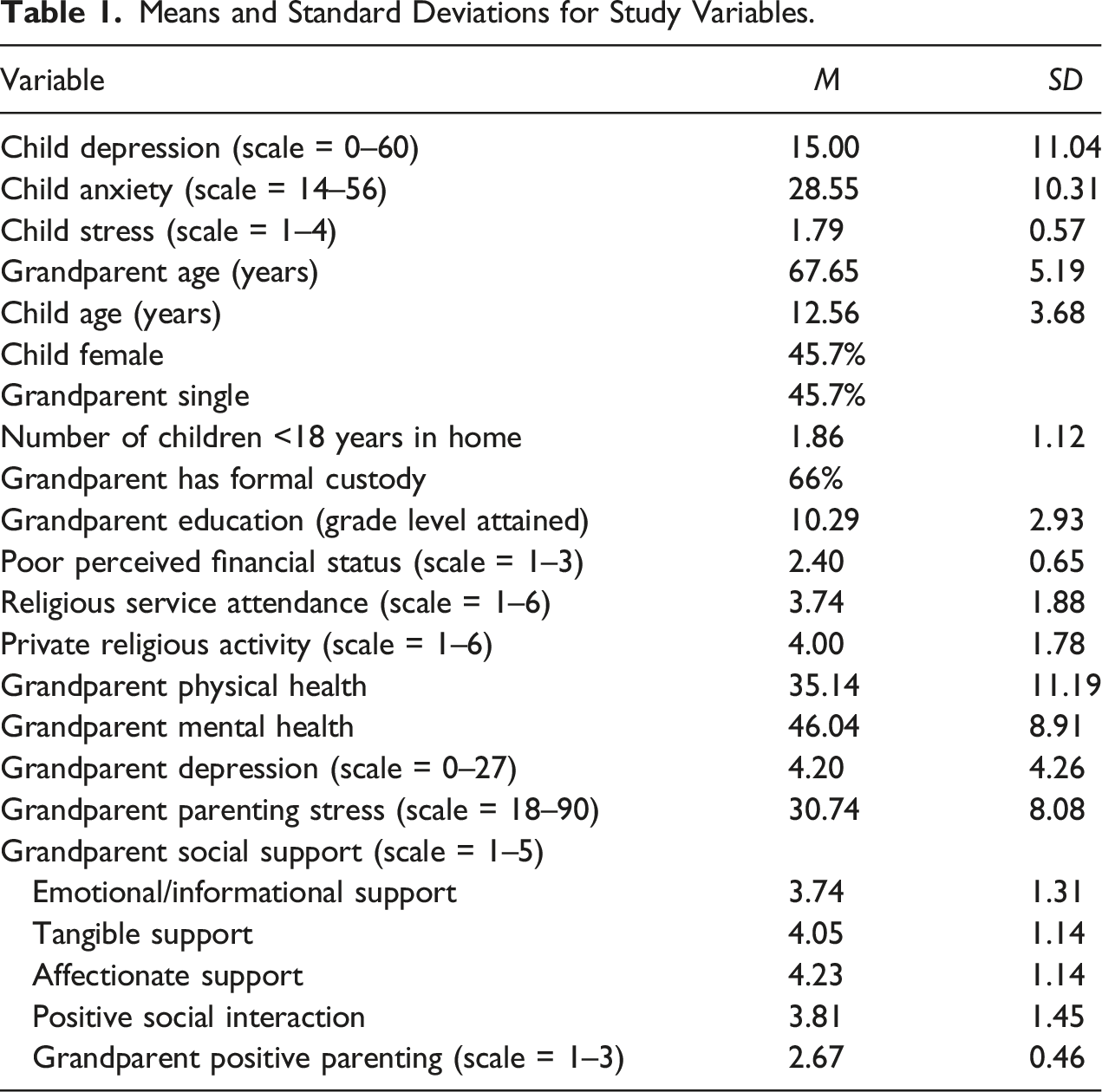
Participants were 35 children (16 girls) between the ages of 5 and 18 years (M = 12.56 years, SD = 3.68) and one of their grandparents (25 women, 19 married or living with a partner). Families were recruited via convenience sampling and snowball sampling. Recruitment was conducted by the local project manager, who attended grandparent coalition meetings or other community gatherings to recruit participants. Eligibility criteria were: (1) grandparent was at least 55 years of age; (2) grandparent served as a primary caregiver to at least one grandchild; (3) grandchild is between the ages of six and 18 years. Only one child (chosen by grandparent if multiple were eligible) and one grandparent per grandfamily participated. Twenty-three grandparents had formal legal custody of the grandchild, 11 grandparents did not have formal legal custody but took care of the grandchild most of the time, and one grandparent took care of the grandchild about half of the time. In the majority of cases, grandparents took over care of the children due to parental desertion or neglect (61% of biological mothers and 65% of biological fathers) or substance use problems (26% of mothers and 17% of fathers). In the remaining cases, biological parents had died (9% of mothers and 13% of fathers) or were incarcerated (1 father). Grandparent age ranged from 57 to 85 years, M = 67.65, SD = 5.19. Consistent with the demographics of the region, 100% of the participants were white (96.5% of residents in this area are white based on census data; https://datausa.io/profile/geo/lee-county-ky/#intro), only 13 grandparents had a high school diploma or more education.
Procedure
This study was conducted with the approval of the university Institutional Review Board; informed consent was obtained from grandparents and informed assent was obtained from children. Research staff visited the homes of the grandfamilies and separated the grandparent and grandchild into different rooms for interviews. All questions were asked in interview format to avoid issues with literacy. Participants were provided with cards listing the response options on the Likert scales to improve the ease of answering the questions. Interviews lasted approximately 1 hour, and experimenters were instructed to inquire whether participants would like a break 20 minutes into the interview (no participants requested one) and to monitor for participant fatigue and suggest a break if fatigue became apparent (no participants demonstrated fatigue and instead most appeared to enjoy the interview).
Measures
Child anxiety
Children completed the Penn State Worry Questionnaire adapted for use with children (Chorpita, Tracey, Brown, Collica, & Barlow, 1997). The 14 items are rated on a scale from 1 to 4, with higher scores indicating greater worry; Cronbach’s α in the current sample was excellent, .92.
Child depression
Children completed the Center for Epidemiologic Studies Depression scale for Children (Fendrich, Weissman, & Warner, 1990). The 20 items are rated on a four-point scale, with higher scores indicating greater frequency of the symptom; Cronbach’s α in the current sample was very good, .85. Item scores are summed to provide a total score.
Child stress
Children completed the first portion of the Responses to Stress Scale (Family Stress Version) (Connor-Smith, Compas, Wadsworth, Thomsen, & Saltzman, 2000). This portion includes 11 items representing different family stress experiences (e.g., arguing with grandparents and arguing with siblings) rated on a scale from one to four in terms of how much each of the experiences stresses them. Scores were computed by averaging responses across the 11 items. Cronbach’s α in the current sample was acceptable, .77.
Grandparent health
Grandparents completed the Short Form-36 (SF-36) Health Survey. Items pertaining to ability to walk one or multiple blocks were modified to “one hundred” or “several hundred yards” given the rural setting. The survey was scored using the SF-36 scoring manual (Ware, Kosinski, & Keller, 1994). The Physical Health and Mental Health Scores were computed. Higher scores indicate better health. In the general US population, each component has a norm of M = 50, SD = 10. In the age group of 65–74 years, norms are M = 43.65 SD = 11.02 and M = 52, SD = 9.53 for the physical and mental health components, respectively.
Grandparent depression
Grandparents completed the Patient Health Questionnaire-9 (Martin, Rief, Klaiberg, & Braehler, 2006). The nine items are rated on a four-point scale, with higher scores indicating greater depression. Reliability was good in the current sample, Cronbach’s α = .80. For older adults, a score of six or higher is indicative of any depressive disorder (Lamers et al., 2008). Based on these criteria, 11 grandparents (31.4% of the sample) may have a depressive disorder.
Grandparent parenting stress
Grandparent parenting stress was assessed with a version of the Parenting Stress Scale (Berry & Jones, 1995) modified to use “grandparent” instead of “parent”. Items are rated on a scale from 1 to 5, with higher scores indicating greater agreement with each statement. Of the 18 items, eight reflect positive themes of parenthood and are reverse scored and added to the scores for the other 10 items. Cronbach’s α was good in the current sample, .79.
Grandparent positive parenting
Children completed the Acceptance subscale of the Child Report of Parental Behavior Inventory (Schaefer, 1965). Children rated how much their grandparents make them feel accepted in 10 different ways (e.g., “smile at me very often”) on a scale from one to 3. Higher scores indicate greater acceptance of the child. Cronbach’s α was excellent in the current sample, .91.
Grandparent religiosity
Grandparents answered two questions: (1) How often do you attend church or other religious meetings? And (2) How often do you spend time in private religious activities, such as prayer, meditation, or Bible study? Both questions were rated on a six-point scale, which higher scores indicating greater frequency of religious activity. Given that public and private religious behaviors are conceptually distinct (e.g., Nonnemaker, McNeely, & Blum, 2003), the two questions were treated separately for analysis.
Grandparent social support
Grandparents completed the Medical Outcomes Study Social Support Survey (Sherbourne & Stewart, 1991). This survey includes four subscales for the different types of social support grandparents may experience: emotional/informational support, tangible support, affectionate support, and positive social interaction. There are 18 items, rated on a five-point scale in terms of how frequently a person is available to provide support. Scores were computed by averaging item responses for each scale; Cronbach’s α was excellent in the current sample, ranging from .93 to .98.
Grandfamily demographics
We considered the following demographic variables: Grandparent age, child age, child sex, marital status (partnered or single grandparent), number of children in the household, highest level of grandparent education, and perceived financial status. Perceived financial status was rated on a scale from 1 to 3, with 1 reflecting “I have more than I need to live well” (n = 3), 2 indicating “I have just about enough to get by” (n = 15), and 3 indicating “I sometimes struggle to make ends meet” (n = 17). To evaluate differences in correlations due to child age, the sample was divided into children 12 and younger, and children older than 12 years, resulting in 17 children in each age group. Child age was otherwise treated as a continuous variable (measured in years).
Results
Child Internalizing Problems
Means and Standard Deviations for Study Variables.
Sources of Child Stress.
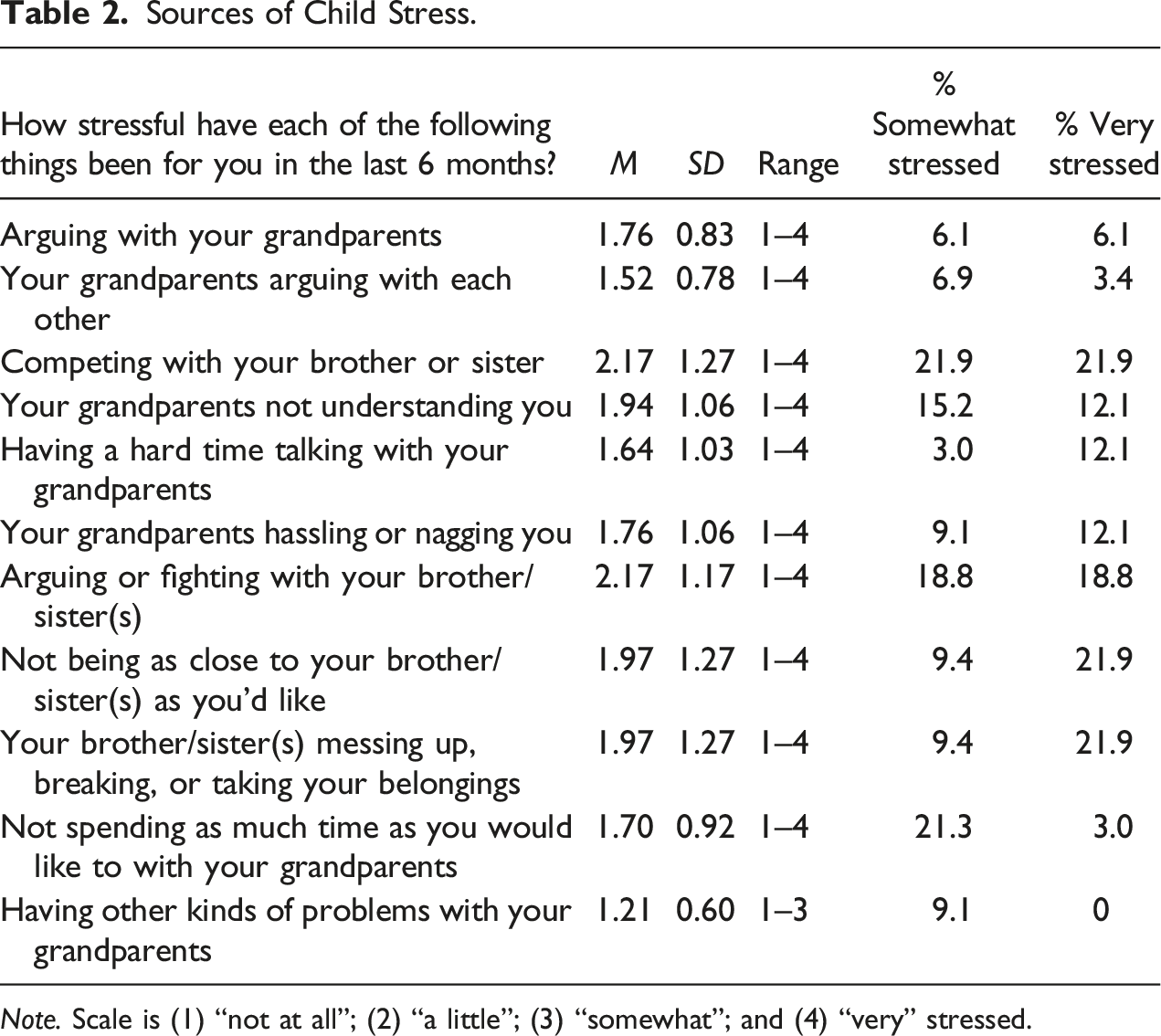
Note. Scale is (1) “not at all”; (2) “a little”; (3) “somewhat”; and (4) “very” stressed.
Grandfamily Strengths and Weaknesses
Means (Table 1) show that, in some ways, grandparents were doing well. The mean score for grandparent depression on the Patient Health Questionnaire was below the clinical cut-off, positive parenting had a mean score close to the top of the possible range, and the means of the social support measures were close to 4, indicating that social support is available “most of the time.” However, the mean perceived financial status was halfway between the option “I have just enough to get by” and the worst option, “I sometimes struggle to make ends meet.” Education levels were fairly low, being only a 10th grade education on average. Mean scores for grandparenting stress were near the middle of the scales. The mean score for grandparent physical health on the Short Form-36 is 1.35 SDs below the mean of a general national population and 0.77 SDs below the mean of the corresponding age (65–74 years) population. The mental health mean score on the Short Form-36 is 0.42 SDs below the national mean and 0.63 SD below the corresponding age group mean.
Correlations Among the Whole Sample
Correlations between Grandfamily Characteristics and Child Internalizing Symptoms.
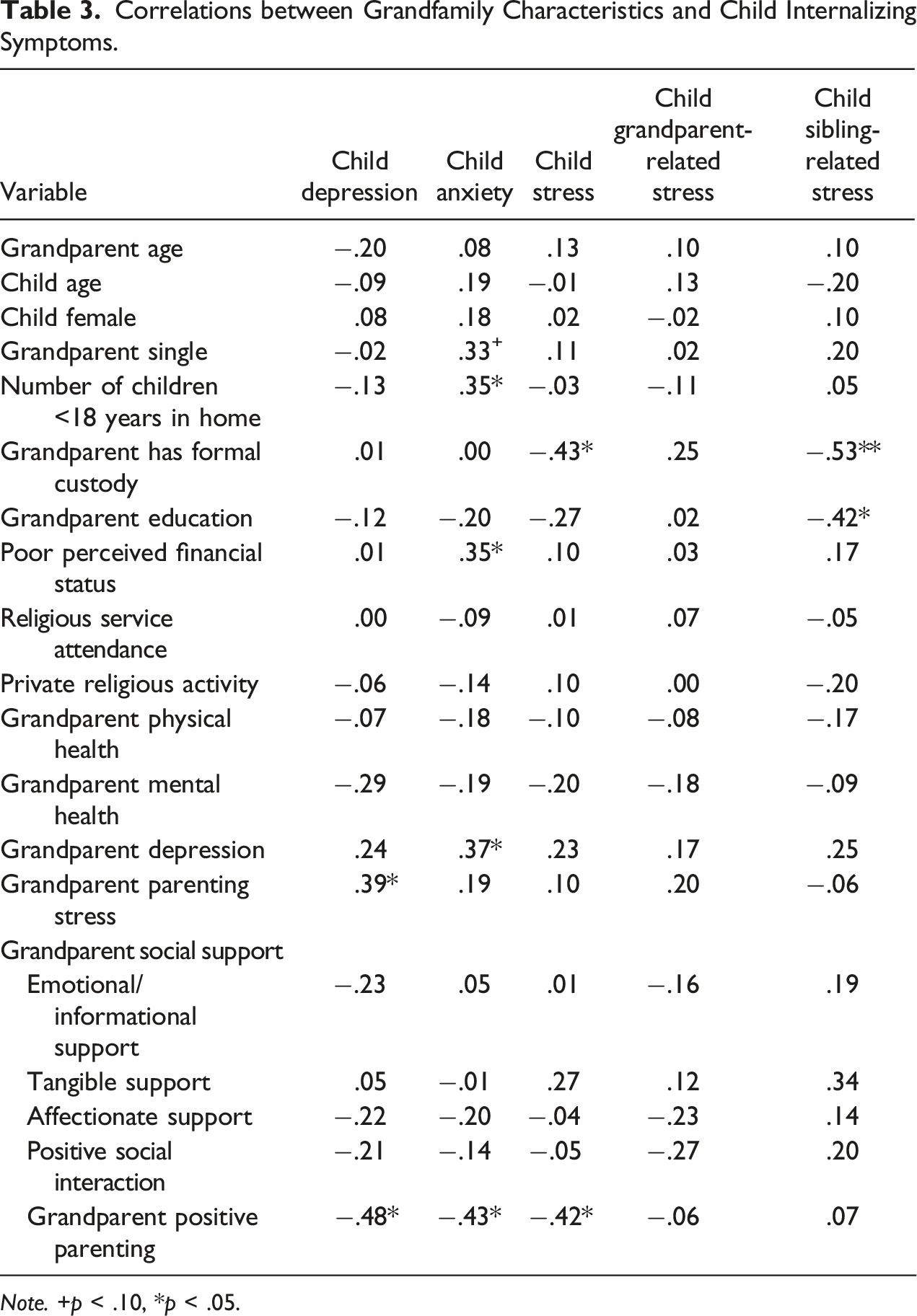
Note. +p < .10, *p < .05.
Given the potential differences in sibling-related stress and grandparent-related stress, additional correlations were examined with these separate scores. Some differences were noted between the two types of stress. Positive parenting was associated with lower grandparent-related stress, r = −.61, p < .001, but not sibling-related stress, r = −.05, p = .77. Grandparents having custody of children was related to sibling-related stress, r = −.53, p < .01, but not to grandparent-related stress, r = −.25, p = .17. A follow up analysis indicated that sibling-related stress was significantly greater when grandparents did not have custody (M = 2.73, SD = 0.93) compared to when they did (M = 1.71, SD = 0.70), t (30) = 3.46, p < .01. Grandparent education was related to child sibling-related stress, r = −.42, p < .05, but not to child grandparent-related stress, r = −.02, p = .90.
Differences Based on Child Sex
Correlations between Grandfamily Characteristics and Boys and Girls Internalizing Symptoms.

Note. +p < .10, *p < .05.
Differences Based on Child Age
Correlations between Grandfamily Characteristics and Older and Younger Children’s Internalizing Symptoms.

Note. Younger children are 12 years of age or younger, and older children are older than 12 years of age; +p < .10, *p < .05.
Discussion
In this study we found that children being reared by their grandparents in rural Appalachia exhibited high levels of depression and anxiety symptoms. Children also reported significantly more sibling-related stress than grandparent-related stress. Grandparent parenting stress was positively associated with child depressive symptoms, while grandparent positive parenting was negatively associated with child depressive symptoms. More children in the household, greater grandparent depression and having a single grandparent were associated with greater child anxiety. Although grandchild adjustment and grandfamily characteristics did not differ across child sex or age, the associations between grandfamily characteristics and child internalizing symptoms differed between boys and girls, and between older and younger children.
Children in our sample experienced high levels of stress, depression and anxiety symptoms. It is interesting that sibling-related stress was significantly higher than grandparent-related stress. Although sibling conflict is to some extent normative, it may be especially distressing in a culture in which family ties and loyalty are emphasized. To our knowledge, this is the first study to examine aspects of the sibling relationship among grandfamilies, and additional research is needed. It is possible that sibling conflict may be exacerbated in families where there are limited resources and competition for grandparent attention (Salmon & Hehman, 2014). We also note that the percent of children with potentially clinical levels of depression is substantially higher than the rates seen in other high-risk samples, such as children and adolescents who have been exposed to trauma (24.7%) and a much larger sample of children involved in the US child welfare system (17% of girls and 7% of boys; Orton, Riggs, & Libby, 2009). Accurate estimates of prevalence rates for a population require large sample sizes, and therefore additional research is needed before concluding that children being reared by grandparents in rural Appalachia are at 2–3 times the risk for internalizing problems than other high risk samples. However, the findings do indicate that the current sample is experiencing high rates of distress.
Although only a preliminary study, the pattern of associations can be used to construct a possible model of child internalizing symptoms in grandfamilies. In this model, a constellation of risk factors may create an environment conducive to the experience of children’s stress, anxiety, and depression. Most distal to the child, grandparents may contend with frailty due to older age, lack of cognitive resources for dealing with their situation and high financial strain due to low education, and issues obtaining formal custody of their grandchildren. Each of these factors was associated with internalizing symptoms for at least some of the children in the study. Such distal risk factors may result in increases in grandparent parenting stress and declines in grandparent mental health, variables also associated with grandchild internalizing symptoms in the present study. In turn, stress and mental illness may impair the parenting skills of grandparents. Although the current study only examined positive parenting, results indicated that this variable was consistently associated with lower internalizing symptoms and conversely that less positive parenting would be related to higher internalizing symptoms. Finally, the possible causal chain from distal risk factors to grandparent stress and mental illness to grandparenting to child internalizing symptoms may be moderated by protective factors. Grandparent religiosity and social support were related to lower grandchild internalizing symptoms, and therefore may ameliorate the possible negative effects of the risk factors that can occur in this population.
Although the goal of the current study was to describe risk and protective factors in the context of grandparents rearing grandchildren in rural Appalachia, it is worth considering whether the provisional model described above may also apply to other at-risk family types. For example, there are likely to be similarities and differences to models designed for traditional two-parent biological families who are also economically disadvantaged. Similarities include how financial strain and low cognitive resources from poor education may contribute to parenting stress, which in turn reduces positive parenting and may increase hostile parenting. Such family processes are likely to put children in two-parent biological families at risk for internalizing symptoms as well. Such a model has been proposed for economically disadvantaged families and is well-supported (Masarik & Conger, 2017). On the other hand, traditional two-parent biological families are less likely to face issues of physical frailty, custodial issues, and the loss of the parent generation, while at the same time potentially having the disadvantage of less social support (in Appalachia) and life experience.
It is important to note that associations differed based on child sex and age. For boys, many associations involved grandfamily demographics, such as grandparent age, education, number of children, financial status, and whether grandparents had custody of them. In terms of the potential model, this would suggest that there are direct associations between these risk factors and boys’ internalizing symptoms rather than indirect associations through the other variables, or that other possible intervening variables need to be identified. For girls, many associations involved grandparent mental health, depression, and parenting stress, supporting the possible model. Interestingly, there has been very little research on sex differences in child adjustment in grandfamilies. One study found no sex differences in associations between grandfamily functioning and child adjustment in a national sample (Smith, Palmieri, Hancock, & Richardson, 2008). However, research more broadly does report gender differences in the impact of family stress on child adjustment, with girls often experiencing greater impacts (Goodman, Rouse, Connell, Broth, Hall, & Heyward, 2011). Girls are often socialized to value and take responsibility for family harmony (Leman & Tenenbaum, 2011); this may especially be the case in rural Appalachia (Latimer & Oberhauser, 2004).
There were also interesting age differences in associations. These differences concerned the role of protective factors. Grandparent religiosity was related to greater stress among younger children but was unrelated to internalizing symptoms for older children. In addition, grandparent social support was associated with lower internalizing symptoms for younger children, but no associations were observed for older children. Grandparent social support may be less related to outcomes among adolescents because adolescents are building their own social support networks with peers (Shulman & Scharf, 2000). It is unclear why grandparent religiosity would be positively associated with internalizing symptoms for younger children; these associations were not found for older children and negative associations were found for boys. As negative associations between religiosity and mental health problems are typically observed (Sawatzky, Ratner, & Chiu, 2005), additional research is needed.
Social service and other programs that capitalize on these strengths may be of benefit to grandfamilies. Residents of rural Appalachia have limited access to mental health care services (Hendryx, 2008). They may also be wary of outsiders who enter the community with limited understanding of their culture (Weller, 2013). However, Appalachians place a high value on family well-being and are often willing to expend great effort to care for their children (Manoogian, Jurich, Sano, & Ko, 2015). The frequent custodial role that grandparents take in rural Appalachia is a testament to the strength and resilience of family ties. Culturally adapted and community based interventions for Appalachian grandfamilies, therefore, may be successful. For example, family strengthening programs that have been adapted to Appalachian culture result in higher retention in the program and significantly improve parenting and child outcomes (Marek, Brock, & Sullivan, 2006).
Findings should be interpreted in light of study limitations. First, the current study has a small sample size. Small sample sizes can lead to inflated Type I and Type II error rates, and additional research with larger samples is needed. With a larger sample size, statistical interactions between grandfamily functioning and child sex or age can be directly tested. Our approach of splitting the sample into two groups is only suggestive of interactions, and therefore direct tests of interactions should be done in future research. Second, the current study has a cross-sectional design, which prevents inferences about causality. We speculate that grandfamily challenges (and strengths) exert a negative (and positive) effect on child internalizing symptoms. However, findings are also consistent with the possibility that children’s mental health problems cause increased stress, mental illness, and physical health problems in grandparents. Previous research has documented that grandparents raising grandchildren with physical, emotional, or behavioral problems experienced more distress than grandparents raising grandchildren without these problems (Hayslip & Shore, 2000). Therefore, future research with a longitudinal design will be able to clarify the likely bidirectional nature of associations. Despite these limitations, the current study improves understanding of the strengths and limitations of grandfamilies in rural Appalachia, adds to the broader research on grandfamilies, and provides some insight into a possible model for the development of grandchild internalizing symptoms in this context.
Footnotes
Declaration of Conflicting Interests
The author(s) declared no potential conflicts of interest with respect to the research, authorship, and/or publication of this article.
Funding
The author(s) disclosed receipt of the following financial support for the research, authorship, and/or publication of this article: This study was supported by a grant awarded to the third author from the Retirement Research Foundation, an Igniting Research Collaborations grant awarded to the first and third authors by the University of Kentucky, and a small grant awarded to the first author from the University of Kentucky Center for Clinical and Translational Science (CCTS). The CCTS is funded by the National Center for Advancing Translational Sciences, National Institutes of Health, through grant number UL1TR001998. The content is solely the responsibility of the authors and does not necessarily represent the official views of the Retirement Research Foundation or the NIH.
