




Abstract
Parentification is a role-reversal phenomenon in which boundary violations occur such as children being their parents’ physical or emotional caretakers. Researchers have shown that childhood parentification can produce anxiety, but locus of control (LOC) moderates this relationship. We sought to examine the influence of LOC on the parentification-anxiety relationship in father–daughter dyads, as this dyad is under-represented in the parentification literature. One hundred and eighty-one undergraduate women completed an anxiety measure, parentification questionnaire, and an LOC inventory. Higher levels of parentification and lower levels of internal LOC were associated with higher reports of anxiety, but internal LOC did not appear to moderate the anxiety-parentification relationship. For individuals residing at home, parentification predicted anxiety, whereas internal LOC predicted anxiety among those not residing at home. These results further the paternal parentification literature, as well as show the relationship between childhood parentification and women’s anxiety for those currently living at home.
Introduction
In Western society, it is not uncommon for children to hold minor roles and responsibilities regarding their family unit. These responsibilities can include chores such as washing dishes, cleaning the house, and doing laundry. However, when the boundaries between a parent and child are violated, and the child takes on parental responsibilities for the parent that exceed what is expected of the culture, parentification occurs. For example, it is appropriate for the parent to bathe, feed, and clothe their children. It is not, however, typical in Western society for the child to bathe, feed, and clothe his/her parent. This behavior is a form of parentification. Additionally, providing an emotional outlet for their parents’ problems is another form of parentification. Parentification is a term coined by Boszormenyi-Nagy and Spark (1973) used to denote this inappropriate role-reversal phenomenon (Hooper et al., 2012; Macfie et al., 2015; Schier et al., 2015).
Children of people with alcohol use disorders (Pasternak & Schier, 2012), children of divorce (Jurkovic et al., 2001), children with immigrant parents (Kosner et al., 2014), and children with parents who have mental health disorders (Aldridge, 2006; McMahon & Luthar, 2007; Loon et al., 2015) tend to exhibit higher levels of parentification. Although there have been some studies to show positive effects such as resiliency and posttraumatic growth in adults (Hooper et al., 2008), and increased happiness and positivity in adolescents (Telzer & Fuligni, 2009), parentification can have negative effects on the child that they later carry on into adulthood; an adult who experienced childhood parentification can have greater levels of anxiety (e.g., Arellano et al., 2018; Hooper et al., 2011), depression (e.g., Arellano et al., 2018; Williams & Francis, 2010), externalizing and internalizing problems (Loon et al., 2015), and romantic relationship problems (Madden & Shaffer, 2016).
There are two categories of parentification: emotional and instrumental (Jurkovic, 1997). Emotional parentification occurs when the child acts as the parent’s main emotional outlet or provider. Instrumental parentification occurs when the child takes on an inappropriate amount of physical caretaking. Each of these produces a different effect on the individual. Madden and Shaffer (2016) found that emotional parentification was negatively correlated with healthy communication in romantic relationships and positively correlated with both avoidant attachment styles (e.g., emotional apathy toward romantic partners) and anxious attachment styles (e.g., extreme dependency on romantic partners). Instrumental parentification was related to avoidant attachment styles only. Likewise, in a study comprised of father–daughter dyads, higher parentification scores were associated with more avoidant and anxious attachment styles, and the daughters reported having less relationship satisfaction and higher insecurity in their current romantic relationships (Baggett et al., 2013).
Type of familial dyad also plays an important role in the type of negative outcome from parentification. Schier et al. (2015) found that negative outcomes from paternal parentification were related to the report of symptoms such as dizziness, nausea, and heart palpitations and “could be signs of psychological distress” (p. 1316) while maternal parentification related to reports of physical pain (e.g., headaches, chest pains, and backaches). Overall, Schier et al. (2015) found more pronounced physiological effects of father–child parentification than mother–child parentification. Feelings towards the father following the parentification period can also correlate with psychological distress manifesting into anxiety and panic disorders. Newman et al. (2016) found that lower scores on perceived love from the father and higher scores of anger toward the father predicted higher prevalence of General Anxiety Disorder (GAD), panic disorders, and a mix of both. The researchers also found that vulnerability towards the father predicted higher odds of mixed GAD and panic disorders, and rejection from the father predicted greater odds of panic disorders. On a similar note, Cassidy et al. (2009) noted that participants who suffered from GAD reported higher incidents of childhood role-reversal than non-anxious control participants. In the meta-analysis done by Hooper et al. (2011) using 12 non-overlapping studies, they found a significant positive correlation between childhood parentification and anxiety, with higher parentification in childhood associated with an increased likelihood of anxiety disorders in adulthood.
Like parentification, perceptions of control can also predict anxiety levels. Locus of control (LOC), a concept created by Rotter (1966), explains these perceptions as the tendency of people to attribute good or bad events in their life to (a) externally controlled forces such as fate, other people, or luck (external LOC) or (b) internally controlled forces such as their own innate abilities and behaviors (internal LOC). LOC appears to be relatively stable (Hovenkamp-Hermelink et al., 2019), and the research regarding the relationship between LOC and anxiety suggests that external LOC is more indicative of increased anxiety levels. In one study, participants who were diagnosed with GAD were found to have less internal LOC of their emotional experiences as compared to the non-anxious control participants (Stapinski et al., 2010). In other words, those with GAD believed that their experiences were outside of their own control.
In the workplace, LOC accounted for more than twice the variation in perceived general life stress in the women participants than the men participants, and those with higher levels of external LOC experienced more stress and were more likely to quit their job (Bernardi, 2011). Kliewer and Sandler (1992) also found that women were more vulnerable to stress when external LOC and low self-esteem were combined. Similarly, researchers have demonstrated the relations between self-esteem and LOC among college students (Kurtović et al., 2018). In a study with Turkish college students, participants with high levels of internal LOC had significantly lower scores of trait anxiety (Arslan et al., 2009). Additionally, Arslan and colleagues found that those with internal LOC were more adept at problem-solving than participants with external LOC. LOC also partially mediated the relationship between over-controlling parents and social anxiety in a study done by Spokas and Heimberg (2009). Participants who reported memories of over-controlling parents had higher levels of external LOC which, in turn, correlated with higher levels of social anxiety in those participants. Furthermore, LOC mediated the relationship between parentification and depression and happiness (Williams & Francis, 2010). Results indicated that internal rather than external LOC mediated the relationship with internal LOC having been a protective factor against depression.
In the current study, we aimed to explore the role of LOC in the relationship between paternal parentification and anxiety in women. Specifically, we studied women because researchers have shown that women are more affected by parentification than men (Aldridge, 2006; Byng-Hall, 2008; East & Weisner, 2009; Mayseless et al., 2004; McMahon & Luthar, 2007; Schier et al., 2015; for contrary evidence see Hooper et al., 2011). We focused on the father–daughter dyad because (a) the parentification literature lacks substantial research on paternal parentification among these dyads (see Baggett et al., 2013, and Brumariu & Kerns, 2010, for a review) and (b) the studies that have examined paternal parentification show that it can produce significant negative psychological effects that differ from effects caused by maternal parentification (Baggett et al., 2013; Brumariu & Kerns, 2010; Newman et al., 2016; Schier et al., 2015; Williams & Francis, 2010). To the authors’ knowledge, this study was the first study to examine the role of LOC in the relationship between parentification and anxiety regarding the father–daughter dyad. This study is important because it helps elucidate the relationship between parentification, LOC, and anxiety in father–daughter dyads, and contributes to the deficiency of paternal parentification literature. Additionally, the results of this study could help counselors recognize the unique effects paternal parentification has on women so that they may treat accordingly.
Method
Participants
One hundred and ninety-nine women from a rural university with approximately 12,000 students in the south-central United States participated in this study. Of those, five dropped out of the study. Thirteen participants failed to complete all scale items. Therefore, a total of 181 participants were used in these analyses. Participants’ ages ranged from 17 to 51 years of age (M = 22.59, SD = 6.20), with 13 participants not reporting their age. The sample consisted of 36 first year, 32 second year, 56 third year, and 57 fourth-year students. Over half of the sampled students reported identifying as White (98 students, 54.1%), followed by 22.1% (40 students) identifying as Black or African American, 18.8% (34 students) identifying as a race or ethnicity not represented by the given choices (i.e., “other”), and less than 5% identifying as either American Indian or Alaska Native (2 students), Asian (4 students), or Native Hawaiian or Pacific Islander (3 students).
We recruited participants using the university’s participant pool via the SONA Research Participation System. The participants were pre-screened prior to signing up for the investigation in order to ensure that those qualified for the study were female and that the participants had a male father figure growing up in their childhood.
Materials
Depression Anxiety Stress Scales
The Depression Anxiety Stress Scales (DASS-42) (Lovibond & Lovibond, 1995) is a 42-item self-report measurement that consists of three subscales: depression, anxiety, and stress. Each subscale consists of 14 statements based on negative emotional symptoms. Because this study was concerned with anxiety, this subscale was the only one used. Statements for the anxiety subscale include “I found myself in situations that made me so anxious I was most relieved when they ended.” Participants rate statements on a 4-point Likert scale based on how they felt over the previous week, with the scale ranging from (0) Did not apply to me at all to (3) Applied to me very much or most of the time. Raw scores for the subscale are summed, and they range from 0 to 42; higher scores indicate more presence of the variable. Scores values correspond to the following categories: Normal = 0–7; Mild = 8–9; Moderate = 10–14; Severe = 15–19; Extreme 20+. Internal reliability has been measured with Cronbach’s alpha with results of α = .84 to .92 for the anxiety subscale (e.g., Brown et al., 1997; Lovibond & Lovibond, 1995).
The Parentification Questionnaire
The parentification questionnaire (PQ) (Sessions & Jurkovic, 1986) is a 42-item retrospective true/false self-report measure. We revised it to a 6-point Likert scale ranging from (1) Strongly Disagree to (6) Strongly Agree to capture a larger range of participants’ experiences similar to revised parentification scales (e.g., Jurkovic, 1998). Although this measure does not have formal subscales, statements corresponding to instrumental parentification (e.g., “I was frequently responsible for the physical care of some member of my family, i.e., washing, feeding, dressing, etc.”) and emotional parentification (e.g., “It seemed as though family members were always bringing me their problems”) are included. Because we focused on father–daughter relationships, we edited the questionnaire to specify the paternal role (e.g., “It seemed as though my father was always bringing me his problems”). Scores can range from 46 to 252, and higher scores indicate a greater report of parentification. Measured with Cronbach’s alpha (α), the PQ ranges from α = .83 to .84 (Burnett et al., 2006). It should be noted that two questions were mistakenly repeated in our survey for the first 76 participants; we counted only the first score for these participants.
The Levenson Multidimensional Locus of Control Inventory
The Levenson Multidimensional Locus of Control Inventory (LMLOC) (Levenson, 1973) is a 24-item self-report measure consisting of three 8-item subscales that measure internal LOC (e.g., “Whether or not I get to be a leader depends mostly on my ability”), external LOC influenced by chance (e.g., “To a great extent my life is controlled by accidental happenings”), and external influenced by powerful others LOC (e.g., “I feel like what happens in my life is mostly determined by powerful people”). Participants rate the statements on a 6-point Likert scale ranging from (–3) Strongly Disagree to (+3) Strongly Agree. Raw scores for each subscale are summed and range from 0 to 48. The higher the number, the higher indication of that LOC. Measured with Cronbach’s alpha, internal reliability for the Internal LOC subscale ranges from α = .56 to .68; for the Chance LOC subscale α = .68 to .81; and for the Powerful Others LOC subscale α = .73 to .79 (Pavalache-Ilie & Unianu, 2012; Presson et al., 1997; Spokas & Heimberg, 2009).
Demographic questionnaire
The demographic questionnaire included questions about age, ethnicity, residential status, and whether they had a male father figure present in their childhood. The latter was included to confirm that they had a male father figure growing up.
Procedure
The entire study was completed online using Qualtrics. Participants began with an anxiety measure (DASS-42; Lovibond & Lovibond, 1995), and then they completed a revised PQ (Sessions & Jurkovic, 1986). Next, they answered questions about LOC (LMLOC; Levenson, 1973), and lastly they answered a demographic questionnaire.
Results
A preliminary analysis dividing the PQ measure into instrumental and emotional parentification revealed that these components were highly correlated (r = .89, p < .001); therefore, we used the entire PQ scale in the subsequent analyses. The following scales showed acceptable reliability: DASS (α = .93), PQ (α = .76), and Powerful Others LOC subscale (α = .80). The Internal LOC subscale and the Chance LOC subscale fell below the .70 criterion (α = .61, and α = .65, respectively). However, the reported alphas for the Internal LOC and Chance LOC subscales are similar to that found in other studies (e.g., Pavalache-Ilie & Unianu, 2012; Spokas & Heimberg, 2009).
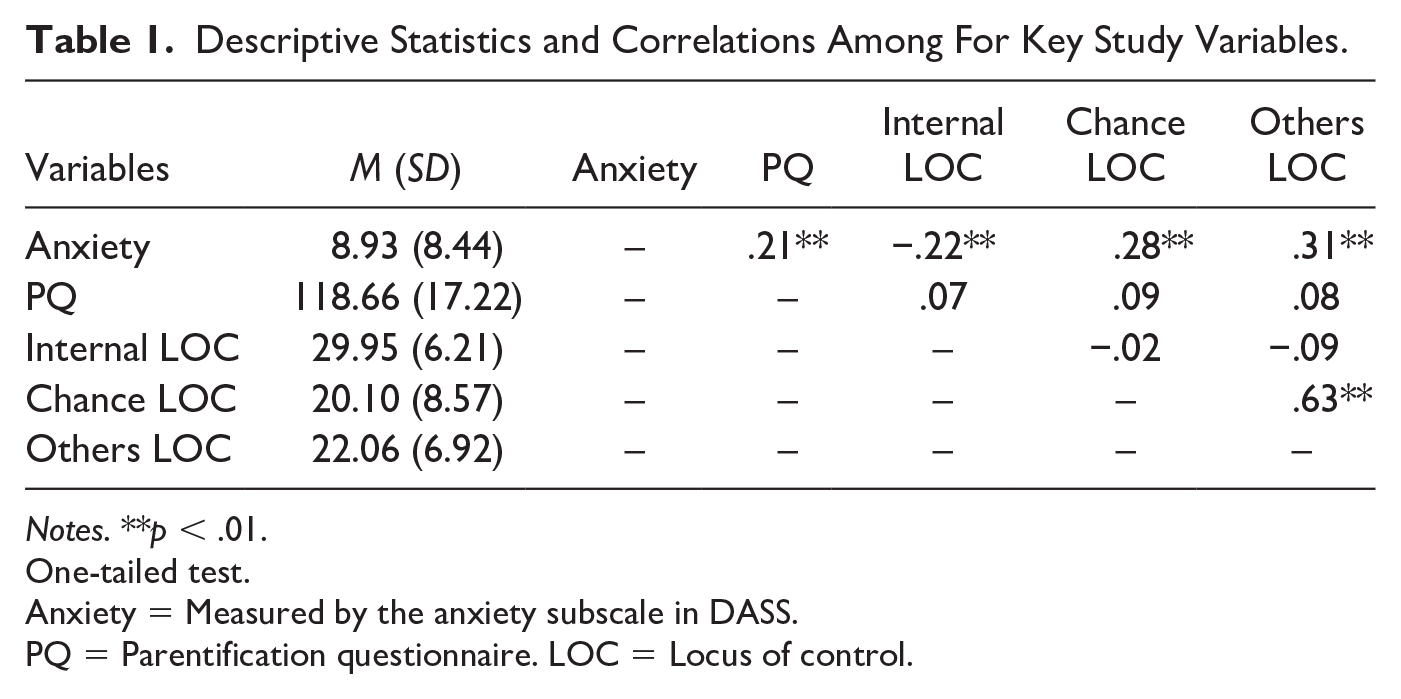
Table 1 displays the means, standard deviations, and correlations among anxiety, parentification, and LOC scores. As displayed in the table, higher anxiety scores were related to higher parentification scores. Additionally, as expected, higher levels of Internal LOC were associated with lower levels of anxiety, whereas the reverse was true for Chance LOC and Powerful Others LOC. Lower scores on the Chance and Powerful Others LOC subscales, which represent external influences of LOC, were associated with higher anxiety.
Descriptive Statistics and Correlations Among For Key Study Variables.
Notes. **p < .01.
One-tailed test.
Anxiety = Measured by the anxiety subscale in DASS.
PQ = Parentification questionnaire. LOC = Locus of control.
Similar to Williams and Francis (2010), we conducted a moderation analysis with Internal LOC and parentification as independent variables to discern whether Internal LOC moderated the anxiety-parentification relationship. To avoid multicollinearity, we standardized our independent variables. Our simultaneous multiple regression analysis with Internal LOC, parentification (PQ), and Internal LOC × PQ as predictors accounted for 10.4% of the variance in anxiety scores, F(3, 177) = 6.81, p < .001, one-tailed test. Internal LOC (β = −.23, p = .001, 95% CI = −3.16, –.77) and parentification (β = .23, p = .002, 95% CI = .73, 3.11) were significant predictors of anxiety, but the analysis did not yield a significant interaction (β = .06, p = .83, 95% CI = −.62, 1.51).
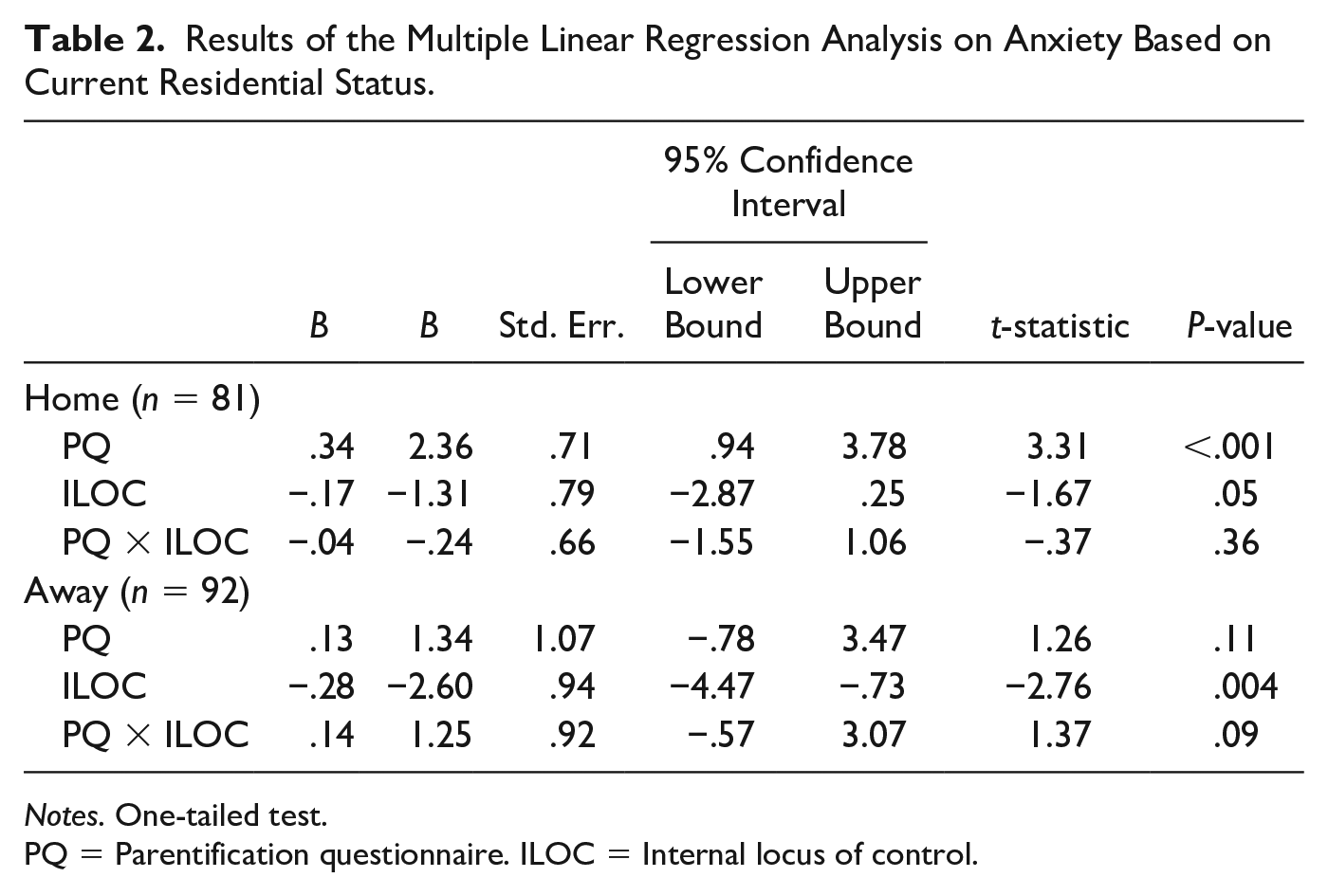
Because research has shown that heavy reliance on the child by the parent can make it hard for that child to leave home later in life (e.g., Bountress et al., 2013), in an exploratory analysis we examined whether the pattern of results would vary as a function of whether the individual resided at home or not. We repeated the simultaneous multiple regression analysis with the two categorized groups based on their current living arrangement. Eight participants did not report their residential status and therefore were excluded from the analyses. As displayed in Table 2, for those residing at home, parentification scores predicted anxiety, but Internal LOC and the interaction term did not, F(3, 81) = 4.59, p = .003, one-tailed test, R2 = .15. A different pattern emerged for those not residing at home such that Internal LOC predicted anxiety, but parentification or the interaction term did not, F(3, 92) = 3.80, p = .007, one-tailed test, R2 = .11.
Results of the Multiple Linear Regression Analysis on Anxiety Based on Current Residential Status.
Notes. One-tailed test.
PQ = Parentification questionnaire. ILOC = Internal locus of control.
Discussion
In the current study, we sought to explore the role of LOC in the relationship between paternal parentification and anxiety in women. Higher reported levels of parentification and lower levels of reported internal LOC were associated with higher level of reported anxiety. While both internal LOC and parentification predicted anxiety scores, internal LOC did not moderate the relationship between parentification and anxiety, as evidenced by a lack of significance of the interaction term.
Williams and Francis (2010) noted that internal LOC moderated the relationship between parentification and their measures of depression and happiness. Possibly the difference in dependent variables—depression and happiness versus anxiety—may account for the discrepancy in the moderation results. Additionally, our study focused on paternal parentification, and we changed the statements to reflect this by using the word father instead of parent. The parentification scale included by Williams and Francis did not differentiate between mothers and fathers, given the scope of their research questions. Furthermore, we modified the parentification scale from a true versus false version to a 5-point scale (i.e., strongly disagree to strongly agree). While our PQ using the 5-point scale showed accepted reliability, we performed a post hoc analysis whereby we recoded participants’ responses to True (i.e., strongly agree and agree) and False (i.e., strongly disagree, disagree, and neutral) to test whether changes in the scale could account for our lack of a moderation effect. Using the transformed data, our analysis did not reveal a moderating effect. It could be the case that internal LOC does not moderate the anxiety-parentification relationship. Additional research would need to be conducted to replicate this. Nevertheless, the lack of LOC as a moderator is in line with Sandler and Lakey’s (1982) finding on perceptions of control of negative life events and psychological disorders, as operationalized by anxiety and depression. Further, Smith (1989) discovered in his study that internal LOC was not a significant predictor in anxiety reduction in anxious students; therefore, sample demographics may contribute to the findings.
One sample characteristic that we explored was residential status of currently living at home versus residing away from home. Although we studied university students, our sample was fairly equally comprised of those still living at home, with 81 still residing at home and 92 not residing at home. It is possible moderation effects occur for those not residing at home given that the internal LOC and parentification interaction was marginally significant in that group. Interestingly, internal LOC predicted anxiety scores for those not residing at home, whereas paternal parentification predicted anxiety for females continuing to reside at home. Lee (2018) noted the impact of father’s residential status on their children’s satisfaction in romantic relationships as young adults. Her findings suggest the critical importance of father–daughter relationships in households with residing fathers. Boumans and Dorant (2018) suggested the crucial need to understand parentification in emerging adults given that most of the research has focused on the lasting effects of childhood parentification rather than emphasizing its continued presence in adults’ lives. Thus, as Boumans and Dorant conclude, school counselors should be aware of the effects of parentification on college students, particularly among females still residing at home with their father.
There are several limitations of the current study that should be considered. The women in this study were pooled from a university setting. It is possible that high levels of parentification may prevent individuals from attending college, such that they require to work to take care of their family or are full-time in-home caretakers to their parents. Thus, the level of parentification may be underestimated in our sample, and trends may differ from college students. We also did not include ethnic backgrounds as a variable. Fuligni et al. (1999) found that ethnic backgrounds were associated with adolescents’ perceptions of their roles in the family. Specifically, Asian American and Latin American adolescents indicated they expected to provide support to family, and they exhibited less difference between their perceptions and their parents’ values compared to adolescents from a European background. Among Korean college students perceived fairness contributed to associations of parentification and depressive symptoms (Cho & Lee, 2019). Thus, results from these studies allude to the importance of perceptions of children’s expectations about their roles in their family. Therefore, in a future study, it would be meaningful to examine paternal parentification in college students with different ethnic backgrounds to discern whether our observed trends in our current study would remain the same. Finally, a limitation of this study lies in the retrospective, self-reporting nature of the study. Time and other confounding variables could have distorted parentification experiences while self-report questionnaires rely on the accuracy of the participant’s introspection of self (see Schwarz, 2007, for a review).
Despite these limitations, this study does provide a preliminary exploration of the relationship between LOC, parentification, and anxiety among women. Given the negative effects of parentification reported by other researchers such as relationship issues (Madden & Shaffer, 2016), psychological distress (Hooper et al., 2011; Williams & Francis, 2010), and externalizing and internalizing problems (Loon et al., 2015) continued research is important to understand what factors are associated with parentification, and which ones will contribute to maladaptive outcomes. Our study contributes to the deficiency of paternal parentification literature, as most of the literature focuses on maternal parentification (e.g., Aldridge, 2006; McMahon & Luthar, 2007; Loon et al., 2015): answering the call by researchers for more analysis on the father’s role (Baggett et al., 2013; Brumariu & Kerns, 2010; Lee, 2018). Future research should continue to focus on the effects of paternal parentification among college students and consider residential status, gender, and ethnic background.
In conclusion, we found that in female college students that paternal parentification was associated with higher anxiety, particularly among those still residing at home. For those not living at home, internal LOC predicted anxiety. Furthermore, nearly half of our participants still resided at home suggesting a critical need to continue to examine the effects of parentification on college students.
Footnotes
Declaration of Conflicting Interests
The author(s) declared no potential conflicts of interest with respect to the research, authorship, and/or publication of this article.
Funding
The author(s) received no financial support for the research, authorship, and/or publication of this article.
