



Abstract
For four decades after China initiated economic reform, rural-urban migration has become a central experience for rural families. How do families negotiate economic production and social reproduction across geographic spaces and against institutional constraints? This article identifies the concept of intergenerational contract as an analytical tool to answer this question. Based on qualitative data gathered in Hunan and Shenzhen, I reveal that (a) children’s education is pursued as a family project, deeply rooted in families’ classed social mobility aspirations; (b) by spatializing the living and responsibilities of generations, rural migrant families selectively appropriate the hierarchical economic geography produced by state policies, to balance work and family arrangements; and (c) children engage in emotional labor guided by normative expectations and rules to reciprocate older generations’ care and support. The study uncovers coexisting resilience and vulnerabilities of migrant families and opens theoretical spaces to address the linkages between family, culture, and class in contemporary China.
Introduction
Across China, massive waves of rural–urban migration have gained momentum since the 1980s. This demographic transition comes as a result of a combination of top-down development policies the state adopted to encourage the achievement of “allocative efficiency” (Cai et al., 2009) through a transfer of cheap labor from agriculture to nonagricultural sectors, as well as bottom-up pursuit of economic opportunities by peasant workers away from underdeveloped rural areas. Statistically, the growth of this migrant population is phenomenal. Between 1983 and 1993, the number of rural migrants to cities increased from 2 million to 62 million, a 30-fold increase (Cai et al., 2009). In 2017, rural migrants living away from their home villages reached 286.5 million (NBS, 2018).
Institutionally, the governance of this huge migrant population is based on the hukou (household registration) system that is largely a socialist legacy, albeit successive reforms. 1 It binds an individual’s citizenship rights and entitlements to a particular category of population (agricultural vs. non-agricultural) and a particular locality (local vs. nonlocal) (Wang, 2005). Under this framework, although rural migrants are allowed to work in sectors shunned by urban locals and migrant professionals, their access to social benefits in host cities such as children’s education, is restricted. As a result, 58 million under-aged children (referred to as “left-behind children”) are left in rural communities under the care of grandparents or other relatives, and another 38 million accompany their parents to cities (referred to as “migrant children”), where their opportunities of accessing public education and other services are meager (ACWF, 2013). In a context where neither the state nor capitalists claim responsibility to “undertake the costs of proletarianization and its generational reproduction” (Pun, 2005, p. 46), how children’s well-being might be implicated has attracted increasing scholarly attention.
Two bodies of literature are relevant to the discussion of rural–urban migration and children’s life in post-reform China. The first body of literature has investigated the consequences of parental migration for their children’s developmental outcomes such as academic achievement, emotional well-being, and social functioning (see reviews in Choi, 2016; Tan, 2011; Zhou & Rong, 2011), which presents an inconsistent picture. Earlier sweeping discourses of these children’s disadvantages, particularly in Chinese language publications, are challenged by recent studies using national representative data such as the China Family Panel Studies, which report weak evidence of academic underachievement and emotional difficulties among either left-behind or migrant children (Ren & Treiman, 2013; Xu & Xie, 2015; Yeung & Gu, 2016). It is therefore imperative to move beyond the migrant-family problem paradigm and explore families’ agentic role to cope with structural constraints.
The second body of literature, smaller in volume and qualitative in methodology, has examined internal dynamics of rural migrant families in their negotiation of migration and child-rearing (Choi & Peng, 2016; Ling, 2017; Murphy, 2014; Peng, 2018). It is found that intergenerational collaborative child-rearing patterns occur between migrant parents and grandparents (Peng, 2018); the division of labor between conjugal couples is characterized by men’s limited “masculine compromise” (Choi & Peng, 2016); and children’s education becomes a central theme, linking migrant parents’ and left-behind children’s mutual commitments (Murphy, 2014). Despite valuable and nuanced knowledge produced in this literature, it has several limitations. First, due to research designs prioritizing single generation’s perspectives (either that of migrant parents or that of their children), an intergenerational perspective is lacking to explore how families as organizational units arrange their everyday life across spaces. In particular, children’s actions, voices, and subjectivities remain largely obscure in this literature. Further, due to a static conceptualization of families’ migration trajectories, previous studies often treat families with left-behind children and those with migrant children as distinct entities (Choi, 2016), thus missing opportunities to explore a wider range of spatiality and temporality of migrants’ family life as they engage in multimodal and multidirectional migrations.
Addressing the linkages between family dynamics, culture, and class in contemporary China, this article identifies the concept of intergenerational contract as an analytical tool to understand how rural migrant families juggle economic production and family reproduction, based on longitudinal interview data gathered from 38 rural migrant families (inclusive of15 families with left-behind children and 23 with migrant children) in Shenzhen and Hunan in two rounds of field research in 2014-15 and 2018 respectivelyincluding. In particular, my data show that there remains considerable potential to understand the intergenerational contract underpinning migrant families’ organization of everyday life through a class lens. I argue that a child-centric intergenerational contract to achieve upward social mobility motivates and galvanizes members of different generations to play their respective roles and maintain their family life against structural constraints.
Conceptualizing Intergenerational Contract
Filial Piety in Transition
Historically, filial piety constituted the primary principle of Confucian familism, which defines a hierarchical parent–child relationship. In practice, filial piety norms include unconditional submission of junior to senior generations, multigenerational co-residence, old-age support, and continuance of the (patrilineal) family line through reproducing male offspring (Chai & Chai, 1965). Despite China’s sociopolitical vicissitudes in the twentieth century, particularly after 1949 when the Chinese Communist Party in power launched campaigns against “feudalistic” family practices, filial obligations were still touted as the essential norms to observe (Diamant, 2000). After economic reform initiated in the late 1970s, however, though filial piety as a value remains popular among young people (Deutch, 2006), its practice in real life has drastically changed. In a socialist mixed economy where market incentives rather than seniority are increasingly rewarded, the power dynamic has tilted toward younger generations who are better educated and possess greater economic resources (Guo, 2001; Yan, 2003; 2016). Combining with other social changes, including mass-scale migration and reduced fertility, reversed intergenerational exchanges of resources and support from elderly parents to their adult children become prevalent (Chen et al., 2011; Goh, 2011; Silverstein et al., 2006), revealing more reciprocal intergenerational relationships than prescribed in filial piety norms. Some scholars argue that filial piety has transformed into a family ethic, characterized by egalitarian intergenerational relationships and intimate parent–child bonding (Sun, 2017), hence less valid as a theoretical lens.
Intergenerational Contract as a Theoretical Lens
The idea of applying intergenerational contract to analyzing Chinese family relationships is by no means new, though the concept has not yet been fully developed. A literature using this concept has described the tacit agreements regulating children’s responsibilities in parents’ old-age support, as a function of parents’ earlier investment and nurturance, situational needs and resources, as well as their relational dynamics (Croll, 2006; Göransson, 2013; Greenhalgh, 1985; Ikels, 1993). In general, this literature portrays a pragmatic and reciprocal relationship between generations. For example, Ikels (1993) examined aid flows between generations in 200 urban households in Guangzhou during the late 1980s and early 1990s, revealing that elders gradually strategized to incentivize their adult children’s support in a process full of conflicts and ambivalences.
The concept provides a useful lens in examining the implicit agreements upon generational commitments and expectations in multigenerational families in the Chinese society. First, it recognizes the family as an organizational unit that structures members’ activities of economic production and social reproduction. In this vein, families operate under collective imperatives rather than individual rational choices (Cheng, 1944; Fei, 1939). Such is the case among China’s rural population, for whom the family remains the primary institution and the last defense to rely on, as Huang (2011) put it: Their outlook is not just of the individual self but rather of a three-generational (or longer) perspective, and includes considerations not just of protections against the instabilities of urban employment and old age maintenance of their parents, but also of their own old-age retirement and even of the family line beyond.
Moreover, this concept builds upon a feedback model (fankui moshi) of intergenerational exchanges (Fei, 1983), where every generation shoulders dual obligations to their preceding and following generations throughout the family cycle under the principle of reciprocity. In this system, not only children’s rightful attitudes and behaviors toward parents but also parents’ obligations to provide for and support their children are prescribed (Croll, 2006). The concept also alludes to the interactive nature of intergenerational exchanges, in that a benefit creates an obligation for its recipient to repay, leading to further give-and-take between the concerned parties (Gouldner, 1960). Lastly, the concept of contract illuminates the binding nature of social norms in regulating family relationships, which “is a prominent feature in studies of Chinese society, past as well as present” (Göransson, 2009, p. 103). Family members under intergenerational contract are liable for any breach of their obligations and thus are morally compelled to fulfill their duties.
In its current version, the concept has gained little traction beyond scholars of aging and gerontology, partly due to a focus on old-age care in existing research, without applications to families in different life cycles. A more important gap is its culturalist approach, which may lead to overgeneralized, hence imprecise, findings. For example, one might draw misguided conclusions about the care arrangements between rural elderlies and their children by inferring from Ikels’ (1993) description based on Guangzhou urbanite households in the 1990s where the elderly possessed properties and job titles for children to inherit. I argue that a research agenda on intergenerational contract should incorporate material relations and hierarchies where families are imbedded in, that is, the class conditions, which shape the materiality of families’ everyday life and their subjectivities.
Bring Class Back in
In a material sense, a new working class has been in the formation for the four decades after reform among China’s massive rural migrant population, albeit with its unique trajectories and characteristics under an authoritarian state, and a coercive production regime. Migrant workers have transcended and yet remain trapped in the rural-urban divide instituted by the Maoist state in the 1950s: they work as waged laborers in foreign-owned or privately owned factories or enterprises in an expanding private market, but their proletarianization is an unfinished project due to the hukou system that deprives them of the rights to settle and claim for social protection in the cities where they work (Pun & Lu, 2010). In other words, their economic prospects may improve compared to counterfactual scenarios where they need to rely on the subsistence economy of farming for livelihoods, but their positioning in urban society remains precarious, whether in terms of employment opportunities and income remuneration, maintenance of households, or social status, because the hukou system has institutionalized their second-class-citizen status.
From another perspective, has China’s migrant working class developed a coherent class consciousness? The answer to this question has major implications for migrants’ self-positioning in engaging with other social classes, their own group, and subgroups within. Dwelling on the capital–labor relationship, labor scholars have yet to reach an agreement: while Pun and her colleagues (e.g., Chan & Pun, 2009; Pun & Lu, 2010) register a growing class consciousness formed based on common interests and solidarity through various localized instances of collective actions taken by second-generation migrant workers against overseas Chinese or foreign capital, Lee (2016, 2019) disputes that this empowerment thesis reflects more of its proponents’ “prevailing voluntarism and optimism” than empirical facts, since migrant workers’ collective actions are bound to be temporary and localized, given the formidable structural constraints they face (i.e., the state–capital alliance at the production sites and the land dispossession). One could debate whether agency or structure should be emphasized in discussing the working class’ class consciousness in its conflictual relation to capital. However, evidence suggests that the migrant working class increasingly shows a clear self-assessment of their precarity and vulnerability in the broader society, especially among the second generation of migrants. Tian (2017), for example, finds that despite relatively higher education and higher income, migrant workers born after 1980 reported lower self-evaluation of their social status than previous cohorts.
In the current study, by integrating rural migrant families’ stories with the notion of class in contemporary China, I show that migrants’ location within the segmented labor market and the country’s institutionalized rural–urban divide has implications for how they organize everyday life, aspire for their offspring’s futures, and act upon their family responsibilities. In so doing, I show that family reproduction is always intertwined with economic production, the broader social stratification system, and individuals’ self-positioning within.
Fieldwork and Data
The empirical evidence informing this analysis is largely based on fieldwork undertaken in Shenzhen and Hunan between September 2014 and February 2015. Follow-up interviews with a smaller set of interviewees in 2018 constitute sumplementary data for the analysis. These two field sites were selected for two reasons. I was born and grew up in Hunan and spent 10 years studying and working in Guangdong, which afforded me with access to interviewees through my personal networks with educators, parent volunteers, and other professionals who served as key gatekeepers. In terms of population dynamics, while Hunan is a major migrant-sending province, Shenzhen, “both a project and symbol of post-Mao modernization” (O’Donnell, 2001), has been a popular migration destination in the Pearl River Delta region. Research in these two sites thus offers a full picture of migration and family dynamics in post-reform China.
Data Collection
The fieldwork comprised detailed interviews with and observations of adolescent–caregiver pairs from 38 migrant families. The sampling framework had the following criteria: (a) respondents were registered under the agriculture-hukou, with at least one parent being a migrant in each family; (b) these families had a variety of living arrangements to accommodate parents’ different migratory trajectories; (c) the adolescent interviewee in each family was paired with at least one adult caregiver interviewee, whose narratives could triangulate each other; and (d) there should be a balanced representation of gender and family socioeconomic conditions to avoid sampling bias.
Interviews, which lasted from one to three hours, followed a semi-structured interview guide (separately for adolescents and their caregivers). Interviews with adolescents focused on three themes: family history, particularly migration history; home life, such as daily schedules and housework arrangements; and intergenerational interactions and relationships. Interviews with adult caregivers covered the following themes: migration motivations and experiences, childcare arrangements and parenting practices, and intergenerational interactions. Interviews with adolescents were conducted in person, in empty classrooms, teachers’ offices, or school sports fields. Half of the interviews with adults were conducted face to face and the rest by telephone. The interviews (and informal conversations 2 ) were digitally recorded, transcribed, translated, and cross-checked within each child–caregiver pair. I took several measures to protect adolescents’ well-being in fieldwork. First, I received informed consent from both the adolescents and their main caregivers before initiating interviews, in which it was ensured that the adolescents under study could choose not to answer questions that may cause discomfort and withdraw when necessary. Second, when interviewing and interacting with the adolescents, I created a relaxing and comfortable atmosphere by selecting venues to their convenience and suitable for private conversations.
Sample Characteristics
The child sample included 15 left-behind adolescents recruited from a rural school in Hunan (school A), 8 adolescent migrants from an urban mixed school with both migrants and urban locals in the town center of Lake County (Hunan) (school B), and 15 rural adolescent migrants from a migrant school in Shenzhen (school C). Their mean age was 13 years. Due to the purposive sampling strategy, there were about equal numbers of female (18) and male (17) adolescents. In each family, I was able to interview or converse with at least one adult who could provide useful information about their family circumstances and everyday life. 3 As such, the adult sample included 26 mothers, 5 fathers, 8 grandmothers, and 4 grandfathers, which reflects both the gendered nature of childcare and the prevalence of grandparents’ involvement in child-rearing in rural families. Most families were dual-income families with parents working in factories, construction crew, service industry, and self-employment (e.g., running food stalls). Parents of five adolescents had separated or divorced, and the rest were married at the time. Most parents attended only up to junior middle school, with three fathers and three mothers being graduates from high school, technical secondary school, or special college (see Appendix A for details).
Data Analysis
I conducted data analysis following a grounded theory approach (Corbin & Strauss, 2008; Glaser & Strauss, 1967). I first read line by line all of the interview transcripts with the 38 adolescent–caregiver pairs and used opening coding to allow major themes to emerge from the data. Constant comparison was made between cases to reveal the similarities and differences. Eight codes were generated, which covered parents’ migration history, family economic conditions, care and schooling arrangements, strategies of keeping in touch and committing to each other, and future aspirations and plans. I then initiated selective coding to identify a core concept. Throughout the process, I noticed that two words, “sacrifice” (xisheng) and “indebtedness” (gan’en), repeatedly showed up in both caregivers’ and adolescents’ narratives. These two in vivo codes prompted me to conduct a further in-depth analysis on the intergenerational relations in each household, which led to the identification of “intergenerational contract” as the core concept. During and after coding, I wrote 12 theoretical memos to elaborate on the development of a grounded theory about the intergenerational contract in these families. Pseudonyms were used to protect respondents’ privacy.
Findings
Children’s Education as a Social Mobility Project
I begin with an inquiry of the motivational bases for rural migrant families’ intergenerational contract in their endeavors to maximize their collective welfare. Similar to transnational labor migrants (Bartlett et al., 2018) or Chinese middle-class migrants abroad (Huang & Yeoh, 2005), rural migrant parents and their substitutes in this study regard children’s education as a social mobility project that tops the family agenda (Gu & Yeung, 2020). Parents and grandparents expressed soaring hopes for the adolescents’ future educational achievement and indicated their support “as long as he/she could make it!”; unanimously cited funding for children’s education as the primary motivation for migration; and constantly weighed between different migration trajectories and family living arrangements to better support children’s care and education. Cheng’s family is such a case. Cheng was born in 2001 and lived with his grandparents in their village home until Grade 2 in primary school, when both parents worked in a garment factory in suburban Guangzhou. In 2009, his parents quit from their factory jobs and relocated to the county seat after finding out that after three years in kindergarten and a year in the village school, the boy still could not write his own name! They transferred him to a public school there and later enrolled him in an expensive private junior middle school. In 2014, the father worked on construction projects in town, and the mother held a part-time job in a retail store. The parents expressed keen aspirations for Cheng to be admitted to a military university in the future, which allegedly guarantees a life of secure employment and benefits from the state. When I followed this family up in the summer of 2018, the father had remigrated to Shenzhen to work as a janitor for a factory to save for Cheng’s (a high school sophomore then) and Li’s (Cheng’s younger sister in kindergarten then) education. In a phone call, the father cited “all for the children!” to explain the new arrangement. Cheng’s family illustrates a common narrative I heard in the field, in which a concern with children’s education prompted the families’ drastic readjustments of migration plans and living arrangements.
One may argue that high expectations for children’s educational achievement are a prevalent phenomenon among Chinese parents of all backgrounds. For example, based on data from the China Family Panel Studies (2014), Gu (2020) reveals that about 70% of parents with children aged between 6 years and 15 years rated greater importance of “educational excellence” than “family background” for their children’s future. However, data in this study show that rural migrants’ educational aspirations are more deeply rooted in their class subjectivities, that is, their self-positioning as the lower status group vis-à-vis the higher status group as defined by a series of notions demarcating hierarchical and dichotomous relationships. They distinguish two kinds of mobilities, that is, their labor mobility and the expected educational mobility of their children, corresponding to China’s bifurcated urban governance regime which defines transience/permanence based on migrants’ education categories (Fan, 2002). While labor migration expands one’s physical mobility and allows for economic opportunities limited to certain segments in the urban labor market, it does not lead to permanent settlement or social mobility with a potential pathway toward their hukou conversion to the local status. Rural–urban labor migrants are therefore a permanently transient labor force in the urban scene. In contrast, a category of “permanent migrants,” mainly comprising highly educated professionals, could easily achieve their hukou conversion, through state sponsorship earlier or neoliberal points systems adopted in local states in recent years (Zhang, 2012), thus gaining access to institutional resources. In this sense, education acquires a path-breaking nature, leading to not only economic opportunities but also the transformation of one’s social status and institutional position. Relatedly, in China’s enduring Confucian tradition, education often serves as a marker of the brain–brawn (naoli–tili) dichotomy, with the former socially constructed to be superior along the ideology of meritocracy (also see Gu & Yeung, 2020).
Given the role of education in reproducing or (allegedly) transcending economic and social hierarchies which generate “durable inequality” (Tilly, 1998), it serves as a strong motivation for families at the bottom of society to achieve social mobility. During fieldwork, parents and grandparents frequently cited a local expression—“jump out of the peasant family’s gate” (similar to the pronunciation of “jump out of the dragon’s gate” in Mandarin, foreboding auspiciousness and prosperity)—to describe their hope for children’s future. For them, such a jump could only be achieved through a tertiary education, which promises an attainable middle-class life and a categorical transformation of one’s hukou status. Toward this goal, as will be elaborated on later, families of different generations pool resources and subscribe to and play out their respective roles and responsibilities, based on shared norms and expectations in the family contract.
Juggling Economic Provision and Care: Space Strategies
How do migrant families juggle economic provision and care arrangements in the context of migration and with a strong motivation to advance children’s educational prospects? This section answers the question by examining the space strategies that families adopt to cope with structural constraints and situational contingencies in this process. By space strategy, I refer to families’ practices and plans to arrange for and carry out productive and reproductive activities through appropriating geographic spaces within their reach and to their benefit. It is important to note that a major challenge in migrants’ family life is the incompatibility of spaces for their productive and family reproductive engagements, largely produced by state policies. For one thing, urban-biased (Cheng & Selden, 1994; Lei, 2001) and coast-biased (Fan, 1995, 1997; Yang, 1997) development policies in the reform era have generated considerable levels of spatial inequalities in China’s economic geography, which necessitates the rural migrant population’s physical move away from their underdeveloped village communities. For another, as mentioned, an urban governance regime through the hukou system creates a condition where migrants’ stay in and occupation of urban spaces are kept permanently temporary by allowing for their sojourns during employment, while denying responsibilities toward their social protection and family reproduction (Solinger, 1999; Wang, 2005). These combined make juggling family life and employment for China’s migrant working class a spatially challenged task. In other words, economic realities and institutional arrangements in post-reform China make families’ physical togetherness a class condition, where the default option for rural migrant families is separation. Before delving into the families’ coping strategies, I present the life histories of three families whose experiences recur in narratives of many other cases.
The three aforementioned cases illustrate that migrant families’ life is characterized by considerable fluidity and flexibility in shifting between different migration strategies and living arrangements contingent on policy changes, recalibrated plans, and situational needs. Such a high level of fluidity and flexibility is necessitated by the space constraints that migrant families confront, as described earlier. Despite the fluidity and flexibility, we observe a three-tiered spatial arrangement among the researched families, with the village home being constructed as the fallback place, an affordable apartment (self-owned or rental) in the county seat as the relocation place (like the case of Kai’s family), and a temporary rental room in host cities as a launch pad for more ambitious plans.
Underpinning this spatial arrangement are spatialized generational (and gendered 5 ) family responsibilities and differentiated notions of productivity (i.e., economic utility) for generations. For example, those belonging to the grandparents’ generation, due to their economic dependency on their children for old-age support, coupled with physical fragility, are often relegated to their village residence as stayers or as co-caregivers or substitute caregivers for their grandchildren, for which they receive compensations in care when needed (as in Dan’s grandparents’ case) or/and monetary support. In the majority of the 38 families under study, grandparents’ care support was at least an episode of children’s childhood memories, for longer or shorter terms. However, only few grandparents’ space of activities extended to urban areas when they joined their adult children’s households to continue their care work, largely due to living cost considerations. The middle generation, the family’s main provider(s) and temporary migrants by the state’s definition, weighing between economic opportunities (or the lack thereof) and their dependents’ care and (children’s) educational needs, engaged in constant readjustments of their migration trajectories and family living. In 33 out of the 38 families, at least one parent had changed their migration destinations at least twice since the birth of a first child, with fathers (e.g., Cheng’s father) mostly shifting migration plans wherever economic opportunities arose and mothers (e.g., Dan’s mother) reversing courses when care needs arose. Such spatialized strategies of dividing labor between generations (and genders) form an ever-changing support network for children who engage in pendulum movements across different locations, shifting between the left-behind status and that as migrants.
By spatializing generations (and genders) in the division of labor, rural migrant families selectively appropriate the hierarchical economic geography produced by state policies to balance between economic production and family reproduction. Their spatial strategies and practices, reflected in various nonnormative family structures, should therefore be better understood as their situational agency to counter structural constraints imposed on them, which dispute numerous studies and media discourses in China that frame migrant families’ nonnormative structures (skip-generation households with left-behind children in particular) as a result of parents’ moral failings (Gu, 2021).
Sacrifice and Indebtedness: Children’s Emotional Labor
As alluded earlier, children are at the receiving end of the care, support, and educational investment provided by a coalition of parents and grandparents in rural migrant families. How do they reciprocate in the family contract? I argue that the “economically useless but emotionally priceless” (Zelizer, 1994) children reciprocate through articulating expected emotions guided by intergenerational norms in the family contract. Here, I borrow Hochshild’s (1979, 1983) concept of emotional labor—the process of managing feelings and expressions to fulfill socially expected emotional requirements—as a tool to analyze children’s family responsibilities and their fulfillment. In particular, I show that a “feeling rule” (Hochschild, 1979) normalizing children’s indebtedness to parents’ sacrifices shapes children’s emotional labor in everyday life. There are several elements to unpack here. Culturally, a sense of indebtedness to one’s parents for one’s birth and nurturance has long been inculcated as a basic ethic in child socialization in Chinese society (Göransson, 2013; Ikels, 1993; Wolf, 1970). This is further reinforced by a moral framework about migrant parents bearing the brunt of all kinds of inconveniences and indignities (i.e., their acts of sacrifices as the new working class at the bottom of urban society) to raise and nurture their children. Thus, through articulating their indebtedness to reciprocate parents’ sacrifices, children perform their duty and reaffirm their commitments to the family contract, which, in essence, is a process of their “doing class” as the second generation of the migrant working class.
Consider the case of Ni, a 12-year-old 7th grader in rural Hunan. She lived in a skip-generation household with her two younger siblings and grandparents in a rental house in the township center near her school; the family rented because rapid depopulation in rural areas due to reduced fertility and mass out-migration led to the closure of her former school in the village. Since 2007, Ni’s parents had been factory workers in Zhejiang Province in east China. Besides weekly phone calls, they kept in touch with the left-behind household through regular remittances to cover rent fees, school tuition, and living expenses. One Saturday afternoon when I visited the household, her grandparents brought up a phone call the night before: Grandpa: My daughter just called last night. Author: what did she say? Grandpa: telling Ni to study hard and test into university. Grandma (sigh): if not for the kids, why do they risk their lives to work (pinming gan) like that? Grandpa: really risk their own lives!! My son-in-law finished his shift and ran to my daughter’s factory to do over-time for her. They work till 12am these days! They sacrifice themselves for children.
Sitting at a table beside me, Ni (tears in her eyes) reiterated this by saying that “they eat all the bitterness!” 6 Here, Ni tearfully acknowledged her gratitude for her parents’ hard work. Moreover, her parents’ acts of sacrifice such as forgoing leisure activities and taking on overtime work to earn a higher income became a moral scaffolding for her to repay the heavy social “debt.”
The feeling rule of indebtedness also compels adolescents’ management of “undesirable” emotions. Many interviewees, especially those left-behinds, often used emotion-laden phrases such as “heartbroken,” “heavy heart,” and “lonely” to describe their longing for family reunion and stability. Nonetheless, in interacting with their migrant parents, they channeled their emotional presentations to be positive, that is, to be appreciative of parents’ sacrifices, just like a hostess needs to perform pleasure in serving customers (Hochschild, 1983). Some went through an elaborate process of reframing and rationalizing their emotional gaps, such as Kai (a left-behind child mentioned earlier): Author: Did your parents come back to celebrate your birthday? Kai: They had no time. Grandma and Grandpa bought my favorite cakes and cooked nice meals. . .Only four of us celebrated together. My sister sometimes was annoying and crying for attention all the time. Author: What did you do then? Kai: we fought. Usually I would apologize immediately, and make peace. Interviewer: why? Kai: when you can control emotions, then do it. When you can forgive, just forgive! Author: who told you so? Kai: from books (laugh). Many (emotion management) books (from the library) say so.
She suppressed her needs for her parents’ company on her birthday by acknowledging their constraints as migrants in a remote locality with work responsibilities and expense considerations, while showing considerable gratitude toward the special efforts by her grandparents to celebrate her birthday. In dealing with sibling rivalry, she believed that she should be the one to strike peace and maintain harmony by enduring unreasonable demands from her younger sister as part of her responsibility as the elder child. Noteworthy is that in this case, Kai’s emotional labor and self-regulation derived not only from the implicit feeling rules described earlier but also from emotion-management books. Kai’s case may be exceptional in the sense that she equipped herself with sophisticated skills and tools to present her “indebted self” as a child of migrants. However, her case resonates with many other narratives in which children labor to control, manage, and reframe their emotions to fit social expectations.
More importantly, adolescents repeatedly told me that a good report card was their best repayment, echoing parents’ and grandparents’ narratives. Here we return to the role of children’s education as the motivational base for migrant families’ intergenerational contract. For children at the receiving end of all the “sacrifices” made by adults in the family, the reciprocity norm thus obliges them to excel academically. Through this way, a child’s academic excellence is constructed to gauge not only their intellectual capabilities but also their moral commitment to the family contract. High school sophomore Cheng in 2018, whose parents went great lengths to support his education as described earlier, was keenly aware of the situation: Despite all the difficulties, I have been given the best support possible, having enrolled in top public or private schools in town and attended tuition classes. Testing into a military academy in gaokao (the college entrance exam) next year is my parents’ hope, also my report card to them!
The pressure to excel pervades every aspect of adolescents’ life. The few top performers garnered unanimous support from parents, extended families, and school communities. They earned the good reputation as grateful children who compensated for parents’ investment. However, this also means a constant process of self-motivation, self-discipline, and self-denial. Ni spent most of her spare time revising textbooks and working on exercises, repeatedly blamed herself for not scoring full marks, and was anxious about her grade after each test. When probed about her anxiety, she replied: “I don’t want to disappoint my parents and grandparents. They have such high expectations!” Given the overwhelming importance of educational success, unsatisfactory test results are often interpreted as a failure of family obligations. The majority who did not excel showed a palpable sense of guilt and frustration, which was amplified by a relentless regime of educational discipline, maintaining that rural students’ advantage in brute memorization wins them the merits for social mobility (Kipnis, 2001). Simply put, the fact that they could not achieve satisfactory grades is held against them to index their lack of motivation and perseverance to fulfill their family duty.
Concluding Discussion
For four decades after China initiated economic reform, rural-urban migration has become a central experience for rural families. Using intergenerational contract as a conceptual tool and addressing the linkages between family, culture, and class, this article unpacks the social meanings of being a rural migrant family in contemporary China. First, children’s educational excellence is pursued as a family project, deeply rooted in rural families’ classed social mobility aspirations. Second, by spatializing generations (and genders) in the division of labor, rural migrant families selectively appropriate the hierarchical economic geography produced by state policies to balance between economic production and family reproduction. Finally, children engage in emotional labor to reciprocate older generations’ provision and care support, guided by a feeling rule that normalizes their indebtedness to parents’ sacrifices.
The results suggest that solidarity and sacrifice are the two faces of rural migrant families’ lives. On the one hand, we see that family mediates the negative impact of structural inequality on children’s well-being by pooling resources and efforts to nurture and support them. On the other hand, the intergenerational contract compels sacrifices by individual members to advance the family’s collective welfare, which include, but do not limit to, migrant mothers’ double shifts, grandparents’ malleable and marginal role as the reserve workforce in the domestic sphere, and children’s emotional labor. I contend that this paradoxical nature of family contract is conditioned by and constitutes ongoing culture and class relations in contemporary China. In the post-reform era, where migration is regarded as an economic and cultural necessity for rural families to escape poverty and participate in urban prosperity, and where a national development strategy of “incomplete urbanization” (Chan, 2010) exploits migrants’ cheap labor while dodging responsibilities toward its reproduction and social protection, family as an institution is overstretched to negotiate arduous structural constraints, existing cultural norms and situational contingencies.
Theoretical contributions of this study are two-fold. First, by exploring three dimensions of migrant families’ intergenerational contract, that is, its motivational base, the space strategies that families adopt to juggle production and reproduction, and the emotional labor the children engage in to affirm and accomplish their responsibilities, this study extends the intergenerational contract framework to understand family practices and inner dynamics, which open spaces for theoretical explorations of multiple dimensions of family life. The framework allows for insights of individuals’ situational agency as well as of the family as an organizational unit to mobilize, share, and redistribute resources for the collective welfare, and to maintain, reconfigure, and reaffirm mutual attachments and identities as family members. Second, by contextualizing the analysis of intergenerational contract in the economic conditions and subjectivities of the migrant working class, the study offers a fresh perspective in theorizing class in contemporary China, beyond the labor–capital nexus in the dominant academic discourse. The evidence presented here seems to suggest that the migrant working class as a vulnerable group subject to exploitation and subordination by the powerful state–capital alliance continues to face grave challenges to juggle work and family life, but it remains hopeful toward upward social mobility through intensive and all-out investment in children’s education. The implications of such characteristics of the migrant working class for China’s future social stratification trends, class politics, and family changes remain to be observed.
From a policy perspective, as said, a pronounced feature of rural-migrant families’ intergenerational contract reported in this study is how education is intricately intertwined with almost every aspect of their family life and the socio-emotional toll it exerts on the adolescents. However, empirical evidence suggests that migrant children’s educational achievement is systematically suppressed by structural inequalities rooted in China’s rural-urban divide, including the rural–urban education gap at the school level (Hannum, 1999), and migrant children’s persistent disadvantage in accessing quality education in cities (Gu & Yeung, 2020). By ignoring these glaring structural inequalities that blockade the children’s educational opportunities, these families’ single-minded investment in and high expectations for children’s education comprise a kind of “cruel optimism” (Bartlett et al., 2018) that pit these structurally disadvantaged children against the imagined limitless potentialities attached upon them. In this way, rural–urban inequalities induced by state policies are translated into familial and personal problems, in particular the adolescents’ performance problem. As shown previously, to digest these social problems and present honorable selves, adolescents like Kai make immense efforts of concealing, suppressing, and reworking their emotional needs to align with the ethics of sacrifice and indebtedness. This amplifies their emotional baggage as members of an underclass in an increasingly unequal society. It is therefore of vital importance for the Chinese government and the society at large to address the underlying structural issues such as rural–urban inequalities and social exclusion and provide equal opportunities for the migrant working class to realize their long pent-up social mobility aspirations.
Footnotes
Appendix
Characteristics of Interviewed Families.
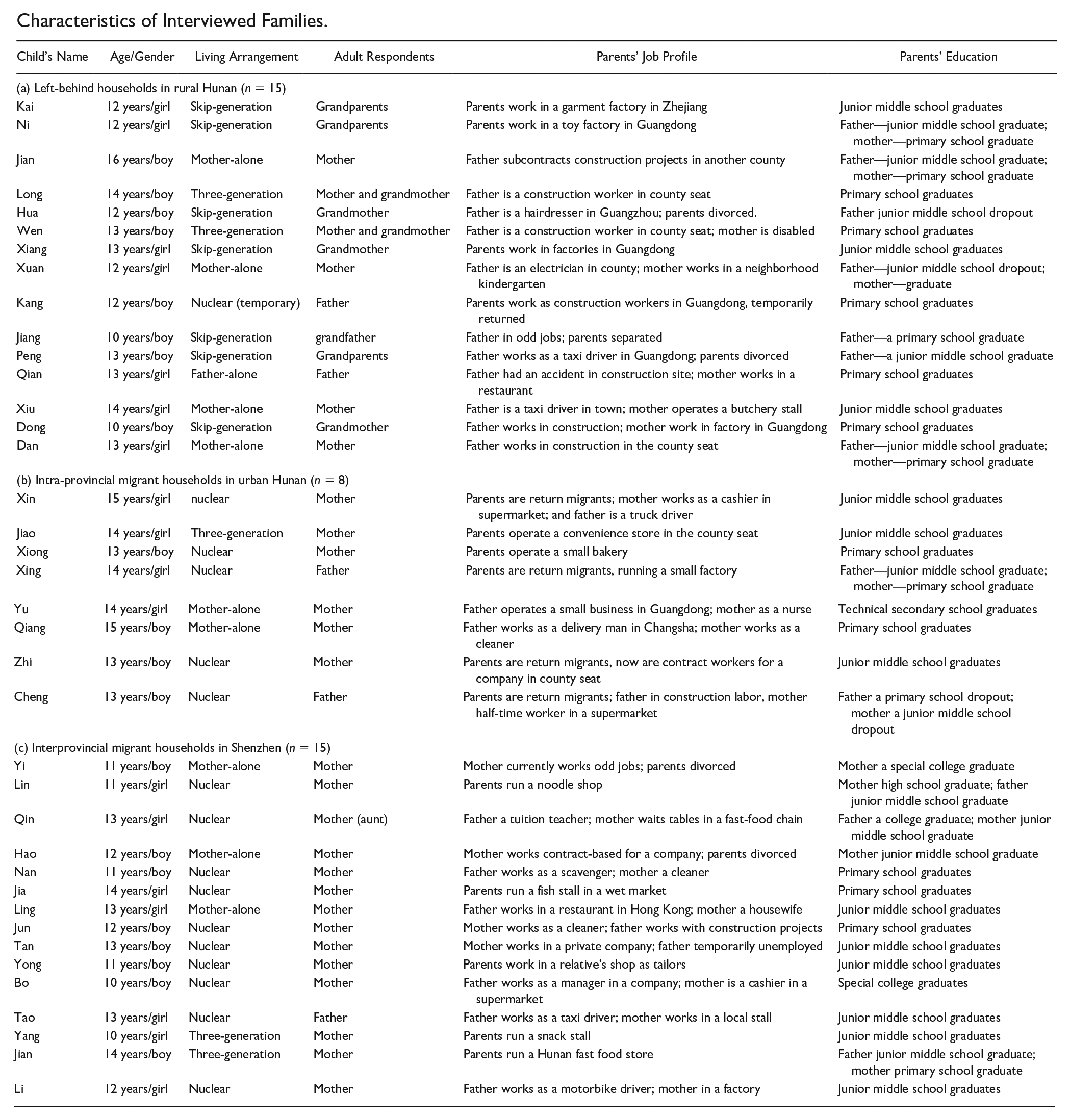
| Child’s Name | Age/Gender | Living Arrangement | Adult Respondents | Parents’ Job Profile | Parents’ Education |
|---|---|---|---|---|---|
| (a) Left-behind households in rural Hunan (n = 15) | |||||
| Kai | 12 years/girl | Skip-generation | Grandparents | Parents work in a garment factory in Zhejiang | Junior middle school graduates |
| Ni | 12 years/girl | Skip-generation | Grandparents | Parents work in a toy factory in Guangdong | Father—junior middle school graduate; mother—primary school graduate |
| Jian | 16 years/boy | Mother-alone | Mother | Father subcontracts construction projects in another county | Father—junior middle school graduate; mother—primary school graduate |
| Long | 14 years/boy | Three-generation | Mother and grandmother | Father is a construction worker in county seat | Primary school graduates |
| Hua | 12 years/boy | Skip-generation | Grandmother | Father is a hairdresser in Guangzhou; parents divorced. | Father junior middle school dropout |
| Wen | 13 years/boy | Three-generation | Mother and grandmother | Father is a construction worker in county seat; mother is disabled | Primary school graduates |
| Xiang | 13 years/girl | Skip-generation | Grandmother | Parents work in factories in Guangdong | Junior middle school graduates |
| Xuan | 12 years/girl | Mother-alone | Mother | Father is an electrician in county; mother works in a neighborhood kindergarten | Father—junior middle school dropout; mother—graduate |
| Kang | 12 years/boy | Nuclear (temporary) | Father | Parents work as construction workers in Guangdong, temporarily returned | Primary school graduates |
| Jiang | 10 years/boy | Skip-generation | grandfather | Father in odd jobs; parents separated | Father—a primary school graduate |
| Peng | 13 years/boy | Skip-generation | Grandparents | Father works as a taxi driver in Guangdong; parents divorced | Father—a junior middle school graduate |
| Qian | 13 years/girl | Father-alone | Father | Father had an accident in construction site; mother works in a restaurant | Primary school graduates |
| Xiu | 14 years/girl | Mother-alone | Mother | Father is a taxi driver in town; mother operates a butchery stall | Junior middle school graduates |
| Dong | 10 years/boy | Skip-generation | Grandmother | Father works in construction; mother work in factory in Guangdong | Primary school graduates |
| Dan | 13 years/girl | Mother-alone | Mother | Father works in construction in the county seat | Father—junior middle school graduate; mother—primary school graduate |
| (b) Intra-provincial migrant households in urban Hunan (n = 8) | |||||
| Xin | 15 years/girl | nuclear | Mother | Parents are return migrants; mother works as a cashier in supermarket; and father is a truck driver | Junior middle school graduates |
| Jiao | 14 years/girl | Three-generation | Mother | Parents operate a convenience store in the county seat | Junior middle school graduates |
| Xiong | 13 years/boy | Nuclear | Mother | Parents operate a small bakery | Primary school graduates |
| 14 years/girl | Nuclear | Father | Parents are return migrants, running a small factory | Father—junior middle school graduate; mother—primary school graduate | |
| Yu | 14 years/girl | Mother-alone | Mother | Father operates a small business in Guangdong; mother as a nurse | Technical secondary school graduates |
| Qiang | 15 years/boy | Mother-alone | Mother | Father works as a delivery man in Changsha; mother works as a cleaner | Primary school graduates |
| Zhi | 13 years/boy | Nuclear | Mother | Parents are return migrants, now are contract workers for a company in county seat | Junior middle school graduates |
| Cheng | 13 years/boy | Nuclear | Father | Parents are return migrants; father in construction labor, mother half-time worker in a supermarket | Father a primary school dropout; mother a junior middle school dropout |
| (c) Interprovincial migrant households in Shenzhen (n = 15) | |||||
| Yi | 11 years/boy | Mother-alone | Mother | Mother currently works odd jobs; parents divorced | Mother a special college graduate |
| Lin | 11 years/girl | Nuclear | Mother | Parents run a noodle shop | Mother high school graduate; father junior middle school graduate |
| Qin | 13 years/girl | Nuclear | Mother (aunt) | Father a tuition teacher; mother waits tables in a fast-food chain | Father a college graduate; mother junior middle school graduate |
| Hao | 12 years/boy | Mother-alone | Mother | Mother works contract-based for a company; parents divorced | Mother junior middle school graduate |
| Nan | 11 years/boy | Nuclear | Mother | Father works as a scavenger; mother a cleaner | Primary school graduates |
| Jia | 14 years/girl | Nuclear | Mother | Parents run a fish stall in a wet market | Primary school graduates |
| Ling | 13 years/girl | Mother-alone | Mother | Father works in a restaurant in Hong Kong; mother a housewife | Junior middle school graduates |
| Jun | 12 years/boy | Nuclear | Mother | Mother works as a cleaner; father works with construction projects | Primary school graduates |
| Tan | 13 years/boy | Nuclear | Mother | Mother works in a private company; father temporarily unemployed | Junior middle school graduates |
| Yong | 11 years/boy | Nuclear | Mother | Parents work in a relative’s shop as tailors | Junior middle school graduates |
| Bo | 10 years/boy | Nuclear | Mother | Father works as a manager in a company; mother is a cashier in a supermarket | Special college graduates |
| Tao | 13 years/girl | Nuclear | Father | Father works as a taxi driver; mother works in a local stall | Junior middle school graduates |
| Yang | 10 years/girl | Three-generation | Mother | Parents run a snack stall | Junior middle school graduates |
| Jian | 14 years/boy | Three-generation | Mother | Parents run a Hunan fast food store | Father junior middle school graduate; mother primary school graduate |
| Li | 12 years/girl | Nuclear | Mother | Father works as a motorbike driver; mother in a factory | Junior middle school graduates |
Declaration of Conflicting Interests
The author declared no potential conflicts of interest with respect to the research, authorship, and/or publication of this article.
Funding
The author received no financial support for the research, authorship, and/or publication of this article.
