




Abstract
Grounded in Affection Exchange Theory’s assumptions that affectionate communication fosters relational benefits and increases people’s likelihood of survival, this study sought to examine young adult grandchildren’s willingness to serve as their grandparents’ caregivers as a function of received affection from their grandparents. Young adult grandchildren (N = 209) independently completed a questionnaire in reference to a specific, biological grandparent. The results of a multiple regression analysis revealed partial support for the hypothesized positive relationships between grandchildren’s received affection from their grandparents and the grandchildren’s willingness to care for their grandparents. These findings are indicative of both practical and theoretical implications.
According to demographers, America is an “aging” nation, in that the proportion of older people (i.e., +65 years old) increases more rapidly compared to the proportion of younger people. This demographic change is believed to affect both family life and the healthcare system, in that the dependency ratio in America increases, meaning the proportion of people who are dependent on others increases more rapidly than the proportion of people who are self-sufficient (Ortman et al., 2014). As such, America is experiencing a caregiving crisis (Rosalynn Carter Institute for Caregiving, 2010) and today “family caregiving is more intensive, complex, and long lasting than in the past” (Schulz & Eden, 2016, p. 73).
A review of extant literature indicates that, to date, gerontology, nursing, psychology, and sociology scholars have pioneered the family caregiving research (see Egbert [2014] for a review). This body of literature focuses primarily on the effects caregiving has on both the caregiver and the care receiver, demographic factors (e.g., race/ethnicity, culture), and the roles and responsibilities of caregivers. However, researchers have largely neglected to examine the communicative processes influencing caregiving relationships (Edwards, 2001). One type of communication believed to affect the caregiver–care receiver relationship is affectionate communication (Hirschfeld, 1983). To explore this idea further, the purpose of this study is to examine young adult (i.e., 18–25 years old) grandchildren’s willingness to serve as future caregivers for their aging grandparents as a function of received grandparental affection.
Family Caregiving and Affectionate Communication
Family caregiving refers to a relative or partner who provides a wide range of assistance for an older family member who suffers from a chronic or disabling condition (Family Caregiver Alliance, 2014), such as instrumental, emotional, mental, and physiological health concerns (Archbold et al., 1992). In these family caregiving relationships, relational mutuality between the caregiver and care receiver is pivotal to continued, long-lasting caregiving (Hirschfeld, 1983). According to Archbold et al. (1992), relational mutuality in caregiving relationships encompasses four dimensions: love and affection, shared pleasurable activities, shared values, and reciprocity. Central to the current investigation is the assumption that caregiver–care-receiver affection contributes to the caregivers’ likelihood of providing continued care (Hirschfeld, 1983). Although the display of affection is inherently a communicative process (Floyd, 2006), little is known about how affectionate communication may influence family caregiving relationships.
To date, communication scholars have examined the role of communication in end-of-life care planning (Freytag & Rauscher, 2017; Pecchioni & Nussbaum, 2001), communication challenges faced by caregivers (Egbert, 2014), communication in ongoing family caregiving relationships (Edwards & Noller, 1998; Polk, 2005), and how health literacy, and the lack thereof, influence family caregivers’ interactions with both healthcare professionals and the family members for whom they care (Young et al., 2017). Yet, researchers have neglected to examine how, and the extent to which, different types of communicative behaviors in ongoing intergenerational relationships contribute to people’s willingness to care for their older family members in the future. It is with this in mind that the current investigation seeks to explore the effects of received grandparental affection in ongoing grandparent–grandchildren (GP–GC) relationships on grandchildren’s willingness to serve as future caregivers for their aging grandparents.
Conceptualized as intentional and overt expressions of care, closeness, and fondness (Floyd & Morman, 1998), affectionate communication plays a central role in the development and sustainment of dyadic relationships (Floyd & Voloudakis, 1999). Mansson (2013c) found that grandparents express affection for their grandchildren through overt expressions of love, relationship importance, and compliments (i.e., love and esteem), by being good listeners and expressing interest in their grandchildren’s lives (i.e., caring), by telling stories and jokes (i.e., memories and humor), and by acknowledging special occasions in their grandchildren’s lives (i.e., celebratory). A host of recent studies indicate that grandchildren who receive affection from their grandparents are both relationally and psychologically advantaged. Specifically, grandchildren of affectionate grandparents feel emotionally close to, and supported by, their grandparents. They also like and trust their grandparents; are communicatively and relationally satisfied with their GP–GC relationships; actively maintain their GP–GC relationships; are socially active and comfortable with closeness’; and report low levels of depression, stress, and loneliness (Mansson, 2013a, 2013b, 2013c, 2014; Mansson et al., 2017). Not surprisingly, then, grandchildren report that ideal grandparents are affectionate (Kennedy, 1990).
Theoretical Framework
Floyd’s (2006) Affection Exchange Theory (AET) postulates that affectionate communication contributes to people’s viability and fertility. As such, Floyd argues that affectionate communication is of particular importance in family relationships in which indirect, instrumental affection (e.g., providing assistance and resources) is prevalent and believed to foster viability. It should be noted, however, that although most of Floyd’s (2006) arguments regarding the association between affection and viability center on children reaching reproductive maturity, he also noted that this assumption is applicable to people of all ages.
Grounded in Darwin’s work on selective fitness, AET further postulates that affectionate communication contributes positively to relational quality in human pair-bonds. According to AET, receivers of affectionate communication become affectionate themselves and therefore express comparatively high levels of affection. Thus, because caring for, or assisting, a family member can be considered a type of instrumental affection, grandchildren of highly affectionate grandparents should theoretically be highly affectionate themselves and therefore also willing to express affection for their grandparents (Floyd, 2006). Based on these assumptions and the positive relational outcomes associated with grandparental affection reported in previous studies as described earlier, affectionate grandparents are likely advantaged, in that they can prolong and improve the quality of their lives, in part because their grandchildren are likely willing to care for them as a form of reciprocal affection. Thus, it was hypothesized that:
H: Grandchildren’s received affection from their grandparents will be related positively to grandchildren’s willingness to serve as future caregivers for their grandparents.
Method
Participants
The participants were young adult grandchildren (N = 209) enrolled in introductory and upper-level administration of justice, English, mathematics, and rehabilitation and human services courses at a small, public university in northeastern United States. The participants (Mage = 19.68, SD = 1.41, range = 18–25 years) were freshmen (26.0%), sophomores (49.5%), juniors (17.8%), and seniors (6.7%) who represented 34 academic majors. The participants self-identified as African Americans (8.0%), Asian Americans (3.0%), Caucasian Americans (67.2%), Hispanic/Latino Americans (17.4%), Native Americans (.5%), and other (4.0%).
Procedures and Instruments
Once Institutional Review Board (IRB) approval for human subjects’ research was secured, the participants were recruited during regular class time. To qualify for this study, the participants had to be 18–25 years old and have at least one living biological grandparent. The decision to study only biological GP–GC relationships was based on Floyd’s (2006) argument that affectionate communication plays a more significant role in biological relationships compared to nonbiological relationship.
Those who chose to participate completed a three-part questionnaire. The first part of the questionnaire contained the basic demographic participant data outlined earlier. In the second part of the questionnaire, the participants were instructed to:
Think about the biological grandparent whose birthday is closest to your own and then complete the following questions in reference to that specific grandparent. If you do not know your grandparents’ birthdays, think about the biological grandparent with whom you most recently communicated and then complete the following questions in reference to that specific grandparent.
This approach has been used successfully in previous studies as it prevents the participants from simply selecting their “favorite” grandparent when completing the questionnaire. Moreover, the participants were asked to write down their target grandparent’s initials to ensure they kept a specific target in mind when completing the questionnaire.
The target grandparents (Mage = 74.74, SD = 8.41, range = 56–96 years) on whom the participants reported were maternal grandmothers (44.9%), maternal grandfathers (16.1%), paternal grandmothers (12.7%), and paternal grandfathers (26.3%) with whom they interacted, on average 35 times (i.e., twice a week) per semester (SD = 39.50, range = 0–120). In the third part of the questionnaire, the participants completed the Grandchildren’s Received Affection Scale (Mansson, 2013c) and a modified version of the Preparedness for Caregiving Scale (Archbold et al., 1990, 1992).
The grandchildren’s received affection scale
This instrument consists of 17 Likert scale items that assess the extent to which grandchildren receive four types of affection from their grandparents (i.e., love and esteem, caring, memories and humor, and celebratory). Sample items are: “My grandparent tells me s/he loves me” (love and esteem), “My grandparent asks me about my life” (caring), “My grandparent tells me stories about her/his life” (memories and humor), and “My grandparent gives me gifts on special occasions” (celebratory). Responses were solicited using a seven-point Likert scale anchored in 1 (strongly disagree) and 7 (strongly agree). Mansson et al. (2017) reported reliability coefficients ranging from .83 to .93 for the four factors that comprise this instrument. In the present investigation, the Cronbach’s alphas were .91 (M = 27.33, SD = 7.87) for the love and esteem factor, .94 (M = 30.73, SD = 6.34) for the caring factor, .93 (M = 20.69, SD = 7.11) for the memories and humor factor, and .81 (M = 16.56, SD = 5.26) for the celebratory factor.
The preparedness for caregiving scale
This instrument consists of eight Likert-type items that assess the extent to which the respondents are prepared to provide informal caregiving to older family members. All eight items were rephrased slightly to reflect “willingness,” as opposed to “preparedness,” to serve as caregivers, and the words “family member’s” were replaced with “grandparent’s.” Accordingly, to reflect “willingness” rather than “preparedness,” the wording of the response format was changed such that the word “prepared” was replaced with “willing.” Sample items are: “I am willing to take care of my grandparent’s physical needs” and “I am willing to take care of my grandparent’s emotional needs.” Responses were solicited using a fice-point Likert-type scale anchored in 0 (not at all willing) and 4 (very willing).
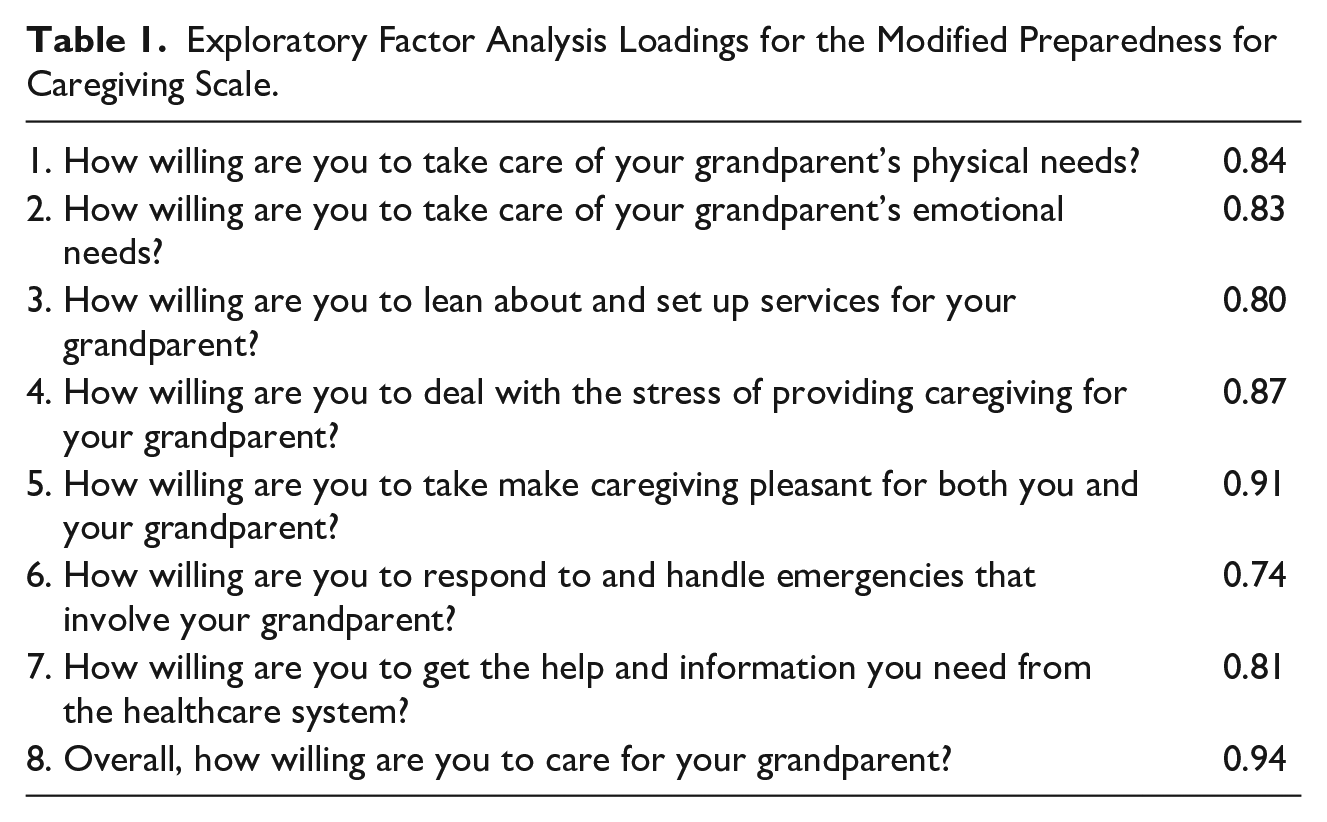
Because the wording of both the scale items and the response format were modified slightly in this study, the eight items that comprise this scale were subjected to an exploratory maximum likelihood factor analysis with oblique rotation. The results (see Table 1) indicated that all eight items loaded on a single factor that accounted for 74.50% of the variance (eigenvalue = 5.96). Thus, SPSS did not reveal a rotated factor solution. The Kaiser–Meyer–Olkin measure of sampling adequacy was .94 and the Bartlett’s test of sphericity was significant, χ2 (28) = 1,553.60, p < .001, indicating that the sample size was adequate to conduct an exploratory factor analysis. Hudson and Hayman-White (2006) reported a reliability coefficient of .93 for this scale. In the present investigation, the Cronbach’s alpha was .95 (M = 26.10, SD = 7.19).
Exploratory Factor Analysis Loadings for the Modified Preparedness for Caregiving Scale.
Data Analyses
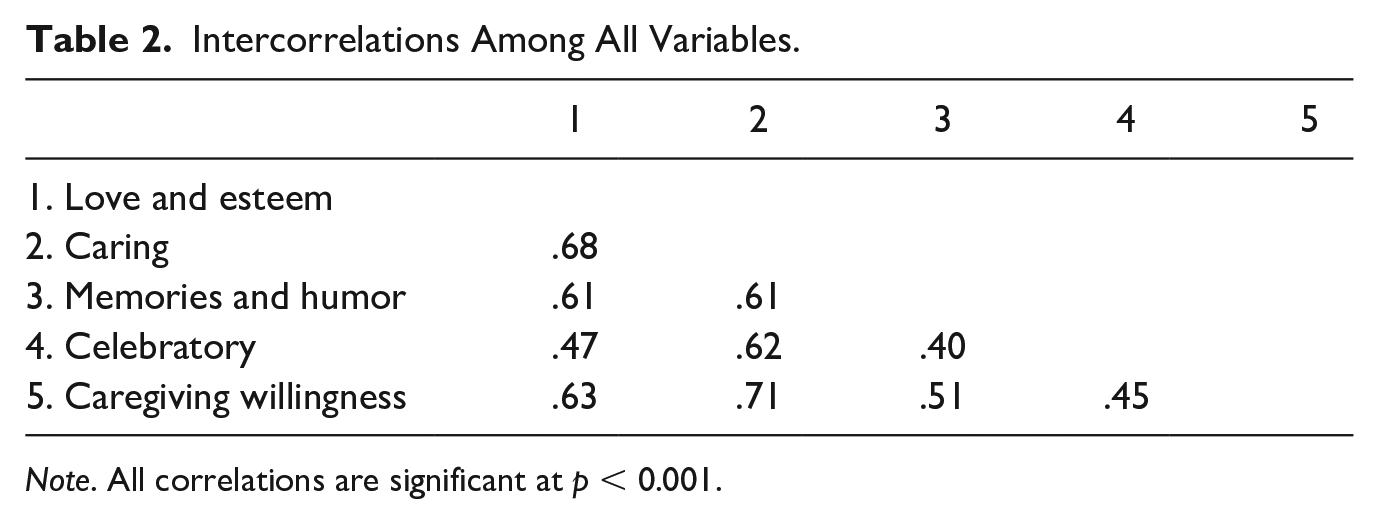
Prior to testing the hypothesis, the intercorrelations among all variables were examined to determine if all four types of affection (i.e., love and esteem, caring, memories and humor, and celebratory) were significantly related to grandchildren’s willingness to serve as caregivers for their grandparents. As indicated in Table 2, all intercorrelations were positive and significant at p < .001. Thus, a multiple regression was performed to test the hypothesis. Willingness to serve as caregiver was entered as the dependent variable and the four types of affection were entered as independent variables. Given the moderately strong correlations among the four types of affection (Mean r = .58), the variance inflation factors (VIF) and tolerance statistics (TS) were assessed to examine the possibility of multicollinearity among the independent variables. The lowest TS was .85 and the highest VIF was 1.18; it was concluded that multicollinearity was not a concern in this study (Garson, 2012).
Intercorrelations Among All Variables.
Note. All correlations are significant at p < 0.001.
Results
The hypothesis, which was partially supported, posited that grandchildren’s received affection from their grandparents would be related positively to grandchildren’s willingness to serve as future caregivers for their grandparents. The multiple regression analysis yielded an overall significant model, adjusted R2 = .54, F (4,200) = 59.87, p < .001. The individual beta weights indicated that love and esteem (β = .23, p < .001) and caring (β = .51, p < .001), unlike memories and humor (β = .06, p = .37) and celebratory affection (β = .01, p = .95), emerged as significant predictors of grandchildren’s willingness to serve as caregivers for their grandparents.
Discussion
America is an aging nation, which is believed to affect both family life and the healthcare system (Ortman et al., 2014), making family caregiving an important demographic and economic issue (Edwards & Noller, 1998). Based on these ideas, the current study sought to examine the relationship between grandchildren’s received grandparental affection and the grandchildren’s willingness to serve as future caregivers for their grandparents. Results of a multiple regression provided partial support for the hypothesis, in that only love and esteem and caring affection were significantly associated with grandchildren’s willingness to serve as future caregivers for their grandparents, whereas neither memories nor humor and celebratory affection emerged as significant predictors. These findings are indicative of both practical and theoretical implications.
In terms of practical implications, grandparents who desire to be cared for by their grandchildren in the future should emphasize caring affection and, to a lesser degree, love and esteem affection as they accounted for 33.64% and 5.06% of the variance, respectively. Of particular importance is the omnibus effect of caring affection. This finding corroborates previous GP–GC studies in which grandparental caring affection has been most closely associated with grandchildren’s reports of GP–GC relational characteristics (i.e., commitment, communication satisfaction, control mutuality, liking, relational satisfaction, and trust; Mansson, 2013a, 2013c) along with grandchildren’s shared GP–GC family identity, perceived availability of grandparental social support (Mansson et al., 2017), and grandchildren’s use of advice, conflict management, shared tasks, and positivity relational maintenance behaviors with their grandparents(Mansson, 2014b). Specific grandparent caring behaviors include asking grandchildren how things are going, how they are doing, and about their lives in general along with listening and paying attention to grandchildren when they talk (Mansson, 2013c).
However, grandparents’ expressed affection for their grandchildren is not only important prior to initiating a caregiving relationship, as noted earlier, family caregiving is taxing and may result in both psychological and physiological strains on the caregivers (Vitaliano et al., 2003; Zarit, 2006). Therefore, grandparents should continue to be affectionate toward their caregiving grandchildren during the caregiving process as doing so may buffer the negative effects of caregiving experienced by many family caregivers.
The nonsignificant effects of grandparents’ memories and humor and celebratory affection on grandchildren’s willingness to serve as future caregivers for their grandparents are initially counterintuitive. However, extant literature provides two possible, related explanations. First, according to grandchildren, ideal grandparents are affectionate (Kennedy, 1990), but it does not appear to be adequate for grandparents to only express affection in the form of memories and humor and celebratory behaviors in order to be cared for by their grandchildren. Thus, given the importance of caring affection in this, and previous investigations, it is possible that non-caring grandparents are perceived as non-affectionate (or less favorably) by their grandchildren. These ideas suggest that the old saying “actions speak louder than words” applies to the GP–GC relationship. As stated by Fern (2013, para. 1): “Some feelings cannot be expressed in mere words; they require actions to speak for them. Words are cheap . . . [and people] . . . will not feel the immensity of these emotions until they are acted upon.”
Second, grandchildren expect their grandparents to be generous (Karofsky, 2005) by giving their grandchildren gifts and money; grandchildren also believe they have a responsibility to listen to their grandparents’ stories (Kennedy, 1990), which reflect both celebratory and memories and humor affection (Mansson, 2013c). As such, these two types of grandparental affection may simply be assumed by grandchildren in order to fulfill GP–GC role expectations. Moreover, grandchildren generally agree that one of their responsibilities is, indeed, to care for and assist their grandparents (Kennedy, 1990). Consequently, it is possible that some grandchildren are willing to care for their grandparents due to social and familial expectations, regardless of received grandparental celebratory and memories and humor affection, which are expected, resulting in these types of affection not emerging as significant predictors in this study.
In terms of theoretical implications, the results obtained in the current investigation suggest that AET (Floyd, 2006) is suitable for continued intergenerational family caregiving studies that emphasize the effects of affectionate communication. However, when examining grandchildren’s “willingness” to serve as future caregivers for their grandparents, a more complex theoretical model should be tested in which grandchildren’s perceived caregiving preparedness and efficacy, along with their financial status, time availability, and ability to cope with stressful situations are assessed as moderating variables because these factors influence people’s decisions to care for their older family members as described in the review of literature. As such, the role of communication in intergenerational family caregiving relationships is a fruitful and timely area worthy of continued examinations. The following sections provide suggestions for such studies.
Although this study started the process of understanding how affectionate communication in ongoing GP–GC relationships influences grandchildren’s willingness to serve as future caregivers for their aging grandparents, it is constrained by two limitations. First, grandchildren’s perceived caregiving preparedness and efficacy were not assessed in this study. These two caregiver factors have proven important in previous family caregiving relationships and may therefore influence grandchildren’s willingness to serve as future caregivers for their grandparents, regardless of received grandparental affection (Archbold et al., 1990; Freytag & Rauscher, 2017). Simply put, grandchildren who would like to care for their grandparents may be reluctant to do so if they doubt their caregiving abilities. Thus, researchers should test a moderated model in which grandchildren’s perceived caregiving preparedness and efficacy moderate the relationships between received grandparental affection and grandchildren’s willingness to care for their aging grandparents.
Second, the grandchildren’s current (and perceived future) financial statuses, time-availability, stress, and other psychological health indicators were not assessed in this study. Family caregiving is a time-consuming process (Lin & Lu, 2005; van den Berg & Spauwen, 2006), which often results in caregiver loss of income and out-of-pocket expenses (Schulz & Eden, 2016). Similarly, many college students experience a series of school-related stressors (e.g., financial, mental health) that are directly related to college students’ limited time (Houston, 1971; Ross et al., 1999), which may affect not only their willingness but also their ability to care for their grandparents, independent of their received grandparental affection.
Until the beginning of the twenty-first century, the GP–GC relationship had received scant attention by communication scholars. Since then, however, scholars have made substantial strides toward a more comprehensive understanding of GP–GC communication processes and patterns with an emphasis on immediate relational outcomes. The current investigation is the first in which a future, practical outcome related to communication in ongoing GP–GC relationships has been examined, namely grandchildren’s willingness to serve as future caregivers for their aging grandparents as a function of received grandparental affection. Considering that the proportion of people who are above 65 years of age is growing significantly faster than do other age groups, which affects both family life and the healthcare system (Ortman et al., 2014), this timely study not only advances our insight into this unique, affectionate, and mutually beneficial relationship, it also is indicative of both practical and theoretical implications that are in need of continued research endeavors.
Footnotes
Declaration of Conflicting Interests
The author declared no potential conflicts of interest with respect to the research, authorship, and/or publication of this article.
Funding
The author received no financial support for the research, authorship, and/or publication of this article.
